Categories
Musings of a Copywriter

‘Is this a Dagger I see…?’

By Devraj Singh Kalsi

Although I do not think I have the potential to write a controversial book that ends up hurting or offending the sentiments of readers or non-readers in any part of the world, the recent episode of a violent attack on an internationally acclaimed author has brought about a fundamental change. Now, I spend more time pondering over novel attacks and how to protect myself and my vital organs from fundamentalists and other hardliners stepping across the line to seek revenge and make the ground beneath my feet disappear. I do not dismiss the possibility of being attacked or hounded by a crazy fellow who does not like the colour of my skin or my hair or the aquiline shape of my nose or simply finds the entire set of features not aligned with his sensibilities. As a small-time writer who cannot afford a full-time, fully armed bodyguard shadowing me wherever I go, I must find other cost-effective ways to keep my creative head safe from bullets and pellets. 

Whenever I go out for a walk during the day, I should wear a helmet even if pedestrians find it weird. I do not need to explain to them the hazardous profession I am part of, riskier even than that of a mining engineer. There are many themes and plots for stories and novels brewing in the cerebral pot, so I cannot risk a fatal hit. A broken leg can assure me of recovery, but a cracked-up skull will end my writing career before it could take flight. Some years ago, I remember being hit on my head by a super charged cricket ball that came at top speed. Just after this episode, my writing speed has suffered, and I suspect the neurological wiring suffered some irreversible damage.  

As a precautionary move, I should also put an end to my flirtatious tendencies since the possibility of being attacked by a jealous lover haunts me these days. Attending marriage ceremonies, getting close to the bride, and wasting no time to put my hands around her slender waist for a joint photograph by edging out her obese husband from the frame is a risky act indeed. As waiters keep moving around with trays loaded with forks and knives, the offended husband could pick up a sharp one and jab one at me while hurling the most abusive words I fear to use for wily characters in my prose. Having identified this area of darkness, I should throw more light on my behavioural pattern and avoid building a huge female fan following that activates life-threatening impulses in men. 

As a writer, my attempt should be to hammer harsh truths. But the sight of labourers and carpenters working with hammers and other heavy tools induces fear of another kind. Whenever I find myself close to such working class people, I feel an unexplained fear that the bitter truths have stopped flowing from my pen, and this has not gone down well with them. One of them running after me with a hammer to silence my voice, generates a fear that compels me to think of the need to get closer to the realities of life instead of being an escapist. I fail to convince them that the need to offer relief is far greater than reminding them of the depressing truths all the time.

Humour in my writing could also be the potential reason for disaster to strike me. This entertaining streak possibly offends some people who do not like a writer to be an entertainer but an eye opener. Cordoning myself from such a mindset is not easy. In the park, in the subway or in the market, such offended folks keep lurking and stalking. The scissors and blades at the barber’s shop generate a rising sense of fear as the most unlikely source of danger often shocks and silences you. The truth behind losing an eye[1] is an eye-opener in many ways and makes a lily-livered writer like me extra cautious when it relates to scribbling thoughts and ideas on the page. 

Signing book copies and then being surrounded by a guy holding a knife near the throat is a scary possibility that has made me stay away from book launches forever. Losing the scope to interact with readers to build new bonds comes with the high risk of losing my bond with life. I do not know the reason why such a thing should happen to me, but the dire consequences of such a deadly attack compels me to stay away from the limelight and keep writing in anonymity. 

My voracious appetite for humour could also provoke a person to serve me a lethal delight. The food delivery app guy who presses the doorbell and offers me a food packet with poisoned foodstuffs comes prepared to seek revenge for my attempt at making fun of food in my writing, calling it a violent act of mastication. As I imagine retribution, I should stop my writing contribution or funnel my sentiments through a different outlet. Survival of writers has always been challenging, but now it goes beyond the financial domain and includes his right to life.  

More bubbles up my mind. An acid attack or any such violent attack truncates the life of a writer. Though the writer kills characters the way he likes, he does not know his end. Sitting in a café could bring on his sudden end as a biker enters and fires at point-blank range and leaves behind a note of apology.

My crime of poking fun and being satirical might trigger the dangerous sentiment. The offended fellow for whom life is no fun finds such humour unacceptable. And the writer must meet his end for making fun of his situation, for not focusing on serious issues, for the unlisted crime of offering light reads of little or no worth or value to readers who seek literary merit in words. Not being an ideal writer could be the reason for my premature end, with dollops of humour dying along with me. 

[1] Salman Rushdie lost an eye in 2022: https://www.bbc.com/news/entertainment-arts-68739586#

Devraj Singh Kalsi works as a senior copywriter in Kolkata. His short stories and essays have been published in Deccan Herald, Tehelka, Kitaab, Earthen Lamp Journal, Assam Tribune, and The Statesman. Pal Motors is his first novel.  


PLEASE NOTE: ARTICLES CAN ONLY BE REPRODUCED IN OTHER SITES WITH DUE ACKNOWLEDGEMENT TO BORDERLESS JOURNAL

Click here to access the Borderless anthology, Monalisa No Longer Smiles

Click here to access Monalisa No Longer Smiles on Kindle Amazon International
Categories
Poetry

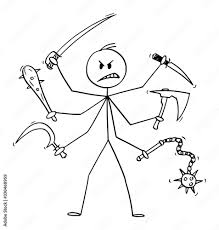
Try Your Brakes

Poetry and Photography by Rhys Hughes

TRY YOUR BRAKES

Try your brakes!
After they have been arrested
for squeaking
you should prosecute them in
court: don’t fret
that you might be thought haughty
or vindictive.
Justice must be done.

The brakes deserve it.
They never gripped the wheel rims
smoothly: they always
screamed for more oil
while you toiled
to keep your balance downhill.

Cats on the path were startled
by the sound. You even found
that pedestrians
jumped in fright
when you attempted to reduce
your speed on slopes.
One hopes they soon recovered.

But enough is enough.
You ought to take
the smooth with the rough.
So wheel your bicycle
into the hallowed halls
where the judge awaits
in an itchy wig
and barristers fan themselves
with cryptic legal documents
as if they meant
to blow themselves away.

The frame of the bicycle
is not on trial
and in a while you will hear
how the wheels
are innocent too: they should
be held dear by you.
But the brakes are scoundrels
through and through!

Try your brakes!
Find them guilty, you are the jury.
Mitigating circumstances
like damsels in romances
dance deceptively
and will put you in a trance.
Heed them not!

Your brakes belong in jail
before they fail
completely and propel you
into me. Hurry!
Try your brakes today.

Rhys Hughes has lived in many countries. He graduated as an engineer but currently works as a tutor of mathematics. Since his first book was published in 1995 he has had fifty other books published and his work has been translated into ten languages.

.

PLEASE NOTE: ARTICLES CAN ONLY BE REPRODUCED IN OTHER SITES WITH DUE ACKNOWLEDGEMENT TO BORDERLESS JOURNAL

Click here to access the Borderless anthology, Monalisa No Longer Smiles

Click here to access Monalisa No Longer Smiles on Kindle Amazon International

Categories
Notes from Japan

A Golden Memory of Green Day in Japan

By Suzanne Kamata

At the end of April and the beginning of May, several Japanese holidays fall close together. This special time of year is called Golden Week. Often, a few work/school days fall between the holidays, however many people take advantage of the break and travel. I have a hard time remembering which days are which holidays, however I do remember that one of them is Midori-no-hi, or Green Day (which falls on the Showa Emperor’s birthday, May 4).

Not long after I graduated from college, I came to Japan to work as an assistant English teacher. I was assigned to a high school in Naruto, a city in Shikoku, southeast of Osaka, noted for its tasty seaweed and huge, natural whirlpools.

The principal of the high school was very friendly and often invited me to drink tea and chat with him, so I was none too surprised when he called me to his office one April afternoon. This, however, wouldn’t turn out to be a typical encounter.

The principal began to tell me about the annual Midori-no-hi (Green Day) ceremony. Each year, it’s held in a different prefecture, and that year it was Tokushima’s turn. The Emperor and Empress are always in attendance. Only a select group of people would be invited to attend the proceedings, the principal told me, and I had been chosen to participate.

How could I refuse? I imagined meeting the Emperor and Empress and telling them about my hometown in America. Maybe we’d sip green tea together from the locally-crafted pottery cups.

A full rehearsal was scheduled a couple of weeks in advance of the actual event. I boarded a bus at 5 a.m. along with a group of high school band members who would be performing during the ceremony.

As we approached the park settled in the mountains of Tokushima, I noticed that the formerly rough road had been paved. The roadside was lined with marigolds which had been freshly planted in anticipation of the imperial couple’s visit.

At the park, we all practiced our separate parts. Mine would be quite simple. Two other young women — a Brazilian of Japanese descent and an Australian who’d just arrived in the country — and I would be escorted to a spot in front of the Emperor and Empress. We would then bow, accept a sapling from the governor, and plant it in the ground with the help of boy scouts.

As the Emperor would be there and the entire ceremony would be broadcast on national television, everything had to be perfect. We practiced bowing many times with our backs straight and our hands primly layered.

Finally, Midori-no-hi arrived. The day was cloudy and occasional rain drops spotted my silk dress. Everyone hoped that the weather would not ruin the proceedings.

Marching bands, an orchestra, and a choir made up of students from various local high schools and colleges filled the morning with music. Instead of the sun, we had the bright brass of trombones, trumpets and cymbals.

Modern dancers in green leotards enacted the growth of trees. Later, expatriate children from Canada, France, Peru and other countries announced “I love green” in their native languages. This was followed by the release of hundreds of red, blue and yellow balloons into the grey sky. A hillside of aging local dignitaries were on hand to view the pageantry.

About mid-way through the ceremony, the Emperor and Empress arrived. They followed the red carpet laid out to the specially-constructed wooden dais, the Empress a few steps behind her husband as protocol demanded, to “Pomp and Circumstance”. The rustle of Japanese flags waved enthusiastically in the air threatened to drown out the orchestra.

After many solemn addresses and much bowing, the Emperor and Empress stepped down to “plant” trees. His Highness pushed some dirt around the base of a cedar sapling with a wooden hoe. His pink-suited consort did the same while balancing on high heels. The placement of the trees was only for show. Later, everything would be transplanted to a more suitable location.

At last, it was my turn. The other young women and I were led to the grass stage to the accompaniment of a harpist. I accepted my tree and buried its roots in the ground. The tree was a sudachi, which bears small green citrus fruit and is the official tree of Tokushima Prefecture.

The music and majesty of the occasion made me feel like I was doing something important on Earth. I was adding to the verdure of the world, enabling Nature. I felt a sense of awe.

When all of us were finished planting, we bowed in unison to the Emperor and Empress, then filed off the field. Afterwards, there was a mass-gardening session as all of the attendants on the hillside began planting prepared saplings.

I didn’t get to meet the royal couple after all. Although they passed by within a few meters of where I was standing, there were no handshakes, no pleasantries, not even any eye contact.

What I did get was a big bag of souvenirs — a cap, a small wooden folding chair, commemorative stamps, a flag, sudachi juice, and a book of photos so that I could always remember that misty day, that baby tree.

Suzanne Kamata was born and raised in Grand Haven, Michigan. She now lives in Japan with her husband and two children. Her short stories, essays, articles and book reviews have appeared in over 100 publications. Her work has been nominated for the Pushcart Prize five times, and received a Special Mention in 2006. She is also a two-time winner of the All Nippon Airways/Wingspan Fiction Contest, winner of the Paris Book Festival, and winner of a SCBWI Magazine Merit Award.

PLEASE NOTE: ARTICLES CAN ONLY BE REPRODUCED IN OTHER SITES WITH DUE ACKNOWLEDGEMENT TO BORDERLESS JOURNAL

Click here to access the Borderless anthology, Monalisa No Longer Smiles

Click here to access Monalisa No Longer Smiles on Amazon International

Categories
Poetry

Poems by George Freek

THE HAWK IN THE MOONLIGHT

I stare at the dying sunlight.
When that passes, stars
will light the night,
but sleep won’t come.
My wife is gone.
My children are grown.
The story is very old.
I watch darkness closing in alone.
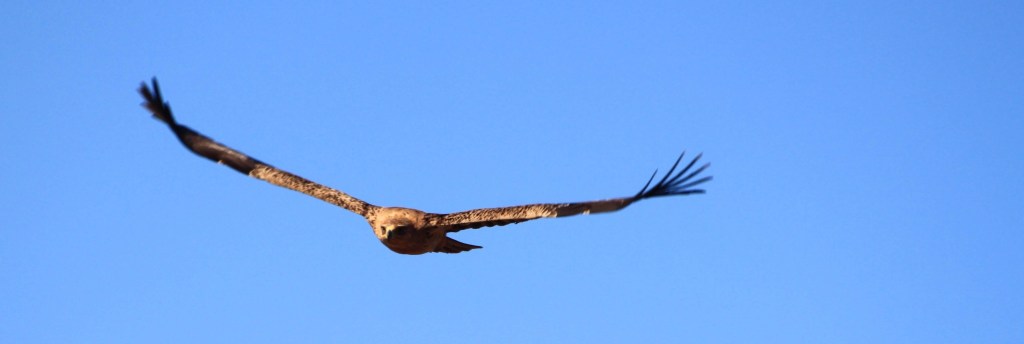
A hawk slowly circles
over the sluggish river.
The moon has vanished.
It’s unable to light my way.
That hawk is my only companion,
and I won’t be unhappy,
if he doesn’t stay.


AS IT IS IN OCTOBER

As autumn arrives,
dressed in somber gray
like an expectant mortician
the flowers die.
Where squirrels scurry
to gather a few remaining nuts,
leaves fall to their rest
in yellow, red and brown
on the cold ground
without a sound.
The moon’s silver light
clings to the trees,
then fades into eternity.
If I look at the stars,
I barely see them,
and they never look back at me.

George Freek’s poetry has recently appeared in The Ottawa Arts Review, Acumen, The Lake, The Whimsical Poet, Triggerfish and Torrid Literature.

PLEASE NOTE: ARTICLES CAN ONLY BE REPRODUCED IN OTHER SITES WITH DUE ACKNOWLEDGEMENT TO BORDERLESS JOURNAL

Click here to access the Borderless anthology, Monalisa No Longer Smiles

Click here to access Monalisa No Longer Smiles on Amazon International

Categories
Stories

Pier Paolo’s Idyll

By Paul Mirabile

In order to build a new low-cost residential complex twenty kilometres to the West of Rome, hundreds of hectares of low-lying hills, orchards, several depopulated hamlets and unplanted vineyards had been cleared by an army of bulldozers, cranes and cheap labour with picks and shovels. In the 1960s, housing construction in Italy had mushroomed out in an erratic, rampaging spectacle beyond any public or private circumspection.

Pier Paolo and his middle-aged mother benefitted from one of these new, but hastily built residential flats on the tenth floor of a fifteen-storey tower. His father had abandoned the family four or five years ago, forcing the boy’s mother to work as a seamstress for the hundreds of residents of their tower. He himself had dropped out of school to work at a nearby wine factory in the industrial zone. Their meagre incomes paid the rent, permitted them to eat two or three meals a day and dress decently.

Everyday, Pier Paolo shuffled lazily to the factory at eight o’clock. To reach the small factory, he crossed an immense horizonless, treeless esplanade paved in the most banal ugly grey paving stones. What caught his attention, however, was a low rising stretch of grassy dirt mounds which ran for a lengthy distance along a high, barbed wire metal barrier which separated the dirt mounds from a rocky embankment leading downwards to a newly build avenue. These low dirt knolls, according to the season, blushed a poppy spring red, a leafy, autumnal brown, a wintry white then a lush, verdant green in the summer. On his off days, he would walk through the low hillocks from one point to the other. They covered an area of about twenty-five metres by ten metres. His constant crossings in this forgotten pile of dirt had traced footpaths in and around the knolls, the low bushes and over broken roots.

Pier Paolo enjoyed these pleasant promenades. Below, on one side, buzzed speeding vehicles. On the other, lay the empty, treeless esplanade where hardly a soul appeared, save a few workers, housewives pushing carts of food, flowers or trinkets to be sold in the neighbourhood market, one or two old school comrades and stray dogs. It was at that particular movement of contemplation that Pier Paolo experienced a tinge of excitement, a mounting commotion that would endorse and embolden his existence, would prompt his escape from the boring walls of a suffocating flat, the ugly concrete and metal of their block residence …

Returning from the factory one afternoon at the beginning of June, Pier Paolo walked briskly over the range of shaggy mounds of piled up dirt for an hour or so before finally deciding  upon a spot that would suit his adventure nicely. Hidden from the eyes of those who crossed the esplanade, a small concavity in the rim of a grassy hillock would afford him a place to sleep. He only needed to erect a make-shift lean-to, not to protect him from the rain — during the spring and summer months it never rained — but from the scorching heat. Yes, Pier Paolo resolved to live with nature on this diminutive tract of earth that had miraculously survived the building contractors’ bulldozers and cranes.

He hastened home to his mother who was busy sowing a marriage dress for her second storey neighbour. Pier Paolo excitedly explained his adventure. It would last through not only for the summer months, but also through autumn before the heavy rains set in. She listened passively, her mouth agape. Had her son gone completely daft? No, he appeared quite normal, even serious. He would rise with the rising sun, have his breakfast at the café near the factory, lunch at the factory canteen, and as to diner he would buy deli meats, olives, cheese and bread at the grocer’s.

“Why not eat diner here with me?” his mother suggested in her soft, meek voice.

“Of course I’ll eat with you mummy, but only on weekends. I must live permanently in my new environment. I’m eighteen year’s old, and it will be an adventure to sleep out in such primitive and natural surroundings without neighbours’ screaming and shouting, loud parties until four in the morning, lifts breaking down all the time. I want to breathe fresh air, if that is all possible in this godforsaken dump.”

His mother flushed at these last words, but held her tongue, astonished at her son’s resolution. “You see mummy, I want to look up at the stars and not at the cracks in the ceiling of my room.” His mother nodded her head, thimble on her thumb, needle and thread between her index and middle finger. He was right, there were many cracks and fissures in the ceilings and walls of their ‘new’ flat ! Well, he did show ingenuity and imagination. He wouldn’t take no for an answer, and besides, he wouldn’t be far from home …

So Pier Paolo packed a few belongings in his back-pack, rolled up his sleeping bag, kissed his mother on her wrinkled forehead and strolled to his ‘earthy paradise’ as he facetiously called his up-coming ‘residence’.

The first two weeks Pier Paolo did eat with his mother on Sundays and also gave her his clothes to be washed, cleaned and dried, made ready for work on the morrow. However, the following weekends he did his own washing at the launderette for a few lira, and ate sandwiches at his hilly home instead of with his mother. It certainly was not out of anything against her. He loved her very much. But Pier Paolo wished to be on his very own, especially on his off days and at night, lying on his sleeping bag outside the lean-to, observing the stars and the moon as they moved slowly across the universe. Up till then, no one had disturbed him. A stray dog did sniff about his installation on several occasions, but the animal seemed friendly, and Pier Paolo threw it some slices of salami and pepperoni. The only other ‘visitors’ to his comfortable solitude were the sparrows who gayly pecked at the crumbs of bread that he scattered for them just below his shelter.

Oh how after a hard day’s work at the factory he relished those calm, starry evenings, the light whir of vehicles below beyond the barbed-wire barrier, the absolute silence of the esplanade behind him! He really felt quite at home amongst the natural elements; the ants building their ant-hills, the bees doing their dance amidst the honeysuckles, the birds chirping in and out of the bushes. The poppies and daisies were in bloom, too. Alas, many of the grassy knolls and thorny footways had been littered with coke bottles and caps, beer cans or liquor bottles, yellowed magazine and newspaper pages, cigarette studs, all thrown there by returning workers from the industrial area or gangs of drunken adolescents. Pier Paolo, struggling through the prickly weeds, would clean the mess the best he could, but invariably the same lot or other litter-louts would fling whatever trash they had into his ‘paradise’ as if it were a huge rubbish bin. Did these individuals know that Pier Paolo had taken up residence in those piles of grassy mounds? Even if they did, nothing would have prevented them from tossing whatever they had into it, accompanied by drunken guffaws and mindless giggles.

The sea must not have been far off, or so he imagined. For at times he heard the whir of a winged seagull. He stood to catch sight of it, but only the blurry orange glow of the high rising tower lights far off at the end of the esplanade marked the sky. The towers resembled so many indistinct parapets of flickering light-bulbs which loomed ominously at the end of the soundless esplanade. That vastness of ugly emptiness had always frightened him, and at those times he would turn his back to this sinister, featureless urban landscape and dwell upon the images of faraway scenes that crossed his imagination. No, those electric lights would not chase away his stars …

One star-filled night, he envisaged pink and amber sands of a horizonless desert whose barkans[1] and chots[2] left him breathless; the heat of the sands made him sweat under the blazing hot sun in an azure sky of pure, unpolluted, untainted opal. In another vision, he pictured himself deep in a chain of snow-clad crested mountains, trekking with difficulty over ribbed glaciers and ice-laden passes, the blues of the mountains inviting him to penetrate ever deeper so as to discover the arcane entrance to the subterranean kingdom of the King of the World.

Pier Paolo’s imagination soared to new heights night after night following a hard day’s work. It were as if he had mounted a magic carpet which floated under rainbows, over wide forests and turquoise seas. These fantastic images slid him slowly into a deep, healthy sleep. He awoke refreshed and vigorous, ready for a hearty breakfast at the café and work. In fact, he had never worked as hard as he did now, loading the train cars with heavy cartons of wine, working rapidly at the conveyor belt packaging wine bottles.

Many of the workers admired the young Pier Paolo for his renewed energy, his replenished stamina and spirit. At the sound of the whistle, he showered, bought some prosciutto, pepperoni, provolone, olives, pistachios and bread from the grocer’s, then returned merrily to his shaggy-mounded home. His muscles ached, but gradually relaxed when the stars began to pop out forming clusters of scintillating comfort …

He saw himself on the Niger River somewhere in Mali, drifting in a canoe on the slow moving current, wild geese cackling on the wing, hippopotami bellowing and rumbling in the deep waters, camels grunting from the arid sand-filled shores. He drifted and drifted as the heat bore heavily upon him, lying upon sacks of corn, munching on dates, tomatoes and boiled fish …

A sudden barking! It was the stray dog. Pier Paolo shook himself out of his dreamy stupor, threw the poor scraggy creature a slice of pepperoni, then closed his weary eyes and slept soundly. Darkness crept over the hilly mounds, mantling their denizen in another tranquil night of peaceful repose.

Oddly enough, after having devoured the slice of pepperoni, the dog never returned to visit our grassy-mounded denizen. He had other visitors, however — a motley lot of out-of-schoolers who seemingly scented the presence of someone living amidst the abandoned lot, and who endeavoured to confirm it. It was a Saturday afternoon. Pier Paolo was busy reading an interesting detective story when suddenly he found himself encircled by three ragamuffin boys and two very buxom girls! They all sized him up, noses in the air as if sniffing the warm breeze of a July day.

“Who are you mate?” a skinny boy questioned with overt contempt. He appeared to be the ‘chief’ of the pack. Pier Paolo stood up. He was much taller than any of them and more broad-shouldered. The others held their ground, but one or two scraped the dirt with their worn-out shoes, biting their lips.

“I’m the king of these mounds. What of it?”

“The king?” guffawed the skinny chap out of the corner of his distorted mouth.

“Yea, the king,” repeated Pier Paolo, heightening his voice with an added tinge of condescension.

“Very well, king. Then what if we were to dethrone you and turn your monarchy into a democratic state?” The others sniggered at this show of rhetoric, albeit hesitantly.

“Go ahead, Mister Democrat!” responded the monarch, tightening his fists, smiling through clenched teeth. No one moved. The warm breeze made the democrats sway in their fixed positions like a herd of paper tigers.

“Ah, let it go,” interrupted one of the girls. “Let him rule over his trash-filled kingdom.” And she turned to leave, followed shortly by the other girl then the three boys, who exchanged menacing glances with Pier Paolo. The ‘chief’ bowed in affected reverence to the ‘king’ and mumbled something unintelligible. When they had reached the esplanade, Pier Paolo scoffed at this unexpected intrusion, crawled under his lean-to and went back to his afternoon reading …

The August heat dried all the perfumed poppies and dainty daisies that Pier Paolo had planted around his lean-to. The heat had become unbearable, driving through the palm-leaf roof of his make-shift shelter. It was holiday for most of the workers at the wine factory, but Pier Paolo volunteered to work the whole month, not only for higher wages, but for showering and the afternoon hot meals. He did visit his mom every now and then, but was living mostly on deli meats, olives, cheese, fruit and bread. Because of the heat, he showered every day and took his clothes to the launderette every two days. It’s true that this kind of a diet began to bore him, however, his solitary refuge had really become his royal paradise!

Every Saturday and Sunday, he roamed through his ‘kingdom’ searching the nooks and crannies for unusual objects: a broken tombstone dating from the seventeenth century judging from the Latin inscription, a yellow-paged book of verses by a poet unknown to him, several of which he managed to read but hardly understood. He discovered a rusted compass and magnifying-glass, half-buried in one of the weedy mounds. In a riot of dead roots he rummaged out a photo of a young girl dressed as if to go to church, all in white with a huge black crêpe de chine hat. He collected these treasures and put them in a box for safe-keeping. They represented objects reminiscent of some by-gone era.

One day he stumbled upon a huge footprint, much bigger than any print he had ever seen.

“A dinosaur?” he thought excitedly.

He scoured the knolls for any dinosaur bones but found none. Where did that enormous footprint come from? Pier Paolo grew somewhat apprehensive. His kingdom indeed enclosed a myriad mysteries. And this one drew him further before the advent of humankind …or so he thought.

One fine sunny morning, the black dog he had fed, suddenly appeared with a huge bone in its mouth. Pier Paolo threw it a few slices of salami he had been munching on but the dog shook its shaggy head and plodded off behind a knoll. He raised a quizzical eyebrow. Did the dog not like salami? Perhaps that bone was a dinosaur bone. He shrugged his shoulders sniffing the hot air.

During the month of August he hardly visited his mother. He hardly spoke to his colleagues at the factory. They eyed him nervously. The boy seemed so estranged, aloof with a distant look in his eyes. He would look straight through you and beyond, somewhere far, far away. His gait too had slackened. This being said, he carried out his tasks as usual.

He let his hair grow long, dishevelled. He grew a wispy beard, uncombed. His clothes, although clean, hung on him like a bag, and a bit bedraggled to boot as if he had slept in them. Which he always did, needless to say. All he yearned for was to return to his solitary retreat in the evening, lie down and stare at the emerging stars. They drew him upwards and outwards. The sun having set, the heat ceased to vex him. The crickets discontinued their August chorus. Other sounds, alien, rose to a high pitch in his head…the tinkling of camel bells across the sandy wavelets of the Gobi or the Sahara deserts. There he was again, riding atop a camel, a white, gleaming, silken turban wound about his head, his body protected by a satin djellaba. He had sailed the high seas for many moons before disembarking in this ocean of ergs[3] whose vibrant colours made his eyes squint. The cleanliness of such an expanse delighted him, such a contrast to the concrete ugliness and filth of all those horrid towers! As the ship disappeared over the rim of the watery horizon, he stood between the vastness of the desert and the sea, the first in front of him, the second behind, ready to penetrate unknown territories. Above, a translucent blue sky. The camels plodded onwards; a sudden crispy sound alerted him to a change in the landscape, the camels’ hooves now trudged over stetches of slaty black sands that the dried lava of a volcano eruption had deposited thousands and thousands of years ago. The camels trudged and trudged ; the crusty slaty sands crunched and crunched until Pier Paolo fell asleep …

Pier Paolo, after five weeks of not visiting his mother, spent a Sunday with her. So happy was she to see her son that the cheerful woman cooked him his favourite dish: eggplant parmigiana. She bought him the best provolone and caciocavallocheeses that she could afford, and served him a vintage Chianti wine. As a special treat for dessert, she fried him Sicilian sfince[4]. How he wolfed those delicious delicacies down! Pier Paolo hadn’t eaten such sweets for over three months. He had become so thin, his long hair and beard framed an emaciated face, whose bulging eyes bore a wild look. Yet he remained very polite, mild-mannered, even tender towards his loving mother throughout the afternoon. When he closed the door behind him, she held back her tears. Would she hold them back when his final hour came?

It was a warm September afternoon, 1975. Next to his lean-to, Pier Paolo sat reading a novel by Alberto Moravia, ‘Gli Indifferenti’[5], the 1929 edition. He sniffed the cool autumn air, admired the pleasant scents of the poppies and honeysuckles around which the bees were busily buzzing. From behind the mounds, he heard a few vehicles screech to a halt, followed by many coarse voices. The boy stood, walked over the mounds and noticed five or six men in ties and two policemen staring up at him. A big fat man, probably a building contractor by the look of his clothes, waved to him to come down. With overt disdain, he turned and returned to his novel. Shortly after, though, he found himself surrounded by these intruders to his privacy. He stood, miffed to the marrow!

“You’re trespassing, sirs. And encroaching on my afternoon reading.” This was stated with calm but obvious scorn. All the men laughed so loud that it brought a series of yowls from the stray dog, who had been observing the scene from atop the knoll where Pier Paolo had built his lean-to. It was showing its teeth, yet uttered not a growl.

“Clear out boy, you’ve had your fun for the summer. The neighbours are complaining about you. Anyway the city is about to level all this and pave it clean.” The fat man certainly gave himself airs, puffing out his chest.

Pier Paolo, with a thin smile, replied wearily: “What neighbours? No neighbour has ever said anything about my being here. They don’t even know I’m here.”

“Listen, don’t muck about with us. I’m telling you to push off or we’ll be forced to drag you off,” the other said in a offensive tone, his face turning a beet-red.

Pier Paolo clenched his fists: “This is my kingdom, fatty. I and only I decide when to leave!”

The dog yowled again. The fat contractor kicked down the lean-to in a spate of anger. Pier Paolo, taken aback by this display of uncalled for violence, lashed out at him with two or three well-placed blows to the face. ‘Fatty’ fell backwards to the ground, spitting out a tooth and much blood.

One of the policemen grasped Pier Paolo by the shoulder ; the young boy showing unusual strength knocked his arm away and struck the policeman’s jaw with his elbow, then continued to strike him in the ribs with a volley of punches. Just then from above, the dog leapt into the crowd barking hysterically. It fell onto one of the men biting into the neck. The dog had gone mad. The other policeman took out his pistol and shot it dead.

Pier Paolo, stunned by the gunshot and the dog lying limp next to his broken lean-to, flew into a rage and attacked the policeman, seething like an animal, gnashing his teeth. He struck blow after blow, uncontrollably. Now the rest of the men pounced on the boy beating him mercilessly to the ground, kicking him in the head. The policeman broke up the beating, handcuffed the half-unconscious Pier Paolo and dragged him off to the police car …

The badly beaten boy was taken to hospital. Upon his release, he was immediately arrested and charged for assault and battery on the two policemen and on two municipal civil servants. At the trial the accused, who had no defence, was sentenced to two years imprisonment and a 50.000 lira fine, which he refused to pay on the grounds that neither he nor his mother could afford such a sum. The judge slapped on another year of imprisonment.

Confined to stare at four concrete walls many hours a day, Pier Paolo gradually slipped out of the reality of his circumstances. He took no food nor spoke to anyone. He merely lay prostrate on his little cell bed like one awaiting death. No more wonderful images of deserts, mountains and seas crossed his benumbed mind.

Death stole upon Pier Paolo in violent spasms on the evening of the second of November, 1975. Apparently, he had starved himself to death.

His lonely mother sewed and sewed, no longer able to retain her tears. No neighbour came to comfort her; no religious authority to commiserate with her grief.

As to Pier Paolo’s kingdom or paradise, on one dreary November day, several bulldozers levelled the shaggy mounds. The area that had been his home now became an extension of the paved esplanade up to the barrier of the embankment.

[1] Crescent-shaped sand dunes.

[2] Large lake-like salt deposits.

[3] Large wavy dunes.

[4] Made of ricotta, unbleached flour and unsalted butter, rolled into balls and fried. When cooled, sugar powder is sprinkled on them. They are generally eaten on Saint Joseph’s day in Sicily.

[5] Translated in English as ‘The Indifferent Ones’ or ‘The Time of Indifference’ by Alberto Moravia(1907-1990)

.

Paul Mirabile is a retired professor of philology now living in France. He has published mostly academic works centred on philology, history, pedagogy and religion. He has also published stories of his travels throughout Asia, where he spent thirty years.

.

PLEASE NOTE: ARTICLES CAN ONLY BE REPRODUCED IN OTHER SITES WITH DUE ACKNOWLEDGEMENT TO BORDERLESS JOURNAL

Click here to access the Borderless anthology, Monalisa No Longer Smiles

Click here to access Monalisa No Longer Smiles on Kindle Amazon International
Categories
Poetry

Sylvan Musings

Poetry by Milan Mondal

THE REVERIE

Two score and ten I passed,
Voicing, save water, air and earth.
Many were indifferent.
A few cared.
Two and two, four and four,
Six and six...
The series goes on
And the cares increased.

As I would step into my three score,
I had a dream…
Wonderful and pleasing.
In awe I saw,
Chirping sparrows…
I heard,
Babbling rivers…
And I felt,
A gentle fresh breeze
In the scorching heat
Like a Zephyr…


THE WOOD NYMPH


I intruded
Into the heart of the forest
To collect frankincense.

The addiction of smuggling
Blinded me,
And I chopped a number of sal trees.

Suddenly a shadow
Beckoned me within.
And I was paralysed.

The shadow slapped me.
And I came out running
With a sapling in my hand.

Milan Mondal’s poems have been included in journals and anthologies of international repute.

Categories
Review

Contemporary Everest Industry as seen by an Explorer

Book review by Bhaskar Parichha

Title: Everest, Inc.The Renegades and Rogues who Built an Industry at the Top of the World 

Author: Will Cockrell

Publisher: Gallery Books/ Simon & Schuster India

This book delves into a unique topic with a unique approach. Will Cockrell’s Everest Inc. The Renegades and Rogues who Built an Industry at the Top of the World explores the intersection of democratisation and commercialisation in the realm of high adventure. Through meticulous research, Cockrell presents a dynamic narrative of the evolution of guided climbing on Mount Everest. The narrative captures the shift of the mountain from a challenging climb to a lucrative business venture. From the pioneering expedition of Hillary and Norgay in 1953, Cockrell traces the journey of various individuals who played a role in making the summit more accessible and profitable.

Cockrell, an award-winning writer and journalist, skillfully delves into the captivating world of mountain climbing. With meticulous research and interviews with guides, sherpas, amateur climbers, and even Hollywood figures, he unveils the fascinating story that led to the rise of this industry. These entrepreneurial adventurers, who once catered to affluent clients, have now become an indispensable part of the lucrative adventure economy, revolutionising our perception of mountain climbing and the majestic peaks themselves. Despite the unfortunate tragedies and the excessive commercialisation that have plagued the mountain in recent years, Cockrell’s narrative remains an inspiring and uplifting tale.

This comprehensive adventure history delves into the world of guided climbing on Mount Everest, featuring exclusive interviews with renowned mountain guides and climbers such as Jimmy Chin and Conrad Anker. It serves as a cautionary tale about the risks of overexposure while also celebrating the enduring allure of this ultimate terrestrial adventure.

Says the blurb: “Anyone who has read Jon Krakauer’s Into Thin Air or has seen a recent photo of climbers standing in line to get to the top of Everest may think they have the mountain pretty well figured out. It’s an extreme landscape where bad weather and incredible altitude can occasionally kill, but more so an overcrowded, trashed-out recreation destination where rich clients pad their egos—and social media feeds—while exploiting local Sherpas.”

“There’s some truth to these clichés, but they’re a sliver of the story. Unlike any book to date, Everest, Inc. gets to the heart of the mountain through the definitive story of its greatest invention: the Himalayan guiding industry. It all began in the 1980s with a few boot-strapping entrepreneurs who paired raw courage and naked ambition with a new style of expedition planning. Many of them are still living and climbing today, and as a result of their astonishing success, ninety percent of the people now on Everest are clients or employees of guided expeditions.”

The book glances at the lives of early guides, victories and setbacks experienced during the industry’s growth, and diverse opinions on the evolution of the guiding industry on Everest. Cockrell interviews prominent figures in the Everest guiding community — ranging from Conrad Anker to the late David Breashears, as well as climbing legends like filmmaker, Jimmy Chin, and outdoor industry leader, Yvonne Chouinard.

Filled with firsthand accounts from over a hundred western and sherpas, clients, writers, filmmakers, and even a Hollywood actor, Everest, Inc. places emphasis on the perspectives of those who have shaped the mountain’s current state. While it delves into the gripping tales of triumph and tragedy spanning the past four decades, it goes beyond clichés and presents an inspiring alternate narrative about the dedicated individuals who have fulfilled the aspirations of others, as well as the Nepalis who are propelling the industry forward.

Despite the constant media exposure on Mount Everest, there has been a lack of comprehensive documentation regarding its recent turbulent existence. Will Cockrell discusses this gap exhaustively with research and interviews to by present a multifaceted perspective that pays tribute to various viewpoints, particularly those of the sherpas who consider the Himalayas their homeland.

Everest, Inc. is essential read for anyone considering attempting the world’s highest peak or for those interested in understanding the intricate workings of the contemporary Everest industry.

.

Bhaskar Parichha is a journalist and author of UnbiasedNo Strings Attached: Writings on Odisha and Biju Patnaik – A Political Biography. He lives in Bhubaneswar and writes bilingually. Besides writing for newspapers, he also reviews books on various media platforms.

.

PLEASE NOTE: ARTICLES CAN ONLY BE REPRODUCED IN OTHER SITES WITH DUE ACKNOWLEDGEMENT TO BORDERLESS JOURNAL

Click here to access the Borderless anthology, Monalisa No Longer Smiles

Click here to access Monalisa No Longer Smiles on Amazon International

Categories
Poetry

At the Tip of a Thistle Tree …

Poetry and translation from Korean by Ihlwha Choi

NOW, WHAT I CAN DO...

Presenting a poem as a member of a poets' group,
Climbing the mountain hoping not to disturb the peace of birds and trees, I can look around,
Feeling relieved that quitting smoking was a good decision.
I think it's time to quit drinking after reflecting on over-drinking the other day,
Think it's better to eat lesser for health.
I sit on a sesame field or at the tip of a thistle tree like a red dragonfly.
Yielding the television to the family,
I return to my room and browse over poetry I used to enjoy.
Finally, I look back on not being a good father figure,
Finding excuses though to say that isn't it in my heart.

Ihlwha Choi is a South Korean poet. He has published multiple poetry collections, such as Until the Time When Our Love will Flourish, The Color of Time, His Song and The Last Rehearsal.

.

PLEASE NOTE: ARTICLES CAN ONLY BE REPRODUCED IN OTHER SITES WITH DUE ACKNOWLEDGEMENT TO BORDERLESS JOURNAL. 

Click here to access the Borderless anthology, Monalisa No Longer Smiles

Click here to access Monalisa No Longer Smiles on Kindle Amazon International

Categories
Slices from Life

Sundays are Only for Some…

By Snigdha Agrawal

He is at the door at 10 am on a Sunday.  Sleepy eyed. But all smiles.  A small frame for a twelve-year-old.  Neatly dressed in jeans and a t-shirt, sneakers on his feet, a size too big.  I presume he must have risen early to accompany his parents to their workplace.  A well brought-up lad, as is obvious from his body language, and impeccable manners.  So, unlike other kids I cross in the lift daily, studying in private schools where the annual fees runs into six digits.  

“Good morning, Ma’am,” he says, leaning against the door, while I hand out the laundered clothes for ironing.  I start counting the clothes.  He beats me to it.  One…two…three, right up to twenty-seven.  Bent on his knees he folds the clothes methodically and bundles them in the faded bedsheet, kept specifically for this purpose.  Heaving the bundle on his shoulder, he leaves, assuring the clothes will be ironed and returned by the evening.  Once again repeating the number twenty-seven and the cost of ironing per piece at Rs.7/-, making it obvious, that he is aware of the prevailing rates.  Homework done well. I see him off at the service lift, with many such bundles picked up from other apartments, piled into a trolley, crudely fashioned after luggage trolleys bellboys use in hotels for moving visitor luggage from floor to floor.

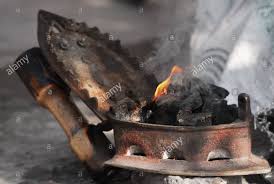
It sets me thinking.  Is he ironing the clothes himself?  It can’t be.  How could he ever lift that heavy charcoal iron box[1]?  And if so, does that make it grossly wrong and unacceptable — surmounting to child labour…?

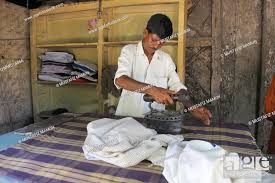
I went to the basement of our apartment complex to search for the designated space allocated to the ‘ironing persons’.  Rent-free with power points, rarely used.  Comfortable with the traditional method. I find him sitting on a plastic stool, jotting down the number of clothes against the apartment number and the amount payable. That puts my fears to rest. 

At the workstation, Manorama, his mother, is busy preparing for the day’s ironing.  A makeshift ironing board of plywood sheets, salvaged from throwaway pieces, assembled to resemble a cabinet, with a tabletop and storage below.  Where was Bhaskar, I asked.  The little guy is quick to respond.  “Sundays… my mother and I take over from my father.  All week, he is busy from 8 am to 8 pm, returning home tired, and ready to hit the bed.” 

I was touched, to say the least.  Here was a caring twelve-year-old boy who was helping out his parents on a Sunday.  Collecting and delivering clothes from apartments, doing the book-keeping without any complaints.  Leaning against the wall, are his school books.  Presumably to catch up on weekend assignments.  To my question “Do you like reading?” his face lights up like a thousand-watt bulb.  His smile with a few missing teeth, stretches from ear to ear.  Okay…that solved a problem I needed to deal with. I decided to surprise him with books that were lying in the house, keepsakes from my childhood. Time to part with them. 

Around 7 pm, he arrives with my bundle, unknots the bedsheet, opening the four folds and proceeds to count the clothes, for his satisfaction and mine.  I can hear his sigh of relief.  Numbers match.  Contents are the same as was handed over.  He is surprised as I hand over the books.  “These are for you to read…I’m sure you will understand and enjoy the stories.  If you don’t, come over whenever you have spare time. I’ll explain.” The smile on his face is priceless.

“So, Mahesh what did your mother cook for breakfast and lunch today?” I ask, worried about his nutritional needs.  

I see the look of confusion on his face, wondering why this old lady was asking so many questions.  Pauses.  He seems to be churning something over in his mind and then says, “Sundays I make breakfast and allow my parents to sleep longer. Today I made lemon poha[2] and filter coffee.  Amma made curd rice for lunch.”   I was moved enough to want to give him a big hug.  Not sure, how he would respond to getting physical, instead gave him a bag of candies.  He was hesitant to accept it, till I pushed it into his little hands.  His pupils dilated and the spark in his eyes said the unsaid.  Admittedly, I was curious. I needed to engage him in conversation to know more about his plans for the future.

To my question, “Do you plan to take over your father’s trade once you are of age?” Pat is his emphatic reply:  “No…Ma’am! I am working hard to secure the qualifying marks for admission into an engineering college to study Computer Science and work in an office.  My parents are saving for my education.  Part of the earnings from ‘ironing clothes’ are kept aside for this purpose.  That is why I help out on Sundays and school vacations.” 

“What happens to your father’s business then?”

“Oh! It has been agreed that it will be discontinued, once I can provide for them.  Another ten years. My grandfather passed away early because of the occupational hazards associated with this profession.  I don’t want my parents to meet the same fate. They deserve a better life.”  That tears me up.  So much wisdom in that little head.  

.

[1] In India, there are people who make a living of ironing clothes for the more affluent. They normally use heavy charcoal irons and not electric irons… they could set up a stall under a porch or under a tree…

[2] flattened rice with spices/ flavouring

Snigdha Agrawal (nee Banerjee) is a published author of four books and a regular contributor to anthologies published in India and overseas.  A septuagenarian, she writes in all genres of poetry, prose, short stories and travelogues.

PLEASE NOTE: ARTICLES CAN ONLY BE REPRODUCED IN OTHER SITES WITH DUE ACKNOWLEDGEMENT TO BORDERLESS JOURNAL

Click here to access the Borderless anthology, Monalisa No Longer Smiles

Click here to access Monalisa No Longer Smiles on Amazon International

Categories
Poetry

Poetry by Craig Kirchner

Craig Kirchner
THE GODLY PAID

We live between the
past and the future

-- Mattie Stepanek*

Life for most turns, churns
through dry tomorrows
to next unwritten pages.
Some sing, mould, paint,
any number of modes,
on call for celebration,
lifting hearts on rare occasion.

And then the specials,
... the godly paid,
doing what only they can do --
shooting souls with beacon rays,
a path to the essence --
inspiring those less capable
to phrase true words
with moist todays.

*Matthew Joseph Thaddeus Stepanek ( 1990 – 2004) or Mattie Stepanek published best-selling books of poetry and peace essays and died at thirteen.

Craig Kirchner thinks of poetry as hobo art, loves storytelling. He has had two poems nominated for the Pushcart, and has a book of poetry, Roomful of Navels.

.

PLEASE NOTE: ARTICLES CAN ONLY BE REPRODUCED IN OTHER SITES WITH DUE ACKNOWLEDGEMENT TO BORDERLESS JOURNAL

Click here to access the Borderless anthology, Monalisa No Longer Smiles

Click here to access Monalisa No Longer Smiles on Kindle Amazon International