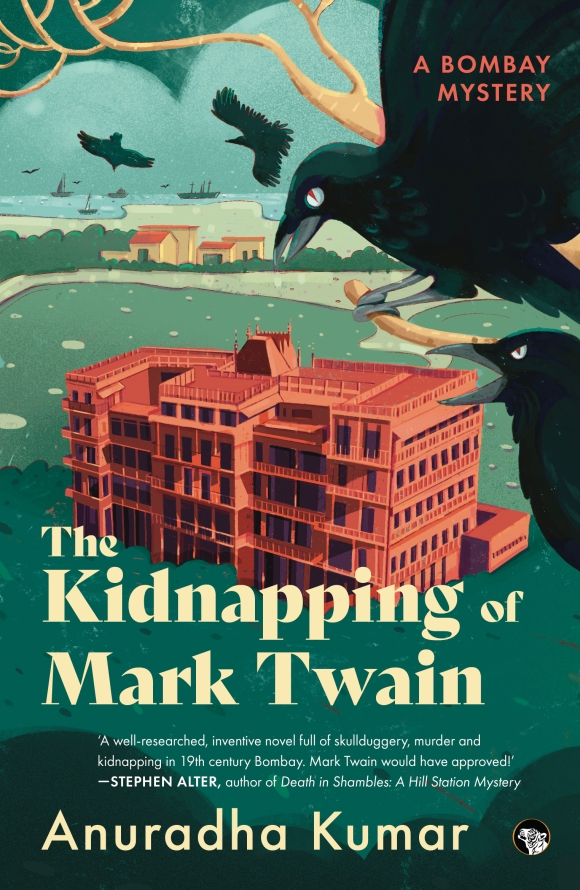
Title: The Kidnapping of Mark Twain: A Bombay Mystery
Author: Anuradha Kumar
Publisher: Speaking Tiger Books
At the turn of the nineteenth century, Bombay was a city bustling with economic activity. A city that stood on the verge of modernisation and rivalled cities like Paris, London and New York. A city that had much to offer to those coming in to make a living or to simply visit it for sightseeing. A city that offered home and work opportunities to people from different countries across the world. It was also during the years 1896-97 that Samuel L. Clemens, or Mark Twain as he was better known as, travelled to Bombay with his family and wrote about his experience in his travelogue, Following the Equator.
In The Kidnapping of Mark Twain, Anuradha Kumar weaves the historic facts from Twain’s book with some intriguing and riveting detective fiction and makes it a fascinating read, especially for the mystery readers. Anuradha Kumar has published more than thirty books, has won the Commonwealth awards for short stories a couple of times, written under the pseudonym of Aditi Kay, worked in the Economic and Political Weekly for almost 9 years and writes from USA now.
The book starts with Henry Baker, an American trade consul, waiting impatiently for the arrival of Mark Twain and his family to Bombay. His arrival is shadowed by the news of murder of a young girl named Casi which has also left Henry’s friend Maya Barton disturbed. Within a day of his reaching Bombay, Mark Twain suddenly vanishes from his hotel room. What follows then is a series of trailing and mystery solving that keeps the reader in thrall.
Henry, with the help of Maya and his loyal aide Abdul, takes upon himself to find the writer. With much that is happening in the city, including murder, a labour unrest, a threat of strike, Henry finds the authorities a little too preoccupied or uninterested to follow Mark’s case. Since he cannot further risk any diplomatic disagreement between the United States and Britain, he follows through even though his position offers no legal authority. What he encounters at each step leads him to more confusing scenarios but he manages to pull through despite the shocking and bizarre revelations coming in.
Kumar skilfully crafts characters who carry the most unusual of acts which keep the readers on an edge – a ‘Waghare’ thief, a stilt walking magician, a fanatic preacher and a sad Serbian musician. Along with Maya Barton who excels in impersonating appearances. All this and much more. With the help of Maya and Abdul, Henry succeeds in unravelling the mystery of Mark Twain’s disappearance. The mystery that is solved, however, is just not of Mark’s disappearance but also of Casi’s murder and truth behind fanatic Arthur Pease’s de-addiction centre.
Anuradha Kumar’s research that has gone in writing this novel shines through her depiction of the city of erstwhile Bombay – its sights and sounds as well as all the places which stand out in the making of this city. The novel hustles with everything quintessentially Victorian Bombay. Action happens in places like the Victoria Terminus, the Bombay Police Headquarters, Colaba Causeway, Elephanta Caves and the Bombay Cotton Mills. Mark Twain takes rooms at the famous Watson’s Hotel where he finds it difficult to sleep because of all the noise made by crows. Henry Baker lives at Byculla club and Maya Barton at a Colaba bungalow. Tukaram, Casi’s husband and a suspect, is the labour supervisor at the Bombay Cotton Mills. The day Mark Twain lands, he attends a party hosted by a rich Parsi businessmen where the famous nautch girls present a dance. The reader gets a grasp on the city that once was. On the other hand, the novel also stirs with the city’s underbelly where crime, opium addiction, poverty and class dynamics are at play.
It is fascinating to note that the author would make use of Mark Twain’s disappearance as mentioned in his travelogue and spin it to make a thrilling mystery. The portrayal of events is so vivid that sometimes the reading seems akin to watching an Agatha Christie in a TV series. Then there are historic events mentioned in the backdrop which gives an idea about the world politics at large. The narrative refers to Oscar Wilde’s trial and his subsequent imprisonment in England and the first protest of women’s right to vote. It brings forth the discriminatory policies that British persisted in India like labelling certain ethnic groups as criminals and makes use of the social reforms like women education underway in the Indian society. All of these, combined with the adventure that the book offers, make for a gripping tale that could have been only set in the Bombay of 1896.
Rakhi Dalal is an educator by profession. When not working, she can usually be found reading books or writing about reading them. She writes at https://rakhidalal.blogspot.com/ .
.
PLEASE NOTE: ARTICLES CAN ONLY BE REPRODUCED IN OTHER SITES WITH DUE ACKNOWLEDGEMENT TO BORDERLESS JOURNAL
Narrative by Debendranath Tagore, translated from Bengali by Somdatta Mandal
Note from the Translator
Debendranath, Father of Rabindranath Tagore
Born to Dwarkanath Tagore in Shelaidah, Debendranath Tagore (15 May 1817 – 19 January 1905) was a Hindu philosopher and religious reformer. One of the founders of the Brahmo religion in 1848, his journey in the role of ‘Maharshi’, the great ascetic, was an attempt to spread the Brahmo faith and he travelled extensively to various places, especially in different parts of the Himalayas like Mussourie, Shimla, Kashmir, and Dalhousie. He even constructed a house in Bakrota called ‘The Snow Dawn’ where he used to reside for months. Although Debendranath was deeply spiritual, he managed to continue to maintain his worldly affairs — he did not renounce his material possessions, as some Hindu traditions prescribed, but instead continued to enjoy them in a spirit of detachment. His considerable material property included estates spread over several districts in Bengal. Debendranath was a master of the Upanishads and played no small role in the education and cultivation of the faculties of his sons.
In his memoir, Jeevan Smriti [Memories of Life], Rabindranath also narrates in detail about his trip with his father in the Himalayas when he was just eleven years old. Debendranth founded the Tattwabodhini Patrika (1843) as a mouthpiece of the Brahmo Samaj and apart from his autobiography, wrote several other prose pieces which also reveal his wanderlust.
Among the two entries included here, we have ‘Moulmein Bhraman’ which is an interesting travel piece narrating his sojourn in Burma in September/October 1850. In the Chaitra 1817 Saka issue of Tattwabodhini Patrika, a travelogue ‘Mori Bhraman’ narrating Debendranath’s trip to Mori was published. Interestingly, as a prologue to this piece Sri Chintamani Chattopadhyay tells us that he was so enamoured after listening to Debendranath’s oral narration of the trip undertaken 28 years earlier, that he decided to transcribe it for the satisfaction of the readers.
Moulmein Bhraman (Travel to Moulmein)
After a year, the splendour of autumn revealed once again and the desire to travel blossomed in my mind. I could not make up my mind where to go for a trip this time. I thought I would make a trip on the river and so went to the bank of the Ganges to look for a suitable boat. I saw that several khalasis — dockyard workers – of a huge steamer were busy at their work. It seemed that this steamer would soon set sail.
“When would this steamer go to Allahabad?” I asked them.
In reply they said, “Within two or three days this will venture into the sea.”
On hearing that this steamer would go to the sea, I thought that this was the easiest way my desire for a sea journey could be fulfilled. I went to the captain instantly and rented a cabin and in due time boarded that steamer to begin my sea journey.
I had never seen the blue colour of the sea water before. I kept on watching the beautiful sights by day and night amid the continuous bright blue waves and remained immersed in the glory of the eternal spirit. After entering the sea and swaying with the waves for one night, the ship dropped anchor at three o’clock the next afternoon. In front of us, I saw a stretch of white sand and something that looked like human habitation. So, I took a boat and went to see it. As I was wandering about the place, I saw a few Bengali men from Chittagong with charms around their necks coming towards me. I asked them, “How come you are here? What do you do?”
“We do business here. We have procured the idol of Goddess Durga in this month of Ashwin[1],” they replied.
I was really surprised to hear that they celebrate Durga puja here in Khaekfu town of Burma. Durga puja was celebrated even here!
From there, I came back to the ship and started towards Moulmein. When the ship left the sea and entered the Moulmein River, I remembered the scene of leaving Gangasagar Island and going into the Ganges River. But this river did not offer any such good scenery. The water was muddy and full of crocodiles; no one bathed in it. The ship came and dropped anchor at Moulmein. Here a Madrasi resident called Mudeliar came and greeted me[2]. He came on his own and introduced himself. He was a high-level government official and a true gentleman. He took me to his house, and I remained a guest there and accepted his hospitality for the few days I stayed at Moulmein. I stayed very comfortably in his house.
The streets in the city of Moulmein were wide and clean. The shops that lined both sides of the street selling different kinds of things were all manned by women. I bought a box, and some very fine silk clothes from them. Going around the marketplace I went to the fish market at one time. I saw big fish for sale displayed on huge tables.
“What are these big fish called?”
They replied, “Crocodiles.” So, the Burmese ate crocodiles; they spoke verbally about ahimsa and the Buddhist religion, but their stomachs were filled with crocodiles!
One evening when I was wandering on the wide streets of Moulmein, I saw a man walking towards me. When he came close, I understood that he was a Bengali. I was quite surprised to see a Bengali there. From where did this Bengali arrive across the ocean? It seemed there were no places where Bengalis did not go. I asked him, “From where have you come?”
“I was in trouble and so came here,” he replied.
Instantly I understood his trouble[3]. I asked him further, “How many years of trouble?”
“Seven years,” he replied again.
“What did you do?”
“Nothing much. I just duplicated some papers of a company. Now my term is over, but I cannot go home because I do not have the money.”
I offered to give him the passage money. But how will he go home? He had set up a business, had got married, and was living quite comfortably. Would he ever go back to our country to show his shameful black face there?
Mudeliar told me that there was a mountain cave here which people went to visit[4]. If I wished he would accompany me there. I agreed. On the first moon night[5], he brought a long boat during the high tide. There was a wooden cabin in the centre of that boat. That night, Mudeliar, I, the captain of the ship and seven or eight other people boarded the boat and it left at two o’clock at night. We sat up for the whole night in that boat. The foreigners kept on singing English songs and requested me to sing Bengali songs. So, I kept on singing Brahma-sangeet occasionally. No one understood anything. They did not like them and went on laughing. We travelled for about twenty-seven miles that night and reached our destination at four o’clock in the morning.
Our boat reached the shore. Everything was still dark. On the shore I saw a cottage full of trees and creepers from which light was coming out. I got curious and ventured alone to that unknown place in the darkness. On reaching there I found it was a tiny cottage. Inside several bald-headed priests in yellow ochre robes were placing candles in different parts of the room. I was quite surprised to see people resembling the priests of Kashi[6] here. How did they come here? Later I came to know that they were the leaders of the Buddhist monks and known as Phungis. I hid myself and observed them playing with the lamps but suddenly one of them saw me and took me inside. They gave me a mat to sit on and water to wash my feet. I had come to their house, so this was their way of entertaining guests. According to the Buddhists, serving guests was a sacred act.
I returned to the boat at early dawn. The sun rose. Mudeliar and the other invited guests came and joined us. This made us fifty in number. Mudeliar fed all of us there. He had arranged for several elephants; about two or four people got on each elephant and proceeded towards the dense jungle. There were small hills all around and in between was that dense forest. There was no other way of travelling here except on elephant back. We reached the entrance of the cave in the mountain around three o’clock in the afternoon.
We descended from the back of the elephants and started to walk in the jungle where the undergrowth was waist high. The entrance to the cave was small; we had to crawl in. After crawling in a little we could stand up straight. It was very slippery inside and we kept on slipping and falling. So, we started walking very cautiously. It was pitch dark inside. Though it was three in the afternoon it seemed like three at night. I was scared that if we lost our way in the tunnel, we would not be able to come out. We would then have to wander inside the cave for the whole day. So, wherever I went, I kept an eye on the faint light at the entrance of the cave. All the fifty of us spread ourselves in various parts of the cave and everyone had sulfur powder in their hands. Then each person put a little sulfur powder in the little holes in the cave next to where he was standing.
After everyone’s place was defined, the captain lit his share of the sulfur powder. Instantly each one of us lit matches and ignited our portion. Now the cave was lit simultaneously at fifty different places like fireworks, and we could see the inside clearly. What a huge cave it was! On looking up to the ceiling our vision could not gauge its height. We saw the different natural formations that had been caused by rainwater seepage inside and were really surprised.
Later, we came out and had a picnic in the forest and then came back to Moulmein. On our way back we heard different musical instruments being played together. Locating that sound, we went forward and saw a few Burmese people dancing with all kinds of gestures of their bodies. Our captain and the foreigners also joined them and started to dance in a similar manner. They found great pleasure. A Burmese lady was standing at the entrance of her house. She watched the mimicry of the foreigners and went and whispered something in the men’s ears. They stopped their singing and dancing immediately, and all of them suddenly left the scene and disappeared somewhere. The captain went on entreating them to resume their dance, but they did not listen. It was amazing to see how much hold the Burmese women had over their men.
We came back to Moulmein. I went to meet a high-level Burmese official at his house. He received me very politely. There was a huge room and in its four corners sat four young women stitching something.
One of the girls instantly came and handed me a round box full of betel leaves. On opening it I found it to contain different condiments. This was the local Buddhist custom of receiving guests. He then gifted me some excellent saplings resembling the Ashok flower. I had brought them home and planted them in my garden, but they did not survive despite great care. The fruit of this tree is very popular with the Burmese. If someone had sixteen rupees then he would spend the entire amount to buy that fruit. We disliked their favourite fruit because of its smell[8].
Mori Bhraman (Travel to Murree)
On the 10th of Pous, 1789 Saka[9], I abandoned all work and ventured in full earnest to go for a tour in the west. I did not decide where I would go. Just as a confined river feels overjoyed when released, I too left home with equal enthusiasm. Two servants accompanied me. One was a Punjabi Sikh called Gour Singh, the other was Kashi Singh, an Odiya Kshatri. At that time the train went only up to Delhi.
Upon arriving at Delhi, I found out that there was no other way to go except by mail coach. So, I booked a seat on it. My destination was Punjab. The horses of the coach in which I travelled up to a place near Sutlej were not steady. Because of them the coach swayed on both sides. I feared that it might topple, and it did tilt on one side and fell down on the ground.
I got out of the coach through its panel and shouted at the driver in the topmost voice – “You made me fall down, the body is hurt in many places and the nose is bleeding.” The driver had assumed that I had already died under the pressure of the carriage. Feeling assured after hearing my voice he replied, “Baancha to – at least you are alive.” My servant brought some water from a nearby well. I washed my nose. It was almost evening by then. Seeing a rest house nearby, I spent the night there.
Early next morning, I boarded the mail carriage again. It crossed the huge bridge upon the river Sutlej. Upon looking down I saw that the water had a tremendous current. I had never seen such a large bridge before. The wind was blowing fiercely. The strange sound of the waves hitting one another created great pleasure in my mind.
After that I reached an inn near the Beas River. Having our lunch there, I boarded the coach again at four in the afternoon. It was almost evening; we hadn’t progressed far when all of a sudden, a heavy storm rose. The road was just along the river. Sand started blowing to form clouds and cover the surroundings. Nothing was visible in front of us. Sand filled our nostrils and the coach could hardly move. I couldn’t decide where to go and take shelter. We found a settlement a little further ahead. Seeing a two-storied house I got off the coach and spent the night there. The storm continued unabated till three o’clock at night. As soon as it stopped, I boarded the coach again.
In this manner, travelling from one inn to another, I ultimately reached Amritsar. Earlier when I had gone to Shimla, I had spent a few days with great pleasure in Amritsar in an old, dilapidated house located next to a narrow sewer line. Immediately upon reaching Amritsar, I went looking for that beloved house.
I came next to the sewage line but saw that the house did not exist anymore. There wasn’t even a sign of it anywhere. This was an example that nothing was permanent in our lives.
I came back from there in a depressed mood. I rented a small single storied hut next to the road. As a traveller on the road, I stayed there amid the dust in that small room quite stoically but with great excitement. I cannot express in words how much I enjoyed living in such seclusion. The room wasn’t much taller than the road. Unknown travellers would stop by and speak to me in a manner as if we had been acquainted before. I was also happy to interact with them. One of them was a devotee of Hafiz and I too became an admirer. He did not want to leave me and became an earnest friend of mine.
Days went by in this manner. One day a Brahmo gentleman called Shibchandra babu came from the Brahmo Samaj at Lahore. He said that he had been sent by the Brahmos there once they heard that I was here, and I had to go to Lahore. Seeing his eagerness I started for Lahore. Babu Nabinchandra Roy had arranged for my accommodation beforehand in a house located next to a wide road at Anarkali. Once I reached there, the Brahmos came and surrounded me with devotion. During my stay in Lahore, I even had to deliver a lecture in Hindi.
From there the Brahmos arranged for my stay inside a garden. Surrounded by lime trees, the dwelling house was in the middle. With only two servants accompanying me, who was going to cook for me? I developed diarrhoea after eating the hard rotis that were served. Soon, I was also attacked by malaria. The Brahmos informed a Muslim doctor, and he came and saw me. I did not take the medicines prescribed by him. My own medicine was powdered Myrobalan and I took that. The next day there was a lot of emission of blood. I became weak; wanting fresh air I went up to the first floor. There I felt the tremendous heat of the sun and my head started reeling. The very next moment I fainted. Upon hearing this news, two Brahmos came and started feeding me sugar cane and I regained my consciousness after their nursing.
The body was in a miserable condition. The next day I sat wondering where I could go in such a state and that too without a cook. How could I return home in the heat of summer? As I was feeling tense thinking about it and could not decide what to do, my heart suddenly said, “Go to Murree.”
Thinking this to be a god-sent instruction I started preparing to go to Murree. The local Brahmos came to meet me at around two in the afternoon. My body was still very weak, and I didn’t have the energy to even talk much. They asked me what I wanted to do now, and I told them that I had decided to go to Murree and would begin my journey that day itself. After they left, Nabin babu and a few other Brahmos came.
I told them, “I want to go to Murree today so please arrange for a coach.”
They sent Gour Singh and arranged a mail carriage for me. Nabin babu asked me what I would eat on the way. He then gave me two bottles of pomegranate juice. After the coach arrived, I had the two big trunks loaded on its roof and got inside with the two bottles of juice as sustenance. Two servants sat on the roof of the coach. Despite my objection, the Brahmos dismantled the horses and started pulling the coach by themselves. I had to persuade them to stop. The coachmen attached the horses again and started moving.
After travelling a little I realised that the coach was swaying too much, and it was also not strong enough. The Sikh Gour Singh who was sitting on top was very strong, and there were two heavy trunks; if the roof collapsed on my head, there would be nothing I could do. I started feeling scared. Travelling in this manner, I reached a dak bungalow. It was a great relief and I felt that my life was saved. After eating there, I boarded the coach again. Gradually I came to the Jhelum. Gour Singh’s house was located there. He stopped the coach and was pleased to call his relatives and introduce me to them.
In this manner I arrived at Rawalpindi, which was situated in the Murree valley. From this point the road went up and down. Many broken wheels lay scattered here and there as proof of this dangerous road. I became scared on seeing them and kept wondering what would happen to me if the wheels of this unstable coach also broke. But by God’s grace, we overcame all these various hurdles and safely reached another dak bungalow[10]. As soon as I arrived there, the local Bengali gentlemen came to meet me. The pain in my body and the strain of travel made it difficult for me to speak. A gentleman called Dwarik babu started taking special care of me. He went here and there looking for a house, and at last went and requested a Parsi gentleman to allow me to stay in his garden.
I stayed in that garden and a Punjabi doctor came to see me. I told him that milk was my only food, but I could not digest that milk very well. I asked him for some medicines that would help me to digest that milk and was slightly relieved with what he gave me. I had become very weak. At night when I went to bed, I felt that I would not be able to get up the next day.
When Dwarik babu came the following day, I told him that I wanted to go to Murree. He told me that there were still no shops and markets at Murree, and I would find it difficult to stay there. But I went on pestering him. So having no other way he arranged for two basket carriages called dulis that would take me to Murree. I went in one duli and my luggage was put in the other one, while the servants went walking. I reached Murree after three days and a lot of hardship.
It was situated at a height of 7,500 feet. The bearers asked me where I wanted to go, and I told them to take me to the place where the sahibs usually landed. They took me to a huge house which was totally deserted and not a single human being was around.
I told them, “Why did you bring me here? Take me to a bungalow where people are staying.”
So, they took me to another bungalow. But the people there told me that it was a club house and not a place for travellers to stay. So, I could not put up there. I told the bearers to take me back to that same uninhabited house where they had taken me at first. They got annoyed and went back there and said that they would not go anywhere else. They placed my duli under a tree in front of that house. Looking up I saw the sky overcast with clouds. Here in the hills, it doesn’t take long for clouds to gather and rain. I was worried and wondered where to go now. I asked the bearers to take me inside and they carried the duli up to the verandah. I got down and inspected the house. There was no one anywhere. I selected a room and again asked the bearers to bring all by bedding from the carriage and spread it out near the wall so that I could sit up and take some rest. They did that and the very next moment quickly disappeared with their dulis.
A little later it started raining. The servants had not reached till then. Through the windowpanes, I could see that a heavy storm was raging outside. The leafless branches of all the big trees were fiercely swaying and big hailstones started hitting the windowpanes as if they would break them, but nothing happened. I kept on thinking that if I arrived here a little late then I would surely have died inside the duli in this severe hailstorm.
After a while the two servants came shivering. With the cold, the rain, and the hailstorm, they were in very bad shape. After wringing their clothes, they came near me. I told Gour Singh to look for a bearer or the caretaker of this hotel and bring him to me.
So he went and got the chowkidar. I asked him to fetch the furniture for the room, but he said he couldn’t do that till he received orders from the master. I threatened him that if he did not bring the furniture out under my orders and if his owner got to know about it, then he would be instantly dismissed from his job. The man got scared and then brought out a charpoi. I spread out my bedding on that cot and lay down. That night Gour Singh brought me a roti and some water. I could neither eat that hard roti nor drink the ice-cold water of Murree. So, I spent the night without any food. In the morning, I sent Gour Singh to fetch some milk and kept on counting the hours until his return.
It was eight o’clock and still there was no sign of Gour Singh. Those eight hours seemed like eight days. At last, he came back at 9 am with some buffalo milk. Upon drinking it, I found it to be diluted with water and tasteless. I could not digest that milk, and nothing remained in my stomach. The milk just passed out as it was. I covered myself with layers of blankets and shawls and went to sleep in the charpoi in that tremendously cold weather.
While I was lying down, I saw a shivering sahib entering my room. I realised how extremely cold it was outside when I found his teeth were chattering. He lit a fire in the next room and because of that I felt a bit comfortable.
The next day Gour Singh brought such diluted buffalo milk once again. I drank it but again the milk went out of my body as it is. Having starved for three nights I felt almost half-dead on the third night. I laid down quite comfortably on the charpoi with all the warm clothes layered upon my body and did not feel any pain. I felt as if someone like my mother was sitting near my head. I was breathing and along with that breath I saw my friend, Sajuja, also looking at me. Breathing in and out in that manner I spent the whole night doing easy yoga and cannot describe how happy I felt.
Soon the night was over, and it was morning. Once again Gour Singh brought that kind of diluted buffalo milk. I drank it. How strange! I digested the milk that day. Since pure milk was unavailable here, I told Gour Singh that it would be nice if he went looking for a cow. So, he went to Rawalpindi and bought a small cow for thirty rupees. He said that she gave ten seers of milk per day. Now milk has become my staple diet.
After drinking that milk my body became a little stronger. I had been staying in Bekereya Hotel from the beginning but now I decided that it was not feasible to continue staying there any longer. So, I went to look for a rented house. I went up the hill in that extremely weak condition and found an empty house. But it was so cold there that I did not find it suitable. A little lower from that point I found another house and liked it. I rented it for nine hundred rupees and started staying there. The next day the postal peon brought me a letter from my nephew Gnanendranath. I opened it with excitement, and he had included a Brahma-sangeet which read thus:
Gao rey tahar naam
Rochito jaar visvadhaam.
Dayar jaar nahi biram
Jharey abitito dhaarey.

[Sing His name/He who has created this world/Whose blessings endless/Falls continuously on earth]
I had already received His blessings to get back my life from the verge of death; the same blessings that were referred to in this song made me feel excited and my heart leaped with joy. This sort of a letter, and at such a time! How strange! How strange!
In this new house I managed to get a cook. He prepared green moong dal for me, and I liked its taste. It was sufficient for my lunch. After a long time, I felt satiated after an afternoon meal. As my health started improving, I gradually began to increase the quantity of my milk consumption. Early in the morning after the upasana was over, they brought the cow in front of me, and I would immediately send a bowl for the cow to be milked before my eyes. The bowl of milk was brought to me; I drank it and sent the bowl back. The cow would then be milked again, and I would once again drink from the bowl. This procedure was repeated several times and after drinking four or five bowls of milk, I would go for a walk in the mountains. Walking in the fresh cool breeze and under the direct rays of the morning sun, I wandered here and there and then came home. Instantly I would have tea, chocolate, and milk. During lunch I would drink milk again, and in the evening, and before going to bed. In this manner, I would drink about ten seers of milk each day and whatever was left over was made into butter to be consumed with rotis the next morning.
Within seven days, I regained my strength and, feeling exuberated started travelling in the mountains. I started singing songs praising the grace of our creator and there was no end to those songs. For a long time, I had been cherishing dreams of visiting Kashmir and it seemed that our creator would now fulfill it. So, I started enquiring about how to go to Kashmir. By the beginning of May, Murree became full of people and the place took a new look with the red uniform of the British soldiers and the fanciful clothes of the other British men and women. Deserting its shabby look, even nature filled up the place with varieties of flowers. After staying in Murree for three months, I heartily began my journey to Kashmir on the 4th of September.
[ Excerpted from Wanderlust: Travels of the Tagore Family. Translated and Edited by Somdatta Mandal. Kolkata: Visva-Bharati, 2014]
[2] Sri Murugesam Mudeliar was the then Commissariat contractor of the military outpost at Moulmein.
[3] The fact was that the man had been banished here. Usually, political prisoners were interned in Moulmein prior to 1848. But after 1848 Port Blair in the Andaman Islands was made the new place for banishment and imprisonment. This narrative is dated 1850.
[4] The local name of this famous cave was Kha-yon-gu, and Farm Cave in English. It was situated in the northeast part of Moulmein town and was approachable through the Ataran River.
Nazrul’s lyrics translated by Professor Fakrul Alam
Painting by Jamini Ray (1887-1972)
DO LOVE MY SONGS

Dearest, even if you won’t love me,
Do love my songs.
Who remembers forest birds
When they cease singing and fly out of sight?
Whoever wants the moon by itself?
Everyone enthuses only about moonlight!
No one ever notices how wicks get burnt
When lamps emit their light!
Cut stems drip tear drops
But in time blossom as flowers.
But when plucking flowers and taking them away,
Do you ever think of helping the plant in any way?
All quench their thirsts with river water
But the act parches the riverbed so!
Seek, seek the river’s water in an ocean of sorrow…
But dearest, even if you won’t love me
Do love my songs!
A rendition of the original song in Bengali by the legendary singer, Feroza Begum(1930-2014)
Born in united Bengal, long before the Partition, Kazi Nazrul Islam(1899-1976) was known as the Bidrohi Kobi, or “rebel poet”. Nazrul is now regarded as the national poet of Bangladesh though he continues a revered name in the Indian subcontinent. In addition to his prose and poetry, Nazrul wrote about 4000 songs.
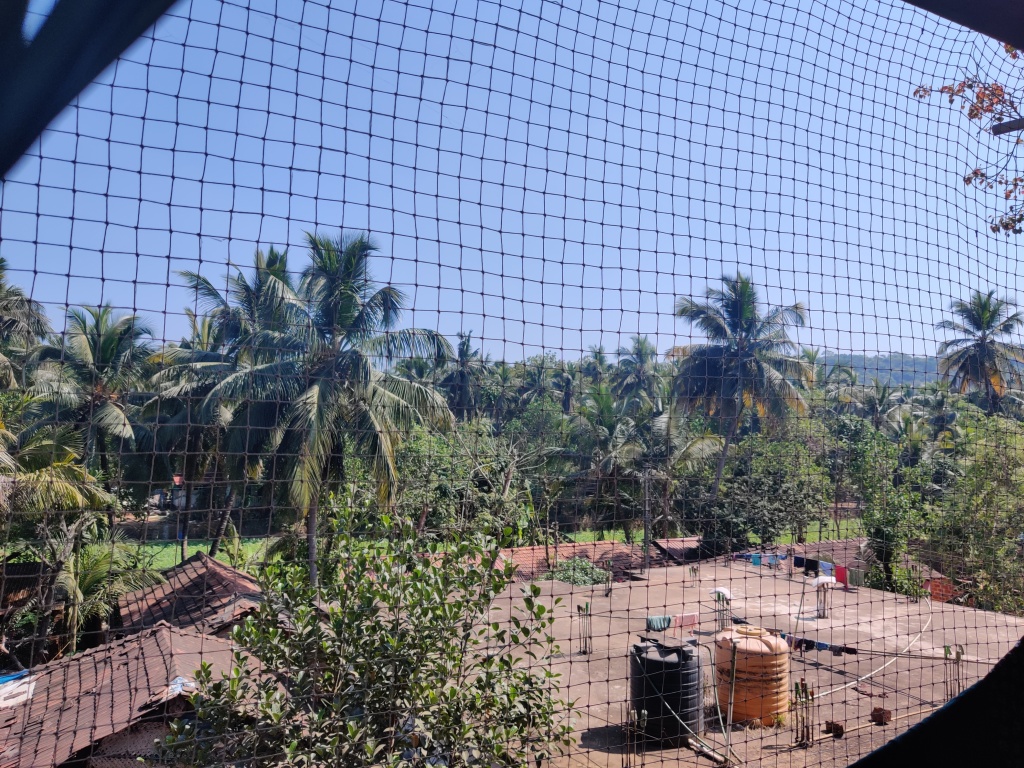
This was her second week in Siolim as a resident, in her aesthetically pleasing, slightly bohemian, rented two bedroom flat. The flat itself gave very tropical vibes with a host of plants – both real and artificial, enhancing the outdoorsy look. Though her building was part of a bigger residential complex, it was miraculously not blocked by views of other buildings. Instead, the windows at both ends of the flat faced east and west, providing stunning views of the morning sky change colour as the sun rose over the dense grove of coconut palms and as if that were not already enough to drive up the rent, a peek of the setting sun, from the opposite end. No less than three spacious balconies with French doors offered an unobstructed view of the quaint sloped roof homes of the ‘locals’, the villagers, bordered by paddy fields beyond.
Except for one house in their midst. From her bedroom balcony that faced east, Anika noticed the one slightly better and bigger home, built with concrete walls and a concrete flat roof, functioning as its terrace. It was not directly opposite but slightly to the right so that she could only see it only from the window or the balcony.
Every morning she would look out in hope of spotting the big fawn dog – the unknown ubiquitous mixed breed — on the terrace. She was always entertained by his movements. He would strut about for a bit, peering over the edge while woofing his alpha dominion over other dogs and cats he spotted. At other times, thinking himself unobserved, he would lie down flat on his back, utterly vulnerable with his legs up in the air, squirming about, tongue lolling, making her laugh.
She had seen the other residents occasionally: two teenage girls who would climb and sit together leaning against the water drum conversing in the evenings as the sky deepened it hues, probably out of the hearing distance of the lady who would sit by herself at the far end staring at the horizon. Anika imagined that this might have been her only place of escape from the endless chores and hubbub of daily life. At other times, a much younger boy of about five followed a slightly older girl, probably his sister (or cousin) of about seven. As she sat to read and do her homework, he would entertain himself skipping about the flat terrace or lolling about on a mattress placed there. After dark, however, the terrace was the domain of the men of the household. Though there were no lights on the roof, the occasional clink told Anika that feni or urak had been smuggled upstairs.
Local families here tended to be ‘joint’ ones with aunts and uncles, siblings and cousins included in the same household. Daily, a slim, capable lady would briskly hang clothes to dry on strings stretched out from stakes. So many clothes every day! The only times Anika didn’t spot too many visitors to the terrace was on extremely sunny days when cotton sheets would be spread out with a brick at each end. They would dry fish on the sheet. She could never identify which of them it was — kokum, shrimp, jambul — from the plethora of spices, fruit and and fish Goans loved to sun dry.
She would have loved procuring some of it straight from them but was still conscious of being the non Goan outsider. She had already experienced all types of opinions. Those who were hypocritical and contradictory – people who welcomed European expats but looked down upon Indians from other states. Those who lamented the growing population due to migration – yet, uncomplainingly, raked in profits from the meteoric growth of the square foot rate. She had also experienced the warmth and hospitality of the majority of the Goans who would go out of their way to help you settle in and make you feel like family.
*
The lady who sat by herself was back today sitting as usual at the very edge. She had the terrace to herself. Something about her intrigued Anika, who realised she had been staring at her instead of being at work on her laptop for the past few minutes. Was it because she was the most frequent visitor? She spent a lot of time staring out over the other end. Or was it because even if others were there, they barely acknowledged her, not even glancing in her direction, or exchanging a friendly word. Likewise, she too ignored them for most part. The only one who paid her any attention was the small boy, too innocent and young to pay heed to family politics, who would wave and go running towards her when he saw her. She seemed to be the family outcast yet was outwardly unperturbed, never getting confrontational, at least on the terrace, from what Anika could observe.
On this day, she was back, presumably ruminating about life. Hailing from a nuclear family herself, Anika mused over the conveniences that a joint family surely had, from shared expenses and chores, to child supervision and upbringing. As she looked at the lady on the terrace, she also thought about the difficulties that living in a large group in a confined space probably entailed, with no privacy, varying opinions and multiple imagined slights.
Today, she seemed restless as she was strolling on the terrace. Anika stepped out onto the balcony to get a closer look. The south-west corner of the terrace with the water drums was the closest point to her balcony. The lady was whiling away time by walking along the perimeter of the terrace. As she wandered closer to the south-west corner, Anika finally got a good look at her.
Her personality was apparent even from this distance, from the way she held her body upright to the confident yet feminine walk. She was neither slim nor thickset but somewhere in between. There was a certain sophistication to her gait. Anika watched as she turned the corner and continued her solitary stroll around the edge of the terrace.
*
The sound of loud arguments in male and female voices interrupted her work the next morning – the family members had reached the downward curve in the sine wave of highs and lows of joint family existence. Adding to the cacophony was a girl’s full-throated wail. Perhaps a fall, burn or injury, with the elders blaming each other for the oversight?
The staircase that the family used to ascend was on the far east side and never visible to Anika. She now saw a small head make an appearance at the flat edge followed by the body of the boy who had climbed up unobserved. His sister as the designated minder was the injured one then. He looked for the assortment of toys that always lay in a heap in one corner of the terrace. Soon he was revving the toy car and following it about as it raced forward a few feet. Anika was a little concerned and stepped out to the balcony. What if the child wandered too close to the edge? The roof edge was unprotected by any railing or boundary wall. She stood undecided and hoped that someone else would arrive soon. That’s when she saw the lady walk towards the boy. Anika sighed in relief. She had probably been sitting, leaning against the other side of the water tanker, that’s why she hadn’t spotted her. The boy would point the car in her direction and she would then send the car revving back to him. The game continued until she heard shouts and the mother climbed halfway up the stairs gesturing at them to come down. The lady and the boy complied. Anika noticed that as usual she didn’t convey her gratitude either by gesture or a word to the lady who had kept a watchful eye over him. She wondered what had caused the breach in their relations and felt the lady deserved at least some acknowledgement. Maybe she sensed her empathy because suddenly she turned and looked directly at Anika. Anika felt a voyeuristic warmth flush her ears and stepped back inside her bedroom.
*
Anika noticed over the next few days that the lady had started sitting closer to the south-west edge, closest to her balcony. She would occasionally glance towards Anika. Her eyes were dark, so dark that you couldn’t distinguish the iris from the pupil. Anika felt a little sorry for her unfortunate circumstances. The only time she noticed her smile was on the rare occasions the boy wandered onto the terrace alone. With nobody to stop him from interacting with her, he would sit beside her presumably listening to stories or they would chase each other.
Anika wondered why she didn’t leave this house – perhaps she had no independent income. Anika had been doing the cleaning herself in her apartment but now she took a decision.
*
Anika stood at the gate of the concrete house. One of the teenage girls came to the gate. Anika did not know Konkani, the local language, but it had similarities to Marathi and with that including a mix of Hindi and basic English, conveyed that she was looking for a daily help to sweep and mop the floors, do the dishes and some light dusting. Would anyone from this household be interested? “Okay! I tell to my mother, give me house number,” she replied. As she wrote down the apartment number behind a schoolbook she had got from inside, Anika tried to find a diplomatic way to say that the sturdy looking lady on the terrace who played with her younger brother would be better for this kind of a job instead of anyone else from the household. However, as the girl looked at her uncomprehendingly, she realised that this was a task beyond her communicative abilities and left.
*
It was not quite dusk when her doorbell rang. The younger, slimmer lady Anika had seen so many times on the terrace, stood at her doorstep. Julie spoke English quite well and understood it even better. Anika took her on a brief tour of the flat stopping at the balcony that overlooked her house. “I really enjoy your dog’s antics early in the morning!” she said, to break the ice. Julie laughed.
Anika noticed that the boy had found his way onto the roof again and was lying on his stomach with his head in his hands, absorbed in the story the lady was no doubt telling him. She sat cross legged in front of him, using gestures and making faces while telling the story, hugely entertaining him. Julie noticed them and her face changed to a scowl.
Anika gestured towards them, “What about her? Doesn’t she need a job? I have seen her on the terrace by herself so many times. She doesn’t seem to be as busy as you are — that’s why I approached your house to look for help.”
“Who? Her? Sheela?” Julie looked thunderous. “Look at her! Wasting time, always sitting on the terrace!”
Anika’s face looked a question. “Well, she seems to look after the boy so well.”
Julie turned towards her – the scowl changing to a confused look. “Her boy? How long have you stayed here?”
“Oh, this is my just my fifth week.” And now, leaping to her defence, Anika continued, “I’ll tell you something you don’t know, that boy has come to the terrace so many times on his own and if it were not for Sheela’s presence, God knows what accident might have happened! Why do you all treat her so badly? Look, even now only she is there with him on the terrace, no one else is supervising him!”
I knew I had probably crossed a line with this as it was none of my business to comment on their affairs.
Julie was struck dumb by my outburst, but her eyes changed. The anger was fading. “Boy?” she repeated. “She lost her five-year-old son three months ago. He drowned in the well behind the house.”
The anger had faded completely from Julie’s eyes to be replaced with fear. “Look at her — she keeps playacting like she’s doing now, as if she is talking to him and can see him, scaring the children — that’s why we argue. She spends all her time sitting on the terrace from where she can watch the well.”
Anika turned back to the terrace. Sheela had noticed them watching her and walked closer. She looked up at Anika with an appeal in her liquid black eyes, almost as if to say, “You can see him too, can’t you?”
.
Rakhi Pande, an experienced education professional, transitioned from a brand management career to become an award-winning teacher and school leader. An avid reader, she tries to write whenever time permits.www.linkedin.com/in/rakhi-pande
.
PLEASE NOTE: ARTICLES CAN ONLY BE REPRODUCED IN OTHER SITES WITH DUE ACKNOWLEDGEMENT TO BORDERLESS JOURNAL.
Before the bombings, I was not aware
That homes, like humans, could get orphaned too.
Built by a wealthy merchant's wealthy heir,
I've held this ground since 1992.

I've witnessed nicety, hope during pain,
Devoutness, goodwill, and pragmatic views
In those five souls I roofed, who once sustained
Me with dense quicksets, sconces, and bright hues.

They say love's sown with hopes of its return,
But I had failed to be a loyal friend
That ill-starred night, when swiftly, turn by turn,
Those cruel projectiles brought my family's end.

The lattices (my forearms) crumpled first,
And then the heavy gambrel roof (my head)
Fell on my sleeping members as the burst
Of asphalt shingles claimed them on their beds.

But greater is my guilt from treachery;
For now, I'm slave to foes, who triumph, shout
On my own land, spit at our dignity.
Oh, how I strongly wish to drive them out!
Shamik Banerjee is a poet from India. He resides in Assam with his parents and works for a local firm. His poems have appeared in Fevers of the Mind, Lothlorien Poetry Journal, and Westward Quarterly, among others, and some of his poems are forthcoming in Willow Review and Ekstasis, to name a few.
.
PLEASE NOTE: ARTICLES CAN ONLY BE REPRODUCED IN OTHER SITES WITH DUE ACKNOWLEDGEMENT TO BORDERLESS JOURNAL
Title: Mafia Raj: The Rule of Bosses in South Asia
Authors: Lucia Michelutti , Ashraf Hoque , Nicolas Martin, David Picherit, Paul Rollier, Clarinda Still
Publisher: Speaking Tiger Books
In criminal law, mafia raj refers to an organised crime regime enforced by criminal elements. Throughout history, such syndicates have had significant influence over various aspects of society, including politics, business, and even law enforcement.
Mafia Raj: The Rule of Bosses in South Asia is authored by multiple academics. It is a fascinating book as it delves deep into the subject. Among the writers, Lucia Michelutti is a Professor of Anthropology at University College London. Ashraf Hoque is an Associate Professor in the Department of Anthropology there. Nicolas Martin is an Assistant Professor in Indian/South Asian Studies at the AsienOrientInstitut of the University of Zurich. David Picherit is Research Fellow at the French National Centre for Scientific Research. Paul Rollier is Assistant Professor in South Asian Studies at the University of St. Gallen. Arild E. Ruud is Professor of South Asia Studies at the University of Oslo. Clarinda Still is Research Associate at the University College London.
The book tells us number of criminal organisations emerged within the country during the British rule, primarily in urban areas. Drug trafficking, extortion, and murder are some of the ways in which these concerns gained power and influence. These developed into the mafia in post-colonial times.
The presence of mafia raj has within any society has far-reaching consequences. It undermines the rule of law and democratic institutions, creating a climate of fear, intimidation, and corruption. The activities of mafia raj often involve violence, extortion, and illegal activities that threaten the stability and security of communities. Addressing the issue of mafia raj requires a multi-faceted approach. One of the key challenges is to combat the vast network of criminal organisations that operate with impunity. This requires strengthening law enforcement agencies, conducting targeted investigations, and implementing effective anti-crime strategies.
The book expounds it is important to improve the socioeconomic conditions that contribute to organised crime in addition to law enforcement efforts. There is a need to bolster economic development, reduce poverty, and provide opportunities for marginalised communities. Mafia raj is a significant threat to society, undermining the rule of law and democratic institutions. A comprehensive approach that combines law enforcement efforts with socioeconomic development initiatives is required to combat it. Only through collective action and international cooperation can we hope to put an end to this dark chapter in history.
Says the blurb: “‘Mafia’ has become an indigenous term on the Indian subcontinent. Like Italian mobsters, South Asian ‘gangster politicians’ and violent entrepreneurs are known for inflicting brutal violence while simultaneously upholding vigilante justice-inspired fear and fantasy. But the term also refers to the diffuse spheres of crime, business and politics operating within a shadow world that is popularly referred to as the rule of the mafia, or ‘Mafia Raj’.”
Through intimate stories of the lives of powerful and aspiring bosses in India, Pakistan and Bangladesh—a rookie neta from Dhaka, a self-styled leader of the poor in Punjab, a henchman from Chittoor, small-time brokers in Lahore, a female don in western UP, a political bigshot in Nawabganj, and a legendary figure in the blood-ridden politics of South India—this book illustrates their personal struggles for sovereignty during their climb up the ladder of success.
A rich ethnographic study of the distinctive cultural milieu within the sub-continent from which such stories emerge, the authors offer a global perspective on crimes, corruption, and the lure of the strongman that flourish within the geographical constraint of South Asia.
Bhaskar Parichha is a journalist and author of Unbiased, No Strings Attached: Writings on Odisha and Biju Patnaik – A Political Biography. He lives in Bhubaneswar and writes bilingually. Besides writing for newspapers, he also reviews books on various media platforms.
.
PLEASE NOTE: ARTICLES CAN ONLY BE REPRODUCED IN OTHER SITES WITH DUE ACKNOWLEDGEMENT TO BORDERLESS JOURNAL
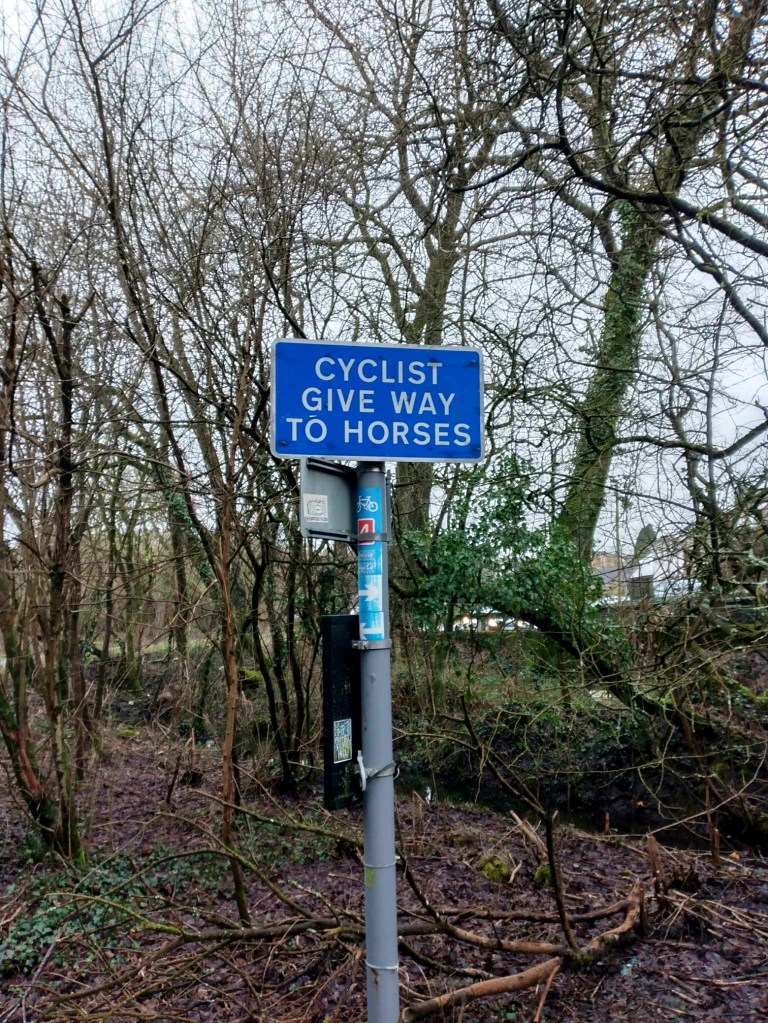
Cyclist, give way
to horses.
     The forces
of darkness will prevail
if you don’t.

A sound of hooves
removes
     any doubts
you may entertain about
whether your brakes
still work–
     Surely they must fail.

The narrow saddle
you ride upon
is smaller than the seats
     the horses know.
It would make
a very poor paddle
if you were ever forced
     to use a canoe.

The glowing sunrise lies
beyond the hills
but what keeps it rising?
Hydrogen atoms
     pay the monthly bills.

Cyclist, give way
every time:
     You are not as fast
as a neighing beast.
In a race you might be
a semi-finalist
     but never a winner.

And what do you eat
for dinner? Do you feast
     on apples and hay
and drink nothing stronger
     than fresh water?

I very much doubt it.
     It seems to me
you prefer to eat cakes
and sip pints of
     strong Irish stout.

You are like a centaur
     mounted there.
The horses will stare
at you and your shoes
and never forget
     this unbalanced fact.

Cyclist! Don’t presume
to know the sources
that continually fill
your rubber wheels
     with airs and graces.
Simply give way
to the faces of horses.
Rhys Hughes has lived in many countries. He graduated as an engineer but currently works as a tutor of mathematics. Since his first book was published in 1995 he has had fifty other books published and his work has been translated into ten languages.
.
PLEASE NOTE: ARTICLES CAN ONLY BE REPRODUCED IN OTHER SITES WITH DUE ACKNOWLEDGEMENT TO BORDERLESS JOURNAL
I have learned how to bake my pain into a cake. I now feed them To other people. When you come for tea, you might leave with a bitter aftertaste.
The antacids are in the candy bowl.
PLEA BARGAIN
Break, ugly mirror. Crack into shiny pieces and split my funny face. Let the jagged edges of me, be swept away into dust.
The laughter in my head is enough; I don’t need your judgemental eyes to remind me of all that is left undone.
Break, ugly mirror. Or turn me to stone instead.
Baisali Chatterjee Dutt is a domesticated nomad who writes, edits, dabbles in theatre and teaches. Her poetry has been published in various anthologies and magazines, print as well as online. Her novella in verse, Three is a Lonely Number, is available on Amazon Kindle.
.
PLEASE NOTE: ARTICLES CAN ONLY BE REPRODUCED IN OTHER SITES WITH DUE ACKNOWLEDGEMENT TO BORDERLESS JOURNAL
A difficult hiking trail up into the mountains combined with bouts of inner doubt makes for an interesting big day out, as Keith Lyons discovers on an alpine route in New Zealand.
Photo Courtesy: Keith Lyons
The coroner’s reports make sobering reading. Two people had died on the same track within a couple of years – both deaths partly attributed to insufficient signage warning hikers heading down to cross the river at that point rather than continue to where cliffs, waterfalls and slippery rocks could be fatal. Both fatalities were preventable, the reports concluded. The one day, up and down rocky alpine route is recommended to only be attempted by experienced hikers, and in good weather, but when my friend and I set off recently on the Gertrude Saddle hike, in New Zealand’s Fiordland, it seemed ‘experienced’ was not a word I would describe the fellow walkers.
Inspired by photos on Instagram, guidebook recommendations in English, French and German, blogposts with photos, and travellers’ recommendations, the hike is popular and easily accessible. It is only 7km return, but 7km involving some risk and quite a lot of altitude gain and fall – 600m climb to be precise. Already nearly 30 cars, vans and motorhomes were parked in the carpark, close to the divide on the Te Anau-Milford Sound Scenic Highway. If you can’t find the marker signs, just look for the people hiking, one website had quipped.
Peering into the distance, we could make out hikers in waterproof jackets and wind blocking fabrics. In the carpark, I reiterated my expectation that if the trail proved slippery, crumbling or covered in snow or ice, then I wouldn’t want to continue. The start of the trail was picture-perfect, and the weather was fine – something of a rarity for a region that gets 200 days of rainfall in an average year. The first part of the 6-hour hike is along the flats of a valley with a meandering river, giving a chance to admire the alpine grasses and flowers, and look up to the amphitheatre of rugged mountains capped in the previous night’s snow.
Photo Courtesy: Keith Lyons
It was early autumn, but colder than normal, and we wore extra layers of clothing. I counted five layers, plus my gloves. It felt good to be on the move, to be enjoying the day, and the prospect of crowning our week’s trip with a route that neither of us had attempted before. From a previous trip to Fiordland I’d spied the valley, with a hundred waterfalls flowing thanks to the torrential rain, and having heard from friends that this was a great day out, remembered to add it to the possible hike list, when the weather was more favourable.
The first people we encountered were coming down. Maybe they’d started early and were the first back, I thought. As the trio approached, I inquired onto the track conditions. They hadn’t been to the saddle, instead turning around when the going got tough. There were rocks falling down from climbers above, and they didn’t feel safe. It was not the news we were hoping for, but at least I thought this gave us an opt-out.
Photo Courtesy: Keith Lyons
The trail veered left, out of the valley, and up. I felt my breathing become more laboured, and my calves straining. My companion had earlier talked about meeting Edmund Hillary, the first to climb Mt Everest, and being impressed with the size of his strong calves. When I met the New Zealand climber I didn’t get a chance to admire his gastrocnemius and soleus muscles, but when I shook his hand I realised that his hands were also strong, large and powerful.
We reached the river crossing below a waterfall, which was easily crossed with a hop, skip and jump, and then looked again at the route and markers, to ensure imprinted on our memory was the turn off for the river crossing, against the natural inclination to go down, down to where bluffs had claimed weary hikers too keen to get down to the valley below.
Photo Courtesy: Keith Lyons
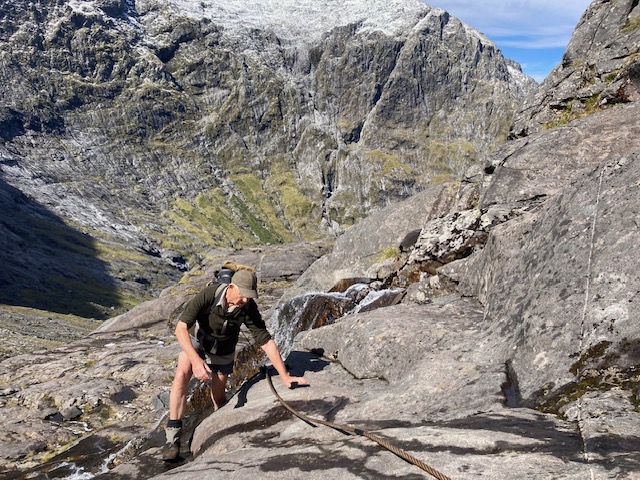
There were warning signs along the way, as if to reinforce the gravity of the situation. The track from the river crossing on is steep, and not suited to those with limited experience or a dislike for heights, the signs warn. “The track goes up steep rock slabs and is treacherous when wet or frosty — there are steel cables to assist you.” A young woman passed us with just a purse and mobile phone, wearing a spaghetti top. We saw another 20-something walking uphill texting with both thumbs – a feat I was curious about, given that I had no phone reception for my network. Millennials. Seemingly unprepared should the weather turn or they need extra energy for the hike.
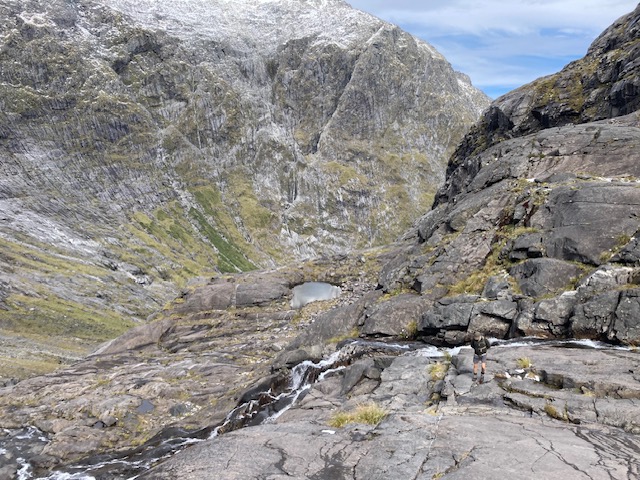
We stopped beside Black Lake, and saw a smaller blue lake below, perched above the river crossing waterfall. Other hikers stopped to have snacks or lunch, but we had already tucked into our sandwiches by the river, and I was anxious to keep moving in case the snows ahead melted into slush as the sun finally reached the boulder field. The clamber up with steel cables wasn’t too bad, it was more a case of avoiding damp areas where boots and shoes would slide and attack any confidence.
Photo Courtesy: Keith Lyons
The ridge by the Black Lake has proved to be a false summit, and there was still more climbing to do, on zig-zag tracks which displaced rocks and pebbles with every footfall, along uneven trails covered in pockets of snow, and over granite rocks worn smooth by the elements. Those rocks, where dry, proved to be the most satisfying to walk on, once it was established that the tread of shoes was sufficient to grip the surface.
Looking up, we could make out the silhouette of climbers who had made it to the ridge, which we presumed was the actual saddle. But it was hard to calculate just how far it was up. As more hikers started to come down, we asked, but assessments of the distance and time varied. When someone said ‘probably half an hour’ I realised that rather than turn back, we were probably going to make it to the top for the literally ‘breathtaking’ views. I was feeling good, and my companion was enjoying the rock scrambling.
Photo Courtesy: Keith Lyons
Picking our way among the rocks and boulder, we kept going, the prospect of views, a rest and a second lunch ahead. Eventually the steepness gave way to a more gentle terrain, and a few more steps and we were looking out to different mountains and valleys. We joined the other walkers admiring the view into the Milford Sound and savouring packed lunches. There were folk from the USA, France, Germany, India, China and Belgium, some of them on working visas in New Zealand, or enjoying ‘van life’. People asked others to take their photos, some standing on large boulders very close to drop offs of 700m. We looked around for the spaghetti-top woman. Maybe she had made it, or turned back.
At the top, some 1400m high, ice sat on top of small hollows, with snow melting to make the tracks muddy. My friend found a shelter build with rocks and had his nap, while I climbed a little higher for views both sides of the saddle. The saddle got its name some 140 years ago when the surveyor for the road hiked up with his wife Gertrude Holmes. She was likely wearing a dress, but most probably not a spaghetti top.
As Edmund Hillary once said, to climb a mountain successfully you not only have to hike up it, you have to hike back down too – and survive to tell the tale. With this message taken to heart, we carefully descended to the valley floor, and eventually back to the carpark.
.
Keith Lyons (keithlyons.net) is an award-winning writer and creative writing mentor originally from New Zealand who has spent a quarter of his existence living and working in Asia including southwest China, Myanmar and Bali. His Venn diagram of happiness features the aroma of freshly-roasted coffee, the negative ions of the natural world including moving water, and connecting with others in meaningful ways. A Contributing Editor on Borderless journal’sEditorial Board, his work has appeared in Borderless since its early days, and his writing featured in the anthology Monalisa No Longer Smiles.
.
PLEASE NOTE: ARTICLES CAN ONLY BE REPRODUCED IN OTHER SITES WITH DUE ACKNOWLEDGEMENT TO BORDERLESS JOURNAL.
December and January are not real months – they do not seem to be; They are like translucent blurs in the puddle of the whole year’s colours. But, Perhaps it’s the other way around and only December and January are real. Maybe our lives are translucent colourless blurs. And all the colours are just our assumptions, expectations, our dreams and hopes, which we fill into our days ourselves – so that life may seem a bit bearable. And maybe, only endings and beginnings are real. Perhaps, that’s why beginnings always seem so difficult, and endings are so heartbreaking.
Shahalam Tariq is a writer and student based in Rawalpindi, Pakistan. His writings on history, theory and literature have appeared in The Friday Times and Bazm e Dana. His poems have appeared in The Writers Sanctuary, an anthology of poetry.
PLEASE NOTE: ARTICLES CAN ONLY BE REPRODUCED IN OTHER SITES WITH DUE ACKNOWLEDGEMENT TO BORDERLESS JOURNAL








 Borderless