It is a relief that young women have not called me Uncleji yet – despite the visible signs of greying hair and beard. While they may not consider me fit for a romantic fling, they feel somewhat restrained to deprive me of the right to be called eligible. Thanks to the growing acceptance of premature greying, women seem to appreciate the strength and honesty of men who flaunt their salt-and-pepper combination even though they have the option of applying hair dye. While my peers use hair colour and suggest a similar makeover to avoid negative comments, I prefer to look real and face everything that comes my way.
Barring a few occasions marred by toxic jealousy, grey hair has never dismantled my confidence. In case greying is a cause for concern, blame a weak liver or genes and proudly declare that you have celebrated your grey hair throughout your youthful days and consider it a sign of wisdom that other people have to wait to acquire. However, in a changing world, with a thrust on balance and equality, where young women do not shy away from entering into wedlock with men with grey hair, the acceptance of young women with streaks of grey as a suitable life partner remains an unrealised dream, leading to another kind of gender inequality that should be rooted out.
Bumping into a former girlfriend, who still overlooks my grey hair but continues to chuckle at the unending struggles of a creative life, I discovered she drew the simplistic conclusion that nothing seems to have changed in my life despite the passing of two decades. Before I chose to contest her view by drawing up a detailed comparative analysis chart that could prove her wrong on several counts, I allowed her assessment to soothe me inside as she maintained the status quo, mentioning quite a miraculous achievement that the tide of time had failed to wreak havoc. Blessed with skin that refuses to show signs of ageing, I still drink municipal tap water instead of worrying about how and where to purchase pristine litres from glaciers to rejuvenate myself. When she raised queries about facials, night creams, and oil massages to tone up the sagging skin and get rid of wrinkles, I had a simple advice to offer: purity inside shows up outside. And this includes thoughts and a positive mindset.
She introduced me to her daughter in a video chat as a classmate who missed the chance of hitching up. The young girl spoke of her interest which fluttered at the threshold of pursuing a creative life full of adventure. I was curious to know why she wanted to pursue this path, even though nobody in her family had ever tread on it. This was answered best by her ambitious mother who had perhaps nurtured the idea of giving birth to a creative child even though she had rejected spending her life with a creative person. This was a bold question but she admitted the fact that she had always wanted her child to become creative even though she did not wish for a career in this domain. The girl now had the clarity to make a quick decision as my plight strengthened her resolve to join her father’s accountancy firm after completing her graduation.
The attitude of men seems to have changed towards me over time as I end up being called Uncle by those who view my grey hair as a conclusive sign of old age. Men belonging to the same age bracket also call me Uncle just because they have dyed their hair to sport a young, dapper look while I prefer being myself. The other day, a gentleman from the neighbourhood came seeking donations for a noble cause and chose to address me as Uncle. This was not said with the intent to prick or provoke, but a cautious attempt to remind me of my age. He had seen me moving around with young women and he must have secretly envied me my companions. He seized the opportunity to send an apt reminder that I should behave and act my age, and my knee-jerk reaction was to deny him what he sought. Men older than me have also called me Uncle – from drivers to fruit vendors – and derived a sense of satisfaction but I do not deny them this pleasure by showing my anger. Even if the entire tribe of men orchestrates a similar sentiment, it should not trigger a negative response as I have grown immune to such expressions.
Recently, a gentleman near the market stopped me to say that my daughter had left behind a tote bag last week. It set me thinking as I tried hard to remember when she had come with me to the shop. He added that we sat in a café and ordered French fries with cappuccino. I recalled the episode with this prompt and clarified that she was a young female companion of mine and not my daughter. He looked stunned to hear that I was privileged enough to enjoy the company of young female friends. I took the bag, thanked him and left.
Devraj Singh Kalsiworks as a senior copywriter in Kolkata. His short stories and essays have been published in Deccan Herald, Tehelka, Kitaab, Earthen Lamp Journal, Assam Tribune, and The Statesman. Pal Motors is his first novel.
PLEASE NOTE: ARTICLES CAN ONLY BE REPRODUCED IN OTHER SITES WITH DUE ACKNOWLEDGEMENT TO BORDERLESS JOURNAL
The world has changed, so the people claim. Knowledge and wisdom have reached great heights. Yet my unyielding heart remains ever the same.
Dawns and dusks often ask of me, When will the sun glide upon the sea? When will, like the moon, the rainbow Cast upon the earth its colourful glow? When will stars adorn the earth's lap, Descending from heavenly height?
When will the wind chant like a cooing dove? When will elegies transform into songs of love? When will lizards and moths soar like birds? And mountains soften to cotton flakes?
Your smiles and giggles, unfurl in my songs, When will fire rise from beneath the water? Lightning leap from eyes, the scorching winds Blow across as gentle as gentle breeze? When will fig blooms scatter, a feast for all to see, When will Man regress from the heights of grace? When will he grasp his true essence? When will this world birth a new dawn's light?
When will life witness such glories? With fervent urge, I plead.
The world has changed, or so the people claim. Yet my unyielding heart remains ever the same. I ponder, will change ever find its way?
Mubarak Qazi(1955-2023), is one of the most prolific and popular of modern Balochi poets. He is credited with making poetry a vocation for the masses in a lucid vocabulary. In other words, Qazi is like the conscience of the people — one who addresses them in a language they can easily comprehend and decipher. Instead of maintaining a subtle or vague approach, he conveyed his sentiments in simple and unembellished language. He has published ten anthologies of poetry.
Fazal Baloch is a Balochi writer and translator. He has translated many Balochi poems and short stories into English. His translations have been featured in Pakistani Literature published by Pakistan Academy of Letters and in the form of books and anthologies.
.
PLEASE NOTE: ARTICLES CAN ONLY BE REPRODUCED IN OTHER SITES WITH DUE ACKNOWLEDGEMENT TO BORDERLESS JOURNAL
Long, long ago, Zeus descended to the place where two trees are wrapped in a loving embrace: an oak and a linden tree amid an undulating landscape, their entwined branches a testimony to undying love. ‘I have seen them with my very eyes’ is how the narrator begins the story about how the gods can decide our fate, which was recorded by Ovid in his Metamorphoses.
The story goes as follows: one day Zeus, king of the gods, disguised himself as a mortal and descended to Earth, accompanied by his son, Hermes. They knocked at every door they found in search of a place to rest, but none of the homes they visited welcomed them in. They finally reached the tumble-down cottage belonging to Baucis and Philemon, an old couple who, in spite of their poverty, were perfectly content with their lot, and welcomed the pair with open arms, generously providing them with all the fruit, nuts, figs and dates they had to hand. They were even prepared to kill their goose, but the bird escaped its fate and found safety between the two gods. Hermes and Zeus explained to the couple who they were and why they were going to destroy this godless part of the world: ‘Only the two of you will be allowed to escape this disaster’.
Leaning on their staffs, the old couple followed the gods to the top of a hill, from which they looked back to see all the land in the valley flooded and sinking into a muddy bog, apart from their own cottage, which had been turned into a glistening temple with marble floors and columns. Zeus granted the couple a wish, and they did not need too long to think about their reply: they wished to become priest and priestess of the new temple and, most beautifully of all, they both wanted to die at the same time at the end of their lives. Both wishes were granted.
One day, after a long and fortunate life, the pair stood at the bottom of the marble steps leading up to the temple. All of a sudden bark began to cover their bodies and legs and their arms began to sprout leaves. They shared one final word of farewell as the leafy canopy started to engulf their faces. In an act of tenderness, they stretched out their branches longingly towards one another, and to this day continue to whisper to each other through the rustle of the leaves.
Living on together in human form after death is another comforting solution in stories the world over. No surprise therefore that storytellers have always wondered how Adam and Eve, the first humans according to Judaism, Christianity and Islam, met their end. The holy books of these three religious traditions all begin with the pair living in Paradise, with the Bible even stating that Adam was 930 years old when he died, but the details of their deaths are conspicuous by their absence.
Eve’s widowhood is not dealt with at all in the Bible, yet oral traditions do discuss it, as storytellers tend to have free rein. In one early Christian story, on his deathbed Adam confronts Eve with the most wicked accusation; during that emotional moment, he forces her to once again explain to their children and grandchildren (and all of his progeny) that it is through her that death came into the world. No surprise therefore that, after Adam’s death, Eve wallows in the mud, grief-stricken and despondent, imploring God’s mercy for her unending guilt, until she dares to gaze upwards, where the most incredible spectacle unfolds before her eyes: angels float in the sky, obscuring the vaults of heaven with their swinging incense burners, as the body of Adam is brought to Heaven on a chariot of light drawn by four shining eagles.
Further details about the now widowed Eve are absent, but in one optimistic Islamic story from Yemen, upon their deaths the angel Gabriel comes to Earth to collect both Adam and Eve to take them back to the Garden of Eden. As they arrive, the gates of Heaven swing open, and they are greeted with ‘Peace be with you and welcome back’. These words are spoken by Ridwan, the same gatekeeper who at the start of their earthly lives had slammed the gates of heaven behind the pair as they left. Upon their return they must undergo a ritual purification: first they are handed a golden cup with water from the well of purity, followed by another golden cup filled with water from the fountain of eternal youth.3 Together till the end, from their expulsion from Paradise to their return.
One goes, the other remains
In the harsh reality of life, this narrative works slightly differently, the question being ‘which of the two of us will be the first to go?’ This pressing question inevitably arises among people who are in love and happy with one another. In fairy tales, couples live long and happy lives, and at weddings you will often hear a variant of the adage ‘may you live long and well’. At weddings in India’s eastern state of Assam, you will hear the words ‘may the kinowari (bindi) never disappear from your forehead’. This symbol of marital bliss is used to wish brides a marriage that lasts a lifetime, with those who become widows no longer being permitted to wear it.
‘May a God-blessed wife go with her husband to his grave’ is a popular Arabic wish for women, as what could be more beautiful than dying together on the same day?
(Extracted from Widows: A Global History by Mineke Schipper. Published by Speaking Tiger Books, 2024)
About the Book
Widows have always far outnumbered widowers (who quickly remarry, usually younger women). War, hunting and the uncertainties of long travel ensured that most husbands died before their wives did. Mineke Schipper’s cultural history of widows examines how these husband-less women have, throughout history and mythology, been portrayed as helpless damsels, easy pickings for men outside the family or clan, or as cunning witches who are suspected of murder. In every case, the motive has been to exclude them and control them. Schipper traverses the world, travelling across time, to collect and analyse stories about widows and their treatment—the loss of status they face after their husband’s death; the harsh rituals of mourning they are forced to perform; the often brutal controls on attire, mobility and sexuality that they must submit to. It is a global legacy of cruelty and shame—as also, occasionally, of resilience and defiance—that has rarely been studied as deeply and thoroughly as in this extraordinary work. Widows draws upon sources from Ancient Egypt and Greece, medieval India and modern-day Europe, Africa and the Americas—examining folk and real-life stories of communities in Fiji, Papua New Guinea, Ghana, China, France, and several other countries and regions, as also stories and images from comics and fashion magazines.
Impressively researched and entertainingly narrated, this book—its information made distinctive by Schipper’s sharp insight and her humour—is an important document that helps us understand our past and, through it, our present.
About the Author
Mineke Schipper is Emeritus Professor of Intercultural Literary Studies at the University of Leiden, The Netherlands, with visiting professorships in Nigeria, Kenya, Zimbabwe, Burkina Faso and China. She is the author of NeverMarry a Woman with Big Feet (Eureka Prize for Non-fiction), Naked or Covered and Hills of Paradise.
.
PLEASE NOTE: ARTICLES CAN ONLY BE REPRODUCED IN OTHER SITES WITH DUE ACKNOWLEDGEMENT TO BORDERLESS JOURNAL.
I release you, moral underpinnings,
you all have a journey in front of you.
Some will leave quietly like summer winds,
others will be packed in boxes and shipped,
some I’m sure will go underground.

All will be in mourning
of what was a wondrous coming together,
spelled out in words that allowed for growing,
held for centuries until they somehow
could no longer be understood.

History will say you should have stayed
and fought, not realising the struggle
is not foreign or about winning,
it is about the being, the empathy,
caring for the lesser.

This is not a battle fought, or a flag flown.
That war was already won.
Fathers and grandfathers died to rid
the planet of leaders and demagoguery
that came to power on the rhetoric of hatred and fear,

and yes in my lifetime the mantra was,
Never again in my lifetime.

My lifetime is almost over,
and despite history, it’s back.
I wish I could be travelling with you,
instead of crying about your departure,
but I am too old for such a journey…
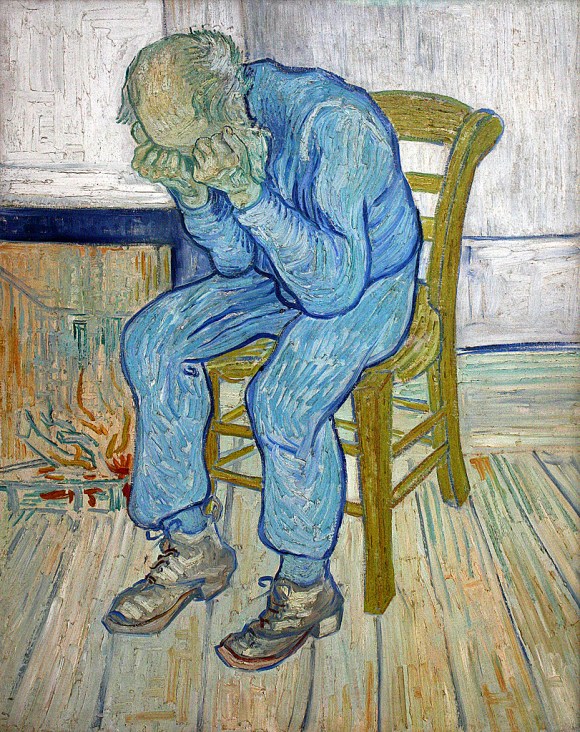
Painting by Vincent Van Gogh (1853-1890)
Craig Kirchner thinks of poetry as hobo art, loves storytelling. He has had two poems nominated for the Pushcart, and has a book of poetry, Roomful of Navels.
PLEASE NOTE: ARTICLES CAN ONLY BE REPRODUCED IN OTHER SITES WITH DUE ACKNOWLEDGEMENT TO BORDERLESS JOURNAL
“Limitless and immortal, the waters are the beginning and end of all things on earth.” -- Heinrich Zimmer, German Indologist and linguist
Little Varshita has an inborn affinity for proximity to water bodies. A June-born Cancerian, she eagerly looks forward to short walks along the Marina Beach in Chennai – the second-largest urban beach in the world. Five-and-a-half years old now, she is a prodigy eagerly looking forward to starting school next year. Whether her genius owes itself to nature or nurture or both, is difficult to say. It can be mentioned here that both her parents are teachers. She also possesses a very high emotional intelligence for her age. Perhaps there is a connection here to the aforementioned affinity for proximity to water bodies. Perhaps not.
“We were there two days ago, Varshita. Can we go tomorrow instead?” Her father Ramesh who wants to watch a cricket match on television at home, smilingly attempts to dissuade her.
“Okay, no problem, Appa. Can I watch Animal Planet then this evening? If they show fish and crabs and whales and sharks and dolphins and orcas and octopuses and squids and seals and penguins….and….my-aunties?”
“Your aunties? Are Periyamma[2] and Aththai[3] going to be seen swimming, on Animal Planet?” Ramesh asks with a wink and a smile, eagerly expecting a response from Varshita.
“Noooo…M.A.N.A.T.E.E.S…” She hurls a pillow playfully at Ramesh, realising that he is pulling her leg.
“Ah, I see! Those creatures which are also called sea-cows.”
“Are they also called sea-cows, Appa? I did not know that. Now I do. But I knew sea-lions.” Ramesh is happy that he has invested in his daughter’s knowledge bank. Perhaps, his sister and sister-in-law are not going to be very happy if Varshita decides to share the joke with them. His sister especially does not have a sense of humour.
“Do not share this joke with your aunties, Varshita.”
“I promise, but in return you have to take me to the beach three times next week,” she says matter-of-factly.
“Done! Good girl!”
Varshita looks at Ramesh and knows that she has somehow gotten her way, tactfully. Little girls wiser than men; cleverer too, thinks Ramesh, recalling the Leo Tolstoy story about Akulya and Malasha[4], he had read in school in the ninth grade.
.
The waters of the Bay of Bengal are calm. Waves, longing for contact with the littoral sands, swoosh against the shore. Even though there are many people there on the beach, they seem to be observing silence in deference to the Sea-God. Varshita tends to speak less when out on these walks. She watches Mother Nature intently, listens carefully to Her sounds, and once in a while her curiosity leads her to ask a carefully-thought-out question. Ramesh does his best to reply, and whenever he is not able to find an answer instantly, he makes it a point to put the question on the back-burner, give it serious thought, and get back to Varshita with the answer. At times, that is even a day or two later. Once in a while, there are unanswerable questions hurled at him. Being a senior lecturer at the Indian Institute of Technology, he is used to this practice. After all, his daughter is also his student – a special one at that.
“Appa, is it okay to throw a chocolate wrapper into the water?”
“No, Varshita. It is not. One must not pollute the environment.”
“But then why are there so many things lying around here? That is bad, right?”
“Yes, it is. Very much so. But maybe, people will learn not to do so, and when you are an adult, you will see that the beach is perfectly clean.”
She looks up, nods and smiles.
“Appa, when the waves come and take all these things into the sea, what happens to them?”
“ A good question, Varshita. Many things which you see lying here are harmful to the animals which live in the water. All the animals you like seeing in the Animal Planet.”
“I will not throw anything, Appa, when I come here with you to walk.”
Ramesh and Varshita do a high-five, and Ramesh tells her that he is very proud of her.
The blue sky starts turning grey and some clouds float in. Precisely at that moment, Varshita sees a little girl with a sack on her back, and a stick in her hand, bending down and picking up a plastic bottle.
“Appa, what is she doing?”
“She is doing a very good thing. People throw things, and this little girl is collecting them, so that they do not get dragged into the sea to cause harm to the animals living in it. There are many people like her in our city. They are poor, yes. But we have to be thankful to them for what they do for us.”
It starts drizzling, and Ramesh tells Varshita that they have to head home. She keeps looking sideways at the little girl with the sack, as they walk away from the sea. Unanswered questions, for sure, start piling up in that four-and-a-half-year-old brain of hers.
.
Rains reign in Chennai for the next three days. Varshita knows that she cannot compel Ramesh to take her out to the beach for a walk. Ramesh however remembers the promise, and keeps checking the weather forecast every day. On Thursday, he tells Varshita that it is going to be sunny for four days at a stretch.
“So, can we go the beach tomorrow, the day after and the day after the day after?”
He chuckles, realising that his daughter remembers the promise in letter and spirit.
“Why are you laughing?”
“Because I am happy to go to the beach three evenings in a row with you. We must also ask Amma[5]to come along.” He winks, and they do a high-five.
“Yes, that will be fun. But Amma is afraid of the waves.”
“We will help her to get over her fear. But you must convince her to come with us.”
“Yes! I take on that challenge,” she says.
Ramesh’s wife Megha works as a school-teacher. She picks up Varshita daily from the kindergarten on her way back home from school. “Amma, are you interested in coming to the beach tomorrow evening with me and Appa?’
Megha looks at Varshita and studies the expression on her face. She realises that the last time she was out with Ramesh and her for a walk on Marina Beach, was over a month ago. She agrees.
“You do not seem really interested,” says Varshita.
Megha is taken aback. “How can you say that?”
“It is written all over your face,” Varshita says.
Megha bursts out laughing. “Well, whatever is written on my face, I will join you both tomorrow. That is a promise.”
“Yes!” Varshita does a V-sign this time.
.
Friday evening happens to be just the perfect time to be out on Marina Beach. Yes, there are some stray clouds, but they do not seem to be in a mood to discharge their content in Chennai. Some other place is destined to receive rainfall from them.
Megha, Ramesh and Varshita buy three ice-creams, and walk down closer to the shore. Megha spreads a large plastic sheet, and they sit down on it. Varshita remembers the little girl with the sack on her back she had seen on the previous weekend and starts looking around. Call it intuition or what you will, she spots her about 50 metres away. The girl spots a big plastic bottle floating on the water, but is a bit wary of the waves advancing to the shore.
“Appa, can I go and help her to retrieve that plastic bottle? I like getting my feet wet in the water.”
Megha glares at Ramesh and nods her head from left to right, signalling to him that he must not give in to Varshita’s request. Ramesh winks at Megha. “I will go with her. Do not worry.”
The father-daughter duo walks towards the girl, and Ramesh tells Varshita to go and talk to her. She is as tall as Varshita is, and may perhaps be a little older than her. Not more than six years old, for sure.
“You want to get that bottle?”
“Yes, but I am afraid of the waves.”
“I will get it for you. Wait here.”
Varshita looks at Ramesh, who gives her the thumbs-up sign. The little girl notices that and smiles.
Varshita takes off her slippers, and leaves them beside her father. “Take care of them, Captain, till I come back.”
Courtesy: G Venkatesh
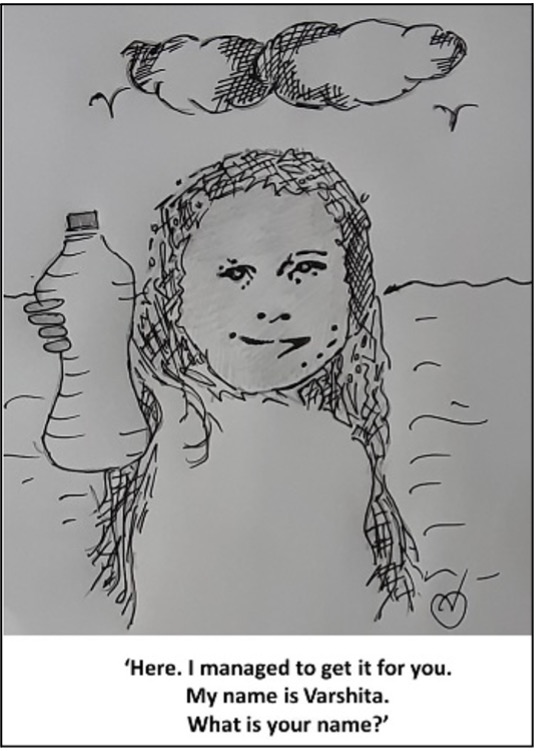
Laughing aloud, she wades two metres into the sea when the nearest incoming wave is still a few metres away. She retrieves the bottle, turns and walks up to the girl, and says, “Here. I managed to get it for you. It was easy. My name is Varshita. What is your name?”
The girl smiles gratefully, accepts the bottle, and drops it into her sack. “My name is Mary. You are not afraid of the waves, Varshita?”
“I used to be.” She points to Ramesh and continues, “Appa told me not to be. He said that we must be careful, not afraid. But you know what, Amma is still afraid.”
“You visit the beach daily, Varshita?”
“Appa and I like to walk here sometimes. I love the sea. How about you?”
Mary looks into the distance. “I do not know if I love the sea or not. I just come here to look for things like these.”
“What do you do with them? Appa says that we must be thankful to all of you who clean up the beaches. He says that you help to stop damage being done to the fish.”
Mary smiles weakly. “You see my Amma there,” she points to a woman with a bigger sack hunting for treasures, about 100 metres away. “I will give these to Amma. Then my Amma and Appa will sell these and get money. Then we buy food and eat.”
Varshita listens intently, as she always does. “You like ice-cream, Mary?”
“Yes, I ate an ice-cream long ago. On Christmas Day.”
“Wait here,” says Varshita. She runs to where Ramesh is guarding her slippers, puts them on, and runs to her mother. “Amma, can I give my ice-cream to Mary over there? I just helped her to get that plastic bottle.”
“I saw you doing that, dear. I am so proud of you. Yes, you can give her your ice-cream. It is melting away slowly. Ask her to eat it quickly.”
Varshita grabs the ice-cream cone and runs towards Mary with a cherubic smile of her face. “Here, Mary. Your second ice-cream.”
“Have you eaten?”
“I will eat Amma’s. She usually does not eat her ice-cream and ends up giving it to me.”
“Will you be coming tomorrow, Varshita?”
“Yes, that is the plan. And the day after tomorrow also.”
“At this time?”
“Yes, and you?”
“I am not sure. I go with Amma wherever she goes. If she chooses to come here, it will be at this time.”
“What is that you are wearing around your neck?” Varshita asks, pointing to the little crucifix.
“Oh, this one. This is Jesus. Our God. I got this on the same day I ate my first ice-cream.”
Mary’s mother is calling out to her from a distance. “I am so happy that you got me the bottle and then gave me your ice-cream. You are a good person. Can we be friends?”
Varshita smiles cutely, and extends her hand for a handshake. Mary reciprocates, puts her little sack on her right shoulder, holds the stick in the right hand and the ice-cream in the left, and hurriedly walks towards her mother.
“Eat the ice-cream quickly. It will melt away,” shouts Varshita.
“Yes, I will,” Mary shouts back.
.
The next day, Mary’s mother decides to take her to a stretch of the beach further away. The day after that, Varshita feels a little unwell and the trip to the beach is called off. The two girls never meet each other again in Chennai.
But as we already know, God’s ways are mysterious. Many years pass, before they meet again in Bengaluru in a public school. One in her capacity as the mother of a girl named Sarah, and the other in her capacity as Sarah’s science teacher.
Jawbone of a deer along the trail, jagged incisors winged with little points, sheath of bone damask with clay and blood.
I heard coyotes arguing with dogs last night and thought about the senselessness that can’t be helped, the cunning and cupidity of hunger, the indiscriminate
meals we stop to take. This unnamed sandy stream babbles as it doglegs around itself. A muskrat carries an apricot into the earth. The resident
blue heron lights off when it hears my footfalls on the path. Its complaint is an asthmatic, dissonant sound. It throws its shadow
on the dead ash trees whose dehisced branches rise like antlers, like trophies rooted from their little skulls
Cal Freeman is the author of Fight Songs and Poolside at the Dearborn Inn. His chapbook, Yelping the Tegmine, has just been released.
.
PLEASE NOTE: ARTICLES CAN ONLY BE REPRODUCED IN OTHER SITES WITH DUE ACKNOWLEDGEMENT TO BORDERLESS JOURNAL.
According to Australian author Frank Moorhouse, a short story is like a beautiful handmade toy — a specialised craft requiring talent, originality, creativity and skill. Not surprisingly, many of today’s successful writers have used this medium to launch their professional careers. And for good reason. Short stories have helped them hone their writing skills, develop the writing habit and inculcate a sense of discipline in their writing schedules.
Contrary to what some editors and publishers believe, there is a growing market for the short story. Modern technology has offered a tremendous boost to the short story genre. The short story today can be made accessible to readers in a much quicker time frame and at a much lower cost. With so many online magazines, it’s now cheaper to produce and distribute more short fiction than ever before. This flexibility makes it possible to download a short story on a website, on a mobile phone or on a tablet; and a short story can be read and enjoyed anywhere and anytime – during a lunch break, in a doctor’s waiting room, on a short journey or a commute, or even whilst waiting in a queue!
From the reader’s point of view there are several other advantages to a short story. One of the major strengths of the short story lies in its brevity and compactness, providing a punch that is so different from a novel. The theme of the story, the setting, the plot, the characters, the conflict, the turning point and the resolution are all contained in a short space. And it is precisely this compactness that makes this form of writing so appealing. A short story provides a quick and easy read from start to finish in a short period of time, and often in a single sitting. In the words of Neil Gaiman, “Short stories are journeys you can make to the far side of the universe and still be back in time for dinner.”
Apart from that, because of the media overload in today’s world, our attention spans are shrinking. This is why it is important to condense the message in a short and concise form that catches the attention of the reader and stimulates his curiosity. They could be a way towards inculcating the reading habit. They are great for reluctant readers, slow readers or anyone intimidated by books.
The lasting power of the short story is so well illustrated in the fact that many famous and successful films and television series were based on short stories. The Curious Case of Benjamin Button, for instance, was an award-winning film inspired by F Scott Fitzgerald short story of 1922 and released 86 years after the original story was written. Malgudi Days was made into a television serial of 54 episodes and four seasons and had become a household name in India. It was inspired by a series of 32 short stories written in 1943 by celebrated author, RK Narayan.
So if you are an aspiring young writer, the short story would be a good means of kick starting your writing career. We all have a story inside us waiting to be told. And who knows, that yet to be written masterpiece may well find its way to a block buster series on Netflix!
Saeed Ibrahim’s family saga, Twin Tales from Kutcch, and his book of short stories, The Missing Tile and Other Stories, have had successful runs both in India and overseas. He continues to write newspaper articles, travel essays and book reviews for various Indian and international publications.
.
PLEASE NOTE: ARTICLES CAN ONLY BE REPRODUCED IN OTHER SITES WITH DUE ACKNOWLEDGEMENT TO BORDERLESS JOURNAL
We live on a huge planet, a watery world, which is a small cosmos in itself.Keith Lyons discovers humanity in his local swimming pool.
In recent years, I’ve increasingly sought an elixir of life. Even though I know this magical potion won’t grant me eternal life — not even eternal youth. The elixir doesn’t even promise to cure all diseases, though it seems a lot of other people are taking this tonic as treatment for every kind of ailment.
My pursuit of this higher realm means that most days, if I am able, I take a break from work, life and the busy-ness of it all to replenish, relax, and rejuvenate. My woo-woo astrological friend reckons that because my star sign is Cancer (one of the three water signs along with Pisces and Scorpio), I am drawn to water. But then, we all need water. Water is Life. It keeps all life going – for without water, life cannot exist. As the saying goes, “No Blue – No Green.” We need water to survive, to thrive, for our hygiene, for our wellbeing, and for the ice cubes in our virgin piña colada cocktails.
When I heard about the prospect of a new swimming pool opening up nearby my home, in the dark days of the Covid-pandemic, I was doubly happy and expectant. I even turned up to the new venue before it had actually opened, when they were still finishing the build and checking all the systems worked. The local government funded facility offered not only a swimming pool, but also a point of contact for interactions with the council, and the pool was twinned with a modern library. In my mind, I imagined that it might be possible to go swimming, then to glide over to a cafe or bar to get a drink, and then to select a book to read while reclining on an in-water lounger. Could it possible? I know I had stayed at a fancy hotel with a wet bar in Macau, where the bartender served cocktails to me and a photographer as we lived our best lives — until the next morning when we didn’t feel so flash.
Water, as you may know, makes up over 70% of the Earth’s surface. Up to 60% of the human body is actually water — depending on how much fluids you’ve drunk. A cucumber is made up of around 96% water. I recall these facts from a high school science project as I push the button of the water dispenser and a half circle of cool water arcs up for me to catch as much as I can in my mouth. I’m thirsty and know I need to drink lots of fluids, as I’ve just spent the last 80 minutes exercising and soaking in warm water. And I feel like I’m dehydrated from all the exertion.
Ever since a new indoor swimming pool opened in my neighbourhood, I’ve been making the effort to go as often as I can, to move and stretch in the warm hydrotherapy pool and then relax in the even-hotter spa. It has become something of a pilgrimage for me, even on the coldest, rainy days of winter. My route there from my house goes along a new cycleway, through a park (where a dog recently tried to attack me on my bike) cuts through a local ‘secret shortcut’ beside offices and a new church, then tracks along an industrial area of factories, warehouses, and commercial premises. After 6pm, the road to the pool has little traffic, just the occasional truck and security vehicle. If road conditions, traffic and winds are favourable, I can be door-to-door in under 10 minutes. But once I enter the new complex, change into my swimming gear, and walk down the ramp of the hydrotherapy pool, time becomes less important. I change from the demands of a busy world to more me-time.
But there’s more than devoting an hour to honour and exercise one’s physical body. Moving in water offers benefits beyond the physical realm, whether one’s aim is to help the heart, the waistline or the body’s strength. Because water is a lot denser than air, water provides more resistance — around 12-14% — compared to doing the same exercises on land. That resistance assists cardio and strength training. There’s another factor for water-based activities: buoyancy. The feeling of being lighter or weightless when submerged in water means you take the pressure off bones, joints and muscles. It is the closest thing you or I might get to being in space. You don’t even need one of those NASA t-shirts with the iconic blue, red and white logo of the National Aeronautics and Space Administration.
The 1.4-metre-deep hydrotherapy pool, which is kept at 33-36C, sits alongside the traditional 25-metre swimming pool, which is kept at 26-28C. The therapeutic pool’s inclusion in the new community complex was the result of lobbying by locals, who previously had to drive across to the opposite side of the city to access a suitably warm pool.
Photo Courtesy: Keith Lyons
It has only been a few months since the pool opened, but already many come to the waters, from when it opens at 5.30am each weekday (7am weekends) to when the last are forced to leave at 9.30pm (8pm in weekends). I’m more of an afternoon and evening swimmer, preferring to go to the pool after work or at the end of the day. Some attend the twice-a-week gentle exercise class, where the average age is 65+. Others visit almost every day at nearly the same time.
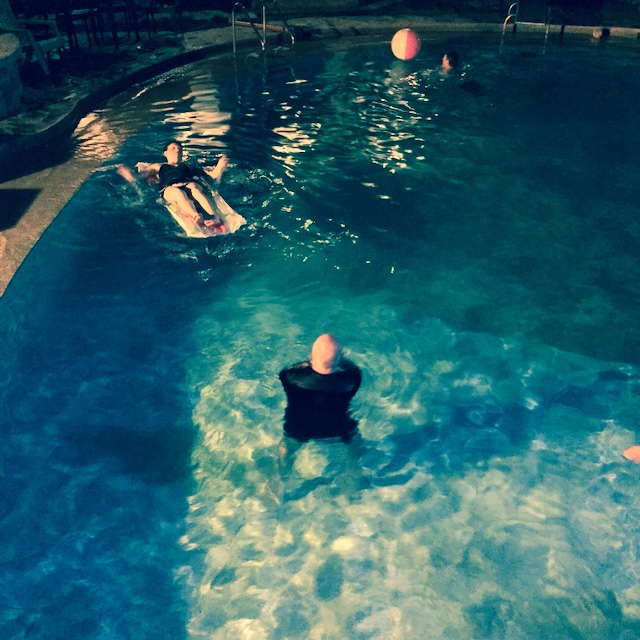
Some arrive in wheelchairs, pushing walking frames, or hobbling on crutches. Others walk from the changing rooms to the water smiling expectantly as they pace towards the transformative pool. At mid-morning, with the light from the wall-to-ceiling windows slanting across the pool, it could easily be a scene from the 1985 movie, Cocoon, where the retirement home pool helped them rediscover their youth (it was full of aliens). If you had to paint the scene, there would be a lot of blue hues, along with off-white and grey tones, with silvery reflections off the water.
While some exercise by themselves, focusing on their routines, the set prescribed by their physiotherapist, or whatever takes their fancy, for many it is also a social time, as they aqua jog up and down the lengths, or stand at the sides doing calisthenics. If you listen carefully over the music soundtrack of upbeat, positive songs playing over the public speakers, you can hear the water gushing and flowing. It bubbles up from the floor of the pool. Jets roll in from the sides of the hydrotherapy pool. In the spa pool, there’s a force field strategically placed around the pool. Modern water treatment means there’s no smell of chlorine.
The pool is a very tactile, sensual in-body experience. It is also somewhat humbling. Patrons must change into suitable bathing costumes, which can be as skimpy and revealing as bikinis and togs, though some prefer full body covering for modesty or self-perceptions. The water in the hydrotherapy pool is so warm that there’s never any hesitation on entering. People are only limited by the speed at which they can move from the air environment to the watery world of buoyancy and drag.
My local swimming pool is a microcosm of the wider community, and the big wide world. As where I live has experienced significant migration in recent decades, it is certainly a diverse multi-national cross-section of the community. Chinese are the largest group, with a swim school, coached sometimes in Mandarin, operating most weeknights. There are also families from the Philippines, a group of learn-to-swimmers from Nepal, and occasionally a non-swimmer from India who needs to be rescued from the deep end of the main pool by lifeguards. On one afternoon and evening, the whole pool becomes ‘women-only’, with the blinds drawn so women can use the pools without the glare of men. With more refugees from other countries now making up our neighbourhood, there are often people from Afghanistan, Eritrea, Kurdistan, Ethiopia, Somalia and Bhutan venturing into the pools for the first time.
Is the swimming pool I go to special? Can such a multi-sensory, multi-cultural, relaxing-yet-reviving experience only be found in my swimming pool? Nope. Seek out a public swimming pool in your area and discover another world.
Photo Courtesy: Keith Lyons
.
Keith Lyons (keithlyons.net) is an award-winning writer and creative writing mentor originally from New Zealand who has spent a quarter of his existence living and working in Asia including southwest China, Myanmar and Bali. His Venn diagram of happiness features the aroma of freshly-roasted coffee, the negative ions of the natural world including moving water, and connecting with others in meaningful ways. A Contributing Editor on Borderless journal’sEditorial Board, his work has appeared in Borderless since its early days, and his writing featured in the anthology Monalisa No Longer Smiles.
.
PLEASE NOTE: ARTICLES CAN ONLY BE REPRODUCED IN OTHER SITES WITH DUE ACKNOWLEDGEMENT TO BORDERLESS JOURNAL.
              I
What is this strange apparition
shining in the morning mist?
Glimpsed through a thin line of trees
it appears like a magical palace;
yet with its spiral towers, its great walls,
like battlements, it seems more than that;
like a castle outpost, stranded
somewhere on the Russian Steppes.
The mist hangs a few feet above
the ground, and, through the mist,
shafts of sunlight pierce the grass,
where a layer of frost sparkles;
as if a thousand diamonds
are scattered lie.
And, in my mind's eye, now I see
a black horse emerge from the trees
on which a Cossack, robed in red,
sits proudly on the saddle.
The rider pulls hard on the reins.
A plume of smoke rises
from the horse's nostrils;
it warmly mingles with the cold of mist.
The horse is restless; hooves stamping
off the frosty ground.

            II

And, from across the field, another horse appears.
This one white; on which is mounted
a second Cossack, his blood red tunic,
splendid in the sun.
He, too, restrains his powerful steed;
tugging hard on the reins,
suppressing the animal's spirit.
There, the field gapes between them;
two hundred yards of open ground.
A sudden scrape of metal; and their keen sabres
flash menacingly in the morning light.
Gloved hands loosen on leather reins;
metal stirrups dig into the flanks
of the great horses.
They charge; each one briefly caught
in a sudden sunbeam.
Faster -- then faster still.
Pounding of hearts, surge of blood;
eye of horses and men, alike, intent on
a terrible imminence.
Sabres raised higher now, cold blades
cutting at the fleeing air.
A final glint of light.
A devilish cry rends the heart of the morning
and the clash of sabres jangles
in the mist.
Stuart MacFarlane is now semi-retired. He taught English for many years to asylum seekers in London. He has had poems published in a few online journals.
.
PLEASE NOTE: ARTICLES CAN ONLY BE REPRODUCED IN OTHER SITES WITH DUE ACKNOWLEDGEMENT TO BORDERLESS JOURNAL










 Borderless