Title: Epidemic Narratives: The Cultural Construction of Infectious Disease Outbreaks in India
Author: Dilip K. Das
Publisher: Orient BlackSwan
After the major outbreak of COVID-19 pandemic in 2020, there has been a plethora of studies about epidemic narratives in different kinds of literary and visual forms. Not that the issue had not been dealt with earlier, but somehow it increased manifold times and contends with a reality that is now increasingly becoming our way of life as new infectious diseases break out and older ones resurface almost every year. Drawing from the humanities, medicine and social sciences, and using the approach of interdisciplinary studies, this non-fiction examines stories of epidemic outbreaks in India, from the late-nineteenth century to the present, in the form of fiction, film, memoir, blogs, media reports and epidemiological accounts, to show how epidemics have been represented in social understanding.
Epidemics signify a crisis in society on multiple levels. The author, who specialises in medical humanities and has been meticulously studying and teaching courses in this area for several years, realised that very little is readily available in the nature of theoretical and analytical scholarship of epidemic narratives in general and on Indian narratives in particular and so he decided to write this book.
Divided into ten chapters, the study attempts a close textual analysis and focuses on the subjective experience of people affected by the outbreak. This ranges from the emotional impact of the suffering it causes to socio-political conflicts that it brings to the fore as a collective crisis. It poses two questions: what kind of plot do they employ, and what significances do they attribute to outbreaks as complex human events?
In the first chapter, the author discusses the social understanding of epidemics using a theoretical framework drawing on Charles Rosenberg and several other theorists to show how this understanding both derives from and adds to the biomedical view of disease. It examines how, in pluralistic societies, epidemic reality is constructed through both biomedical and cosmological paradigms, leading to contrary ways of responding to it. Thus, worshipping goddesses like Sitala Mata or Corona Devi and ritualising the event in shows of solidarity exists along with scientific perspectives.
The second chapter is about the impact of pandemic on the nation as a community that imagines itself as healthy yet is vulnerable to the threat posed by pathogens and pathogenic outsiders. The COVID-19 pandemic has made it clear that the future of public health in a rapidly globalizing context depends on how nationalism and internationalism balance mutual interests. Chapters three to ten deal with specific outbreaks. The third chapter discusses two intertextual narratives of the plague outbreak Pune in 1897 which culminated in the assassination of the Plague Commissioner Walter Charles Rand. The first is the autobiography of Damodar Hari Chapekar, who was convicted and hanged for the assassination. It shows how the outbreak was constructed and framed as a political event, marking the emergence of militant nationalism and anticipating the freedom struggle. The second narrative is 22 July 1897, a film made on the same incident by Nachiket and Jayoo Patwardhan.
U. R. Ananthamurthy’s novel Samskara1is usually studied as a text that deals with the themes of caste and religious orthodoxy, the role of tradition in a modernising society, and the tension between allegory and realism. In the next chapter, Das argues that plague not only provides the inspiration for the novel and its point of departure but also serves the function of a focaliser. Samskara is about the question of social order, how a particular code of conduct becomes rigid. In this context the plague outbreak serves as a metaphor for larger social and ethical crises.
Chapter five is about Spanish flu, which broke out in Bombay in June 1918 and was rapidly carried to the rest of the country by soldiers returning from the First World War. It begins with two official reports on the flu by the assistant health officer of Bombay municipality and the sanitary commissioner of India. The author examines newspaper accounts of the outbreak and two literary narratives to show how the outbreak was variously framed as a lapse of colonial public health, a personal tragedy and a cosmological crisis. The final section of the chapter discusses the memory of the Spanish flu a hundred years later with the outbreak of COVID-19.
Chapter six deals with an outbreak of viral hepatitis, a disease that is largely endemic but has occurred intermittently in epidemic form in India in the last hundred years. The author analyses Satyajit Ray’s 1990 film Ganashatru, an adaptation of Henrick Ibsen’s An Enemy of the People, which is about an outbreak of infectious hepatitis in a pilgrimage town in West Bengal. Taking the main theme of asserting commitment to ethics as against manipulation of truth for personal gain, Ray changes the plot, characterisation and context of Ibsen’s story to criticise religious dogma which contradicts rationality and places at risk the health of people.
The next chapter analyses narratives of the HIV/AIDS epidemic which broke out in India in 1986. It examines a range of media articles, literary and cinematic texts and an AIDS awareness video to track changes in the social understanding of the disease and those affected by it. From the stigmatising accounts of risk groups and HIV-positive individuals that was characteristic of the early decades of the epidemic in India, the focus shifted at the turn of the century to empathy for them. The author discusses in details the first commercially released Hindi film on AIDS, Naya Zaher (New Poison,1991) directed by Jyoti Sarup, mentions two human interest stories like Ritu Sarin’s ‘The Outcast’ (1990) and Subhash Mishra’s ‘Damned to Death’ (2000), analyzes a film like Ek Alag Mausam ( A Different Season, 2003) directed by K. P. Sasi, Negar Akhavi’s anthology AIDS Sutra (2008), and Kalpana Jain’s Positive Lives (2002) where the author journeys more than 15,000 kilometers in four months in order to get an idea of the epidemic’ s scale. He also analyses movies like Phir Milenge ( We’ll meet again, 2004) directed by Revathy and Onir’s My Brother…Nikhil(2005) and examines the dialectical relation between social understanding and narrative in bringing about this change.
Aashique Abu’s Malayalam film, Virus, is a fictional reconstruction of the outbreak of the Nipah virus disease in Kerala in the summer of 2018 and deals with biomedical explanations as well as accounts of personal suffering. The eighth chapter therefore shows how the film constructs the event as the disintegration and renewal of community and as a sign of the vulnerability of human life. It also shows how the ending denies any assurance that the crisis is over and will not recur.
The recent outbreak of COVID-19 in India that resulted in a nationwide lockdown in 2020 forms the subject of the next chapter. It discusses stories of the pandemic and the lockdown in terms of the suffering they caused, the loneliness, disruption of everyday life, time-space disorientation, loss of life and livelihood, the lack of institutional support, and the precariousness that resulted from all of these. It focuses on two kinds of stories, those of personal suffering like the video Infected 2030 and the Times of India blog ‘My Covid Story’, and those of collective suffering like Vinod Kapri’s documentary 1232 KMS and the book that followed from it, 1232 km: The Long Journey Home. The lockdown following the COVID outbreak in India disproportionately affected migrant workers who lost livelihoods and were prevented by the police and the local administration from returning to the safety of their villages. The author clearly analyses how the governments were unable to deal effectively with so complex a crisis.
The last chapter attempts to explain why narrative is the genre best suited to represent the experience of epidemic, and why epidemic in turn calls forth narrative as its most suitable mode of representation. We make sense of an outbreak in two ways, as an objective event and as subjective human experience. Narratives bring out both these dimensions, by emphasising emotional responses to disease, death and suffering as well as making cognitive sense of it. The book also contains an interesting epilogue by S. Mukundan who examines a narrative poem Plague Sindhu (1924) by Anthony Pillai recording the outbreak of plague in his home district of Theni in Madras Presidency. The poem is an apt example of how an outbreak of infectious disease comes to be socially constructed in terms of both modern scientific ideas of disease-causation and traditional ideas of disease as divine punishment for wrongdoing.
As mentioned earlier Epidemic Narratives takes as its main theme Charles Rosenberg’s argument that the social reality of disease is constituted in the frames of explanation provided by biomedical, political, cultural and social ideals and practices. Das mentions that the book is about “human suffering and compassion” and it will be of interest to researchers and students of literature, cultural studies, the history of medicine and public health policy.
.
Translates to ‘A Rite for a Dead Man’, a Kannada novel written in 1965 ↩︎
Somdatta Mandal, critic and translator, is a former Professor of English at Visva Bharati, Santiniketan.
PLEASE NOTE: ARTICLES CAN ONLY BE REPRODUCED IN OTHER SITES WITH DUE ACKNOWLEDGEMENT TO BORDERLESS JOURNAL
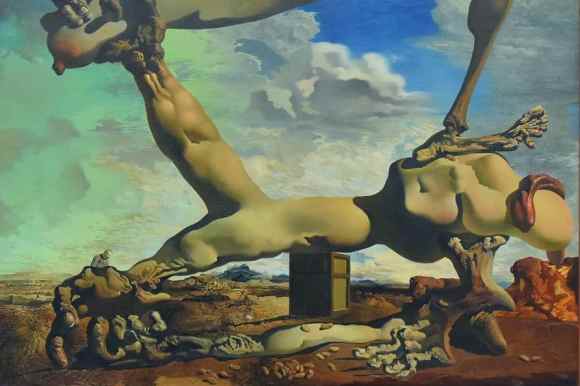
Art by Salvador Dali(1904-1989) From Public Domain
BEHIND BARS

I write about what I see…

If you don’t want me to see it
Close the TV channels down

I write about what I see…

If you don’t want me to scroll up and down
Close the internet down

I write about what I hear…

If you don’t want me to listen
Put all the people behind bars

Though I fear, the truth
	May slip through the cracks


COME BACK THE COUNTRY I LOVE

Come back the country I love
Come back and put
Food on my table

Come back and bring me
Peace and Love

No one is excluded
 and I belong here again

Not trembling over words
Or the bang at the door

It is you who don’t belong here
anymore


Come back
Come back
 the country I love

THIS IS HAPPENING

This is not happening
This you can’t see
The prison cells are filling
Whilst you digest the lies on TV

This is not happening
This you can’t see

You play deaf dumb and blind
Until you see

This is happening
This you can see
Your brother your mother your father
Taken away
Live on TV

CHEERING YOUR GENOCIDE

Every time I let the tap run, I feel guilty
Every time I fill my belly, I turn away from the screen
Every time the key clicks to my door, I can open and walk around
But you and yours are raised to the ground,
No guilt from those who cheer on your genocide.


DEAD SOUL

There is no limit
Because babies are still born
And each by being alive is dead

The last straw a family of nine wiped off this earth

But there are fields and fields of such dead souls.

SOMEONE IS KILLED

Everyday someone is Killed on your street. . .
No one says or does anything to help . . .

It’s not your street. . .
But everyday someone is killed on a Gaza Street
A human being just like you and me.
David R Mellor is from Liverpool, England. He spent his late teens homeless on Merseyside. He is currently writing and performing in Turkey. His work has been featured by the BBC and the Tate, and his published collections of poetry are What a Catch (2012, Some Body (2014), Express Nothing (2019) and So This Is It (2020). His collection of stories An Englishman in Turkey (Turkiye’De Bir Ingililiz) has recently been published .
.
PLEASE NOTE: ARTICLES CAN ONLY BE REPRODUCED IN OTHER SITES WITH DUE ACKNOWLEDGEMENT TO BORDERLESS JOURNAL
Nico hurried off the steamer at Burgaz Island, oblivious of the swarming passengers disembarking and embarking. How long had it been since he had stepped foot on the island of his grandfather’s birth: twelve … thirteen years ? He made a bee-line for the central plaza. There he still stood, Saït Faïk, ever so thoughtful, leaning against that eternal tree. Nico approached the Turkish poet –Grandpa would have been so delighted to be here with us again. I’m sure he would have asked you about the talking seaweed and weeping mussels, Nico mused.
Vasiliki had passed away six years ago, a natural death, probably in his sleep. The old fisherman had asked Nico to have him buried between his wife, Nefeli, and daughter, Myrto, which he dutifully accomplished. Since the adolescent was the sole inheritor, he sold his grandfather’s little house for a good price, which permitted him to live comfortably in Athens while completing his university studies. Indeed, because he was parentless, and because his grades in grammar school were excellent, Nico had qualified for a scholarship. The ambitious student, thus, enjoyed financial ease to continue studying several more years for his doctorate. He excelled in Greek language and literature, French and English philology, in European History. At nights he read and spoke Turkish with several Turkish friends, for the vision of returning to Burgaz stole upon him like those perfumed nights on Burgaz with his grandfather as they contemplated the star-studded sky. That seemed so long ago …
Once his doctoral thesis defended, Nico left Greece and set off for Burgaz, off on an adventure. Poetry had been a major part of his thesis, and he had written quite a few poems, contributing to the university Literary Club’s weekly journal. Some of his poems and short stories caught the eye of an editor in Athens who had them published in a widespread monthly magazine. Soon he was invited to poetry readings and story-telling jousts, and because of these eventful evenings his circle of readers widened like concentric ripples in a pool of water after a rock had been thrown in …
The young poet left Athens not knowing exactly what Destiny held for him … nor what drove him so powerfully to return to the island. Was it because of his love for his grandfather ? His fascination for Saït Faïk? Or both? Saïk’s provided him with inexhaustible inspiration. Perhaps, too, it was the mystery of Burgaz of which his grandfather had so oftentimes spoke. Yes. It might have been that.
The horse-drawn carriage pulled up in front of the long flight of stairs to Zorba’s ‘humble’ home. Nico paid and began to ascend the worn-out mossy steps. Nothing had changed as the fretted gable slowly loomed in front of him. The perfumed scent of azaleas, roses, honeysuckles and pomegranate stirred distant memories. He had written to Zorba about his project to spend some time on Burgaz, and the good merchant, although away for several months in the United States on business, insisted that the young poet stay as long as he wished in his ‘humble’ home. He would be greeted and well-fed by his trusty maid, Zelda.
On hearing carriage bells Zelda rushed out, waiting for the ascending Nico arms akimbo. He dropped his knapsack, shoulder-bag and hugged the good woman. Speaking Greek had been her wont when Nico accompanied his grandfather years ago, but now, since the young man had decided to sojourn in Burgaz, she spoke to him in Turkish. Zelda was pleasantly surprised to hear him reply quite readily in Turkish. In fact, Zelda would prove an excellent tutor for Nico. Her grammar was excellent and her accent easy to understand.
So, after a solid diner, exhausted after a long day of travelling, Nico once again trudged up the steps of the floating stairway, the tinkling sound of the fountain below tickling his ears, opened the door to the room he knew so well with its frescoed ceiling of Greek heroes and large bay window looking out upon the darkened forests and the Marmara Sea. He washed and before drifting off to sleep, read a few chapters from Homer’s Odeyssus, which he always carried with him when ‘on the road’, and several paragraphs from Saït Faïk’s Son Kuşlar (Last Birds), underlining the words he couldn’t understand.
Up early the next morning, Zelda had prepared a breakfast of black olives, goat’s cheese, hard-boiled eggs, bread, butter, rose jam and black tea. She had gone to the local market (it was Tuesday) and would not be back before eleven.
Dressed lightly — the weather was very warm, Nico sauntered down the same long and winding path through the wooded slope that led to the stony beach, hoping Abi Din Bey would still be serving grilled-cheese sandwiches, and spouting poetry for his customers. How the brisk island breeze of the sea swept away the cobs of lingering doubt in Nico’s mind as he descended — doubts that had tortured him because his grandfather would no longer be at his side, physically. Yet, when he stepped upon the beach these doubts evaporated. Vasiliki was there and would always be there. He spotted several fishing boats out at sea. Had Nico built a new boat with the help of his grandfather? Indeed he had. It was the biggest and most beautiful of all his boats! Much bigger than the Nefeli which was still in route towards China. But this wonderful boat would not be launched into the leaden seas: it lay housed in a small museum in Hydra where it can be admired by both the young and the old. In fact, Nico even won an award for that marvellous construction. He had named her Myrto in memory of his grandfather’s daughter. The tombstone engraver, on Nico’s behest, carved the silhouette of his boat on Vasiliki’s gravestone.
Abi Din Bey’s welcoming gate had been sealed! The homely front gardens lay desolate, the trees devoid of fruit, clusters of weed and couch grass grew wild. The poet’s house, albeit perfectly intact, exhaled an odour of negligence. Nico stared at this bleak scene, his heart growing heavy. It had never occurred to him that Abi Din Bey would not come rushing out to greet him. That this solitary man was mortal like all other human beings … like his grandfather. He felt like a child who believes his or her parents immortal out of love for them.
From behind a middle-aged man walked up to him: “Abi Din died about ten or eleven years ago,” he began in a soft voice in broken Turkish. “He has no inheritors, so his house stands derelict and abandoned.”
Nico, snapped out of his despondency, eyed the stranger with mixed emotions. “What of his poetry?”
“Abi Din’s life of a poet held absolutely no interest for most who prefer to live in a cloud of unknowing. Abi Din Bey wrote some excellent poems, but alas no one had ears to listen to them.”
“We listened to them,” remonstrated Nico, though rather lamely.
“I know you did, you and your grandfather, Vasiliki.”
Nico reeled back as if struck by a blow. “How do you know … Who are you?”
“Oh, who I am makes no difference to anyone. But if you insist. I am the pilgrim of the heart, I voyage throughout the world admiring its marvels, an idler preaching the blessings of uselessness. Abi Din was one of those marvels, one of those brilliantly elevated idlers.” With those words, the stranger turned to leave.
Nico caught him by an arm: “Sir, where is the old man who piled up stones on the beach ? I haven’t seen him.”
“Nor will you ever see him again. Gone too, and some say that he recited several passages from Saït Faïk’s Son Kuşlar on his dying breath. Have you read Saït Faïk?”
Overcome by all these converging threads of some hidden or latent fabric beyond his grasp or comprehension, Nico could only stutter: “Well … yes … in fact…”
The other interrupted: “Listen, if you want to pay respects towards Abi Din and Saït, you should buy his house. It’s not very expensive.”
“But you …” The unnamed pilgrim put up a hand.
“I have no possessions. That is my first life principle. I idle my way through countries, people and books like a phantom. You buy it, my friend. Buy it before either Time brings about its ruin or the Burgaz municipality its demolition. For now, there are no plans to do either. It’s a mystery why that quaint house has not caught the eye of some eager artist.” And he gave Nico a wink.
“Mystery?” A sudden bout of remorse paralysed Nico. Had his grandfather not spoken of a mystery on Burgaz?
“Yes, mystery! Isn’t that why you’ve returned?” With that last question left unanswered by a flummoxed Nico, the pilgrim strolled away along the beach, chanting some sea-faring tune.
When Nico came to his senses he literally jumped for joy. he would buy Abi Din’s house, settle on Burgaz and pursue his artistic life simply, wholeheartedly. He could become a resident of Turkey merely by depositing enough money in the Osmanlı Bankası[1]. The anonymous figure of the pilgrim had since vanished into a haze of blue. Nico ran up the winding path to Zorba’s home, where Zelda had been preparing lunch. Excitedly he explained his project. She thought it a smashing idea, and promised to help him with the paper work. They ate, had their coffee, and at two o’clock walked to the crossroads, hailed a carriage and rode to the Town Hall, a majestic, white-washed villa near the centre of town.
On the way, Nico asked Zelda whether or not she knew of a middle-aged man who walked about the island, idling his way here and there. Zelda giggled: “Oh yes, him. The Turks call him Mister başı boş[2]and the Greeks tempelis[3].”
“But he’s far from empty-headed,” remonstrated Nico.
“I’m sure he isn’t, that’s why I call him ‘aylak‘.”
“I don’t know the word.”
“Someone who idles about without any definite destination.” Nico nodded, puzzled none the less at these attributes of a person who seemed quite ‘full-headed’ to him …
The irksome formalities to purchase Abi Din’s house would fill a book. Suffice it to report that in two weeks the house belonged to Nico, once he had deposited enough money in the bank, and of course, bought the house in cash …
Although Nico now spent most of his time in his acquired house, he always ate lunch with Zelda at Zorba’s house, and sometimes dinner. It must be recorded here that Nico was better versed in writing stories than in culinary skills.
Every morning after breakfasting, Nico would roam the hilltops of Burgaz sauntering cheerfully along the dirt paths, jotting down in his little notebook details that caught his eye or thoughts that scudded across his mind. The island air intoxicated him as he conjured up characters and events for future stories or poems.
On Sundays, Nico would attend services at St John’s Greek cathedral, there mingling with the small community members who had taken a liking to this young man, calling him their ‘island writer’! He became a novelty for the islanders, who invited him dine or to read his creations. Meanwhile, several of Nico’s short stories and poems were being published in Athens by his editor and were read by the Greek community in Burgaz. Nico even attempted to write poems and stories in Turkish which Zelda not only corrected, but suggested a more fitting word or subtle syntax structure.
Once a month, Nico took the steamer to Heybeliada, or in Greek, Chalki[4], the third of the four Princess Islands where he was fortunate enough to consult the books at the library of the massive Greek Theological Centre, opened in 1844 for seminarists but closed by the Turkish authorities in 1971. Although prohibited, Nico’s reputation, which had spread to all the islands, allowed him to study at the library, the second largest religious library in the western world, several million tomes behind the Vatican’s. The young artist even managed to work two days a week there. How he managed that remains a mystery.
Once or twice a month, accompanied by Zelda, Nico would go to Büyükada (Big Island) called ‘Prinkipo’ in Greek because it is the largest island of the four, and stroll along a tarred road to contemplate the largest wooden building in Europe, a former Greek orphanage, built by the French in 1898. The Greeks bought it and children who had lost their parents were lodged here until its forced closing in 1964. This eerie-looking structure remained intact. Surrounded by high barb-wire fencing and guarded by savage dogs, no one could enter it. Every time Nico stood before this ominous edifice, he thought of his grandfather who had salvaged him from such a parentless fate. Perhaps, the children here were well taken care of…
One day as Nico sauntered along one of the myriad paths in the wooded hills of Burgaz he came face to face with the idling pilgrim. So delighted was Nico to meet this eccentric character that he began to pour out all the good news that had occurred to him since their last encounter many months ago. The other smiled kindly: “No need to repeat what many have already told me,” he stated indifferently. “Nothing on Burgaz goes unnoticed, especially novelties such as yourself. I wouldn’t want to puff up your pride, but some have considered you as a new Saït Faïk.”
Nico stared at the pilgrim disconcertedly. “I can assure you, my dear friend, that you have made quite a reputation for yourself on Burgaz. And who knows, you may be able to solve the mystery of which your grandfather so often spoke.” Baffled, Nico remained speechless. The other took his arm and they strolled together downwards into the sinking sun.
Nico could not contain his surprise: “How could you know about …”
“About Vasiliki’s mystery? Ah, that would entail hours of explanation, Nico. For now let us discuss your writings, for the intention behind those writings may have given you the key to unlock the mystery.”
The pilgrim paused sniffing the pine- and spruce-scented air. “You know, many writers have lost touch with reality, or have been completely overwhelmed by it. They seem incapable of telling a story, transmitting the joys and sorrows of their characters whose traits lie deep in their own hearts, imprisoned like birds in a cage, fluttering frantically, unable to express the Truth of what lies beneath the masks and costumes. Saït Faïk, Edgar Poe, Dino Buzzati[5], Guy de Maupassant[6], Somerset Maugham, Katherine Mansfield all drew their inspiration from fragments of a separate reality, the glints of a deflected flood of light, the shards of a broken vase to disclose the experiences of their characters, to bestow upon their readers the amalgamated emotions that flew freely from their hearts. Their stories and poems are not talk-of-the-day productions. They were derived from the unlocking of the cage, the flight outwards into the battlefield between joy and sorrow. You would think that their eyes were turned both inwards and outwards at the same time. There is something powerful, even sacred, if I may use that word, in their narrated experiences, which does not necessarily entail the use of I, nor does it insinuate a ‘message’ to be harnassed or brought into line by the opinionated or bigoted. The syntax rhythms and word combinations expose the élan or the coming and going between the inward and the outward regard … I discern in your regard that inward and outward alternating vision, the aura that enhaloes your stories and poems. But mind you, this is only an idler’s perception.”
“What do you mean by aura?” Nico, crimsoning under the weight of so many complex compliments, managed to ask, almost out of breath.
“The halo of tradition that all sincere writing bears,” came the succinct reply. “A poem or a short-story, as in your case, bears an aura familiar to the reader, yet whose tale and expression of this tale transports him or her to strange, unfamiliar places. This is especially noticeable in your Turkish writings, an uncanny concoction of familiarity and eeriness. Perhaps it’s due to Zelda’s mixed origins.”
Nico stopped in his tracks, a blank look on his face. “Yes, Zelda, who, when we cross paths, addresses me as the ‘aylak‘. Her father was a remarkable writer and professor of philosophy in Greece and in Turkey. She inherited much of his wisdom as well as her mother’s strong character.” Nico stood stunned by this revelation.
“Zelda is only …”
“Only what, my friend ? Zorba’s maid or servant ? Ah ! I see you haven’t delved deep enough into the hearts of those who are very close to you. I’ve noted, too, that you have never written one line or verse about your deceased grandfather.”
Nico, stung to the quick by the very truth of that remark, bowed his head. He felt a surging wave of shame, and on this billowing wave rode an undulating image of a squealing seal that he and his grandfather had admired on their fishing adventure — an image gradually over-shadowed by another, more fuzzy, the stiffening body of a seagull on a pebbly shore near the mouth of a cavern.
The mild voice of his companion brought back these troubling scenes: “When all is said and done you will surely open wider the cage and let fly the encaged birds towards brighter poetic heights. Heights that perhaps you have yet to imagine.” With those comforting but enigmatic words the pilgrim turned to leave. He halted and asked: “Tell me, have you been to Granada?”
“Granada, Spain? No I haven’t, why?”
“You look like someone I met there.” The idler disappeared downwards into the crimson glint of sunset.
Nico ran back to Zorba’s house, undecided whether to speak to Zelda about her family. He never dreamed of broaching the subject to her as she herself had never bought up.
When the young writer had lumbered up those mossy steps he found Zelda seated on an armchair in the corner of the dining room, a shadow of gloom etched on her face. Her eyes were red. Wordlessly, she handed him a letter. It was written in faulty Greek, addressed to Zelda from an associate of Zorba’s in New York. A moment later Nico looked at Zelda with deep compassion. Zorba had died of a heart attack. His body would be sent to Burgaz for burial, accompanied by several of his associates who intended to buy his house.
“What will happen to me?” were Zelda’s first strained words. “I refuse to live in the same house with strangers even if they are Zorba’s associates.”
“Have you any family, Zelda? Anywhere to go? Anyone to help you financially?” She nodded in the negative to all these questions.
Nico sat down beside her: “Listen Zelda, come live with me, it’s a bit cramped, but at least you will have a roof over your head, food on the table, and a good friend who will always be at your side.”
Zelda dried her eyes and stared at Nico in embarrassment.
“I’m old enough to be your mother,” she said faintly.
“Exactly!” responded Nico excitedly. “You shall be the mother I hardly ever knew, in the same way that the presence of Abi Din in his house has been the father I hardly ever knew. How my grandfather would rejoice at that family reunion, however surreal, if I may say so.” Zelda smiled.
And with that acquiescing smile the two orphaned destinies appeared to converge into one …
[1] The biggest bank of Turkey at the time of Nico’s arrival specializing in international transactions. (Ottoman Bank).
Paul Mirabile is a retired professor of philology now living in France. He has published mostly academic works centred on philology, history, pedagogy and religion. He has also published stories of his travels throughout Asia, where he spent thirty years.
.
PLEASE NOTE: ARTICLES CAN ONLY BE REPRODUCED IN OTHER SITES WITH DUE ACKNOWLEDGEMENT TO BORDERLESS JOURNAL
I sit at the altar, my hands clasped for a prayer, but they bleed. There is a chapel in my throat, but all the hymns I want to sing bristle my throat.
By thirteen, I wrote odes to fawns. By sixteen, I kissed a razor and called it my Saviour. By twenty-five, I no longer dog ear my books for they bleed. So, I kiss them goodnight before I sleep. Out of guilt, I no longer pray. Redemption lies beyond.
Sometimes, I dream of Plath and she tells me: Write till it kills you wholly. So, I lay awake, my soul yearns to be heard.
The pen or knife, sinner or saint— contradictions lie in me and I cannot breathe. Half Plath, half prayer; one hand holds a light, the other holds a rosary. Paralysed by the ghosts of the past, I do not know what I'll hold next.
THE GRAMMAR OF WOUNDS
My mother corrects my Urdu, as if it were a wound I should have known how to clean. Little does she know that it remains like a broken record. It is on repeat…
To her, it is silk on tongue, gliding effortlessly. To me, it is a thorn, every word bleeds. It is a torn hem I keep stitching wrong. Her tongue folds while mine cracks, like the ruins of Mohenjo Daro. Specks of my identity forever lost in time, I speak in syllables that ghosts cannot recognise.
Each correction is a reminder that I no longer reside in my own body. The symphonies morph into a no man’s language, this remains my swan song. Yet I write relentlessly till my fingers blister.
One day, I’ll know how to write, knowing what I bled was not in vain. I will soon speak Urdu correctly as resilience.
Momina Raza is a writer from Lahore, Pakistan. She writes about ghosts that speak in broken tongues and love that doesn’t stay buried. When not obsessing over the texture of silence, she’s underlining sentences in Madonna in a Fur Coat and wondering if ghosts speak Urdu. You can find her on Instagram @momina17_.
PLEASE NOTE: ARTICLES CAN ONLY BE REPRODUCED IN OTHER SITES WITH DUE ACKNOWLEDGEMENT TO BORDERLESS JOURNAL
It was for the first time Karisma had entered her father’s room after he was discharged from the Amrit Hospital. He had suffered that massive paralytic stroke a month and a half back, the night on which she had announced that she had transferred her shares in the company and debentures in the name of Sunil Arya, the company’s junior partner. Doctors had little hope of any significant improvement in his condition. Karisma had engaged a couple of nurses from the hospital who worked in shifts and took care of her father. A doctor visited the house twice a week to examine his vitals.
‘How are you, father?’ Karisma asked. Her voice had a formal, indifferent note. A brief sparkle came to the eyes of the man who lay helpless in the bed. He tried desperate to move his hands that lay dead and stiff.
‘This is the last time you are seeing me father,’ she said softly. ‘I will be leaving this place. I have no idea what I am going to do but I will not return here. I have made all financial arrangements for you. Aruna aunty will see to it that you are taken care of properly as long as you are alive. There will be no lapse in your treatment.’
The man’s eyes darted around revealing how desperate he was and his lips quivered as if he struggled to speak out something but the only sound he made was a muffled groan.
‘I know what you want to say, father,’ Karisma said, a deep agony in her eyes. ‘But I cannot continue to live here now. You have to be alone. Didn’t you want to live in a palace and own heaps of wealth? I have transferred all the amount to your account and authorized Aruna aunty to do all transactions on your behalf. You have avenged the injustice done to you years ago, though I would not call it a heinous sin as you have always believed and made my poor mother believe it to be one. But what did I do to deserve the punishment you meted out to me, father? Which father would subject his daughter to such devilish exploitation? But of course, you were determined to torture your poor wife for the slip she made by punishing me, by snatching away every damn thing I loved, by utilizing me to slake your hunger for money. What a fool have I been to fall for that dirty ‘princess’ trick you played with me! I have never wanted to be a princess father. I was happy in that small tenement house, with the love of my mother. That was genuine and not fake, motivated by greed and hostility like yours. And of course, there was Ronit! My Ronit! The only silver lining behind my gloomy clouds of despair. You destroyed that too. I do not believe in the existence of a world beyond this one, or that of a hell or a heaven. Each of us has to atone his sin through a penance, through self-afflicted torments, like mother did, like I have been doing all these years. My sin was just that I had a look that constantly reminded you of the slip my mother made.’ Karisma paused for a breath and looked at the eyes that had sunken into the pale, desiccated face. A few drops of tears trickled down from the corners of the dull eyes. Karisma wiped the tears with the end of her sari. ‘There is nothing I could do to help you father.. This is your nemesis and you cannot escape it. And I give you my word father, I will not let the truth come out to the open, ever! It will always remain a secret.’
She rose to her feet and cast a long pitiful look at the inert figure, then turned and walked towards the door. A frantic but low and muffled animal howl rippled across the room, bringing her to a halt. She repressed the urge to look back and strode out of the room, breaking into a tearless, dry sobbing.
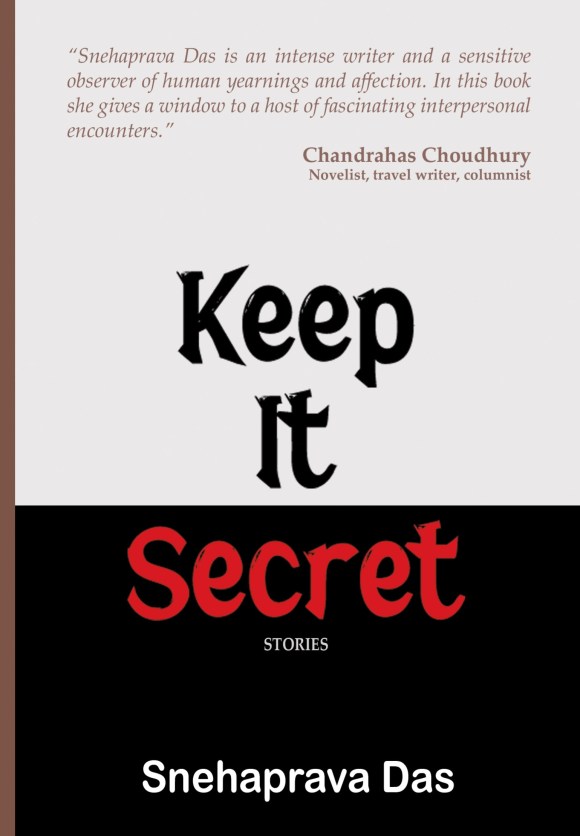
About the Book
Keep It Secret, a collection of ten stories, has in its agenda an effort to cross over the flimsy and floating border between the substance and the shadow, to explore into the jungle within, to study the secrets carefully concealed behind the mask of pretence and shamming of an agreeable and acceptable facade.
In the words of Andre Malraux, ‘Man is not what he thinks, he is what he hides.’
The aim, thus in a way, is to unravel the truth man hides and strives to protect it under a falsehood, that, at times projects, reveals itself through a behaviour pattern which may appear absurd. It intends to push aside the deceptively glossy screen of fake complacence, and traverse into that murky, elusive terrain beyond the ordinary logical perceptibility.
This excerpt is the from the title story, a tale of personal vendetta.
About the Author
Dr.Snehaprava Das, Former Prof. of English, is a noted author, poet and translator. She has three collections of English stories, five collection of English poems, and thirteen collection of Translated texts (Odia to English) to her credit. She has received The Prabashi Bhasha Sahitya Samman, The Jivanananda Das award, The Fakirmohan Anuvad Sammana and Lakshmi Narayan Mohanty translation awards for her contribution to literature.
.
PLEASE NOTE: ARTICLES CAN ONLY BE REPRODUCED IN OTHER SITES WITH DUE ACKNOWLEDGEMENT TO BORDERLESS JOURNAL
There is a marble top chest that fills the small wall to the left of the front door. It’s walked by multiple times a day, but unless you do the dusting, you forget it’s there.
Standing in front of it now waiting on Dee, I realise there is a crystal lamp and three books that stand by themselves, thick like upright bricks, no bookends, makes us look well read, haven’t looked at them in years.
There’s Texas by Michener, The Complete Short Stories of Mark Twain, and The Oxford Book of American Verse. She says she’ll be a few more minutes, this is not a rare occurrence.
I take the Oxford back to the couch and let it fall open to Mnemosyne by Trumbull Stickney. There are 1132 pages, what are the odds that it opens to Trumbull Stickney. Trumbull died at thirty of a brain tumor.
He graduated Harvard in 1895, did his doctorate at the Sorbonne on the Bhagavad Gita. Had he lived longer he would have been one of the greats, his work did not have time to mature. I’m wondering what matures the work of poetry.
Certainly, sitting in this tome at the front door, aging like fine wine, tannins have smoothed the legacy of Trumbull’s goddess of memory. During the next wait, while Dee primps, I’m going to randomly open to a short story.
I lived in Texas for three long years and saw the movie with Glenn Ford, it doesn’t hold a candle to Mark Twain, and can’t touch what is now the undying remembrance, the myth of the near greatness of Trumbull Stickney.
PALM READER
Well, let’s take a look. You haven’t had to work too hard.
I haven’t dug graves or felled trees, but I’ve always worked hard.
I didn’t mean you weren’t productive, I just meant they’re smooth, not roughened, and of course, at your age, a little pruney.
Well, now that we have that out of the way, what about the future?
First the past. You don’t anymore, but you used to bite your nails and cuticles. You have an attention deficit and an inner tension. You also have a soulmate, someone who has loved you unconditionally your whole life. That doesn’t make you exclusive, but it is rare.
Right on both counts. There are children being slaughtered and neglected. It bothers me …. a lot.
It will take time away from you. You should do what you can to step away from these thoughts and this bitterness. Find a happy place as often as possible.
Are you suggesting political ignorance would make me live longer?
No, that would not make you happy, but you dwell on not being able to do anything, and you can. You can care, as you do, you can also spend more time focusing on the good around you and less on the evil. And as we both know you have the hands of a poet.
Craig Kirchner loves storytelling. He has been nominated for the Pushcart three times, and has a book of poetry, Roomful of Navels. He’s been published in Chiron Review, The Main Street Rag, Borderless and dozens of other journals.
PLEASE NOTE: ARTICLES CAN ONLY BE REPRODUCED IN OTHER SITES WITH DUE ACKNOWLEDGEMENT TO BORDERLESS JOURNAL
Narrative by Meredith Stephens& photographs by Alan Noble
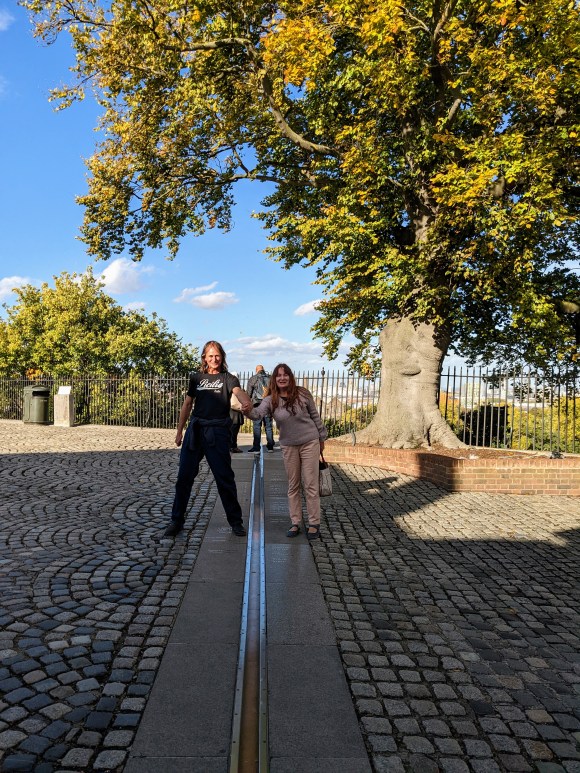
The Prime Meridian Line.
Whenever we visit another city, Alex and I always head straight for a science or maritime museum. When we spent a day in London several years ago, Alex insisted that we visit the National Maritime Museum in Greenwich, and then the Royal Observatory. The highlight of the latter was John Harrison’s marine timekeepers, which made the calculation of longitude at sea possible, therefore making navigation safer. A fun part of visiting the Observatory was standing on either side of the Prime Meridian Line, which defines zero longitude and divides the eastern and western hemispheres of the earth. If you are facing north, the person on the left is in the western hemisphere, and the person to the right is in the eastern hemisphere. We had to queue behind other couples to stand either side of the line. The couple in front of us were taking an inordinate amount of time to have their photo taken here, from which global time is calculated.
“Time’s up!” quipped someone behind us.
“What’s time?” came a philosophical comment from someone else.
The quick banter between strangers is one of the many reasons why I love visiting London.
During our short stay we devoted hardly any time to visiting any other tourist sites. The changing of the guard at Buckingham Palace held little allure. After visiting the Royal Observatory, we strolled past the historic British clipper ship “Cutty Sark” and then caught a ferry back from Greenwich to Central London. We briefly hopped off to see the Houses of Parliament, but after having visited the Royal Observatory Alex’s curiosity was sated.
Fast forward to March 2025 and we found ourselves in a remote town in Western Australia called Carnarvon. The first attraction Alex wanted to visit was the Carnarvon Space and Technology Museum. Carnarvon has a little-known relationship to Cape Canaveral in Florida. Many people have heard of Cape Canaveral and its rocket launching site, but who has heard of the not dissimilar-sounding town of Carnarvon?
Unlike the grand public museums in Western Australia, this one is self-funded and run by volunteers. NASA established a tracking station at Carnarvon in 1964, which played a critical role for both the Gemini and Apollo programs. Carnarvon was strategically located as the most distantly located site on the earth diametrically opposite from Cape Canaveral, providing the ability to track spacecraft over the Indian Ocean that were out of range from Cape Canaveral. The most famous launch was Apollo 11 in July 1969, which achieved humanity’s dream of landing humans on the Moon and safely returning them to Earth.
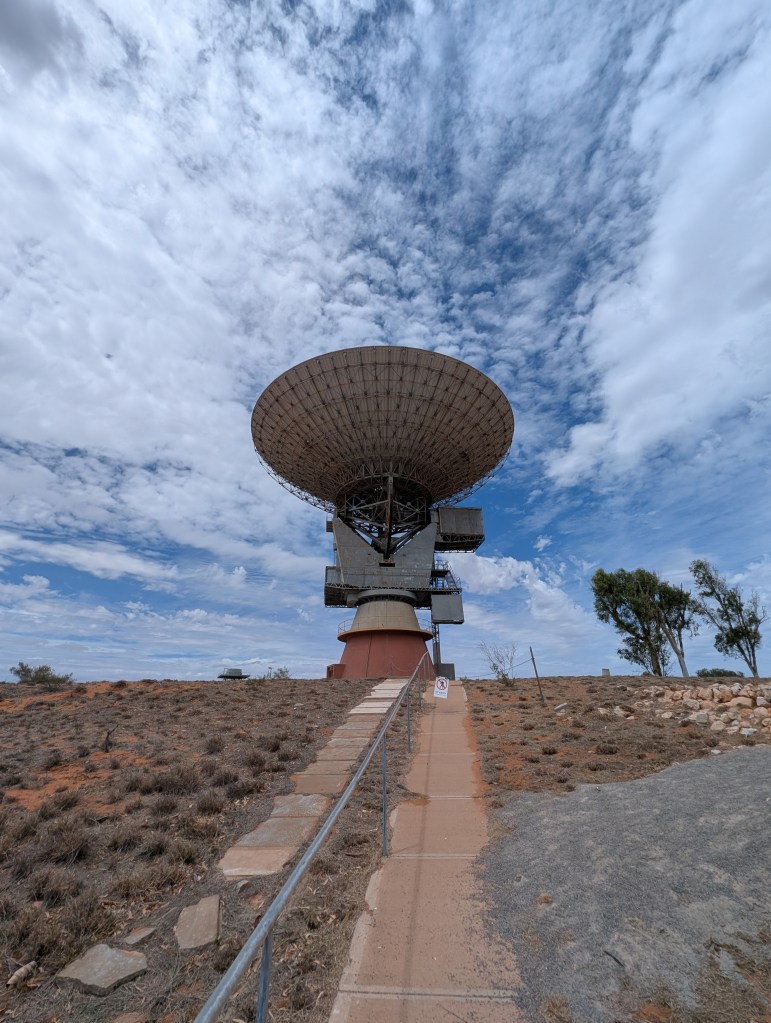
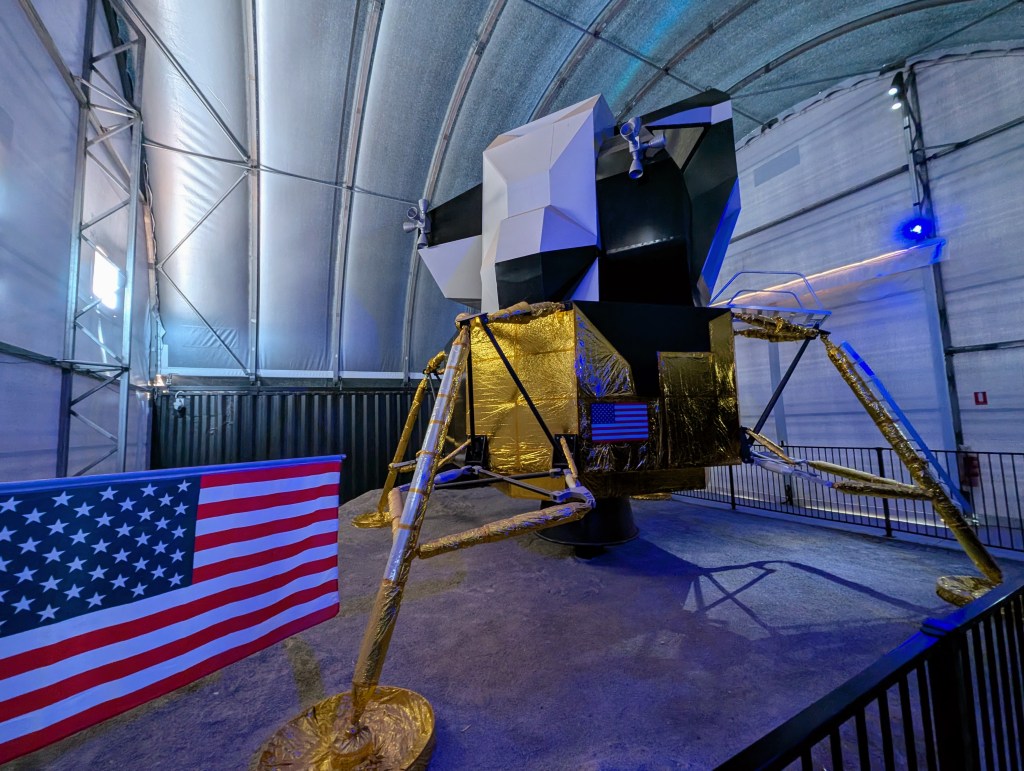
Radio Astronomy Dish Apollo 11 Lunar Lander Module (replica)Exhibits at Carnarvon Space and Technology Museum
This museum was different from public museums in that when we visited it was managed by a grey nomad couple from the east coast. (“grey nomad” is an Aussie term for retirees who embark on an extended period of travel around the country, usually in a caravan.) A resident cat curled himself into a ball proudly on the reception desk. It was the only museum we visited in Western Australia that required a fee to enter. The first experience we sought was to hop in the replica of the Apollo capsule to get a feel for the astronauts during the July 1969 launch. I was worried about a panic attack coming on in a confined space but the manager assured me that he would open the door to let me out at any time if I felt uncomfortable. We lay down with the lower half of our bodies propped up on a platform in what we hoped was an astronaut launching posture, while footage from the 1969 launch played out on the screen in front of us. Countdown on the screen was followed by lift-off. Not only did I not have a panic attack, it felt exhilarating to be transported to Cape Canaveral in 1969. Having watched this on black and white television when we were in primary school, it was all the more meaningful to watch it as adults. After touring the rest of the museum, we returned to the Apollo capsule to experience it a second time, like the space nerds we were.
We braced ourselves to face the oppressive heat as we headed outside to view the original satellite dish. Rather than languishing as ancient technology the dish has been leased to an overseas company who were upgrading it to track satellites orbiting Earth.
After viewing numerous 1960s space memorabilia, such as a replica of a Gemini capsule, which had preceded the Apollo series of capsules, and a life-sized replica of the lunar lander module, we bought some tourist T-shirts, chatted with the manager couple, and bade farewell to the resident cat. This was the most thrilling of the magnificent museums we visited in Western Australia. Thanks to Alex, we had a bias to visit maritime museums, including The WA Maritime Museum in Fremantle, The Museum of Geraldton, and The WA Shipwrecks Museum. They provided rich accounts of the many arrivals from distant lands to the west Australian shores since Dutchman Dirk Hartog’s nearby landing at Shark Bay in 1616. All visits were immensely educational and informative, but somehow the less glamorous Carnarvon Space and Technology Museum stood out. Unlike the public museums, it was somewhat ramshackle, but this was more than made up for in terms of authenticity and charm. Who would have thought that this outpost in regional Western Australia that even many Australians have not heard of, could have played such a pivotal role in the tracking of Apollo 11? This museum enjoys none of the fame of the Royal Observatory in Greenwich, but the role it played in history is just as moving.
.
Meredith Stephens is an applied linguist from South Australia. Her recent work has appeared in Syncopation Literary Journal, Continue the Voice, Micking Owl Roost blog, The Font – A Literary Journal for Language Teachers, and Mind, Brain & Education Think Tank. In 2024, her story Safari was chosen as the Editor’s Choice for the June edition of All Your Stories.
PLEASE NOTE: ARTICLES CAN ONLY BE REPRODUCED IN OTHER SITES WITH DUE ACKNOWLEDGEMENT TO BORDERLESS JOURNAL
Stuck in an absurd divide, Between truth and half-truth, I am a mirror capturing the contours Of the days that were then. Faces shift on the page of glass, Blurry, painted and plain.
Overlapping faces of Civilisations rise and fall To their broken glory. Cities, fortresses, landscapes Along the meandering length of time, Crawl to meet the end of a story.
Faces wearing triumphs of battles won On bloody fields, that were once Sprawls of flowing green, smile Under a starry fragrance.
Faces crumpled at war-cries, At sirens screaming, At loud laments ripping apart The ecstatic valleys of spring, Faces baffled at the uncanny chants in The ruins, caves and dens, And the whispers of yesterdays' ghosts Echo in silence.
Cradling a bundle of unborn days And untold tales inside, I sit like a stoic saint waiting to see, The other faces that will float into My page of glass.
What is that incorrigible legacy Time will pass to me? I wait to discover my digital face Muraled on the rocks of another planet Smiling at me happily.
Snehaprava Das is an academic, translator and writer. She has multiple translations, three collections of stories and five anthologies of poetry to her credit. She has been published in Indian Literature, Oxford University Press, Speaking Tiger Books, Penguin and Black Eagle Books.
.
PLEASE NOTE: ARTICLES CAN ONLY BE REPRODUCED IN OTHER SITES WITH DUE ACKNOWLEDGEMENT TO BORDERLESS JOURNAL
Story by Surya Dhananjay, translated from Telugu by Rahimanuddin Shaik
Surya Dhananjay
That night, in Tarnaka, Hyderabad city, all the apartments were silent as if lost in deep sleep. Sujatha’s flat was one among those. Her husband and children were sound asleep. Meanwhile, she, in the bedroom, faintly heard the phone ringing in the hall. Sujatha, a lecturer by profession, was awake, preparing for the next day’s class. A strange fear gripped her as the phone rang at that hour. As if someone was chasing her, she rushed to answer the phone. It was an unknown number. She thought of calling back but decided against it, thinking it was too late at night. The phone rang again. She immediately picked it up.
Who could it be? Why would they call at this hour of the night?
Various thoughts raced through her mind. Thinking she’d find out who it was if she called back, she redialled
“Hello,” she said, and that was it!
She could hear crying and shouting from the other end. Then the phone got disconnected again. Anxiously, she redialled, but the phone had been switched off. She checked Truecaller app[2] to see who it might be. ‘Not found’ was the result. Putting aside the book she was reading, she lay down. But she couldn’t sleep. Various thoughts haunted her. She didn’t know when she finally drifted off to sleep.
Morning dawned bright. Waking up, she fearfully picked up her phone. There were four or five messages.
She read: “Mastan anna2 is no more. He has left us.”
She felt like a thunderbolt had stricken her heart. Her eyes filled with tears. Wiping them away, she read the message again. The news slowly sank in – the news that the brother she had cherished since childhood, Mastan anna[3] who eagerly awaited for the rakhi[4] she tied every year, was gone. Tears flowed uncontrollably from her eyes. Her tear-filled eyes became slightly blurry. Through that blur, her childhood memories, mixed with tears, began to drip down drop by drop.
Sujatha was then studying in the sixth standard at Miryalaguda Girls’ High School. She came from Hemanayak tanda,[5] near the Sagar canal. Her mother, Dhwali Bai, and father Bhadru Naik were forward thinking people. Though they had only daughters, they educated them well instead of arranging child marriages for them like everybody else. Sujatha was the youngest. Theirs was a family living happily in the lap of nature, drawing their living from small-scale farming and raising cows.
Dhwali Bai occasionally went to the Miryalaguda market for groceries. On her way back, she would drop off the children’s clothes for stitching at tailor Mastan’s shop in the old bus stand area. Not just her, everyone from the tanda got their clothes stitched there for festivals and occasions. Mastan treated his customers well. He was thin in appearance and always wore clothes as white as jasmine flowers. He captivated everyone with his gentle speech. He had immense respect for Dhwali Bai and Bhadru Naik’s family. He called Dhwali Bai ‘Amma[6]’. Dhwali Bai always wished well for others. He was won over by her kindness. Dhwali Bai, who had no sons, saw a son in him. After some time, their bond grew, and Mastan became a member of the family.
Back then, there was only one bus service from Miryalaguda to Hemanayak tanda. It made only two trips a day – one in the morning and one in the evening. Sujatha, studying in Miryalaguda, would go home every Saturday evening by this bus. Her mother would wash all her school dresses white. She would oil her hair and braid it into two plaits. While making her hair, Dhwali Bai would advise Sujatha to be careful in the town.
“Because I didn’t study, I didn’t know the world. You, at least, study well and bring light to our tanda, Beti[7]. Even if Bhadru Naik has no sons, the daughters he has should study well and become role models for everyone,” Dhwali would say.
One day, Dhwali Bai, having come to drop Sujatha at the hostel, introduced Sujatha to Mastan.
“Look, Beta[8], this is your younger sister. You need to make a uniform for her. Otherwise, they won’t let her into school today. Also, whenever she comes to board the service bus, you must save a seat for her by placing a towel near the window. Tell that conductor to take the girl carefully and drop her off at the tanda gate. There aren’t good boys on the buses these days. Tell the driver to scare those boys a bit,” Dhwali instructed, as if instructing her own son.
Mastan smiled. “Alright, Yaadi[9], I’ll do as you say. I’ll look after Sujatha like my own sister. From the moment she gets off the bus all the way to her school, and after school, putting her on the bus to the tanda – it’s my responsibility,” he said, engaging them in conversation while quickly stitching a skirt and blouse for Sujatha.
“Here, sister, this dress is a gift from your brother,” he offered.
Sujatha shook her head as if declining the gift and looked at Dhwali Bai.
“Don’t take it for free, Amma. Instead, she can tie rakhi on me every year,” he said, placing the dress in her hand. From that day, their bond grew. Mastan looked after Sujatha like the apple of his eye. Their brother-sister relationship became known in the tanda as well. Every year, Mastan would go to the tanda, have Sujatha tie the rakhi, and receive Dhwali Bai’s blessings before returning. Mastan’s wife, Rajitha, was very happy that he treated Sujatha with such respect and love, even though she wasn’t his biological sister.
However, some people in the tanda didn’t like their bond. Naturally, the tanda dwellers lived happily like deer in the forest, away from the plains. Just as deer get agitated by the presence of a new creature, they hesitated when non-tribals mixed with them. They viewed Mastan’s visits to the tanda with suspicion. Kalya, Sakku, and Saida decided they must somehow stop Mastan from coming to the tanda. They didn’t dare discuss this with Bhadru Naik and Dhwali Bai. The tanda dwellers had immense respect for Bhadru. He treated everyone lovingly. Raising his daughters admirably, he stood as a role model. They didn’t dare oppose such a person. But they wanted to stop Mastan from coming to the tanda and were waiting for an opportunity.
Mastan, living amidst the car horns and crowds of Miryalaguda town, constantly stressed, dearly loved the tanda, its people, and its atmosphere. The peaceful tanda air, the innocent talk of the Lambadis, the mouth-watering jowar rotis and garlic chutney, the pleasing sight of green trees, cows, goats, and chickens in every house – Mastan liked all this very much. Moreover, like Bhadru Naik and Dhwali Bai, Mastan had an immense love for people and relationships. He helped those who came to his shop within his means and earned a good reputation around the old bus stand. If anyone came to the Mandal[10] Revenue Office with work, he would inquire about their problem, connect them with officers he knew, and provide appropriate help.
That day was 15th August[11], flag hoisting Day. Mastan went to the school looking for his sister. But Sujatha wasn’t there. As it was also Rakhi that day, Mastan learned from her friends that Sujatha had gone to the tanda the previous day to tie rakhis to her brothers there. Mastan set off for the tanda, cycling. Near the tanda, he saw some children and gave them chocolates. Sakku and Saida, who were coming that way, saw Mastan giving chocolates. They came up to him.
“Hey Mastan! What are you giving the kids? Are you giving them some enchanted marbles?!” they asked suspiciously.
“Ayyo, nothing like that, Bhiya[12]! These are just chocolates distributed at school, I brought them in my pocket. That’s what I’m giving,” Mastan replied and moved on.
Reaching Dhwali Bai’s house, Sujatha saw Mastan and shouted joyfully, “Yaadi, Mastan anna has come!”. Sujatha tied the rakhi on Mastan’s wrist and fed him sugar.
“Mastan anna, I tied the rakhi, what will you give me?” she asked.
“You’ll go to Hyderabad for higher studies, won’t you! If you get a job, you’ll stay there. Then, I myself will look after Yaadi and Bapu[13]. That is the gift I give you,” he said, smiling as he mounted his cycle.
Ten days later, suddenly, everyone in the tanda fell sick with fever. Some had diarrhoea and vomiting. Every house had patients. The tanda, which until then was like a marigold field full of bright flowers, now looked like a cotton field stripped of its flowers. Dark and unwell.
‘Some evil misfortune has befallen the village,’ people began to think.
“No, no, some ghost has possessed the tanda,” said one. “No, we didn’t celebrate the Seethlayadi festival grandly this time. That’s why the goddess is angry,” said another.
“Yes, the village deities of the tanda are angry. We must call the priest. We need to talk. Let’s all contribute a hundred rupees each and celebrate the festival well,” said the Tanda Naik[14].
“Oh Naik, these are not the real reasons why the people in the tanda suffer. That tailor shop Mastan is the cause of all this. He did this. They say he knows magic spells. Whatever he wishes, happens, they say. We found out in town,” Saida spoke passionately, his words sparking fear in the hearts of the tanda people.
“Hey, don’t talk nonsense, Saida! Mastan is not that kind of person,” Bhadru Naik thundered angrily.
Realising that his words would be wasted if he didn’t counter Bhadru, Saida looked at Sakku. “Hey Sakku! Didn’t Mastan give marbles to our tanda boys the other day…?”
“Oh… he did, Saida. I saw it too.”
“Ah! He put enchanted spell on those marbles.”
The people slowly nodded their heads, seeming to agree with Saida’s words. Meanwhile, someone from the crowd said, “In that case, we must catch that Mastan! We must make him confess what spell he used. If we just leave him, our tanda will be ruined. Only if we punish him severely will anyone else be afraid to even look towards our tanda,” they said.
“We will go and catch him,” said Kalya, Sakku, and Saida, setting off for Miryalaguda. Since everyone was united on this, Bhadru Naik and Dhwali couldn’t refuse.
The next day, Sakku, Saida, and Kalya met Mastan. “Our tanda dwellers have asked us to bring you. Come!” they said and took him away. Learning about the situation from school friends, Sujatha also left the hostel for the tanda. People gathered in front of the Tanda Naik’s house. Mastan was brought there. Sujatha reached the spot.
“Why have you brought me here?” Mastan asked the Tanda Naik.
“Everyone in our tanda has fallen ill with fever. We have never seen everyone get fevers like this at the same time. We are strong people. We can withstand any disease. But today, the entire tanda is troubled like this. They are saying you are the reason for all this. They say you gave some enchanted marbles to our boys. People apparently saw it. If that is true, tell us the counter-spell. Otherwise, the people are angry. They won’t leave you,” the Naik concluded, looking straight into Mastan’s eyes.
The accusation pierced Mastan’s heart like a crowbar.
“Spells?… I don’t know what those are. I only know how to love others. Please trust me,” he replied pitifully.
“Then what did you mix in those chocolates? What about them?” Kalya questioned.
“Those were distributed on the Independence Day at Sujatha’s school.”
“Then why did you bring them here? Aren’t there any little boys in Miryalaguda? Our boys look healthy and vibrant. That’s why you got jealous. You couldn’t bear it. Isn’t that it?!” they bombarded Mastan with question after question.
Kalya, Sakku, and Saida, who wanted to stop Mastan from coming to the tanda, saw this small opportunity as a great one and launched their attack. The people, suffering from fear and pain due to the fevers, couldn’t think rationally about right and wrong. They almost fell upon Mastan and beat him. Even though Bhadru, Dhwali, and Sujatha tried to stop them, no one listened. Swinging furiously, they attacked him.
“Don’t do this my fellow brothers, Mastan anna is not like that.”
“Hey Mastan, don’t ever look towards our tanda again! Go!” Before the Naik could finish his words, Sujatha interrupted, “Dada[15], is this your wisdom? Can’t your leadership distinguish between good and bad people?” she asked, her voice filled with anger and anguish.
“You don’t know about him, child,”
“I know everything, Dada! I am studying in the sixth standard. Science doesn’t accept spells and magic. Those are just our fears. Mastan anna is a good man. He considers not just me, but all the children of our tanda as his brothers and sisters. To stay in our tanda which suspected and insulted a good man like Mastan anna, I too feel humiliated, Dada!” she cried, taking Mastan away.
From then on, Mastan stopped coming to the tanda and Sujatha moved out of the tanda to study in less than a month. Eventually, she married and settled down in the capital town of Hyderabad. But she would come to Miryalaguda every year on Rakhi just to tie the rakhi on Mastan’s wrist. No matter how much anyone threatened, their brother-sister bond continued.
Hearing the news of Mastan’s death, Sujatha set off from Hyderabad to Miryalaguda with a grief-stricken heart. As she travelled in the car with her husband and children, childhood incidents flashed before her eyes.
“Though not of our caste, our religion, our tribe, the bond of humanity and the jewel of goodness united Mastan anna with our family. How good was Mastan anna! Though his shop was a small one, his heart was vast. Mastan anna always had the quality of helping others in his own way,” she thought to herself, looking out the car window. She realised they had reached the town. People were bustling in the shops along the roads. ‘What is it?’ she wondered, rolling down the car windows. People were enthusiastically buying rakhis. Whichever shop she looked at, only rakhis were visible.
Just then, Mastan’s small shop near the old bus stand came into her view. It was open. Seeing it, her heart grew heavy. Inside, she saw Mastan’s photo with a gentle smile and a serene face. Hundreds of rakhis surrounded the photo. The whole shop was filled with rakhis. Seeing this, crying she got out of the car and paid her respects. She was surprised and astonished looking at the farewell Mastan received.
The car reached Mastan’s house. There was no one outside the house. Only a few people were inside. Seeing Sujatha, Mastan’s wife, Rajitha, came out of the house crying and held her tightly. Rajitha’s told her that the cremation ceremony was over the night before. She said in a gloomy tone that only Mastan’s memories remained for them now. This left Sujatha stunned. She felt immense pain for not being able to have a final glimpse of Mastan.
Composing herself, Sujatha asked, “On the way, I saw many rakhis around Anna’s photo in that small shop. Who put them there?”
Then Rajitha replied, “The people of Hemanayak tanda tied them,” leaving Sujatha even more surprised.
“Our tanda people? Weren’t they angry with Anna, Vadina[16]?”
“That was once upon a time. The very people who misunderstood him under the pretext of spells came to admire him after knowing the truth. The occasion never arose to tell you this matter!”
“Really! How did they find out?” Sujatha asked eagerly.
“A month after they insulted him in front of the tanda Naik’s house, your brother went to the tanda on his cycle to plead with them and to tell them he knew nothing. On the way, beside the road, he apparently saw groups of crows and vultures gathered some distance away. Going closer, he saw that chicken shop owners from Miryalaguda town were dumping their waste there. Crows gathered around it, picking up the rotten stuff with their beaks, flying to the tanda’s water tank, sitting on it to eat, and dropping some of the pieces into the water tank. Those waters got contaminated, and cholera spread throughout the tanda.
She continued, “As soon as he understood the matter, he returned to Miryalaguda, complained to the Municipal Health Department, and got the waste removed. He got the tank cleaned. He got fines imposed on the chicken shop owners who dumped the waste there. He ensured no one came that way again.
“After some days, the diseases in the tanda subsided. The people learned the truth. Everyone came from the tanda and apologised and expressed their gratitude to your brother. They asked him to come to the tanda again. But your brother had too much self-respect. He said, ‘It’s enough that you know the truth, I won’t come again.’ The occasion never arose to tell you all this,” Rajitha said, handing Sujatha a packed cardboard box.
“Your brother asked me to give this to you,” Rajitha said. Sujatha opened it with great curiosity. Inside, he had carefully preserved all the rakhis she had tied on Mastan over the past twenty years. Seeing them, Sujatha cried profusely, realising Mastan’s noble personality, his heart as vast as the ocean, and his love for her as high as the Himalayas.
Along with the box, Rajitha gave Sujatha a packet that Mastan had also asked her to give. Inside was a green saree with a red border.
“Your brother himself spun the yarn and wove this saree. He worked hard for six months to weave it. Saying one shouldn’t remain indebted to a sister, and that he had never given you anything, he planned to call you for the Dasara festival this time and give you this saree,” Rajitha explained.
Mastan belonged to the Padmashali[17] community. In truth, Mastan had long forgotten how to spin yarn and weave sarees. But Sujatha was astonished that he had personally woven a saree for her.
“How much Mastan anna loved me! Truly, having such a brother is my fortune,” she offered a tribute from her heart. She felt very happy that the tanda people had understood Mastan’s goodness. Assuring Rajitha that she would take responsibility for educating Mastan’s two children and making them successful, Sujatha got into the car.
Now her heart felt elated. The anger she held towards her tanda for twenty years vanished. “My tanda dwellers are children of the forest. They are not aware of the outside world and its cunning ways. They all live together like one family. They don’t easily trust non-Lambadis or newcomers. That’s not just their characteristic. It’s also the law of the forest for their own protection. That’s why they insulted Mastan anna like that, that day. But if they love someone, they cherish them dearly. For them, everything is intense — love or anger. ” thinking thus, Sujatha reached Hyderabad with Mastan’s memories and a heavy heart.
.
Originally published in Telugu as Mastananna Dabba (tr. the box of Mastan brother) in Namaste Telangana, Sunday edition, on 8th March, 2020
Prof. Surya Dhananjay is an eminent Telugu scholar and folklorist from Osmania University. She champions tribal heritage and education with her writing. With an illustrious literary career spanning decades, Prof. Dhananjay has authored 28 books, including poetry, short stories, critical essays, historical studies, and compilations, alongside 80+ research papers. Her seminal work, Gor Banjara: An Enduring Tribe (co-authored with Dr. Dhananjay Naik), is a landmark exploration of Banjara (gipsy) heritage. Through her writings and advocacy, she has championed the preservation of cultural identities, leaving an indelible mark on Telugu literature and tribal studies.
Shaik Rahimanuddin has translated children’s literature on Storyweaver, Analpa and Prajasakti have published his children’s book translations.
.
PLEASE NOTE: ARTICLES CAN ONLY BE REPRODUCED IN OTHER SITES WITH DUE ACKNOWLEDGEMENT TO BORDERLESS JOURNAL
The wheatfields lean like a sundial over the river, sun bronzes the walking staff rafted at my shoulder, the wind flowers flax for your dress in the sun.
Glimpsing the jasper hill, we contemplate a palace beyond ascent, the roof lanterns above the oratory dome, we burn thoughts like myrrh, the fragrant smoke horses, the sky sings to the earth with the meadowlark.
I recite the codex pouring from your mirrored eye-stone, we read the light in silence awed by the light you table.
John Swain lives in Le Perreux-sur-Marne, France. His most recent chapbook, The Daymark, was published by the Origami Poems Project.
.
PLEASE NOTE: ARTICLES CAN ONLY BE REPRODUCED IN OTHER SITES WITH DUE ACKNOWLEDGEMENT TO BORDERLESS JOURNAL

 Borderless