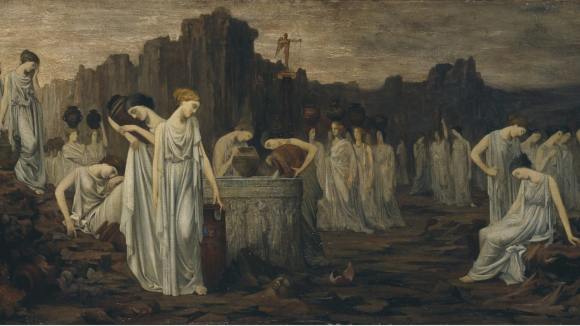
The Daughters of Danaus by Fernand Sabatté (1874-1940). From Public Domain
SIEVE

(The Danaids were the fifty daughters of King Danaus who murdered their husbands, the fifty sons of his brother Aegyptus, on their wedding night. Only Hypermnestra spared her husband whom she loved. As punishment for their crime, the other Danaids were condemned to an eternal torment in the Underworld: endlessly carrying water in a leaking vessel.)


These things you call experiences, are they separate
leaves who do not know

their neighbors in bloom and bare? Or rather notes
in grand symphonies,

seasons in the House of Being? They rise and ring.
And you, water carrier, you who

press them in the book of memory, hoping to
hold them forever, page by page,

why is your pail so hard? Through wind and rain
and gossamer glide, do you know

the mind of emptiness? The more you try to catch
the world the more

you fail. Buddha is the sieve you seek. Flowing
and flowing, everything

fills you, again and again. You have nothing to lose
but yourself.
John Valentine is a retired teacher living in Savannah, GA.
.
PLEASE NOTE: ARTICLES CAN ONLY BE REPRODUCED IN OTHER SITES WITH DUE ACKNOWLEDGEMENT TO BORDERLESS JOURNAL
Theodore Dreiser (1871-1945) reached apotheosis of his literary endeavour with his 1925 publication An American Tragedy. In the following twenty years, until completion of the The Bulwark in 1946, nothing he wrote remotely equaled the power of the tragedy. His opus plus Sister Carrie has become a classic—so too Jennie Gerhardt to a less heralded extent. Some of Dreiser’s short stories, such as “Nigger Jeff”, “St. Columba and the River”, and “The Lost Phoebe”, could stand on their own in any American or world anthology. Due to its narrative thrust and other attributes (powerful romance), The Financier was and is the best of Dreiser’s ‘Trilogy of Desire’ (including The Titan and The Stoic). The first three-quarters of the autobiography Dawn made for compelling reading, as did all of the essays in Twelve Men. The Bulwark was and is a minor classic, truncated but yanking at heart strings as adamantly if not for as long as any of Dreiser novels. Newspaper Days, the second volume of his autobiography is a baggy and verbose twin of the heavily, and unfortunately edited, A Traveler at Forty.
“The last great American writer of Melvillean dimensions,” Jerome Loving wrote of Dreiser. Dimensionality and similarity is each writer’s search to uncover and understand the phenomenon of existence. It’s a spiritual quest, though neither men have any sectarian belief (Melville nominally Unitarian). What is and to whom does the “oversoul” of Emersonian transcendentalism belong? To Dreiser, the grand protagonist life itself suggests a something else: God or gods perhaps, behind the display of natural phenomenon. Hs opus suggests that God or gods, or the “Creative Force,” used humankind for his, her, its own purpose; a purpose hidden from humankind’s limited understanding; also theorising possibilities of additional God or gods in the background making use of, let us say, “primary” God or gods, for a like inscrutable purpose.
In his last years Dreiser looked through a microscope for clues to the phenomenality of being—to unravel mysteries of life. Switching gears mid-career, he became an explorer of consciousness who preferred the company of scientists to that of literary brethren (to the detriment of his art, I must add).
In Dawn, Dreiser theorised that humankind was an invention—a schemed-out machine, useful to a larger something. This theory marked his turn from an early mechanistic belief in universal proceedings to consideration of an oversoul, or creative intelligence, behind or causative to universal phenomenon.
But what “soul”? What cause? What intelligence? Ahab[1] tried to tear the veil that covered the quondam source; tried to expose the phenomenon of so-called “reality,” but being only a man, and mortal, failed—dying in the process. What is the symbolism of the great whale’s whiteness but a concealing veil thrown over appearances? Melville’s scientifically, scrupulously dismantled his leviathan part by part, yielding naught as to mysteries of origins and unquantifiable organic processes, while Dreiser wandered over the same dry speculative desert (as Hawthorne noted) too honest to be or do otherwise.
Dreiser had his own mystic creed; refusing to conform to any formal doctrine—his views in later years influenced by Quakerism, Hinduism, and Christian Science (which his wife “Jug,” and his character Eugene Witla of The Genius came under spell of). In Newspaper Days, and in a sour mood, he wrote, “Religion! What a mockery! Why pray? Of whom to ask? The one who loaded the dice at the start?” Elsewhere in that same book—and in a better mood—he wrote, “There is a sower somewhere. Is it planet, gas, element, fire? It gardens and sows—what is its plan, and why?”
Like many ex-parochial students, Dreiser had a profound dislike of Catholicism and her rituals. A dislike engendered, in Dreiser’s case, by scorn of an ineffectual father, John Paul Dreiser. In Dawn, Dreiser wrote of Catholics with ossified brains who rejected natural emotion as sinful; who spent inordinate amounts of time on their knees praying to an immense and inscrutable something which cared not for their adoration or supplication.
He denied sectarian pretense to divine authority and wrote about how little there was to the Christ legend aside from artistic spectacle. Ritual and churchly dogma infuriated him—particularly angered by the priest who at first denied Dreiser’s mother burial in the sacred grove because she was a lapsed Catholic.
Dreiser despised religion in the form of Catholicism as much as he came to despise oligarchy—though early in his career celebrated the power of the oligarch in the character of Frank Cowperwood, of the ‘The Trilogy of Desire’, apotheosis of laissez faire capitalism run amuck.
Will Dreiser’s work survive the muddle of brave new world exigencies? I hope so. The slow relentless and inexorable pace of his stories, with their accumulation of details, are or seem anathema to the cyborg-screed of flash fiction sound bites in the blogosphere, but the stories he told—all having to do with vagaries of the human heart—though perhaps out of vogue, will never not be relevant to the human oh so human condition.
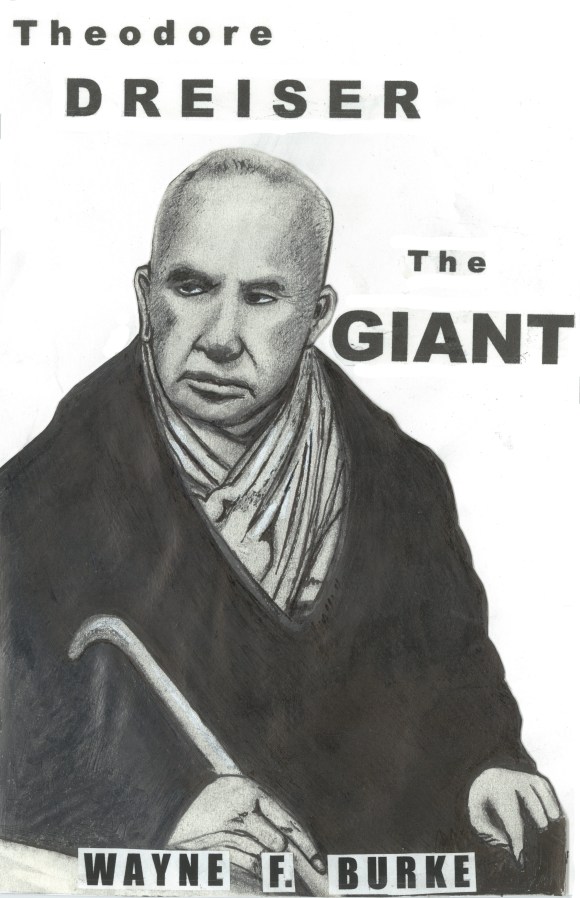
Theodore Dreiser – The Giant, is an explication, exegesis, of the fiction of Dreiser plus much of his nonfiction. Included are synopses of each title. Between considerations of the work is a biography of the writer. (Note: Dreiser could be, in his work, pedantic and humourless: this study is neither.)
About the Author:
Wayne F. Burke writes both poetry and prose. He is author of 12 published poetry collections–most recently Whatever Happened to Baby Wayne? Hog Press, 2025; two works of fiction–most recently No Tab For Sully, a novella, Alien Buddha Press, 2025; and six works of nonfiction–including Theodore Dreiser – The Giant, Cyberwit,net., publisher, 2025. He lives in Vermont (USA).
PLEASE NOTE: ARTICLES CAN ONLY BE REPRODUCED IN OTHER SITES WITH DUE ACKNOWLEDGEMENT TO BORDERLESS JOURNAL
As I watched -- She wrapped the rainbow round her finger, and drifted away -- slowly, ever so slowly. Yet The Heavens saw nothing.
EVENING
The wind wanders, seeking the fragrance of your musk: My heart and a fading leaf are carried along.
SPRING
The poor larks that returned this year peck at the scent of your bosom, still drifting through the footprints along the path of yesteryear.
JUNGLE
Such terror stirs within, none dare to face themselves. The road runs deep with fear— no one walks it alone.
THE WAIT
Shall I open a window? Will you come—or the moon?
Munir Momin is a contemporary Balochi poet widely cherished for his sublime art of poetry. Meticulously crafted images, linguistic finesse and profound aesthetic sense have earned him a distinguished place in Balochi literature. His poetry speaks through images, more than words. Momin’s poetry flows far beyond the reach of any ideology or socio-political movement. Nevertheless, he is not ignorant of the stark realities of life. The immenseness of his imagination and his mastery over the language rescues his poetry from becoming the part of any mundane narrative. So far Munir has published seven collections of his poetry and an anthology of short stories. His poetry has been translated into Urdu, English and Persian. He also edits a literary journal called Gidár.
Fazal Baloch is a Balochi writer and translator. He has translated many Balochi poems and short stories into English. His translations have been featured in Pakistani Literature published by Pakistan Academy of Letters and in the form of books and anthologies.Fazal Baloch has the translation rights to Munir Momin’s works.
.
PLEASE NOTE: ARTICLES CAN ONLY BE REPRODUCED IN OTHER SITES WITH DUE ACKNOWLEDGEMENT TO BORDERLESS JOURNAL
I stretched the boat hook as far as I could towards the mooring buoy, but it slid beneath the bow.
“Go back!” I shouted to Alex back at the helm, but my voice was carried away in the wind.
I pointed at the buoy under the net, and Alex reversed. The waves were dancing in front of me and the buoy would not stay in place long enough for me to reach it. On the second attempt, I forced all of my attention on the rope attached to the buoy, and tried to pull it aboard. It was much too heavy so I screamed for Alex to come, and he raced from behind, pulled the buoy up and secured it to the bow.
How would I alight into the dinghy in these waves? Alex lowered it into the water and it lunged towards the stern and back in succession. I doubted I would be able to board in these conditions.
“How about if I move the dinghy to the side of the boat and you enter via a ladder?”
“Worth a try!” I answered.
Alex brought the dinghy to the side of the boat and slung a ladder made of strong fabric overboard. I gingerly stepped down but once I glanced at the water raging beneath me, I lost confidence and gave up.
“I think I had better hop in from the stern after all,” I told Alex.
He moved the dinghy back to the stern. As I walked towards it, I slipped and fell on my thigh. There was no time to feel sorry for myself, so I picked myself up and continued heading for the dinghy. It lunged back and forth in the waves.
“Now!” commanded Alex.
I placed one foot in the centre of the dinghy to centre myself and then sat down on the bench. As hard as it was for me it was not hard for Haru, my border collie. I called her in and tapped the dinghy behind me because I knew she was hard of hearing. She leapt behind me with alacrity. It was so much easier for her to board the dinghy, not least because of her four legs.
Alex was locking the door back on the boat. The dinghy kept lunging toward the stern, and I was scared of getting knocked off when it hit the stern. I screamed as hard as I could.
“Okay!” replied Alex and hopped in behind me. Then he turned on the engine and headed for the shore, except that the shore was unrecognisable. Instead of a sandy beach, there were rocks.
Alex headed for the most promising spot. “Hop out!” commanded Alex, and I disembarked one leg after the other and headed to climb over the rocks. As usual, Haru leapt out and ran ashore.
I thought I was clear of the rocks and the menacing water, when Alex called out to me.
“Take my backpack! The laptops are in here. They can’t get wet. I realised then that we should have put them into the dry bag.”
I walked over the slippery rocks and strained to grasp the shoulder straps of the backpack. Once they were in my hands I returned to shore over the rocks, ready for the trek up to the holiday house.
I was so longing for the warmth of the fireplace and the view of the setting sun over the bay. I walked effortlessly up the hill, with Haru trotting happily beside me. The shelter and glow of the house was just as I had imagined. It was worth the hardship of getting there.
That night the winds continued to build, but it was pleasurable to hear them passing over the house as we enjoyed the safety and warmth of being inside.
Around one in the morning, the whole house shuddered when hit by a particularly strong gust, which was violent enough to briefly wake Alex.
No sooner was it light that I heard Alex enter the room. He must have been out before the wee hours.
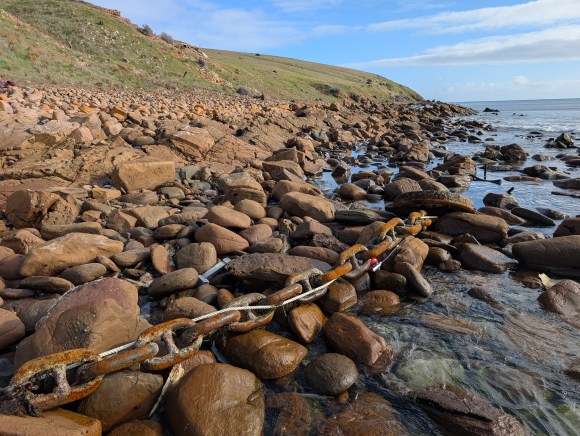
“The boat has drifted to shore. I had a bad feeling and got up early to check the position of the boat. From the cliffs I could see that the mast was too close to the shore. Then my fears were confirmed when I saw that it had been blown ashore.”
Dragged moorings. Photo Courtesy: Alan Noble
“Didn’t the mooring hold?” I asked.
“Evidently not. I’m going to check it out now. Want to come?”
I agreed, and we drove out to the cliff with Haru in the back seat. Once at the cliff, I remained in the car because I couldn’t face the gale-force winds that were now gusting to forty knots. Meanwhile, Alex, in his wetsuit, walked down the dirt road towards the beach, entered the water, and pulled himself aboard. I kept my eyes focused on him until I saw his figure exit the boat, swim ashore, and walk up the track back toward me.
“It’s finished. There’s nothing we can do, beyond salvage.”
Alex’s boat of sixteen years and our home away from home for the last five years was no more. In years past, we had circumnavigated Tasmania, sailed to New Caledonia and back, and across the Great Australian Bight to sail north on the Indian Ocean. Exiting a marina and heading towards the waves was a symbol of leaving our troubles behind and anticipation of adventure. I could no longer take this adventure for granted.
Alex reached out to Thompson’s Marine Salvage, and they arrived at the bay within two hours. The plan was to attach one end of a heavy rope to a tractor at the top of the cliff, and the other end to the boat, and drag it onto the sand to save it from smashing on the rocks.
Alex again donned his wetsuit, descended the cliffs, and swam to the boat. I sheltered from the wind in the car at the top of the cliffs with Haru. Then I thought that I should walk towards the boat in case there was anything I could do. Just as I reached the shore, a young man in a wetsuit approached me.
Haru observing from inside the car. Photo Courtesy: Meredith Stephens
“Watch out for the rope. We’re ready to begin!”
It was too late. The operation had started, and the rope was heading towards me, as the tractor started to try and haul the boat to the shore.
“Jump!” the young man urged.
I’m glad the young man thought this was a possibility, but I haven’t jumped for years. My days of jumping are decades behind me. Unable to jump, I met the full force of the rope and was knocked on my back. My head hit some rocks. I uttered an expletive “sh..!” which I reserve for extreme situations. I lay there for seconds before slowly getting back to my feet. My head was aching from the blow and my whole being was in shock. I gave up on rendering assistance and walked slowly back to the car. There I sheltered from the wind until Alex eventually returned to the boat.
“The operation has failed. The boat is still stuck on the rocks,” he explained.
Late in the day, a twenty-ton excavator arrived on the scene. I spent the day bent over holding a rubbish bag, picking up rubble from the boat. Haru trotted around me enjoying being freed from the confines of the house. The excavator approached the boat like a giant menacing dinosaur. I grabbed Haru by the collar and removed myself to a distant spot on the other side of the boat. I could not face another industrial accident. The hand of the excavator grappled the mast and moved it to a safe spot on the rocks. I watched the dinosaur make its retreat back to the road while I maintained a hold on Haru’s collar.
The following day a second twenty-ton excavator descended onto the beach. The first excavator lifted the stern while the second lifted the bow. Slowly, the airborne boat was moved off the rocks and onto land. I was invited to view it, but I couldn’t face seeing the destruction of our home. That evening, I ventured out to the paddock where the boat now rested high and dry, like a beached whale. Amongst the devastation, I retrieved the remains of my dressing gown, which had somehow become entangled in the bow.
Over the next few days, I continued to return to the beach to extract boat rubble from the shore and pull up items of clothing and bedding from the sand. Alex drove down to the beach in his off-road vehicle, and we loaded up the tray with bags of rubble. Different items washed ashore each day.
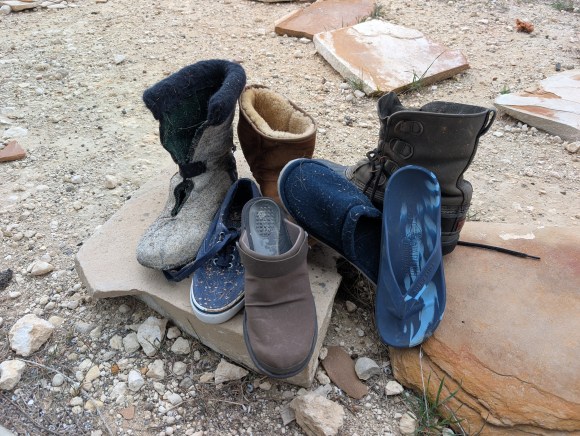
Salvaged shoes. Photo Courtesy: Alan Nobel
The bump on my head continued to heal, only feeling pain when touched. The bruises on my legs changed colour as they too healed. And eventually the bay would heal too. We continued daily beach clean-ups. Seven odd shoes were salvaged, an odd snorkel fin, and odd gloves. Two months later the other fin washed up, but none of the missing shoes ever made an appearance. We continued to fill our off-road vehicle, and rubbish bags, with debris. Our beloved nautical home sat out of place in a paddock awaiting salvage. We came away with a renewed appreciation and respect for the destructive power of the ever-changing sea, but it would take more than a broken boat to diminish our desire to sail again. For now, our sailing adventures were on hold, but once we had the opportunity, we would again return to the sea. This would not be our final voyage.
.
Meredith Stephens is an applied linguist from South Australia. Her recent work has appeared in Syncopation Literary Journal, Continue the Voice, Micking Owl Roost blog, The Font – A Literary Journal for Language Teachers, and Mind, Brain & Education Think Tank. In 2024, her story Safari was chosen as the Editor’s Choice for the June edition of All Your Stories.
PLEASE NOTE: ARTICLES CAN ONLY BE REPRODUCED IN OTHER SITES WITH DUE ACKNOWLEDGEMENT TO BORDERLESS JOURNAL
The sun is an orange, fallen from an invisible tree, as an avalanche of leaves also falls to the earth. I hope when it comes, Death will come so easily. Leaves feel no pain, but do they sigh when they die, gazing at the ground, which will be their final home. No one grieves, and time means nothing to leaves, or to the sun or the stars, but it means a lot to me. A sudden wind blows clouds toward the moon, as distant as our dreams are from June, and where is September? It was swept aside, even as I was writing this poem, so I missed it, but it departed far too soon.
AT WEST LAKE CEMETERY
The sky observes the graves on this lonely hillside, without concern, as if they were metaphors in an obscure poem. The bodies buried there are now harmless. Were they always that, and how much did they suffer, before they arrived here? Death reduces our lives to insignificance, just as our emotions, have no effect on what will be, and if I offered a prayer for these dead souls it would only mean something to me.
SPRING SONATA FOR THE DEAD
Flowers rise from the earth, and buds appear on boughs. Cicadas can be heard, though where they’re at, no one ever seems to know. Along the riverbank, the ice has broken, and the sun is shining, in honor of this new season. Squirrels frolic in the grass happy to be alive. When I place fresh flowers, on your grave, I know the world will survive and life will still thrive, but I feel no joy. You are no longer alive. And the stars are blind, when they look down, as another dark night arrives.
George Freek’s poetry has recently appeared in The Ottawa Arts Review, Acumen, The Lake, The Whimsical Poet, Triggerfish and Torrid Literature.
PLEASE NOTE: ARTICLES CAN ONLY BE REPRODUCED IN OTHER SITES WITH DUE ACKNOWLEDGEMENT TO BORDERLESS JOURNAL
A Tamil story by S Ramakrishnan, translated by B.Chandramouli
From Public Domain
That town had fewer than a hundred homes. Children playing in the street looked at them curiously when they alighted from the car. Kandasamy called one boy and asked him where Venangulam was. That boy asked him mockingly, “Do you want to do a penance in the Venangulam pond?” and pointed him towards the south.
His wife, their only daughter, and the astrologer who had brought them to perform the penance got out of the car. The astrologer tightened his loose dhoti and said, “This is a powerful pond, Sir; all your ‘dosha[1]’s would wash away.”
Kandasamy nodded and started walking towards the south.
Kandasamy had been suffering for over ten years with a skin disease; he had suffered an unexpected loss in his business. There were problems in his daughter’s in-laws home as well. As if these were not enough, he lost an old lawsuit he had been fighting in court. He felt as though the snake in the Snakes and Ladders game had brought him down. He visited many temples, performed pujas[2] and penances; nothing had worked. Only then did an astrologer tell him about Venangulam and the story of the king of Venangulam himself, who had dipped in that pond to get rid of his doshas. Kandasamy felt a sense of hope and agreed to visit Venangulam.
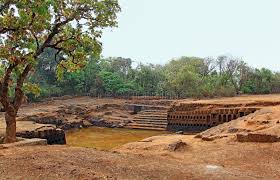
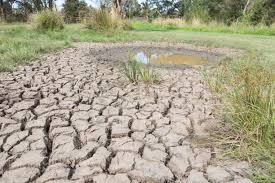
It was a small village with red tile roofs and somewhat broad streets. However, the people had nearly deserted it; some houses were locked up. When they went to Venangulam, they found it to be dry; the steps were dusty. There were four idols on the four sides of the pond.
Doubtful if that was Venangulam, he asked a person splitting logs nearby, “Is this the pond for penance?” That person nodded yes and continued his work.
Kandasamy stood on the dried-up pond’s steps and waited for his wife and daughter.
He wondered if they had come there not knowing that the pond had dried up; he felt angry thinking, “Didn’t the astrologer inquire about this even?”
The astrologer, Kandasamy’s wife and daughter, came near Venangulam.
The pond was full of torn clothes, dried leaves, and plastic waste. Kandasamy said to the astrologer, “There’s no water in this pond.”
The astrologer said,” It had been dry for several years. You get down, imagine that there is water, and sprinkle water on your head.”
“How can I bathe without water?” asked Kandasamy angrily.
“Can you see the sins you have committed with your eyes? But doesn’t the mind feel them? Similar to that, this pond contains invisible water; if you feel that and have a bath, your sins will wash away. Belief is everything, isn’t it?”
Kandasamy descended the steps of the dry pond. Though the pond appeared to have only ten or twenty steps, as he descended, the steps seemed to keep going down forever. Kandasamy kept on descending the steps alone. He did not know how long he had been descending, but when he looked up, it appeared as though he had descended into an abyss. He had not yet reached the bottom of the pond. The steps still kept descending.
He got confused, thinking, “What kind of magic is this? How did this small pond become so huge?” Various thoughts crowded his mind. He thought of how he had deceived his elder brother when they ran a joint business, and how he had cheated money entrusted to him. All these past sins returned as memories.
How can a person who deceived his own brother not fail in life? Suddenly, his elder brother’s face flashed in his mind. In that minute, the thought that until then, he had been pretending as though he had committed no mistakes bothered him. Kandasamy felt that one’s mistakes become weightless when hidden, but once you start realising them, they feel heavy.
Kandasamy realised he was descending the steps of his conscience.
He felt that to relieve himself of his sin, he must return the money he had cheated from his elder brother to his brother’s family. No sooner had this thought occurred to him than he felt a sudden wetness on his feet. The step beneath him seemed to be underwater. He pretended to bend down and sprinkle the water from the pond onto his head.
When his wife asked him loudly, “What are you thinking, standing on the steps?” he came to his senses.
Thinking, “Have I not gone to the depth of the pond? Was it all in my imagination?” He looked closely at the pond. He saw only dried steps and a pond without water.
He realised that the pond awakened the conscience and made you understand the crimes you have committed. It was indeed a magical pond.
He pretended as though he had had a bath and came out of the pond.
The astrologer said, “Think of something in your mind and throw coins into the pond.”
He took coins from his pocket and threw them into the pond, thinking that he would pay back the amount due to the family of his elder brother.
The idols’ eyes in the pond seemed to smile at him mockingly.
S. Ramakrishnan is a writer from Tamil Nadu, India. He is a full-time writer who has been active over the last 27 years in diverse areas of Tamil literature like short stories, novels, plays, children’s literature and translations. He has written and published 9 novels, 20 collections of short stories, 3 plays, 21 books for children, 3 books of translation, 24 collections of articles, 10 books on world cinema, 16 books on world literature including seven of his lectures, 3 books on Indian history, 3 on painting and 4 edited volumes including a Reader on his own works. He also has 2 collections of interviews to his credit. He was awarded the Sahitya Akademi Award in 2018 in the Tamil language category for his novel Sanjaaram.
Dr.B. Chandramouli is a retired Physician. He has published several translations. He has translted Jack Londen’s novel, White Fang and Somerset Maugham’s Razor’s edge (2024) to English and various English translations of Tamil fiction and non-fiction.
PLEASE NOTE: ARTICLES CAN ONLY BE REPRODUCED IN OTHER SITES WITH DUE ACKNOWLEDGEMENT TO BORDERLESS JOURNAL
There’s a black phoebe on the feeder this morning, She’s chasing other birds away. Black top knot and glossy black bib, Small, territorial, aggressive. And we saw a pelican on the split rail fence
Doves in the dust, a dry bath for feathers and insects Cooing sounds echo around the neighbourhood. They whistle-fly a few wing beats, Then they duck under the shrubs. They will be back this evening The big owl has been silent lately, He will return soon. We saw an old pelican on a fence rail.
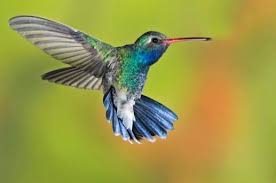
Humming birds hover and dart, Sampling the nectar, pollen on its beak. The old pelican is too far from the coast. There’s a seagull on the streetlamp, Looking for the beach And five wild turkeys scatter as we pass. Hawks pose on the treetops, surveying their domain Crows and sparrows are everywhere The old pelican rests before flying west, home.
THE BLUE AGAVE
They have been there. The Blue Agaves: lush and strong with long hard thorns. Today I noticed them, for the first time. The way they reproduce. Like a hen with chicks, The baby Agaves are surrounding their mother plant. Their pointed thorns are ominous, protective. How can a plant act like a bird? How can a bird act like a plant? Like chicks with a hen; Like an Agave with spikes. The shelter works. We’ll use it twice.
Blue Agave. From Public domain
Ron Pickett is a retired naval aviator. His 90-plus articles have appeared in various publications. He has published five books: Perfect Crimes – I Got Away With It, Discovering Roots, Getting Published, 60 Odd Short Stories, and Empaths. Ron has had his poems published in Scarlet Leaf, Borderless Journal, and other periodicals.
PLEASE NOTE: ARTICLES CAN ONLY BE REPRODUCED IN OTHER SITES WITH DUE ACKNOWLEDGEMENT TO BORDERLESS JOURNAL
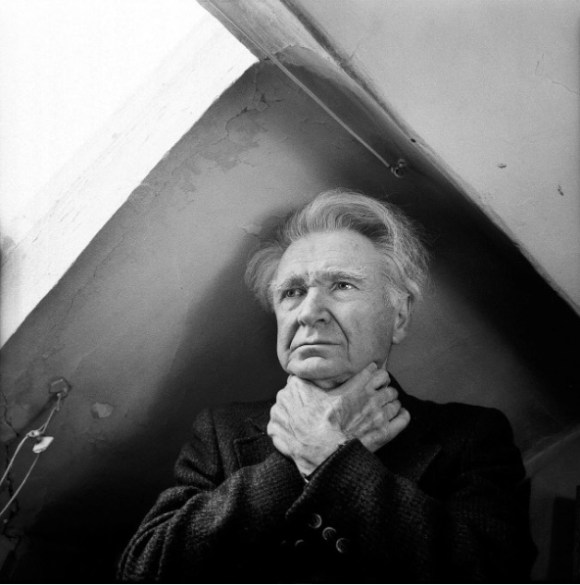
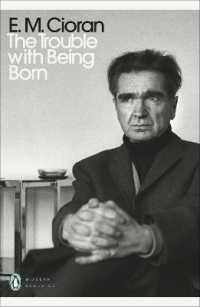
Emil Cioran (1911-1995). Photo provided by the author
It was the summer of 2019. The hostels were empty. Vacation had begun, and most students had already left for their hometowns. I was to leave the next day. While packing, I suddenly remembered The House of the Dead by Dostoevsky, which I had lent to a senior months ago.
I walked to his nearly abandoned hostel block and knocked on his half-open door. The room was dark—uncannily dark for the middle of the day. Thick curtains strangled the sunlight, casting the room into a premature night. There he lay on the bed, flat on his back, a laptop balanced on his belly. He handed me my book and resumed the video he had been watching—with monastic focus—from the fifty-sixth minute. It was footage of a man slowly cutting down a giant tree with an axe. He had been watching it, second by second, without skipping. He didn’t pause even when I left.
That was the man who introduced me to Emil Cioran.
It was not until much later that I finally read him. The Trouble with Being Born opens at three o’clock in the morning with Cioran contemplating the futility of existence:
“Three in the morning. I realize this second, then this one, then the next: I draw up the balance sheet for each minute. And why all this? Because I was born. It is a special type of sleeplessness that produces the indictment of birth.”
The book proceeds as a collection of aphorisms circling around the nausea of existence and the idea of suicide as both temptation and reprieve.
Before I began to read his work, I tried to prepare myself by reading his biography and interviews. I wanted to understand the man behind the words, as if glimpsing his life might help me endure the weight of his thoughts. One such childhood story was telling. In an interview, Cioran confessed that when he was a child, one of his favourite pastimes was to play football with human skulls excavated by a gravedigger who was his friend. But little did he know at that time that what seemed like play was the seed of a lifelong fixation, depriving him of sleep, driving him to insomnia, in the hope of a long, never-ending slumber.
For Cioran, suicide was not a prescribed act but an ever-present possibility—a metaphysical escape hatch that bestowed dignity on existence. The mere awareness of this option granted him a strange form of freedom. The power of contemplating death, rather than executing it, was his way of wrestling with life’s meaninglessness. Suicide was philosophical, not prescriptive; a potential that loomed, yet never fully realised.
Yet one question persists: if Cioran saw life as an error and glorified suicide as the only coherent act, why did he never end his own life? His own words reveal the paradox:
“It is not worth the bother of killing yourself, since you always kill yourself too late.”
According to him, suicide comes too late to undo anything. The damage is already done. You’ve already suffered so much that ending it doesn’t fix anything—it merely ends an already exhausted life. By the time you do it, you’ve already endured the worst. You’ve already been broken, emptied, eroded by suffering. So, what’s the point? The act becomes redundant, even absurd.
At another moment, he offers a different angle, confessing his indecision:
“The energy and virulence of my taedium vitae continue to astound me. So much vigor in a disease so decrepit! To this paradox I owe my present incapacity to choose my final hour.”
Although Cioran ascribes his procrastination for suicide to his extreme weariness and boredom, yet, contrastingly, at another place, for him the power of ending one’s life is the greatest power.
“No autocrat wields a power comparable to that enjoyed by a poor devil planning to kill himself.”
This is the Cioranian condition: every insight undermined by its opposite, every aphorism shadowed by contradiction. He frames suicide as the ultimate sovereignty. The mere thought of being able to end one’s life surpasses the power of kings. And yet, he never exercised it. Instead, he transformed the possibility into philosophy, into aphorism, into art. His writing is not a system but an ongoing quarrel with himself. Instead of answering any particular question, his writings raise towers of new questions.
This tension, of circling but never arriving, defines his thought. He writes with precision, but his precision is not in building arguments―it is in dismantling them. Each aphorism is like a shard of glass: sharp, illuminating, but impossible to piece into a whole. Consider his reflection on sleeplessness:
“If there is so much discomfort and ambiguity in lucidity, it is because lucidity is the result of the poor use to which we have put our sleepless nights.”
Cioran knew the price of insomnia. To be awake at three in the morning is to be exiled from the world of the living, suspended in a state where thoughts spiral without conclusion. For him, insomnia was both torment and revelation. Perhaps, if Cioran had been able to sleep well, he might not have been trapped in this endless dialogue with futility. Instead, he lived in perpetual wakefulness, speaking to his own emptiness:
“No one has lived so close to his skeleton as I have lived to mine: from which results an endless dialogue and certain truths which I manage neither to accept nor to reject.”
“Once we appeal to our most intimate selves, once we begin to labor and to produce, we lay claim to gifts, we become unconscious of our own gaps. No one is in a position to admit that what comes out of his own depths might be worthless. ‘Self-knowledge’? A contradiction in terms.”
If, according to Cioran, true self-knowledge is not possible because we are too attached to our own depths and ego to judge ourselves truly, then there is no way he could have unearthed any truths about himself while living close to his emptiness (skeleton).
Cioran is, however, conscious of his contradictions. They were not accidents; they were his method. But are those contradictions a mirror of the thinkers he admired? In one of his aphorisms, he confesses:
“In the Orient, the oddest, the most idiosyncratic Western thinkers would never have been taken seriously, on account of their contradictions. This is precisely why we are interested in them. We prefer not a mind but the reversals, the biography of a mind, the incompatibilities and aberrations to be found there, in short those thinkers who, unable to conform to the rest of humanity and still less to themselves, cheat as much by whim as by fatality. Their distinctive sign? A touch of fakery in the tragic, a hint of dalliance even in the irremediable.”
Cioran points to that strange quality in writers like Nietzsche, Baudelaire or even himself-deeply tragic, but also stylistic, artful, and aware of the absurdities of their drama. For him, the appeal is not in the polished answers but in the drama of the doubt, in the visible struggle of a mind with itself.
Cioran is always in a perpetual state of perplexity. His thoughts are malleable. What is true for him today becomes obsolete tomorrow. And all this he has tried to betray through words. He knew his thoughts were mercurial, unstable. He confesses his extreme mental variability:
“I may change my opinion on the same subject, the same event, ten, twenty, thirty times in the course of a single day. And to think that each time, like the worst impostor, I dare utter the word “truth”!
Every time he pronounces a new opinion, he does so with the implicit suggestion that this one is right―that this is the truth. He accuses himself of a kind of fraud, i.e. knowing his judgments are volatile, yet he delivers them as if they were true.
Amidst all these contradictions and paradoxes, what, then, did Cioran truly long for? Because what he wishes for in one place, he rejects in the other. But there is one feeling, or a longing, that recurs throughout the book―a longing for a time before time, a time before creation. He speaks of it with yearning, as if for a paradise never lost yet never possessed.
“There was a time when time did not yet exist…. The rejection of birth is nothing but the nostalgia for this time before time.”
“O to have been born before man!”
This longing resonates the idea of what the Portuguese call saudade, a longing for something that never was or will never be attainable. Unlike nostalgia, which mourns a past that once existed, saudade is a longing for an unattainable ideal, a sense of melancholic absence that can only be evoked in poetry and art. This yearning captures the profound melancholy that saturates Cioran’s philosophy—a feeling that seeps like a grey mist into a distant blue sky. And yet he admits the impossibility of feeling it:
“It is impossible to feel that there was a time when we did not exist. Hence our attachment to the personage we were before being born.”
We cannot experience absence, so we cannot truly imagine our non-being before birth. In our memory and awareness, we’ve always been — we cannot step outside ourselves to picture a time when we were nothing. This is not a metaphysical claim, but a psychological one.
If Cioran were a simple nihilist, one who believed in nothing and cared for nothing, why would he write at all? Why invest thought and feeling into a world he found so painfully absurd? The answer lies in his profound sensitivity. Cioran was a nihilist who felt too much. He was wounded by life. Writing, for him, was both a compulsion and a failure. Cioran was a master of paradox. He despised life yet wrote nine books about it. He dismissed language as futile yet clung to words as his only tool. He longed for silence yet confessed:
“We write books because we are ashamed of not having been able to remain silent.”
Writing was a failure to keep still in the face of futility. Yet silence was a greater failure, an impossibility. Thus, he turned his torment into words. For him, each book was a kind of reprieve. Perhaps, his most telling aphorism is this:
“A book is postponed suicide.”
For him, writing a book symbolised a form of delayed self-destruction or self-sacrifice, where the author channels inner turmoil into the work and thus postpones an existential “death”.
On a similar note, he explains the need for language, the need for writing.
“The more injured you are by time, the more you seek to escape it. To write a faultless page, or only a sentence, raises you above becoming and its corruptions. You transcend death by the pursuit of the indestructible in speech, in the very symbol of nullity.”
Language itself, for Cioran, is paradoxical. It is both empty (words are mere signs, lacking substance) and the only tool we have to approach the eternal. So even while writing may seem futile or illusory, it’s also the only space where something indestructible can be momentarily glimpsed.
The Cioranian paradox yet again comes into the picture, where he proclaims:
“One must be mad or drunk,” the Abbe Sieyès said, to speak well in the known languages. One must be drunk or mad, I should add, to dare, still, to use words, anyword….”
In his earlier aphorisms, he advocates for the meaning or use of writing, but then in the following aphorisms, he expresses the futility of writing, or words, of language itself. To use language sincerely is itself madness. If words distort, then every attempt to write is a betrayal. And yet he could not stop writing. This was the paradox that sustained him.
In the book, Cioran traces this disposition back to his family:
“Every family has its own philosophy. One of my cousins, who died young, once wrote me: ‘It’s all the way it’s always been and probably always will be until there’s nothing left any more.’”
Whereas my mother ended the last note she ever sent me with this testamentary sentence: “Whatever people try to do, they’ll regret it sooner or later.
“Nor can I even boast of having acquired this vice of regret by my own setbacks. It precedes me, it participates in the patrimony of my tribe. What a legacy, such unfitness for illusion!”
Cioran interjects with irony: he can’t even take credit for being regret-prone as a result of his own failures. It’s not just personal experience that made him this way—regret runs deeper; it’s not biographical but ancestral.
Yet Cioran was not only drawn to grand despair. He had a peculiar love for the banal, the ordinary, and the infinitesimal things in our everyday life. Like Georges Perec’s concept of the “infraordinary”―the unnoticed texture of daily life―Cioran wrote:
“The intrinsic value of a book does not depend on the importance of its subject (else the theologians would prevail, and mightily), but on the manner of approaching the accidental and the insignificant, of mastering the infinitesimal. The essential has never required the least talent.”
“No true art without a strong dose of banality. The constant employment of the unaccustomed readily wearies us, nothing being more unendurable than the uniformity of the exceptional.”
For him, the ordinary was not a distraction from philosophy but its truest field.Emil Cioran was also deeply influenced by the Eastern philosophies of Hinduism and Buddhism. He often returned to the idea of renunciation and detachment:
“It is trifling to believe in what you do or in what others do. You should avoid simulacra and even ‘realities’; you should take up a position external to everything and everyone, drive off or grind down your appetites, live, according to a Hindu adage, with as few desires as a ‘solitary elephant’.”
“I am enraptured by Hindu philosophy, whose essential endeavor is to surmount the self; and everything I do, everything I think is only myself and the self’s humiliations.”
And yet, while he admired Buddha’s teachings on suffering, he could not detach himself from his own disappointments:
“My faculty for disappointment surpasses understanding. It is what lets me comprehend Buddha, but also what keeps me from following him.”
Cioran is the kind of person who is aware of his suffering, knows the cure, but won’t take the medicine because the illness has become who he is. For him, disappointment is instinctive, all-consuming and more intimate than thought itself. Since Buddha taught that life is marked with Dukha (suffering/disappointment), Cioran feels connected to Buddhist philosophy, but he cannot follow that path because to follow Buddha requires detachment, letting go of even disappointment, which Cioran cannot do.
Cioran also reflects on a peculiar way to cope with life’s anxieties. He says:
“In order to conquer panic or some tenacious anxiety, there is nothing like imagining your own burial. An effective method, readily available to all…”
This aphorism resonates directly with the Hindu practices, as especially embodied in Banaras (Varanasi), where the city itself is a living memento mori, where cremation fires at Manikarnika Ghat never extinguish, and death is not hidden away but displayed as part of life. In Varanasi, the pilgrims are encouraged to watch the burning pyres, not to indulge morbidity but to confront impermanence directly. But even here, he reminds us of the futility of origins:
“The emphasis on birth is no more than the craving for the insoluble carried to the point of insanity.”
He knows that obsessing over the question of birth, of life, is futile, insoluble and unanswerable. To take this obsession with origins, with life’s beginning, so seriously — to revere it, to found ideologies or hope on it — is, for Cioran, madness. It means you are so committed to wrestling with the unanswerable that you’ve abandoned sanity. It’s a form of spiritual masochism: continually turning to the one question — Why was I born? — that has no satisfying answer.
A man who spent all his life thinking about the tragedy of birth, the futility of life and the meaning of death confesses at one point in the book that he has known nothing new in all his later years that he knew when he was young. All his thinking, the sleepless nights, the anxiety and the dread have contributed nothing to further his knowledge. In his own words:
“What I know at sixty, I knew as well at twenty. Forty years of a long, superfluous, labour of verification.”
Despite all of Cioran’s nihilistic or dark thoughts, he granted failure a strange dignity:
“This is how we recognize the man who has tendencies toward an inner quest: he will set failure above any success, he will even seek it out, unconsciously of course. This is because failure, always essential, reveals us to ourselves, permits us to see ourselves as God sees us, whereas success distances us from what is most inward in ourselves and indeed in everything.”
“Failure, even repeated, always seems fresh; whereas success, multiplied, loses all interest, all attraction.”
In this sense, he inverts conventional wisdom: failure is not defeat but a revelation, a mirror of the self, stripped of illusion.
The Trouble with Being Born is not an easy read. The book is a constant rumination and meditation on the bliss of nonexistence, the deep nostalgia for a state before being, before consciousness, before identity. There is an uneasiness, an anxiety, a restlessness and an unknown dread that creeps in and grows with every sentence one reads. It has the potential to scratch the old wounds of one’s soul, which one has forgotten. Yet, if one reads and analyses the aphorisms from a distance with a particular perspective, it can also provoke laughter―the laughter of someone who has stared too long at the abyss and found it absurd.
Emil Cioran is like a chess master, and each of his aphorisms is a calculated move. For every aphorism that he mentions, he has already anticipated the reader’s move. He has anticipated every question, especially the most obvious one, why he did not kill himself and his reply is already there.
Reading Cioran is like walking into a fog. Every sentence brings a chill of recognition, but also a deeper uncertainty. He lived next to his emptiness, befriended it, argued with it, laughed at it—and wrote it down. He is frustrating. He contradicts himself. He writes aphorisms that sound like suicide notes, only to retract them with a smirk. But that is the trouble with Cioran. He lived. He wrote. He suffered. And somehow, he made it all sound beautiful.
And perhaps that’s the final paradox: the man most disillusioned with life gave us one of its most enduring voices.
After reading him, I’ve come to admire Cioran because, to me, he is like a mathematician devoted to solving the equation of life and death. Every variable, every permutation and combination, has passed through his mind; the possibilities now stand exposed on the blackboard, supporting and undermining one another in turn. The solution, if it exists, hovers just within sight—yet he chooses to work through it endlessly, not in pursuit of an answer, but in devotion to the act itself. He is a modern Sisyphus, who has not merely accepted his fate, but learned to love the rolling of the boulder, again and again, to the mountain’s top.
Satyarth Pandita is a PhD student at the National Institute of Mental Health and Neuro Sciences (NIMHANS), Bengaluru. He completed his dual degree, a Bachelor of Science and Master of Science in Biological Sciences (major) and Humanities and Social Sciences (minor), at the Indian Institute of Science Education and Research Bhopal (IISERB). His works have appeared in various newspapers and periodicals, including The Quint, OutlookIndia, The Wire, Madras Courier, Borderless, and Kitaab, among others.
Links to Satyarth’s published works, email address and social media handles can be found here.
.
PLEASE NOTE: ARTICLES CAN ONLY BE REPRODUCED IN OTHER SITES WITH DUE ACKNOWLEDGEMENT TO BORDERLESS JOURNAL
There’s a slowness to packing boxes when there’s nowhere to take them. It’s the deliberation that surrounds every item of clothing as it’s neatly folded, placed gently with the others.
With the child, there’s an even greater sluggishness when it comes to the dolls and stuffed animals, an unwillingness even for fear that there won’t be enough room to fit them all.
For haste in that apartment house, you’d need to look to the landlord’s first floor apartment, the tapping of his fingers on the kitchen table, like tiny impatient jackhammers.
For mother and child, the sidewalk awaits. It’s both leisurely and brisk… and indifferent, which is not a speed at all.
KISS AND MAKE UP, THE LATEST ITERATION
Your words slap my face around. Now you have me where you want me – an effigy of everything you hate.
My response is a prison-riot of old angers.
Pain doesn’t travel well so hurting others is our go-to.
We learned it from our parents. We were taught it in school.
To be cruel is a mega-aspirin, a vein-load of morphine.
But we love each other. Our harshness knows this. Our rages are intrinsically aware.
So our voices soften. Red cheeks whiten. Flaming eyes are doused by tears.
Then it’s kiss and makeup time. Our mouths are like tunnels in a mountainside. Tongues collide but there’s little collateral damage.
.
John Grey is an Australian poet, US resident, recently published in Shift, River And South and Flights. His latest books Bittersweet, Subject Matters and Between Two Fires are available through Amazon. He has upcoming work in Rush, Spotlong Review and Trampoline.
PLEASE NOTE: ARTICLES CAN ONLY BE REPRODUCED IN OTHER SITES WITH DUE ACKNOWLEDGEMENT TO BORDERLESS JOURNAL
Title: India in the Second World War: An Emotional History
Author: Diya Gupta
Publisher: Rupa Publications
When we think of the Second World War, the images that most often come to mind are those of Europe’s ruin — the Blitz in London, the camps in Poland, the victory parades in Paris. India, though one of the largest contributors of men and material to the Allied cause, usually slips to the margins of that global story.
Diya Gupta’s India in the Second World War: An Emotional History sets out to correct that imbalance — and does so not by recounting battles or strategies, but by uncovering the feelings, memories, and private sufferings that shaped India’s wartime experience.
In this groundbreaking work, Gupta turns away from generals and governments to listen instead to soldiers, families, poets, and activists. Through letters, diaries, photographs, memoirs, and literary texts in both English and Bengali, she reconstructs the emotional life of a country caught in the contradictions of fighting for freedom while serving an empire. Her book is as much about the inner weather of a people at war as it is about history itself.
The story begins with the strange binary of India’s position in the 1940s. The British declared India a participant in the war without consulting its leaders. While nationalist politics in the country were reaching their boiling point, over two million Indian men were dispatched to fight on foreign fronts — from North Africa to Burma — under the Union Jack. They fought for a cause that was not their own, for a government that denied them liberty.
Gupta’s focus on emotion allows her to expose this moral paradox with nuance. The letters of sepoys from the Middle East reveal homesickness, confusion, and occasional pride; families back home are haunted by anxiety, caught between imperial propaganda and the whisper of rebellion. The result is a portrait of divided loyalties — of men and women who inhabited both the empire’s war and the nationalist struggle at once.
But it was the Bengal Famine of 1943 that made the war’s cost most brutally visible. Triggered by colonial economic mismanagement and wartime policies, it claimed nearly three million lives. Gupta’s chapter, ‘Every Day I Witness Nightmares’, captures this catastrophe through eyewitness accounts and literature that tried to make sense of it. Hunger, she suggests, became not only a physical condition but an emotional state — an emblem of the moral starvation of empire.
In poems and essays by writers such as Sukanta Bhattacharya and Mulk Raj Anand, the famine appears as a mirror held up to civilisation’s collapse. Tagore’s haunting late work, ‘Crisis in Civilisation’, forms a central thread in Gupta’s narrative — the poet’s disillusionment with humanity, his grief at the world’s descent into barbarism, and his call for renewal through compassion.
One of Gupta’s greatest achievements lies in her ability to braid together the intimate and the historical. The war years, she shows, were also years of reflection and redefinition. In the chapter named ‘The Thing That Was Lost’, she explores how the idea of “home” was transformed by displacement — whether through the departure of men to distant fronts or through the forced migrations caused by famine and air raids. Home, once a site of safety, became a space of longing and loss.
Another chapter, ‘Close to Me as My Very Own Brother”, turns the spotlight on male friendships in Indian war writing. Here, Gupta uncovers the tenderness that often underpinned comradeship — relationships that blurred the lines between duty and affection, and that offered emotional sustenance amid violence and uncertainty. In these pages, she challenges the stereotypes of stoic masculinity, showing that vulnerability and empathy were also part of the soldier’s story.
While the battlefield has long been the focus of war history, Gupta gives equal weight to those who remained behind. The women who waited, worked, and wrote — often in silence — emerge as witnesses in their own right.
Activists such as Tara Ali Baig, nurses and doctors on the Burma front, and countless unnamed mothers and wives populate the emotional landscape she paints. Through their letters and memoirs, we see how war invaded domestic spaces, transforming everyday life into a theatre of endurance.
Gupta writes of “anguished hearts” not as metaphor but as historical evidence. The fear of air raids, the sight of hungry children, the absence of loved ones — these, too, were the realities of India’s war. By restoring emotion to the historical record, she argues that feelings are not soft data but vital clues to understanding how societies survive crisis.
What makes the book so compelling is its insistence on looking at the global war from the Indian perspective. For Britain, the war was a fight for democracy and civilisation; for India, it was also a confrontation with the hypocrisy of those ideals. As Gupta notes, the same empire that called for liberty in Europe jailed Gandhi and suppressed the Quit India movement at home.
Seen from Calcutta rather than London, the war ceases to be a heroic narrative of Allied victory and becomes instead a story of moral contradictions and human cost. Gupta’s intervention is both historiographical and ethical: she reminds us that global history must include the emotions of those who bore its burdens without sharing in its glory.
A historian with literary sensibility, Gupta writes with precision, empathy, and grace. Her prose balances academic rigour with narrative warmth, allowing the reader to move effortlessly between archival fragments and the larger questions they evoke. Each chapter unfolds like a story, yet the cumulative effect is that of a symphony — voices rising and blending, carrying echoes of pain, pride, and endurance.
Gupta’s work has been widely celebrated for its originality and emotional depth. Shortlisted for the 2024 Gladstone Book Prize, it has drawn praise from scholars and critics alike for its fresh approach to war history. What distinguishes her study is not only its range of sources but its refusal to treat emotion as peripheral. For Gupta, feelings are the connective tissue of history — the invisible threads binding individuals to events, memory to nationhood.
The book is more than the war. It is about the human capacity to feel in times of fracture — to love, mourn, and imagine even amid devastation. It shows that the emotional life of a people can illuminate their political choices, their artistic expressions, and their vision of freedom.
By reassembling scattered memories and forgotten emotions, Diya Gupta offers a new way of reading both India and the world in the 1940s. Her India is not a passive colony swept along by imperial tides, but a living, feeling community navigating grief and hope in equal measure. The war, as she reminds us, did not just redraw maps; it reshaped minds and hearts.
In giving voice to those who seldom found one in history books — the sepoy writing from the desert, the poet confronting famine, the mother waiting for news — Gupta transforms statistics into stories, and stories into testimony. Her book stands as a reminder that history is not only written in treaties or timelines but in tears, silences, and the fragile language of feeling.
It ensures that those emotional histories, too long buried under the dust of archives, are heard again — quietly, insistently, and with the full weight of their truth.
.
Bhaskar Parichha is a journalist and author of Cyclones in Odisha: Landfall, Wreckage and Resilience, Unbiased, No Strings Attached: Writings on Odisha and Biju Patnaik – A Political Biography. He lives in Bhubaneswar and writes bilingually. Besides writing for newspapers, he also reviews books on various media platforms.
PLEASE NOTE: ARTICLES CAN ONLY BE REPRODUCED IN OTHER SITES WITH DUE ACKNOWLEDGEMENT TO BORDERLESS JOURNAL






 Borderless