Categories
Essay

The Wabi-Sabi of Making a Living

By Aditi Yadav

When Magellan set sail on the seas in 1519, little did he know that his expedition would be the first to circumnavigate the earth. Unfortunately, he died midway and could not see the historic feat that his voyage accomplished. Human race has travelled an exponentially long way since then– locating places through GPS, hopping around on Google earth, planning voyages to solar system family and researching on galaxies far, far away.  In some inter-galactic bird’s eye-view, just like Carl Sagan(1934-1996) said, the earth is just a ‘pale blue dot.’ Yet, the ‘only home we’ve ever known’, is marred with myriads of conflicts across the continents. Major conflicts on global scale, time and again lead to wars and revolutions.

 The French Revolution which laid the foundation of democratic institutions of the world, was deeply inspired by the famous political philosopher Jean-Jacques Rousseau (1717-1778). As an enlightened man of his times, Rousseau famously said, “Man is born free but everywhere he is in chains”. I do not know if he considered women absolutely free or irredeemably enslaved that he put it down with a such male-centric perspective. Nonetheless, to celebrate the progress of civilization, let’s just rephrase it for modern times– humans are born free but everywhere they are in chains. Indeed, such are the repercussions of the said and unsaid social contracts we find ourselves tied to, that stir conflicts in everyday human life.

“Work” is one such social contract that involves exchange of labour and capital. But it is not just labour that one puts in — there is so much of one’s precious soul and time that goes into the process. Even if one gets capital or remuneration in exchange — more often than not, there is not enough time or energy to make fulfilling use of this compensation. Such is the conflict of ‘work-life’ balance. The internet these days is ablaze with reactions to a certain Indian CEO calling for ‘18 hours of work per day’ while the first world countries rethink working patterns with ‘four days a week’ option. In my personal experience, I recall many high-ranking corporate bosses saying how they have serious problems with non-working Saturdays. Oh, the conflict of losing one’s life while making a living!

Since the dawn of Industrial Revolution, the world has increasingly taken to machines and industrialisation. Humans have enhanced their control over nature while their own lives are controlled by the force of their inventions. Sociologically speaking as Karl Marx (1818-1883) propounded, this is the age of alienation. He theorised that this estrangement takes place on four levels: from the process of production, from the product, from the family and fellow workers and from the self. The last category of estrangement is indeed disconcerting.

The concept of work in post-covid scenario needs a serious rethink on the macro-level, with well-planned sustainable and flexible approach keeping in pace with the demographic scene. What would a physically sick and mentally stressed population accomplish anyway? In modern times nuclear families have become the norm, and the stakeholder-ship of women in work force is on the rise. The work policies, infrastructure and facilities need to be upgraded. Men and women should equally be given the environment where they don’t feel guilty about taking care of their families or themselves. All this needs systemic structural change and would take substantial time to be put into practice. Meanwhile, until the system overhauls or evolves, it is incumbent upon us as individuals to try a mind shift to address the conflict of everyday work and life. Moreover, any macro change will happen only when enough micro level consciousness lays its foundations.

Throughout school and college, one is continuously wired to focus on earning good credentials, and building up a brilliant CV, to rank high on labour-capital exchange quotient. When we join the work force as adults, there are bound to be troubles, because we haven’t been humane enough to ourselves.  In the face of multifold de-humanisation, Austrian philosopher Ivan Illych (1926-2002) even called for ‘Deschooling society’, wishing for a liberated humane model of education.

Let’s first come to terms with the fact that a human being is not a machine with the sole goal to be the perfect employee to maximise profits. Life as gift of nature should be valued and cherished. The chicanery of modern times is that your fears and dreams are exploited if you are not on your guard. That top spot, that super performer tag, that fear of failure and ignominy — are all factors that will make you vulnerable mentally and psychologically — more often than not leading to serious ailments. You will feel stuck in a rut and suffocated if your life pivots arounds this exploitation.

Although extremely recommended and desirable, not all of us are able to find regular time out for physical routine or yoga session. It instead seems more prudent to wire a change of perspective in day-to-day life situations to deal with conflict. In this regard, the spirit of Japanese philosophy of wabi-sabi [1]can be of comfort. There is inner peace and contentment in being kinder to oneself.

Wabi-sabi’ as a way of life is acceptance of simplicity, imperfection and transience. It reminds you that it’s okay to not be perfect (because perfectionism is elusive anyway). There is not one single word in the English language to exactly express this beautiful philosophy. The essence is to be grasped by inferred understanding. Literally, the kanji character for wabi (侘) stands for the feeling of desolation and solitude one experiences, especially midst nature. It sounds depressing at first. But the root feeling is that of humility and gratefulness, realising that in the scheme of grand nature, you are only one among billions of living forms. It the true essence of life, you come alone and go alone, as there is only so much you can do.  While sabi (寂) means to rust, wither or decay. It underscores the impermanence of life. How the cherry blossom petals wither away in spring after a brief dazzling display of ethereal pink! The transience of life should teach us better appreciation of aging, loss and celebration of little moments that we have in everyday life.

Erin Niimi Longhurst in her book Japonisme (2018) tries to elucidate what wabi-sabi encompasses. Applying the principles with a bit of thoughtfulness can be helpful for a lot of conflict resolution within one self.

  • “Asymmetry, not conformity or evenness”: There will be days you’ll be on top of things at work, but miss out on personal goals, while vice versa on other days. Lopsidedness of achievements is natural. Have some, loose some. Celebrate little joys that come your way. Reassess and reset priorities once in a while.
  • “Humble and modest, not arrogant, conceited or proud”: Humility is strength indeed. It helps you see and accept your flaws, and fix what can be fixed. It makes you a cooperative member of the society. The flexibility it instills, earns peace. Arrogance not only earns you toxic energy of those around you, it is self-defeating for personal growth where you are blind to you mistakes.
  • “Growth not stagnation”:  While one starts celebrating simple pleasures of life, chooses to opt out of blind race, is peaceful with being flawed, it does not mean stagnation. Impermanence of life means acceptance of changes. Working on weeding out toxicity in life is a life-long growth process. Once this takes roots, you connect will your priorities better.
  • “Natural decay, not synthetic nor preserved”: As a natural product, every thing has a natural life. Lifestyle choices make a great impact on mindset and vice-versa. Choosing to moderate processed and synthesized food, spending time in nature are little steps of consciousness with profound impact. Also, aging is inevitable. Practice kindness unto yourself– accept the onset of wrinkles and ward off chronic worry to look youthful. As time passes you by, you become a work of time you spend with yourself. Peace starts with you.
  •   “Slow not fast”. The implied meaning is slowing down enough to connect to your own pace of life.  Taking time to observe, appreciate and reflect, rather than storming headlessly through life.
  • “Abstemious, not gluttonous”: As much as it is important to know what you can do, it is crucial to understand your limitations too. It’s like knowing what your digestive system can take and what it is intolerant to. Just as overeating is dangerous, overcommitment at work or in personal relations to meet everybody’s expectations, can take a toll on your life — and before you realise you are caught in the vicious cycle of meeting people’s expectations at the expense of your peace. Limit yourself and cautiously expand the boundaries.
  • “Small moments not grand gestures”: The beauty of a well composed haiku is in its brevity to capture the moment. It conveys how epic emotions can be experienced in transience. Take a moment to congratulate others around you, compliment them, or immerse in brewing your coffee/ tea- little by little- profoundness of life begins to shine in mundane, everyday things. Each moment is a grand celebration of life. Do not wait for that grand day or promotion to hold a party. Be your own host, your own guest. Revel!
  • “Unfinished, not complete”: The uncertainty of life makes it all the more precious and mysteriously alluring. The best thing is to remember that the rest is still unscripted. There’s still more to come, and life always stays an unfinished project, even when one leaves the earth. Perfection or being best of the best are grand illusions. One always remains imperfect. With that understanding, take some time to look inward at what bothers you at work place or home, what irritates you, there so much toxic grass to weed out. Better still, search for anything that uplifts or makes you feel creative. Have yourself merry little breaks.  Merry little heart will go a long, long way.

The whole spirit of building micro-level consciousness is like kintsugi[2] to heal our broken parts. It tones down our toxic drive toward continuous competition, comparison, and excessive target planning. The approach is to know yourself better, and set work limits accordingly in your natural pace. Soon you realise the carrot that dangles is only a bait to bigger trap, and you start setting your boundaries as a human. Though this prima-facie[3] appears opposed to the socially perceived standards of success, the continuous practice earns you inner peace at your intrinsic pace-kind of negotiating your way through the matrix. Instead of perfection, you choose sustainability. You have raced enough, find a breather, connect with what relaxes you, comforts you, recharge time and again, live.

St. Augustine(354-453) contends: “There are many going afar to marvel at the heights of mountains, the mighty waves of the sea, the long courses of great rivers, the vastness of the ocean, the movements of the stars, yet they leave themselves unnoticed!” Magellan’s ship went on to circumnavigate the earth. Guided by the essence of wabi-sabi, there is much more adventure and fulfillment when one sets out to circumnavigate oneself. Bon Voyage, humans!


[1] The transient nature of life

[2] Repairing broken ceramics with gold

[3] Latin for apparent or self-evident

Aditi Yadav is a public servant from India. As and when time permits she engages in creative pursuits and catches up her never-ending to-read list. 

.

PLEASE NOTE: ARTICLES CAN ONLY BE REPRODUCED IN OTHER SITES WITH DUE ACKNOWLEDGEMENT TO BORDERLESS JOURNAL

Categories
Poetry

Fowler’s Revenge

By Ryan Quinn Flanagan

Abstract art by Picasso. Courtesy: Creative Commons
1.

There is this dummy quality about it all.
A sprawling suspension bridge vastness about 
the ambition if not the foresight.
I sit, surrounded by numerous bird-hatched plans.
Drinking down all the man’s beer, 
and none of his ideas.

2.

You are predictable as a subway train.
Eat, sleep, drink, talk the same so that
the sum of your habits make you an easy target.
Just two days ago, you were under surveillance.
From some tired hock shop camera
with a faulty aperture that has seen
better days.


3.

Time casts doubt, that is true,
so that anyone who waits on anything 
becomes less the suspect and more 
the patient opportunist all the time.

4.

I don’t care what you did or didn’t do.
This is Fowler’s revenge.
I hear you’re teaching his own children to hate him
which is utterly deplorable.
Keeping him from seeing them,
but such revelations come second hand.
I am friends with both of you
which makes this all the more difficult.

5.

Distance is another consideration.
No one could have invaded Russia 
from the pleasure-seeking funhouses 
of Coney Island.

6.

I hear you have taken up with your legal counsel now,
please tell me it is not true.
The rumour mill never stops spinning.
I hear it is still on the sly.
He is in it for the favours as much as you are
for the money.  And he is married,
please tell me this is not true.
Perhaps you have already made 
your calculations.

7.

Fowler made good on his threats tonight.
Not against you, but himself.
The one he always hated most 
according to the letter.
I walked in and had to cut him down.
So blue in the face he looked like some dangling 
pathetic Picasso which angered me.

And the smell, let me tell you!
All alone in that sorry basement apartment.
After everyone had left.

8.

I guess you get full custody.
I hope you are happy.
A phone call would be nice.
We used to be friends.

9.

Tell Jimmy happy birthday.
I believe this would be his ninth.
I hope you got the gift I sent.
The mail is sporadic these days.

Ryan Quinn Flanagan is a Canadian-born author residing in Elliot Lake, Ontario, Canada with his wife and many bears that rifle through his garbage.  His work can be found both in print and online in such places as: Evergreen Review, The New York Quarterly, Borderless Journal, GloMag, Red Fez, and The Oklahoma Review

.

PLEASE NOTE: ARTICLES CAN ONLY BE REPRODUCED IN OTHER SITES WITH DUE ACKNOWLEDGEMENT TO BORDERLESS JOURNAL

Categories
Review

Is it a Story, a Novel, or a Memoir?

Book Review by Somdatta Mandal

Title: The Dreams of a Mappilla Girl: A Memoir

Author: B.M. Zuhara

Translator: Fehmida Zakeer

Publisher: Yoda Press & Sage

 The terms ‘autobiography’ and ‘memoir’ are sometimes used interchangeably but the former is more fact-based and tends to be historical, whereas a ‘memoir,’ derived from the Latin word ‘memorandum’, is chiefly a personal, minute recollection of events, not necessarily intending to cover a person’s entire life, but often written from an epiphanic perspective, a significant event, or a particular aspect of the memoirist’s life. Thus, memoirs are essentially subjective and can never claim to be bio-bibliographical narrations. B.M. Zuhara, the writer and columnist from Kerala and a Sahitya Akademi awardee who writes in Malayalam, had penned The Dreams of a Mappila Girl: A Memoir (2015), which was recently translated by Fehmida Zakeer to English. It traces the childhood years of the writer, growing up in the village of Tikkodi in rural Kerala as a young Mappila girl from the Muslim community in post-Independence India.

For Zuhara, the things she remembers from her childhood act as vignettes which we readers string together to form a wholesome picture of the feudal system and social issues that were significant in her mind as she was growing up in the Malabar Muslim community in the 1950s. The tenth and youngest child of her parents living in a huge ancestral house called Kizhekke Maliakkal, Soora’s narrative gives us details of the things she remembered about the place till the point where at the age of thirteen she moves with her family to live in a rented house at Kohzikode to be admitted in a high school and begin a new chapter in her life. But even after she gets admitted into a prestigious school at Kozhikode, uncertainty looms large over Soora’s life as her mother stays adamant about not allowing her daughter to wear a skirt as a uniform as mandated by the school. In the ‘Preface’, Zuhara mentions that her childhood ancestral home does not exist anymore, but its memory is so strong that it appears as a character in many of her writings.

From the very beginning of the memoir, we form a clear picture in our minds about the location of the house, its detailed set-up filled with characters of the extended family including servants and cooks who lent a helping hand to run it smoothly. Like many other narratives, food plays a significant role in developing the ambience of Soora’s household. We get details of the elaborate tea ritual every evening, the eating of pathiris soaked in coconut milk, the aroma of fried plantains and coconut residue that filled the air, the details of the betel leaf chewed by her mother and grandmother with their decorative boxes and copper spittoons, the attempts to hatch chickens from eggs that were undertaken in the storeroom, the rearing of hens and ducks and goats by her brothers, the midday meals offered in their village school which their mother did not allow them to partake considering that it was solely meant for underprivileged children, and so on fill up a considerable portion of the narrative. Apart from visiting the village fair, Zuhara recounts the social mores of the society she lived in and offers glimpses into the secluded lives of Muslim girls and women who, despite obstacles, made the best of their circumstances and contributed positively to their communities.

One significant point about the memoir is the presence of Soora’s mother throughout the narrative and the strong influence that she had over her. While growing up, Soora often accused her of not looking after her well because she was an unwanted child. A religious woman who prayed five times a day, she not only tried to apply the teachings of the Quran to her life, but also shared her newly acquired knowledge with the people around her. Any deviation from the traditional lifestyle was, according to her, punishable as an offence by Allah. A pampered cry baby who would often burst into tears for the slightest reason, Soora from the very beginning was a sensitive child, who was often admonished for her interest in playing with boys and learn Kalari Payattu like her brothers, play with them in the rice fields, stand on the bridge and listen to the songs sung by the farmhands as they worked. She was also scolded for eavesdropping into conversations made by adults and like all traditional Muslim women, her mother wanted to get her married at a very young age. The real and perceived slights that Soora was subjected to, were primarily targeted at her physical appearance, specifically her dark complexion and her tendency to cling to her mother. But paradoxically for a seemingly timid child, Soora’s propensity to constantly question what is established as normative behaviour for a girl earns her the nickname of ‘Tarkakozhi’ – one who argues. What these contradictory impulses perhaps reveal was a girl who was overwhelmed by the big and small battles she must constantly fight, a life burdened by gendered expectations, yet a girl whose deepest desire was to be like Unniarcha, a mythological woman celebrated for her fearlessness whose ballads Soora grew up listening to.

But soon Soora realised that some of her dreams would never materialise because of her gender. Certain details, such as that of Soora’s grandmother passing away at the age of thirty when Soora’s mother was fifteen; or that two of Soora’s sisters were married even before she was born, reveal the dark reality of women’s lives in those times. In the ‘Preface’ Zuhara categorically states:

“I grew up at a time when Muslim girls did not have the freedom to dream. When I started writing, I had to face a lot of criticism and threats, and I found many limitations imposed on me. Until then, only men had recorded the inner lives of Muslim women. Even though I could not comfort my sisters physically, I have tried through my writings to give them a voice by speaking about their dreams, chronicling the obstacles and difficulties faced by them, and providing a perspective from the point of view of women. In the process, I have tried to define a space for myself in the literary landscape.”

In her ‘Preface’, the author also wonders if her work is a “story, or a novel, or a memoir.” Her words became the wings upon which forgotten, and deeply bruised memories travelled out into the world. She recreated the stories of her dear and near ones around whom she had spent her childhood. She coloured her childhood experiences with her imagination and penned them all down. Even though all the names are of actual people, if she is asked if the stories are real or imagined, she can only say that they are both. So, she leaves it to her readers who have encouraged and supported her writing journey to decide.

Here one needs to add a few words about the translation. The translator Fehmida Zakeer also hails from Kerala and being a Muslim herself, her effort to make this book read as smoothly as the original Malayalam text is laudable. There is no italicisation of non-English words throughout the text and the list of kinship terms at the beginning, along with the elaborate glossary at the end, makes the book as reader friendly as possible while trying to retain the flavour of the original. The only occasional problem this reviewer faced while reading the text was that too many authentic words and salutary terms for relationships of even a single individual often turned confusing for a lay reader like her who had to pause and recollect who the actual person referred to was. For the protagonist, mention of Sora, Soora, Sooramol, and Zuhura is understandable, but addressing members of the extended family and others residing in the neigbhourhood in different salutations sometimes becomes difficult for people not acquainted with the South Indian Malayali culture. However, despite such a minor lapse, the book is engrossing and offers a wonderful slice of life of the rural and semi-urban Muslim community in Kerala, of its customs and lifestyle which otherwise would remain unknown to us in a muti-cultural and multilingual country like India.

.

Click here to read an excerpt from The Dreams of Mappila Girl: A Memoir

.

Somdatta Mandal, critic, translator, and reviewer, is a former Professor of English at Visva-Bharati, Santiniketan.

.

PLEASE NOTE: ARTICLES CAN ONLY BE REPRODUCED IN OTHER SITES WITH DUE ACKNOWLEDGEMENT TO BORDERLESS JOURNAL

Categories
Poetry

From Traigh Beach

By Mike Smith

Traigh Beach. Photo Courtesy: Mike Smith
Bone
sinew and hide
articulated 
on the beach at Traigh* 
where this otter
from the lie of it
crawled from the sea to die
sink now
into soft sand
such as we with our small talk
of futures and of pasts
walk.


(ripples waves tides sift the present
pools fill and dry 
winds drift the beach
 earth and sky move
storms pass)

Return one day
the bones will lie
disarticulated now
telling a different tale
of lives lived upon sand.

But however they fall 
those of us who walked and talked here will understand


*
Traigh'(pronounced to rhyme with 'try') is on the West Coast of the Scottish Highlands. It's a place, but also the Scottish Gaelic word for 'shore', though it might be translated to 'beach' too. Traigh Beaches lie on the old coast road from Arisaig to Morar, and face towards the island of Eigg. 

Mike Smith lives on the edge of England where he writes occasional plays, poetry, and essays, usually on the short story form in which he writes as Brindley Hallam Dennis. His writing has been published and performed. He blogs at www.Bhdandme.wordpress.com

.

PLEASE NOTE: ARTICLES CAN ONLY BE REPRODUCED IN OTHER SITES WITH DUE ACKNOWLEDGEMENT TO BORDERLESS JOURNAL

Categories
Slices from Life

Keep walking….

Ravi Shankar recommends walking as a panacea to multiple issues, health and climate change and takes us on a tour of walks around the world, including in the Everest region and the island of Aruba in the Caribbean

Walks in Kuala Lumpur where the author is located currently.

The Government Medical College, Thrissur, Kerala, India has a sprawling and densely wooded campus. The old TB sanatorium at Mulangunathukavu (quite a mouthful even for Malayalis) had been taken over and modified to establish a medical college. There were villages on the outskirts of the vast campus. My undergraduate medical education days at the sylvan campus introduced me to the joys of walking. There were several quiet spots, and you could easily get among nature. The campus was rocky in places and may not have been prime agricultural land. The place could reach 40 degrees Celsius during the peak of summer in April and May.       

We occasionally walked to the tea stalls located in the villages and the walk along unpaved roads among blooming nature was interesting. The campus was much less crowded than it is today, and we enjoyed a relatively sheltered experience. Many of us eventually took to jogging in the early morning. Hitting the tarmac early before the activities of the day begin is a cleansing experience.

The Postgraduate Institute of Medical Education and Research (PGIMER), a premier health science institution in the city of Chandigarh, north India, hosts a number of attractive sites for walking.  Chandigarh was the first planned city in the country and sector 12 where the institute is located is congested but just across the road, the vast expanses, and the green lawns of Punjab University were inviting. The city is spread out and expansive and offers good opportunities for walking. The rose garden and the rock garden are vast. The heat during summer can be a challenge but even at the peak of summer, Chandigarh is a bit cooler compared to the cities on the plains and lovely to explore on foot.

The lakeside city of Pokhara is situated in the middle of the Himalayan country of Nepal. The city and the surrounding hills offer plenty of opportunities for walking and hiking. I occasionally walked between the two campuses of the Manipal College of Medical Sciences (MCOMS). We had to walk through the Prithvi Narayan (PN) campus and cross a suspension bridge across the milky Seti River. Rivers cut spectacular gorges through the soft limestone rocks in the valley. Later PN campus blocked access to outsiders and we had to take a longer way. There are also magnificent walks to Damside and Lakeside. The walk to the village of Batulechaur from the Deep Heights campus of MCOMS is also spectacular. The city is full of magnificent walks and hikes. Winter is the best time, and the views of the snow-covered Himalayas are spectacular.

Walks along the Himalayas

Hiking in the hills of Nepal is a unique experience. Change is coming slowly to the hills. For city-born and bred folks stepping into the hills may mean stepping out of one’s comfort zone. It can often be a journey back in time to a simpler existence. The ascents and descents are long and steep. The trail can deteriorate very quickly, and landslides are common. New trails have been created and some have eventually become rough jeep friendly roads. The trail to Manang north of Pokhara is now blasted through solid rock. The trail passes very close to Annapurna II and in bad weather, the trail can seem threatening.  Walking through the magical Manang valley provides you with a view of the back side of the Annapurnas. The flat trail is mostly easy but can get very dusty. The trail climbs steadily uphill and after Manang village climbs through barren hillsides.  

View from Pokhara

Weather changes quickly in the mountains and can transform from bright and sunny to cloudy and snowy within an hour. Sunny weather elevates the mood while cloudy and snowy weather seems threatening. A trail with a risk of avalanches is the one to the Machapucchare base camp (MBC). The classical pyramidal fishtail (Machapucchare) seen from Pokhara is seen as two separate peaks from MBC. I had hiked to the base camp in March and saw avalanches coming down on the other side of the river.

The Everest region Nepal

In the Everest region, the hike to Everest Base Camp (EBC) from Gorak Shep is a rocky one along the moraine of the Khumbu glacier. I had done this hike while I was staying at Lobuche for a high-altitude research project. The weather was cloudy and low-lying clouds soon closed in. It started snowing steadily and fresh powdery snow soon covered the rocky trails making walking slippery and difficult. The psychological effect of bad weather and the threatening silhouettes of the highest mountains on earth made me deeply uneasy.

Dusk at Wilhemina Park. Photo Courtesy: Ravi Shankar

The island nation of Aruba like most other parts of the world is becoming increasingly obese and overweight. Aruba created a network of walking paths to encourage physical activity. Aruba advertises itself as ‘One happy island’. I used to walk along the Caribbean coast from Wilhelmina Park to the airport. Rains are rare in Aruba and the paved trail is well maintained.

The Sun can be hot though the trade winds keep the temperature bearable. The plan is to extend the linear park from palm beach in the tourist area to the airport. Aruba has beautiful sandy beaches, and a lot of effort is expended on their maintenance and care. The Atlantic coast is less settled, and the waves crash against the rocky shoreline. There are excellent walks among the barren hills and along the old gold mine.

The city of Kuala Lumpur in Malaysia also has good walking paths. The Bukit Komanwel (Commonwealth hill) near my apartment has inviting walks. Due to the constant rains, the trail can be slippery in places, and caution is needed.

The city is green and the Perdana Botanical Garden in the heart of the city is well-maintained and has several walking trails. The pavements are usually maintained though due to the constant heavy rains they may be wet and covered with moss.  

One of the most difficult cities for a walker in my opinion would be the city of Mumbai, India. It is crowded, the traffic is chaotic, and the pavements are blocked by hawkers, stalls, and parked vehicles, and most shop owners keep their goods on the pavements. The concept of the pavement as a protected area for pedestrians seems to be lacking. The pavements are often dug up and the perpetually ongoing metro railway projects ensure more than half of the road may be unusable. Most open areas and woodlands have long been converted into housing projects and/or slums. The situation has steadily deteriorated during the last four decades.

The modern age has several conveniences and labour-saving devices. With increasing prosperity most people now own cars. Families have multiple cars. Cars can be a double-edged sword in reference to health. I think cars are addictive and the convenience makes you take them everywhere. You end up waking less and less unless you properly plan and stick to your exercise routine. Studies now indicate that all steps taken by a person are useful and can add up over the course of a day. In Malaysia recently there have been several virtual races motivating people to accumulate steps over the course of a day and month. The university where I work has a corporate wellness program and several virtual races are held over the course of a year.      

We are facing one of our biggest challenges in the form of climate change. A steady increase in carbon dioxide emissions since the start of the industrial revolution has caused global temperatures to rise. Sea level rise, super hurricanes, extremely heavy and concentrated rainfall, forest fires, and scorching summers are all being experienced. We seem set for at least a two-degree celsius rise in global temperature and we are still learning the catastrophic changes this can bring. Walking results in insignificant carbon dioxide emissions and helps us do our bit to save the planet. We are only taking care of planet Earth for future generations as, currently, humanity does not have a planet B.

Though I am a teetotaller a good quote promoting walking may be the one provided by Johnnie Walker, the whisky distillery. After the shutdown due to the pandemic, they launched a new campaign to get the world moving again. Keep walking!

.

*All the photographs have been provided by Ravi Shankar.

Dr. P Ravi Shankar is a faculty member at the IMU Centre for Education (ICE), International Medical University, Kuala Lumpur, Malaysia. He enjoys traveling and is a creative writer and photographer.

.

PLEASE NOTE: ARTICLES CAN ONLY BE REPRODUCED IN OTHER SITES WITH DUE ACKNOWLEDGEMENT TO BORDERLESS JOURNAL
Categories
Poetry

Poetry from Iraq

By Ahmad Al-Khatat

IMMIGRANT DREAM

My father was once an 
immigrant dream,
he often struggled 
to buy bottled water for us.

He taught me not to be a 
slave to privileged people,
he trained me to be fierce 
and speak about our country.

I attempted to whisper 
through his deafness, 
“O father some people 
are racists in exile.”

“O father some people 
are the reason for the 
misery of immigrants
and ply humans with a curse.”

I closed my eyes and my father 
faded away, went missing, and
absent for a lifetime. After they 
pulled on their trigger mercilessly.


DISTANCE BURNT

After the drab rain, the 
taste of honey dims into 
a midnight cigarette. Like the 
money we earn from distance burnt.

She says that she loves me, yet 
she asks what’s my death date? As 
if my heart is a forsaken bullet, above 
the lifeless flower in the lighthouse.

Let’s face my depression, or whatever 
your noisy educated brain desires to call it. 
I drank because I can't strangle my crying-soul
inside the leaking roofs of mental issues.


SIMPLE ORDER

For me to be confident
I must adopt to my heart’s strength.

For me to admire the blue sky,
I must displace the warplanes from 
the dove’s wings of peace.

For me to smile to your face, 
I must open my lyrical mouth and 
kiss your rhyming lips.

Ahmad Al-Khatat was born in Baghdad, Iraq. His work has appeared in print and online journals globally. He has poems translated into several languages such as Farsi, Chinese, Spanish, Albanian, Romanian. He has published some poetry chapbooks, and a collection of short stories.

.

PLEASE NOTE: ARTICLES CAN ONLY BE REPRODUCED IN OTHER SITES WITH DUE ACKNOWLEDGEMENT TO BORDERLESS JOURNAL

Categories
Stories

The Browless Dolls

By S.Ramakrishnan, translated from Tamil by B Chandramouli

S Ramakrishnan

S. Ramakrishnan is an eminent Tamil writer who has won the Sahitya Akademi Award in the Tamil Language category in 2018. He has published 10 novels, 20 collections of short stories, 75 collections of essays, 15 books for children, 3 books of translation and 9 plays. He also has a collection of interviews to his credit. His short stories are noted for their modern story-telling style in Tamil and have been translated and published in English, Malayalam, Hindi, Bengali, Telugu, Kannada and French. 

The Browless Dolls

Hasan Sikari’s house was the scene of a strange incident that seemed impossible.

 Real-life is always more fascinating than fiction. The impossible happens more easily in reality than in fiction. Such an incident occurred at Hasan Sikari’s house.  

We do not notice oddities until they are over. We only examine how they happened afterwards. Strange things happen only to show us we are not in control. What exactly happened at Hasan Sikari’s house?

Two dolls have come together. 

One might wonder what is surprising about that. 

That is because you have not known about these two dolls. 

These were hand-painted white ceramic dolls. They said that the Chinese dolls were a gift to Hassan Sikari at his wedding; one is a man and the other a woman. The male doll wore a round cap. Around its neck was a handkerchief. A small belt circled its waist.

A red robe adorned the female doll’s body. Its left hand was visible in front, but it had the right hand hidden inside the robe. The woman’s hair bent forward like a crescent. Neither doll had eyebrows, giving them a distinct look. The doll’s expressions were alive, showing that the maker of these dolls was a gifted artist.

Those in Hasan Sikari’s household said the dolls were of a husband and wife. The dolls appeared normal, but a strange belief accompanied them. These dolls reunited by themselves if they were ever separated.

You must wonder how lifeless dolls could come together. Maybe, these dolls had fate as well, just like humans. If not fate, it was strange the way they stayed by each other’s side.  

No one at Hasan Sikari’s house tried to test this theory by separating the dolls. Hasan Sikari was a silk merchant. Their family had moved to Burma from India to trade silk only. His family had been in the silk business for generations.

One of Hassan Sikari’s ancestors bought silk wholesale directly from China. The friendship that began then continued during Hasan Sikari’s time. Hasan Sikari is now eighty-six years old. However, he still visits his shop every day. The silk business still fascinates him. They no longer go to China to buy silk. They buy silk from Kashmir. Hasan Sikari would sometimes lament that artificial silk has ruined the greatness of silk.

Hasan Sikari was 18 when he got married. Quen Lee, a Chinese merchant, gave him the dolls as a wedding gift. Quen Lee, a family friend, was married to an Indian woman. While he gifted the dolls, he said nothing about their strangeness. Three months later, when Quen Lee came to me to tell Hasan about the flood in the Irrawaddy River, he said, “These dolls are an inseparable couple. They will definitely come together again, even if they are somehow separated” 

Hasan Sikari’s response was sarcastic, “Even humans find it difficult to come together when separated. So why do you spin such a yarn about dolls?”

Quen Lee said in a firm voice, “No, what I say is the truth. They do not make these dolls anymore, but four centuries ago, the bride’s parents would give them as a wedding gift. These are also four hundred years old and have been in my family all this time. They are a gift of love from me.” 

When Quen Lee said this, Hasan Sikari’s wife fell in love with the dolls. She cleaned them and placed them on a pedestal next to their bed. The doll husband and wife appeared meek. Touching the wife doll’s cheeks felt like touching a rose petal.

“Quen Lee was right. These dolls are strange,” Hasan Sikari’s wife told him one day.

“What happened?” he asked.

“The dolls are too shy to see our intimacy in bed. They turn their faces away by themselves.”

 “No way it can happen. Why should dolls be ashamed?” Hasan asked.

“How can the dolls see our intimacy? You’re confused. Tell me what happened.”

“I’ve watched them for the past few days. The dolls look at the bed during the day but turn by themselves around at night.” 

“Lie. I’ll hug you now and see if these dolls turn around.” 

“Oh. Not now… you don’t know the time and place,” said Hassan Sikari’s wife after shyly shaking off his embrace. Both dolls remained motionless.

When Hasan Sikari went to bed at night, he noticed the dolls were facing the bed. He got up early in the morning and turned on the lights. All he could see were the dolls’ backs. The dolls had turned their faces. What a surprise! They were in fact, embarrassed to see our privacy, thought Hasan Sikari. He woke up his wife and told her so.

“At least now, do you believe what I said? The dolls are watching us.”

“Do you think they will hear what we’re saying?” 

“I don’t know. There seems to be some emotion in the dolls. Your friend was right. These are not ordinary toys.” 

Hasan Sikari’s wife blushed and transferred the toys from the bedroom to the hall showcase. The dolls stayed there together for twelve years.

One day, Hasan Sikari’s wife said, “These dolls have not aged at all. Same smile. Same youthful look. The same glowing blue eyes. Only we have grown old.”

Upon hearing this, Hasan Sikari said, “It is like our marriage happened just yesterday. But already marriage has become boring.”

Before he finished talking, she exclaimed in false anger, “A man who dislikes marriage should go into the forest. He has no business in the bedroom.” 

Hasan Sikari laughed and said, “These dolls don’t even pick such petty fighting Shamima. Age is the gift of human beings. Age makes a guru out of a man. It is your age which makes you mouth off like this Shamima. The woman I married never used to argue.”

“I am like this because of habit,” Hasan Sikari’s wife laughed. Hasan Sikari believed they were as happy as the dolls given by Quen Lee. A bomb hit Rangoon during World War II. On the night Hasan Sikari attempted to leave the house and return to India, he missed the male doll from the pair.

Only the female doll was in their bamboo basket when they arrived back home by ship. Hasan Sikari’s wife was sad that the male doll had been left behind, but she did not express it.

As soon as they arrived in India, they bought a house in Lucknow and began living there. Only the female doll stood alone in their living room. Six years later, a man trading in old papers came to Hasan Sikari’s house. He bought old papers and empty bottles and left. A few hours after he left, Hasan Sikari’s youngest daughter announced,”The male doll is back.”

 Hasan Sikari could not believe it. The dirtied male doll stood on the floor in a corner. How did the doll materialise? Was it brought by the old paper trader? Did he leave the doll by mistake?

 Hasan Sikari’s wife almost cried when she saw the doll. Grasping the doll, she wiped it with her saree and placed it near the female doll. The male doll seemed to look longingly at the female doll.

Hasan Sikari’s wife said, “Did you see? after traveling here and there for so many years, it has finally returned to our home itself. We should not separate these dolls anymore.” 

The return of the male doll gave Hasan Sikari a new hope, as if he had found all his lost assets. One day he himself wiped the dolls with his hand. Each morning before heading to work, he would stand beside the dolls for a minute, saying something to himself.

All the visitors to Hasan Sikari’s house heard about the dolls looked at them in amazement. A police officer’s wife wanted to buy the doll from Hasan Sikari. He flatly refused.

Hasan Sikari’s family went on a summer vacation to Nainital. The dolls were missing when they returned. Some workers in the house have stolen the dolls. Hasan Sikari notified the police. He questioned the workers and threatened them. However, they could never find the dolls. He suffered a great loss emotionally after losing the dolls and in the following weeks, he fell ill.

 Hasan Sikari dreamt of the dolls one day. He lamented the loss even in his sleep. He spent a lot of money in search of the dolls. Hasan advertised in the paper as well. But the dolls could not be located. Six months later, a railway porter brought the two dolls, apparently found in a railway coach. The male doll had a slightly broken leg. Hasan burst into tears, unable to believe that he had the doll back. He gave the porter a reward of Rs. 2,000.

He decided not to display the dolls outside anymore and made a wooden box and hid them in his money locker. He took out the dolls and prayed every day before taking money. Then he would put them back inside and close the locker.  

Hasan Sikari’s eldest daughter-in-law could not conceive for a long time. In the house, this grievance was discussed as a major issue. One day, in a fit of rage, the eldest daughter-in-law pulled out the two dolls and dumped them outside.  Losing the dolls devastated Hasan Sikari and he fainted. Upon learning that the eldest daughter-in-law has done the deed, Hasan’s wife drove her out of the house. The eldest daughter-in-law never revealed what she had done with the dolls.

Three years later, during the de-silting of the well one summer, they found the two dolls, discoloured and soiled. When they brought out the dolls, washed and held them in their hands, the same blue eyes glowed motionless. When Hasan Sikari’s eldest daughter-in-law was asked about it, she replied: “I just put them in the trash. I wonder how they got into the well.”

It was impossible to determine who took the dolls and threw them into the well.

After that, Hasan Sikari never parted with the dolls. He always kept them with him. He would not give them to his grandchildren even if they asked him. The dolls were near his bed even when he was in the hospital. On the day Hasan Sikari underwent heart surgery, one of the dolls disappeared again. It was the girl doll. Not wanting to make his health worse, the family lied to him saying that the doctor told them to take the dolls home.

Then Hasan Sikari returned home, the first question he asked was, “Where are the toys?”

They brought only the male doll. He stared at all of them, not asking a single question. He told the male doll, “Wherever she is, she’ll come searching for you.”

It did not work out the way he had hoped. When he saw the male doll every morning, he assumed the female doll would arrive that day. But it never happened. That night, he would go to sleep with a heavy heart. Over time, the doll that disappeared became like his daughter. Hasan Sikari acted like a father looking for his lost daughter. The thought of the lost female doll drew him to tears.

One day, after seven years and thirty-six days, the female toy was on their doorstep, with her arm broken. How did it get there and who brought it? No one knew anything; Hasan had no desire to find out. Hugging the doll with the broken arm, he lamented that this had happened. Hasan Sikari’s wife cried also.

The next day, Hasan Sikari adorned the female doll with jewellery and took her to the male doll. He hosted a party at home to celebrate the reunification of the dolls.

Those who came to the party were all stunned by the story of the incredible dolls. A woman looked at the dolls and said,“In the past, these dolls must have been a real man and women who were unable to unite. When they turned into dolls, they will not stay separated”.

Her words seemed true to Hasan Sikari. 

Hasan Sikari’s wife had a sudden heart attack one night, and she passed away before they took her to the hospital. Hasan Sikari, who lost his wife unexpectedly, found solace in the dolls. He kept the dolls by the pillow itself on the bed. Every day, he would tearfully tell the dolls of his wife’s love and their happy days, to relieve his misery.

The dolls seemed to have a sad expression on their faces.

One night, as he told the dolls about the behavior of his newly wed wife, the female doll accidentally fell from the bed and shattered into pieces. As he bent down to grab the doll, he saw the male doll jump out of bed and fall also.

There were two broken browless dolls scattered on the floor. When he saw them, he cried out loudly. Hasan Sikari had never cried so much, not even at the death of his wife.

.

Dr. Chandramouli is a retired physician.. . He has done several English to Tamil, and Tami to English translations. His Tamil translation of Jack London’s novel, White Fang, has been published recently.   

.

PLEASE NOTE: ARTICLES CAN ONLY BE REPRODUCED IN OTHER SITES WITH DUE ACKNOWLEDGEMENT TO BORDERLESS JOURNAL

Categories
Poetry

Cogitations by Kirpal Singh

Courtesy: Creative Commons
COGITATIONS

I read some of my old letters-
Friends and lovers and miscellaneous.
I wonder if I should keep any?

How does one preserve privacy 
When one is told to donate
Private stuff to libraries?
Because- they flatter—
One is deemed to be special.

I struggle both for right words 
And also right conduct!

In the end I’d probably succumb.
Do what my betters have done:
Donate but with time-limits
So the immediate won’t hurt.

What a privilege to have —
Choose between now or later!

Kirpal Singh is a poet and a literary critic from Singapore. An internationally recognised scholar,  Singh has won research awards and grants from local and foreign universities. He was one of the founding members of the Centre for Research in New Literatures, Flinders University, Australia in 1977; the first Asian director for the Commonwealth Writers’ Prize in 1993 and 1994, and chairman of the Singapore Writers’ Festival in the 1990s. He retired the Director of the Wee Kim Wee Centre.

PLEASE NOTE: ARTICLES CAN ONLY BE REPRODUCED IN OTHER SITES WITH DUE ACKNOWLEDGEMENT TO BORDERLESS JOURNAL

Categories
Slices from Life

KL Twin Towers near Kolkata?

By Devraj Singh Kalsi

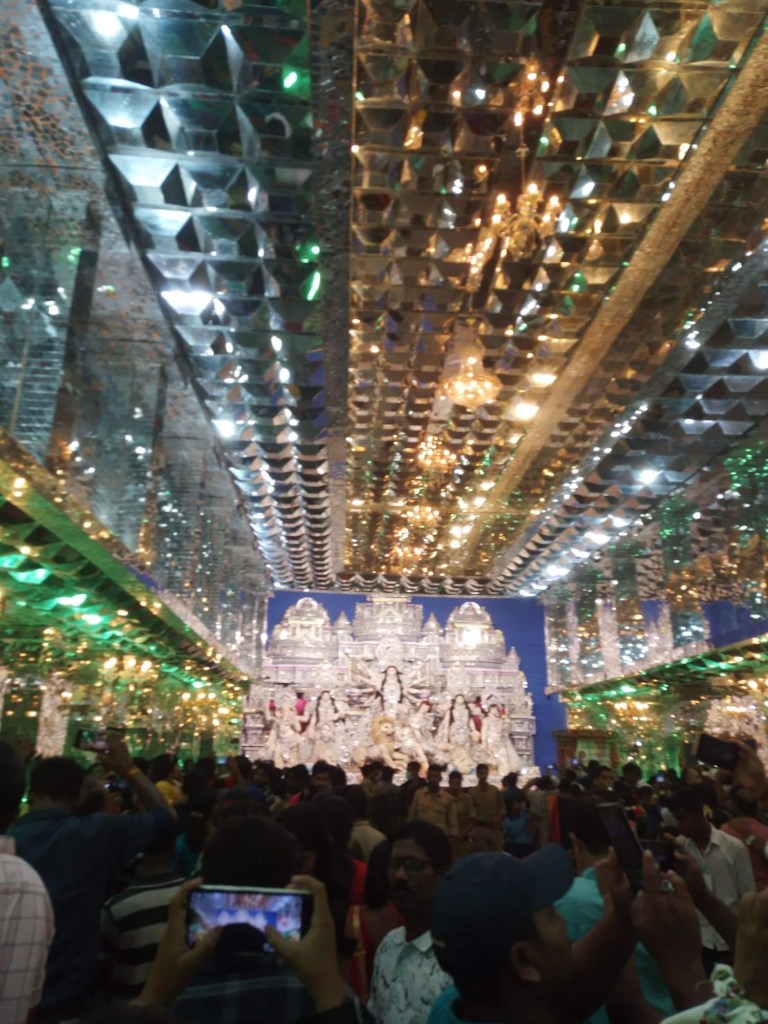
On Panchami, the Fifth Day of Durga Puja, around noon, I was stopped by a small girl riding a pillion on her father’s motorbike. In a polite but hurried and restless voice, she asked me the way to reach the ‘Twin Towers’. Usually, I am not comfortable while offering directions, and often goof it up by saying left when I mean right. On this occasion, I exercised caution and pondered over the easiest and quickest route before advising her father to enter through the next lane and then turn right to find what was nothing short of a wonderland for the schoolgirl. She smiled and waved for prompt assistance while her father accelerated the two-wheeler. It was apparent they were new to this small town that had suddenly grown big in stature within weeks and emerged as a hotspot because of the replica of the Twin Towers from Malaysia as one of the Puja pandal themes here.   

The Puja organisers were surprised as the turnout surpassed their expectations and broke all previous records. Some analysts explained this unprecedented wave was the public response to the pandemic that had kept them indoors for two consecutive years. With people sharing images and reels across social media platforms, the ‘Twin Towers’ went viral, generating a big buzz among pandal hoppers to include it in the must-see list. The sea of humanity in this small town surged from neighbouring towns, far-off districts, and even other states.  

The grandeur of tall towers led to a google search for architectural wonders, modern and ancient, from around the world as likely themes for the puja pandals next year. The appeal of tall and towering structures offers a valid reason to see the lavish artificial mounts to be dismantled within a few days of idol immersion. Painstakingly built over the months, the hard work of artisans and craftsmen has paid off rich dividends – without any special efforts by the organisers. The public informed fellow citizens of all faiths, through every possible means of communication, to visit the Twin Towers and make the Puja celebrations complete.

It was much bigger than the crowds milling at any cadre-driven political rally organised in Bengal. Missing this marvel was a loss for devotees and non-believers who thronged the Puja pandals to see art and creativity in full bloom. “Have you seen the Twin Towers?” became the common refrain that gained currency among local people drawn from all sections. Tens of thousands of people stood in queues that moved at a snail’s pace, their floral and musk fragrances overpowering their perspiration. Driven by faith and the desire to see the architectural marvel and the Goddess, the crowds showed patience for hours, braving thunderstorms and intermittent showers without complaints, standing with umbrellas for their turn, without any attempt to jump the fence. 

Droves of people – armed with camera-flashing mobile phones – were busy capturing the Twin Towers from various angles, looking for a different click for their feeds, slowing down their pace to capture the images without blurring. The volunteers brandished batons to keep the crowds moving toward the exit gate. The entire process of entering the pandal and exiting was over within two minutes. The wait outside the pandal took a couple of hours at least.  

Although I had visited other pandals where the turnout was modest, I intended to see the ‘Twin Towers’ after Dashami, the last day of the festival, after the crowds thinned. I wanted to be bedazzled by the lights, so I did not venture during the daytime. I chose to go during in the late evening for a fully lit-up view of the colossal towers, to stand behind the crowds discussing bus routes and means of transport available at night, apart from momos and biriyani outlets in the vicinity. It was the last day after the week-long festival drew to a close. But the turnout remained steady and suggested it was perhaps the first day, showing once again that aesthetic appeal allures people and creates a hangover that refuses to subside even after the curtains are drawn.  

I came out of the premises and checked the random clicks on my phone. I was overwhelmed with the pride of having seen the replica. I had captured the precious moments, posing against the backdrop of the Twin Towers forever. 

Whether this Puja inspires people from Bengal to travel to Malaysia to see the towers is pure speculation. But it has made people complacent, and they happily declare they have seen the Malaysia ‘Twin Towers’ in Bengal. Crossing borders, oceans, countries, and continents to select themes, the Pujas in Bengal offer people the vicarious pleasure of seeing the global wonders come alive in the art form.  

Devraj Singh Kalsi works as a senior copywriter in Kolkata. His short stories and essays have been published in Deccan Herald, Tehelka, Kitaab, Earthen Lamp Journal, Assam Tribune, and The Statesman. Pal Motors is his first novel.  


PLEASE NOTE: ARTICLES CAN ONLY BE REPRODUCED IN OTHER SITES WITH DUE ACKNOWLEDGEMENT TO BORDERLESS JOURNAL. 

Categories
The Observant Immigrant

We had Joy, We had Fun…

By Candice Louisa Daquin

Courtesy: Creative Commons

Heortology (the study of festivals) has expanded beyond its initial Christian focus to embrace all festivals and their enduring appeal and necessity in our human culture. Festivals remind us to celebrate, and celebration is a positive experience. The very idea of festivals is ancient. No existing history book is old enough to document when the first festival took place or what its origins were, but it’s a safe bet they had some kind of worship element attached. Modern festivals often also land on old pagan holidays, whilst others are more obvious in their origins. Many who attend festivals have no idea of their origins but go for entirely celebratory reasons. We have learned a lot about the history of varied festivals but another question to consider is: Why are humans drawn to festivals and what do they provide us?

Imagine the ancient world. As much as we think we know now, they knew a tremendous amount also, considering their lack of modern resources. This may well be down to the ‘necessity is the mother of invention’ paradigm. Or that we severely underestimate our ancient ancestors, in our egocentric belief the modern world knows best. Just as we underestimate the knowledge of animals and their abilities to survive. Perhaps we could even say, we have lost the art of survival and wouldn’t know how to, if our computers were offline and our cars did not work and the supermarkets were empty.

What we do know, is the ancients were able to amass a great deal of knowledge, despite seemingly not having easy access like we do today, with our modern telescopes and technology. They had to understand mathematics and science at the very core, to establish theorems on the universe and our place in it. Whilst many were later corrected, it is surprising how many ancient scientists, mathematicians and philosophers, got it right. Almost against all odds. It is fair then to say, we dismiss the richness of the ancient world, and imagine everyone lived ignorant lives, which was not the case. When ignorance did reign, it did so deliberately, with the quashing of knowledge by various religious groups, and resulting periods of ‘dark ages’.

The ancient world was in touch with what it means to be human. Being human isn’t knowing how to work your iPhone or microwave. It’s not having a huge house, with a swimming pool and driving a Lexus. Nor is it eternal youth, fame and glory. Being human is about surviving — just as it is with any animal. When we then add an awareness of our own being, which it is argued, not all animals understand, then we become the modern human we recognise today. A being who has the choice, the ability to reflect and learn, and a tendency to seek beyond themselves. In seeking beyond oneself, we find an innate or shaped desire for ‘more’ and that ‘more’ has often come in the guise of a God-head or spirituality of some kind.

Whether we believe humans are prone to worshipping gods or being spiritual, because Gods actually exists or we just have a propensity to create them, is immaterial. The outcome is the same. The God gene hypothesis proposes that human spirituality is influenced by heredity and that a specific gene, called vesicular monoamine transporter 2 (VMAT2), predisposes humans towards spiritual or mystic experiences, perhaps that is what is at work? In essence a transmitter in our brain that makes it more likely we will believe in God (and could explain why some people do so fervently, whilst others do not). Or perhaps we may find meaning in believing in a spirituality beyond the temporal world. But what we do know is, as long as humans evolved from their primate ancestors, they have formed meaning around some kind of spiritual observance and festivals were tied to this worship.

Why do we do this? We are born part of something (a family) but are also separate (an individual). Perhaps festivals and what they represent, is the coming together of all things: Nature. The seasons. Marking time (birth and death). Marking passages (fertility, menstruation, maturity, marriage, children, dying). These are the cornerstones of meaning, with or without God. I say without God, because for many, their notions of God are tied to nature, so it’s more the world around them than specific deities. For others, it’s the manifold destinies of humanity, or history of deities. But whatever the reason there is a sense of coming together in celebration of being alive, and acknowledging that life. A festival in that sense, irrespective of its actual purpose (the harvest, pagan holidays, etc.) is a ‘fest’ of life. Maybe this is why we can have such a happy time being part of it.

Growing up, neither of my parents liked festivals. They thought they were silly. I remember a street festival I went to as a child, for Fête du Travail (Labour Day) in France. I dressed up as princess and the frog (taking my toy Kermit with me) and felt an excitement like I had never felt before. The throngs of people and other children, the food, the smells, the magicians, the shows and the things to see. It was like walking through a market of treasures. I couldn’t understand why neither of my parents liked this; to me, it felt like a jewel had opened. But for some, festivities are synonymous with rituals and a degree of adherence to religion, even when it’s not. And rather than entering into the spirit of it and enjoying it, they feel what it represents is part of social control.

In France, like many countries, festivals abound. The national Fête du Citron (Menton Lemon Festival) draws crowds from around the world, as does the film screening: Festival de Cannes –near where I grew up — and Fête des Lumières (festival of lights, in Lyon). More traditional festivals include Défilé du 14 Juillet (Bastille Day). In the Middle Ages in France, on Midsummer’s Day, at the end of June, people would celebrate one last party (fête de la Saint-Jean or St. John’s Day). Bonfires would mark this longest day and young men would jump over the flames. This also happened on the first Sunday of Lent (le Dimanche de la Quadragésime), where fires are lit to dance around before carrying lit torches. Religion dominated many of the Autumn/Winter festivals historically.

In France, Christmas, is marked over twelve days with the Feast of the Innocents, the Feast of the Fools, New Year’s Eve and culminates in the Feast of the Kings with its traditional galette des Rois. Events include Candlemas (Chandeleur) with its candlelight process. Likewise, many Christian societies have some celebration connected to Easter (Pâques, in French)) or its Pagan roots. In France (and New Orleans in America) these include Shrove Tuesday (typically Mardi-Gras in America), marking the last feast day before Lent, and many others until Pentecost Sunday. My favorite ‘fest’ was Shrove Tuesday (also known as Fat Tuesday or Pancake Day, in other countries) because my grandma would make pancakes, despite our being Jewish. The notion was to eat before Christian Lent and a period of fasting, which has much in common with Muslim beliefs too (unsurprisingly since God is one in the Jewish, Christian and Muslim faiths). In America, they serve fish options every Friday for much the same reason.

Far more impressive and immersive festivals occur in India, with Hinduism celebrating among the highest number of festival days in the world. Over 50 festivals are celebrated throughout India by people of different cultures and religions. These Indian festivals form an integral part of the rich heritage of the country. The ancient Hindu festival of Spring, colors and love known as Holi is one. “Holi is considered as one of the most revered and celebrated festivals of India and it is celebrated in almost every part of the country. It is also sometimes called as the ‘festival of love’ as on this day people get to unite together forgetting all resentments and all types of bad feeling towards each other.” Holi is celebrated on the last full moon in the lunar month of Phalgun, the 12th month in the Hindu calendar (which corresponds to February or March in the Gregorian calendar).

With social media, more of the world have been granted access to the visual beauty of Holi – “This ancient tradition marks the end of winter and honors the triumph of good over evil. Celebrants’ light bonfires, throw colourful powder called gulal, eat sweets, and dance to traditional folk music.” One of the most popular legends in Hindu mythology says the Holi festival marks Lord Vishnu’s triumph over King Hiranyakashyapu, who killed anyone who disobeyed him or worshipped other gods. With coloured powder thrown on people as part of the celebration, many countries now celebrate Holi just as Indians may celebrate Halloween or Día de Muertos. The crossover effect may seem to dismiss the individualistic cultural value and smack of appropriation but, in reality, it’s more a sign of respecting other cultures, learning about them, and celebrating with them.

Mexico, which I live near to now, celebrates over 500 festivals yearly and consequently is one of the most festive cultures in the world. In San Antonio, TX, where I currently live, we celebrate many of these fiestas, alongside American ones. The most popular being Día de Muertos, Día de la Virgen de Guadalupe, Cinco de Mayo and Día de la Candelaria, (like the French Candlemas, celebrated after Three Kings Day, which is a bigger holiday than Christmas in Mexico). The variables in cultures are fascinating. In San Antonio, we get a huge influx of Mexican tourists over Christmas because they aren’t home celebrating as they do so a few days later. We have a fiesta in San Antonio that is much like those in Mexico, due to our large Mexican population and it’s heartening to see the merging of the two.

As a child I celebrated the Jewish Pilgrim Festivals—Pesaḥ (Passover), Shavuot (Feast of Weeks, or Pentecost), and Sukkoth (Tabernacles)—and the High Holidays—Rosh Hashana (New Year) and Yom Kippur (Day of Atonement). But I attended a school that celebrated all faiths so we also celebrated Ramadan, the Muslim sacred month of fasting, akin to Christian Lent. Growing up, my friends of all faiths, celebrated Eid-ul-Fitr or simply Eid which is among the religious festivals for the Muslim community, marking the end of Ramadan. This festival is celebrated on the day after seeing the night crescent moon with devotees offering prayers at mosques and then feasting with their near and dear ones.

We would also celebrate Kwanzaa, which is a worldwide celebration of African culture, running from December 26 to January 1, culminating in a communal feast called Karamu. Its creator was a major figure in the black power movement in America, “Maulana Karenga created Kwanzaa in 1966 during the aftermath of the Watts riots as a specifically African-American holiday. Karenga said his goal was to ‘give black people an alternative to the existing holiday of Christmas, and give black people an opportunity to celebrate themselves and their history, rather than simply imitate the practice of the dominant society.’”

Are we socially controlled when we attend festivals? Given we have a choice, I would say no. Someone who chooses to be part of something, isn’t signing up for life, they’re passing through. Since my childhood I have been lucky enough to have attended many festivals in many countries. For me it is a reaffirming experience, seeing people from all walks of life come together in happiness. I like nothing better than dressing up and meeting with others and walking through streets thronged with people. Be they carnivals, even political events, there is an energy that you rarely feel anywhere else.

The May Pole festival, believed to have started in Roman Britain around 2,000 years ago, when soldiers celebrated the arrival of spring by dancing around decorated trees thanking their goddess Flora, is an especially interesting festival because it is still practiced almost as in ancient times. The ribbons and floral garlands that adorned it represent feminine energy and the beauty of the ritual is enduringly something to behold.

Likewise, another event ‘Guy Fawkes Night’ is steeped in ritual and British history, with much symbolism in the burning of straw dummies that are meant to represent Guy Fawkes thrown onto bonfires. However, the act of throwing a dummy on the fire to represent a person, has also been done since the 13th century to drive away evil spirits. What most people seem to take away from Guy Fawkes Night are the abundant fireworks in a beautiful night sky, alongside children and families holding sparklers and eating horse chestnuts in the cold, wrapped up in mittens. It’s a ritual that is beloved and a chance to ‘be festive’ even if it’s not a specific festival. As much as anything, it marks time, another year, another November, and gives wonderful memories. If we didn’t mark time or have those memories, we’d still have others, but there is an ease with festivals because they do it for us, unconsciously.

Young collegiates often attend festivals that involve dancing and sometimes drugs. Again, this is not a modern occurrence but has been going on for years, as rites of entering adulthood. The desire of the young to get out and meet others and dance and enjoy life, is primeval, and possibly a part of who we are as humans, marking a potent stage in our lives. Recently I went to a birthday party at a night club. I observed the diverse throngs of party goers and reveled in that abundant diversity. In just one night I saw: Pakistani women in saris, Japanese girls in anime costumes with ears, a pagan woman with huge, curled bull horns and floor length leather dress, Jamaican families in neon shorts and t-shirts, transgender wearing spandex dresses and big wigs, Hispanic Westsider’s filled with tattoos, and gold necklaces, Lesbian and gay couples holding hands. Old couples in sensible church clothes including one old black man with a pork pie hat and a waist coat.

I thought of all the diversity that had attended this club to dance the night away. All ages, all genders and backgrounds and ethnicities, and I thought how wonderful it was that one place could hold them all. In many ways this is the essence of a festival, especially nowadays where anyone can attend most festivals. Years previous, they were segregated by subject. Only those followers of that subject usually attended and you could be harmed if you tried to attend and were an outsider. The advantage we have today is we are more accepting of outsiders and when you attend festivals today, you see a wide range of people. Maybe this is the best opportunity we have to put down our differences and celebrate our similarities.

When I lived in Canada, I loved the homage paid to different seasons in varied outdoor festivals, where shaking off the lethargy of Winter, Canadians would celebrate with fairgrounds, amusements, shows and food among other things. It was like a period of renewal. Likewise, during my time in England, the Notting Hill Carnival, celebrated the Afro Caribbean culture, so essential and entrenched in English culture, with gorgeous street displays and floats, as well as some of the best music around. The idea of welcoming everyone into the fold, helps to remove any tensions between cultures and promote a feeling of unity, whilst not denying the unique properties of those cultures and ensuring they are promoted in their adopted countries. It may be idealistic and not entirely accurate, but it’s a better step than ignoring those myriad cultures exist.

As Halloween and Día de Muertos is fast approaching, I am thinking of how many of my neighbours attend these parties, despite some of them being from very conservative churches. Just last year, we all sat outside in the green spaces and had a mini fireworks display. I sat next to my little 4-year-old neighbour and watched her face as the older kids, dressed in all sorts of costumes, shrieked at the fireworks, and ran around with neon bangles, throwing glow powder at each other. I saw how inculcated we are, since childhood, but despite this I truly believe festivities are in our hearts, even if we weren’t introduced to them at an early age. Children mark their growing up by the events of their lives and it’s not just their birthday they celebrate but the touchstones of their respective culture and nowadays, many other cultures.

My Egyptian grandfather used to tell me about the Nile festival which celebrated the flooding of the river and the replenishing of life in Egypt. Without the Nile, Egypt couldn’t exist, and the ancients knew this. They employed methods to enhance the flooding and gave thanks for it. Gratitude like this can be found in many celebrations, including the American Thanksgiving (although this is a double-edged sword, given the history of genocide of the Native Americans by European pilgrims and invaders) and Harvest throughout the world. A celebration of life through food with music, is at the core of the human ability to endure and overcome hardship. More recently many of us celebrated healthcare workers by singing out of our windows and putting messages of thanks in our windows. We do this because it symbolizes essential parts of our lives, without which we would suffer.

Owing to its melting pot past, Egypt celebrates the Coptic Orthodox Christmas, the more ancient Abu Simbel Sun Festival that is akin to the Egyptian Sun God Ra (who in turn was one inspiration for the Christian God many years later), Sham Ennessim, the national festival marking the beginning of spring, as it originates from the ancient Egyptian Shemu festival, Ramadan and the Muslim Eid al-Adha (honoring the willingness of Ibrahim (Abraham) to sacrifice his son Ismail (Ishmael) as an act of obedience to Allah’s command). As a Jew, my grandfather’s family celebrated Passover, the festival celebrating the Jews Exodus from Egypt, despite our family still living there! Nowadays it is no longer safe to live in Egypt as a Jew but the memory of all people’s experiences is preserved through ancient festivals and events, marking our shared history.

Before the advent of mass-produced entertainment, festivals were also a highlight in any village or town, because they were entertainment. Traveling theatres and shows for children, even book sellers and traders of items not commonly found locally, could be bartered or purchased at such events and it was almost a spilling out from the market square economy that kept such villages alive. Perhaps evolving from our natural tendency to barter for things we want, we evolved to invite others from outside to come for specific events to gain greater reach. With this trading and bartering, came the accoutrements such as eating, drinking, dancing. Not only did this increase diversity and knowledge of foods and drinks from other locales, but brought people who may otherwise not meet, together into a camaraderie.

Sharing stories is also part of festivals, by way of theatre, or more improvised scenarios. It is at our heart to pass on oral knowledge and we haven’t lost that desire. We may do this now via YouTube more than face to face (which is a shame), but the desire to get out and talk directly, is innate, as evidenced by how many people have done just that since Covid 19 restrictions are eased. Religion, folklore, ritual and a desire for escapism, alongside our desire to celebrate things or others (saints, gods, seasons, harvest) are all reasons why festivals endure. Just like children will instinctively dance when music is played, maybe it is our innate nature to enjoy festivals because they foster inter-relationships we all crave to some degree. We may be diverse and believe different things, but we can also come together and respect the perspectives of others. Never more so than through our shared love of celebration.

.

Candice Louisa Daquin is a Psychotherapist and Editor, having worked in Europe, Canada and the USA. Daquins own work is also published widely, she has written five books of poetry, the last published by Finishing Line Press called Pinch the Lock. Her website is www thefeatheredsleep.com

.

PLEASE NOTE: ARTICLES CAN ONLY BE REPRODUCED IN OTHER SITES WITH DUE ACKNOWLEDGEMENT TO BORDERLESS JOURNAL.