Categories
Nazrul Translations

Ring Bells of Victory!

Nazrul’s poem, Proloyullash, has been translated as ‘The Frenzy of Destruction’ by Professor Fakrul Alam, published in his first anthology Agnibeena (Fiery Instrument) in 1922.

Kazi Nazrul Islam. Courtesy: Creative Commons

Born in united Bengal, long before the Partition, Kazi Nazrul Islam (1899-1976) was known as the  Bidrohi Kobi, or “rebel poet”. Nazrul is now regarded as the national poet of Bangladesh though he continues a revered name in the Indian subcontinent. In addition to his prose and poetry, Nazrul wrote about 4000 songs.

THE FRENZY OF DESTRUCTION

Ring bells of victory!
Summer’s storm flutters the flag of the New!
Ring bells of victory!

He who was to come is coming,
Dancing as if possessed and bent on destruction!
Crossing Oceans, storming the Main Gate, smashing portals, 
Into the dark hole of death
In the guise of the eternal executioner—
Through smouldering smoke
Lighting the lamp of lightning
The Violent One comes,
Bursting with glee!
Ring bells of victory!

Locks swaying in the overcast sky, He makes the sky flare,
Forcing even the fiery all-consuming comet’s tail to tremble.
In the very heart of the Creator of the universe
Like an unsheathed sword the blood sparkles
Roll and sway!
His loud laughter stuns the universe into silence—
Look how stunned the universe is!
Ring bells of victory!

A dozen suns’ rays stream fiercely from His eyes
The sorrows of the world stick in His disheveled hair.
Every teardrop falling from His eyes 
Makes the seven seas roll and swell
His cheeks flush and glow!
Hugging Mother Earth in His huge arms,
He thunders, “Let destruction triumph!”
Ring bells of victory!
Ring bells of victory!  

Take heart, take heart, cataclysms shake the universe,
The sluggish and shrunken, the dying and decrepit,
Hide and flee because of the coming catastrophe.
Cheerfully, compassionately,
The infant moon’s beams will shine in the sky’s unkempt locks.
Light will flood your home now!
Ring bells of victory!

The eternal charioteer comes, lashing his bloodied whip,
His horses neigh out; their cries resound in thunder and rain.
Their hooves spark off stars and scatter them across the blue sky
In the covered well of the dark dungeon
The gods are tied up with sacrificial stakes
And heaped in cold stony pillars.
Time for Him and His chariot to shake the earth.
Ring bells of victory!

Why fear destruction? It’s the gateway to creation!
The new will arise and rip through the unlovely.
Hair disheveled and dressed carelessly
Destruction makes its way gleefully.
Confident it can destroy and then build again!
Ring bells of victory!

Why fear since destruction and creation are part of the same game?
Ring bells of victory!
Wives, hold up your lamps of welcome! 
The Beautiful comes in the guise of the Violent One

Ring bells of victory!  


(The translation was first Published in Daily Star, 2007)

It was converted to a song called Tora Sab Jayadhani Kar or ‘Ring Bells of Victory’ in 1921 and set to tune by Nazrul himself.

Tora Sab Jayadhwani Kar sung in Bengali by contemporary singer Swagatalakshmi.

Fakrul Alam is an academic, translator and writer from Bangladesh. He has translated works of Jibonananda Das and Rabindranath Tagore into English and is the recipient of Bangla Academy Literary Award (2012) for translation and SAARC Literary Award (2012).

PLEASE NOTE: ARTICLES CAN ONLY BE REPRODUCED IN OTHER SITES WITH DUE ACKNOWLEDGEMENT TO BORDERLESS JOURNAL

Click here to access the Borderless anthology, Monalisa No Longer Smiles

Categories
Stories

Little Billy

By Paul Mirabile

Little Billy was a timid, quiet boy of thirteen going on fourteen. He kept to himself both at home and at school. Because he was the only child, little Billy’s mother, unemployed, pampered him to such an extent that he sought refuge in outdoor activities such as tree-fort and cabin constructions in the back garden, chemical experiments with dead animals conducted in his hand-built cabins, tunnel-burrowing under trees or fences, this last activity much to the dismay of his parents. As to his father, well, his work kept him long hours away from home, so the boy hardly ever saw him besides at their late evening dinners, or on the week-ends when he wasn’t busy ‘on the road’.

Little Billy loved to read. Not those ‘childish’ stories imposed by the school programme and taught unenthusiastically by his teachers, which he never read in spite of the spot tests that his teacher would surprise the pupils with, and which he would invariably fail. No, not those boring scrawls. He indulged in true literature: the adventures and exploits of explorers in the wilds of Africa or in the depths of Asia, especially the marvellously written tales by Jules Verne, his literary hero …

Billy’s schoolmates despised his taciturn attitude in class. The more rambunctious boys indulged in creating the usual chaos during recreation when he would sit under a tree and listen to the birds or meditate on his future chemical experiments whilst his schoolmates fought, spat or cursed. Yet he was no snob; he just had nothing to share with his classmates; his adventurous dreams only bored the boys who preferred wrestling and football, and the girls who preferred wrestlers and footballers.

Little Billy filled his time and soul with adventure and constructive projects to escape his mother’s irksome babying and his father’s coerced absence. Twice his imagination materialised into daring escapes from home. The first took him about thirty kilometres or so from his neighbourhood, peddling on his little bicycle as fast as his little legs could, growing more excited as he traversed unknown territories where woods, villages and hamlets passed before his giddy eyes like a magical phantasmagoria. The police, having been phoned by Billy’s hysterical mother because he hadn’t come home for lunch or dinner, finally caught up with him late at night, seated on a grassy hillock, munching apples that he had pinched from a nearby orchard. Everyone believed that Billy simply had lost his way. Little Billy, however, felt he had been on an adventure, and to have absconded for the first time, conferred upon him a powerful and secret aura …

His second escapade was more daring: the absconder hitch-hiked and walked into regions where the folk spoke in accents very much distinct than his own. They even addressed him in strange dialects, using words he had never heard, neither at home nor at school. And how exciting it was neither to understand nor to communicate with the individuals whom he met! Three days later, dirty, hungry and clothes be-spotted with mud and rainwater, little Billy stood before his tall frowning father, who, although never having raised a hand to the child, scolded him with uproarious words and frenzied gestures. As to his distraught mother, there is no need to go into detail: her sobs and sighs, albeit somewhat theatrical, rose higher to in crescendo than the father’s roars.

Henceforth, little Billy decided to limit his adolescent élan to constructing a duplex tree-fort in the large oak tree at the back of his spacious garden. As to the wood required for such a project, the ingenious boy strolled into the many construction sites that surrounded their neighbourhood, negotiated with the workers for spare wood, nails and screws. They liked this little bugger, combative and imaginative, so they plied him, without cost, with large boards of plywood for flooring and roofing and cut, oaken beams for the supporting frames. As to the tools, these the he procured from his father’s garden tool-shed.

Little Billy set to work immediately, choosing four sturdy branches of that leafy oak tree, one branch slightly higher than the other, which allowed him to build one level at a time. Once the lower level had been finished (it took him a mere three days), the energetic builder went on to build the second level of his duplex, connected by a three-rung ladder made from the oak beams that he sawed to measure between the thick limbs with his father’s electric saw. His fort proved to be rather high off the ground, and although he shimmied up the branches like a monkey, Billy preferred a more elaborate ascent: he found two long pieces of rope, made six knots in them at half metre intervals and used the legs of chairs as rungs, which he pushed through the loops of the knots and tightened; chairs that he found thrown out as rubbish in the streets of his neighbourhood. Little Billy took pride in his tree-fort, and spent much time there reading, writing or meditating …

With the arrival of winter, however, he had to abandon his fort, open to strong, glacial winds, and began to devise a plan to build a cabin. It would be a sturdy cabin with a floor, a roof (flat of course), three windows and a door. Again the kind workers provided him the material for his project and his father, the tools. He built it in less than a month in spite of the cold and frost, which obliged him to make a floor several centimetres off the frozen earth. The door proved a bit dodgy : he bought three hinges with his pocket money, screwed them into the oaken frame of his entrance and into a large piece of plywood which he cut to fit the rectangular entrance. The fit was far from perfect; that is, the door could not be closed correctly. But that didn’t matter, he was only a little boy! Billy dispensed with a door-knob and simply sawed a hole in the plywood big enough to put two fingers through. He did the same for the three square windows, the first sawed out next to the door and the other two on the opposing sides of the cabin. He did not fit them out with sheets of pane as they were expensive and his father refused to give him money for those. Finally, to complete his happy home, he laid out several spare rolls of rug to keep his feet warm during the winter months that his father had stored away in the tool-shed. His cabin became cozy and comfortable, out of bounds to his parents; after all, it was Billy’s own private universe, his intimate recluse from the world. His father only asked him not to dig any more tunnels !

Inside, on the rickety table he had also made by himself, he conducted all sorts of experiments: dissecting frogs and fish, concocting chemical potions made his clothes stink (much to the consternation of his mother) and into which he threw frogs’ legs or fish eyes, or any other animal parts that he happened to come across on his daily late afternoon or evening jaunts.

Alas, during that very harsh winter, a terrible snow storm flattened his cabin completely; it lay wrecked, buried under tons of dirty grey snow until the early Spring rains exposed the tragic ruins.

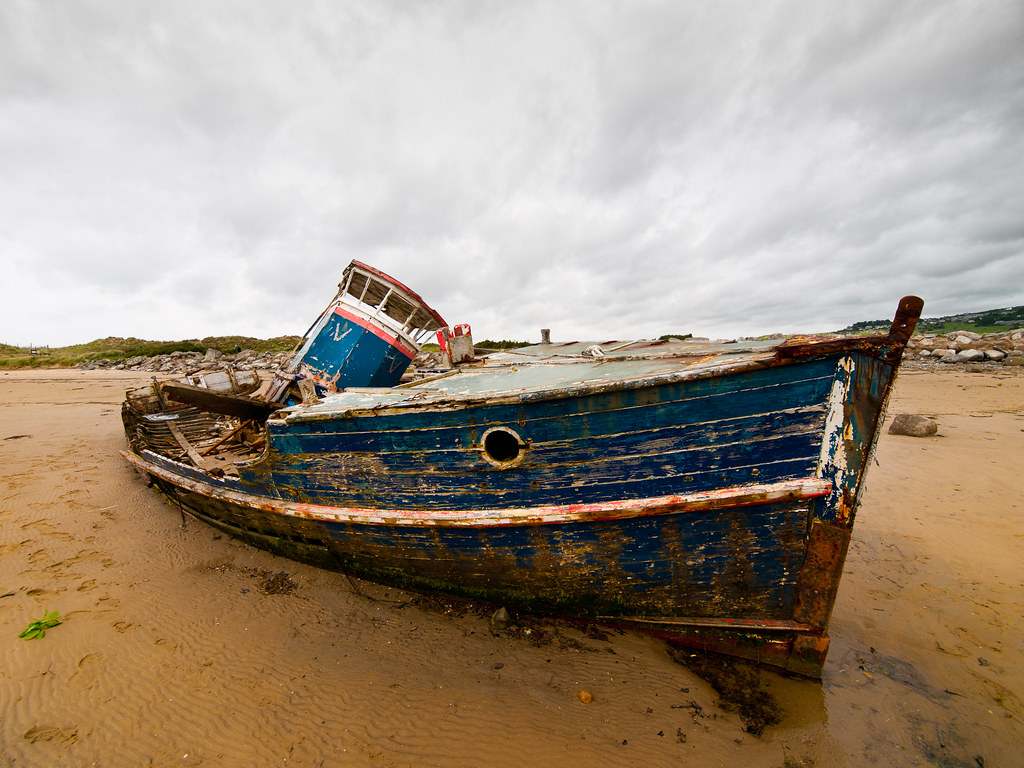
But Billy was not a boy to be put out by such unforeseen discomfitures. The undaunted Billy, when the snows of winter had completely melted, set out to build a boat! Yes, a real boat, made of wood, big enough for three or four adults, with a real bow and deck and cabin, on top of which he would lay or sit on the ‘bridge’, bathing in the sun, reading Jules Verne or writing his memoirs.

So he again pleaded with the workers to supply him with oaken beams for the hull, large planks of plywood for the siding, bottom, deck and bridge to bridge securely the sides of the boat. The workers, amused by this boy’s inventiveness, even furnished him with a special putty to caulk the seams of his boat to make her perfectly watertight. Billy was all agog … So too were the workers!

Little Billy threw his heart and soul into his boat-building under the back deck of the house; he felt at the height of his creative powers, and by early Spring he had completed it: his dream boat. He painted the hull a bright marine blue and christened the boat ‘Captain Nemo’ painted in bold green letters, after the hero of his favourite Jules Verne adventure. He relinquished the task of providing a helm, tiller and rudder which would have required engineering skills beyond his ability; after all, Billy’s boat was a simple boat. However, with a long pole or paddle it could always been poled or paddled if he so desired. On the other hand, he carpeted the cabin located under the ‘bridge’ with the rolls that remained of his father’s thick, blue carpet. Since he had managed to secure his rickety table under the collapsed wreckage of what was once his back garden cabin, he placed that in the cabin of his boat and even built a little chair for it, a bit wobbly, but none the less, usable for what would a table be without its chair, and a boat-cabin without both ? Finally he bought a notebook which served as a logbook.

Now the reader at this point may ask him or herself in what waters would this boat be floated, and how would it be hauled into those, up till now, undisclosed waters? It goes without saying that the ingenious Billy had answers to both those questions, for if he didn’t, why would he have built a boat in the first place? The answer to the first question is quite simple. Many years ago next to Billy’s house had been dug a huge sump, surrounded by a high, wire fence, and whose waters rose very high during the winter and spring. As to the second question, the

And it floated! Yes, Billy’s marvellously made boat really floated! He tugged, hauled and pulled it down the slope of his garden, through the rent in the high wire fence, then down again to the dirty brown sump waters. There he tied it to a stake in the soft soil and stepped back to admire his work. He especially appraised the little ladder he had made that led from the fore-deck to the ‘bridge’ (Billy did not have the engineering know-how to make a stairway), and gloated over the two curves of the bow, joined so perfectly to a nice pointy fit, a bow whose nice fit was thoroughly achieved thanks to his father’s timely and skilful assistance  …

Tiny ripples spun round the beautifully painted hull caused by a soft wind. They lapped against the bold green letters of ‘Captain Nemo‘. Billy frowned: he had painted the name a bit too low on the hull! Ah well, he could afford himself a bit of self-indulgence, he hadn’t taken into consideration the weight of the boat and her submersion level. His face, however, lightened up as the rays of the sun grew stronger and stronger. The weeping willows that lined the high wire fence swooned to the gentle breezes and to little Billy’s face beaming with joy. How he revelled in several instants of self-vanity! Who could blame him?

He took a cursory glance up at his house ; his parents who had gone out to shop had not as yet returned. So much the better! Smiling a mischievous smile, he untied the rope, jumped aboard and let the warm zephyrs of early springtide guide his lovely boat further and further from the sloping shore of the sump. It was her maiden voyage… He went below into the cabin and peeked out of the two portholes (without glass), picked up his logbook and chair, then climbed the make-shift ladder to the ‘bridge’. There he sat in the sun, listening to the silence of the sump, sizing up its largeness.

The branches of the weeping willows brushed lazily against the high wire fence, the birds chirped merrily here and there, some pecking at the dirt around the tree-roots. Billy’s boat, and this goes without saying, had neither outboard motor nor masts for sails: she just drifted on her own, erring aimlessly, like his thoughts, like his lively imagination had always drifted and erred from adventure to adventure … book to book … page to page … word to word … Adventures upon the high seas, atop the highest of mountains, across the hottest of deserts. Fabulous tales of a thousand and one days and nights that no one, neither parents nor teachers, could ever deprive him of, divest him of, dispossess him of …

The sun warmed his cheery, glowing cheeks as he read and wrote to the rhythm of his wanderings. His mind slipped from the scummy waters of the sump to the high swells of some very distant sea … The swells rose to titanic heights, then crashed into a myriad ripples upon some remote sandy island strand. Just then Billy’s drifting mind was brusquely interrupted by cries and shouts. They were coming from inside the sump, near the rent in the fence.

There stood Mr. and Mrs. Wimbly, his next-door neighbours, waving their chubby arms frantically, crying out to him. Mr. Wimbly had even begun to descend precariously the steep slope of the sump to the waters. He stood at the edge, hands now cupped around his mouth, hollering words that he could not understand. Mrs. Wimbly raced recklessly back and forth on the grassy walk-way between the high wire fence and the slopes of the sump. Little Billy shook his head: Was all this real or just an hallucination?

At first he ignored their cries and wild gestures, concentrating on his reading and writing ; after all the Wimblys weren’t his parents! But soon other neighbours began to pour into the sump, or materialise on the other side of the high wire fence, under the weeping willows, their twisted, purple faces swelled in torment, their piercing shrills drowning the musical chirping of the birds. There was fat Mrs. Holly shaking her pudgy fist, chiding him with names that he was taught never to pronounce either in public or at home. How dare the old cow address him with such ugly words. And there, Mr. Rogers, red-faced, his jowls bouncing up and down from so much hooting and hallooing!

Other neighbours, too, came running, all upset, jumping about like puppets on strings, waving at him, scolding him. He stood up and frowned …

Then a sudden strange sensation chilled him to the bone and which made him forget all the ongoing bedlam: He felt that his boat had stopped moving, in spite of the wind that had suddenly picked up, and that the sloping sides of the sump appeared to rise higher and higher, slowly, very slowly, whilst the clouds, too, were rising higher and higher in the deep blue of the sky … rising slowly away from him. Something was terribly wrong. He climbed down from the ‘bridge’ and was about to step down into the cabin when he fell back in horror: black waters were streaming over his lovely carpet, tossing his little table from side to side. The starboard side of his boat had burst from the seams of its framework. Billy froze in utter incomprehension: How could this be? The boat had been properly caulked! His beautiful boat …  Months of love and labour …

Coming to himself quickly, little Billy climbed back up to the ‘bridge’. There he stood, half baffled, half defiant! From his sinking position he glimpsed through tear-stained eyes the stamping of feet and the pointing of fingers of so many neighbours, known or unknown. Their cries and shouts rose to incredible crescendos. He had no idea how to overcome this predicament, and it suddenly struck him that he had never learned to swim … The sump waters were very deep after the winter months. He prayed that they wouldn’t be so deep where his boat was irretrievably disappearing, for there was nothing else to be done, no one came to his succour, everyone just jumped and ran about like a pack of wild animals.

Then little Billy heard a familiar cry: It was his mother’s! She had come home, noted all the fuss round the sump and had found the rent in the fence. Now there, at the edge of the slanting slope, she was tearing at her hair, writhing in agony, her hysterical screams drowned out all the others that were drumming through his tiny head without respite. His father suddenly came into view, there, at the foot of the slope, he was descending towards the waters and appeared to jump in and swim towards the now stricken boat … swimming and swimming towards his only child with long and powerful breast-strokes … But no … this was an hallucination: Billy’s father did not know how to swim, and in any case it was too late; little Billy’s beautiful dream boat sank rapidly below the scummy dark waters, dragged down by its weighty load. The last vision that his father and mother had of this hallucinating scene was their son’s outstretched hands clutching his logbook … A few seconds later, out from the suction of the whirlpool, Billy’s little red captain’s cap popped up and floated there, aimlessly, a flotsam of engulfed dreams and sunken aspirations …

His mother collapsed. His father howled with outstretched hands, then fell lamely to his knees …

Sometime afterwards the police arrived on the scene equipped with rubber rafts. They spent hours scouring the waters, mainly because the benumbed neighbours could not decide exactly where the boat had gone under; Billy’s cap having since waded to the other side of the sump. Finally, however, a frogman brought up little Billy’s limp, lifeless body to the surface. As to his boat, it remained at the bottom of those dirty brown waters, a memorial to the boy’s ardent dreams, like the Titanic, never to be disturbed in its final resting place. And although the waters do subside during the hot summer months, there it remains to this day, lying upon its cracked and scorched, lunar-like bed, rotting yet recognisable, a ghostly vision that no hand should ever touch besides that of its hapless creator and captain.

Soon, the ill-fated ghost-boat drew many mourners from the region and beyond. They gathered round the sump to pray or look on in sorrow. Some threw flowers over the fence. (The rent had been repaired.) The sump appeared to have become some sort of pilgrimage site, attracting hundreds and hundreds of people, even foreigners came to vent their curiosity! The mayor of the town, a rather unscrupulous blighter, brought up in one of the town meetings that perhaps the municipality should charge a small fee for entry into the ‘pilgrimage site’! This proposal was over-ruled as bad taste and cynical.

As to little Billy, he was buried at the town cemetery on the bright, warm day of his fourteenth birthday, a funeral without clamour or commotion. Only his parents and close relatives attended the church service and the walk to his final burial plot.

Little Billy’s parents, due to all the fanfare that their son’s cadaverous hulk had aroused, have since moved to another region without sharing their new address with any one …

Courtesy: Creative Commons

.

Paul Mirabile is a retired professor of philology now living in France. He has published mostly academic works centred on philology, history, pedagogy and religion. He has also published stories of his travels throughout Asia, where he spent thirty years.

.

PLEASE NOTE: ARTICLES CAN ONLY BE REPRODUCED IN OTHER SITES WITH DUE ACKNOWLEDGEMENT TO BORDERLESS JOURNAL

Click here to access the Borderless anthology, Monalisa No Longer Smiles
Categories
Essay

 Half A World Away from Home

By Mike Smith

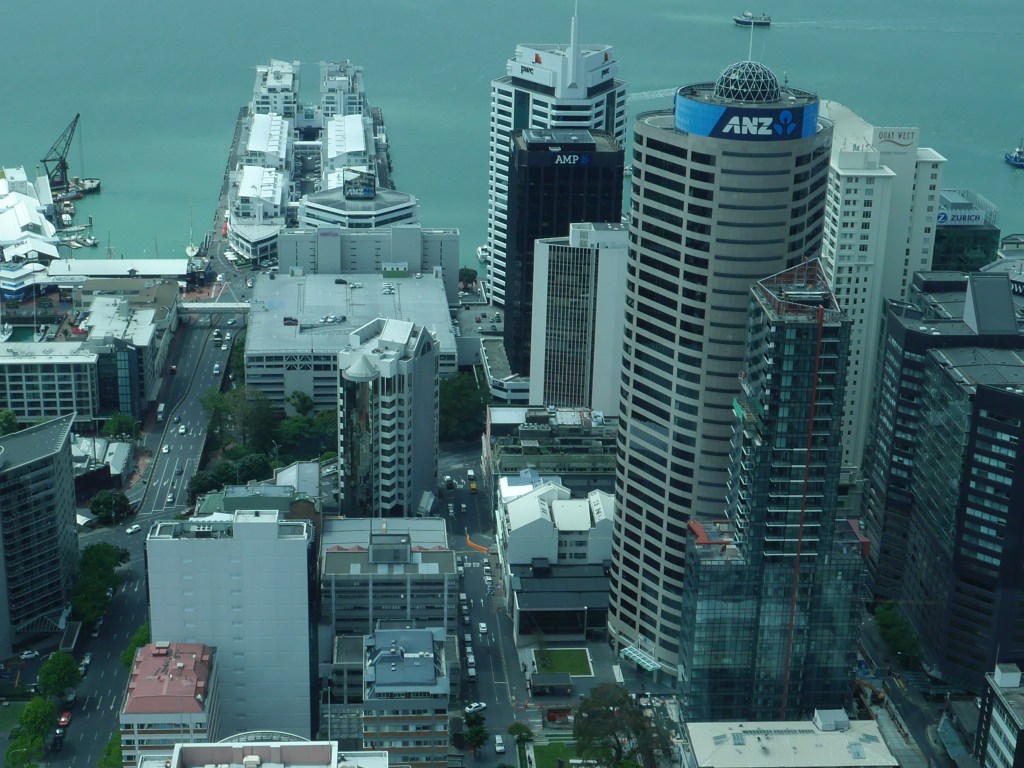
Auckland downtown. Photo Courtesy: Mike Smith

I recently visited New Zealand, where I met up with writer Jenny Purchase, whose collection of short stories Transit Lounge  has just been published. I was fortunate enough to read an earlier version of this in manuscript form, and it was good to meet up face to face with her at last; and to get my own proof copy of the then not yet published volume!

Reading a book written in and about a foreign country (where, it has been famously asserted, ‘they do things differently’) is a bit like travel itself. We are hit simultaneously by not only what is dissimilar from our own patch and experience, but also what is, unexpectedly perhaps, amazingly similar. It’s not just Maori culture that Jenny’s stories jolt the outsider into, but the wider society of this modern democracy, which is said, at least here in my country, to be like stepping back in time into a version of our own past.

That’s true to a very shallow extent. Buildings are reminiscent of British structures: but who could tell skyscraper London, from skyscraper Hong Kong, or Dallas, or tower packed City Centre Auckland if they’d never been in any of them before? I used to think a good TV game might be to fly contestants into night clubs around the world and ask them to guess which country they were in. It crossed my mind more than once that you could do something similar with shopping centres, or malls if you prefer it. There would be clues, but often not in the appearance of the shoppers, nor in the brands they were carrying. But what we in the UK call charity shops are in NZ called opportunity stores, which implies differences that cut much deeper than mere labelling.

Yet those low-rise suburbs of New Zealand’s largest city, the wood-framed clapper boarded houses that I think of as ‘chalet chic’, and especially the oldest of them, and which look so alien to my eyes, were once common in the UK, and I could take you to a few still rotting gently in Lake District lanes under pine trees, oak and ash. One house we stayed in, at the resort town of Akoroa, settled by the French in 1840, is said to have been imported in kit form from Britain in the 1850s, and to be same kit as the more famous ‘Treaty House’ at Waitangi, except of course with an additional second storey.

The traffic, too, has that blend of the familiar and unfamiliar to European eyes, with the same private cars I would see on UK roads. But the lorries! Huge Mack trucks, often with trailers, that I’ve seen before only in the movies. There was the odd Chevy knocking about too. But they all drive on the left, just like in the UK.

When people get off the bus in Auckland, they thank the driver. Yet, I was told, the drive to get more people out of their cars and into public transport in the city was struggling against a deeply ingrained reluctance to take the bus. Snobbery was given as the explanation. And from the sound of engine noises in the night, and during the day, there are more drivers than I hear where I live who still think it’s clever to be audible three streets away. And don’t get me started on those who play their music louder than all the traffic noise within a hundred yards!

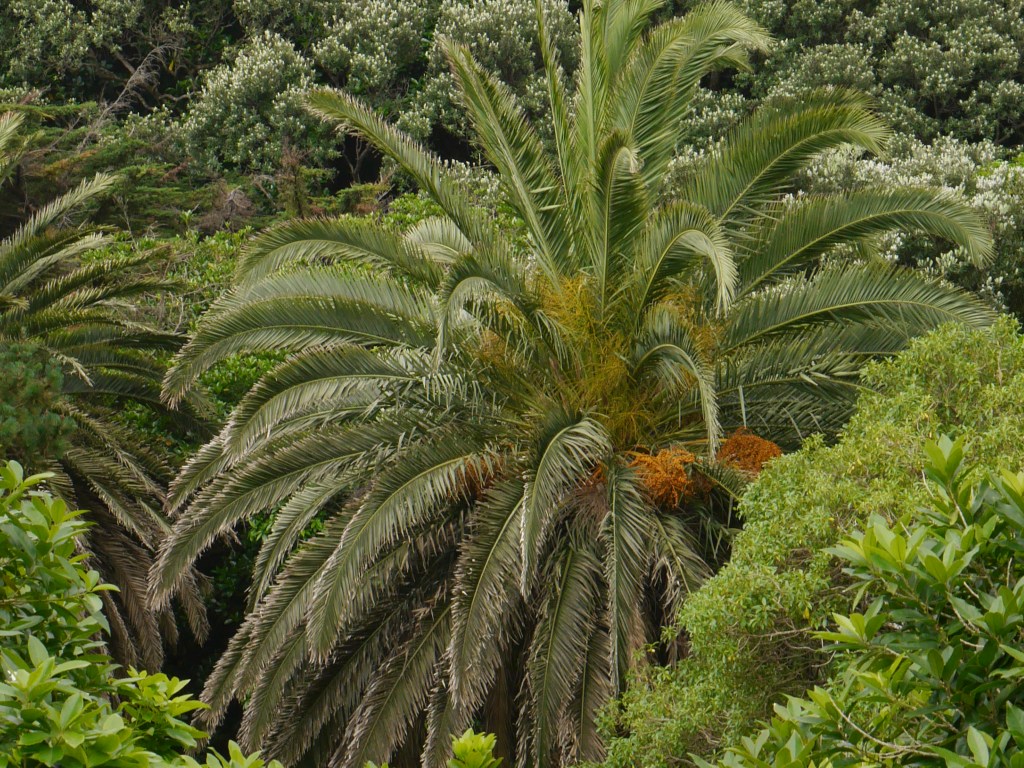
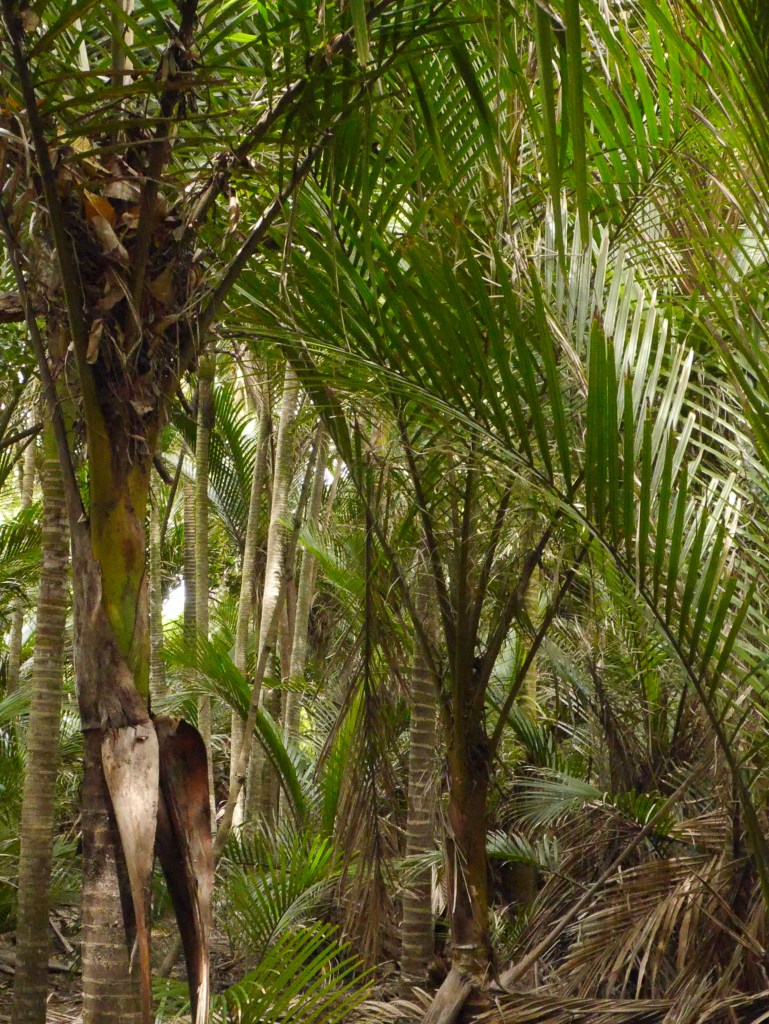
And what about the forests? Walking on the Queen Charlotte trail near Picton in South Island, it was the difference that struck me: the canopy of ferns and palms; leaf shapes that I couldn’t identify; the scars of recent landslips, which looked as if some giant had taken a massive ice-cream scoop to the hillside and peeled off a good helping, only to drop it a few hundred feet down the valley side, often into the sea where the path ran close above the shore. I got the feeling all along the coast that I was walking on sandcastles not yet reached by the rising tide. 

Yet, turn a corner and momentarily you could imagine yourself in an English glade or a Scottish glen, and in so many places the name given to it might well be of an English or Scottish general or politician, or any surname that you’re very familiar with. And, let’s be honest, in an English woodland I’m as likely to struggle with identifying those leaves except for a really obvious few! But the palm fronds and ferns exploding like huge green fireworks from an otherwise normal — to my eyes — New Zealand forest canopies always excite me!

Plants that at home are house plants on the windowsill, and never big enough to block the view are here growing outside, and above head height. Fruit that costs a fortune in English supermarkets falls here in back gardens like English apples and is left to rot.

The Fish and Chips are good, and celebrated both here and there, though it throws me for a second each time what we call crisps are referred to as ‘chips’. The coffee, ‘a long black a day keeps the senses in play’ is my take on the old saw, is the best I’ve ever had, though I’m doing my best to replicate it here in Cumbria!

Similarities and differences abound both in stories, and in the places they come from and reveal. They told me when I was young that travel broadens the mind, but I wonder if also, and perhaps more so, it sharpens our perception of where we’ve come from as well as that of where we’ve arrived, whether we travel by plane or on the page! 

Raising A Trowel

Seen from the Auckland waterfront, where the pedestrian swing bridge salutes the boats as they enter and exit the inner harbour, city centre offers an intense, almost intimidating backdrop of close-packed tower blocks of concrete and glass, overtopped by the sharp needle of the skytower a few blocks further up the hillside beyond the historical shoreline.

But turn around and follow the embedded railway tracks left over from the days of steam trains and sailing ships, all the way to where the old industrial silos have been decorated with lights and festooned with climbing plants and find the single track spur that slips away to the right, splitting almost immediately into two again before entering the double-track tram shed, and you will have arrived at what we were told is the last of the Auckland Community Gardens.

Lying alongside the long building are some forty raised beds, tended by volunteers, each bed that I saw, carrying the name of its gardener. Hard up to the tram shed wall (here decorated with images of old tickets), sits a row of composters for food waste and wormeries in plastic barrels. There’s a greenhouse and a traditional pallet-built compost heap. Water runs from the tap.

There were many such gardens in Auckland at one time. I recall encountering one unexpectedly on a small site on one of the steeper city centre streets during a previous visit. But I’m told that all save this one have gone now, the land taken for the far more valuable purpose, in monetary terms and for other reasons, of squeezing in another tower block. This last of them is fighting to keep its plot, and I hope it does. Buildings, from what I’ve seen, sit tight in their boundaries in Auckland. It’s a city that doesn’t seem to see the need for growing space. And perhaps, with a country more or less the size of the United Kingdom but with only about one fourteenth of its population, that shouldn’t surprise us.

Two tomato plants were pressed on us, for our daughter’s nascent garden out in the suburbs. My guess is that I will never eat tomatoes grown in such valuable land, on a dollar per acre basis. But the clue is in the name. This is a Community Garden, and the community, which it not only serves but also creates, is an inclusive one.

Community Gardens offer more than a source of ‘home grown’ food, paid for in care rather than cash. I would guess that even a city like this, which to the outsider’s eyes can seem remarkably relaxed and laid back at first glance, could use those benefits.

The names on those raised beds confirmed the story told by the volunteer who we chatted with on our stroll past. The garden brings together people whose languages and skin colour vary enormously, but they are united by their green fingers and that remarkable thing, the human smile, and much more.

Back on my own plot now, bound fast in winter frost, harsher and earlier this year than we have become used to over the last decade, I raise a trowel from the iron hard soil, in salute to fellow gardeners everywhere.

A Cacophony of Voices

The variations we hear around us, in accent and in language itself, I suspect, offer different perspectives of reality rather than merely alternative words for it. Perhaps that’s why I came home from my recent trip to New Zealand with a beginner’s guide to Maori!

‘Yis’ and ‘yes’ are both similar and different at the same time, and so are ‘iggs’, though the latter perhaps weighs more heavily on the difference side of the scale. But in the North of England, yes and aye carry a much older distinction, despite both being used without forethought locally. Though my skin is more or less the same colour as that of almost all my neighbours, and though I’ve lived in this part of the world for over half a century now, any school kid, and any old codger of my own age would know as soon as I opened my mouth that I’m ‘nut frum rahnd ‘ere’. Old codgers, fifty years ago, in a Cumbrian pub told me that during their childhood, people from villages only two miles apart could be distinguished by the way they spoke.

Only the outsider is fooled into thinking that rural England has a homogenous population, and perhaps that’s true elsewhere. But in the cities, it is cosmopolitan around the world, and visibly so. More interesting to me is the cacophony of voices, none of which I believe, have been genetically inherited. We speak as we have heard. We speak as we have listened, and in the accents of those we have listened to and consciously or unconsciously, copied.  Until a couple of generations ago that would have been limited almost completely to geographically close family and neighbours.

Several years after my visit to the Waitangi Treaty Grounds, it suddenly struck me what I had overlooked, though it was obvious from the beginning. The Treaty was signed by many Maori leaders in 1840, but on behalf of a single Monarch-Emperor. Our perceptions of others, and of ourselves, evolve over time. As part of that process we forget, deny, re-interpret and re-invent both our own narratives and those of people we have encountered. We redefine who ‘we’ are, and who ‘they’ are. ‘Us’ and ‘them’, are perhaps the two most unstable words in the English language.

Language itself is unstable. New languages are formed by the coalescence of older languages – English is a prime example of this, and not yet a thousand years old as a national, let alone an international tongue. They are formed too from the disintegration of an earlier single language – Scottish Gaelic, Irish, and Welsh among others, all derive from a single widespread early European language. Which process the language of any people is undergoing at any moment, that of coming together or that off moving apart, must be an indicator of wider social, political and religious evolutions.

The biblical story of Babel’s Tower, and its cataclysmic dividing of us, of being struck down as it were by the curse of having different languages rather than one, is a story that raises ideas we might do well to ponder and examine more than it seems to me that we have.  Harari’s book Sapiens makes the simple assertion that once upon a time a monkey had two offspring, with the astonishing addition that one was a human being. My question is did their offspring develop a single language from which all our languages grew? Or did they disperse into separate communities each of which developed their own languages?

A history of the North American Indian that I came across asserted that those first people had dispersed across the continent before the development of language, which implies that by the time we had spread that widely across the world we were still, apart from, perhaps, something like birdcalls, mute. Yet we all carried the genes that would predispose us to develop language, and that when the American Indians did so it was in quite as many unrelated languages. The Maori came to New Zealand less than a millennium ago and brought with them languages with shared roots despite their many tribes.

Of course, I have no answers, though it seems likely to me that communities and individuals who are open to strangers are more likely to see the amalgamation of languages, and that those who are not will encourage their disintegration. And I do have the suspicion that language, to use a modern analogy, is like a TV channel. Each one carries its own agenda and its own programmes. Each presents the world from its own perspective and its own focus. There may be overlap. There will be difference. But as language using beings we can, with varying degrees of competence and effort no doubt, tune in to any, and who knows, perhaps to all of them, if we wish to do so.

Mike Smith lives on the edge of England where he writes occasional plays, poetry, and essays, usually on the short story form in which he writes as Brindley Hallam Dennis. His writing has been published and performed. He blogs at www.Bhdandme.wordpress.com 

.

PLEASE NOTE: ARTICLES CAN ONLY BE REPRODUCED IN OTHER SITES WITH DUE ACKNOWLEDGEMENT TO BORDERLESS JOURNAL

Click here to access the Borderless anthology, Monalisa No Longer Smiles
Categories
Review

Of the Raj, Maharajas and Me

Book Review by Bhaskar Parichha


Title: Of the Raj, Maharajas and Me

Author: MA Sreenivasan

Publisher: Speaking Tiger Books

This is a delightful book for two reasons: One, it is a reminiscence of a civil service official with the princely state of Mysore and Gwalior, and later with the government of British India. Secondly, the stream of language and the lucidness with which the author has penned his recollections is remarkable. What is more, it reflects on the administrative practices of the former princely states of India.

M.A. Sreenivasan (1897-1998) lived through almost the entire 20th century and was among the very few people who witnessed at close quarters the enormous changes that took place in India during this period. Born in Madras, he belonged to a family that traced his subsequent generations of Pradhans (ministers) of successive kings of Mysore for 150 years. Sreenivasan joined the Mysore Civil Service in 1918 and, after a varied career both with the Mysore Government and the Government of British India. He became a Pradhan of the Maharaja of Mysore in 1943. In 1947, he was invited by the Maharaja of Gwalior to become the Dewan of that State. During that momentous year, he was a member of the Constituent Assembly of India and in regular touch with many of the leading figures (including Mountbatten) involved in the transfer of power from British to Indian hands.

Much more than an autobiography, the book is a rare portrait of India during and immediately after the British Raj. The princely States of India have been neglected by scholars, many of whom have tended to be unfairly critical. There is much in this book on the effectiveness of administration in two major princely States. It redresses the balance and makes the book a valuable document on the subject. Further, Sreenivasan provides sharp insights into the negotiations that led to the end of the Raj, and into the new polity that emerged after Independence. 

Writes Sreenivasan about Louis Mountbatten: “I had seen and talked to Mountbatten at lunch parties in Viceroy’s House and meetings of the Chamber of Princes. Tall of stature, with an enviable reputation as Supreme Commander of the Allied Forces during the War, he impressed everyone with his fine personality and pleasing manner. Standing on the dais that day, wearing his bright, white naval uniform, festooned with medals and decorations, he addressed the gathering as Crown Representative of His Majesty, the King of Great Britain, his cousin, and spoke of the King’s concern for the Princes of India with whom the Crown’s long-standing associations and obligations were soon to come to an end.”

Elsewhere in the book he writes about Sir CP Ramaswamy Iyer: “He was a remarkable man. Endowed with a fine personality and a keen intellect, he was learned and brilliant, an eloquent speaker, and a brave and dynamic administrator. In his early years, he was a much sought-after lawyer and one of the first, most ardent, champions of Home Rule for India. CP, as he was called by friends, was among the leaders and statesmen whose views were sought by successive British missions. He did not, however, take part in the Constituent Assembly or its committees. I knew he had plans of making Travancore an independent maritime State. I had always held him in esteem as a distinguished elder statesman and called on him at Travancore House in New Delhi, asking him why he had not agreed to the accession of Travancore.”

Write Shashi Tharoor in the foreword: “This book is simultaneously an exploration of the region’s glorious past and present and a memorable personal history, tracing Sreenivasan’s life and career, which was as challenging as it was deeply interesting. From the ups and downs of local politics to navigating the bureaucracy of nascent independent India, not to mention moving forays into Sreenivasan’s home life particularly relating to his beloved and constantly supportive wife, Chingu, there is little that is not covered. The reader follows the author through his myriad journeys, from Mysore to New York and London, to the Chambal Valley and beyond.”

The last few chapters of the book are notable. Whether it is the merger of the princely states or Prime Minister Nehru, Sardar Patel and the two Nobel laurates- CV Raman and Dalai Lama – Sreenivasan’s chronicles make for an absorbing read.

In the epilogue, he writes: “The years have witnessed revolutionary changes in India. There has been impressive progress in many directions and many remarkable achievements. The scourge of smallpox and plague has been eradicated. The shame of human beings carrying night soil has ended in many cities and towns. Infant mortality has been reduced, and life expectancy enhanced.

“The production of food grains and other needed crops has vastly increased. Thanks to generous foreign aid and increased revenues, huge dams and reservoirs have been built. Hydro-and thermal power generating stations installed. An industrial revolution has taken place. Thousands of mills and factories turn out myriads of products, from cotton cloth and silk to telephones, television sets, computers, locomotives, motorcars, and aeroplanes. Transport and communication have also been revolutionized. Scores of universities, hundreds of engineering and medical colleges and research institutions have been started and equipped. India can boast of having perhaps the largest surplus of scientists and technologists in the world for export. But progress has not come with both hands full. With great gains have come great losses. An irreparable loss is the grievous vivisection of India.”

This captivating life story will be of particular interest to students and scholars of modern Indian history as well as the general reader.

Bhaskar Parichha is a journalist and author of UnbiasedNo Strings Attached: Writings on Odisha and Biju Patnaik – A Political Biography. He lives in Bhubaneswar and writes bilingually. Besides writing for newspapers, he also reviews books on various media platforms.

.

PLEASE NOTE: ARTICLES CAN ONLY BE REPRODUCED IN OTHER SITES WITH DUE ACKNOWLEDGEMENT TO BORDERLESS JOURNAL

Click here to access the Borderless anthology, Monalisa No Longer Smiles
Categories
Slices from Life

Sails, Whales, and Whimsical Winds

Photographs & Narrative by Meredith Stephens

It was June, and we were sailing north along the coast of New South Wales. We arrived at Hacking Bay to weigh anchor at sunset, and later fell asleep to the gently rocking motion of the boat. The following day, Alex made an early start up the coast before I roused. In anticipation of rough waters, he brought me an anti-seasickness pill and a glass of water. After lying there in my cabin for half an hour, I heard Alex uncharacteristically utter an expletive. I knew I couldn’t stay in bed any longer.

“There’s a tear in my mainsail!”

“What now?”

“We can’t get to Pittwater today. We have to find a sailmaker as soon as we can.”

Alex rang his sailor friend Luke who put him on to a competent sailmaker. We had just passed Botany Bay near where the sailmaker worked, so had to turn around in rough waters and motor upwind back to the bay.

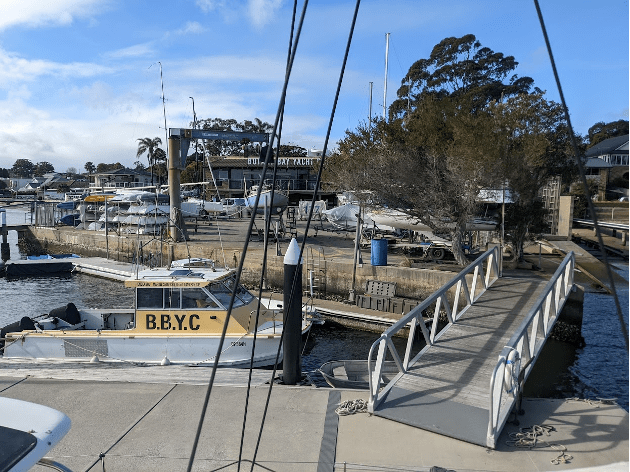
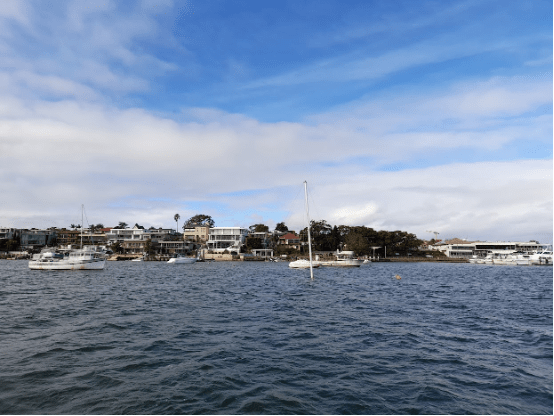
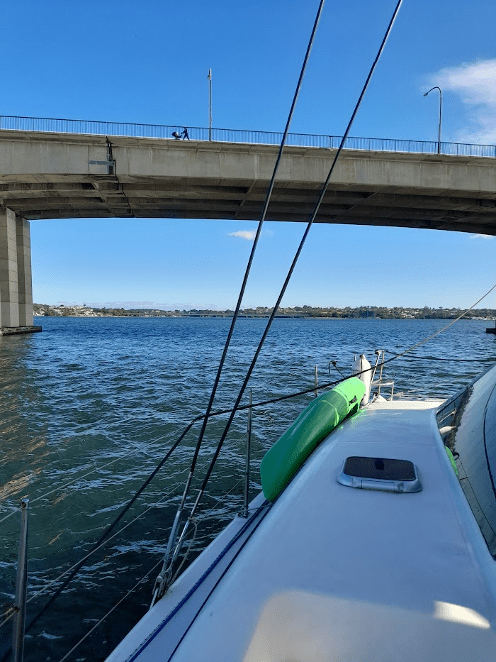
Soon after entering the bay into the St George Estuary we spotted the Captain Cook Bridge looming ahead of us. Would the mast clear the underside of the bridge? We gently and carefully started moving under the bridge. As we passed under it, we noticed the VHF antenna on top of the mast bending while scraping the underside of the bridge, so we reversed as quickly as we could and decided to wait nearby until low tide. After finding out the precise time of low tide we tentatively approached the bridge again, Alex all the while craning his head upwards and to the side of the helm to find the high point of the bridge. The VHF barely tickled the bridge, and we made it to the other side.

Then we navigated the boats dotted around the harbour while we made our way to the wharf. Shipwrights working there approached the berth and greeted us warmly. We threw them the docking lines and they expertly tied them to the cleats. The sailmaker arrived soon after to take the sail away for repair. We entreated him to have it ready before low tide the following day so we could pass back under the bridge and avoid being trapped another day.

We had twenty-four hours to pass in the Sans Souci neighbourhood and spent most of our time strolling along the pedestrian path by Botany Bay. Upon our return to the boatyard, the gates were locked, and we could not access the boat. Alex spied a metal ladder lying in the boat yard. He pulled it under a gap in the base of the fence and laid it against it. We climbed up and stepped onto one of the boats on the other side, and then lowered ourselves onto the ground. I ruefully thought that this was something only teenagers would do, but here we were in our sixties, using a ladder to enter a locked property.

The next morning the sailmaker arrived in good time and we heaved the sail back onto the boat. Alex raised the sail and looked pleased with the neat patch.

We waited until low tide, and then wove our way once more through the moored boats, even passing a sunken boat with its mast protruding through the surface of the water.

We precisely timed our passing under the bridge to low tide. As before, Alex proceeded under the highest point of the bridge.

We were exhilarated to have timed the low tide accurately and to have passed under the bridge with only the tip of the VHF antenna having gently grazed its underbelly. We exited the bay in relief and headed back to the Tasman Sea, turning back north to resume our trip up the coast.

Over the next few days, we enjoyed fair conditions for winter sailing. Sailing downwind was like floating in space. The boat cantered across the surface of the water but we had the sensation of being gently propelled through the air.

“This wind is a bit whimsical,” complained Alex, as he moved to the helm to turn on the engine.

“We are approaching Ballina so I have to keep an eye out for…”

“Whales?” I interrupted.

“No, craypots. There might be whales too, though.”

Alex scrutinized the horizon, shivering in his wet weather gear, searching for unforeseen objects.

The name of the town, Ballina, reminded me of the word for ‘whale’ in French:  une baleine. In fact, the name has nothing to do with whales. Rather it was probably named after the Irish town of the same name.

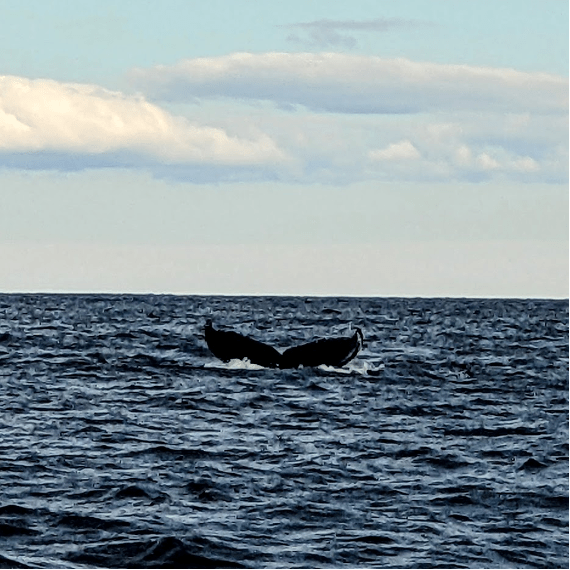
Whale sightings were the highlight of our voyage as we sailed north up the coast of New South Wales. They had migrated from the Antarctica for calving. These were my reward when it was my stint at the helm. Sitting still and observing did not come easily to me. Usually, I liked to busy myself with errands, reading, writing or socialising. I gradually became used to sitting at the helm for hours at a time trying to remain vigilant to spot obstacles to our path. One such day I was sitting there, sensing the swell of the ocean gently rocking beneath me as I held my posture erect, listening to the swishing of the water against the hull, when I was suddenly shocked out of my trance by a spout of water erupting from the ocean surface. Waves do not erupt horizontally so it held my attention. Then I saw a whale throw herself into the air to somersault, and then reveal her fluke as she dived back in again.

“Alex!” I screamed, uncharacteristically, surprising even myself.

It was like being transported to a film set. Alex sensed my excitement and came out with his phone camera, moving to the bow to get as close as he could.

“They’re only a hundred metres away,” he observed.

They performed another flip for us, and flashed their flukes as they dived down. We kept scanning the patch of ocean where they had given their performance, but they did not reappear. I retreated to the helm and then turned around as I heard another splash behind me. The boat had moved on, and the whales were making a reappearance in their original spot.

The trials of seasickness, straining to keep alert while on duty, and sail damage were more than compensated for in the unanticipated sight of a whale breaching before my eyes. All the hardships dimmed in those moments of awe.

Meredith Stephens is an applied linguist from South Australia. Her work has appeared in Transnational Literature, The Muse, The Font – A Literary Journal for Language Teachers, The Journal of Literature in Language Teaching, The Writers’ and Readers’ Magazine, Reading in a Foreign Language, and in chapters in anthologies published by Demeter Press, Canada.

PLEASE NOTE: ARTICLES CAN ONLY BE REPRODUCED IN OTHER SITES WITH DUE ACKNOWLEDGEMENT TO BORDERLESS JOURNAL

Click here to access the Borderless anthology, Monalisa No Longer Smiles
Categories
Poetry

Fragrance

By Priyanka Panwar

The stillness of love
No language
No haste
A calm touches the air;
your heart sits in one place
after having slogged for years.
The aroma of chai 
and the sound of rain drops
‘tis the only truth out there.

Love 
that blooms
in the wildest weather
and touches the ground
on a soft, winter morning;
shedding and giving. 

Ready for the morning prayers;
Living in the fragrance that is left behind.


Priyanka Panwar teaches English at University of Delhi. When she isn’t reading or teaching, she likes to travel and observe. A movie buff and a voracious reader; on most days she dreams of coffee and mountains.

PLEASE NOTE: ARTICLES CAN ONLY BE REPRODUCED IN OTHER SITES WITH DUE ACKNOWLEDGEMENT TO BORDERLESS JOURNAL. 

Click here to access the Borderless anthology, Monalisa No Longer Smiles

Categories
Musings

What do Rishi Sunak, Freddy Mercury& Mississippi Masala have in Common?

By Farouk Gulsara

Rishi Sunak. Courtesy: Creative Commons

Rishi Sunak’s appointment to 10 Downing Street has made people aware of the significant presence of Indians in the African Continent. Indian-African cultural and trade exchanges had been ongoing as early as the 7th century BC. Africans are also mentioned to have significantly influenced India’s history of kingdoms, conquests and wars.

The second wave of Indian migration to Africa happened mainly in the 19th century with British imperialism via the indentured labour system, a dignified name for slavery. It is all semantics. What essentially happened at the end day is a large Indian diaspora in countries like South Africa, Mauritius, Uganda, Kenya, Tanzania and many more. Many of the Indians who made their way there as labourers, over the generations, began to play significant roles in the economy and professional representations in these countries.

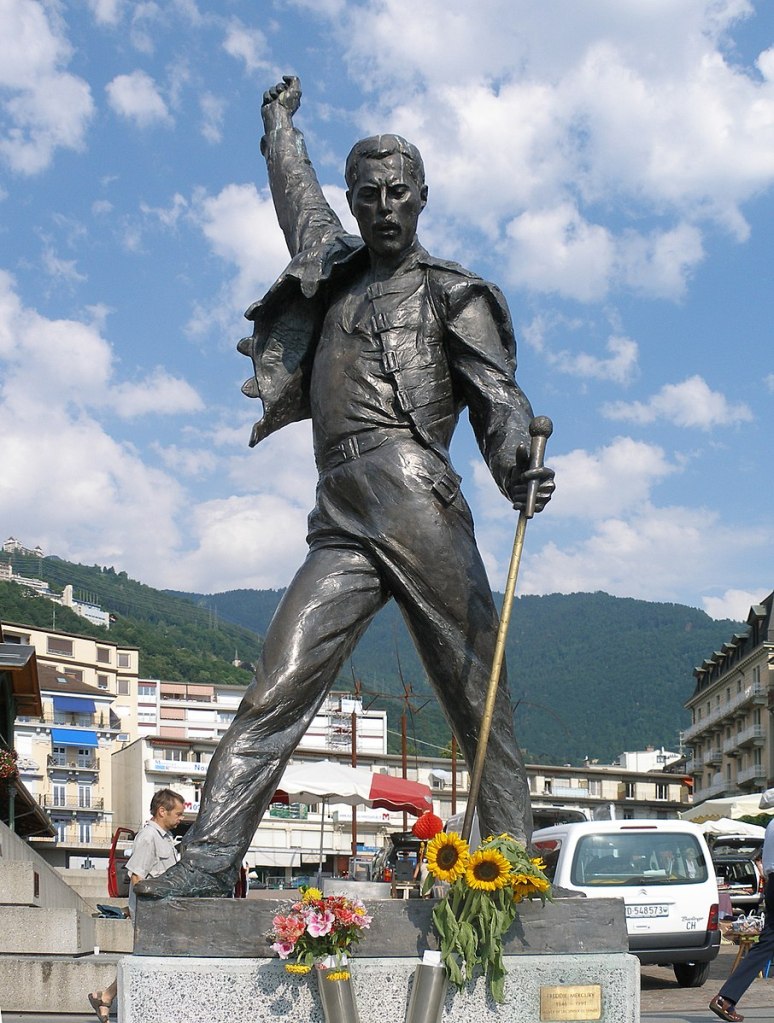
A certain famous Indian diva born in Zanzibar to British colonial civil service who kicked a storm in the rock and roll is, of course, Freddy Mercury (1946-1991) as Farrokh Bulsara.

Idi Amin declared himself the President of Uganda after a coup d’état in 1971. The first thing that he did was to expel Indians from Uganda. His reasoning is that the South Asian labourers were brought in to build the railways. Now that the rail network was completed, they had to leave. They had no business controlling all aspects of Ugandan wealth.

In Mira Nair’s Mississippi Masala (1991), the protagonists, Jay, Rinnu and young Mina, had to uproot themselves from Kampala overnight when Amin decreed that all Indians were no longer welcome in Uganda. With a single stroke of the pen, they became refugees. 

By 1990, they are shown to have become residents of Mississippi. The 24-year-old Mina is entangled with a local Afro-American man. This creates much friction between the two families. That is the basis of the movie. 

It is interesting to note many Asiatic societies complain that the rest of the world practises discriminatory, racist policies against them. In reality, they are quick to differentiate each other within their community — the high-heeled, the aristocratic ancestors, their professions, the fairness of the colour of their skins, you name it. And they call others’ racists. For that matter, everyone is a racist. The Europeans subclassify their community by economic class. The seemingly homogenous Africans also differentiate themselves by tribes. Remember Rwanda with their Tutsi and Hutu civil war? Even the Taiwanese have subdivisions. China and Russia have varying ethnicities across the vast span of their lands.

Interestingly, the politics of the oppressed is much like what we read in George Orwell’s Animal Farm (1945) and saw in the South Korean 2019 Oscar winner Parasite. Like how some animals are ‘more equal’ than others, the maids of the Parks feel more entitled than the freeloading dwellers of the bunker. Even amongst the oppressed, there is a class consciousness to sub-divide the oppressed.

Photo provided by Farouk Gulsara

Race-based politics is so passè. In the post-WW2 era, when the people of the colonies needed to unite to reclaim their land, it made a lot of sense to join under race. Past that point, it did not make any sense for the dominant ethnicity within the nation to claim the country as theirs. At a time when purebreds are only confirmed to be prized pets, it is laughable that politicians are still using racial cards to get elected. Each nation’s survival depends on its competitiveness, anti-fragility, and ability to withstand a Black Swan event. Race does not fall into the equation. With changing social mingling at school and the workplace, interracial unions are the norm. How is race going to be determined anyway? The fathers? The mothers are not going to take that lying down, of course!

The Afro-Americans were emancipated in 1863 after the Civil War, after generations of living as slaves. The black community, at least, still complained that they had received an uncashable cheque from the Bank of America for insufficient funds. Many Indian (and other races, too) labourers were no longer labourers by the second generation and had managed to springboard themselves out of poverty to occupy important positions in society. What gave? Did the coveted American dream slip them by? 

Coming back home to Malaysia, it appears that we will forever be entangled in race politics. In an era when minions around us who were basket cases decades ago have leap-frogged by leaps and bounds in science and technology, our leaders and people stay inebriated in the intoxicating elixir of race superiority. Imagine starting a political party in the 21st century where only people of a certain race can hold critical positions. In day-to-day dealings, expertise is compromised to maintain racial purity. Intertwined with race these days is religion.

Farouk Gulsara is a daytime healer and a writer by night. After developing his left side of his brain almost half his lifetime, this johnny-come-lately decided to stimulate the non-dominant part of his remaining half. An author of two non-fiction books, ‘Inside the twisted mind of Rifle Range Boy’ and ‘Real Lessons from Reel Life’, he writes regularly in his blog ‘Rifle Range Boy’.

.

PLEASE NOTE: ARTICLES CAN ONLY BE REPRODUCED IN OTHER SITES WITH DUE ACKNOWLEDGEMENT TO BORDERLESS JOURNAL

Disclaimer: All the opinions stated in this article are solely that of the author.

Click here to access the Borderless anthology, Monalisa No Longer Smiles

Categories
Notes from Japan

The Year of the Tiger Papa

By Suzanne Kamata

Courtesy: Creative Commons

When I returned to the university where I teach at the beginning of the year – the Year of the Rabbit in Japan — my Canadian colleague and I greeted each other.

“How was your winter break?” he asked me.

“Wonderful!” I told him about how both of my children, who have finished school and left home, returned for the holidays. We’d enjoyed feasting on traditional foods and lazing in front of the TV. “And yours?”

He rolled his eyes. “My son is studying for his high school entrance exam,” he told me. “It was so-o-o stressful.”

How well I remember those days! I think of the year that my own son faced that all-important test, the one that would supposedly determine his entire future, predicting what college he would enter, and then what kind of job, as the Year of the Tiger Papa.

You have probably heard of “tiger mothers” or “education mamas,” stereotypical Asian moms who push their children to succeed academically. Although after having lived in Japan for 23 years at that point I felt that I almost qualified as an Asian mother, no one had ever called me by either of those names. Of course, I wanted my children to do well in school. I was a good student myself, and I was well aware of the value of a good education. However, during PTA meetings, when other mothers were begging the homeroom teacher to assign more homework, mine was the lone voice lobbying for more recess.

Then, my son became a third-year junior high school student. I’d heard that in Japan everything gets put on hold while the kid in question prepares for the all-important high school entrance exam. Since I didn’t have to take an exam to get into my American high school, I really had no idea of the preparation involved. I deferred to my Japanese husband, whom I began to refer to as Tiger Papa.

During the long school holiday, I proposed a family trip to the United States.

“No, “ Tiger Papa said. “Our boy needs to study.”

“Can’t he study while he’s on vacation?” I asked.

Tiger Papa was doubtful. “He needs to study for ten hours a day. Plus, there’s cram school.”

“Well, okay.”

There are many debates about how many hours kids should study, and which country has the best educational system, but we live in Japan. For our kids, success in school meant doing well in the Japanese school system. If our son was willing to study ten hours a day to get into the high school of his choice, then I wasn’t going to stand in his way.

During the end of the year cleaning, my husband and daughter and I washed the windows and polished the floors while our son was holed up in his room with his books. He didn’t have time to hang out with his friends, but he was exempt from all chores. Occasionally, I would bring a cup of hot chocolate to his room.

On the morning of his entrance exam, he sharpened his pencils, strapped on a watch, and rode his bike to the high school where he sat for a five-hour exam. When he came home, he smiled for what seemed the first time in weeks. Come what may, his year of studying was over. I made his favourite soup to celebrate.

“It’s your turn to do the dishes,” Tiger Papa said afterwards. “And then you can clean your room.”

(And yes, dear reader, he got into the school of his choice.)

Suzanne Kamata was born and raised in Grand Haven, Michigan. She now lives in Japan with her husband and two children. Her short stories, essays, articles and book reviews have appeared in over 100 publications. Her work has been nominated for the Pushcart Prize five times, and received a Special Mention in 2006. She is also a two-time winner of the All Nippon Airways/Wingspan Fiction Contest, winner of the Paris Book Festival, and winner of a SCBWI Magazine Merit Award.

PLEASE NOTE: ARTICLES CAN ONLY BE REPRODUCED IN OTHER SITES WITH DUE ACKNOWLEDGEMENT TO BORDERLESS JOURNAL

Click here to access the Borderless anthology, Monalisa No Longer Smiles

Categories
Poetry

Accounting Acronyms

Poetry by Rhys Hughes

ACRONYMS OF AFFECTION AND OPPOSITION

(i)
Significant
Other
Unique
Lover

     Makes
     A cup of
     Tea
     Every morning.

(ii)
Boundless
Energy for playing
Scrabble and
Travelling to the beach

      For fabulous frolics
      Relentless
      In the
      Endless
      Nocturnal
      Delightful surf

(iii)
Anachronistic 
Ruffian
Chews
His grudges

      Eternally
      Never
      Expecting to
      Make friends again with
      You (but they do)


NO ACCOUNTING FOR TASTE

There’s no accounting for taste
and in my haste
to attempt to complete
a sweet and savoury tax return
I made a mistake
and ruined my chances of a rebate.
In future I will employ
a taste accountant
who will check the receipts
of everything I eat
in any gastronomic year.

Rhys Hughes has lived in many countries. He graduated as an engineer but currently works as a tutor of mathematics. Since his first book was published in 1995 he has had fifty other books published and his work has been translated into ten languages.

.

PLEASE NOTE: ARTICLES CAN ONLY BE REPRODUCED IN OTHER SITES WITH DUE ACKNOWLEDGEMENT TO BORDERLESS JOURNAL

Click here to access the Borderless anthology, Monalisa No Longer Smiles
Categories
Poetry

Microcosms

By George Freek

Courtesy: Creative Commons
MICROCOSMS 

Silence sits on my sofa
like a guest. 
On the wall a painting
with birds flying headless,
unable to find the sun,
is going to pieces.
In a corner a shadow
as long as a lizard’s tongue
catches flies
and spits them out again.
As I turn off the lamp,
a moth lights on my shoulder,
his wings like hands
folded in prayer.
He escapes into the darkness 
my shadow created,
to kill himself against a window.

George Freek’s poetry has recently appeared in The Ottawa Arts Review, Acumen, The Lake, The Whimsical Poet, Triggerfish and Torrid Literature.

PLEASE NOTE: ARTICLES CAN ONLY BE REPRODUCED IN OTHER SITES WITH DUE ACKNOWLEDGEMENT TO BORDERLESS JOURNAL

Click here to access the Borderless anthology, Monalisa No Longer Smiles