Categories
Poetry

Bringing along their homeland

Poetry by Abdul Jamil Urfi

Delhi in the 1960’s:
Nostalgia about Lahore was high.
Partition displaced refugees spoke of 
misery, mayhem, murder. Deda Ji regretted 
that, at the time of leaving, a pillowcase of house jewels
was misplaced. Bhabhi Ji had similar regrets--
leaving priceless possessions behind in Lahore
and friends.
 
But what struck us-- newcomers to the grand city
were the names of shops.
So many of them were
named after places in Western Punjab,
or those now in Pakistan. For instance, 
A popular eatery called ‘Lahorian di Hatti’
‘Quetta DAV School’.
Small eateries served dishes called ‘Pindi ke Chholey Bhatoorey’. 
A shop with the name ‘New Lyallpur Cloth House’. 
There were ‘Lahorian Jewellers’, ‘Sindh Wood & Ply’, 
Karachi Sweet Shop, Karachi Stationery Mart, Quetta Store, 
Peshawar Sweet Bhandar, Lahore Watch Co., Sialkot Jewellers 
and also ‘Abbott Drycleaner’s’, whose shop, it turned out, 
had not been named after some monastery’s abbot 
but after ‘Abbottabad’ --a town in Pakistan 
(made famous by the capture of Osama Bin Laden by US Navy Seals)
Thus, many places in erstwhile undivided India, 
but no more in India now.
Lahore, Quetta, Rawalpindi, Lyallpur, Sindh, 
Abbottabad, Karachi, Peshawar, Sialkot 
made their presence felt in a walk in any area of Delhi. 
The Partition displaced people had suffered immense tragedies and losses
And had also brought a little bit of their homeland with them.

Abdul Jamil Urfi published ‘Memoirs of the bygone century, Beeswin Sadi- Growing up in Delhi during the 1960’s and 70’s’, which was extracted and reviewed in The Friday Times (Lahore)FirstpostIndia of the PastCaleidescopeNew Asian WritingScroll.in and The Quint. He works in Delhi as a university teacher. His poems have appeared in ‘Skylark’,  NAW and Vayavya.

.

PLEASE NOTE: ARTICLES CAN ONLY BE REPRODUCED IN OTHER SITES WITH DUE ACKNOWLEDGEMENT TO BORDERLESS JOURNAL

Click here to access the Borderless anthology, Monalisa No Longer Smiles

Click here to access Monalisa No Longer Smiles on Kindle Amazon International

Categories
Review

Independence by Chitra Banerjee Divakaruni

By Somdatta Mandal

Title: Independence

Author:  Chitra Banerjee Divakaruni

Publisher: Harper Collins 

Over the last two or three decades, the Indian American writer, Chitra Banerjee Divakaruni, has managed to carve a niche for herself by regaling in stories of cross-cultural issues prevalent in India and the United States with special emphasis on experiences of diasporic immigrant women. Though most of her stories are women-centric, with time one notices a gradual tectonic shift in her selection of themes. Initially she would write on problems of immigration and culture clash plaguing Indians in the New World. In Palace of Illusions, she went back to the Indian epic and narrated the story of the Mahabharata told from Draupadi’s point of view. In her novel The Forest of Enchantments, she brought Sita at the centre of the epic narrative The Ramayana and accorded her parity with Ram, revealing her innate strength. Then she took recourse to Indian history and rebuilt the story of Maharaja Ranjit’s Singh’s empire in Punjab narrating it from the viewpoint of Rani Jindan Kaur, his last wife as one of the most fearless women of the nineteenth century. Apart from the available historical data, she filled in The Last Queen by imagining many things Jindan would have said and done and thus painted a complete picture of a woman from all perspectives. A perfect blending of fact with fiction, the novel interested all categories of readers, serious and casual alike.

Now with Independence, Divakaruni widens her canvas to tell us the story of a doctor’s family and his three daughters against the freedom movement in India, particularly Bengal, beginning from August 1946 till the epilogue in 1954. The story of India’s independence is narrated through the eyes of three sisters, each of whom is uniquely different, with her own desires and flaws. They live in a rural village Ranipur and right at the beginning of the novel, which is divided into five parts and an epilogue, the author manages to give us the idyllic ambience of the place in very selective poetic language:

    “Here is a river like a slender silver chain, here is a village bordered by green gold rice-fields, here is a breeze smelling of sweet water-rushes, here is the marble balcony of a grand old mansion with guards at its iron gates and servants transporting trays of delicacies up the stairs, here are a man and a woman on carved teak chairs. Here is the country that contains them all.
     “The river is Sarasi, the village is Ranipur in Bengal, the mansion belongs to Somnath Chaudhury, zamindar. He is playing chess with Priya, daughter of his best friend, Nabakumar Ganguly. The country is India, the year is 1946, the month is August.
      “Everything is about to change."

Doctor Nabakumar Ganguly is an idealist and with his practice in their native village Ranipur, where the family resides, he also treats patients in a slum region in Calcutta. He is highly regarded but earns little as he refuses to charge patients without sufficient means. His wife Bina complains about this but supplements the family income by making exquisite quilts for sale and gifting them to those in need. Among the three daughters, Priya is intelligent and idealistic, and resolved to follow in her father’s footsteps she wants to become a doctor, though society frowns on it. She is fortunate to have the support of zamindar Somnath Chowdhury, her father’s best friend. The eldest daughter Deepa is very beautiful and is determined to make a marriage that will bring her family joy and status. The third daughter, Jamini, is devout, sharp-eyed, and a talented quiltmaker, with deeper passions than she reveals.

Theirs is a home of love and safety, a refuge from the violent events taking shape in the nation. This idyllic setting changes rapidly, as the violence of Direct Action Day in August 1946 takes Nabakumar’s life and introduces fear and a communal bitterness in the once largehearted Bina’s veins. Soon their neighbours turn against them, bringing the events of their country closer to home. Deepa is estranged from her mother and eventually isolated on the other side of the border in what becomes East Pakistan, when she falls in love with Raza, a Youth Leader at the Muslim League. As Priya is determined to pursue her career goal, her attempts to get into medical school in India are thwarted by a gender bias, and she finds herself at a college in America. But due to several reasons she cannot complete her degree there and comes back to India to run the clinic where her father worked. And Jamini attempts to hold her family together, even as she secretly longs for the handsome Amit, her sister’s fiancé. When India is partitioned, the sisters find themselves separated from one another, afraid of what will happen to not only themselves, but also each other. It is only then that they understand what it means to be independent, and the price one must pay for it.

After a lot of twists and turns to the story, including smuggling of arms and rescue mission on the Ichhamati River dividing the two Bengals, Amit shot to death, by the time we come to the Epilogue it is 1954 where we learn about Deepa’s daughter Sameera, Jamini’s son Tapan, Deepa managing the zamindari estate and Manorama and Somnath eager to find a suitable match for Priya when she tells them that she is happy as she is now. Feminism, communal amity, empathy, and self-growth are among the requisite qualities Divakaruni identifies for both a country and a human being to be truly independent. Though set in households more than seventy years ago, towards the end we still find some hope. The Postscript to the story is rather interesting as it comes even after the epilogue. It reads thus:

   “Here is a river. Here is a wind rising. Here is a village. Here is the year.
   “The river is time, ebbing, flooding. The wind is memory, it can carry flowers, it can carry flames. The village is the world, and you are at its centre. The year is now.
   “What will you do with it? What will you do?”

As a Professor of Creative Writing in an American university, Divakaruni has gained the expertise of playing her cards well – her narrative technique in each of her novels and short story anthologies preaches what she teaches – the saleability and marketability of a book in this electronic age should be of utmost concern. Like her earlier novel The Oleander Girl, which seemed to have been written as a sort of film script in mind, (incidentally two other novels are being made into motion pictures at the moment), Independence too seems to follow suit with the right amount of ingredients necessary for promoting the book to different kinds of readers and in different forms as well. One is therefore taken by surprise to find a QR code even before the Contents page which tells us to “Listen to the soundtrack for Independence. A playlist of songs that inspired the freedom movement.” For her Western readers, Divakaruni managed to blend history and fiction very well where along with the fictitious characters we get to read about Mahatma Gandhi and the Noakhali riots, Sarojini Naidu, Nehru and others as they played their parts in the freedom movement. Here we find Priya actively engaged in conversation with Sarojini who gives a letter of recommendation to Bidhan Chandra Roy to help Priya to run a clinic.

One praiseworthy aspect of the novel is how Divakaruni manages to give us details of the streets and sounds of Calcutta – the Calcutta of the 1950s with her double decker buses, the shops at New Market, the quaint little restaurants with curtained cubicles to maintain privacy in a public place – all brought back from memory of the city in which she was born and brought up. The novel is also full of translations of several patriotic songs in Bangla which the swadeshis sang during that period. Several lines from Tagore’s songs are also interspersed to express the moods of characters – a technique used by Divakaruni in some of her earlier fiction as well. The exoticism of India, especially rural Bengal of the time is deftly portrayed through many other incidents of killing and looting at different regions of undivided Bengal. As for her Indian readers we are given the story of Priya’s brief stay in America to study medicine at the Woman’s Medical College in Philadelphia where along with her homesickness, we have Arthur, a lovelorn American doctor, who lends her support and patiently waits for her to come back to him as “his heart has been empty” without her.

Despite such manipulations to the story to bring in as wide a canvas as possible, including sufficient examples of Hindu-Muslim amity and hatred as well, the novel remains a page-turner no doubt and can be recommended for its lucid and racy style of narration, something that Chitra Banerjee Divakaruni excels in.

Somdatta Mandal, author, critic, and translator, is former Professor of English at Visva-Bharati, Santiniketan, India.

PLEASE NOTE: ARTICLES CAN ONLY BE REPRODUCED IN OTHER SITES WITH DUE ACKNOWLEDGEMENT TO BORDERLESS JOURNAL

Click here to access the Borderless anthology, Monalisa No Longer Smiles

Click here to access Monalisa No Longer Smiles on Kindle Amazon International

Categories
Poetry

Porch Pirates by William Miller

Courtesy: Creative Commons
Once, boats on the river were floating prey
for fast schooner Turks who stole whiskey, playing cards,
even slaves. Now the barges are driven by one man,
a skeleton crew, a computer that sounds depths,
knows the tides better than any old salt.
But we adjust to time. In the Crescent City,
greed never takes a holiday. Today, every porch
is a cargo deck and all packages are contraband
anyone on foot, bicycle or stolen car can claim
for free. Up and down Poydras
or further north on Louisa, no home is safe
in spite of video doorbells, crime cameras
on telephone poles that scan with one black eye
the landscape of theft. The booty is whatever
can be pawned, resold or simply tossed
in the grass if it has no resale value. Watches,
perfume, I-Phones go quickly, even cancer drugs
if the pharmacy is open to a backdoor bargain,
the expiration date checks out. Nothing changes here;
slow-burning summer is the one season
we all suffer, the same sun that shone
on black men in iron collars, the pirates
who pinched a dozen then sold them back for a quick profit.
In the city that forgot to care, ghosts breed ghosts--
every hand is a grappling hook.

William Miller’s eighth collection of poetry, Lee Circle, was published by Shanti Arts Press in 2019.  His poems have appeared in many journals, including, The Penn Review, The Southern Review, Shenandoah, Prairie Schooner and West Branch.  He lives and writes in the French Quarter of New Orleans.

.

PLEASE NOTE: ARTICLES CAN ONLY BE REPRODUCED IN OTHER SITES WITH DUE ACKNOWLEDGEMENT TO BORDERLESS JOURNAL

Click here to access the Borderless anthology, Monalisa No Longer Smiles

Click here to access Monalisa No Longer Smiles on Kindle Amazon International
Categories
Excerpt

The Wistful Wanderings of Perceval Pitthelm

Title: The Wistful Wanderings of Perceval Pitthelm

Author: Rhys Hughes

Publisher: Telos Publishing

There is a shop somewhere in this town that sells bittersweet longing and I decided to seek it out and buy enough for the afternoon and perhaps the evening too. I wandered the streets of Figueira da Foz and if I happened to meet a stranger I asked them for directions, but no one knew where it was, though most had heard of it.

My yearning to find and enter that shop grew steadily more intense, and it now occurred to me that I already had what I wanted, a bittersweet longing for the building and the product sold by its keeper to his clients. But this simply wasn’t sufficient.

Perceval Pitthelm is my name and I’m sure you already knew this and I am English and a writer of adventure novels. I came to Portugal because I had been told it was a more tranquil land than my own in which to write a new book. This turned out not to be quite true. Nonetheless I was fairly satisfied with my circumstances.

I was a little lonely, indeed, but my health had improved. Originally, I planned to stay three months, but I now felt I would be here until the day of my death. Of course, that day might come with any particular sunrise. It could even be today. Fate likes to take us by surprise and teach us useless lessons. Who can say why this is?

At last, purely by chance, I found the shop at the far end of a dark and narrow alley that went nowhere else. The low doorway was covered by a curtain that I realised was a ragged flag and it tickled the nape of my neck as I stooped to pass under. I emerged in shadows and it required a minute for my eyes to adjust to the gloom.

Then I saw I wasn’t alone and that a man was sitting on a chair behind a long counter on which stood rows of oddly shaped jars and bottles. His teeth shone faintly behind a wide but unjustified smile. Most illumination came from the vessels in front of him, an eerie phosphorescence of many shifting colours. I took a step closer.

‘There is bittersweet longing in the glass containers?’

He nodded slowly. ‘Correct.’

‘I didn’t realise it came in liquid form.’

‘You can freeze it if you wish, then it will turn solid. You may heat it over a flame and inhale the vapour. But at room temperature it is a liquid that emits the glow of its own sad craving.’

‘Shall I drink it neat?’

‘Not if you are unaccustomed to it.’

‘I am English, you see.’

‘Of course you are. Drink it mixed with tea. ‘Saudade’ in its raw form is too potent for you. The effects are dramatic. All day and night you will stand on the shore waiting for something you may not even recognise if it arrives. Your hair will grow long in hours and float in the wind, whipping your face and urging it to gallop off your head, even if there is no wind at the time. So many tears will stream from your eyes that your cheeks must go mad from the excess of salt.’

‘I’ve never had mad cheeks! My features are sane.’

‘Keep it that way, Senhor.’

‘Yet I wish to taste bittersweet longing …’

He sighed deeply and said:

‘I understand and I won’t try to discourage you, but imbibe it slowly, a few drops only. This stuff is lethal. Mad cheeks have been responsible for much mischief in the past.’

I was intrigued and asked him to cite examples.

‘Well,’ he continued, ‘there was once a man named Dom Daniel and he drank against my advice half a bottle of distilled saudade and went off to stand on the beach, to weep, wait and gaze at sea, and his cheeks went mad and began swelling with delusions of grandeur and they became too big for his face and gravity tore them off. The tide dragged them far out and he assumed they were lost forever. Back home he walked, ashamed to own a face without cheeks and dreading the anger of his wife when she found out, but those lost cheeks of his didn’t drown or sink to the bottom. They kept riding the currents.’

‘And were washed up on a remote island?’

‘Indeed, Senhor! How did you guess? On an island off the coast of far distant Brazil they reached a new shore and they took root in the sand and grew into cheek trees, extremely tall and festooned with cheeks for leaves and those cheeks blushed deeply like overripe fruits and they were visible to the crews of passing caravels.’

‘Do they still sail caravels in Brazil?’ I asked.

He shrugged. ‘Why not?’

‘We are living in the modern era, that’s why.’

‘Oh no, Senhor! Oh no!’

‘What did I say wrong? What is my blunder?’

‘Saudade doesn’t permit one to remain in the present. It takes us back, my friend, to a time that perhaps never was real but has been lodged in our hearts since we were children, to a time and to places from that time. The magical lands that filled our daydreams, those visions of wonder and marvels, those gentle golden easy places, when we knew that travel was a miracle that would take us there one day, always one day, one day, yes, but never now, never soon. We just had to wait to grow up and the power would be ours. But we did grow up and nothing was as simple or fine as it should have been. The lands were gone, we couldn’t locate them on any map, for we had forgotten to look into our hearts, where they really were, slumbering and fading all the while.’

‘But what happened to those giant cheek trees?’

‘Nothing at all, Senhor.’

‘Didn’t anyone climb them?’

‘To pluck unripe cheeks, you mean? No! The cheeks blushed and the blushes were visible for many leagues across the ocean. Burning blushes that pulsed in the night like lighthouse beams. How do you think it made sailors feel? Sure, they could navigate using the blushes, but cheeks will respond to other cheeks like brothers.’

‘And also like lovers?’

‘Exactly that way! You are no fool, my friend. I knew it before and I know it again. The cheeks of the cheek trees blushed and the cheeks of the sailors blushed in sympathy. How embarrassing for grown men! How humiliating that must be in front of their comrades, all together with their scarlet cheeks pulsing and burning!’

‘And they began to avoid that island, to sail far around it, to take long detours out on the open ocean?’

‘You are perceptive. And saudade was to blame.’

‘The tale is intriguing.’

‘This really happened,’ he told me, and he sighed again, ‘so take care if you sip saudade, even if you dilute it with tea. This isn’t fake stuff, the bittersweet longing of actors in films.’

‘I listen. I have no desire to lose my cheeks.’

‘Oh Senhor! This stuff is intoxicating and throbs your soul as well as your heart. It must be swallowed only in drops. As for cheeks, they are perilous and weird, but let me tell you something. Knees are worse, much worse. Knees! Bear this in mind.’

I said farewell to Old Rogerio, for I already knew his name and in fact had spoken to him at length before. But saudade cares not for precision. It prefers the vagueness that frames a longing. One must never be quite sure what exactly one is yearning for…

About the Book:

Writer, explorer, inventor, fantastist … join Perceval Pitthelm as he takes you on a journey in the township of Kionga, self-propelled on a pair of massive, mechanical kangaroo legs. His stories may be wild, but his adventures are even wilder. In a riot of imagination and literary sleight of hand, Rhys Hughes presents an old-style adventure set in East Africa, Brazil and the Sahara Desert in this novel. We’re talking Philip José Farmer crossed with H Bedford-Jones meeting James Hilton by way of Karel Čapek (in his War with the Newts phase). And with hefty chunks of Flann O’Brien and Boris Vian thrown in for good measure!

About the Author

Rhys Hughes has been writing fiction from an early age. His first book was published in 1995 and since that time he has published fifty other books, nine hundred short stories and many articles and poems, and his work has been translated into ten languages. He graduated as an engineer but currently works as a tutor of mathematics. Having lived in Britain, Spain and Kenya, he is now planning to move to India. His poetry tends to be humorous light verse and offbeat lyrical fantasy, influenced mainly by Don MarquisOgden NashEdward Lear, Richard Brautigan, Ivor Cutler and Spike Milligan.

PLEASE NOTE: ARTICLES CAN ONLY BE REPRODUCED IN OTHER SITES WITH DUE ACKNOWLEDGEMENT TO BORDERLESS JOURNAL

Click here to access the Borderless anthology, Monalisa No Longer Smiles

Click here to access Monalisa No Longer Smiles on Kindle Amazon International

Categories
Poetry

Poetry by Scott Thomas Outlar

Courtesy: Creative Commons
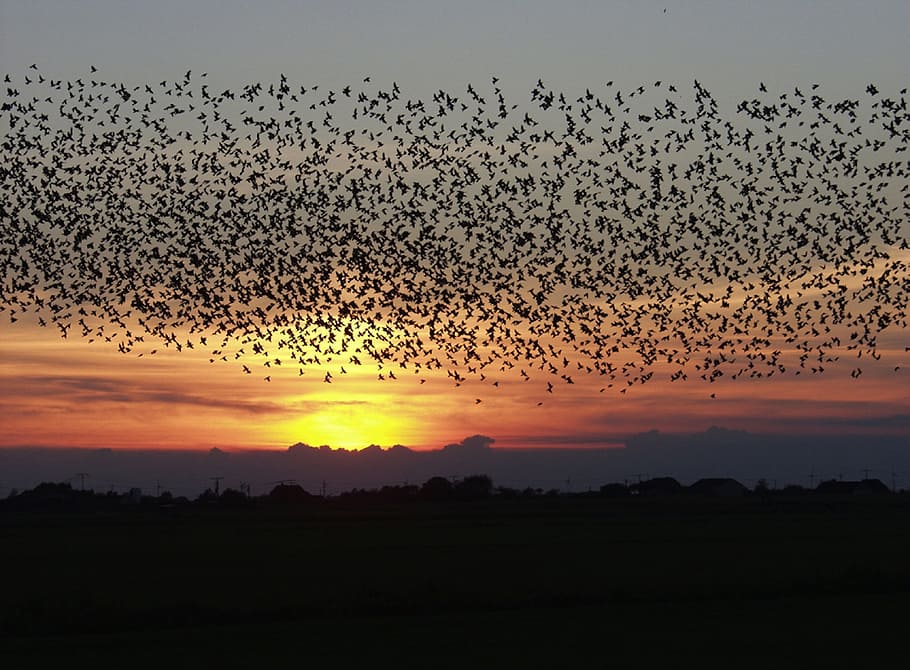
THE SWARM 
 
 
When night passed and came the morning
blackbirds enveloped the grass,
smothering green moss across the street,
moving as a synchronized cluster of fluttering wings.
 
I switched my position in bed to gain a better view,
squatting on the mattress while staring out the window
as the dark wave gained a new tide…
shrieking and soaring as one blanket mass
headed straight toward me.
 
For a brief moment, I feared that the yawning grave was calling me
back to the dust, dirt, and ash from whence I once came;
but then, in unison, the wave broke,
the aggressive wings grew calm, and
the swarm settled down as it landed again,
this time in my front yard.
 
I exhaled with a smile.
The beauty of chaos shifted
as order was reclaimed in my respite -
the reaper had granted a reprieve;
and though I now realise that he will surely
one day come hunting for me,
whether with a murmuration of blackbirds,
a flock of starlings, a flutter of sparrows,
an unkindness of ravens, a murder of crows, a wake of vultures,
or one-on-one, all alone, with a scythe in hand,
 
at least for the moment I can lay back
safely and soundly in my warm bed,
knowing that while I dream about the future
it will be the worms outside in the cold
that serve as today’s sacrifice to the cycle.
 
FATHOMED PERCEPTIONS 


You are neon electric
diamond gypsy thunder

You are passion incarnate
dreaming whispered caresses

You are focus ignited
dancing fiery atom

You are depth personified
dazzling magic moments

You are light ablaze
drifting smoky signals

You are crisis averted
dangling lusty kisses

You are power raptured
daunting crystal visions

You are truth pulsed
damning fallen systems

You are peace perfected
demanding creative explosion

You are sight opened
drenching weeping eyes

You are flesh experienced
dispersed energy released
 
ALPHA (ADRENALINE) /OMEGA (SATURATION)
 
 
I saw you blinking/pulsing/glowing
on the far side of chaos
with whispers of light
guiding/cajoling ships out at sea
to come home and roost
on the shoreline (of your sweet salvation).
 
I heard you singing/weeping/wailing
from a ruptured sky
with diamonds of fire
torching/igniting hearts of the dead
to burst forth into life
with yellow resurrection (of your primal passion).
 
I felt you loving/lusting/longing
in the empty bed of loneliness
with purest intentions of night
exciting/enticing thoughts of the truth
to dream their way to flesh
and taste the core (of your open bleeding heat).

Scott Thomas Outlar is originally from Atlanta, Georgia. He now lives and writes in Frederick, Maryland. His work has been nominated multiple times for both the Pushcart Prize and Best of the Net. He guest-edited the Hope Anthology of Poetry from CultureCult Press as well as the 2019-2023 Western Voices editions of Setu Mag

.

PLEASE NOTE: ARTICLES CAN ONLY BE REPRODUCED IN OTHER SITES WITH DUE ACKNOWLEDGEMENT TO BORDERLESS JOURNAL. 

Click here to access the Borderless anthology, Monalisa No Longer Smiles

Click here to access Monalisa No Longer Smiles on Kindle Amazon International
Categories
Stories

The Book Hunter

By Paul Mirabile

Courtesy: Creative Commons

Adamov led an introverted life. Perhaps because everyone, both friends and foes, thought he was ugly. In fact, he himself, when looking in the mirror that hung lopsided on his peeling wallpaper drew the same conclusion. An ugliness that drove him deeper into his own world, and which would lead him to become the foremost collector of books in the Kalmak region of the Caucasian mountains, and even beyond … This intense activity, which began at a very early age until his violent, and I may add, mysterious death in a dingy New York City hotel room, took him to the four corners of the earth, buying, bartering, stealing manuscripts, first published books, political pamphlets, rare essays. He even possessed, heaven knows how, an incunabulum[1]: a Lutheran Bible! Adamov also acquired, as a picturesque pastime, miniatures of Mughal, Kangra and Rajput stamps, Tibetan thankas, Buddhist prayer masks, mediaeval Chinese scroll paintings. It was said that he amassed more than 25,000 books at the humble two-storey lodging of his home village in the mountains of Daghestan ! But this, I will not confirm …

In short, books became his very existence, his raison d’être. His trusty companions and faithful, consoling friends in his many moments of maniac depression. His book-hunting transformed Amadov into a detective, snooping out the scent of an affair, flaring the odour of yellowing pages, crispy to the touch, invigorating to the smell, pleasing to the eye.

For Adamov, it was not just a question of tracking down a book like a hunter hunting his prey, but of locating the author’s place of residence, his or her favourite haunts. He would spend weeks, months in cities and towns, even after having procured his book, following the daily footfalls of those illustrious or obscure writers. If the writer happened to be alive, he would trail him or her from his or her home to a restaurant, a hotel, a library or book-shop, but never like a sleuth. If caught red-handed, this might have caused him some embarrassment. Adamov was afraid of direct confrontation, especially if it involved the law. To tell the truth, Adamov had no real intention of meeting an author, however famous. He reckoned that authors never measure up to their books, so why waste time actually meeting them? What would they talk about anyway: the birds and the bees? The weather?

It was during those moments of utter dolefulness on the road that Adamov recalled his childhood with a faint smile: He recollected rummaging through the dilapidated homes of his village in search of maps, pamphlets, books, picture cards or any scribblings that caught his eye, classing them in files either by theme or by date of their finding. For example, in 1960 he found 345 miscellaneous documents; in 1961, only 127. He had such a wonderful childhood, in spite of the periodic bombings from above, parental scoldings or beatings, visits from the neighbouring village militia that demanded money, food or young blood for the ’cause’ … A ’cause’ which he never adhered to, nor was ever recruited for, given his frail body and nervous disposition …

Finally he left his home village in search of bigger game, although he promised his parents that he would always keep in contact with them by his book trade; that is, every book purchased, after having read it, would be sent to their two-storey home … A home which became legally his after their deaths in the 1970s …

In 1974 we find our book-hunter in Amsterdam, lodged at the Van Acker Hotel, Jan Willem Brouuersstaat 14, just opposite the Concertgebouw, the famous concert hall, where he had been listening to Beethovan’s symphonies during that delightful month of May. It was in that hotel, in his room, that he arranged an appointment with a Dutch book dealer, a pasty-faced, unscrupulous dwarf, who negotiated hard for his wares. He clutched in his chubby, wrinkled arms an XVIIIth century first edition of Dom Bedos’ L’Art du Facteur d’Orgue[2], that Adamov had been tracking down for years. And finally, there it lay in the hands of that despicable dwarf who wanted more than 7,000 guilders for it! Adamov knew this was an illegal purchase, being classed as patrimonial property, probably having been stolen from the National Library by this slimy sod, but he had to possess it ! They haggled over the price for hours and hours well into the night. Following a rather violent squabble, the dwarf suddenly clutched at his chest, gurgled a few irrelevant syllables, and fell stone dead at Adamov’s shoeless feet. He wretched the priceless treasure from the still clutching arms of the dwarf, slipped on his shoes, checked the street from his window, then the corridor from the door, noiselessly. Adamov quickly packed his meagre belongings (he always travelled light), locked the door behind him and silently crept out into the soothing blackness of the street. In his flight, he threw the hotel door key in a rubbish bin, then made a bee-line for the bus station, where at six o’clock in the morning he was already headed for Berlin, and without wasting a moment, on a train for Istanbul where he was expected by an Armenian seller (or reseller ?) who possessed several Armenian illuminated manuscripts of mediaeval stamp, costly indeed, but since he paid nothing for Dom Bedos’ invaluable treasure, after an hour or two of desperate haggling, bought two manuscripts. The Armenian threw in two or three miniatures from Herat and Tabriz in the hope that his client would return for the other four illuminated manuscripts … Adamov never did: He was murdered sixteen years later …

Now the incident in Amsterdam caused our book-hunter much discomfiture; not any pangs of conscience mind you; Adamov felt no grief over the sudden death of that dwarf. He feared rather police enquiries about the death, and the overt fact that he fled from his hotel without assistance to him, and without paying the bill to boot! The police might accuse him of the dwarf’s death … As to the manuscript, that posed no particular problem since the dwarf had undoubtedly had it stolen or had stolen it himself. Wherever he went now, the hunter would have to look over his shoulder, staying at the grottiest hotels imaginable to avoid the police or their hired henchmen, travelling on night-buses or trains or on cargo ships when crossing oceans or seas.

The Amsterdam incident happened three years ago. Since, Adamov had eluded local police and Interpol not by any Arsène Lupin[3] tactics or strategies, but perhaps by some lucky star or a guardian angel, if the readers are inclined to believe in these wardens of the wanton. But still our book-hunter remained on the qui-vive[4]! Since that unfortunate (or fortunate?) incident, Adamov had been seen in Georgia, Armenia, Iran and Uzbekestan, where he spent over a year, illegally (his visa having expired after three months!), in Bukhara haggling over a XIVth century publication of Hoca Ahmet Yesevi’s Hikmets (Strophes of Wisdom)in the original Chagatai language, a language that he learned to read in three months.

How he slipped out of Uzbekistan is anyone’s guess. He probably bribed the custom officials. In any case, we find traces of him in the Yunnan, at Lijiang, southern China, bargaining hard for three colourful Naxi pictographic manuscripts from a Dongba priest, manuscripts which the Chinese government absolutely forbade to be taken out of the country, but whose exorbitant estimated price on the black market, a cheery sum of 25,000 yuan, persuaded the wily priests to take the risk. Besides, the priest could always imitate the three XVIth century manuscripts : it was all a question of time and patience … And he had both! Who would ever know? Adamov sensed the abysmal greed of his vender, and promised him 10,000 yuan more if he would relinquish two more of the forbidden scriptures, but payable in two days since he would have to wire back to Daghestan for the money. The plucky priest, all agog, smiling a wicked smile, handed the two booklets over to him without hesitation. Adamov never returned. He disappeared, travelling quickly through Nepal to the Himalayas via Sikkim, Ladakh and Zanskar, where, at last, at the Phuktal monastery he sojourned for five months, reading a first edition of James Hilton’s Lost Horizons whilst ploughing through the Hungarian philologist and Tibetologist, Alexander Csoma’s Tibetan-English Dictionary. Before he bid farewell to his kind and generous hosts, he had filched six illuminated prayer books in Tibetan, two festival masks and a thangka[5]. By the time the good monks noticed the theft, the incorrigible thief had trekked to Kaylong, bussed it to Manali, finally arriving in Karachi, where he boarded a cargo ship for Japan, then on to Oakland, California.

Aboard the cargo the thief had time to mediate upon his book-hunting existence. He admitted it wasn’t particularly glamorous — abandoned parents, a dead dwarf, stolen patrimonial property, false passports and bribery of officials. Nevertheless, these unsavoury moments of his hunting never dampened his enthusiasm. His lust for sweet-smelling tomes, his craving to possess, at any cost, more and more of them. To tell the truth, Adamov had become completely obsessed by his collection. Oddly enough, the more he accumulated the uglier he became ! In fact, he not only became uglier, he became fatter … Adamov had no qualms about this ponderous load; indeed, it enveloped him with a sort of pompous aura, whose fleshy freight he swaggered about the decks of the ship like some august, stately sultan. It added to the mystery of his past, present … and future. A future that had little cheer and much disquiet. He was running out of money, for he refused to sell what he bought. Even the many stolen books he dreaded to forswear. How many times had he asked himself why he hoarded such a vast treasure without really capitalising on his assets, without developing a trading-network throughout Asia, without, at least, rereading his precious volumes two or three times, sniffing their illuminated contents, inhaling the strange forms of their letters and signs, touching ever so lightly, again and again, the brittle paper of their pages or the calfskin vellum of their covers … To these questions he had no clear answer. He felt trapped in a conundrum, out of whose meshes Adamov, the hunter, gradually fancied himself the hunted!

But by who? The few passengers aboard hardly looked at him, much less spoke to him. He ate his meals with two or three burly fellows, perhaps Koreans, who beyond a good morning, afternoon or night, never pronounced a word to him, nor amongst themselves for that matter.

So he churned these thoughts over and over in his head as the days went by on the never-ending Pacific Ocean. What he needed was a project. Yes, a project that would offer him a meaning to his collecting … to his cherished collection. He resolved to go to New York City once disembarking at Oakland. Why New York City? Because Adamov had read about a Jewish New Yorker, named Louis Wolfson, who spoke many languages and wrote in French because he hated his mother speaking English to him. An odd chap indeed, but this is what he read. The idea fascinated him. The fact that Wolfson was still alive, in spite of the many sojourns in psychiatric wards and clinics. It was his book : Le Schizo et la Langue[6] that he would find and read. This posed no real problem, having been edited and re-edited since 1970. Yes, this book would put him on the trail of something enormous … Something worthwhile. Adamov looking out to sea gazed complacently into his future. A piercing crimson glow hollowed out a widening hole amidst the thick, grey clouds … He spun on his heels. The hunter sensed a pair of eyes bearing down on him. Yet, when he searched out the deck and the bridge high above him there was not a soul in sight. He sighed, padded his paunch, and casually shuffled off to his cabin as the swells lifted the ship high into the crests of the grey sky, only to drop with tremendous speed into the black, oceanic valleys below …

Six months later, Adamov had reached New York City on a greyhound bus from Atlanta, Georgia. He took up his lodgings at a sleezy hotel on the Lower East Side, Water Street, number 9. It wasn’t long before Adamov, weaving in and out of the 8 million New Yorkers day after day, night after night, had purchased a cheap 1970 edition of the aforesaid book by Louis Wolfson, with a preface by Gilles Deleuze, a French philosopher of some renown in Europe. He pored over this odd book as if he himself had written it. His fascination over such a contemporary edition unnerved him. This Wolfson grew on him like a drug-addiction — not for his writing, which indeed proved rather drab, but to the singularity of his method to achieve a written work through strenuous exercises of self-neglect and utter detachment from maternal infringement. The schizophrenic maniac had managed to create his own sphere of reality through the myriad experiences of listening to such diverse languages as Yiddish, French, Russian and German on his make-shift Walkman whilst strutting through the streets, sitting in parks, at the table when eating with his obnoxious mother, ensconced in the public library as he read or wrote in all the languages he knew … except English, that accursed language that his mother tortured him with like a sadist would when ripping out fingernails! That language which he hated as much as he hated his mother …

Adamov bought a Walkman and had recorded Persian, Arabic and Mongolian on it, which he listened to as he strolled about the same streets that Wolfson had strolled. Or, he sat in the same New York Public Library where Wolfson had sat for hours and hours until closing time. He couldn’t give a biscuit where Wolfson was now living, probably locked up in some clinic for the alienated in a straitjacket. He had nothing personal against English. However, these dippings into ‘alien tongues’ hour after hour, day after day, lifted him out of the ‘New World’ into one of his own making … his own created polyphonic world. His excitement grew as he shifted from Wolfson’s book to the many languages that he repeated over and over again …

It was more or less at this time that I penetrated Adamov’s world. I, too, had my grotty lodgings at the same hotel, a room right next to his. At night I heard his wild, inflamed exclamations about things I hardly deciphered. However, one day we met in the low-lit, begrimed corridor as he dawdled to his room. He had shaved his head and let grow a beard down to his chest. He wore a skullcap of pure white. Adamov’s black, beady eyed bore into mine with some suspicion at first, but my soft spoken, causal demeanour put him immediately at ease. I introduced myself, and he invited me into his room for an evening chat …

It was the first and last discussion I had with this odd fellow, and it lasted well into the night. The oddness lay not so much in the subjects that we touched upon, but the dream-like atmosphere that Adamov somehow created. There he sat enthroned behind his reading and writing table near the unclean window like Genghis Khan himself, stroking his beard, turning the pages of Wolfson’s book that lay before him, his pudgy fingers smearing coffee grinds on page 40, heavily marked with pencilled notes ! He would address me in English, then after several minutes switch to Spanish and Italian with the utmost ease, an ease that I echoed since I was well versed in those languages. My host appeared to be pleased by this hollow echo in the night. After a drink or two of some cheap red wine, Adamov would burst into a soliloquy in Turkish, afterwards slipping into Russian, German, Dutch and French, attempting to throw me off the chase, to deviate my beating. And in this, I must confess, he thoroughly succeeded. Oftentimes the sly polyglot began a sentence in Russian and finished it in Chinese or Tamil, a feature that linguists call ‘code-switching’. I was flabbergasted …

But what really stupefied me was this strange man’s ability to alter his speech patterns and accents. Now he would impersonate, linguistically, an American from the deep South, now one from New York City. Now a Frenchman from Paris, now from Marseilles! When he fell into speaking Spanish, he conversed ever so casually with a Mexican ‘gaucho’[7] accent, only to follow up with a ‘caballero’[8] one from Barcelona or Madrid … All these inflections and modulations left me swooning, to say the least. At length, at four in the morning, I rose and retired to my room, having learnt absolutely nothing of importance about this amazing creature. In short, I felt more ignorant of this man than before I ever laid eyes on him …

Everyday Adamov spent over ten hours at the public library. It was there that his great project suddenly took form, looming larger and larger in his excited mind. Why not write stories myself ? Why not write stories in many languages and not just read or listen to them ? Yes, different stories written in different languages, signed by invented names! Twelve stories – fiction, each bearing a style of its own, a flavour and texture of its own, yet signed by twelve different writers. Adamov grew more and more agitated, fidgeting in his chair much to the annoyance of two elderly readers opposite him, poring over a William F. Buckley essay and Eric Lux’s 1991 edition: Woody Allen: A Biography.

But what languages could he choose? French, Spanish, English, Turkish, Italian and German … Any. How about Russian and Chinese? That would make eight. “I can get on all right with Tamil and Persian … and Armenian?” Adamov paused, collecting his thoughts. What would be the twelfth language ? His own ? Never. It was his mother’s tongue, and besides who would ever read it? But was being read all that important, vital to his existence? No. This project was beyond a reading public … beyond mankind’s expectations of what writing and literature meant to him.

By this time, Adamov’s eyes seemed to pop out of their sockets. The two elderly readers rose from their chairs and left with many a smirk and sneer. What did he care? Still, he needed one last language: “I got it, I’ll invent a language from all the languages I know! That will be my twelfth story; a story to end all stories …”

He mapped out his plan of action mentally. Our future short-story writer shot out of his chair and made a bee-line for his hotel. He would put his plan into action that very night … He set to work at his reading and writing table, having decided to begin the Twelve with English, the language that Wolfson loathed! He cringed under that delicious stroke of inspiration. Let the bugger loathe all he might! Adamov could love his book, but he harboured no devotion towards its writer. Besides, he was residing in an English-speaking country and there he wanted to write in English. He would write French in France or Belgium, Spanish in Spain or in Latin America, Turkish in Turkey, and so on.

Hours went by as Adamov pressed on and on, burning oil of the midnight lamps, filling sheets of cheap notebook paper as quickly as his imagination spiralled out. Coffee after coffee kept pace with his hand, à la Balzac, amidst the screaming police sirens, the bickering of pimps and their whores below his window, rubbish bin cans crashing on pavements as stray cats or vagrants rummaged through their contents. Through the thin walls of his room he heard coughing, sneezing, cursing, snoring and sleep-talking.

As the sun broke through the thick, colourless skies of a New York City morning, Adamov, thoroughly exhausted, threw down his mighty writing tool. He had finished the first of the Twelve: The Garden of Enchantment, signed Hilarius Eremita …

Just at that triumphant moment a sudden hammering at his door rocked him out of his reverie. He rose sluggishly and shuffled to the unlocked door. As he grasped the knob the door burst open in one forceful thrust. Two hooded men seized Adamov by the throat, pinned him against the wall and strangled him with their bare hands. The ponderous writer slid limply to the floor, mouth ajar, eyes open in tragic astoundment. The hooded men fled, vanishing into thin air, as the expression goes …

Hearing hurried footsteps, I waited until they had died down, then tip-toed to his room. For some unknown reason his premeditated murder, for premeditated murder it undeniably was, did not surprise nor move me. I swiftly, however, rushed to the writing table : Nothing had been touched ! I gathered all his papers then returned briskly to my room …

And this was how I was able to salvage from the malevolent hands of Adamov, or Hilarius Eremita, the story called,  The Garden of Enchantment

When I think back on this whole affair there is no shadow of a doubt that the hunter had become the hunted for reasons that we shall never really know. In light of that, I departed from New York City the day after the murder on a flight to Buenos Aires, then on to Madrid …

.

[1]          A book printed on a Gutenburg Press before 1500.

[2]          The Art of an Organ Builder.

[3]          Famous French ‘gentleman’ robber who steals from the rich to give to the poor, and in doing so, always outsmarts the police, but without ever shedding any blood. Arsène’s adventures were written by Maurice Leblanc (1864-1941).

[4] On the alert (French)

[5] Tibetan painting

[6]          The Schizophrenic and Language.

[7]          A cowboy from the Mexican plains or pampas.

[8]          ‘Gentleman’.

Paul Mirabile is a retired professor of philology now living in France. He has published mostly academic works centred on philology, history, pedagogy and religion. He has also published stories of his travels throughout Asia, where he spent thirty years.

.

PLEASE NOTE: ARTICLES CAN ONLY BE REPRODUCED IN OTHER SITES WITH DUE ACKNOWLEDGEMENT TO BORDERLESS JOURNAL

Click here to access the Borderless anthology, Monalisa No Longer Smiles

Click here to access Monalisa No Longer Smiles on Kindle Amazon International

Categories
Slices from Life

Kindred Spirits

By Anjali V Raj

“Two birds balance on the top branches of a tree. Together they fly into the sky”
--Snow flower and the Secret Fan by Lisa See
Courtesy: Creative Commons

Friendship is a perennial river of comfort where we can dive and swim throughout our life. Growing up, I was a silent student at school with not many friends and definitely no close companions. I was neither amicable nor bright and made little effort to change this attitude. I spent my teenage years trying to be inconspicuous to my classmates like they were some predatory animals. I didn’t own a personal phone until my undergrad years hence even if I made friends I couldn’t keep in touch with them, which I rarely did even after acquiring a phone. Communication technology especially mobile phones and social media plays a vital role in connecting people and maintaining friendships. At some point in one’s life, everyone finds someone who knows them better than the rest of the world, with whom they share a bit of everything from their life.

I remember the first time I met her; she was sitting across from me — two seats ahead in the institutional shuttle. I could only see a part of her little face, but I could make out the charming smile she wore. It was the second day at my first job. I was still intimidated by the new place and faces. Later that day, she came into our lab, a short affable girl and had the same charming smile. Apparently, she was also working on the same project as me but in a different team. She spoke to my colleague in English. However, I noticed the Malayalamaccent lingering in her words. I wondered why they spoke in English when they were both Malayalis; given that Malayalis have an inherent tendency to communicate with each other in Malayalam wherever they go. I observed her a little longer; definitely bold and smart, I concluded. Who knew then that this smart young woman was to be my north star?

With few joint project meetings, our acquaintance grew from colleagueship to friendship. She often visited our lab. Whenever she came, the gloomy chemical mood of our lab would transform into a jovial garden of fragrant flowers. She would laugh at almost anything and believe me her laughter was very contagious. The silent lab except for the perfunctorily grumbling instruments would suddenly mimic a rackety town hall. Her laughter made me wonder if it was hidden for a long time and finally finding its freedom made up for the lost time. I could see my stoic and altruistic friend find solace in the smile and laughter of others. After a few field trips together, I found a close companion in her. I didn’t know all of her. One can never know the whole of a person however close they are but I felt proud that I knew more of her each day. She was a popular smart friendly face at our institution and now, my friend. There was a sense of happiness and pride in finally finding someone who could bring warmth to your heart and to whom you were more than just a random person.

We had our differences and similarities, arguments and opinions, mischief and complaint — all as the part and parcel of our friendship. We never shared our deep secrets or fears, yet we knew the existence of such buried inside us. Importantly, we knew, if need be, we had each other’s shoulders to lean on and could confide in each other. She made a continuous effort to make me smile by sharing pictures of beautiful flowers, landscapes, hilarious memes, cute animal videos and such. She had inspired the scared timid mind inside me to come into the light. She encouraged me to discover the unmolded writer in me, inspired me to write and share my silly poems. Moreover, she educated me on certain domains of knowledge I lacked and she continued to inspire me every day. She encouraged me to fly with her into the unfathomable spread of the sky. I owe it to her for all my accomplishments in the past three years while all I could be was a listener.  She was and is my laotong, the sister of my heart.

We are not perfect people in the perfect world and yet sometimes, our shortcomings drew us closer together. We are two overthinkers with our disconcerting opinions, who can never put a firm foot on the ground. Sometimes when she consults me for my opinion on certain matter,s all I provide her is obscure suggestions making the matter more ambiguous.  But my dear friend is always pleased and content with whatever outlook I provide. Even with the continents separating us now we are still the ‘old sames’ close within our hearts.

I have only countable friends, of which there are very few that I still maintain communication. A strange sense of detachment grows in me when the common grounds of friendship alter and are separated by large physical distance. The connection through electronic devices usually wouldn’t suffice to regain my earlier attachment. Hence, I avoid any communication at all. However, I hold them, dear, within my heart even if I constantly fail to express this in person. Strangely with her, I have been able to communicate freely with no detachment as if no distance separated us, mostly due to her persistent efforts rather than mine. And still, she continues to inspire me, spread joy and bring laughter to my face. Like the two birds that return to the same tree branch to share the stories of their daily adventure, we share our daily bits through the electronic branch connecting us. I hope our friendship grows and travels beyond the grasp of time.

Anjali V Raj is a natural science researcher from Kerala, India. She currently works as a researcher at Azim Premji University. Her poems and short essays based on thoughts cultivated from observation of surrounding, lifestyle and society. She has published few of her works in the Down to Earth, The Wire, Café Dissensus Everyday, Borderless Journal and Times of India Reader’s Blog.

PLEASE NOTE: ARTICLES CAN ONLY BE REPRODUCED IN OTHER SITES WITH DUE ACKNOWLEDGEMENT TO BORDERLESS JOURNAL

Click here to access the Borderless anthology, Monalisa No Longer Smiles

Click here to access Monalisa No Longer Smiles on Kindle Amazon International

Categories
Poetry

Early Winter in Delhi

By Akshada Shrotryia

early winter in delhi

marks a beautiful change. 

the cruel sun of the summer
becomes kind.

so kind that the roads embrace happily - new footwear,
warm, woolen boots - knee high, suede, chelsea.

when the sun shines, full of April’s warmth
people share stories on the grass.

crowds in the metro provide respite from the harsh winds,
desserts become sweeter.

the atmosphere becomes soft too -
warm cashmeres, colourful pashmina, playful jumpers, everywhere.

early winter in delhi,
binds the city with a certain silence

when the hum and whirr of the fans cease,
people listen to each other.

Akshada Shrotryia, a graduate from Delhi University, harbours an intense passion for literature and writing. Her works have been published by The Punch Magazine, Setu Mag, Live Wire, Gulmohur Quarterly, Muse India, among others.

.

PLEASE NOTE: ARTICLES CAN ONLY BE REPRODUCED IN OTHER SITES WITH DUE ACKNOWLEDGEMENT TO BORDERLESS JOURNAL

Click here to access the Borderless anthology, Monalisa No Longer Smiles

Click here to access Monalisa No Longer Smiles on Kindle Amazon International
Categories
Poetry

Chest of Jesters

Poetry by Rhys Hughes

Courtesy: Creative Commons
There is a chest in the cellar
with a broken lock
and a ticking comes from inside it
like a working clock.

So I throw it open
to find out what might be within,
but the noise is made
by little bells
on the caps and slippers
of men who look like elves
with pointed chins
and pointy ears, who have no fear
of me at all but laugh
and jump up like lines on a graph
that charts a sudden
interest in the arts
of the anonymous
populace in a highly cultured town.

They come back down,
those mediaeval clowns,
and land on the floor,
descend the stairs and prance
throughout the expanse
of my living room. What should I do?
My wife is coming home soon
and she has jester-phobia.
I don’t think she can cope
with parti-coloured harlequins
who caper, cavort and grin like loons.
     I don’t blame her!

I must capture them one by one,
I’ll use a butterfly net
and drag them kicking back upstairs,
deposit them in what was
their secret lair for untold generations,
slam the lid, ignore the lock,
weigh down the chest with a heavy rock
and keep them safe forevermore
in that hiding place.

The fact they escaped is a disgrace,
the chest in the attic is an heirloom,
passed down through my family
from father to son for centuries.
And knowing this, it occurs to me
that I can work out the identities
of these pesky pestering fellows.
Yes, it’s true, I’m forced to confess–
those jesters are my ancestors.

Rhys Hughes has lived in many countries. He graduated as an engineer but currently works as a tutor of mathematics. Since his first book was published in 1995 he has had fifty other books published and his work has been translated into ten languages.

.

PLEASE NOTE: ARTICLES CAN ONLY BE REPRODUCED IN OTHER SITES WITH DUE ACKNOWLEDGEMENT TO BORDERLESS JOURNAL

.

Click here to access the Borderless anthology, Monalisa No Longer Smiles

Click here to access Monalisa No Longer Smiles on Kindle Amazon International

Categories
Stories

Clothes of Spirits

A Balochi Folktale translated by Fazal Baloch

Balochistan. Courtesy: Creative Commons

Once upon a time there was a certain kingdom somewhere on the earth. The moment night set in, thieves and robbers would let lose all across the kingdom. Despite all efforts from the king, the robbers were not contained. One day, the king, his emirs and viziers all put their heads together to devise an effective plan. At last, one of the viziers floated the following idea:

“Let’s us call the day the night, and the night the day. It is the only way to protect our people”.

The king liked the idea very much and immediately he issued the decree asking the people to start their day after the sunset and mark the sunrise as the beginning of the night. Initially, many people violated king’s decree and they were subsequently hanged. In due time, the unusual routine ensued in the kingdom. People slept during the day and resumed activities at night.

One day two strangers arrived in the city at midday. They went to a shop. The shopkeeper was asleep. They were looking around the shop, when the shopkeeper woke up and caught saw them. He instantly presumed they were thieves and accused them of shoplifting.

“We are no thieves. We have come to get some merchandise,” said one of the strangers.

“Why did you come so late in the night?” asked the shopkeeper.

Confounded by shopkeeper’s remarks he quipped: “Night? It is not night! Rather it is midday”.

The shopkeeper accused them of violating king’s decree and subsequently dragged them to the king’s court. The king told them that he would investigate their case in the daytime. Meanwhile, they were locked in a room. They were astounded by the strange behaviour of the king and his subjects. At night – the time they took to be the day — the king summoned the two strangers and asked them the purpose of their visit to the city.

“We are no ordinary folks. Rather we are royal tailors from the neighboring kingdom. We sew clothes for spirits”.

The king said: “How do these kinds of clothes look?”

“Only the legitimate sons of their fathers can see these clothes,” the man replied.

The king provided them with a sewing machine and asked them to sew the clothes. Later on, he asked his vizier to see if the clothes were ready. The vizier walked over to the room allotted to the strangers. They were absorbed with the sewing machine. The vizier drew nearer to the men and asked them about the progress in their work.

“The shirt is all done. We are half way through the trousers.  Isn’t it visible to you?” Surprisingly asked one of the men.

The vizier was quite confused. He couldn’t find any clothes there but he reckoned any negative answer would mean he was not his father’s legitimate son.

Hence, he said: “Of course, it is. It looks beautiful”. Then he cleverly asked them: “Where is the shirt?”

“It’s there in the box. See it for yourself.”

The vizier opened the box. It seemed empty, but he exclaimed: “What an exceedingly beautiful shirt!”

Then the vizier walked over to the king and told him that the clothes looked wonderful. Then the king strolled into the room. The vizier asked him to try the clothes on. The king opened the box. Lo, it was empty! He knew any remarks about the invisible clothes would call the legitimacy of his own birth into question. Thereupon, he peeled off his clothes and pretended to wear the clothes of spirits. He was naked but the vizier asked the people to clap and praise him new clothes. The king made a detour around the city. Everybody clapped and admired him being clad in the spiritual clothes.

The next day he issued another proclamation asking his subjects to wear the clothes of spirits. A few days later, the king invited the king of a neighbouring kingdom which was the home of the two strangers. When the king arrived there, he was astonished to see that nobody had a thread on their body and they slept during the day and worked at night. Then the two strangers whispered the entire story into his ear. The king said: “Let’s hurry off; otherwise they will force us to wear the clothes of spirits.”

This folktale has been translated from a retelling by Ghulam Jan Nawab in “Cher Andaren Neki” (The Hidden Virtue), a collection compiled by Ghulam Jan Nawab and published by Chammag Chap o Shing in 2021.

Fazal Baloch is a Balochi writer and translator. He has translated many Balochi poems and short stories into English. His translations have been featured in Pakistani Literature published by Pakistan Academy of Letters and in the form of books and anthologies. Fazal Baloch has the translation rights from the publisher.

PLEASE NOTE: ARTICLES CAN ONLY BE REPRODUCED IN OTHER SITES WITH DUE ACKNOWLEDGEMENT TO BORDERLESS JOURNAL

Click here to access the Borderless anthology, Monalisa No Longer Smiles

Click here to access Monalisa No Longer Smiles on Kindle Amazon International