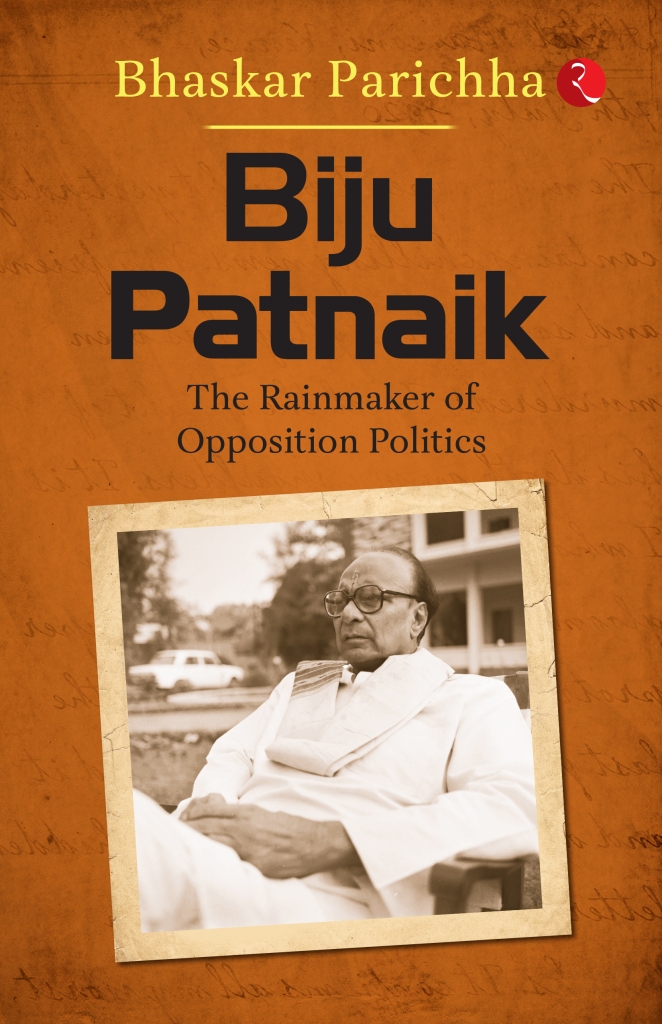
Title: Biju Patnaik: The Rainmaker of Opposition Politics
Author: Bhaskar Parichha
Publisher: Rupa Publications India
Architect of Modern Odisha
Biju had a strong sense of zeal for dreaming big. At that time, no one had even dreamt that there could be a private sector industry, much less one that was successful. He dreamt and succeeded. Throughout his life, Biju stood out as a person with courage, and that by itself chronicled a remarkable saga of industrial adventure in Odisha half a century ago.
In 1945, when he had attempted to establish an industrial empire in Odisha, he had several other responsibilities. He could have remained committed to politics and wielded political power, as he was exposed to it during the height of the freedom struggle. However, he had a unique vision of industrialization of Odisha. As mentioned earlier, Biju was greatly influenced by Manubhai Shah. In the same way that Mahtab taught him the basics of realpolitik, Manubhai taught him the first few lessons of setting up an industry.
In the years following Biju’s release from jail, he developed an unshakable faith in himself and a commitment to utilize his full potential. There were no great merchants or wealthy individuals in his circle, nor was he in possession of vast resources. The only thing he had was a lofty vision. Despite British strongholds throughout the country, he had flipped through quite a few pages on how to struggle and achieve success. However, the actual struggle had not yet begun.
Owing to his aviation background, several years before he became a big industrialist, he had set up his own airline Kalinga Airlines. At one time, it is believed that Biju had seven aircraft registered in his name, a rare possession. This demonstrated the importance of Biju as a pilot—industrialist. Apart from aviation, it was Choudwar’s textile mill that ushered in a new era of industrial expansion in Odisha. With the establishment of the Odisha Textile Mill in Choudwar, he launched the first chapter of his industrial empire. Slowly but surely, the Kalinga Empire was taking shape. Two years later, it swept through the area, adding a few more plants, both large and small. It would be a reiteration of the obvious to dwell on the ingenuity of this stalwart who painted a large industrial landscape on a blank canvas.
In setting his vision of an industrialized Odisha, Biju was clearly aiming to change the fate of Odias; to transform an agriculture-dominated, feudalist economy and society into something more industrial. This was the inevitable course of action that he took.
ODISHA TEXTILE MILL
From 1946 to 1950, Mahtab served as the Chief Minister of Odisha.
There was a great deal of activity during his tenure as
CM Mahtab, like Biju, was also concerned with the industrialization of Odisha. He was seeking a dynamic youth to this end, which he found in Biju. Mahtab was also instrumental in establishing Biju as a leading industrialist in the country. It took just a short period of time for Biju to become one.
In 1944, the interim Indian government decentralized the textile industry. As a result, Odisha received four textile units. As textiles appeared to have great potential, Biju was particularly interested in them. Odisha Textile Mills was established at that time. A company named B. Patnaik & Co. was established. A half stake in the company was owned by Biju. Lala Pratap Singh, a descendant of industrialists Lala Sriram and Bhubanananda Das, held the other half. In Odisha, it was the first private company to begin operations. Through this flagship company, Biju’s enterprise was growing rapidly. Several small- and medium-sized industries emerged, including cotton and ferromanganese. Biju Patnaik & Co. was an industry through and through. It was the birth of a brand. A common thread running through Biju’s corporate credo was the concept of industrialization and diversification.
It was in the late 1940s that Biju joined the Kalinga industrial empire. The primary objective of his career was to establish himself as an upcoming industrialist and develop a company that had the highest annual growth rate. Biju took a shot and Odisha’s industrialization was catapulted into a remarkable era. However, this glory did not last long. Out of his own free will, Btu was renouncing that industrial prowess. The two contrasting factors that contributed to his disdain for the position must have been his well-publicized commitment to do something for the slothful people of Odisha and his dislike of the responsibilities that came with being a manager.
After a brief blossoming, his entrepreneurial spirit soon faded. Biju was the only one apart from Prafulla Chandra Roy[1] in West Bengal, who was able to build industries from scratch. It has been decades since Sir Prafulla Chandra Roy pioneered the West Bengal industry before it withered away.
In 1963, Biju gave away his Ironworks plant in Barbil to the state when it was earning 10-15 per cent profit annually. Biju then gave other plants to his employees. The Kalinga Group saw a gradual decline once he made everything available to the state. All of this had the potential to make him the richest man in the state. This reluctance to engage in business, which Biju demonstrated later as well, was accompanied by a lack of expectation of compensation. All he wanted was a progressive Odisha, which could have never become a reality if he had no political power.
[1]Physicist, educator, historian, industrialist and philanthropist, Roy was an eminent figure in Indian science. Known as the father of chemical science in India, he established the first modern Indian research school in chemistry. While being the founder of Bengal Chemical & Pharmaceuticals, he also served as its chairman.
About the Book
Transitioning from pilot to freedom fighter, businessman to politician, Biju Patnaik(1916-1997) was a multifaceted leader and towering regional icon who has left behind an impactful legacy. Step into the riveting saga of Biju Patnaik, the icon of resurgent opposition politics, through this compelling biography, Biju Patnaik: The Rainmaker of Opposition Politics. His journey, from leaving office in 1963 to reclaiming it in 1990, epitomized resilience and rebirth in politics. Whether as chief minister or Opposition leader, Patnaik’s unwavering connection with the people of Odisha defied conventional politics. Navigating triumphs and trials, Patnaik wielded immense influence, shaping the state’s destiny. His adept manoeuvring from the state secretariat to the corridors of power in Delhi showcased unparalleled strategic prowess, strengthening Opposition alliances and advocating for a credible alternative to the dominant Congress. Biju had tremendous faith in Opposition unity, considering it vital for the survival of democracy in the country. A visionary and unifier, Biju Patnaik’s legacy as a stalwart of Opposition unity echoes through the captivating pages of this stirring account.
About the Author
Bhaskar Parichha is a renowned name in Odisha journalism. Throughout his four-decade long career in the media industry, he has been affiliated with various newspapers in the state. He is the writer of Unbiased: Writings on India, No Strings Attached: Writings on Odisha, and Madhubabu – The Global Indian. Recently, he has also edited a collection titled Naveen@25 – Perspectives. Residing in Bhubaneswar, he is known for his bilingual writing.
.
PLEASE NOTE: ARTICLES CAN ONLY BE REPRODUCED IN OTHER SITES WITH DUE ACKNOWLEDGEMENT TO BORDERLESS JOURNAL
My heart is in upheaval.
I long for you to knock at my door,
To give me the joy to be your host.
I have longed for this day,
To have you with me and for me alone.
I have waited so long for the footsteps of spring.

The road map of our luminous past,
By which our relationship passed,
Is still as painful to recollect as it is to relive,
Still as crushed by your psyche in distress.
Hardly were you ever in your full senses.
You had to vanquish your curses to be here.

Yet, when I saw you in your lonely silence,
I shed all my misgivings,
And welcomed you in my heart.
I will love you and seek nothing in return.
Vanishing images of our lovely past
Will be cherished in the tomb of our love.
Pramod Rastogi is an Emeritus Professor at the EPFL, Switzerland. He is a poet, academician, researcher, author of nine scientific books, and a former Editor-in-chief (1999-2019) of the international scientific journal Optics and Lasers in Engineering. He has published over ninety poems in international literary journals.
PLEASE NOTE: ARTICLES CAN ONLY BE REPRODUCED IN OTHER SITES WITH DUE ACKNOWLEDGEMENT TO BORDERLESS JOURNAL
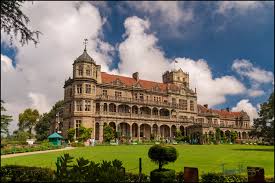
It took a couple of days to sink in, the serene beauty of the place on Summer Hill, Shimla, and the quiet atmosphere of the campus. Indian Institute of Advanced Study (IIAS), now housed in the regal ambience of the Viceregal Lodge[1], still wore its grandeur well, filtering into interior, the corridors, foyer and the conference room that had a stamp of history. Momentous decisions had taken place in this very room. The sylvan surroundings seemed to have rubbed off on the people too who worked in the offices, for they functioned with a quiet harmony, like it was an unstated requirement.
Tulsi Shankar’s paperwork went off smoothly in the office. She was given the keys to her allotted flat, a man was assigned to go along with her to help, and she was asked to tell the housing department if she would need anything more for her flat, the kitchen and the washroom. The man helped her unpack her big boxes of books and folders and set up her laptop. The vessels in the kitchen were minimal and very basic. She added the small items that she had got from her home, a saucepan, a ladle, spoons, cups, mugs, tea, coffee, sugar and milk powder. That would do. The man offered to fix a milkman who would deliver fresh milk every morning. The mess served two meals in a day, so there was nothing more to be done except rustle up an occasional upma or poha[2], if one fancied a change.
Tomorrow, she would explore the books for her area of research in the library, and start her work. She sank into her mattress and made a mental list of the reference books but soon slipped into a deep slumber.
The next few weeks rolled by in a rhythm of studies, notes, typing points on her laptop to draw a skeletal sketch of the chapters for her book. Little did she know how the details she sought would soon rain down on her and submerge her overwhelmingly in. They were right there, within her reach, in the huge library. Sure enough, there were some gaps, but she could always visit the Nehru Memorial Museum and Library at Teen Murti Bhavan in Delhi to fill them up.
She met the three other Fellows who were also working on their manuscript for their books. Whenever they met, at the dining area in the mess, or while strolling back to the institute after meals, or their shopping trips to the mall, the four Fellows exchanged notes about how much easier it was when they wrote their dissertation for Ph.D. years ago. They knew exactly what was expected from them — their chosen topic in itself ‘set limits’ for their scope and research took them forward with a controlled sense of direction. But a book? A BOOK? Good Lord, it seemed to be like entering an unchartered territory. It felt adventurous, thrilling even, but alternated with bouts of uncertainly and panic. It often loomed like a road not taken, yet to be explored. Exciting, and scary at the same time.
They decided to help each other with their research for the background. Sudipta Banerjee who taught history, offered to help Tulsi with Hari Mohan Maitee’s notorious case of brutally raping his eleven-year-old child bride, Phulmani Dasi, causing her death. The case was committed to the Sessions Court in Calcutta in 1890, but Justice Wilson let off Maitee lightly by saying that he had just committed ‘a rash and negligent act’. It was Gidumal Dayaram, a reformer from Bombay, who relentlessly pursued the case of Dasi. On his recommendations, Sir Andrew Scoble based his in 1891. Tripti Sharma from Political Science was equally interested in the steps that led to raising the ‘Age of Consent’ from ten to twelve years, from a legal angle. She had a project for which she needed to know more Sir Andrew Scoble (1831-1916), and the legal aspects of his contribution.
And all three of them took some lessons in yoga from the fourth Fellow Namrata Tripathi in her flat, just before dinner. She had trained in the Tushita Mahayana Meditation Centre. Namrata often warned them – and herself – of the hazards of sitting down on a chair for long hours to read or write. ‘We’ve to move our limbs and walk, or else we’ll become stiff,’ she laughed, even as she herself spent hours poring over her books for her research on the ghats in Varanasi. Sudipta, Tripti and Namrata looked to Tulsi, a published author, for help in writing their drafts.
“Please, Tulsi,” said Tripti. “We’re painfully conscious that we’re not here to write a Ph.D. dissertation. It is a book, a BOOK, for God’s sake.”
“Yes,” said Sudipta. “We’re anxious that thechapters are readable and don’t come across as boring information. You’re a creative writer, so you can tweak our lines.’
*
Then there were the Associate Fellows (called AFs) who could visit the IIAS three times in a span of three years or more, and were allowed each time to stay for one month to consult books in the library and work towards their M.Phil thesis. Hopefully, after their M.Phil, they would be admitted to Ph.D. programmes in their colleges. Each AF was given a single room in the hostel.
The women were nearly through with their lunch. Over the dining table, they whispered to each other about the time they would meet Namrata in her flat in the evening, for yoga lessons. Also learn some tips for meditation, a most elusive practice for them.
The Associate Fellow sitting across two tables was loud. No surprise. Ever since he came from Hyderabad, he has been the most vociferous critic of the food served by the Mess. He was unsuccessful in forming a lobby to join him in his protest and ‘do something’ about the ‘atrocious food’. The others AFs heard him out, some nodded in agreement, but carried on with their work.
Tulsi and her friends considered all that as noise and hurried through their meals.
The man from Hyderabad came over to their table.
“How can you stand this horrible food?” he asked.
“Well…it’s a change, certainly, from what we are used to,” said Namrata, in a placatorytone.
“A change! It’s appalling. You can do something about it. Each one of you haveakitchen in your flat,” he said.
“What!” said Sudipta, getting up from her chair.
“You’re four ladies. You can easily take turns and cook,” he said, glancing at the other AFs over his shoulder.
.
[1] Viceregal Lodge, formerly the residence of the British Viceroy of India, is the present Indian Institute of Advanced Study that has a library with archival acquisitions that go back to the times before the British rule in India. The magnificent building is also a tourist attraction for its stunningly regal structures designed by the British architect Henry Irwin, built in the Jacobean style during Lord Dufferin’s tenure as Viceroy.
[2] Upma—Semolina based savoury dish: Poha – A savoury preparation of flattened rice
Dr. Lakshmi Kannan is a poet, novelist, short story writer. Her recent books include Guilt Trip and Other Stories (Niyogi Books, 2023) and Nadistuti, Poems (Authors Press, 2024). For more details, please see http://www.lakshmikannan.in and her entry in The Routledge Encyclopedia of Indian Writing in English (2023).
PLEASE NOTE: ARTICLES CAN ONLY BE REPRODUCED IN OTHER SITES WITH DUE ACKNOWLEDGEMENT TO BORDERLESS JOURNAL
Poetry by Manzur Bismil, translated from Balochi by Fazal Baloch
Manzur Bismil
In my head,
Bustles a world
With the sun, the moon, and the earth.
In this vast realm,
A stream of light gives voice to my thoughts.
Yet, amidst this brilliance,
A quern has ground fire.
From that fire, pours forth the light.

In my head,
Exists a world
With the sun, the moon, and the earth.
I am an ant, a worm,
Snuggled in a hole,
Somewhere in the corner of that vastness.
My 'sovereign head',
Unaware of the world's flux,
Mute and silent,
Brings no tidings,
Indifferent to all,
Ignorant of the spectrum of life.
I'm an ant, yearning for light,
A worm, a firefly in the dark!
Manzur Bismil is a prominent Balochi poet. He emerged on the literary scene in the early 1990s and soon rose to fame, creating a niche for himself in the pantheon of the Balochi poets. He is widely known for his neo-classic style, especially in his verses. So far he has published eight anthologies of his poetry. This poem is taken from the second edition of “Hoshken Kaaneeg” published in 2017.
Fazal Baloch is a Balochi writer and translator. He has translated many Balochi poems and short stories into English. His translations have been featured in Pakistani Literature published by Pakistan Academy of Letters and in the form of books and anthologies. Fazal Baloch has the translation rights of of this poem from the poet.
PLEASE NOTE: ARTICLES CAN ONLY BE REPRODUCED IN OTHER SITES WITH DUE ACKNOWLEDGEMENT TO BORDERLESS JOURNAL
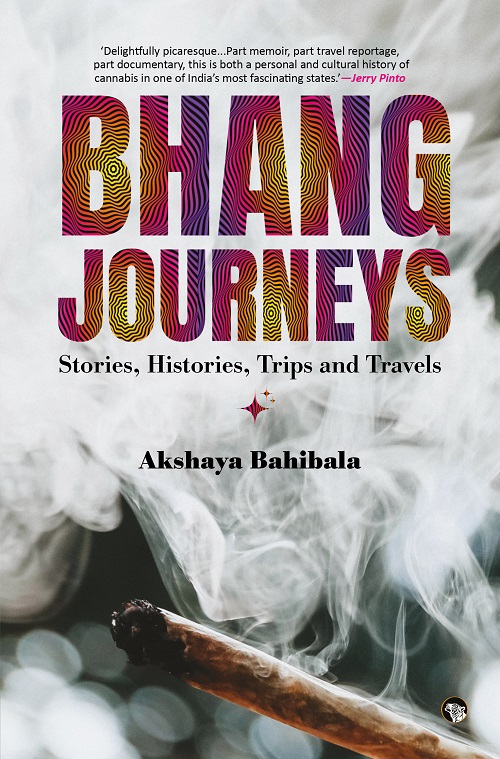
Title: Bhang Journeys: Stories, Histories, Trips and Travels
Author: Akshaya Bahibala
Publisher: Speaking Tiger Books
Akshaya Bahibala is a poet, bookseller, publisher, and library advocate. He is the co-founder of Walking Book Fairs, an independent bookstore and publishing company, as well as one of the most beloved bookmobiles in India, having journeyed over 35,000 kilometres through 20 states to promote a love of literature. Bahibala has authored four books in Odia. This book marks his debut in English. This captivating book is full of unexpected twists and turns, offering a unique blend of memories, adventures, and intriguing facts about a well-known substance. It serves both as an exploration and a cautionary tale.
Bhang Journeys: Stories, Histories, Trips and Travels by Akshaya Bahibala is an eye-witness account of the cannabis in one part of India – Odisha. Quite a bit of research and ideation seems to have gone into the book. This book is truly captivating due to its exploration of a controversial subject — bhang or cannabis..
Reads the blurb: “For ten years, from 1998 to 2008, Akshaya Bahibala was in the grip of bhang, of ganja—drinking it, smoking it, experiencing the highs and lows of an addict on Puri’s beaches with hippies, backpackers and drop-outs from France and Japan, Italy and Norway. Then he drew back from the edge and tried to make a life, working as a waiter, a salesman, a bookseller. He starts this journal-cum-travel book with startling, fragmented memories of his lost decade. From these, he moves to stories about people across Odisha whose lives revolve around ganja-bhang-opium.”
Bahibala commences the book by recounting his experiences of indulging in bhang and ganja on the shores of Puri. He also spends time with a considerable number of foreigners — Caucasian men and women who appear to visit Puri for the purpose of getting high. The author mingles with Japanese, German, French, Italian, and Israeli tourists, sharing meals, borrowing money, exchanging bhang-infused biscuits, occasionally engaging in fights, all while listening to Bob Marley’s soulful rendition of “No Woman, No Cry” in a state of intoxication.
The book has some interesting details like how the owner of a government-approved bhang shop prides himself on selling the purest bhang available, claiming it can make people as forgiving and non-violent as Jesus. Another story is about how an opium cutter, learnt how to massage a lump of opium with mustard oil and carve it into tablets as a boy. There is a heart wrenching narrative of a girl who survived cholera by licking opium and became a lifelong addict. Yet another, is about the yearnings of a goldsmith with an opium de-addiction card for 20 grams a month, but he longs for more — atleast 25 grams. There is also the story of the ganja farmer who flies to Puri from Punjab in a helicopter.
The hallucinations induced by the drug are reflected in the case study of a young man, suffering from ganja-and-bhang-fuelled paranoia, convinced that Indian and American spies are after him makes for an interesting yet concerning read. Descriptions are given of angry villagers indulging in violence against excise department officials who try to destroy ganja plantations.
Alongside these narratives, are official data on opium production, seizures, and destruction; UN reports on the medicinal benefits of cannabis and a veteran’s recipes for bhang laddoos and sherbets. The author delves into the process of creating bhang, highlighting its complete legality in India (unlike charas and ganja, which are prohibited under the country’s 1985 Narcotic Drugs and Psychotropic Substances Act). Additionally, there is a subtly humorous account of a Brahmin bhang shop owner who offers intriguing insights into the procurement and sale of bhang. Bahibala also discusses opium (referred to as afeem locally) cutters and government-operated facilities where opium is manufactured. He sheds light on opium addicts, for whom the government provides a de-addiction program.
The author concludes the book on a rather melancholic tone, discussing the current state of affairs in Puri and the significant changes that have occurred over the past two decades. The absence of foreign tourists on Beach Road, the police cracking down on public marijuana use, the proliferation of hotels and restaurants, and the eagerness of owners to expand and construct more establishments are all highlighted. Additionally, the author reflects on the individuals he once knew during his youth, noting that some have relocated to other countries while others remain in the area.
This book offers a comprehensive perspective on the bhang/charas/ganja culture in India, covering aspects such as production, sale, purchase, and consumption under peer pressure. The author’s personal experiences and lessons learnt add depth to the narrative, making it a captivating read. It is a liberating and unfiltered account, unconcerned with conforming to political correctness and yet, there is his own story, where he feels he ‘lost’ a decade of his life to addiction.
Bhaskar Parichha is a journalist and author of Unbiased, No Strings Attached: Writings on Odisha and Biju Patnaik – A Political Biography. He lives in Bhubaneswar and writes bilingually. Besides writing for newspapers, he also reviews books on various media platforms.
.
PLEASE NOTE: ARTICLES CAN ONLY BE REPRODUCED IN OTHER SITES WITH DUE ACKNOWLEDGEMENT TO BORDERLESS JOURNAL
I wish I could think In an ir - erasable way So that what I write Need not be rewritten To satisfy The whims of expert ideas That are invited To find excuses For erasing What I just wrote.
It is not that I want to write Something unforgettable. For many such things Are often better off When erased, And I don't like To erase anything.
Unfortunately it happens Sometimes or Often Or Usually that What is just written Feels itself to be immature, Not properly dressed, To be presented to The gaze of others.
What can one do Except agreeing to erase Such immature words.
But that is painful.. Or perhaps It ought to be painful With a tinge of guilt For not being able to think In an ir - erasable way. Though perhaps Not as painful As erasing the lives That are just being formed and don't yet know If they are presentable!
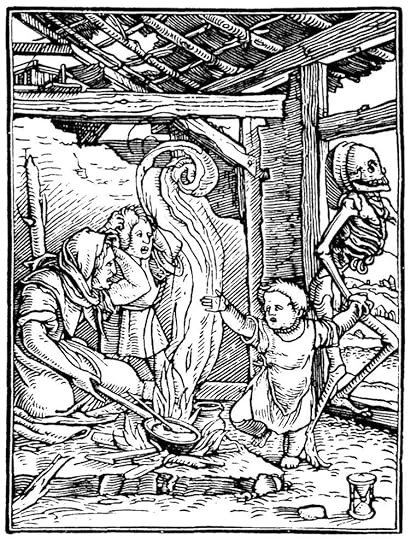
The Dance of Death by Hans Holbein (1497–1543)
Kumar Bhatt is a retired professor of Physics interested in everything in general. After retirement in 2002, he has been trying to learn to write. He lives in Ahmedabad.
.
PLEASE NOTE: ARTICLES CAN ONLY BE REPRODUCED IN OTHER SITES WITH DUE ACKNOWLEDGEMENT TO BORDERLESS JOURNAL
Tagore would have been 163 years old this year. In fact, he is that old this year. That is because he did not die in 1941. When poets pass away, they merely pretend to die, leaving mortals to bear the weight of their non-passage. In my case, at the age of 66, the happy punishment for being a Bengali is to be tied to a childhood spent in the lap of Tagore’s poems. That lap gets younger as I grow older.
I remember listening to Phagun, haoai haoai[1], Tagore’s ode to the winds of spring, on the radio in the attic of my ancestral village home in West Bengal’s Hooghly district. My home bordered a vast, circular expanse of agricultural land contoured by villages that included mine. Sitting in the third-storey attic, next to a terrace that overlooked the fields, I was transformed by the song. It turned vision into movement. The song’s opening lines speak of the poet making the gift of his carefree and untamed soul to the flow of the eager spring winds. Those lines might have added that Tagore had cast my soul as well to his winds. I leapt out of myself: I gladly yielded to my capture by the elements. I looked out, imagining that the spring winds would carry me across the vast fields into the homes and lives of the people who were participating in the rituals of spring, one of which was Tagore’s song itself.
There were many other songs in the same vein that accompanied me into youth. Among them were Tomar khola hawa[2], where Tagore welcomes a fresh gush of wind to his waiting sails and promises the elements no regret even if his boat sinks; and Nil Digante[3], where the blue horizon catches fire from the rioting colours of flowers and even the sun asks for itself in the brightness of the earth. Such were the poetic conceits that lent the urgency of understanding to the passage of my youthful days. To lead the imaginative life was to consign oneself to the youthfulness of Tagore.
My spring is over: Those days have passed, taking a happy Tagore with them. Now, what appeal to me are his sombre songs that deal with mortality and the divine. Tai tomar ananda amar por[4] is an outstanding example of what I would call the Late Tagore in me. Essentially, Tagore says to God: “You are the Creator only because I am the created.” Can you imagine the degree of self-certainty that allows a human to address God so fearlessly? I do not share Tagore’s devout hubris but I listen to that song over and over again to reassure myself that my days have not been useless because they have been inhabited by God-created hours. And, of course, with Jokhon porbe na more payer chinho[5], Tagore turns death itself into a romance with the endless interplay of time and space that defines life. I stand redeemed by his lines.
But I am growing old. I am not conveyed out of myself by the spring poems any more: I prefer to age, as wildly as health and imagination allow me to, within myself. Tagore accompanies me still, but what confounds me is how young he remains even in his constancy to the maturity of my withering years.
Phagun, haoai haoai: Tagore is exulting in the colours of this spring, this very year, even as I accept my autumnal steps to the final winter.
I gaze across the piazza -- you're lounging with our daughters who are sipping limoncello
A wall lizard loiters in dimming light -- distracted by your yellow blouse it ignores the pulse of moths
I pause too, not wanting the intermezzo to end with a Ciao -- I linger under the lemon tree's shade
CWTCH
Our cosy rooms do not become timeless, removing clocks is just a childish gesture.
This sharing space – a spicy spaghetti in bed, a bubbly bath - both knowing pleasure
adds up a cost. But cuddling on the settee, the room unmoors with cartoon repeats.
A wine, no half-life measure: happiness will breathe carefree, no careless cough defeats.
KEATS
reading rooted in mind and tasting ripe berries the oozing winking scent window open writing
Phil Wood was born in Wales. He enjoys chess and learning German. His writing can be found in various places, including : The Seventh Quarry, Borderless, and Arachne Press (Byways Anthology).
.
PLEASE NOTE: ARTICLES CAN ONLY BE REPRODUCED IN OTHER SITES WITH DUE ACKNOWLEDGEMENT TO BORDERLESS JOURNAL
Title: Once Around the Sun: From Cambodia to Tibet
Author: Jessica Mudditt
Chapter 20 – In or out?
As I walked the streets of downtown Hohhot in search of a travel agency, I felt further than five hundred kilometres from Beijing. I was still in East Asia, but the capital city of Inner Mongolia had Central Asian influences too, such as the cumin seed flatbread I bought from a hawker with ruddy cheeks and a fur hat. I passed a Muslim restaurant with Arabic lettering on the front of its yellow-and-green facade, and many street signs and shops featured Mongolian script as well as Mandarin. With its loops, twirls and thick flourishes, Mongolian looked more similar to Arabic than Chinese. In actual fact, the top-down script is an adaptation of classical Uyghur, which is spoken in an area not far to the west.
The winds that blew in from the Russian border to the northeast were icy cold, so I was glad to soon be inside a travel agency. It was crammed with boxes of brochures and a thick film of dust covered the windowpanes. Hohhot is the main jumping-off point for tours of the grasslands, so I was able to get a ticket for a two-day tour that began the following morning.
I wasn’t enthusiastic about going on a tour because I preferred to move at my own pace, however there was no other way to access the grasslands. The upside was that I was guaranteed to sleep inside a ger, which is a circular tent insulated with felts. The Russian term of ‘yurt’ is better known. I had read that Inner Mongolia was a bit of a tourist trap for mainland Chinese tourists, but I was nonetheless excited to get a glimpse of the Land of the Weeping Camel.
I walked into a noodle shop and a customer almost dropped her chopsticks when she saw me. The girls at the cash register were giggling and covering their faces as I pointed at a flat noodle soup on a laminated menu affixed to the counter.
Foreign tourists must be thin on the ground in Hohhot, I thought as I carried my bowl over to a little table by the window.
Inner Mongolia was one of the few places that Lonely Planet almost discouraged people from visiting: ‘Just how much you can see of the Mongolian way of life in China is dubious.’ But I was still keen to see what I could.
I ate slowly, enjoying each fatty morsel of mutton. I was pretty good with chopsticks by that point – I’d never be a natural, but I didn’t drop any bits of mutton into the soup with a splash, as I used to in Vietnam.
Hohhot seemed a scruffy, rather bleak sort of city – or at least in the area where I was staying close to the train station. Street vendors stood cheek by jowl on one side of the road, calling out the prices of their wares. The opposite side was under construction and the one still in use was unpaved, which meant that two lanes of traffic had to navigate a narrow area of bumpy stones while avoiding massive potholes and piles of dirt. I saw a motorbike and a three-wheel truck almost collide.
I spent the next few hours wandering around the Inner Mongolia Museum, which has a staggering collection of 44,000 items. Some of the best fossils in the world have been discovered in Inner Mongolia because its frozen tundra preserves them so effectively. The standout exhibit for me was the mammoth. It had been discovered in a coal mine in 1984 and most of its skeleton was the original bones rather than replicas. I gazed up at the enormous creature and tried to imagine it roaming the earth over a million years ago. Mind-boggling.
I admired the black-and-white portraits of Mongolian tribesmen, and then took photos of a big bronze statue of Genghis Khan astride his galloping mount. The founding leader of the Mongol Empire was the arch-nemesis of China, and parts of the Great Wall had been built with the express purpose of keeping out his marauding armies. Genghis Khan must have rolled in his grave when China seized control of a large swathe of his territory in 1947.
What was once Mongolia proper became a Chinese province known as ‘Inner Mongolia Autonomous Region’. This long-winded name is an example of Orwellian double-speak. So-called ‘Inner Mongolia’ is part of China, whereas the independent country to the north is by inference ‘Outer Mongolia’. Nor is the Chinese region autonomous. The Chinese state has forced Mongolians to assimilate. Their nomadic lifestyle and Buddhist beliefs had been pretty much eradicated, and although speaking Mongolian wasn’t outlawed, learning the state language of Mandarin was non-negotiable.
On top of this, the government provided tax breaks and other financial incentives to China’s majority ethnic group, the Han Chinese, if they relocated to Inner Mongolia. Mongolians now account for just one in five people among a total population of 24 million. The same policies of ethnic ‘dilution’ exist in China’s four other ‘autonomous regions’, which include Tibet and Xinjiang, the home of the Uyghurs.
Shortly before I left the museum, I came to a plaque that described the official version of history, which was at odds with everything I’d read in my Lonely Planet.
‘Since the founding of Inner Mongolia Autonomous Region fifty years ago, a great change has happened on the grasslands, which is both a great victory of the minority policy and the result of the splendid leadership of the Communist Party of China. The people of all nationalities on the grassland will never forget the kind-hearted concerns of the revolutionary leaders of both the old and new generations.’
I rolled my eyes, snapped a photo of the plaque for posterity, and continued walking.
* * *
I didn’t venture far from my hotel for dinner because I planned on having an early night. I chose a bustling restaurant with lots of families inside and was waiting for a waiter to come and start trying to guess my order when a group of men at the next table caught my eye. They seemed to be waving me over.
Me? I asked by pointing at myself.
Yes, they were nodding. Shi de.
I happily joined the group and introduced myself by saying that I was from ‘Aodàlìyǎ’. I think they were Han Chinese, as they didn’t look Mongolian. I whipped out my phrasebook and tried to say I had come from Beijing, but I was fairly certain they didn’t understand me.
Anyhow, no matter. Ten shot glasses were filled from a huge bottle of baijiu, and I was soon laughing as if I was with old friends. One of the slightly older guys used a set of tongs to place wafer-thin slices of fatty pork into the bubbling hotpot on the table, followed by shiitake mushrooms and leafy greens. As the impromptu guest of honour, my bowl was filled first once it was cooked – by which time I’d already had three shots.
The hotpot was fantastic, and I had to remind myself not to finish everything in my bowl. Bethan had told me that Chinese etiquette requires a small amount of food not to be eaten at each meal. This indicates that it was so satisfying that it wasn’t necessary to eat every last bite. As a kid, it was ingrained in me to finish everything on my plate. I loved food and was generally in the habit of licking my bowl clean, so I had to exercise a certain amount of restraint.
I had just rested my chopsticks across the top of my bowl to signal I was finished when I was invited to go sit on the wives’ table, which was across from the men’s. The women were very sweet and a couple of them seemed to be around my age. I once again tried to communicate using my phrasebook, but I was hopelessly drunk by then. I could hardly string a sentence together in English, let alone Mandarin. I was also beginning to feel queasy from the baijiu, so I gratefully accepted a cup of green tea from the porcelain teapot that came my way on the lazy Susan. After taking some photos together, I bid the two groups ‘zaijian’ (goodnight). I tried to contribute some yuan for the meal, but they wouldn’t hear of it. I curtsied as a stupid sort of thank-you, and then I was on my way.
* * *
More hard liquor awaited me the following day. A striking woman in a red brocade gown with long sleeves handed me a small glass of baijiu as I stepped off the minibus a bit before noon.
‘It’s a tradition,’ she said with a smile, while holding a tray full of shots.
I downed the baijiu with my backpack on and grinned as the backpacker behind me did the same. There were four foreign tourists on the tour, and about eight domestic ones. The liquor gave me an instant buzz, which I needed. I hadn’t slept well and woke up feeling lousy, so I’d kept to myself during the two-hour journey. Even though I should have been excited, I got grumpier and grumpier as the reality of being on a tour began to sink in. Plus, the landscape was not the verdant green steppes I’d been expecting. At this time of year, it was bone dry and dusty. It hadn’t occurred to me to check whether my visit coincided with the low season.
I began chatting to the other tourists. The guy who had the baijiu after me was Lars from Holland. There was also a couple from Germany. I could immediately tell they were pretty straitlaced. Their clothes looked very clean and functional, and the girl refused the baijiu.
The woman in red introduced herself as Li, our tour guide. Then she led us along a path lined with spinifex to a dozen gers. They faced each other in a circle, and off to the right was a much larger ger with the evil eye painted on its roof and Tibetan prayer flags fluttering in the fierce winds. There were no other buildings in sight and no trees.
Li told us to meet inside the big ger in fifteen minutes after we’d put our stuff in the smaller gers she proceeded to assign us. Lars and I would be spending the night in a ger with ‘82’ painted on its rusted red door. There certainly weren’t eighty gers, so the logic behind the numbering system wasn’t clear – but no matter. The German couple took the ger to the right of ours.
These were not portable tents for nomads. Each ger was mounted on a concrete base and I think the actual structure was made of concrete too, and merely wrapped in grey tarpaulins. The door was made of metal and at the top was a sort of chimney structure – perhaps for ventilation. Like igloos, the only opening was the door, and it was pitch-black inside. I located a dangling light switch as I entered.
‘Ah – I love it!’ I exclaimed.
It was a simple set-up, with single beds lining the perimeter and a low table in the middle of the room. Patterned sheets were draped from the concave ceiling. I chose the bed with a framed portrait of Genghis Khan above it. Lars put his backpack next to a bed on the other side. I was happy enough to share a ger with him. He gave off zero sleazy vibes.
‘I might just take a couple of those extra blankets,’ I said to Lars as I piled on a few extra floral quilts from another bed. The wind had an extra iciness to it out on the steppes and I shuddered to think what the temperature would drop to overnight. We zipped our jackets back up and headed out.
I wandered over to the toilet block, which was quite a distance from the gers. I made a mental note to drink as little as possible before getting into bed to avoid having to go in the night. Once I got closer to the toilets, I was glad they were so far away. The stench was unbelievable.
In the female section were two concrete stalls without doors. In the middle of the floor in each was a rectangular gap. I almost gagged. Just a few centimetres away from the concrete was an enormous pile of shit. I could make out bits of used toilet paper and sanitary pads and there were loads of flies buzzing around. Without running water or pipes, the excrement just sat there, day after day, building up. I would have turned and walked straight back out but I was busting for a wee. I held my breath so I wasn’t inhaling the smells. I wanted to close my eyes too, but I was terrified of falling in, so I had to look at what I was doing. I couldn’t get out of there fast enough.
‘Oh my god, Lars – the drop toilets are totally disgusting,’ I said after I met up with him in the big ger. ‘It’s just a pit of shit without running water.’
‘I know an American girl who fell into a drop toilet in China last year,’ he said.
‘No way,’ I said with a shudder.
‘Yeah. She said it was terrible. She was in a really poor village somewhere in central China and she went to the toilet at night. She couldn’t see that some of the wooden planks had gaps in them – and then one of them broke and she fell in. She was up to her neck in shit. She was screaming for people to come help her. Apparently, it took them half an hour to fish her out, and all the while she could feel creatures writhing around her body. She cut her trip short and had to get counselling when she got home.’
‘I bet she did,’ I said. ‘That’s the most disgusting thing I’ve ever heard in my life. The poor girl.’
Just then Li appeared and said we were heading outside to watch horse racing and traditional wrestling after some sweet biscuits and tea. We assembled around a fenced area where there were about thirty ponies tethered to poles. Some were lying down while still saddled.
‘Horses usually sleep while standing up, so these ponies must be knackered – pardon the pun,’ I joked to Lars.
Notwithstanding, they looked to be in reasonably good condition, with shiny coats and no protruding ribs. There were chestnuts, bays and dapple greys.
I heard the sound of hoofbeats and looked behind me. A group of men on horseback came thundering across the steppes. It was a magnificent sight, and any lingering resentment I had about being on a tour melted away.
One of the men rode ahead of the rest. He was wearing a cobalt-blue brocaded tunic and his wavy black hair came down past his ears. He was really good-looking. He approached Li with a smile, said something to her and dismounted with the ease of someone who had probably started riding horses before he learned to walk. Li and the man exchanged a few words – I definitely saw her blush – and then he got back on.
‘Gah!’ he yelled as he dug his heels into his horse’s sides.
The other horsemen followed after him with whoops, leaving a trail of dust in their wake. These Mongolian ponies were only about twelve or thirteen hands, but they sure were fast and could turn on a dime. I loved watching them carve up the dry earth.
Next a group of men on motorcycles appeared along the track. There were quite a lot of them – at least twenty. We formed a big circle, and the traditional wrestling began. I wasn’t sure what the rules were, but it was fairly self-explanatory: one man got another in a headlock and thumped him to the ground. The next man came along and fought the winner, and so on and so forth. The spectators egged on the fighters with what I assumed were good natured cat calls. Everyone was grinning. By the time the wrestling matches were over, the fighters were absolutely covered in dust and the sun was beginning to set. I’m sure it was all staged for our benefit, but it was good fun.
With the seamless orchestration of a tour that has been done a thousand times before, we gravitated to the big ger. Dinner was bubbling away in a large clay pot and it smelled pretty good. There was also a big vat of noodles with black sauce and the ubiquitous Chinese vegetables of thinly sliced carrot, bok choy, baby corn and onion. There was a bottle of baijiu on each table.
We were serenaded with traditional music while we ate. One of the instruments reminded me of the didgeridoo and there was also a violin. I had read that strands of horse mane are used to make violin strings. The male singer had a deep voice that was almost a warble, and it was hauntingly beautiful.
Five men and women emerged from behind a red curtain and began to dance. They wore long-sleeved, billowing satin tunics that were cinched at the waist with embroidered belts. One of the women had a tall hat made of white beads that dangled down to her waist. It must have been heavy. It was a high-energy display of kicks and splits and parts of it were reminiscent of Irish dancing. They twirled their billowing skirts like sufis. The Chinese tourists started clapping in time with the music and then we all joined in. Sure, it was a bit cheesy, but I was really enjoying myself. At the end of the concert, we had photos with the performers as they were still trying to catch their breath.
We were given torches to light our way back to our gers. It was absolutely freezing, so I wore all my clothes to bed. I snuggled into my blankets and pulled them right up to my chin, feeling grateful for the warmth of Bethan’s jumper.
Mercifully, I slept right through until morning and avoided a late-night visit to the shit pit.
When I wandered out of the ger the next morning, breakfast was being prepared nearby. The carcass of a freshly slaughtered sheep was hanging from the back of a trailer. A man was skinning it while the blood drained out of its neck into a big metal bowl. Its head was in a second bowl, while squares of wool were laid out flat to dry on a tarp. A toddler in a puffy orange jacket was playing in the dust while his mother worked away at skinning parts of the wool. What distressed me more than butchery up close was the live sheep that was watching on from the back of the trailer. He presumably knew he was next.
After a breakfast of ‘sheep stomach stew with assorted tendons’ (as Li described it) we headed out for a ride on the steppes. I couldn’t wait to ride a horse again. I’d spent most of my childhood obsessed with horses, and I was lucky enough to have one for a few years, until I got older and became more interested in hockey and parties.
I rode a stocky bay with a trimmed mane that bobbed up and down as it trotted along the path. I looked over its perky little ears. The saddle had an uncomfortable pommel that kept jabbing me in the stomach, but I loved being under the wide open sky. It was a pale blue with just a few wispy clouds. Sheep grazed and crows rested on clumps of rocky outcrops.
I winced at the Chinese guy ahead of me, who was bouncing out of time to the rhythm of his horse’s gait and landing with a heavy bump in the saddle; his oversized suit flapping in the wind and his feet poking out straight in the stirrups. Much easier on the eye was the guide two horses ahead of him. He was every inch the Mongolian cowboy. Dressed from head to toe in black, he wore a leather jacket, cowboy hat and scuffed black cowboy boots. He never took off his wraparound sunglasses and he spoke little. He smouldered like the heartthrob actor, Patrick Swayze.
We’d travelled several kilometres when we came to a building block that was the same greyish brown as the earth. Inside it had a cottage feel. We sat around a table covered with a frilly tablecloth and drank yak milk. As we did, Lars told me about his day trip to North Korea. While in South Korea for a couple of weeks, he had visited the demilitarised zone (better known as the ‘DMZ’), where a ceasefire was negotiated between the two Koreas in 1953. In a military building is what is known as the ‘demarcation line’ – and Lars had one foot in North Korea and another in South Korea. I hung on his every word.
Our conversation got me thinking about how cool it would be to go to North Korea. I was actually quite close to the border. When I got back to the ger, I retrieved my Lonely Planet out of my bag and thumbed to the section titled ‘Getting there and away’, which had instructions for every country that borders China.
‘Visas are difficult to arrange to North Korea and at the time of writing, it was virtually impossible for US and South Korean citizens. Those interested in travelling to North Korea from Beijing should get in touch with Koryo Tours, who can get you there (and back).’
I was pretty sure the cost would be prohibitive for my budget and decided to stick with my existing plan of cutting south-west towards Tibet. Maybe one day I’d get the chance to visit North Korea, but it wouldn’t be on this trip.
Once back in Hohhot, I boarded a train bound for Pingyao. As I watched the apartment blocks pass by in a blur, I thought with satisfaction about the past twenty-four hours. Any visit to Inner Mongolia is problematic, but I couldn’t fault the Chinese tour company. They had made every effort to keep us entertained. Mongolian culture was so new to me that I couldn’t even tell whether something was authentic or staged, but I had seen and done all the things I hoped to during my visit. And, sure, my time there was really brief. But I’d be forever grateful to have seen a part of the world I thought I’d only ever get to see in a documentary.
Photo Courtesy: Jessica Muddit
About the Book: While nursing a broken heart at the age of 25, Jessica Mudditt sets off from Melbourne for a year of solo backpacking through Asia. Her willingness to try almost anything quickly lands her in a scrape in Cambodia. With the nation’s tragic history continuing to play out in the form of widespread poverty, Jessica looks for ways to make a positive impact. She crosses overland into a remote part of Laos, where friendships form fast and jungle adventures await.
Vietnam is an intoxicating sensory overload, and the hedonism of the backpacking scene reaches new heights. Jessica is awed by the scale and beauty of China, but she has underestimated the language barrier and begins her time there feeling lost and lonely. In circumstances that take her by surprise, Jessica finds herself hiking to Mount Everest base camp in Tibet.
From a monks’ dormitory in Laos to the steppes of Inner Mongolia, join Jessica as she travels thousands of kilometres across some of the most beautiful and fascinating parts of the planet.
About the Author: Jessica Mudditt was born in Melbourne, Australia, and currently lives in Sydney. She spent ten years working as a journalist in London, Bangladesh and Myanmar, before returning home in 2016. Her articles have been published by Forbes, BBC, GQ and Marie Claire, among others. Once Around the Sun: From Cambodia to Tibet is a prequel to her earlier book, Our Home in Myanmar.
.
PLEASE NOTE: ARTICLES CAN ONLY BE REPRODUCED IN OTHER SITES WITH DUE ACKNOWLEDGEMENT TO BORDERLESS JOURNAL
A gentleman in a suit descends in the elevator from the eighth floor
and walks to the base of a maple tree, lighting a cigarette.
From the twelfth floor, another gentleman in a suit walks down the corridor,
takes the elevator down the stairs, and heads to the shade of the maple tree,
lighting another cigarette.

Several people gather, lighting their cigarettes,
but no words are exchanged among them.
Conversations reside within the smoke of their cigarettes.

It's been seventeen years since
a comedian did a no-smoking public service announcement and left.

Through the respiratory track and lung rotations,
the smoke, exhaled from mouths and nostrils, disperse,
but the scent clings to the tongue, gums, and roof of the mouth.

Carcinogens are sprayed into blood vessels, brain cells, and nerve cells,
and the smell permeates ties, fingers, and hair.
The carcinogens refill the elevator and ascend
from the first floor to the second, then to the twelfth.

Ignoring the sensitive noses of customers has become a habit.
I believe in the saying, "You grow to love what you know."

How can one understand the heart of someone who doesn't know the taste of tobacco,
as they leave the office, ride the elevator, and head to the shade of the maple tree to light up a cigarette?
The relationship between tobacco, its lovers, and the maple tree is expected to continue for a while longer.
Ihlwha Choi is a South Korean poet. He has published multiple poetry collections, such as Until the Time When Our Love will Flourish, The Color of Time, His Song and The Last Rehearsal.
.
PLEASE NOTE: ARTICLES CAN ONLY BE REPRODUCED IN OTHER SITES WITH DUE ACKNOWLEDGEMENT TO BORDERLESS JOURNAL.







 Borderless