Categories
Essay

 Bottled Memories, Inherited Stories

By Ranu Bhattacharyya

I hear the scents whisper. Familiar fragrances of clove and cinnamon, imbued with spicy notes of pepper and eucalyptus beckon and tease. Elusive murmurs of mysterious oils and herbs tinge the air as I walk along a narrow-paved lane in Old Dhaka, overshadowed by looming walls on either side. I ignore the press of prying eyes and inquisitive bodies that accompany my passage. The call of the scents is irresistible, and I feel strangely unafraid of what lies before the next turn in the path ahead. These were the scents of my childhood — of summer afternoons spent secretly exploring the forbidden depths of my grandmother’s closet, the kaancher almarih[1] where her medicines were stored in shiny glass bottles with peeling labels.

The narrow lane spills into a small courtyard hemmed by buildings on three sides. Everything is closed because it is Friday, the day of prayer in Bangladesh. Peering through grimy windows, I see gigantic iron cauldrons, cavernous kansa kadhais[2], their gold gleaming in glimpses amidst sooty splatters, huge ladles and enormous tongs. Some vessels perch on hand-crafted mud stoves, their sides smoothened and baked by fires. Wooden logs are stacked in the corner along with bulging sacks of coal. Nearby, some large pieces of cloth, perhaps used for straining, are hung out to dry. In the shadowy recesses, shelves stacked with glass bottles glisten with reflected light. It seems almost staged, like a theatrical representation of a medieval kitchen and yet the evidence of daily use is undeniable.

The fourth side of the courtyard has an open doorway. A sudden urge, an inexplicable pull, lures me towards it. I feel I know what lies beyond its brink. Yet how could that be? In this alien city, situated in a land scarred by a brutal Partition, from where does this knowing come? Concentrating on lifting the edge of my saree as I step across the threshold, it takes me a moment to lift my eyes to see what lies ahead. A painting of a pot-bellied man seated cross legged on an asana[3], a sacred thread adorning the vast expanse of his chest, looks solemnly back at me. Before me was the same face I’d seen on countless bottles in that medicine cupboard of my childhood — the same glossy hair, oiled and parted with precision, the same curled moustache, the same narrow bordered white dhoti[4].
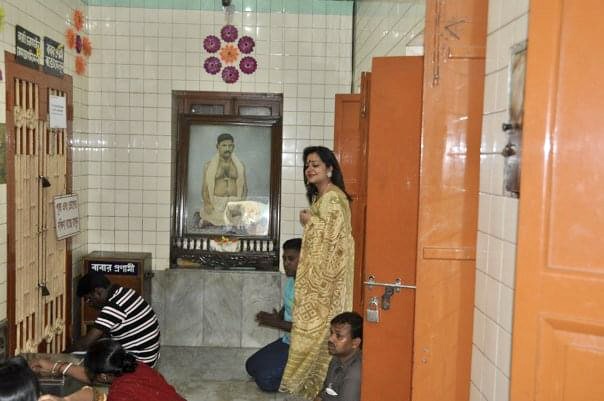
The author with her great grandfather’s portrait in Dhaka. Photo Courtesy: Ranu Bhattacharyya

I find myself before a life-size portrait of my great grandfather, Mathura Mohan Chakraborty, founder of Shakti Aushadhalaya, the Ayurvedic pharmacy famed in the streets of Dhaka, Calcutta, Patna, Benaras and Rangoon at the turn of the 19th century. The kitchen behind me was the pharmacy’s karkhana[5] to prepare medicines of his formulations. His portrait hung before the inner sanctum of the temple he had dedicated to the revered Bengali saint, Lokenath Baba. Legend claimed that the mystic had whispered the recipe of the first medicinal formulation to his most faithful disciple — my great grandfather.

Ever since I arrived in Dhaka as an expat, I had been searching for the Shakti Aushadhalaya premises. Everyone knew of the company; yet nobody seemed to know where it was located. I was introduced everywhere as a young scion of the family. And though whispers followed me at gatherings and smiles broadened on hearing I was the great granddaughter of Mathurababu, my questions regarding the whereabouts of the company drew blank stares and confused responses. In horticulture, the word scion, refers to the detached living part of a plant that is cut to be grafted onto another plant. The sundering of this particular scion had been so complete, over so many generations, through such a series of violent events that it seemed my search for the original plant would remain elusive.

It was only through persistent enquiry that I found myself in Swamibagh Road in Old Dhaka where the manufacturing unit of Shakti Aushadhalaya was located. Mathurababu had founded the company in Patuatuli, Dhaka, in 1901. Family lore suggests Lokenath Baba inspired him to venture far from his origins as a schoolteacher in Bikrampur. The ascetic recognised his potential, unusual in those times, as a graduate versed in three languages — Bengali, Sanskrit and English. Starting from humble beginnings in the family kitchen, peddling hair oil and tooth powder in his neighbourhood, Mathurababu’s prescient business acumen saw his enterprise flourish. The company produced and supplied quality Ayurvedic medicines at low prices. Mathurababu also established an Ayurvedic institute, attached to his manufacturing unit to popularise Ayurvedic knowledge. The institute taught Ayurveda and philosophy in Sanskrit. Students were offered free tuition, boarding, and lodging.

Ayurveda, considered the oldest existing health science in the world, is believed to have originated in India 5000 years ago. The journey of Ayurveda from ancient times to its present incarnation is a fascinating story that follows several simultaneous trajectories, embracing geopolitics and history, trade and commerce, science and industry, technology and travel.

It is with a sense of wonder that I encounter my great grandfather’s name in journals and books that describe the history of Ayurveda in India. He was among the earliest entrepreneurs to transition towards production of Ayurvedic drugs for the market. Directly involved in all aspects of his company, Mathurbabu immersed himself in the study of Ayurveda and had an extensive library of rare treatises on ancient Indian medical traditions, including a prized copy of Susruta Sanhita[6].

He noticed that Western medicines advertised their products in newspapers and journals. Following this model, he embraced a similar practice for his own company. An advertisement published in Muhammadi in February 1940 included endorsements from freedom fighter Chittaranjan Das, Lord Lytton, the Viceroy of India, and Lord Ronaldshay, the Governor General of Bengal. In the vintage advertisement, Lord Lytton wrote: “I was very interested to see this remarkable factory which owes its success to the energy and enthusiasm of its proprietor Babu Mathura Mohan Chakravarty B.A. The preparation of indigenous drugs on so large a scale is a very great achievement. The factory appeared to me to be exceedingly well managed and well equipped &c. &c.” In the same advertisement, in Bengali, Chittaranjan Das endorsed that nothing could surpass the production processes for medicines at Shakti Aushadhalaya.

Since the mid-19th century, several eminent leaders of the Indian freedom struggle visited Mathurbabu’s factory in Dhaka. On June 6, 1939, in the company’s visitor’s book, Subhash Chandra Bose wrote, “I visited the Sakti Oushadhalaya[7], Dacca, today and was very kindly shown around the premises. Indigenous medicines are prepared here on a large scale and in accordance with Ayurvedic principles. The institution reflects great credit on Babu Mathura Mohan Chakravarty, whose enterprise has brought Ayurvedic medicines within the reach of the poor. I wish him all success to the institution which he has built up after so much enterprise and hard labour for a long period. The success of Sakti Oushadhalaya, Dacca, means the popularity of Ayurveda throughout the country and this in its turn means the relief of suffering humanity.”

When my parents visited us in Dhaka a year after our arrival, we went back to Swamibagh Road. Our visit included a trip to the shop where the medicines of Shakti Aushadhalaya were sold.

Despite being taken over by the Pakistan government in 1971 and subsequently acquired by a private entrepreneur, the company remains operational in Bangladesh to this day with 37 branches nationwide. Though Mathurababu’s portrait is no longer on the medicine bottles in the shop, the names of the formulations inscribed, are still recognised by my mother.  As we browse through the offerings, a crowd begins to form around her, hailed and welcomed as Mathurababu’s direct descendant. Much to my mother’s delight, the crowd guided her to his house, a now derelict mansion hidden in the by-lanes of Old Dhaka.

We entered the property through an ornamented gatehouse that opened to a large courtyard. On one side was the Baithakghar, the public receiving room with the Nat Mandir, the family temple in front of us. On the other side was the majestic mansion with tall columns, topped with ornate capitals. Next to the Nat Mandir was a small doorway that led to a shaded courtyard with a well, meant for the family’s private use. Beyond was yet another courtyard, enclosed with buildings on three sides.
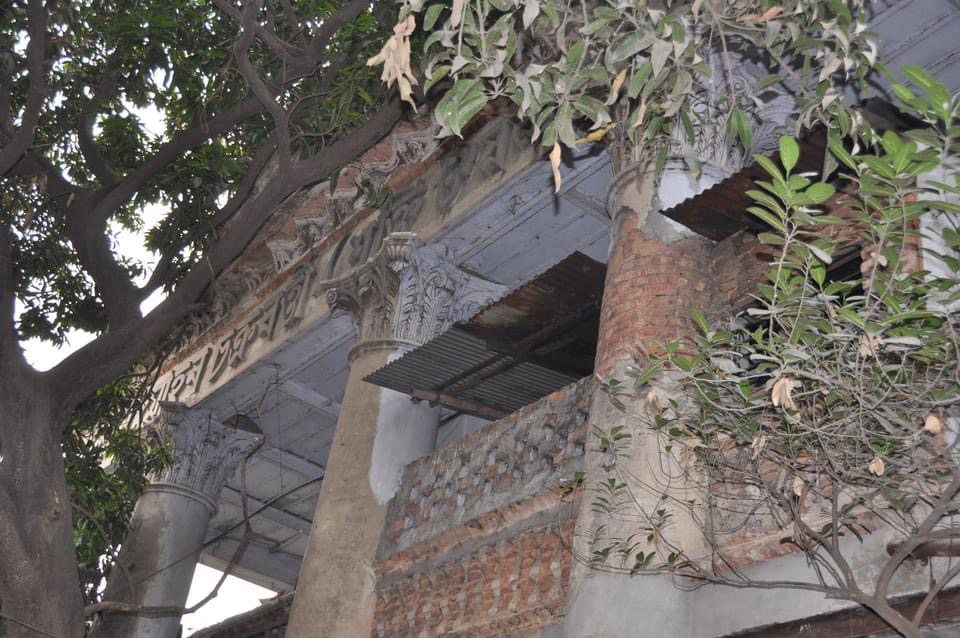
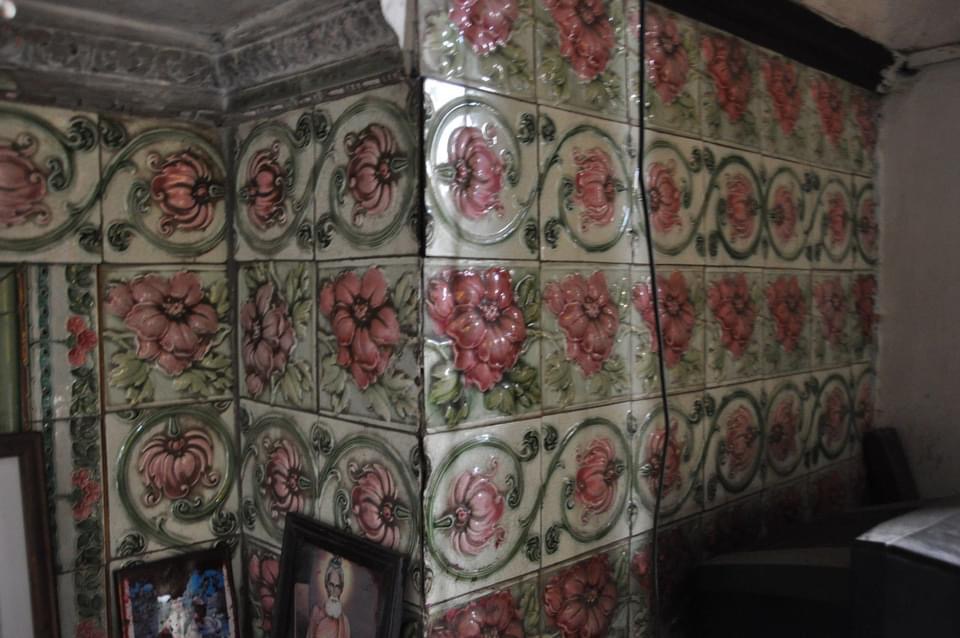
As I climbed the stairs leading to the second floor, I had a feeling of déjà vu. I felt I had been here before through my grandmother’s stories. Her small feet must have climbed these stairs. There was the arched windows she had said she gazed out of, and the vast veranda with colonnades, where she played with her eight siblings. Wandering through the rooms, I hear her voice narrating tales of her childhood — kite races on the terrace, indolent boat rides on the Padma, and the indulgence of choosing sarees from the weavers who came all the way from Benaras.

The house is now home to several families who regard our arrival with wary welcome. “Where are the Italian painted tiles?” I ask eagerly. The story of the tiles imported by her father from Italy were amongst the kaleidoscope of stories that my grandmother had shared with me. Whisperings and murmurings ensue amidst the crowd and then a hefty cupboard was pushed aside to reveal the tiles in all their faded glory.

Slowly it dawns upon me that the silent bottle in my grandmother’s cupboard had encoded stories that belied its seemingly mundane materiality. To uncover these lost stories, I embark on a renewed search for those old medicine bottles of my childhood. Their fragrance lingers at the edges of my memory, offering tantalising glimpses to fragments of knowledge. The sense of smell is our oldest sense. My memories of stories narrated by my grandmother were inextricably connected to the scents locked in that bottle. Would holding the bottle in my hand peel back the layers of my memory, answer some unanswered questions about my grandmother’s roots, help me map the route of our family’s journey? But alas! Those bottles are lost to time. My grandmother’s generation is gone and I search among Mathurababu’s scattered grandchildren and great grandchildren to no avail.

My grandmother left Dhaka in 1936, never to return. Mathurbabu’s house on Calcutta’s Central Street was completed that year, and it is there he moved with his wife and three youngest unwed daughters, including my grandmother. His older son remained in Dhaka to oversee the factory and drug production, while Mathurbabu focused on controlling the distribution from a central office in Calcutta. Till his death in 1942, despite his ailing health and flagging energy, he visited the company’s distribution centres spread across Calcutta everyday, accompanied by his faithful retainer Nathu. Probing for reasons for this abrupt migration, my uncle gave me a solitary clue. He recalled that my great grandfather had felt his family was unsafe in Dhaka. With this obscure clue in hand, I delved into history books for elaboration. I read about the rise of communal tensions in Bengal from the mid-1920’s. The Dhaka riots of 1930 targeted several well-established businessmen and involved loot and arson of their business and personal properties.

In 1947, there was yet another wave of migrations far more existential and grimmer. After the borders were drawn between the newly formed nations of India and Pakistan, the remaining family fled Dhaka overnight, leaving behind the factory, the mansion, in fact, all their material possessions in a land suddenly hostile to their continued habitation. Unable to exercise control over their properties in East Pakistan, there was an initial attempt by Mathurbabu’s heirs to establish a factory in Chandernagore. Without my great grandfather at the helm, this nascent enterprise floundered and ultimately sank. Cut from its moorings in Dhaka, Mathurbabu’s inheritors could not keep the business afloat in India. Slowly his legacy dissipated. The Shakti Aushadhalaya head office in Calcutta’s Beadon Street closed and the shops in Calcutta, Karachi, Kabul, and Colombo lowered their shutters.

Through generations of migration and resettlement, we are left with only scattered memories and fragmented stories. These intangible remains are my inheritance today. These intangibles are bound neither by form, nor by time. Instead, they offer limitless possibilities for exploration, crafting and archiving. Memory, nourished by the repeated telling of stories, provides continuity. These intangible wisps of legacy — a remembered glimpse of a peeling label, the stories heard from my grandmother, the whispered whiff of a familiar fragrance, open a door to the past and invite me to connect it to the present. “Listen to us,” the scents call. “Let us tell you our story.”

[1] Glass cupboard

[2] Bronze woks

[3] A rug for prayers

[4] A cloth wrap for the lower half of the body

[5] Workshop

[6] Ancient Sanskrit text on medicine, dated to 12th-13th century

[7] Pharmacy

Ranu Bhattacharyya, author of The Castle in the Classroom: Story as a Springboard for Early Literacy, Stenhouse, 2010, is an educator and writer who has lived and worked across the world, exploring and archiving narratives that connect people and cultures.

.

PLEASE NOTE: ARTICLES CAN ONLY BE REPRODUCED IN OTHER SITES WITH DUE ACKNOWLEDGEMENT TO BORDERLESS JOURNAL

Click here to access the Borderless anthology, Monalisa No Longer Smiles

Click here to access Monalisa No Longer Smiles on Kindle Amazon International
Categories
Poetry

Poetry by Naisha Chawla

Naisha Chawla
GULAB JAMUN

Kafka would've liked these corridors,
these walls of painted advertisement,
these coloured towns with attributions to deities at every tree's feet.
The running nerve of this place,
through the garble of a thousand dialects,
sounds all kinds of chants,
of faith, food, and architecture,
of life weaving through its weighting waiting slums,
through linoleum hardened heel-clad grounds.

Not a day goes by without auto horns,
or political instability,
or chai,
sweet, sweet, God-sent chai,
a thousand wicks in a thousand burning lamps,
a million lit cigarettes in stalls,
a million lit-up smiles in places you wouldn't expect to belong.

This home functions upon its dysfunctions,
builds upon what breaks it,
ever encompassing,
entirely amassing,
fields in farms,
skills of talents,
sacks of wheat,
bundles of wires,
collected coins,
plastic bags like Russian dolls,
ringing evening bells,
a life so culturally fulfilled,
lived in the grand denominations of
Division of the masses
and Parle G*.


* A popular brand of biscuits in India


Naisha Chawla is inspired by the works of Robert Frost, Oscar Wilde, W.H. Auden, Sylvia Plath, and Richard Siken amongst many others. She believes poetry to be a language of infinite letters, words and secret combinations to figuring out the better mysteries of life! Her debut book is called The Grants of Calliope.

PLEASE NOTE: ARTICLES CAN ONLY BE REPRODUCED IN OTHER SITES WITH DUE ACKNOWLEDGEMENT TO BORDERLESS JOURNAL

Click here to access the Borderless anthology, Monalisa No Longer Smiles

Click here to access Monalisa No Longer Smiles on Kindle Amazon International
Categories
Excerpt

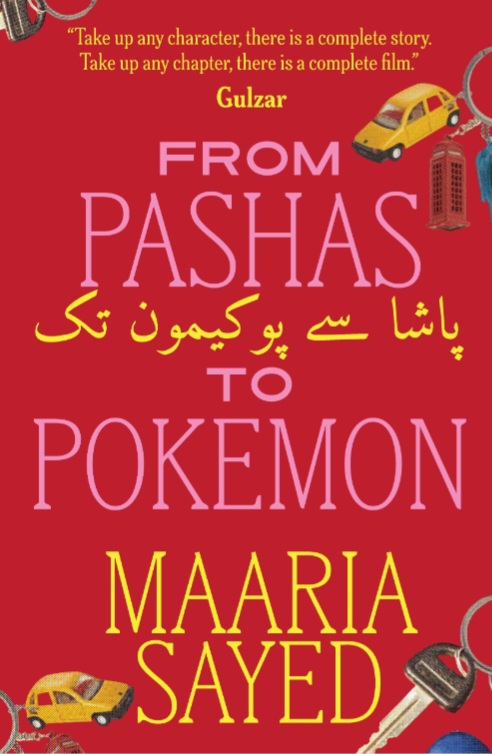
From Pashas To Pokemon

Title: From Pashas To Pokemon

Author: Maaria Sayed

Publisher: Vishwakarma Publications

    Both the doors were locked. We knew Ammi must have locked the main door on her way out, but the emergency door wasn’t opening either. Yusuf and I jumped into our flat through our exceptionally large windows. We were accustomed to swiveling our fingers until we reached the latch hidden on the inside of the window. We’d pivot the hook and squeeze our pinky fingers through the tiny hole between the plastic orifices in the windowpane. Ammi had gone over to Nani Jaan’s house, and we were not expected back for another few hours. Rashid, my brother’s friend was reprimanded by his mother and grounded in his house to study. There was a limit to how much time Yusuf and I could spend at Rashid’s house eating sev puris with his mother. We sighted an excuse to get away and return home. But as Abbu says, fate has its way of creeping into the unlikeliest of places, so it did. The sunset remained hidden behind the mass of clouds, just like the rest of the month of November, and brought with it its own woes. Yusuf and I had expected to be jumping into an empty house, but were taken aback to see our living room filled with a score of giant men dressed in white kurtas. Abbu sat at the centre looking disheveled in his unkempt hair and crumpled lungi. It was an oddly monstrous sight. We had never seen so many men gathering at home when it wasn’t an Eid celebration. We were also not accustomed to seeing men with beards as long as these men had.

     Nani Jaan had a personal assessment about the length of men’s beards that we had internalized over the years. ‘When it is longer than your fist, you know the intention is intimidation,’ she’d say in a spinechillingly confident tone. ‘We don’t live amidst Jalaaluddin Rumis and Nostradamuses anymore. The only inspiration the men could possibly be hiding under their beards would be a horde of lice.’ Thus, I had developed a quaint habit of mentally calculating the length of the beards I saw as I walked. Within the split second when I glanced around our living-room, I knew all their beards were much longer than their fists. I wondered how Abbu fit in with this forest of mens’ hair, because Abbu always remained clean-shaven, save the Sunday stubble Ammi would pester him to get off. On that particular day too, Abbu’s facial skin remained exposed.

   The visual was threatening far beyond the beards when we saw what the men were concealing below their cloth bags and our pillow covers —— big black and brown guns. On our news channels, such guns were called AK 47s —— Yusuf identified the type almost instantly. We looked at Abbu helplessly, rummaging up a response, a conjecture, a remark, hint, and something —— anything. My single most gigantic fear was that Abbu was in deep trouble. Yusuf looked at me from the corner of his eye, gesturing to me to be tight-lipped and non-reactive. Abbu stared at us pale-faced, without uttering a word. He introduced us in a point-blank manner as his children.

    ‘Here, Yusuf is the naughty one I’d told you about. And his elder sister, my first born, Aisha.’ Abbu pointed at me and his index finger poked me like the razor-sharp edge of the blade Ammi used to carefully slice the dead skin off her feet.

    Both Yusuf and I hated being introduced to the strangers we clearly despised. We took a seat in the corner of the room as Abbu directed us to. The next few minutes were a blur as my mind wandered into nothingness, like the blurry images of a super eight camera unable to focus on any particular sight. It just moved from beard, to table, to Abbu, to slippers, to window, to teacup, and back again to the beard. The next few moments were nauseating, like the time I tried my first mushroom drug. It was in an open field, a few hours away from Mumbai, on top of a blue car bonnet. I felt my shivers as I cascaded back and forth, breaking the continuum of time and space. I was sick for the next few days, but all Abbu and Ammi ever knew was that I had terrible food poisoning. Whenever Yusuf uttered the word mushroom in front of our parents to provoke me, I simply smiled, knowing that Ammi had decided never to cook mushrooms at home ever again. Abbu had subjected me to a sly smile as if he were fully cognizant of what was happening to me. Like various other things in my family, this was another one we buried under our carpets so I could sleep peacefully.

   The bearded men bid their salaams to Abbu, smiled at us coldly, and hid their guns inside their oversized black kurtas before they left our home.

     I was sixteen, Yusuf was thirteen, and we had seen what most people never get to see in a lifetime. Abbu forbade us from asking questions, demanding answers, or telling anyone what we had seen, ever. When we asked Abbu if Ammi knew what he was up to, he asked us to abide by our oath of complete silence regarding what we had witnessed. As anxious, hormone-charged teenagers, we naturally argued our way through the conversation with Abbu. He sat on the edge of the sofa, staring at the floor like a victim with nothing to back up his conscience. When Yusuf saw a discreet tear trickle down Abbu’s cheek, we stormed out of the room with an uneasy feeling eating away our guts. We loved to drive our parents up the wall, so long as we knew it was our doing. But the moment we sensed the involvement of another hand, it made us lament uncontrollably. Abbu and Ammi’s story about their engagement period was folklore for us. In our heads, they weren’t three-dimensional beings like the rest of our family. I clearly recall the morning Abbu, Ammi, Yusuf and I tried making pancakes for the very first time after Abdul Chachu, Abbu’s cousin, had written to us saying it was their daily breakfast ever since they relocated to Detroit. Of course, Abbu had responded saying he didn’t fancy pancakes, but nudged Ammi to hunt for the recipe since he desperately wanted to taste what his cousin had substituted scrambled egg with. Pancakes, in Abbu’s mind, became the recipe to success; he envied how his cousin had started from scratch and managed to make a respectable living in a foreign land. That morning, when we ate pancakes for the very first time, we looked at each other, trying to gauge if the one seated opposite us really liked them. Ammi sat opposite me and I remember seeing her gulp hers down with long sips of sherbet. We all disliked them, but we never admitted this to each other. Probably the one who disliked them the least was Yusuf, but I could tell that he would never substitute our scrambled eggs for what seemed like a cross between South Indian dosa and Maharashtrian pooran poli with a whole lot of Nutella.

ABOUT THE BOOK

At 25, Aisha has seen more than many people do in a lifetime and has understood one thing: no matter who you are and where you are from, there are things that you can study and others that you can actually learn from and grow.

Lively tales from family history and everyday life in a Mahammad Ali Road colony in Mumbai form the background of Aisha’s internal journey. Childhood memories mingle with her experiences while studying in London, and are woven into a sharp commentary on the transformations in India over 20 years as she ponders her place in this ever-changing world. The novel narrates the story of many journeys. It is a journey of growing up: the journey from childhood to adolescence, youth to old age, from one culture to another, and a glimpse of past to present times.

ABOUT THE AUTHOR

Maaria Sayed is an Indian filmmaker and writer whose work focuses on the sexual and spiritual liberation of women, evolving Muslim identities, and South Asian life. She has been supported by Cineteca di Bologna, Sharjah Art Foundation, and Busan Film Commission, among others, and was a delegate and jury for the UN-backed Asia Peace Film Festival in Pakistan. She regularly holds workshops on cinema for students and teaches intercultural communication to executives of multinational companies. She is a graduate of literature and cinema, and obtained her fellowship on Asian media production and collaboration in South Korea. She is passionate about Sufi poetry, folk music, Indian theatre and cats- big and small. This is her debut novel.

.

PLEASE NOTE: ARTICLES CAN ONLY BE REPRODUCED IN OTHER SITES WITH DUE ACKNOWLEDGEMENT TO BORDERLESS JOURNAL

Click here to access the Borderless anthology, Monalisa No Longer Smiles

Click here to access Monalisa No Longer Smiles on Kindle Amazon International
Categories
Poetry

Tillandsia

By Lakshmi Chithra

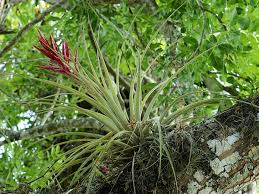
Tillandsia, A plant with herbal roots. From Public Domain
Once, on a dark snowy day in a strange land, 
I metamorphosed to an air plant.
First, I lost my tongue; then I lost my limbs;
My brown trunk swirled into itself.
A crusty mossy green veneer over my fern-like body.
I lay still, a green cocoon– I am going back.


This chip based plastic card is my DNA barcode.
It lets the rootless ausländer reside in this land,
to breathe it's AQI certified perfect-for-a walk air
for these exact contractual work years.
It keeps me safe -- a new sample specimen,
well preserved in a laboratory bell jar.
A permit -- a hermit immersed in nirvana liquid.
I gaze outside through the transparent glass --
everything magnified, everything distorted.
An enticing pool of sunlight at the far end of the lab,
beyond the windows, there are patches of green.
I look for familiar faces, long lost cousins and neighbours --
Is that the rabbit-ear-leafed* herb?
(the long wanderings on monsoon mornings to cure the little one’s cough)
the small-flowery-leafed* one?
(the herbal decoction for feverish nights)
the crawl-on-the-ground-palm* and down-the-stream-gooseberry*?
(a folk song, a ritual, the cure for yellow-fever)
The patches of green remained as aloof as they were.
They denied my identification procedure –
“Wir bist nicht deine ‘name-place-animal-thing’,
we are google lens-approved rational scientific botanic beings,
we were featured in Systema Naturae and
we are alien to your wobble-gobble”.

I swayed away and stared at the supermarket herbs section for hours.
Familiar fragrances -- dried and powdered and renamed.
And the authentic all-rounder -- “Indische Curry-Englisch style”
Black pepper from my backyard would disown me for this affair.
I reside, breathe in and breathe out the AQI verified air.
I reside, observe and wait, in this permitted residence of mine.
To live -- to live and thrive one should go back or grow roots.
(And then, herbs are no longer a supermarket section
they are an image of your soul in green,
a fibrous embrace that warms your blood.)

*Literal translations of medicinal herbs from author’s mother tongue

Lakshmi Chithra is a PhD student at the University of Augsburg, Germany. When academic life allows she welcomes her writer-ego to take over. She is from Kerala and is a lover of the monsoon, the Arabian Sea and Chai.

.

PLEASE NOTE: ARTICLES CAN ONLY BE REPRODUCED IN OTHER SITES WITH DUE ACKNOWLEDGEMENT TO BORDERLESS JOURNAL

Click here to access the Borderless anthology, Monalisa No Longer Smiles

Click here to access Monalisa No Longer Smiles on Kindle Amazon International
Categories
Stories

Roberto Mendoza’s Memoirs of Admiral Don Christopher Columbus

A fiction by Paul Mirabile

I, Roberto Mendoza, in this year 1550, ship’s boy on Christopher Columbus’ first and second voyages to the West Indies before my promotion to sailor on his third and fourth voyages, testify to the veracity of the eye witness events that I record for posterity. And in spite of their devastating raw truth, it is my troubled conscious that has conducted my hand, goaded my intelligence to write down these sorrowful facts. For facts they are, regardless of the prestige and boons that Columbus received from his protectors and admirers.

Where shall I begin? How do I burrow through the layers of unquestionable fame that has marked that name to reverberate with the clanking of the slave chains, the death rattles in the gold and silver mines, the gnashing of teeth, the hangings and dismemberments … the insensible apathy of the subjugation or submission of the Indian masses?

It has always appeared to my young eyes that Columbus’ achievements were enveloped in an aura of mystery or incomprehension. I may even add an aura of fantastic falsifications, mainly initiated and authorised by Columbus himself and his unquestioning gallants.

I knew him well, too well to be duped by those seductive charms of his, that subtle cunning, a mask donned whenever a fruitful occasion arose, yet under which lay a brutal, tyrannical individual bent on attaining his greatest ambition: wealth and glory, and this at any price. What was the little ditty that some fool invented for innocent children and naive adults to recite: “In fourteen ninety-two Columbus sailed the ocean blue?” A ridiculous rime to recall that wretched year. Yes, I say that wretched year for it celebrated the Genoan hero’s glorious voyage.

During that fatal year of 1492, two other major events occurred in Spain which I believe to be in relation to Columbus’ conniving his way into Isabella’s confidence: the expulsion of the Jews to North Africa, Italy and Constantinople, and the capitulation of Granada, the last stronghold of the Muslims in Spain, to the Christian kings. Henceforth, Spain rid herself of those ‘impure’, centuries-laden ‘foreign’ plunderers. Did not Columbus write in his logbook (if we are to believe Bartolomé de Las Casas’s transcribed copy of it) that he was overjoyed by those two events: ”thus you (the Monarchs) have turned out all the Jews from your kingdoms and lordships”, and ”the royal banners have been placed on the towers of Alhambra”[1].

This being said, because of the expulsion and the reconquest, Columbus’ true birthplace had to be concealed, for any negotiation with Isabella or Ferdinand. This hero was not born in the city of spaghetti and banks, Genova, as commonly known. The darling of the Spanish monarchy was born in the land of the corsairs, in Calvi, a lovely port town in Northern Corsica, indeed conquered by the Genovans and governed by them during five centuries, but none the less born and bred far from the banks of Italy. Corsica, where for centuries Vandals, Ostrogoths, Greeks and Lombards, and ill-bred Aragonese and Genovans vied for domination, intermingling, integrating and assimilating.

Why would Columbus lie about his place of birth? Was it out of fear of a possible ‘corsair descent’? One that connoted piratry, pillage and other misdeeds [2]? Be that as it may, the rogue managed to cajole Queen Isabella into giving him enough maravedis[3] to undertake a voyage that would heighten the glory of the conquering Spanish Monarchy and the new-founded kingdom.

And that was how Admiral Don Christopher Columbus frayed his way to fame and fortune!

With the Queen’s glittering maravedis he commissioned three caravels : the Nina, the Pinta and the Santa Maria, the third of which he navigated himself, the other two by the Pinzón brothers. How I happened to be aboard the Santa Maria is a long story with which I shall not bore my readers.

So there he stood at the prow, mantled in a vaporous circle of pride and arrogance whilst we, his sea-faring companions, sweated away on deck or in the hold, were fed rotten food, furled and unfurled the sails without respite, hunted out the innumerable rats that ran amok below, withered under the insufferable heat of September. I myself almost fainted under the long, long hours of tedious work, boredom and especially fear; fear that we and our tiny caravel, surrounded by thousands of leagues of far from blue waters, would be food for the horrible undersea monsters that had swallowed many a brave crew and their vessels with yawning jaws and leathery tentacles. All of us were terrified, and the five weeks we spent crossing a swelling ocean towards the East, or so we all thought, triggered a feeling of panic, alienness and remorse. The admiral described the ocean like a river; I myself felt like a cork in a rainswept pond, jostled and jolted, no land in sight, our water and meat, taken aboard at the Canary Islands, foul-tasting, half-eaten by the enormous black rats.

Did the great Admiral not consult the stars? Eastward? There was nothing — only rolls and rolls of higher and higher walls of water battering the fragile sides of our vessels. And I, so young, asked myself time and time again, how did an incompetent sea-faring fellow like Columbus ever win the confidence of Isabella and Ferdinand ? Oh how I recall his bulky figure at the prow, oftentimes behind the helm, screaming orders or simply staring out into the watery vastitude, dreaming no doubt of gold … gold … and more gold … He had written the word ‘gold’ seventy-five times in his logbook during the first two weeks of our crossing!

How many of our poor sailors had been beaten for insubordination, had suffered the excruciating trial of keelhauling[4], one or two even hanged for attempting mutiny, so fearful were they of being devoured by sea monsters, dying of thirst or hunger or being bitten by the furry rats that thrived below in our beds of straw?

At long last I heard the cry “Land ahoy!” coming from the crow’s nest. Yes, we finally reached a cluster of islands that would be named Guanahani[5], Cuba, Haiti and the Dominican Republic on the maps of future cartographers. It was on these islands that my first glimpses of a barbaric and despotic Columbus would not only be corroborated, but magnified to the heights of psychopathic insanity. For it became more and more evident to me that the Admiral, whom I considered in my youthful age as a hero, had no intentions of treating the indigenous peoples of these islands either as equals or with a soupçon of humane sympathy. He indeed judged them somewhat higher than animals, yet whose only human value was how much they would bring him as slaves sold in Spain, or how much gold and silver they would extract for him from the mines and rivers. All he saw in these peaceful peoples was the glitter of gold fastened to their noses and the rings of equal glitter hanging off their ears and arms. He saw gold everywhere, even gold stones shining in the rivers! He wrote in his logbook that gold grew in clusters and could be plucked off trees like fruit!

The way in which he ferreted information out of the Indians about gold deposits turned my stomach. His obsession with gold drove him into periodical frenzies during which time he would beat, even torture the poor indigenous man or woman who failed to locate the deposits. He spent his sweltering nights tossing and turning in bed, totally possessed by this maniacal craving.

But his brutality was not limited in this direction: The Spaniards or other Europeans who disobeyed  him or sought to outmanoeuvre him in the pursuit of power or riches were tracked down and hanged, accused of criminal acts. His barbarity knew no bounds, nor his slave-selling which began to enrich him immensely.

On our second and third voyages, which led us to the islands of Granada and Tobago, the abundance of gold extracted was tantamount to the number of Indians he enslaved for his own ‘household’ purposes, and those he sold into a slavery which by then had become a thriving, lucrative business. We navigated from island to island sowing the seeds of destruction as the stoic Admiral described their beauty, the exotic animals and birds, and especially the immense, awaiting riches buried under that beauty. How many of the indigenous he had killed when several tribes revolted against him, and how many committed suicide cannot be accurately tallied. I would learn much later that Las Casas put that tally at 1,500 Taion Arawaks.

Indeed, as time went by Columbus’ wrath found merciless outlets against Indians and Europeans alike as the settlements grew in economic and political importance. Indians who failed to extract enough gold from the mines had one of their arms cut off[6]. On many occasions he had rebellious Spaniards dismembered in public much to the outrage of the governors appointed to the settlements by the Spanish Monarchy.

The governors of these settlements began sending reports to the King and Queen relating the horrendous behaviour of Columbus, his obsession for power and riches, his masquerading as a ruling god-like figure over the ignorant natives. Testimonies piled higher and higher on the Queen’s pearl-inlaid writing-table, relating cases of rape, murder and mutilation.

On his return trip to Spain she immediately had him seized, chained and thrown into prison. She also expropriated all his extorted possessions, be they gold or land. There he rotted away for six weeks, so enraged was the Queen, betrayed by this ‘foreigner’. However, his brother Bartholomew, on his knees, pleaded tearfully in favour of his brother’s heart of gold, his innocence in all matters of governance, having been slandered by the governors and their lackeys who wrote defamatory reports to wreak vengeance upon a man whose glory and greatness surpassed theirs. The Queen hesitated. It was King Ferdinand who decided to have him released.

His release from prison had puffed up his ego, unlocked his megalomania.

Columbus’ fourth and last voyage, between 1502 and 1504 with four caravels, took us to Martinique, Honduras, Jamaica, Costa Rica and Nicaragua. I had been appointed a full-fledged sailor by then and relished the idea of accompanying the Admiral, jotting down all his actions, prudently of course, so that I would not to be arrested for bearing witness to his ruthlessness, perhaps even hanged as a traitor. The ‘civilising’ process undertaken by him included plundering, murdering, enslaving and mutilation. Amidst the unbridled violence and sadism, he posed as an evangelist, a disinterested zealot deeply desirous to convert the ‘savages’ into God-fearing Christians, into ‘civilised’ beings like himself.

Columbus returned to Spain a hero of piety, magnanimity, sanctity. The impostor even wrote two books : the Book of Privileges[7] in 1502, an indecent mass of statistics which enumerate all his accumulated rewards wrested from the Crown under which lay the beaten and mutilated bodies of the indigenous, and the Book of Prophecies[8] in 1505, a shameful scream of smut comprising hundreds of citations from the Bible, all of which spell out in his vapid style his Christian ‘mission’ in the New World, ever so charitable and lenient towards the ignorant, child-like ‘natives’ ; a mission, indeed, pure in spirit, rightful in act.

With Columbus’ death the unwarrantable fervour that he had kindled slowly shrivelled into ashes. I retired from sea-life and found work in the Custom’s Bureau, a most comfortable employment. Besides, I was disgusted by all the tales told about him by the sailors, especially their bawdy narratives about the native women in the New World. I wished to leave my sea-legs behind and tread more earthy paths. Furthermore, my new tasks gave me ample time to read the posthumous reports about Columbus[9], many of which belied the benignant deeds and bountiful achievements of the monarchial and New World idol. It was after these important readings that I decided to begin my memoirs …

The rogue’s Book of Prophecies created quite a stir amongst the aristocratic castes : Columbus’ fantasies of promoting Isabella and Ferdinand as heads of a new crusade to the Holy Lands to defeat the Muslims, and there spread Christianity kindled many a nostalgic and gun-ho heart. The monarchs, wary of the old Admiral’s apocalyptic inaccuracies and religious bigotry, never took him seriously. I wonder if they had even read his book …

None the less, Columbus certainly provided an excellent example for other freebooters to follow in the wake of his doughty adventures. The slave trade between the Old and the New World thrived as well as the gold and silver that flooded the Spanish markets. It is no mere metaphor that this period in Spain was called as El Siglo de Oro (The Golden Century).

.

[1]          Bartolome de Las Casas (1484-1566) a Dominicain priest who spent forty years in Hispaniola (Haiti and the Domican Republic) transcribed an abstract of Columbus’ lost logbook. How accurate or truthful is this copy is difficult to assess. Journal of the First Voyage of Christopher Columbus (1492-1493), translated by Clements R. Markhma : London, Hakluyt Society, 1893, pp. 15-93

[2]          Corsica : Columbus’ Isle, Joseph Chiari, edition Barrie and Rockcliff, 1960.

[3]          Gold coins used in mediaeval Spain during the 11th and 14th centuries.

[4]          A maritime punishment by which the sailor is ‘hauled’ under the ‘keel’ of the ship with ropes.

[5]          As called by the Indians. Columbus called this island San Salvador. Today it is called Watling.

[6]          On this point see Howard Zinn, Christopher Columbus and Western Civilization, Open Magazine Pamphlet Series, 1992.

[7]          El Libro de Privilegios. The English edition : Book of Privileges, The Claiming of the New World, John W. Hessler, 2014.

[8]          El Libro de Profesías. The English edition : Book of Prophecies, Repertorium Columbianum, Blair Sullivan, 2004.

[9]         Columbus and Las Casas : Two Readings on the Legacy of Columbus (1542 (The Devastation of the Indians. A brief Account) and 1550 (In Defense of the Indians).

Paul Mirabile is a retired professor of philology now living in France. He has published mostly academic works centred on philology, history, pedagogy and religion. He has also published stories of his travels throughout Asia, where he spent thirty years.

PLEASE NOTE: ARTICLES CAN ONLY BE REPRODUCED IN OTHER SITES WITH DUE ACKNOWLEDGEMENT TO BORDERLESS JOURNAL

Click here to access the Borderless anthology, Monalisa No Longer Smiles

Click here to access Monalisa No Longer Smiles on Amazon International

Categories
Poetry

“Purrsonifying”

By Arshi Mortuza

I’m a rough tongued kitty.
Many blades, many languages.
I’ve licked the globe like it’s my very own
Catnip filled toy --
Yet forever remained an alien, exotic breed.
“You speak meow so well,”
Say the domestics.
“It doesn’t fit.”
I’m a sharp-clawed kitty.
Declawed, I’m defenceless.
Where beauty remains the ultimate weapon -- do I fit?
Do I fit -- among these manicured personas
Moulded into the shapes of patriarchal desire?
My feral femininity,
My felinity
Trying to go hand in paw --
But it doesn’t fit.

Arshi Mortuza was made in Bangladesh but moulded in the U.K, U.S.A, Sweden, China, Thailand and Canada. Many of her poems explore the theme of alienation, drawn from her experiences of being raised in multiple countries. You can find her on instagram as @poetessarshi

.

PLEASE NOTE: ARTICLES CAN ONLY BE REPRODUCED IN OTHER SITES WITH DUE ACKNOWLEDGEMENT TO BORDERLESS JOURNAL

Click here to access the Borderless anthology, Monalisa No Longer Smiles

Click here to access Monalisa No Longer Smiles on Kindle Amazon International

Categories
Review

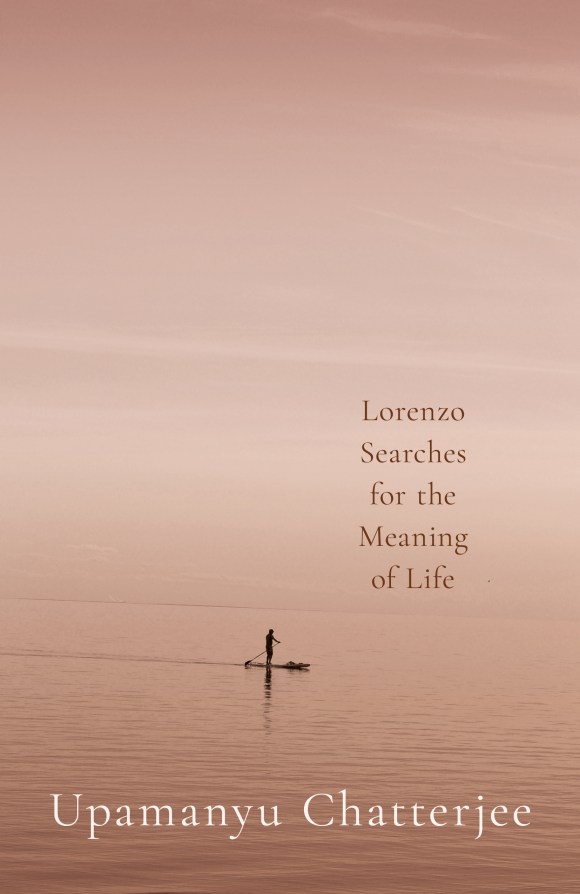
Lorenzo Searches for the Meaning of Life

Book Review by Somdatta Mandal

Title: Lorenzo Searches for the Meaning of Life

Author: Upamanyu Chatterjee

Publisher: Speaking Tiger Books

Several years ago, probably around the 1990s, the critic Nilanjana S Roy had defined the current crop of Indian Writing in English novelists as a ‘Doon School-St. Stephens’ conspiracy’. It was an interesting but true observation since the writers who were popular at that time were all products of these elite institutions and were quite adept at imitating western culture and simultaneously wrote in a style that was quite polished and urban. Upamanyu Chatterjee, belonging to this category, and at present a retired Indian civil servant, had shot into fame way back in 1988 by writing a definitive urban Indian coming-of-age story with his first novel, English August: An Indian Story. Several years later in 2000, he won the Sahitya Akademi Award for Mammaries of a Welfare State. His seventh novel Villany focused on a new class of post-liberalisation, westernised urban Indians who were hitherto ignored in the regional as well as the English fiction of India. This meticulously crafted literary thriller, a riveting story of crime and retribution, now stands at the other end of the spectrum when we read Chatterjee’s latest novel Lorenzo Searches for the Meaning of Life (2024). Narrating the life-story of an Italian Benedictine monk Lorenzo Senesi, who is on a spiritual quest to find the meaning in life, this meticulously detailed story is based on the life of Italian Fabrizio Senesi, an acquaintance of Chatterjee in Sri Lanka for the last few years, who turned out to be “a good friend” of his and who is now a European bureaucrat and a Development expert residing in Phnom Penh leading a successful professional as well as a blissful family life. As Chatterjee states in his foreword, “It is a true story, that is to say, like many true stories, it is a work of fiction.”

Divided into nine chapters, the locale of his story moves from Italy to London and then to Bangladesh. This is how things begin. One summer morning in 1977, nineteen-year-old Lorenzo Senesi of Aquilina, Italy, drives his Vespa motor-scooter into a Fiat and breaks his forearm. It keeps him in bed for a month, and his boggled mind thinks of unfamiliar things: where he has come from, where he is going, and how to find out more about where he ought to go. When he recovers, he enrolls for a course in physiotherapy. He also joins a prayer group, and visits Praglia Abbey, a Benedictine monastery in the foothills outside Padua. Detailing this part of his life we are told how this monastery will become his home for ten years, its isolation and discipline the anchors of his life. The first three chapters are full of quotes from the teachings of Saint Benedictine, the different vocations that Lorenzo follows, and give us details of monastic life as led in different Catholic institutions spread throughout Italy.

In the fourth chapter titled ‘The Visitor at the Abbey’, Lorenzo listens to a talk by one Luca Rossini, a Benedictine monk native of Bergamo, who since 1976 has been staying a little over seven thousand kilometers to the east in a place called Phulbari Para near the town of Khulna in Bangladesh where he runs an ashram as a dependent of the Praglia monastery. So, after eight long years of the introspective silence of a monastery, Lorenzo decides to go to Khulna. But before that he must spend eight months in England attending English-to-Speakers of-Other-Languages courses at an Academy there, till Luca would come to pick him up and take him to Bangladesh.

Upon arriving in Dhaka, the cacophony and different aspects of an alien culture that Lorenzo faces is described very beautifully by Chatterjee in great details. He starts wearing a lungi, eating with the fingers of his right hand, washing his clothes in a public tank along with female strangers, studying Bengali in the library with Luca, and tries to acclimatise with the place, the weather, and the people as quickly as possible. Apart from praying seven times a day, he also spends a lot of time decorating the walls of the chapel with different tempura paintings.

After some time, he visits another ashram called Rishilpi run by Enzo and Laura, an Italian missionary couple in Satkhira, some sixty kilometers away. Seeing the multifarious social upliftment activities that are being undertaken at their place, Lorenzo is intrigued by the idea of worming one’s way into a community and working for its betterment from within. Though remaining a Benedictine at heart, he decides to quit the Order and continue his search for some purpose to his life.

At Rishilpi he joins as Deputy Director, Health Services, and opens a sorely needed physiotherapy clinic that would attempt to instill a little meaning in the lives of the disabled and would educate the rest in matters of hygiene, sanitation, medical care and physical well-being. After surviving quite comfortably without money for the past eleven years and living a strict, disciplined monastic life, Lorenzo gradually undergoes a change when he starts interacting with people from all strata of society. Concealing his religion within his heart, he goes on working with a missionary zeal and after some time realises that even working with women felt marvellous.

In due course, he even falls in love and proposes to Dipti, the Headmistress of the same institution, and thus an ex-priest goes on to marry an ex-nun, both remaining devout Catholics forever. They spend the six happiest years of their lives at Rishilpi, till Lorenzo realises it is also life that is holding him back. With children, his responsibilities increase, he cannot go his own way. He needs money to survive and is called upon more and more often to lecture trainees in Dhaka at the Centre for the Rehabilitation of the Paralysed. In this manner, he slowly broadens his acquaintance with the developing world, and becomes the ideal person to build a bridge between the first world donors and third world recipients.

In the brief concluding chapter of the book, Chatterjee tells us that if one ended Lorenzo’s story here, it is because, even though twenty-nine years have passed since his marriage and he and Dipti are alive and well in Phnom-Penh, he has not in essential changed and he is still in spirit, Benedictine. But what is most interesting is the fact that “he still continues, though, to live his life anti-clockwise, as it were, for (as we have seen) after passing his youth in search of direction for his spirit, he turned outward to the community – and to the joys and responsibilities of the domestic life – only in his mid-thirties; and it was not till his early forties that he properly set about addressing the matter of money. It is – broadly – the trajectory of the typical human life but lived in reverse.”

Chatterjee’s tour-de-force is his storytelling and imaginative prose combined with his trademark wit and attention to detail. In the acknowledgement section he thanks his friend Fabrizio Senesi for providing him innumerable clarifications about life in Italy and in Bangladesh. The long list of books that Chatterjee read and mentioned in the end provides ample proof that he undertook his research rather seriously and this is clearly reflected in the intricate details that he provides of places and people throughout the novel. The book is not a page-turner, and one must read it rather seriously to savour the meticulous effort that Chatterjee made to provide us a fascinating tale about an ordinary human being who finds that a life of service to God is enough, and that it is not enough.

Click here to read the excerpt from Lorenzo Searches for the Meaning of Life

Somdatta Mandal, critic and translator, is a former Professor of English at Visva-Bharati, Santiniketan, India.

.

PLEASE NOTE: ARTICLES CAN ONLY BE REPRODUCED IN OTHER SITES WITH DUE ACKNOWLEDGEMENT TO BORDERLESS JOURNAL

Click here to access the Borderless anthology, Monalisa No Longer Smiles

Click here to access Monalisa No Longer Smiles on Kindle Amazon International

Categories
Poetry

Poems by John Grey

From Public Domain
THIS HEAT WAVE

It's over a hundred.
Trees droop close to melting.
Air-conditioners whirr and whine.
The electrical grid sputters close to blackout.

Air is slow to get around
and some climate skeptic
in a row house on Broadway
wipes his brow,
unpeels his shirt,
thinks maybe this really is
the hottest it's ever been.

In my house,
with every window open,
I imagine a crystal blue stream
cascading down from mountains.
Even in my mind,
it turns to steam in an instant.


LET ME TELL YOU ABOUT THE MOUNTAIN


It was gold up there
and my head could see clear
to the next state
and to the people I knew in childhood.

Forget the wind
and the soughing boughs
and the cold rocks
and the clotted dry grass --
there were sounds
like bells ringing
and steps that penetrated clouds.

It was like a table
set for me.
And lit by one candle, one sun.

I approached
gods fit to worship
and they thanked me for my kind words
but then directed me
to deities even greater.

When I reached the peak,
the sky was a wide blue altar.
I climbed so high
just so I could drop to my knees.

John Grey is an Australian poet, US resident, recently published in New World Writing, North Dakota Quarterlyand Lost Pilots. His latest books are Between Two Fires, Covert and  Memory Outside The Head are available through Amazon. 

.

PLEASE NOTE: ARTICLES CAN ONLY BE REPRODUCED IN OTHER SITES WITH DUE ACKNOWLEDGEMENT TO BORDERLESS JOURNAL

Click here to access the Borderless anthology, Monalisa No Longer Smiles

Click here to access Monalisa No Longer Smiles on Kindle Amazon International

Categories
climate change

Landslide In Wayanad Is Only The Beginning by Binu Mathew

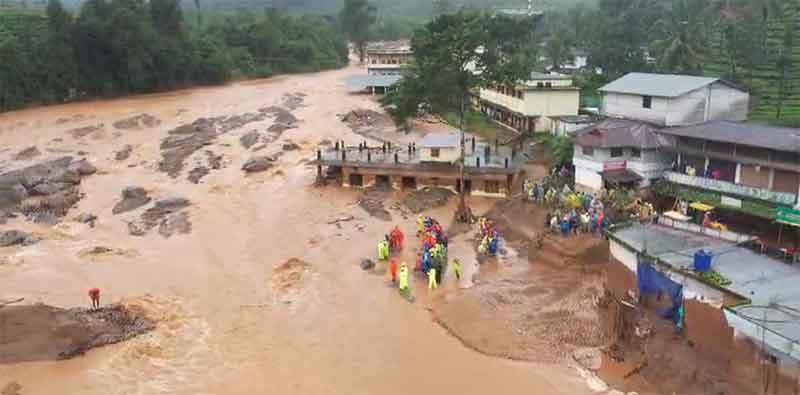
Landslide at Wayanad: Photo Courtesy: Countercurrents

On the morning of  July 30, a huge landslide occurred at Mundakkai, in the mountainous district of Wayanad, Kerala, India. 282 people have been confirmed dead and many hundreds are still missing. It is the worst landslide in the history of Kerala and perhaps one of the worst in the history of India. A whole village was washed away in the flood and the flow of earth and rocks. A government higher secondary school and a bridge also got washed away. The rescue operations are still going on.

According to data released by India Meteorological Department Wayanad district received as much as 7% of its entire seasonal rainfall in 24 hours (from Monday morning to Tuesday morning). The Mundakkai region received 572 mm of rainfall in the past 48 hours prior to the landslide. This clearly points to an extreme climate change-induced disaster.

Experts like Madhav Gadgil are saying that it was due to the environmental degradation that the disaster occurred. The fact of the matter is that the landslide happened inside a deep forest which was not affected by human intervention.

The disaster area belongs to the Western Ghats, a UNESCO World Heritage Site, which is a very fragile ecologically sensitive area. This is also a region prone to frequent landslides. The Western Ghats starting from the Southern tip of the Indian subcontinent to the Konkan region is home to about 50 million people. In the parts belonging Kerala alone at least 5 million people live. Human habitation has caused a lot of ecological damage to the region. After the liberalisation of Indian economy, tourism has become a major industry in the region. Lots of tourist resorts have come up in the last 30 years, leading to stone quarrying in a major way. The stones from Western Ghats are used to build new roads, bridges, houses even in the lower land area and even the Adani port in Vizhinjam, Trivandrum.

If you look at the history of the Kerala part of Western Ghats, it was the Britishers who started huge tea, coffee and rubber plantations starting from late 19th century. It has caused huge environmental degradation in the region. Tata and Harrison Malayalam are the big planters now in the region. They behave like feudal lords, giving paltry sums in lease to the government and even encroach government lands to plant monocrops. The landslide affected Mundakkai also is a tea estate area owned by Harrison Malayalam company.

The farmers migrated to Wayanad and other parts of the Western Ghats of Kerala during the independence period due to the acute famine of that time. The government also promoted the migration of farmers. It is the descendants of these farmers who are killed by the landslide. They are the unsuspecting victims of unchecked development model and climate change caused by the Global North.

No place can withstand the kind of rain that was received in the landslide area. Yes, of course, wrong development model and environmental degradation has contributed to the disaster but it is not the root cause. It is the climate change caused by global warming for which the Global North is primarily responsible.

Present CO2 level in the atmosphere is 421 parts per million (ppm), which is similar to the CO2 level of Pliocene Epoch was a period in Earth’s history that lasted from 5.333 million to 2.58 million years ago. During the Pliocene epoch, CO2 levels in the Earth’s atmosphere were between 380 and 420 (ppm) during the warmest period.  The global mean sea level during the early Pliocene Epoch was around 17.5 ± 6.4 meters which means that we are locked in for a sea level rise of at least 6.5 meters, 17 meters being the upper limit. Also CO2 levels in the atmosphere are rising 2.9 ppm per annum.   This also means that we are moving into an unchartered territory in the climate crisis.

Most of our coastal cities will be under water very soon. Kerala which has one third of the landmass very close to the sea will be submerged under water.  As the ocean warms more and more drastic climate events like Mundakkai will be a regular phenomenon. As Himalayan glaciers melt, the rivers originating from the Himalayas will dry up. Most of North India will be a desert. As the permafrost melts in the Arctic, Methane which is 28 times more potent than Carbon Dioxide will be released into the atmosphere and we will lead to a feedback loop, meaning more and more greenhouse gases will be released into the atmosphere without any human intervention. Another dangerous scenario is that as the permafrost melts, viruses and bacteria buried millions of years ago will be released into the atmosphere causing pandemics like COVID. Forest fires will be a regular occurrence in the dry seasons.

Do you think that climate change would be just weather events? No. Not at all. It will spread into social relations and human relations. We might see water wars, famines, and even civil wars in the name of nationality, ethnicity, language etc. Do you think that the present population of 8 billion people will survive the coming climate catastrophe? I think it will not. Many researchers are saying that we are in the middle of the Sixth Great Extinction.  The sixth great extinction, also known as the Holocene extinction, is an ongoing mass extinction event that is caused by human activity. It is thought to be the sixth mass extinction event in Earth’s history, following the Ordovician–Silurian, Late Devonian, Permian–Triassic, Triassic–Jurassic, and Cretaceous–Paleogene extinction events. 

Courtesy: Countercurrents

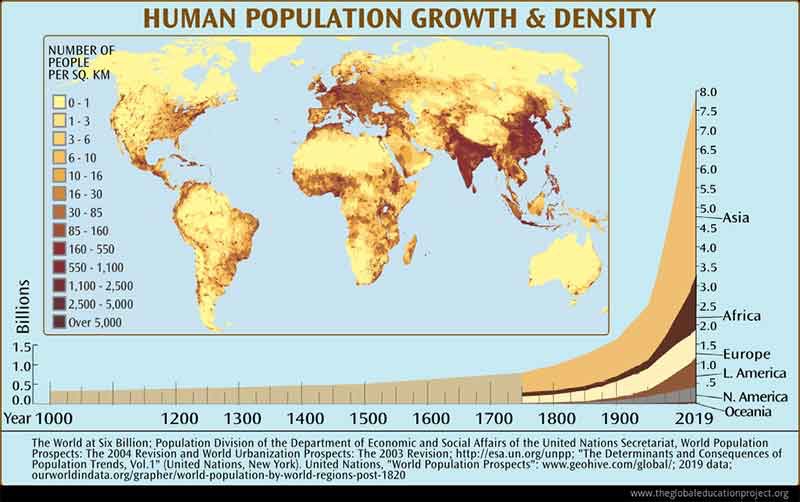
In the beginning of the 20th Century, the human population was only 2 Billion. Now we are 8 Billion. The huge spike in population growth that we saw recently is an aberration in human history. Nature will correct itself. That means we are going to see millions or even billions of deaths, if not in our lifetime, definitely in the lifetime of our children and our grandchildren. That means thousands of Mundakkai events will play in a loop in front of our eyes! What is most devastating is that there would be some of our dear and near ones too.

What happened in Mundakkai, Wayanad is not an aberration. It’s the new normal. It’s the beginning!

Binu Mathew is the Editor of Countercurrents.org. He can be reached at editor@countercurrents.org. This article was first published in Countercurrents.org.

.

PLEASE NOTE: ARTICLES CAN ONLY BE REPRODUCED IN OTHER SITES WITH DUE ACKNOWLEDGEMENT TO BORDERLESS JOURNAL

Disclaimer: The opinions expressed are solely that of the author and not of Borderless Journal.

Click here to access the Borderless anthology, Monalisa No Longer Smiles

Click here to access Monalisa No Longer Smiles on Kindle Amazon International
Categories
Tribute

A Hundred Years from Today…

A hundred years from today…
Who are you reading my poetry
With eager curiosity?

-- One Hundred Years Later,Tagore
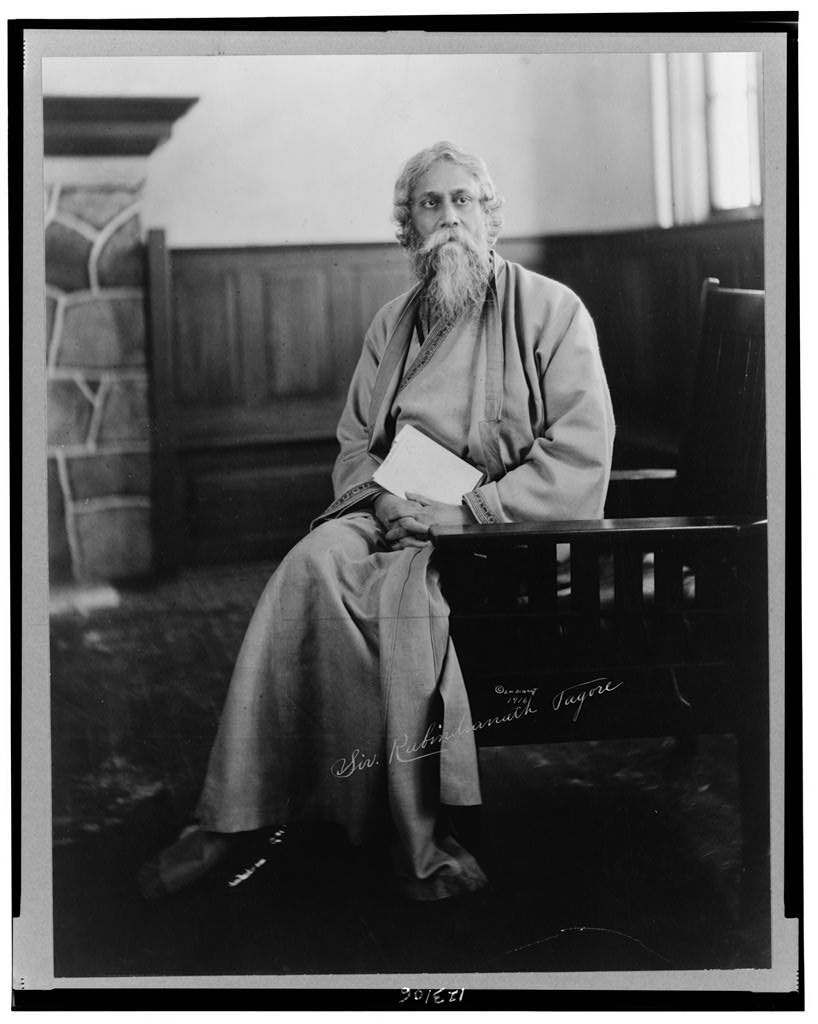
Rabindranath Tagore (May 7th 1861-August 7 1941). From Public Domain.

One of the greatest minds of centuries, Tagore wondered about life and death… about posterity. He lost his wife, some of his children and many more loved ones in his lifetime. He took a philosophical stance on death. On his death anniversary, we bring to you his ideas on death and life too…

As a salute to his pen, we start with his poems and stories, mostly in translation, and move on to tributes by Nazrul (translated by Professor Fakrul Alam), by Aruna Chakravarti , by the late Sunil Gangopadhyay and more…

Tagore’s Poetry   

The Child, a poem by Tagore originally written in English. Click here to read. 

Tagore in Translation  

Tagore’s Achhe Dukhu, Achhe Mrityu(Sorrow Exists, Death Exists): These lyrics were composed by the poet when on the death of his wife. It has been translated by Fakrul Alam. Click here to read.

Mrityu or Death, a poem by Tagore has been translated by Mitali Chakravarty. Click here to read.

One Small Ancient Tale: Rabindranath Tagore’s ‘Ekti Khudro Puraton Golpo (One Small Ancient Tale)’ from his collection Golpo Guchcho ( literally, a bunch of stories) has been translated by Nishat Atiya. Click here to read.  

Tributes

Nazrul’s Ghumaite Dao Shranto Robi Re(Let Robi Sleep in Peace) has been translated from Bengali by Professor Fakrul Alam. Click here to read.

The Myriad Hues of Tagore by Aruna Chakravarti : Aruna Chakravarti writes on times and the various facets of Tagore. Click here to read.

Rabindranath Tagore: A Universal Bard :This conversation between Aruna Chakravarti and Sunil Gangopadhyay that took place at a Tagore Conference organised by the Sahitya Akademi in Kochy in 2011. Click here to read.

A book review by Meenakshi Malhotra of Somdatta Mandal’s The Last Days of Rabindranath Tagore in Memoirs, a translation from a conglomeration of writings from all the Maestro’s caregivers. Click here to read.