In late September, I visited Rwanda with a professor of Naruto University of Education in Japan and two Japanese graduate students. We traveled from Kigali, the capital city, to the Kayonza District, a rural area, to learn about the 1994 Genocide against Tutsi which necessitated peace education in Rwanda. In one month, around a million Tutsis and their sympathisers were systematically and viciously slaughtered by members of the Hutu ethnic group following government directives. This “final solution” was enacted via machetes and spears, often by classmates, co-workers, and neighbors. Just about everyone in Rwanda was affected by the horror in some way. Our driver told us that his father, sister, and brother were murdered at that time. Our interpreter, Claude Mugabe, was also a genocide survivor. He had been eight years old at the time, and he said that he remembered everything.
The animosity between two ethnic groups may be traced to the colonial period, when Belgians favoured the Tutsi, who typically had tall, slender bodies, high foreheads, and narrow features, for prestigious positions and privileges. Periodic violence against the Tutsis began in the 1950s and continues to this day, but Rwandans have made great efforts to ensure that the events of 1994 never occur again. We learned that Rwandan citizens are no longer required to carry identity cards indicating their ethnicity.
We visited a center which is a part of the Peace Education Initiative Rwanda. The three pillars of their program are peacebuilding and reconciliation, youth empowerment, and social economic development. We first gathered in tent where some photos of the massacre were displayed. Some community members, including those who had been alive at the time of the genocide and high school students, were gathered to share their thoughts and experiences with us.
Photograph by Suzanne Kamata
As birds sang and chickens squawked in the background, Mugabe explained some ways in which the people of his community have sought reconciliation, including sharing goats, building together, and working alongside one another. He emphasised that it’s important that everyone have their basic needs met. To this end, the community members fight against malnutrition, which can lead to diseases, through gardening vegetables and rearing animals such as goats and chickens, which provide milk and eggs.
Another important part of reconciliation, as we learned, is forgiveness. We heard moving –and often shocking – testimonies from both a victim and a perpetrator. We first heard from a woman who was a victim. She told us how she was harassed by her teachers after they learned that she was a Tutsi, and ultimately forced to drop out of school. She said that she spent some days and nights hiding in the bush. Her house was burned, and nothing remained. On April 9, she left her hiding place and sought refuge in the Catholic church. It was full, however, so she went to the cinema. On April 14, the Hutus attacked the church. Although the woman lost her sight, she said that she later received health insurance, and “Today we’re living in peace and harmony.”
Next, we heard from a man who was 30 years old, with a wife and two children, at the time of the genocide. He admitted that he had critical thinking ability, but he participated in the attack on the church, anyway, along with other civilians and members of the military. They were armed with machetes, guns, and grenades, and given thirty minutes to exterminate everyone in the church. They surrounded the church and opened fire, but they “succeeded” in killing only thirteen people the first day. He did not return the second day because his wife was sick. Later, he fled to Tanzania, but after being repatriated to Rwanda, he, like many others, was arrested and sent to prison. “I internalized what I did,” he said through the interpreter. He was filled with remorse. When he was released, he bought a cow for the victims, and asked for forgiveness. In the beginning, only 12 people were involved, but now almost 3,000 participate in peace education in the village.
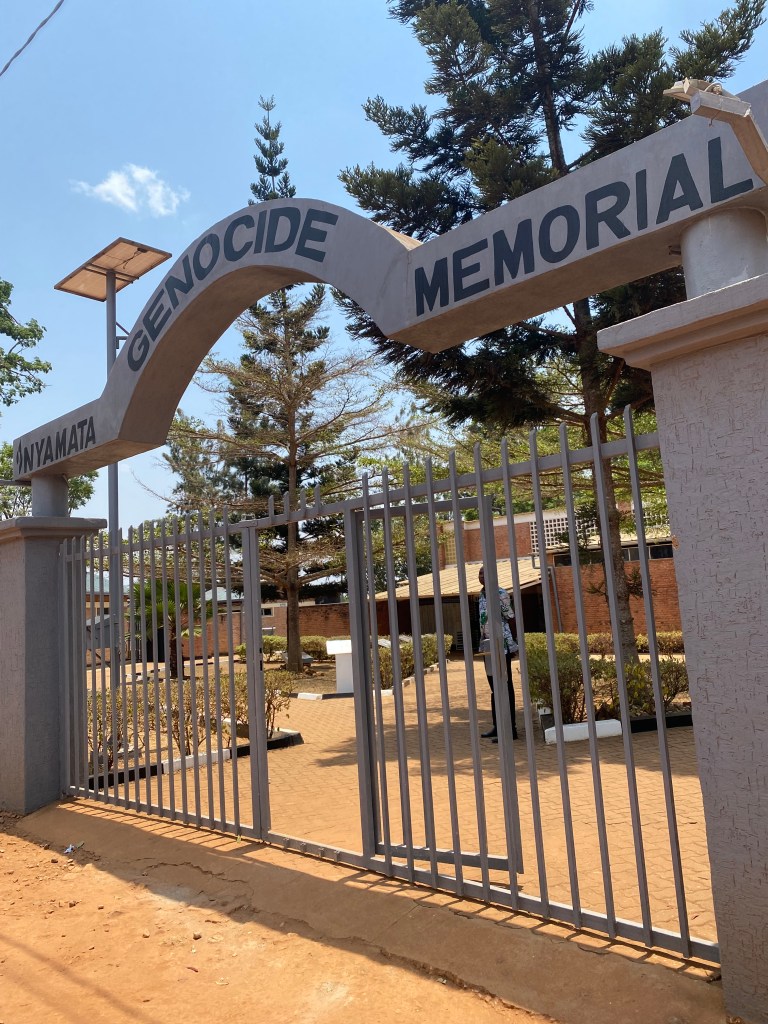
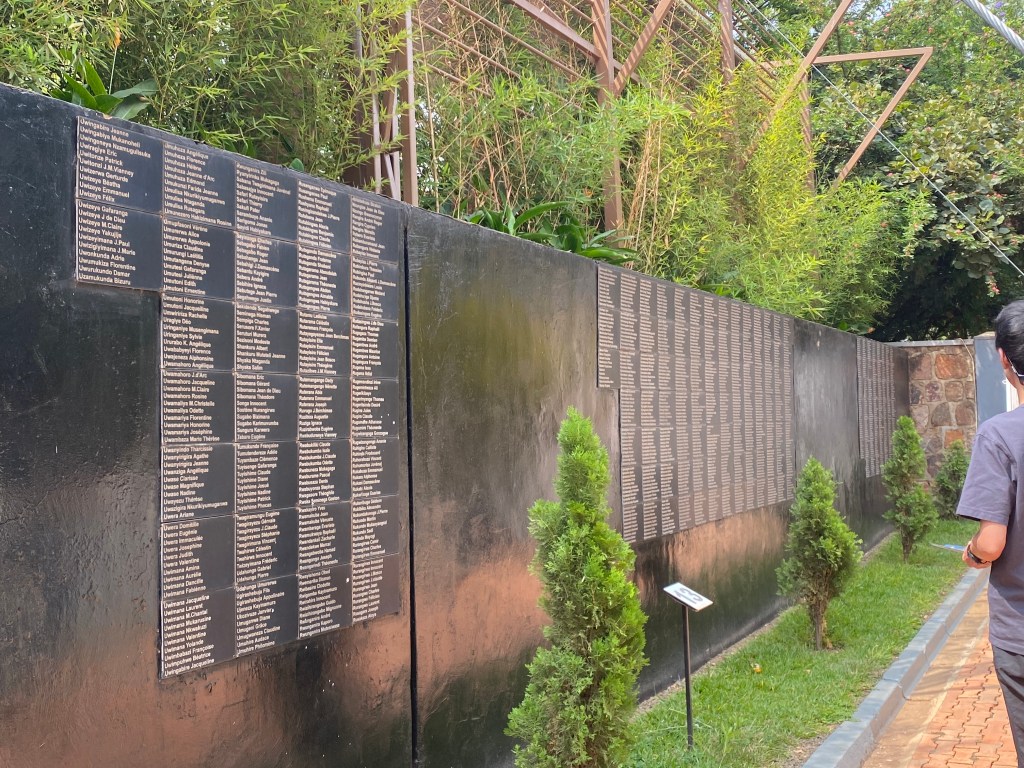
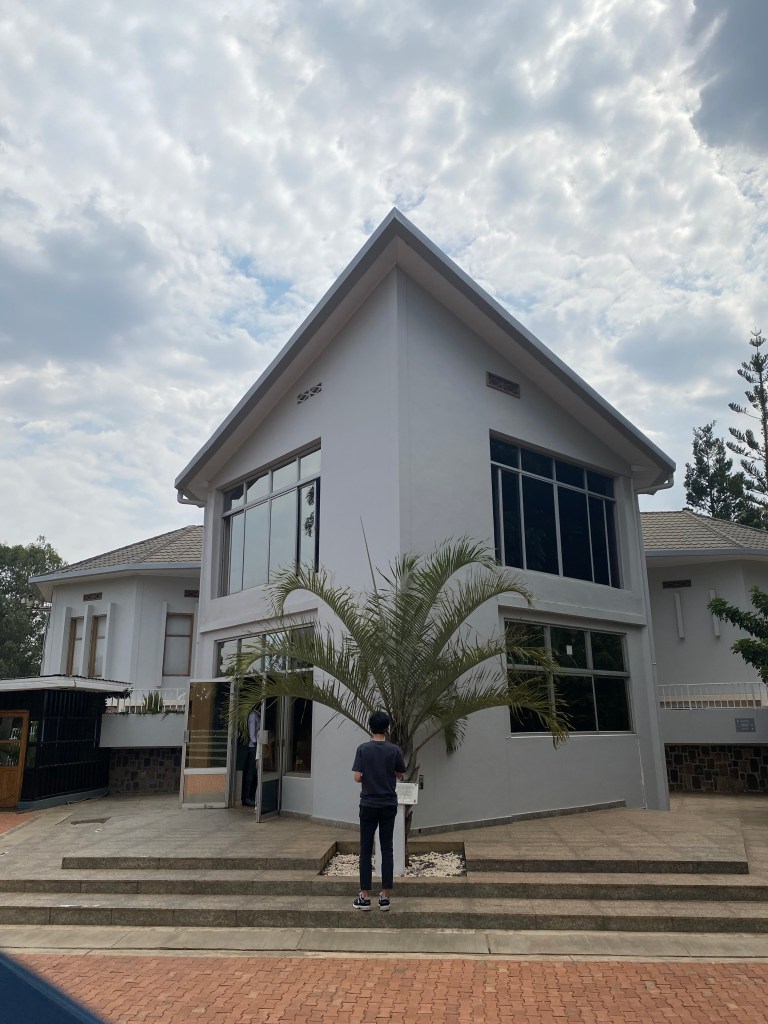
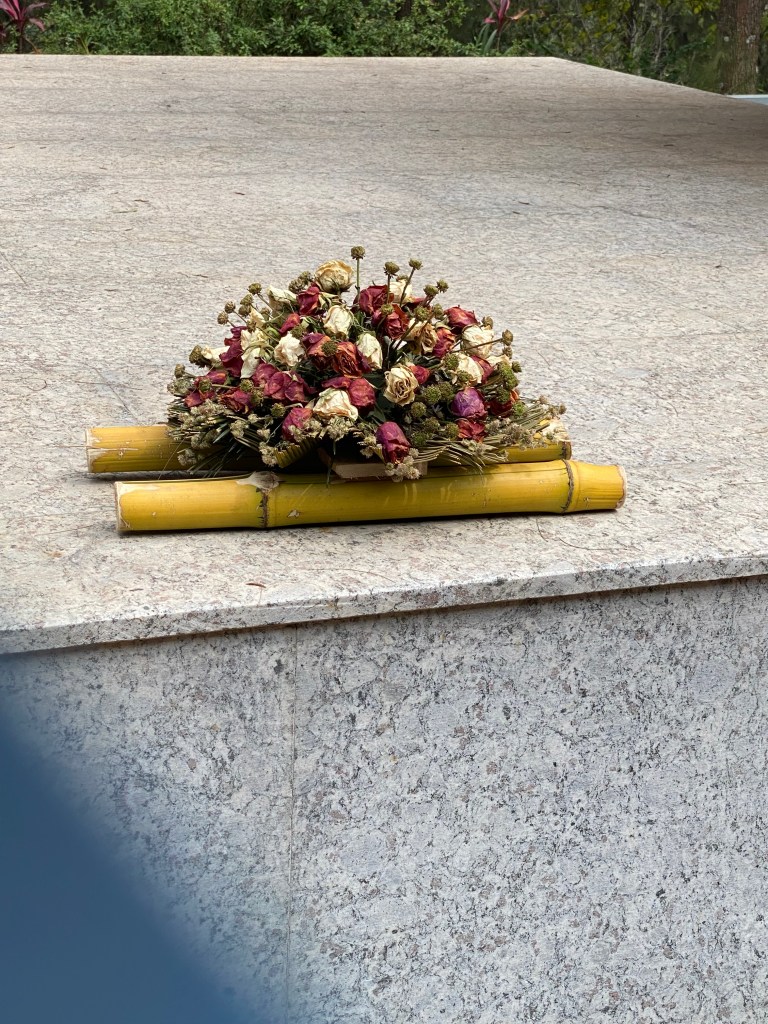
In addition to these community activities, peace education is an important part of the school curriculum in Rwanda. As in Japan, where students go on field trips to Hiroshima and Nagasaki to learn about the atomic bombing of those cities, Rwandan students visit sites related to the genocide, such as churches which now serve as memorials to those who died. We visited two such memorials. In one, the blood-stained clothing of the murdered was stacked on the church pews, while their photos were displayed on the wall. There were glass cases full of skulls, some with bullet holes, or larger gashes caused by clubs or machetes, as well as coffins full of bones. Though graphic and disturbing, these exhibits gave us an understanding of this particular tragic event and of the horrors of war in general.
As I thought about the divisions among people in my own country, the United States, all of the hate-filled rhetoric spewing from the mouths of politicians, and the move to silence voices from outside the mainstream, I couldn’t help thinking that some of these measures might be applied there, as well. What if we truly acknowledged that past? What if we shared our bounty? What if we asked for forgiveness? For now, I will remember what I learned in Rwanda. I will cling fast to hope.
Photographs by Suzanne Kamata
Suzanne Kamatawas born and raised in Grand Haven, Michigan. She now lives in Japan with her husband and two children. Her short stories, essays, articles and book reviews have appeared in over 100 publications. Her work has been nominated for the Pushcart Prize five times, and received a Special Mention in 2006. She is also a two-time winner of the All Nippon Airways/Wingspan Fiction Contest, winner of the Paris Book Festival, and winner of a SCBWI Magazine Merit Award.
PLEASE NOTE: ARTICLES CAN ONLY BE REPRODUCED IN OTHER SITES WITH DUE ACKNOWLEDGEMENT TO BORDERLESS JOURNAL
So there I was, jacket zipped, MP3 player charged and loaded, sneakers laced and tied. Just as I was about to go out the door to embark on my power walk, I realised that I’d left the keys on the table in the other room. No one else was in the house. What a bother!
I considered my options. One, I could go out and leave the house unlocked, but I didn’t want to do that. Two, I could try to crawl on my hands and knees to the table without letting my feet touch the floor. Three, I could take off my jacket, lay it down like a carpet, and step on that instead of the bare wooden floor. Four, I could untie, unlace, and step out of my shoes and, in my socks, go get the keys.
I’ve lived in Japan for over 20 years, so I know better than to wear shoes in the house. After all this time, I can’t bring myself to wear shoes indoors in the United States, either, though I was brought up treading on carpet while shod. Most of my footwear is of the slip-on variety—clogs, flip-flops, pumps, loafers—but I still prefer lace-up athletic shoes for exercise.
On this day, I managed to walk on my knees to the table, grab the keys, and get back to the entryway, all without letting my soles touch the floor.
Shortly after that, I was again standing in an entryway while visiting an American friend in Kamakura. My shoes were laced and tied. She had just pulled on her boots and zipped them when she discovered that she had forgotten something. I was prepared to commiserate with her about the nuisance of taking off one’s shoes when, to my surprise, she re-entered the house with her boots on, to retrieve the forgotten bag.
My jaw dropped. This friend had also lived in Japan for a very long time. “You go into your house with your shoes on?” I asked.
She shrugged. “Sometimes. It’s too much trouble to take them off.”
Perhaps this was common. Maybe all over Japan, people were secretly stepping onto the floors of their homes in spike-heeled sandals and hiking boots, and who knows what else!
Curious to know, I asked a Japanese friend—an older woman, with grown children—if she’d ever done such a thing.
“Well,” she said, leaning close, “sometimes in winter, when I’ve already got my boots on, I quickly step inside and hope no one’s watching.”
Again, my jaw dropped. “And what about your children?”
“If they did it, I would scold them,” she assured me. “We’re not supposed to wear shoes in the house.”
Suzanne Kamatawas born and raised in Grand Haven, Michigan. She now lives in Japan with her husband and two children. Her short stories, essays, articles and book reviews have appeared in over 100 publications. Her work has been nominated for the Pushcart Prize five times, and received a Special Mention in 2006. She is also a two-time winner of the All Nippon Airways/Wingspan Fiction Contest, winner of the Paris Book Festival, and winner of a SCBWI Magazine Merit Award.
PLEASE NOTE: ARTICLES CAN ONLY BE REPRODUCED IN OTHER SITES WITH DUE ACKNOWLEDGEMENT TO BORDERLESS JOURNAL
In Conversation with Suzanne Kamata about Cinnamon Beach, published by Wyatt Mackenzie Publishing, and a brief introduction to her new novel.
Suzanne Kamata
Cinnamon beach by Suzanne Kamata seems to be ostensibly a normal romantic novel but there is an aspect that makes it unique. It glues all colours of humanity together. Almost all the families in her narrative are of mixed heritage or multiracial. She has stepped beyond the veneer of race and nationality to highlight that all humanity has the same needs— for love, acceptance and kindness, irrespective of colour and creed, a gentle reminder in a world that is moving towards polarisation in terms of constructs made by human laws.
Set against the backdrop of the Cinnamon Beach, the narrative shuttles through two countries that she has called home — Japan and USA. There are autobiographical elements woven into the narrative but perhaps, they halt in becoming lived experiences. The protagonist, upcoming writer, Olivia Hamada, an American married to a Japanese, has lost both her job and finds her marriage in doldrums when she visits her sister-in-law, Parisa. Parisa is a renowned fashion designer, daughter of an immigrant Indian and has lost her husband, Ted, Olivia’s elder brother. It is a poignant story with Olivia and her deaf daughter, Sophie, falling in love with a star, Devon, and his son, Dante respectively — both persons of colour. Devon’s ancestors were brought in from Africa. So how mixed are the races – Sophie is half Japanese-half American and Dante is part African-part American!
The narrative start simply and gains nuances as it progresses. There are comments and conversations that introduce twists and turns to explore attitudes and prejudices.
At a point Kamata tells us: “She’d heard, several years ago, of a revolt at a liberal college cafeteria in protest of its serving sushi. And there was that dust-up over a reality TV star using the name ‘kimono’ for her new line of shapewear. Perhaps she had been wrong to ever go to Japan in the first place. But she had done it and she had gone and written a collection of short stories heavily inspired by events in her real life, and now, here she was.” The bias against Japan that led to the destruction of Hiroshima and Nagasaki are hinted at conversationally – world events that conspired more than eighty years ago. Why do such biases still exist today when we have moved forward so much technologically?
When Olivia asks Devon why he never liked to talk race or indulge in activism, he tells her, “It’s just that I would rather build bridges than burn them.”
And he explains further, “Sometimes taking a stand on issues creates more division.”
Religious observances seem to be unboxed too with Buddhist, Hindu and Christian customs intermingled. All festivals become a celebration of love and acceptance. Her world is idyllic when it comes to interactions between the lead characters. Living in a city like Singapore, that does not seem an impossibility as many are of mixed origins.
One would hope that the whole world will eventually learn that all these differences are only the colours of the rainbow, as shown in Kamata’s novel. The novel ends on a note of hope — hope for a new beginning and for love and for a multiracial relationship.
Kamata’s style is fluid. The situations and events are so much a part of the lived reality that you can almost feel and see the characters come to life. Anyone can enjoy the novel, whether as a light read or to find the nuances that explore the need for the redefinition of societal norms. With her smooth and untroubled storytelling, Kamata leaves it to the reader to decide what they want to find in her storytelling. Nothing is coerced or made incomprehensible.
With a number of novels, short stories and poetry collections under her belt, as an award-winning storyteller, Kamata guides us through her world skilfully leaving us with a feeling of having made new friends and gained deeper insight into myriad colours of humanity. In this interview, she talks about her writing, her novel and beyond.
Tell us when you started writing? And how?
I have been writing since I was a child. I loved reading, so perhaps it was natural that I would start to make up my own stories. I got a lot of encouragement from my teachers and parents, which inspired me to continue.
How many novels have you written in all? And which has been your favourite?
I have written seven, including young adult novels and one for middle grade readers. At the moment, Cinnamon Beach is my favourite, maybe because it’s shiny and new.
You do stories for children too and poetry. Tell us a bit about those.
I subscribed to a magazine called Ladybug for my children when they were young. I decided to try writing a story and submitting it to the magazine, and it was accepted. Other stories, inspired by my children, followed. For example, my son requested a baseball story. My middle grade novel, Pop Flies, Robo-pets and Other Disasters is the result of that.
What is your favourite genre to read and to write?
I prefer to read and write realistic fiction. The age level doesn’t really matter. I personally read everything from picture books to middle grade novels to adult novels.
How did Cinnamon Beach come about? How long did it take you to write the novel?
This was my pandemic book. I wrote most of it within a year, which is unusual for me. It usually takes me about four years to finish something. But I had a lot of free time during the pandemic, when I was alone in my office, and I wrote. I was kind of obsessed with what was happening in the United States, where things were much, much worse than where I live in Japan. I actually made a visit to the US at the height of COVID-19 because my father broke his hip. So, my thoughts were turned toward South Carolina, where my parents and sister-in-law live. Also, I had been thinking about writing a multicultural beach novel for some time. I enjoy reading novels set at the beach, but they usually feature only white people. My family is very diverse, so when we go to the beach together there is a very interesting mix of cultures. I wanted the book to reflect that.
What kind of research went into it?
As I mention above, I did visit South Carolina during the pandemic. I also talked about it with my sister-in-law, who is Indian American. She gave me some ideas and commented on the final draft. Other than that, I went for a lot of walks on a nearby beach here in Japan.
In Cinnamon Beach, you have woven in autobiographical elements. Tell us how much of it is from your lived experiences.
A lot of it starts with something true and then leaps into “what if”? I did lose my brother, but not during the pandemic. He died in 2019, and I attended his funeral, but what if he had died a year later, when travel restrictions were in place? Also, I did have a work experience similar to Olivia’s. I brought my story to a newspaper, but I found a new job before the story was published, and I asked that it not appear in print after all. But what if I had allowed it to be published? My daughter is deaf and she uses an app to communicate with non-Japanese users. As far as I know, she doesn’t have a secret boyfriend, but what if she did?
You have written of nepotism in a Japanese University. Is that based on your experiences, facts or is it fiction?
Olivia’s experiences at a Japanese university are based on mine. People often get jobs through connections in Japan.
Having been married to a Japanese for a number of decades, what are the cultural differences? How do you bridge them? Is that woven into your narrative?
There are so many! There are a lot of little ones, such as my husband’s expectation for homemade soup with every meal (which I find troublesome to prepare), and my expectation for some sort of celebration on my birthday (which is rarely met). And there are many greater differences. For example, I feel that people don’t take gender harassment as seriously in Japan as they do in my native country, or that they are unaware of what it means. Also, Americans are very forthcoming about mental health issues, whereas it seems more secret and shameful to talk about them in Japan. I don’t know that my husband and I have necessarily bridged our cultural differences, but I have accepted that we think differently about many things. Olivia is divorced, so she and her Japanese husband did not bridge them very well.
Are mixed marriages more common in Japan or America? Please elaborate.
Mixed marriages are much more common in the United States than in Japan. Marriages between Japanese men and Western women are quite rare. According to Diane Nagatomo’s Identity, Gender, and Teaching English in Japan, in 2013, less than 2 percent of the 21,488 marriages registered in Japan between a Japanese and foreign national were between Japanese men and American women. I doubt that those numbers have changed much.
Do such families — with Western, Japanese, Indian and black, exist outside your fiction? Please elaborate.
Certainly. The ethnic mix of the family in Cinnamon Beach is based on that of my own family. As another example, Nikki Haley, the former governor of South Carolina, is an Indian American married to a white man. Their daughter married a black man. Many children of my Western friends who are married to Japanese have partners who are of other cultures (neither Japanese, nor Western). I think Third Culture Kids tend to be very open to people from other cultures.
What books, stories, music impact your writing and how?
In the case of Cinnamon Beach, having read beach novels by authors such as Elin Hilderbrand, Dorothea Benton Frank, Mary Alice Monroe, Patti Callahan Henry, Kristy Woodson Harvey and Sunny Hostin made me want to write my own beach novel. I don’t know that music influences my writing, because I write in silence, but it was fun to come up with a playlist of songs that related to the book.
Having said that, I love music and I have known people in bands. The music world is fascinating to me, and I have created musician or music-adjacent characters in other books as well. The character Devon was inspired by the Black American Country and Western singer Darius Rucker. I knew him a bit in college, because he and his then-band sometimes practiced in the house next to mine.
What are your future plans? What other books can we look forward to from you soon?
Next up in a short story collection, River of Dolls and Other Stories, which will be published in November by Penguin Random House SEA. And I also have an essay collection (mostly travel narratives) in the works. Will keep you posted!
Thank you for giving us a lovely novel and your time.
(The online interview has been conducted through emails and the review written by Mitali Chakravarty.)
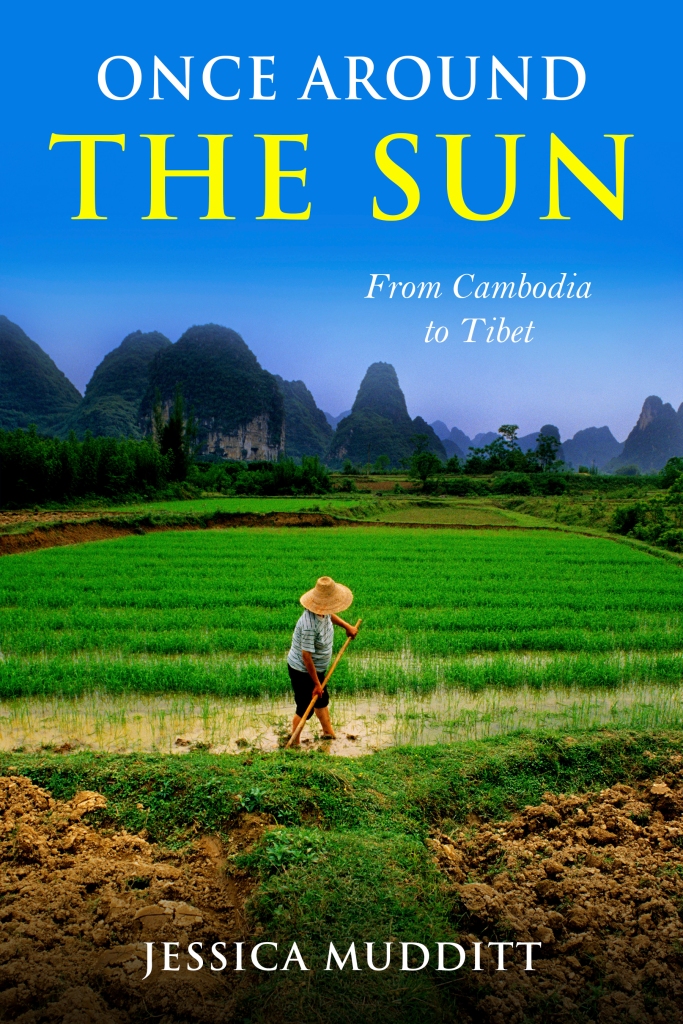
A brief overview of Once Around the Sun : From Cambodia to Tibet (Hembury Books) by Jessica Mudditt and a conversation with the author
Jessica Mudditt
Jessica Mudditt’s Once Around the Sun: From Cambodia to Tibet is not just a backpacker’s diary but also her need to relate to humanity, to find friendships and even love, as she does with Kris, a photographer named after Krishna, the Hindu god, because his parents while visiting India fell in love with the divinity!
The Burmese translation of Our Home in Myanmar was published recently.
Hurtling through Cambodia, Vietnam, China, Tibet, young Mudditt concludes her narrative just at the brink of exploring Nepal, India and Pakistan in her next book… leaving the reader looking forward to her next adventure. For this memoir is an adventure that explores humanity at different levels. Before this, Mudditt had authored Our Home in Myanmar – Four years in Yangon, a narrative that led up to the Myanmar attack on Rohingyas and takeover by the military junta. Once Around the Sun: From Cambodia to Tibet is the first part of a prequel to her earlier book, Our Home in Myanmar, both published by her own publishing firm, Hembury Books.
What makes her narrative unique is her candid descriptions of life on a daily basis — that could include drunken revelry or bouts of diarrhoea — while weaving in bits of history and her very humane responses. Her trip to Angkor Wat yields observations which brings into perspective the disparities that exist in our world:
“I was gazing out at an empire that was once the most powerful and sophisticated in the world. In 1400, when London had a middling population of 50,000, the kingdom of Angkor had more than a million inhabitants and a territory that stretched from Vietnam to Brunei. It had flourished for six hundred years, from the ninth to the fifteenth centuries.
“But somehow Cambodia had become one of the world’s poorest countries, and surely the most traumatised too, following a recent war and genocide. I knew that when we came back down to the ground, there would be a collection of ragtag street kids and downtrodden beggars desperately hoping for our spare change. It was difficult to reconcile the grandeur of Cambodia’s past with its heart-breaking present in the twenty-first century. How did a country’s fortunes change so dramatically? Could the situation ever be turned around?”
How indeed?
Then, she writes of Vientaine in Vietnam:
“I was struck by the fact that sex work seemed to be the consequence for countless young women living in poverty. It made me angry, but mostly sad.”
In these countries broken into fragments by intrusions from superpowers in the last century, judged by the standards of the “developed countries” and declared “underdeveloped”, an iron rice bowl becomes more important to survive than adventure, discovering other parts of the world or backpacking to self-discovery. Travel really is the privilege of that part of the world which draws sustenance from those who cannot afford to travel.
Jessica showcases mindsets from that part of the Western world and from the mini-expat world in Hong Kong, which continue alienated from the local cultures that they profess to have set out to explore or help develop. One of the things that never ceases to surprise is that while the ‘developed’ continue to judge the ‘third world’, these countries destroyed by imposed boundaries, foreign values, continue to justify themselves to those who oppress them and also judge themselves by the standards of the oppressors.
Some of these ‘developing’ countries continue to pander to needs of tourism and tourists for the wealth they bring in, as Jessica shows in her narrative. She brings out the sharp differences between the locals from Asia and the budgeted backpackers, who look for cheap alternatives to experience more of the cultures they don’t understand by indulging in explorations that can involve intoxicants and sex, their confidence backed by the assurance that they can return to an abled world.
Backpackers from affluent countries always have their families to fall back on — opulent, abled and reliable. Mudditt with her candid narrative explores that aspect too as she talks of her mother’s response to her being sick and budgeting herself. Her mother urges her to cut short her trip. But she continues, despite the ‘adversities’, with an open mind. That she has a home where she can return if she is in any kind of trouble begs a question — what kind of ‘civilisation’ do we as humans have that she from an abled background has a safe retreat where there are those for whom the reality of their existence is pegged to what she is urged to leave behind for her own well-being? And why — as part of the same species — do we accept this divide that creates ravines and borders too deep to fathom?
Mudditt with her narrative does create a bridge between those who have plenty and those who still look for and need an iron rice bowl. She mingles with people from all walks and writes about her experiences. Hers is a narrative about all of us –- common humanity. Her style is free flowing and easy to read — quite journalistic for she spent ten years working as one in London, Bangladesh and Myanmar, before returning to her home in Australia in 2016. Her articles have been published by Forbes, BBC, GQ and Marie Claire, among others. This conversation takes us to the stories around and beyond her book.
What led you to embark on your backpacking adventure? Was it just wanderlust or were you running away from something?
It was primarily from wanderlust, but I also didn’t know what I was going to do with the rest of my life. After six years at university, I was still yet to have any particular calling. However, I was also glad I didn’t know. It meant that I was free to go and explore the world, because I wasn’t putting my career on hold. I had no career.
I also had a broken heart when I set off for Cambodia – but the trip was planned before that relationship had even begun. But again, part of me was glad that my boyfriend had called it quits, because my plan was to be away for a very long time (and it ended being a decade away).
What made you think of putting down your adventures in writing? As you say, this is a prequel to your first book.
It was the pandemic that made me realise that backpacking was really special. There was a period in 2020 when it looked like travel may never be so unrestricted again, so it motivated me to document my year of complete freedom. It was also before social media was even a thing. When I was lost, I was really lost, and I had to use my problem-solving skills.
Prior to the pandemic, I sort of thought that backpacking itself was too fun to write about. I hadn’t actually lived in any of the countries I visited – I was just passing through. But that is also a valid experience, and one that many people can fondly relate to. There were also some really confronting and difficult moments.
You have written of people you met. How have they responded to your candid portrayals? Or did you change their names and descriptions to convey the essence but kept your characters incognito?
While I was writing the book, I got back in touch with the people I travelled with – I can thank Facebook for still being in touch with most people mentioned. They helped me to remember past anecdotes and I got some of the back story of their own trips. I have only used first names to protect their privacy, although there are some photos in the book too. Thankfully the world is so big that the odds are small that anyone would recognise, say, an Irish guy from Adam in Vietnam in 2006! Clem from Shanghai has just sent me a photo of her with my book, and Romi from Vietnam actually came to my book launch, which was awesome.
What was your favourite episode in this book — as a backpacker and as a writer? Tell us about it.
I think it was crossing into China and meeting ‘the man.’ I felt so alive with every step I took into China after crossing over on foot from Vietnam. To be chaperoned in the way I was – without being able to communicate a single word – was unusual. His kindness left me speechless, so the anecdote has a nice story arc.
In your travels through China, you faced a language handicap and yet found people kind and helpful. Can you tell us a bit about it?
I foolishly underestimated the language barrier. It was profound. In Southeast Asia, there was always at least a sprinkling of English, and I sort of just assumed that I’d be fine. I entered China from Vietnam, so my first port of call was Nanning, where there is not even really an expat population. I couldn’t do the most basic things, from finding the toilet or an internet cafe or something to eat! I used sign language and memorised the Chinese character for ‘female’ to make sure I went into the right toilet! In a restaurant, I just pointed at whatever someone else was eating in the hope that they would bring me a bowl of whatever it was. There were times when I was seriously lost and lonely, but I ended up staying in China for two months and saw the comedic side. I was bumbling around like Mr Bean (who is hugely popular in China).
I met a lot of people who were really kind to me, and I was just so grateful to them. I didn’t have Wi-Fi on my phone back then, so getting lost in a massive city in China was a bit scary. I met a student called Mei-Xing who ‘adopted’ me for a few days in Guilin. We had a really nice time together and it was so great to hang out with a local.
What is/are the biggest takeaway/s you had from your backpacking in this part of the world? Tell us about it.
I think it’s something quite simple: the world can be a very beautiful place, and a very polluted place. Tourism can do a great deal of damage when there are too many people clambering over one area. There is also an incredible level of disparity in a material sense on our planet. Some humans are travelling into space on rockets. Others are pulling rickshaws, as though they are draught horses. It is profoundly inequitable.
Having travelled to large tracts of Asia, what would you think would be the biggest challenge to creating a more equitable world, a more accepting world? Do you think an exposure to culture and history could resolve some of the issues?
I think that democracy is key. It slows us down and forces us to act in the interest of the majority, not the top-level cronies. That is definitely also something I witnessed in Myanmar. When a few people hold all the power, the population is deprived of things that ought to be a human right.
I think that travel definitely alters your perspective and broadens your mind, and it is something I’d recommend to anyone. Realising that the way that things are done in your home country is not the only way of doing things is a valuable thing to learn.
Mostly, you met people off the street. In which country did you find the warmest reception? Why and how?
In Pakistan. The hospitality and friendliness was unparalleled. I think it was in part due to not having many tourists there. Nothing felt transactional. I met some fascinating people in Pakistan who would have a profound impact on my own life. I am still in touch with several people I met there.
At a point you wondered if the poverty you saw could be reversed back to affluence in the context of the Angkor kingdom. Do you have any suggestions on actually restoring the lost glory?
I believe that it is beginning to be restored. Pundits have called this the “Asian Century.” I am convinced that the United States and the UK are in decline, and this process will only speed up. India, to me, holds the most promise as the next superpower, because it is a democracy (albeit flawed – like all of them), English- speaking, enormous, beautiful, fascinating and its soft power is unmatched. China is facing headwinds. I blame that on making people sad by removing their agency.
How long were you backpacking in this part of the world? Was it longer than you had intended? What made you extend your stay and why?
My trip was exactly 365 days long. I planned it that way from the beginning. I wanted to travel for no less than a year (more than a year and I might stay feeling guilty for being so indulgent!). That is also why the book is called Once Around the Sun – my time backpacking was the equivalent of one rotation of the Earth. I set off on 1 June 2006 – the first day of winter in Australia – and I arrived on 1 June 2007 in London, on the first day of the British summer. I love the sunshine.
After having travelled around the large tracts of Asia and in more parts of the world, could you call the whole world your home or is it still Australia? Is your sense of wellbeing defined by political boundaries or by something else?
Home for me is Sydney. I absolutely love it. I get to feel as though I am still travelling, because my home city is Melbourne. I go down a new road every other day and I love that feeling. The harbour is beautiful, and the sun is shining most days. It’s very multicultural too.
My kids are three and five, so I haven’t travelled overseas for years. My plan is to travel with them as much as possible when they are a bit older. I hope they love it as much as me. I cannot wait to return to Asia one day. I am also desperate to visit New York City.
What are your future plans for both your books and your publishing venture?
The second part of Once Around the Sun will come out in 2025. It’s called Kathmandu to the Khyber Pass, and it covers the seven months I spent Nepal, India and Pakistan.
My goal is to complete my fourth memoir by 2027. It will be called My Home in Bangladesh (it will be the prequel to Our Home in Myanmar!).
My fifth book will be about how to write a book. I am a book coach and in a few years I will have identified the most common challenges people face when writing a book, and finding their voice.
In the next twelve months, there will be at least 12 books coming out with Hembury Books, which is my hybrid publishing company. I love being a book coach and publisher and I hope to help as many people as possible to become authors.
Please visit the website and set up a discovery call with me if you plan on writing a nonfiction book, or have gotten stuck midway: https://hemburybooks.com.au/.
Photographs from Once Round the Sun, provided by Jessica Mudditt
(The online interview has been conducted through emails and the review written by Mitali Chakravarty.)
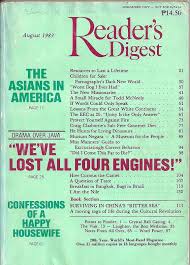
The last two years have been especially sad ones for printed books and magazines. Toward the end of 2023, the iconic magazine, National Geographic stopped selling its print issues. And in April 2024, Reader’s Digest stopped publishing. Many other print magazines have also downed their shutters though the online version continues.
I grew up with the Reader’s Digest. My father subscribed to the magazine and each month a copy wrapped in a brown envelope arrived at our door. The envelope partially covered the magazine inside, and you could see the top and bottom of the magazine. The size was small, and this made for easy handling. Reader’s Digest was a magazine you could read comfortably in bed. During the festival of Diwali, there was a special wrapping for the magazine. We had several magazines in our house when I was growing up. My mother used to read many magazines in Malayalam (our mother tongue).
Reader’s Digest provided shortened versions of stories and articles that had been published elsewhere. Their skill was in condensing the material while still retaining the interest. There was a rich collection of reading material. There were also advertisements for other books published by Reader’s Digest. Unfortunately, these were beyond our family budget. I wanted to purchase these when I grew up and became financially stronger. My neighbour who was a scientist had some of these books that I occasionally borrowed.
Another favourite of mine was the National Geographic. My father was a faculty member at a banker’s training college in Mumbai and their library subscribed to National Geographic. He often brought the magazine home. I was mesmerised by the articles and the photos in the magazine. The artistic quality of the photos was superb. The magazine had only three or four articles in an issue but addressed these at great depth. I travelled to faraway places, to the bottom of the ocean, to within the human body and to outer space with the magazine. Later, National Geographic started a television channel, and I would watch the documentaries in the nineties.
We also subscribed to the Illustrated Weekly of India. This was in a large format and again had very good photographs. I still remember the column by the journalist Khushwant Singh titled ‘With malice towards one and all’. I was also a fan of the comics section of the magazine. I had a huge collection of comics and my father purchased both Amar Chitra Katha and Indrajal Comics. Amar Chitra Katha introduced me to the rich history of India. Indrajal comics had superheroes like Phantom, Mandrake, and Flash Gordon. I used to eagerly await new issues. Most of my comics were lost when we shifted houses.
When the news magazine, India today, made an appearance, we subscribed to it and to Outlook and The week (Indian news magazines). During my school days in May, I used to eagerly await the new textbooks and notebooks for the next class following the results. I used to go with my mother to purchase these from a stationery store near the railway station. The smell of the new paper and the fresh ink was mesmerising. I loved to read some of the easier chapters in these books. Covering the notebooks with brown paper was another major activity. Our school year started with the rains in June.
My good friend, Sanjay Mhatre had a good library and loved to collect books. I loved to borrow from his vast collection. His collection on physics and cosmology were extensive. In those days, the erstwhile Soviet Union used to have cheap books of high quality for Indian readers. I remember the publishers Mir and Progress and I had several of their collections on science. The Soviet publishers used to hold exhibitions in our college. For twenty or thirty rupees, you could purchase high quality hard bound books. My introduction to quantum mechanics and to chemistry was through one such book.
At Thrissur in Kerala most of our medical textbooks were western and predominantly from the United Kingdom. There used to be an English Language Book Society (ELBS) that published cheaper versions of textbooks for developing countries. With our limited resources purchasing textbooks was a challenge. The two major textbooks published from the United States were those of Anatomy and Pathology. Those days we did not have online textbooks and online sources and were limited to the printed word.
I used to write for our medical college magazine and eagerly waited for the annual issue to be published. During my residency days at PGI, Chandigarh I was the literary secretary and was very involved in bringing out the annual magazine, The Resident. We also introduced a newsletter, ARDent Voice, with ARD standing for the Association of Resident Doctors.
At Pokhara, Nepal the college library had a good collection of general books and novels in addition to medical books. I used to read a lot of novels and the author, Frederick Forsyth was one of my favourites. His meticulous research blurred the lines between fact and fiction. Sidney Sheldon was another bestselling author. Novels enabled me to travel vicariously to different places and through varied situations.
Today reading has become less common among the younger generation. Reading strengthens creativity and the imagination as you must imagine in your mind’s eye the situation the author is creating. Is it not magical that the author can communicate with you, the reader through squiggles on a page across the boundaries of space and time?
I started writing during my MBBS days. I still remember the versification competition I took part in and won the first prize. I used to participate in different literary events at my college. In Nepal, I combined my triple loves of writing, photography and hiking with articles for the newly started newspaper, The Himalayan Times. I met my writing guru, Don through the magazine, ECS Nepal. Don was the editor of the magazine and a powerful writer with a deep knowledge of Nepal. I learned a lot from his comments and suggestions and the workshops he conducted. I also used to write a medical column for ECS Nepal. ECS Nepal was a beautifully produced magazine with great photographs. Unfortunately, it stopped publishing around the beginning of the pandemic.
Other travel and lifestyle magazines were also published from Nepal but could not sustain themselves. In the Caribbean Island of Aruba, I used to write off and on for a daily newspaper published in English. Again, the newspaper ceased publishing. During the last two decades several print magazines have ceased to exist. I feel it is a great loss.
I do not read much on paper these days. Most of my reading is done online on computers, laptops and tablets. I also have a Kindle reader. Kindle screen mimics the appearance of paper closely, but it is not the same as reading a printed page. You can no longer feel the smoothness of glazed paper, the smell of fresh ink and the vivid colours of photographs. With the closure of the print version of Reader’s Digest, an era in print publishing has ended. The demise was sadly expected. Without printed books, our (my) world may never be the same again!
.
Dr. P Ravi Shankar is a faculty member at the IMU Centre for Education (ICE), International Medical University, Kuala Lumpur, Malaysia. He enjoys traveling and is a creative writer and photographer.
.
PLEASE NOTE: ARTICLES CAN ONLY BE REPRODUCED IN OTHER SITES WITH DUE ACKNOWLEDGEMENT TO BORDERLESS JOURNAL
Here is my son, as a toddler, an ice cream cone in one hand, the other signing “peace.” Here is my daughter at five, posing in front of the Inland Sea, two fingers held up in the air. Here is my son, aged ten, sitting on a park bench in Charleston, South Carolina. Peace!
From pretty much the time that my Japanese-born children learned to say “cheese,” whenever they’ve found themselves in the presence of a camera, they stuck up two fingers in a “V.” Pick up any family photo from our children’s first ten years, and you’ll find someone making this gesture.
It drove my American parents crazy. “Be natural,” they’d say. “Don’t do that!” Candid shots were nearly impossible because as soon as my kids realised they were about to be photographed, those two fingers went up in the air.
My children were not exceptions, of course. I first noticed this practice when I arrived in Japan over thirty years ago. I have a drawer full of photos of myself and various Japanese kids making the sign. Me, I sometimes did it ironically. For Japanese youth, it seemed to be a Pavlovian response.
It hadn’t always been this way. An older Japanese woman friend told me that when she was a child, no one made a “V” when having their picture taken. She lamented that her own children had picked up the same habit, that her daughter signed “peace” even in her wedding photos. When I asked her how it all got started, she couldn’t tell me. However, theories abound.
According to one source, the trend originated in a baseball manga. A character made the “V” for Victory sign in imitation of Winston Churchill. The gesture caught on, and remains.
One of my foreign friends, hoping to break her kids of the tendency, refused to take their picture if they were making the sign. I was not quite so strict. The peace sign may, in fact, be the Japanese equivalent of the smile. In the United States, whenever someone has their picture taken, the photographer tries to get a grin out of them. I’m sure that many of us have faked a smile in order to comply with custom. I certainly have.
Here in Japan, however, smiling for the camera is relatively new. Back in the day, only the very vulgar would show their teeth. In school and other formal photos, gravitas is seemingly required. Thus, in the group portrait taken at my own wedding, the Japanese guests wear poker faces, better suited to a court date. My American relatives are all smiles, though their posed grins may be frozen in place. No one, I might add, is making the peace sign. My husband and I got married in Hawaii, so everyone’s hands are raised with pinkie and thumb extended, a gesture that means “hang loose” in the islands. Shaka shaka.
These days, thanks to the influence of K-pop artists in Japan, people posing for photos are likely to use another gesture. At a recent party celebrating graduating students at the university where I teach, we all got into formation.
“What should we do?” one professor asked. “Peace signs?”
“How about K-pop hearts?” I suggested. The others agreed. We touched our thumbs and index fingers, forming hearts. The picture was taken.
Suzanne Kamatawas born and raised in Grand Haven, Michigan. She now lives in Japan with her husband and two children. Her short stories, essays, articles and book reviews have appeared in over 100 publications. Her work has been nominated for the Pushcart Prize five times, and received a Special Mention in 2006. She is also a two-time winner of the All Nippon Airways/Wingspan Fiction Contest, winner of the Paris Book Festival, and winner of a SCBWI Magazine Merit Award.
PLEASE NOTE: ARTICLES CAN ONLY BE REPRODUCED IN OTHER SITES WITH DUE ACKNOWLEDGEMENT TO BORDERLESS JOURNAL
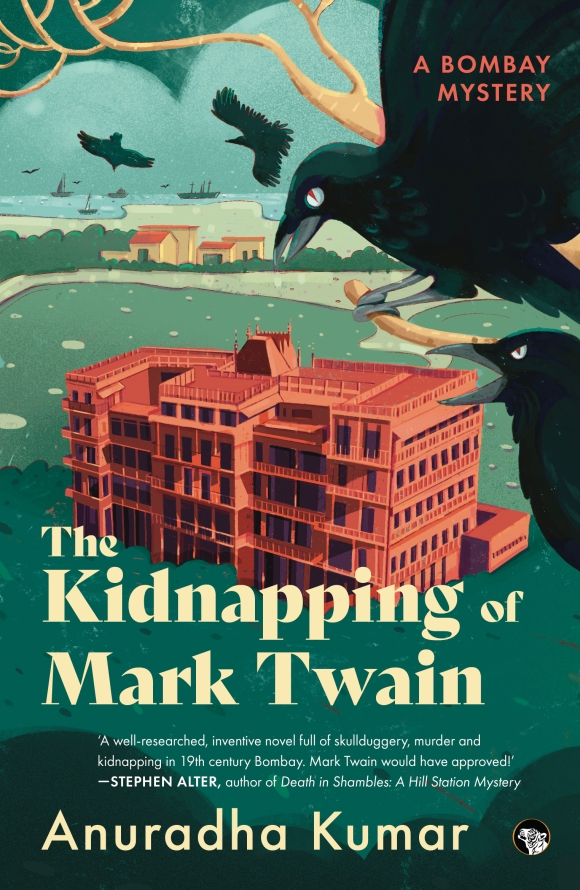
Title: The Kidnapping of Mark Twain: A Bombay Mystery
Author: Anuradha Kumar
Publisher: Speaking Tiger Books
At the turn of the nineteenth century, Bombay was a city bustling with economic activity. A city that stood on the verge of modernisation and rivalled cities like Paris, London and New York. A city that had much to offer to those coming in to make a living or to simply visit it for sightseeing. A city that offered home and work opportunities to people from different countries across the world. It was also during the years 1896-97 that Samuel L. Clemens, or Mark Twain as he was better known as, travelled to Bombay with his family and wrote about his experience in his travelogue, Following the Equator.
In The Kidnapping of Mark Twain, Anuradha Kumar weaves the historic facts from Twain’s book with some intriguing and riveting detective fiction and makes it a fascinating read, especially for the mystery readers. Anuradha Kumar has published more than thirty books, has won the Commonwealth awards for short stories a couple of times, written under the pseudonym of Aditi Kay, worked in the Economic and Political Weekly for almost 9 years and writes from USA now.
The book starts with Henry Baker, an American trade consul, waiting impatiently for the arrival of Mark Twain and his family to Bombay. His arrival is shadowed by the news of murder of a young girl named Casi which has also left Henry’s friend Maya Barton disturbed. Within a day of his reaching Bombay, Mark Twain suddenly vanishes from his hotel room. What follows then is a series of trailing and mystery solving that keeps the reader in thrall.
Henry, with the help of Maya and his loyal aide Abdul, takes upon himself to find the writer. With much that is happening in the city, including murder, a labour unrest, a threat of strike, Henry finds the authorities a little too preoccupied or uninterested to follow Mark’s case. Since he cannot further risk any diplomatic disagreement between the United States and Britain, he follows through even though his position offers no legal authority. What he encounters at each step leads him to more confusing scenarios but he manages to pull through despite the shocking and bizarre revelations coming in.
Kumar skilfully crafts characters who carry the most unusual of acts which keep the readers on an edge – a ‘Waghare’ thief, a stilt walking magician, a fanatic preacher and a sad Serbian musician. Along with Maya Barton who excels in impersonating appearances. All this and much more. With the help of Maya and Abdul, Henry succeeds in unravelling the mystery of Mark Twain’s disappearance. The mystery that is solved, however, is just not of Mark’s disappearance but also of Casi’s murder and truth behind fanatic Arthur Pease’s de-addiction centre.
Anuradha Kumar’s research that has gone in writing this novel shines through her depiction of the city of erstwhile Bombay – its sights and sounds as well as all the places which stand out in the making of this city. The novel hustles with everything quintessentially Victorian Bombay. Action happens in places like the Victoria Terminus, the Bombay Police Headquarters, Colaba Causeway, Elephanta Caves and the Bombay Cotton Mills. Mark Twain takes rooms at the famous Watson’s Hotel where he finds it difficult to sleep because of all the noise made by crows. Henry Baker lives at Byculla club and Maya Barton at a Colaba bungalow. Tukaram, Casi’s husband and a suspect, is the labour supervisor at the Bombay Cotton Mills. The day Mark Twain lands, he attends a party hosted by a rich Parsi businessmen where the famous nautch girls present a dance. The reader gets a grasp on the city that once was. On the other hand, the novel also stirs with the city’s underbelly where crime, opium addiction, poverty and class dynamics are at play.
It is fascinating to note that the author would make use of Mark Twain’s disappearance as mentioned in his travelogue and spin it to make a thrilling mystery. The portrayal of events is so vivid that sometimes the reading seems akin to watching an Agatha Christie in a TV series. Then there are historic events mentioned in the backdrop which gives an idea about the world politics at large. The narrative refers to Oscar Wilde’s trial and his subsequent imprisonment in England and the first protest of women’s right to vote. It brings forth the discriminatory policies that British persisted in India like labelling certain ethnic groups as criminals and makes use of the social reforms like women education underway in the Indian society. All of these, combined with the adventure that the book offers, make for a gripping tale that could have been only set in the Bombay of 1896.
Rakhi Dalal is an educator by profession. When not working, she can usually be found reading books or writing about reading them. She writes at https://rakhidalal.blogspot.com/ .
.
PLEASE NOTE: ARTICLES CAN ONLY BE REPRODUCED IN OTHER SITES WITH DUE ACKNOWLEDGEMENT TO BORDERLESS JOURNAL
I was already living in Japan when Taylor Swift was born, so she was never part of my American cultural experience. I didn’t hear her songs on the radio, didn’t see her face on the cover of magazines, and because I never clicked on links about her, she never entered my online bubble.
I had a vague awareness that she was a Country and Western singer, but I’d always been more inclined to listen to “alternative” music (Kate Bush, Siouxsie Sioux, Sinead O’Connor, Bjork, and so on).
At some point, my students at a small teacher’s college in Western Japan began to mention her as their favourite singer in their self-introductions. When they asked me what musicians I liked, I struggled to come up with someone they had heard of. Finding a favorite Taylor Swift song seemed like a good way to connect.
I learned a little bit more about her: she enjoys baking and knitting; she loves cats. Every time she visits a city, its economy improves. She gives generous bonuses to the people who work for her and supports LGBTQI rights. She has inspired girls all over the world. She seems like a genuinely nice person.
My son listened to her music, and after he shared one of his playlists with me, I had “We Are Never Ever Getting Back Together” on my phone. I liked it. It was catchy and relatable, easy to sing along to. But I didn’t really become a fan until she released Folklore during the pandemic. A friend whose musical taste I trusted raved about it on Facebook, so I downloaded the album. I listened to it as I drove to my office where I sat alone at my desk all day, uploading material for virtual classes. I became enamored with her storytelling, evident in songs such as “Betty,” about a teenage love triangle, and “The Last Great American Dynasty,” which exudes Great Gatsby vibes.
Last July, I learned that Taylor Swift would be performing four shows in Tokyo. A lottery would determine who would get tickets. I had never been to a big concert in an arena—well, not since I saw the Bee Gees in Detroit, when I was in junior high school, and that was before artists began incorporating mapping and other bells and whistles. I thought it would be fun. An extravaganza. I asked my husband if he wanted to go to a Taylor Swift concert with me.
“There’s no way you’ll be able to get tickets,” he said.
I entered the lottery anyway. Lo and behold, I “won” two tickets for Thursday, February 8, the second of four shows. As the date was months away, I didn’t count on anything. A lot could happen. And it did!
A week before the concert, I got an emergency text from my sister-in-law telling me that my elderly mother had fallen down and broken her hip. She was in the hospital, about to have surgery. The last time something like that had happened (to my father), I had rushed back to America. But my dad told me that everything was under control, and my mother made it through surgery without any complications, so I decided to put off my return home.
Then, three days before the start of the concerts, a rare snowstorm hit Tokyo, shutting down transportation. Since my husband and I live in distant Shikoku, we were planning to take a plane on the day of the show, arriving just a few hours in advance. If the snow continued, we wouldn’t make it.
“It’ll melt,” my husband assured me.
He was right. By Thursday, most of the snow was gone.
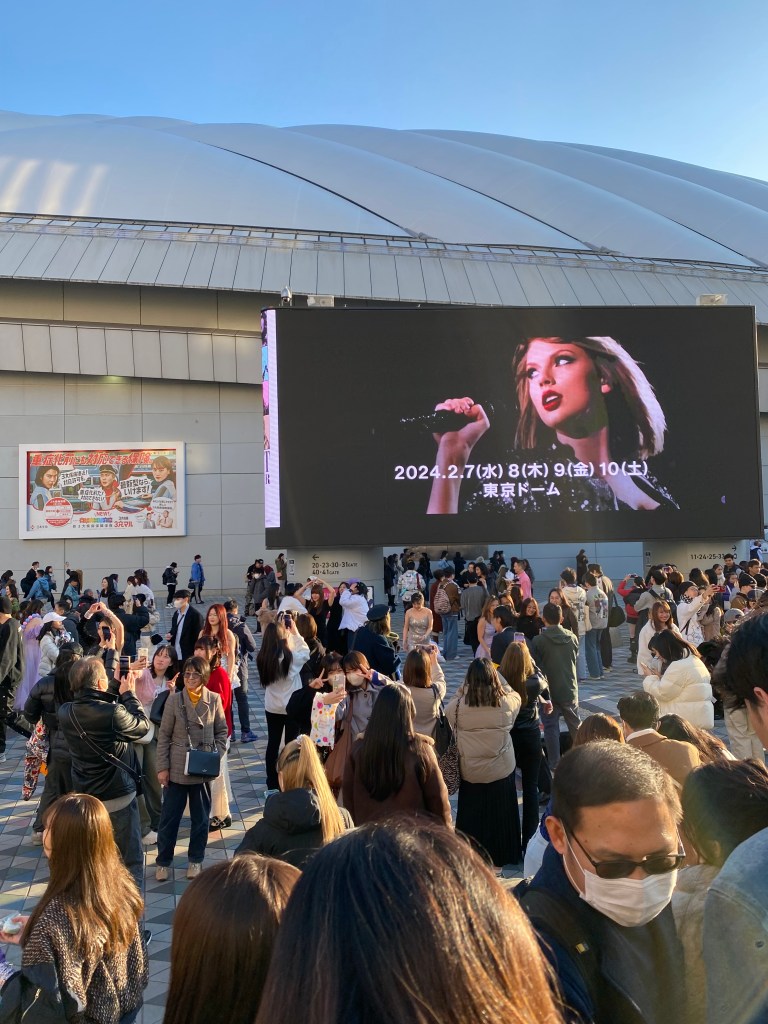
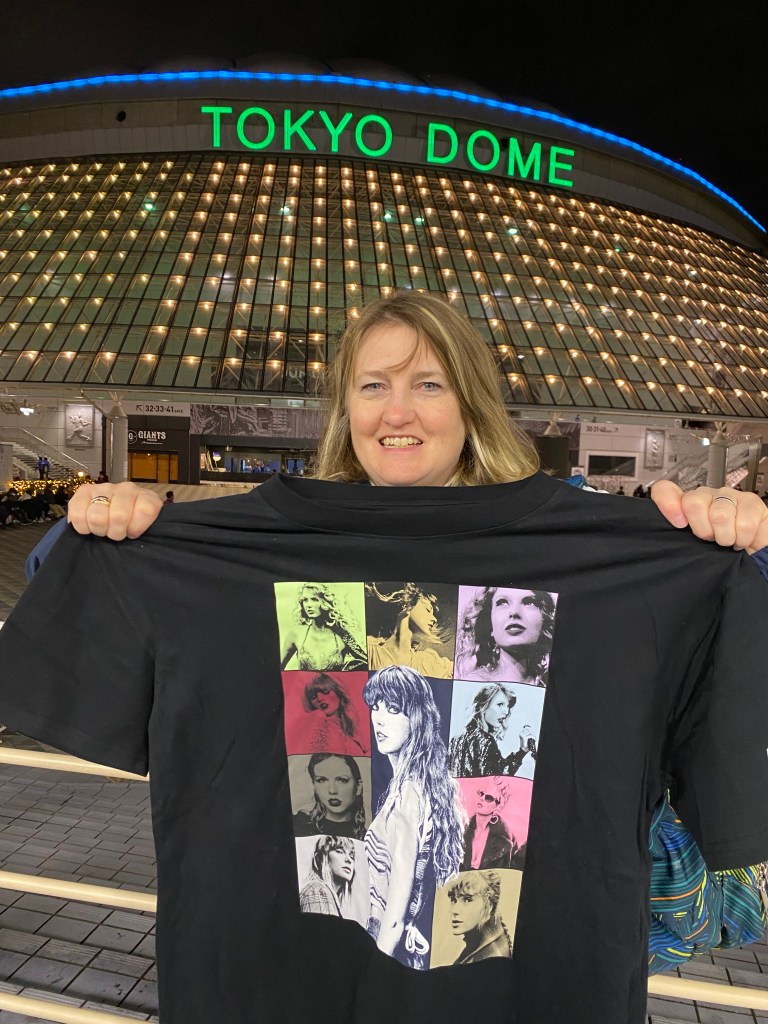
We made it to Haneda Airport, checked into our hotel in Ueno, had some sushi, and took the train to Tokyo Dome. Two hours before start time, a crowd had already gathered. Young women in spangled dresses, tiaras, and cowgirl hats, speaking various languages, posed for photos and exchanged friendship bracelets. Hundreds of people were queued up to buy merchandise related to the Eras Tour. Although my husband and I waited in line for almost an hour, when it became clear that we risked missing the beginning of the performance, we left and went to find our seats, which were high up in the rafters.
Slowly, the seats began to fill. By the time the lights dimmed, the place was packed. The music began, and dancers came onto the stage holding what looked like Japanese fans. Cheers surged. To my left, an earnest young woman, who was apparently attending alone, recorded nearly the entire show on her phone. A white-haired Japanese man, also on his own, sat just in front of me. Several young women in short dresses stood behind us, singing and dancing along to the songs that they knew. Whenever Taylor disappeared for a set or costume change, they would squeal in delight at her reappearance on stage: “Yabai, yabai, yabai[1]!”
For three hours and twenty minutes, as Taylor went through her set of 47 songs, ranging across her career, the arena was filled with joy.
Occasionally, my husband would lean over and ask, “Do you know this one?”
I confess that I didn’t know all of the songs—especially those from her early albums. I danced along anyway.
After the concert, my social media feeds were abuzz with reactions from other friends who had been there, or who’d attended the performance the night before. It felt as we had been part of something huge—and happy.
Meanwhile, back in the United States, rumors were circulating that Taylor Swift was part of some Deep State government plot to re-elect President Joe Biden in November. NFL fans were complaining that she got too much onscreen attention when she attended her boyfriend’s games (to cheer him on). Others slut-shamed her for having had too many boyfriends or attacked her for polluting with her private plane.
I was glad that none of that vitriol had reached Japan.
My husband and I went back to Tokyo Dome the next evening, during the concert, to buy T-shirts. At that time, the line for merchandise was blessedly short. We saw people sitting on benches outside the arena, or with their ears pressed to the walls, taking in as much as they could. It was strangely moving.
When I got back home, I downloaded two more of her albums. I’ve been listening to them non-stop ever since.
Suzanne Kamatawas born and raised in Grand Haven, Michigan. She now lives in Japan with her husband and two children. Her short stories, essays, articles and book reviews have appeared in over 100 publications. Her work has been nominated for the Pushcart Prize five times, and received a Special Mention in 2006. She is also a two-time winner of the All Nippon Airways/Wingspan Fiction Contest, winner of the Paris Book Festival, and winner of a SCBWI Magazine Merit Award.
PLEASE NOTE: ARTICLES CAN ONLY BE REPRODUCED IN OTHER SITES WITH DUE ACKNOWLEDGEMENT TO BORDERLESS JOURNAL
The decision to retire was a long, tough, and protracted one. The traditional wisdom always gave out doctors never retire. But we needed time to ourselves. We had long and fulfilling lives and now was the time to take things slow. The body was ageing and required more time to complete various activities. Some tasks were no longer possible.
Jiri, Nepal
I still remember the first day I met Rajendra on the orientation day of the Family Medicine residency program in upstate New York. Rajendra was from Jiri in the Himalayan country of Nepal. For a few decades, Jiri was the gateway to the Everest region. Then the hikers and mountaineers started flying to the air strip at Lukla. Roads were also progressing further and further in the country. We grew closer during the residency. We shared many interests including nature, hiking, photography, creative writing, and a strong empathy for the underdog. Our friendship slowly deepened, and by the end of the residency we decided to spend the rest of our life together.
We were also different in so many ways. I was a girl of mixed German and Colombian heritage. My family was well-to-do, and I had a privileged childhood. Raj was from a poor family and had to face many struggles in his life. He went to medical school on a government scholarship. Like most graduates of the Institute of Medicine in Kathmandu he then concentrated on being selected for a residency in the United States. Even in the early eighties this was a long, hard struggle.
He did a few ‘observerships’ and research attachments. He eventually went on to become a chief resident and we both worked for around two years in the Northeast health system after residency. Soon we had to decide on what to do next. I would have liked to continue in the United States. Raj however, was increasingly considering whether we should go back to Nepal. I told him that though I had never even visited Nepal I was OK with whatever he decided.
Though his family had settled in Jiri, Raj was a Newar. His full name was Rajendra Shakya. The religion of the Newars was complex tapestry of Hinduism and Buddhism. His family home was at Bungamati, a Newar village in Lalitpur district at the southern part of the Kathmandu valley. Newar Gods and Goddesses were complex and had both good and more wrathful aspects. Women were considered ritually impure during menstruation and were not allowed into the kitchen during this period, and they could not visit temples. In some rural parts of the country, the Chaupadi system was still followed, and women were banished to a cow shed during their periods. The Newars had their own caste system, and the concept of purity was important. In the Kathmandu valley the Newars had their ritual feasts (bhoj) and the buffalo was the most important animal in Newari cuisine.
The cow was sacred and killing one was a grave sin, but the poor black buffalo was fair game. I often reflected on this injustice. We first worked at the United Missions to Nepal hospital at Tansen at the foothills of the Himalayas. Tansen was a small town with a significant Newari influence and the hospital was the major and often only source of health care for a large population. The hospital was overcrowded, and we had to deal with a variety of patients. The houses for the doctors were lovely and picturesque, and we had a great community of both Nepalese doctors and expats. We stayed in Tansen for nearly a decade. There were delightful walks in the surrounding hills and a rather long hike to the Rani Mahal on the banks of the Kali Gandaki, often called the Taj Mahal of Nepal.
There was an opening for a doctor couple at Khunde hospital in the Everest region and as he was from Jiri, Raj wanted to apply. The hospital was at a height for around 4000 m and was set up by Sir Edmund Hillary. The hospital provides care to local residents, hikers, mountaineers, and porters from the lowlands. Initially it was a very isolated existence. Later a satellite phone was set up and eventually an internet connection followed. We dealt with all kinds of patients. The weather was cold, but I loved the picturesque cottage near the hospital. The region was becoming a popular trekking region and during the peak seasons of autumn and spring several thousand trekkers passed through.
Patan hospital is one of the old and famous hospitals of Nepal located in the city of Lalitpur also known as Patan in the Kathmandu valley. Migration of doctors to developed nations was a major challenge for Nepal and the Institute of Medicine was not very successful in producing doctors for the country as most graduates left for developed nations. The importance of a family medicine/general practice programme was understood by the policy makers and the Patan Academy of Health Sciences (PAHS) was set up. MD was the postgraduate medical qualification in the country and a MD in General Practice and Emergency Medicine (MDGP) was started in this institution.
We were among the faculty for this program, and we were now working at Patan hospital. We had some family land at Bungamati and built a traditional Newari style house. There were smiling mustard fields around though the area was rapidly urbanising. Flowers grew well. In winters, the Himalayas could be seen on a clear day but air pollution and dust made this a rarer phenomenon.
My brother had retired and settled in our family land on the outskirts of Albany, New York. We had a rather large plot of land, and I was thinking of settling near him. We had followed different life trajectories, and it would be nice to spend some together in the autumn of our lives.
Our work at Patan Hospital was hectic. After long conversations we decided to retire from the hospital and offer our expertise to the MDGP program as Emeritus Professors. Raj’s sister and brother had retired and were now living in Bungamati. Patan hospital would have loved for us to stay on.
We decided to divide our time between Albany and Bungamati. Summers in Albany and winters in Bungamati. Winters in upstate New York can be harsh and unforgiving. The long flight between the two locations will be a challenge as we did not handle long flights well. Let us see what fate had in store for us. Our son was a vascular surgeon in New York and we could be near to him. We were happy that we finally decided to retire and spend time with our families and our grandchildren. It was time to explore the road less travelled!
.
Dr. P Ravi Shankar is a faculty member at the IMU Centre for Education (ICE), International Medical University, Kuala Lumpur, Malaysia. He enjoys traveling and is a creative writer and photographer.
.
PLEASE NOTE: ARTICLES CAN ONLY BE REPRODUCED IN OTHER SITES WITH DUE ACKNOWLEDGEMENT TO BORDERLESS JOURNAL
Title: Journey to the End of the Empire: In China Along the Edge of Tibet
Author: Scott Ezell
Publisher: Speaking TigerBooks
This is one of the rare travelogues written by a gifted writer. The topic Scott Ezell covers is equally intriguing- China and Tibet. In about two hundred eighty pages, he takes readers on a tour of the most contentious part of China. Journey to the End of the Empire: In China Along the Edge of Tibet is an essential read.
American musician and poet Scott Ezell has a background in Asia and indigenous cultures. Between 1992 and 2004, he lived in Taiwan and traveled extensively in China, India, and Japan. He has been working on a project since 2009 that documents the impacts of centralised state power, civil conflict, and destructive resource extraction in the China-Southeast Asia border region. A Far Corner is an account of his experiences living and working with an indigenous artist community in Taiwan over a period of three years.
Says the blurb: “On foot, by rattling truck and local bus, by jeep and motorcycle, American poet and musician Scott Ezell explores the Tibetan borderlands in the twenty-first century Chinese empire. The journey starts in Dali, in the foothills of the Himalaya in southwestern China, and extends north a thousand miles through towns and villages along the edge of Tibet, finally arriving at Kekexili, the highest plateau in the world, and crossing the Kunlun Mountains. Ezell takes us through landscapes of blond and gold barley fields, alpine meadows ablaze with wildflowers, silver-blue rivers beneath ‘clouds like burning aluminium’, and snow peaks ‘cracking and shattering into jagged resplendence against the sky’.”
Along the way, Ezell speaks Mandarin with farmers, shopkeepers, lamas, nomads, and police officers. Throughout Ezell’s account, there is also outrage, as he observes the rise of militarization, surveillance, destructive resource extraction, and the destruction of entire river ecosystems by massive dams over the course of many years and numerous trips.
Writes Ezell in the introduction: “In September 2004 I set out on a journey along the edge of Tibet. Starting from the foothills of the Himalayas in southwest China, I traveled north into further, higher landscapes by local bus, hitchhiking, and a motorcycle I bought along the way. I speak Mandarin, which allowed me to communicate all down the road with villagers, Buddhist lamas, nomads with chunks of bone braided in their hair, and police at security checkpoints. After six weeks and 1,200 miles, I reached Kekexili, a wilderness reserve 17,000 feet above sea level. From there I crossed the Kunlun Mountains and descended to Golmud, a city at the crossroads of Tibet, China proper, and Xinjiang. That journey is the basis for the narrative.
“Over the next fifteen years I returned a dozen times to Tibet and southwest China. I witnessed transformations so shocking that I felt I was taking blows to my own bones. Massive dam systems killed rivers and displaced communities, mountains were raked apart to provide gravel for construction projects, and the region was increasingly militarized and surveilled as China tilted toward its grim police state superpower status.”
Ezell strikes a sympathetic note when he says : “Today China holds one million Uyghurs in concentration camps in Xinjiang, democratic freedoms have been smashed in Hong Kong, human rights lawyers are held in black jails, and the government openly surveils its population. But the systematic oppressions of ‘empire’ are not unique to China. The seizure of land and genocide against indigenous peoples in the United States and elsewhere, the legacy of slavery and the present-day wage-slavery of the global economy, and the colonization of Tibet as a means of territorial expansion and resource extraction these are all variations of centralized authority exerting power over minority, marginalized, and disenfranchised peoples.”
The book evokes the majesty of Tibetan landscapes, the unique dignity of the Tibetan people, and the sensory extremity of navigating nearly pre-industrial communities at the edge of the map, while also encompassing the erosion of cultures and ecosystems. Journey to the End of the Empire is both a love song and a protest against environmental destruction, centralised national narratives and marginalised minorities.
.
Bhaskar Parichha is a journalist and author of Unbiased, No Strings Attached: Writings on Odisha and Biju Patnaik – A Political Biography. He lives in Bhubaneswar and writes bilingually. Besides writing for newspapers, he also reviews books on various media platforms.
.
PLEASE NOTE: ARTICLES CAN ONLY BE REPRODUCED IN OTHER SITES WITH DUE ACKNOWLEDGEMENT TO BORDERLESS JOURNAL















 Borderless