Categories
Review

The History Teacher of Lahore by Tahira Naqvi

Book Review by Somdatta Mandal

Title: The History Teacher of Lahore: A Novel

Author: Tahira Naqvi

Publisher: Speaking Tiger Books

Tahira Naqvi, the Pakistani American writer, has extensively translated the works of Saadat Hasan Manto, Khadija Mastur, Hajra Masroor, and the majority of works by Ismat Chughtai from Urdu into English. As a teacher/professor of Urdu language and literature at New York University, she has regaled us with several short stories that speak of cross-cultural encounters of immigrant Pakistanis in America, especially about how women experience acculturation in the New World. The History Teacher of Lahore is her first novel where she recollects the sights, sounds, and ambience of growing up in Lahore in intimate details. The setting of this novel is the nineteen eighties, which was particularly a time of unrest in Lahore. In this debut political novel, Naqvi eloquently portrays the struggle between a besieged democracy and the rise of Islamic fundamentalism on the one hand, and the thriving cultural traditions of Urdu poetry on the other.

The story begins with the young protagonist Arif Ali who moves from his hometown of Sialkot to Lahore with a dream of being a history teacher and a poet. A ‘tall, slight man in his late twenties,’ we find him relaxing on a bench in Jinnah Park — a place that has become haven for him to spend his time reading, far away from the ferocity of traffic and street crowds. In the days that followed, Arif realised that in the Government Model School for Boys where he taught, he was forced to teach the boys another kind of history for his sake as much as theirs. But that required deep thought, time, and enthusiasm. He befriended Salman Shah, another teacher in his school, and his rapport with him grew stronger by the day. But once again, Arif found the atmosphere in the school was becoming increasingly confining. He would often engage in animated chatter with the high school Islamiyat teacher Samiullah Sheikh, whom he found disagreeable. Not only dressed in Shariyah compliant clothes, but this man was also waiting for his opportunity to teach at a madrassah[1]. This was the period when bans were being imposed on popular music of the kind Nazia Hasan and her brother sang for the younger generation, and even though ‘Disco Deewane’ and ‘Dreamer Deewane’ were sung loud, fear had become an elixir for rebellion. Arif was forced to resign from the school and along with his friend Salman. he ultimately got another position as a history teacher in another private school, Lahore Grammar Institute, where there was more freedom to teach than in the earlier one. The free socializing among the sexes here was new and noteworthy for Arif.

As Arif’s impotent rage towards the increasing religious intolerance grew, he joined his friend’s uncle Kamal and his partner Nadira to secretly help them rescue underprivileged children in clandestine ways. In the meantime, his poetic creations found great impetus when he found a secret admirer in Roohi, Salman’s sister, and started sending her his poems regularly. Though they never met, Roohi would write letters to him every week, and gradually, the more letters Arif received from her, the more his feelings for her grew. The secrecy of their epistolary courtship continued for quite some time till things were disclosed and after a lot of twists and turns in the story, they were finally engaged to get married.

In the meantime, his friend Salman got engaged to a colleague Zehra Raza, and despite the Shia-Sunni clashes that prevailed in society all around, they were unaffected by such ideology. The three of them developed a close camaraderie among themselves, but soon after, the General’s death brought in a lot of political turmoil in the city. The mentality of the public also changed, people went en-masse to watch public flogging, and trouble loomed ahead when Sunni Shia, Ahmadi non-Ahmadi, Punjabi Urdu-speaking, Protestant-Catholic, divisions and sub-divisions, inter-faith, inter-class and inter-religion issues became more and more marked in all spheres of society. The warp and weft of faith produced such tangled intricacies as could only be imagined in nightmares.

As the nation was caught in the vortex of religious extremism, Arif’s position also underwent a great change in the school when he wanted to teach ‘true’ history to his students. He was caught in a dilemma when he found he was forced to teach false historical information in the doctored textbook that Aurangzeb with his hatred of other religions was adored whereas Akbar with more religious tolerance was totally sidelined. He tried to rectify the errors by providing supplementary notes to his students, but that landed him in more trouble. Apart from differences of opinion with the other teachers in school, Arif’s was gripped with a kind of fear and frustration when some unidentified goons threatened him to stay away from issues that did not concern him. Things got worse when a Christian student in his class was falsely accused of blasphemy and Arif decided to save him from being arrested. He embarked on a dangerous mission to resolve this Christian-Muslim conflict that landed him in the middle of sectarian clashes and without giving out all the details, one just mentions that the novel ends at a tragic moment.

In the acknowledgement section Naqvi states that she is grateful to her father for many things but especially for his Urdu poetry which she has used freely in translation. These poems, ghazals and nazms, help to explain the different moods of the protagonist and his mental situation very clearly. One interesting aspect of the novel is that each of the twenty-two chapters is prefaced by a small quote that in a way summarizes the mood and content of that chapter. Most of these quotes are from Jean-Paul Sartre, while others are from Spinoza, Ghalib, Shakespeare’s Sonnet 116, H.W. Longfellow, Jacques Derrida, Tertullian, Thomas Mann, and four entries particularly from The Lahore Observer dated 15 September 1990, December 1990, January 1997, and January 1998 respectively. These wide-ranging quotes not only increase the story-telling impact, but also endorse the erudition of the novelist herself.

To conclude we can say that Bapsi Sidhwa’s The Ice-Candy Man gave us the sights, sounds and details of Lahore during the Partition in 1947, and the same city becomes wonderfully alive again through the pen of another woman writer from Pakistan who had spent her growing years there, and who gives us details about it from the 1980’s onwards when  the political situation of the country was once again very murky. The novel wonderfully portrays the radical Islamisation of the country that included murder, mayhem, and public flogging and more that was visible in Lahore, as this process resulted in terrible uncertainty in the lives of the city’s residents from all walks of life. Strongly recommended for all readers, we eagerly wait for more novels by Tahira Naqvi in the future. The insider-outsider’s point of view offered by her is remarkable and this debut novel can be counted as a collector’s item.

[1] Muslim religious school

Somdatta Mandal, critic and translator, is a former Professor of English from Visva-Bharati University, Santiniketan, India.

.

PLEASE NOTE: ARTICLES CAN ONLY BE REPRODUCED IN OTHER SITES WITH DUE ACKNOWLEDGEMENT TO BORDERLESS JOURNAL

Click here to access the Borderless anthology, Monalisa No Longer Smiles

Click here to access Monalisa No Longer Smiles on Kindle Amazon International

Categories
Excerpt

New Novel by Upamanyu Chatterjee

Title: Lorenzo Searches for the Meaning of Life

Author: Upamanyu Chatterjee

Publisher: Speaking Tiger Books

It is the 20th of December 1980, a Saturday, and at dinner, Lorenzo Senesi, who will turn twenty-two in a little over a month, tells his mother, ‘Mamma, I think I just might go down to Padua with Roberto and Francesca for Christmas and the New Year. Should be back by the 3rd or 4th of January.’

Elda glances at her son but says nothing. Amedeo the father grunts once to acknowledge that the information has reached his ears. Paola, Lorenzo’s sister, older by fourteen months, asks in a tone that suggests that it wouldn’t matter if he doesn’t respond, ‘With those two? But I thought you were bored to death of them.’

The next morning, Lorenzo packs some essential things, including his copy of Carlo Carretto’s The Desert in the City, in an overnight bag, places the bag on the rear seat of his Renault 5, goes to the kennel in the corner of the garden to hug and nuzzle Vega the dog (a handsome golden-brown beast, half German Shepherd, a quarter Retriever, and in her reflective moments, there is something about her eyes that recalls the young Sylvester Stallone) and is off. Francesca and Roberto are nowhere to be seen. From Aquilinia, the dot on the outskirts of Trieste where they stay (a workers’ village, really, an adjunct to the Aquila oil refinery is how it was conceived and inaugurated in 1938, with habitual pomp, by Mussolini), he takes La Strada Costiera, the scenic coast road, down to the plains.

It is late in the morning, and bright and sunny. On his right lie the hummocks, ridges and undulations of karst, their eroded limestone continually sneaking a peek between the trees of lime and pine at the brilliant blue, on his left, of the bay of Trieste. The landscape tumbles down in leaps and bounds to the radiant sea that stretches like blue polythene till the haze of the horizon. On some curves, he can spot the white sails of boats, as still as life, on the aquamarine lapping at the feet of Miramare Castle.

The Renault, three years old, is an acquisition that dates from his road accident and the insurance money that he reaped as one of its consequences. It moves well; he makes good time to Sistiana and thence to Monfalcone where, having left the Adriatic and reached the bland plains, he takes the A 4 west-south-west towards Milan. He is undecided—but only for a moment—between the radio and the cassette player. Radio Punto Zero on FM wins; with his arms fully stretched to grip the steering wheel, he leans back in the seat to enjoy Adriano Celentano crooning ‘Il Tempo Se Ne Va.

A hundred and fifty kilometres, more or less, to Padua, an uncluttered highway through the ploughed cornfields and plantations of poplar of the region of Gorizia; Celentano on the radio is succeeded by Franco Battiato, Giuni Russo, Antonello Venditti and Claudio Baglioni. Friuli-Venezia-Giulia gives way to the Veneto a while before Lorenzo switches off the radio to enjoy, in peace, the noon silence. At Padua, though, it not being his final destination, he still has a further fifteen kilometres to go to reach Praglia at the foot of the Euganean Hills.

He parks the Renault as far as he can from a bus disgorging a contingent of British tourists alongside the church wall of the Chiesa Abbaziale di Santa Maria Assunta and carrying his overnight bag, walks across to the arched recess in which is inset an iron door. It is the principal entrance to Praglia Abbey of which the church forms an integral part. He rings the bell and waits.

He glances back at his car. Behind the wall, the church rises solid and grey, monolithic like a fortress, almost forbidding. Hearing the clang and whine of the iron door being opened, he turns back.

The monk whom he sees, Father Anselmo, sombre in his black robe, is tiny. He smiles and nods at Lorenzo and ushers him in. ‘Oh, have you come by car? Then I’ll open the main gates for you so that you can park inside.’ Without ceasing to nod and smile, he ushers him out.

Father Anselmo, being the porter of the abbey, is a statutory requirement of the institution. Let there be stationed at the monastery gate, says Chapter 66 of the Rule of Saint Benedict, a wise and elderly monk who knows how to receive an answer and to give one and whose ripeness of years does not suffer him to wander about. This porter ought to have his cell close to the gate so that those who come may always find someone there from whom they can get an answer. So when the Father does not reply, it may be presumed that the question was not worth a response. For they do not speak much, the Benedictines.

The Renault having found its parking berth in a spacious, paved, open corridor that runs right around a large, rectangular garden, Lorenzo returns to the reception room where Father Anselmo, at his place behind a plain, unadorned desk, waits for him.

‘Good afternoon,’ he starts again formally. ‘I would like to meet the maestro dei novizi. I have an appointment. My name is Lorenzo Bonifacio.’

A cue, as it were, for Father Anselmo to nod and smile again, and without getting up, lean sideways in his chair and press, six times in a measured, definite code, a red plastic button affixed to the wall. One push of the bell, a long pause, two pushes, a short pause, two more pushes, a long pause, one last push. Immediately, from the great bell tower of the church, clearly audible in each nook and cranny of the abbey, begins to ring, in the same code and with the same pauses, one of the lesser bells. Father Anselmo then gestures to Lorenzo to sit down in one of the chairs ranged along the wall. No conversation ensues.

(Extracted from Lorenzo Searches for the Meaning of Life by Upamanyu Chatterjee. Published by Speaking Tiger Books, 2024)

About the Book

One summer morning in 1977, nineteen-year-old Lorenzo Senesi of Aquilina, Italy, drives his Vespa motor-scooter into a speeding Fiat and breaks his forearm. It keeps him in bed for a month, and his boggled mind thinks of unfamiliar things: Where has he come from? Where is he going? And how to find out more about where he ought to go?
When he recovers, he enrols for a course in physiotherapy. He also joins a prayer group, and visits Praglia Abbey, a Benedictine monastery in the foothills outside Padua.

The monastery will become his home for ten years, its isolation and discipline the anchors of his life, and then send him to a Benedictine ashram in faraway Bangladesh—a village in Khulna district, where monsoon clouds as black as night descend right down to river and earth. He will spend many years here. He will pray seven times a day, learn to speak Bengali and wash his clothes in the river, paint a small chapel, start a physiotherapy clinic to ease bodies out of pain, and fall, unexpectedly, in love. And he will find that a life of service to God is enough, but that it is also not enough.

A study of the extraordinary experiences of an ordinary man, a study of both the majesty and the banality of the spiritual path, Upamanyu Chatterjee’s new novel is a quiet triumph. It marks a new phase in the literary journey of one of India’s finest and most consistently original writers.

About the Author

Upamanyu Chatterjee is the author of English August: An Indian Story (1988), The Last Burden (1993), The Mammaries of the Welfare State (2000), Weight Loss (2006), Way to Go (2011), Fairy Tales at Fifty (2014), and Villainy (2022)—all novels; The Revenge of the Non-vegetarian (2018), a novella; and The Assassination of Indira Gandhi (2019), a collection of long stories. 

In 2000, he won the Sahitya Akademi Award, and in 2008, he was awarded the Order of Officier des Arts et des Lettres by the French Government for his contribution to literature.

.

PLEASE NOTE: ARTICLES CAN ONLY BE REPRODUCED IN OTHER SITES WITH DUE ACKNOWLEDGEMENT TO BORDERLESS JOURNAL

Categories
Review

Artificial Intelligence in a Human World 

Book review by Bhaskar Parichha

Title: Faking It : Artificial Intelligence In a Human World 

Author: Toby Walsh

Publisher: Speaking Tiger Books

AI, or Artificial Intelligence, has become an integral part of our daily lives. It has revolutionised industries, from healthcare to transportation and manufacturing. However, some people may seek to artificially enhance AI to deceive others. This is called “faking AI”. There are several reasons why someone might fake AI.

Faking AI can enable individuals to impersonate someone else or appear as experts in a particular field. This can have negative consequences, such as fraud or phishing scams. Creating AI from scratch can be complex and time-consuming. By pretending to have AI, individuals can save time and effort while still achieving their desired results. In some cases, individuals may prefer to keep certain aspects of their AI-driven projects confidential. Faking AI can provide privacy and discourage further investigation.

One of the most common methods of fake AI is to manipulate data. By selectively choosing or modifying data, individuals can create artificial patterns or results that seem AI-generated. Another approach is to use pre-trained models, which are AI systems based on large datasets. These models can be repurposed and fine-tuned to deliver specific results without significant effort.

Machine Learning as a Service (MLaaS) platforms enable individuals to create AI models without technical expertise. These platforms often offer pre-trained models to generate fake AI results. Fake AI APIs, or Application Programming Interfaces, can simulate AI functionality. These APIs provide AI-driven responses or data but rely on predetermined algorithms or scripts.

While pretending to have AI may have certain advantages, it also has several disadvantages. Faking AI can mislead consumers about AI quality and authenticity. This can erode trust in AI technology and hinder its widespread adoption.

Faking AI may violate ethical guidelines and legal requirements. The use of AI without disclosing its true origins or limitations can contribute to legal consequences, including breach of contract or fraud. Faking AI can result in inaccurate predictions and decisions. This can lead to serious consequences in industries where AI plays a significant role, such as healthcare or finance.

Faking It: Artificial Intelligence In a Human World by Toby Walsh goes into the subject. A world leader in artificial intelligence, Walsh has spent his life dreaming about and researching how machines think. Scientia Professor of AI at the University of New South Wales and Fellow of the Australian Academy of Science. Toby is passionate about ensuring AI improves, not harms, our lives. He authored It’s Alive! From the Logic Piano to Killer Robots, which was named one of the year’s best books by the New Statesman. Toby contributes to American Scientist, New Scientist and The Guardian.

The blurb says:Faking AI has become an increasingly prevalent concern in today’s digital age. It is crucial for individuals and organizations to be aware of the methods and motivations behind faking AI and take appropriate measures to detect and protect against it. By implementing best practices and promoting transparency, we can build trust and preserve the integrity of the AI-driven world. Artificial intelligence is, as the name suggests, artificial and fundamentally different to human intelligence. Yet often the goal of AI is to fake human intelligence. This deceit has been there from the very beginning. We’ve been trying to fake it since Alan Turing answered the question ‘Can machines think?’ by proposing that machines pretend to be humans.

As Walsh argues in his book, we are on the verge of developing artificial intelligence that can be used to deceive us. ChatGPT is an example of an artificial intelligence that is capable of fooling us into believing that it is intelligent and blurring the line between what is real and what is not. The truth is that they are devoid of true understanding, sentience, and common sense.

In spite of this, they are still capable of making a difference in the world. He raises fundamental questions in the book, including: Can artificial intelligence be creative? Can they be moral? What can we do to ensure they are not harmful?

Toby Walsh takes us through all the ways artificial intelligence mockups human emotion in this exciting and fascinating book. Also, he examines the implications of this for humanity in the present and the future of our planet.

.

Bhaskar Parichha is a journalist and author of UnbiasedNo Strings Attached: Writings on Odisha and Biju Patnaik – A Political Biography. He lives in Bhubaneswar and writes bilingually. Besides writing for newspapers, he also reviews books on various media platforms.

.

PLEASE NOTE: ARTICLES CAN ONLY BE REPRODUCED IN OTHER SITES WITH DUE ACKNOWLEDGEMENT TO BORDERLESS JOURNAL

Click here to access the Borderless anthology, Monalisa No Longer Smiles

Click here to access Monalisa No Longer Smiles on Amazon International

Categories
Review

Along the Tibetan Edge in China

Book Review by Bhaskar Parichha

Title: Journey to the End of the Empire: In China Along the Edge of Tibet

Author: Scott Ezell 

Publisher: Speaking Tiger Books

This is one of the rare travelogues written by a gifted writer. The topic Scott Ezell covers is equally intriguing- China and Tibet. In about two hundred eighty pages, he takes readers on a tour of the most contentious part of China. Journey to the End of the Empire: In China Along the Edge of Tibet is an essential read.

American musician and poet Scott Ezell has a background in Asia and indigenous cultures. Between 1992 and 2004, he lived in Taiwan and traveled extensively in China, India, and Japan. He has been working on a project since 2009 that documents the impacts of centralised state power, civil conflict, and destructive resource extraction in the China-Southeast Asia border region. A Far Corner is an account of his experiences living and working with an indigenous artist community in Taiwan over a period of three years.

Says the blurb: “On foot, by rattling truck and local bus, by jeep and motorcycle, American poet and musician Scott Ezell explores the Tibetan borderlands in the twenty-first century Chinese empire. The journey starts in Dali, in the foothills of the Himalaya in southwestern China, and extends north a thousand miles through towns and villages along the edge of Tibet, finally arriving at Kekexili, the highest plateau in the world, and crossing the Kunlun Mountains. Ezell takes us through landscapes of blond and gold barley fields, alpine meadows ablaze with wildflowers, silver-blue rivers beneath ‘clouds like burning aluminium’, and snow peaks ‘cracking and shattering into jagged resplendence against the sky’.”

Along the way, Ezell speaks Mandarin with farmers, shopkeepers, lamas, nomads, and police officers. Throughout Ezell’s account, there is also outrage, as he observes the rise of militarization, surveillance, destructive resource extraction, and the destruction of entire river ecosystems by massive dams over the course of many years and numerous trips.

Writes Ezell in the introduction: “In September 2004 I set out on a journey along the edge of Tibet. Starting from the foothills of the Himalayas in southwest China, I traveled north into further, higher landscapes by local bus, hitchhiking, and a motorcycle I bought along the way. I speak Mandarin, which allowed me to communicate all down the road with villagers, Buddhist lamas, nomads with chunks of bone braided in their hair, and police at security checkpoints. After six weeks and 1,200 miles, I reached Kekexili, a wilderness reserve 17,000 feet above sea level. From there I crossed the Kunlun Mountains and descended to Golmud, a city at the crossroads of Tibet, China proper, and Xinjiang. That journey is the basis for the narrative.

“Over the next fifteen years I returned a dozen times to Tibet and southwest China. I witnessed transformations so shocking that I felt I was taking blows to my own bones. Massive dam systems killed rivers and displaced communities, mountains were raked apart to provide gravel for construction projects, and the region was increasingly militarized and surveilled as China tilted toward its grim police state superpower status.”

Ezell strikes a sympathetic note when he says : “Today China holds one million Uyghurs in concentration camps in Xinjiang, democratic freedoms have been smashed in  Hong Kong, human rights lawyers are held in black jails, and the government openly surveils its population. But the systematic oppressions of ‘empire’ are not unique to China. The seizure of land and genocide against indigenous peoples in the United States and elsewhere, the legacy of slavery and the present-day wage-slavery of the global economy, and the colonization of Tibet as a means of territorial expansion and resource extraction these are all variations of centralized authority exerting power over minority, marginalized, and disenfranchised peoples.”

The book evokes the majesty of Tibetan landscapes, the unique dignity of the Tibetan people, and the sensory extremity of navigating nearly pre-industrial communities at the edge of the map, while also encompassing the erosion of cultures and ecosystems. Journey to the End of the Empire is both a love song and a protest against environmental destruction, centralised national narratives and marginalised minorities.

.

Bhaskar Parichha is a journalist and author of UnbiasedNo Strings Attached: Writings on Odisha and Biju Patnaik – A Political Biography. He lives in Bhubaneswar and writes bilingually. Besides writing for newspapers, he also reviews books on various media platforms.

.

PLEASE NOTE: ARTICLES CAN ONLY BE REPRODUCED IN OTHER SITES WITH DUE ACKNOWLEDGEMENT TO BORDERLESS JOURNAL

Click here to access the Borderless anthology, Monalisa No Longer Smiles

Click here to access Monalisa No Longer Smiles on Kindle Amazon International

Categories
Excerpt

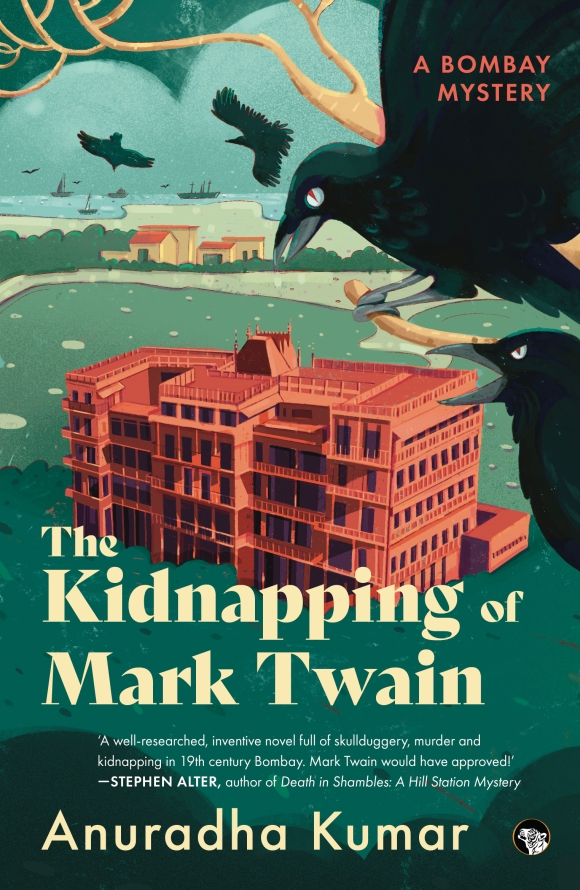
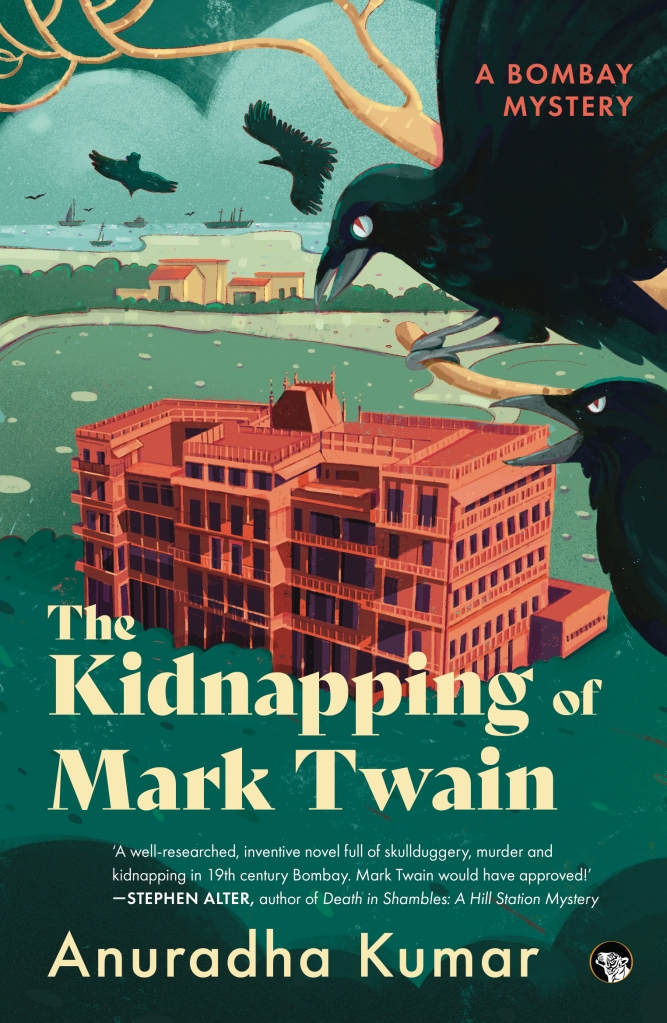
The Kidnapping of Mark Twain

Title: The Kidnapping of Mark Twain: A Bombay Mystery

Author: Anuradha Kumar

Publisher: Speaking Tiger Books

An hour passed as Henry, back in his rooms at the Byculla Club, waited for Abdul to return from the doctors’ bungalow. He had taken a message from Henry to Maya. He would not be back to have dinner with the Clemenses that evening. ‘Don’t give Maya memsahib the message in front of them,’ Henry warned, and Abdul gave him his usual long-suffering look. He really wasn’t an idiot, Henry thought to himself ruefully. ‘And if she asks more, tell her some urgent business came up.’ Henry’s face darkened, for he wouldn’t tell her about his intentions of tailing Bancroft, even accosting him. ‘And come back fast, we need to…’

Abdul looked at him expectantly, but Henry paused, pursed his lips. ‘I will tell you when you are back.’

He looked toward his desk, where his prized Colt Bisley lay in the locked second drawer. A brand-new model, with its five-inch barrel, that he had bought in London. Henry didn’t want to use it, especially on Bancroft and he hoped the other man wouldn’t make it difficult for him. Freddie Bancroft had quite a reputation, one that preceded him. He had first trained as a dentist and then worked as an insurance agent in Philadelphia before he had set out to make a magician of himself. It was an ambitious hope, and Bancroft could be impatient. The time when the

New York papers had reported unfavourably about his show, when his illusions had not worked, and his card tricks had bored much of the audience, Bancroft had thrown a tantrum, throwing his magician’s props on the seated audience. He had then burst into the offices of the New York Journal. He had accosted the editor on the late evening shift, accusing him, and the paper, of favouring the other magician Alexander Hermann, and insisted that the next day the office itself would vanish into thin air.

A portion of the office was indeed found ablaze early the next morning, but Bancroft had an alibi. There were many people who had seen him on the return train to Philadelphia. And the culprits were found to be two workers who were part of the union of newspaper workers. But Bancroft later bragged about it, that he could indeed hypnotize people to do his bidding.

He had made sure people in Bombay knew about this too, and he was determined to stage his own show at the Rippon Theatre on Grant Road. Bancroft had dropped flyers all over, had demanded advertising space for himself in the Gazette, and was also soliciting funds from the likes of Albert Sassoon, Shapoorji Bengalee, and the others, to build those elaborate sets he so wanted. But, of course, Henry, his fellow countryman, hadn’t been of much help, nor had he pulled his weight with the customs people.

Henry sighed. He was letting his jealousy get to his head. Bancroft must have added to his skills in the months he was in Bombay. For he had impressed Maya, and in a far shorter period of time, Mark Twain too, it would appear. And perhaps, Henry thought, Bancroft wanted Twain to write about him, an entire piece in the American papers about the magician’s immense popularity in the East. And now, it would appear that Bancroft may have been the last person to actually see Mark Twain, for he must have peered into his room, as he had Boehme’s, and it was likely, he did know a thing or two.

Henry looked at his notes on the table, and realized with some consternation that he had forgotten a meeting. With a man he disliked as much as he did Bancroft, but when business mattered, Henry knew he had to be quite the professional. Arthur Pease, the tireless campaigner against opium, the vices of drinking, and prostitution, had expressed an interest in the electric fans. They were needed, Pease had said, for the big meetings and assemblies he called every once in a while, in the Parsi meeting halls, and the town hall, and especially at the Reformatory Institute that was a particular favourite of his, for he always found a willing and suppliant audience here.

An hour later, Henry felt there was little point waiting for Abdul in his study. The longer he was on his own, the more he would fret over Twain and think sullenly about Bancroft. So Henry resolutely set off first for the police headquarters, and then to meet with Arthur Pease in Khetwadi, that lay a bit after Crawford Market. This was where Pease lived in a small bungalow, part of which doubled up as a healing centre for addicts.

Henry left a note for Abdul by the table near the hat stand, next to the silver embossed tray that usually held the keys, messages, and letters. Come to…, and he wrote the address. House next to Daji clinic. Crawford Market. Come as soon as you see this.

He called for a carriage, from the many standing aimlessly by the club. The coachman, a Pathan judging from his build and turban, saluted smartly as he jumped down from his seat to hold the door open. ‘The police station first,’ Henry said in a low voice, ‘and then someplace else. I will tell you later. You do have the time, I hope?’

‘Good, sahib, very good,’ the coachman said, nodding to his helper who would ride with him. The boy resting at the foot of the statue that everyone called the Standing Parsi, came running up, and the carriage shook momentarily as he jumped up behind. ‘Go fast, all right?’ Henry said, looking through the window.

The man nodded, gently tapping the pony, a young, spirited brown animal, with his whip, and then, looking over his shoulder said, ‘They are sending a lot of the police toward Sewree and Parel, the workers are angry. They really anticipate trouble, and they are stopping us from going there.’

(Extracted from The Kidnapping of Mark Twain: A Bombay Mystery by Anuradha Kumar. Published by Speaking Tiger Books, 2023)

About the Book: In 1896, Mark Twain arrives at the docks of Bombay, wife and daughter in tow, and, after attending a party in his honour, vanishes from his room at the iconic Watson’s Hotel in the dead of night.

Desperate to find the legendary writer and avoid an international incident between his country and Britain, the American Trade Consul, Henry Baker, teams up with Abdul, his trusted aide, and Maya Barton, a free-spirited Anglo- Indian with surprisingly intuitive detective skills. But they have their task cut out for them: Mark Twain’s disappearance appears to be entangled with a thriving opium trade; an intimidating, self-righteous preacher; an anxious magician who walks on stilts; a professional thief on the run; and a powerful labour leader, Tuka, whose young wife is found strangled in her bed.

Full of fascinating period detail and delightful cameos—and awash with suspense—The Kidnapping of Mark Twain is a thrilling page-turner.

About the Author: Anuradha Kumar was born in Odisha. She studied history at Delhi University and management (specializing in human resource management) at the XLRI School of Business, Jamshedpur. She has worked for the Economic and Political Weekly. She has an MFA in Writing from the Vermont College of Fine Arts (VCFA). Her stories have won awards from the Commonwealth Foundation, UK, and The Little Magazine, India. She writes regularly for Scroll.in. Her stories and essays have appeared in publications like Fiftytwo.in, The India Forum, The Missouri Review, among others. She has written for younger readers as well. This present work is her 11th novel.

PLEASE NOTE: ARTICLES CAN ONLY BE REPRODUCED IN OTHER SITES WITH DUE ACKNOWLEDGEMENT TO BORDERLESS JOURNAL

Categories
Review

How Suffering Unites across Borders

Book review by Rakhi Dalal

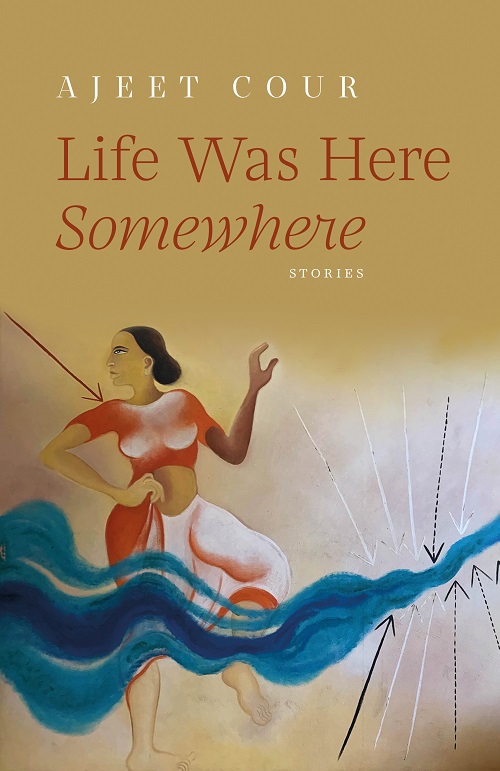
Title: Life Was Here Somewhere

Author: Ajeet Cour

Translators: Ajeet Cour and Minoo Minocha

Publisher: Speaking Tiger Books

India’s independence in 1947 came with its own set of political as well as social uncertainties and challenges. For the people displaced from their native places, it was a struggle to find a home in unknown places amidst strangers, a firm footing to hold. The stories in this collection by Ajeet Cour, a profound and powerful voice in Punjabi Literature, offer observation of everyday lives of common people in the wake of Partition and during the early years of settling of migrants in Delhi and Punjab. But more than accounts of struggle for their livelihoods, these are stories of interpersonal relationships, of pain, anguish, betrayal and heartbreaks.

Ajeet Cour was born in 1934 in Lahore and migrated to Delhi in 1947 after the Partition. She began writing short stories as a teenager and today is the author of twenty-two books which include novels, novellas, short stories, biographical sketches and translations. In 1986, she was awarded the Sahitya Akademi Award for her autobiography. In 2006, she was awarded the Padma Shri for her writing and her contributions in the field of social upliftment. She is the Founder President of the Indian Council for Poverty Alleviation, and has been President, Foundation of SAARC Writers and Literature. In 1977, Ajeet Cour also founded the Academy of Fine Arts and Literature, a non-commercial institution in New Delhi for the promotion of the arts, literature, theatre, music and dance.

This book is a collection of fourteen short stories translated from Punjabi to English by Ajeet Cour and Minoo Minocha. In her note at the beginning of this collection, the author says:

“I write because I am a witness to the horrors of daily life, day-to-day existence of people living next door, or in Punjab or Kashmir or Assam, or in Bosnia or Chechnya or Rawanda, or anywhere else in the world, feeling my destiny entwined with theirs, living in fear, dying like flies. And I can’t look the other way. I write because I believe that those who remain silent become a part of the dark conspiracy.”

The stories comprising this collection are accounts of everyday horrors faced by common people, of the brunt of estranged and conflicted relationships bore by people even as they grappled to find and hold onto a ground in life after the suffering endured during partition. Most of these stories are women centered and carry a first person narrator. The story ‘Walking a Tightrope’ is that of a woman torn between her husband and an irresponsible son disowned by his father. The author offers a nuanced glimpse into before/after the partition in a big household. She employs the image of kitchen to demonstrate a married woman’s domain as well as her confines in a patriarchal household. ‘Death Among Strangers’ is a story of a grief stricken daughter who could not take care well for her father post Partition due to the apathy of her husband. Both stories use death as the pivot which jostles the main women characters out of their pre-determined roles of mother and wife respectively. 

In some of the stories, characters navigate through the ‘babudom’ of Indian Bureaucracy. Trying to find ways to get their problems addressed, they often surrender to the system which becomes increasingly inaccessible to them. Often, the characters are irritated by the system which makes them invisible and works only at the behest of those in power. The title of such a story ‘Clerk Maharaja’, otherwise an oxymoron, denotes the high esteem accorded to a regular class government employee who carries enormous power when it comes to the movement of files from one desk to the other.

In the titular story ‘Life Was Here Somewhere’, a helpless and disgruntled narrator declares the whole country as a heap of garbage no one is interested in cleaning, and those running the country as visceral creatures feasting on the stinking pile.

The story ‘The Kettle is Whispering’ explores kinship between a single and a widowed woman whereas the story ‘Unsought Passion’ explores the ugliness of unwarranted attention. Both stories take us to the corridors of working women hostels in the early years of Delhi post independence, presenting a window to the dynamics of interactions and disagreements.

In a couple of stories the horror of terrorism is explored where the loved ones are either targeted by extremists or by the forces fighting extremism. These stories focus upon the suffering families, their anxieties and pain as they try to make sense of their loss. In ‘Dead-End’ a young woman tries to save a young wounded extremist even though she is apprehensive that he might have killed her brother.

Ajeet Cour poignantly portrays the internal and interpersonal conflicts as faced by ordinary people in the course of their everyday lives in the stories of this collection. Her writing resonates with their pain, her words capture their mindscapes bearing witness to horrifying bestiality humans are capable of and continue to exhibit in their dealings with their fellow human beings. 

Rakhi Dalal is an educator by profession. When not working, she can usually be found reading books or writing about reading them. She writes at https://rakhidalal.blogspot.com/ .

.

PLEASE NOTE: ARTICLES CAN ONLY BE REPRODUCED IN OTHER SITES WITH DUE ACKNOWLEDGEMENT TO BORDERLESS JOURNAL

Click here to access the Borderless anthology, Monalisa No Longer Smiles

Click here to access Monalisa No Longer Smiles on Amazon International

Categories
A Special Tribute

A Christmas Poem by Tagore

The Child by Tagore

A Poem

~ Rabindranath Tagore ~

The final two sections of one of Tagore’s finest long poems, inspired by the life of Jesus Christ. Tagore wrote the poem first in English, in 1930, and translated it himself into Bengali the following year, titling it ‘Sishutirtha’.

                IX

The first flush of dawn glistens on the dew-dripping
leaves of the forest.
The man who reads the sky cries:
‘Friends, we have come!’
They stop and look around.


On both sides of the road the corn is ripe to the horizon—
the glad golden answer of the earth to the morning light.
The current of daily life moves slowly
between the village near the hill and the one by the
river bank.
The potter’s wheel goes round, the woodcutter brings
fuel to the market,
the cow-herd takes his cattle to the pasture,
and the woman with the pitcher on her head walks to
the well.
But where is the King’s castle, the mine of gold, the
secret book of magic,
the sage who knows love’s utter wisdom?
‘The stars cannot be wrong,’ assures the reader of the sky.
‘Their signal points to that spot.’
And reverently he walks to a wayside spring
from which wells up a stream of water, a liquid light,
like the morning melting into a chorus of tears and
laughter.
Near it in a palm grove surrounded by a strange hush
stands a leaf-thatched hut,
at whose portal sits the poet of the unknown shore, and
sings:
‘Mother, open the gate!’

X

A ray of morning sun strikes aslant at the door.
The assembled crowd feel in their blood the primaeval
chant of creation:
‘Mother, open the gate!’
The gate opens.
The mother is seated on a straw bed with the babe on
her lap,
like the dawn with the morning star.
The sun’s ray that was waiting at the door outside falls
on the head of the child.
The poet strikes his lute and sings out:
‘Victory to Man, the newborn, the ever-living.’
They kneel down, the king and the beggar, the saint and
the sinner,
the wise and the fool, and cry:
‘Victory to Man, the newborn, the ever-living.’
The old man from the East murmurs to himself:
‘I have seen!’

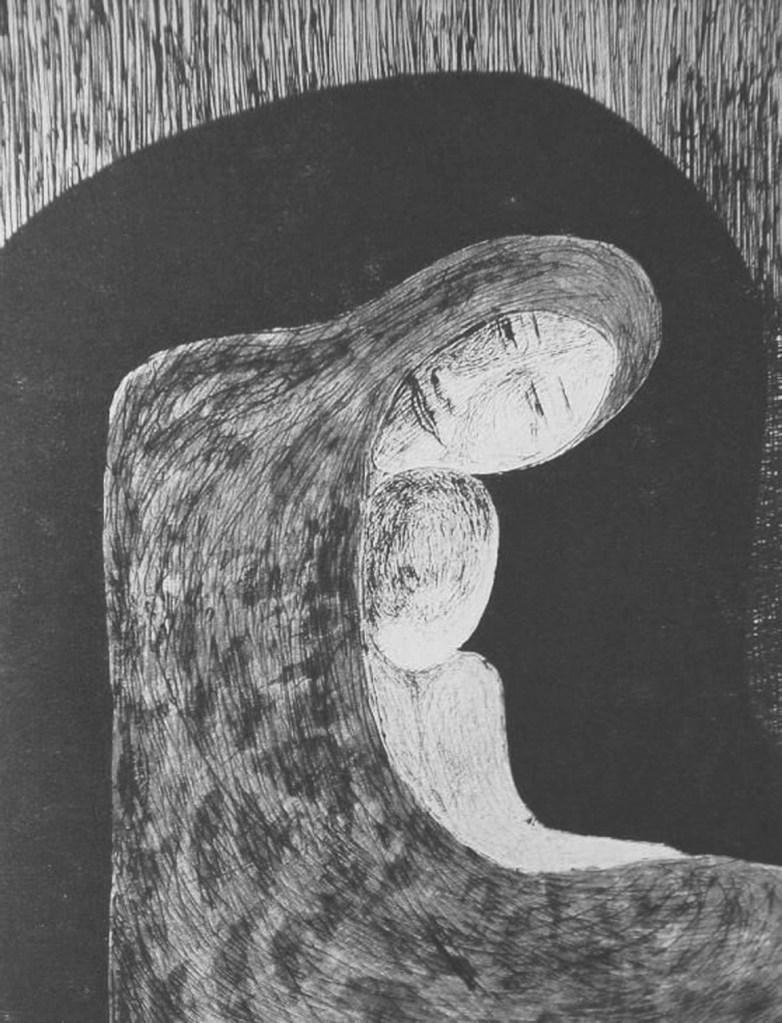
‘Mother and Child’, painting by Rabindranath Tagore. Photo Courtesy: Indian Christmas: An anthology

Extracted from Indian Christmas: Essays, Memories, Hymns, edited by Jerry Pinto and Madhulika Liddle. Published by Speaking Tiger Books, 2022.

Categories
Review

‘Burradin’: An Indian Christmas

Book Review by Somdatta Mandal

Title: Indian Christmas: Essays, Memories, Hymns

Editors: Jerry Pinto and Madhulika Liddle

Publisher: Speaking Tiger Books

We all know that Christmas Day, the night that Jesus came to earth, bringing with him peace and love for all humanity, is celebrated by Christians all around the world with great enthusiasm and merriment. Interestingly, for a multicultural country like India, Christmas is equally celebrated — not only as a religious festival but also as a cultural one. For a country where less than three percent of the population is Christian, the central celebration is the birth of a child, but it takes on new meaning in different Indian homes.  Known in local parlance also as “Burradin”[big day] Indians from all classes and communities look forward to this day when they can at least buy a cake from the local market, shower their children with stars, toys, red Santa caps and other decorative items, and go for a family picnic for lunch, dine at a fancy restaurant or visit the nearby church. This syncretic cult makes this festival unique, and for Jerry Pinto and Madhulika Liddle editing this very interesting anthology comprising of different genres of Indian writing on the topic – essays, images, poems and hymns, both in English and also translated from India’s other languages is indeed unique.

In his introduction which he titles “Unto All of Us a Child is Born,” Jerry Pinto reminisces how he was surprised when he saw his first live Santa Claus. He was a figure in red that Akbarally’s, Bombay’s first department store, wheeled out around Christmas week. “He was a thin man, not very convincingly padded… seemed to be from my part of the world, someone who would climb up our narrow Mahim stairs and leave something at the door for us at three or four a.m., then take the local back to his regular job as a postman or seller of second-hand comics. The man in the cards and storybooks preferred London and New York. And a lot of snow. … Today, it is almost a cliché to say that Christmas, like every other festival, is hostage to the market.”

The other editor, Madhulika Liddle in her introduction “Christmas in Many Flavours” states, “According to the annals of the Mambally Royal Biscuit Factory bakery in Thalassery, Kerala, its founder Mambally Bapu baked the first Christmas cake in India”.  It was way back in 1883, at the instance of an East India Company spice planter he set about trying to create a Christmas cake. Liddle wondered what that first Christmas cake tasted like; how close it was to the many thousands of cakes still baked and consumed at Christmas in Kerala? She also writes about the situation in India, where instead of wholesale and mindless importing of Christmas ideas, the people have been discerning enough to amalgamate all our favourite (and familiar) ideas of what a celebration should be and fit them into a fiesta of our own.


Images from Indian Christmas: Essays, Memories, Hymns: dressed up as Santa Claus leave for school in Punjab. (Picture courtesy: Ecocabs,Fazilka).

There are several other aspects of Christmas celebrations too. The Christmas bazaars are now increasingly fashionable in bigger cities. The choral Christmas concerts and Christmas parties are big community affairs, with dancing, community feasts, Christmas songs, and general bonhomie. Across the Chhota Nagpur area, tribal Christians celebrate with a community picnic lunch, while many coastal villages in Kerala have a tradition of partying on beaches, with the partying spilling over into catamarans going out into the surf. In Kolkata’s predominantly Anglo-Indian enclave of Bow Bazar, Santa Claus traditionally comes to the party in a rickshaw, and in much of northeast India, the entire community may indulge in a pot-luck community feast at Christmas time. Thus Liddle states:

“Missionaries to Indian shores, whether St Thomas or later evangelists from Portugal, France, Britain, or wherever brought us the religion; we adopted the faith, but reserved for ourselves the right to decide how we’d celebrate its festivals.”

Apart from their separate introductions, the editors have collated twenty-seven entries of different kinds, each one more interesting than the other, that showcase the richness and variety of Christmas celebrations across the country. Though Christianity may have come to much of India by way of missionaries from Europe or America, it does not mean that the religion remained a Western construct. Indians adopted Christianity but made it their own. They translated the Bible into different Indian languages, translated their hymns, and composed many of their own. They built churches which they at times decorated in their own much-loved ways. Their feasts comprised of food that was often like the ones consumed during Holi or Diwali.

Thus, Christmas in India turned to a great Indian festival that highlighted the syncretism of our culture. Damodar Mauzo, Nilima Das, Vivek Menezes, Easterine Kire, Hansda Sowvendra Shekhar, Nazes Afroz, Elizabeth Kuruvilla, Jane Borges and Mary Sushma Kindo, among others, write about Christmas in Goa, Nagaland, Kerala, Jharkhand, Delhi, Kolkata, Mumbai, Shillong and Saharanpur. Arul Cellatturai writes tender poems in the Pillaitamil tradition to the moon about Baby Jesus, and Punjabi singers compose tappe-boliyan about Mary and her infant. There are Mughal miniatures depicting the birth of Jesus, paintings by Jyoti Sahi and Sister Claire inspired by folk art, and pictures of Christmas celebrations in Aizawl, Bengaluru, Chennai and Kochi and these visual demonstrations enrich the text further.

Interestingly, the very first entry of this anthology is an excerpt from the final two sections of one of Rabindranath Tagore’s finest long poems, inspired by the life of Jesus Christ. Tagore wrote the poem “The Child” in 1930, first in English and translated it himself into Bengali the following year, titling it “Sishutirtha.” But many years even before that, every Christmas in Santiniketan, Tagore would give a talk about Christ’s life and message. Speaking on 25 December 1910, he said:

“The Christians call Jesus Man of Sorrow, for he has taken great suffering on himself. And by this he has made human beings great, has shown that the human beings stand above suffering.”

India celebrates Christmas with its own regional flair, its own flavour. Some elements are the same almost everywhere; others differ widely. What binds them together is that they are all, in their way, a celebration of the most exuberant festival in the Christian calendar.

Apart from the solemnity of the Church services, there is a lot of merrymaking that includes the food and drink, the song and dance. The songs often span everything from the stirring ‘Hallulujah Chorus’ to vibrant paeans sung in every language from Punjabi to Tamil, Hindi to Munda, Khariya and Mizo tawng.

Among the more secular aspects of Christmas celebrations are the decorations, and this is where things get even more eclectic. Whereas cities and towns abound in a good deal of mass decorating, with streets and public places being prettied up weeks in advance, rural India has its own norms, its own traditions. Wreaths and decorated conifers are unknown, for instance, in the villages of the Chhota Nagpur region; instead, mango leaves, marigolds and paper streamers may be used, and the tree to be decorated may well be a sal or a mango tree. Nirupama Dutt tells us how since her city had no firs and pines, she got her brother’s colleague to fetch a small kikar tree as kikars grew aplenty in the wild empty plots all over Chandigarh. In many entries we read about how Christmas decorations were rarely purchased but were cleverly constructed at home.

A very integral part of the Christmas celebrations of course is music. In many Goan Catholic neighbourhoods, Jim Reeves continued to haunt the listeners in his smooth baritone: “I’ll have a blue Christmas without you/ I’ll be so blue thinking about you/ Decorations of red on a green Christmas tree/ Won’t mean a thing, dear, if you’re not here with me.”  Simultaneously, the words and music of “A Christmas Prayer” by Alfred J D’Souza are as follows: “Play on your flute/ Bhaiyya, Bhaiyya/ Jesus the saviour has come./ Put on your ghungroos/ Sister, Sister/ Dance to the beat of the drums!/ Light up a deepam in your window/ Doorstep, don with rangoli/ Strings of jasmine, scent your household/ Burn the sandalwood and ghee,/ Call your neighbour in, smear vermillion/ Write on his forehead to show/ A sign that we are one/ Through God’s eternal Son/ In friendship and in love ever more!/ Ah! Ah!” But the most popular Christmas song was of course “Jingle bells, jingle bells, jingle all the way….”

In “Christmas Boots and Carols in Shillong”, Patricia Mukhim tells us how the word ‘Christmas’ triggers a whole host of activities in Meghalaya and other Northeastern states that have a predominantly Christian population. Apart from cleaning and painting the houses, everything looks like fairyland during Christmas, a day for which they have been waiting for an entire year. She particularly mentions the camaraderie that prevails during this time:

“Christmas is a time when invitations are not needed. Friends can land up at each others’ homes any time on Christmas Eve to celebrate. Most friends drop by with a bottle of wine and others pool in the snacks and the party continues until the wee hours of morning. It’s one day in the year when the state laws that noise should end at 10 p.m. is violated with gay abandon. …Shillong [is] a very special place on Planet Earth. Everyone from the chief minister down can strum the guitar and has a voice that could put lesser mortals to shame. And Christmas is also a day when all VIPism and formalities are set aside. You can land up at anyone’s home and be welcomed in. It does not matter whether someone is the chief minister, a top cop, or the terrifying headmistress of your school.”

One very significant common theme in all the multifarious entries is the detail descriptions provided on food, especially the makeshift way Christmas cakes are baked in every home and the Indian way meat and other specialties are being prepared on the special day. There are several entries that give us details about the particular food that was prepared and consumed at the time along with actual recipes about baking cakes. “Christmas Pakwan[1]” by Jaya Bhattcharji Rose, “The Spirit of Christmas Cake” by Priti David, and “Armenian Christmas Food in Calcutta” by Mohona Kanjilal need special mention in this context.  Liddle in her introduction wrote:

“Our Christmas cakes are a reflection of how India celebrates Christmas: with its own religious flair, its own flavour. Some elements are the same almost everywhere; others differ widely. What binds them together is that they are all, in their way, a celebration of the most exuberant festival in the Christian calendar.”

Later in her article “Cake Ki Roti at Dua ka Ghar[2],” the house where they lived in Saharanpur, Uttar Pradesh, she wrote how her parents told her that ‘bajre ki tikiyas’, thin patties made of pearl millet flour sweetened with jaggery, used to be a staple at Christmas teatime at Dua ka Ghar[3], though she has no recollection of those. She of course vividly recalls the ‘cake ki roti’. This indigenisation of Christmas is something that’s most vividly seen in the feasting that accompanies Christmas celebrations across the country. While hotels and restaurants in big cities lay out spreads of roast turkey (or chicken, more often), roast potatoes and Christmas puddings, the average Indian Christian household may have a Christmas feast that comprises largely of markedly regional dishes.

In Kerala, for instance, duck curry with appams is likely to be the piece de resistance. In Nagaland, pork curries rich in chillies and bamboo shoots are popular, and a whole roast suckling pig (with spicy chutneys to accompany it) may hold centre stage. A sausage pulao, sorpotel and xacuti would be part of the spread in Goa, and all across a wide swathe of north India, biriyanis, curries, and shami kababs are de rigueur at Christmas.

This beautifully done book, along with several coloured pictures, endorses the idea of religious syncretism that prevails in India. As a coiner of words, Nilima Das came up with the idea that ‘Christianism’ in our churches is after all, a kind of ‘Hinduanity’ (“Made in India and All of That”). This reviewer feels guilty of not being able to mention each of the unique entries separately that this anthology contains, so it is suggested that this is a unique book to enjoy reading, to possess, as well as to gift anyone during the ensuing Christmas season.

[1] Cuisine

[2] Cake bread

[3] Blessed House

Somdatta Mandal, critic, academic and translator, is a former Professor of English at Visva-Bharati, Santiniketan, India.

Click here to access an excerpt of Tagore’s The Child

PLEASE NOTE: ARTICLES CAN ONLY BE REPRODUCED IN OTHER SITES WITH DUE ACKNOWLEDGEMENT TO BORDERLESS JOURNAL

Click here to access the Borderless anthology, Monalisa No Longer Smiles

Click here to access Monalisa No Longer Smiles on Kindle Amazon International

Categories
Review

A Case for the Body: Kuhu Joshi’s My Body Didn’t Come Before Me

Book Review by Basudhara Roy

Title: My Body Didn’t Come Before Me
Author: Kuhu Joshi
Publisher: Speaking Tiger Books

The body is a text, writing and written on. As much of this text is ‘given’ as it is ‘fashioned’, its meaning continually negotiated at the intersections of self, society, and culture. Thoroughly personal, the body cannot, at the same time, escape from being spectacularly public because in its corporeality, it constantly responds to the material and metaphysical dimensions of the world around it. A body is being, becoming, possession, as also performance. It is, at the same time, uncertainty, liability, incarceration, and an alibi against everything that we might wish it to be.

In Kuhu Joshi’s slim collection of thirty-five poems titled My Body Didn’t Come Before Me (Speaking Tiger, 2023), the problematic of the body is placed at the centre of poetic inquiry. The crisp and categorical title catches the readers’ attention first and in many ways, the cover offers a brilliant paratext to the ideas in this book as it evocatively underlines a conversation between girlhood, body, nature, and form.

We are never merely inhabitants of our bodies but also bear responsibility for our embodiment. The question of identity is, to a great extent, framed by questions of embodiment, and the conformity of the body to established cultural codes. Such conformity, however, is a sheer travesty of nature. Kuhu Joshi’s poems chart the development and growth of selfhood through severe scoliosis or spinal deformity and the experience of alienation that gathers around it led by societal conventions of normalcy.

Central to these poems is a conflict between embodiment and selfhood, and the numerous ways in which socio-cultural codes of accomplishment, lifestyle, and beauty dictate the need for possessing the ‘perfect’ body. Often, ideas of romance and scripts of love and longing also reiterate the same narrative, rendering desire and its fulfilment both difficult and transgressive. This book is an ardent statement of such experiences of otherness and an activist desire to dismiss them into the idea of individuality or selfhood.

Joshi’s poems delineate subtle contradictions between the body-as-construct and the body-as-experience with insight, freshness, and candour. There is little sentimentality in these pages, almost no lamentations of victimhood, and hardly any regret for life as it has been or is. But in their abrupt matter-of-factness and remarkable economy of expression, these poems manage to communicate a startling range of emotions – pain, fear, shame, depression, self-loathing, forbearance, and self-confidence.

The collection, interestingly, begins with ‘I tell myself I am beautiful’, a poem that on the page curves itself like a scoliotic spine: “…And I tell myself/ I am beautiful/ so I do not feel the need/ to be normal. I tell myself/ I am beautiful/ so I do not feel the need/ to be something I am not.” The poem offers a convergence of several themes that will underlie the book – embodiment, normalcy, beauty, de/form/ity, narrativisation, and selfhood.

Despite the grand diversity of bodies that inhabit this world and the  numerous modes of embodiment, stereotypes of normalcy rule our everyday lives to such an extent that even the slightest deviation from the norm sparks reactions that inject within us feelings of otherness. Such narratives of otherness can only be combated through self-fashioned narratives of beauty, experience, identification and identity.

The body at the centre of these poems is a body consistently othered by medical discourse. But it is also, and with equal tenacity, a female body that through its girlhood, adolescence, pubescence and growth, must bear the implications of this otherness in more ways than one with the result that everyday narratives of friendship, safety, love, and desire are complicated in their enunciation. In ‘The girl with a rod’, one of the most tender poems in the collection, the subtle yet dramatic inter-gender confrontation between two adolescents raises several questions on normalcy, vulnerability, and comfort in social spaces – here, the seemingly innocuous space of a school bus.

And yet, the speaker in these poems acknowledges that when it comes to another scoliotic body, her own gaze is marked by the same curiosity that borders on the invasion of privacy and the transgression of personal space. In ‘A girl. Scoliotic’, she begins with the confession “I don’t remember her name./ I remember her Instagram handle. sco.lio/-something. I remember clicking on her/ to compare her/ curves to mine. ” In this virtual encounter, the social media profile representing the individual becomes the object of the speaker’s scrutiny and realisation that ‘my curve/ was never that curvy’, she offers a mirror-reaction to socio-cultural perceptions of her own identity.

The cold professionalism of medical procedures and the seeming detachment or unconcern of medical practitioners that work together to objectify the dis-eased body, establish themselves strongly in these poems – “I think a lot about the cold, wet plaster./ And the hands of the doctor/ moulding it around my waist.” (‘In this one you win’) In ‘The day of the fitting’, the doctor at the Spinal Injuries Hospital who ‘does not look at me. He says namaste to Mom’ is, paradoxically, also the one whose hands ‘messing’ with plaster across her torso intimately gather “the skeleton of my body. In his hands/ the silence of my spine, white and hollow. ”

In the two poems ‘What your doctor will not tell you:’ and ‘What your doctor will tell you:’, Joshi compresses with remarkable skill and deftness the two sides of the experience of embodiment – the private and the public, the subjective and the objective, the circular and the linear, and most importantly, the marginal and the mainstream. The doctor’s “Kuch nahin hota hai” and “Lacheeli” (with regard to the spine), find their alternative truths in the speaker’s “Hard-back chairs will hurt no matter what. ” and “Do not listen to ‘Sexy Back’”.

A hint of the Father as Patriarch lurks decisively in this collection in the speaker’s equivocal relationship to male figures of reverence and in her repeated seeking for comfort among women. There is the father who, because he is absent in ‘Nani’s house[1]’, the children are “free to dream”. In ‘The protector of life’, Joshi writes:

…The protector of life
is a man, and I
am not surprised. Neither are you.
I assure you. God
was a man too. This is what we
were given, you and I, Eves weeded out
of the garden of life. 

In ‘Enter a garden in new delhi’, she contrasts the injunctions placed on the female body with the careless freedom of male bodies that manage to remain beyond cultural surveillance– “all around you there are/men/spread/men spread out/spread all around/legsflopping backssprawling/handscratching bodiesrelaxing” In ‘Five stages’, the speaker asks “Is it odd to extend responsibility/ for my body?” and the unarticulated answer is ‘no’ since our bodies are continually being transformed and redefined both physically and psychologically by our personal and social encounters.

With its articulate language, assertive voice, and sharp images, Kuhu Joshi’s My Body Didn’t Come Before Me makes a potent debut, emphasising subjective embodiment as a form of resistance, and offering an alternate cultural site to reimagine normativity.

*Note: Kuhu Joshi has recovered from scoliosis or spinal deformity and is currently based in New York City where she is a professor of creative writing and English composition. She has been the recipient of the Jane Cooper Poetry Fellowship and was awarded an honourable mention for the Academy of American Poets’ University Prize in 2021. She is the co-author of the chapbook Private Maps (Human/Kind Press, 2020) and founder of the poetry workshop ‘The Terrible Joy of Poetry’.

[1] Maternal grandmother’s house

Basudhara Roy teaches English at Karim City College affiliated to Kolhan University, Chaibasa. Author of three collections of poems, her latest work has been featured in EPW, The Pine Cone Review, Live Wire, Lucy Writers Platform, Setu and The Aleph Review among others. 

.

PLEASE NOTE: ARTICLES CAN ONLY BE REPRODUCED IN OTHER SITES WITH DUE ACKNOWLEDGEMENT TO BORDERLESS JOURNAL

Click here to access the Borderless anthology, Monalisa No Longer Smiles

Click here to access Monalisa No Longer Smiles on Kindle Amazon International

Categories
Excerpt

Poetry by Mamang Dai

Title: The White Shirts of Summer: New and Selected Poems

Author: Mamang Dai

Publisher: Speaking Tiger Books

Hello, Mountain

Every morning when the forest wakes
The canopy goes for a walk
Hailing the sun, courting the wind
Discussing fruit and weather

The idle moss turns into velvet
Branches make signs.
Who says there is no time?
The only thing we are given is Time.

Chattering life high above,
Babel of tree dwellers.
For a seed falling so far down
To rise again, time is a given.
A foothold for the hunger of a weed,
Colour, scent, camouflage
And the grass that never sleeps

Shooting up to meet the gaze of the mountain.
How are you, mountain?
Is everything all right?
Is the earth growing old,
Birds flying away, trees falling?


After Gabo

No one can say it like you said it,
about love and magic,
solitude and growing old.

Here it’s white butterflies
whirling around in the garden
and the scent of bitter almond
is the scent of orange blossom.

You know, love is a virus too,
jumping ship,
landing up in ports and cities
so eager, enchanted
by the banks of another river
in the time of quarantine.

There are lines and lines
of communication
jostling through a virtual pandemic,
a sadness named, unnamed.

Fermina Daza, is it true:
Everything is in our hands?

Outside my window
red hibiscus, red.
If the aim is to survive,
it’s time to weigh anchor again.

For how long? Who knows.

Our old life is gone.
It’s another summer
and the pages are turning
in a chronicle of things foretold.

One battered flag in a time of lockdown.
Despite contrary winds
a battered flag is fluttering,
you’ll see it here and there
pointing in the direction of the future.
Salt water, caresses,
buoyant as the hearts of old lovers
young enough to believe
in forever.

(Extracted from The White Shirts of Summer: New and Selected Poems by Mamang Dai. Published by Speaking Tiger Books, 2023.)

About the Book:

 ‘A major voice in Indian English literature, and literature from North East India…[Her] poems are like a race of butterflies bargaining with the night.’

Keki Daruwalla

‘Dai’s poetic world is one of river, forest and mountain, a limpid and lyrical reflection of the terrain of her home state. Nature here is mysterious, verdant with myth, dense with sacred memory. There is magic to be found everywhere…But as you read closer, you [also] sense a more sinister undertow: this paradisiacal landscape is also one of “guns and gulls”, punctuated by “the footfall of soldiers”. You also realize that the simplicity of Dai’s verse is not without guile. It possesses a gentle persuasive riverine tug that can lead you to moments of heart-stopping surprise.

‘For all its simplicity, Dai’s poetry does not arrive at easy conclusions. There is no dishonest sense of anchor here, no blissful pastoral idyll. The poet describes her people as “foragers for a destiny” and her work is pervaded by a deep unease about erased histories and an uncertain future. And yet, implicit in her poetics is the refusal to divorce protest from love. This seems to translate into a commitment to a poetry of quiet surges and eddies rather than gritty textures and edges…[and] a tone that is hushed, wondering, thoughtful, reflective. The strength of this poetry is its unforced beauty and clarity, its ability to steer clear of easy flamboyance.’

Arundhathi Subramaniam

About the Author

 Mamang Dai, poet and novelist, was born in Pasighat, Arunachal Pradesh. A former journalist and a Padma Shri awardee, Dai is the author of a short story collection, The Legends of Pensam, and the novels Stupid Cupid, The Black Hill (winner of the Sahitya Akademi Award) and Escaping the Land (longlisted for the JCB Prize). Dai lives in Itanagar, Arunachal Pradesh.

.

PLEASE NOTE: ARTICLES CAN ONLY BE REPRODUCED IN OTHER SITES WITH DUE ACKNOWLEDGEMENT TO BORDERLESS JOURNAL