Categories
Slices from Life

Suga Didi

By Snigdha Agrawal

A Santhali woman

She stood somewhere at 5 feet 8 inches.  Of athletic build.  Swarthy skin. A face full of punch holes; ravages of smallpox during childhood.  Her disarming smile more than made up for the lack of a flawless complexion.  The girls were told she was being employed as their Ayah, with strict instructions to address her as ‘Didi[1]’.  The Ayah affix after her name, was a ‘no’, ‘no’ in a Bengali household.  So, it was Suga Didi right from day one. The rest of the elite living in the cosmopolitan community frowned upon such bourgeois sentiments.

Suga lived in a Santhal village, on a river bluff, surrounded by dense Sal Forest. Inaccessible by road and cut off from civilisation. The only Santhal village in the area, close to the gated community, offering employment opportunities to the tribals. Not that they were keen on leaving the village to work in the steel and brick factories. Suga was the one-off amongst them venturing out from her cloistered society.  She arrived for the interview, hair oiled, drawn back from her face tied into a chignon, and dressed in a cotton saree with a red border, way above her ankles. The blouse was missing. Her attire would surely be viewed as improper in the elitist community.    She spoke in the Santhal dialect, with words common to Bengali and Hindi.  Amenable to change, she did not resist the suggestion of wearing a blouse, nor letting down the saree border to her ankles, when reporting for work.  Agreed happily to the working hours from 6.30 am to 4.30 pm, five days a week.  During school vacations, morning reporting was pushed back to 8.30 am. 

The decision to employ Suga was borne out of necessity. With four growing girls, aged between fourteen and four, or thereabouts, it was becoming increasingly difficult for their mother to handle all the chores.  Plaiting their hair, getting them dressed for school, ironing uniforms, and accompanying them to the school Bus stand, were some of the many activities entrusted to her.  Add to that, the role of a luggage carrier.  With four school bags, piled on her head, and four tiffin baskets weighed down with filled water bottles, hand-held, she shepherded the girls safely, morning and evening.  It wasn’t an easy walk. There were open drains to cross.  Heavily loaded truck movement posed a serious problem as well. She guarded them like her own. Taking care of the girls when they got home from school was also included. Occasionally, when the mood was right, she shared ancient tribal folklore, sometimes breaking into a song. 

The eldest of the four had read stories of tribal practices.  Witchcraft.  Human sacrifice.  Eating wild animals.  Men and women drinking ‘mahua’ toddy. Suga was questioned on the validity of all this to which, she neither denied nor confirmed.  Tribal secrets were not for the ears of the civilized. But she couldn’t ward off the pestering from the girls for long.  And went on to narrate the story of the Santhal deity, Bonga, visiting their village on a moonless night, in the guise of a king cobra to drive away the bad spirits living on the edge of the forest, responsible for killing the cattle.  Quietly slithering on the muddy terrain, the twelve-feet reptile, held the spirits captive, performing a wild dance with its raised hood.  And then struck.  The spirits screamed and fled, never to return. The village headsman invited the cobra for dinner, sharing toddy and barbequed lizards.  That was not the end of the story.  Suga concluded that the snake dissatisfied with the host, gobbled his head from neck upwards.  The girls held onto each other shocked out of their wits.  A bizarre ending.  Doubts were raised as to whether the story was real or imaginary, made up by Suga Didi.  Many such stories found their way into the older one’s scrapbook.  Later found in the steel trunk, along with old photos, discovered by the younger two. 

When Birbhadra the cook took leave to visit home, Suga filled in, helping out with cutting, and clipping the meat and fish.  All the preparatory work for cooking the meals.  Prepared by the lady of the house.  The girls were curious to know what Suga cooked at home. Her stock answer was hot, spicy, and unpalatable.  Their persistent pleading to cook a tribal dish at some point bore fruit. Reluctantly, she agreed to treat the household with a recipe, made from goat innards. The butcher supplying meat was duly informed to send the liver, fat, spleen, heart and intestines.  “Eww, gross!”  But not so, when the dish arrived on the dining table.  Blood red with a film of fat floating on the top, garnished with freshly chopped coriander leaves.  In no time it was polished off.  Delicious!  Delicious! All exclaimed.  Suga was on cloud nine that day.  They named the dish “Chagol Pagol Curry[2]”.  Suga’s signature dish.

It was the spring of 1959.  By then, the older girls had left for boarding school.  Younger ones then six, were pretty much able to ready themselves for school on their own. Suga’s workload had halved.  For most of her free time, she took upon herself the role of gardener, attending to the vegetable garden, and advising the gardener on how best to get good yields from her experience of growing vegetables in the village.  The smell of ‘bidi[3]’ wafting into the porch, meant the two were sharing a smoke.    

And then for over a week during that summer, she had not reported for work. Alarm bells rang in the household.  Had she fallen ill?  Had she died of cobra poisoning?  Had she been thrown out from the village for violating the rules?  Worst still, was she a victim of human sacrifice?  Concerns that kept the family awake.  No one knew her address, except that she belonged to the Santhal village on the river bluff, inaccessible to non-tribals.  A security guard from the factory was sent to find out if the headsman could be summoned to the river, under the ruse of gifting him Scotch whiskey.  Didn’t work.   No one responded to the call, announced with a handheld loudspeaker.  Several attempts were made to no avail.  Rumours mills were churning out stories of her having eloped with the cook, Birbhadra, though it made no logical sense.  Happily married with a dozen or so kids living in Begusarai, he could least afford a second wife.  Though coincidentally, Birbhadra left employment around the time Suga was out of the radar.     

It was decided there was no further need to employ a nanny aka ‘didi’ for the girls. Suga was the first and the last.  Irreplaceable.   She remains an enigma to date.

.

[1] Elder sister

[2] Crazy goat curry

[3] A type of cheap cigarette made of unprocessed tobacco wrapped in leaves

Snigdha Agrawal (nee Banerjee) is a published author of four books and a regular contributor to anthologies.  A septuagenarian, she writes in all genres of poetry, prose, short stories and travelogues.

PLEASE NOTE: ARTICLES CAN ONLY BE REPRODUCED IN OTHER SITES WITH DUE ACKNOWLEDGEMENT TO BORDERLESS JOURNAL

Click here to access the Borderless anthology, Monalisa No Longer Smiles

Click here to access Monalisa No Longer Smiles on Kindle Amazon International
Categories
Celebrating Translations

We are the World

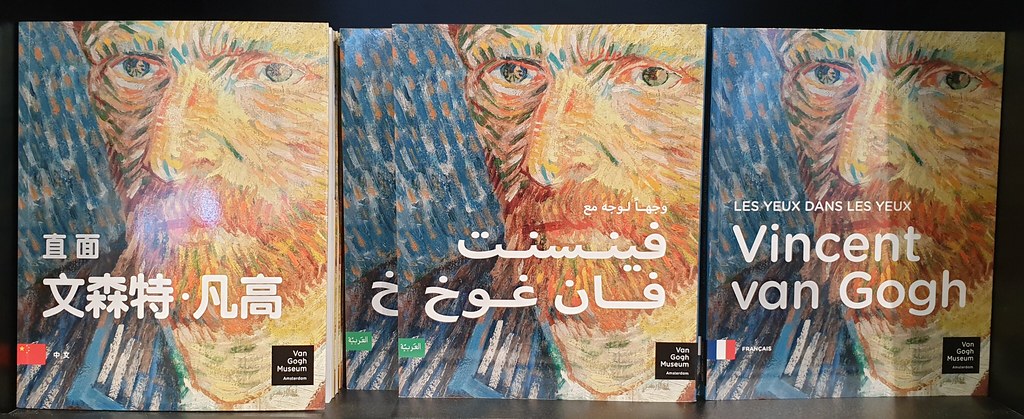
Vincent Van Gogh written is different scripts. Courtesy: Creative Commons

The whole world opens up in the realm of ideas that have existed wafting and bridging across time and space. Sometimes they find conduits to come to the fore, even though they find expression in different languages, under varied cultural milieus. One way of connecting these ideas is to translate them into a single language. And that is what many have started to do. Celebrating writers and translators who have connected us with these ideas across boundaries of time and place, we bring to you translated writings in English from twenty eight languages on the International Translation Day, from some of the most iconic thinkers as well as from contemporary voices. 

Prose

Tagore’s short story, Aparichita, has been translated from Bengali as The Stranger by Aruna Chakravarti. Click here to read. 

Travels & Holidays: Humour from Rabindranath, have been translated from Bengali by Somdatta Mandal. Click here to read.

Hena, a short story by Nazrul, has been translated from Bengali by Sohana Manzoor. Click hereto read.

Munshi Premchand’s Balak or the Child has been translated from Hindi by Anurag Sharma Click here to read.

Munshi Premchand’s Pus Ki Raat or A Frigid Winter Night  has been translated from Hindi by C Christine Fair. Click here to read.

Nadir Ali’s The Kabbadi Player has been translated from Punjabi by Amna Ali. Click here to read.

Kamaleswar Barua’s Uehara by  has been translated from Assamese and introduced by Bikash K. Bhattacharya. Click here to read.

S Ramakrishnan’s Muhammad Ali’s Singnature has been S. Ramakrishnan, translated from Tamil by Dr B. Chandramouli. Click here to read. 

PF Mathews’ Mercy,  has been translated from Malayalam by Ram Anantharaman. Click here to read.

Road to Nowhere, an unusual story about a man who heads for suicide, translated from Odiya by the author, Satya Misra. Click here to read.

An excerpt from A Handful of Sesame by Shrinivas Vaidya, translated from Kannada by Maithreyi Karnoor. Click here to read.

Writings from Pandies’ Corner highlight the ongoing struggle against debilitating rigid boundaries drawn by societal norms. Each piece is written in Hindustani and then translated by a volunteer from Pandies’ in English. Click here to read.

Rakhamaninov’s Sonata, a short story by Sherzod Artikov, translated from Uzbeki by Nigora Mukhammad. Click here to read.

Of Days and Seasons, a parable by the eminent Dutch writer, Louis Couperus (1863-1923), translated by Chaitali Sengupta. Click here to read.

The Faithful Wife, a folktale translated from Balochi by Fazal Baloch. Click here to read.

An excerpt from Ramy Al-Asheq’s Ever Since I Did Not Die, translated from Arabic by Isis Nusair, edited by Levi Thompson. The author was born in a refugee camp. Click here to read.

Poetry

Two songs by Tagore written originally in Brajabuli, a literary language developed essentially for poetry in the sixteenth century, has been translated by Radha Chakravarty. Click here to read. 

Rebel or ‘Bidrohi’, Nazrul’s signature poem,Bidrohi, translated from Bengali by Professor Fakrul Alam. Click here to read.

Banlata Sen, Jibananada Das’s iconic poem, translated from Bengali by Professor Fakrul Alam. Click here to read. 

Poetry of Michael Madhusudan Dutt has been translated from Bengali by Ratnottama Sengupta. Click here to read.

Our Children, a poem by well-known Iranian poet, Bijan Najdi, has been translated from Persian by Davood Jalili. Click here to read.

Akbar Barakzai’s Be and It All Came into Being has been translated from Balochi by Fazal Baloch. Click here to read.

Biju Kanhangad’s The Girl Who Went Fishing has been translated from Malayalam by Aditya Shankar. Click here to read.

Jitendra Vasava’s Adivasi Poetry,  translated from the Dehwali Bhili via Gujarati by Gopika Jadeja. Click here to read.

Sokhen Tudu’s A Poem for The Ol Chiki, translated from the Santhali by Hansda Sowvendra Shekhar. Click here to read.

Thangjam Ibopishak’s Gandhi & Robot translated from the Manipuri by Robin S Ngangom. Click here to read.

 Rayees Ahmad translates his own poem, Ab tak Toofan or The Storm that Rages, from Urdu to English. Click here to read.

Poetry by Sanket Mhatre has been translated by Rochelle Potkar from Marathi to English. Click here to read.

An excerpt from Evening with a Sufi: Selected Poemsby Afsar Mohammad, translated from Telugu by Afsar Mohammad & Shamala Gallagher. Click hereto read.

Ihlwha Choi’s Universal Language written at Santiniktan, translated from Korean by the poet himself. Click here to read.

Sangita Swechha’s Motherhood: A Tiny Life inside Me has been translated from Nepali by Hem Bishwakarma. Click here to read.

Rosy Gallace’s Two poems from Italy  have been translated from Italian by Irma Kurti. Click here to read.

Poetry in Bosnian written and translated from Bosnian by Maid Corbic. Click here to read.

Lesya Bakun translates three of her own poems from Ukranian and Russian to English. Click here to read.

Poems from Armenia by Eduard Harents translated from Armenian by Harout Vartanian. Click here to read.

Categories
Review

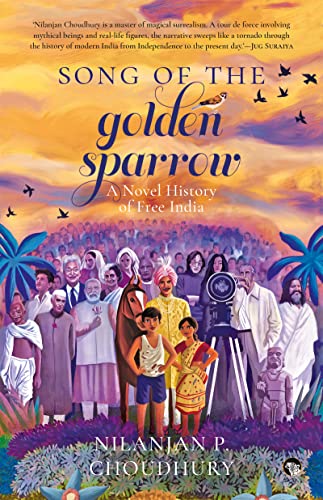
Song of the Golden Sparrow

Book Review by Rakhi Dalal

Title: Song of the Golden Sparrow – A Novel History of Free India

Author: Nilanjan P. Choudhary

Publisher: Speaking Tiger Books

Song of the Golden Sparrow by Nilanjan P.Choudhary is a defiant and gripping novel set in independent India, of its many successes and failures, and of its spirit – often battered by its own people.  Choudhury is a new voice from the Northeast. His most recent book, Shillong Times, has been widely acclaimed. His debut novel, a mythological thriller entitled Bali and the Ocean of Milk, was a best-seller.

Placed within the period 1947 to 2022, the Song of the Golden Sparrow sets out to chronicle the history of India as witnessed by a sparrow named Prem Chandra Guha, who is actually a yaksha banished from the kingdom of Alaka by Lord Kubera and punished with the task of writing the history of India. The yaksha, a shape-shifter, finds it convenient to take the form a sparrow, a little bird for the task. Exactly when India enters its tryst with destiny, this sparrow reaches the small town of Netrahat near the forests of Chhota Nagpur and meets Manhoos and Mary. As the fates of Manhoos and Mary take them to various places across India, the sparrow follows too, covering in its wake the important events from their lives; events intertwined with the fate of independent India itself.

Manhoos is an illiterate and orphaned boy, working at a garage. Mary is a spirited tribal girl from a nearby Santhal village. Both are good friends and almost meet every day until they are separated by circumstances. Taken in by a Prince, Manhoos, later Manu, moves to the city of Calcutta from Netrahat, where he learns to read and write and takes on enterprises with the motive to earn money. Mary’s village, on the other hand, is destroyed by the government to make way for land mines. Time brings them together again and they make efforts to stay together. Their lives, however, knotted by various events taking place in the country, diverge to different paths.

The yakhsha or sparrow, who is their constant companion, observes the turns in their lives brought about and affected by larger events like industrialisation, liberation of Bangladesh, rise of Naxal movement[1], imposition of emergency, birth of Jana Sangh, chipko andolan[2], fall of a mosque, liberalisation of economy, IT boom, development of Silicon Valley of India, 2002 Gujrat, upheaval of 2014 and pandemic of 2020.

Choudhary employs the tools of magical realism to blend the historical facts with mythology and satire, creating a narrative that not only lets us imagine the lives of ordinary people, carving their own way after independence but also to visualise the many complexities and contradictions which were not only inherited but also turned inevitable as India marched on to the path of progress after attaining freedom from colonial rule. 

Figuratively, Manu and Mary represent two distinct facets of independent India which has co-existed amid the incongruities brought about by the political and economic events and has largely shaped the realities of everyday life of common people. Whereas Manu symbolises the progressive, liberal and democratic spirit of the country which desires to advance, to progress and become wealthier by taking every opportunity that arises, Mary is the voice of oppressed people. Manu belongs to the India which made advancement through industrialisation, IT or real estate and cashed on the economic boom brought about by liberalisation of economy. Mary belongs to the India which keeps fighting the system that continues exploiting them whether by displacing them from their homes, their forests, their lands or by not giving them due share in the profits of development whose wheels are turned by them. Their final separation signifies the divide which overtime became even more difficult to address and heal.

The progressive Manu becomes disenchanted with wealth after his wife Sayoni is brutally killed during 2002 Gujrat riots. He returns to his roots and tries to make a meaningful life by devoting himself to the preservation of forests of his homeland. He adopts Ismail, an orphan like him, who is a brilliant young boy and has dreams of pursuing higher education. In 2016, Ismail is heckled to death on the suspicions of cow smuggling. This leaves Manu shattered. And he dies soon afterward.

Through the portrayal of disenchantment and despair of Manu, the author sketches the gloom which has shrouded the country in the last decade. Towards the end, the yaksha sparrow also experience anguish on having to observe and chronicle events which have bloodied the land and the spirit of the country over and over again. As a historian, despite all this, his task is far from over. For he has to keep recording all the incidents for the posterity. It is a tale that asks to be read.

[1] Maoist insurgency in India

[2] The Chipko andolan was a non-violent social and ecological movement by villagers, particularly women, in India in the 1970s, to protect trees and forests slated for government-backed logging.

.

Rakhi Dalal is an educator by profession. When not working, she can usually be found reading books or writing about reading them. She writes at https://rakhidalal.blogspot.com/ .

.

PLEASE NOTE: ARTICLES CAN ONLY BE REPRODUCED IN OTHER SITES WITH DUE ACKNOWLEDGEMENT TO BORDERLESS JOURNAL. 

Click here to access the Borderless anthology, Monalisa No Longer Smiles

Click here to access Monalisa No Longer Smiles on Kindle Amazon International