Categories
Contents

Borderless, March 2023

Art by Sohana Manzoor

Editorial

Imagine… Click here to read.

Translations

A translation from Nabendu Ghosh’s autobiography, Eka Naukar Jatri (Journey of a Lonesome Boat), translated by Dipankar Ghosh, from Bengali post scripted by Ratnottama Sengupta. Click here to read.

Uehara by Kamaleswar Barua has been translated from Assamese and introduced by Bikash K. Bhattacharya. Click here to read.

Kurigram by Masud Khan has been translated by Professor Fakrul Alam from Bangla. Click here to read.

Bonfire by Ihlwha Choi has been translated from Korean by the poet himself. Click here to read.

Tagore’s Borondala (Basket of Offerings) has been translated by Mitali Chakravarty from Bengali. Click here to read.

Poetry

Click on the names to read the poems

Michael R Burch, Kirpal Singh, Luis Cuauhtémoc Berriozábal, Amit Parmessur, Carl Scharwath, Isha Sharma, Gale Acuff, Anannya Dasgupta, Vaishnavi Saritha, Ryan Quinn Flanagan, Pragya Bajpai, George Freek, Sanket Mhatre, Ron Pickett, Asad Latif, Rhys Hughes

Poets, Poetry and Rhys Hughes

In Indian Pale Ale, Rhys Hughes experiments with words and brews. Click here to read.

Conversation

Being fascinated with the human condition and being vulnerable on the page are the two key elements in the writing of fiction, author and poet Heidi North tells Keith Lyons in a candid conversation. Click here to read.

Musings/Slices from Life

Mother Teresa & MF Hussian: Touching Lives

Prithvijeet Sinha muses on how Mother Teresa’s painting by MF Hussain impacted his life. Click here to read.

The Night Shift to Nouméa

Meredith Stephens writes of her sailing adventures to Nouméa. Click here to read.

Musings of a Copywriter

In Simian Surprises, Devraj Singh Kalsi describes monkey antics. Click here to read.

Notes from Japan

In Multicultural Curry, Suzanne Kamata reflects on mingling of various cultures in her home in Japan and the acceptance it finds in young hearts. Click here to read.

Essays

Which way, wanderer? Lyric or screenplay…

Ratnottama Sengupta explores the poetry in lyrics of Bollywood songs, discussing the Sahityotsav (Literary Festival) hosted by the Sahitya Akademi. Click here to read.

One Happy Island

Ravi Shankar takes us to Aruba, a Dutch colony, with photographs and text. Click here to read.

Cadences in A Portrait of the Artist as a Young Man

Paul Mirabile explores the stylistic nuances in this classic by James Joyce. Click here to read.

Stories

Heafed

Brindley Hallam Dennis plays with mindsets. Click here to read.

Busun

A Jessie Michael narrates a moving saga of displacement and reservations. Click here to read.

A Wooden Smile

Shubhangi gives us poignant story about a young girl forced to step into the adult world. Click here to read.

The Infallible Business

Sangeetha G tells a story set in a post-pandemic scenario. Click here to read.

Book Excerpts

An excerpt from Robin S. Ngangom’s My Invented Land: New and Selected Poems. Click here to read.

An excerpt from Vikas Prakash Joshi’s My Name is Cinnamon. Click here to read.

Book Reviews

Aruna Chakravarti reviews Bornali Datta’s In A Better Place: A Doctor’s Journey. Click here to read.

Somdatta Mandal reviews Baba Padmanji’s Yamuna’s Journey, translated from Marathi by Deepra Dandekar. Click here to read.

Basudhara Roy reviews Robin Ngangom’s My Invented Land: New and Selected Poems. Click here to read.

Bhaskar Parichha reviews S.Irfan Habib’s Maulana Azad – A Life. Click here to read.

.

Click here to access the Borderless anthology, Monalisa No Longer Smiles

Click here to access Monalisa No Longer Smiles on Kindle Amazon International
Categories
Review

A Thinker who Fought for an Inclusive India

Book Review by Bhaskar Parichha

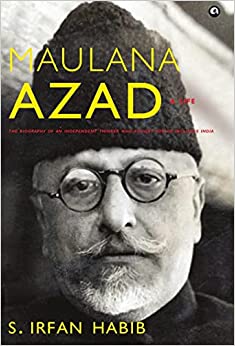
Title: Maulana Azad – A Life

Author: S.Irfan Habib

Publisher: Aleph Book Company

At a time when India is celebrating its 75th anniversary of independence, it is only fitting that Maulana Azad’s contributions to the country should be remembered. He was one of the most prominent Muslim leaders in India’s freedom movement, whose contribution to the establishment of the education foundation in India is recognised by observing his birthday across the country as “National Education Day”.

Azad became the youngest member of Congress to hold a presidential post. Using his position to work to re-unite the Swarajists and the Khilafat leaders under the common banner of the Congress. He opposed the Partition of India because he thought Muslims would be more powerful and dominant in a united India. After independence, he became the first Minister of Education in the Indian government. In 1992, he was posthumously awarded India’s highest civilian award, the Bharat Ratna.

Maulana Azad – A Life by S. Irfan Habib is “the biography of an independent thinker who fought for an inclusive India”. In this in-depth chronicle, historian Habib takes the reader through some of the most decisive moments in Azad’s life.

 A widely published historian of science and modern political history, Habib was the Maulana Azad Chair at the National University of Educational Planning and Administration, New Delhi. He has authored To Make the Deaf Hear: The Ideology and Programme of Bhagat Singh and His Comrades and is the editor of Indian Nationalism: The Essential Writings.

Says the blurb: “Born into an orthodox family of famed Islamic scholars, Azad was deeply influenced by the pan-Islamic philosophies of Sir Syed Ahmad Khan and Jamaluddin Afghani. Azad had no formal education, but he was an autodidact who taught himself about culture, philosophy, languages, and literature. As a teenager, he successfully published several magazines and newspapers and went on to publish the immensely popular Urdu weekly Al-Hilal through which he tried to persuade Indian Muslims to shake off the shackles of British rule. He became inspired by Gandhi’s non-violent civil disobedience movement and was extremely critical of the Muslim League’s communal politics.”

Azad’s unusual upbringing, his illustrious family, upheavals in the Islamic world, and the initial inklings of Azad’s freethinking outlook on life. ‘Maulana Azad and Critical Thinking in Islam’ examines the various schools of thought, ethical questions, and pan-Islamic debates that shaped Azad’s religious attitudes and his approach to the idea of nationalism. ‘Azad, Islam, and Nationalism’ looks at Azad’s political career and his unwavering belief in composite nationalism and staunch opposition to the Muslim League’s sectarian politics. ‘Ghubar-i-Khatir Beyond Faith and Politics’ lays bare Azad’s philosophical moorings and personal likes and dislikes through a collection of epistolary essays written during his imprisonment in the Ahmednagar Fort prison in the 1940s. And, finally, ‘Building a New India’ charts Azad’s efforts to strengthen the country’s weak education system through initiatives aimed at primary and adult education, his efforts towards the scientific and cultural advancement of the country, and his contribution to the arts and culture of a newly independent nation.”

As Habib writes, “justice is all the more relevant to education as a process of harmonious nurture. Indeed, social justice commands a pivotal place in Azad’s general perspective, which influenced his educational outlook quite profoundly. He was conscious of the fact that a class or caste-ridden education system needed to be replaced by a more inclusive and just educational order. In 1948, while addressing the educational conference, Azad again reiterated that education, at any rate, must be pushed forward as rapidly as possible. We must not, for a moment, forget that it is the birthright of every individual to receive at least the basic education, without which he cannot discharge his duties as a citizen.”

Writes Habib : “With a view to gearing education towards the cause of democracy, he, in his very first official statement, referred to Disraeli’s verdict: ‘A democracy has no future unless it educates its masters.’” In independent and democratic India, with universal franchise as the key principle, the voter was truly the master of democracy, and Azad wanted this voter to be educated and aware. He was conscious of the sad inheritance of colonial inequalities, where 85 per cent of the country’s population was illiterate on the eve of Independence. Several classes and caste discriminations were discussed for the first time, and it was necessary to eliminate them immediately.

Azad was convinced, according to the biography, that the state had to play a key role in combating such social afflictions and provide everyone with the means to “the acquisition of knowledge and self-betterment”; however, the most disconcerting factor was the lack of necessary funds to carry forward the state’s responsibilities. Azad conceded with a sense of guilt as minister of education that the central government had allotted only 1 per cent of the funds in the budget for education. He therefore urged the Constituent Assembly to raise expenditure to 10 per cent.

Maulana Azad pursued the issue with passion and was able to raise the allocation from Rs 20 million to around Rs 350 million during his tenure as minister of education. On September 30, 1953, Azad addressed the nation on All India Radio, reiterating that “every individual has a right to an education that will enable him to develop his faculties and live a full human life.”

In about three hundred pages of inexorable text, Habib reconstructs the life of the remarkable man while arguing that Azad is more relevant now than ever before. An essential read for understanding India’s pre-independence history and the significance of a dedicated life.   

Bhaskar Parichha is a journalist and author of UnbiasedNo Strings Attached: Writings on Odisha and Biju Patnaik – A Political Biography. He lives in Bhubaneswar and writes bilingually. Besides writing for newspapers, he also reviews books on various media platforms.

PLEASE NOTE: ARTICLES CAN ONLY BE REPRODUCED IN OTHER SITES WITH DUE ACKNOWLEDGEMENT TO BORDERLESS JOURNAL

Click here to access the Borderless anthology, Monalisa No Longer Smiles

Categories
Review

Building a Free India

Book Review by Bhaskar Parichha

Title: Building A Free India

Author: Rakesh Batabyal

Publisher: Speaking Tiger Books

“Under this Flag there is no prince and there is no peasant, there is no rich and there is no poor… Whether we be Hindus or Muslims, Christians, Jains, Sikhs or Zoroastrians and others, our Mother India has one undivided heart and one indivisible spirit.” — Sarojini Naidu, poet and political activist, on the resolution on the national flag in the Constituent Assembly, 22 July 1947

The immutability of prodigious speeches and their magnifying impact on people can’t be underestimated. The prize of a great speech comes from pure wisdom that originates from indulgence. These words from Naidu’s speech can work as magic anytime one reads them.

Building A Free India – Defining Speeches of Our Independence Movement that Shaped the Nation by Rakesh Batabyal is just the book you needed to read as India celebrates her 75th year of its independence. It is a thought-provoking assemblage of solicitous speeches delivered by some of the most prominent Indian personalities.

Many of these men and women have made invaluable contributions to India’s coming together as a nation of people and are the pride and honour of the sub-continent. These are people who impacted the lives around them. Their words were the gems that had the power to evoke courage and emotion in countless people and inspire them to make history.

Rakesh Batabyal teaches history, theory, and philosophy of media at the Centre for Media Studies, Jawaharlal Nehru University. His The Penguin Book of Modern Indian Speeches is widely accepted as an important work in the genre. He is working on a book on the history of nationalism in India.

Says the blurb: “The new public sphere that emerged in nineteenth- and early-twentieth-century India was a space that enabled magnificent public oratory, particularly that which mounted a challenge to colonial rule. From social and political platforms like the Indian National Congress, in the courts of law, or inside legislative bodies, leaders of the freedom struggle gave eloquent and clear-eyed articulations of not only the social, economic, and political problems that faced India and their possible solutions but also the kind of sovereign nation we must collectively aspire to be. India’s democratic ethos was a product of these foundational ideas of the freedom movement.”

Building a Free India brings together these landmark speeches delivered over roughly a century by the leading lights of the national movement—from Dadabhai Naoroji, Surendranath Banerjee, Bhikaiji Cama, Lajpat Rai, and Tilak, to Gandhi, Nehru, Ambedkar, Bose, Sarojini Naidu, and Maulana Azad—as well as a range of lesser-known but equally remarkable figures.

Writes Batabyal in the book: “As the movement progressed—from the economic critique of colonial rule by the early nationalists to the unequivocal demand for Purna Swaraj[1] and the immense moral authority of the Mahatma Gandhi-led resistance—the notion of an equal society that ensured dignity to all—irrespective of caste, class, gender or religion—came to occupy a central place in it. By the time the Constituent Assembly met in December 1946, not just civil rights, but the particular rights of women, of minorities, of the Depressed Classes, and the Adivasis were being articulated and demanded, not as favours but as a matter of course.” As the editor of this volume writes in his brilliant introduction, the effect of the speeches delivered by the leaders of our national movement was to focus “political action towards scripting an ennobling nationalism that would give us a just and equal society”.

A couple of speeches in the book are captivating. This one by India’s philosopher-President Dr Sarvepalli Radhakrishnan on India’s history and legends reads: “Our pledge tells us that this ancient land shall attain her rightful and honored place. We take pride in the antiquity of this land for it is a land which has seen nearly four or five millenniums of history. It has passed through many vicissitudes and at the moment it stands, still responding to the thrill of the same great ideal. Civilization is a thing of the spirit; it is not something external, solid, and mechanical. It is the dream in the people’s hearts. It is the inward aspiration of the people’s souls. It is the imaginative interpretation of human life and the perception of the mystery of human existence. That is what civilization actually stands for.

‘We should bear in mind these great ideals which have been transmitted to us across the ages. In this great time of our history, we should bear ourselves humbly before God, brace ourselves for this supreme task that is confronting us and conduct ourselves in a manner that is worthy of the ageless spirit of India. If we do so, I have no doubt that; the future of this land will be as great as its once glorious past.’

Painstakingly divided into six chapters, each section in the 300-plus page veers around freedom and that itself makes the collection unique. What’s more Batabyal provides a context to every single discourse.

On his way to Noakhali and in the face of the large-scale massacre, to the question ‘Will Partition Change Us Forever?’ Mahatma Gandhi replied: “I have seen more of history than anyone of you, and I tell you that I have known Hindu boys who called Muslims ‘uncle’. Hindus and Muslims used to participate in each other’s festivals and other auspicious occasions. You want to force me to leave this place but you should know that I have never submitted to force. It is contrary to my nature. You can obstruct my work, even kill me. I won’t invoke the help of the police. You can prevent me from leaving this house, but what is the use of your dubbing me an enemy of the Hindus? I will not accept the label. To make me quit, you have to convince me that I have made a mistake in coming here.”

This and many such defining speeches make the collection truly exceptional. The book  is not only a priceless history of India’s  freedom movement but also of the ideas of universal equality, dignity, and justice that are—and must always remain—at the root of any democracy. The assortment of some sixty communicative moments of oratory would provide the reader with a fresh perspective and evoke feelings of patriotism, motivation, and infinite stimulus.


[1] Full self-rule

.

Bhaskar Parichha is a journalist and author of UnbiasedNo Strings Attached: Writings on Odisha and Biju Patnaik – A Political Biography. He lives in Bhubaneswar and writes bilingually. Besides writing for newspapers, he also reviews books on various media platforms.

.

PLEASE NOTE: ARTICLES CAN ONLY BE REPRODUCED IN OTHER SITES WITH DUE ACKNOWLEDGEMENT TO BORDERLESS JOURNAL