Categories
Interview Review

Of Wanderers and Migrants & Anuradha Kumar

A review of Anuradha Kumar’s Wanderers, Adventurers, Missionaries: Early Americans in India (Speaking Tiger Books) and an interview with the author

Migrants and wanderers — what could be the differences between them? Perhaps, we can try to comprehend the nuances. Seemingly, wanderers flit from place to place — sometimes, assimilating bits of each of these cultures into their blood — often returning to their own point of origin. Migrants move countries and set up home in the country they opt to call home as did the family the famous Indian actor, Tom Alter (1950-2017).
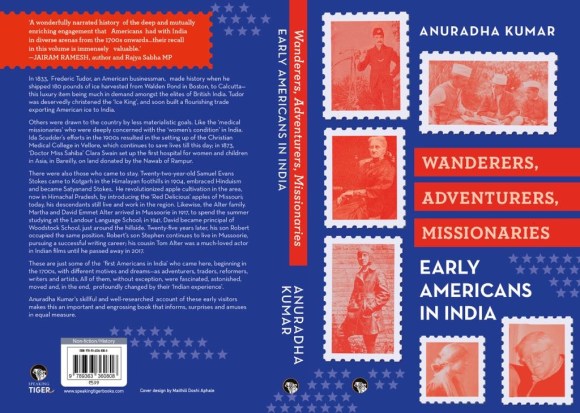
Anuradha Kumar’s Wanderers, Adventurers, Missionaries: Early Americans in India captures the lives and adventures of thirty such individuals or families — including the Alter family — that opted to explore the country from which the author herself wandered into Singapore and US. Born in India, Kumar now lives in New Jersey and writes. Awarded twice by the Commonwealth Foundation for her writing, she has eight novels to her credit. Why would she do a whole range of essays on wanderers and migrants from US to India? Is this book her attempt to build bridges between diverse cultures and seemingly diverse histories?

As Kumar contends in her succinct introduction, America and India in the 1700s were similar adventures for colonisers. In the Empire Podcast, William Dalrymple and Anita Anand do point out that the British East India company was impacted in the stance it had to colonisers in the Sub-continent after their experience of the American Revolution. And America and India were both British colonies. They also were favourites of colonisers from other European cultures. Just as India was the melting pot of diverse communities from many parts of the world — even mentioned by Marco Polo (1254-1324) in The Kingdom of India — America in the post-Christopher Columbus era (1451-1546) provided a similar experience for those who looked for a future different from what they had inherited. The first one Kumar listed is Nathaniel Higginson (1652-1708), a second-generation migrant from United Kingdom, who wandered in around the same time as British administrator Job Charnock (1630-1693) who dreamt Calcutta after landing near Sutanuti[1].

Kumar has bunched a number of biographies together in each chapter, highlighting the commonality of dates and ventures. The earliest ones, including Higginson, fall under ‘Fortune Seekers From New England’. The most interesting of these is Fedrick Tudor (1783-1864), the ice trader. Kumar writes: “In Calcutta, Dwarkanath Tagore, merchant and patron of the arts (Rabindranath Tagore’s grandfather), expressed an interest to involve himself in ice shipping, but Tudor’s monopoly stayed for some decades more. Tagore was part of the committee in Calcutta along with Kurbulai Mohammad, scion of a well-established landed family in Bengal, to regulate ice supply.”

Also associated with the Tagore family, was later immigrant Gertrude Emerson Sen (1890-1982, married to Boshi Sen). She tells us, “Tagore wrote Foreword to Gertrude Emerson’s Voiceless India, set in a remote Indian village and published in 1930. Nobel Laureate Rabindranath Tagore called Emerson’s efforts, ‘authentic’.” She has moved on to quote Tagore: “The author did not choose the comfortable method of picking up information from behind lavish bureaucratic hospitality, under a revolving electric fan, and in an atmosphere of ready-made social opinions…She boldly took in on herself unaided to  enter a region of our life, all but unexplored by Western tourists, which had one great advantage, in spite of its difficulties, that it offered no other path to the writer, but that of sharing the life of the people.’” Kumar writes of an Afro-American scholar, called Merze Tate who came about 1950-51 and was also fascinated by Santiniketan as were some others.

Another name that stuck out was Sam Higginbottom, who she described as “the Farmer Missionary” for he was exactly that and started an agricultural university in Allahabad. Around the same time as Tagore started Sriniketan (1922), Higginbottom was working on agricultural reforms in a different part of India. In fact, Uma Dasgupta mentions in A History of Sriniketan: Rabindranath Tagore’s Pioneering work in Rural Reconstruction that Lord Elimhurst, who helped set up the project, informed Tagore that “another Englishman” was doing work along similar lines. Though as Kumar has pointed out, Higginbottom was a British immigrant to US — an early American — and returned to Florida in 1944.

There is always the grey area where it’s difficult to tie down immigrants or wanderers to geographies. One such interesting case Kumar dwells on would be that of Nilla Cram Cook, who embraced Hinduism, becoming in-the process, ‘Nilla Nagini Devi’, as soon as she reached Kashmir with her young son, Sirius. She shuttled between Greece, America and India and embraced the arts, lived in Gandhi’s Wardha ashram and corresponding with him, went on protests and lived like a local. Her life mapped in India almost a hundred years ago, reads like that of a free spirit. At a point she was deported living in an abject state and without slippers. Kumar tells us: “Her work according to Sandra Mackey combined ‘remarkable cross-cultural experimentation’ and ‘dazzling entrepreneurship.’”

The author has written of artists, writers, salesmen, traders (there’s a founder/buyer of Tiffany’s), actors, Theosophists, linguists fascinated with Sanskrit, cyclists — one loved the Grand Trunk Road, yet another couple hated it — even a photographer and an indentured Afro-American labourer. Some are missionaries. Under ‘The Medical Missionaries: The Women’s Condition’, she has written of the founders of Vellore Hospital and the first Asian hospital for women and children. Some of them lived through the Revolt of 1857; some through India’s Independence Movement and with varied responses to the historical events they met with.

Kumar has dedicated the book to, “…all the wanderers in my family who left in search of new homes and forgot to write their stories…” Is this an attempt to record the lives of people as yet unrecorded or less recorded? For missing from her essays are famous names like Louis Fischer, Webb Miller — who were better known journalists associated with Gandhi and spent time with him. But there are names like Satyanand Stokes and Earl and Achsah Brewster, who also met Gandhi. Let’s ask the author to tell us more about her book.

Anuradha Kumar

What made you think of doing this book? How much time did you devote to it? 

These initially began as essays for Scroll; short pieces about 1500-1600 words long. And the beginnings were very organic. I wrote about Edwin Lord Weeks sometime in 2015. But the later pieces, most of them, were part of a series.

I guess I am intrigued by people who cross borders, make new lives for themselves in different lands, and my editors—at Scroll and Speaking Tiger Books—were really very encouraging.

After I’d finished a series of pieces on early South Asians in America, I wanted to look at those who had made the journey in reverse, i.e., early Americans in India, and so the series came about, formally, from December 2021 onward. I began with Thomas Stevens, the adventuring cyclist and moved onto Gertrude Emerson Sen, and then the others. So, for about two years I read and looked up accounts, old newspapers, writings, everything I possibly could; I guess that must mean a considerable amount of research work. Which is always the best thing about a project like this, if I might put it that way.

What kind of research work? Did you read all the books these wanderers had written?

Yes, in effect I did. The books are really old, by which I mean, for example, Bartolomew Burges’ account of his travels in ‘Indostan’ written in the 1780s have been digitized and relatively easy to access. I found several books on Internet Archive, or via the interlibrary loan system that connects libraries in the US (public and university). I looked up old newspapers, old magazine articles – loc.gov, archive.org, newspapers.com, newspaperarchive.com, hathitrust.org and various other sites that preserve such old writings.

You do have a fiction on Mark Twain in India. But in this book, you do not have very well-known names like that of Twain. Why? 

Not Twain, but I guess some of the others were well-known, many in their own lifetime. Satyanand Stokes’ name is an easily recognisable still especially in India, and equally familiar is Ida Scudder of the Vellore Medical College, and maybe a few others like Gertrude Sen, and Clara Swain too. I made a deliberate choice of selecting those who had spent a reasonable amount of time in India, at least a year (as in the case of Francis Marion Crawford, the writer, or a few months like the actor, Daniel Bandmann), and not those who were just visiting like Mark Twain or passing through. This made the whole endeavour very interesting. When one has spent some years in a foreign land, like our early Americans in India, one arguably comes to have a different, totally unique perspective. These early Americans who stayed on for a bit were more ‘accommodating’ and more perceptive about a few things, rather than supercilious and cursory.

And it helped that they left behind some written record. John Parker Boyd, the soldier who served the Nizam as well as Holkar in Indore in the early 1800s, left behind a couple of letters of complaint (when he didn’t get his promised reward from the East India Company) and even this sufficed to try and build a complete life.

How do these people thematically link up with each other? Do their lives run into each other at any point? 

Yes, I placed them in categories thanks to an invaluable suggestion by Dr Ramachandra Guha, the historian. I’d emailed him and this advice helped give some shape to the book, else there would have been just chapters following each other. And their lives did overlap; several of them, especially from the 1860s onward, did work in the same field, though apart from the medical missionaries, I don’t think they ever met each other – distances were far harder to traverse then, I guess.

What is the purpose of your book? Would it have been a response to some book or event? 

I was, and am, interested in people who leave the comforts of home to seek a new life elsewhere, even if only for some years. Travelling, some decades ago, was fraught with risk and uncertainty. I admire all those who did it, whether it was for the love of adventure, or a sense of mission. I wanted to get into their shoes and see how they felt and saw the world then.

Is this because you are a migrant yourself? How do you explain the dedication in your book? 

I thought of my father, and his cousins, all of whom grew up in what was once undivided Bengal. Then it became East Pakistan one day and then Bangladesh. Suddenly, borders became lines they could never cross, and they found new borders everywhere, new divisions, and new homes to settle down in. They were forced to learn anew, to always look ahead, and understand the world differently.

When I read these accounts by early travellers, I sort of understood the sense of dislocation, desperation, and sheer determination my father, his cousins felt; maybe all those who leave their homes behind, unsure and uncertain, feel the same way.

You have done a number of non-fiction for children. And also, historical fiction as Aditi Kay. This is a non-fiction for adults or all age groups? Do you feel there is a difference between writing for kids and adults? 

I’d think this is a book for someone who has a sense of history, of historical movements, and change, and time periods. A reader with this understanding will, I hope, appreciate this book.

About the latter half of your question, yes of course there is a difference. But a good reader enters the world the writer is creating, freely and fearlessly, and I am not sure if age decides that.

You have written both fiction and non-fiction. Which genre is more to your taste? Elaborate. 

I love anything to do with history. Anything that involves research, digging into things, finding out about lives unfairly and unnecessarily forgotten. The past still speaks to us in many ways, and I like finding out these lost voices.

What is your next project? Do you have an upcoming book? Do give us a bit of a brief curtain raiser. 

The second in the Maya Barton-Henry Baker series. In this one, Maya has more of a lead role than Henry. It’s set in Bombay in the winter of 1897, and the plague is making things scary and dangerous. In this time bicycles begin mysteriously vanishing… and this is only half the mystery!

We’ll look forward to reading a revival of the characters fromThe Kidnapping of Mark Twain: A Bombay Mystery. Thanks for your time and your wonderful books.

.

[1] Now part of Kolkata (Calcutta post 2001 ruling)

Click here to read an excerpt from Wanderers, Adventurers, Missionaries: Early Americans in India

(This review and online interview is by Mitali Chakravarty)

PLEASE NOTE: ARTICLES CAN ONLY BE REPRODUCED IN OTHER SITES WITH DUE ACKNOWLEDGEMENT TO BORDERLESS JOURNAL

Click here to access the Borderless anthology, Monalisa No Longer Smiles

Click here to access Monalisa No Longer Smiles on Kindle Amazon International
Categories
Slices from Life

From Cape Canaveral to Carnarvon

Narrative by Meredith Stephens & photographs by Alan Noble

The Prime Meridian Line.

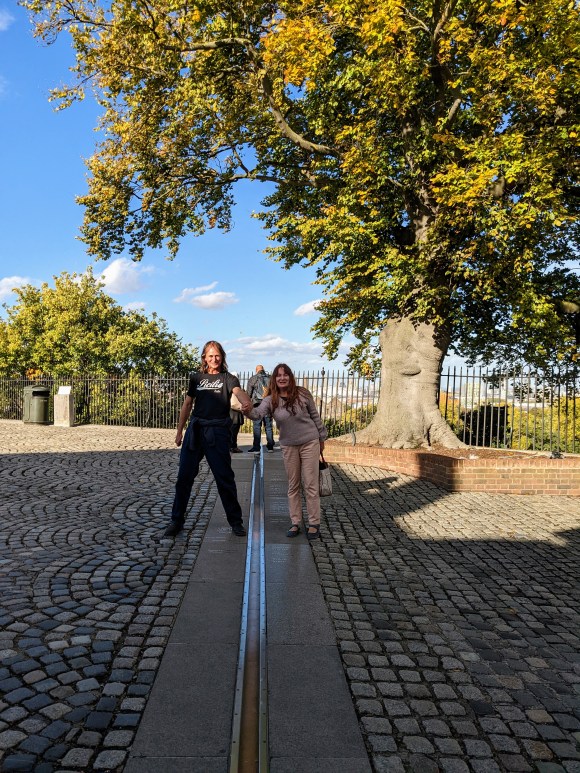
Whenever we visit another city, Alex and I always head straight for a science or maritime museum. When we spent a day in London several years ago, Alex insisted that we visit the National Maritime Museum in Greenwich, and then the Royal Observatory. The highlight of the latter was John Harrison’s marine timekeepers, which made the calculation of longitude at sea possible, therefore making navigation safer. A fun part of visiting the Observatory was standing on either side of the Prime Meridian Line, which defines zero longitude and divides the eastern and western hemispheres of the earth. If you are facing north, the person on the left is in the western hemisphere, and the person to the right is in the eastern hemisphere. We had to queue behind other couples to stand either side of the line. The couple in front of us were taking an inordinate amount of time to have their photo taken here, from which global time is calculated.

“Time’s up!” quipped someone behind us.

“What’s time?” came a philosophical comment from someone else.

The quick banter between strangers is one of the many reasons why I love visiting London.

During our short stay we devoted hardly any time to visiting any other tourist sites. The changing of the guard at Buckingham Palace held little allure. After visiting the Royal Observatory, we strolled past the historic British clipper ship “Cutty Sark” and then caught a ferry back from Greenwich to Central London. We briefly hopped off to see the Houses of Parliament, but after having visited the Royal Observatory Alex’s curiosity was sated.

Fast forward to March 2025 and we found ourselves in a remote town in Western Australia called Carnarvon. The first attraction Alex wanted to visit was the Carnarvon Space and Technology Museum. Carnarvon has a little-known relationship to Cape Canaveral in Florida. Many people have heard of Cape Canaveral and its rocket launching site, but who has heard of the not dissimilar-sounding town of Carnarvon?

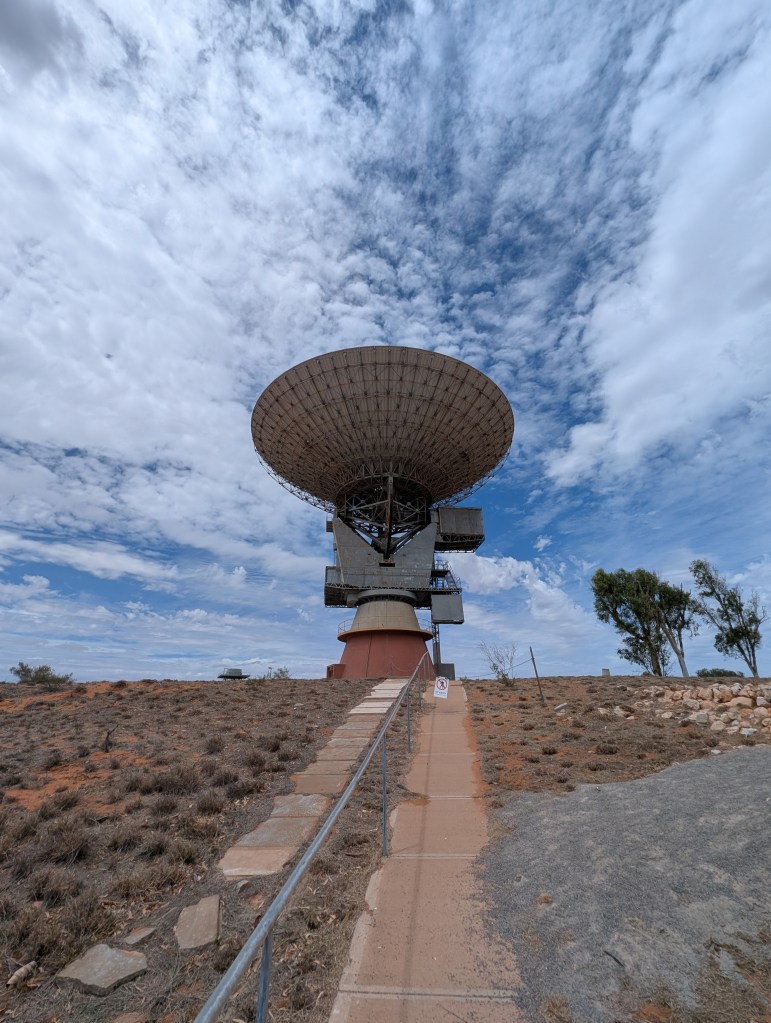
Unlike the grand public museums in Western Australia, this one is self-funded and run by volunteers. NASA established a tracking station at Carnarvon in 1964, which played a critical role for both the Gemini and Apollo programs. Carnarvon was strategically located as the most distantly located site on the earth diametrically opposite from Cape Canaveral, providing the ability to track spacecraft over the Indian Ocean that were out of range from Cape Canaveral. The most famous launch was Apollo 11 in July 1969, which achieved humanity’s dream of landing humans on the Moon and safely returning them to Earth.

This museum was different from public museums in that when we visited it was managed by a grey nomad couple from the east coast. (“grey nomad” is an Aussie term for retirees who embark on an extended period of travel around the country, usually in a caravan.) A resident cat curled himself into a ball proudly on the reception desk. It was the only museum we visited in Western Australia that required a fee to enter. The first experience we sought was to hop in the replica of the Apollo capsule to get a feel for the astronauts during the July 1969 launch. I was worried about a panic attack coming on in a confined space but the manager assured me that he would open the door to let me out at any time if I felt uncomfortable. We lay down with the lower half of our bodies propped up on a platform in what we hoped was an astronaut launching posture, while footage from the 1969 launch played out on the screen in front of us. Countdown on the screen was followed by lift-off. Not only did I not have a panic attack, it felt exhilarating to be transported to Cape Canaveral in 1969. Having watched this on black and white television when we were in primary school, it was all the more meaningful to watch it as adults. After touring the rest of the museum, we returned to the Apollo capsule to experience it a second time, like the space nerds we were.

We braced ourselves to face the oppressive heat as we headed outside to view the original satellite dish. Rather than languishing as ancient technology the dish has been leased to an overseas company who were upgrading it to track satellites orbiting Earth.

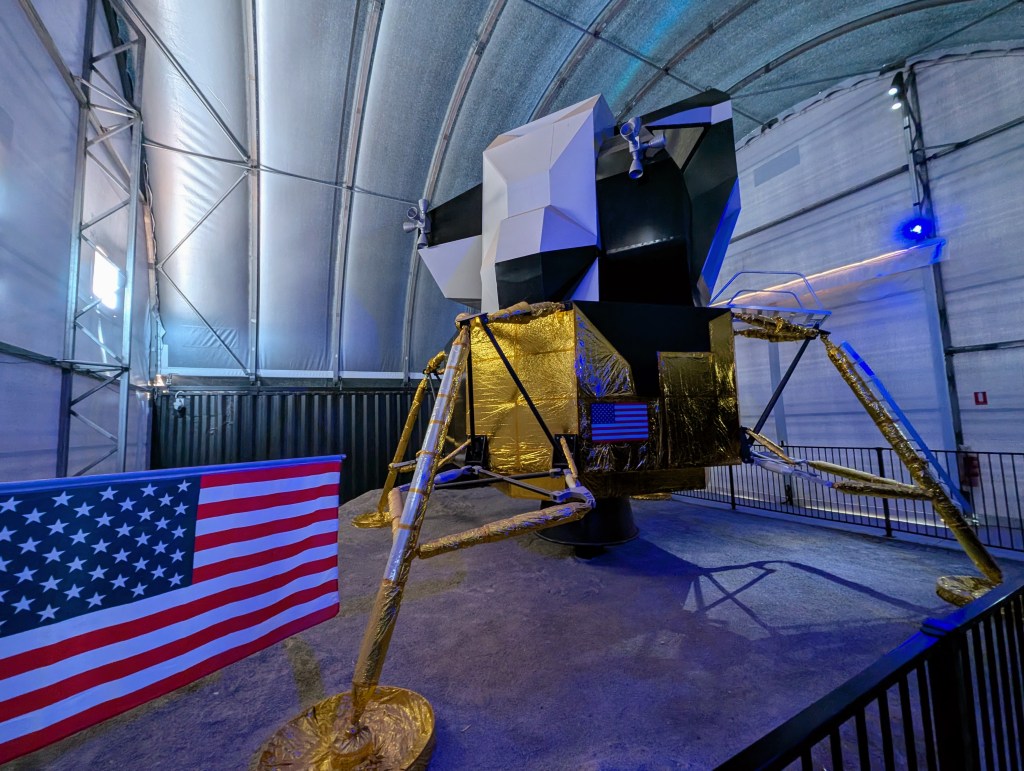
After viewing numerous 1960s space memorabilia, such as a replica of a Gemini capsule, which had preceded the Apollo series of capsules, and a life-sized replica of the lunar lander module, we bought some tourist T-shirts, chatted with the manager couple, and bade farewell to the resident cat. This was the most thrilling of the magnificent museums we visited in Western Australia. Thanks to Alex, we had a bias to visit maritime museums, including The WA Maritime Museum in Fremantle, The Museum of Geraldton, and The WA Shipwrecks Museum. They provided rich accounts of the many arrivals from distant lands to the west Australian shores since Dutchman Dirk Hartog’s nearby landing at Shark Bay in 1616. All visits were immensely educational and informative, but somehow the less glamorous Carnarvon Space and Technology Museum stood out. Unlike the public museums, it was somewhat ramshackle, but this was more than made up for in terms of authenticity and charm. Who would have thought that this outpost in regional Western Australia that even many Australians have not heard of, could have played such a pivotal role in the tracking of Apollo 11? This museum enjoys none of the fame of the Royal Observatory in Greenwich, but the role it played in history is just as moving.

.

Meredith Stephens is an applied linguist from South Australia. Her recent work has appeared in Syncopation Literary Journal, Continue the Voice, Micking Owl Roost blog, The Font – A Literary Journal for Language Teachers, and Mind, Brain & Education Think Tank. In 2024, her story Safari was chosen as the Editor’s Choice for the June edition of All Your Stories.

PLEASE NOTE: ARTICLES CAN ONLY BE REPRODUCED IN OTHER SITES WITH DUE ACKNOWLEDGEMENT TO BORDERLESS JOURNAL

Click here to access the Borderless anthology, Monalisa No Longer Smiles

Click here to access Monalisa No Longer Smiles on Kindle Amazon International
Categories
Feature

In Translation: Bitan Chakraborty

The story of Hawakal and a conversation with the founder, Bitan Chakraborty, whose responses have been translated from Bengali by Kiriti Sengupta.

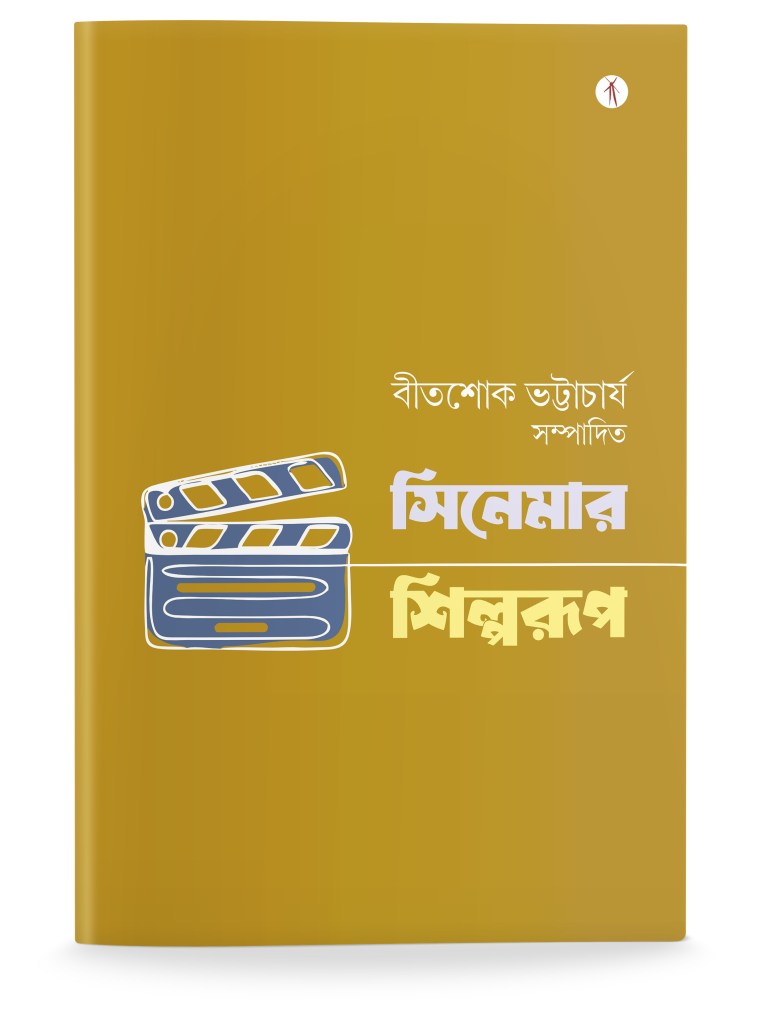
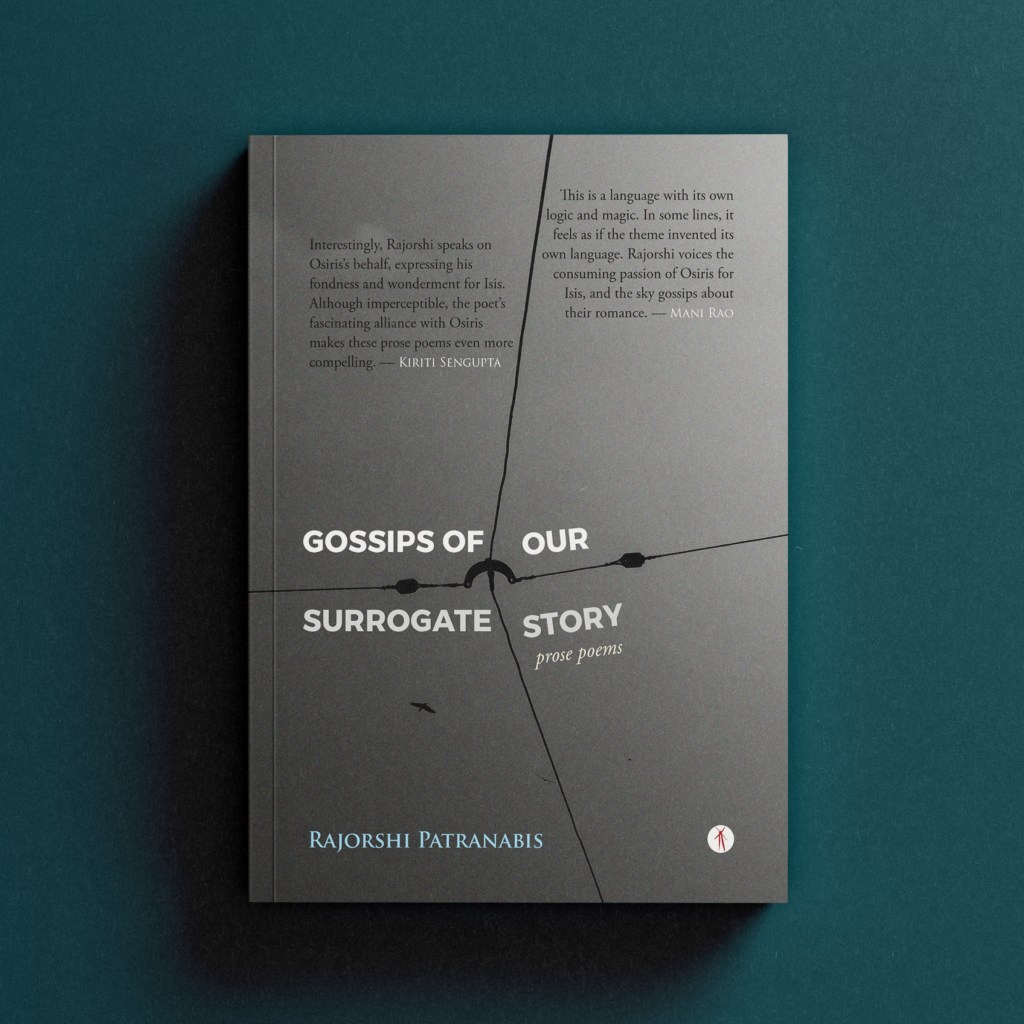
Hawakal Publishers grew out of the compulsive need young Bitan Chakraborty had to express and connect. This was a young man who was willing to labour at pasting film hoardings to fund his dreams. An Information Technology professional by training, Chakraborty realised early he did not want to tread on trodden paths and started his journey as a creative individual. Now, he not only writes and publishes but also designs the most fabulous covers and supports local craftsmen.

Over the last nearly two decades, the brand Hawakal has become synonymous with traditional poetry publication from India. They do not offer buy back deals or ask to be paid like most publishers but pick selectively. No one seems to know what it is they look for. All Chakraborty says is – “We aimed to introduce a fresh wave in publishing.”

Chakraborty writes fully in Bengali which is why the dentist-turned-writer-turned-publisher, Kiriti Sengupta, had to chip in with the translation of his responses in Bengali. Their friendship matured over the last decade when Sengupta approached Chakraborty to publish a book of critical essays, which along with essays on Sharmila Ray’s poetry homed critical writing on his too. This was the first English publication of Hawakal.

Sengupta had given up dentistry by then and was living in a hostel on a packet of Maggi a day to indulge his creative passions.  A skilled poet with a number of books under his belt, he eventually joined Chakraborty to run the English section of Hawakal.  He also translates from Bengali to English. We have one of his translations of Chakraborty’s short story, Disappearance. A powerful reminder of social gaps that exist in the Subcontinent, it’s a poignant and frightening narrative, the kind someone writes and imagines out of a passion to reform.

Some of Bitan’s works are available in English. His style — by the translations — seems graphic. The deft strokes make the landscape and the stories almost visual, like films. 

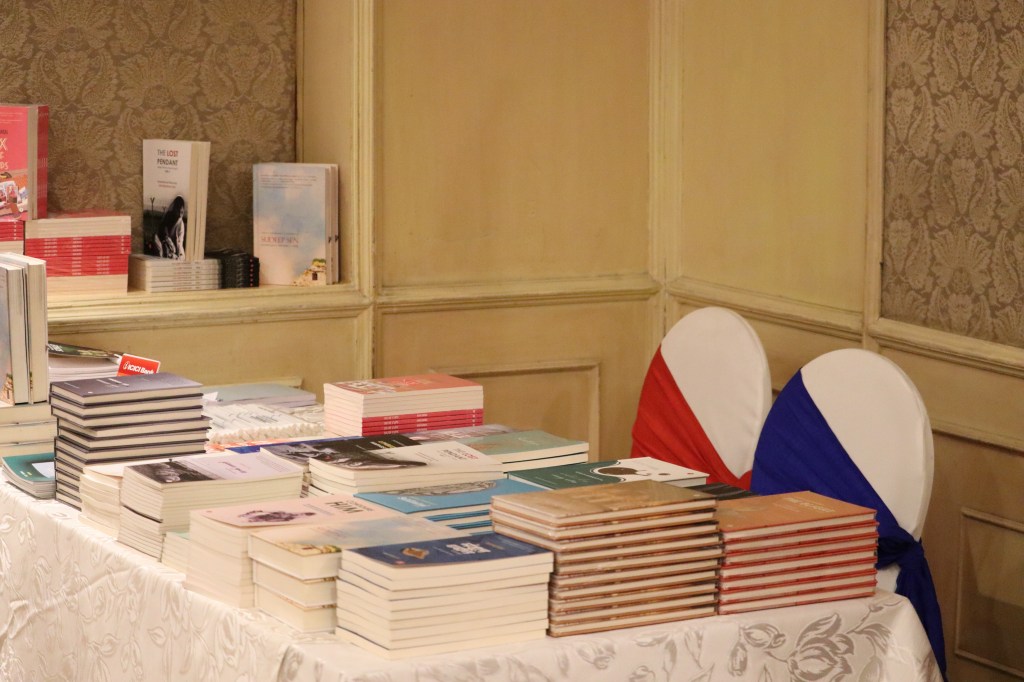
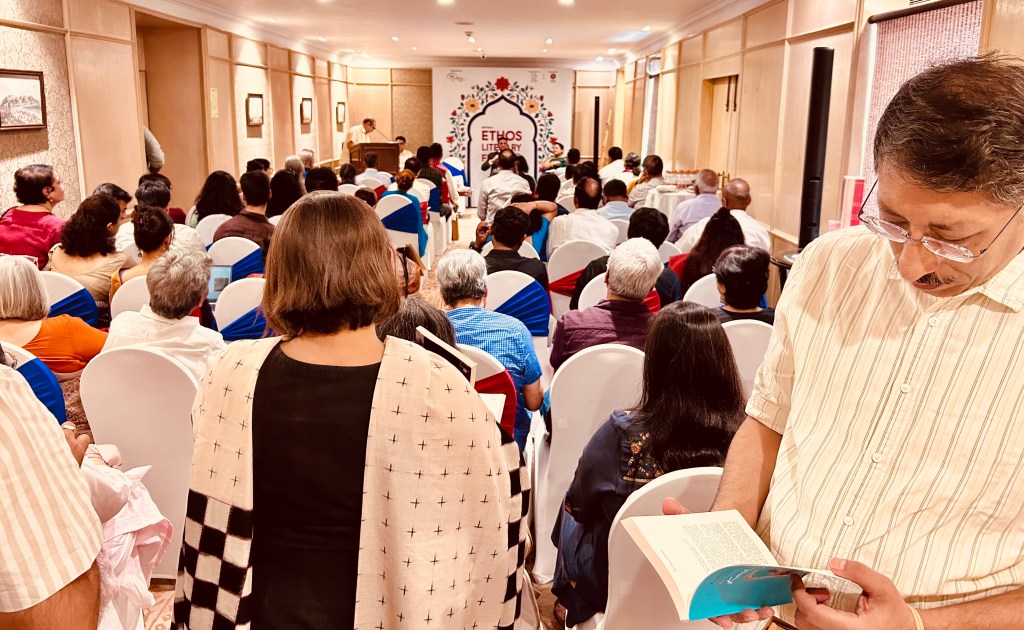
Chakraborty worked with ‘Little Magazines’ for some time. Then he made his way into publishing full time. Though he found it hard to make ends meet, he started his adventure without compromising his beliefs. He wanted to take books to readers and, with that spirit, they started the Ethos Literary Festival, where they host writers published by them. In fact, in the 2025 festival, Hawakal sold more than 400 books in seven hours! Who said poetry doesn’t sell?

Chakraborty and Sengupta have yet another hallmark. They wear matching clothes. These are tailored with material sourced from handloom weavers. They resorted to this when they found that commercialisation was killing the traditional homeborn handlooms. In that spirit, they started a clothes venture too, Mrinalika Weaves. 

Chakraborty is an unusual person – as the interview will reveal – humble, stubborn with aims like no other publisher or writer in this day and age! He doesn’t talk of money, survival, politics, awards or glamour, but what matters to him. He is direct and straightforward and perhaps, his directness is what makes his outlook appealing. He translates a few to Bengali for his own growth. But these are poets who are known for their terse writing. Maybe, that is what he looks for… Let’s find out!

Conversation
Bitan Chakraborty. Photo Courtesy: Kiriti Sengupta

Bitan, you are a multifaceted person: a writer, an artist, a photographer, and, most importantly, a publisher for all writers. What is it you most love to do and why?

I need to talk. What I observe or learn from my experiences compels me to express myself. Therefore, regardless of the medium I use, I strive to convey meaningful messages. Nevertheless, the range I enjoy in weaving words is unparalleled.

What sparked your interest in writing? Please elaborate. Do you only use Bengali to communicate with others? Do you translate from other languages to Bengali?

I felt emotionally down when I began writing. What a dreadful time it was! I believe it must be the emotional turmoil of my youth. However, writing has never left me since then. It’s more accurate to say that I have never managed to rid myself of my urge to write. During the early period, my writings contained more emotion than substance. In my college years, I was engaged in student movements that helped me discover the purpose of words. Society, socio-economic status, politics, and human dissatisfaction are the themes that run through my stories. Bengali is my mother tongue: I think, speak, dream, and curse in Bengali. I find it challenging to derive the same pleasure from using another language; it is my shortcoming.

Nevertheless, when I meet outstanding works in English, I attempt to translate them into Bengali. Not everything I read, but I have translated poems by Sanjeev Sethi and Kiriti Sengupta. I have consistently translated Gulzar into Bengali, but it has yet to be published in book format. Translation is a mental exercise; it particularly helps when I am experiencing writer’s block. I read poetry when I wish to untangle my thoughts, and when I come across fine poems in another language, I try to make them my own — bring them into my culture through translation.

Do you write only prose or poetry too?

I have been writing stories and essays for the past fifteen years. Interestingly, I began with poems, but they turned out to be junk. Therefore, I focussed on writing fiction.

Many of your stories focus on the Bengali middle class. What inspires your muse the most? People, art, nature, or is it something else?

I grew up in a lower-middle-class environment. Poverty, unemployment, and debt were parts of my formative years. I witnessed how this economic disparity allowed a particular segment of society to insult and humiliate others. Consequently, I have developed a strong affinity for those who are underprivileged. Later, when I began writing fiction, my political awareness enhanced my observations — I was able to merge the existing economic inequality with the nation’s political perspectives. The lessons I have learned over the years motivate me to write.

You design fabulous book covers. Do you have any formal training, or is it a natural flair?

When I entered the publishing industry, I had no funds to commission professionals for book covers or layouts. I had been involved with Little Magazines since my college days. I used to spend hours with the printers, meticulously observing how they designed cover spreads and interior text files. This experience proved useful when I began producing books. For the past several years, I have frequented bookstores, picking up a book or two — I also purchase books online, especially those that help me stay abreast of recent developments in book architecture. In my early years, I was unable to learn design formally due to financial constraints.

When and why did you decide to go into publishing? Could you tell us the story of Hawakal?

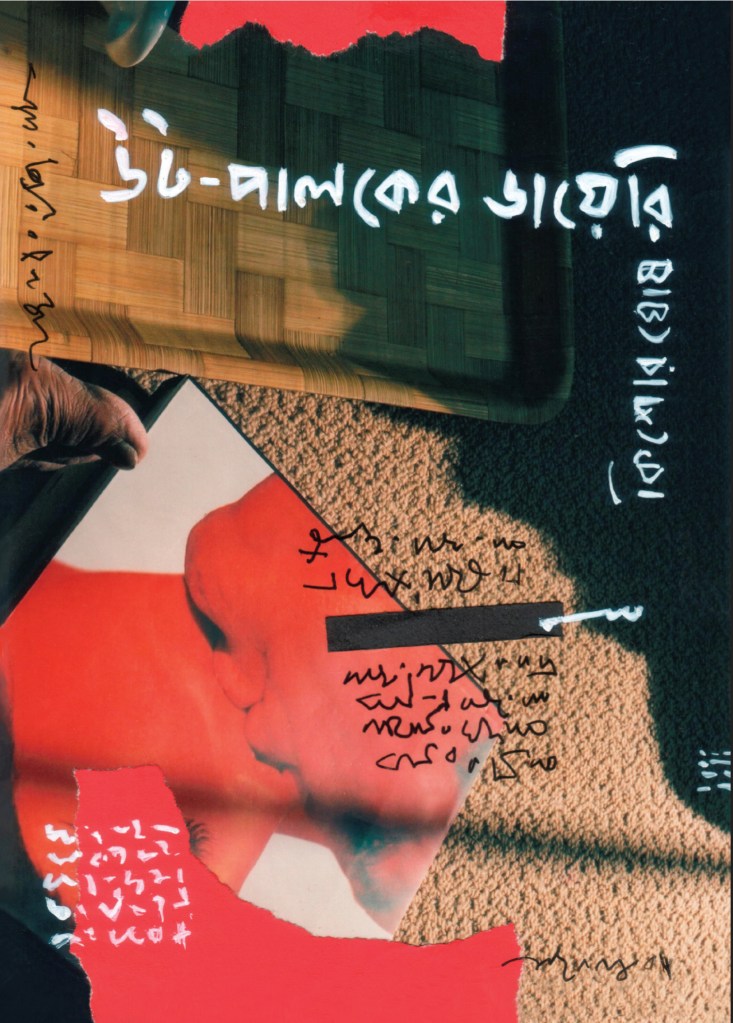
From 2003 to 2008, I was involved with four Little Magazines. Bengali Little Magazines thrive on minimal funds. Therefore, we (the team) managed everything necessary to publish a little magazine. We oversaw printing, distribution, book fairs, and other activities. By the middle of 2007, I realised I wasn’t suited for a day job. I understood that I would struggle to survive the conventional 10 am to 5 pm career. During that time, my family was in financial difficulties. Suddenly, we had the opportunity to publish Kishore Ghosh’s debut collection of poems, Ut Palaker Diary. It was published under the banner of the little magazine I was actively working with. As we worked on the book, I learned that publishing a magazine and publishing a book were entirely different endeavours. A little magazine is primarily sold through the efforts of its contributing writers and poets, while a book is sold through the combined efforts of the author and the publisher. I decided to pursue publishing as my career after we successfully sold 300 copies of Ghosh’s book in 10 months. That was the beginning.

Why did you opt to name your firm after a windmill — Hawakal in Bengali? Please elaborate.

We spent days selecting a name for our publishing concern. Finally, we chose the title of one of Kishore Ghosh’s poems as our company name. Hawakal, in English, means windmill. It signifies an alternative source of energy. We aimed to introduce a fresh wave in publishing. As an independent press, we have consistently operated ahead of our time. From developing a fully-fledged e-commerce hub (hawakal.com) in 2016 to producing the highest number of books during the pandemic (2020-2021), Hawakal has accomplished it all.

The first logo of Hawakal designed by contemporary artist, Hiran Mitra and then modified over time by Bitan Chakraborty.

You have boutique bookshops in Kolkata, Delhi — any other places? I believe you started a collaboration to get your books into the USA? Could you tell us a bit about your outlets and how you connect writers with the people? Are your boutique shops different from other bookshops? Do they only stock Hawakal books?

As you know, Hawakal has two functional ateliers in Delhi and Kolkata, while our registered office is located in New Delhi. We do not have any plans for an additional studio in India. We also have a bookstore in Gurgaon called Bookalign. There is a small outlet in Nokomis, Florida. It is a new unit in the United States. We primarily stock books published by Hawakal and its imprints (Shambhabi, CLASSIX, Vinyasa). However, we carefully select titles from other publishers for our store. We have sufficient seating in the store, allowing readers to browse the books before making a purchase. Since we publish non-mainstream authors, readers need to make a conscious choice. This not only benefits the authors we publish, but it also helps us evaluate the effectiveness of our selection process.

You started as a Bengali publisher, if I am not mistaken, and then forayed into English; now you are bringing out a translation in Hindi? How many languages do you cover? Do you plan to go into publishing in other languages?

We initially focused on Bengali books. Our venture into English titles began when Kiriti Sengupta joined Hawakal as its Director. Publishing a Hindi book was unexpected. However, we will not release books in other languages that we cannot read or speak. It is essential, as a publisher, to be well-versed in the language of the books we publish.

What kind of writers do you look for in Hawakal?

Would you like me to reveal the truth? We expect more than just satisfactory work from our writers: we want writers who will value their work passionately and take the necessary steps to reach a wider readership. Please don’t assume that what we expect from our authors is not something we adhere to ourselves. We expect this because we understand what it means to be truly passionate about one’s writing.

I heard that Hawakal was diversifying into textiles. How does that align with your writerly and publishing journey?

We opened our first kiosk in Mathabhanga, North Bengal, back in 2016. We simultaneously sold books and sarees from that small outlet. We had to close the shop due to a lack of staff. Kiriti Sengupta has long cherished the dream of representing the fine textiles of Bengal. Our family has grown larger. Bhaswati Sengupta and Lima Nayak have joined the team; they are the ones who established Mrinalika, collaborating with artisans from remote regions of India to showcase their creations to a wider audience.

Where do you envision yourself and Hawakal, your most extraordinary creation, ten years from now?

We aim to publish fifty timeless books over the next decade.

Thanks for your time and for the service you render to readers and writers.

[1] Ut Palaker Diary – Diary of a Camel Herder

Click here to read Disappearance, a story by Bitan translated from Bengali by Kiriti Sengupta.

(This feature — based on a face to face conversation — and online interview is by Mitali Chakravarty)

PLEASE NOTE: ARTICLES CAN ONLY BE REPRODUCED IN OTHER SITES WITH DUE ACKNOWLEDGEMENT TO BORDERLESS JOURNAL. 

Click here to access the Borderless anthology, Monalisa No Longer Smiles

Click here to access Monalisa No Longer Smiles on Kindle Amazon International
Categories
Conversation

From Ukraine to America: A story of Resilience

Lara Geyla converses about her memoir, Camels from Kyzylkum, and her journey as an immigrant.

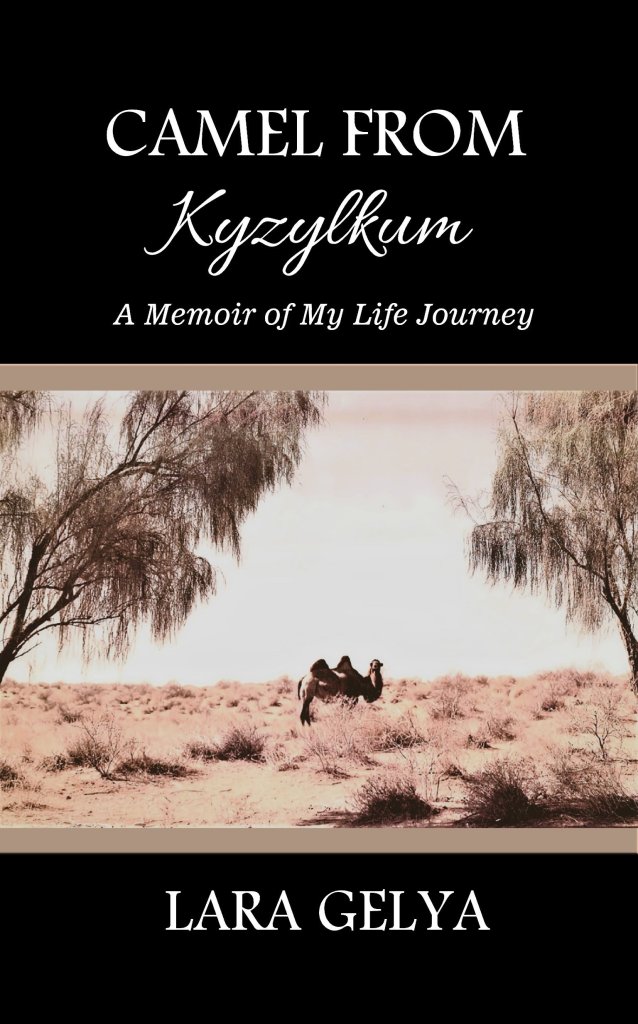
A migrant’s journey is never easy – it’s rife with adjustments and changes. Adapting to a country that is totally different from the one in which an immigrant is born, requires adjustments of various kinds, including learning new languages. Migrants also need to find acceptance and friends in the country they move to as did Lara Geyla, when she migrated out of a crumbling USSR to America, pausing by the way of Austria and Italy. She recorded her journey in Camels from Kyzylkum: A Memoir of my Life Journey.

Kyzylkum is a desert located in Uzbekistan. Geyla lived and worked in the desert for twenty years. She learnt that the camels were the hardiest of creatures. Her life’s journey like that of any other immigrant, had been hard. So, at the start of her memoir, she tells us: “I am a camel from Kyzylkum, too. Like a camel, I have adapted and found ways to help myself survive in the desert. As a camel stores his energy in its hump as part of its legendary ability to travel hundreds of miles without food and water, I stored the energy of my spirit to help me stay strong as I crossed continents alone, with two suitcases and $140 in my pocket in my search for a better life.”

Perhaps, this is a resilience that each migrant needs to unearth to settle into a country of their choosing, or sometimes thrust on them due to external factors like war and climate change. Through her memoir, we get glimpses of different parts of the world as she inched her way closer to the country she sought. People helped her along. At one point, when she arrived at the wrong destination for an interview with the American embassy that was crucial to her move to the country of her choice, an Italian taxi driver drove her at breakneck speed to the right address, where after a few questions, she was given the permission to emigrate.

This was in the 1990s. After moving to America, she helped more of her family to move to the country which gave her refuge. She found acceptance in a firm as a programmer/ analyst in Maryland. She lives now in her new home in Florida with her new family and friends and basks in their acceptance and love. In this exclusive, she talks to us of her journey.

Tell us what made you write Camel from Kyzylkum?

I had wanted to write my life story for a long time, as I believed my life journey was filled with incredible places and events. However, while I was working, I never had the time to focus on writing. Even then, I knew that if I ever wrote a book, it would be titled Camel from Kyzylkum. I finally wrote my story during the COVID 19 pandemic in 2020–21, when we were confined to our home.

Where in the Soviet Union did you grow up? What was your childhood like? Tell us about your schooling and a child’s life in the Soviet Union? How was it different from what we find in other countries?

I was born into a Jewish family in Vinnitsa, a city in southwestern Ukraine, not far from the capital, Kiev. At the time, Ukraine was part of the Soviet Union. Life wasn’t easy for those born into Jewish families in the Soviet Union; being Jewish was considered a nationality, not a religion. In fact, during my time there, we lived under the slogan: “Religion is poison for the people.” Religion was heavily suppressed, and atheism was strongly promoted during my time there. Although I grew up much like other children—playing the same games and attending the same schools—I was aware from a young age that there was a stigma attached to being Jewish. I felt different but didn’t understand why. After 1948, anti-semitism in the Soviet Union reached new heights, particularly during the anti-cosmopolitan campaign, when numerous Yiddish poets, writers, painters, and sculptors were arrested or killed. During my time there, antisemitism was consistently supported by the Soviet state and used as a tool to consolidate power.

When I was about 12 years old, my parents divorced, and my mother and I moved to Belarus to live with my grandmother. We all shared the same apartment. Soon after, I was sent to a boarding school, which I hated but had no choice and stayed there until I graduated. I’ve written about all of this in my book.

How was life different from what we find in other countries? That likely depends on the country you compare it to. Despite the many challenges and negative aspects of life in the Soviet Union, one notable advantage was the education system. It was of quite high quality, mandatory, and free.

You moved with your husband to the desert of Kyzylkum. What was it like living in the desert? In tents?

For the first three years, our young family lived in a small settlement belonging to a geological expedition. It really was in the middle of nowhere. The nearest civilized city, Navoi, was 200 kilometers (124 miles) away. Our settlement, simply called Geological Party #10, and it consisted of about two dozen barracks under the blistering sun, set in a barren landscape devoid of vegetation and offering hostile living conditions for humans, plants, and animals alike. The summers were extremely hot. The winters were harsh. At night, the wind became a growling, tumbling mix of sand and snow. I lay awake for hours, listening to the eerie howling outside. It was one of those winds that frayed nerves, made your hair stand on end, and left your skin crawling.

After three years, we moved to Muruntau, a slightly larger geological settlement, but we still lived in barracks. From there, we relocated to Zarafshan, a city in the heart of the Kyzylkum Desert of Uzbekistan, where we finally got our first apartment.

I have written extensively about our life in Zarafshan in my memoir, Camel from Kyzylkum. However, you might find it interesting to read an article by a Canadian reporter who accidentally stumbled upon Zarafshan while exploring Google Earth. He wrote and published the piece online in 2011, In Zarafshan.

What work were you doing there? What jobs did you do in the USSR? Did you go back to university there?

I earned my degree from a geological college in Kiev and worked as a geophysicist in the Kyzylkum Desert, focusing on gold and uranium deposits. Geophysics involves using surface methods and specialised equipment to measure the physical properties of the Earth’s subsurface and identify anomalies. These measurements help to make interpretations about a geological site, detect and infer the presence and location of ore minerals. Geophysical data is then integrated with surface geological observations to develop a comprehensive understanding of a region’s geological structure and history.

My job required me to work in various environments, including the open fields of the desert, open-pit and underground mines, as well as in the office. In fact, the Muruntau gold deposit in the Kyzylkum Desert, where I once worked, was and still is being mined as the world’s largest open-pit gold mine.

You have told us you were part Ukrainian and part Jewish? Judaism is faith — not a geography. So, were both your parents Ukrainian?

I was born into a Jewish family in Ukraine, which was part of the Soviet Union at the time. Both of my parents were Jewish and born in the Soviet Union. In my time there, Judaism was not considered a faith but rather a nationality. Nationality was stated in one’s passport. Synagogues were closed, and like most other Jewish families in the Soviet Union, our did not follow Jewish religious or spiritual practices. Instead, we celebrated all Soviet holidays. However, I do remember my father’s family gathering for Hanukkah and giving us, little kids, gifts and money. My husband, however, was Ukrainian, which made our daughter part Ukrainian and part Jewish.

Were you there during glasnost? Did things improve for you after the Perestroika and Glasnost? Please elaborate. How long did you stay after the dissolution of the USSR within your country of birth?

I would like to answer to this question with excerpt from my memoir Camel from Kyzylkum:

“Glasnost was understood as the movement in the USSR towards greater openness and dialogue. In the period from 1987-1991, Glasnost became synonymous with “publicity,” “openness,” and it reflected a commitment by the Gorbachev administration to allow Soviet citizens to publicly discuss the problems and potential solutions of their system.

I still lived in Zarafshan and took an active part in Perestroika and Glasnost—I was not afraid to express my opinions or attend meetings. I truly believed that we could change life for the better. One day I came to work only to find out that agents from the KGB had searched my office. KGB stands for Komitet Gosudarstvennoy Bezopasnosti, which translates to “Committee for State Security” in English.

At the time of Perestroika and Glasnost, books that previously had been available only through the underground distribution in the Soviet Union became legal, and excerpts were printed in many publications. I read a lot, and these books opened my eyes to the bloody recent history of our country—from the 1918 Revolution to the present day, on to all of the misleading, hidden truth, hypocrisies of our government, and the Soviet system as a whole. I realised that all of the concepts and ideas that they had taught us from early childhood were mendacious.”

I left the Soviet Union in October 1989, and as punishment, my citizenship was revoked. The Soviet Union ultimately collapsed on December 26, 1991, by which time I was already living in the United States.

Why did you want to move out of the Soviet Union? Can you give us the timeframe in which you moved out in terms of Glasnost and other events?

The Glasnost period in the Soviet Union was from 1987 to 1991. I left in 1989.

The late 1980s were years of exodus from the Soviet Union. Gorbachev opened the door of the “iron curtain” and everyone who could escape was leaving. I moved from Zarafshan, Uzbekistan, to Gomel, Belarus, in 1988. At that time, every single day platforms at the Gomel railroad station were full of people: families who were lucky to get exit visas, and relatives and friends who came to say their last goodbyes to them.

There was a code word: “to leave.” If you whispered it with a mysterious gravitas, there would be no need to ask further questions.

When I was asked if I would consider leaving, I said “yes” with no hesitation. I did not know what leaving would entail, but I started to go through the process as everyone else did. I apprised the family members, but there was no need or time to have long discussions—it was a once-in-a-lifetime chance, and the “iron curtain” could be down again at any time. We all knew how challenging and frightening immigration could be, but we had a hope that after all of the suffering, we could build a better life.

How is it you were on the list for visas and others were not given the privilege? Who were the people given the right to leave the Soviet Union?

Under Soviet law, no person could leave the country without the government’s permission, granted through an exit visa. This regulation applied not only to Soviet citizens but also to foreigners, including diplomatic personnel. Emigration policies varied over time and were always challenging to navigate.

In the 1970s, Jewish people in the USSR, often referred to as “refuseniks,” staged hunger strikes to protest the Soviet government’s refusal to grant them permission to emigrate to Israel. These protests highlighted the severe restrictions on their right to leave the country and garnered international attention, becoming a pivotal part of the movement advocating for Soviet Jewry, an international human rights campaign for Soviet Jews.

In the late 1980s and early 1990s, liberalised emigration policies allowed many Soviet Jews to leave, with more than half of the Jewish population emigrating, primarily to Israel, the United States, Germany, Canada, and Australia. However, it wasn’t only Jewish individuals departing; anyone who could endure the convoluted emigration process took the opportunity to leave. As a punishment, those who emigrated had their citizenship revoked.

The Hebrew Immigrant Aid Society (HIAS) played a vital role in assisting people leaving the Soviet Union, supporting them on their journeys to new destinations. HIAS continues to advocate for the protection of refugees and ensures displaced individuals are treated with the dignity they deserve.

For me, navigating the bureaucratic barriers of Soviet emigration policies in the late 1980s was extremely difficult, but my Jewish heritage worked to my advantage. After overcoming numerous hurdles, I left the Soviet Union at the end of October 1989. I had two suitcases, $140 in my pocket, and no certainty about my final destination. With my Soviet citizenship revoked, I became a “citizen of the World”.


Why did you choose to move to the USA over all other countries?

When I left the Soviet Union at the end of October 1989, I knew my point of departure but not necessarily my destination. The only identity document I had was an exit visa from the USSR and the train ticket to Vienna, Austria. I held no citizenship in any country and knew very little about immigration laws or processes. My ultimate goal was to reach America because I believed that the United States was the land of opportunity like no other country. During my interview in Austria, I was given the option to select a country I wanted to go to, and I chose the United States.

Other than language, did you have to study further to get a job in the US? How is working in the US different from working in the USSR?

Yes, I wore many hats and attended various schools before landing my professional job in the USA. First, I had to learn English. My journey began with earning a certificate as a nurse assistant. Next, I attended school to become a medical assistant, followed by completing a two-year program and passing the exam to become an X-ray technician. I worked in that role until I later completed a course for computer programming.

My first job in the US, however, was clearing tables at Burger King. I worked as a waitress, cleaned people’s houses, worked in department stores, and babysat young children. I did whatever it took to survive and was never afraid of hard work.

Working in the US was vastly different from working in the USSR, mainly because of the many barriers I faced: learning a new language, navigating cultural differences, adapting to unfamiliar social norms, and constantly acquiring new skills. Despite the challenges, I succeeded. Now, I’m happily retired, enjoying life in a beautiful community in Southwest Florida.

Have you ever returned to Russia after you migrated? How did you find it, especially as the Soviet Union broke up into so many countries?

My husband and I traveled to Ukraine in 2010, by which time it was an independent country. This was after the Orange Revolution1, a series of protests primarily in Kiev in response to election fraud. The revolution, which unfolded between late November 2004 and January 2005, brought significant political upheaval. Viktor Yushchenko was elected president on December 26, 2004, after weeks of turmoil that thrust the country into chaos.

As the informal leader of the Ukrainian opposition coalition, Yushchenko was one of two main candidates in the 2004 presidential election, the other being Prime Minister Viktor Yanukovych. During the campaign, Yushchenko survived an assassination attempt when he was poisoned with dioxin, leaving him disfigured. Despite this, he persevered and emerged victorious in the re-run election.

When we visited Ukraine in July 2010, the memory of the Orange Revolution was still fresh. We explored many cities, stayed with my childhood friend in Vinnitsia, and visited relatives in Yalta, Crimea. Crimea, sadly, was annexed from Ukraine by Russia in 2014.

The changes in Ukraine since my time living there were noticeable, but some things remained the same. We especially enjoyed our time in Yalta—a vibrant city filled with cheerful faces, where people celebrated life at this beautiful Black Sea resort.

In June 2018, during a cruise around the Baltic countries, we spent a day in St. Petersburg, Russia. The city and its museums are undeniably remarkable, as they always have been. However, the rude customs control at the port, long lines at the museums, being rushed through the exhibits, and other all-too-familiar experiences immediately brought back unpleasant memories from the past. After this brief visit, I have no desire to ever return to this country.

So, are you writing more books?

I’m considering it. However, finding the time to focus has been challenging. Between our extensive travels, my photography and video projects, marketing my memoir, and other everyday activities, my schedule hasn’t left much room for writing another book.

Thanks for giving us your time.

Click here to read an excerpt from Camels from Kyzylkum

(This online interview has been conducted by Mitali Chakravarty.)

PLEASE NOTE: ARTICLES CAN ONLY BE REPRODUCED IN OTHER SITES WITH DUE ACKNOWLEDGEMENT TO BORDERLESS JOURNAL. 

Disclaimer: The opinions expressed are solely that of the interviewee and not of the Borderless Journal.

Click here to access the Borderless anthology, Monalisa No Longer Smiles

Click here to access Monalisa No Longer Smiles on Kindle Amazon International
  1. Orange Revolution took place in Ukraine between November 2004 to January 2005, primarily a response to the Presidential elections ↩︎
Categories
Excerpt

From Ukraine to America: A Refugee’s Narrative

Title: Camel from Kyzylkum

Author: Lara Gelya

Publisher: Life Journeys Books

In Italy – Now and Then

The first time I visited Rome was in early 1990. I was on a mission to find a better life after escaping the Iron Curtain of the Soviet Union. As punishment for my escape, my USSR citizenship was revoked, leaving me stateless, with the status of ‘Refugee of the World.’ I traveled light across continents, with just two suitcases filled with family photos, a few books, spoons, and small pots. I had almost no money in my pocket, but Rome and Italy were still a wonderful discovery and a source of immense cultural enrichment for me in 1990.

During that time, I visited Rome and its historical landmarks such as Vatican City, the Colosseum, the Roman Forum, and the Trevi Fountain, to name a few. I also had the most important interview of my life in Rome, at the American Embassy, where I received the green light to go to the USA!

In May of 2024, during our Mediterranean odyssey, we spent some time in Rome. It was a deeply nostalgic and memorable experience for me! Revisiting Rome after so many years brought back a flood of memories and allowed me to see familiar places with new eyes.

I would like to share with you a chapter about my life in Italy in 1990, from my memoir Camel from Kyzylkum:

Italy

My first impression of Italy was that it was quite dirty and noisy. After I got used to the spotless cleanliness of streets and places in Austria, it disappointed me to see trash on the streets and in public places, along with graffiti. For the first time, I saw homeless people sleeping on rags on the marble floor of the subway in Rome. I also noticed how Italians get pretty animated when they talk, compared to very restrained Austrian people. But with time, my opinion about Italy changed—I fell in love with the country, and I grew to love the warmth of Italian people. I came to love Italian bread. The Italian language was like music to my ears, and I even learned how to speak some basics.

For the first two weeks in Italy, we were stationed at the bungalow summer camp south of Rome. It was January, and even during the day it was pleasantly warm outside, but at night it was cold. These bungalow houses did not have heat and were not equipped for the wintertime. I remember I was sleeping in my warmest clothes and even covered myself with a mattress from a spare bed in my bungalow. Nevertheless, I got very sick with a cold, so sick that I thought I would not survive it. During the day I walked to the seafront and sat there for long hours—the warm Mediterranean sun and fresh, salty sea air helped me to slowly recover.

After two weeks in the bungalow summer camp, we were told that we needed to rent apartments for ourselves in the nearby city of Torvaianica, a city south of Rome that was founded in the 1940s and is best known for its beaches. It has a population of about 12,700 inhabitants and extends for about eight kilometers along central Lazio’s coast. The refugee organization, HIAS, gave us money to cover rent and food. I do not remember the exact amount it was per person, but it was just enough for us not to be on the street dying from hunger. Later on, when I was already in the United States and working, I was required to reimburse HIAS for what they’d spent on me. I paid it back gradually, a small amount each month.

There were plenty of apartments available for rent in January. Many of them were at the seaside. Refugees from the Soviet Union usually shared one apartment—a two-room apartment for two families, a three-room apartment for three families. I was alone and in no way could I afford to pay for a room on my own. Someone from the group introduced me to a young fellow who was traveling alone, too. His actual name completely escapes my memory at present, but I’ll call him “Misha.”

Misha was in his early twenties. He was very smart and even knew English. For the first time in his life, he was separated from his parents whom he had left behind in the Soviet Union. Misha and I rented a room in the two-room apartment on the first floor of a building at the seaside. We could sit on the balcony and look at the beach and the Mediterranean Sea in front of us. The enormous wardrobe that was in the room divided our room into two halves to give each of us some privacy. Misha was absolutely unprepared for everyday life. He did not know how to manage the little money we had, how to do grocery shopping, or how to cook food. I felt sorry for him and suggested that he contribute some amount of money for food and I would shop and cook for both of us. Misha was happy to do that.

When I went for an interview for the first time at the American Embassy in Rome, I was asked a lot about places I had worked in the Kyzylkum Desert. They had a detailed map of Uzbekistan on the table and asked me about Zarafshan, Navoi, Uchkuduk. I was surprised; I thought they already knew more than I did.

After the first interview, I had to wait for the second one, a very important interview, after which a decision would be made on whether to allow my entrance to the United States. Many families were denied the entrance visa to the United States without being given any specific reason or explanation. These people had stayed in Italy for six months, for a year, or even longer. They found some jobs to support themselves and their families. Some of them decided to stay in Italy for good. It was an unsettling time.

Every day at 6:00 p.m., all Soviet refugees who stayed in Torvaianica gathered together at the central square of the city. There were a lot of us, and while I do not know the exact number, I remember how the square was filled with a Russian-speaking crowd, to the amazement of the local population of Italians. We were waiting for the messenger, usually a man who would stand in the middle of the crowd and read the list of people who had gotten permission to go to America. Even though I had not yet had a second interview in the American Embassy, these daily meetings were the biggest entertainment of the day and a learning experience—people mingled together, told stories, shared news, and made friends.

Misha always found me in the crowd after the announcing part was over and asked, “What’s for dinner tonight?” It seemed that he was always hungry. Even though I did not want to go home yet, I felt an obligation to serve him dinner. I thought he was acting like a little baby and since I was not his mother, it was bothering me. There was only one time when I sent Misha to the store to get something for me while I was cooking. He returned with an ice cream cake, our money for two weeks of our food ration gone. We divided the cake among all of the people who lived in both rooms of the apartment. This was the last straw for me. I canceled our contract and let Misha be on his own. Our living arrangements in the apartment remained the same, but I did not cook for him anymore. Meanwhile, we got a new tenant in our room. Another woman, approximately my age, joined us. Three of us shared the room up to the time of my departure.

The distance between Torvaianica and Rome was about 40 kilometers (25 miles), and there was bus transportation. I used the bus a few times. The ride was about 50 to 60 minutes. I did not go often, because the bus was usually packed with people and reminded me very much of the buses in the Soviet Union. Also, traveling by bus costs money I could not spare. Very soon I learned I could get to Rome by hitchhiking—every car driven by an Italian man would stop when they saw a young, pretty woman hitchhiking on the road. Several times I even hitchhiked with Misha. When the car stopped, I told the driver that he was my brother. I must say that most of the time Italians were very reckless drivers, and I felt uncomfortable in the car quite often.

I loved my outings to Rome. I enjoyed exploring the beautiful city where every stone has a history. Once or twice a month, all museums in Rome were free and I took advantage of this. Visiting the Colosseum, St. Peter’s Basilica, the museums of the Vatican, including the Sistine Chapel and the Trevi Fountain, to name a few, all became unforgettable experiences and cultural enrichment for me.

On the days when I was not traveling to Rome, I was discovering Torvaianica. Some items and events from my time there will be engraved in my memory forever.

For instance, there was a shoe and leather accessories store across from our apartment. In the Soviet Union, Italian shoes and leather accessories always were part of every woman’s desirable outfit, but they were difficult to get. In the store across the street was everything I could only dream about: elegant leather shoes, hand purses, belts. I visited the store quite often—not to buy, just to look. The store seemed to me big and exceptional. Years later, in 2001, Sparky and I traveled to Italy and visited Torvaianica. We found the beachfront apartment where I lived at the beginning of 1990 and a shoe store across the road. To my amusement, all at once, I saw an ordinary little store where I calmly browsed —it did not give me the excitement that it had in 1990. Perception is everything, and I was a very different person by 2001.

The main drag of Torvaianica with its famous Italian bakeries, restaurants, and shopping sprawled along the Mediterranean coast. On the snuggly, warm Italian evenings of January and February, I liked to stroll the street, window shopping and people watching. Italian people did not like to hold back their emotions—they laughed, they talked loudly, helping themselves with gestures, and I loved the music of the Italian language. I always stopped at the window of one particular bakery to examine all of the wonderful baked goods on display, though I could not afford to buy any. One of these baked goods was filled with a mix of rich semolina and ricotta cheese, and was a shell-shaped pastry called Sfogliatelle; Zeppole was another pastry consisting of a deep-fried dough ball dusted with powdered sugar and sometimes filled with various sweets; there was also biscotti, Venetian cookies, and hot chocolate cake—I could not take my eyes off of these beautiful culinary arts. One evening, the owner of the store, a middle-aged Italian man wearing a white chef’s coat and hat, with a lush body, dark mustache, and kind, laughing eyes, came out carrying a plate with a few biscotti and Venetian cookies and offered it to me to taste. Bewildered by his offer and the fact that he, probably, had been watching me evening after evening in front of his window, I did not have the strength to refuse his marvelous-looking, tasty Italian pastries.

Finally, the day came when I received a letter from the American Embassy in Rome with the invitation for the second and most important interview of my life. As I struggled with the English language then, I clearly understood the date and time of my interview, but I completely missed the location. Besides, I was pretty sure that there was only one location for the American Embassy in Rome and I knew where it was. But I was wrong.

The interview was scheduled for 12:00 p.m. I wanted to be collected and prepared. To eliminate any possibility of being late, I arrived at the American Embassy in Rome at 11:00 a.m. It was a sunny, beautiful, spring-like day; I lost myself for a short time (while waiting) on the fascinating streets of Rome. The sidewalk cafes were full of business people enjoying their lunch hours. I was thinking, “Is there going to be a time in my life when I, like them, can sit leisurely at a sidewalk cafe and have lunch? And feel myself as confident, relaxed, and happy as these people?” I wanted to believe that this time would eventually come in my life.

At about 11:45 a.m., I returned to the American Embassy expecting to soon be called by the guard. There was a good crowd of people waiting, like me, to be called. One by one they went inside until only I was left waiting. It was after 12:00 p.m. I got anxious—I began to wonder why I was not being called. I showed my paper to the guard. He explained to me (mostly by gestures and with some Italian phrases) that my interview was in a completely different location on the other side of the city. I was shocked. First, I had no money to get a taxi. Second, I thought my life was doomed. With this realization, I stood on the curb of the street in the center of Rome and sobbed bitterly. Tears rolled down my face.

Well, the Italian people did not easily tolerate this scene. Soon enough, a taxi stopped by me. The driver got out of the cab and asked me what had happened. Continuing to cry, I showed him my paper invitation for the interview and tried to explain to him that I had come to the wrong location. He looked at the paper and then at me and started vigorously gesticulating, pushing me inside his cab. Even inside the taxi, I could not stop crying. The driver turned around to me shouting some equivalent of “Shut up” in Italian. I became quiet. I realized he was going to drive me to the address where I needed to be. While he was driving, I feverishly thought about how I would pay for my ride as I had very little money in my pocket. But I was wearing a gorgeous silver ring with a gemstone on the ring finger of my left hand. The ring was handmade with an intricate Gothic design and a big, beautiful, pink, tourmaline stone—it was my favorite ring! I bought it during my vacation in Latvia, a country on the Baltic Sea—Latvia was a part of the Soviet Union from 1940 to 1991. I immediately decided to pay for my ride with the ring.

We arrived at the address of the second location of the American Embassy. I paid for the ride with the ring. The grounds of the Embassy were surrounded by a high fence and the gates were closed. I was not sure how I could get inside. However, the gates opened for an incoming cab and I just sneaked through the gates and ran towards the main building. I entered a room full of people waiting to be called for their interviews. My face was red, mascara smeared across my face, and my hair was messed up. Immediately, I heard my name being called. I walked into a smaller room where two men asked me questions. Then one man with reddish hair said to me how he had grown up in Buffalo, New York. He asked me if I knew how severe the winter could be in Buffalo. I said, “Probably not worse than in Siberia.” They both laughed. With this, my interview was over. From that point, I would have to wait for the Messenger at the Torvaianica square to call my name and give me an official paper with “Yes” or “No” written on it.

After two weeks or so, the Messenger at the 6:00 p.m. gathering at the Torvaianica square called my name. I was not nervous; for some reason, I was sure that it would be “Yes”. I calmly opened the envelope—there were dates for my flight from Rome to New York City. It was exciting news for me, and in anticipation of big changes in my life, I started to prepare myself for the trip.

About the Book

Camel from Kyzylkum is an award-winning memoir that chronicles the remarkable journey of immigrating from the Soviet Union during the late twentieth century. It delves into themes of hope, struggle, family, and loss, offering a profound exploration of the human spirit’s yearning for freedom and self-determination. Through the author’s compelling narrative, readers gain a deep insight into life within the Soviet Union and the immense sacrifices and risks individuals undertake in pursuit of a better life.

The memoir traces a gripping path from Ukraine to the Kyzylkum Desert in Uzbekistan, and onward through Austria, Italy, and finally America. Along this journey, the author navigates personal truths and aspirations, illustrating the resilience and determination required to forge a new path in unfamiliar lands.

Camel from Kyzylkum is not just a memoir; it’s a transformative narrative that opens doors to unfamiliar worlds, encouraging readers to broaden their perspectives and empathize with the challenges and triumphs of others. It stands as a testament to the enduring human spirit and the universal quest for identity and belonging.

About the Author

Born and schooled in Ukraine, Lara Gelya spent the next two decades in the Kyzylkum Desert of the Republic of Uzbekistan, working at geological sites and expeditions of the Mining Industry. At that time Ukraine and Uzbekistan were parts of one country — the Soviet Union.

In 1989 Lara left the Soviet Union, lived in Austria and Italy before she, at last, found her way to the United States in 1990. Starting her life from ground zero again, and trying on so many hats, she was able to make a lengthy professional career that led to her eventual retirement on the shores of sunny Florida.

Now, enjoying her retirement, Lara fills her days with enriching activities like writing, creating videos and pictures, reading, gardening, cooking, traveling, and immersing herself in nature or entertainment. Her diverse interests and active lifestyle after retirement show a deep appreciation for life’s pleasures and a continuing curiosity about the world around her.

.

PLEASE NOTE: ARTICLES CAN ONLY BE REPRODUCED IN OTHER SITES WITH DUE ACKNOWLEDGEMENT TO BORDERLESS JOURNAL

Click here to access the Borderless anthology, Monalisa No Longer Smiles

Click here to access Monalisa No Longer Smiles on Amazon International

Categories
Stories

In the Shadows…

By Paul Mirabile

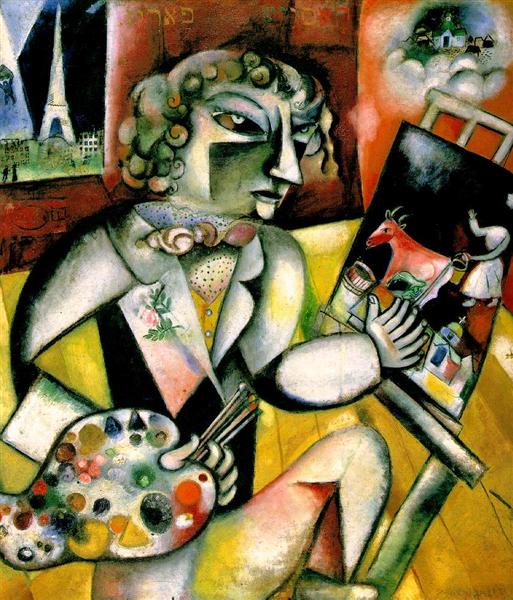
A Self-Portrait with Seven Fingers by Marc Chagall (1887-1985). From Public Domain

Tommy ordered a second pint of beer at the counter. The bar buzzed with the usual crowd, and a few groups of tourists, mostly from northern Europe, were beering it up as they did at home. Tommy had had a long day preparing breakfast and clearing the rooms at the Hotel Van Acker, Jan Willem Brouwersstraat, 14. Afterwards, he accompanied three Spanish tourists to the ‘high’ spots of Amsterdam: Anne Frank’s house, Vondel Park, the Rijks and Stedelijk museums, Rembrandthuis, Madame Tussauds, completing his tour at the ‘hot’ spot for all such tourists — the red light district. There he left the Spaniards, tired of having dragged them about the town while straining to understand their Spanish.

How long had he been at it ? Four … five years ? Who knows. Something in his mind had snapped. Oftentimes he suffered from bouts of amnesia or blackouts, a succession of synapse that triggered in him extreme panic, even paranoia. He felt an elbow nudge him lightly in the ribs: “ All right, mate?” asked a middle-aged man with long, blond, silken hair and ultramarine blue eyes.

Tommy eyed the man suspiciously. He had managed to squeeze himself in at the counter as imperceptibly as a ghost. “Yes, I’m all right. Why?”

“Oh, I just saw you staring into space as if you were in great thought or pain.” Tommy smiled leerily.

“No pain, just thinking small thoughts.” The other smiled. His teeth were very white. He reached over, took a few pinches of tobacco from a drinker’s pouch with unabashed effrontery and rolled himself a cigarette.

“Do you do that often?” Tommy enquired lamely.

“What?” the other asked puffing away dreamily.

“Pinch tobacco from people’s pouches.”

“Of course I do, it’s been my custom for ages,” answered the tobacco pincher with a whimsical gleam in his eyes. “What are you doing in Amsterdam, working I suppose?”

Tommy straightened up. “I work at the Hotel Van Acker doing odd jobs for the owner.”

“Ah, yes, Van Acker … Where they found that murdered dwarf.”

“He wasn’t murdered. He died of a heart attack.”

“The police never found the key to his room. That is strange. To die of a heart attack in a hotel room without the key.”

“So what?”

“Sounds a bit shadowy to me. But that’s all in the past. And who cares anyway, right ? What’s your name?”

“Tommy.”

“From?”

Tommy hesitated: “From Luton.”

“Luton?”

“It’s in Bedsfordshire.”

The pincher of tobacco nodded, rolling himself another cigarette. “I’ve seen you handing out leaflets or pamphlets in the streets.”

“That’s possible.”

“How’s the salary at Van Acker’s?”

“I get on. Van Acker gives me my meals and I sleep in the cellar room under the stairway.”

There was a very long silence — a silence so long that Tommy began to grow nervous. Finally, the man said: “Listen, I might have a job for you Tommy that will earn you enough money to live like a prince anywhere in the world for the rest of your life. One night ! Only one night, and you’ll become as rich as Crassus.”

“Who’s Crassus?” asked Tommy mistrustfully. The other laughed.

“The richest man in the Roman Empire. You see, my proposition deals with paintings; I’m an art collector.”

“Pictures? I like pictures. I take all my hotel tourists to the art museums.”

“Perfect. Here’s my address. Come by any time after eight at night. By the way, my name is Gustav.”

“Gustav … Gustav what?”

“Gustav Beekhot. I hope to see you soon, Tommy. Tot ziens[1]!” Gustav slapped Tommy on the shoulder and left the crowded bar, weaving through the mass of throbbing, bulky bodies like a shadow amidst a darkening, nameless stretch of land …

Five days later, after having wrestled with his thoughts, Tommy leaned his bicycle at the gate of a plank which led to Gustav’s house-boat on the Ruysdaelkade Canal. It was quite an impressive barge. He knocked at the door. Gustav, eyes a watery blue, opened the door and wished his visitor a hearty welcome ‘aboard’. “Just in time for dinner,” he said flippantly. When Tommy stepped in he couldn’t believe his eyes: they swept over a long ‘hold’ full of paintings of all sizes and colours, some hanging off the walls, others on easels, and still others scattered on the uncarpeted ‘bottom deck’, unfinished.

“You might open a museum here,” he suggested, strolling from painting to painting. “I like to look at pictures. When I accompany people to the Rijks or to the Rembrandthuis I always take my time to examine the pictures. The tourists just look at the title and at the name of the painter.”

“Yes, very few people really examine a painting.” Gustav placed two bowls of rice, shredded carrots and two pints of Heineken beer on a hackney table. “I for one prefer to paint them, buy or sell them, although I do often go to the museums for inspiration.”

“You sell your own pictures, then?” Gustav chuckled.

He gave Tommy a conspiratorial wink: “No, who would ever buy a Gustav Beekhot ? To tell you the truth I sell the ones I steal or have stolen from museums or from private collectors.” Tommy, who had sat down at the table dropped his fork. He stared at Gustav in disbelief. All that had been said with absolute aplomb. “Yes, Tommy my lad, sometimes I do buy them from contemporary Scandinavian painters living in poverty, but I prefer to steal them … It’s cheaper!”

“But … but how can you steal a picture from a museum?” questioned Tommy in alarm.

“It’s quite simple. It’s a question of know-how. Thievery is an art, my dear lad. And if you are willing, you will learn this art easily, and by doing so, earn a half a million dollars!”

Tommy jumped up. “No, please, let us eat, and I shall spell out all the niceties to you. There’s really nothing to it: a wiry, loose-limbed body like yours, will-power and the common sense to keep your mouth shut. And I do believe you possess all those aforesaid qualities. Am I correct?” Tommy remained voiceless. “Of course you possess them. But you doubt my word. Others too doubted, and today are living like kings in Tahiti, the Seychelles or in some Central American country.”

“A half a million dollars?” Tommy managed to stammer, sitting down slowly as Gustav glided between his paintings in a breezy, phantasmal gait to procure a bottle of Jenever in his kitchenette at the ‘prow’.

“Yes, Tommy. One night. One night only.” Tommy peered out the ‘porthole’, it had begun to drizzle. He watched as the drops gently fell upon the unruffled canal waters; they fell gently, rocking his host’s barge dreamily. He suddenly felt a seizure coming on. He strained to control it, the house-boat rocking … rocking so gently, like the drops of drizzle. Something snapped in his head; he shook it out. Gustav ate his rice and carrots as if he noticed nothing of the crisis that his visitor, and future accomplice, was suffering. He was smiling that engaging smile.

“What do I have to do?” came Tommy’s belated reply in spite of himself. He had asked that without being fully conscious of actually asking it.

Gustav stopped eating, sized him up, then thrust his taunt face forward. It had a ghostly white appearance to it: “Crawl through a very very narrow tunnel about two hundred metres long behind the Zadelhoff Café to the storage room of the Stedelijk museum. In that storage room you will find a painting by Marc Chagall, A Self-Portrait with Seven Fingers, which will be waiting for you to cut out of its frame with a razor blade. The nightwatchman has already put the painting exactly where you will pop up from the storage room hole.”

Gustav stood, went to a broken, plastic shelf over his wash-basin and picked up a razor-blade. “Look, this is how it should be done.” And the art dealer began to cut out a painting from its frame.  Tommy gasped. The other laughed. “Don’t worry, it’s one of my worst chefs-d’oeuvre …” Gustave then rolled up the canvas and placed it into a plastic cylinder. “There you have it my boy,” he beamed. “Sling the cylinder over your shoulder, drop down into the hole and crawl back through the tunnel where I shall be waiting for you.”

“But this tunnel … I can’t see …” Gustav put up a hand.

“The tunnel was dug during the second world war and used either to store ammunition by the local militia or as an escape route for Jews and communists.”

“How do you know all this?” Tommy asked incredulously.

“I studied history, and have many friends who deal in these particular matters.” There was a shrewd, impish twinkle in his host’s eyes.

Tommy seemed a bit sceptical about the whole operation. Gustav’s eyes were all alit, the glow of which stabbed at his distrustful heart. Gustav noted his guest’s wavering emotions. “My buyer will be in Amsterdam in five days,” he proceeded in a haunting undertone. “He’s arriving from Tampa, Florida and will be paying me one million three hundred thousand dollars for the painting. You will receive five-hundred thousand.”

He went to a drawer. “Here, this bank card will permit you to withdraw your share of the profits in any bank machine in the world. It’s a Swiss Banker’s card. But under no circumstances must you withdraw more than two thousand a day; bank administrators may become suspicious.”

“Where’s my bank?”

“That I cannot tell you,” Gustav answered sharply. “I suspect that you are mistrustful of me?” he chaffed.

“No, I’m not, but still …”

“No buts. The card is perfectly valid once the money has been deposited. And it will be after your mission has been completed. But I warn you Tommy, you must leave Amsterdam immediately before the museum authorities realise that the Chagall has been stolen. My buyer will leave on a morning flight back to Florida.”

At that moment Gustav poured out two glasses of Jenever, raised his and cried — ‘Godverdomme’ [2]! And with that coarse shout they both gulped down the divine nectar. Tommy felt a mounting tension in his chest, throat and jaw. Had he made a pact with a man whom he hardly knew ? He left at midnight, benumbed, as if he were a bit tight.

For two days Tommy struggled to control his taut emotions. To weigh the consequences of this incredible proposition. He could become immensely rich after a few hours of mental and physical toil, yet something irked him. It all seemed so unreal! He walked the streets of Amsterdam in the late afternoons, flicking matches into the air one after the other, watching the lit sticks glide gently to the street where the last lingering sparks sizzled out. He repeated aloud, “Tahiti, the Seychelles … I wonder where they are?” over and over again. He would take out the bank card and study it carefully. “It looks real to me,” he assured himself, albeit nervously.

On the fourth afternoon they met for tea at the Zadelhoff Café, after which Gustav took Tommy behind the café and showed him the sewer lid which led to the tunnel. Then they strolled over to the Stedelijk Museum, and whilst promenading through the halls of paintings Gustave cautiously pointed out the storage room where the Chagall had been stored for a future exhibition at another museum. All that day Tommy had admired the art collector’s professionalism and precision in elucidating the details of this very risky, but lucrative operation.

“Will-power, nerve and stamina, my lad,” Gustav kept repeating until he told Tommy to meet him that very night behind the Zadelhoff Café at one o’clock sharp. The buyer had booked a morning flight back to Florida. “One night ! Only one night, my friend. Don’t let us down … “ Tommy clenched his fists. He suddenly felt a surge of unwonted force, a force he had experienced many years ago before his unexpected arrival in Amsterdam. Gustav slapped him on the shoulder and glided away like a phantom in the reddening twilight …

A far away church-tower bell struck the hour of one. And so it happened, happened like a dream …

Gustav cut a spectral figure outlined against an ill-lit, moonless night as he waited impatiently for his accomplice. At that moment Tommy arrived, a trifle late. They both set immediately to work to open the heavy sewer lid. Once pried open, Tommy climbed down the rusty rungs, a torch in hand, the plastic cylinder slung over his shoulder. “The rats! The rats!” he called, looking up, his lithe body trembling.

“Rats ? The rats will scramble away when you train your torch-light on them,” Gustav shouted down in a weird, stilted voice. “Don’t talk nonsense ; just move on …”

And he slid the sewer lid over the hole. Tommy stopped. Darkness engulfed him. The boy panicked. — All alone! All alone! — he lisped to himself in fear. He nevertheless carried on down into the damp darkness training the light along the broken stone walls dripping with age. There, the opening of the tunnel! It was true. There was the tunnel … But so narrow … so terribly narrow …

Poor Tommy was hardly able to push himself into  the opening. He began to cry. He felt he had been buried alive in a toolless coffin. All alone! All alone! “Mummy!” escaped from his dry, chapped lips. Yet Tommy crawled on and on. The thought of a half million dollars flooded his inflamed brain. The brave boy elbowed a painstaking trail over root and rock, his torch-light cutting out a thin stream of blissful light that disappeared into a dark Nothingness. A Nothingness that frightened him, reminded him of vague scenes in some other life that he had once led, a former life of battling and crying out in a moonless, raging darkness …

His head struck stone. Yes, it was stone! The gallant Tommy had reached the museum storage hole. He straightened up with difficulty, touched the cold walls; a ladder had been provided for the Second World War escapees.

“The rest will be child’s play,” he whispered in an echoless vacuum. Up he clambered excitedly. The hole seemed endlessly deep. Was that possible ? Ah, the floor tile … Finally. He pushed it open as easy as that. “Child’s play,” he sniggered as if speaking  to Gustav.

Tommy pulled himself out into a deep, deep darkness. A darkness he had never experienced before. He searched for the razor-blade in his trouser pocket, trained his torch …

A merciless neon light suddenly blinded him, absorbing all the darkness, save that which still lay heavy and hauntingly in his head. Four policemen stood pointing at him, laughing and laughing. A very stoutish, well-dressed man stepped out from the policemen and grabbed the boy by the scruff of the neck. “So this is the little twit that has been hiding out like a rat!” the man chidded in broken English. “Hiding in the storage pit, hey? Think you’d slip away from us? What on earth are you doing in here you scamp, playing hide and seek?” Tommy said nothing. Baffled, he had lost all contact with reality. “Deaf and dumb, hey? Let’s see.” One of the police officers struck the boy across the face.

“Please don’t,” he whimpered.

“There you are, he can speak after all, and with a British accent, too,” pursued the well-dressed man who happened to be the museum director. “So, why are you hiding here ? What are you doing in that pit? Look at the mess you’ve made.” Indeed, the storage hole was filled with empty cracker and potato chip bags that Tommy had been eating. “Were you drinking water from the lavatory tap ? Look at this floor, there’s water all over it.” He poked Tommy in the chest.

“I was sent to steal a picture … Marc Chagall …”

“Steal a painting ? A Marc Chagall ? How were you to get it out of the museum ? Are you masquerading as Honest Jack[3] ?” This was asked with biting irony.

“Through the tunnel back to the Zadelhoff café.”

“Oh, I see … a tunnel to the Zadelhoff café.” He turned to the policemen: “Is there a tunnel to the Zadelhoff café.” All the policemen laughed and laughed, pointing at the sulking boy whose filthy, ill-smelling clothes struck a grotesque contrast with the museum director’s well-tailored suit.

“And with a razor-blade cut it out of its frame,” Tommy hurriedly added.

“Where’s the razor-blade?” one of the policemen demanded, taking him by the arm. “Give it to me.” Tommy searched his pockets. He held out a safety-pin.

“No tunnel, no razor-blade,” broke in the museum director. “You’re either a liar or a raving lunatic.”

“But I crawled through it. Gustav Beekhof showed me the tunnel and told me to steal the picture when he invited me to his house-boat,” Tommy pleaded, tears flowing over the dark shadows of his wild, tired eyes.

“There is no tunnel you little liar!” screamed a policeman. “And who is this Gustav Beekhot? Where is his house-boat?”

Tommy racked his brains: “I don’t know the exact address but I can take you there.”

He was hustled out of the museum into the moonless night, bundled into a police van and off they sped through, along and over streets, canals and bridges … until …

“There, on the Ruysdaelkade Canal,” the boy shouted in triumph. “His house-boat is the second …” Tommy stared in horror: there was no house-boat ! A police officer pulled him out of the van and dragged him to the slip where the house-boat should have been docked. Tommy rubbed his red, stinging eyes : “But it was there … I …”

“Shut-up you impudent little runt!” the officer barked. “I’ll check.” He returned to the van.

A few minutes later, he returned. “There’s no house-boat registered in that slip, and we have no record of a Gustav Beekhof,” he stated stiffly, looking hard at Tommy. “You’re raving mad.” A bewildered Tommy stepped back, his thoughts running riot.

“No house-boat. No Gustav Beekhof,” fumed the police officer. “A little scamp of a thief, that’s what you are.” And he twisted Tommy’s ear until it turned beet-red. “What’s your name, boy?”

“My name ? My name is Outis,” he lisped, holding his smarting ear.

 “And your papers?”

“Papers ? I have no papers … I’m …”

“Shut-up!” the police officer stormed, turning red. He took Tommy by the shoulders and shook him so hard that his teeth chattered. All of a sudden something snapped in his brain. The boy was seized by a mounting tension which sent him spiralling into a dark nothingness that he had never before experienced — a nothingness where he drifted through a darkened, nameless stretch of land …

DOCTOR VAN DIJK’S REPORT

The patient who calls himself Outis, as recorded by the police, most probably English-born, was found hiding in the Stedelijk museum storage room for two days with, according to the patient, the intention of stealing Marc Chagall’s ‘A Self-Portrait with Seven Fingers‘, which the aforesaid patient claimed had been deposited in the room for that purpose. This claim was disclaimed by the museum director, Mister Aalbers who avowed that the painting hangs in its usual place in the museum. The patient being questioned by the police, maintained that he was put up to the supposed theft by a certain Gustav Beekhof who apparently does not exist, according to police records, nor does his place of residence: a house-boat on the Ruysdaelkade Canal. The patient was promised a half a million dollars for the theft, which, as he declared, was undertaken by crawling through a tunnel from behind the Zadelhoff Café to the museum storage room. The police confirm that this tunnel has never existed. Furthermore, when the patient showed the police his bank card with which he was to withdraw his share of the theft, it turned out to be a library card whose owner’s name and library location had been thoroughly effaced beyond deciphering.

The patient has fallen into a coma for several days now. There seems to be no doubt that he is suffering from an acute case of schizophrenia, caused perhaps by a sudden mental or physical traumatism that has created an imaginary parallel world through which the patient wanders in and out whenever jolted by an unsual event or encounter.

The patient thus will remain in our clinic under strict observation until he emerges from his unconscious state.

Chief Psychologist of the Psychotherapierpraktijk Overtoom     

Wilfrid Van Dijk, May 9th, 1975    

.

[1]  ‘Good bye’ in Dutch.

[2] ‘God damn it’ in Dutch. A rather ‘informal’ interjection when making a toast amongst close friends.

[3] The notorious English robber John Jack (1702-1724). He was hanged for his daring thefts.

.

Paul Mirabile is a retired professor of philology now living in France. He has published mostly academic works centred on philology, history, pedagogy and religion. He has also published stories of his travels throughout Asia, where he spent thirty years.

.

PLEASE NOTE: ARTICLES CAN ONLY BE REPRODUCED IN OTHER SITES WITH DUE ACKNOWLEDGEMENT TO BORDERLESS JOURNAL

Click here to access the Borderless anthology, Monalisa No Longer Smiles

Click here to access Monalisa No Longer Smiles on Kindle Amazon International
Categories
Interview

Carr is Driven to Write Fast

Short-story writer, publisher and writing advocate, Steve Carr, has helped many writers around the globe get published for the first time. The author speaks to Keith Lyons about his prolific output and the best way to conquer writer’s block by being abundantly productive and creative.

Steve Carr is on the quest to write the perfect short story. But perfectionism isn’t putting him off the challenge. Since his first short story was published half a dozen years ago, he’s had over 600 short stories published internationally.

The native of Cincinnati, Ohio has travelled extensively outside the United States, serving as a military journalist in the Army and Navy before switching to fiction. As well as his work appearing in print and online in magazines, literary journals, and anthologies, eight collections of his short stories have been published, including ‘A Map of Humanity’ in 2022. He’s even released a paranormal/horror novel ‘Redbird’.

He was editor of literary magazine ‘Short Story Town’ and is the founder and publisher of Sweetycat Press whose goal is to support emerging writers by providing opportunities to getting published, primarily in anthologies.

When did you first discover your talent for writing?

From the earliest grades in school, I excelled in writing and English. By the time I reached high school the word had gotten around with the English Composition teachers that I had talent as a writer. In my senior year I had an English teacher, Mrs. Katz, who went out of her way and far beyond the curriculum to challenge my writing abilities. She encouraged me to pursue a writing career after I completed high school. Thanks to her support, and my own curiosity about what was happening in Vietnam (during the war), instead of going to college I enlisted in the Army to become a military journalist.

What encouraged you along the way to express yourself through writing?

My teachers in school and I took to writing the way fish take to water.

Tell us about your career as a military journalist? What did that involve? What kind of writing did you do in the army and navy?

I attended the prestigious joint military school, The Defense Information School, where I learned journalism and photojournalism. My intention was to go to Vietnam to see and report first-hand on what was happening over there. Fate intervened, and I was sent to the District Recruiting Command in Jacksonville, Florida as an Information Specialist, which involved me travelling around Florida and Georgia writing articles about the war about the war, as conveyed to me by military channels and returning soldiers, for local newspapers. I spent three years in that position and decided to end my enlistment to begin my college education in Cincinnati, where I’m from. Being the restless sort, I got bored after my Freshman year and enlisted in the Navy, and following the path of my favourite writer, W. Somerset Maugham, who had trained as a doctor, I enrolled in the Hospital Corps School, to become a Navy medic (a Hospital Corpsman). Because I did well during that training, I was offered the opportunity to attend the Neuropsychiatric Technician Program in San Antonio, Texas. Completing that, I was sent to the Portsmouth Virginia Naval Hospital where I quickly advanced to the position of the only enlisted instructor for the Psychiatric Technician School, Phase II, and for the next three years I worked with psychiatric patients while also teaching. During that time my writing was entirely medical/ psychiatric-based. That proved as beneficial to my writing as the skills I learned in the Army as a journalist.

Where in the world did your early career take you?

It took me first to the Army and then to the Navy. I traveled to a number of states and saw things and experienced life in ways I never thought possible or imaginable as I grew up.

How did you get into fiction writing?

My path as a writer, leading me to writing fiction, zigzags all over the place. If writing plays can be considered writing fiction (which it is), it wasn’t until after college where I double-majored in English and Theater, completed after my enlistment in the Navy, that I turned to writing plays, resulting in a few of them being produced in several states. During the next few years while writing plays I also wrote grants for non-profit health care providers, another unexpected benefit to my eventual path to writing fiction, which didn’t begin in earnest until years later, after I retired from owning my own theatrical production company. Writing fiction didn’t happen until I was mentoring a college student interested in learning to write fiction, and wanting to show him how it was done, I wrote a short story and then submitted it to a publication that quickly accepted and published it. Thinking that was really easy, the same thing happened with my second story. That was where my fiction writing career began.

What’s one of your first success stories in getting published? How did you feel seeing your name in print?

In June, 2016, the online publication, Literally Stories, accepted my first story “Eleanor” about the life of a modern-day reclusive woman who lived on the edge of the South Dakota Badlands. To tell you the truth, I don’t recall how I felt, other than being surprised that getting my first fiction story was so easy. I must have also felt encouraged because I quickly followed that with a second story. 600-plus stories – new and reprints – published since then tells me that from the beginning I must have liked the experience of being published because as evident, I haven’t stopped.

What’s your motivation for writing, given that rewards are scarce in a monetary sense?

I’ve been asked that question a lot, and honestly, I have no idea what motivates me to write. I don’t need the money, so that wasn’t a motivator from the very beginning. Maybe what motivates me is the challenge of writing good fiction. Now, I’m on the conquest to write the perfect short story. Someone told me that I may have already done that and don’t realise it. I have my doubts about that, so I continue to write short story fiction.

Does writing fiction involve a different part of your brain or different process than non-fiction writing such as journalism? If so, how?

The process of journalistic writing and writing fiction is somewhat similar. The best in both forms of writing involves making the individuals (characters) in the work, engaging, compelling and relatable, and bringing the events in the piece to life. For me, writing begins with observation and intellectual curiosity. Both journalistic writing and fiction almost demands that. I have no idea which parts of my brain I’m using, but I think I was wired to observe and give thought to the world and people around me from a very early age.

If writing is a creative process, how does the aspiring writer manage the creative side with the more mundane, organised side, such as having a schedule for writing and submitting, and meeting deadlines?

That’s a hard question to answer since every individual has their own methods and abilities to be organized in anything they do. I have a guidebook, Getting Your Short Stories Published, published by Clarendon House Publications, that is available on Amazon, that provides the method I use for organising my writing and submissions. Even in that I caution the reader that it is my method, and it may not work for everyone. If I can be conceited about the guidebook, it has some very useful information in it, including the importance of knowing grammar and punctuation, why reading the submission guidelines is essential, and understanding how editors evaluate submissions.

How do you get motivated to write?

Motivation has never been a problem for me. What helps is that I set goals and quotas: how many stories do I want to write in a given month? How many words do I want to write on any given day? Am I on track for my yearly quota of published stories?

Where do you get your ideas, and how do they form into a story?

I begin with a title that has popped into my head, not always inspired by anything in particular, but sometimes a result of reading a news article or seeing something happening while outside. I’ve also been fortunate enough to travel, to meet lots of interesting people, and I have a very fertile imagination born of a love of art, music and movies, so those things are always stirring around in my head. Once a title has been formed, I then think about how the story will begin and end. In that way I am a “plotter,” (someone that plots out the entire story). I fill in the middle as I write. In that way I am also a “pantser.”(someone who flies by the seat of their pants all the way through their pants).

What’s your actual writing process – and is it fuelled by anything?

I don’t really have a process. I tend to write in shifts throughout the day or night, mostly when I feel like it. I have goals, as I said, but I don’t allow myself to become stressed if I lag behind or don’t meet them. I enjoy the process of writing, of seeing the words, sentences and paragraphs appear on the blank page.

How do you find out about opportunities for submissions, for example for literary journals and anthologies?

I have a subscription to Duotrope which is a publication search site. Their fee for use is either $5.00 per month or $50.00 per year. The great thing about them that is unlike any other search site is that they send out a weekly email that lists publications looking for submissions. I get about 80-90% of my submission opportunities from Duotrope. They can be found at https://duotrope.com/search/catalog.aspx. I also subscribe to Authors Publish https://authorspublish.com/ and to a number of publications that send out monthly newsletters and calls for submissions. I also find opportunities for submissions on social media, both in the large number of Facebook writing groups I belong to, and on Twitter. There are a number of editors who like my work and ask for stories from me.

What do you attribute to your incredible success in having over 600 short stories published?

This is going to sound like bragging, but I’m a good writer. I have a thorough understanding of short story structure and I write stories that have a broad appeal. I was told by another editor that I’m a “commercial writer,” meaning I write what readers want. I also write stories based on what publications are looking for. I found out early it was a waste of time and energy to write a story and then try to find a home for it. I use what the publications are seeking as prompts, and then I write a story from the prompt. I also write a lot of stories, so it’s a simple law of averages that the more stories I submit, the more of them get accepted – of course if only they are well-written. I also write in every genre which is extremely helpful in being able to adjust my themes, plots and characters to match a genre. 

Tell us about your efforts to support emerging writers through Short Story Town and publishing anthologies with Sweetycat Press?

Short Story Town is a Sweetycat Press online literary magazine that paid emerging for their stories and narrative poems. It will be closing down on June 1 after a year of operations to allow me to focus on the anthologies. Under the Sweetycat Press publishing imprint over 1,000 prose writers and poets worldwide have had their works published. The anthologies are varied and each one has a theme. So far Sweetycat Press has published an episodic crime anthology titled The Whole Wide World, an anthology titled Landscapes & Cityscapes, followed by A Love Letter (Or Poem) To . . ., Stories and Poems in the Song of Life, Beautiful: In the Eye of the Beholder, and Movement: Our Bodies in Action. On July, I will be giving out $900 in combined cash awards in the Jewels in the Queen’s Crown contest to 20 writers poets who have had a prose work or poem published in one of the anthologies judged by a small panel to be the best of the best.

What’s your advice for aspiring writers?

Never take advice about writing from anyone who has less experience with writing than you do. Readers are important but being told what a reader likes or dislikes about what they read is a lot different than being told how to write. Also, don’t get freaked out about a rejection. Everyone gets them. Shrug it off and move on. A rejection will never cause you physical harm.

And your next projects?

An anthology will be published from the Jewels in the Queen’s Crown contest and then two anthologies are planned for later in the year. Anyone interested in writing a story or poem for inclusion in an anthology should check in regularly with the Sweetycat Press website https://www.sweetycatpress.com/ Unfortunately, I don’t pay the writers/poets whose works are accepted, but the anthologies do provide platforms for showcasing a writer or poet’s talent and skill.

Steve Carr’s Twitter is @carrsteven960. His website is https://www.stevecarr960.com/ He is on Facebook:https://www.facebook.com/steven.carr.35977

Keith Lyons (keithlyons.net) is an award-winning writer, author and creative writing mentor, who gave up learning to play bagpipes in a Scottish pipe band to focus on after-dark tabs of dark chocolate, early morning slow-lane swimming, and the perfect cup of masala chai tea. Find him@KeithLyonsNZ or blogging at Wandering in the World (http://wanderingintheworld.com).

PLEASE NOTE: ARTICLES CAN ONLY BE REPRODUCED IN OTHER SITES WITH DUE ACKNOWLEDGEMENT TO BORDERLESS JOURNAL