Categories
Interview Review

Of Wanderers and Migrants & Anuradha Kumar

A review of Anuradha Kumar’s Wanderers, Adventurers, Missionaries: Early Americans in India (Speaking Tiger Books) and an interview with the author

Migrants and wanderers — what could be the differences between them? Perhaps, we can try to comprehend the nuances. Seemingly, wanderers flit from place to place — sometimes, assimilating bits of each of these cultures into their blood — often returning to their own point of origin. Migrants move countries and set up home in the country they opt to call home as did the family the famous Indian actor, Tom Alter (1950-2017).
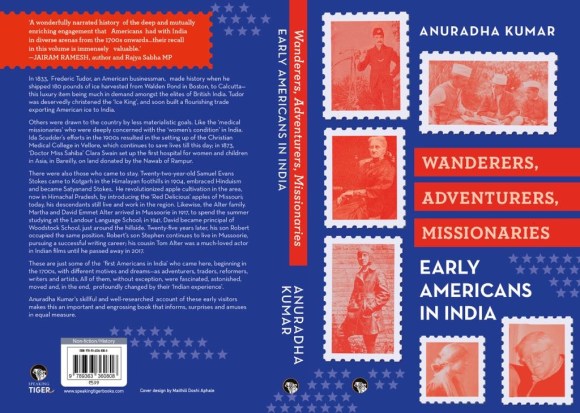
Anuradha Kumar’s Wanderers, Adventurers, Missionaries: Early Americans in India captures the lives and adventures of thirty such individuals or families — including the Alter family — that opted to explore the country from which the author herself wandered into Singapore and US. Born in India, Kumar now lives in New Jersey and writes. Awarded twice by the Commonwealth Foundation for her writing, she has eight novels to her credit. Why would she do a whole range of essays on wanderers and migrants from US to India? Is this book her attempt to build bridges between diverse cultures and seemingly diverse histories?

As Kumar contends in her succinct introduction, America and India in the 1700s were similar adventures for colonisers. In the Empire Podcast, William Dalrymple and Anita Anand do point out that the British East India company was impacted in the stance it had to colonisers in the Sub-continent after their experience of the American Revolution. And America and India were both British colonies. They also were favourites of colonisers from other European cultures. Just as India was the melting pot of diverse communities from many parts of the world — even mentioned by Marco Polo (1254-1324) in The Kingdom of India — America in the post-Christopher Columbus era (1451-1546) provided a similar experience for those who looked for a future different from what they had inherited. The first one Kumar listed is Nathaniel Higginson (1652-1708), a second-generation migrant from United Kingdom, who wandered in around the same time as British administrator Job Charnock (1630-1693) who dreamt Calcutta after landing near Sutanuti[1].

Kumar has bunched a number of biographies together in each chapter, highlighting the commonality of dates and ventures. The earliest ones, including Higginson, fall under ‘Fortune Seekers From New England’. The most interesting of these is Fedrick Tudor (1783-1864), the ice trader. Kumar writes: “In Calcutta, Dwarkanath Tagore, merchant and patron of the arts (Rabindranath Tagore’s grandfather), expressed an interest to involve himself in ice shipping, but Tudor’s monopoly stayed for some decades more. Tagore was part of the committee in Calcutta along with Kurbulai Mohammad, scion of a well-established landed family in Bengal, to regulate ice supply.”

Also associated with the Tagore family, was later immigrant Gertrude Emerson Sen (1890-1982, married to Boshi Sen). She tells us, “Tagore wrote Foreword to Gertrude Emerson’s Voiceless India, set in a remote Indian village and published in 1930. Nobel Laureate Rabindranath Tagore called Emerson’s efforts, ‘authentic’.” She has moved on to quote Tagore: “The author did not choose the comfortable method of picking up information from behind lavish bureaucratic hospitality, under a revolving electric fan, and in an atmosphere of ready-made social opinions…She boldly took in on herself unaided to  enter a region of our life, all but unexplored by Western tourists, which had one great advantage, in spite of its difficulties, that it offered no other path to the writer, but that of sharing the life of the people.’” Kumar writes of an Afro-American scholar, called Merze Tate who came about 1950-51 and was also fascinated by Santiniketan as were some others.

Another name that stuck out was Sam Higginbottom, who she described as “the Farmer Missionary” for he was exactly that and started an agricultural university in Allahabad. Around the same time as Tagore started Sriniketan (1922), Higginbottom was working on agricultural reforms in a different part of India. In fact, Uma Dasgupta mentions in A History of Sriniketan: Rabindranath Tagore’s Pioneering work in Rural Reconstruction that Lord Elimhurst, who helped set up the project, informed Tagore that “another Englishman” was doing work along similar lines. Though as Kumar has pointed out, Higginbottom was a British immigrant to US — an early American — and returned to Florida in 1944.

There is always the grey area where it’s difficult to tie down immigrants or wanderers to geographies. One such interesting case Kumar dwells on would be that of Nilla Cram Cook, who embraced Hinduism, becoming in-the process, ‘Nilla Nagini Devi’, as soon as she reached Kashmir with her young son, Sirius. She shuttled between Greece, America and India and embraced the arts, lived in Gandhi’s Wardha ashram and corresponding with him, went on protests and lived like a local. Her life mapped in India almost a hundred years ago, reads like that of a free spirit. At a point she was deported living in an abject state and without slippers. Kumar tells us: “Her work according to Sandra Mackey combined ‘remarkable cross-cultural experimentation’ and ‘dazzling entrepreneurship.’”

The author has written of artists, writers, salesmen, traders (there’s a founder/buyer of Tiffany’s), actors, Theosophists, linguists fascinated with Sanskrit, cyclists — one loved the Grand Trunk Road, yet another couple hated it — even a photographer and an indentured Afro-American labourer. Some are missionaries. Under ‘The Medical Missionaries: The Women’s Condition’, she has written of the founders of Vellore Hospital and the first Asian hospital for women and children. Some of them lived through the Revolt of 1857; some through India’s Independence Movement and with varied responses to the historical events they met with.

Kumar has dedicated the book to, “…all the wanderers in my family who left in search of new homes and forgot to write their stories…” Is this an attempt to record the lives of people as yet unrecorded or less recorded? For missing from her essays are famous names like Louis Fischer, Webb Miller — who were better known journalists associated with Gandhi and spent time with him. But there are names like Satyanand Stokes and Earl and Achsah Brewster, who also met Gandhi. Let’s ask the author to tell us more about her book.

Anuradha Kumar

What made you think of doing this book? How much time did you devote to it? 

These initially began as essays for Scroll; short pieces about 1500-1600 words long. And the beginnings were very organic. I wrote about Edwin Lord Weeks sometime in 2015. But the later pieces, most of them, were part of a series.

I guess I am intrigued by people who cross borders, make new lives for themselves in different lands, and my editors—at Scroll and Speaking Tiger Books—were really very encouraging.

After I’d finished a series of pieces on early South Asians in America, I wanted to look at those who had made the journey in reverse, i.e., early Americans in India, and so the series came about, formally, from December 2021 onward. I began with Thomas Stevens, the adventuring cyclist and moved onto Gertrude Emerson Sen, and then the others. So, for about two years I read and looked up accounts, old newspapers, writings, everything I possibly could; I guess that must mean a considerable amount of research work. Which is always the best thing about a project like this, if I might put it that way.

What kind of research work? Did you read all the books these wanderers had written?

Yes, in effect I did. The books are really old, by which I mean, for example, Bartolomew Burges’ account of his travels in ‘Indostan’ written in the 1780s have been digitized and relatively easy to access. I found several books on Internet Archive, or via the interlibrary loan system that connects libraries in the US (public and university). I looked up old newspapers, old magazine articles – loc.gov, archive.org, newspapers.com, newspaperarchive.com, hathitrust.org and various other sites that preserve such old writings.

You do have a fiction on Mark Twain in India. But in this book, you do not have very well-known names like that of Twain. Why? 

Not Twain, but I guess some of the others were well-known, many in their own lifetime. Satyanand Stokes’ name is an easily recognisable still especially in India, and equally familiar is Ida Scudder of the Vellore Medical College, and maybe a few others like Gertrude Sen, and Clara Swain too. I made a deliberate choice of selecting those who had spent a reasonable amount of time in India, at least a year (as in the case of Francis Marion Crawford, the writer, or a few months like the actor, Daniel Bandmann), and not those who were just visiting like Mark Twain or passing through. This made the whole endeavour very interesting. When one has spent some years in a foreign land, like our early Americans in India, one arguably comes to have a different, totally unique perspective. These early Americans who stayed on for a bit were more ‘accommodating’ and more perceptive about a few things, rather than supercilious and cursory.

And it helped that they left behind some written record. John Parker Boyd, the soldier who served the Nizam as well as Holkar in Indore in the early 1800s, left behind a couple of letters of complaint (when he didn’t get his promised reward from the East India Company) and even this sufficed to try and build a complete life.

How do these people thematically link up with each other? Do their lives run into each other at any point? 

Yes, I placed them in categories thanks to an invaluable suggestion by Dr Ramachandra Guha, the historian. I’d emailed him and this advice helped give some shape to the book, else there would have been just chapters following each other. And their lives did overlap; several of them, especially from the 1860s onward, did work in the same field, though apart from the medical missionaries, I don’t think they ever met each other – distances were far harder to traverse then, I guess.

What is the purpose of your book? Would it have been a response to some book or event? 

I was, and am, interested in people who leave the comforts of home to seek a new life elsewhere, even if only for some years. Travelling, some decades ago, was fraught with risk and uncertainty. I admire all those who did it, whether it was for the love of adventure, or a sense of mission. I wanted to get into their shoes and see how they felt and saw the world then.

Is this because you are a migrant yourself? How do you explain the dedication in your book? 

I thought of my father, and his cousins, all of whom grew up in what was once undivided Bengal. Then it became East Pakistan one day and then Bangladesh. Suddenly, borders became lines they could never cross, and they found new borders everywhere, new divisions, and new homes to settle down in. They were forced to learn anew, to always look ahead, and understand the world differently.

When I read these accounts by early travellers, I sort of understood the sense of dislocation, desperation, and sheer determination my father, his cousins felt; maybe all those who leave their homes behind, unsure and uncertain, feel the same way.

You have done a number of non-fiction for children. And also, historical fiction as Aditi Kay. This is a non-fiction for adults or all age groups? Do you feel there is a difference between writing for kids and adults? 

I’d think this is a book for someone who has a sense of history, of historical movements, and change, and time periods. A reader with this understanding will, I hope, appreciate this book.

About the latter half of your question, yes of course there is a difference. But a good reader enters the world the writer is creating, freely and fearlessly, and I am not sure if age decides that.

You have written both fiction and non-fiction. Which genre is more to your taste? Elaborate. 

I love anything to do with history. Anything that involves research, digging into things, finding out about lives unfairly and unnecessarily forgotten. The past still speaks to us in many ways, and I like finding out these lost voices.

What is your next project? Do you have an upcoming book? Do give us a bit of a brief curtain raiser. 

The second in the Maya Barton-Henry Baker series. In this one, Maya has more of a lead role than Henry. It’s set in Bombay in the winter of 1897, and the plague is making things scary and dangerous. In this time bicycles begin mysteriously vanishing… and this is only half the mystery!

We’ll look forward to reading a revival of the characters fromThe Kidnapping of Mark Twain: A Bombay Mystery. Thanks for your time and your wonderful books.

.

[1] Now part of Kolkata (Calcutta post 2001 ruling)

Click here to read an excerpt from Wanderers, Adventurers, Missionaries: Early Americans in India

(This review and online interview is by Mitali Chakravarty)

PLEASE NOTE: ARTICLES CAN ONLY BE REPRODUCED IN OTHER SITES WITH DUE ACKNOWLEDGEMENT TO BORDERLESS JOURNAL

Click here to access the Borderless anthology, Monalisa No Longer Smiles

Click here to access Monalisa No Longer Smiles on Kindle Amazon International
Categories
Poetry

Therefore: A Poem by Sukanta Bhattacharya

Translated from Bengali by Kiriti Sengupta

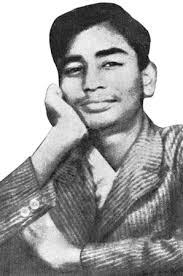
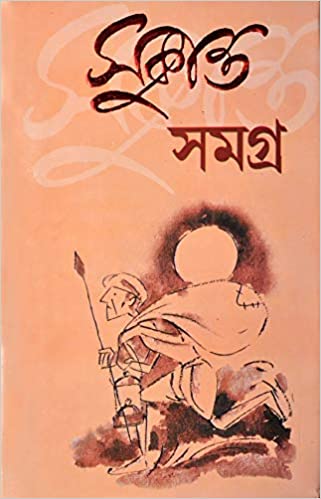
Sukanta Bhattacharya (15th August 1926-31st May 1947):  Called “Young Nazrul” and Kishore Bidrohi Kobi[1], Sukanta Bhattacharya died at the tender age of twenty of tuberculosis. He, like Nazrul, wrote poetry to protest the colonial atrocities. His poems describe the suffering of common people and looked forward to a world free of exploitation. His writings were anthologised in Sukanta Samagra (Complete Works of Sukanta, 1967), published posthumously, simultaneously in East Pakistan and West Bengal.

The once-paved paths 
are now vitiated.
How can I endure
the trauma without
divine intervention?

Death, death, everywhere...

Life's earnings
must be renounced.
When the means
become futile,
they are best discarded like tattered rags

[1] Youthful Rebel Poet: Nazrul was called the rebel poet of Bengal. He wrote a poem called Bidrohi or Rebel and his poetry had been that of rebellion like Sukanta Bhattacharya’s.

Kiriti Sengupta, awarded the 2018 Rabindranath Tagore Literary Prize and the 2024 Nilim Kumar National Honour, has had his poetry featured in various publications, including The Common, The Florida Review Online, Headway Quarterly, The Lake, Amethyst Review, Dreich, Otoliths, Outlook, and Madras Courier. He has authored fourteen books of poetry and prose, published two translation volumes, and edited nine anthologies. Sengupta serves as the chief editor of Ethos Literary Journal and leads the English division at Hawakal Publishers Private Limited, one of the top independent presses established by Bitan Chakraborty. He resides in New Delhi. Further information is available at www.kiritisengupta.com.

.

PLEASE NOTE: ARTICLES CAN ONLY BE REPRODUCED IN OTHER SITES WITH DUE ACKNOWLEDGEMENT TO BORDERLESS JOURNAL

Click here to access the Borderless anthology, Monalisa No Longer Smiles

Click here to access Monalisa No Longer Smiles on Kindle Amazon International
Categories
Review

 A Saga of Self-empowerment in Adversity

Book Review by Bhaskar Parichha

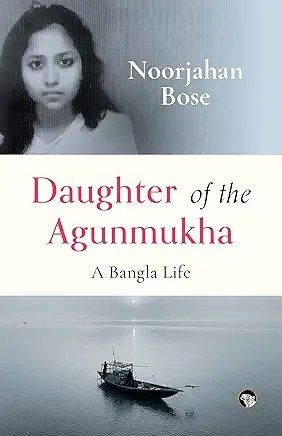
Title: Daughter of The Agunmukha: A Bangla Life 

 Author: Noorjahan Bose (Author), Rebecca Whittington (Translator)

Publisher: Speaking Tiger Books

This memoir recounts the journey of a young woman from a small island in Bangladesh who discovers the works of Tagore, Marx, and de Beauvoir, ultimately emerging as a prominent advocate for feminist causes.

Noorjahan Bose is a feminist author, social advocate, and activist resides between the United States and Bangladesh. She is the founder of two organizations based in the US aimed at empowering South Asian women: Ashiyanaa (previously known as ASHA) and Samhati. Rebecca Whittington serves as a literary translator specialising in Tamil, Bangla, and Hindi.

The narrative of Daughter of the Agunmukha[1] intricately weaves the life story of Noorjahan Bose, a remarkable woman whose journey is marked by resilience, courage, and an unwavering quest for freedom. Born in 1938 in a rural area of what is now Bangladesh, Noorjahan’s early life was deeply intertwined with the rhythms of nature and the struggles of her family, who were farmers living in close proximity to the tumultuous River Agunmukha, ominously referred to as the Fire Mouth River. This river, with its fierce currents and unpredictable nature, serves as a powerful metaphor for the challenges Noorjahan would face throughout her life.

From a young age, Noorjahan was thrust into a world of hardship and trauma. She endured sexual abuse at the hands of male relatives, a harrowing experience that left deep emotional scars. Compounding her struggles was the influence of her mother, who, having been a child bride herself, was often constrained by the societal norms and expectations of their time. Despite her own limitations, Noorjahan’s mother became a beacon of hope and creativity in her life. She instilled in Noorjahan a sense of joy and the importance of self-expression, encouraging her to explore her talents and dreams even in the face of adversity.

As Noorjahan grew older, her thirst for knowledge and personal freedom became increasingly evident. Education, however, was not easily accessible to her. The societal barriers and gender discrimination prevalent in her community posed significant obstacles to her academic pursuits. Yet, with the unwavering support of her mother and the encouragement of local activists who recognised her potential, Noorjahan began to carve out a path for herself. These activists, driven by a vision of social justice and equality, played a crucial role in empowering her to challenge the status quo.

Emboldened by her experiences and the solidarity she found in progressive movements, Noorjahan’s journey took her beyond the borders of her village. She became an advocate for women’s rights, using her voice to speak out against the injustices faced by women in her community and beyond. Her activism not only transformed her own life but also inspired countless others to join the fight for equality and empowerment.

As she traveled the globe, Noorjahan encountered diverse cultures and perspectives, each enriching her understanding of the world and deepening her commitment to social change. Her experiences abroad further fueled her passion for education and advocacy, leading her to collaborate with international organisations dedicated to uplifting marginalised communities.

Noorjahan’s life has been marked by significant hardships, beginning with the anguish of Partition, followed by the loss of her husband when she was merely 18 and expecting a child. Additionally, she faced the relentless threat of cyclones that jeopardised her family’s home and means of survival. Despite these challenges, her bravery is evident throughout her memoir. She advocated for the rights of the Bangla language in East Pakistan, navigated the tumultuous period of Bangladesh’s Liberation War (1971), and entered into a marriage that transcends her family’s religious boundaries.

This poignant and compelling narrative encapsulates a profound journey of trauma, loss, resilience, and empowerment.

.

[1] Agunmukha means fire mouthed

Bhaskar Parichha is a journalist and author of Cyclones in Odisha: Landfall, Wreckage and ResilienceUnbiasedNo Strings Attached: Writings on Odisha and Biju Patnaik – A Political Biography. He lives in Bhubaneswar and writes bilingually. Besides writing for newspapers, he also reviews books on various media platforms.

.

PLEASE NOTE: ARTICLES CAN ONLY BE REPRODUCED IN OTHER SITES WITH DUE ACKNOWLEDGEMENT TO BORDERLESS JOURNAL

Click here to access the Borderless anthology, Monalisa No Longer Smiles

Click here to access Monalisa No Longer Smiles on Amazon International

Categories
Excerpt

Tales of a Curious Land

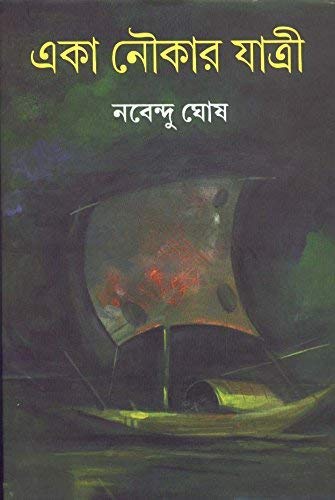
Journey of a Lonesome Boat by Nabendu Ghosh

Title: Eka Naukar Jatri/ Journey of a Lonesome Boat

Author: Nabendu Ghosh, translated by Ratnottama Sengupta

Publisher: Dey’s Publishing

Nabendu Ghosh writes of the time when two directors had wanted to film his novel – but why it was not made… 

Putul Nacher Itikatha[1] did not prove to be a hit but those with any understanding of screenplay all said, “Nabendu Ghosh did a great job.” 

I got the proof of this soon enough. One morning, around 11, Jahar Roy showed up on the first floor of my rented flat on Mahanirban Road.

“Nabenduda, Udayer Pathe[2]beckons.” 

Who?” 

Jahar sang out, “Bimal Roy, the Director of Udayer Pathey! He was all praises for one of your writings. So I offered to escort you — and introduce you if he so wished. He said, ‘He is a creative talent, I’d surely likely to meet him.’  Forthwith I set out on this venture.”

I was stunned. Overwhelmed. My experience of the craze in Rajsahi – when the police had to lathi charge on the crowds that thronged the theatre where Udayer Pathey had released — flashed through my mind. I recalled my deep seated desire to work with him. 

At this point Kanaklata stepped into the room. Jahar sprung forward and despite her vehement protest he bowed to the ground and touched her feet. “Boudi,” he spoke to her, “renowned director Bimal Roy has expressed his wish to meet Nabenduda. I’m here to escort him.”

“Sure, after you’ve tasted some sweetmeat and had a drink of water. The fish curry rice can wait for you to come back for lunch.”

“Thy wished is my command Boudi!” Jahar bowed again. 

*

Bimal Roy lived on Sardar Shankar Road in South Calcutta. Tall, fair complexioned, attractive looking with a commanding presence, Bimal Roy was a heavy smoker.  

After a while of polite conversation he said, “I’ve read your Daak Diye Jaai [3]and Phears Lane. As an admirer of your writing I can say that it has all the essentials of a screenplay.”

This observation brought me alive to a latent aspect of my writing. I kind of rediscovered myself. Gratefully I thanked him. 

“Why don’t you narrate a story that can be made into a film?” he said. “Something new, different, and arresting,” he added.

So I narrated the storyline of my new novel, Ajab Nagarer Kahini (Tales of a Curious Land). It was an allegorical story about contemporary civilisation, about the state, and about love too. His face lit up as he listened to the story. He sat still for a couple of minutes. When I stopped, I waited eagerly for his response. Tense. 

“I liked the story very much,” Bimal Roy pronounced. “It’s a peerless but relatable and captivating emblematic story. But there’s a slight problem. Mr B N Sircar, the proprietor of New Theatres must hear the story. I firmly believe he will also like it. But right now he is not in Calcutta. Just a few days ago he left for Europe. He will be back after two months. So you will have to wait this while.”

“I will wait,” I replied, earnestly.

*

Two months went by. 

One day Mrinal Sen came over. 

“Welcome Mrinal Babu, do come in.” Soon as he sat down Mrinal excitedly said, “I’ve got a producer. I’ll direct a film – so I need a good story.” 

I narrated two stories, of which Mrinal liked one. Then, after some random conversation I spilled out that “Bimal Roy of Udayer Pathe fame has selected a story of mine.” Mrinal was naturally curious and I had to narrate the storyline to him as well. 

The minute I stopped the narration Mrinal clasped my hand, “Give this story to me.”

“But Bimal Roy…” I started out but before I could finish the sentence Mrinal said,“Ritwik [Ghatak] and Hrishikesh [Mukherjee] will both be working with me.”

“Who’s Hrishikesh?” 

“He is a well-known assistant in the Editing department of New Theatres. Very intelligent.” 

“I cannot give you the story without having a word with Bimal Roy,” I told Mrinal. Mr Sircar will be back in a matter of days.”

Mrinal left for the day.

*

I met Bimal Roy the very next day. He informed me that Mr Sircar’s return had been delayed, it will be some more weeks before he returns.

But more than a fortnight went by and I did not hear from Bimal Roy. Besides, I was facing financial hardship. I needed money to keep the kitchen fire going.

Suddenly Mrinal showed up again. “I must have that story Nabendu Babu,” he said and shoved 500/- rupees in my hand. 

I ended up saying ‘Yes’ to Mrinal Sen. 

Two days later we signed an agreement.

On the third day a postcard landed in my flat. Bimal Roy was writing to say that, “Mr Sircar is back from Europe. He has also liked the story idea of Ajab Nagarer Kahini. Come over right away, we must meet Mr Sircar to sign the contract with him.”

The next morning I went to his house and told Bimal Roy about Mrinal Sen. The solemn gentleman turned grave.

I sat still with bowed head. 

The Shubh Mahurat, two months later spelt the ‘auspicious commencement’ of the film. The lead character of Arindam was to be played by Sambhu Mitra, the famous theatre personality who is still revered as an actor, director, playwright, and reciter. In Technicians Studio, the clapstick was sounded on a shot of him by the eminent actor of Bengali theatre and screen ‘Maharshi’, whose name was Monoranjan Bhattacharya. But why was he called ‘Maharshi’? Because the very first role he essayed was of Maharshi Balmiki in Sita produced and acted by Sisir Kumar Bhaduri[4]. His Ramchandra was an amazing portrayal of Lord Rama. So long back he had portrayed the author of Ramayan, yet that remained his calling card in popular imagination, for decades. Why? Because he was a stalwart as far as his wisdom and character was concerned too.

Mahurat, yes, but that initial instalment of Rs 501 was not followed up by another. So what if an agreement was drawn up and signed!

“Oh sir!” I complained to Mrinal Sen, “I need…”

“Yes, he will give,” Mrinal assured me, “in a few days you will get the second instalment. I have spoken with him.”

Six months later Mrinal himself told me, “This producer does not have any fund. You better send him a notice.” 

So I sent him a notice – to the effect that unless you clear all my dues within 15 days, then the agreement will stand cancelled. Null and void. The producer did not bother to grace me with a reply. So legally the rights to the story was now mine again.

Forthwith I visited Bimal Roy again.

“Come, come Nabendu Babu…”

His gracious welcome was encouraging. I said, “It’s been a while since I was here. So, what’s keeping you busy?”

Bimal Roy smiled, “Your story was not available, so I am currently shooting a film about Netaji’s INA.”

“Who is the author?”

” Nazir Hussain, a gentleman who was formerly with INA.”

“Excellent,” I said. Then I murmured in a low voice, “Necessity obfuscates clarity of thought. That’s what happened with me Mr Roy. But my story is back with me now. Those who had acquired the right did not have the wherewithal to film it.”

“Let me complete this film,” Bimal Roy said, “I will speak with Mr Sircar after that. I’ll be happy if we can film your story.”

I drank up the tea, greeted him with folded hands and came away.

*

Then I went through a difficult phase. To put it bluntly, I was in dire need of money. Here’s why.

Literature was my main occupation. However, writing the scripts for Putul Nacher Itikatha and Swarna Sita[5]had spelt a certain prosperity and made life easier. But both literature and cinema was dealt a blow by the political development of 1947.

I think of the Partition as a national curse. I still think so. The direct impact of that was I was alienated from my birthplace, Dhaka, which had become East Pakistan. I still had a link – Bengali Literature and Bengali Cinema. But Pakistan was Pakistan, be it East or West. So the Pak mind thinks differently – rather, quite the opposite. Iconic dramatist Dwijendralal Roy’s classic play Shahjahan had a scene revolving around Danishmand, a celebrated figure from Persia who came to India and was the court jester during Aurangzeb’s rule. Then, he went by the name of Dildar. In the aforementioned scene he discussed the Hindus and Muslims and commented that “These two communities will remain opposites. One prays facing East, the other faces West; one writes from left to right, the other from right to left. One wears a pleated dhoti, the other wears the unpleated lungi. One has a pig tail at the back of his head; the other nurses nur, a tuft of hair on his chin.”

I recalled the scene in the fading days of 1948 when the government of East Pakistan dealt a blow to Bengali language and films by declaring Urdu as the national language of Pakistan at the cost of Bengali, the language of the people’s heart.

In fact, those deciding the fate of the people from distant Islamabad mandated that Bengali too should be written in the Arabic script. What is more, to destroy every emotive link between Bengalis on either side of the divide, Bengali books and Bengali movies were banned in East Pakistan. As a result, once again the middle class and upper class Hindus started deserting their home and hearth and crossing the borders even to live as refugees in West Bengal. 

This dealt a massive blow to the commerce of publishing and cinema.

I had just completed a short novel; I started doing the rounds of publishers to try my luck with it. My household was crying out for money to keep the kitchen fire alive.

I went over to Bengal Publishers. Manoj Da said, “I will definitely publish this Nabendu but after two-three months. The market is stymied right now.”

Sachin Babu of Baak Sahitya also said the same thing in polite words.

I walked over to Cornwallis Street and into the office of D M Library. Gopal Das Majumdar warmly welcomed me and treated me to tea and sandesh[6]. Then he said, “You leave the manuscript with me. I will most certainly publish it but not right away. The market is reeling under this attack by Pakistan. Just wait for a couple of months. Meanwhile here’s an advance for you.”

That’s what I did eventually. That novel was titled Nahe Phoolhaar[7]

Meanwhile, since Gana Natya Sangha, the radical theatre group or People’s Theatre Association that attempted to bring social and political theatre to rural villages in the 1930s and 1940s, was banned by the West Bengal government. Bijon Bhattacharya, the famed dramatist of the classic Nabanna (1944), and other major members founded another organisation named Natyachakra. On its very first night of performance Neel Darpan[8]written by Dinabandhu Mitra in 1858-1859 and pivotal to the Indigo Revolt of 1859, raised a storm amongst the theatre lovers. We the members of Natyachakra were inspired by that.

*

Almost a year had passed by. One day I was visiting my friend Santosh Kumar Ghosh in Bhowanipore. One of the majors in the editorial department of the newspaper, Ananda Bazar Patrika, who was acclaimed as the author of Kinu Gowalar Gali, this friend of mine lived on the first floor of a house opposite Bijoli Cinema. On this visit I noticed that Bijoli was showing Pahela Aadmi[9]

I glanced at my wrist watch — 5.30 pm. “I feel like watching a movie,” I told Santosh Babu. “Care to join me?” 

“Which film?”  

“That one playing in Bijoli – Bimal Roy’s latest creation. The evening show starts at 6 pm.” 

“I’m game for it,” Santosh Kumar said in English. “Let’s go.”

Right away the two of us friends made our way to the balcony of Bijoli Cinema. 

Some of the scenes of Azad Hind Fauj [10] excited us and made us feel proud. The structuring of the story and direction made me salute Bimal Roy once more.  “Jai Hind[11],” I said to myself in his honour. Santosh Ghosh also highly praised the film. ‘’This gentleman Bimal Roy is a rare talent – and this film once again proves that. Well done.” 

As soon as I reached home I told Kanaklata about Pahela Aadmi. She was happy and unhappy, “Such a nice film but I didn’t get to see it.”

“I will take you to watch the film – it is worth a second viewing.”

Next morning at 9 am, I told Kanaklata, “I need to buy some writing paper, I’ll just be back from the market.” But I did not go to the market. I headed straight for Sardar Sankar Road, to Bimal Roy’s residence.

“Come Nabendu Babu, step inside.” Bimal Roy was, as before, holding a cigarette between his fore fingers. 

“I watched Pahela Admi yesterday,” I started the conversation. 

“In which theatre?” he asked, smiling. “Bijoli. And with me was Santosh Kumar Ghosh of Ananda Bazaar Patrika.” 

Kinu Gowalar Gali[12]?”

“Yes Sir. Both of us liked the film very much. It’s very courageous. To make a film concerning INA[13] calls for a lot of courage. We congratulate both New Theatres and you Sir.”

“Thank you,” he replied with a smile. Then he called out, directing his voice inward, “Two cups of tea here, please.”

“Yes, I will send…” a lady’s voice replied. Then he puffed his cigarette in silence. After a few seconds I mumbled what I had actually come for, “Now that Pahela Aadmi has released, will you consider my story?”

“No,” Bimal Roy looked straight at me and shook his head. “And I am sorry to say this. Because I am leaving New Theatres to go to Bombay. There, no one will value your story the way Bengali cinema would. Besides, I am going to Bombay to make a Hindi film for Bombay Talkies.”

He fell silent. And I felt darkness descend around me.

Bimal Roy had not finished. He took a puff off his cigarette and then spoke again, “Himangshu Rai’s wife Devika Rani has sold all the rights over Bombay Talkies and left.  At present thespian Ashok Kumar is the owner of the Bombay Talkies. He has invited me to make a film.” 

Waah!” I was overwhelmed on hearing the name, Ashok Kumar.

Bimal Roy went on speaking, “Bombay is at the other end of India. The demands of the Hindi film world are quite different, so there is a risk involved in this. Besides, the financial condition of Bombay Talkies is not robust at the moment. If I cannot make a film that is both good and successful, then…” his voice trailed off. 

Silently I started pondering over what options I had before me. 

A maid brought tea and biscuits for us. “Have the tea,” Bimal Roy’s voice cut into my thoughts. I kept thinking even as I downed the tea, “What now? Pakistan has as good as killed the markets for both, books and films. Everything was uncertain at the moment. I had no option but to send off Kanaklata and our four year old son to live with her parents in Malda.”

“Nabendu Babu,” Bimal Roy’s voice floated into my ears. I looked at him. He smiled a bit as he said, “My chief assistant Asit Sen is going with me and so is Hrishikesh Mukherjee as the editor in my team. Can you join us as our screenplay writer?”

‘Ayn!’ Surprised, I looked at him with renewed attention. “Are you asking me to go to Bombay with you?” I sought to clarify my own thoughts perhaps. “Yes. Screenplay writing is a very serious part of filmmaking. Not everybody can become a screenplay writer. Along with the ability to wield the pen the person must also possess a sound sense of drama. You have that.”

Am I dreaming! Was I dreaming?! After watching Udayer Pathe in Rajsahi I had secretly desired to work with that film’s director. God seemed to have heard me then and was all set to fulfil that desire.

“I will be happy to do so, Mr Roy,” I replied, gratitude overflowing in my voice. 

“Our future is uncertain, let me caution you Nabendu Babu. You will have to treat it as an adventure. And, another thing: Asit, Hrishi, all these guys will go alone for now, leaving their families here.”

“So will I Mr Roy,” I stressed. “I will go with you to Bombay — ”

[1] Bengali movie, translation: The Puppet’s Tale

[3] The Clarion Call

[2] 1944 Bengali movie, translation: Towards the Light

[4] Pioneer of Bengali theatre, 1889-1959

[5] Golden Sita

[6] Sweet

[7] Not a Garland of Flowers

[8] Indigo Mirror

[9] Bollywood movie, The First Man

[10] Netaji Subhash Chandra Bose’s army, Indian National Army

[11] Hail India

[12] A novel by Santosh Ghosh published in 1950, Translation: Kinu Milkman’s Lane

[13] Indian National Army

About the Book: Published in 2008, this is the autobiography of the legendary screenplay writer and Bengali litterateur, Nabendu Ghosh. Spanning through Pre-Partition India to the modern times, it is both a political and an artistic commentary of his times.

About the author: Nabendu Ghosh was born 27 March 1917 in Dhaka (now in Bangladesh). At the age of 12 he became a popular actor on stage. As an acclaimed dancer in Uday Shankar style, he won several medals between 1939 and 1945. Ghosh lost a government job in 1944 for writing Dak Diye Jaai, set against the Quit India Movement launched by Indian National Congress. The novel catapulted him to fame and he moved to Calcutta in 1945. He soon ranked among the most progressive young writers in Bengali literature.

Nabendu Ghosh has written on all historical upheavals of 1940s – famine, riots, partition – as well as love. His oeuvre bears the distinct stamp of his outlook towards life. His literary efforts are ‘pointing fingers.’ There is a multi-coloured variety, a deep empathy for human emotions, mysterious layers of meaning, subtle symbolism, description of unbearable life. Love for humanity is also reflected in his writings. He has to his credit 26 novels and 14 collections of short story. He directed the film Trishagni (1988), based on Saradindu Bandopadhyay‘s historical short story Maru O Sangha.

He died on 15 December 2007. 

About the Translator: Ratnottama Sengupta, formerly Arts Editor of The Times of India, teaches mass communication and film appreciation, curates film festivals and art exhibitions, and translates and write books. She has been a member of CBFC, served on the National Film Awards jury and has herself won a National Award. 

.

PLEASE NOTE: ARTICLES CAN ONLY BE REPRODUCED IN OTHER SITES WITH DUE ACKNOWLEDGEMENT TO BORDERLESS JOURNAL

Click here to access the Borderless anthology, Monalisa No Longer Smiles

Click here to access Monalisa No Longer Smiles on Amazon International

Categories
Poetry

The L-o-s-t Bengal Project 

By Isha Sharma

The year is 1905

The tunes of Tagore’s Amar Sonar Bangla* flower in the streets of Bengal

Curzon calls the Partition to create a divide

However, ‘culture’ thrives

As Muslims and Hindus, unite


The year is 1947

Bloodshed and madness pick up as

Radcliffe creates new lines

People leave ‘homes’

To find new ones

Violence slices humanity

How could Bengal survive?


The year is 1965

Bengal has two sons, one -- West Bengal

The second, ‘East Pakistan’

As conflicts flare again, the memory of the lost home revives

Women adorning sarees sing the lyrics of that Rabindra Sangeet


The year is 1971

Liberation calls are made

As women get raped

A new nation is born but the legacy of the past still prospers


A woman in Bangladesh teaches her daughter tunes of Tagore’s song written in 1905 --

Amar Sonar Bangla may have been lost but is it fully forgotten?

It still hums ...somewhere


* The national anthem adopted by Bangladesh in 1971. It was written by Tagore to unite Bengalis together to oppose the 1905 Partition.

Isha Sharma is passionate about the process of translating emotions into verses. Her works, including articles and poems, have been published in Borderless Journal, Kitaab International, The Indian Literary Review, The Indian Periodical, The Indian Express, Indus Women Writing Newsletter, The Feminist Times, and The Tribune (Student Edition).

.

PLEASE NOTE: ARTICLES CAN ONLY BE REPRODUCED IN OTHER SITES WITH DUE ACKNOWLEDGEMENT TO BORDERLESS JOURNAL. 

Click here to access the Borderless anthology, Monalisa No Longer Smiles

Click here to access Monalisa No Longer Smiles on Kindle Amazon International
Categories
Stories

The Untold Story

By Neeman Sobhan

She is wondering how to enter the story, if she were to write it. The story she has been circumambulating in the last few days, ever since the encounter at the Bar in her piazza.

Was it possible to enter any story directly, as if through a front door? It occurs to Naureen that there might be as many doors and windows to a tale, as there actually were in any house. Her own, for example, here in a suburb of Rome, as also in all those houses she had inhabited in her childhood and growing years, all over undivided Pakistan before 1971.

In West Pakistan, there was the red brick colonial house in Multan of the late fifties, the modern bungalow in Nazimabad colony in Karachi of the early sixties, or in East Pakistan, the pink and grey two-storey house next to a boys’ school in Dhaka Cantonment, when the city was still written as Dacca, and the school was owned by the powerful Adamjees of West Pakistan and not a college yet, and the momentous seventies had not started. East Pakistan was not Bangladesh yet, and still yoked to its bullying Western half.

Naureen brushes off her thoughts about the past and returns to the story nagging her, which was not about houses. But wasn’t every story like a house? The house of an amnesiac who enters it as if it were an unfamiliar space, till certain things made him realise that this might be a place he knew well: a piece of furniture, a smell, a view, adding up to a sensation of déjà vu.

Or it could be an oddly familiar face. Or a voice, husky and wounded, whispering, even laughing, hiding its unspeakable pain.

*

A week ago, Naureen adjusted her mask and entered the Bar in the piazza near her house.

Un caffè Americano, a tavolo.” She ordered her coffee at the counter and went outside to sit under the striped awning. The August heat, like clockwork, had turned after the middle of the month and it was cool in the shade. She opened her laptop but her eyes scanned the streets of her neighbourhood. Things were almost normal now, more people were out and about, wearing masks. Since the lockdown in Rome in March, her university had shut physically, but till June, Naureen had taught on-line her classes of English and Bengali to her Italian students. Now, finally, she was free.

A writer friend in Dhaka, editing an anthology dedicated to the fiftieth anniversary of Bangladesh’s independence had requested her to translate into English a Bengali story submission, and Naureen had been happy to return to the world of fiction.

The story, based on facts, the editor friend mentioned in his email, concerned the experience during the war of liberation in 1971 of a teenage girl abducted from a high school in a district town by collaborators and brought to a military camp. A rape camp. A harrowing, yet ultimately redeeming story. How could such a cruel fate end in redemption? Naureen started to read.

She had barely finished reading the first page of the story when she heard a voice across the street from the Bar.

Apu[1]!” Naureen turned around. On the pavement, under the Nespole fruit tree stood Sadia with a pram. She looked plump since the birth of her baby. The last time she had seen her young compatriot was the year before, when Sadia had regretfully announced that due to her pregnancy, she could not continue the lessons of Italian and English that she loved taking with Naureen. Those two hours once a week were something even Nareen had enjoyed. Then came Covid. So, they had not seen each other for a long time, even though they lived in the same zone, different neighbourhoods.

Standing beside Sadia was another Bengali woman, in shalwar-kameez. Despite the mask, and her head loosely covered in a scarf, Naureen could see she was an older person, Naureen’s age, or a bit more. Possibly in her late sixties. Sadia waved with genuine delight at Naureen and whispered to her companion, who took off her mask and nodded in Naureen’s direction.

The woman looked strangely familiar. Where had she seen her? Naureen knit her brows, before she produced a polite smile. Meanwhile, Sadia left the pram with the other lady and crossed over. She walked up to Naureen’s table and beamed.

Apu, how have you been? You never came to see my baby.”

“I know, Sadia. But with this Corona virus situation…” Naureen rose saying, “But let me see the baby now.”

“Oh! Stay where you are, Apu. Let them walk over. I’ll introduce you to my mother.” She signalled and the mother ambled over pushing the pram. Naureen cooed appropriately and forced a fifty euro note into Sadia’s reluctant hands.

“It’s for the baby,” Naureen said.

“Your blessings would have been enough, Apu,” Sadia protested.

The lady kept a smiling but dignified distance. They exchanged formalities, and the mother said: “My daughter has mentioned you often. How special you are, your home…”

Naureen kept looking at her, not listening to her words but absorbing that husky, bruised voice. “When did you come from Dhaka? Didn’t you have problems with the visa, and with quarantine?” Naureen asked.

“Oh! I don’t live in Bangladesh. I live in London. I have a small tailoring shop there in a Bengali neighbourhood. Brick Lane. I came to Rome early this year, before the corona problem started. I am now stuck here. But happily, of course, with the baby….”

Naureen was only half listening.

Somewhere, through a cloudy window she peeked into another era. Dacca, 1972, the year after Bangladesh’s tumultuous birth. Naureen and her young aunt Fahmida, a doctor and social activist, had gone to the Dhanmandi Rehabilitation Centre to interview some of the rescued rape victims….

The baby was getting cranky. Sadia was saying “Apu, you have to come over to my flat and have tea with us one day.”

“I will,” Naureen said, then turned slowly to the mother. “Is your name by any chance, Shopna?”

Sadia laughed, “No, her name is Shamima Akhtar Begum, Shumi.”

The lady turned placid eyes to Naureen, a glint of recognition surfacing. They locked eyes for a second. She said, “Sadia, you can’t just ask your teacher to drop by. Invite her for a meal.”

Sadia joined her effusively. Naureen said, “You should bring your mother to my place, too. But I will come over for tea very soon.”

After they left, Naureen sat over her coffee, her laptop, and the world of stories waiting to be uncovered. She was thinking, after fifty years, everything becomes fiction: our past, our lives, our dreams, our struggles and pains, our joys and triumphs. It all transforms into story.

Story. History. His-story. Her-story. Everyone’s story. All we could do was to preserve it by narrating and transmitting it to each other.

*

Why the hell was she talking so much? The bitch. Spawn of bloody Hindus, or sister of some ‘Mukti’ for sure. Traitors! Bastards all

“Shut the hell up!” He didn’t want to hear her voice, especially her pleading, broken Urdu. Nor look at those limpid, fraught eyes. Already it was diluting his rage, his fire.

No. He had been told while being posted to Jessore, these Bengalis needed to be a taught a lesson. . .  His slap knocked her down, her head hitting the floor.

“Oof! Allah!” She cried out, and instead of terror she looked up at him with wild, angry eyes, as if she would jump up to his throat, kick and slap him back. Just the way his younger sister, Laali, would as a kid. Lalarukh, far away in Quetta.

Instinctively, he was on his knee. “Oh! God, I’m sorry.”

In a flash the expression in the girl’s eyes changed from anger back to fear. Her cracked lips trembled and so did her hand as it lifted to wipe a trickle of blood from her forehead.

But before he could pull her up, they froze on the floor listening to heavy footsteps coming up the corridor outside. The boots stopped at the door next to their room. The door handle rattled as voices jeered.

‘Oye yaar! Let us in. Why is the door locked?”

“How many do you have there? Come on, give us a share.” There were thuds, sounds of laughter interjected with the sharp notes of women’s screams and wails.

He pulled her up. She was shaking and clung to him. He held her for an instant then moved her away and said, “Listen, see that door at the back. It leads out. Just go.”

She looked at him blankly.

He repeated, “Go!”

“Go where?”

He shrugged, “Kaheen bhi. . . wherever. Just leave. Now.”

She turned her face away. “Yes, and have a whole battalion of grizzly animals descend on me. I’d rather be protected by someone decent like you.”

“I can’t protect you and I am not decent. In war, we are all barbarians.” He sat down on a chair, face in hand. She stood before him her shoulders sagging, her dupatta pooled at her feet. 

*

“And then? What happened?” Seventeen-year-old Naureen asked.

Shopna gazed unseeing outside the windows of the Dhanmondi Rehab Centre and let out a shuddering sigh.

Fahmida said. “It’s okay. Shopna, you don’t have to tell us more, if you don’t want to.”

“It’s not that.” The dark eyes were strained but tearless. Her voice was low and scratchy. “It’s just that this is not a ‘story’ but things that actually happened to me, so in my mind it’s all jumbled up. Some parts are erased, others sharp as a knife. What we saw and endured…no language has words to describe these. . .”  

Shopna started to sway from side to side. “We were a dozen women, all herded like cattle in that room…. One woman was fortunate and died after being assaulted repeatedly. Her body was hauled away like a sack of rice . . .” Her voice was thin and low as a keening.

Fahmida stroked Shopna’s head. “It’s okay, dear. We don’t want you to dig into anything you don’t want to. Unless it helps you.”

Naureen wiped her eyes and whispered to her aunt, “Khala, I just can’t process what she went through! Imagine, her husband brought her, a newlywed bride, to be safe with her parents in Dacca and went to join the guerrillas, and a neighbour betrayed her!”

Shopna raised stony eyes to them and muttered, “Yes. I will never forget that morning. It started as any morning. How was I to know what destiny had in store for me by day’s end?”

*

Yet the girl knew how lucky she was not to have been herded into the other crowded rooms where they took the rest of the girls brought in military trucks. She was deemed more educated and pretty, so reserved for officers. Thus, she was in a separate room. 

And she survived to narrate her story.

Early the next morning, it was still dark when the officer opened the back door and smuggled her out to the compound outside. She hid behind a drum while he went and got a jeep. He backed to where she was. She scrambled in and lay low at the back. There was only one sentry at the check post at that hour, who saluted and then they were out.

She stayed hidden till he stopped the jeep. It was near a road edged with paddy fields. This was the road going out of the cantonment. He asked her to sit up. She peeked out and saw in the distance two figures: old men, farmers, watching them from the field. Nearer to them, across the road and beside a ditch stood a little boy.

O Ma! Military!” She heard him say as he ran into the grove of thatched houses. She hid her face in her hands. He observed her reaction and understood. It would not be safe for either of them. He drove further off to a more isolated spot, took his jeep down the earth track and stopped under a tree. He let her out. She barely had time to utter her gratitude before he turned the jeep sharply around, said, “‘Forgive me.” and drove off.

*

Teenaged Naureen let out her breath. She felt she had aged since she entered the Rehab Centre that morning.

Fahmida whispered, “I wonder what happened to him.”

Shopna was far away, silent. And within the silence, each moved further into the untold story.

*

A month later the girl was in her uncle’s village home. It was a safe zone, far away from Jessore, near a Mukti Bahini training camp. Some freedom fighters including her brother and cousins had come to stash arms. She was in the kitchen boiling rice and dal for a quick khichuri for the men when she heard shouts. Then grunts, groans and sounds of jostling and kicking came from the courtyard. Her brother and his group of freedom fighters had captured a Pakistani soldier.

They dragged him to the inner courtyard and were beating him with the butt of a rifle. One of the men held up his head by his forelock. She glimpsed his terrorized, bewildered eyes in his bloodied face. In an instant, she ran outside leaving the pot simmering on the fire.

“Stop. Oh! Please stop.” She screamed and dashed between the attackers and the prone body. “Let him go.” She shouted, beating at the others.

“What?” Her brother motioned the others to stop.

“Don’t touch him. Please! He… saved my life. A month ago, in Jessore. . . before I came here.” She sank to her knees and started to weep. The soldier’s left eye was puffed, a side of his face bloated and bruised. He looked at her blankly.

The beating had stopped. “What the hell do you mean?” her brother shouted.

The girl wiped her tears and said, “Bhaiyya[2]. You have not been in touch with our mother, and when I came here, I only told you that I was with my friend Mubina at her aunt’s house outside Jessore and had come here directly to be safe. That’s true, and I told Uncle to tell Amma that also. But there was one day and night, earlier in Jessore town, when Amma was desperately searching for me since I did not return from school.” Her lips trembled. “Bhaiyya! I was abducted and taken to a military camp by someone. . .”

Her brother yelled, “Which haramjada bastard did this…? I’ll rip out his. . .”

“Bhaiyya! Listen. Nothing happened to me. It was the new chowkidar of the school. He said that Amma was seriously ill and had asked me to come home quickly. He whisked me away in a three-wheeler. With his beard and prayer cap, I trusted him Bhaiyya!” Instead of tears, her eyes are aflame with loathing.

She continued steadily, “Luckily, I was spared, because this soldier saved my honour. He helped me escape. I recognised him.” The brother, still breathing heavily kept his rifle pointed at the soldier but told the others they needed to discuss. The others turned away, all shouting and gesticulating, and motioned the brother to follow. “Lies!” One of them spat on the soldier’s boots before he left. They stood not too far away, keeping an eye on the soldier. When they came back, they told the girl that they had decided to tie his hands and feet, blindfold him and set him adrift on a boat.

“He will die,” she cried.

“Oh! Don’t you worry. Every village, every riverbank is crawling with collaborators. Some bloody razakar[3] will find him and help him get back to his camp. It’s only important that we obliterate our tracks.”               

While the freedom fighters discussed the proceedings among themselves, the Pakistani soldier turned to whisper to the girl in Urdu. ‘I don’t know why you saved my life. I can never repay you for your humanity.”

She put a warning finger to her lips and muttered. “This is what I owe someone.”

He looked at her baffled. “You said I saved your life. I don’t understand. But God bless you, my sister.”

The men came back with a bundle of rope and a thin, chequered gamchha[4]. Before they dragged him away, he turned to the girl and said, “Khuda hafez[5].”

“You too. God be with you. . . and with him,” she whispered.

*

Naureen opened the windows of her study room wide to get some air to dispel the August heat and sat down at her desk computer to look at her translation so far. The rawness, the immediacy in the Bengali narrative was not coming through in English. It was sounding trite. The fault was hers. She could not improve it, because another story was fidgeting within her. She wished she could write that: Shopna’s untold story that Naureen could not even begin to imagine.

Still, she was wondering how she could enter that tale, if she were to write the story. Not through doors or windows, but possibly by burrowing through like animals, tunnelling underground, and re-imagining the trench of captivity. The grave-like penumbra, the women not knowing if it was night or day, summer or winter. A dozen half-naked ravaged females with unseeing eyes lying like corpses, wishing they were properly dead and buried, and not awaiting the shame of light, of discovery, the world outside.

Naureen got up. She needed to talk to Sadia’s mother. Not to Shamima Akhter Begum, Shumi, but to Shopna.

*       

Naureen calls Sadia for directions. Her flat is near the Viale dei Caduti per la Resistenza — “The Street of Those Who Fell during the Resistance.” — the Italian struggle against the enemies during the Second World War. Naureen finds these long street names both musical and moving. How painful must have been the path of those who fell during any struggle, whether men or women. But in Italy, the “Fallen” had been elevated and preserved in public memory, and they had shady avenues dedicated to them, lined with pine trees and flowering oleander bushes.

In 1971, the struggle for freedom was fought not just by men; countless women had made sacrifices. Remembering and honouring them was of fundamental importance. Naureen feels excited that today, this peaceful street named for the spirit of resistance was leading her to Shopna. For her Italian students of Bengali, she could translate that name as “she who dreams.” But how would she tell the story of dreams mutating into nightmares?

*

Sadia’s flat is on the third floor of a well-maintained, middle-class apartment block between a supermercato[6] and a shady children’s park. 

Naureen is welcomed by Sadia and ushered directly into the main bedroom.

Apu, the room at the front, we have rented to two Bengali bachelors who work in a restaurant nearby. We hardly see them.”

The bedroom Naureen enters is well lit and airy. Next to the neatly made-up bed is a two-seater sofa facing a TV on a laminated bureau. Once Naureen is settled on the sofa, Sadia goes to the kitchen to make tea. Naureen watches Sadia’s mother put the baby in her cot in another room.

“I keep the baby in my room,” she says coming back to sit on the bed.

Without preliminaries, Naureen says, “So, Shopna, tell me your story since we last met.”

Shopna’s head is uncovered today. She takes time to knot her loose hair into a bun. There are some grey strands. “Sister, I am no longer the person you met with your aunt that day in Dhaka, fifty years ago. That Shopna died in 1971 and was reborn since then. A cruel rebirth. Still, here I am, sitting before you, smiling.” She looks out at the view of the distant hills.

Sadia returns with a mug of milky tea. It’s sweet. Naureen only drinks black sugarless tea. But she sips it to not make a fuss.

“Have you taken your mother to the hills?”

“What’s there to see, Apu?”

“You have never been there?”

“Well, my husband is so busy all week working at the petrol station that on Sundays our only outing is to go shopping.” Sadia laughs.

“Those hills that you see in the horizon, that’s where the Pope’s summer palace is. You know, the Pope? The Vatican? Anyway, in summer he lives there, overlooking a volcanic lake . . .”

Sadia is listening gravely, trying to absorb all the information.

Naureen rushes on. “Anyway, it’s a scenic place. Go there sometime.” Naureen ends, feeling slightly foolish.

Sadia says eagerly, “Apu, please write down the name of the place. I will ask my husband to take us next week. I always learn so much from you.”

Shopna smiles. “Actually, even in London, I hardly go anywhere. Once a nephew took me on the bus and showed me the Queen’s palace. Otherwise, I only know Wembley and my area.”

They are quiet for a while. Sadia goes to check on her baby, saying, “Apu, it’s her feeding time. I hope you don’t mind. It takes a while. You two chat.”

After Sadia leaves, Shopna says, “Sadia’s father, my present husband, was a widower when I met him. He married me after my first husband abandoned me. Another day, I will tell you about my life. I had thought, the ordeal I went through with the army animals during 1971 was hell. But another fiery dozakh[7]awaited me when my husband came to see me at the Rehabilitation Centre. He and his family could not accept me. To be fair, they tried at first, but could not when they found out I was pregnant. I, too, wanted to die, but failed. I recovered from the abortion. And the day after your aunt and you came to the Rehabilitation Centre, I joined a sewing course and decided to live in a women’s hostel. I started to work as a seamstress. One day, I met Sadia’s father. He had a small business in London…”

Shopna pauses and looks towards the open window. “Some might consider Sadia’s father to be an ugly man. But I only saw a beautiful heart. He came like a fereshta, an angel who took me away. I was granted a new life.”

Naureen follows Shopna’s gaze, directed, she realizes now, not at the lofty faraway hills. Shopna, a smile like a tremor on her lips, is looking nearby, at a shard of sunlight on the open windowpanes, one of them reflecting a tiny balcony with baby clothes drying on a stand.

*

That long ago February winter morning in Dacca was not as chilly as Shopna’s eyes were, as she recounted her ordeal, in bits and pieces. The room at the back of the Dhanmandi Rehabilitation Centre was quiet at this time.

Fahmida put her hand on Shopna’s head and said, “You must allow the tears to come.”

Shopna let out a hysterical laugh. “I watched my parents being shot dead in front of me, my mother’s blood and father’s brain splattered on the verandah by the military. I was dragged away to the hellhole of the army camp. For months we women underwent torture. All my tears dried up. Forever. Even on the day we heard ‘Joy Bangla’ shouted all around us and we were released and rescued by some Bengali brothers and kind Indian officers who wrapped us in blankets, I had no tears of joy. And the day my husband sent me the message to not return home, I had no tears of sorrow.”

Suddenly Shopna burst into tears. Wild tears. She howled in fury. Her eyes were molten lava: “If only one day I could find that razakar, the neighbour who betrayed my family, led the military to our house as the family of freedom fighters, thrust me into hell fire…. and if I could avenge myself, that day I would find peace.”

“Do you know his name, where he lives?”

Shopna sighed. “Yes. But he’s not there. He escaped.”

Naureen blinked back tears and let out her breath.

Fahmida said, “I wonder what happened to him…and to other devils like him….”

Shopna was silent. And each of them burrowed into the silence of untold, unspeakable stories.

[1] Elder sister

[2] Brother

[3] Vernacular, mercenary soldiers

[4] A lightweight cotton towel

[5] Vernacular, goodbye. Persian word for ‘May God be your Guardian’

[6] Supermarket, Italian

[7] Hell

Neeman Sobhan, Italy based Bangladeshi writer, poet, columnist and translator. Till recently she taught Bengali and English at the University of Rome Publications: an anthology of columns, An Abiding City: Ruminations from Rome; fiction collection: Piazza Bangladesh; Poetry: Calligraphy of Wet Leaves. Armando Curcio Editore is publishing her stories in Italian. This short story was first published in When the Mango Tree Blossomed, edited by Niaz Zaman, for the 50th anniversary of Bangladesh.

.

PLEASE NOTE: ARTICLES CAN ONLY BE REPRODUCED IN OTHER SITES WITH DUE ACKNOWLEDGEMENT TO BORDERLESS JOURNAL

Click here to access the Borderless anthology, Monalisa No Longer Smiles

Click here to access Monalisa No Longer Smiles on Kindle Amazon International
Categories
Interview Review

To Egypt with Syed Mujtaba Ali and Nazes Afroz

A discussion with Nazes Afroz along with a brief introduction to his new translation of Syed Mujtaba Ali’s Tales of a Voyager (Joley Dangay), brought out by Speaking Tiger Books.

Translations bridge borders, bring diverse cultures to our doorstep. But here is a translation of a man, who congealed diversity into his very being — Syed Mujtaba Ali (1904-1974), a student of Tagore, who lived by his convictions and wit. Like his guru, Mujtaba Ali, was a well-travelled polyglot, who till a few years ago was popular only among Bengali readers with his wide plethora of literary gems that can never be boxed into genres precisely. People were wary of translating his witty but touching renditions of various aspects of life, including travel and history from a refreshing perspective, till Nazes Afroz, a former BBC editor, took it up. His debut translation Mujtaba Ali’s Deshe Bideshe as In a Land Far from Home: A Bengali in Afghanistan in 2015 was outstanding enough to be nominated for the Crossword Prize. Recently, he has translated another book by Mujtaba Ali, Tales of a Voyager (Joley Dangay[1]), a book that takes us back a hundred years in time — a travelogue about a sea voyage to Egypt and travel within.

This narrative almost evokes a flavour of Egypt as depicted by Agatha Christie’s Death on the Nile (1937) or The Mummy (film, set in 1932), simply because it is set around the same time period. Afroz in his introduction sets the date of Mujtaba Ali’s travels translated here between 1935 and 1939. The book was published in 1955. This book is a treasure not only because it gives a slice of historic perspective but also weaves together diverse cultures with syncretism.

Mujtaba Ali has two young travel companions, Percy and Paul, who despite being British (one of them is on the way to study in Oxford) seem to have a fair knowledge of Indian lore and there is the inimitable Abul Asfia Noor Uddin Muhammad Abdul Karim Siddiqi, who almost misses a train while trying to argue about the discrepancies shown in the time between his Swiss watch and the clock at Cairo. The description is sprinkled with tongue-in-cheek humour.

The voyage starts at Sri Lanka and sails through the Arabian Sea to Africa, where the ship pauses at Djibouti. Here, Mujtaba Ali expands his entourage with the addition of the long-named Abul Asfia, well-described in the blurb as a man who “carried toffees, a gold cigarette case, and other sundry items in his capacious overcoat pocket and who had the answer to all problems though he barely spoke a word ever.” Afroz himself has given an excellent introduction to the writer and the book — almost in the style of Mujtaba Ali himself. This is a necessary addition as it highlights Mujtaba Ali’s perspectives and gives his background to contextualise the relevance of this translation.

Mujtaba Ali’s style is poetic and humorous. It demystifies erudition and touches the heart simultaneously. His ability to laugh at himself is inimitable. He tells us a story about how the giraffe from Africa was introduced to China by a king from Bengal. At the end, he and his companions reflect about the tallness of this tale!

Mujtaba Ali contends: “‘…One of my friends is learning Chinese in order to read Buddhist scriptures in that language. Possibly you know that many of our ancient scriptures were destroyed with the decline of Buddhism in India. But they are still available in Chinese translations. My friend came across this story while searching for Buddhist scriptures. He had it translated and published in Bengali with the copy of the painting in a newspaper. Or else Bengalis would never have known of this because there is no mention of it in our history books or documents in the archives in Bengal.’”

The irony is not lost that Buddha is of Indian origin and yet an Indian has to learn Chinese to read the scriptures. The narrative continues with more dialogues:

“Percy said, ‘But sir, it didn’t sound like history. It [the giraffe’s story] exceeds fiction.’

“I [Mujtaba Ali] replied, ‘Why, brother? There is the saying in your language, ‘Truth is stranger than fiction.’

“And my personal opinion was that if the narrative of an event could not rouse interest in someone more than fiction, then that event had no historical value. Or I would say that the narrator was not a true historian. In our land, most of our historians are such dry bores.”

As Mujtaba Ali’s renditions are colourful – is he a ‘true historian’ by his own definition? Such narratives dot the travelogue, generating curiosity about major issues in a light vein and linking ancient cultures with the commonality of human needs, creating bridges, taking us to another time, finding parallels and making learned, hard concepts comprehensible by the simplicity of his observations.

Similarly, he says of the rose: “The Mughal-Pathan era of India ended a long time ago, but can we say for how long the roses brought by them will continue to give us fragrance?”

Some of his renditions are poetic and beautiful. Mujtaba Ali watches the sunrise by the pyramids and describes it: “Streaks of light were gradually lighting up the liquid darkness. The white parting in the middle of black hair was becoming visible. There was a light daubing of vermillion on that.”

Borrowing from diverse cultures, Mujtaba Ali skilfully weaves the commonality of cultures, customs and countries into his narrative under the umbrella of humanity. Afroz with his journalistic background and a traveller himself, is perhaps the best person to translate this narrative of another traveller from the past. The depth of erudition simplified with humour has been well captured in this translation too. In this interview, Afroz discusses more about the author, his new translation and the relevance of the book in the present context.

Nazes Afroz

You have translated two books by Mujtaba Ali. Is he essentially an essayist? Were there many essayists and travel writers at that point, especially from within Bengal? Where would you place him as a writer in the annals of Bengali literature?

I don’t think that ‘essentially an essayist’ is the right description of Mujtaba Ali. Of course he wrote many essays but his repertoire included novels, short stories, funny anecdotal pieces based on his experiences (in Bangla they are called romyorochona) and stories from his travels, his encounters with extremely interesting people across the globe. He was deeply interested in culinary experiences. So he wrote a lot about food habits, multitude of cuisine and also gave recipes. Hence, it is difficult to box him into one genre of writing. With the publication of his first book, Deshe Bideshe, (serialised in 1948 in Bangla literary magazine Desh and as a book in 1949) he instantly occupied a significant place in Bengali literature.

Syed Mujtaba Ali

His Bangla prose, steeped in effortless and seamless multilingual and multicultural references, swept the discerning readers of Bangla literature off their feet. It was not only the prose that he created but the breadth and depth of subjects his pen touched was unparalleled. No author in Bangla language has been able to write on such a wide range of topics till date.

Coming to the other part of the question about travel writers and essayist in Bengal in early part of the twentieth century: the short answer is, yes there were many. Travel writing has been an important genre in Bangla literature. Bengalis had been travelling – for pilgrimage, for rest and recuperation following illnesses, or just for pleasure since the middle of the nineteenth century, which was the time of Bengal renaissance. Writers who undertook such journeys, wrote about their travels too. So Mujtaba Ali is no exception in that regard. He followed in the footsteps of his predecessors and also his peers.

You have called the book ‘Tales’ of the Voyager — would you say that some of the stories are like tall tales here — perhaps tales to convey an idea or a thought which in itself would be larger than history in explaining the truth of a civilisation, like the tale of the giraffe? Would you see this as a comment on the gap between popular and documented narratives in history and on the different interpretations of history? 

Ali was an excellent raconteur. He was also gifted with an almost eidetic memory. This allowed him to learn a dozen languages – some with native proficiency. He was a voracious reader too. So, not only did he read tomes on history and philosophy in many languages across cultures but also he gathered fascinating tales from many corners of the world as he loved storytelling. Whenever opportunities came, he masterfully wove those stories into his writing. Thus the tale of the giraffe’s journey from Africa to China via Bengal found its way in this book as he was narrating stories from the east coast of Africa. There is another thing that makes Ali’s writing attractive. He weaves in fascinating quirky funny stories while discussing something apparently dense and dry. I have not come across many writers who have done that. I don’t know whether to name it as his comment on bridging the gap between popular and documented history. There’s no evidence to prove that he was trying to achieve that as he never mentioned it. We could only conclude that it was a style that he invented and mastered in an effort to engage with his readers.

A writer that came to mind while reading this book of Mujtaba Ali is, one who is really more entertaining than accurate –Marco Polo. We know he lived five centuries before Mujtaba Ali. Mujtaba Ali of course is erudite, a scholar, but he seems to have a similar fire within him, a wanderlust. Do you think he would have been impacted by the writings of Marco Polo? Was wanderlust not a very typical phenomenon that was part of the culture that had evolved in Bengal post the Tagorean renaissance? Did Mujtaba Ali also travel for wanderlust? 

Reading Ali’s books, one may think that he had wanderlust in the true sense. It will be correct to assume that he was fidgety; he refused to settle down; he moved jobs; he moved cities and even continents. But to be  truly smitten by wanderlust, one has to enjoy the travel, which wasn’t possibly the case for Ali. His son told me that even though he travelled extensively, Ali didn’t enjoy travelling much. There had been many, of his time, who were really smitten by wanderlust — like Rahul Sankrityayan (1893-1963, walked to Tibet twice and wrote only in Hindi), Bimal Mukherjee (1903-1996, a true globetrotter who cycled to London from Kolkata), Umaprasad Mukhopadhyay (1902-1997, who crisscrossed the Himalayas from one end to another), Probodh Kumar Sanyal (1905-1983, his travelogues of the Himalayas), Premankur Atorthi (1890-1964, author of Mahasthobir Jatok) — to name a few. While these authors were inherently bohemian and were drawn towards travelling only for the sake of it, Ali was more of an unsettled soul who travelled with a particular purpose and wrote about his experiences as he had picked up fascinating stories and observed connections between cultures. Because he loved to tell stories and also because he was infused with the idea of internationalism that he inculcated from Tagore, there was no way he could escape but narrating the stories and cultural experienced from his travels.

Tales of a Voyager takes us on a sea voyage to Egypt. Did you travel to Egypt while translating the book? Would you say that the Egypt of those times still resonates in the present day — especially after the 2011 uprising?

Even before his one night stopover in Cairo that he narrated in Tales of a Voyager, Ali had previous experience of Cairo where he spent a year as a post-doctoral scholar in 1933-34 at the Al-Azhar University. So there are many short pieces on Cairo and Egypt by him in his other books. He raved about the café-culture of Cairo and came to the conclusion that Egyptians surpassed the Bengali in terms of adda—hours of the purposeless sessions of chitchat and chinwag. I have been to Cairo at least half a dozen times and realised how acute his observation was. I witnessed in person why Ali mentioned that this was a city that never slept. The cafes and shops were open all night and the streets were full of people with families including children until well past midnight.

Late night, a cafe in Cairo. Photo Courtesy: Nazes Afroz

As expected, the political landscape that you mention in the question, would be completely different between Ali’s time in the 1930s and in 2010 when I started visiting Cairo. When Ali first went to Cairo in 1933, Cairo had just gained full independence from the forty years of British occupation (not as an annexed state but more of a protectorate). So there are some references of the political figures like Sa’ad Zaghloul Pasha[2] in his various writings but the main focus was on its cultures.

When I started travelling to Cairo from 2010, I witnessed some similarities in the cultural traits as elaborated by Ali. But politically by then, Egypt had moved far from where it was in the 1930. It had become an architect of the Non-Aligned Movement in the 1950s. It was the most prosperous country in North Africa and an important leader among the Arab nations. But it was also reeling under the oppression of one party rule and the youth were bubbling to break away from that. This is something we witnessed unfolding from 2011.

What were the challenges you faced while translating this book? Was it easier to handle as it was the second book by the same author? 

The main challenge of translating Mujtaba Ali is transposing his unique language steeped in multi-lingual references into English. Also to get his oblique sense of wit and puns from Bangla into another language, which at times, may not have the right words for them. Translating the second book of the same author doesn’t make it easier as the challenges I just mentioned remain for every book.

Tell us what spurs you on to continue translating Mujtaba Ali. Please elaborate.

Syed Mujtaba Ali’s writing had a huge influence on me from my young age. His writing shaped my worldview, planted the seeds of curiosity about many societies, taught me how to make friends in distant lands and start making connections between cultures. So what I’m today is largely due to his writing. As an avid reader of his texts, I felt that it was my duty to introduce him to a wider readership. That’s the motivation of my taking up the translation of Ali. It is also a tribute to a writer who had such an impact on me.

In your introduction you have written of Mujtaba Ali and his writing. What had he written to be put on the Pakistani watchlist in 1950s? 

He had penned an essay opposing the imposition of Urdu as Pakistan’s national language on the Bengalis who were in majority in the newly created East Pakistan. He even predicted how the Bengalis would rebel against such a policy, which came true in 1952 in the form of the Language Movement. He wrote this when he was the principal of a government college in Bogura. So he drew wrath of the Pakistani leaders and an arrest warrant was issued against him. That was the time when he left Pakistan and returned to India in 1949.

There also the other difficult personal situation. His wife (married in 1951) who was from Dhaka and was working in the education ministry, continued to live in East Pakistan with their two sons while he lived in India working for the Indian Government. So Pakistanis always thought he was an Indian spy while he was under suspicion in India that he was on the side of Pakistan!

Did Mujtaba Ali participate in the political upheaval between Pakistan and Bangladesh? Please elaborate if possible. 

Ali was hugely affected in 1971 because of his personal situation as I just mentioned. I don’t know how deeply he was involved with the liberation war in Bangladesh but he wrote a novel, Tulonaheena (his last novel), against that backdrop – based in Kolkata, Shillong and Agartala and told through the story of a lover couple – Shipra and Kirti. So it is likely that he was involved in some capacity with the war efforts.

Mujtaba Ali studied in Santiniketan — that would have been in the early days of the university. Would he have been influenced by Tagore himself and the other luminaries who were in Santiniketan at that time? Can you tell us how? And did that impact his work and outlook? 

The simple answer is: it was huge. Tagore was the polar star for Mujtaba Ali, which he acknowledged every now and then in his writing. This experience also decided his life’s journey. He imbibed humanism and internationalism as a direct student of Tagore in Santiniketan. He also developed deep apathy towards all sorts of bigotry. So it was not surprising that he would find it very difficult to accept a country that was created on the basis of religion.

Do you find him relevant in the present-day context? Is your writing influenced or inspired by his style?

I feel that his relevance will never fade. His ability to create cultural connection from different corners of the world will continue to fascinate readers for generations. Yes, in this globalised world when information from around the world are at our finger tips with the click of a button but one also needs to learn how to look at those information beyond mere facts and go deep underneath to make a sense. Apart from being fun and entertaining read, I feel his writing is one such training tool to learn how to make cultural connections. This way, if one wants, one can truly become a global citizen.

As for me, my outlook towards the world is massively influenced by Ali’s writing but not my writing style. It’s simply because I’m not a polyglot like him! I’ll not be able to come anywhere close to his style even if I try.

Well, that is for the reader to judge I guess! You have books on Afghanistan. But you do travel with your camera often. Will you write of your own travels at some point — like Mujtaba Ali but in English?

I have only one book on Afghanistan – a cultural guide book that I co-authored with an Afghan friend. I was working on my own book on Afghanistan, which would have capture one decade of Afghan history and interspersed with my own direct experiences of the country between 2002 and 2015. But the research got stalled for lack of funding. I hope to revive it at some point. And, yes I would like to do my own writing from my travels. That’s there in the wish list.

What are your future plans as a journalist, writer and photographer? 

Travel more, see the world more, make more friends and photograph more!

Thanks a lot for giving us your time and the wonderful translation.

[1] Literal translation from Bengali, In Water and On Land

[2] 1857-1957, Egyptian revolutionary and statesman

Read the excerpt from Tales of a Voyager by clicking here


(The online interview has been conducted through emails by Mitali Chakravarty)

PLEASE NOTE: ARTICLES CAN ONLY BE REPRODUCED IN OTHER SITES WITH DUE ACKNOWLEDGEMENT TO BORDERLESS JOURNAL. 

Click here to access the Borderless anthology, Monalisa No Longer Smiles

Click here to access Monalisa No Longer Smiles on Kindle Amazon International
Categories
Stories

Khaira, the Blind by Nadir Ali

Translated from Punjabi by Amna Ali

Why did I resent Khaira? Rivalry among equals makes sense, but he was just a poor, blind beggar. The first thing that got under my skin was his cry. “Seeing ones! Vision is indeed a blessing! Show sympathy for a blind man’s daughters! In the name of your eyes! In the name of your daughters! O seeing ones!” My wife glances at her purse and then the cash she needs to pay the school fees of our sons, daughters and granddaughters. She always keeps ten rupees for Khaira separately. Ten rupees is a decent amount, even in these days of sky-rocketing costs. And god forbid if one of our children is unwell! Fortune smiles on beggars then.

Our daughter’s daughter was unwell, and we were both worried. “Khair Din, listen carefully!” my wife entreated him.  She handed him a five hundred rupee note with an appeal: “You have to pray for my grand-daughter Khaireya,” as if Khaira were a specialist.

“Lady! God will shower you with blessings as vast as your generous heart!” he exclaimed.

I couldn’t stay quiet. “For heaven’s sake, stop bribing god!”

My wife reacted angrily to my words. “None of that now! The poor have a right to a portion of our earnings.”

“Sweetheart, I didn’t mean it that way. How about a kind glance my way too once in a while!” I said to appease her.

Truth be told, a wall of pious rituals grows between a husband and wife as they get older. Often things end in divorce. It matters little whether the man genuinely loves her or only pretends to do so. Once he is old, the woman makes sure he gets the treatment he deserves. But we were discussing Khaira. Since he irritated the hell out of me, I managed to discover his secret.

I followed his every move as if he were my enemy.

“I have a feeling he is not blind,” I said one day.

“Have some fear of God! He’s been frequenting this neighbourhood for five years,” my wife replied.

“Well, I have a suspicion,” I continued.

“Let’s see you trek through two neighbourhoods in the punishing afternoon heat,” she retorted. “His little girl is the one who suffers in the heat. He is built like a wrestler. Two of me could hide inside him!” I said.

As they say, great discoveries are often right around the corner. I spotted Khaira hopping over a drainage ditch during the rainy season. I announced my findings once I was home. “The scoundrel has been exposed! He is not blind!”

“It must be time to get your eyes tested! You are already hard of hearing. If you could tell the difference between a blind and a sighted person, Rahma would not be our son-in-law today.”

Once again, my wife changed the direction of the conversation. But I remained on the lookout for the enemy. The next day I dragged him inside. As soon as I produced a dagger, Khaira begged for mercy. “Forgive this miserable person. It is his livelihood. I don’t know how to drive or cook for a living. I would have become a servant at a young age if I did. No one takes to begging because he wants to.”

He attempted various explanations. I threatened to turn him in to the police at first, but then decided to present him at my wife’s court. “Appear before the Chaudhrani and confess,” I ordered. I felt vindicated.

But my wife left his fate to Allah. “He will answer to Allah for his deeds. And we will answer for ours,” she declared.

The story did not end here. Khaira left our neighbourhood only to take up begging in the streets of Garden Town. I entertained the thought of stopping the car one day and saying hello. Instead, I ended up forgiving him like my wife had.

*

An unplanned, ramshackle neighbourhood lay along the back of ours. It boasted a tiny market. Late one night, I went to buy cigarettes and Khaira emerged from one of the doorways, all smiles. He seemed like another person. His clothes were spic and span and he held a cigarette between his lips.

“Do you know that man?” I asked Hayata, the cigarette vendor, as I gestured towards the figure walking away from us.

“That is Khaira, the gambler, Chaudhry Saheb,” he replied.

“Gambler?” That persona of his was completely new to me.

“Why else would he hang out with Chabba Butt? To say his prayers?” Hayata asked with a laugh.

My wife would consider what happened next beneath us, but the story took a strange new turn. I didn’t know Chabba Butt personally, but he was a known goon of the area. I went up to him early one morning and asked, “Do you know someone named Khair Din?”

He mistook me for a police officer given how well-dressed I was. “Why the investigation, officer?” he asked.

“Butt Saheb, I am no police officer, just an oppressed citizen. He tricked me out of a large sum of money over the years,” I replied.

“Sir, he is not a behrupiya[1],” Butt went on, “but he is a wonderful actor. He can act deaf, blind, just about anything, it is none of our business. When it comes to gambling, he often loses.”

“Butt Saheb, I too play poker,” I shared. “If I happen to pay you a visit, you won’t have me thrown out would you?”

He tried to dissuade me. “Sir, you belong with your kind at the clubs. Only kanjars and dregs visit this place.”

“Tell me, is this Khaira from the kanjar caste?” I asked.

“No sir, he is a Rajput. He does visit the brothels often though.”

“Ah, he belongs to my fraternity then . . . I didn’t ask out of any enmity . . .  it’s just that he is an interesting fellow. He is a virtuoso, as if he were a behrupiya. Looking at him now, who would guess that he roams the next neighbourhood dressed as a beggar?”

My introduction to Chabba came about thanks to my quest for Khaira. Chabba seemed to be a goon from the bygone days, not the current brand connected with the land mafia or arms smugglers. He was a gambler and gamblers need their den. I was not one of them, but who doesn’t enjoy some wagering and betting now and then. Add the lure of money and the habit can turn deadly. I avoided the club scene. Old age seemed to usher in a kind of boredom. Upscale neighbourhoods like Gulberg and Cantonment reminded me of a graveyard. What is an old man like me supposed to do if he is forbidden alcohol and a second marriage. The tiny market reminded me of the old city. Poverty bothers those who lack spirit, otherwise, the company of the poor is superior to that of the rich. It offers a refuge for those who have endured a beating, a helping hand when one is in a fix. I visited a couple of times and overcame my self-consciousness. The gamblers also shed their discomfort. “Come, respected elder! What do you make of the situation? Will Nawaz Sharif win the election?” What other news was there to mull over . . .The short rounds of poker, rummy and blackjack, with small bets would continue till evening. I would get up and head home once the gambling really gathered steam.

In that company, Khaira was no blind man. He was a loud and loquacious character. Still, he showed some diffidence around me. In any case, he had the strange habit of avoiding eye-contact. Instead of looking at one directly, he would focus on the ground or high above one’s head. His gaze left me feeling strangely uneasy.

Then came the calamity that can finish off an old man. My wife caught me red-handed with Kulsoom. Luckily, I survived. Nothing happened. My class status shielded me. I remained deeply affected. Khaira somehow sensed it. I opened up to him. “I have been exposed. I am very worried!”

“Choose a different neighbourhood!” he suggested mirthfully. “That is a man’s basic nature. He is a deceitful being. There is no choice but to be a blind behrupiya. Now ask yourself: Is Khaira the blind one or me?”

.

“Khaira, the Blind” is a translation of the Punjabi story Khaira Annha. It is from Nadir Ali’s short story collection titled Kahani Paraga , published by Suchet Kitab Ghar in 2004 in Lahore. Photo provided by Amna Ali.

[1] A professional pretender who earns money by entertaining people, especially at weddings. Once widespread in South Asia, this profession is now in decline.

.

Nadir Ali (1936-2020) was a Punjabi poet and short story writer. In 2006, he was awarded the Waris Shah Award for his collection Kahani Praga. Coming late to writing, particularly fiction, Nadir Ali is credited with spearheading a unique style, blurring the boundaries between significant and petty, artistic and ordinary, primarily due to his preference for and command over the chaste central dialect understood by the majority of Punjabi speakers. He is also noted for writing and speaking about his experiences as an army officer posted in East Pakistan at the height of the 1971 war.

Amna Ali is Nadir Ali’s daughter.  She translated a selection of Nadir Ali’s short stories into English in collaboration with Moazzam Sheikh. The translations were published by Weavers Press in USA in a book titled Hero and Other Stories in 2022. She is a librarian and lives in San Francisco with her husband and two sons.

PLEASE NOTE: ARTICLES CAN ONLY BE REPRODUCED IN OTHER SITES WITH DUE ACKNOWLEDGEMENT TO BORDERLESS JOURNAL

Click here to access the Borderless anthology, Monalisa No Longer Smiles

Click here to access Monalisa No Longer Smiles on Kindle Amazon International

Categories
Review

The Best of Travel Writing of Dom Moraes

Book Review by Indrashish Banerjee

Title: The Best of Travel Writing of Dom Moraes: Under Something of a Cloud

Author: Dom Moraes

Publisher: Speaking Tiger Books

Travel books that I have read so far, broadly fall into two categories. One is investigative and the other is a spontaneous account of the author’s experience. If one is analytical, the other is immediate. It’s not necessary that the two styles can’t be combined. V.S Naipaul’s A Million Mutinies Now (1990) is a good example of that: a mix of investigation of a place’s past and present through ordinary people’s lives combined with day-to-day travel details. Bill Bryson’s Travels in Small-Town America (1989) is about Bryson’s experience of visiting the towns of America with occasional dosage of nostalgia.

The Best of Travel Writing of Dom Moraes: Under Something of a Cloud falls into the second category – a spontaneous account of events as seen by the author. However, where it’s different from travel books in general (and the ones mentioned above) is that it doesn’t stick to a singular theme. A collection of essays, some autobiographical, some reports, the book takes the reader through a kaleidoscopic journey spanning continents, lives and topics ranging from when the author takes his first steps into the world of writing as a child to the time he is a mature travelling journalist covering topics as diverse as Suharto’s rule in Indonesia to dacoits in India. 

If you are familiar with Dom Moraes ((1938-2004) as a poet, novelist and columnist, you will not be surprised by the sheer finesse of writing you encounter as you move from one essay to another, although you may have your own favourites. Regarded as one of the giants of Indian English literature, Moraes won the prestigious Hawthornden Prize when he was just 20 followed by Sahitya Academy Award and a series of other literary awards in England, America and India.

The book starts with an introduction by Sarayu Srivastava recounting the last days of Moreas with detours to his past. The introduction has a morbid element to it, as did Moraes’s life. But, surprisingly, the morbid mood the introduction sets, vaporises in the pieces that follow.

The first two travel pieces are purely autobiographical. ‘His Father’s Son’ (1945) recollects the carefree childhood days of Dom Moraes in Ceylon (now Sri Lanka) where is father, a reporter with Times of India, was posted. There is a strong visual element to how the natural world of these places has been described. Anecdotes about a child – Moraes – discovering this natural world slowly almost reads like the formative pages of a novel. In ‘Figures in the Landscape’ (1955) Moraes is equally carefree, if a little awkward, going through a range of experiences, some writerly, others potentially amorous, in that global capital of arts, artists and sensuality, Paris.

But there is a tragic and frightening aspect to the pieces, too, which appears and retreats only to reappear as if to remind you that life is not just about gambolling. That aspect is the gradual mental deterioration of Dom Moreas’s mother who was given to violence. Her fits of violence form a recurrent theme until she leaves Ceylon and returns to Bombay to stay with her relatives. But even after she departs, her presence constantly lurks in the background. And when she does reappear, either actually or via recollection, the atmosphere of the essay instantly changes.

She, although absent from many other pieces in the collection, casts a shadow on her son such that some of the actions of the son, particularly his introverted and melancholic personality, seem to be coloured by his mother’s tragedy. One can sense in later essays where the author has grown up, how the derangement of the mother would have affected the son. That almost becomes a subterranean subtheme.

The following opening passage of ‘The Chinese at the Doorstep’ is a case in point.

One recalled the oddest things: I remember a toy-shop in a Knightsbridge arcade where I used to go when very unhappy, during my first days in London, in order to buy small delicate glass toys which I later smashed, one by one, in the fireplace of my flat, with a malediction against anything beautiful.”

Moraes had a complex relationship with his mother. And in the essays that are a throwback to his childhood days, you meet a helpless child unable to make up his mind whether he loves his mother for who she is, or is indifferent to her — seeing her from a distance with a sense of fright and awe.

As the book progresses, the world of Moraes opens up further. ‘The Chinese at the Doorstep’ (1959) is about a sudden journey to Sikkim and surrounding places. There is a tension in the place that it’s abuzz with Chinese spies, and that China is engaged in incursions and military build-up in the Indian border states. The year is 1959 and developments are admittedly a precursor to the things to come in 1962. Written more than half a century ago, the essay reads disturbingly current. The essay’s narrative is much tauter, almost like a spy thriller, than the other essays.

Since the global brouhaha about climate change is not older than roughly a decade and half, we tend to locate all climate disasters to recent times, having settled into the belief that the past generations were coexisting with nature in peace and harmony. However, the subcontinent has always been home to extreme climate events going back to the 18th century.

“Geography as well as history has always been linked to East Pakistan.” When I read this sentence, the first sentence in ‘Death by Water’ (1970), I thought I was in for an account of the atrocities on the Hindu population of East Pakistan during that period but was surprised to find an extremely well-informed report on a cyclone which had hit the region in 1970. The sea level had risen to a great height creating a ‘water wall’, according to eyewitnesses, which had then crashed on the land raging inland with a monster force and then stopping and moving back into the sea. The next day when helicopters were sent to survey the damage, bodies of humans and cattle were found floating in the sea, river and crevices. 

In ‘Dispatches from Indonesia’ (1972), Moraes visits a country under the tyrannical rule of General Suharto. The dictator had come to power seven years before his visit through a military coup, and immediately after, there was a crackdown on the intelligentsia. Some were executed and some sent to prison camps. Moraes travels to one such prison camp outside the city and meets two famous prisoners, Suprapto (Soeprapto), the former Attorney General, and Pramudja (Pramudya Ananta Tur), a famous writer. Their lives are a reflection of the losses and tragedies the critics of the regime suffered.

In ‘The Company of Dacoits’ (1981), Moraes withdraws from the world of dictators and devastating floods and enters the rugged terrain of dacoits.  We meet Lajjaram, who is dead and whose body is being constantly mishandled by the police, and Lakshman Singh Rathore, alias Lachhi, an eighteen-year-old boy who was thrust into dacoity by his circumstances, first to seek help to avenge his father being deceived, and then to pay for the help received by becoming a fulltime bandit. The rest of the essay is about Lachhi trying to get himself acquitted of the crimes committed by other dacoits in his group. 

Likewise, the other pieces also deal with human conditions in varied settings.                    

The essays are undoubtedly dated, but the subjects they deal with brim with recency: human disaster, tyrannical govt, national expansionism, inaccessibility of justice. Over a period of time, these subjects, of course, have acquired a new lexicon: territorial conflict, climate change, human right excesses and so on.

The collective time span of the pieces is almost 60 years. Dom Moraes’s gaze is that of a writer, rather than of a journalist, always looking out for human tragedies, helplessness and intricacies within bigger narratives of climate disaster, military coups and national conflicts.

.

Indrasish Banerjee has been writing and publishing his works for quite some time. He has published in Indian dailies like Hindustan Times and Pioneer, and Café Dissensus, a literary magazine. Indrasish is also a book reviewer with Readsy Discovery. Indrasish stays and works in Bangalore, India. 

.

PLEASE NOTE: ARTICLES CAN ONLY BE REPRODUCED IN OTHER SITES WITH DUE ACKNOWLEDGEMENT TO BORDERLESS JOURNAL