Book Review by Meenakshi Malhotra
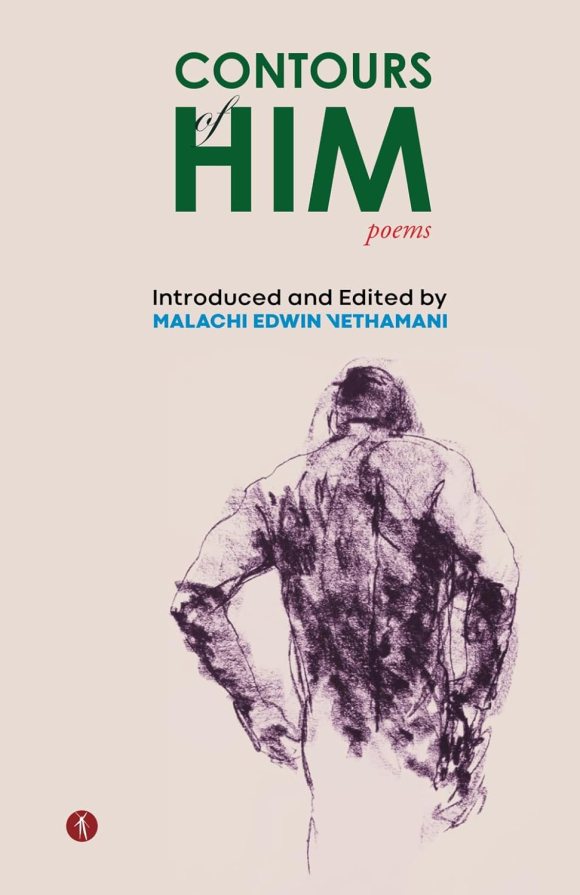
Title: Contours of Him: Poems
Edited and Introduced by Malachi Edwin Vethamani
Publisher: Hawakal Publishers
Contours of Him: Poems has been edited and introduced by Malachi Edwin Vethamani, a Malyasian academic of repute. The book has a rich assemblage of poetical voices — from both men and women — representing the contours and nuances of the many aspects and shades of masculinity. The poems explore the male body as a symbol of identity, art, and humanity, delving into themes of masculinity, strength, vulnerability, and beauty. It also examines the male body and psyche as the site of hurt and wounding. The book features poems that scrutinise the male form revealing or concealing it to explore these themes.
The focus on corporeality or the somatic coexists with the psychological in many poems in the anthology. Childhood innocence and curiosity coexist and yield to what could be viewed as growing pains or the challenges of maturation and understanding. There are several poems on the father-son theme, with poems that express homage to the father. Christina Yin’s prose poem ‘To My Father’ and Gopal Lahiri’s ‘My Ideal Man’ are cases in point. Sudeep Sen in the poem, ‘Baba/Father’, captures the enormous vacuum left by the loss of the father as Sen completes the elaborate death rituals as the eldest son of his dead father, performed as per brahminical prescriptions. In a gnomic and nuanced vein, Vethamani , the editor of the anthology, gives his take on father-son intimacies.
This book examines the contours of the male body and psyche at different stages of life and could be viewed as a psycho-somatic exploration of masculinity across diverse cultures. It also explores the strength and fragility of the male physique, occasionally dipping into cultural repertoires of male archetypes, human and divine. At the same time, it acknowledges societal expectations from men and their concomitant cultural insecurities, particularly regarding their identity and the search for acceptance.
A common motif in many of the poems is about the unwitting and unwillingly borne burden and baggage of masculinity. The protagonists/personae of many of these poems seem to be conscious that masculinity is but a performance, involving the display of muscles and embodying a certain swag. Yet this definition of and expectation from men within patriarchies, can be a cage and straitjacket which binds, restricts and confines the human being. If patriarchies bind women, men are not exempt from it either. It is this theme that resonates(among others) in Angshuman Kar’s poem called ‘Tears’: “When mountains cry, rivers are born/From a woman’s tears, pearls have always been born/And when mothers cry, dormant volcanoes awaken…No one in the world knows/why a strong man cries/or why, when he does/he looks so sacred and beautiful.”
The predominant focus, however, is on corporeality that has led to the exploration of its many aspects of the body in the poems. The many facets locates the male body along a spectrum of materiality, vulnerability, relationality and the transcendental possibilities of the body. In recent years, there have been a plethora of poems by women discussing corporeality in multiple registers, exploring female subjectivity, desire and sexuality. Focus on the psychosomatic aspects of the gendered body has led to numerous explorations and analyses of femininity, on being/becoming women, on trans-identities. Many poems have been written on the human-divine aspect of the female body. Kamala Das and others (including Pakistani women poets) have written evocatively about the transgressive desires and the many hungers of the female body .
Voices from the global south recording the voices of men was perhaps the need of the moment. The anthology includes a few poems on masculinity as a construct, especially focusing on the male body through various lenses — vulnerability, performance, shame, violence, and transformation. These poems offer a critical lens rather than idealising masculinity, exposing its social constructions and internal contradictions. They also highlight the relational nature of masculinity which are often traditionally embedded within family structures in South Asia. There are glimpses of guilt in Arthur Neong’s poem, “At this juncture of age, I feel like a teenager again,” where the persona/speaker seems keen to shed and slough off the burdens of masculinity and be in an escapist mode. He writes “At times I go to my wife for a little reprieve/Yet eyes open, think of ways to cheat”. Some of the poems read like love poems, like David C.E. Tneh’s poem, ‘Crossings’, that memorialises his dead friend. Tneh writes: “between the shared spaces and/ private moments come a synergy of collective memories/that I have of you.”
A writer writing on the female body once referred to it as a story discussed by men. Similarly, the anthology at hand discusses the contours of male corporeality and affect. The anxieties of masculinity, of literally not measuring up, pepper these poems and forms one of the vital themes of this anthology. Occasionally, a kind of narcissism creeps in, often giving way to musing or self-introspection. After voicing the common masculine concerns(and anxieties) of corporeal self-consciousness, the poet Kiriti Sengupta declares:
“I don’t look at veiled people anymore.
It is either my age or my hormones.
I now look beyond the flesh, bone and keratin.”
In the last revelatory line, there is a movement towards transcendence: “I have been told /the finer body dwells undressed.”
In a different context but similar vein, Sandeep Kumar Mishra in ‘The Canvas of Form’ writes, “The naked body, stripped of all pretence,/Breathes honesty, raw beauty, fragile strength.” The profundity of the closing lines is inescapable: “The body, bared, is neither shame nor pride/But speaks of histories, of fears ,of love. It tells of burdens carried, joys embraced/And in its stillness, whispers human truth.”
Much canonical poetry, including that of the famed icon of modernist poetry, T.S.Eliot, writing a century ago, display a preoccupation with masculine anxieties in his iconic ‘The Love Song of Alfred J Prufrock’. The effete personae/protagonist , immortalised in the eponymous poem, Felix Cheong writes of ‘Middling Age’ that it’s “So unbecoming to have become so old? You’d sooner wear the ends of your frailty rolled”, lines echoing T.S.Eliot’s The Love Song of Alfred J Prufock, “I will wear the bottoms of my trousers rolled.”
From Justin Baldoni’s Man Enough to Shyam Selvadurai’s Funny Boy, there are many coming of age stories in our cultural landscape-on book lists and bestseller lists. While the sociology of sex and gender has long been a part of sociology and social psychology, the growth and development of a field of knowledge –gender studies– in the last four decades or so, has thrown into relief the fact that if femininity is a construct, so is masculinity.
Meenakshi Malhotra is Professor of English Literature at Hansraj College, University of Delhi, and has been involved in teaching and curriculum development in several universities. She has edited two books on Women and Lifewriting, Representing the Self and Claiming the I, in addition to numerous published articles on gender, literature and feminist theory. Her most recent publication is The Gendered Body: Negotiation, Resistance, Struggle.
.
PLEASE NOTE: ARTICLES CAN ONLY BE REPRODUCED IN OTHER SITES WITH DUE ACKNOWLEDGEMENT TO BORDERLESS JOURNAL
Click here to access the Borderless anthology, Monalisa No Longer Smiles
Click here to access Monalisa No Longer Smiles on Amazon International
 Borderless