Ranu Bhattacharyya takes us back to Dhaka of the 1930s… and a world where the two Bengals interacted as one with her migration story. Click here to read.
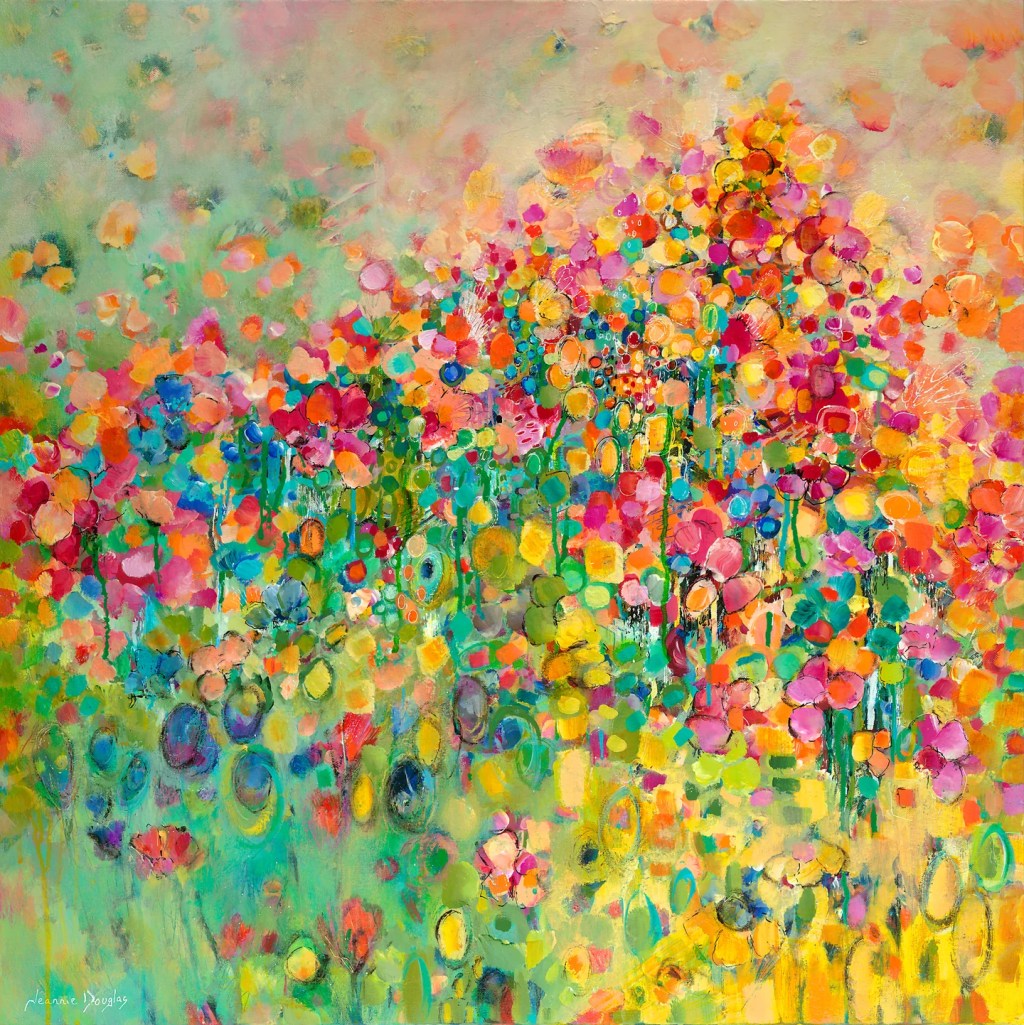
A Pop of Happiness by Jeanie Douglas. From Public Domain
Happiness is a many splendored word. For some it is the first ray of sunshine; for another, it could be a clean bill of health; and yet for another, it would be being with one’s loved ones… there is no clear-cut answer to what makes everyone happy. In Harry Potter and the Half Blood Prince (JK Rowling, 2005), a sunshine yellow elixir induces euphoria with the side effects of excessive singing and nose tweaking. This is of course fantasy but translate it to the real world and you will find that happiness does induce a lightness of being, a luminosity within us that makes it easier to tackle harder situations. Playing around with Rowling’s belief systems, even without the potion, an anticipation of happiness or just plain optimism does generate a sense of hope for better times. Harry tackles his fears and dangers with goodwill, friends and innate optimism. When times are dark with raging wars or climate events that wreck our existence, can one look for a torch to light a sense of hope with the flame of inborn resilience borne of an inner calm, peace or happiness — call it what you will…?
It is hard to gauge the extreme circumstances with which many of us are faced in our current realities, especially when the events spin out of control. In this issue, along with the darker hues that ravage our lives, we have sprinklings of laughter to try to lighten our spirits. In the same vein, externalising our emotions to the point of absurdity that brings a smile to our lips is Rhys Hughes’ The Sunset Suite, a book that survives on tall tales generated by mugs of coffee. In one of the narratives, there is a man who is thrown into a bubbling hot spring, but he survives singing happily because his attacker has also thrown in packs of tea leaves. This man loves tea so much that he does not scald, drown or die but keeps swimming merrily singing a song. While Hughes’ stories are dark, like our times, there is an innate cheer that rings through the whole book… Dare we call it happiness or resilience? Hughes reveals much as he converses about this book, squonks and stranger facts that stretch beyond realism to a fantastical world that has full bearing on our very existence.
A powerful essay by Binu Mathew on the climate disaster at Wayanad, a place that earlier had been written of as an idyllic getaway, tells us how the land in that region has become more prone to landslides. The one on July 30th this year washed away a whole village! Farouk Gulsara has given a narrative about his cycling adventure through the state of Kashmir with his Malaysian friends and finding support in the hearts of locals, people who would be the first to be hit by any disaster even if they have had no hand in creating the catastrophes that could wreck their lives, the flora and the fauna around them. In the wake of such destructions or in anticipation of such calamities, many migrate to other areas — like Ranu Bhattacharya’s ancestors did a bit before the 1947 Partition violence set in. A younger migrant, Chinmayi Goyal, muses under peaceful circumstances as she explores her own need to adapt to her surroundings. G Venkatesh from Sweden writes of his happy encounter with local children in the playground. And Snigdha Agrawal has written of partaking lunch with a bovine companion – it can be intimidating having a cow munching at the next table, I guess! Devraj Singh Kalsi has given a tongue-in-cheek musing on how he might find footing as a godman. Suzanne Kamata has given a lovely summery piece on parasols, which never went out of fashion in Japan!
Radha Chakravarty, known for her fabulous translations, has written about the writer she translated recently, Nazrul. Her essay includes a poem by Tagore for Nazrul. Professor Fakrul Alam has translated two of Nazrul’s songs of parting and Sohana Manzoor has rendered his stunning story Shapuray (Snake Charmer) into English. Fazal Baloch has brought to us poetry in English from the Sulaimani dialect of Balochi by Allah Bashk Buzdar, and a Korean poem has been self-translated by the poet, Ihlwha Choi. The translations wind up with a poem by Tagore, Olosh Shomoy Dhara Beye (Time Flows at an Indolent Pace), showcasing how the common man’s daily life is more rooted in permanence than evanescent regimes and empires.
Fiction brings us into the realm of the common man and uncommon situations, or funny ones. A tongue-in-cheek story set in the Midwest by Joseph Pfister makes us laugh. Farhanaz Rabbani has given us a beautiful narrative about a girl’s awakening. Paul Mirabile delves into the past using the epistolary technique highlighting darker vignettes from Christopher Columbus’s life. We have book excerpts from Maaria Sayed’s From Pashas to Pokemonand Nazes Afroz’s translation of Syed Mujtaba Ali’sShabnamwith both the extracts and Rabbani’s narratives reflecting the spunk of women, albeit in different timescapes…
When migrations are out of choice, with multiple options to explore, they take on happier hues. But when it is out of a compulsion created by manmade disasters — both wars and climate change are that — will the affected people remain unscarred, or like Potter, bear the scar only on their forehead and, with Adlerian calm, find happiness and carpe diem?
Do pause by our current issue which has more content than mentioned here as some of it falls outside the ambit of our discussion. This issue would not have been possible without an all-out effort by each of you… even readers. I would like to thank each and every contributor and our loyal readers. The wonderful team at Borderless deserve much appreciation and gratitude, especially Manzoor for her wonderful artwork. I invite you all to savour this August issue with a drizzle of not monsoon or April showers but laughter.
May we all find our paths towards building a resilient world with a bright future.
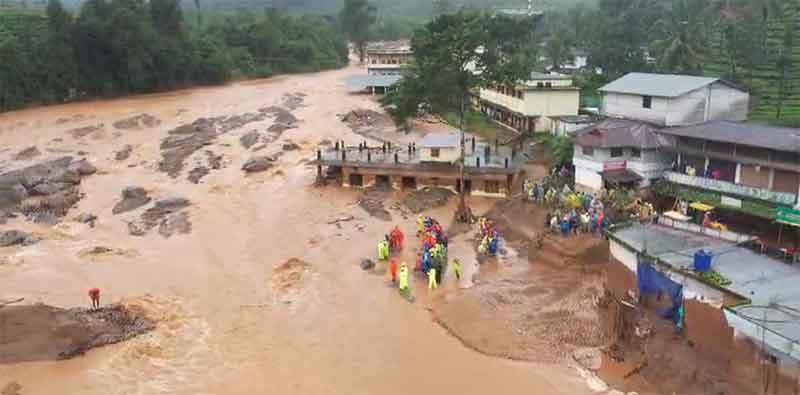
Landslide at Wayanad: Photo Courtesy: Countercurrents
On the morning of July 30, a huge landslide occurred at Mundakkai, in the mountainous district of Wayanad, Kerala, India. 282 people have been confirmed dead and many hundreds are still missing. It is the worst landslide in the history of Kerala and perhaps one of the worst in the history of India. A whole village was washed away in the flood and the flow of earth and rocks. A government higher secondary school and a bridge also got washed away. The rescue operations are still going on.
According to data released by India Meteorological Department Wayanad district received as much as 7% of its entire seasonal rainfall in 24 hours (from Monday morning to Tuesday morning). The Mundakkai region received 572 mm of rainfall in the past 48 hours prior to the landslide. This clearly points to an extreme climate change-induced disaster.
Experts like Madhav Gadgil are saying that it was due to the environmental degradation that the disaster occurred. The fact of the matter is that the landslide happened inside a deep forest which was not affected by human intervention.
The disaster area belongs to the Western Ghats, a UNESCO World Heritage Site, which is a very fragile ecologically sensitive area. This is also a region prone to frequent landslides. The Western Ghats starting from the Southern tip of the Indian subcontinent to the Konkan region is home to about 50 million people. In the parts belonging Kerala alone at least 5 million people live. Human habitation has caused a lot of ecological damage to the region. After the liberalisation of Indian economy, tourism has become a major industry in the region. Lots of tourist resorts have come up in the last 30 years, leading to stone quarrying in a major way. The stones from Western Ghats are used to build new roads, bridges, houses even in the lower land area and even the Adani port in Vizhinjam, Trivandrum.
If you look at the history of the Kerala part of Western Ghats, it was the Britishers who started huge tea, coffee and rubber plantations starting from late 19th century. It has caused huge environmental degradation in the region. Tata and Harrison Malayalam are the big planters now in the region. They behave like feudal lords, giving paltry sums in lease to the government and even encroach government lands to plant monocrops. The landslide affected Mundakkai also is a tea estate area owned by Harrison Malayalam company.
The farmers migrated to Wayanad and other parts of the Western Ghats of Kerala during the independence period due to the acute famine of that time. The government also promoted the migration of farmers. It is the descendants of these farmers who are killed by the landslide. They are the unsuspecting victims of unchecked development model and climate change caused by the Global North.
No place can withstand the kind of rain that was received in the landslide area. Yes, of course, wrong development model and environmental degradation has contributed to the disaster but it is not the root cause. It is the climate change caused by global warming for which the Global North is primarily responsible.
Present CO2 level in the atmosphere is 421 parts per million (ppm), which is similar to the CO2 level of Pliocene Epoch was a period in Earth’s history that lasted from 5.333 million to 2.58 million years ago. During the Pliocene epoch, CO2 levels in the Earth’s atmosphere were between 380 and 420 (ppm) during the warmest period. The global mean sea level during the early Pliocene Epoch was around 17.5 ± 6.4 meters which means that we are locked in for a sea level rise of at least 6.5 meters, 17 meters being the upper limit. Also CO2 levels in the atmosphere are rising 2.9 ppm per annum. This also means that we are moving into an unchartered territory in the climate crisis.
Most of our coastal cities will be under water very soon. Kerala which has one third of the landmass very close to the sea will be submerged under water. As the ocean warms more and more drastic climate events like Mundakkai will be a regular phenomenon. As Himalayan glaciers melt, the rivers originating from the Himalayas will dry up. Most of North India will be a desert. As the permafrost melts in the Arctic, Methane which is 28 times more potent than Carbon Dioxide will be released into the atmosphere and we will lead to a feedback loop, meaning more and more greenhouse gases will be released into the atmosphere without any human intervention. Another dangerous scenario is that as the permafrost melts, viruses and bacteria buried millions of years ago will be released into the atmosphere causing pandemics like COVID. Forest fires will be a regular occurrence in the dry seasons.
Do you think that climate change would be just weather events? No. Not at all. It will spread into social relations and human relations. We might see water wars, famines, and even civil wars in the name of nationality, ethnicity, language etc. Do you think that the present population of 8 billion people will survive the coming climate catastrophe? I think it will not. Many researchers are saying that we are in the middle of the Sixth Great Extinction. The sixth great extinction, also known as the Holocene extinction, is an ongoing mass extinction event that is caused by human activity. It is thought to be the sixth mass extinction event in Earth’s history, following the Ordovician–Silurian, Late Devonian, Permian–Triassic, Triassic–Jurassic, and Cretaceous–Paleogene extinction events.
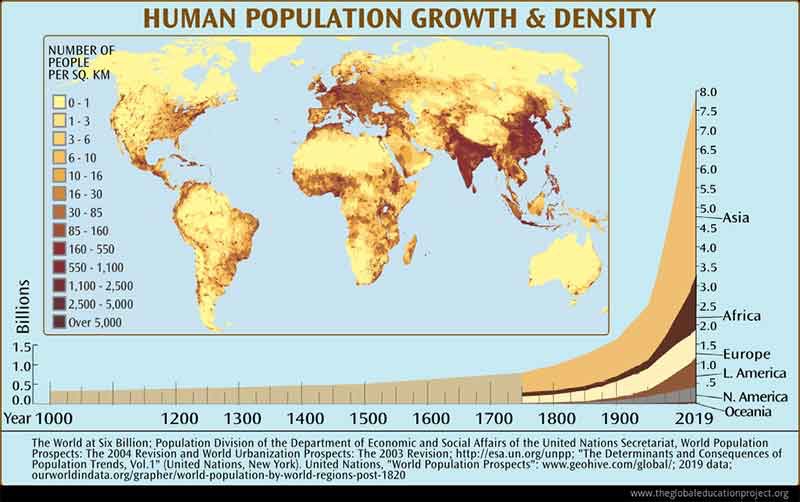
Courtesy: Countercurrents
In the beginning of the 20th Century, the human population was only 2 Billion. Now we are 8 Billion. The huge spike in population growth that we saw recently is an aberration in human history. Nature will correct itself. That means we are going to see millions or even billions of deaths, if not in our lifetime, definitely in the lifetime of our children and our grandchildren. That means thousands of Mundakkai events will play in a loop in front of our eyes! What is most devastating is that there would be some of our dear and near ones too.
What happened in Mundakkai, Wayanad is not an aberration. It’s the new normal. It’s the beginning!
Binu Mathew is the Editor of Countercurrents.org. He can be reached at editor@countercurrents.org. This article was first published in Countercurrents.org.
.
PLEASE NOTE: ARTICLES CAN ONLY BE REPRODUCED IN OTHER SITES WITH DUE ACKNOWLEDGEMENT TO BORDERLESS JOURNAL
Disclaimer: The opinions expressed are solely that of the author and not of Borderless Journal.
Binu Mathew, Founder and Editor of Countercurrents.org, in conversation with Mitali Chakravarty
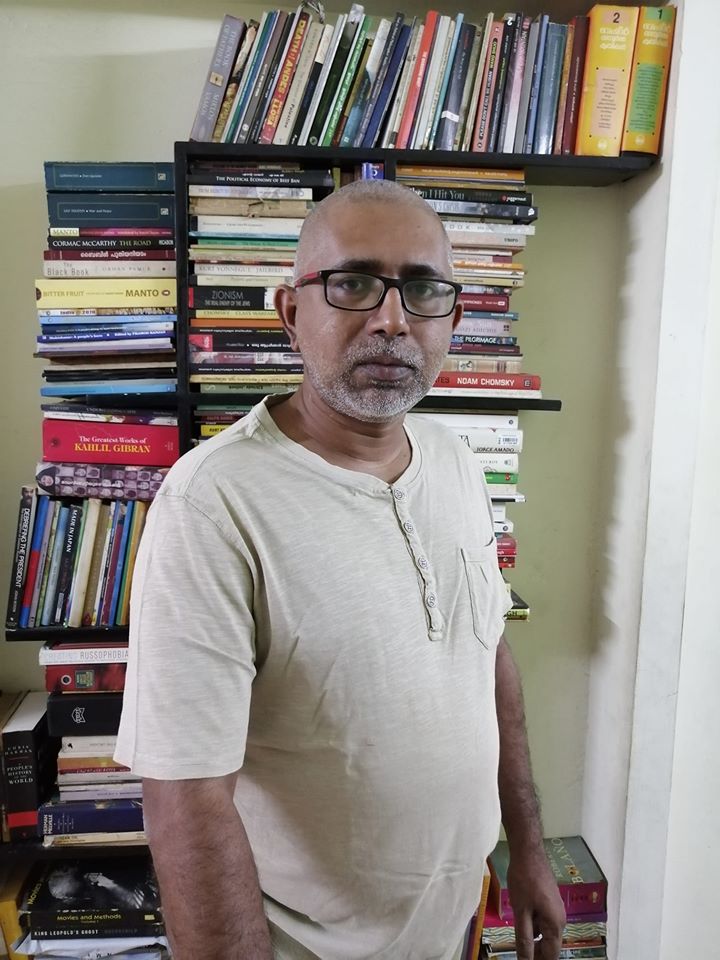
Binu Mathew
Can you interview an online site?
You can’t. So, I did the next best thing. I interviewed Binu Mathew, the man behind the award-winning million readers a month or three million-page views a month online journal, Countercurrents. Mathew claims this is not a big thing except that his journal is based on ideology and openness. He calls it a “people’s journal” in his you tube interview.
He has also started a ‘People’s Manifesto‘, a campaign that will be released by August 15, 2020. He is asking people to give an alternative vision to the government for a post-COVID 19 India. Mathew grew up in a farm on Kerala and turned to journalism. He has talked of his life in an interview with John Scales Avery, a theoretical chemist who is a part of the Nobel Peace Prize winning Pugwash Conferences.
Mathew is a man who finds links and interlinks between major world issues from climate change, COVID to economics and politics. What impresses me most about Mathew is that while almost all writers and journalists see their journeys at an individual level, he completely identifies with his journal and lives by his ideology. Here in this exclusive, we have Mathew himself unravel his ideology.
You have been running Countercurrent.org for 18 years. Tell us how it was conceived and why?
I was working as a journalist in Malayalam language news paper. It was a mundane job. Although the job gave me some financial security, it didn’t satisfy my intellectual curiosity. My desire to do something positive for the society kept nagging me. The job itself was a monotonous one, doing local beats and making local pages.
Some of my college mates and I had some discussions about starting an alternative weekly or monthly in Malayalam language. But the financial cost was huge, and it was beyond our capacity.
By the year 2000, internet infiltrated into our homes. There I chanced upon Znet, Electronic Intifada and many such fascinating websites. It was a revelation to me. Znet was a great source of left intellectual literature. Noam Chomsky, the rock star of intellectuals was free to read at the click of a mouse. In those days it was very expensive to buy books by Chomsky. In other websites, I found people telling stories from Palestine and other conflict zones.
In around the same time, I read the book, When Corporations Rule The World by David Korten. It was an eye opener. I thought I had to do something more than doing the local beats for my paper. Internet gave me the opportunity to do this. I decided to start a website like Znet.
I had zero knowledge in computing language. So I joined a basic html course. I and some of our friends had a brain storming session and decided on the name “Countercurrents“. I took a loan from bank and bought a computer. It was a 20GB hard disc, 256 MB RAM computer. It cost me Rs 40,000 at 18% interest! I paid it back by monthly instalments from my salary.
It was also the time a pogrom in Gujarat against Muslims was going on, in which at least 2000 Muslims were killed. We decided to launch the site as soon as possible.
Artist Razi designed the site, Ajith Kumar B converted it into html. I translated an article from Malayalam by the well-known writer Sarah Joseph titled, “The Womb and the Sword”, on the attack on pregnant Muslim women in Gujarat, in some cases where the pregnant women’s belly was cut open and the foetuses were thrown into the fire. That’s how I became the editor of Countercurrents. It was on March 27, 2002 the first article was published. Since then more than fifty thousand articles have been published. Thousands of well-known and young people have written for CC. Some of them went on to become big journalists or activists.
Tell us about your team and what makes you tick?
I don’t have a team to speak of. Most of the editing work is done by me. There are people like K.P Sasi and Satya Sagar who help me with their intellectual inputs. There are also many other people who are part of the Countercurrents Collective who don’t like to be named. In that way, I’m very fortunate and extremely thankful to them.
What is the philosophy of Countercurrents?
Humanity is facing its greatest existential threat ever with climate change and resource depletion and environmental degradation. This is not a crisis waiting to happen in the future, but it is already here and manifests itself in the COVID-19 pandemic we are facing today. Many resources wars continue to rage in several parts of the world, rising food and fuel prices, growing hunger, natural calamities of horrifying proportions, water scarcity, debt crisis, unemployment, social tensions among communities, growing human rights violations and unprecedented ecological degradation. Unless we take urgent action to change the way we live, trashing our only home, this beautiful planet, this crisis has the potential to wipe out the entire humanity and a majority of the other species from the face of this Earth.
The objective of Countercurrents.org is to spread awareness about this crisis and search for meaningful solutions. We believe that energy intensive globalization should end and it must be replaced by a low energy, ecologically sustainable local economies. If humanity is to survive, the destructive system of capitalism and consumerism must be replaced by an economic system which is based on just equitable distribution and need based use of resources.
Your motto says —“Educate! Organise! Agitate!” How do you explain it?
Susan B. Anthony (February 15, 1820 – March 13, 1906), who was an American social reformer and women’s rights activist and played a pivotal role in the women’s suffrage movement said, “Organise, agitate, educate, must be our war cry.”
In the Indian context Dr Ambedkar gave the call “Educate, Agitate and Organise.”
We combined both the slogans and took as our motto —“Educate! Organise! Agitate!”
We thought of it as a revolutionary call for caste annihilation and women’s empowerment, two of the major concerns in the world today. It also envisages a new kind of journalism which ‘educates’ instead of entertains as in ‘infotainment’. Organisation is necessary for social change. Without organisation, we cannot make any social change. However, it is not the duty of Countercurrents to establish an organisation. We hope that an organisation would emerge organically from the masses. An example is ” Fridays For Future” initiated by Greta Thunberg. Countercurrents has been educating the world about the danger of climate change from its inception. It is happy to see organisations emerge organically, especially on critical issues like climate change. Agitation is the final push for social change. It will happen or it should happen. Otherwise, we are all going to perish.
You have many hallowed names attached to your journal, like noted intellectuals like John Scales Avery, Magsaysay award winners, Sandeep Pandey and Prafulla Samantara and social activist Ram Puniyani. What do you think made them pick your journal over others?
I respect and love all these people. They are regular writers of Countercurrents too. They must have seen Countercurrents as an engine of social change. Otherwise they would not have endorsed CC.
You have recently started a section called Citizenship Amendment Act and it has won some recognition from US universities. Can you tell us a bit about this initiative and the subsequent recognition? How will this recognition help Countercurrents or your initiative?
Countercurrents was covering the Citizenship Amendment Act from the initial days of this controversial pact and the resultant agitations across the country. We were happy to know that Ivy Plus universities in the US decided to include it in their digital library for the benefit of faculty and researchers. Their communication said, “The Ivy Plus Libraries Confederation has selected your website — https://countercurrents.org/tag/citizenship-amendment-act — for inclusion in its India’s Citizenship Amendment Act Protest Movement Web Archive. The Archive is an initiative developed by librarians at Columbia University, the University of Pennsylvania, and New York University, under the auspices of the Ivy Plus Libraries Confederation. The Archive contains material related to protests against India’s new Citizen Amendment Act and the National Register of Citizenship, and was created to preserve and expose this content for academic research in politics, religion, sociology, and interdisciplinary South Asian Studies.”
It is extremely heartening to have this recognition from such prestigious universities, especially in this age of fake news. This speaks volumes of the authenticity of the content Countercurrents publishes. By the way, Countercurrents is archived in the US Library of Congress too. That too is an immense recognition
What kind of contributors do you look for?
Whatever the articles that Countercurrents publishes have some insights, give a new perspective to the reader. We won’t publish articles that don’t fit this criterion. We have contributors from Nobel Prize winners to grade ten students. Achievements doesn’t matter. Insights matter.
What kind of readership do you have?
We have readership from around the world. I get emails from even a remote village of Nicaragua.
What do you see as the future of Countercurrents and your own?
The future is beyond our control. We do our best while we can is my motto, the rest is beyond our control. If I die tomorrow, I hope someone will be willing and capable enough to take over.
You Tube interview of Binu Mathew with Vidya Bhushan Rawat, a social and human right’s activist
.
PLEASE NOTE: ARTICLES CAN ONLY BE REPRODUCED IN OTHER SITES WITH DUE ACKNOWLEDGEMENT TO BORDERLESS JOURNAL.
The COVID-19 has taught us that we are in an emergency. In 2019 a teenager named Greta Thumberg was crying hoarse that we are in an emergency and no one was listening. It’s time for us to take stock of the matter. Which is the greater emergency, this COVID-19 emergency or the climate emergency that Greta Thumberg was warning about?
Up to 1 million: species threatened with extinction, many within decades
>500,000 (+/-9%): share of the world’s estimated 5.9 million terrestrial species with insufficient habitat for long term survival without habitat restoration
>40%: amphibian species threatened with extinction
Almost 33%: reef forming corals, sharks and shark relatives, and >33% marine mammals threatened with extinction
25%: average proportion of species threatened with extinction across terrestrial, freshwater and marine vertebrate, invertebrate and plant groups that have been studied in sufficient detail
At least 680: vertebrate species driven to extinction by human actions since the 16th century
+/-10%: tentative estimate of proportion of insect species threatened with extinction
>20%: decline in average abundance of native species in most major terrestrial biomes, mostly since 1900
>6: species of ungulate (hoofed mammals) would likely be extinct or surviving only in captivity today without conservation measures Food and Agriculture
Yes this is an EMERGENCY that very few are talking about.
Why are all these species going extinct? Just because of the actions of this invasive dominant species called homosapiens!
The same UN report points out that:
1 degree Celsius: average global temperature difference in 2017 compared to pre-industrial levels, rising +/-0.2 (+/-0.1) degrees Celsius per decade
>3 mm: annual average global sea level rise over the past two decades
16-21 cm: rise in global average sea level since 1900
100% increase since 1980 in greenhouse gas emissions, raising average global temperature by at least 0.7 degree
40%: rise in carbon footprint of tourism (to 4.5Gt of carbon dioxide) from 2009 to 2013
8%: of total greenhouse gas emissions are from transport and food consumption related to tourism
5%: estimated fraction of species at risk of extinction from 2°C warming alone, rising to 16% at 4.3°C warming
Even for global warming of 1.5 to 2 degrees, the majority of terrestrial species ranges are projected to shrink profoundly.
When Countercurrents.org started in 2002, the CO2 level in atmosphere was 370 ppm. Now it stands at 412 ppm. Dr. Andrew Glikson, a climate scientist has pointed out in several articles in Countercurrents that total green house gases in the atmosphere in the atmosphere including CO2, Methane, Nitrous Oxide, Ozone etc has topped 500ppm.
The Paris Agreement’s goal is to keep the increase in global average temperature to well below 2 °C above pre-industrial levels; and to pursue efforts to limit the increase to 1.5 °C.
Coordinated by the World Meteorological Organisation which is also backed by the United Nations Environment Programme and the Intergovernmental Panel on Climate Change, the United in Science report released in September 2019 estimates global emissions are not likely to peak before 2030 on the current trajectory. It says policies to reduce emissions must triple to meet the 2°C target and increase fivefold to keep heating to within 1.5°C.
With the forced COVID-19 lockdown we are well on track to reach the Paris temperature goals. The COVID lockdown taught us what is essential for our sustenance. Most of the carbon emitting vehicles and airplanes are grounded. Our consumption has come down to our basic essentials. Continents jumping tourism has come to a standstill, so has the neoliberal globalisation. It is good time for globalisation to fail and save our planet. Pollution has come down. Cities have become serene. Rivers have become clean. We’ll have to wait for authentic studies to confirm how much carbon footprint did we reduce.
We were living a reckless life like there is no tomorrow, consuming as much as we can and travelling as far as we can. COVID lockdown has put a break to this reckless lifestyle. In fact it is so much better for the environment. The COVID lockdown has taught us how much wastage we were making. It also taught us we can live better life with much less than we usually consume.
The COVID lockdown has also taught us we have to do a lot more work to do make our economy resilient. We have to make our local economies resilient. We have to grow our food in our neighbourhood. It will create more local jobs and stop the long haul migration to the cities. The cities too have to become resilient by producing its own food. May be cities itself may not be a good idea and wither away.
The COVID lockdown has given us a sneak preview into the future if we are to meet the global temperature goals. We have no other choice if we are to believe our science experts. Scientists like James Hansen predicts that even the human species may go extinct if we can not control global warming.
Human civilization has seen many pandemics and have won over all of them. We’ll overcome this pandemic too. But I’m not so sure about the battle against global warming. The COVID-19 lockdown has taught us that we can win the battle against global warming too. With a little bit more planning we can do even better.
 Borderless