Categories
Contents

Borderless, June 2025

Art by Sohana Manzoor

Editorial

‘How do you rebuild a life when all that remains is dust?’… Click here to read.

Translations

The Great War is Over and A Nobody by Jibanananda Das have been translated from Bengali by Professor Fakrul Alam. Click here to read.

Sukanta Bhattacharya’s poem, Therefore, has been translated from Bengali by Kiriti Sengupta. Click here to read.

 Five poems by Soubhagyabanta Maharana  have been translated from Odia by Snehaprava Das. Click here to read.

Animate Debris, a poem by Sangita Swechcha has been translated from Nepali by Saudamini Chalise. Click here to read.

Lost Poem, a poem by Ihlwha Choi  has been translated from Korean by the poet himself. Click here to read.

Sonar Tori (Golden Boat), a poem by Tagore, has been translated from Bengali by Mitali Chakravarty. Click here to read.

Poetry

Click on the names to read the poems

Allan Lake, Shobha Tharoor Srinivasan, Ron Pickett, Ananya Sarkar, George Freek, Bibhuti Narayan Biswal, Jim Bellamy, Pramod Rastogi, Vern Fein, Saranyan BV, Ryan Quinn Flanagan, Juairia Hossain, Gautham Pradeep, Jenny Middleton, Mandavi Choudhary, Rhys Hughes

Musings/Slices from Life

Where Should We Go After the Last Frontiers?

Ahamad Rayees writes from a village in Kashmir which homed refugees and still faced bombing. Click here to read.

The Jetty Chihuahuas

Vela Noble takes us for a stroll to the seaside at Adelaide. Click here to read.

Hope Lies Buried in Eternity

Farouk Gulsara muses on hope. Click here to read.

Undertourism in the Outback

Merdith Stephens writes from the Australian Outback with photographs from Alan Nobel. Click here to read.

Musings of a Copywriter

In Driving with Devraj, Devraj Singh Kalsi writes of his driving lessons. Click here to read.

Notes from Japan

In The Tent, Suzanne Kamata visits crimes and safety. Click here to read.

Essays

Public Intellectuals Walked, So Influencers Could Run

Lopamudra Nayak explores changing trends. Click here to read.

Where No One Wins or Loses a War…From Lucknow with Love

Prithvijeet Sinha takes us to a palace of a European begum in Lucknow. Click here to read.

Bhaskar’s Corner

In Can Odia Literature Connect Traditional Narratives with Contemporary Ones, Bhaskar Parichha discusses the said issue. Click here to read.

Feature

The story of Hawakal Publishers, based on a face-to-face tête-à-tête, and an online conversation with founder Bitan Chakraborty with his responses in Bengali translated by Kiriti Sengupta. Click here to read.

Stories

The Year the Fireflies Didn’t Come Back

Leishilembi Terem gives a poignant story set in conflict-ridden Manipur. Click here to read.

The Stranger

Jeena R. Papaadi writes of the vagaries of human relationships. Click here to read.

The Opening

Naramsetti Umamaheswararao relates a value based story in a small hamlet of southern India. Click here to read.

Book Excerpts

An excerpt from Wendy Doniger’s The Cave of Echoes: Stories about Gods, Animals and Other Strangers. Click here to read.

An excerpt from Mohua Chinappa’s Thorns in My Quilt: Letters from a Daughter to Her Father. Click here to read.

Book Reviews

Somdatta Mandal reviews Madhurima Vidyarthi’s Job Charnock and the Potter’s Boy. Click here to read.

Rakhi Dalal reviews Dhruba Hazarika’s The Shoot: Stories. Click here to read.

Satya Narayan Misra reviews Bakhtiyar K Dadabhoy’s Honest John – A Life of John Matthai. Click here to read.

Bhaskar Parichha reviews David C Engerman’s Apostles of Development: Six Economists and the World They Made. Click here to read.

.


Click here to access the Borderless anthology, Monalisa No Longer Smiles

Click here to access Monalisa No Longer Smiles on Amazon International

Categories
Editorial

‘How do you rebuild a life when all that remains is dust?’

The Great War is over
And yet there is left its vast gloom.
Our skies, light and society’s soul have been overcast…

'The Great War is Over' by Jibanananda Das (1899-1954), translated from Bengali by Professor Fakrul Alam.

Jibanananda Das wrote the above lines in the last century and yet great wars rage even now. As the world struggles to breathe looking for a beam of hope to drag itself out of the darkness induced by natural calamities, accidents, terror attacks and wars that seem to rage endlessly, are we moving towards the dystopian scenario created by George Orwell in 1984, which would be around the same time as Jibanananda Das’s ‘The Great War is Over’?

Describing such a scenario, Ahmed Rayees writes a moving piece from the Kashmiri village of Sheeri, the last refuge of the displaced refugees who were bombarded after peace was declared in their refuge during the clash across Indo-Pak borders. He contends: “People walked back not to homes, but to ruins. Entire communities had been reduced to ash and rubble. Crops were destroyed, livestock gone, schools turned into shelters or craters. How do you rebuild a life when all that remains is dust?”

People could be asking the same questions without finding answers in Gaza or Ukraine, where the cities are reduced to rubble. While we look for a ray of sunshine, amidst the rubble, Farouk Gulsara muses on hope that has its roots in eternity. Vela Noble wanders on nostalgic beaches in Adelaide. And Meredith Stephens travels to the Australian outback. Devraj Singh Kalsi brings in lighter notes writing of driving lessons while Suzanne Kamata creeps back to darker recesses musing on likely ‘criminals’ and crimes in her neighbourhood.

Lopamudra Nayak writes on social media and its impact while Bhaskar Parichha writes of trends that could be brought into Odia literature.  What he writes could apply well to all regional literature, where they lose their individual colouring to paint dystopian realities of the present world. Does modernising make us lose our ethnic identity and how important is that? These are questions that sprung to the mind reading his essay. As if in an attempt to hold on to the past ethos, Prithvijeet Sinha wafts around old ruins in Lucknow and sees a cemetery for colonial soldiers and concludes: “Everybody has formidable stakes, and the dead don’t preach the gospel of victory or sombre defeat.”

Taking up a similar theme of death and war is a poem from Saranyan BV. In poetry, we have colours from around the world with poems from Allan Lake, Ron Pickett, Ananya Sarkar, George Freek, Jim Bellamy, Ryan Quinn Flanagan, Juairia Hossain, Gautham Pradeep, Jenny Middleton, Mandavi Choudhary and many more. Multiple themes are woven into a variety of perspectives, including nature and environment, with June hosting the World Environment Day. Rhys Hughes gives a funny poem on the Welsh outlaw, Twm Siôn Cati.

We have mainly poetry in translation this time. Snehaprava Das has brought to us Soubhagyabanta Maharana’s poems from Odia and Ihlwha Choi has translated his own poem from Korean. Sangita Swechcha’s poem in Nepali has been rendered to English by Saudamini Chalise. From Bengali, other that Jibanananda Das’s poems translated by Professor Fakrul Alam, we have Tagore’s pensive and beautiful poem, Sonar Tori (the golden boat). Yet another Bengali poet, one who died young and yet left his mark, Sukanta Bhattacharya (1926-1947), has been translated by Kiriti Sengupta. Sengupta has also translated the responses of Bitan Chakravarty in a candid conversation about his dream child — the Hawakal Publishers. We also have a feature on this based on a face-to-face conversation, giving the story of how this publishing house grew out of an idea. Now, they publish poetry traditionally, without costs to the poet. Their range of authors are spread across continents.

Our fiction again returns to the darkness of war. Young Leishilembi Terem has given a story set in conflict-ridden Manipur from where she has emerged safely — a story that reiterates the senselessness of violence and politics. While Jeena R. Papaadi writes of modern human relationships that end without commitment, Naramsetti Umamaheswararao relates a value-based story in a small hamlet of southern India. 

From stories, our book excerpts return to the real world, where a daughter grieves her father in Mohua Chinappa’s Thorns in My Quilt: Letters from a Daughter to Her Father while Wendy Doniger’s The Cave of Echoes: Stories about Gods, Animals and Other Strangers, dwells on demystifying structures that create borders. We have two non-fiction reviews. Parichha writes about David C Engerman’s Apostles of Development: Six Economists and the World They Made. And Satya Narayan Misra discusses Bakhtiyar K Dadabhoy’s Honest John – A Life of John Matthai. Somdatta Mandal this time explores a historical fiction based around the founding of Calcutta, Madhurima Vidyarthi’s Job Charnock and the Potter’s Boy while Rakhi Dalal looks at fiction born of environmental awareness, Dhruba Hazarika’s The Shoot: Stories.

We have more content. Do pause by our contents page and take a look.

Huge thanks to all our contributors without who this issue would not have materialised. Heartfelt thanks to the team at Borderless for their support, especially Sohana Manzoor for her iconic artwork that has almost become a signature statement for Borderless.

Let’s hope that next month brings better news for the whole world.

Best wishes,

Mitali Chakravarty

borderlessjournal.com

Click here to access the contents for thJune 2025 Issue

READ THE LATEST UPDATES ON THE FIRST BORDERLESS ANTHOLOGY, MONALISA NO LONGER SMILES, BY CLICKING ON THIS LINK.

Categories
Review

Six Economists and the World they Made

Book Review by Bhaskar Parichha

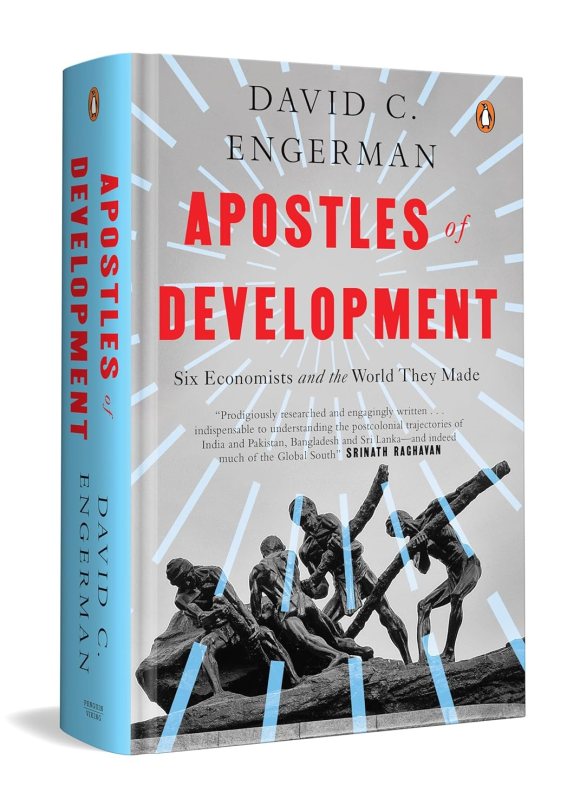
Title: Apostles of Development: Six Economists and the World They Made 

Author: David C. Engerman

Publisher: Penguin Viking

David C. Engerman is a Yale University professor focused on twentieth-century international history. He has authored two books on Russia and the USSR’s influence on American politics and has extensively studied international development assistance. His key works include the co-edited volume Staging Growth: Modernization, Development and the Global Cold War (2003) and the monograph, The Price of Aid: The Economic Cold War in India. His research was featured in his 2016 presidential address to the Society for Historians of American Foreign Relations. He is currently writing a comprehensive history of international development, tentatively titled International Development: A History in Eight Crises.

Apostles of Development: Six Economists and the World They Made by Engerman focuses on six influential economists from South Asia : Amartya Sen, Manmohan Singh, Mahbub ul Haq, Jagdish Bhagwati, Rehman Sobhan and Lal Jayawardena.

All six were born as colonial subjects in the British Empire and studied at Cambridge University. They emerged as pioneering “Third World development experts”, playing central roles in shaping global debates on poverty, inequality, and economic development.

The book highlights that the fight against global poverty, which began in the aftermath of World War II, represented a monumental effort that brought together economists, engineers, and a multitude of organisations.

This period marked the emergence of economists as a vital force in global affairs, playing a crucial role in shaping international dialogues focused on poverty alleviation and development strategies. Their contributions were essential in formulating policies and initiatives aimed at addressing the complex challenges of poverty on a worldwide scale.

Writes Engerman in the introduction: “The Apostles’ careers — and their home countries — demonstrate that there was no one path to development. Many governments in new nations opted to build factories. Others focused on roads and power plants, or on schools and hospitals. Some, like India, stressed economic self-reliance while others, including Pakistan and Ceylon, pursued international trade. Whatever the strategy, debates over the role of government-which frequently divided these six-resonated with the growing tensions of the Cold War, which pitted contrasting economic and political models against each other. Yet development was no mere creature of the Cold War, especially when examined from the perspective of the former colonies.” 

He further contends: “Core ideas and practices of development changed dramatically over the Apostles’ long careers. Debates roiled academic conferences, di- vided planning commission discussions, and dominated international venues — and the Apostles participated on all sides. Was the goal of development to alleviate poverty or was it to reduce inequality? Was the best solution to expand the economic role of government or to reduce it? Was national development better served by becoming self-sufficient was economic theory universal or did a different set of economic rules (and therefore economic tools) apply to poor countries than to rich ones? Development was always contested. 

“The Apostles’ turn to economics was in keeping with the spirit of the age. Economic questions loomed large in the middle of the twentieth century and economists proved ready, willing, and able to offer answers. Political leaders frequently sought their expertise and the century’s leading economists answered that call. The Depression cried out for an explanation that suggested a solution; the doyen of Cambridge economics, John Maynard Keynes, took on that task with gusto. The fate of World War II was determined as much by each side’s ability to mobilize resources as it was by battlefield tactics– hence Paul Samuelson’s boast that it was ‘an economist’s war’. And the problems of the postcolonial world arose precisely as economics was becoming what one historian called ‘the master discipline of the 20th century’.”

The book emphasizes that the origins and driving force of development were rooted in the Global South, aiming to improve the conditions of the world’s poorest countries, rather than being a project imposed by the West.It explores the different economic philosophies of these six economists and the ongoing debate about how economic theory should differ for poor versus rich countries.

Engerman challenges the idea that development is simply a tool for rich countries to dominate or a pure expression of humanitarianism. Instead, he argues that successful development comes from practical solutions tailored to real-world problems, not rigid ideological frameworks.

The book advocates for a modest, pragmatic approach to development, prioritising the reduction of gross inequality and insisting that development means more than just economic growth.

The narrative situates these economists’ work in the broader context of the Cold War and the shifting global landscape, highlighting how their ideas shaped and were shaped by international politics and economic crises.

This extensively researched and substantial book is acknowledged as a significant and timely addition to the literature concerning economics, economic history, and the progression of development thought, particularly in light of current global discussions regarding inequality and the prospects for economic growth.

Apostles of Development is suggested for those who are interested in the historical context of development economics, the influence of the Global South on global policy formulation, and the life stories of several of the most impactful economists of the 20th century.

.

.

Bhaskar Parichha is a journalist and author of Cyclones in Odisha: Landfall, Wreckage and ResilienceUnbiasedNo Strings Attached: Writings on Odisha and Biju Patnaik – A Political Biography. He lives in Bhubaneswar and writes bilingually. Besides writing for newspapers, he also reviews books on various media platforms.

.

PLEASE NOTE: ARTICLES CAN ONLY BE REPRODUCED IN OTHER SITES WITH DUE ACKNOWLEDGEMENT TO BORDERLESS JOURNAL

Click here to access the Borderless anthology, Monalisa No Longer Smiles

Click here to access Monalisa No Longer Smiles on Amazon International