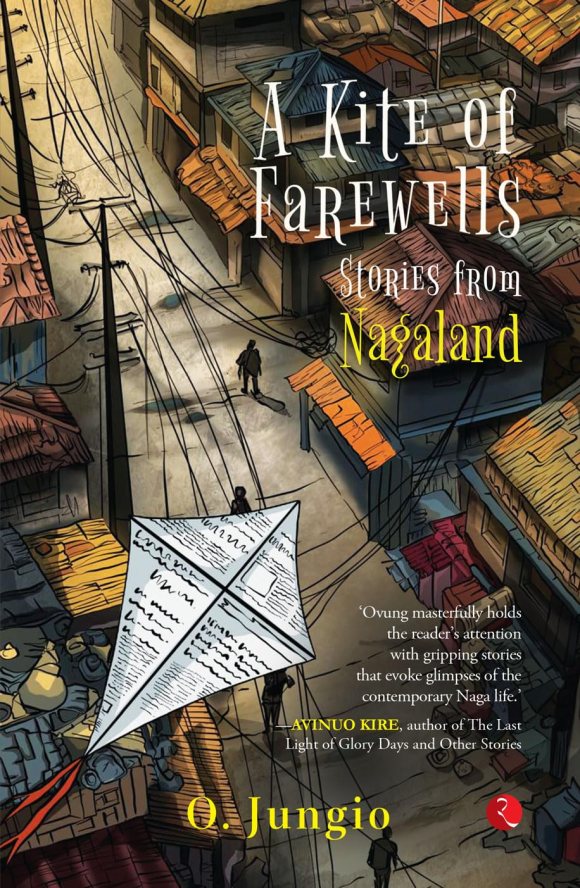
Title: The Kite of Farewells: Stories from Nagaland
Author: O’Jungio
Publisher: Rupa Publications
O. Jungio’s The Kite of Farewells: Stories from Nagaland is a collection of short stories of longing and grief set in contemporary Nagaland. The author is a tribal studies scholar, and cultural historian whose research and essays focus on oral traditions, folklore, and socio-cultural changes among Naga communities. In the book’s preface, he writes, “The objects—mute spectators to human sorrow—become the vessels of collective grief, the repositories of the most intimate of the farewells”. And every story in this collection does explore of longings of different kinds followed by farewells.
The first story, ‘Fire’, begins with a man driving in a downpour. He forgot to carry the food packed by his Ayo’s(mother’s). Like many others she believes hotels are “vectors for every ungodly disease in the world masquerading as something palatable.” What follows is at night he ends up in a strange village for food and shelter; where it seems like the lines between the living and the dead are blurred. The narrator chances upon a man who serves him raw food. He notes, “perhaps by way of some idiosyncratic tradition, this village served raw food on this particular day of the great harvest” and starts a fire to cook himself only to be spooked out by the man. Despite his longing for food, he has to make an escape.
In ‘The Encyclopaedia of a Salesman’, a young man selling encyclopaedias meets a retired government official. Initially, the narrator is cautious about why a man so steeped in command would be interested in something as democratic as encyclopedias. He reflects: “With a career of bossing around subordinates, were more inclined to be loud in their admission of suspicion and disinterest in things that challenged and subverted their sphere of command. What annoyed such men more was the vague possibility that for once in their life they would be hoodwinked by a lesser man like me. It would amount to an abominable upset of social order.” This single observation is enough to collapse multiple distances of age, profession, class. The salesman’s mind, seasoned by years of observation, becomes its own encyclopedia. Just when the disparity gets real, Jungio reminds us of a harder truth: that conversations end.
Jungio tries play on the longing for nostalgic memories in ‘Scoreboard’, highlighting an exchange about keeping a manual scoreboard for FIFA world cup 2017; the son arguing “you can get match summaries and stats from google” for the father to brush it off with “it has been a tradition for me”. The whole act of hanging a whiteboard with teams playing and the predictions along with their scores stands out as a cherished activity for the season. When tragedy strikes, that brief exchange transitions itself into a way of longing, in the practices we all hold on to after the passing of loved ones.
It is not just about the personal objects of longing, but also the social objects, or feeling like a forgotten object that has stood still in time. In the story ‘Showroom’, we meet a middle-aged man, who has always “shopped cheap and done so unapologetically,” visits a new mall in town after much contemplation, only to find himself embarrassed when he misunderstands the mall purchase policy. The story is tinged with humour.
In ‘Sacred Crow’ the concept of ‘Echu Li’ is introduced to the reader and the protagonist at the same time as “a world not different from ours. It is a transient stop for the dead before they move on to the Great Home, where they all would become noble spirits, formless like the wind” — which presents itself as an acceptance of loss. The protagonist awaits the black crow, building curiosity only to close on a note that better fits the tales passed around orally in rural Nagaland.
The final story, ‘The Newspaper Kite’, features four rowdy boys who “create” trouble for their neighbours with their games, their little understanding of familial financial struggles and a bond they both form with a man in his sixties. They lovingly call ‘Amotsu’ when he kindly returns them their newspaper kite in a new frame the boys “dropped” in his garden. The boys find joy in a paper boat because “Lofty ideas are, to an extent, a luxury when the means to materialise it are limited or absent. When you are poor, you train your mind to dream on a budget, and some days, you surprise yourself by getting so much out of so little.” When the boys find about the sudden demise of the Amotsu, they remember his words, “There is always a next day,” with the awareness that the coming days would be without Amotsu. It is in the memory of “that thread trick Amotsu used to do” while flying kites, the boys stay connected to the person who left this world.
O. Jungio does a balancing act between inherited lore and the present. He subtly hints at that it is the lore that differs from landscape but not the emotions or beliefs. Regardless of the objects that offer solace, people connect with the commonality of emotions.
.
Madhuri Kankipati is a reader, writer, and translator with too many hobbies and refuses to pick just one. She was raised to follow instructions, but the real world doesn’t work that way, she just stares at her problems. You can find her on instagram @withlovemadhuu
PLEASE NOTE: ARTICLES CAN ONLY BE REPRODUCED IN OTHER SITES WITH DUE ACKNOWLEDGEMENT TO BORDERLESS JOURNAL
Snehaprava Das, a former Associate Professor of English, is a noted poet and translator. She has translated many Odia works into English and published five poetry collections. Her translations have received several awards, including the Prabashi Bhasha Sahitya Sammana, the Jibanananda Das Award, and the Fakir Mohan Anubad Sammana.
Keep It Secret is a collection of ten short stories. The relatively lengthy narratives are equally grounded in reality and fantasy. In the author’s view, these narratives strive to traverse the delicate, ephemeral boundary that exists between reality and illusion. They delve into the inner jungle to uncover the secrets that are meticulously hidden behind a facade of pretense and the artifice of a pleasing and socially acceptable exterior.
Engaging with her stories provides a rewarding experience. These tales encompass a diverse array of themes, including life and death, the supernatural, the real and the surreal, peculiar coincidences, and the intricacies of human relationships.
In the Preface, Das provides a rationale for her stories, which contributes to their uniqueness. Citing Regina Pally, a distinguished psychiatrist and therapist based in Los Angeles, Das states, “Most of what we perceive occurs non-consciously and effortlessly, and according to her, this process can be described as a ‘survival instinct’.” This may lead the guilt-ridden mind to interpret and shape a future aimed at compensating for past wrongs. This ‘survival instinct,’ which entices individuals to assume and perceive various things, can even distort the true impact of actual events, creating multiple and bizarre interpretations of a single incident that may approach the surreal.
She bases her stories on the presumption made by Freudian scholars: “From error to error, one discovers the entire truth, observes Freud. Some of the stories aim at exposing the errors man is forced to commit, lured by compulsive emotions, which leave life irrecoverably difficult, and could at times prove fatal in that self-destructive process of discovering the truth. Some stories attempt to study the complex and shifting patterns of human relationships that hang precariously balanced between trust and distrust, and to observe the reaction of the characters while confronting the secret of that relationship, which was kept closely guarded till the end. The experience of that confrontation could be subversive in that specific moment of anagnorisis.”[1]
Some stories may not always offer a seemingly logical, definable, or happy ending.
Das’s short stories possess a cerebral quality, posing a challenge for discerning readers to fully appreciate her offerings.
.
[1] ‘The other Freud: Rethinking the philosophical roots of psychoanalysis’ by Parker & Donald Lewis
Bhaskar Parichha is a journalist and author of Cyclones in Odisha: Landfall, Wreckage and Resilience, Unbiased, No Strings Attached: Writings on Odisha and Biju Patnaik – A Political Biography. He lives in Bhubaneswar and writes bilingually. Besides writing for newspapers, he also reviews books on various media platforms.
PLEASE NOTE: ARTICLES CAN ONLY BE REPRODUCED IN OTHER SITES WITH DUE ACKNOWLEDGEMENT TO BORDERLESS JOURNAL
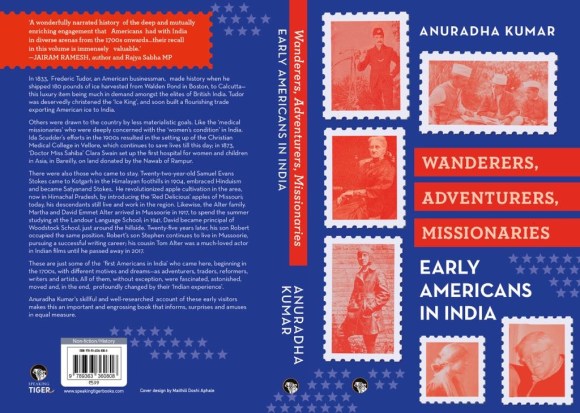
A review of Anuradha Kumar’s Wanderers, Adventurers, Missionaries: Early Americans in India (Speaking Tiger Books) and an interview with the author
Migrants and wanderers — what could be the differences between them? Perhaps, we can try to comprehend the nuances. Seemingly, wanderers flit from place to place — sometimes, assimilating bits of each of these cultures into their blood — often returning to their own point of origin. Migrants move countries and set up home in the country they opt to call home as did the family the famous Indian actor, Tom Alter (1950-2017).
Anuradha Kumar’s Wanderers, Adventurers, Missionaries: Early Americans in India captures the lives and adventures of thirty such individuals or families — including the Alter family — that opted to explore the country from which the author herself wandered into Singapore and US. Born in India, Kumar now lives in New Jersey and writes. Awarded twice by the Commonwealth Foundation for her writing, she has eight novels to her credit. Why would she do a whole range of essays on wanderers and migrants from US to India? Is this book her attempt to build bridges between diverse cultures and seemingly diverse histories?
As Kumar contends in her succinct introduction, America and India in the 1700s were similar adventures for colonisers. In the Empire Podcast, William Dalrymple and Anita Anand do point out that the British East India company was impacted in the stance it had to colonisers in the Sub-continent after their experience of the American Revolution. And America and India were both British colonies. They also were favourites of colonisers from other European cultures. Just as India was the melting pot of diverse communities from many parts of the world — even mentioned by Marco Polo (1254-1324) in The Kingdom of India — America in the post-Christopher Columbus era (1451-1546) provided a similar experience for those who looked for a future different from what they had inherited. The first one Kumar listed is Nathaniel Higginson (1652-1708), a second-generation migrant from United Kingdom, who wandered in around the same time as British administrator Job Charnock (1630-1693) who dreamt Calcutta after landing near Sutanuti[1].
Kumar has bunched a number of biographies together in each chapter, highlighting the commonality of dates and ventures. The earliest ones, including Higginson, fall under ‘Fortune Seekers From New England’. The most interesting of these is Fedrick Tudor (1783-1864), the ice trader. Kumar writes: “In Calcutta, Dwarkanath Tagore, merchant and patron of the arts (Rabindranath Tagore’s grandfather), expressed an interest to involve himself in ice shipping, but Tudor’s monopoly stayed for some decades more. Tagore was part of the committee in Calcutta along with Kurbulai Mohammad, scion of a well-established landed family in Bengal, to regulate ice supply.”
Also associated with the Tagore family, was later immigrant Gertrude Emerson Sen (1890-1982, married to Boshi Sen). She tells us, “Tagore wrote Foreword to Gertrude Emerson’s Voiceless India, set in a remote Indian village and published in 1930. Nobel Laureate Rabindranath Tagore called Emerson’s efforts, ‘authentic’.” She has moved on to quote Tagore: “The author did not choose the comfortable method of picking up information from behind lavish bureaucratic hospitality, under a revolving electric fan, and in an atmosphere of ready-made social opinions…She boldly took in on herself unaided to enter a region of our life, all but unexplored by Western tourists, which had one great advantage, in spite of its difficulties, that it offered no other path to the writer, but that of sharing the life of the people.’” Kumar writes of an Afro-American scholar, called Merze Tate who came about 1950-51 and was also fascinated by Santiniketan as were some others.
Another name that stuck out was Sam Higginbottom, who she described as “the Farmer Missionary” for he was exactly that and started an agricultural university in Allahabad. Around the same time as Tagore started Sriniketan (1922), Higginbottom was working on agricultural reforms in a different part of India. In fact, Uma Dasgupta mentions in A History of Sriniketan: Rabindranath Tagore’s Pioneering work in Rural Reconstruction that Lord Elimhurst, who helped set up the project, informed Tagore that “another Englishman” was doing work along similar lines. Though as Kumar has pointed out, Higginbottom was a British immigrant to US — an early American — and returned to Florida in 1944.
There is always the grey area where it’s difficult to tie down immigrants or wanderers to geographies. One such interesting case Kumar dwells on would be that of Nilla Cram Cook, who embraced Hinduism, becoming in-the process, ‘Nilla Nagini Devi’, as soon as she reached Kashmir with her young son, Sirius. She shuttled between Greece, America and India and embraced the arts, lived in Gandhi’s Wardha ashram and corresponding with him, went on protests and lived like a local. Her life mapped in India almost a hundred years ago, reads like that of a free spirit. At a point she was deported living in an abject state and without slippers. Kumar tells us: “Her work according to Sandra Mackey combined ‘remarkable cross-cultural experimentation’ and ‘dazzling entrepreneurship.’”
The author has written of artists, writers, salesmen, traders (there’s a founder/buyer of Tiffany’s), actors, Theosophists, linguists fascinated with Sanskrit, cyclists — one loved the Grand Trunk Road, yet another couple hated it — even a photographer and an indentured Afro-American labourer. Some are missionaries. Under ‘The Medical Missionaries: The Women’s Condition’, she has written of the founders of Vellore Hospital and the first Asian hospital for women and children. Some of them lived through the Revolt of 1857; some through India’s Independence Movement and with varied responses to the historical events they met with.
Kumar has dedicated the book to, “…all the wanderers in my family who left in search of new homes and forgot to write their stories…” Is this an attempt to record the lives of people as yet unrecorded or less recorded? For missing from her essays are famous names like Louis Fischer, Webb Miller — who were better known journalists associated with Gandhi and spent time with him. But there are names like Satyanand Stokes and Earl and Achsah Brewster, who also met Gandhi. Let’s ask the author to tell us more about her book.
Anuradha Kumar
What made you think of doing this book? How much time did you devote to it?
These initially began as essays for Scroll; short pieces about 1500-1600 words long. And the beginnings were very organic. I wrote about Edwin Lord Weeks sometime in 2015. But the later pieces, most of them, were part of a series.
I guess I am intrigued by people who cross borders, make new lives for themselves in different lands, and my editors—at Scroll and Speaking Tiger Books—were really very encouraging.
After I’d finished a series of pieces on early South Asians in America, I wanted to look at those who had made the journey in reverse, i.e., early Americans in India, and so the series came about, formally, from December 2021 onward. I began with Thomas Stevens, the adventuring cyclist and moved onto Gertrude Emerson Sen, and then the others. So, for about two years I read and looked up accounts, old newspapers, writings, everything I possibly could; I guess that must mean a considerable amount of research work. Which is always the best thing about a project like this, if I might put it that way.
What kind of research work? Did you read all the books these wanderers had written?
Yes, in effect I did. The books are really old, by which I mean, for example, Bartolomew Burges’ account of his travels in ‘Indostan’ written in the 1780s have been digitized and relatively easy to access. I found several books on Internet Archive, or via the interlibrary loan system that connects libraries in the US (public and university). I looked up old newspapers, old magazine articles – loc.gov, archive.org, newspapers.com, newspaperarchive.com, hathitrust.org and various other sites that preserve such old writings.
You do have a fiction on Mark Twain in India. But in this book, you do not have very well-known names like that of Twain. Why?
Not Twain, but I guess some of the others were well-known, many in their own lifetime. Satyanand Stokes’ name is an easily recognisable still especially in India, and equally familiar is Ida Scudder of the Vellore Medical College, and maybe a few others like Gertrude Sen, and Clara Swain too. I made a deliberate choice of selecting those who had spent a reasonable amount of time in India, at least a year (as in the case of Francis Marion Crawford, the writer, or a few months like the actor, Daniel Bandmann), and not those who were just visiting like Mark Twain or passing through. This made the whole endeavour very interesting. When one has spent some years in a foreign land, like our early Americans in India, one arguably comes to have a different, totally unique perspective. These early Americans who stayed on for a bit were more ‘accommodating’ and more perceptive about a few things, rather than supercilious and cursory.
And it helped that they left behind some written record. John Parker Boyd, the soldier who served the Nizam as well as Holkar in Indore in the early 1800s, left behind a couple of letters of complaint (when he didn’t get his promised reward from the East India Company) and even this sufficed to try and build a complete life.
How do these people thematically link up with each other? Do their lives run into each other at any point?
Yes, I placed them in categories thanks to an invaluable suggestion by Dr Ramachandra Guha, the historian. I’d emailed him and this advice helped give some shape to the book, else there would have been just chapters following each other. And their lives did overlap; several of them, especially from the 1860s onward, did work in the same field, though apart from the medical missionaries, I don’t think they ever met each other – distances were far harder to traverse then, I guess.
What is the purpose of your book? Would it have been a response to some book or event?
I was, and am, interested in people who leave the comforts of home to seek a new life elsewhere, even if only for some years. Travelling, some decades ago, was fraught with risk and uncertainty. I admire all those who did it, whether it was for the love of adventure, or a sense of mission. I wanted to get into their shoes and see how they felt and saw the world then.
Is this because you are a migrant yourself? How do you explain the dedication in your book?
I thought of my father, and his cousins, all of whom grew up in what was once undivided Bengal. Then it became East Pakistan one day and then Bangladesh. Suddenly, borders became lines they could never cross, and they found new borders everywhere, new divisions, and new homes to settle down in. They were forced to learn anew, to always look ahead, and understand the world differently.
When I read these accounts by early travellers, I sort of understood the sense of dislocation, desperation, and sheer determination my father, his cousins felt; maybe all those who leave their homes behind, unsure and uncertain, feel the same way.
You have done a number of non-fiction for children. And also, historical fiction as Aditi Kay. This is a non-fiction for adults or all age groups? Do you feel there is a difference between writing for kids and adults?
I’d think this is a book for someone who has a sense of history, of historical movements, and change, and time periods. A reader with this understanding will, I hope, appreciate this book.
About the latter half of your question, yes of course there is a difference. But a good reader enters the world the writer is creating, freely and fearlessly, and I am not sure if age decides that.
You have written both fiction and non-fiction. Which genre is more to your taste? Elaborate.
I love anything to do with history. Anything that involves research, digging into things, finding out about lives unfairly and unnecessarily forgotten. The past still speaks to us in many ways, and I like finding out these lost voices.
What is your next project? Do you have an upcoming book? Do give us a bit of a brief curtain raiser.
The second in the Maya Barton-Henry Baker series. In this one, Maya has more of a lead role than Henry. It’s set in Bombay in the winter of 1897, and the plague is making things scary and dangerous. In this time bicycles begin mysteriously vanishing… and this is only half the mystery!
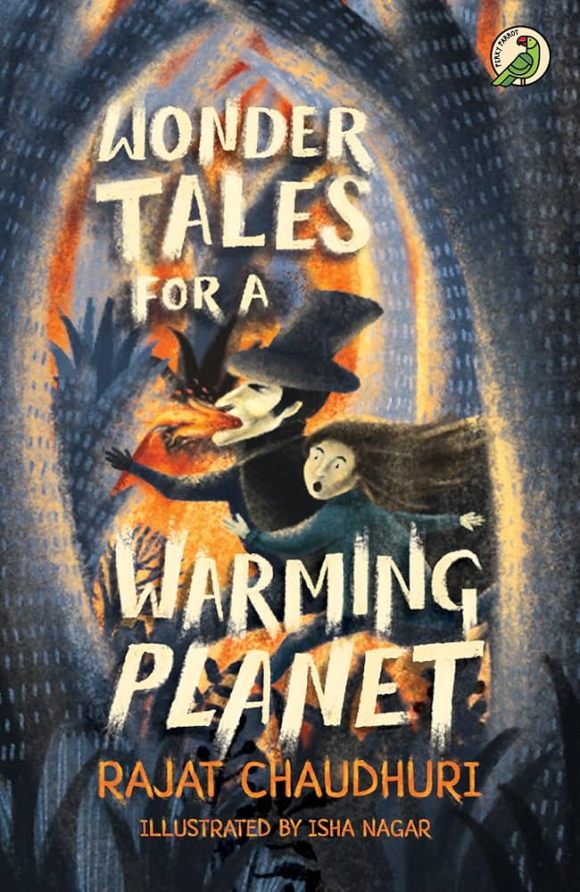
In a world teetering on the edge of ecological collapse, it’s often children who inherit the burden of our choices. But what if they could also inherit the tools to re-imagine the future? In Wonder Tales for a Warming Planet, Rajat Chaudhuri doesn’t simply tell stories—he offers blueprints for curiosity, resistance, and wonder. This collection of three speculative tales—’Tina and the Light of the World’, ‘The Seventh Sense’, and‘How Did the Oceans Vanish’—invites young readers to explore climate change not as a distant apocalypse, but as an unfolding narrative in which they are already key players.
Chaudhuri, author of acclaimed climate novels like The Butterfly Effect and Spellcasters, and short story collection like Hotel Calcutta, does not offer didactic lessons to children here. Instead he channels the age-old power of storytelling—immersive, imaginative, and intimate—to speak directly to children. His tales empower children not by shielding them from the truth, but by equipping them with imaginative tools to face it.
The first story, ‘Tina and the Light of the World’, revolves around a young girl’s encounter with a solar-powered future. In a town gripped by blackouts and crumbling infrastructure, where the rich have access to energy while the nights of those poor are engulfed in darkness, Tina meets Stoker who takes her to light but vanishes after sometime. Then Tina meets Anu who accompanies her for a while but soon she leaves her too. Finally, Tina meets sun-catcher in a place where people use solar panels to trap sun’s energy. Tina’s journey—from darkness to a solar-powered community—unfolds like a fable of illumination, both literal and symbolic. The characters she encounters—Stoker, Anu, and the sun-catcher—each represent stages in her awakening to the possibility of decentralised, sustainable energy. Chaudhuri while suggesting the alternate sources of energy other than those used earlier, cleverly weaves together issues of energy access, decentralised power, and the democratisation of technology. But the story also touches something deeper: the notion that light—both electric and symbolic—can emerge not from grand solutions, but from the small, often overlooked spaces where ingenuity persists.
In ‘The Seventh Sense’, Chaudhuri turns inward, weaving a delicate tale around Gogol, a neuro-divergent boy who develops an extra sense—one attuned to ecological shifts. What initially feels like a fantasy premise soon unfolds into a sophisticated meditation on sensory perception and ecological empathy. This “seventh sense” allows its young bearer to understand the impact of forest cutting to make way for an urban city. The brilliance of this story lies in its central metaphor: that saving the planet may not be about creating more infrastructures mindlessly in the name of fulfilling the needs of people but about cultivating an intuitive, affective connection to the non-human world. The writing is delicate, almost lyrical, yet grounded in a chilling recognition of the precarity the present world seems to now inhabit.
The final tale, ‘How Did the Oceans Vanish’, moves from the speculative to the cautionary. Told as an oral history in a distant future where seas have dried up, the story is framed as a conversation between a grandmother and her grandchild of a different evolved species. Through anecdotal fragments we piece together a slow-motion disaster — brought about by different methods of geo-engineering ushered without considerable testing — that no one tried hard enough to stop. This retrospective mode of storytelling is effective; it avoids heavy-handedness while building a quiet, cumulative sorrow. But even here, Chaudhuri resists fatalism. The tale ends not with despair, but with a question, almost whispered: What will you do differently now?
Across all three stories, Chaudhuri’s prose remains crisp and fluid. He avoids the pitfall of jargon while subtly integrating scientific ideas— alternate energy, sustainable living, geo-engineering, and more. What binds the collection is not only its thematic concern with climate but its faith in the moral imagination of children. These are not just tales about the future; they are invitations to imagine alternate presents.
That said, the book does not attempt to be everything. The storytelling is intentionally restrained. There are no dramatic twists or action-packed sequences. The stakes are emotional and ethical, rather than physical. Young readers who’ve already begun to sense the ambient anxiety of climate discussions—will find in this collection recognition, reassurance, and a language to speak about what they feel but cannot yet articulate.
Wonder Tales for a Warming Planet deserves a place not just in classrooms or children’s libraries, but in dinner table conversations. It dares to approach the climate crisis through the lens of empathy and imagination rather than panic or guilt. In doing so, Rajat Chaudhuri gives us what many adult climate narratives fail to deliver—a reason to believe that another world is not only possible but already being imagined by the young. All we need to do is listen.
Rakhi Dalal is an educator by profession. When not working, she can usually be found reading books or writing about reading them. She writes at https://rakhidalal.blogspot.com/ .
.
PLEASE NOTE: ARTICLES CAN ONLY BE REPRODUCED IN OTHER SITES WITH DUE ACKNOWLEDGEMENT TO BORDERLESS JOURNAL
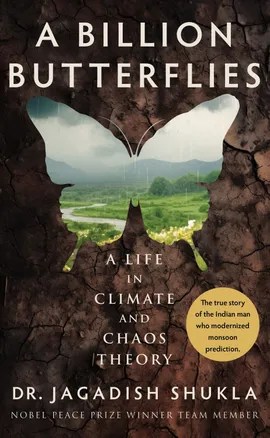
Title: A Billion Butterflies: A Life in Climate and Chaos Theory
Author:Jagadish Shukla
Publisher: Pan Macmillan India
This is a fascinating autobiography – autobiography of an Indian who revolutionised monsoon forecasting. Raised in a rural area of India devoid of electricity, plumbing, or formal educational institutions, he participated in classes conducted within a cow shed. Shukla’s upbringing was marked by erratic weather patterns, including intense monsoons and severe droughts, which resulted in unpredictable agricultural yields. His resolve led him to the Indian Institute of Tropical Meteorology, despite having limited experience. Subsequently, he embarked on an unexpected journey to MIT and Princeton, reaching the pinnacle of climate science.
His contributions have made it possible to forecast weather further into the future than was previously deemed achievable, enabling us to nourish more individuals, preserve lives, and maintain hope in an increasingly warming world.
A Billion Butterflies by Shukla offers a remarkable insider’s perspective on climate science, alongside an extraordinary memoir of his life. Grasping the concept of dynamical seasonal prediction will transform our experience of thunderstorms and our interpretation of forecasts; the incredible narrative of the individual who uncovered this will alter our perception of the world.
The fundamental concept of this heartfelt narrative revolves around envisioning a world devoid of weather forecasting. How would we determine when to evacuate populations in anticipation of fires or floods, or decide what attire to don the following day? Until four decades ago, we were unable to predict weather conditions beyond a ten-day horizon.
Writes Shukla in the Prologue: “In the past one hundred fifty years, humans chopped down many of Earth’s carbon-sucking forests and began burning fossil fuels to heat their homes, power their factories, and propel their vehicles, releasing unprecedented amounts of CO2, into the atmosphere. Like the glass walls of a greenhouse, CO2, admits energy from the sun but prohibits energy from leaving the Earth. And so pretty quickly, our nicely balanced climate became imbalanced. In the century, as the amount of CO2, in the atmosphere has increased, Earth’s global mean surface temperature has ticked up from 14 to 15 degrees Celsius.
“This is called climate change. Climate change due to human activities is now firmly established by the observed facts and the laws of physics. The consequences of the phenomenon are becoming self-evident, but so are, I’d argue, the capabilities of the new generation of scientists to find a way forward.”
Shukla says in the book, on average, the Earth expels approximately 122,000 trillion watts of energy into space annually, which is roughly equivalent to the energy it receives from the sun. This equilibrium between outgoing and incoming energy is what establishes the average climate on our planet. For nearly ten millennia, the balance between incoming and outgoing energies was so well maintained that the global annual average temperature remained a comfortable 14 degrees Celsius, allowing life to persist and humanity to flourish. On Venus, this equilibrium results in an annual average temperature of 464 degrees Celsius. This is not unexpected, considering Venus’s proximity to the sun. However, there is another significant factor, aside from the energy a planet receives from the sun that affects climate: the chemical composition of its atmosphere. On Venus, carbon dioxide constitutes 95 percent of the atmosphere. In contrast, Earth’s atmosphere contains approximately 0.04 percent carbon dioxide—or at least, it did.
The book is meticulously crafted and filled with complex details about climate events, representing a significant effort that the author labels as chaos theory. Its importance is evident in a world facing the pressing challenge of addressing the devastating impacts of climate change.
For anyone who cares about the health of our planet, this book is a must-read.
.
Bhaskar Parichha is a journalist and author of Cyclones in Odisha: Landfall, Wreckage and Resilience, Unbiased, No Strings Attached: Writings on Odisha and Biju Patnaik – A Political Biography. He lives in Bhubaneswar and writes bilingually. Besides writing for newspapers, he also reviews books on various media platforms.
PLEASE NOTE: ARTICLES CAN ONLY BE REPRODUCED IN OTHER SITES WITH DUE ACKNOWLEDGEMENT TO BORDERLESS JOURNAL
Title: Epidemic Narratives: The Cultural Construction of Infectious Disease Outbreaks in India
Author: Dilip K. Das
Publisher: Orient BlackSwan
After the major outbreak of COVID-19 pandemic in 2020, there has been a plethora of studies about epidemic narratives in different kinds of literary and visual forms. Not that the issue had not been dealt with earlier, but somehow it increased manifold times and contends with a reality that is now increasingly becoming our way of life as new infectious diseases break out and older ones resurface almost every year. Drawing from the humanities, medicine and social sciences, and using the approach of interdisciplinary studies, this non-fiction examines stories of epidemic outbreaks in India, from the late-nineteenth century to the present, in the form of fiction, film, memoir, blogs, media reports and epidemiological accounts, to show how epidemics have been represented in social understanding.
Epidemics signify a crisis in society on multiple levels. The author, who specialises in medical humanities and has been meticulously studying and teaching courses in this area for several years, realised that very little is readily available in the nature of theoretical and analytical scholarship of epidemic narratives in general and on Indian narratives in particular and so he decided to write this book.
Divided into ten chapters, the study attempts a close textual analysis and focuses on the subjective experience of people affected by the outbreak. This ranges from the emotional impact of the suffering it causes to socio-political conflicts that it brings to the fore as a collective crisis. It poses two questions: what kind of plot do they employ, and what significances do they attribute to outbreaks as complex human events?
In the first chapter, the author discusses the social understanding of epidemics using a theoretical framework drawing on Charles Rosenberg and several other theorists to show how this understanding both derives from and adds to the biomedical view of disease. It examines how, in pluralistic societies, epidemic reality is constructed through both biomedical and cosmological paradigms, leading to contrary ways of responding to it. Thus, worshipping goddesses like Sitala Mata or Corona Devi and ritualising the event in shows of solidarity exists along with scientific perspectives.
The second chapter is about the impact of pandemic on the nation as a community that imagines itself as healthy yet is vulnerable to the threat posed by pathogens and pathogenic outsiders. The COVID-19 pandemic has made it clear that the future of public health in a rapidly globalizing context depends on how nationalism and internationalism balance mutual interests. Chapters three to ten deal with specific outbreaks. The third chapter discusses two intertextual narratives of the plague outbreak Pune in 1897 which culminated in the assassination of the Plague Commissioner Walter Charles Rand. The first is the autobiography of Damodar Hari Chapekar, who was convicted and hanged for the assassination. It shows how the outbreak was constructed and framed as a political event, marking the emergence of militant nationalism and anticipating the freedom struggle. The second narrative is 22 July 1897, a film made on the same incident by Nachiket and Jayoo Patwardhan.
U. R. Ananthamurthy’s novel Samskara1is usually studied as a text that deals with the themes of caste and religious orthodoxy, the role of tradition in a modernising society, and the tension between allegory and realism. In the next chapter, Das argues that plague not only provides the inspiration for the novel and its point of departure but also serves the function of a focaliser. Samskara is about the question of social order, how a particular code of conduct becomes rigid. In this context the plague outbreak serves as a metaphor for larger social and ethical crises.
Chapter five is about Spanish flu, which broke out in Bombay in June 1918 and was rapidly carried to the rest of the country by soldiers returning from the First World War. It begins with two official reports on the flu by the assistant health officer of Bombay municipality and the sanitary commissioner of India. The author examines newspaper accounts of the outbreak and two literary narratives to show how the outbreak was variously framed as a lapse of colonial public health, a personal tragedy and a cosmological crisis. The final section of the chapter discusses the memory of the Spanish flu a hundred years later with the outbreak of COVID-19.
Chapter six deals with an outbreak of viral hepatitis, a disease that is largely endemic but has occurred intermittently in epidemic form in India in the last hundred years. The author analyses Satyajit Ray’s 1990 film Ganashatru, an adaptation of Henrick Ibsen’s An Enemy of the People, which is about an outbreak of infectious hepatitis in a pilgrimage town in West Bengal. Taking the main theme of asserting commitment to ethics as against manipulation of truth for personal gain, Ray changes the plot, characterisation and context of Ibsen’s story to criticise religious dogma which contradicts rationality and places at risk the health of people.
The next chapter analyses narratives of the HIV/AIDS epidemic which broke out in India in 1986. It examines a range of media articles, literary and cinematic texts and an AIDS awareness video to track changes in the social understanding of the disease and those affected by it. From the stigmatising accounts of risk groups and HIV-positive individuals that was characteristic of the early decades of the epidemic in India, the focus shifted at the turn of the century to empathy for them. The author discusses in details the first commercially released Hindi film on AIDS, Naya Zaher (New Poison,1991) directed by Jyoti Sarup, mentions two human interest stories like Ritu Sarin’s ‘The Outcast’ (1990) and Subhash Mishra’s ‘Damned to Death’ (2000), analyzes a film like Ek Alag Mausam ( A Different Season, 2003) directed by K. P. Sasi, Negar Akhavi’s anthology AIDS Sutra (2008), and Kalpana Jain’s Positive Lives (2002) where the author journeys more than 15,000 kilometers in four months in order to get an idea of the epidemic’ s scale. He also analyses movies like Phir Milenge ( We’ll meet again, 2004) directed by Revathy and Onir’s My Brother…Nikhil(2005) and examines the dialectical relation between social understanding and narrative in bringing about this change.
Aashique Abu’s Malayalam film, Virus, is a fictional reconstruction of the outbreak of the Nipah virus disease in Kerala in the summer of 2018 and deals with biomedical explanations as well as accounts of personal suffering. The eighth chapter therefore shows how the film constructs the event as the disintegration and renewal of community and as a sign of the vulnerability of human life. It also shows how the ending denies any assurance that the crisis is over and will not recur.
The recent outbreak of COVID-19 in India that resulted in a nationwide lockdown in 2020 forms the subject of the next chapter. It discusses stories of the pandemic and the lockdown in terms of the suffering they caused, the loneliness, disruption of everyday life, time-space disorientation, loss of life and livelihood, the lack of institutional support, and the precariousness that resulted from all of these. It focuses on two kinds of stories, those of personal suffering like the video Infected 2030 and the Times of India blog ‘My Covid Story’, and those of collective suffering like Vinod Kapri’s documentary 1232 KMS and the book that followed from it, 1232 km: The Long Journey Home. The lockdown following the COVID outbreak in India disproportionately affected migrant workers who lost livelihoods and were prevented by the police and the local administration from returning to the safety of their villages. The author clearly analyses how the governments were unable to deal effectively with so complex a crisis.
The last chapter attempts to explain why narrative is the genre best suited to represent the experience of epidemic, and why epidemic in turn calls forth narrative as its most suitable mode of representation. We make sense of an outbreak in two ways, as an objective event and as subjective human experience. Narratives bring out both these dimensions, by emphasising emotional responses to disease, death and suffering as well as making cognitive sense of it. The book also contains an interesting epilogue by S. Mukundan who examines a narrative poem Plague Sindhu (1924) by Anthony Pillai recording the outbreak of plague in his home district of Theni in Madras Presidency. The poem is an apt example of how an outbreak of infectious disease comes to be socially constructed in terms of both modern scientific ideas of disease-causation and traditional ideas of disease as divine punishment for wrongdoing.
As mentioned earlier Epidemic Narratives takes as its main theme Charles Rosenberg’s argument that the social reality of disease is constituted in the frames of explanation provided by biomedical, political, cultural and social ideals and practices. Das mentions that the book is about “human suffering and compassion” and it will be of interest to researchers and students of literature, cultural studies, the history of medicine and public health policy.
.
Translates to ‘A Rite for a Dead Man’, a Kannada novel written in 1965 ↩︎
Somdatta Mandal, critic and translator, is a former Professor of English at Visva Bharati, Santiniketan.
PLEASE NOTE: ARTICLES CAN ONLY BE REPRODUCED IN OTHER SITES WITH DUE ACKNOWLEDGEMENT TO BORDERLESS JOURNAL
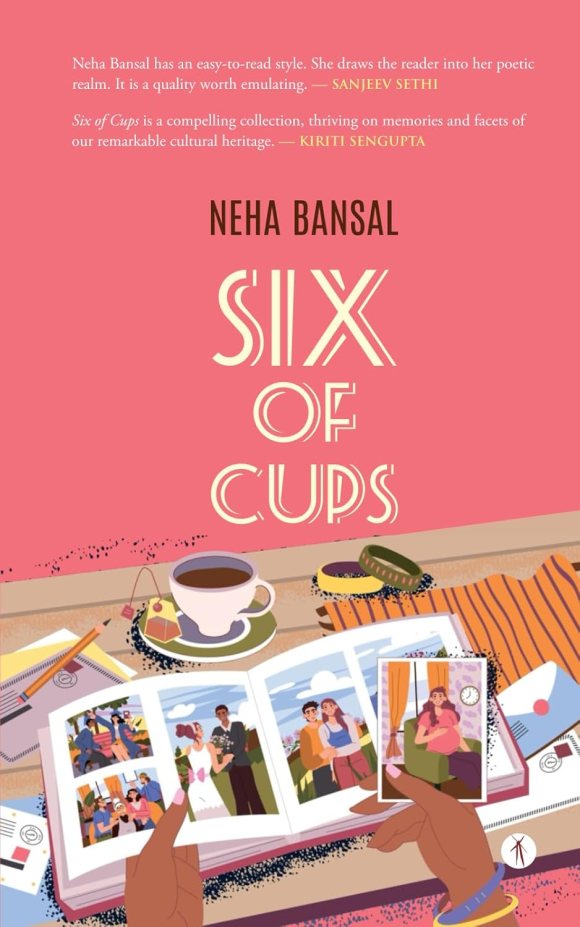
Some books speak in metaphors. Some shout their brilliance. Some want to be dissected, reviewed, analysed like puzzles. But Six of Cups isn’t that kind of book. It doesn’t ask you to do much. It just wants you to sit with it.
Neha Bansal’s poems don’t pretend. They don’t try to be clever. They don’t need you to clap. What they ask for is something quieter — your stillness, maybe. Your memory. They speak softly. Almost like they’re afraid of waking something in you. And maybe that’s exactly what they do.
This is a collection of fifty poems. Simple on the surface. But like most simple things, they carry weight. Not the kind that crushes. The kind you forgot you were holding until you’re reminded.
Reading Six of Cups is like finding an old sweater at the back of your closet. You didn’t even know you were missing it. But the moment you hold it, you’re somewhere else. In another time. Another house. Another life.
The title itself comes from the tarot — a card about childhood, nostalgia, kindness, innocence. The poems live in that space. They revisit things that aren’t just personal, but also collective such as homemade meals, festivals, sibling fights, old TV serials, chalk-smeared hands, and monsoon evenings. There’s a familiarity here that doesn’t feel manufactured. You don’t get the sense that Neha Bansal is trying to be nostalgic. She just is.
There’s a poem about Doordarshan[1]. It doesn’t try to explain the significance. It just takes you there — back to the old wooden cabinet TV, the warm static before the signal settled, the family crowding around the screen. It doesn’t say much and yet it says everything.
‘Sibling Squabbles’ is a small miracle. It captures that strange love we carry for the ones who shared our roof, our food, our secrets. The kind of love that includes shouting, pushing, sulking. But also defending each other, silently. Even now.
‘Paper Boat’ and ‘Mint Chutney’ — two more standouts don’t indulge in poetic imagery. Instead, they lean into the senses. The tartness of raw mango on your tongue. The wet smell of monsoon earth. The steam of evening tea. You read them and you’re not just reading. You’re smelling things. Tasting them. Hearing the old kitchen door creak open.
Neha Bansal is an Indian Administrative Services officer. It’s an unexpected background for a poet, maybe. Bureaucracy is about order. Poetry, one imagines, is about chaos. But in these poems, there’s order in the chaos. There’s discipline, but not rigidity. Every word is chosen carefully. Nothing feels excessive. Nothing is wasted. She writes like someone who listens closely to the world, to people, to memory. Maybe that’s what makes her poetry so honest. Her poems for people who’ve lived. People who remember the smell of their mother’s shawl. People who know the comfort of routine — boiling milk, folding bedsheets, watching Ramlila in the open field. They’re for the ones who’ve carried small hurts for years and never said a word.
There’s a kind of sacred quiet in this collection. That might be its most remarkable trait. In a time when poetry is often loud, performative, and built for clicks, these poems resist the noise. They’re not dramatic. They don’t climax. They settle in. They let silence speak.
In one of the most moving pieces, Neha Bansal writes about an old family tradition — Janmashtami, the celebration of Lord Krishna’s birth. But it’s not about religion. It’s about her grandmother drawing tiny footprints with rice flour. The quiet anticipation of the festival. The waiting. The softness of belief, not its spectacle. It’s in those tiny footprints that the poem finds its magic. You can almost see them fading slowly on the tiled floor.
These poems understand that memory is not a highlighted reel. It’s a soft murmur. A drawer that squeaks when you open it. A spoon stirring something warm. A phrase you haven’t heard in years but still know by heart. Neha Bansal knows that nostalgia isn’t about grandeur. It’s about the details we almost miss.
Her form is mostly free verse. But that doesn’t mean it’s careless. She knows how to pause — where to breathe. The white space around her lines isn’t empty. It holds meaning. A kind of emotional residue. You finish a poem, and it doesn’t end. It lingers. Like the scent of someone who just left the room.
There’s no poetic ambition here and that’s its strength. These poems don’t ask to be poetry. They just are. And that’s why they work. You trust them. You feel at home in them.
I thought of my own home while reading these pages. Kashmir. The long winters. My grandmother in her worn pheran, roasting cornflakes and walnuts on an old iron tawa, her hands, cracked and slow. The hush of mornings. No urgency. Just living.
That’s what Six of Cups reminded me of — the art of simply being. And how much that art is vanishing now.
Some poems mention festivals like Lohri, Janmashtami, Diwali. They present them as they are — domestic, lived-in, full of ordinary magic. For those unfamiliar, there’s a glossary at the end. But the real understanding happens not through translation, but emotion. Neha Bansal doesn’t lean on metaphor much. And when she does, it’s light. A passing breeze, not a storm. She doesn’t build complex imagery. But she does ask you to notice. In a world of scrolling, skimming, glancing — she’s saying, “Stop. Look. Listen.”
Even the titles of her poems have that simplicity: ‘Old Shawls’, ‘Grandmother’s Halwa’, and ‘First Rain’. They sound like diary entries. And in a way, they are. Only they’re not just her diary — they become ours too.
The brilliance of Six of Cups is that it democratises poetry. It makes it accessible again. You don’t need a theory. You need memory. You need feeling. That’s it. If you’ve ever missed someone or some place or even some version of yourself — you’ll get this.
And maybe that’s the beauty of it. It doesn’t want to be studied. It wants to be remembered. Like an old friend. Like a childhood street. Like a scent you can’t name but know in your bones.
The last poem in the collection doesn’t try to wrap everything up. There’s no neat ending. It just… fades out. The way light fades at dusk. Slowly. Gently. Without warning.
You close the book and feel something that isn’t quite sadness. It’s quieter than that. Maybe it’s the feeling of being seen. Or the feeling of remembering something small that meant something big. You sit with it for a while. You let it settle.
Six of Cups is not a loud voice. It’s a warm room. A soft light. A hand reaching back, not to pull you into the past, but to remind you it’s still with you. That you are made of it.
And maybe that’s what poetry should be sometimes — not a performance but a presence.
Gowher Bhat is a published author, columnist, freelance journalist, and educator from Kashmir. He writes about memory, place, and the quiet weight of things we carry. His work often explores themes of longing and belonging, silence and expression. He believes the smallest moments hold the deepest truths.
PLEASE NOTE: ARTICLES CAN ONLY BE REPRODUCED IN OTHER SITES WITH DUE ACKNOWLEDGEMENT TO BORDERLESS JOURNAL
The nomenclature ‘historical fiction’ is sometimes quite confusing for the reader who keeps on wondering how much of the novel is real history and how much of it is the figment of the author’s imagination. Beginning in 1686, and set in the later part of Aurangzeb’s reign, this work of historical fiction named Job Charnock and the Potter’s Boy charts the turbulent history of an insignificant hutment in the inhospitable swamps of Sutanati in Bengal that becomes one man’s unyielding obsession. This man is no other than Job Charnock whom we all claim to be the original founder of the city of Calcutta.
Bengal during that period was the richest subah of the Mughal Empire and the centre of trade. The English were granted a toehold in Hugli when Shah Jahan ousted the Portuguese in 1632 and made it a royal port. Since then, they had been worrying Shaista Khan, the current nawab at Dhaka, to give them permission to erect a fort at the mouth of the river but the wily old nawab did not agree and dismissed their petitions repeatedly. This was a period of extreme flux when the European powers like the Dutch, the Danes, the French and the English were all playing out age-old rivalries in new battlefields, aided and abetted by individual interests and local conflicts. This is when Sir Joshua Child was at the helm of East India Company’s affairs in London throughout the 1680s and his plans were brought to fruition in faraway Bengal by William Hedges and then Job Charnock.
Of the earliest champions of the British Empire, none was as fanatic or single-minded as Job Charnock. He evinced no wish for private trade or personal gain, and unlike many of his contemporaries who returned to England as wealthy ‘nabobs’, he lived and died here as a man of modest means. His life’s work was only to identify the most strategic location on the river and secure it for his masters.
Sutanati, with its natural defences and proximity to the sea, appealed to his native shrewdness and he applied himself in relentless pursuit. The story of this novel begins in Hugli in 1686, on the first day of the monsoon, when a poor potter, Gobardhan, and his wife, Indu, find it difficult to make ends meet and their life is centred around their young son Jadu. In the guise of Gobardhan relating bedtime stories to his son, the novelist very tactfully gives us the earlier historical background of the place. He tells us how during his great-great-grandfather’s time, two hundred years ago, Saptagram was the greatest city in the country, the greatest port in the Mughal Empire where ships and boats came from all over the world. Later the Portuguese bought land and built a fort at Golghat, but the Mughals grew jealous of them and finally attacked Hugli and ousted them from there.
Coming down to the present time, Jadu is twelve years old when his parents are burnt to death in front of his eyes as they were innocent bystanders in the struggle for power between the East India Company and the Nawab of Bengal. By a quirk of fate, Jadu is rescued by his father’s Mussalman friend, Ilyas, who is really protective of the boy and acts as a substitute father figure. But soon Ilyas leaves for Dhaka on a diplomatic mission and thrusts the young boy in the hands of a trusted Portuguese sailor and captain called D’ Mello. Since then, Jadu is drawn into the whirlwind of events that follow. He spends a lot of time on the river, and from December 1686 to February 1687, stays at Sutanati. Then, he moves from Sutanati to Hijli, and back to Sutanati up to March 1689, till at last he stands face to face with the architect of his misfortune — Job Charnock himself.
The rest of the tale hovers around how Jadu becomes one of his most trusted aides and though Charnock’s grand dreams did not come to fruition during his lifetime. When he died in 1693, the place was still a clutch of mud and timber dwellings still awaiting the nawab’s parwana[1] to build and fortify the new settlement. The English finally managed to acquire the zamindari rights to Sutanati, Kolkata and Gobindopur in November 1698, when the area had become quite lucrative by then.
In exploring the how, but more importantly the reason for this coming into being, the story then speaks of the motivations of the great and good and the helplessness of the not so great, all of whom in their own way contributed little nuggets of history to the city’s birth. The novel is also filled with common folk, both local natives as well as foreigners, who watch unheeded while destinies are shaped by the whims of rulers. Interwoven with verifiable historical events and many notable characters from history, the novel therefore is above all primarily the story of an innocent boy Jadu who navigates the different circumstances he is thrust in and emerges victorious and hopeful in the end. As the narrative continues, he also moves from innocence to maturity. Through his eyes we are given to read about a wide range of characters who form the general backdrop of the story.
In the ‘Author’s Note’ at the end of the novel, Madhurima Vidyarthi categorically states that this is not a history book, but she has strung together imaginary events over a skeleton of fact, based on the sum of information available. She states, “While trying to adhere to accepted chronology, the temptation to exercise creative license is often too great to be overcome”. The most significant character in this perspective is Job Charnock’s wife, who has been the subject of much research and her treatment in the Company records is typical of the time. But though a lot of information is available about Charnock’s daughters repeatedly in letters, Company documents, baptismal registers, and headstones, their mother is conspicuous by her absence. This is where the author applies her ‘creative license’ and makes Mrs. Charnock’s interactions with Jadu reveal his coming of age, and with her death, he symbolically reaches manhood. Vidyarthi also clarifies that several characters in the novel like Jadu, his parents, Ilyas, Manuel, Madhu kaka and Thomas Woods are also imaginary, and they represent the nameless, faceless masses during that period and therefore provide a ‘slice of life’ that make up history. All in all, this deft mingling of fact and fiction makes this almost 400-page novel a page-turner, ready to be devoured as fast as possible.
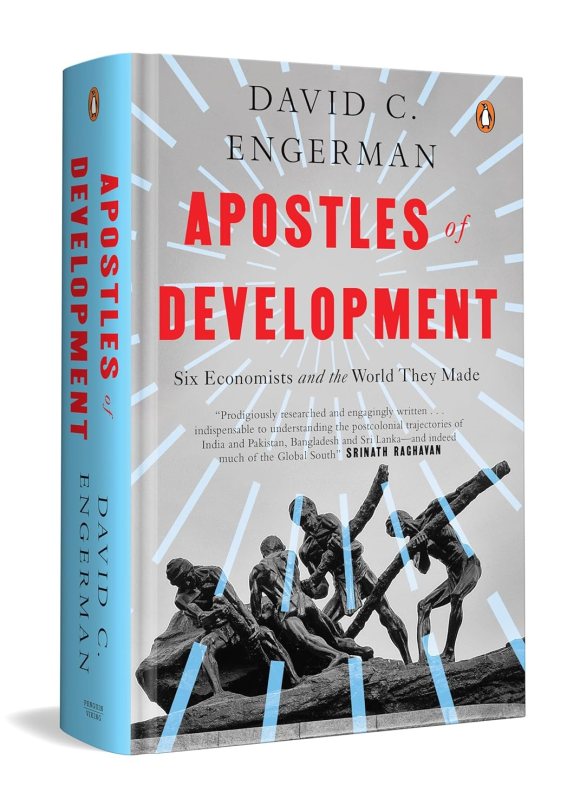
Title: Apostles of Development: Six Economists and the World They Made
Author: David C. Engerman
Publisher: Penguin Viking
David C. Engerman is a Yale University professor focused on twentieth-century international history. He has authored two books on Russia and the USSR’s influence on American politics and has extensively studied international development assistance. His key works include the co-edited volume Staging Growth: Modernization, Development and the Global Cold War (2003) and the monograph, The Price of Aid: The Economic Cold War in India. His research was featured in his 2016 presidential address to the Society for Historians of American Foreign Relations. He is currently writing a comprehensive history of international development, tentatively titled International Development: A History in Eight Crises.
Apostles of Development: Six Economists and the World They Madeby Engerman focuses on six influential economists from South Asia : Amartya Sen, Manmohan Singh, Mahbub ul Haq, Jagdish Bhagwati, Rehman Sobhan and Lal Jayawardena.
All six were born as colonial subjects in the British Empire and studied at Cambridge University. They emerged as pioneering “Third World development experts”, playing central roles in shaping global debates on poverty, inequality, and economic development.
The book highlights that the fight against global poverty, which began in the aftermath of World War II, represented a monumental effort that brought together economists, engineers, and a multitude of organisations.
This period marked the emergence of economists as a vital force in global affairs, playing a crucial role in shaping international dialogues focused on poverty alleviation and development strategies. Their contributions were essential in formulating policies and initiatives aimed at addressing the complex challenges of poverty on a worldwide scale.
Writes Engerman in the introduction: “The Apostles’ careers — and their home countries — demonstrate that there was no one path to development. Many governments in new nations opted to build factories. Others focused on roads and power plants, or on schools and hospitals. Some, like India, stressed economic self-reliance while others, including Pakistan and Ceylon, pursued international trade. Whatever the strategy, debates over the role of government-which frequently divided these six-resonated with the growing tensions of the Cold War, which pitted contrasting economic and political models against each other. Yet development was no mere creature of the Cold War, especially when examined from the perspective of the former colonies.”
He further contends: “Core ideas and practices of development changed dramatically over the Apostles’ long careers. Debates roiled academic conferences, di- vided planning commission discussions, and dominated international venues — and the Apostles participated on all sides. Was the goal of development to alleviate poverty or was it to reduce inequality? Was the best solution to expand the economic role of government or to reduce it? Was national development better served by becoming self-sufficient was economic theory universal or did a different set of economic rules (and therefore economic tools) apply to poor countries than to rich ones? Development was always contested.
“The Apostles’ turn to economics was in keeping with the spirit of the age. Economic questions loomed large in the middle of the twentieth century and economists proved ready, willing, and able to offer answers. Political leaders frequently sought their expertise and the century’s leading economists answered that call. The Depression cried out for an explanation that suggested a solution; the doyen of Cambridge economics, John Maynard Keynes, took on that task with gusto. The fate of World War II was determined as much by each side’s ability to mobilize resources as it was by battlefield tactics– hence Paul Samuelson’s boast that it was ‘an economist’s war’. And the problems of the postcolonial world arose precisely as economics was becoming what one historian called ‘the master discipline of the 20th century’.”
The book emphasizes that the origins and driving force of development were rooted in the Global South, aiming to improve the conditions of the world’s poorest countries, rather than being a project imposed by the West.It explores the different economic philosophies of these six economists and the ongoing debate about how economic theory should differ for poor versus rich countries.
Engerman challenges the idea that development is simply a tool for rich countries to dominate or a pure expression of humanitarianism. Instead, he argues that successful development comes from practical solutions tailored to real-world problems, not rigid ideological frameworks.
The book advocates for a modest, pragmatic approach to development, prioritising the reduction of gross inequality and insisting that development means more than just economic growth.
The narrative situates these economists’ work in the broader context of the Cold War and the shifting global landscape, highlighting how their ideas shaped and were shaped by international politics and economic crises.
This extensively researched and substantial book is acknowledged as a significant and timely addition to the literature concerning economics, economic history, and the progression of development thought, particularly in light of current global discussions regarding inequality and the prospects for economic growth.
Apostles of Development is suggested for those who are interested in the historical context of development economics, the influence of the Global South on global policy formulation, and the life stories of several of the most impactful economists of the 20th century.
.
.
Bhaskar Parichha is a journalist and author of Cyclones in Odisha: Landfall, Wreckage and Resilience, Unbiased, No Strings Attached: Writings on Odisha and Biju Patnaik – A Political Biography. He lives in Bhubaneswar and writes bilingually. Besides writing for newspapers, he also reviews books on various media platforms.
.
PLEASE NOTE: ARTICLES CAN ONLY BE REPRODUCED IN OTHER SITES WITH DUE ACKNOWLEDGEMENT TO BORDERLESS JOURNAL
Dhruba Hazarika is a novelist, short-story writer and columnist. The Shoot is his fourth published book, the previous three being two novels and another collection of stories. He has also been a columnist for 40 years, writing for The Telegraph, The Sentinel and The Assam Tribune. He divides his time between Guwahati and Shillong.
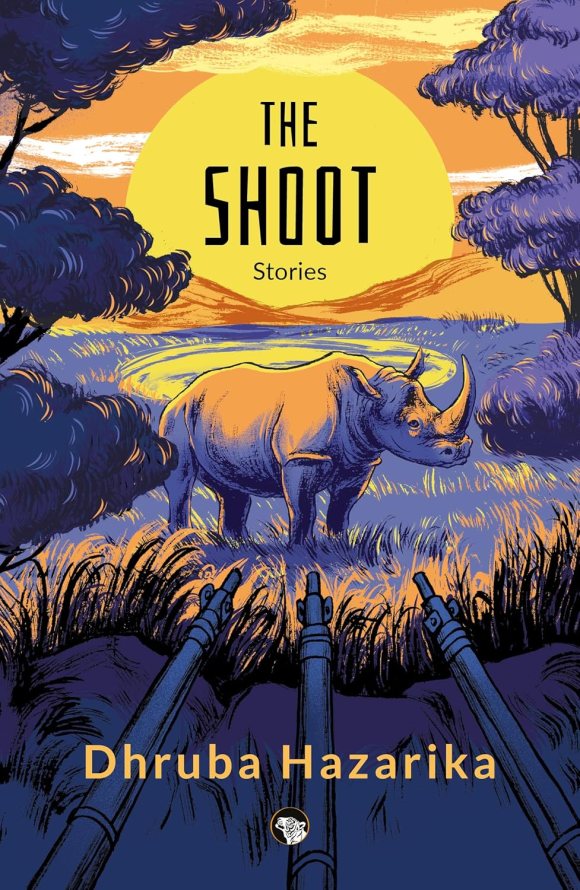
In The Shoot, Dhruba Hazarika offers a remarkable collection of seventeen stories set largely in the landscapes of Assam, where the lines between the human and the wild blur with lyrical precision. These are stories in which rivers, forests, and animals are not merely setting or backdrop, but players in a drama as emotional as it is elemental as we can see in the titular story. Through a careful balance of violence and tenderness, Hazarika conjures a world where the rawness of nature mirrors the inner lives of his characters, and where the most subtle gestures—a bird taking flight, a child stroking an injured animal—carry quiet revelations.
The collection is defined by this tension: the everyday friction between cruelty and compassion, solitude and connection. Hazarika’s Assam is not a romanticised escape into the natural world, but a lived-in, at times harsh territory where poachers and foresters share space with schoolchildren and aging widows. Yet amid the reality of rifles, hunting dogs, and worn-out boots, there is also grace—brief but luminous moments of understanding between humans and animals, or between people themselves.
The story, ‘The Hunt’, anchors the collection in this interplay of brutality and regret. A group of men set out into hills to hunt a deer. The thrill of the chase and the shared camaraderie are abruptly fractured when they confront the full weight of what they’ve killed—a doe carrying unborn fawns. It is a moment as visceral as it is symbolic, capturing how deeply the act of taking life reverberates, especially when one is already grieving. The story unfolds with a slow, almost meditative pace, allowing space for both awe and horror.
In ‘Elephant Country’, a herd of elephants blocks the only road to a village. As the local magistrate faces pressure to use force to reach the village because a woman is in labour, the narrative unfolds with quiet tension, exploring the fragile boundary between human authority and the natural world’s quiet resistance. While the elephants stand as a living barricade, guarding newborns in their midst, the magistrate’s ultimate decision—not to intervene—signals a moment of alignment of human instincts with nature. It is a moment when the animal and human worlds come into uneasy but essential dialogue—reminding us that the miracle of life demands not dominance, but deference.
Another story, ‘Ghostie’, revolves around a group of boys who mercilessly torment a stray dog. The tale, told with an unflinching gaze, does not moralise but instead allows the violence to unfold naturally, in all its thoughtless cruelty. What lingers is not just the fate of the dog, but the haunting change in the narrator—who comes to see, far too late, the cost of such disregard. Here again, Hazarika proves masterful in using small, personal episodes to hint at larger truths: the slow erosion of innocence, the gradual awakening of empathy.
One of Hazarika’s most distinctive strengths lies in his depiction of the natural world. Forests, rivers, birds, and animals are not incidental; they pulse with presence and meaning. A snow-white egret momentarily lifts the spirits of a tired clerk. A solitary crow returns night after night to the same veranda, evoking a sense of memory and mourning. These encounters are never mystical in a fantastical sense, but they carry the weight of the intangible—grief, love, regret, and occasionally, hope.
Woven through many of the stories is an awareness of the political and cultural fabric of Northeast India. Hazarika never foregrounds these themes, yet the region’s complex history—its insurgencies, its marginalisation, its uneasy relationship with mainstream Indian narratives—simmers beneath the surface. There is a sense of a land both remote and familiar, with its own rhythms, codes, and forms of resistance. The occasional reference to tribal customs, local deities, or community rituals further grounds the stories in their specific cultural soil.
Hazarika writes with a light, unobtrusive touch. His sentences are lean and quiet, yet they resonate. He gives space to silence, to gesture, to the unsaid. The characters, too, are often defined more by what they withhold than by what they reveal. A doctor mourning his wife, a boatman with a flute, a young boy who can’t understand his own cruelty—these are not heroic figures, but deeply human ones, faltering and flawed.
Amid the more solemn tales, there are a few that flirt with whimsy or absurdity. These diversions offer tonal contrast without ever straying too far from the book’s central themes. Even the lighter moments carry a trace of melancholy, as if joy in Hazarika’s world is always tinged with loss.
This is not just a collection about the Northeast or about the wilderness. It is about what it means to be tender in a world that wounds, and what it means to live ethically in the shadow of violence—whether that violence is inflicted on others, on animals, or on ourselves. In that sense, The Shoot is both rooted and universal, intimate and expansive.
Rakhi Dalal is an educator by profession. When not working, she can usually be found reading books or writing about reading them. She writes at https://rakhidalal.blogspot.com/ .
.
PLEASE NOTE: ARTICLES CAN ONLY BE REPRODUCED IN OTHER SITES WITH DUE ACKNOWLEDGEMENT TO BORDERLESS JOURNAL




 Borderless