Categories
Review

Song of the Golden Sparrow

Book Review by Rakhi Dalal
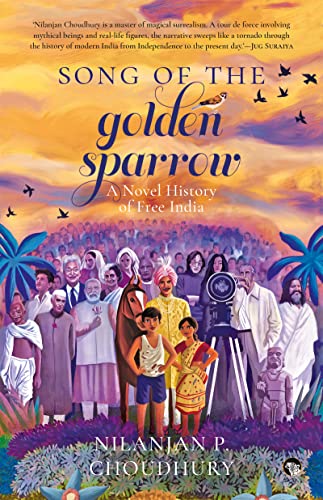
Title: Song of the Golden Sparrow – A Novel History of Free India

Author: Nilanjan P. Choudhary

Publisher: Speaking Tiger Books

Song of the Golden Sparrow by Nilanjan P.Choudhary is a defiant and gripping novel set in independent India, of its many successes and failures, and of its spirit – often battered by its own people.  Choudhury is a new voice from the Northeast. His most recent book, Shillong Times, has been widely acclaimed. His debut novel, a mythological thriller entitled Bali and the Ocean of Milk, was a best-seller.

Placed within the period 1947 to 2022, the Song of the Golden Sparrow sets out to chronicle the history of India as witnessed by a sparrow named Prem Chandra Guha, who is actually a yaksha banished from the kingdom of Alaka by Lord Kubera and punished with the task of writing the history of India. The yaksha, a shape-shifter, finds it convenient to take the form a sparrow, a little bird for the task. Exactly when India enters its tryst with destiny, this sparrow reaches the small town of Netrahat near the forests of Chhota Nagpur and meets Manhoos and Mary. As the fates of Manhoos and Mary take them to various places across India, the sparrow follows too, covering in its wake the important events from their lives; events intertwined with the fate of independent India itself.

Manhoos is an illiterate and orphaned boy, working at a garage. Mary is a spirited tribal girl from a nearby Santhal village. Both are good friends and almost meet every day until they are separated by circumstances. Taken in by a Prince, Manhoos, later Manu, moves to the city of Calcutta from Netrahat, where he learns to read and write and takes on enterprises with the motive to earn money. Mary’s village, on the other hand, is destroyed by the government to make way for land mines. Time brings them together again and they make efforts to stay together. Their lives, however, knotted by various events taking place in the country, diverge to different paths.

The yakhsha or sparrow, who is their constant companion, observes the turns in their lives brought about and affected by larger events like industrialisation, liberation of Bangladesh, rise of Naxal movement[1], imposition of emergency, birth of Jana Sangh, chipko andolan[2], fall of a mosque, liberalisation of economy, IT boom, development of Silicon Valley of India, 2002 Gujrat, upheaval of 2014 and pandemic of 2020.

Choudhary employs the tools of magical realism to blend the historical facts with mythology and satire, creating a narrative that not only lets us imagine the lives of ordinary people, carving their own way after independence but also to visualise the many complexities and contradictions which were not only inherited but also turned inevitable as India marched on to the path of progress after attaining freedom from colonial rule. 

Figuratively, Manu and Mary represent two distinct facets of independent India which has co-existed amid the incongruities brought about by the political and economic events and has largely shaped the realities of everyday life of common people. Whereas Manu symbolises the progressive, liberal and democratic spirit of the country which desires to advance, to progress and become wealthier by taking every opportunity that arises, Mary is the voice of oppressed people. Manu belongs to the India which made advancement through industrialisation, IT or real estate and cashed on the economic boom brought about by liberalisation of economy. Mary belongs to the India which keeps fighting the system that continues exploiting them whether by displacing them from their homes, their forests, their lands or by not giving them due share in the profits of development whose wheels are turned by them. Their final separation signifies the divide which overtime became even more difficult to address and heal.

The progressive Manu becomes disenchanted with wealth after his wife Sayoni is brutally killed during 2002 Gujrat riots. He returns to his roots and tries to make a meaningful life by devoting himself to the preservation of forests of his homeland. He adopts Ismail, an orphan like him, who is a brilliant young boy and has dreams of pursuing higher education. In 2016, Ismail is heckled to death on the suspicions of cow smuggling. This leaves Manu shattered. And he dies soon afterward.

Through the portrayal of disenchantment and despair of Manu, the author sketches the gloom which has shrouded the country in the last decade. Towards the end, the yaksha sparrow also experience anguish on having to observe and chronicle events which have bloodied the land and the spirit of the country over and over again. As a historian, despite all this, his task is far from over. For he has to keep recording all the incidents for the posterity. It is a tale that asks to be read.

[1] Maoist insurgency in India

[2] The Chipko andolan was a non-violent social and ecological movement by villagers, particularly women, in India in the 1970s, to protect trees and forests slated for government-backed logging.

.

Rakhi Dalal is an educator by profession. When not working, she can usually be found reading books or writing about reading them. She writes at https://rakhidalal.blogspot.com/ .

.

PLEASE NOTE: ARTICLES CAN ONLY BE REPRODUCED IN OTHER SITES WITH DUE ACKNOWLEDGEMENT TO BORDERLESS JOURNAL. 

Click here to access the Borderless anthology, Monalisa No Longer Smiles

Click here to access Monalisa No Longer Smiles on Kindle Amazon International
Categories
Review

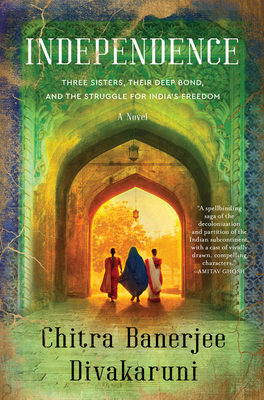
Independence by Chitra Banerjee Divakaruni

By Somdatta Mandal

Title: Independence

Author:  Chitra Banerjee Divakaruni

Publisher: Harper Collins 

Over the last two or three decades, the Indian American writer, Chitra Banerjee Divakaruni, has managed to carve a niche for herself by regaling in stories of cross-cultural issues prevalent in India and the United States with special emphasis on experiences of diasporic immigrant women. Though most of her stories are women-centric, with time one notices a gradual tectonic shift in her selection of themes. Initially she would write on problems of immigration and culture clash plaguing Indians in the New World. In Palace of Illusions, she went back to the Indian epic and narrated the story of the Mahabharata told from Draupadi’s point of view. In her novel The Forest of Enchantments, she brought Sita at the centre of the epic narrative The Ramayana and accorded her parity with Ram, revealing her innate strength. Then she took recourse to Indian history and rebuilt the story of Maharaja Ranjit’s Singh’s empire in Punjab narrating it from the viewpoint of Rani Jindan Kaur, his last wife as one of the most fearless women of the nineteenth century. Apart from the available historical data, she filled in The Last Queen by imagining many things Jindan would have said and done and thus painted a complete picture of a woman from all perspectives. A perfect blending of fact with fiction, the novel interested all categories of readers, serious and casual alike.

Now with Independence, Divakaruni widens her canvas to tell us the story of a doctor’s family and his three daughters against the freedom movement in India, particularly Bengal, beginning from August 1946 till the epilogue in 1954. The story of India’s independence is narrated through the eyes of three sisters, each of whom is uniquely different, with her own desires and flaws. They live in a rural village Ranipur and right at the beginning of the novel, which is divided into five parts and an epilogue, the author manages to give us the idyllic ambience of the place in very selective poetic language:

    “Here is a river like a slender silver chain, here is a village bordered by green gold rice-fields, here is a breeze smelling of sweet water-rushes, here is the marble balcony of a grand old mansion with guards at its iron gates and servants transporting trays of delicacies up the stairs, here are a man and a woman on carved teak chairs. Here is the country that contains them all.
     “The river is Sarasi, the village is Ranipur in Bengal, the mansion belongs to Somnath Chaudhury, zamindar. He is playing chess with Priya, daughter of his best friend, Nabakumar Ganguly. The country is India, the year is 1946, the month is August.
      “Everything is about to change."

Doctor Nabakumar Ganguly is an idealist and with his practice in their native village Ranipur, where the family resides, he also treats patients in a slum region in Calcutta. He is highly regarded but earns little as he refuses to charge patients without sufficient means. His wife Bina complains about this but supplements the family income by making exquisite quilts for sale and gifting them to those in need. Among the three daughters, Priya is intelligent and idealistic, and resolved to follow in her father’s footsteps she wants to become a doctor, though society frowns on it. She is fortunate to have the support of zamindar Somnath Chowdhury, her father’s best friend. The eldest daughter Deepa is very beautiful and is determined to make a marriage that will bring her family joy and status. The third daughter, Jamini, is devout, sharp-eyed, and a talented quiltmaker, with deeper passions than she reveals.

Theirs is a home of love and safety, a refuge from the violent events taking shape in the nation. This idyllic setting changes rapidly, as the violence of Direct Action Day in August 1946 takes Nabakumar’s life and introduces fear and a communal bitterness in the once largehearted Bina’s veins. Soon their neighbours turn against them, bringing the events of their country closer to home. Deepa is estranged from her mother and eventually isolated on the other side of the border in what becomes East Pakistan, when she falls in love with Raza, a Youth Leader at the Muslim League. As Priya is determined to pursue her career goal, her attempts to get into medical school in India are thwarted by a gender bias, and she finds herself at a college in America. But due to several reasons she cannot complete her degree there and comes back to India to run the clinic where her father worked. And Jamini attempts to hold her family together, even as she secretly longs for the handsome Amit, her sister’s fiancé. When India is partitioned, the sisters find themselves separated from one another, afraid of what will happen to not only themselves, but also each other. It is only then that they understand what it means to be independent, and the price one must pay for it.

After a lot of twists and turns to the story, including smuggling of arms and rescue mission on the Ichhamati River dividing the two Bengals, Amit shot to death, by the time we come to the Epilogue it is 1954 where we learn about Deepa’s daughter Sameera, Jamini’s son Tapan, Deepa managing the zamindari estate and Manorama and Somnath eager to find a suitable match for Priya when she tells them that she is happy as she is now. Feminism, communal amity, empathy, and self-growth are among the requisite qualities Divakaruni identifies for both a country and a human being to be truly independent. Though set in households more than seventy years ago, towards the end we still find some hope. The Postscript to the story is rather interesting as it comes even after the epilogue. It reads thus:

   “Here is a river. Here is a wind rising. Here is a village. Here is the year.
   “The river is time, ebbing, flooding. The wind is memory, it can carry flowers, it can carry flames. The village is the world, and you are at its centre. The year is now.
   “What will you do with it? What will you do?”

As a Professor of Creative Writing in an American university, Divakaruni has gained the expertise of playing her cards well – her narrative technique in each of her novels and short story anthologies preaches what she teaches – the saleability and marketability of a book in this electronic age should be of utmost concern. Like her earlier novel The Oleander Girl, which seemed to have been written as a sort of film script in mind, (incidentally two other novels are being made into motion pictures at the moment), Independence too seems to follow suit with the right amount of ingredients necessary for promoting the book to different kinds of readers and in different forms as well. One is therefore taken by surprise to find a QR code even before the Contents page which tells us to “Listen to the soundtrack for Independence. A playlist of songs that inspired the freedom movement.” For her Western readers, Divakaruni managed to blend history and fiction very well where along with the fictitious characters we get to read about Mahatma Gandhi and the Noakhali riots, Sarojini Naidu, Nehru and others as they played their parts in the freedom movement. Here we find Priya actively engaged in conversation with Sarojini who gives a letter of recommendation to Bidhan Chandra Roy to help Priya to run a clinic.

One praiseworthy aspect of the novel is how Divakaruni manages to give us details of the streets and sounds of Calcutta – the Calcutta of the 1950s with her double decker buses, the shops at New Market, the quaint little restaurants with curtained cubicles to maintain privacy in a public place – all brought back from memory of the city in which she was born and brought up. The novel is also full of translations of several patriotic songs in Bangla which the swadeshis sang during that period. Several lines from Tagore’s songs are also interspersed to express the moods of characters – a technique used by Divakaruni in some of her earlier fiction as well. The exoticism of India, especially rural Bengal of the time is deftly portrayed through many other incidents of killing and looting at different regions of undivided Bengal. As for her Indian readers we are given the story of Priya’s brief stay in America to study medicine at the Woman’s Medical College in Philadelphia where along with her homesickness, we have Arthur, a lovelorn American doctor, who lends her support and patiently waits for her to come back to him as “his heart has been empty” without her.

Despite such manipulations to the story to bring in as wide a canvas as possible, including sufficient examples of Hindu-Muslim amity and hatred as well, the novel remains a page-turner no doubt and can be recommended for its lucid and racy style of narration, something that Chitra Banerjee Divakaruni excels in.

Somdatta Mandal, author, critic, and translator, is former Professor of English at Visva-Bharati, Santiniketan, India.

PLEASE NOTE: ARTICLES CAN ONLY BE REPRODUCED IN OTHER SITES WITH DUE ACKNOWLEDGEMENT TO BORDERLESS JOURNAL

Click here to access the Borderless anthology, Monalisa No Longer Smiles

Click here to access Monalisa No Longer Smiles on Kindle Amazon International

Categories
Review

A Dialogue with Stillness

Book Review by Basudhara Roy

Title: Ukiyo-e Days… Haiku Moments

Author: Bina Sarkar Ellias

Publisher: Red River

The wonder of art acknowledges and affirms the potency of stillness, its pregnancy vouching for a revelation that is both vital and imminent. Ambitious as the thought is, is it possible to engage in a dialogue with stillness, to distil the flurry of a day into the transcendence of a moment, and to transform that moment, in turn, into a metaphoric prism for the illumination of all our hereafters? In her recent collection of poems Ukiyo-e Days… Haiku Moments, Bina Sarkar Ellias can justifiably claim to have assayed each of these tasks with remarkable felicity and quiet grace.

A form of Japanese art that flourished between the 17th and the 19th centuries, ‘ukiyo-e’ is a composite of three words – ‘uki’ (floating), ‘yo’ (world) and ‘e’ (pictures), literally meaning “pictures of the floating world”. The ‘floating world’ referred to the theatre districts and (licensed) courtesan quarters that flourished in Japan’s major cities during the Edo period and constituted an important source of attraction for the nouveau-riche of the era. Inhabited largely by courtesans and the traditional kabuki actors, this floating world, despite its low status in the social hierarchy of the times, made its impact as valuable cultural capital, its sartorial customs and mannerisms becoming quite effectively, a rage among common people.

Since paintings could be afforded only by the prosperous, the ukiyo-e artists made a distinct historical move to democratise art by being the first to experiment with woodblock prints which could be produced cheaply and in large numbers, thus making ukiyo-e widely accessible to the  populace. Actors, courtesans, legends, folklore, and landscapes were some of the common subjects that marked this art, the heroic and the erotic being significant thematic notes within it.

Ukiyo-e Days… Haiku Moments revisits this memorable Japanese artform to bring to the reader a remarkable collection of 68 ukiyo-e by 28 artists from across the seventeenth to the early twentieth century, showcasing a delectable mix of the traditional and the modern in Japanese art and its unique blend of native and foreign influences. Compounding the effect of the Ukiyo-e here, is a set of 62 haiku by Bina that excavate, explore and expand the meaning and value of the artworks by bringing them into dense ekphrastic conversation with her own mind and times. “My haiku travels with each of the ukiyo-e works as a companion through this journey, responding with a deep kinship I feel with the artworks,” she writes in her Preface.

In this collaborative project of creativity, the haiku become a companion to the historical journey of the ukiyo-e, illuminating them in a transcultural framework which even as it asserts the omnipotent significance of art, helps draw attention to its omniscience across temporal and cultural divides. “To read a haiku,” says Jane Hirshfield, “is to become its co-author, to place yourself inside its words until they reveal one of the proteus-shapes of your own life.” As Bina places her contemporary and complex historical self within the sensibility of the ukiyo-e, her unravelling of meaning through the haiku becomes yet another act of seeking connection and consolation in an alienated world.

As a poetic form, the haiku establishes a constant romance with the brevity of expression on the one hand and the expanse of space on the other. Its sharp imagism helps to illumine both the moment and the emotional ambience that will render this moment organic in every context. Scale, speed, succinctness and surrealism can all work in concert within the seemingly fragile universe of the haiku to make it an emblem of and testimony to the wide-ranging historical forces within which it is birthed. The animated and tender conversation between colour, form and script in Ukiyo-e Days… Haiku Moments works similarly holding both word and beauty in suspension, mirroring the moment as self and self as moment, and asking us to return to the quintessential celebration of both:

you want to be free
but maya mesmerises-
locks all the doors

The haiku is, often, a lesson in perception. It is characteristic of the haiku to be profoundly epiphanic and in many of her pieces, Bina ascends to that level of quiet illumination wherein an inner truth becomes simpler by the sole virtue of its lucid expression. Art, life, hope, faith, poetry, war, human vulnerability — all emerge as important themes here. One cannot help noticing, however, the collection’s loving partiality toward women. Women and their myriad-layered lives constitute a recurrent thematic motif in these poems:

into the long night
her toil of pleasure-giving
a tale of two worlds

Since in much of the ukiyo-e, the women represented were courtesans, Bina brings a profound sense of tenderness and understanding in reinterpreting their situation for modern women whose lives, in different contexts, remain emotively the same. In their intensity and in the overall poignance with which these haiku delineate women’s ever-shifting roles in terms of profession, domesticity and relationships with the world, Bina evinces a deep knowledge of women’s spiritual multiplicity. To Torii Kiiyonaga’s delicate artwork ‘Bathhouse Women’, for instance, Bina, deflecting attention from the voyeuristic potential of the scene to give the bathhouse a larger cultural and political logic, responds:

a day for washing
wash away patriarchy
energise our souls

Another beautiful narrative turn in haiku is offered in response to Kitagawa Utamaro’s print ‘Naniwa Okita Admiring Herself in a Mirror’ in which Bina imagines a different (more youthful) face emerging from the mirror. While the mirror has mostly been used as a truth-telling device in literature and a means of shattering illusion, this particular mirror becomes a gateway to the discovery of the magical self within, unmarred by the winter of time:

i see a mirage
see my youth in winter years
does the mirror lie?

With Chobunsai Eishi’s ‘The Courtesan Hanaogi of the Ogiya Brothel’, Bina communicates thus:

within the prose
of her pleasure-house living
she breathes poetry

Here is a mature and perceptive weaving of art and life — a recognition of art as art and of life as life with the potential of building strong and tenable bridges across them. It is noteworthy how each haiku stands independently even as it adds a significant hermeneutic or experiential dimension to the ukiyo-e, imparting a certain luminosity to this book. There is a distinct sensation of time-travel in this collection, of moving through the slow whirl of centuries while remaining undivorced from the crises and flavours of the present:

realisation
we were not born violent
let’s repair ourselves

Empathy becomes a powerful voice in Ukiyo-e Days as Bina’s haiku touches raw spots within our shredding cultural fabric to draw attention to greed, war, exploitation and the relentless process of needing to find our integral human selves:

all the world’s armies
trained as cannon fodder
they live to die

In these delicate and consummately-crafted pieces, one finds doors open to deep investigation of the moment and what it stands for in life’s ever-shifting landscape. There is a stillness that the collection speaks from and to, a stillness that characterises both the ukiyo-e and the haiku as art forms. Invested with extraordinary visual and tactile charm and an interesting Preface that throws light on the genesis and growth of the ukiyo-e in Japan, this book accomplishes a unique synthesis between two valuable Japanese art forms, bringing to a connoisseur-reader the unforgettable enchantment of both.

Basudhara Roy teaches English at Karim City College affiliated to Kolhan University, Chaibasa. Author of three collections of poems, her latest work has been featured in EPW, The Pine Cone Review, Live Wire, Lucy Writers Platform, Setu and The Aleph Review among others. 

.

PLEASE NOTE: ARTICLES CAN ONLY BE REPRODUCED IN OTHER SITES WITH DUE ACKNOWLEDGEMENT TO BORDERLESS JOURNAL

Click here to access the Borderless anthology, Monalisa No Longer Smiles

Click here to access Monalisa No Longer Smiles on Kindle Amazon International
Categories
Review

My Invented Land: Poetry as Pilgrimage

Book Review by Basudhara Roy

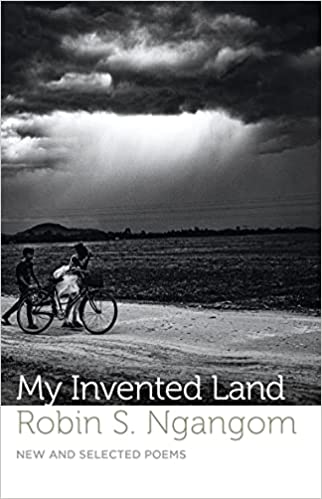
Title: My Invented Land: New and Selected Poems

Author: Robin Ngangom

Publisher: Speaking Tiger Books

Into the myriad-doored faith of poetry, there are manifold ways to arrive. Some come to it for respite, some for resuscitation, some for refuge. To a lot of us, poetry is therapeutic; to many others, an arsenal; to yet others, an immortal witness. Through what door one seeks admission into poetry’s realm is important for the way poetry will speak to us and the kind of poetry we will, in turn, create.

To Robin Ngangom, poetry manifests itself as both companion and quest, currency in circulation and archive, vision and the language to communicate the thought. “Poetry cannot help anyone to get on in life,” he writes, “or make a successful human being out of anyone. But poetry should move us; it should change us in such a manner that we remain no longer the same after we’ve read a meaningful poem.” (‘Introduction’) As necessary, as native, and as effortless to him as breath, Ngangom’s poetry bespeaks an honest and wholehearted engagement with life that is rare.

My Invented Land: New and Selected Poems recently brought out by Speaking Tiger Books is Ngangom’s fourth poetry collection. Containing an admirable selection of his work from his three earlier collections Words and the Silence (1988), Time’s Crossroads (1994) and The Desire of Roots (2006) along with more than thirty new poems, this volume brings to us a fascinating diachronic document of Ngangom’s steady journey in and with poetry over the last thirty-five years. For readers familiar with his work, this volume is an asset. For those who wish to make an acquaintance with it, the book will be indispensable and an immensely appealing starting point.

In reading Ngangom’s poems, one is pleasantly startled, each time, by his distilled sensibility, his linguistic finesse and his inimitable lyrical fecundity. Simplicity is the catchword of these poems. One would be hard put to identify any posturing in Ngangom’s poetry. There are no mirages here, no postmodernist obsession with camouflage, no cautious construction of the self or deliberated distance between poet-observer-speaker. Personality, in fact, is such an important accompaniment of these poems that it casts each poem in the resolutely warm light of its familiarity, meeting in poem after poem, an expectation unarticulated but answered.

Self, land and poetry constitute an essential thematic triangle in My Invented Land – each theme inevitably leading to the other. For Ngangom, there is no poetry apart from the existential rootedness of the self in (home)land, this relationship being both a prism and a prison through which his sensibility is reflected upon the world – “But where can one run from the homeland,/ where can I flee from your love?” (‘The Strange Affair of Robin S. Ngangom’) In the best of times, this bond with the land becomes one of gratitude; in spans of torment, a burden he cannot do without; and during moments of reflection, an agonising search as in ‘Poem for Joseph’:

It is never too late to come home.
But I must first find a homeland
where I can find myself,
just a map or even a tree or a stone
to mark a spot I could return to
like an animal lifting his leg
even when there’s nothing to return for. 

Even love and its exploration through adolescence into manhood which is an important concern in Ngangom’s poetry, finds its expression in the distinct foreground and background of the landscape, so much so that be(love)d and land become one:

Maternal earth,
generous and callous.
You untouchable then,
and invulnerable now;
all your instincts 
rearranged with
your scattered hair. 

Were I to trace
my name on your frosted mirror
you would quickly efface it with your breath. (‘Age and Memory’) 

There is no denying the sharp political edge of this poetry, its inveterate honesty and its essential inability to water down the truth with fancy or idealism. In ‘To Pacha’, a moving elegy to Pacha Meetei, one of Manipur’s finest writers, Ngangom writes:

There are no more tears to shed
in this withered country where they
kill pregnant women and children; its
nipples have long gone dry, and leering 
death walks your homeland. 

In ‘The Strange Affair of Robin S. Ngangom’, patriotism is “admiring the youth who fondles grenades,/ patriotism is proclaiming all men as brothers/ and secretly depriving my brother,/ patriotism is playing the music of guns/ to the child in the womb.” ‘My Invented Land’ writes home as “a gun/ pressed against both temples/ a knock on a night that has not ended/ a torch lit long after the theft/ a sonnet about body counts/ undoubtedly raped/ definitely abandoned/ in a tryst with destiny.” The uneasiness between homeland and nation is a palpable presence in the telling use of the phrase ‘tryst with destiny’ as it is in many of the poems in this book. The golden jubilee of the nation’s independence becomes, in ‘15 August 2008, Northeast India’, “fifty years of discrimination festering in the periphery/ with another anniversary of murder and disappearances.” In ‘My Invented Land’, the homeland “has no boundaries./ At cockcrow one day it found itself/ inside a country to its west,/ (on rainy days it dreams looking east/ when its seditionists fight to liberate it from truth.)”

But this is not poetry of writing back, of witness, of resistance or of conscious activism. My Invented Land is poetry of observation, of quiet but ceaseless self-exploration and self-assessment (the land being an inalienable unit of the self and vice-versa), of lament and of agonis

ed truth-seeking with “only one pair of shoes/ but many roads” (‘Saint Edmund’s College’). One marvels at the beauty of the title, an apposite image for a body of poems that is invested so completely in poetry as this essentially nourishing collection of eighty-two poems is. This invented land, one realises, is as much Imphal or Manipur or Shillong or the Northeast of India as it is the land of memory, imagination, hope, language and poetry.

One must take special note of Ngangom’s deftness with language in this collection, his mastery over its opulence and crisis, its headiness and its insomnia, its velocity and meditativeness. Much of his poetry is pointedly and joyously literal with little need of metaphor to expand or accentuate his ideas. However, his language arrives from such depth in the soul that lyricism and beauty are innate to it, deluging the reader with an unsurmised assertion of its grandeur in a poem like ‘Laitlum’ for instance:

I want to be converted amongst houses kneeling
in the thick of firs of former lives,
randomly built without electricity.

It is characteristic of Ngangom to lift what would be, in most hands, a random assortment  of prosaic moments and to elevate it, with his heightened attention, into iridescent poetry. Observe the following lines from ‘Street Life’:

I’ve had decadence forced on me.
I let the rain waste my day, and arriving
at streets that do not even know my name
I take off just like that, waving to silhouettes,
buying drinks for anyone, even primates
for whom I have no great regard, hating the houses
which warn of dogs instead of welcoming me.

The new poems in this collection, while retaining a spiritual connect with the poet’s earlier work, branches off into greater profundity. Marked by the loneliness, uncertainty and despair of the Pandemic, the language has grown quieter and more serene so that a metaphysical restlessness animates these poems, quiet unlike the earlier ones – “All voyages will be inward from now,” (‘September’) The language of realism mutates here into unexpected symbols and uneasy images that haunt. ‘Postcard’ written for Jayanta Mahapatra finds “ghosts leaving friends on the road”; in ‘Home’, a river swirled with “brown waters/ until it died, strangled by garbage”; in ‘Flight’, “The most vulnerable will sell bodies./ Because in spite of the landmines/ they still shared limbs.”

But despite Ngangom’s disquiet with the world and his unceasing inquest into its maladies, love remains his avowed and timeless panacea. It is in and through love that human life acquires redemption and as one moves through the collection, one perceives it watermarked by love of many kinds – amorous, passionate, seductive, lustful, nostalgic, mythic, idyllic, ecological, fraternal and forgiving. Every despondency, for the poet, springs from an absence of love and can find an effective resolution in love – love for the beloved, for the homeland, for one’s brethren, for humanity, for poetry, and above all, for love itself. “…someone who cannot love is always alone,” he writes in his ‘Introduction’. In ‘Day’, he prays for the Pandemic’s end so that “a primeval need/ may be restored to us:/ the ability to hold another/ before the day ends.” The all-embracive and sustaining religion of love that leads him to fashion each word “from a private hurt”’ (‘Introduction’) can alone right the balance. In ‘January’, for instance, he believes that “If anyone were so much as to mention a word like ‘love’/ everything will fall quietly again as snow.”

Poetry, according to Ngangom, “should not merely amuse us or make us think: it should comfort us, and it must heal the heart of man.” (‘Introduction’) With a brilliant introductory essay by the poet (that makes one desperately wish there were more such essays by Indian English poets on their vision and craft) and its timeless verses, My Invented Land accomplishes this and more with poise, grace and an unquestionable claim to the glory of its writer in the canon of Indian English poetry, his committed pilgrimage in verse promising to be an inspiration for many poets to come.

Basudhara Roy teaches English at Karim City College affiliated to Kolhan University, Chaibasa. Author of three collections of poems, her latest work has been featured in EPW, The Pine Cone Review, Live Wire, Lucy Writers Platform, Setu and The Aleph Review among others. 

.

PLEASE NOTE: ARTICLES CAN ONLY BE REPRODUCED IN OTHER SITES WITH DUE ACKNOWLEDGEMENT TO BORDERLESS JOURNAL

Click here to access the Borderless anthology, Monalisa No Longer Smiles

Categories
Review

Is There No Place like Home…?

Book Review by Aruna Chakravarti

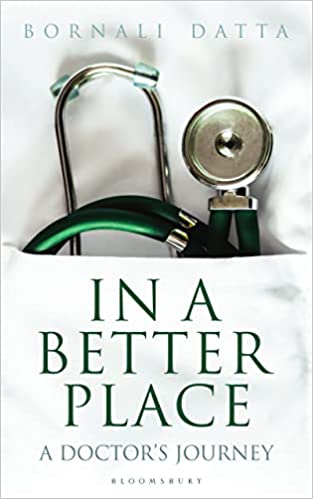
Title: In A Better Place: A Doctor’s Journey

Author: Bornali Datta

Publisher: Bloomsbury, U.K.

The author of In a Better Place is a highly respected medical practitioner with a long and distinguished career in U.K. and India. Given the vast knowledge and wide-ranging experience that have gone into the writing of this book, it is surprising to note that it is not an academic work. It is a novel, written with effortless ease, that proves to be as informative as it is readable and interesting. Bornali’s language is simple and has a gentle mellowness and her style, though lively, isn’t racy or trendy. It has a leisurely flow but demands close attention. She gives her reason for writing this book in her ‘Author’s Note’:

“While reams of clinical history and medical notes are written arduously every day in every hospital by its diligent doctors and nurses, there is hardly anyone to document the human stories that unfold continuously in the long corridors and lonely wards of hospitals.”

The book, as per her own admission then, is not an account or analysis of medical research and clinical practice. It is a story of human lives caught in the cusp of aspiration and reality. Of sickness and suffering entwined with the pressures and frailties of care givers. It draws from detailed and extensive research into the lives of Indian doctors during the last thirty years of our history. A momentous period which saw globalization and the waking up to a Many countries; One world, concept in a big way.

 The writer shows a comprehensive understanding of her subject. Her characters are a group of idealistic young doctors, who are genuinely eager to use their medical education to treat the sick in the best way possible. They inhabit two worlds, India and England, sometimes physically; sometimes in spirit. They are confronted with two choices to begin with. Adherence to convention and traditional ways. Or carrying out their aspirations for what they think will be a better life, in defiance of social and parental pressure. Those who are unhappily trapped in India’s heat and dust, poverty and primitive systems, crowds and chaos yearn for foreign shores. Those who have made it to the West are ill at ease in the strange new life they have embraced. A sense of not fitting in, of somehow being reduced to the other despite all their education and proficiency in English, dogs them. Swamped in nostalgia and exile they are confused and bewildered.

Both sets of lives are seen as fragmented. Places define people and relationships. The book provides a fascinating kaleidoscope of yearning and aspirations in a direct, not always complimentary way. The value of the book lies in its creation of complex emotions, use of empirical data and honest telling.

The chief protagonist of the novel, Sudha, undergoes post graduate training in a government hospital in Delhi before moving to England with her husband, another young doctor called Girish. Their friends, Jai and Sanjay, also make it to their dreamland. All four are overwhelmed, initially, by the difference in the two systems and take a jingoistic delight in having reached where they wanted to be. The dirt and squalor in Indian hospitals, the rusted equipment and callous attitude to suffering by overworked doctors and nurses, is a shameful contrast to what they see in English hospitals. At first the picturesque buildings, manicured lawns, spotless beds and hushed corridors win their total admiration and respect. But, gradually, they get a sense that all is not as it appears on the surface. They, who only wish to do their best, encounter hurdles, injustice and racism and the cold, hard superiority of people who will never forget or let them forget they were once their rulers. An immigrant angst overtakes them. Some make a desperate bid to overcome it and manage to carve a groove for themselves in the land of their exile through unequal, often loveless, marriages with British citizens. Some begin to consider going back to India. But the choice, either way, is equally hard.  

Dr. Chatterjee, a senior doctor in the hospital Jai works in, has made two attempts to return to India. Both proved abortive and he was forced to return. His wife and children, having lived too long in the West, could not adjust to India. He has become the proverbial nowhere man, unable to find a comfort zone anywhere. Though an excellent doctor and an intelligent, cultured gentleman, he knows that he will never reach the top of his profession or be accepted socially by his colleagues.

 “’The Whites…,’ he tells Jai, ‘don’t want to socialize with you. Take Dr Smith and Dr Weldon. I’ve called both of them for dinner to my house, their entire families, not once but two times. But there is no reciprocation from their side. Not once have they invited me over, although they get together quite often.’”

Aspirations die but hope continues. People suffer but they also find solutions. The author is non-judgmental.

“There is never right or wrong­­­, she says in conclusion to her story.  Just what works for one and what works for another. Life goes on regardless, both inside and outside of the hospital, through the trepidation of change, of migration, of loss and adoption of a foreign land.”

 But what, in the end, is a better place? Though Bornali doesn’t provide the answer I am tempted to do so. I quote from a poem I used to recite as a child:

Mid pleasures and palaces though we may roam
Be it ever so humble there’s no place like home.

Aruna Chakravarti was the principal of a prestigious women’s college of Delhi University for ten years. She is also a well-known academic, creative writer and translator with a number of published books on record. Her novels, The Inheritors, JorasankoDaughters of Jorasanko, have sold widely and received rave reviews. The Mendicant Prince is her last novel and Through a Looking Glass, her latest short story collection. She has also received awards such as the Vaitalik Award, Sahitya Akademi Award and Sarat Puraskar for her translations.

PLEASE NOTE: ARTICLES CAN ONLY BE REPRODUCED IN OTHER SITES WITH DUE ACKNOWLEDGEMENT TO BORDERLESS JOURNAL. 

Click here to access the Borderless anthology, Monalisa No Longer Smiles

Categories
Review

A Thinker who Fought for an Inclusive India

Book Review by Bhaskar Parichha

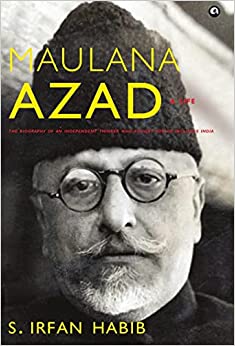
Title: Maulana Azad – A Life

Author: S.Irfan Habib

Publisher: Aleph Book Company

At a time when India is celebrating its 75th anniversary of independence, it is only fitting that Maulana Azad’s contributions to the country should be remembered. He was one of the most prominent Muslim leaders in India’s freedom movement, whose contribution to the establishment of the education foundation in India is recognised by observing his birthday across the country as “National Education Day”.

Azad became the youngest member of Congress to hold a presidential post. Using his position to work to re-unite the Swarajists and the Khilafat leaders under the common banner of the Congress. He opposed the Partition of India because he thought Muslims would be more powerful and dominant in a united India. After independence, he became the first Minister of Education in the Indian government. In 1992, he was posthumously awarded India’s highest civilian award, the Bharat Ratna.

Maulana Azad – A Life by S. Irfan Habib is “the biography of an independent thinker who fought for an inclusive India”. In this in-depth chronicle, historian Habib takes the reader through some of the most decisive moments in Azad’s life.

 A widely published historian of science and modern political history, Habib was the Maulana Azad Chair at the National University of Educational Planning and Administration, New Delhi. He has authored To Make the Deaf Hear: The Ideology and Programme of Bhagat Singh and His Comrades and is the editor of Indian Nationalism: The Essential Writings.

Says the blurb: “Born into an orthodox family of famed Islamic scholars, Azad was deeply influenced by the pan-Islamic philosophies of Sir Syed Ahmad Khan and Jamaluddin Afghani. Azad had no formal education, but he was an autodidact who taught himself about culture, philosophy, languages, and literature. As a teenager, he successfully published several magazines and newspapers and went on to publish the immensely popular Urdu weekly Al-Hilal through which he tried to persuade Indian Muslims to shake off the shackles of British rule. He became inspired by Gandhi’s non-violent civil disobedience movement and was extremely critical of the Muslim League’s communal politics.”

Azad’s unusual upbringing, his illustrious family, upheavals in the Islamic world, and the initial inklings of Azad’s freethinking outlook on life. ‘Maulana Azad and Critical Thinking in Islam’ examines the various schools of thought, ethical questions, and pan-Islamic debates that shaped Azad’s religious attitudes and his approach to the idea of nationalism. ‘Azad, Islam, and Nationalism’ looks at Azad’s political career and his unwavering belief in composite nationalism and staunch opposition to the Muslim League’s sectarian politics. ‘Ghubar-i-Khatir Beyond Faith and Politics’ lays bare Azad’s philosophical moorings and personal likes and dislikes through a collection of epistolary essays written during his imprisonment in the Ahmednagar Fort prison in the 1940s. And, finally, ‘Building a New India’ charts Azad’s efforts to strengthen the country’s weak education system through initiatives aimed at primary and adult education, his efforts towards the scientific and cultural advancement of the country, and his contribution to the arts and culture of a newly independent nation.”

As Habib writes, “justice is all the more relevant to education as a process of harmonious nurture. Indeed, social justice commands a pivotal place in Azad’s general perspective, which influenced his educational outlook quite profoundly. He was conscious of the fact that a class or caste-ridden education system needed to be replaced by a more inclusive and just educational order. In 1948, while addressing the educational conference, Azad again reiterated that education, at any rate, must be pushed forward as rapidly as possible. We must not, for a moment, forget that it is the birthright of every individual to receive at least the basic education, without which he cannot discharge his duties as a citizen.”

Writes Habib : “With a view to gearing education towards the cause of democracy, he, in his very first official statement, referred to Disraeli’s verdict: ‘A democracy has no future unless it educates its masters.’” In independent and democratic India, with universal franchise as the key principle, the voter was truly the master of democracy, and Azad wanted this voter to be educated and aware. He was conscious of the sad inheritance of colonial inequalities, where 85 per cent of the country’s population was illiterate on the eve of Independence. Several classes and caste discriminations were discussed for the first time, and it was necessary to eliminate them immediately.

Azad was convinced, according to the biography, that the state had to play a key role in combating such social afflictions and provide everyone with the means to “the acquisition of knowledge and self-betterment”; however, the most disconcerting factor was the lack of necessary funds to carry forward the state’s responsibilities. Azad conceded with a sense of guilt as minister of education that the central government had allotted only 1 per cent of the funds in the budget for education. He therefore urged the Constituent Assembly to raise expenditure to 10 per cent.

Maulana Azad pursued the issue with passion and was able to raise the allocation from Rs 20 million to around Rs 350 million during his tenure as minister of education. On September 30, 1953, Azad addressed the nation on All India Radio, reiterating that “every individual has a right to an education that will enable him to develop his faculties and live a full human life.”

In about three hundred pages of inexorable text, Habib reconstructs the life of the remarkable man while arguing that Azad is more relevant now than ever before. An essential read for understanding India’s pre-independence history and the significance of a dedicated life.   

Bhaskar Parichha is a journalist and author of UnbiasedNo Strings Attached: Writings on Odisha and Biju Patnaik – A Political Biography. He lives in Bhubaneswar and writes bilingually. Besides writing for newspapers, he also reviews books on various media platforms.

PLEASE NOTE: ARTICLES CAN ONLY BE REPRODUCED IN OTHER SITES WITH DUE ACKNOWLEDGEMENT TO BORDERLESS JOURNAL

Click here to access the Borderless anthology, Monalisa No Longer Smiles

Categories
Review

Yamuna’s Journey

Book Review by Somdatta Mandal

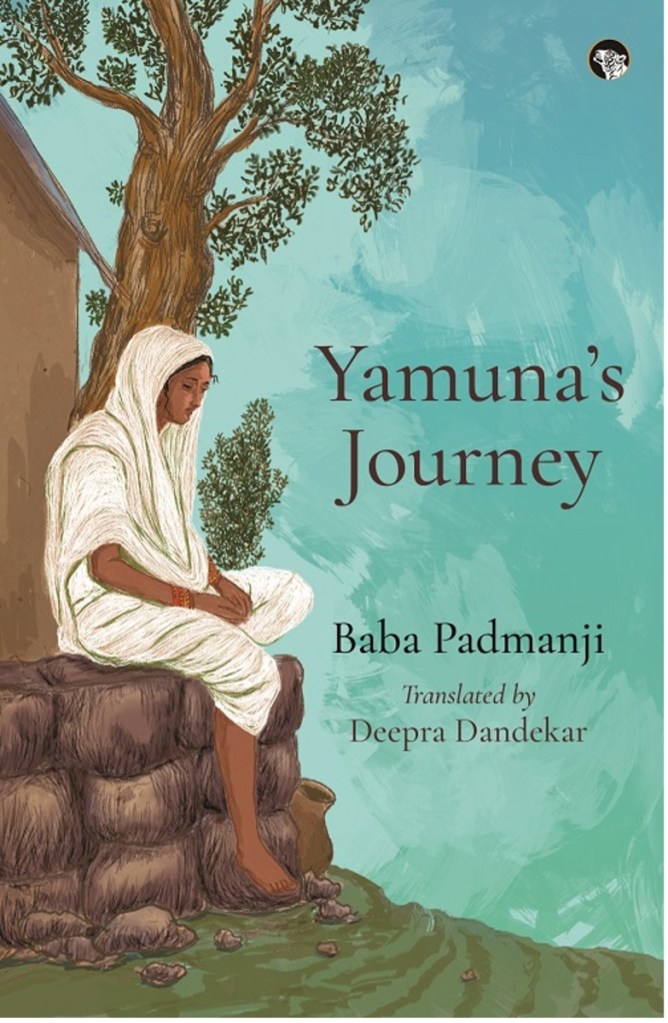
Title: Yamuna’s Journey

Author: Baba Padmanji, Translator: Deepra Dandekar

Publisher: Speaking Tiger Books

During the nineteenth century, among the various social concerns that plagued Indian society, three issues were greatly significant — the abolition of sati, or the burning of the widow on the pyre of her dead husband, the passing of the widow-remarriage bill by the British-Indian Parliament in 1856 augmented by the activism of reformers like Pandit Ishwar Chandra Vidyasagar, and of course the attempts at conversion to Christianity of people plagued, tortured and humiliated by the rigid strictures of class hierarchy and torture and humiliation imposed by Brahminical society during that period.

Baba Padmanji’s 1857 Marathi novel, Yamunaparyatan (translated as Yamuna’s Journey), is the first vernacular novel in India meant to provide a realistic account of the travails suffered by Hindu widows in Bombay Presidency region in particular and India in general and is based on empirical facts. It highlights the suffering of Hindu widows, forced into a life of loneliness and torture by their cruel Brahminical families. The heroine of the novel, Yamuna, starts off as a happily married woman, sharing a bond of mutual trust and respect with her husband. She travels with him across various regions of the Bombay Presidency and Western India and her interactions with widows on the way reveal the extent of their suffering within Hindu patriarchal and Brahminical society. Yamuna sympathises with them and calls for urgent reform, while advocating for widow remarriage.

Based on empirical research, and its main storyline composed of empirical anecdotes which were woven together in a single narrative, Yamunaparyatan was only written in the form of a novel. From the very beginning it was never meant to be a poetic, aesthetic book, and was always meant to be hard-hitting, and a realistic treatise. Deeply influenced by Rev. Surendra Nath Banerjea and his writings on women’s education and emancipation, Padmanji described the piteous situation of those young girls who were married off hastily as children to men decades older than themselves. Squeezed between marital duties, childbirth, and heavy domestic work, young girls became victims of their marital families. After their husbands died, they were subjected to further torture – tonsure, inadequate food and clothing, ill-treatment, a heavier than ever workload, and no creature comforts whatsoever. Padmanji argued that women within Brahminical families were constantly on the brink of abandonment and destitution, suffering deeply from the fear of becoming outcasts, even before they became widows.

When tragedy strikes and Yamuna is widowed, she too is tortured and stigmatised. But the feisty young woman manages to start a new chapter in life by converting to Christianity and remarrying a Christian man. In the last chapter of the novel, we are told how Yamuna-bai’s grief diminished gradually as she found solace in religion:

“After some time, God introduced her to an educated and religious young man, who became a loving and caring husband to her. With time, Yamuna dedicated herself to her new life companion and the couple thereafter spent the rest of their years in happiness, helping others and praising God.”

As mentioned earlier, Baba Padmanji was fiercely critical of the stigma accorded to widows within Brahmanical Hinduism and fought against it tooth and nail. In fact, one of the most enduring legacies of Yamunaparyatan is its portrayal of equal, romantic, conjugal partnerships, depicted between spouses of the same age, who shared religious, intellectual, emotional and moral proclivities and insights; spouses who were constantly in conversation and discussion with each other. Yamuna was not her husband’s junior, and their relationship constituted an ideal example of conjugal marital relationships for young, educated and reformed readers. This equality between spouses was something unimaginable in Hindu society of the time and one of Padmanji’s greatest anxieties was concerned with the hesitation of the educated and the reformed youth in taking the step to remarry widows. In fact, one of the book’s junior protagonists even outlines an evolved idea of running an organised, crowd funded, social movement in favour of widow remarriage. Padmanji even articulated the promise of happiness that reformed marriages held out for couples who could live together with social awareness, even if the women were widowed.

Apart from the proselytising mission by Baba Padmanji who himself converted to Christianity a few years earlier and thought it his duty to preach about its merits, especially the way women were respected in that religion, the novel is rather weak in structure. For instance, the last chapter begins in the following manner:

“The time has come for us to end the story and for our readers to finally know what the future held for Yamuna, Shivram, and his mother as the seeds of divine scripture sown in their hearts came to fruition.”

Labelled as the first of its kind in Indian literature, the novel’s weaknesses can of course be overlooked. It is true that the novel form in India was in its nascent stage at the time of composition of this text. The first vernacular novel in India was Fulmoni O Korunar Bibaran ( Fulmoni’s and Karuna’s Account) by Hanna Catherine Mullens published by the Calcutta Christian Tract and Book Society in 1852 and this Bengali book had its aim clearly mentioned in the subtitle –“Written for the purpose of educating women.” But since the author was not Indian by birth, the credit for being the first Indian author to pen a novel remains with Padmanji. It was about a decade later that writers like Bankim Chandra Chatterjee would gradually popularise the genre.  

What makes Yamuna’s Journey special even today is the bold feminist ideas expressed in the novel, and though it was published more than a hundred and fifty years earlier, one still feels the currency of the feminist issues that Padmanji had raised. When we read about the deplorable condition of Hindu widows in religious places like Varanasi and Vrindaban even today, we realise that the vice has not been eradicated from Hindu society even in this twenty-first century.  Not focusing particularly on the plight of lower-caste Hindus, Padmanji instead criticised middle-class Hindus (like the goldsmith caste, or Prabhus) for ritually aligning with Brahmins. The solution for him thus lay, not in focusing on lower-caste emancipation, but in strongly divesting Brahmins and Brahminism of demographic support, singling them out, and subjecting them to legal measures, social activism, and compulsory re-education. If Hindu society was bent on self-destruction by eliminating its women, then Padmanji felt that they had no right to be offended if these same women converted and lived respectful lives thereafter, as part of the Christian community that accorded them equality and dignity. Thus, reading the translation of this Marathi text, despite its proselytising tone and weak narrative structure, one still feels it to be rather significant.

Deepra Dandekar has done yeoman service by translating this vernacular Marathi text into English for a pan-Indian readership. In the note for the readers, she tells us how readability in the 21st century becomes the primary concern for her translation. Though she has kept Padmanji’s arguments intact, she has in other places paraphrased and desisted from providing verbatim translations, especially when Padmanji quotes Sanskrit passages or older Marathi religious texts. Since these verbatim translations do not add special meaning to the storyline, she has simplified the text in places, though she has also striven not to render it too simplistic. Dandekar also admits that in keeping with Padmanji’s aim of writing a fledgling romantic novel, she has desisted from making the text too academic. By avoiding footnotes, she has provided a glossary in the end that explains the meaning of vernacular words in context. So, Yamuna’s Journey is recommended for readers of all categories – those who want to study it as the first vernacular novel in India; those who want to know more about the larger debates concerning widow remarriage in the years 1856 and 1857; and those who want to read it as a feminist text propagating the drawbacks of Hindu contemporary society with its rigid class structures and embracing Christianity as a remedy to all social evils of the time.

.

Somdatta Mandal, critic and translator, is a Former Professor of English at Visva-Bharati, Santiniketan, India.

PLEASE NOTE: ARTICLES CAN ONLY BE REPRODUCED IN OTHER SITES WITH DUE ACKNOWLEDGEMENT TO BORDERLESS JOURNAL

Click here to access the Borderless anthology, Monalisa No Longer Smiles

Categories
Interview Review

Women, Taliban & More: In Conversation with Andrew Quilty

 August in Kabul: America’s Last Days in Afghanistan and the Return of the Taliban is a real-life account of a journalist who returned to Kabul from Dubai to be with his “friends”, to let them know that their well-wishers had not abandoned them, even while the American forces withdrew and the Taliban took over. Most, including President Ghani, were flying out of Kabul while acclaimed photojournalist who had spent eight years there, Andrew Quilty, flew back from Dubai on 14th August, 2021.

His account traces the history of the takeover, the inception of the Taliban, the reactions of the people to their earlier regime dating from 1996 to 2001: “The Taliban were initially welcomed there, and many young, uneducated male residents, enamoured by the group’s piety, joined their ranks. But to Soviet-era communist officials, senior Hezb-i Islami figures and those with tertiary educations or financial means, the Taliban’s devoutness foretold merciless intolerance, and they left the country, travelling to the West through costly smuggling networks or to neighbouring Pakistan or Iran, joining the millions who had moved there during the Soviet war, as refugees.”

He is vocal about the Doha Agreement made by the Trump regime and executed by Biden, where the handing over left gaps which caused suffering not only among foreigners but also the local population of Afghanistan. Citizens died trying to find safety for themselves and their loved ones. Chaos prevailed and both Taliban forces and American soldiers killed innocents. With more than hundred interviews, Quilty brings the plight of these people to light. What touches the heart in this narrative is the human suffering caused by political games and beliefs. This has been captured well in the account.

That the current acknowledged rulers of Afghanistan, the Talibans, have reverted in certain senses to their past stance, especially pertaining to a major issue, the freedom of women has been acknowledged. But is this an issue that is related essentially to Taliban only or does it run deeper within the culture? Through the narrative of a young girl, Nadia, the author relates the equation for Afghani women: “Preserving the safety of women is a common sleight of hand used by Afghan men to keep those within their family under control. Neglecting such a duty and allowing a young woman the freedom to walk when they wish in the streets, to socialise with unrelated men, and to develop their understanding of the world outside the home and their ideas about their place therein, is deduced by many outside the immediate family to imply the woman is what Nadia refers to euphemistically as a ‘bad girl’. Boiled down, a ‘bad girl’ is one who cavorts and sleeps with men out of wedlock—a prostitute in Afghan terms, a great stain on a family’s honour. To avert such a possibility, rather than confront those who deliberately misinterpret the young woman’s ways and use it to undermine her family, instead, her brothers, father and male members of the extended family more often elect to restrain her behaviour.”

Women are not the only victims of a society that balks at liberal or out of the box thinking. The book is an eye-opener and reveals how the events of that August unfolded in 2021. It was an amazing coincidence that the takeover was completed on a date that coincided with the Independence Day celebrations of its neighbours, India (15th August) and Pakistan (14th August).

This account varies from an earlier account of Afghanistan written almost a century ago in its tone – that was humorous essays, a memoir by Syed Mujtaba Ali translated by Nazes Afroz from Bengali, called In a Land Far from Home: A Bengali in Afghanistan. This is a journalistic account. But one thing that runs through both the narratives is the bonding both these writers experienced with the locals, perhaps a bond born of friendship with people who have lived in oppressed communities and the need to get the world to hear their voices. The social norms still sound the same with wild gun shots marking celebrations. But what was not mentioned in the earlier were the scars left by Soviets and American weapons – because Mujtaba Ali’s account ended at the start of the civil war (1928-29), long before the superpowers intervened in a major way, even though the then-ruler Amanullah Khan (1892-1960) had abdicated and escaped to British India.

Andrew Quilty in Kabul. Photo provided by Quilty

Andrew Quilty who gives a splendid coverage of the current scenario, had been in Afghanistan since 2013. He is the recipient of nine Walkley Awards, including the Gold Walkley, for his work on Afghanistan. He has also received the George Polk Award, the World Press Photo Award and the Overseas Press Club of America award for his investigation into massacres committed by a CIA-backed Afghan militia. In this conversation, Quilty tells us more about the writing of the book and his own responses to the change in regime and the takeover, and most of all what made him return to a conflict zone.

What made you return to Kabul, when others were fleeing from a Taliban takeover?

There were two things: as a journalist and photographer, the days ahead of when I decided to return to Afghanistan were going to be the country’s most pivotal since the US invasion in 2001. Having covered the country for eight years at that point, despite the risk, I really wanted to be present to cover the period that was to follow. But more than that, at the time I really just wanted to be with my friends, both foreign and Afghan, with whom I had experienced so much with in the country over the years leading up to August 2021. While many of my Afghan friends felt the international community was abandoning them, I didn’t want them to feel their friends had as well.

In your ‘Epilogue’, you tell us that the book turned out to be different from what you had thought it would be at the start. What was it that you had wanted to start with and how has it departed from the way you had visualised it earlier?

I had envisaged writing a book about the way international military special forces had, through their tactics of night raids and air strikes, turned much of the rural Afghan population against the central government and the US-led military coalition.

You are a well-known photo-journalist and yet your book is written only in words. Why did you opt to use words instead of photographs this time?

I am currently working on a photo book that will cover the entire time I spent in Afghanistan (2013 – 2022). But my photos of the events of 2021 alone wouldn’t have been sufficient to tell the story of what happened in the detail the way words can.

In the twentieth century, a book had been written by Syed Mujtaba Ali in Bengali and translated by a journalist who was in Afghanistan, Nazes Afroz, talks of the dislodging of Amanullah by Bacha-ye-Saqao (Habibullah Kalakani) during the civil war. Can Bachai-ye-Saquao be seen as some kind of a precursor to the making of Taliban? Please elaborate.

Not really. He was of Tajik descent and so didn’t have the support of the majority Pashtuns. Also, his rule didn’t even last a year. The Taliban that took control of Afghanistan in 1996 are a closer replica of the Taliban that took control of the country in 2021 than Kalakani.

Afghanistan seems to be a country torn by the politics induced by Cold War, which of course is said to have concluded now. How would you compare the Soviet intrusion from 1979 to 1989 with the recent American intrusion which concluded with the Taliban takeover? You have mentioned how bio warfare by Soviets ruined the countryside. Please elaborate.

There are a lot of comparisons that could be made. Both the Soviets and the US-led coalition had superior technology, equipment and training. The Mujahedin and the Taliban (whose fighters call themselves Mujahedin) had poor quality weapons, funding and training, but they had a motive to fight that invading nations could never match. The nature of the style of warfare they used also made them very hard to defeat — ie. an insurgency that lives among the population, whose fighters are very difficult to distinguish from the local non-combatants.

Reading some of the case stories that you have taken up in your non-fiction, the oppression of women seems to be an accepted social norm in Afghanistan and persisted before the current invasion of the Taliban. Can you please comment on this?

While there were improvements for women in Afghanistan after the Taliban were ousted in 2001 — education was once again permitted, they were allowed to work in all sectors of the workforce and allowed to own property etc. — across much of the country, especially in rural areas, many women’s lives were still highly restricted by conservative cultural norms. Despite the constitution giving women many more rights than they had previously, culture often overrode the law. That said, the Taliban have now enshrined the most conservative interpretation of cultural norms in law, and so for those families who had permitted women to live under the more permissive post-2001 laws, the choice is no longer theirs to make.

One of the major issues one gathers from various narratives as well as yours in Afghanistan is not only the lack of freedom to women but also extends to freethinkers. Is this a cultural issue, religious issue or Taliban induced?

I think this is more about stamping out dissent as well as ideas that don’t conform to the Taliban’s worldview, like communism or democracy for example. So, it’s both religious as well as a means for the Taliban to enforce those under their control to follow their very strict worldview.

The Taliban destroyed the Bamiyan Buddha. Have they changed since then to become more accepting of diverse thought?

I had hope that they might be. Most Afghans cautioned my optimism, and they seem to have been proven vindicated. While the Taliban haven’t yet destroyed any cultural heritage like the Buddhas, it took them five years in control to do that in 2001. The way they have rolled back rights in the 18 months they have been in control, it doesn’t bode well for what the next few years will bring. So far, however, they don’t seem to have been targeting ethnic minorities specifically or systematically.

The Taliban had taken control once earlier to be driven out by Americans in 2001. Can you tell us a bit about the origin of Talibans? Are they the same as Mujahedins?

The Taliban emerged from several groups that, combined, were known internationally as the Mujahedin. Once the Soviets left Afghanistan in 1989, the seven Mujahedin factions fought for control of the country. The Taliban, whose fighters were mostly drawn from religious madrasas, and known to be better-disciplined than the other lawless factions, promised to bring order to the country. Initially they were welcomed.

Photo provided by Andrew Quilty

You had moved to Afghanistan in 2013. Would you think of returning there now? Why?

I hadn’t planned to live in Afghanistan. Initially I went for two weeks to photograph the Afghan cricket team for an Australian magazine. I only planned to stay two weeks but quickly fell in love with the country and my work there and stayed nearly a decade. I have no plans to return as yet, but it will always be close to my heart, and I would love to return one day when it feels right.

Are you planning more books in the future? On Afghanistan?

Yes. As I mentioned, I will publish a photo book on Afghanistan later this year with Melbourne University Press. After that, let’s see.

Thank you for your time.

(This review and the online interview conducted through emails are by Mitali Chakravarty)

Click here to read the Book Excerpt

PLEASE NOTE: ARTICLES CAN ONLY BE REPRODUCED IN OTHER SITES WITH DUE ACKNOWLEDGEMENT TO BORDERLESS JOURNAL

Click here to access the Borderless anthology, Monalisa No Longer Smiles

Categories
Review

Ashoka and the Maurya Dynasty

Book review by Bhaskar Parichha

Title: Ashoka and the Maurya Dynasty: The History and Legacy of Ancient India’s Greatest Empire

 Author: Colleen Taylor Sen

Publisher: Speaking Tiger Books

In The Outline of History, H. G. Wells wrote of Ashoka: “In the history of the world, there have been thousands of kings and emperors who called themselves their highnesses, their majesties their exalted majesties and so on. They shone for a brief moment, and as quickly disappeared. But Ashoka shines and shines brightly like a bright star, even unto this day.”

Ashoka and The Maurya Dynasty: The History and Legacy of Ancient India’s Greatest Empire by Colleen Taylor Sen is a refreshingly ravishing account of the Mauryan empire. Two things stand out prominently in the book: flawless and wide-ranging. Sen has done something extraordinary in dealing with the most powerful empire in India – the amount of material she has used to write the book.

Says the blurb: “At its peak in 250 BCE the Maurya Empire was the wealthiest and largest empire in the world, extending across much of modern India, except a small area in the far south, Pakistan, and parts of Afghanistan up to the Iranian border. The Maurya capital, Pataliputra, was one of the largest cities of antiquity. India (although it was not yet called by that name) was a global power that traded and maintained peaceful diplomatic relations with its neighbors, as far afield as Greece and Egypt.”

Chicago-based, Dr. Colleen Taylor Sen is a culinary historian – having authored several books on food from across continents. A widely translated author, this book does full justice to the subject.

Says the book: “[O]f the seven or eight Maurya emperors, two are remembered today as among India’s greatest leaders: Chandragupta Maurya and his grandson Ashoka. Chandragupta, the founder of the Maurya dynasty, created his empire through both war and peaceful means. He was the first Indian leader known to have signed an international treaty (with the Greeks in the northwest). His grandson Ashoka, after conquering Kalinga in a bloody war in 261 BCE, renounced violence. He then spent the rest of his life advocating and propagating a policy of religious tolerance, kindness to all creatures, and peaceful coexistence in a multicultural society—a policy he called Dhamma.”

Sen discusses Emperor Ashoka’s life, achievements, and his legacy in her book. It also explores the legacy and influence of the Mauryas in politics throughout Southeast Asia, China, and India, as well as in contemporary popular culture. That makes the book broad-based.

An anecdotal reference to the book is in order. While searching for food histories in India, Sen found herself intrigued by Ashoka and began exploring more about him. After conquering Kalinga in a bloody war in 261 BCE, Ashoka renounced violence. He spent the rest of his life propagating religious tolerance and peaceful coexistence in a multicultural society.

In a book of about two hundred sixty adrenaline-charged pages, Sen deals with the rise, the highest point it reached, and the fall of the dynasty. She focuses on the accomplishments of Ashoka. In addition to a truthful account, she discusses Buddhist legends, the legacy of the Mauryas, and colonial South Asia. A captivating add-on tells the story of the rediscovery of the long-forgotten historical Mauryas in the 19th and 20th centuries. The intricacies of Mauryan historiography do not take her away from storytelling and she tells it rather profoundly. The result is a glowing record of one of the world’s most remarkable political eras.

The appendix to the book is as fascinating as it is inquisitive. She does a thorough analysis of how several historians unearthed the Mauryas and what led to those explorations. In her view, the post-Independent Indian historians took a ‘patriotic line’ and presented Ashoka as a ruler free of foreign influences. India’s first Prime Minister, Jawaharlal Nehru, saw in Ashoka the embodiment of a secular role. The Marxist historian, DD Kosambi, wrote that the Ashoka edicts were the first bill of rights for citizens. Then she says, despite extensive scholarship, many questions about the Mauryan empire remain unanswered. For example, what did the city of Pataliputra look like, and will it ever be excavated?

The book is a brilliant addition to the existing literature on Ashoka and the Mauryan Empire. A must-read for history professionals and general book lovers.

.

Bhaskar Parichha is a journalist and author of UnbiasedNo Strings Attached: Writings on Odisha and Biju Patnaik – A Political Biography. He lives in Bhubaneswar and writes bilingually. Besides writing for newspapers, he also reviews books on various media platforms.

PLEASE NOTE: ARTICLES CAN ONLY BE REPRODUCED IN OTHER SITES WITH DUE ACKNOWLEDGEMENT TO BORDERLESS JOURNAL

Click here to access the Borderless anthology, Monalisa No Longer Smiles