Categories
Poetry

The Seventh Stanza

By Rhys Hughes

1.1. The man on the mountain
1.2. Hopes to kiss the clouds
1.3. High above the milling crowds
1.4. With his leathery bold lips
1.5. But the cumulus formations
1.6. Rebuff his flirtations: he is too old.

2.1. The mermaid on vacation
2.2. Plunges in the fountain
2.3. To cool her coelacanth brow,
2.4. See how she attracts attention
2.5. At the merest mention
2.6. Of her favourite steed: a sea cow.

3.1. The Abominable Snowman
3.2. Will be wearing his kaftan
3.3. After he jumps off the summit
3.4. Of the Kathmandu Emporiums
3.5. Because at the end of the day
3.6. It’s better than playing accordions.

4.1. The dolphin indulges in pranks a lot
4.2. In the hope of amusing his friends,
4.3. Voting it best when he strikes his chest
4.4. And splashes the spectators
4.5. Who are juggling potatoes
4.6. On the slippery deck of a passing yacht.

5.1. Citizens who are very fashionable
5.2. Are highly tractable but valuable
5.3. And form fake sartorial societies
5.4. With memberships of great variety
5.5. Including dressmakers
5.6. And models suffering from anxiety.

6.1. The bouncing ball is a big male
6.2. Of his India-rubber species
6.3. And he often shouts out loud
6.4. About how he’s too proud
6.5. To quit by failing to rebound
6.6. At the base of his plummet.

To read the seventh and final stanza, please read one line from each of the above six stanzas in the following order: 1.1, 2.2, 3.3, 4.4, 5.5, 6.6.


Rhys Hughes has lived in many countries. He graduated as an engineer but currently works as a tutor of mathematics. Since his first book was published in 1995 he has had fifty other books published and his work has been translated into ten languages.

.

PLEASE NOTE: ARTICLES CAN ONLY BE REPRODUCED IN OTHER SITES WITH DUE ACKNOWLEDGEMENT TO BORDERLESS JOURNAL

Click here to access the Borderless anthology, Monalisa No Longer Smiles

Click here to access Monalisa No Longer Smiles on Kindle Amazon International

Categories
Essay

Cinema, Cinema, Cinema!

By Gayatri Devi

Is it appropriate to speak of transnational glee as a legitimate audience response to a film? If so, that might be a fitting label for the global spectator reaction to the blockbuster Indian film, Jailer, released worldwide on August 10, 2023.  The film whose OTT rights were purchased by Amazon Prime is streaming online while simultaneously playing to packed theatres in India, Sri Lanka, Malaysia, China, the Middle East, Australia, Canada, the US, the UK, France, and other countries. In its first month of theatrical release, Jailer brought in an impressive 300 crores in India alone with over 600 crores and counting (just shy of 22 million US dollars) as its worldwide earnings. Many Indian blockbuster films have had a worldwide high-performance index recently with the likes of Ponniyin Selvan, Pathaan, Bahubali etc. thriving on an exoticised glamour of an India of kings and queens and palaces and freedom fighters and medieval breakdance routines, a sort of mystified enchanting India of the travel brochure version for viewers both inside and outside India. Even a mediocre film like RRR had a localised transnational success in the United States during the academy award season as well.

Unlike these historical and revisionist costume dramas, Jailer is a full-on pop culture phenomenon, a movie of the moment, a tale of its time; it is as au courant as cellphones and police corruption. It is full of attitude, and packed chockful of allusions and homages to both Indian and western movies in what is essentially a fun romp. Shot mostly in sumptuous wide shots and rhythmic cuts, it establishes an onscreen India, dry and dusty, with industrial warehouses running forgery, guns and knives, roadside ice cream vendors, fly-by beheadings, and struggling gardens along with elementary school YouTube influencers.  Its real distinction is that people all over the world get it. But it is as Indian, specifically, it is as Tamil as a Tamil can be, and it puts a smile on the face of anyone anywhere who watches it. The international blockbuster with no pretensions to anything other than cinematic entertainment is back, thanks to Jailer and its vibrant young director Nelson Dilipkumar.

Jailer tells the story of two men, a hero and a villain, a retired police officer Tiger Muthuvel Pandian, the eponymous jailer, and a criminal mastermind Varman who runs an art forgery ring. They make counterfeit Indian statuary and sells them in the international market. Their encounter becomes complicated when the jailor’s son, a corrupt police officer, starts working for the villain, the male melodrama of father-son conflict being a favorite trope in Tamil cinema from older films like Thangappathakkam (The Golden Badge, 1974) that starred an earlier era’s superstar Shivaji Ganesan. Jailer belongs to the same pedigree of male melodramatic films. The hero is played by the Tamil superstar Rajnikanth and the villain, the psychopathic leader of the forgers by Vinayakan from the nearby Malayalam film industry in Kerala.

Both Rajnikanth and Vinayakan belong to the highly successful world of mainstream, commercial Indian cinema with strong populist reception while also maintaining a certain level of middle-class entertainment sophistication. When compared to Rajnikanth, Vinayakan is relatively a newcomer, but one who has very quickly claimed his own space in Mollywood, Kerala’s film industry that produces Malayalam language-based films.

Vinayakan’s breakout performance as an underworld operative, an executioner and strongman, a complex character who is right, wrong and everything in between in Kammatti Padam[1] (2016) earned him a Kerala State Film Award for Best Actor.  Jailer sees him as a criminal psychopath with unpredictable ticks like instructing his lackeys to dance for him, drowning his enemies in big vats of sulphuric acid, delivering his Tamil-Malayalam pidgin with menacing comic timing etc.  The overall excesses of his character have the potential to turn him into a stereotypical villain, especially since the sulphuric acid dunking trope has a colourful cinematic legacy in Indian popular culture. (The “sulphuric acid joke” is an instantly recognisable film joke in Indian pop culture attributed to the persona of an outlandish villain played by the erstwhile Bollywood star Ajit who is credited with asking his henchman Raabert (Hindi pronunciation of Robert) the following purely apocryphal lines: “Raabert, is haraami ko liquid oxygen mein dal do; liquid ise jeene nahin dega, oxygen ise marna nahin dega”  (Robert, drown him in Liquid Oxygen; the Liquid won’t let him live, and the Oxygen won’t let him die!”). Jailer abounds in many such recognisable “quotation marks” throughout the film, including an ear-slicing scene, an evident homage to Quentin Tarantino’s Reservoir Dogs(1992), and “Stuck in the Middle with You”. These artfully placed allusions create an enjoyable self-reflexive layer in the film where Jailer talks to film materials that have provided evident inspiration. The self-conscious scripting and direction, and the sheer enjoyment and abandonment with which Vinayakan embraces the deranged psyche of Varman makes him a bonafide villain and not a caricature.

Rajnikanth who plays the title role of the jailer is the 72-year-old veteran superstar of Tamil cinema known to his massive adoring fan base as thalaivar (“Leader/Chief” in Tamil). Rajanikanth started his film career with the 1975 romantic drama Apoorva Ragangal (Rare Melodies), a far cry from the action crime thriller genre which would soon become synonymous with his name in the industry. With his trademark moustache, lopsided pursed lips, thick mop of straight black hair swiped across the forehead, lean frame, and long lanky legs, Rajnikanth from the 80s onwards played the righteous underdog on both sides of the law who took on the snobbish elite as well as the violent underworld players and won. He played orphans, rickshaw drivers, underworld consigliere, police officer, milkman, engineer, writer, grandfather, father, son, brother, husband, lover – he played the full spectrum of masculine roles in mainstream Indian cinema.

There is an underacknowledged colour line in Indian films where the relatively whiter-complexioned actors and actresses are considered stardom material. Rajnikanth with his dark-complexion and Midas touch at the box office demolished this industry practice and became the mirror for the ordinary darker Dravidian face on the Indian silver screen.  Jailer sees him aged but fuller and lighter than his earlier years, though what has not changed are his instantly recognisable dance moves; underworld or the penthouse, underdog or the aggressor, Rajnikanth’s dance moves set the tone in his films. The standing jogs, the high kicks, the hip shake, the robotic arm movements and hand props like dark glasses and hand towels showed a new definition of “cool” to his fans.  His tentative dance performance in Jailer is reminiscent of another accomplished dancer who exhibits a pretend stage fright; John Travolta in Pulp Fiction dancing with Uma Thurman to Chuck Berry’s “You Never Can Tell.”

Other significant performances include Vasanth Ravi as the jailor’s corrupt and clueless son, Ramya Krishnan as the jailer’s visibly irritated wife, along with hilarious cameos by Malayalam superstar, Mohanlal, Bollywood star, Jackie Shroff, and Kannada star, Shiva Rajkumar — all of them act as outlaws who help the jailer in his fight against Varman. An equally hilarious subplot involves a love triangle between the dancing beauty Kamna, her lecherous costar “Blast” Mohan, and her lover, the timid film director.

The film clocks an impressive two hours and fifty minutes on the strength of these men and their vivacious performances, smart, sharp, and funny dialogue, over-the-top violence, and a sizzling cameo dance sequence, popularly known in Indian film lingo as an “item number” by the alluring Bollywood actress Tamannah. The single “Kaavaala[2] composed by the music director, Anirudh, is a proper earworm turned worldwide viral hit with the young and the old alike shaking their hips to its mood altering percussive rhythm, the latest being a Japanese version of the song. Perhaps as a testament to the song’s instant infectious popularity, the original dance features dancers of multiple ethnicities, a global potpourri as it were, with a set reminiscent of the production design of Raiders of the Lost Ark[3] (1981) as well as a flute intro that calls out to Andean musicians. If any song can bring the world together, “Kaavaala” can.

Indeed, the multiple references to Quentin Tarantino, Reservoir Dogs and Pulp Fiction are unavoidable while watching Jailer. As with Tarantino, director Nelson (as he is popularly known) too operates inside a similar vision of cinematic storytelling.

The proper subject of Jailer is cinema, cinemas of India, cinemas of the world. Tamil melodramas of the 1970s, the middle class Tamil comedies of the eighties and the nineties, Bollywood action flicks, Hollywood adventure films, the black  crime comedies of Quentin Tarantino, the epic blood splatter of Robert Rodriguez, the bumbling and menacing sociopathic capers of Guy Ritchie films  – Jailer tips its hat to all of these crime-as-entertainment influences through its multilayered dense scripting, the large cast of characters, and the no holds barred display of gory violence. It is a refreshingly confident film without any false notes though some of the repeated explosion scenes could be tightened.

Jailer tells an old story familiar to the Tamil audience, a story as old as Shivaji Ganesan in Thangappathakkam(1974)—the upright police officer father and the fallen corrupt son. The film chugs through its dense thicket of plot and counterplot towards an inevitable moral resolution to this impasse. This is where the power of the star system in Indian cinema, a status equal to that of gods, plays its trump card. With Rajnikanth playing the jailer father there can be only one moral resolution, son, or no son. It is a formula that never fails, and speaks of a justice perhaps unique to cinema.

.

[1]  Kammatti Paadam — is the name of a slum in Kochi, Kerala. It is a place name. Kammatti is a proper noun without any traceable etymology.  Paadam means “field” in Malayalam. “The Slum Fields” of “The Slum” could be an appropriate translation.

[2] Kaavaalaya — A Telugu phrase, “I Want You, Man”

[3] Set in 1936

.

Gayatri Devi is a teacher, translator and writer living and working in Savannah, Georgia.

.

PLEASE NOTE: ARTICLES CAN ONLY BE REPRODUCED IN OTHER SITES WITH DUE ACKNOWLEDGEMENT TO BORDERLESS JOURNAL

Click here to access the Borderless anthology, Monalisa No Longer Smiles

Click here to access Monalisa No Longer Smiles on Kindle Amazon International

Categories
Poetry

A Grandmother’s Lament

By Prithvijeet Sinha

A solitary Om circled her ablutions,
holding the pain of those post war years in her ribs,
when she was young and on her way to the bed chamber,
praying for lesser contractions of torment,
consummating a war-torn union with her eyes to the ceiling.

Broken bangles, shattered pots,
leaking vessels of the Shergill women,
severed heads of cows and crows
and approaching stilts of vultures upon the river's bank --
She escaped all that with her wedding procession,
for the countryside's doomsday was two weeks later.

Telegraphs of the carnage reach her,
from those zigzagging pole wires and squinting birds in the balcony,
her memory drawing palms towards the heads of brides and grooms,
now asking for eternal peace and her elderly wisdom.
Another marital procession seeking her ancient presence,
in the arterial vista of generations.

**

She was young once,
when her tongue limned the outline of his shoulders
and his fingers caressed the very essence of her body.
The idea of existence,
of sandalwood aromas reeling with sweat and smells of new beginnings,
all garnered few towns away from her own, 
where intimacy took beastly garbs to snap hymens
and midnight guards broke their sacred words,
to ransack humanity.

"Blessed be the union of these two souls,
prosper and progress as pilgrims on this eternal road,
in faith and in fidelity,
draw strength and make amends the first time around in brewing conflict's way, "
Her words comforting a small town that always lay outside the epicenter of her heyday.

**

Her town burned,
looted and pillaged,
sacked to become refuge of wandering ghosts
and a blot on nostalgia's subtle arc.

She remembers swings swaying past the rainbow,
the fairs bedecked with children's hoots
and parental vigils of joy
and the day before a prognosis of bloodshed doused the fire of youth.

She remembers.
The lament of her 'long ago' gone
with the last smoke of the past,
her failing memory
and the joy of the town congregating for a couple's future.

She remembers.

Prithvijeet Sinha has prolific published credits that encompass poetry, musings on the city, cinema, anthologies, journals of national and international repertoire, as well as a blog, An Awadh Boy’s Panorama, from which these poems have been republished. His life-force resides in writing, in the art of self-expression.

.

PLEASE NOTE: ARTICLES CAN ONLY BE REPRODUCED IN OTHER SITES WITH DUE ACKNOWLEDGEMENT TO BORDERLESS JOURNAL. 

Click here to access the Borderless anthology, Monalisa No Longer Smiles

Click here to access Monalisa No Longer Smiles on Kindle Amazon International

Categories
Review

I am Not the Gardener

Book Review by Ranu Uniyal

Title: I am Not the Gardener: Selected Poems by Raj Bisaria

Author: Raj Bisaria

Publisher:  Terra Firma, Bangalore

Here is a book that I have been waiting for.  In several sittings you go through these breathtaking poems by Raj Bisaria.  A book that needs to be read with patience and, if you have had the privilege of being taught by him, you read with a curious eye.  Soft and gentle – a touch of an artist gently goads you to read it loudly– as if you are in an auditorium reading out to an unknown audience.  Who will listen to this voice of a gardener who with I am Not the Gardener weaves seasons of delight “telling of one’s heart is not self-gazing” but divine contemplation? 

The book does not carry an introduction to the author.  It has forty-three poems with photos capturing moments with family and friends. A few pictures of the domes and spires from Lucknow too add a special meaning to the verses. As director, producer, designer, actor and professor, Raj Bisaria has left an indelible mark. Press Trust of India described him as “Father of the modern theatre in North India”. Raj Bisaria founded Theatre Arts Workshop in 1966 and Bhartendu Academy of Dramatic Arts in 1975 in Lucknow. He taught English literature for more than three decades at the University of Lucknow. He is the first to receive Padma Shree from Uttar Pradesh for his contribution to modern theatre.  As a theatre artist his contribution remains unparalleled.

The first poem in this collection is ‘The Curtain Boy’. The poem is a thoughtful mediation on the meaning rather meaninglessness of all our actions.  The poet writes “I am not the gardener, / Nor the owner of the garden. / My job is to do odd things/ To weed out little wrongs/ To keep the pathway clean”. ‘Odd’ and “little” acts of “watching” lead to an awareness of the burden of possession and the transitory nature of dreams.  And this is followed by a similar concern in the poem ‘To a Young Actor’ – “I was told once to discipline/ Imagination in the rhythm/ of iambs and trochees. Only I wonder / If external form will give / Meaning to chaos.”

The poet, artist, and the philosopher in him create a complex mirage of emotions that reflect the restlessness and the anxiety of a man who finds comfort in words.  “In your dying/ My love has found / A new lease:/ For beyond death / Only love goes on”, the poet expresses his love for his mother in the poem ‘Elegy’.  Like Hamlet he gives voice to his own fears and then affirms with a defining certitude “Love is a quiet secret, / The seed within the rose.” The images are drawn from garden to the sea and the mountains “And I learnt to be silent / with the unspeakable granite of the mountains.”

Travel as a motif binds his restless spirit and opens the unreachable corners of his heart.  Love and fulfilment are contraries in a world trapped in the mundane.  In his poem ‘Byzantium’, Yeats refers to “The fury and mire of the human veins”. An artist seeks perfection in this imperfect world. The desire to transcend the ordinary compels him to write. The debut collection of poems gives us fascinating insights as Bisaria draws us to a wide range of experiences with a cry for attention “Do not shut my words out.  It is winter.” Here in lies an assertion with a sad awareness that yes, life is ending.  The artist within and the performer without must often be traversing contradictory spaces.  Both are equally strong and vulnerable. 

Sometimes the voice of the performer seems to undermine the anguish of the poet.  “He who does not forgive himself/ Forgives others less.” These are poems of love, longing, grief, and interminable loneliness that invades an artist whenever he confronts his inner self.  Those familiar with Bisaria’s dramatic productions might find a different voice lurking behind these poems.  It requires courage to accept one’s vulnerabilities, to confront the inner daemons and to pour an array of emotions with a faith that only an eternal seeker can display.  “To your shrines I came my Lord, / But I came without faith; / To your people I spoke my Lord / But I spoke without love; …Yet give me Lord peace/ To bear my own emptiness, / And your silence /Quieten my doubting mind.” This is not just a poem with the title ‘Prayer’, but a plea that resonates with a quest for self-realisation. 

A sadness runs through these poems.  Read and receive every word, every glance, every touch of this mortal self where “Love comes slowly by and by…” and the poet firmly believes “Love’s life is more than time…”. “It is a flight in the freedom of self…”. Even if you try hard, it is difficult to run away from oneself.  Like a shadow your inner conscience follows you, here, there, and everywhere.   

Ranu Uniyal is a poet and a Professor from the Department of English and Modern European Languages, University of Lucknow.

.

PLEASE NOTE: ARTICLES CAN ONLY BE REPRODUCED IN OTHER SITES WITH DUE ACKNOWLEDGEMENT TO BORDERLESS JOURNAL

Click here to access the Borderless anthology, Monalisa No Longer Smiles

Click here to access Monalisa No Longer Smiles on Kindle Amazon International

Categories
Poetry

Poems by David Mellor

David Mellor
                    THERE

                  I’m not there
               And neither are you

         But we have all danced at festivals 
             Walked down the streets 
             Cooked food in our homes 

                  I’m not there 
             And neither are they now… 

 
LOVED

Death is 
R
O
P
P
I
N
G

From the skies 

     L  lies  lifeless
     O on
 E  V ery 
Str E et


Death is 
R
O
P
P
I
N
G
From the sky

Bodies mount up 
1.500 here…
1.500 there…


L
	O
		V
			E
			   Lies in ruins… 
			   No one utters her name 


JUST SOME BODY 
(a child refugee)

I heard the shots, I did 
And my siblings being dragged screaming
Out the door 

My father ran, carrying me like a football
Up into the hills and miles away
Terror in his eyes, “Which way now?”
	
Into the truck, freezing at night 
Dumped on the shore
There was no need to ask 
“Are they coming too?”
As I knew…
They were no more


The boat with a hundred frightened faces came ashore, 
We were taken to the airport and told… 
“Get back home!”
My father desperately pleaded, but to no avail 

We landed in Kabul 
He was tortured and murdered 
      And I followed suit

David Mellor has been published and performed widely from the BBC, The Tate, galleries and pubs and everything in between. Now, resident in Turkey he has continued his literary career with his work appearing in journals including a weekly column in Canakkale Gündem about his observations of Turkish life. His poems and writings are autobiographical, others topical and several his take on life. 

.

PLEASE NOTE: ARTICLES CAN ONLY BE REPRODUCED IN OTHER SITES WITH DUE ACKNOWLEDGEMENT TO BORDERLESS JOURNAL. 

Click here to access the Borderless anthology, Monalisa No Longer Smiles

Click here to access Monalisa No Longer Smiles on Kindle Amazon International

Categories
Slices from Life

In Quest of Seeing the Largest Tree in the World

By Meredith Stephens

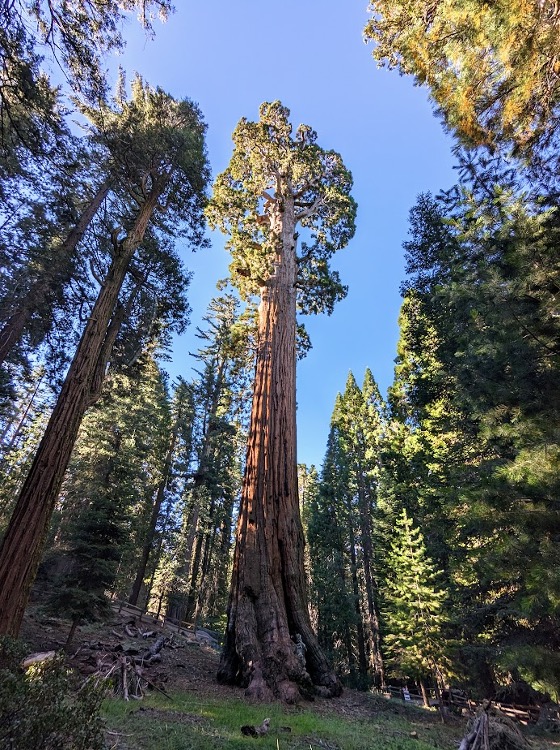
General Sherman: The largest tree in the world. Courtesy: Creative Commons

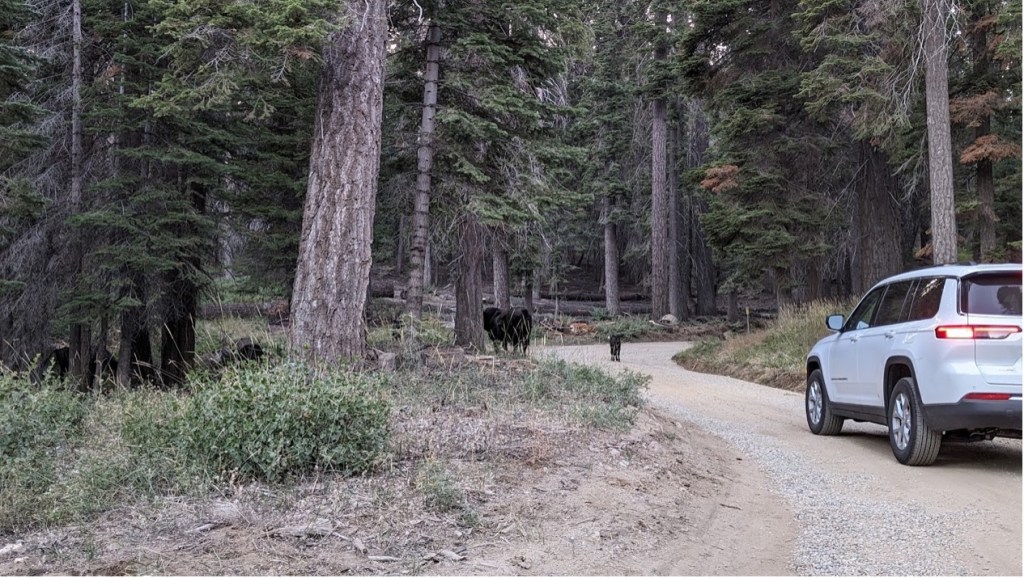
On our final day in California, we were looking forward to making the journey to Kings Canyon to see the largest tree in the world, a giant sequoia 87 metres tall. We packed the car with eight pieces of luggage destined for Australia, into Alex’s 1993 Ford Explorer. It had served us faithfully for several hundred miles of touring in California for the previous weeks. We headed up the winding mountains to Kings Canyon, dotted with live oaks and cattle in the foothills. We were heading up a particularly steep section of the road when the engine faltered. Alex urgently pressed his foot on the accelerator but the car refused to budge. 

“I’ll try and push it,” I offered.

I positioned myself to one side of the rear of the car. If the brakes failed, I did not want the car rolling back and flattening me. The car did not respond to my urgings so I gave up. I noticed cars ascending the mountains at speed, and the blind corner ahead. I decided to walk uphill so that I could signal the cars coming up the hill to warn them of oncoming traffic around the corner. When there was a car descending the hill on the other side, I put up my hand to warn them to stop until it was safe. About twenty cars passed us this way, until one driver noticed our plight and decided to help us. He stopped at the turn-out, and two elderly couples alighted from the car.

“Hasn’t anyone stopped to help you?” the driver asked.

“You’re the first,” I replied.

The two men walked towards the car to help push it twenty metres to the turn-out.

“John!” called out his wife, trying to stop him. It obviously wasn’t safe for a man in his seventies to push a heavily laden car up a mountain ahead of oncoming traffic.

Meanwhile, a man in his thirties had joined the party. Another car stopped on the other side of the road. Two burly men with tattoos crossed the road to help push the car to safety. Alex, the elderly men, the younger man, and the burly men, joined forces to push the car to the turn-out. The car slowly responded and was eventually positioned off the road. The burly men crossed the road to return to their car, and the elderly men returned to theirs. The younger man remained with us.

Alex tried to call the automobile service but his phone had no reception. 

“Can I borrow your phone?” he asked the younger man. 

“Sure. By the way, it might be quicker to call a tow truck. I suggest getting a tow-truck from Reedley, because you will be able to rent a car there.”

We called the tow truck company in Reedley and they agreed to come in two hours. The young man, who turned out to be an off-duty ranger, took his leave. We grabbed our picnic items from the car, and headed downhill to the shade of a large live-oak, while we waited for the tow truck. Lying on the grass under the cool shade of the live-oak, enjoying our picnic items, I could almost forget that we were in a crisis. After an hour or two we thought we needed to be visible from the road for the tow-truck, so we returned to the punishing heat road-side, and soon the tow truck appeared. The driver expertly loaded the car onto the truck, and invited us to join him in the front.

“Careful. It’s very high up,” he warned.

Photograph by Meredith Stephens

I stretched my legs to reach each step to get into the front of the truck, and sat in the back seat, while Alex sat next to the driver.

Sitting in air-conditioned comfort high up with a view down the mountain was such a contrast to sitting in the old car, straining up the mountain. We reached the plains and passed through the hamlet of Squaw Valley before reaching Reedley. With only minutes to spare, we picked up a rental car, removed a few items from the Explorer, and drove back up the mountain. We wound our way past where the car had broken down, into the National Park, through dense forest and charred remains of forest fire several years ago. We followed the signs to our lodge, but our break-down had cost us several hours, and we did not have time for sights that evening. 

That evening, Alex checked the passports to confirm they were at hand for our departure to Australia the following evening. They were not in their usual place. We searched our other bags. Then we retrieved bags from the car and searched them too, to no avail. 

“We’ll have to call the consulate and get temporary passports,” I suggested. 

“First, we will have to retrace our steps. Maybe they fell out when the car broke down. Maybe they are still in the Explorer,” suggested Alex.

That night Alex could not sleep, worrying about the passports. What if we could not return to Australia the next evening and had to buy new tickets? The next morning he was still worried.

“We’ll have to look for the passports, retracing our steps from yesterday. We have no time to see the tallest tree in the world.”

“Do we have time to see the third to tallest tree in the world?”

“Yes. That’s only a fifteen minute detour.”

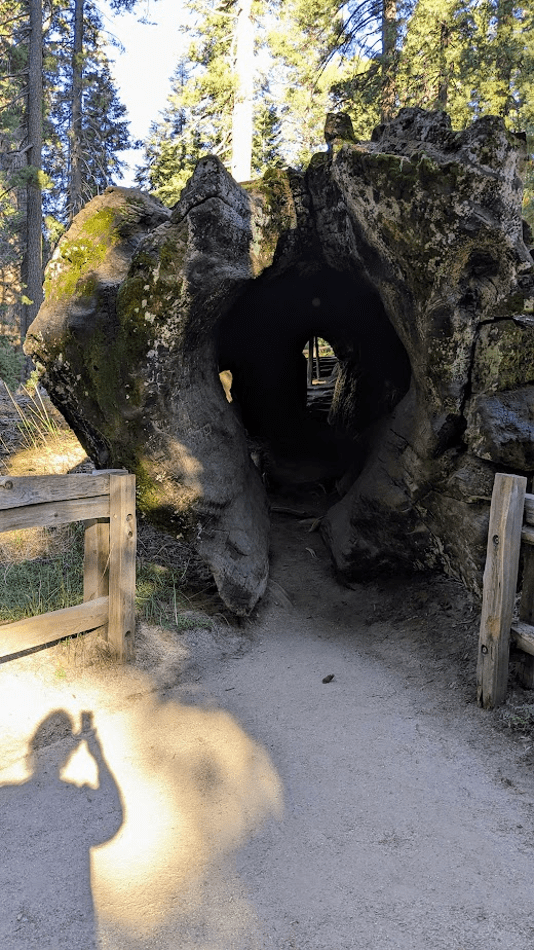
We drove to see the third to tallest tree in the world. As I started walking in the forest I immediately felt both exhilarated and relaxed. These giant trees provided a protective canopy and their scent sent a rush of well-being through my body. I was satisfied. Did I really need to see the largest tree in the world? Yes, but that would have to wait!

We hurried back down the mountain to search for the passports. We could not risk the possibility of not finding them just because of sightseeing. We reached the area of our break-down, and combed the grassy hill carefully in search of the passports, to no avail. Then we wound our way back down the mountain to the tow truck business. I received the keys from the office, opened the car door, and there were the passports on full display.

“Shall we go back to Kings Canyon to see the largest tree in the world?” I asked Alex.

“It will be ninety minutes to get back to the National Park, and then a five hour drive to the airport in LA.”

“I really want to see the tree, but I can’t face over six hours in the car. I guess we should head for the airport.”

“If we had known that the passports were here, we could have gone and seen the tree while we were still in the park,” lamented Alex.

With passports in hand, we did not need to visit the consulate to be issued temporary ones. We could catch the plane as planned. We were not able to see the tallest tree in the world, even though we had driven up the mountain twice. There was some consolation in the fact that the tree would be waiting for us, in years to come, when we had the opportunity to return to our beloved California.

Meredith Stephens is an applied linguist from South Australia. Her work has appeared in Transnational Literature, The Muse, The Font – A Literary Journal for Language Teachers, The Journal of Literature in Language Teaching, The Writers’ and Readers’ Magazine, Reading in a Foreign Language, and in chapters in anthologies published by Demeter Press, Canada.

PLEASE NOTE: ARTICLES CAN ONLY BE REPRODUCED IN OTHER SITES WITH DUE ACKNOWLEDGEMENT TO BORDERLESS JOURNAL

Click here to access the Borderless anthology, Monalisa No Longer Smiles

Click here to access Monalisa No Longer Smiles on Kindle Amazon International

Categories
Notes from Japan

Address Unknown

By Suzanne Kamata

I can still remember the address of my childhood home – the house number on North Shore Road in Spring Lake, Michigan, and the five digit zip code. Short, but sweet. Here in Japan, where I’ve lived for the past twenty three years, I’ve had four different addresses, each seemingly longer than the last. I can hardly remember how to write the location of my current domicile, let alone the complicated addresses of apartments past.

Given the chance to win a bag of rice or a free trip at my local supermarket lottery, I would rather pass than take up a pen. My hand starts to cramp as soon as I see a form to fill out. At the bank, in a doctor’s office, or when having to write in the corner of an envelope, I tend to recoil. It takes such a long time to jot down my address.

Written in the Japanese style, which dates back to the Meiji Period, my address starts out with the name of the prefecture, in this case, Tokushima, followed by the county name, the name of my town, the district, and eventually narrows down to a house number. The house numbers, however, are not in sequential order, but from oldest to newest. Our street, like most in Japan, doesn’t have a name. 

Postal workers seem to be the only ones to whom addresses here have any meaning, and, to their credit, they generally get mail to the right place. When I first came to this country, however, I hardly ever got letters from my friends and relatives in America. My grandma, one of my most reliable correspondents, refused to write to me unless I sent her address labels. My address was simply too long for her to write. An editor once informed me that I had the most complicated address she’d ever seen in her life.

Cab drivers, on the other hand, can never find my house. I usually advise guests coming by taxi to get dropped off at the neighbourhood grocery store, and I go to meet them on foot. Not even satellites seem to be much help. Although most every year we are required to draw a detailed map from our children’s schools to our house to enable teachers to find us for the annual home visit, one teacher tried to find his way using his car navigation system. I watched for his car from the window as rain poured down outside. Finally, the phone rang. He was lost. He was near a shrine, he said. Could I come and get him? I dashed out with my umbrella and found him a few streets away.

For convenience, I had name cards printed up a few years ago. Now, when someone asks for my address, I simply hand over a card or, more often than not, my email address. It’s easy to remember and I can write it in six seconds.

.

Suzanne Kamata was born and raised in Grand Haven, Michigan. She now lives in Japan with her husband and two children. Her short stories, essays, articles and book reviews have appeared in over 100 publications. Her work has been nominated for the Pushcart Prize five times, and received a Special Mention in 2006. She is also a two-time winner of the All Nippon Airways/Wingspan Fiction Contest, winner of the Paris Book Festival, and winner of a SCBWI Magazine Merit Award.

PLEASE NOTE: ARTICLES CAN ONLY BE REPRODUCED IN OTHER SITES WITH DUE ACKNOWLEDGEMENT TO BORDERLESS JOURNAL

Click here to access the Borderless anthology, Monalisa No Longer Smiles

Click here to access Monalisa No Longer Smiles on Kindle Amazon International

Categories
Poetry

The Window and the Flower Vase

Poetry and translation from Korean by Ihlwha Choi

In front of the window, there's a flower vase,

Bright and colourful with various blooms.

As I remove the vase,

The colours and scents leave in droves.


The space in front of the window is now open wide,

Without any colour or fragrance.


The window, all alone in its place,

Finally becomes a true window.

Ihlwha Choi is a South Korean poet. He has published multiple poetry collections, such as Until the Time When Our Love will Flourish, The Color of Time, His Song and The Last Rehearsal.

.

PLEASE NOTE: ARTICLES CAN ONLY BE REPRODUCED IN OTHER SITES WITH DUE ACKNOWLEDGEMENT TO BORDERLESS JOURNAL. 

Click here to access the Borderless anthology, Monalisa No Longer Smiles

Click here to access Monalisa No Longer Smiles on Kindle Amazon International

Categories
Review

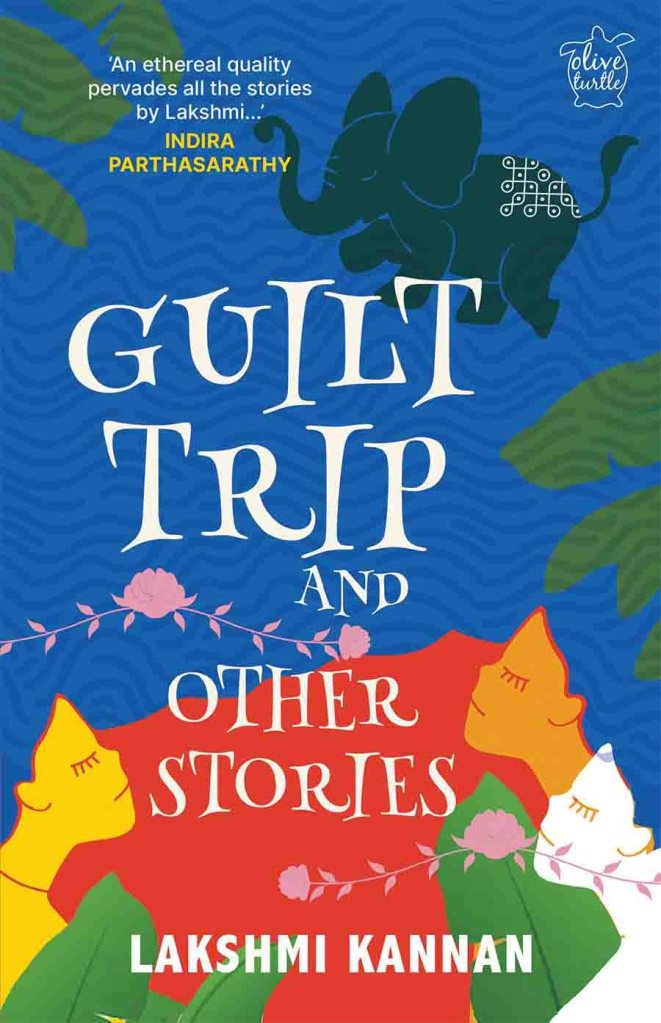
Guilt Trip and Other Stories

Book review by Anita Balakrishnan

Title: Guilt Trip and Other Stories

Author: Lakshmi Kannan

Publisher: Niyogi Books

The short story distills within its succinct form a moment from the amorphous flow of life experiences and re-presents it with a crystalline clarity.  A reader cannot help but be transformed by this epiphanic moment as it serves to illuminate some of life’s most baffling ambiguities. Lakshmi Kannan’s latest book of short stories, Guilt Trip and Other Stories, published in 2023, includes thirteen such stories that provide an insight into the lives of people navigating the vicissitudes of life.

In a similar vein, the entry on Lakshmi Kannan in the Routledge Encyclopedia of Indian Writing in English, Eds Manju Jaidka and Tej N. Dhar (2023), observes that her short stories “are explorations of lived experience that create an apocalyptic dimension. They pitch the reader between the luminal space of the living and the dead”.

 Several writers have commented on the exacting nature of the short story form, as it denies writers the space to develop their themes or trace the arc of their characters’ lives, its taut boundaries requiring every word to be justified. Given the number of women indulging in practising this genre and attaining great acclaim, it has been suggested that the short story is particularly suited for women’s subjects, the preoccupation with domestic life and the vagaries of human relationships. It is thought that the inflexible limits of the form serve as a restraint on elaborate descriptions of the sprawl of family life, condensing them to into chiselled vignettes that allow gleaming insights to shine.

 Lakshmi Kannan, a virtuoso of the short story, has published twenty-eight books, including collections of poetry, novels in both English and Tamil and translations. She is a bilingual writer who writes in Tamil under the penname Kaaveri. She is a prolific writer whose recent books include a historical novel The Glass Bead Curtain (2020, c2016), an English translation of Tamil writer T. Janakiraman’s acclaimed novel The Wooden Cow (2021) and a collection of poetry Sipping the Jasmine Moon (2019).

This collection Guilt Trip and Other Stories contains eleven short stories and two longer   stories, ‘Janaki turns a Blind Eye’ and ‘VRS’. Although pan-Indian in nature, Lakshmi Kannan’s stories are able to effortlessly showcase the ineffable flavour of Tamil culture. Her protagonists are frequently educated women, who struggle to reconcile their desire to be treated as equals within their families, dealing with the cultural mores that seek to restrict them to their homes and kitchens. The varied themes of Lakshmi Kannan’s stories include the spiritual awareness of the transience of human life as seen in the story ‘Open the Gate’. Another story that evokes spiritual transcendence is ‘Floating Free’, where a grieving daughter is comforted by a hummingbird which she sees as the reincarnated spirit of her mother.

A recurring trope among the stories is the equating of women with food and cooking, a reflection of the way women are often perceived in Indian society. Lakshmi Kannan elaborates on this idea observing that in the Tamil cultural milieu the regressive rural-urban divide continues as the norm. Several people, particularly men, do not have a progressive outlook even when they interact with contemporary women who are successful professionals. The author notes: “In Tamil Nadu, the retrograde maxim that a ‘woman’s place is in the kitchen and backyard’ still functions with a mind-numbing attitude irrespective of her economic, social or professional status”. The author employs this trope in the stories ‘Dregs’, ‘Kitchen Fire’, ‘The Colour Green’ and ‘Ladies Watch’. The latter two stories also delineate an allied theme, the insensitivity of adult children in the diaspora who do not hesitate to use their aging parents as unpaid domestic help. Another food related subtext that Lakshmi Kannan introduces is the selfishness of men who demand that the women serve them plenty of food, yet callously consume it without caring to check if there is enough for the women and children of the household.

Nevertheless, the author does not fall into the trap of essentialising Indian men as selfish, uncaring boors. In the story ‘As Dapper as the Come’ she turns the notion of a well-dressed, attractive man being arrogant and self-obsessed on its head. The dapper young man lends a ready helping hand to an older couple in distress unmindful of sullying his expensive suit. Furthermore, in the charming story ‘A for Apple’, the author explores the delight that a small-town boy from Karnataka takes in the rhythms and sonic vibrations of his vernacular, Kannada.

It is perhaps in narrating the strength of the bonds formed among women who use them to circumvent or subvert the rigid hierarchies and oppressively restrictive customs that govern traditional families that Lakshmi Kannan is at her most impressive. She explores the corrosive jealousies, subterfuges and pettiness that undermine relationships within a family. The long story ‘Janaki turns a Blind Eye’ is replete with irony. Narrated in five sections, the story relates how a nearly blind matriarch Janaki helps a young bride defeat the machinations of the senior members of the family who are plotting to steal her jewellery and silverware. ‘Addigai’ and ‘Annapurna Bhavan’ are two stories where the interaction between women may be set in counterpoint.

In the former, a grandmother furtively bequeaths an heirloom necklace on her granddaughter, warning her never to wear it at family celebrations. When Priya, the granddaughter, wears it just once several years later to a family wedding, she is rudely interrogated by the hostess as to how she came by it. The acquisitiveness and jealousy within this affluent family is in stark contrast to the warm camaraderie that characterizes the bonds between women in a small middle-class eatery in the story ‘Annapurna Bhavan’. The well-to-do narrator insists on eating at the same eatery as her driver where she is assailed by the aromas of the food she had earlier eaten in her childhood. The unabashed enjoyment of their food by the women at the eatery, their friendly banter, their freedom from family constraints and their closeness exhilarates the narrator. 

Yet it is not just Lakshmi Kannan’s significant themes — the refusal to be bound by narrow definitions of womanhood, the flowering of the creative impulse, a child’s playful linguistic experiments, the conflicts between appearance and reality – that make her work stand out. It is her prose that evokes both the asymmetries and passions in everyday life with a poetic intensity that is remarkable. An acutely observant chronicler of the incongruities, the asymmetries, the felicities and the marvellous absurdities of life, Lakshmi Kannan is able to express it with precision, empathy and humour. She has an innate sensitivity to the jealousies, treasons, duplicities, compromises, evasions, tender feelings and sentimentalities that characterise human relationships.

Lakshmi Kannan’s stories highlight the extraordinary within the quotidian, revealing the layering of the concrete and the mysterious, the interweaving of diverse elements that reveal that nothing is ever as it seems on the surface. She shows us that even the most ordinary individual has hidden facets that can never be completely known. It is her treatment of the special bonds that can be forged among individuals and contradictory nature of human relationships that makes Lakshmi Kannan’s fiction so special.

.

Dr Anita Balakrishnan is the author of Transforming Spirit of Indian Women Writers published in 2012. She is a contributor to the Routledge Encyclopaedia of Postcolonial Studies edited by Sangeetha Ray and Henry Schwarz.

Email ID: shalkri@gmail.com

PLEASE NOTE: ARTICLES CAN ONLY BE REPRODUCED IN OTHER SITES WITH DUE ACKNOWLEDGEMENT TO BORDERLESS JOURNAL

Click here to access the Borderless anthology, Monalisa No Longer Smiles

Click here to access Monalisa No Longer Smiles on Kindle Amazon International

Categories
Poetry

Voice of the Webb

By Ron Pickett

A Cosmic Tarantula, caught by NASA’s Webb Telescope.
You can’t hear screams in space -- but they are there, in abundance.
I look at the horizon:
The distant hills are covered with trees and shrubs, and grasses.
The fronds on nearby palm trees sway gently in the warm breeze.
I see a small pond with lilies and reeds and even pond scum,
And I feel good, alive and strong and even essential, significant.

I listen to the sound of a Black Hole.
It is a hiss with modulation, but it is somehow ominous -- deadly,
Atavistic, I’ve heard it before.
I look at the pictures from the Webb telescope.
They are gorgeous, incredible, brilliant, unimaginable.
They take me back to the beginning of time.
The stars and galaxies and nebulae are lacy and soft,
Like a necklace or a lovely ball gown designed to enhance natural beauty.

I re-enter my world. Twenty miles deep air protects me, guards me, gives me freedom.
I feel the heat from the sun -- 93 million miles away; it is vital and terrifying.
I look at the photos from the telescope again, and it is beautiful-deadly.
I can’t escape the chilling reality that I can only be here as long as the pond is filled with water,
The sky is filled with air, and the vicious world outside my earth is kept at bay.
I can’t get close to the stars, the vast dust clouds that are birthing stars.
And I can’t get them out of my mind – I want to play among the stars.
I feel a chill of impending doom, but I don’t know where it comes from.

It is the voice of space, of the Webb. 
The hiss of a Black Hole,
The echo of the Big Bang, 
The beat of the spinning pulsar
It is clean and crisp,
Dark and muddied.
This is the voice of our parents.
This is the sound of our death.

Ron Pickett is a retired naval aviator with over 250 combat missions and 500 carrier landings. His 90-plus articles have appeared in numerous publications. He enjoys writing fiction and has published five books: Perfect Crimes – I Got Away with It, Discovering Roots, Getting Published, EMPATHS, and Sixty Odd Short Stories.

.

PLEASE NOTE: ARTICLES CAN ONLY BE REPRODUCED IN OTHER SITES WITH DUE ACKNOWLEDGEMENT TO BORDERLESS JOURNAL

Click here to access the Borderless anthology, Monalisa No Longer Smiles

Click here to access Monalisa No Longer Smiles on Kindle Amazon International