Categories
Discussion

How Gajra Kottary Weaponises Words

In a medium that is known for its regressive content, Gajra Kottary, novelist and short-story writer, has time and again gone against the tide and broken taboos. Shantanu Ray Chaudhuri looks at five shows she has written that went against the grain and emerged triumphant…

Growing up in the 1980s, one of the many pleasures of a less cluttered and leisurely time was the birth of the TV series. Many people I know would swear by the fact that the first of these represented the best of Indian television. Even close to forty years later, I can still rattle off the days on which each was telecast: Karamchand on Mondays; Hum Log[1]and then Buniyaad[2] on Tuesdays and Saturdays; Khandan[3] on Wednesdays; Ados Pados[4]on Thursdays; Yeh Jo Hain Zindagi[5]on Fridays. You had stalwarts like Satyajit Ray, Mrinal Sen, Shyam Benegal and Basu Chatterjee make fine works for the television.

Sometime by the end of the decade kitsch entered in the shape of Ramayan and Mahabharat. I moved on and lost touch. A resurgence of sorts happened with the coming of cable television, and we had path-breaking shows like Shanti and Tara. And then it became increasingly difficult to keep track of TV shows. The shows changed beyond recognition. Led by the likes of Kyunki Saas Bhi Kabhi Bahu Thi,[6] they became more and more ridiculous in the worlds they represented. One word came to be bandied about regularly with respect to soap operas: regressive.

However, like all generalised judgements, a blanket application of the word is unfair to a number of serials that tried to, and often succeeded in breaking taboos, while operating within the limitations dictated by the medium and the grammar of its narrative. And the one writer who has time and again bucked the trend, gone against the tide, is Gajra Kottary, the creator of historic shows like Astitva: Ek Prem Kahani[7]and Balika Vadhu.[8]
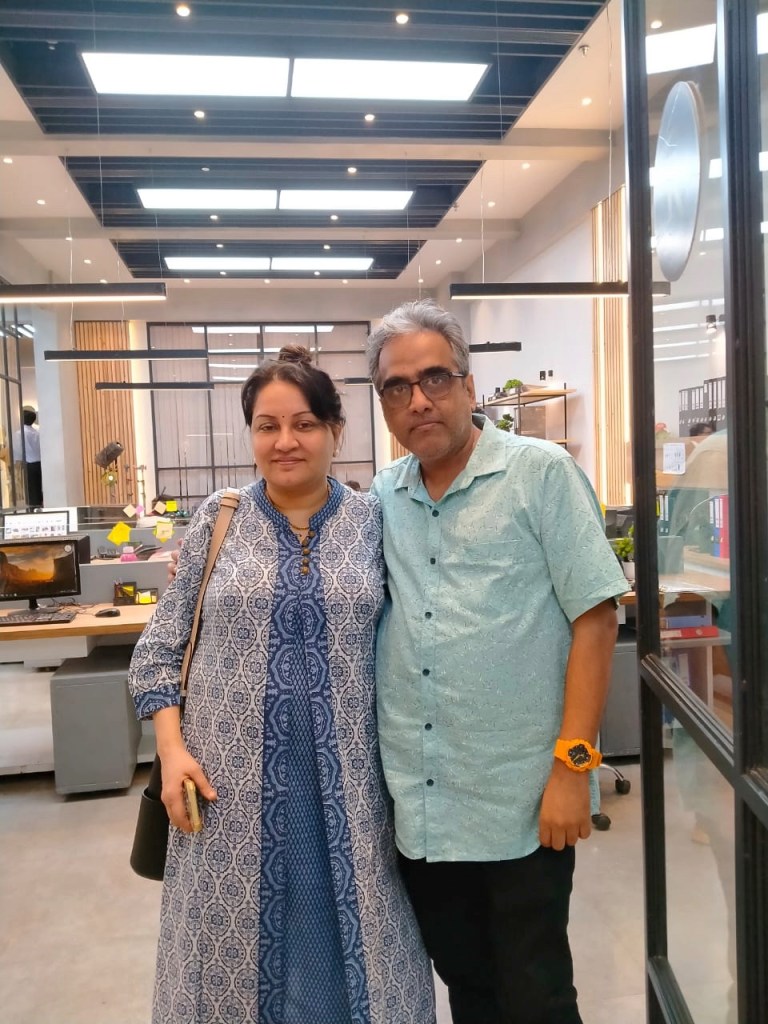
Gajra Kottary with Shantanu Ray Chaudhuri. Photo provided by Shantanu Ray Chaudhuri

Journalism and Fiction Writing

One of the reasons Gajra manages to break new ground in her television narratives might have something to do with her training as a journalist. “IIMC [Indian Institute of Mass Communication] was a tough course to get into and we had a few fresh graduates like me, and a whole lot of older and established professional journalists from other non-aligned countries studying with us, a great mix,” she says. It provided her with a grounding in fact-based narratives while polishing her skills as a writer, of which she had provided glimpses in college, when two stories she wrote got published in Eve’s Weekly, along with two fiction-style middles in The Times of India. “The IIMC stint helped because as I have observed over the years, I have more respect for the sanctity of facts even while taking my flights of fancy than others in the business. I take fewer creative liberties than others. I have done more realistic shows on television which helped forge a distinct identity for my writing.” But it also left her confused since political and economic writing held no interest for her and Delhi offered avenues only for those.

Destiny intervened in the form of Cupid. Falling in love with Sailesh Kottary, a “hotshot and hardcore journalist”, she moved to Bombay. It was here, as a “stay-at-home mom”, that she gave wings to her imagination and honed her writing skills. Watching serials like Saans[9] and The Bold and the Beautiful might also have helped imbibe certain aspects of writing for a visual medium. Her first work of fiction, Fragile Victories, a collection of stories, led to her first assignment in television. She had sent a copy of the book to Mahesh Bhatt, who passed it on to Soni Razdan. Impressed by the collection, the latter signed Gajra up for the story and screenplay of her first TV production, Hamare Tumhare[10](2000), which marked her TV debut, before Astitva made everyone sit up and take notice.

If IIMC shaped her in some ways, another skill-set that has held her in good stead probably came from her experiments in writing fiction. Fragile Victories was followed by another collection of stories, The Last Laugh, and the novels Broken Melodies, Once Upon a Star, Girls Don’t Cry and Not Woman Enough. These helped her to keep to a discipline that could go missing in the never-ending juggernaut that is the TV soap opera. They also are testimony to her willingness to push the envelope when it comes to narratives and characters. Not many know that much before Indian writers, particularly women, began addressing issues of sexual identity and same-sex relationships, Gajra had written about these in her fiction. As she puts it, these themes “continued to ‘consume’ me”. Not Woman Enough may have been published as an e-book only recently, but it evolved from a story that she had published way back in 2003. “I felt that I hadn’t done justice to the theme in the short format, so I wrote a full-length novel titled Not Woman Enough and felt finally relieved of my obsession.” Another story, ‘Two Gold Guineas’, evolved to her third novel Girls Don’t Cry, a pun on the expression ‘boys don’t cry’ and “an ode to the bravery of women and the friendship between a grandmother, mother and daughter”.

What is startling about these works of fiction is her ability to address taboos. Not Woman Enough not only deals with a same-sex relationship, but Gajra has the audacity to set it in rural Rajasthan as opposed to an urban setting, where it would have probably been just another story. She has the perspicacity to understand that the stakes are so much higher for first-generation characters experiencing the forces of social liberation while battling age-old customs. It is the same acuity that she brings to bear upon her iconic TV shows, which have time and again shown what is possible in a medium that allows little leeway for out-of-the-box thinking. 

Astitva: Ek Prem Kahani (2002-2006, Zee TV)

Running 668 episodes, over a period of three-and-a-half years, this is the series that launched Gajra into the big league. Today, twenty years after the first episode was aired, an older woman-younger man relationship might appear staid. But back then it was bold, and Indian television had not seen anything like it. It made an icon of its lead, Niki Taneja, who plays a doctor who falls in love with a man ten years younger. What stood out is the maturity with which the series unfolds, largely devoid of the excesses that came to mark television in later years. “The first TV show maker I decided to call upon was Ajai Sinha, who had directed shows like Hasratein [11]and Justajoo[12]. He had been planning a show called Astitva with a bold theme and my timing was bang-on. It spoilt me enough to believe that television too was conducive to the kind of work I felt happy doing.” That this show managed to hold its own against a raging Kyonki[13], speaks volumes of the writer.

Balika Vadhu (2008-2016, Colors TV)

2167 episodes! Yes, you read that right. One of the longest-running shows on Indian television, this cemented Gajra’s reputation as a writer. Here again, Gajra was going out on a limb addressing a much-abused tradition prevalent in large parts of India. And sure enough, the press wasn’t flattering. It is one show that divided opinion like few others. “Yes, we received some negative press, because Anandi was this irrepressible kid, a happy child who kept bouncing back despite dealing with the dark consequences of child marriages of the past playing out in the present. It was a calculated approach as child marriage is a dark and gloomy issue. It was a conscious decision here as we needed to keep the cheer, but critics felt that we were glorifying child marriage. I think they were missing the woods for the trees.”

One possibly needs to understand the medium and its viewership to get a sense of what Gajra means. Unless the packaging is glossy enough – colourful clothes and jewellery – audiences might have been put off entirely by what is a repulsive subject. “And that would mean we would not be able to get across the underlying message of the show. These tactics are important due to the challenge of the medium of television, and the terror of the remote control. It was a classic case of the sugarcoated pill doing its work.”

Apart from the writing, the series was also recognised for its iconic performances and comments on several social issues that ail Indian society, which were woven in organically without being preachy. It also had an authentically rustic feel thanks to Purnendu Shekhar, whose concept it was. Those decrying the glossy packaging forget that the issues the series addressed included girl child education; peer, sibling and parental pressure to do the best; child labour; the begging racket; forced prostitution behind a legal façade; quacks and medical malpractices; date rape; adoption; alcoholism; divorcee and widow remarriage; trafficking in women; surrogacy; juvenile delinquency and teenage crimes, among others. From the comfort of our air-conditioned condos and offices, far removed from these realities, it was easy for the elitist press to criticise the series.

One standout episode dealt with the protagonist’s first experience of menstruation. This is a subject still, despite Padman and the increased conversation around it, spoken of in hushed tones. It is fascinating to hear Gajra’s take on this: “I remember how we involved Avika’s [the child actor who played Anandi] mother to explain to the child privately about menstruation before we shot the scene showing a young girl’s trauma when it happens to her as a bahu in a conservative household. Lots of people wrote to us about delaying the marriages of their girl children after watching Balika Vadhu. There was a girl who was emboldened enough to annul her marriage that had happened as a child when she turned eighteen. We received mails even from parents of city girls who were now reversing their decisions to get their girls married by the time they were sixteen.”

There was of course the flipside of popularity, when the writer received a death threat on Twitter if she dared to kill off the character of Shiv (played by Siddharth Shukla). “Those were the early days of social media, so real people started to write in with their reactions which were usually very intense and sometimes downright ridiculous.”

Buddha (2013-2014, Zee TV, DD[14] National)

This series, spanning 55 one-hour episodes, was a huge challenge, involving as it did a historical figure, and one of the most important religious figures of the world. But trust Gajra to approach the subject from a refreshing point a view: as she points out, in school textbooks we go straight from the story of Gautama leaving home to being under the Bodhi tree and achieving enlightenment. But his experiments to arrive at the truth had many stages to it. As she says, “What it did was to dispel my own myths about the Buddha’s life. I had always felt disturbed about his abandonment of his wife and child for his own spiritual search.”

It helped that the show came to her at a point in life when the strong opinions and idealism of youth, both professionally and personally, had given way to the realisation that nothing is or can be ‘perfect’. By the time the show was done she too had evolved to accept that the Buddha had to be true to his heart’s calling. “I understood the ‘larger purpose’ of his life. I came to terms with the ‘abandonment’, though my heart still bleeds for Yashodhara and Rahul. What also helped was learning about Yashodhara’s evolution, albeit painfully, to want to join his sangha voluntarily, and him helping her find her ‘larger purpose’.” The series focuses on aspects of his life after the Enlightenment that many are not aware of. It is this larger view that shapes the series, making it a departure from the dime-a-dozen ‘mythological/religious’ shows with ‘special effects’ that blight our senses.

Silsila Badalte Rishton Ka[15] (2018-2019, Colors TV)

Extramarital affairs are the oxygen to the beast that is the TV serial. Offhand, I can think of not one serial that does not have a million and more permutations and combinations of the theme. So, it takes a really perceptive writer to give this tired trope a new perspective, and Gajra manages that in Silsila, upending the traditional way that extramarital affairs are portrayed. “Is the ‘other’ woman necessarily a femme fatale, a super-cool career woman, and the wife a boring domestic goddess or could it be the other way round also?” she asks.

The series provides further proof of her ability to give a new spin to a theme that’s been done to death. As she says, “I am emotional about this show as it was inspired by what happened with some close friends and associates. I needed a relief from all the social stuff in Balika Vadhu. Also, I believe that an author’s voice in terms of standing for the right thing can and should reflect in any kind of story, even if it’s not apparently one on a social issue. The classic extramarital affair with the eternal conundrum is a fascinating aspect of human relationship … does a third person enter the picture because a marriage is already collapsing or does the entry of a third person lead to the collapse of a marriage. Is it the cause or effect?”

Molkki (2020-2022, Colors TV)

After Silsila, it was back to a classic social issue for Gajra. At the heart of this show is the tradition of bride-buying in Haryana, which in turn has its roots in the scarcity of brides due to female feticide/infanticide. As Gajra says, “Molkki was a Covid baby, my second project with Ekta Kapoor and it was made keeping in mind all commercial considerations.”

Female infanticide is a recurrent theme in several of her stories. She writes about it in her novel, Girls Don’t Cry, while Not Woman Enough, published as an e-book by Juggernaut, has this as a strong strand, being part of the protagonist’s backstory impacting her psyche. Again, what needs to be noted here is the writer’s willingness to explore issues that contemporary television is not known for, even if the execution falters given the demands of the medium. 

Addressing the Regressive Nature of Television

But Gajra does agree that on the whole, television is regressive. Though it is described as a writer’s medium, there’s only so much that writers can do in terms of trying to infuse new ideas and nuanced storytelling in the face of TRPs[16] and other market considerations and entrenched beliefs that ‘bas yahi chalta hai’[17]. So, writers take the easy way out, churning out what the studio executives want. “For the handful of people prepared to take the risk and at least try to do things differently, there are scores of others who would like to use every gimmick in their book and keep regurgitating bad content.”

In terms of audience profiling too, what’s happening with television is that most of the intelligentsia has shifted to web shows. The television viewership class has gone lower down in the social scale. So when content is being made and consumed by a non-thinking class, it also starts reflecting in the TRP studies. The classic chicken-and-egg syndrome.

Looking Ahead

Gajra is currently basking in the success of her latest show, Na Umr Ki Seema Ho,[18] which recently celebrated its hundredth episode. The show is being hailed as ‘different’ by many. As she says, “The most heartening comment that I often get to hear is that ‘it’s the first TV show I have started watching after many years’, from people who had switched full time to watching web shows.”
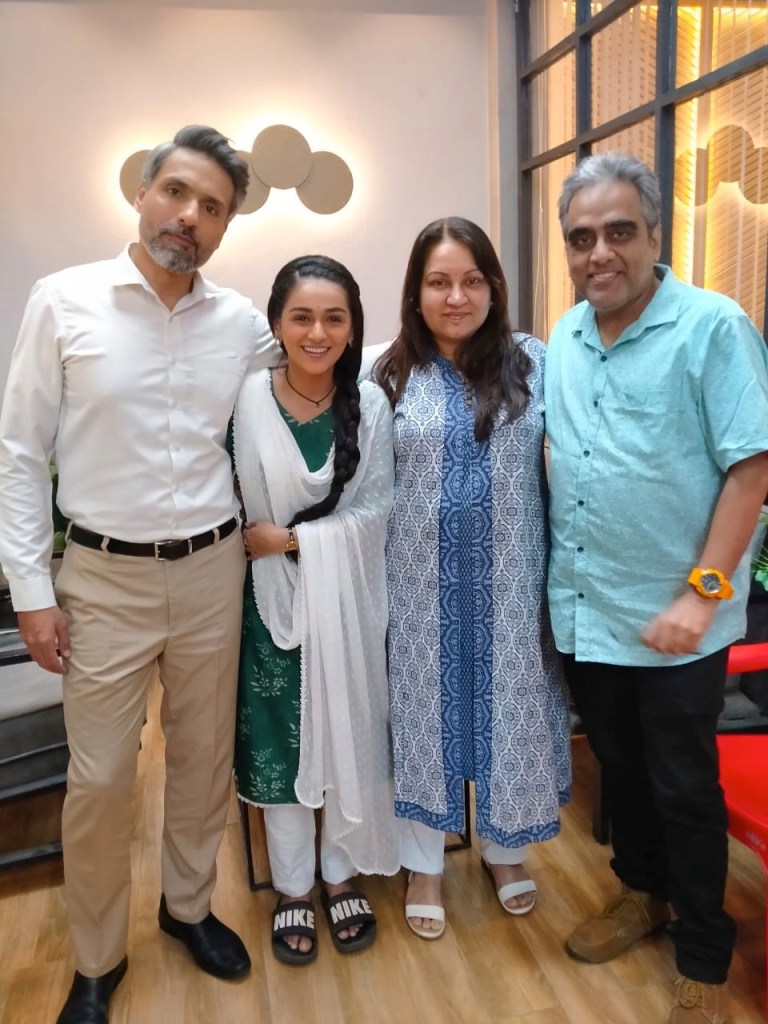
Shantanu and Gajra with the lead actors of Na Umr Ki Seema Ho. Photo provided by Shantanu Ray Chaudhuri

Any grand obsession, a show she would like to write? “As far as TV goes, I have always dreamed of doing a version of one of my all-time favourite films, Abhimaan[19], with or without the music background. The subject becomes more and more relevant every decade. Frankly, no channel wants to touch it. Though the people one speaks to share my admiration for the story, the ‘system’, they say, is not conducive to making it. I also want to adapt my first novel, Broken Melodies, as a web show or film. It’s the story of a girl growing up in the seventies, torn between the values and stifling world that her classical musician father [an autobiographical element given that Gajra is the daughter of the classical maestro Pandit Amarnath] represents and the liberation that the English education sponsored by her mother affords her.”

One can only say, more power to writers like her, and the breaking of glass ceilings and taboos.

(Originally published in The Telegraph, Kolkata)

Addendum

Shantanu: You grew up in Delhi in the 1980s. That was the birth of the TV era with Hum Log, Buniyad, and all those glorious serials. Did any of these influence you?

Gajra: You’re so right, Shantanu, they hugely did, except that there was no plan that I had then, to actually use that impact to write something similar. I loved both these shows purely as a viewer. Hum Log did tackle social issues, for example, dowry, but why I liked it was that it showed the clash of values within a family with different generations, and through that, it entertained and made one feel and think – the sensitization process as its termed. Later, I learned that Hum Log was inspired by the Sabido method (originating in Mexico) where TV is used as a medium to bring about positive social change by making viewers ‘feel and think’ rather than preaching to them.

I loved Buniyaad for a purely sentimental reason. My parents were from Lahore and Multan respectively and had come as refugees to Delhi, so we had grown up hearing stories of Partition and here was a show that brought that era alive for me in an extremely moving and entertaining way. So maybe subconsciously both these shows did impact my psyche – as in it was possible to talk emotions that were universal, even while having a responsible author’s voice.

Shantanu: What do you attribute the change in the style and content in TV soaps, first with Tara and Shanti, and then Kyunki Saas Bhi

Gajra: Tara and Shanti were the first movers, coming in like a breath of fresh air after the DD days which were associated with somewhat stodgy storytelling, Buniyaad etc., being the shining exceptions. Tara and Shanti were great in terms of revolving around thinking and evolved women, but perhaps were ahead of their times…they still are, given where TV storytelling has gone.

By the time Kyunki Saas came to TV screens, middle- and lower-middle-class homes could afford a TV set, so there was a genuine need for TV to go more middle class in its appeal. So, we had a plethora of shows with joint families and generations under one roof, which truly was the reality of such homes, and which therefore connected with the masses easily. Ekta Kapoor also upped the drama quotient hugely, so there was no way it wasn’t going to work with the masses.

Unfortunately, however, everyone went about copying the formula and there was the overdose factor. So, TV honchos were afraid of trying different subjects and worlds and that for a very long time became the bane of TV writers.

Shantanu: On Buddha: ‘dispel your own myths, you say …’ What apart from his abandonment of his wife and child haunted you. Do you reconcile with the abandonment once you had done the writing for this? Did it make sense now?

Gajra: Buddha, the show, came to me at a point in life when the strong opinions and idealism of youth – both in professional and family life – had given way to some acceptance and the realisation that actually nothing is or can be ‘perfect’. And certainly not any decisions of life that we might make. So, we might as well make the decision, and accept and live with the consequences as positively as one can. I know that that’s so ‘anti’ the way today’s youngsters think!

So yes, from his wife and family’s point of view his decision seemed ‘selfish’ but he had to be true to his heart’s calling and that so-called ‘selfishness’ of his is what made him give so much to the world to make it a better one. I understood the ‘larger purpose’ part of the Buddha’s life after I started researching more and more while writing the story for the show. I came to terms with the ‘abandonment’, though my heart still bleeds for Yashodhara and Rahul, when I think about them. What also helped was me learning the historical truths about how Yashodhara evolved, albeit painfully, to want to join his sangha voluntarily at some point, and him helping her find her ‘larger purpose’. 

Also, what I realised is that in school textbooks we go straight from the story of Buddha leaving home to being under the Bodhi tree and achieving enlightenment and uplifting the world. This had been my myth too. But, in reality, the Buddha’s many experiments to arrive at the truth had many stages to it. He went through extreme deprivation, abnegation, self-loathing and much else, before he arrived at the eight-fold path – the most practical and fair way to lead life in any time and space.

And he certainly did not advocate renunciation for all or even the perception of Buddhism as a religion. His was the ultimate live-and-let- live approach to life – just that his methods helped his followers lead a life of peace and equanimity within their chosen path. Through writing the show I realised that there could be no other way of life that was so compatible with the modern way of thinking and doing. So I am not a ‘Buddhist’ but I still try to recall the eight-fold path at various difficult points in my life and it really helps me.

Shantanu Ray Chaudhuri is a film buff, editor, publisher, film critic and writer. Books commissioned and edited by him have won the National Award for Best Book on Cinema twice and the inaugural MAMI (Mumbai Academy of Moving Images) Award for Best Writing on Cinema. In 2017, he was named Editor of the Year by the apex publishing body, Publishing Next. He has contributed to a number of magazines and websites like The Daily Eye, Cinemaazi, Film Companion, The Wire, Outlook, The Taj, and others. He is the author of two books: Whims – A Book of Poems(published by Writers Workshop) and Icons from Bollywood (published by Penguin/Puffin).

.

[1] TV series, translates to ‘We – the People’

[2] TV series, translates to ‘Foundation’

[3] TV series, translates to ‘Dynasty’

[4]   TV series, translates to ‘Neighbours’

[5] Comedy TV series, translates to ‘This is life’

[6] TV Series, translates to ‘Because the Mother-in-law was a bride too’

[7] TV Series, translates to ‘Identity: A Love Story’

[8] TV Series, translates to ‘Child Bride’

[9] TV Series, translates to ‘Breath’

[10] TV Series, translates to ‘Ours & Yours’

[11] TV Series, translates to ‘Desires’

[12] TV Series, translates to ‘Search’

[13] TV Series, translates to ‘Because’

[14] Doordarshan or DD, Indian public service broadcaster founded by the government of India

[15] Translates to ‘Changing Relationships’

[16] Target Rating Points

[17] Hindi phrase: ‘This is what works…’

[18] ‘Age is just a number’, literal translation ‘Age has no boundary”

[19] Translates to ‘Ego’, 1973 Bollywood film

PLEASE NOTE: ARTICLES CAN ONLY BE REPRODUCED IN OTHER SITES WITH DUE ACKNOWLEDGEMENT TO BORDERLESS JOURNAL

Click here to access the Borderless anthology, Monalisa No Longer Smiles

Categories
Interview Review

In Search of a Pitcher of Nectar by Samaresh Bose

A conversation with Nirmal Kanti Bhattacharya, the translator of Samaresh Bose’s In Search of the Pitcher of Nectar, brought out by Niyogi Books.

In 2017, the Kumbh Mela (the festival of the sacred pitcher) was declared an Intangible Cultural Heritage. A Times of India report read: “The committee noted that as the largest harmonious conclave in the world, Kumbha Mela stands for values like magnanimity and patience that are very beneficial for the modern humanity. Moreover, the concept of Kumbha Mela goes well with the current international human rights tools because the festival welcomes people from all corners of the world without any differentiation.”

Five years down the line, Niyogi Books brought out a translation of Samaresh Bose’s[1] In Search of a Pitcher of Nectar, an epic travelogue translated from Bengali by Nirmal Kanti Bhattacharjee on the festival at the confluence of the three rivers, Ganga, Saraswati and Jamuna — in Allahabad. An eminent acknowledged writer, whose stories won not just literary acclaim like the Sahitya Akademi award but were translated to prize winning films, Bose’s solo voice stands alone in the translated version — as that of Kalkut, one of the pseudonyms he assumed.

In the early part of the book, Bose gives the reason for his journey into this crowded event which even in the middle of the pandemic (2021) had 3.5 million visitors: “Observing this great variety of humankind on the move is a thirst that is not easily quenched.” Bose’s exploration came long before the pandemic as his book was published in 1954. Then a Bengali film was made on it in 1982.

The writer claimed to have set out to look into the heart of the nation: “I would dive deep into that heart of India. I would identify my own face in this strange mirror of India. That face is my mind. My religion.” And he discovers, “the poor India was there like a faded cloth by the side of a muslin chunni.” While peeling layers of poverty and ‘respectability’, he introduces us to a bevy of characters which include not just Godmen, but also women, who evolved from wifehood to prostitution to godwomen, to young girls forced to marry polygamous octogenarians, to people in quest of lost family members, to men in search of the intangible — and all united together for a dip in the holy ‘sangam[2]’ of three rivers, the ultimate panacea for all ailments and ills for believers. That the author is not part of the believing crowds, but a sympathetic, humane commentator is obvious from his conversations with various people and his actions, which defy boundaries drawn by the respectable god minding devotees thronging the festival. He uses the event to pinpoint the flaws of socially accepted norms and to find compassion for the less fortunate. He laces his narrative with love and compassion for humanity.

The title itself both in Bengali and English conveys the quest for nectar or the divine amrita of immortality which led to a festival that washes away sins with a dip at the confluence. Legend has it that the gods and the rakshasas worked together to draw out the ambrosial drink at this sangam and then, the gods cheated and consumed all of it, judging the other party as too evil to be handed eternal life in a cup. The unbreachable walls had started and perhaps continue even to this date.

The real origin of the festival as Bose contended remains disputed like that of many other cultural lores, though people do continue to quest for miracles in the waters that were supposed to have thrown up the ambrosia. The narrative implies the educated and schooled rarely participated in this event. There is a mention of the prime minister at the festival, but that would be as a dignitary, and not as part of the crowd.

The crowd in its urgency to take a dip at the holy hour, results in a stampede and many deaths. It is a sad and philosophical ending which clearly takes us back to the questions raised at the start of the narrative. “If lakhs of people are blinded by faith, then why not search for the reason? What is that celestial blinker which can blind lakhs of eyes?”

While questioning faith, the narrative exposes the gaps in society with compassion — even between the educated and uneducated that has become a severe point of contention as more fissures into society and creating more boundaries. At the end of the book, one wonders have things really changed from the 1950s when Bose wrote the book to the current experience where the UNESCO, a modern-day construct and belief, has dubbed this festival as a juncture where all humanity congregates? Do they?  To enlighten us on this issue, we conversed with the eminent translator of this powerful book, Nirmal Kanti Bhattacharjee.

Nirmal Kanti Bhattacharjee

What led you to translate Samaresh Bose’s In Search of a Pitcher of Nectar?

Samaresh Bose was a celebrated novelist. Th social relevance of his novels can never be over-emphasised. But when he started writing travelogues under the pseudo-name Kalkut, he invented a new creative trajectory. Amrita Kumbher Sandhaney, Kothay Pabo Tarey [4]are all classics in Bengali literature. I have been reading and rereading Amrita Kumbher Sandhaney for decades and always felt it should be presented on a national and international platform. Hence, when time and opportunity arose, I took up the translation work and the result in In Search of the Pitcher of Nectar.

There was a Bengali film (Amrita Kumbher Sandhaney, 1982) made with the story of this book. Did you use this as a resource too for your translation? What do you think of the film? Did it capture the book well?

Yes, I have watched the film when it was released. I don’t remember the details now, but the impression remains that it was a reasonably well-made film. But I don’t think it has acted as a resource for my translation work. On the contrary whenever I tried to think of Shyama, the sophisticated face of Aparna Sen[5] would appear in my vision.

In 2017, UN declared the Kumbh-mela as an intangible cultural heritage. And yet, here Samaresh Bose mentioned a stampede within the Mela that killed many people. Do you think things have changed since he wrote this travelogue?

Definitely. Now, the Kumbh-mela is an extremely well-organised event. The way in which the administration handles the flow of lakhs of people is something to be seen to be believed. Even Harvard University researchers had undertaken a study to analyse how an ephemeral city comes up with all the civic, municipal and medical facilities for a temporary period of time. The stampede that Bose mentions are things of the past.

Have you ever been to a Kumbh-mela? Is it as he describes?

Yes, once; obviously inspired by the reading of the book. It was in early 70’s. I found it tallying with Bose’s description to a large extent. It was a lifetime experience for me, because I also went with an open mind, an agnostic as I am.

What in this book strikes you the most?

Two things struck me most in the book. One, unlike all other visitors, Bose’s was not a pilgrimage. He did not even take a dip at any of the auspicious dates and moments. He was in quest of understanding man’s urge for piety. It was as if an atheist’s search for the godhead. Secondly, the technique of writing was a unique blend of travelogue and fiction. His character sketches are something unparalleled in the history of travel writing anywhere in the world. I hope I am entitled to give this opinion, having a modest exposure to the world literature.

You are a felicitated translator. When you translate from Bengali to English, what strikes you as the biggest hurdle? And how do you get over it?

The biggest hurdle in translating from Bengali into English is the problem of culture specific transfer. Here one is not translating from an Indian language into another. Here translation is not just linguistic transfer, but culture transfer also. One has to be very careful where to valorise the source language and where to make some sacrifice for attaining compatibility to the idiom of the target language. I guess I have learnt to strike a balance between the two.

You have translated the Bengali portions fully in this book but not always the Sanskrit or Hindi? Why not?

The Sanskrit and Hindi portions in the text are very well-known quotes from Tulsidas and other celebrated poets. I thought they would communicate even without translation. More importantly, they are all in rhymed couplet or quartet. If the rhyming is done away with, their linguistic impact will drastically reduce. And maintaining a semblance of rhyming in English was beyond me. So, I left them as they were. The case of the Bengali quotes is totally different. There I could confidently take some liberty and attain the desired impact.

Do you think a translation is better if it is closer to the text or if it captures the spirit of the piece and conveys it to the readers, though it departs from the text as in Edward Fitzgerald’s translation of Omar Khayyam’s Rubaiyat?

It depends on the motive of the translator. Gayatri Chakravarty Spivak in her celebrated essay ‘Politics of Translation’ suggested that we should approach the text with love and empathy. If that is achieved, the translator remains as close to the text as possible; and yet he/she can take occasional liberty to capture the spirit of the original. But if the motive is to sanitise the text to cater to a particular reading community, as Tagore wrongly did or civilise the text from the point of view of master-slave attitude, as Fitzgerald did, then it is wrong. We now know how much of Tagore or Khayyam is lost in these English versions.

You have translated major writers from Bengal like Mahasweta Devi, Sunil Gangopadhyay, Sirshendu Mukhopadhyay and Samaresh Bose. Which has been your favourite author to translate and why?

Well, all the authors I translated so far are my favourite authors. I can not translate unless it is so. I greatly enjoy Sirshendu Mukhopadhyay’s young adult stories, Sunil Gangopadhyay’s romantic novels, Samaresh Bose’s dexterity in narration and characterisation, Mahasweta Devi’s socially conscious works. I have translated two novels of Tagore also for their universal appeal and extremely thought-provoking themes.

After translating this many novels, are you planning one of your own?

Oh no, I am not a creative person. I hopelessly lack imagination.

Do you have any advice for upcoming translators?

Well, I don’t feel entitled to give advice to anyone, I can only say that a wannabe translator should live with a book for some time before venturing into translation. You should not take up any translation work unless the book resonates with you or speaks to you, so to say.

Thank you for bringing the book to non-Bengali readers and also your time.

[1] Also known as Samaresh Basu (1924 to 1988)

[2] Confluence

[3] Translates to ‘ On the Golden Peak’, part of Kalkut Rachna Samagra (Kalkut’s collected writings), published in 1957 and made into a Bengali film in 1970

[4] Translates to ‘Where will I find Him?’, published as a part of his collected writings in 1957

[5] Aparna Sen, the legendary actress from Bengal, acted as a character in this film

(The book has been reviewed and the interview conducted online by emails by Mitali Chakravarty)

PLEASE NOTE: ARTICLES CAN ONLY BE REPRODUCED IN OTHER SITES WITH DUE ACKNOWLEDGEMENT TO BORDERLESS JOURNAL

Click here to access the Borderless anthology, Monalisa No Longer Smiles

Categories
Tagore Translations

The Sun on the First Day by Rabindranath

Prothom Diner Shurjo or (the sun on the first day) from Tagore’s last collection of poems, called Shesh Lekha (The Last Writings), was written in 1941.

THE SUN ON THE FIRST DAY

The sun that rose
On the first day asked 
Newly-fledged consciousness —
Who are you? 
There was no answer. 

Many eons passed.

The setting sun in the
Silence of the dusk, asked 
The Western shore the last question —
Who are you?
There was no answer.
Art by Sohana Manzoor

This poem has been translated by Mitali Chakravarty with editorial input from Sohana Manzoor & Anasuya Bhar

PLEASE NOTE: ARTICLES CAN ONLY BE REPRODUCED IN OTHER SITES WITH DUE ACKNOWLEDGEMENT TO BORDERLESS JOURNAL

Click here to access the Borderless anthology, Monalisa No Longer Smiles

Categories
Excerpt

Farewell Song

Title: Farewell Song

Author: Rabindranath Tagore

Translator: Radha Chakravarty

Publisher: Penguin, Hesperus Press

‘I may go away from Shillong, but the month of Agrahayan can’t suddenly slip away from the almanac! Do you know what I shall do in Calcutta?’

‘What will you do?’

‘While Mashima makes arrangements for the wedding, I must prepare for the days that are to follow. People forget that conjugal life is an art, to be created anew each day. Do you remember, Banya, how King Aja had described Indumati in Raghuvamsha?’

‘‘‘My favourite pupil has artistry in her blood,’ quoted Labanya.

‘Such artistry of the blood belongs to conjugal life,’ declared Amit. ‘Barbarians generally imagine the wedding ceremony to be the real moment of union, which is why the idea of union is often so utterly neglected afterwards.’

‘Please explain the art of union as you imagine it in your heart. If you want me to be your disciple, then let today be the first lesson.’

‘Very well, then, listen. The poet creates rhythm out of deliberately placed obstructions. Union, too, should be rendered beautiful by means of deliberately placed obstacles. To cheapen a precious thing so that it is to be had for the asking is to cheat your own self. For the pleasure of paying a high price is by no means negligible.’

‘Let’s hear how the price is to be calculated.’

‘Wait! Let me describe what my heart has visualized. Beside the Ganga, there will be a garden-estate on the other side of Diamond Harbour. A small steam-launch would take us to Calcutta and back, within a couple of hours.’

‘But why the need to travel to Calcutta?’

‘Now there is no need to, please be assured. I do visit the bar- library, not to engage in trade but to play chess.The attorneys have realized that I have no need for work and, therefore, no interest in it. When a case comes up, concerning some mutual dispute, they hand me the brief but nothing more than that. But right after marriage, I’ll show you what it means to set to work, not in search of a livelihood but in search of life. At the heart of the mango lies the seed, neither sweet, nor soft, nor edible; yet the entire mango depends on it, takes shape from it. You understand, don’t you, why the stony seed of Calcutta is necessary? To keep something hard at the core of all the sweetness of our love.’

‘I understand. In that case, I need it, too. I must also visit Calcutta, from ten to five.’

‘What’s wrong with that? But it should be for work, and not in order to explore the neighbourhood.’

‘What work can I take up, tell me? Without any wages?’

‘No, no, a job without wages is neither work nor play: it’s mostly all about shirking. If you wish, you can easily become a professor in a women’s college.’

‘Very well, that shall be my wish.What then?’

‘I can visualize it clearly: the shore of the Ganga. From the lowest level of the paved bathing area rises an ancient banyan tree, laden with aerial roots. While cruising down the Ganga to Ceylon, Dhanpati may have tethered his boat to this same banyan tree and cooked his dinner under its shade. To the south is the moss-encrusted paved bathing ghat, the stone cracked in many places, eroded in patches. At that ghat is tethered our slim, elegant boat, painted green and white. On its blue flag, inscribed in white lettering, is the name of the boat. Please tell me what the name should be.’

‘Should I? Let it be named Mitali, for friendship.’

‘Just the right name: Mitali. I had thought of Sagari, in fact I was rather proud of having thought up such a name. But you have defeated me, I must admit.Through the garden flows a narrow channel, bearing the pulsebeat of the Ganga. You live on one side of the channel, and I live just across, on the other side.’

‘Would you swim across every evening, and must I await you at my window, with a lighted lamp?’

‘I’ll swim across in my imagination, crossing a narrow wooden footbridge. Your house is named Manasi, the desired one; and you must give a name to my house.’

‘Deepak—the lamp.’

‘Just the right name. Atop my house, I shall place a lamp to suit the name. A red light will burn there on the evenings when we meet, and a blue one on nights of separation. When I return from Calcutta, I shall daily expect a letter from you. It should sometimes reach me, sometimes not. If I don’t receive it by eight in the evening, I shall curse my ill-fortune and try to read Bertrand Russell’s textbook on logic. It will be our rule, that I must never visit you uninvited.’

‘And can I visit you?’

‘Ideally, both of us should follow the same rule, but if you occasionally break it, I shall not find it intolerable.’

‘If the rule is not to be observed in the breaking, what would be the condition of your house! Perhaps I should visit you in a burkha.’

‘That’s all very well, but I want my letter of invitation. The letter need contain nothing but a few lines of verse, taken from some poem.’

‘And will there be no invitations for me?Am I to be discriminated against?’

‘You are invited once a month, on the night when the moon is at its full, after fourteen days of fragmented existence.’

‘Now offer your favourite pupil an example of the kind of letter to be written.’

‘Very well.’ He produced a notebook from his pocket and wrote, first in English, then in Bengali:

Blow gently over my garden 
Wind of the southern sea
In the hour my love cometh 
And calleth me

Labanya did not return the piece of paper to him.

‘Now for an example of the kind of letter you would write. Let’s see how much you have gained from your lessons.’

Labanya was about to write on a piece of paper. ‘No,’ insistedAmit, ‘you must write in this notebook of mine.’

Labanya wrote, in Sanskrit, and then in English:

Mita, twamasi mama jivanam, twamasi mama bhushanam, 
Twamasi mama bhavajaladhiratnam.
Mita, you are my life, my adornment, 
The jewel in the ocean of my world.

‘The amazing thing is, I have written the words of a woman, and you the words of a man,’ remarked Amit, putting the notebook in his pocket. ‘There is nothing incongruous about it. Whether the wood comes from a red silk cotton tree or from a bakul tree, when set alight, the fire looks the same.’

About the Book

Rabindranath Tagore reinvented the Bengali novel with Farewell Song, blurring the lines between prose and poetry and creating an effervescent blend of romance and satire. Through Amit and Labanya and a brilliantly etched social milieu, the novel addresses contemporary debates about ‘good’ and ‘bad’ writing, the nature of love and conjugality and the influence of Western culture on Bengali society. Set against the idyllic backdrop of Shillong and the mannered world of elite Calcutta society, this sparkling novel expresses the complex vision and the mastery of style that characterised Tagore’s later works.

About the Author

Rabindranath Tagore (1861-1941), the Renaissance man, reshaped Bengal’s literature and music, and became the first non-European to win the Nobel Prize in Literature in 1913. He introduced new prose and verse forms and the use of colloquial language into Bengali literature, thereby freeing it from traditional models based on classical Sanskrit. He was highly influential in introducing the best of Indian culture to the West and vice versa, and was a living institution for India, especially for Bengal.

About the Translator:

Radha Chakravarty is a writer, critic and translator based in New Delhi, India. She has co-edited The Essential Tagore and translated Rabindranath Tagore’s major works including Chokher Bali, Gora, Farewell Song, Four Chapters, The Land of Cards: Stories, Poems and Plays for Children and Boyhood Days. She has also translated other Bengali writers from India and Bangladesh, such as Bankimchandra Chatterjee, Kazi Nazrul Islam, Sunil Gangopadhyay, Nabaneeta Dev Sen, Mahasweta Devi, Anita Agnihotri, Selina Hossain, Hasan Azizul Haq and Syed Shamsul Huq. She is the author of Feminism and Contemporary Women Writers and Novelist Tagore. Her latest books in translation are Our Santiniketan by Mahasweta Devi and Four Chapters by Tagore. Nominated for the Crossword Translation Award, she also is also a widely published poet. She taught Comparative Literature & Translation at Dr B R Ambedkar University Delhi.

Categories
Essay

Ivory Ivy & Stephen Dedalus

Reflections by Paul Mirabile on James Joyce’s Stephen Dedalus who found fruition in A Portrait of the Artist as a Young Man (1916) & a key role in the 1922 classic, Ulysees

You have a queer name, Dedalus,” says Brother Michael to Stephen Dedalus, the hero of A Portrait of an Artist as a Young Man in the first chapter. Strange perhaps, but quite significant for this tale : Daidalos in Greek means ‘architect, wiseman, artist, craftsman’[1]. He was the universal artist in Greek mythology, the ingenious Athenian architect, who exiled to Crete, designed the labyrinth within which the terrible Minotaur was kept, a complex formation which analogues Dedalus’ intricate or labyrinth-like thinking patterns. A formidable name, thus, for Joyce’s protagonist, one in fact that evokes many of the author’s own traits.

James Joyce (1882-1941) once remarked that a male artist (writer, painter, musician) generally inherits many effeminate attributes from his mother (or from other female figures of the family), and as he matures and grows conscious of them, exploits them to create. Effeminate characteristics in a male engenders a sensitivity that overshadows the ‘virility’ of the father. This is certainly the case with Stephen Dedalus in our story, and perhaps too with James Joyce.

In chapter one, Stephen’s leanings towards his mother appear to be projections of Joyce’s, although the reader should be aware that A Portrait of an Artist as a Young Man, published in 1916, is not an autobiography per se. However, Stephen’s word-associations and flashbacks dissociate, and concomitantly link the ‘masculinity’ of his boarding school surroundings with happy memories which depict his mother and her daily gestures and occupations. There is little doubt that these depictions were drawn from Joyce’s own experiences during his boarding school years.

Stephen felt lonely at the boarding school, studying and playing with boys who were tough, hardened by their fathers’ stern discipline and rough language, many of whom were footballers, pranksters or schemers. He had been brought up by his mother. She never taught him to play football, be a prankster or a schemer. Should that have been his father’s task ? His mother would never have taught him to rub rosin in his hands to harden them against flogging. Fleming, a school comrade, did, and you can be sure that his father had counselled him on that point. When Stephen was flogged along with Fleming, we are witness to the differences in their domestic upbringing : Stephen describes his flogger Father Dolan with great vividness ”looking through his glasses”, those same glasses that were seen through by his father in the first passage at the beginning of chapter one. Had Father Dolan — his ‘brotherly’ father– a ‘tough’ man indeed, misunderstood the scorn that young Stephen’s artistic propensities led him to experience?

Perhaps it is the lack of sympathy and understanding on the part of the father-figures he encounters throughout life that transports Stephen into a lonely, private world dominated by the mother-figure. When he is ill in the infirmary he is quick to address a letter to his mother ; his mother who smells ”nicer” than his father. Joyce, the narrator, also informs us that she played the piano, whereas the father did not …

The boys at the school teased him because he would kiss his mother every night before going to bed, something quite normal for him, yet ”girlish” for the boys. And even if they did kiss their mothers they would never have admitted it in front of the other boys, a habit that their fathers probably told them not to disclose when at school. Stephen had no ‘official training’ in these delicate matters by his father.

He discovered this lack of ‘manliness’ in him through his sensitive, perceptive insight into all that he felt, heard, smelt and observed. His mother’s sensitive world was an innate attribute, one that he consciously cultivated in a creative fashion, examining all that took place, criticising what he felt had been unjust or false. In fact, the opening chapter draws a suggestive parallel of Stephen’s (Joyce’s?) life as an artist and his inner relationship with his mother (and his father to a certain extent) as if she were an inseparable ally on his path to artistic glory.

”He longed to be home and lay on his mother’s lap,” grieves the narrator, defending the downcast Stephen, for indeed the boarding school proved terribly trying for him, violent in many ways, even physically violent by the flogging administered by the brothers and the fights against his comrades. Stephen would reminisce : ”She was a nice mother but she was not so nice when she cried.” Did this prevent him from crying when flogged by the brothers or humiliated by the boys ?

Stephen opens chapter one by recounting what his father had told him when he was a baby. But his father’s language is a child’s, spoken exactly as a child would. On the contrary, Stephen’s childish attempts at communication : too many pronouns, the repetition of a song sung by Betty Byrne : “O, the green wothe botheth … ,” his insight into the ages of his immediate family : “[T]hey were older than his father and mother but Uncle Charles was older than Dante,” and his eventual intellectual developments and abandonment of a Jesuit education due to a very severe and masculine environment, all bespeak a precociousness of character inherited from his mother, which did not prevent him, however, from showing great respect for his father.

At the end of chapter two, he stumbles across a prostitute. Stephen is greatly distressed. He is drawn towards this female but, ”His lips would not end to kiss her. He wanted to be held firmly in her arms, to be caressed slowly, slowly.‘ Like his mother would do ? This being said, the poor, lonely Stephen yielded to the prostitute’s charms …

Stephen’s love for his mother is deep: when he ‘exiles’ himself to Paris to study medicine in the first chapter of Ulysses (1922) he receives a letter that his mother has taken to bed very ill. He returns quickly, but refuses to kneel at her bedside and pray for her : ” ‘You could have knelt down, damn it, Kinch, when your dying mother asked you,’ Buck Mulligan said.”[2] Buck even accuses him of killing his mother: “He kills his mother but he can’t wear grey trousers.”[3] It goes without saying that Stephen did not kill his mother ; he deeply regretted her death. However, this disgraceful act towards her pleadings is explained by the fact that to kneel down on both knees represents a Church rite, ”the Jesuit strain in him”[4]. The tortured Stephen disavows this ‘ecclesiastical’ gesture, this gesture of absolute obedience before authority. It were as if at that difficult moment his confused state of mind confounded the love of a mother and the hate of a Jesuit institution that Stephen (and Joyce) bore. It is true that the severity and pain of his seminary years had all but deadened the youth’s love for his mother. However, if he did feel a disliking at his mother’s bedside for those few moments, they should not be interpreted as hate for her, but rather as a transient absence of love. He will be redeemed of this absence of love by the love of languages, especially his ‘mother’ tongue, in spite of the sorrow he bore within him like some original sin.

Born from the mother, the mother breathes into her child the force and the will to live. Wrought from the womb, the child bathes in the sounds, accents and musical rhythms of his or her mother: the lullabies and nursery songs, the praises and reproaches. And a day will come when he or she must be weaned, and although the umbilical cord is cut the cultural cord continues to nourish the child, of which language is the most vital nourishment.

It is the mother tongue that motivates Dedalus/Joyce to desire his language … and the Others’ languages ! The desire to possess or master English, Italian, French, German, Norwegian, Latin and Greek. A polyglot’s desire to penetrate the womb of the Other out of which all languages have been wrought.

Throughout A Portrait of an Artist as a Young Man Joyce is very methodical in developing Stephen’s acumen in word usage. The hero’s pursuit of intellectual ‘purity’ oftentimes turns him into a pedantic perfectionist correcting a word used outside its proper context with the person whom he is addressing. This preoccupation with perfection in proper word usage is only natural for someone who studies languages and realises that verbal force can be a veritable weapon. A word, above all other linguistic features, can be an instrument of puissance and persuasion when wielded with accuracy and precision. Stephen’s effort to instrumentalise English and use it to overpower his ‘opponent’ is manifest in his attempts to seek the word which best fits the circumstances of his daily human intercourse.

In chapter one, even at an early age, Stephen is asking himself ethnico-linguistic questions, making word comparisons when used in idiomatic expressions. For example, ”that was a belt round his pocket. And belt was also to give a fellow a belt.” (page 9) Stephen’s extraordinary memory focuses in and captures the moment the word or expression is used from which he could then make his point :”Go and fight your match. Give Cecil Thunder a belt.”

He knew this was not a ‘nice’ word, as his mother had told him, but one which belonged to a certain class of people. The youngster would soon come to accept these ‘not nice words’ however, comprise the very beauty of language, their social realism and above all their power to persuade! These idiomatic expressions were surely not learnt from his mother; they were acquired from his daily brushes with the many folds of social commerce.

In the same chapter he utters to himself the word ‘wine’ ; it immediately gives him the image of ”… dark purple because the grapes were dark purple that grow in Greece…” (page 43). Uttering a word and conjuring up its ‘topographic image’ also developed his intricate word-image analogies.

Stephen Dedalus hears: ” You are McGlade’s suck. Suck was a queer word,” reports the narrator. Stephen learns the meaning of this word by observing dirty water going down the drain in a wash-bowl; it made a sound like a suck, and he resumes : “The sound was ugly.” Here he devises an ‘aural relationship’ to word signification which one may define as an ‘onomatopoeic analogy’.

Similar word-image associations emerge in the boy’s mind with expressions such as ‘Tower of Ivory’ and ‘House of Gold’ spoken by his father, and whose precise significance escaped his young mind. It would take some time before he understood their semantic impact. The occasion occurred when he stole a glance at the cool, soft ‘ivory-like’ hands of a girl, and at ”her fair hair streaking behind her like gold in the sun.” And he concluded : “By thinking things you could understand them.” In other words by ‘visual analogical’ efforts Stephen could relate to and grasp the meaning of words.

The first chapter of the book represents a young boy beginning his intellectual-linguisitc voyage, and as the story unfolds and Stephen’s mental capacities become more and more meticulous and keener, his discernment into word usage becomes more demanding when speaking to his peers or to elders.

The second chapter deals with his mental and physical vicissitudes : his father sells the house. The family moves to Dublin. Stephen goes to college. These changes affect his way of thinking, for he is a boy who is already conscious of his detachment from the rest of his schoolmates. He excelled in essay writing and was good in Latin. Stephen’s remark concerning his friend Heron is worthy of mention. Stephen ruminated over the fact that Heron, like the bird, had the same bird-like features. The name Heron suited the boy’s features quite nicely : ‘Vincent Heron had a bird’s face as well as a bird’s name. A shock of pale hair lay on his forehead like a ruffled crest.His forehead too was ”narrow and bony” and he possessed ”a hooked nose.” (page 70) Again, Stephen’s capacity to ‘see’ and associate, analogically, words, or as he says their ”logical parallel”, marks a perspicacious penchant for conjoining the signifier with the signified. In the case of Heron: the name fitted the face. For Heron indeed was the perfect heron.

On page 83, again, whilst attending a seminar in the anatomy theatre, Stephen found the word foetus carved into a desk. This made him suddenly concentrate deeply on the meaning of this odd word. Did it portray reality, a raw and life-like reality, beyond all formal study and ‘higher’ education ? Did this word represent mankind in both its primitive and highest stages ? Did it not evoke the image of the mother … his mother ? Indeed fœtus remained in Stephen’s thoughts for the entire day. He wrestled with it, coming to the conclusion that a word is what man is : ” in the outer world a trace of what he had deemed till then a brutish and individual malady of his own mind.” The words brutish and malady are significant inasmuch as they actually do go far beyond the formal education that Stephen was pursuing. In fact, fœtus provoked yet another urge in the need for reality in language, which his studies in Latin certainly strengthened by discovering the origins of words and their semantic impact on human communication ; they taught him to train his mind to think in terms of precision, brevity and beauty. However, Stephen’s plunge into reality was more often forged outside the sacred walls of that ‘manly’ institution, amongst his myriad frequenting with the world of words uttered by the ‘womanly’ creatures of the whore-filled Dublin streets. This remarkable double-life, in chapter three, manifests itself sharply when Stephen is torn from those ‘womanly’ streets and is plunged into a ‘manly’ Jesuit retreat, where by the force of many well-delivered Hell-fire sermons a multitude of salacious temptations put his semantic perspicacity to trial.

In the Jesuit homilies or sermons during mass, the power of word usage is fully revealed to our heroic hero. So powerful is this usage that he confesses his previous dealings with prostitutes to a father confessor after listening to the ravings of a Jesuit concerning Judgement Day, death, hell, brimstone, fire and other Catholic-contrived image-filled words. The barrage of religiously-orientated words left him reeling in disbelief, which in turn obliged him to ‘believe’ the meanings of all the words which resonated clearly in his mind: judgement, death, soul and heaven. Yet, where were their true meanings? Were they what Stephen really thought them to be, or were they the Jesuit brothers’ invention, forcing themselves upon his young mind? Indeed, the answer becomes clear at the end of the book: Stephen sought his own definitions, his own knowledge, not the knowledge delivered from the books or the sermons of erudite Jesuit priests and brothers. Every word preached were weighed carefully to suit the disposition of the students, to create an ambiance of need, of weakness; a weakness to be satisfied in the pure thought and ‘word’ of God. Every ‘priestly’ word declaimed during mass weighed heavy upon Stephen’s mind. It only lightened when our hero was able to ‘think it through’ and not fall into an abominable, guilt-riddled contempt of himself.

A decisive step in Stephen’s life occurs in chapter four. Instead of accepting a career as a novice, then as a Jesuit priest, he strides out into the world on his own, knowing well his method of attaining knowledge would never have found favour in the eyes of the Jesuit brothers. To give an example, during a long conversation with a Jesuit priest, Stephen again scrutinises word usage. The priest mentions his journey to Brussels. He remarks that the people there wear ‘jupes[5]‘, and when they ride bicycles, it makes them look ridiculous. The mention of this foreign word causes Stephen to smile : ”The vowel was so modified as to be indistinct”. Stephen’s thought was obviously an attack against the priest’s pronunciation of the French word, an attack that went far beyond this one priest to humiliate the Jesuit institution as a whole. The word ‘jupe’ also emitted an olfactory sensation ; a perfumed fragrance. Stephen says that when articles of clothing were mentioned he could actually smell perfume. Here again we read another indication of a word’s power upon Stephen’s mind, whether it be aural, visual or olfactory ; that is, the ‘femininity’ of the image-sensation overrides the ‘masculine’ pronunciation of the word.  The loquacious priest’s voice faded into the background as Stephen’s innate linguistic conscious rose to the surface : ”As the priest spoke, Stephen’s mind erred : ‘The echoes of certain expressions used in Clongrowes[6] (his boarding school) sounded in remote caves of his mind. At this point he was interrupted …”’ Stephen’s linguistic prowess acts like an etymological Time Machine, now straining back in intellectual pleasure, now fixed in the present which creates a spiral movement to his thought patterns. Chapter four ends with this beautiful passage which depicts the young artist’s sagacious ability to put into motion that spiral rhythm. I shall quote the passage in full.

”He drew forth a phrase from his treasure and spoke it softly to himself.

 “-A day of dappled seaborne clouds-

“The phrase and the day and the scene harmonised in a chord. Words. Was it their colours ? He allowed them to glow and fade, hue after hue ; sunrise gold, the russet and green of apple orchards, azure of waves, the grey fringed fleece of clouds. No, it was not their colours ; it was the poise and balance of the period itself. Did he then love the rhythmic rise and fall of words better than their association of legend and colour ? Or was it that being as weak of sight as he was shy of mind, he drew less pleasure from the reflection of the glowing sensible world through the prism of a language many coloured and richly storied than from the contemplation of an inner world of individual emotions mirrored perfectly in a lucid supple periodic prose ?”

Here the past has been contracted into Stephen’s present circumstances: And no doubt, Joyce’s, too.

“Bous Stephaneforos!” mock his comrades. Yet, Stephen took great pleasure in the distorted orality of his name: did not ‘Bous’ in Greek mean ‘cow’ or ‘bull’ and his first name ‘Stephen’, ‘crown’? He was indeed the ‘crowned bull’! The ‘engarlanded bull’! ”His strange name seemed to him a prophecy. […] He would forge a legend, his name a symbol of the artist forging anew in his workshop out of the sluggish matter of the earth a new soaring imperishable being?” Was Stephen not the sacred bull of distant mythological or legendary heroes? Could he also be the victorious bull in the Irish epic tale the Tain Bo Cuailngy ? Whatever bull it be, Stephen knew his Destiny would be a glorious one, bathed in golden aura. Did his comrades know it?

Chapter five opens with Stephen’s acute criticism when reading poetry; certain verses arrest his attention: “Whoever heard of ivy whining on a wall ? And what about ivory ivy ? […] The word now shone bright in his brain, clearer and brighter than any ivory sawn from the mottled tusks of elephants’. Perhaps this poetic oddity of ‘ivy’ reminded him of the ‘Tower of Ivory’ that his father had mentioned, and recalled, too, those of the girl’s soft hands. Could analogical processes elicit such linguistic associations ? In Stephen’s case they certainly did.

Chapter five also initiates the beginning of Stephen’s literary career, his life as an artist, dedicated to ”putting words on paper”. Although the spiral rhythm of his mind abets him in his linguistic and poetic quests, he realises, too, that words belong to the epochs in which they were couched. Whilst reading Ben Jonson: ”He thought : ‘The language in which we are speaking is his before it is mine. How different are the words home, Christ, ale, master on his lips and mine ! I cannot speak or write these words without unrest of spirit. His language, so familiar and so foreign, will always be for me an acquired speech. I have not made or accepted its words. My voice holds them at bay. My soul frets in the shadow of his language.’”

How perspicacious Stephen has become at the end of his formal education : He understands that words of past literature, however potent or poetic, are acquired speech, whereas his present tongue, his ‘mother’ tongue, is innate. It would seem that once again he refutes the authoritative voice of the past, its literary ‘fixedness’, its stringent rules which must be acquired — as if these usages were quite artificial, dead — museum pieces for show and admiration. Stephen strains towards the future … towards horizonless linguistic freedom: His own invented Discourse because now innate (his mother’s), now acquired in the daily social practice of language production or creation.  

Indeed his comments on word usage reflect a growing intellectual acumen, and permits us to comprehend fully his overpowering knowledge of ‘innate’ language. Stephen defines beauty and art in this chapter, surpassing Artistotle and Thomas d’Aquinas (or so he believes!). He rebukes his father’s ”curious idea of gender‘ ; Mr. Dedulas calls his son ”a lazy bitch”. Stephen muses mockingly: ”he has a curious idea of gender if he thinks a bitch is masculine” (page 259). A snippy remark aimed at his father’s linguistic ignorance, which in fact represents a critique of authority : the church … the father-image … the Jesuit priest. Only art will triumph. Art as a spiral cadence of an alternating succession of static and kinetic energies that leads us ”to action, to do”. Static energy holds or arrests our attention, as do words said by others that arrest Stephen’s attention. Kinetic energy thrusts words into our present circumstances which in turn sends them hurtling into the future. For example, further on in the chapter, Stephen is speaking with a Jesuit priest about his decision to take leave of the school ; the word ‘funnel’ is brought up in their conversation pertaining to the pouring of oil into a lamp. Stephen is quick to point out that funnel is out of place here, and that the word ‘tundish’ should be employed in this function. The priest confessed that he had no idea that the word existed and promised Stephen that he would look it up. Stephen insisted on its semantic veracity as if the priest did not take him ‘on his word’.

It is at this moment in the book where Stephen’s expanding linguistic knowledge runs parallel to his diminishing reverence towards those who had educated him.

Again on page 227 we read the word tundish, only this time written in Stephen’s diary : ”… that tundish has been on my mind for a long time. I looked it up and find it English and good old blunt English too. Damn the dean of studies and his funnel! What did he come here for to teach us his own language or to learn it from us? Damn him one way or the other!”

This plain-spoken critique and rejection of authority, and Stephen’s meticulous manner, had made him a better man than even his mentors. Is our hero then a self-sufficient snob ? An overweening upstart ? A pompous prig ? No doubt he can be characterised by all three … Yet, his passion for language spurred him on to become the artist he longed to be after experimenting with the tools of empiricism, since language, being both innate (the mother) and acquired (schooling/social intercourse), can only be learnt with the tools with which it had been forged. Language is human ; it is an integral part of humanity and not the sole property of an authoritative elite.

Stephen plunged into the complex world of word usage at all levels, a sort of socio-linguistic adventure and scrutiny, and like his narrator, James Joyce, emerged from it in all his ‘graphic’ self : The young writer-artist who rebelled against ‘good grammar’, refusing to put hyphens between nouns, or nouns and qualifying adjectives to create compound words ; it was his way of rebelling against prescribed grammar ; that is, against authority. Here is a short list of the ‘rebels’ taken at random : “moocow, hornpipe, terrorstricken, softhue, priestridden, seventyseven, seventysix, whitegrey, granduncle, strangelooking, deathwound, ironingroom, slateblue, rainladen, priestlike, darkplumaged, carriagelamps, suddenwoven (anger), freshfaced, hollowsounding, curtainrings, etc.” The long ligatured or hyphen-less words contrast greatly with Joyce’s use of short, choppy, racy, sentences; sentences devoid of detail. The characters are description less. ‘Literary’ or Dickension-type interpolated clauses are rare (he ejaculated, she ruminated, etc.). Joyce oftentimes has recourse to the simple ”he/she said”.

The rhythm of writing is a flux of Stephen’s verbal consciousness or series of dialogues with brief, curt responses or questions. We are no longer reading ‘classical’ literature but not exactly something that Joyce will experiment in Ulysses or in Finnegans Wake (1939). Something perhaps unfamiliar, estranged from the reading habits of the early twentieth century reader, not the story-plot, but the form in which the story-plot has been cast. It were as if Joyce turned to the languages of the Other in order to express both his own mother tongue and a discourse of his own, embedded within that mother tongue. As if the mature writer-artist in trespassing the rules of ‘good’ English grammar, not only trespassed the authority of the ‘father-figure’, be it his father, Father Dolan or any Jesuit priest, but also instituted an invented discourse which distanced him from the mother tongue (the mother?) only to come back to it in a creative attempt to strike out on his own.

There is no doubt that Stephen Dedalus/ James Joyce is indeed the ”prince of words” …[7]

James Joyce. Courtesy: Creative Commons

Bibliography

Joyce, James, A Portrait of an Artist as a Young Man (Penguin Modern Classics, London, England) 1931.

Joyce, James, Ulysses (Yilin Press, Nanjing, China) 1996.

Burgess, Anthony, Re Joyce Here comes Everyone, (W.W. Norton Company, London England) 1965.

[1]    The verbal form in Greek of the proper name is ‘daidallo’ ‘to work, adorn’, the nominal form ‘daidalon‘ ‘a work of art’ and the adjectival form ‘daidalos’ ‘cunning’. These forms have given the French noun ‘dédale‘ ‘maze, labyrinth’.

[2]    Ulysses, Yilin Press, Nanjing, 1996, page 4.

[3]    Ulysses, page 5.

[4]    Ulysses, page 8.

[5] A short coat in English, skirt in French

[6]    Located thirty kilometres from Dublin.

[7]    Anthony Burgess, Re Joyce. Here comes Everybody. Faber and Faber, 1963.

Paul Mirabile is a retired professor of philology now living in France. He has published mostly academic works centred on philology, history, pedagogy and religion. He has also published stories of his travels throughout Asia, where he spent thirty years.

.

PLEASE NOTE: ARTICLES CAN ONLY BE REPRODUCED IN OTHER SITES WITH DUE ACKNOWLEDGEMENT TO BORDERLESS JOURNAL

Click here to access the Borderless anthology, Monalisa No Longer Smiles

Categories
Notes from Japan

A Clean Start

By Suzanne Kamata

Courtesy: Creative Commons

On the last day of the year, the line at the carwash snakes all the way into the street. My family and I wait patiently in our mini-van, preparing to hose and hoover, and to slather wax onto metal. Our bodies are tired and slightly grimy. For the past two weeks, we’ve been consumed by O-soji, the traditional thorough end-of-the-year cleaning. Every window in our house has been washed. Old newspapers have been bound and toted off to the recycling center. Our floors are as shiny as mirrors.

O-soji, or “Big Cleaning”, can be quite a task for my organisationally-challenged family. As an American, I come from a country where a leading magazine encourages women to aspire to “good enough housekeeping.” Better to become a lawyer or a doctor than spend all my spare time chasing dust bunnies, I learned.

Here in Japan, however, where wiping the floor is part of a kid’s education, cleaning is serious business. And Japanese women seem to spend far more time pushing a vacuum around than their counterparts across the sea. The mother of one of my daughter’s kindergarten classmates told me that she vacuums every day! This, in a country where one has to take off one’s shoes before stepping into a house. Another mother confessed that “tidy up” were among the very first words that her son learned. On a visit to our house, my own mother-in-law once took it upon herself to line up all of the socks in my children’s sock drawer.

However, if the tendency to tidiness is hereditary, my husband apparently missed out. He often leaves a trail of dirty, balled up socks, plastic snack wrappers and empty beer cans, and the car that we are about to wash is cluttered with trash. And although my daughter is often praised by teachers at her school for her obsessive-compulsiveness – i.e., she can’t concentrate unless her pencil case is perfectly aligned with the edge of her desk and she dutifully lines up hers and others’ shoes at the entrance of her classroom – at home, she lapses into sloppiness. And my son? The floor of his room is usually layered with cast-off clothes, comic books, and school papers.

But on the last day of the year, at least, our house is as neat as the proverbial pin.

The car ahead of us finishes, and we pull up in front of the hose. The four of us clear out the empty drink containers, vacuum up crumbs and dirt, and scrub the outside of the car. When we are finished, we go home and collapse on the sofa. We will eat noodles at midnight, and then wake feeling fresh and pure, ready for the first sunrise and the first dreams of the new year.

New Year End Noodles. Courtesy: Creative Commons

Suzanne Kamata was born and raised in Grand Haven, Michigan. She now lives in Japan with her husband and two children. Her short stories, essays, articles and book reviews have appeared in over 100 publications. Her work has been nominated for the Pushcart Prize five times, and received a Special Mention in 2006. She is also a two-time winner of the All Nippon Airways/Wingspan Fiction Contest, winner of the Paris Book Festival, and winner of a SCBWI Magazine Merit Award.

PLEASE NOTE: ARTICLES CAN ONLY BE REPRODUCED IN OTHER SITES WITH DUE ACKNOWLEDGEMENT TO BORDERLESS JOURNAL

Click here to access the Borderless anthology, Monalisa No Longer Smiles
Categories
Poetry

Fun Poems for the New Year

By Michael R Burch

NEW YEAR’S COIN FLIP
 
Rise and shine,
The world is mine!
Let’s get ahead!
 
Or ...
 
Back to bed,
Old sleepyhead,
Dull and supine. 

A POSSIBLE EXPLANATION FOR THE MADNESS OF MARCH HARES
 
March hares,
beware!
Spring’s a tease, a flirt!
 
This is yet another late freeze alert.
Better comfort your babies;
the weather has rabies.
  
 
SONG CYCLE
 
Sing us a song of seasons—
of April’s and May’s gay greetings;
let Winter release her sting.
Sing us a song of Spring!
 
Nay, the future is looking glummer.
Sing us a song of Summer!
 
Too late, there’s a pall over all;
sing us a song of Fall!
 
Desist, since the icicles splinter;
sing us a song of Winter!
 
Sing us a song of seasons—
of April’s and May’s gay greetings;
let Winter release her sting.
Sing us a song of Spring!

THE UNREGAL BEAGLE VS. THE VORACIOUS EAGLE
 
I’d rather see an eagle
than a beagle
because they’re so damn regal. 
 
But when it’s time to wiggle
and to giggle,
I’d rather embrace an angel
than an evil. 
 
And when it’s time to share the same small space,
I’d much rather have a beagle lick my face! 
 
 
OVER(T) SIMPLIFICATION
 
“Keep it simple, stupid.”
 
A sonnet is not simple, but the rule
is simply this: let poems be beautiful,
or comforting, or horrifying. Move
the reader, and the world will not reprove
the idiosyncrasies of too few lines,
too many syllables, or offbeat beats.
 
It only matters that she taps her feet
or that he frowns, or smiles, or grimaces,
or sits bemused—a child—as images
of worlds he’d lost come flooding back, and then . . .
they’ll cheer the poet’s insubordinate pen.
 
A sonnet is not simple, but the rule
is simply this: let poems be beautiful.

Michael R. Burch’s poems have been published by hundreds of literary journals, taught in high schools and colleges, translated into fourteen languages, incorporated into three plays and two operas, and set to music by seventeen composers.

PLEASE NOTE: ARTICLES CAN ONLY BE REPRODUCED IN OTHER SITES WITH DUE ACKNOWLEDGEMENT TO BORDERLESS JOURNAL

Click here to access the Borderless anthology, Monalisa No Longer Smiles

Categories
Poets, Poetry & Rhys Hughes

Some Differences Between Wales and India

I am from Wales but now I live in India. I am therefore in a very good position to note any differences between life in the two different countries. The first of these differences concerns food. Indian food is the main kind of food in public eating places in both locations. But the food itself isn’t quite the same. Indian food in India is Indian by default. In Wales no one knows whose fault it is. I fell into a curry in Wales once. I slipped on discarded laddoo peel (we peel laddoos over there because we think they grow on trees) and into the pot I went. It was a good curry and might be considered authentic. After I fell into it, ‘in authentic’ was the correct term for it. I wiped myself clean with a large naan bread. Later I wore the naan bread as a cloak. Waste not, want not.

So much for food. I am writing this short essay at the end of November. India is especially different from Wales at this time of year. Here I am playing badminton in shorts and a t-shirt. Back in Wales it is so cold that the sunbeams have frozen solid and I would be hanging my washing on one of the horizontal rays. In the afternoon, here in India, I will probably read a book of poetry under a banyan tree while drinking mosambi juice and listening to sitar music. But in Wales, I would be snapping off that frozen sunbeam and using it as a long lance while riding my yeti[1] over the misty mountains.

Traffic is another difference. In India the roads are choked with cars, autos, tuk-tuks (yes, I know that autos and tuk-tuks are the same thing but I need more wordage in this essay), trucks, buses, bicycles, wheelbarrows and cows. Wales doesn’t really have roads and the only traffic consists of crows. A crow perched on the back of a cow would make a perfect official emblem for a Welsh-Indian Friendship Association. If there are no roads in Wales, how do we get about? It is a pertinent question. We jump, is the answer. This not only enables us to reach our destinations but keeps us warm in winter.

In India there are monsoons but in Wales they are never soon, they are here already. The only time it stops raining in Wales is when the clouds go on strike for more pay. Lightning also goes on strike. There are puddles everywhere, even on the surfaces of lakes and ponds. Because we jump everywhere, there is a lot of splashing in Wales. This splashing puts most of the moisture back into the air where it forms clouds and perpetuates the cycle. I once perpetuated a cycle. It was a bicycle originally but I sent it away to get an education and it came back as a unicycle. I connected it to a motor powered by a rainfall gauge. Off it went on an endless journey around Wales. I would never attempt something like that in India. So there’s another big difference.

India is actually a very advanced country in terms of technology. Based in Bangalore, I am able to order anything I like with an app on my mobile phone. If I want food or drink or a bicycle, I just have to tap a few keys and a delivery guy will turn up with the ordered stuff. I once ordered a delivery guy using one of these apps and a different delivery guy turned up carrying the first delivery guy over his shoulder. But then I decided I didn’t really need a delivery guy so I sent him back and obtained a full refund.

It’s not like that in Wales. We only acquired mobile phones very recently in history and they are of a decidedly primitive sort. We started with parrots that one keeps in a pocket and speaks the messages to before releasing them to land on the shoulders of the recipients, where they recite the messages. This meant the pockets of our trousers had to be enlarged but we felt it was worth the cost. The parrots didn’t like flying through the endless rain and the messages usually went astray. So we progressed to a more advanced model, which consisted of riders on bicycles holding tin cans connected by string. You can’t order food on our mobile phones or even new trousers.

Wales is behind the times in other ways too, in fact in all ways. Wales is so belated in every respect that when the end of the world finally takes place, the country will continue for a few more years as if nothing has happened. I suspect that very slow processes, such as continental drift, evolved in Wales. I suppose that even evolution evolved in Wales, considering how slow it is and how long it takes a dinosaur to change into a chicken. I can change into a chicken with a great deal more efficiency, but I prefer pretending to be a gorilla or a chimp. It’s a very relaxing thing to do. Why not try?

Also in India you have holy men, but in Wales we only have holy socks. A holy man can open himself to the secrets of the universe. A holy sock is open to the weather, which is generally wet, and not much else. Holy men can levitate if they are sufficiently pure in spirit, or so I have been told. I once saw a flying sock, but it had been lobbed at me by a neighbour and wasn’t pure at all. That’s not the only thing I have seen rushing through the atmosphere in Wales. Parrots with sad expressions, of course, but also gloves. Why this should be so was a mystery for ages but recently the enigma was solved by an enigma machine and the answer is that “glove is in the air, everywhere I look around”. Or perhaps it is just the wind. Yes, I think it’s the wind.

The Enigma machine was used in the early- to mid-20th century, especially in WWII, for commercial, diplomatic, and military communications. Courtesy: Creative Commons

An enigma machine, incidentally, is a device invented in Wales that looks like an abacus, but it has small onions on wires instead of beads. Crows perch on the wires and peck the onions and move them into different positions, which gives the answer to any question. But the answer is cryptic and must be studied by a druid, who will interpret it. Druids are common in Wales. They aren’t holy men, strictly speaking, but are highly respected because they wear intact socks. They also wear cloaks made from naan breads but if you ask them, they insist they are made from wool and cobwebs.

You are probably beginning to ask yourself, is this a serious essay? And at this point you might be harbouring doubts that it is. There are many harbours in Wales, which has a convoluted coastline, but not many in the interior of India. That’s another difference. I have already mentioned laddoos and the fact that we peel them (and I mentioned it in brackets) but we also peel bells. I don’t think bells are ever peeled in India. They are rung instead. The peel of Welsh bells is used to make the tall hats that old women wear, conventionally on their heads, that you might have seen in vintage photographs. Bell peel is more enduring than satin or any other kind of fabric. It means that every old woman always knows what the time is when their hat bongs.

India is full of palaces. Not long ago, I visited Mysore Palace and found it truly impressive. In Wales we have nothing quite like that, but I often mention Mysore Feet after all the jumping I have to do to get anywhere. And now one final difference before I go. In India, the essays that writers write are generally detailed, comprehensive and lengthy. In Wales they often end abruptly in the middle with three dots, as if the writer was eaten by a yeti unexpectedly… but not this one. No yeti. Not yet anyway.


[1] The Welsh yeti, Abominablis Boyo, is only distantly related to the Himalayan species.

.

Rhys Hughes has lived in many countries. He graduated as an engineer but currently works as a tutor of mathematics. Since his first book was published in 1995 he has had fifty other books published and his work has been translated into ten languages.

.

PLEASE NOTE: ARTICLES CAN ONLY BE REPRODUCED IN OTHER SITES WITH DUE ACKNOWLEDGEMENT TO BORDERLESS JOURNAL

Click here to access the Borderless anthology, Monalisa No Longer Smiles

Categories
Musings of a Copywriter

Of Mice & Men

By Devraj Singh Kalsi

Courtesy: Creative Commons

Waking up in the ambrosial wee hours of the morning to find my silk scarf dragged to the bathroom door sent shivers down my spine. I suspected the sneaky presence of a stranger in the house, most likely a petty thief who fancied this extravagant piece of clothing around his neck to rev up his vagrant style. Rattled by this intrusion, I turned around, with one eye stationed on the wall. I tried to track shadows lurking behind me to hammer my moderately creative head. Nothing appeared in sight or peripheral vision, so I looked up for open ventilators or any broken windowpane to unravel the mystery of the great escape of an agile thief who decamped with more valuable stuff than what had come to my notice so far. 

Picking up the scarf and dumping it in the woven basket, I retraced my steps to enter the bedroom and checked the cash box in the wardrobe. I was about to step in when something scurried very fast along the base of the wall in front of me, squeaking behind the refrigerator in search of a haven, probably feeling scared and jittery of a predatory attack and sending distress signals to its fraternity to stay holed up underground. 

The supposed culprit – a squeaking rat – had made a fleeting appearance. I confess I do not possess the olfactory vigour to smell its presence like many others do. But there was no denying the fact that there was a family of rats residing at my address without my knowledge and permission. The tell-tale signs were their droppings splattered on the marble slab in the kitchen and the dining space. One rat would surely not have such a bulky output even if it enjoyed a wholesome feast every night. Besides, dragging my silk scarf was a specimen of well-orchestrated teamwork.  

As the storytelling instinct does not let go of an opportunity to find a crack for a new narrative, the presence of a ghost could well be another strong possibility. Possibly the rat was not the culprit but the saviour to chase away the spirit in search of salvation or relief from the wintry chill as it rested on the mango tree in the backyard. Spirits enter and exit through closed doors and windows with ease, so this was another fascinating interpretation that engaged me for a while when I traced no sign of pilferage in my wardrobe. 

Since I had witnessed the presence of a shy rat lacking the courage to own up its mischief, I was inclined to go with this credible version. With another rat collaborating to displace my favourite scarf. It was quite a distinct possibility though I was yet to attach a motive to it. Were they just trying to foment trouble in the household? Were they having good fun with my scarf to end their boredom? I had checked the scarf for possible tears but it bore no sign of violence. 

I must praise their good behaviour and upbringing. Though they could have wreaked havoc on my belongings lying in the open, they exercised remarkable restraint. Or perhaps, they had damaged things I had not examined yet. Maybe, the cloth bags, the plastic containers on the kitchen shelf, the woollen carpet, or the backside of the leather sofa were what they preferred to bite into. On the upside, there was still no clinching evidence of their destructive avatar in the household. Playing the devil’s advocate, I thought the rats tried to take my scarf to the washroom and plunge it into the water drum to serve me a reminder. Washing it was a pending task for quite some time. The stubborn stains of tomato sauce on the scarf were unlikely to go away if there were any further delays.  

Instead of thanking them for the timely assistance, I chose to be thankless, like humans tend to do all the time. I preferred to place a rat trap with irresistible bait: jam cookies for dinner. With those tantalising pieces dangling from the iron hook inside the wooden box, a fool-proof trap was laid, like those gorgeous dresses displayed to entice shoppers into a store. The rat trap was not big enough for the pair to walk into comfortably without jostling for space. However, in the cover of darkness, I was sure at least one would go inside to fetch the gourmet food while the partner waited outside, just as a biker ducks into a takeaway snack counter and his pillion-riding girlfriend guards the bike. 

My concern regarding the safety of bestselling books was paramount though I was okay if they chewed the books written by me, to cut their teeth and gain experience of what they were best at. I was impressed with their perfect coordination, fighting like a healthy couple, making a big noise on piffling issues but staying united to stave off external attacks. 

Getting the rats out of their hiding place was a problem that plagued me. I hoped the bait would work as a talisman for me. But deep within, I thanked them for doing good work instead of damaging the items. This was a radical change that deserved praise instead of this brazen attempt to evict them. Human beings find innovative ways to eliminate rivals of all species. My eviction drive was a moderate and tolerant act though I had the freedom to snuff out their precious lives with a mild dose of poison sprayed on bread crumbs or try a glue mat that immobilise them once they have stepped on it accidentally and keep screeching for relief till their last breath.  

I thought the next morning I would push the wooden box out of the house, lift the cage door and set it free to roam the big, bad world instead of remaining cloistered here. But the rats were intelligent and clever to guess my moves. Staying close to books led to some transfer of knowledge. I saw the trap door still open and the jam cookies lying untouched. It proved to be quite a greed-resistant pair, unlike human beings. Let me not read too much into it. Maybe they were fasting that night, maybe the cookies were placed a bit too far beyond their reach, or maybe, they were having something yummier than what I had served them. 

The next day, I placed the same delicacy in a different spot. Closer to the cavity behind the door to shorten its travel distance and switched on a mellow yellow night bulb for ease of movement without stumbling in the dark. It would be quite a romantic setting for the couple to waltz for a while before getting inside the cosy cabin to feast on jam cookies.

I was growing impatient to get them inside the rat trap. By hook or by crook. Surprisingly, this time it worked. Early in the morning, I spotted a long tail swishing. Curious eyes looked at me with horror and betrayal. There was a tacit appeal to reciprocate goodness just as they had been good to my belongings even though they had the power to ruin everything. I dragged the box out of the house, wore the gloves of a gardener, and put on a mask as if I were about to perform a surgical experiment. I pushed the wooden box down the stairs and it was a tumble, a freefall, a deep dive like a car plunging into the deep gorge from a mountain road. 

The world of the rat also turned as topsy-turvy as mine. When he finally crashed and landed on the cement floor with a thud, the shocked rat recovered from the initial rude jolt and looked through the grille at the vast blue sky before establishing eye contact with me. I pushed the entrance door open to set him free. He came out quickly and vamoosed, taking a diagonal route to enter a pesky neighbour’s compound. This was my unintended gift to his house but I hoped the rat would make it hell for him, and settle scores on my behalf, for dumping all his dry waste in front of my house to keep his façade look super clean.  

I abandoned the gloves after the successful operation and washed my hands with anti-septic liquid before going for a breakfast of oats. A day of peace later, I found disturbing noises again. Deprived of its companion, the surviving partner in the household was making fervent screeching pleas to be reunited. I was afraid she would seek revenge this time so I should get it out at the earliest.   

I was mistaken in thinking trapping her would be a challenge. The rat was more than willing to be trapped as it knew this was the vehicle that carried its partner away. Placing a bit of walnut cake slice inside the rat trap allured the survivor though I knew she would have stepped in even without the bait. I found her lying inside listlessly the next morning, without any visible effort to move an inch. She was eager to be ferried out of the house. So, I did what was necessary.

When I finally set her free, she went in the same diagonal direction the earlier one had gone even though I did not provide any clues or hint of direction to proceed. She was rather quick and entered the compound of the same pesky neighbour who would now have two unwanted guests in his elegant villa. 

I know they would recollect memories of happy days spent in my humble abode and glorify my benevolence. I set them free, but they were destined to be united again. Even if the neighbour poisons the two after detecting their presence, they would still be happy to die together instead of living sad lives in separation. 

Courtesy: Creative Commons

Devraj Singh Kalsi works as a senior copywriter in Kolkata. His short stories and essays have been published in Deccan Herald, Tehelka, Kitaab, Earthen Lamp Journal, Assam Tribune, and The Statesman. Pal Motors is his first novel.  

PLEASE NOTE: ARTICLES CAN ONLY BE REPRODUCED IN OTHER SITES WITH DUE ACKNOWLEDGEMENT TO BORDERLESS JOURNAL

Click here to access the Borderless anthology, Monalisa No Longer Smiles


Categories
Poetry

Christmas Poem

By Rhys Hughes

Courtesy: Creative Commons
Christmas is coming,
the goose is getting fat,
the moose is getting fatter
(he has eaten all your hats).
Your baldness is appalling
under the midnight sun,
the polar bears are warming
their thumbs around a drum.
Who set the drum on fire?
It wasn’t me or even you,
I think it must have been
that cold mutineering crew
from the good ship Caribou
that sailed to Arctic latitudes
simply to enjoy the view.

Christmas is coming,
the serpent is rather thin,
the stick is getting thinner
(it never poked your dinner).
Your moustache is atrocious
under the northern lights,
the penguins are out of place
after their long-haul flight.
What agent gave them tickets?
It wasn’t me or even you,
I think it must have been
Rubadub Gimp, the limping
chimp or maybe London Zoo.
And as for the walrus: his
bigger moustache appals us.

Christmas is coming,
the rain remains the same,
but now it is frozen hard
(shards bombard the yard).
Your elbows are despicable
under my critical gaze,
the narwhals are practising
seasonal songs of praise.
Who made them so devout?
It wasn’t me or even you,
I think it must have been
Graham Greene in a dream
researching a future theme.
Now regarding the festivities,
I’ll have more pudding, please.

Rhys Hughes has lived in many countries. He graduated as an engineer but currently works as a tutor of mathematics. Since his first book was published in 1995 he has had fifty other books published and his work has been translated into ten languages.

.

PLEASE NOTE: ARTICLES CAN ONLY BE REPRODUCED IN OTHER SITES WITH DUE ACKNOWLEDGEMENT TO BORDERLESS JOURNAL

Click here to access the Borderless anthology, Monalisa No Longer Smiles