Categories
Excerpt

Deposition of a Political Prisoner: A Speech by Nazrul

Title: Kazi Nazrul Islam: Selected Essays 

Author: Kazi Nazrul Islam

Translator: Radha Chakravarty

Publisher: Penguin Random House

Deposition of a Political Prisoner (1923)

[In 1922, Kazi Nazrul Islam, the famous ‘Rebel Poet of Bengal’, aroused the wrath of the British administration for the revolutionary anti-imperialist writings published in his magazine Dhumketu (Comet), published in Kolkata. The Dhumketu office was raided by the police, Nazrul’s anthology Jugabani was banned, and on 23 November 1922, Nazrul was arrested and imprisoned in Presidency Jail. On 16 January 1923, Nazrul delivered his famous speech “Rajbandir Jabandandi” (Deposition of a Political Prisoner), at his trial. Sentenced to a year’s rigorous imprisonment, Nazrul was confined first in Alipore Jail and subsequently in Hooghly Jail. In February, Tagore dedicated his play Basanta to Nazrul, and later sent him a telegram urging him to call off his hunger strike. Nazrul never received the telegram, and was released from jail in November 1923.]

I am accused of treason. Hence, I am a prisoner of the state, as indicted by the state.

On one side stands the royal crown, and on the other, the flame of the comet. One represents the king, holding the sceptre; the other stands for the truth, holding the rod of justice. On the side of the king are the salaried employees of the state. On my side is the King of kings, Judge of all judges, true from the beginning to the end of time—the living divinity.

Nobody has appointed my judge. In the eyes of this Supreme Judge, all are equal—ruler and subject, rich and poor, the happy and the unhappy. At His throne, the ruler’s crown and the beggar’s musical instrument, the ektara, are placed at par. His laws are the laws of nyaya or justice, and dharma. That law has not been created by any victor for any conquered race, but from the true insights of global humanity. It is the law of universal truth, of omnipresent, all-pervading divinity. On the side of the king is a fragment of creation, minute as an atom; and on my side, the Creator Himself, whole and indivisible without beginning and end.

Behind the king are the insignificant, and behind me, stands the divine force of Lord Shiva himself. The one who backs the king has selfish goals; the one who supports me aims for the truth, to gain perfect bliss.

The king’s words are mere bubbles; my words, the boundless ocean. I am a poet, inspired by the Lord to reveal the hidden truth, to give form to formless Creation. Through the voice of the poet, the Lord makes himself heard. My utterance is the medium that publicly announces the truth, the utterance of the Lord. That utterance can appear as treason in the judgement of the state, but in the judgement of nyaya, that utterance is neither a rebellion against nyaya, nor against the truth. That utterance may be punishable in the king’s court, but in the light of dharma, at the court of nyaya, it is guiltless, untainted, unblemished, clear, inextinguishable, like truth itself.

The truth is self-revealing. It cannot be stopped by an angry, red-eyed royal sceptre. I am the veena, the instrument of that unceasing self-revelation, the veena that resonated as the voice of eternal truth. I am the veena in the hands of the Lord. It may break if it must, but who can break the Lord? It is an eternal truth that the truth exists, and so does the Lord—since the beginning of time, and forever. The one who obstructs the voice of truth today, who wishes to silence that voice, is also one of the minutest atoms of the Lord’s creation. It is by Lord’s signs, signals and wishes that such a person exists today, or may not exist tomorrow. There is no end to the hubris of the foolish mortal: he wants to imprison and punish his own Creator! But one day, this hubris is bound to drown in tears!

As I was saying, I am  an instrument for the revelation of truth. There may be heartless powers that imprison that instrument, or destroy it; but the One who plays that instrument, who expresses His fiery message through that veena – what power on earth can confine Him? What power on earth can destroy the vidhata, the supreme arbiter of our destinies? I am mortal, yes, but my vidhata is immortal. I will die, so will the king, for many traitors like me are dying, and so are many kings who summon up such accusations against them, but through the ages, at no point in time, and for no reason, has the manifestation of truth been suppressed – the voice of truth has never perished. Today, too, in the same way, it continues to express itself, and will continue to do so forever. This utterance of mine, stifled by authority, will be heard again, in the voice of another.  If you snatch away my flute you do not kill my music, for I can take up another flute, or create a new one, and bring the music back to life. The music does not belong to the flute, you see, it exists in my soul, and in the art of my fashioning of the flute. Hence the fault lies not with the flute, nor with the tune; the fault lies in me, the player of the flute. Likewise, for the utterance that emerges through my voice, I am not responsible. The fault lies not in me, or in my veena. It lies with the One who plays his veena through my voice. Hence, I am not the traitor against the state; the ultimate traitor is that same Lord, the player of the veena.  There exists no royal authority or second divinity who has the power to punish Him. No police force or prison has yet been created, that has the power to imprison the Lord.

The royal translator deployed by the king is simply translating the language of that utterance, not its soul. His translation projects that utterance as treason, for his aim is to satisfy the king. But my writing expresses the truth, radiance and the very spirit of life, for my aim is to offer my devotion to the Lord. For the tormented, anguished dwellers on this earth, I appear as a shower of truth, the tears that rain from the Lord’s eyes. I have not revolted against the king, but against injustice. …

[From Kazi Nazrul Islam: Selected Essays, translated by Radha Chakravarty. New Delhi: Penguin Random House, 2024.]

About the Book:
Selected Essays reveals to us the extraordinary versatility of Nazrul as an essayist. Addressing subjects as diverse as social reform, politics, communal harmony, environmental concerns, education, aesthetics, ethics, and philosophy, this rich collection showcases Nazrul’s dynamic vision and unique use of language as an instrument of change. The essays chart his evolving consciousness as a thinker, writer and activist, offering vivid glimpses of the ethos of his times, his relationships with leading figures such as Tagore and Gandhi, and his active engagement with social, political and cultural processes. These new translations bring Nazrul’s powerful voice to life, all its vibrant immediacy.

About the Author:

Kazi Nazrul Islam (1899-1976) is widely remembered as the fiery iconoclast who fought against the structures of oppression and orthodoxy. The iconic ‘rebel poet’ of Bengal and the national poet of Bangladesh, Nazrul continues to be loved for his songs and poetry. But he was also a writer of powerful short stories, novels, essays,  journalistic editorials and articles. In his literary career, which lasted from 1919 to 1942, Nazrul achieved both fame and notoriety, for his fiery, forthright, unorthodox approach to life and art.

About the Translator:

Radha Chakravarty is a writer, critic, and translator. She has published 23 books, including poetry, translations of major Bengali writers, anthologies of South Asian literature, and critical writings on Tagore, translation and contemporary women’s writing. She was nominated for the Crossword Translation Award 2004 and the Pushcart Prize 2020. 

CLICK HERE TO READ THE REVIEW

.

PLEASE NOTE: ARTICLES CAN ONLY BE REPRODUCED IN OTHER SITES WITH DUE ACKNOWLEDGEMENT TO BORDERLESS JOURNAL

Categories
Review

Nazrul and His World View

Book Review by Somdatta Mandal

Title: Selected Essays: Kazi Nazrul Islam

Author: Kazi Nazrul Islam

Translator: Radha Chakravarty

Publisher: Penguin Random House

The Bengali poet, Kazi Nazrul Islam (1899-1976), is widely remembered as the fiery iconoclast who fought against the structures of oppression and orthodoxy. The iconic bidrohi or ‘rebel poet’ of Bengal, Nazrul continues to be loved for his songs and poetry that were aimed at arousing the rebellious spirit of both Hindus and Muslims alike. But what of his prose, his journalism, and his politics? Selected Essays reveals to us the extraordinary versatility of Nazrul as a writer, thinker, and activist. Addressing subjects as diverse as social reform, politics, communal harmony, environmental concerns, education, aesthetics, ethics, and philosophy, this rich collection showcases Nazrul’s dynamic vision and unique use of language as an instrument of change. The essays chart his evolving consciousness as a thinker, writer, and activist, offering vivid glimpses of the ethos of his times, his relationships with leading figures such as Tagore and Gandhi, and his active engagement with social, political, and cultural processes.

Of the forty-one essays selected here, (three undated), the first thirteen are all written in different places all in the year 1920. That was the year Nazrul returned to Bengal after serving in Karachi during World War I as a member of the Bengal regiment of the colonial British army. Reacting to the Jallianwallah Bagh massacre he writes, “May the Dyer monument never allow us to forget Dyer’s memory” because on that occasion Hindus and Muslims embraced each other and wept together as brothers. They shared the same agony as children of the same womb. In ‘Strike’, he praises the social awareness that has swept among the ranks of the labouring class and believes that the “protest is not just a rebellion, but the death-bite of the suffering, moribund class”. When some migrants were fired upon after a clash with the armed police at a place called Kanchagarhi, he asked in ‘Who is Responsible for the Killing of Migrants?’, whether anyone can ever tolerate such injustice towards humanity, conscience, self-respect and independence and states that they are no longer going to passively accept such assaults. ‘Awakening Our Neglected Power’ contends that democracy or people’s power cannot be established in our country because of the oppression inflicted by the Bhadra[1] community.

There are several essays in which Nazrul speaks about the state of National Education, he envisages ‘A National University’, and in a very powerful piece that he wrote from Presidency Jail in Kolkata on 7 January 1923, titled ‘Deposition of a Political Prisoner’ he reveals his self-confidence:

“If anything has struck me as unjust, I have described it as injustice, described oppression as oppression, named falsehoods as falsehood. …For that endless mockery, insults, humiliation and assaults have been rained on me, from within my home and beyond. But nothing whatsoever has intimidated me into dishonouring my own truth or my own Lord. No temptation has overpowered me enough to compromise my integrity or to diminish the immense self-satisfaction gleaned through my own endeavours…. I repeat, I have no fear, no sorrow. I am the child of the elixir of immortality.”

Nazrul grew up in a traditional religious environment, yet in his writings he drew upon both Hindu and Islamic sources, and expressed a faith that transcended the limits of any single religion. In several essays, he harps on the problems of Hindu-Muslim amity and enmity and warns us about “this hideous business of purity of touch and untouchability”. He wants only humans to live in India as brothers and wants everyone to be wary of the terrible deceptions created by both the religions.

In the essay ‘Temple and Mosque‘, he states that both parties have the same leader, and his real name is Shaitan, the Devil. Written in response to the communal riots that broke out in Kolkata on 2 April 1926, he feels that those very same places of worship that ought to have been bridges between heaven and earth are instead causing harm to humanity today, and so those temples and mosques should be broken down. In another essay titled ‘Hindu-Muslim’, penned the same year, Nazrul talks about the question of an internal tail in human beings. He says, “There’s no telling what animal excitement lured the human mind to discover a substitute for tails in the beard or tiki[2]!” He further elaborates:

“Both Hindu and Muslim ways of life can be tolerated, but their faith in tikitwa and daritwa, the orthodox ways of tiki and beard, is not to be borne, for both instigate violence and killing. Tikitwa is not Hindutwa, it is perhaps punditwa, the way of the pundit! Likewise, the beard, too, is not Islamic, it is mullatwa, the way of the mullah. These two types of hair tufts, marked with religious dogma, are precisely the reason for all the conflict and hair-splitting we witness today!”

Though it is not possible to discuss all the different editorials, book reviews, and political pieces that are included in this collection, one must mention at least two essays that speak about literary issues as well. In 1932, Nazrul wrote for Patrika (subsequently reprinted in Bulbul the following year), an interesting piece titled ‘World Literature Today’. In it he states that there are two kinds of writers present in the world today and their different tendencies have assumed immense proportions.

“Ranged on both sides are great war heroes, champion charioteers of the battlefield. On one side are the dreamers, such as Noguchi, Yeats and Rabindranath, and on the other, Gorky, Johan Bojer, Bernard Shaw, Benavente and their ilk.”

But Nazrul’s ire in being ostracized comes out clearly in ‘A Great Man’s Love Is a Sandbank’ (1927), where he criticises the high-handedness of Rabindranath Tagore. He begins by telling us how he was a prisoner of state at the Alipore Central Jail when he was informed by the assistant jailor that Tagore had recognised Nazrul’s talent and dedicated his play Basanta to him. The other political prisoners present there had laughed at him not in joy but in incredulity. For him, the blessing turned into a curse. His very close friends and state prisoners also turned away from him. He realised what massive internal damage this outward gain had caused him. Busy with his political agenda, he didn’t have the time to sit and meditate as advised several times by Tagore. So Nazrul writes, “I find that the brighter my countenance shines in this glory, the darker some other famous poets’ faces seem to appear.” He mentions that he had grown accustomed to police torture but when literary personages begin to torment one, their brutality knows no bounds. “Alas, O youthful new literature!” His crime was that young people celebrated his work. He laments further,

“That Kabiguru[3], revered by both parties like the grandsire Bhisma, should assent to this plot of killing Abhimanyu, is the greatest sorrow of our times. …As for me, I have discarded that topi–pyjama—sherwani–beard look[4], only out of fear of being mocked as a ‘Mia Saheb’. But still there is no respite for me…. Now we get the feeling that the Rabindranath of today is not the same Rabindranath we have always known.”

That the trajectories and beliefs of Tagore and Nazrul went in the opposite direction is well- known. In the essay, Nazrul then further continues his complaints against Tagore. He questions whether they have been considered as his enemies, simply because they didn’t go to him frequently. Also, since the goddess of wealth blessed him, Kabiguru did not know what dire poverty the new writers had to struggle against, languishing in conditions of starvation or semi-starvation. So, he humbly requests Kabiguru not to sprinkle salt on their wounds by mocking the impoverishment that is their singular affliction, for that is one form of heartlessness that they cannot tolerate.

Of the last three essays written in 1960, namely, ‘The Science of Life’(where men “are surrounded by all sorts of travails and sufferings, and many of them cannot be alleviated”), ‘A Point to Ponder’(where the nation faces an immense problem regarding the dispute about the instructions and procedure for the worship of the mother, the Bharatmata, our Mother India) and in ‘What We Need Today’, Nazrul speaks of the necessity of a “vast tumult in India”. Making his readers aware of the vast duplicity and trickery in the name of religion, he warns that unless one avoids the baseness of being subjugated by an external power, there is no prospect of heaven for us, only the grotesqueness of hell. He wants the kalboishakhi, the wild summer storm, to “approach in all its fury, rearing his head like a hooded serpent swimming in the unchecked torrents of an ocean of blood” and sweep everything away.

Before concluding one should also make a few comments on the translation. As a veteran translator, Radha Chakravarty, has successfully managed to transcreate some very difficult Bengali idioms, cultural nuances and analogies that Nazrul used in some of his essays. As she admitted in the Introduction, “[T]ranslating Nazrul’s prose proved to be a challenge, as demanding as it was exhilarating. …The endeavour demanded experiment and creativity rather than mechanical lexical ability and involved some difficult choices…Literal translation has been avoided, with greater focus on the sense, emotion, intellectual import, rhetorical features and stylistic particularities of the Bengali source texts.” She further adds that the present translations stemmed from a desire to bring Nazrul’s essays to a contemporary audience in South Asia and the rest of the world, to draw attention to his literary achievement as well as his significance as a writer, thinker, activist, and visionary. Though a lot of research and translation projects on Nazrul has been going on in Bangladesh for quite some time (where he holds the status of National Poet), in India, especially in West Bengal, the response is still rather lukewarm. Hence this volume is strongly recommended as a collector’s item.

[1] Literally decent but here indicates the bourgeoisie.

[2] A tuft of hair at the back of a tonsured head 

[3] Tagore

[4] Cap-pyajama-longcoat – these with a beard were associated with the genteel muslim look – the look of the Mia Saheb

CLICK HERE TO READ THE EXCERPT

Somdatta Mandal, critic and translator, is a former Professor of English at Visva-Bharati, Santiniketan, India.

.

PLEASE NOTE: ARTICLES CAN ONLY BE REPRODUCED IN OTHER SITES WITH DUE ACKNOWLEDGEMENT TO BORDERLESS JOURNAL

Click here to access the Borderless anthology, Monalisa No Longer Smiles

Click here to access Monalisa No Longer Smiles on Kindle Amazon International

Categories
Nazrul Translations

Poems of Kazi Nazrul Islam

Translation by Niaz Zaman

Forgive Us, O Prophet 
[Kshama Koro Hazrat]


We have not accepted your message. Forgive us, O Prophet.
We have forgotten your ideals, the path you showed.
Forgive us, O Prophet.

Lord, you spurned luxury and riches under your feet;
You did not want us to be kings and nawabs.
All the wealth and treasures of this earth
Are for all to share in equal measure.
You said all human beings are equal on earth.
Forgive us, O Prophet.

Your religion does not reject those of other faiths;
You have cared for them, sheltered them in your home.
Their temples of worship
You did not command to be broken,
O brave one.
But today we cannot tolerate those of other beliefs.
Forgive us, O Prophet.

You did not want shameful wars in the name of religion;
You did not put swords in our hands, but your immortal message.
We have forgotten your magnanimity;
We have embraced blind intolerance.
That is why blessings no longer shower upon us from heaven.
Forgive us, O Prophet.


These Lovely Flowers, This Luscious Fruit
[Ei Shundar Phul Ei Shundar Phal]

Thank you for all these bounties, Lord,
For these lovely flowers, this luscious fruit,
The sweet water of this river.
Thank you for all these bounties, Lord,
For these fertile fields of green and grain.
You have bestowed precious gems on us,
Brothers, companions, sons.
You give us sustenance when we are hungry
Without our asking.
Lord, I disobey your command every day
Still you bestow air and light on this worthless being.
You gave me the greatest prophet
To save me on Judgment Day.
That I might not forget the true path
You sent the message of the Holy Quran.


To the Poets of the Future
[Na-Asha-Diner Kabir Proti]

O poets of the future, may you arise
Like the morning sun,
Bright and red like hibiscus blossoms.
In the golden dawn for which we long
May you wake up like countless flocks of birds.
I sing in the hope that you will come
To soar in the blue sky that I create.
I leave behind the memory of my greetings to you:
Play on my veena the song of the new day.

Born in united Bengal, long before the Partition, Kazi Nazrul Islam (1899-1976) was known as the  Bidrohi Kobi, or “rebel poet”. Nazrul is now regarded as the national poet of Bangladesh though he continues a revered name in the Indian subcontinent. In addition to his prose and poetry, Nazrul wrote about 4000 songs.

Niaz Zaman is an academic, writer and translator from Bangladesh. She has published a selection of Kazi Nazrul Islam’s work in the two-volume Kazi Nazrul Islam: Selections. In 2016, she received the Bangla Academy Award for Translation. “Forgive Us, O Prophet” and “To the Poets of the Future” were first published in Kazi Nazrul Islam: Selections 1, edited by Niaz Zaman (writers.ink, 2020).

.

PLEASE NOTE: ARTICLES CAN ONLY BE REPRODUCED IN OTHER SITES WITH DUE ACKNOWLEDGEMENT TO BORDERLESS JOURNAL
Click here to access the Borderless anthology, Monalisa No Longer Smiles

Click here to access Monalisa No Longer Smiles on Kindle Amazon International

Categories
Essay

When the Feminist and the Revolutionary Met

By Niaz Zaman

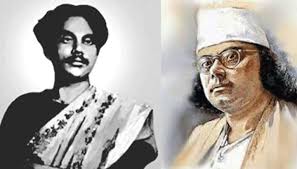
Nazrul (1899-1976)

Roquiah Sakhawat Hossein was born in 1880, Kazi Nazrul Islam in 1899. Apart from their difference in gender, there could not have been more differences in the circumstances of their class and upbringing. Roquiah was born and brought up in an affluent Muslim family of Pairaband. Her brothers went to elite schools in Kolkata. Though she was forbidden to read and write Bangla or English as a child, her brother Ibrahim Saber helped her to learn both languages so that she could write fluently in both. Later, her husband, Sakhawat Hossein, encouraged her to read and write, both Bangla and English.

Kazi Nazrul Islam was born in an impoverished family in the village of Churulia in the district of Bardhaman in West Bengal. Nazrul’s father was the khadim or caretaker of a mosque next to his small mud hut. The death of several earlier children led to Nazrul’s being given the nickname “Dukhu Miah,” the sorrowful one, perhaps also to cast off the evil eye. Initially, Nazrul studied in a maktab, an Islamic elementary school. When Nazrul was about nine, his father passed away, and the young boy was obliged to support his family. This might have meant teaching the children at the maktab, cleaning the mosque, and participating in religious rituals which entailed reciting the Quran

Sometime in 1915, Nazrul got admitted to Searsole Raj High School, and studied there till 1917. This was the longest time he had spent in one place and in one school. However, he did not sit for the matriculation examination, but went off to join the British Indian Army which had started recruiting Bengalis.  Posted to Karachi, Nazrul started subscribing to Kolkata papers and also writing for them.

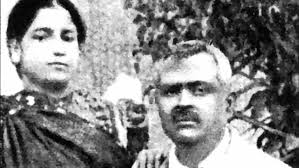
Begum Roquiah (1880-1932) with her husband, Sakhawat Hossein, in 1898

In 1898 – a year before Nazrul was born – Roqiuah Khatun was married to Sakhawat Hossein, an Urdu-speaking widower from Bhagalpur. A civil servant under the British Raj, Sakhawat Hossein, not only encouraged his wife to read and write but was so amazed at her piece of English writing that he showed it to Mr. Macpherson, Commissioner, Bhagalpur.  Mr. Macpherson commended the quality and content of the writing.  We do not know whether Roquiah sent the story herself to Indian Ladies Magazine (Madras) or whether her husband did so. Nevertheless, Roquiah’s first published writing appeared in the magazine in 1905. Three years later, her Bangla translation of the story – with some changes – was published as a small book by S. K. Lahiri and Co, Kolkata.

Sakhawat Hossein passed away on May 3, 1909, leaving a large sum to his widow to start a school. Roquiah initially started the school in Bhagalpur but was unable to continue there and moved to Kolkata. It was there that, onMarch 16, 1911, she re-started Sakhawat Memorial School at 13 Wellesley Lane. Besides persuading Muslim parents to let their daughters enrol in her school and running it, she also had to write letters explaining why certain things were being done or not being done in her school. In addition to these activities, she started writing for local Kolkata newspapers and journals.

Perhaps the earliest Bangla essay of hers that was published was “Pipasha.” This piece about Muharram was published in Nabaprabha in Falgun 1308 [1](Bangla) corresponding to mid-February to mid-March 1912.  She also wrote in other journals such as Mahila, Nabanur, Bharat Mahila, Al-Eslam, Bangiya Mussulman Sahitya Patrika, Saogat, Sadhana, Naoroz, Mohammadi, Sahityik, Sabujpatra, Muezzin, Bangalakshmi, Gulistan, and Mah-e-Nau. News about her school was published in The Mussulman under her initials, Mrs. R. S. Hossein.

During his deployment in Karachi, Nazrul subscribed to Bangla journals from Kolkata and also sent them some of his writings. His first publication was a short story “Baundeler Atmakahini” [The Autobiography of a Vagabond], which was published in Saogat in May 1919. The short stories “Hena” and “Byathar Dan” [The Gift of Sorrow] were published in Bangiya Mussalman Sahitya Patrika in November 1919 and January 1920 respectively. Roquiah’s writings too were being published in Saogat and Bangiya Mussulman Sahitya Patrika.  Though it is not known whether Nazrul and Roquiah actually met, it is impossible that they did not know about each other’s writings.

A few years ago, I asked Majeda Saber, Roquiah’s grandniece who has written considerably on her grandaunt, whether Nazrul and Roquiah had ever met. Majeda Saber did not know. However, even if they did not meet, it is quite evident that Nazrul and Roquiah did meet in print and that they shared some common ideas. Nazrul reveals a deep empathy for women in both his poetry and his fiction. The short story “Rakshushi[2],” about a woman who has killed her husband and gone to jail for her crime, is a sympathetic portrayal of a murderess in her own voice. Nazrul’s poem “Nari[3]” demands equality for women.

I sing of equality. 
In my eyes, there is no difference
Between a man and a woman.
Whatever is great and blessed in this world,
Has come equally from both, man and woman.

(Translated by Selina Hasib)

His song, “Jaago Nari Jaago” [Rise Up, Women], gives a clarion call to all women to rise.

Rise up women – rise up like the flaming fire! 
Rise up, O wife of the Sun god,
with the mark of blood on your forehead!!
...

Like the fire blazing out of a smouldering heap,
rise up – all you mothers, daughters, wives, sisters!
(Translated by Sajed Kamal)

In his epistolary novel, Bandhon Hara [4] which began to be serialized in Moslem Bharat from mid-April 1920 and was published as a book in 1927 the feelings of the women letter writers reflect Roquiah’s ideas.

The narrative of Bandhon Hara seems to focus on the soldier-protagonist Nuru. However, the letters of the women not only contribute to the narrative of the triangular love story but also reflect on the condition of Muslim women in seclusion. For example, Mahbuba writes to Sophie – her friend, who, like her, is also in love with Nuru about the claustrophobic nature of the inner quarters where women reside. It is a place where even the sun may not enter. But women are not criminals, Mahbuba says. “We are entitled to some freedom, for are we not human beings? Are we not made of flesh and blood, don’t we have feelings? Do we not possess a soul?”

After Mahbuba gets married, she writes to Shahoshika, a Brahmo teacher and a family friend,  that women are supposed to be self-sacrificing. She tells Shahoshika that she has no wish to be renowned for self-sacrifice. She would like to die but refuses to die locked up in the inner quarters. “If I have to die, I would wish to have all the doors and windows around me open wide . . .  I want to die looking straight at Mother Earth”.

In her essay “Subeh Sadek” [Dawn], published in Muezzin between mid-July-mid-August 1930, Roquiah asked women to proclaim aloud that they were human beings, not possessions. “Buk thukiya bolo ma! Amra poshu noi. Bolo bhogini! Amra asbab noi. Bolo konye! Amra jarau olonkar rupe lohar sinduke aboddha thakibar bostu noi. Sokole somoswore bolo, Amra manush. Mother, proclaim aloud, we are not animals. Proclaim, sister, we are not inanimate objects. Proclaim daughter, we are not ornaments set with precious gems to be locked up in iron trunks. Proclaim together, we are human beings.” In Aborodhbashini [The Secluded Ones], published in 1931, several years after Bandhon Hara, she described the claustrophobic, unhealthy, and often fatal conditions of extreme purdah.

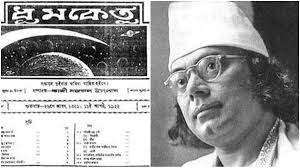
Dhumketu edited by Nazrul

These similarities might simply be coincidences. However, it is clear that Nazrul thought highly of Roquiah and that she too reciprocated that feeling.  Roquiah had been contributing to several Kolkata journals.  In 1922, she contributed two pieces to the newly founded bi-weekly paper, Dhumketu[5], edited by Nazrul. The paper started publication from 26 Sravan 1329 BS/11 August 1922. A month later, a large extract from Roquiah’s essay “Pipasha”[Thirst] was published in the Muharram issue of 16 Bhadra 1329/ September 2, 1922.

Thanks to Selina Bahar Zaman[6], we have facsimiles of Dhumketu. From this valuable collection we realise that, from the very beginning, the paper not only voiced Nazrul’s anti-British views but also displayed his non-communal and non-gendered outlook. Many of the contributors to the paper included Hindu writers as well as women. There were at least ten women who wrote at least once. One of these included a ten- or eleven-year-old girl as well as a thirteen-year-old girl, the former Hindu, the latter Muslim.  Mrs. M. Rahman, to whom Nazrul dedicated his book Bisher Banshi[7], wrote several times. Roquiah – as Mrs R. S. Hossein – was published twice in Dhumketu.

We do not know whether Roquiah sent the extract from “Pipasha” herself or whether Nazrul asked her for the piece for the special issue of twenty pages. The extract published in Dhumketu reflects on the plight of Hazrat Imam Hossain and the group of warriors, women and children, who accompanied him on his tragic journey to Karbala. 

The only other piece by Roquiah to appear in Dhumketu was a poem, “Nirupam Bir” [The Dauntless Warrior], published on 5 Ashwin 1329 BS / September 22, 1922. Unlike “Pipasha”, the poem does not seem to have been published before. This time, Roquiah might herself have sent the poem to Dhumketu. She would not have had to go in person to the office of Dhumketu. With a good postal service, contributions were mailed to journals.

 “Nirupam Bir” is a remarkable poem from a woman who has been called an “Islamic Feminist.”   The 18 August issue of Dhumketu had published a photograph of Kanailal Dutt (1888-1908). Did this inspire Roquiah to write the poem?  Kanailal was a revolutionary belonging to the Jugantor Group[8]. Arrested with a number of other revolutionaries, he was imprisoned in Alipore Jail.  There, along with another revolutionary, he succeeded in assassinating Narendranth Goswami, a government approver. Kanailal was hanged on 31 August, 1908. He was the second revolutionary to be hanged by the British after Khudiram Bose – whose picture also appeared in Dhumketu.

In the poem, Roquiah eulogises Kanai as the dauntless warrior. The poem begins with the magistrate telling Kanai that he will be hanged. But Kanai – addressed here as Shyam, another name of Krishna – laughs. The one who willingly sacrifices his life does not fear hanging.  “Moriya kanai hobe omor/ Shadhyo ki bodhe tarey? By dying Kanai will become immortal. Who can slay him?” The poem ends with a strident call hailing Kanailal: “Bolo bolo ‘Bande Shyam[9].’” It is a brave poem by a woman who was the widow of a government servant, a woman who ran a school for Muslim girls and promised their parents that purdah would be observed.

There were no Muslim revolutionaries at the time – though Nazrul’s friend Muzaffar Ahmad was a communist – and in Mrityukshudha Nazrul would describe a Muslim Bolshevik and in Kuhelika[10] he would portray a Muslim revolutionary. In his two poems on Durga, “Agamoni[11]” and “Anandamoyeer Agamone”, published in the Puja issue of Dhumketu on 9 Ashwin 1329 BS /September 26, 1922, Nazrul used the legend of the goddess to call for the overthrow of the British. In his editorial in the thirteenth issue of Dhumketu, 26 Ashwin 1329 BS / October 13,1922, Nazrul called for complete independence from the British: “‘Dhumketu bharater purno swadhinata chay.[Dhumketu wants India’s complete independence]” He quoted a line from his poem “Bidrohi”: “Ami aponare chhara kori na kahare kurnish [I bow to no one but myself].” Unlike Khudiram and Kanai, Nazrul did not resort to bombs or pistols, but to soul-stirring words. Just as in some of his writings, Nazrul revealed the feminist perspectives of Roquiah; in “Nirupam Bir”, Roquiah approached the revolutionary spirit of Nazrul.

Selected Bibliography

Hossein, Roquiah Sakhawat, “Subeh Sadek.” Rokeya Rachanabali ed. Abdul Mannan Syed et al,   revised edition. Bangla Academy: 1999.

Islam, Kazi Nazrul. Unfettered (translation of Bandhon Hara).Translated by The Reading Circle Nymphea Publication: 2015.

Zaman, Selina Bahar, ed. Nazruler Dhumketu, Nazrul Institute: 2013.

[1] 1902 February

[2] Demoness

[3] Woman

[4] Without Bondage

[5] Comet

[6] Selina Bahar Zaman (1940 – 2004) Bangladeshi academician and writer

[7] The Poisoned Flute

[8] A revolutionary group started in 1906

[9] Translates to — I bow to thee, Shyam/Hail to thee, Shyam

[10] Enigma, first published as a serial in 1927

[11] Advent

Niaz Zaman is an academic, writer and translator from Bangladesh. She has published a selection of Kazi Nazrul Islam’s work in the two-volume Kazi Nazrul Islam: Selections. In 2016, she received the Bangla Academy Award for Translation. This essay was first published in In Focus, the Daily Star,  December 12, 2022.

.

PLEASE NOTE: ARTICLES CAN ONLY BE REPRODUCED IN OTHER SITES WITH DUE ACKNOWLEDGEMENT TO BORDERLESS JOURNAL
Click here to access the Borderless anthology, Monalisa No Longer Smiles

Click here to access Monalisa No Longer Smiles on Kindle Amazon International

Categories
Poetry

‘Brand Loyalty…’ by Ryan Quinn Flangan

‘Brand loyalty, loyalty to the brand is paramount’

It starts early, like learning to walk or sucking that soother into milked oblivion.
As soon as the senses have been developed and primed:
‘brand loyalty, loyalty to the brand is paramount,’
say it with me as though we are trapped in an Orwellian elevator
counting the floors we are told are rushing by, but never witness.
And what stays with us is always the invasive species,
latching on, building appetites and limits, destroying potential.
Replacing creator with consumer, what a slippery little eel of a trick!
Slogans instead of sentiments truly felt, products and their placement.
Armies of jingle writers and focus groups that dwarf any once
great Napoleonic offering. Revenue streams no longer those idyllic
little fishing holes your grandfather took you to on weekends, in secret.
When the sun across your neck and arms and legs felt like
a strengthened reprieve. And what bounced off the water was some
marvellous simple truth revealed, if only for a moment and to you,
who by chance, was born again.

Ryan Quinn Flanagan is a Canadian-born author residing in Elliot Lake, Ontario, Canada with his wife and many bears that rifle through his garbage.  His work can be found both in print and online in such places as: Evergreen Review, The New York Quarterly, Borderless Journal, GloMag, Red Fez, and Lothlorien Poetry Journal

PLEASE NOTE: ARTICLES CAN ONLY BE REPRODUCED IN OTHER SITES WITH DUE ACKNOWLEDGEMENT TO BORDERLESS JOURNAL
Click here to access the Borderless anthology, Monalisa No Longer Smiles

Click here to access Monalisa No Longer Smiles on Amazon International

Categories
Stories

Don Quixote’s Paradise

By Farouk Gulsara

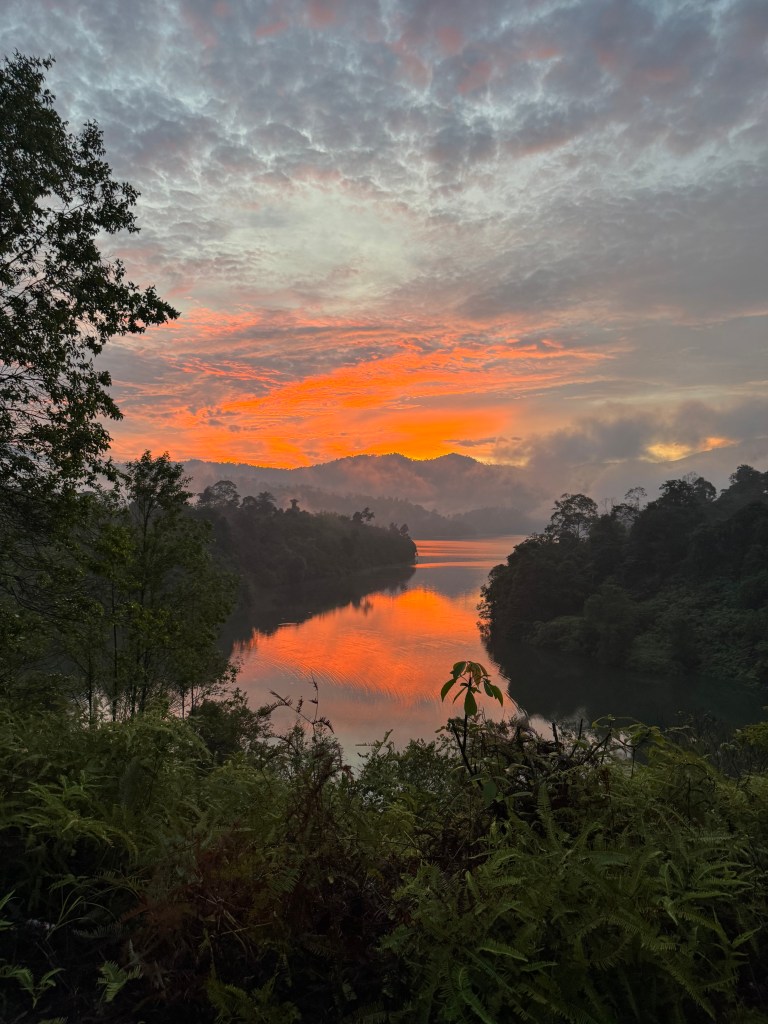
 A new dawn or the sunset of better times? Photo Courtesy: Farouk Gulsara

It is the year 2074. Yes, the world is still around, and so is the human race. It has been over a century since Malaysia received its mandate to self-rule. Technically, we should be in a utopia with so much sunlight throughout the year and a chirpy tropical climate devoid of depressing, chilling winters or debilitating natural calamities. A potpourri of food options is available 24/7 at our fingertips and delivered to our doorsteps with easy-access drone servers. We should be the happiest people in the world. In reality, however…

Teenagers growing up in the formative years of Malaysia in the 1980s, not too long after the 1969 racial riots, were given a promissory note. They were told that if they followed the dotted line, they were assured of a utopia. They would be ushered into a land of milk and honey, oozing with order and tranquility. A land where brothers and sisters of all strata would be walking, holding hands, and singing one song of camaraderie and unity. Peace would be seen seeping from every pore. Smiles and cheery images of bright yellow sunflowers were immortalised in their vision of the future.

Coincidentally, massive oil reserves were discovered off their shores around that time, multiplying their euphoria. Money started flowing freely. The government made it their God-given duty to make millionaires out of their sycophants and display them as the nation’s success story. 

They were so confident that the good times would roll forever that they felt a pressing need to increase the population and strengthen their vote bank. They wanted their 17 million population in 1990 to snowball to 70 million by 2020!

Maybe it was their subconscious intention to exhibit their patriarchal prowess. Soon, the urban skyline was brimming with phallic-like skyscrapers. The Petronas Twin Tower became the pride of the nation. Detractors said it was a waste of taxpayers’ money, but the Government insisted it was a private venture of Petronas, the private-public partnership that struck black gold. 

Like the Tower of Babel, grand towers sprouted here and there, giving the illusion of wealth and prosperity. The government asserted that the promised ‘Vision 2020’ would have citizens speak one language of love for each other and would be knowledgeable and mindful. 

To facilitate foreign investors’ seamless flying in and out of the country, a world-class airport sprung out of the lush greenery at the expense of its natural fauna and flora. 

Like the fate of the Tower of Babel, with the sky being the limit but short on foundation, the idea of uninterrupted progress came tumbling down. The thought of people speaking one language was only on paper. Doublespeak was not only the domain of the leaders. The average citizen gave little back to Malaysia. Many saw little hope in their motherland. They grew wings to fly away to faraway shores. 

Trying times came in droves—first, repeated economic downturns and other black swan events that only the anti-fragile could weather. Then, a global pandemic hit the world. Rather than scrambling to save the economy, leaders were content undercutting and downplaying opponents to grasp the helm of administration. Instead of utilising science to fight rumours, they looked at religious texts for answers. That is when the penny dropped. Citizens realised the country had reached the point of no return. 

Now, in 2074, what we have is a country of economic migrants who sponge on the nation and use Malaysia as a transit point to hopscotch to greener pastures. The descendants of the first wave of workers whom the colonial masters brought in to build the nation are all but long gone. Draconian laws that rewarded mediocrity and championed race and religion successfully converted its subjects to a bunch of zombies, unflinching to the changes to the environment, but one with a one-track mind to satisfy the voices of his master. Religious bigotry ruled the land. Rather than speeding forward to the 22nd century, citizens were hellbent on returning to the 7th, their perceived golden era.

The latest election, the 25th election, went on without a glitch. Of course, there were no untoward incidences. All the opposition leaders have either been forced to retire or behind bars. Voters have been cowed to submission. Years of indoctrination have made the youths of today a bunch of unthinking yeomen. As they have been doing in the past ten elections, the ruling party won more than half of the election seats, uncontested. 

The propaganda machine ensures that people only receive pleasant news. In its infancy, the Internet promised the democratisation of information. Soon, everyone realised that people were not competent enough to filter news. The herd is easily swayed and falls prey to popular clickbait. Hence, the government had to play nanny to alleviate undue anxiety among its citizens. 

Our education system, which used to be at par with any other country, took a slow plunge. One by one, politicians scrapped examinations to garner popularity. Automatic promotions finally produced young adults who left high school without essential reading, writing, or arithmetic skills. People are inebriated by regular freebies and the periodic intoxicating religious cocktails churned out by government-appointed holy men. When they mentioned everyone using the same language and way of thinking, they meant mass conversion. Plurality and multiculturalism had gone out of the proverbial window long ago.

Under the guise of national security, press freedom is a legacy of the past. Policing the public meant monitoring what netizens uttered online and even the thoughts they shared on their social media posts. The lush tropical forests have mysteriously been denuded over the years. All the public protests fell to the deaf ears of the forest department. Files were closed when no one could be zeroed in to be responsible for the crime to nature. Everyone knows whose hand is in the cookie jar, but the leaders conveniently condemn it to global warming. The blame goes back to the public for being irresponsible in disposing of their garbage!

Outside the country, the three world wars that rocked the world to the brink of extinction never woke humans from their slumber. The Nuremberg trials failed to impress us that no one race is superior to the other and that in wars, nobody wins except arms dealers.

The imagined world free from wars and climate crises remains an unfulfilled dream. Whether 2074 or 2704, the world is fated not to learn from its past and is cursed to repeat the same mistake that it never learnt from its history. Humanity can only appreciate the beautiful world it once was on augmented reality screens. A once-promising roaring Asian tiger called Malaysia has now morphed into a toothless and tattered paper tiger. The best it can do is be a cautionary tale for other nations about what not to do in nation-building. 

.

Farouk Gulsara is a daytime healer and a writer by night. After developing his left side of his brain almost half his lifetime, this johnny-come-lately decided to stimulate the non-dominant part of his remaining half. An author of two non-fiction books, Inside the twisted mind of Rifle Range Boy and Real Lessons from Reel Life, he writes regularly in his blog, Rifle Range Boy.

.

PLEASE NOTE: ARTICLES CAN ONLY BE REPRODUCED IN OTHER SITES WITH DUE ACKNOWLEDGEMENT TO BORDERLESS JOURNAL

Click here to access the Borderless anthology, Monalisa No Longer Smiles

Click here to access Monalisa No Longer Smiles on Kindle Amazon International

Categories
Poetry

A Place of Solitude & Rest?

Poetry by Michael Burch

PILGRIM MOUNTAIN 

I have come to Pilgrim Mountain
to eat icicles and to bathe in the snow.
Please don’t ask me why I have done this,
for I do not know . . .
but I had a vision of the end of time
and I feared for my soul.

On Pilgrim Mountain the rivers shriek
as they rush toward the valleys, and the rocks
creak and groan in their misery,
for they recollect they’re prey to
night and day,
and ten thousand other fallacies.

Sunlight shatters the stone,
but midnight mends it again
with darkness and a cooling flow.
This is no place for men,
and I know this, but I know
that that which has been must somehow be again.

Now here on Pilgrim Mountain
I shall gouge my eyes with stone
and tear out all my hair,
and though I die alone,
I shall not care . . .

for the night will still roll on
above my weary bones
and these sun-split, shattered stones
of late become their home
here, on Pilgrim Mountain.


PARADISE

There’s a sparkling stream
And clear blue lake
A home to beaver,
Duck and drake

Where the waters flow
And the winds are soft
And the sky is full
Of birds aloft

Where the long grass waves
In the gentle breeze
And the setting sun
Is a pure cerise

Where the gentle deer
Though timid and shy
Are not afraid
As we pass them by

Where the morning dew
Sparkles in the grass
And the lake’s as clear
As a looking glass

Where the trees grow straight
And tall and green
Where the air is pure
And fresh and clean

Where the bluebird trills
Her merry song
As robins and skylarks
Sing along

A place where nature
Is at her best
A place of solitude
Of quiet and rest

Michael R. Burch’s poems have been published by hundreds of literary journals, taught in high schools and colleges, translated into fourteen languages, incorporated into three plays and two operas, and set to music by seventeen composers.

PLEASE NOTE: ARTICLES CAN ONLY BE REPRODUCED IN OTHER SITES WITH DUE ACKNOWLEDGEMENT TO BORDERLESS JOURNAL
Click here to access the Borderless anthology, Monalisa No Longer Smiles

Click here to access Monalisa No Longer Smiles on Kindle Amazon International

Categories
Musings of a Copywriter

‘Is this a Dagger I see…?’

By Devraj Singh Kalsi

Although I do not think I have the potential to write a controversial book that ends up hurting or offending the sentiments of readers or non-readers in any part of the world, the recent episode of a violent attack on an internationally acclaimed author has brought about a fundamental change. Now, I spend more time pondering over novel attacks and how to protect myself and my vital organs from fundamentalists and other hardliners stepping across the line to seek revenge and make the ground beneath my feet disappear. I do not dismiss the possibility of being attacked or hounded by a crazy fellow who does not like the colour of my skin or my hair or the aquiline shape of my nose or simply finds the entire set of features not aligned with his sensibilities. As a small-time writer who cannot afford a full-time, fully armed bodyguard shadowing me wherever I go, I must find other cost-effective ways to keep my creative head safe from bullets and pellets. 

Whenever I go out for a walk during the day, I should wear a helmet even if pedestrians find it weird. I do not need to explain to them the hazardous profession I am part of, riskier even than that of a mining engineer. There are many themes and plots for stories and novels brewing in the cerebral pot, so I cannot risk a fatal hit. A broken leg can assure me of recovery, but a cracked-up skull will end my writing career before it could take flight. Some years ago, I remember being hit on my head by a super charged cricket ball that came at top speed. Just after this episode, my writing speed has suffered, and I suspect the neurological wiring suffered some irreversible damage.  

As a precautionary move, I should also put an end to my flirtatious tendencies since the possibility of being attacked by a jealous lover haunts me these days. Attending marriage ceremonies, getting close to the bride, and wasting no time to put my hands around her slender waist for a joint photograph by edging out her obese husband from the frame is a risky act indeed. As waiters keep moving around with trays loaded with forks and knives, the offended husband could pick up a sharp one and jab one at me while hurling the most abusive words I fear to use for wily characters in my prose. Having identified this area of darkness, I should throw more light on my behavioural pattern and avoid building a huge female fan following that activates life-threatening impulses in men. 

As a writer, my attempt should be to hammer harsh truths. But the sight of labourers and carpenters working with hammers and other heavy tools induces fear of another kind. Whenever I find myself close to such working class people, I feel an unexplained fear that the bitter truths have stopped flowing from my pen, and this has not gone down well with them. One of them running after me with a hammer to silence my voice, generates a fear that compels me to think of the need to get closer to the realities of life instead of being an escapist. I fail to convince them that the need to offer relief is far greater than reminding them of the depressing truths all the time.

Humour in my writing could also be the potential reason for disaster to strike me. This entertaining streak possibly offends some people who do not like a writer to be an entertainer but an eye opener. Cordoning myself from such a mindset is not easy. In the park, in the subway or in the market, such offended folks keep lurking and stalking. The scissors and blades at the barber’s shop generate a rising sense of fear as the most unlikely source of danger often shocks and silences you. The truth behind losing an eye[1] is an eye-opener in many ways and makes a lily-livered writer like me extra cautious when it relates to scribbling thoughts and ideas on the page. 

Signing book copies and then being surrounded by a guy holding a knife near the throat is a scary possibility that has made me stay away from book launches forever. Losing the scope to interact with readers to build new bonds comes with the high risk of losing my bond with life. I do not know the reason why such a thing should happen to me, but the dire consequences of such a deadly attack compels me to stay away from the limelight and keep writing in anonymity. 

My voracious appetite for humour could also provoke a person to serve me a lethal delight. The food delivery app guy who presses the doorbell and offers me a food packet with poisoned foodstuffs comes prepared to seek revenge for my attempt at making fun of food in my writing, calling it a violent act of mastication. As I imagine retribution, I should stop my writing contribution or funnel my sentiments through a different outlet. Survival of writers has always been challenging, but now it goes beyond the financial domain and includes his right to life.  

More bubbles up my mind. An acid attack or any such violent attack truncates the life of a writer. Though the writer kills characters the way he likes, he does not know his end. Sitting in a café could bring on his sudden end as a biker enters and fires at point-blank range and leaves behind a note of apology.

My crime of poking fun and being satirical might trigger the dangerous sentiment. The offended fellow for whom life is no fun finds such humour unacceptable. And the writer must meet his end for making fun of his situation, for not focusing on serious issues, for the unlisted crime of offering light reads of little or no worth or value to readers who seek literary merit in words. Not being an ideal writer could be the reason for my premature end, with dollops of humour dying along with me. 

[1] Salman Rushdie lost an eye in 2022: https://www.bbc.com/news/entertainment-arts-68739586#

Devraj Singh Kalsi works as a senior copywriter in Kolkata. His short stories and essays have been published in Deccan Herald, Tehelka, Kitaab, Earthen Lamp Journal, Assam Tribune, and The Statesman. Pal Motors is his first novel.  


PLEASE NOTE: ARTICLES CAN ONLY BE REPRODUCED IN OTHER SITES WITH DUE ACKNOWLEDGEMENT TO BORDERLESS JOURNAL

Click here to access the Borderless anthology, Monalisa No Longer Smiles

Click here to access Monalisa No Longer Smiles on Kindle Amazon International

Categories
Poetry

Try Your Brakes

Poetry and Photography by Rhys Hughes

TRY YOUR BRAKES

Try your brakes!
After they have been arrested
for squeaking
you should prosecute them in
court: don’t fret
that you might be thought haughty
or vindictive.
Justice must be done.

The brakes deserve it.
They never gripped the wheel rims
smoothly: they always
screamed for more oil
while you toiled
to keep your balance downhill.

Cats on the path were startled
by the sound. You even found
that pedestrians
jumped in fright
when you attempted to reduce
your speed on slopes.
One hopes they soon recovered.

But enough is enough.
You ought to take
the smooth with the rough.
So wheel your bicycle
into the hallowed halls
where the judge awaits
in an itchy wig
and barristers fan themselves
with cryptic legal documents
as if they meant
to blow themselves away.

The frame of the bicycle
is not on trial
and in a while you will hear
how the wheels
are innocent too: they should
be held dear by you.
But the brakes are scoundrels
through and through!

Try your brakes!
Find them guilty, you are the jury.
Mitigating circumstances
like damsels in romances
dance deceptively
and will put you in a trance.
Heed them not!

Your brakes belong in jail
before they fail
completely and propel you
into me. Hurry!
Try your brakes today.

Rhys Hughes has lived in many countries. He graduated as an engineer but currently works as a tutor of mathematics. Since his first book was published in 1995 he has had fifty other books published and his work has been translated into ten languages.

.

PLEASE NOTE: ARTICLES CAN ONLY BE REPRODUCED IN OTHER SITES WITH DUE ACKNOWLEDGEMENT TO BORDERLESS JOURNAL

Click here to access the Borderless anthology, Monalisa No Longer Smiles

Click here to access Monalisa No Longer Smiles on Kindle Amazon International

Categories
Notes from Japan

A Golden Memory of Green Day in Japan

By Suzanne Kamata

At the end of April and the beginning of May, several Japanese holidays fall close together. This special time of year is called Golden Week. Often, a few work/school days fall between the holidays, however many people take advantage of the break and travel. I have a hard time remembering which days are which holidays, however I do remember that one of them is Midori-no-hi, or Green Day (which falls on the Showa Emperor’s birthday, May 4).

Not long after I graduated from college, I came to Japan to work as an assistant English teacher. I was assigned to a high school in Naruto, a city in Shikoku, southeast of Osaka, noted for its tasty seaweed and huge, natural whirlpools.

The principal of the high school was very friendly and often invited me to drink tea and chat with him, so I was none too surprised when he called me to his office one April afternoon. This, however, wouldn’t turn out to be a typical encounter.

The principal began to tell me about the annual Midori-no-hi (Green Day) ceremony. Each year, it’s held in a different prefecture, and that year it was Tokushima’s turn. The Emperor and Empress are always in attendance. Only a select group of people would be invited to attend the proceedings, the principal told me, and I had been chosen to participate.

How could I refuse? I imagined meeting the Emperor and Empress and telling them about my hometown in America. Maybe we’d sip green tea together from the locally-crafted pottery cups.

A full rehearsal was scheduled a couple of weeks in advance of the actual event. I boarded a bus at 5 a.m. along with a group of high school band members who would be performing during the ceremony.

As we approached the park settled in the mountains of Tokushima, I noticed that the formerly rough road had been paved. The roadside was lined with marigolds which had been freshly planted in anticipation of the imperial couple’s visit.

At the park, we all practiced our separate parts. Mine would be quite simple. Two other young women — a Brazilian of Japanese descent and an Australian who’d just arrived in the country — and I would be escorted to a spot in front of the Emperor and Empress. We would then bow, accept a sapling from the governor, and plant it in the ground with the help of boy scouts.

As the Emperor would be there and the entire ceremony would be broadcast on national television, everything had to be perfect. We practiced bowing many times with our backs straight and our hands primly layered.

Finally, Midori-no-hi arrived. The day was cloudy and occasional rain drops spotted my silk dress. Everyone hoped that the weather would not ruin the proceedings.

Marching bands, an orchestra, and a choir made up of students from various local high schools and colleges filled the morning with music. Instead of the sun, we had the bright brass of trombones, trumpets and cymbals.

Modern dancers in green leotards enacted the growth of trees. Later, expatriate children from Canada, France, Peru and other countries announced “I love green” in their native languages. This was followed by the release of hundreds of red, blue and yellow balloons into the grey sky. A hillside of aging local dignitaries were on hand to view the pageantry.

About mid-way through the ceremony, the Emperor and Empress arrived. They followed the red carpet laid out to the specially-constructed wooden dais, the Empress a few steps behind her husband as protocol demanded, to “Pomp and Circumstance”. The rustle of Japanese flags waved enthusiastically in the air threatened to drown out the orchestra.

After many solemn addresses and much bowing, the Emperor and Empress stepped down to “plant” trees. His Highness pushed some dirt around the base of a cedar sapling with a wooden hoe. His pink-suited consort did the same while balancing on high heels. The placement of the trees was only for show. Later, everything would be transplanted to a more suitable location.

At last, it was my turn. The other young women and I were led to the grass stage to the accompaniment of a harpist. I accepted my tree and buried its roots in the ground. The tree was a sudachi, which bears small green citrus fruit and is the official tree of Tokushima Prefecture.

The music and majesty of the occasion made me feel like I was doing something important on Earth. I was adding to the verdure of the world, enabling Nature. I felt a sense of awe.

When all of us were finished planting, we bowed in unison to the Emperor and Empress, then filed off the field. Afterwards, there was a mass-gardening session as all of the attendants on the hillside began planting prepared saplings.

I didn’t get to meet the royal couple after all. Although they passed by within a few meters of where I was standing, there were no handshakes, no pleasantries, not even any eye contact.

What I did get was a big bag of souvenirs — a cap, a small wooden folding chair, commemorative stamps, a flag, sudachi juice, and a book of photos so that I could always remember that misty day, that baby tree.

Suzanne Kamata was born and raised in Grand Haven, Michigan. She now lives in Japan with her husband and two children. Her short stories, essays, articles and book reviews have appeared in over 100 publications. Her work has been nominated for the Pushcart Prize five times, and received a Special Mention in 2006. She is also a two-time winner of the All Nippon Airways/Wingspan Fiction Contest, winner of the Paris Book Festival, and winner of a SCBWI Magazine Merit Award.

PLEASE NOTE: ARTICLES CAN ONLY BE REPRODUCED IN OTHER SITES WITH DUE ACKNOWLEDGEMENT TO BORDERLESS JOURNAL

Click here to access the Borderless anthology, Monalisa No Longer Smiles

Click here to access Monalisa No Longer Smiles on Amazon International