Categories
Stories

Anand’s Wisdom

By Naramsetti Umamaheswararao

In the town of Kalyanapuram, there lived a wealthy man named Raghav. He had a daughter of marriageable age and was seeking a suitable groom for her.

Once, while Raghav was traveling to a nearby village called Bangaru Palem to explore a possible marriage alliance, he met Anand on the way. Anand introduced himself, saying he was from Machavaram village, well-educated, settled in business, and unmarried.

Raghav thought that Anand might make a good son-in-law, but he decided to test his intelligence and character before making a decision.

As they were traveling, the heat of the sun intensified, and Raghav felt thirsty. He asked a passerby, “Is there a well or a pond nearby?” The man pointed to a pond and said, “You can quench your thirst at that pond.”

Anand asked the man, “Is the pond water poisonous or life-giving?” The man replied, “I don’t know.” Raghav went ahead and drank the water from the pond. He thought to himself, “What a strange question Anand asked! Is he a fool?”

After some distance, two more travelers joined them. One was a farmer, and the other was a moneylender. The farmer was going to a neighbouring village to buy cattle, and the moneylender was on his way to collect old debts.

Anand asked the farmer, “Are you a provider of food or just greedy?” The farmer remained silent, unsure of how to respond. Then, Anand turned to the moneylender and asked, “Do you care for people’s well-being or just focus on squeezing them dry?” The moneylender also remained silent. Raghav now firmly believed Anand was indeed a madman and thought, “There’s no way I can accept him as my son-in-law.”

Even though Raghav continued walking with Anand, he kept his distance, disliking the way Anand spoke. The other two travelers also found Anand’s words odd and wanted to get rid of him as soon as possible.

A little further into the journey, it was noon, and the group felt hungry. They sat under a tree, unpacked their food, and began to eat. But Anand’s attention was drawn to a nearby bush. “It’s not safe to sit here. Let’s move away immediately,” Anand warned.

The other three ignored him and said, “We will eat here. If you don’t like it, go wherever you wish.” But Anand insisted, “I’m saying this for your safety. I sense a dangerous snake nearby. If we don’t leave quickly, it could be a threat.”

Raghav mocked him, “Did the snake come and tell you this in a dream? Or do you have some magical powers?”

Anand pointed to a snake’s skin near the bush and said, “Look at that freshly shed snakeskin. It’s about fourteen feet long and thick, which indicates the size of the snake. It must be nearby. I’m warning you based on this evidence.”

As soon as Anand finished speaking, the farmer screamed, “Look! There it is! The snake is coming toward us, just as Anand said.” In no time, all four ran far away to a safe place and had their meal.

Raghav ’s opinion about Anand began to change. He realised Anand wasn’t mad after all. However, Raghav was still curious why Anand had asked those strange questions earlier.

He asked Anand, “You seem to be a wise man. Why did you ask if the pond water was life-giving or poisonous?”

Anand replied, “Even if the water looks clean, it could be filled with dirt or dangerous creatures like crocodiles, which would make it deadly. On the other hand, water from a safe, clean source sustains life, making it like nectar. That’s why I asked.”

Next, Raghav asked, “Why did you ask the farmer if he was a provider of food or just greedy?”

Anand explained, “A farmer who grows food crops feeds others, so, he’s a provider of food. But if he only grows cash crops for profit, he is driven by greed. That’s why I asked.”

Hearing this, the farmer proudly declared, “I am certainly a provider of food!”

Then Raghav asked, “What was the meaning behind your question to the moneylender—whether he cared for people or just squeezed them dry?”

Anand replied, “There are two kinds of moneylenders. Those who consider the financial situation of the borrower and give them time to repay with understanding — they care for people. But those who are ruthless and demand repayment no matter what, are only focused on taking money and are like a burden on people’s backs. That’s why I asked.”

The moneylender, realising the wisdom in Anand’s words, said, “I am definitely the kind who cares for people!”

With all his doubts cleared, Raghav invited Anand to his home and expressed his desire to make him his son-in-law.

Naramsetti Umamaheswararao has written more than a thousand stories, songs, and novels for children over 42 years. he has published 32 books. His novel, Anandalokam, received the Central Sahitya Akademi Award for children’s literature. He has received numerous awards and honours, including the Andhra Pradesh Government’s Distinguished Telugu Language Award and the Pratibha Award from Potti Sreeramulu Telugu University. He established the Naramshetty Children’s Literature Foundation and has been actively promoting children’s literature as its president.

.

PLEASE NOTE: ARTICLES CAN ONLY BE REPRODUCED IN OTHER SITES WITH DUE ACKNOWLEDGEMENT TO BORDERLESS JOURNAL

Click here to access the Borderless anthology, Monalisa No Longer Smiles

Click here to access Monalisa No Longer Smiles on Amazon International
Categories
Stories

Significance

By  Naramsetti  Umamaheswararao

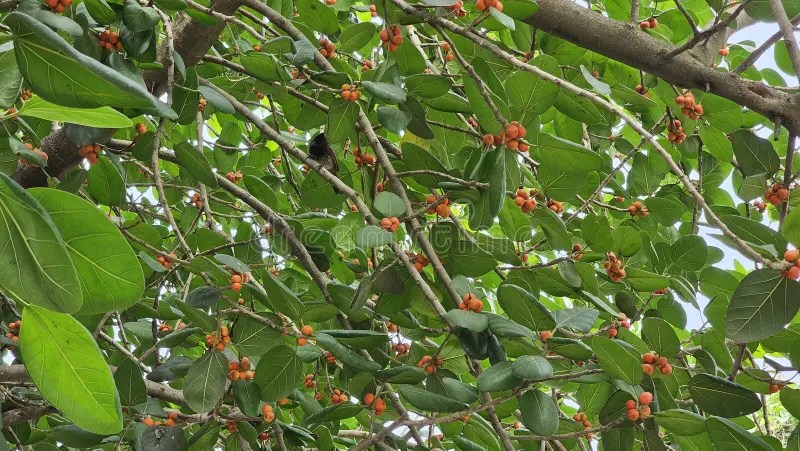
Once, while a bird was searching for food, it spotted a  berry under a banyan tree. As the bird grabbed the berry with its beak and flew, it slipped and fell. The place where the berry landed was a field next to a village. On the same day the berry fell, a strong storm brought rain, causing the soil to cover the berry.

Two days later, the berry rotted, and the seeds inside began to talk to each other.

One seed happily said, “We are alive thanks to our luck! Otherwise, we would have been digested in the bird’s stomach within a week.”

Another seed replied, “That’s true. If we had gone into the bird’s stomach, we would have died. We wouldn’t even have had the chance to talk like this.” The other seeds nodded in agreement.

After two more days, one seed sprouted. The sprouting seed excitedly jumped and said, “Look, everyone! I’ve sprouted!”

Seeing the sprout, the other seeds warned, “Pull that sprout back! If you grow, you will change your form and rise above the ground. You will face many hardships while growing. Sometimes, humans might uproot you. Other times, animals might trample or eat you. You must overcome all this to grow into a plant. If you grow, you need sufficient water. If you don’t get enough water, you will wither and die. You cannot endure all these hardships, so it’s better to remain as we are and enjoy our time together.”

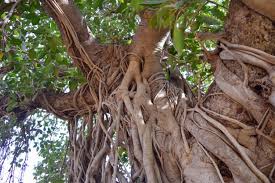
The sprouting seed listened but did not respond or pull back its sprout. After a few days, the banyan plant emerged from the soil and began to grow. Its stem grew straight, branches spread out, and many leaves sprouted. Years passed, and it grew into a large tree.

To escape the heat, farmers and travelers rested in the shade of the banyan tree. Animals found shelter beneath it during the night and when it rained. Birds built nests on its branches. The banyan tree provided refuge to many, making the area lively.

Occasionally, indigenous doctors came to the banyan tree to collect its bark, leaves, and buds for medicinal use. Children played in the field, swinging joyfully on swings hung on the banyan tree. The banyan tree felt happy.

Many years went by. One day, a terrifying storm struck. Strong winds blew, and it rained heavily. Many trees were uprooted by the storm, and the banyan tree was among them. The people were deeply saddened by the fall of the banyan tree. The birds and animals living in its branches mourned silently.

After a few days, when the greenery of the banyan tree faded, villagers used axes to cut its branches and trunk for firewood. Everyone who carried the wood remarked, “It was useful even after it died.”

Meanwhile, the remaining seeds in the ground, which had stayed behind selfishly, felt happy hearing their sibling’s praises but were also ashamed. One seed said, “We all made a grave mistake. We remained as we were and couldn’t help anyone. We didn’t do anything worthy of remembrance. Every life should have significance, but our life has been wasted. Although we had a great opportunity to be born, we squandered it. Our sibling, however, did something good. Even in death, it lives on in the hearts and homes of people. Our sibling’s legacy uncovered the true significance of life.”

Hearing this, another banyan seed replied, “Some people also live cowardly lives. They continue to make the same mistake we did. They waste their lives, not realising that a life dedicated to helping others brings true satisfaction. If we understand that helping others leads to everlasting fame and support one another, it would be much better.”

The banyan seeds lamented, “We cannot bring back what has passed, so this is all we have in this life.”

Banyan Berries: Fom Public Domain

Naramsetti Umamaheswararao has written more than a thousand stories, songs, and novels for children over 42 years. he has published 32 books. His novel, Anandalokam, received the Central Sahitya Akademi Award for children’s literature. He has received numerous awards and honours, including the Andhra Pradesh Government’s Distinguished Telugu Language Award and the Pratibha Award from Potti Sreeramulu Telugu University. He established the Naramshetty Children’s Literature Foundation and has been actively promoting children’s literature as its president.

.

PLEASE NOTE: ARTICLES CAN ONLY BE REPRODUCED IN OTHER SITES WITH DUE ACKNOWLEDGEMENT TO BORDERLESS JOURNAL

Click here to access the Borderless anthology, Monalisa No Longer Smiles

Click here to access Monalisa No Longer Smiles on Amazon International
Categories
Review

In the Footsteps of the Man Who Walked From England to India in 1613

Book Review by Rakhi Dalal

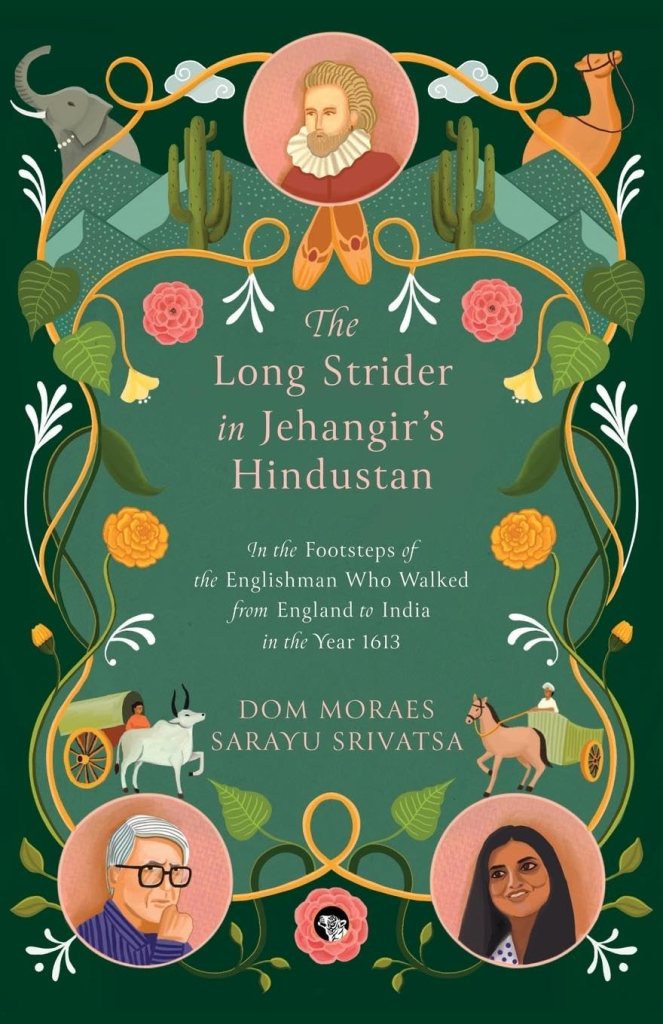
Book Title: The Long Strider in Jehangir’s Hindustan: In the Footsteps of the Englishman Who Walked From England to India in the Year 1613

Authors: Dom Moraes and Sarayu Srivatsa

Publisher: Speaking Tiger Books

During the years, in the early seventeenth century, when East India Company began a search for the possibilities of trade with India via sea route, Thomas Coryate of the village Odcombe in Somerset, England, made an ambitious plan to travel to the Indies, as he called it, on foot. This wasn’t his first undertaking. Having travelled across Europe on foot before, writing a travelogue Crudities on his experience which brought him some fame, he now wished to travel to a place no Englishmen had gone before. Motivated by the thought of gaining more fame with this venture so as to win the affection of Lady Ann Harcourt of Prince Henry’s Court, even the idea of traversing 5000 miles on foot as compared to 1975 miles that he did in Europe did not dissuade him.   

Known as ‘the long strider’, in 1612, Coryate set for his journey to the Indies from London. And in year 1999, more than three hundred years later, his journey and subsequent struggles, somehow inspired Dom Moraes to traverse the same route to correlate Coryate’s experience in the now altered places and its people. Coryate travelled alone, Moraes took the journey with Sarayu Srivatsa, the co-author of this book.

Dom Moraes, poet, novelist and columnist, is seen as a foundational figure in Indian English Literature. He published nearly thirty books in his lifetime. In 1958, at the age of twenty, he won the prestigious Hawthornden Prize for poetry. He was awarded the Sahitya Akademi Award for English in 1994. The Long Strider in Jehangir’s Hindustan was first published in the year 2003. Moraes passed away in 2004.

Sarayu Srivatsa, trained as an architect and city planner at the Madras and Tokyo universities, was a professor of architecture at Bombay University. Her book, Where the Streets Lead, published in 1997 had won the JIIA Award. She also co-authored two books with Dom Moraes: The Long Strider, and Out of God’s Oven (shortlisted for the Kiriyama Prize). Her first novel, The Last Pretence, was longlisted for the Man Asian Literary Prize, and upon its release in the UK (under the title If You Look For Me, I am Not Here), was also included on The Guardian’s Not the Booker Prize longlist.

Srivatsa, who travelled with Moraes to all the places Coryate passed through, writes diary chapters coextending the same routes subsequently. So, each fictive reconstruction of a period and place of Coryate’s travel by Moraes is followed by a diary chapter for the same place by Srivatsa. In that sense the book becomes part biographical fiction and part memoir. 

Coryate, son of a Vicar and dwarfish in stature, was seized by this desire to gain fame and respect. What desire seized the imagination of Moraes, eludes this reader. It, however, doesn’t escape the notice that both the writers shared somewhat similar plight towards the end.

Some of Coryate’s writing during the period did not survive as it was destroyed by Richard Steele, but the rest was sent to England and was posthumously published in an anthology in 1625. Basing his research on such sources, after extensive three years of investigation, Moraes managed to create an account of Coryate’s demeanour, his lived life in a new land with diverse people and customs at different places which he found both shocking and fascinating.  Coryate found the people of India loud and violent but he was also touched by their generosity and kindness. He witnessed the disagreements between Hindus and Muslims, the caste system where the upper caste oppressed the people from lower caste, sati, and the ways of Buddhist monks, Sikhs, pundits of Benaras and Aghoris[1], the lifestyle of Jehangir and the city of Agra before Taj Mahal. He was fortunate to have an audience with Jehangir, the main reason of his travel, but he failed in securing his patronage or enough money to continue to China which he had been his original intent.

In Moraes’ writing, the era comes alive. Vivid imagery and description makes the struggles and sufferings of Coryate palpable on one hand and on the other offer a view on the unfolding of history in a country where these many hundred years later, the echoes of a past similar to the present can be heard. In the preface, Moraes posits one of the reasons to take on the book — to compare the India then with the country during his times. As the reader proceeds with the story, the comparison becomes apparent in Moraes’ construction vis-a-vis Srivatsa’s entries.

Towards the end, an ailing Coryate succumbed to his illness and his body was buried somewhere near the dock at Surat. He could not make a journey home in 1615, but in 2003 a brick from his supposed tomb was sent back to the church in Odcombe by Srivatsa where a ninety six year old vicar waited patiently for the only famous man from Odcombe to return home. The epilogue by Srivatsa gives an account of Moraes’ own struggle with cancer and his demise in 2004, a year after the book was published. It is but right that the soil from his grave in Mumbai also found a resting place in Odcombe.    

[1] Devotees of Shiva

Rakhi Dalal writes from a small city in Haryana, India. Her work has appeared in Kitaab, Scroll, Borderless Journal, Nether Quarterly, Aainanagar, Hakara Journal, Bound, Parcham and Usawa Literary Review

.

PLEASE NOTE: ARTICLES CAN ONLY BE REPRODUCED IN OTHER SITES WITH DUE ACKNOWLEDGEMENT TO BORDERLESS JOURNAL

Click here to access the Borderless anthology, Monalisa No Longer Smiles

Click here to access Monalisa No Longer Smiles on Kindle Amazon International

Categories
Stories

The Mango Thief

By Naramsetti Umamaheswara Rao

Ricky was a boy known for his mischievous nature. Though he was in the eighth grade, he had the sharpness and boldness of someone older. Ricky rarely attended school, preferring instead to roam around the fields beside the road, cutting sugarcane and plucking groundnuts, causing damage to the crops.

In his class, there was a bright and studious boy named Anand. Ricky thought it would be advantageous to befriend Anand to get his notes. The next day, Ricky brought some guavas he had stolen and offered them to Anand, saying, “These are from our orchard. They’re very sweet; take them.” Although Anand initially refused, Ricky insisted and placed the fruits in his hands, and Anand, not wanting to seem rude, reluctantly accepted them.

Over the following days, Ricky brought sugarcane and groundnuts, further solidifying their friendship. Ricky began inviting Anand to accompany him when he went out, and Anand, hesitant to refuse, would often join him. Their classmates noticed this and warned Anand, saying, “Don’t hang out with him. Being with him could get you into trouble.”

But Anand dismissed their concerns, thinking, “I’m a good person, so nothing bad will happen to me. Maybe Ricky will change for the better.”

One day after school, as they were walking home, Ricky suggested they enter a mango orchard along the way. Anand hesitated, knowing it was wrong, but Ricky was persistent. Ignoring Anand’s reluctance, Ricky said, “If you’re so scared, stay here. I’ll go in alone.” Ricky then climbed over the fence, entered the orchard and began plucking ripe mangoes, stuffing them into his school bag.

What Ricky didn’t know was that the orchard’s caretaker had been keeping a close watch. He was already angry about frequent thefts and was determined to catch the thief red-handed. Seeing Ricky pluck the mangoes, the caretaker approached the tree with a stick in hand and shouted, “Hey, you little thief! Come down! I’ll teach you a lesson!”

Ricky, momentarily startled, quickly regained his composure. He was used to such situations. “What can you do?” Ricky challenged, “You’re all alone, and there are two of us. We could easily overpower you, and no one would know.”

The caretaker, growing more furious, demanded, “Where’s the other one?”

Ricky pointed towards Anand, who was outside the fence, and said, “He’s waiting over there, keeping an eye out for me.” The caretaker, not seeing clearly, took a couple of steps to get a better view and thought he spotted someone. But when he turned back to the tree, Ricky had already jumped down and escaped.

The caretaker, enraged, thought, “Not only does this kid steal, but he also dares to threaten me?” He chased after Ricky but couldn’t catch him. Frustrated, he decided to catch the other boy instead, thinking it would lead him to Ricky later.

Ricky saw the caretaker running towards Anand but chose not to warn him.

Anand, seeing the caretaker approaching, remained calm, thinking, “Why should I be afraid? I haven’t done anything wrong.”

But as soon as the caretaker reached him, he grabbed Anand’s hair and began hitting him on the back. “Why are you hitting me? What have I done? I didn’t even enter your orchard,” Anand cried.

The caretaker slapped him twice and said, “You dare ask what you did? No shame? You came here to steal, sent your friend inside, and stayed outside to keep watch? Come with me, I’ll tie you to the tree. You two have been stealing my mangoes every day. I won’t release you until my boss arrives,” he said, dragging Anand inside the orchard.

Despite Anand’s protests and pleas of innocence, the caretaker refused to listen and tied him to a tree.

Passersby noticed Anand tied to the tree and, shocked by the sight, informed his parents. They came and freed him, explaining the situation to the villagers. Anand insisted that he hadn’t done anything wrong.

The villagers scolded him, saying, “Your mistake was befriending a bad boy. What else did you expect?”

Regretful, Anand lamented, “Despite my friends’ warnings, I knowingly continued my friendship with Ricky. I’ve learned my lesson. I won’t make this mistake again.”

Naramsetti Umamaheswararao has written more than a thousand stories, songs, and novels for children over 42 years. he has published 32 books. His novel, Anandalokam, received the Central Sahitya Akademi Award for children’s literature. He has received numerous awards and honours, including the Andhra Pradesh Government’s Distinguished Telugu Language Award and the Pratibha Award from Potti Sreeramulu Telugu University. He established the Naramshetty Children’s Literature Foundation and has been actively promoting children’s literature as its president.

.

PLEASE NOTE: ARTICLES CAN ONLY BE REPRODUCED IN OTHER SITES WITH DUE ACKNOWLEDGEMENT TO BORDERLESS JOURNAL

Click here to access the Borderless anthology, Monalisa No Longer Smiles

Click here to access Monalisa No Longer Smiles on Amazon International

Categories
Review

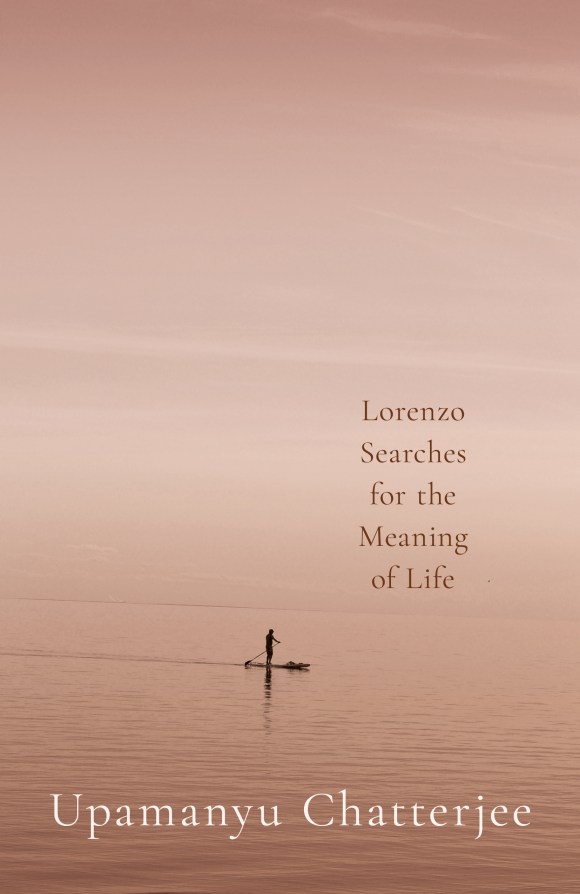
Lorenzo Searches for the Meaning of Life

Book Review by Somdatta Mandal

Title: Lorenzo Searches for the Meaning of Life

Author: Upamanyu Chatterjee

Publisher: Speaking Tiger Books

Several years ago, probably around the 1990s, the critic Nilanjana S Roy had defined the current crop of Indian Writing in English novelists as a ‘Doon School-St. Stephens’ conspiracy’. It was an interesting but true observation since the writers who were popular at that time were all products of these elite institutions and were quite adept at imitating western culture and simultaneously wrote in a style that was quite polished and urban. Upamanyu Chatterjee, belonging to this category, and at present a retired Indian civil servant, had shot into fame way back in 1988 by writing a definitive urban Indian coming-of-age story with his first novel, English August: An Indian Story. Several years later in 2000, he won the Sahitya Akademi Award for Mammaries of a Welfare State. His seventh novel Villany focused on a new class of post-liberalisation, westernised urban Indians who were hitherto ignored in the regional as well as the English fiction of India. This meticulously crafted literary thriller, a riveting story of crime and retribution, now stands at the other end of the spectrum when we read Chatterjee’s latest novel Lorenzo Searches for the Meaning of Life (2024). Narrating the life-story of an Italian Benedictine monk Lorenzo Senesi, who is on a spiritual quest to find the meaning in life, this meticulously detailed story is based on the life of Italian Fabrizio Senesi, an acquaintance of Chatterjee in Sri Lanka for the last few years, who turned out to be “a good friend” of his and who is now a European bureaucrat and a Development expert residing in Phnom Penh leading a successful professional as well as a blissful family life. As Chatterjee states in his foreword, “It is a true story, that is to say, like many true stories, it is a work of fiction.”

Divided into nine chapters, the locale of his story moves from Italy to London and then to Bangladesh. This is how things begin. One summer morning in 1977, nineteen-year-old Lorenzo Senesi of Aquilina, Italy, drives his Vespa motor-scooter into a Fiat and breaks his forearm. It keeps him in bed for a month, and his boggled mind thinks of unfamiliar things: where he has come from, where he is going, and how to find out more about where he ought to go. When he recovers, he enrolls for a course in physiotherapy. He also joins a prayer group, and visits Praglia Abbey, a Benedictine monastery in the foothills outside Padua. Detailing this part of his life we are told how this monastery will become his home for ten years, its isolation and discipline the anchors of his life. The first three chapters are full of quotes from the teachings of Saint Benedictine, the different vocations that Lorenzo follows, and give us details of monastic life as led in different Catholic institutions spread throughout Italy.

In the fourth chapter titled ‘The Visitor at the Abbey’, Lorenzo listens to a talk by one Luca Rossini, a Benedictine monk native of Bergamo, who since 1976 has been staying a little over seven thousand kilometers to the east in a place called Phulbari Para near the town of Khulna in Bangladesh where he runs an ashram as a dependent of the Praglia monastery. So, after eight long years of the introspective silence of a monastery, Lorenzo decides to go to Khulna. But before that he must spend eight months in England attending English-to-Speakers of-Other-Languages courses at an Academy there, till Luca would come to pick him up and take him to Bangladesh.

Upon arriving in Dhaka, the cacophony and different aspects of an alien culture that Lorenzo faces is described very beautifully by Chatterjee in great details. He starts wearing a lungi, eating with the fingers of his right hand, washing his clothes in a public tank along with female strangers, studying Bengali in the library with Luca, and tries to acclimatise with the place, the weather, and the people as quickly as possible. Apart from praying seven times a day, he also spends a lot of time decorating the walls of the chapel with different tempura paintings.

After some time, he visits another ashram called Rishilpi run by Enzo and Laura, an Italian missionary couple in Satkhira, some sixty kilometers away. Seeing the multifarious social upliftment activities that are being undertaken at their place, Lorenzo is intrigued by the idea of worming one’s way into a community and working for its betterment from within. Though remaining a Benedictine at heart, he decides to quit the Order and continue his search for some purpose to his life.

At Rishilpi he joins as Deputy Director, Health Services, and opens a sorely needed physiotherapy clinic that would attempt to instill a little meaning in the lives of the disabled and would educate the rest in matters of hygiene, sanitation, medical care and physical well-being. After surviving quite comfortably without money for the past eleven years and living a strict, disciplined monastic life, Lorenzo gradually undergoes a change when he starts interacting with people from all strata of society. Concealing his religion within his heart, he goes on working with a missionary zeal and after some time realises that even working with women felt marvellous.

In due course, he even falls in love and proposes to Dipti, the Headmistress of the same institution, and thus an ex-priest goes on to marry an ex-nun, both remaining devout Catholics forever. They spend the six happiest years of their lives at Rishilpi, till Lorenzo realises it is also life that is holding him back. With children, his responsibilities increase, he cannot go his own way. He needs money to survive and is called upon more and more often to lecture trainees in Dhaka at the Centre for the Rehabilitation of the Paralysed. In this manner, he slowly broadens his acquaintance with the developing world, and becomes the ideal person to build a bridge between the first world donors and third world recipients.

In the brief concluding chapter of the book, Chatterjee tells us that if one ended Lorenzo’s story here, it is because, even though twenty-nine years have passed since his marriage and he and Dipti are alive and well in Phnom-Penh, he has not in essential changed and he is still in spirit, Benedictine. But what is most interesting is the fact that “he still continues, though, to live his life anti-clockwise, as it were, for (as we have seen) after passing his youth in search of direction for his spirit, he turned outward to the community – and to the joys and responsibilities of the domestic life – only in his mid-thirties; and it was not till his early forties that he properly set about addressing the matter of money. It is – broadly – the trajectory of the typical human life but lived in reverse.”

Chatterjee’s tour-de-force is his storytelling and imaginative prose combined with his trademark wit and attention to detail. In the acknowledgement section he thanks his friend Fabrizio Senesi for providing him innumerable clarifications about life in Italy and in Bangladesh. The long list of books that Chatterjee read and mentioned in the end provides ample proof that he undertook his research rather seriously and this is clearly reflected in the intricate details that he provides of places and people throughout the novel. The book is not a page-turner, and one must read it rather seriously to savour the meticulous effort that Chatterjee made to provide us a fascinating tale about an ordinary human being who finds that a life of service to God is enough, and that it is not enough.

Click here to read the excerpt from Lorenzo Searches for the Meaning of Life

Somdatta Mandal, critic and translator, is a former Professor of English at Visva-Bharati, Santiniketan, India.

.

PLEASE NOTE: ARTICLES CAN ONLY BE REPRODUCED IN OTHER SITES WITH DUE ACKNOWLEDGEMENT TO BORDERLESS JOURNAL

Click here to access the Borderless anthology, Monalisa No Longer Smiles

Click here to access Monalisa No Longer Smiles on Kindle Amazon International

Categories
Essay

The Myriad Hues of Tagore by Aruna Chakravarti

As the author of Jorasanko and Daughters of Jorasanko, which map the life of the greatest visionaries of the world, Aruna Chakravarti gives us a brief summation of the genius of Rabindranath Tagore.

Rabindranath Tagore was born in 1861 in the throes of the Bengal Renaissance. A unique movement which took place during the latter half of the nineteenth century, it saw the germination and the slow stirring into life of a social and religious consciousness and the emergence of a middle class that idealised British rule and used its support to usher in considerable social change. The revolutionising of values and the social, political and literary awakening that followed gradually came to encompass the whole of India.

The Bengal Renaissance, like its European counterpart, swung precariously for a while, between two worlds. One old, decrepit and dying by degrees — the other struggling to be born. A host of great personalities emerged during this time; household names to this day.

All were protagonists engaged in battle. Some to keep alive and perpetuate the old; some to hasten its death and bring about the birth of the new. Needless to say, it was the latter who prevailed. Bengal saw an upsurge of activity, the like of which had never been seen before, in fields as diverse from each other as politics and religion to literature and the performing arts. In this, Bengal’s close contact with the British served as a catalyst.

Yet the same movement, in its latter years, saw the first stirrings of resentment against British domination. India’s acceptance of English education and her faith in the scientific discoveries of the West was countered by a new revivalism. An assertion of political independence and the growth of a nationalist consciousness. A need for introspection became the call of the hour. Rabindranath was among the first to articulate this need. In an essay, entitled Byadhi-o-pratikar[1]written in the early years of the twentieth century Rabindranath expressed his doubts regarding the changed Indian psyche wrought by the West. Reflecting on the French Revolution, the efforts to abolish slavery and the upsurge of literary activity in Europe he wrote: “Western civilisation seemed to proclaim an inclusiveness for all humanity irrespective of race and colour. We were spell bound by Europe. We contrasted the generosity of that civilisation with the narrow mindedness of our own and applauded the West.” He goes on to say, however, that the scales had fallen from the nation’s eyes. The supposedly Western ideal had failed Indians. European education and adoption of its values hadn’t helped them to achieve equality with the white race.

Thus, the movement came full circle. Rabindranath had not been part of it from its inception. Yet, if one were to look for and identify a single persona in whom the entire Bengal Renaissance may be said to be epitomised, it would, without doubt, be the persona of Rabindranath Tagore.

Poet, playwright, novelist, painter, composer, educationist, nationalist and internationalist, Rabindranath was not only a myriad minded genius but a Renaissance Man in the truest sense of the word. In fact, the dawn or awakening of Rabindranath’s creative inspiration is synonymous with the awakening of a whole nation.

The cultural identity of India and the place in it of religion, caste, class and gender which much of Rabindranath’s prose and poetry explores, continue to retain their relevance even today, a hundred years later, in a post-colonial time frame. His novels offer masterly insights and analyses of the complexities of Indian life with its teeming contradictions; its rootedness in tradition as well its ability to assimilate and accommodate change.

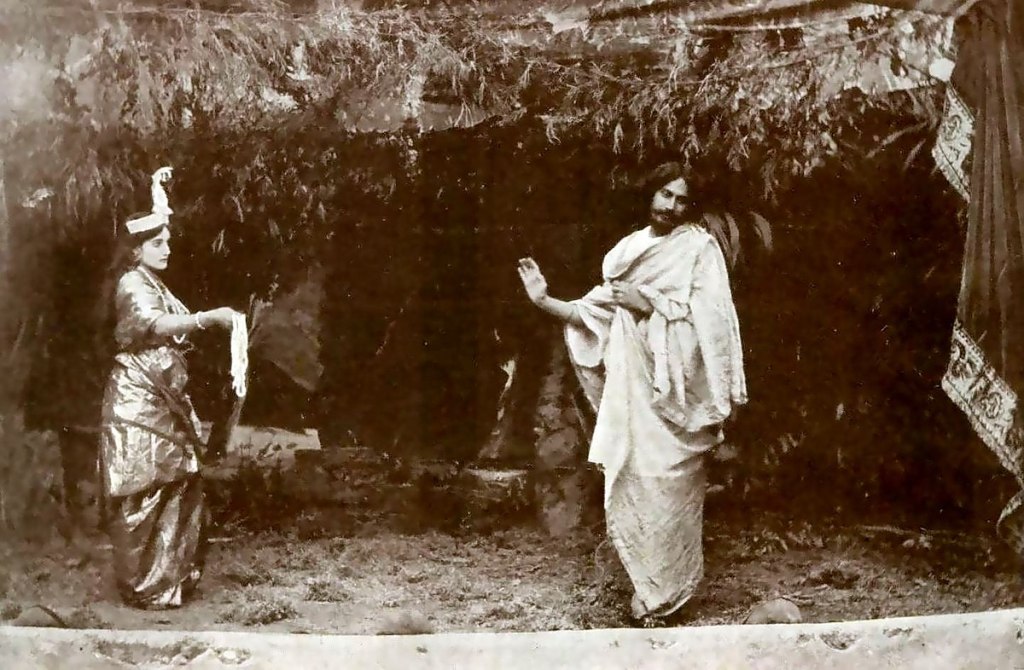
Rabindranath Tagore and Pratibha Devi (his neice) performing in his dance-drama, Valmiki-Pratibha (The Genius of Valmiki) 1881. Photo from Public Domain

Rabindranath, however, is best known as a poet. His poetry, drawn from ancient cultural memory as well as the immediate present, is in a class of its own. For there is a third dimension to it. He not only wrote of what he saw and remembered but what he saw only in his mind — a world that lay a vast space away from reality. ” There are two kinds of reality in the world,” Rabindranath said[2] of his paintings. “One of them is true; the other truer.” He could have said this of his poetry too. The real and surreal quality of his images in the vast span of his poems and lyrics; their indefinable nuances and evocative power are comparable to the works of the great Impressionists.

Interestingly, Rabindranath arrived at the canvas through his poetry. The calligraphic erasures and corrections with which he embellished many of his poems became sketches of a special kind. “I try to make my corrections dance,” he said[3] once, “connect them in a rhythmic relationship and transform accumulation into adornment.”

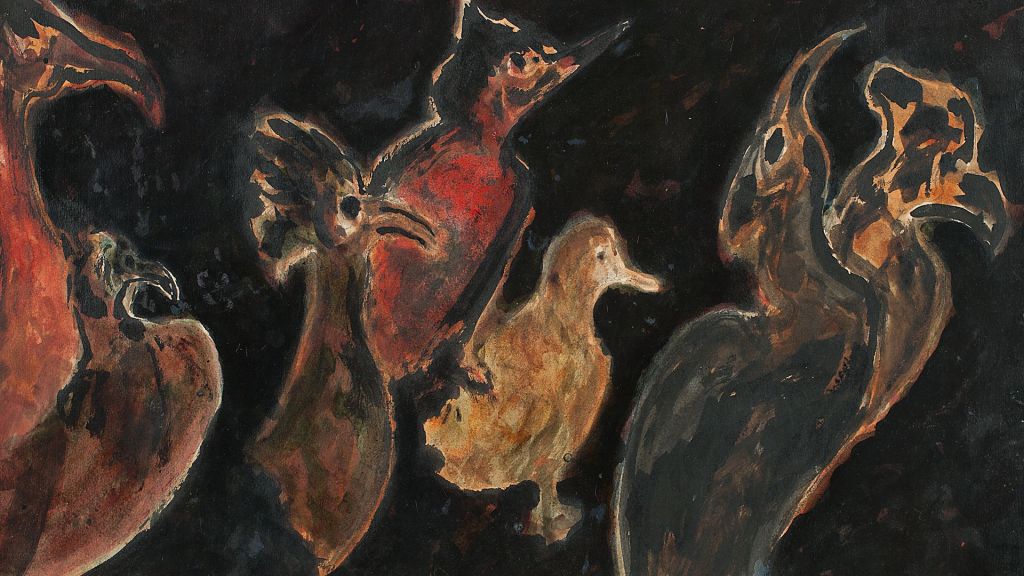
Later, in the last thirteen years of his life he threw himself into frenzied bouts of painting leaving behind more than two thousand and five hundred art works. Strange, haunting faces with eyes that look deep into one’s soul; surreal landscapes the like of which were never seen this side of the horizon; trees and flowers painted in violent colours that erupt from the artist’s palette in volcanic bursts — his paintings, as an artist once said, reflect “emotions recollected more in turmoil than in tranquillity.”

Yet, though famed the world over for his poetry and painting, it is as a music maker that Rabindranath has stayed entrenched in the hearts of his own people. His songs, loved and sung by generations of Bengalis, range in theme from celebrations of nature and yearning for freedom to love of God and Man. They convey the poet’s profound philosophy of life, his deep faith in humanity and his sensitive exploration of the Universe, often touching on the quest of the unattainable. Rabindranath once said that, though he could not predict how future generations would receive the rest of his work, he was confident that his songs would live. The increasing popularity of Rabindra Sangeet, both in India and abroad, bears ample testimony to the fact that his prophecy was based on a certainty born out of self-knowledge. Vast and varied though his genius was — music was its mainspring. He wrote of his songs: “I feel as if music wells up from within some unconscious depth of my mind; that is why it has a certain completeness.”

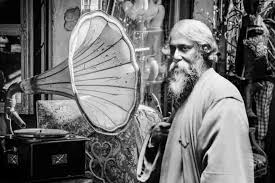
Photo from Public Domain

[1] The Disease and its Cure, 190

[2] Quoted from Tagore’s Galpa Salpa (Conversations) by Soumendranath Bandopadhyay in Expressionism and Rabindranath

[3] Quoted in An Artist in Life by Niharranjan Ray

Aruna Chakravarti has been the principal of a prestigious women’s college of Delhi University for ten years. She is also a well-known academic, creative writer and translator with fourteen published books on record. Her novels JorasankoDaughters of JorasankoThe InheritorsSuralakshmi Villa have sold widely and received rave reviews. The Mendicant Prince and her short story collection, Through a Looking Glass, are her most recent books. She has also received awards such as the Vaitalik Award, Sahitya Akademi Award and Sarat Puraskar for her translations.

.

PLEASE NOTE: ARTICLES CAN ONLY BE REPRODUCED IN OTHER SITES WITH DUE ACKNOWLEDGEMENT TO BORDERLESS JOURNAL

Click here to access the Borderless anthology, Monalisa No Longer Smiles

Click here to access Monalisa No Longer Smiles on Kindle Amazon International

Categories
Excerpt

The Naming of Rabindranth

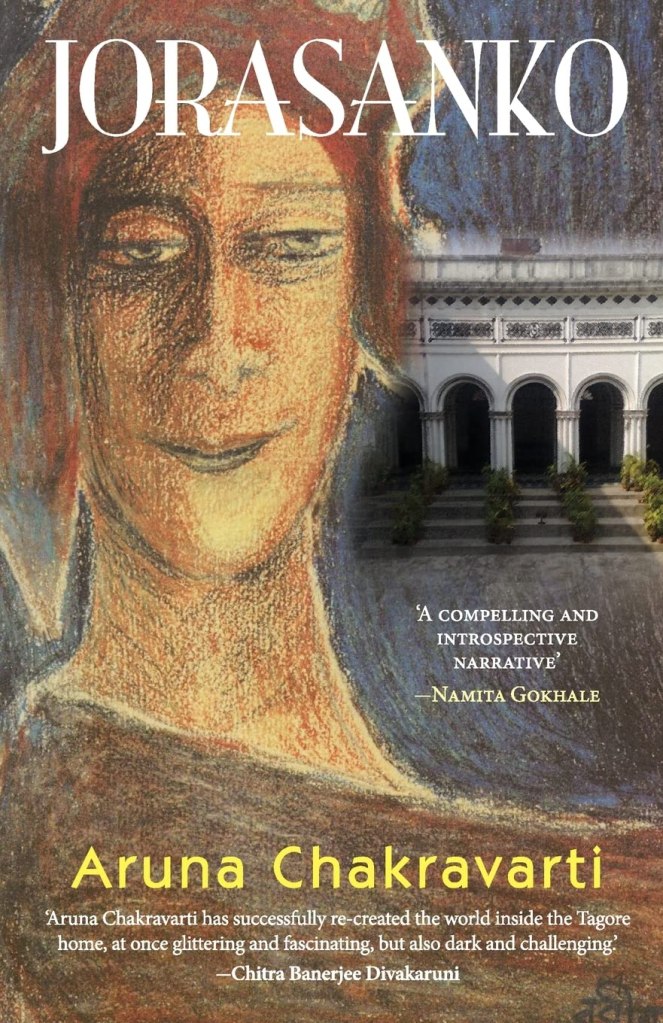
Title: Jorasanko

Author: Aruna Chakravarti

Publisher: HarperCollins India

Genu stood where she was as though rooted to the ground. Her eyes were fixed on the masses of gold and gems that hung from Sarada’s neck and trailed down her vast bosom. Her ears were filled with the jingling from the rows of bangles that encased her mother-in law’s fat arms as she put the finishing touches to her daughter’s toilette. Then the girl turned and walked away.

As soon as she reached the door she started running. Stuffing the end of her sari into her mouth, willing the lump to stay stuck in her throat, she ran like a wild thing down the gallery towards her room. Suddenly, she heard a cry and her feet stopped. She stood nonplussed for a moment. Where had the cry come from? From within her? Had the pain she had tried so hard to suppress burst out of her chest in a wail so bitter? So piteous? Then she pulled herself together. Of course not. It was her mother-in-law’s newborn baby crying. A boy two months and twenty days old…

Following the direction of the sound, she came to a tiny room adjoining the birthing chamber. The room was dark and the child lay, all alone, on a narrow bed. There was no sign of the wet nurse or of anyone else. Everyone was busy enjoying the wedding. Lifting the baby in her arms, she felt something flow out of him, something that warmed and comforted her. They were of a kind, she thought. Both alone. Both unloved. She remembered what Subhankari had told her some days after the child was born. Though she had given birth to a boy, Sarada, she had said, was rather disappointed.

‘He’s ugly.’ Sarada had muttered, looking askance at her newborn.

‘He’s not ugly at all’ Subhankari had retaliated indignantly. ‘You’re too fussy, Saro.’

‘Well he’s certainly darker than my other children. And look at his cars. How big they are! And how they stick out!’ Instructing the midwife to bathe him in milk, she had turned over on her side and gone to sleep.

But what neither Subhankari nor Genu knew was that Debendranath had sent for Anandachandra Vidyabagish soon after the birth and asked him to prepare the little one’s horoscope as he had done for all the other children. And, a few days later, Anandachandra had burst into the baar mahal, his mouth stretched in an exultant grin. ‘An outstanding conjunction of planets! he had cried. ‘A birth like this happens once in hundreds of years. This child’s sun is so strong – he will dazzle the world with the light of his genius.’

Debendra had smiled. ‘A good thing,’ he had said. ‘One of my tasks has been simplified. I’ve been racking my brains to find a suitable name for the boy. Since he was born on a Monday, it could have been Somendranath but that, as you know, has already been taken. Now that you say his sun is so strong, I shall name him Rabindranath. But your calculations had better be correct, Ananda. I don’t want you coming to me with a long face, confessing you bungled them.’

(Excerpted from Jorasanko by Aruna Chakravarti, published by HarperCollins India)

About the Book:

In a sprawling novel that spans a unique phase in the history of Bengal and India, Aruna Chakravarti provides a fascinating account of how the Tagore women influenced and were in turn influenced by their illustrious male counterparts, the times they lived in and the family they belonged to. Jorasanko mirrors the hopes and fears, triumphs and defeats that the women of the Tagore household experienced in their intricate interpersonal relationships, as well as the adjustments they were continually called upon to make as daughters and daughters in law of one of the most eminent families of the land. ‘In her meticulously researched novel, Aruna Chakravarti has successfully re-created for the reader the world inside the Tagore home, at once glittering and fascinating, but also dark and challenging. The women of the Tagore family who are at the heart of this novel are complex beings who will raise many questions in the modern reader regarding the role of women in today’s society’, Chitra Banerjee Divakaruni, author of Palace of Illusions and One Amazing Thing.

About the author:

Aruna Chakravarti  had been the Principal of a prestigious women’s college of Delhi University for ten years. She is also a well-known academic, creative writer and translator with seventeen published books on record. They comprise five novels, two books of short stories, two academic works and eight volumes of translation. Her first novel The Inheritors (published by Penguin Random House) was shortlisted for the Commonwealth Writers’ Prize and her second, Jorasanko (published by HarperCollins India)received critical acclaim and also became a best seller. Daughters of Jorasanko, a sequel to Jorasanko, (HarperCollins India) has sold widely and received rave reviews.Her novel Suralakshmi Villa, published by Pan Macmillan Ltd under the Picador imprint, has been adjudged “Novel of the year (India 2020)” by Indian Bibliography published in The Journal of Commonwealth Literature U.K. Her latest work, The Mendicant Prince, a semi-fictional account of the Bhawal legal case, was released by Pan Macmillan Ltd, in July this year to widespread media coverage and acclaim. Her second book of short stories Through a Looking Glass: Stories has just been released by Om International Ltd.

Her translated works include an anthology of songs from Rabindranath Tagore’s Gitabitaan, Sarat Chandra Chattopadhyay’s Srikanta and Sunil Gangopadhyay’s Those Days, First Light and Primal Woman: Stories. Among the various awards she has received are Vaitalik Award, Sahitya Akademi Award and Sarat Puraskar.

She is also a script writer and producer of seven multi- media presentations based on her novels. Comprising dramatised readings interspersed with songs and accompanied by a visual presentation by professional artists and singers, these programmes have been widely acclaimed and performed in many parts of India and abroad.

.

PLEASE NOTE: ARTICLES CAN ONLY BE REPRODUCED IN OTHER SITES WITH DUE ACKNOWLEDGEMENT TO BORDERLESS JOURNAL

Click here to access the Borderless anthology, Monalisa No Longer Smiles

Click here to access Monalisa No Longer Smiles on Kindle Amazon International

Categories
Review

How Suffering Unites across Borders

Book review by Rakhi Dalal

Title: Life Was Here Somewhere

Author: Ajeet Cour

Translators: Ajeet Cour and Minoo Minocha

Publisher: Speaking Tiger Books

India’s independence in 1947 came with its own set of political as well as social uncertainties and challenges. For the people displaced from their native places, it was a struggle to find a home in unknown places amidst strangers, a firm footing to hold. The stories in this collection by Ajeet Cour, a profound and powerful voice in Punjabi Literature, offer observation of everyday lives of common people in the wake of Partition and during the early years of settling of migrants in Delhi and Punjab. But more than accounts of struggle for their livelihoods, these are stories of interpersonal relationships, of pain, anguish, betrayal and heartbreaks.

Ajeet Cour was born in 1934 in Lahore and migrated to Delhi in 1947 after the Partition. She began writing short stories as a teenager and today is the author of twenty-two books which include novels, novellas, short stories, biographical sketches and translations. In 1986, she was awarded the Sahitya Akademi Award for her autobiography. In 2006, she was awarded the Padma Shri for her writing and her contributions in the field of social upliftment. She is the Founder President of the Indian Council for Poverty Alleviation, and has been President, Foundation of SAARC Writers and Literature. In 1977, Ajeet Cour also founded the Academy of Fine Arts and Literature, a non-commercial institution in New Delhi for the promotion of the arts, literature, theatre, music and dance.

This book is a collection of fourteen short stories translated from Punjabi to English by Ajeet Cour and Minoo Minocha. In her note at the beginning of this collection, the author says:

“I write because I am a witness to the horrors of daily life, day-to-day existence of people living next door, or in Punjab or Kashmir or Assam, or in Bosnia or Chechnya or Rawanda, or anywhere else in the world, feeling my destiny entwined with theirs, living in fear, dying like flies. And I can’t look the other way. I write because I believe that those who remain silent become a part of the dark conspiracy.”

The stories comprising this collection are accounts of everyday horrors faced by common people, of the brunt of estranged and conflicted relationships bore by people even as they grappled to find and hold onto a ground in life after the suffering endured during partition. Most of these stories are women centered and carry a first person narrator. The story ‘Walking a Tightrope’ is that of a woman torn between her husband and an irresponsible son disowned by his father. The author offers a nuanced glimpse into before/after the partition in a big household. She employs the image of kitchen to demonstrate a married woman’s domain as well as her confines in a patriarchal household. ‘Death Among Strangers’ is a story of a grief stricken daughter who could not take care well for her father post Partition due to the apathy of her husband. Both stories use death as the pivot which jostles the main women characters out of their pre-determined roles of mother and wife respectively. 

In some of the stories, characters navigate through the ‘babudom’ of Indian Bureaucracy. Trying to find ways to get their problems addressed, they often surrender to the system which becomes increasingly inaccessible to them. Often, the characters are irritated by the system which makes them invisible and works only at the behest of those in power. The title of such a story ‘Clerk Maharaja’, otherwise an oxymoron, denotes the high esteem accorded to a regular class government employee who carries enormous power when it comes to the movement of files from one desk to the other.

In the titular story ‘Life Was Here Somewhere’, a helpless and disgruntled narrator declares the whole country as a heap of garbage no one is interested in cleaning, and those running the country as visceral creatures feasting on the stinking pile.

The story ‘The Kettle is Whispering’ explores kinship between a single and a widowed woman whereas the story ‘Unsought Passion’ explores the ugliness of unwarranted attention. Both stories take us to the corridors of working women hostels in the early years of Delhi post independence, presenting a window to the dynamics of interactions and disagreements.

In a couple of stories the horror of terrorism is explored where the loved ones are either targeted by extremists or by the forces fighting extremism. These stories focus upon the suffering families, their anxieties and pain as they try to make sense of their loss. In ‘Dead-End’ a young woman tries to save a young wounded extremist even though she is apprehensive that he might have killed her brother.

Ajeet Cour poignantly portrays the internal and interpersonal conflicts as faced by ordinary people in the course of their everyday lives in the stories of this collection. Her writing resonates with their pain, her words capture their mindscapes bearing witness to horrifying bestiality humans are capable of and continue to exhibit in their dealings with their fellow human beings. 

Rakhi Dalal is an educator by profession. When not working, she can usually be found reading books or writing about reading them. She writes at https://rakhidalal.blogspot.com/ .

.

PLEASE NOTE: ARTICLES CAN ONLY BE REPRODUCED IN OTHER SITES WITH DUE ACKNOWLEDGEMENT TO BORDERLESS JOURNAL

Click here to access the Borderless anthology, Monalisa No Longer Smiles

Click here to access Monalisa No Longer Smiles on Amazon International

Categories
Stories

The Monk Who Played the Guitar

Short story by S Ramakrishnan, translated from Tamil by T Santhanam

It was Malavika who sent me the video of the monk who plays guitar. Malavika is my daughter. She is pursuing fashion designing course in Kingston University, England. Her desires and interests are a puzzle to me. Some days ago, she sent a recording of a poem by William Blake in her voice. After that, she sent a photo of her carrying a placard in a demonstration against global warming. As clouds change to forms unimaginable, her interests keep on changing. After watching a butterfly, she had sent her impressions in writing. It seemed as though it was from a seasoned writer. 

Children who leave home for far off places, in a sense, leave us. She was no longer the girl she was in Chennai. The new country and new environment have changed her. The changes are reflected in her appearance and deeds. My wife did not like these alterations. Below the video of the monk who played guitar, she had given the caption: “Music is Meditation”. I could not understand her. At the age of twenty-two, I thought she would be fondly giving herself to worldly pleasure. But she was immersed in meditation, agitation and museum visits.

In the video sent by Malavika, the monk must have been about thirty years old. His head was tonsured. He wore a robe coloured orange. His ears were slightly big. He had a sharp nose and small lips where a smile was frozen. It was hard to find out if he was a Nepali or a foreigner. On his left arm, was tattooed the image of Buddha.

It was funny to see a Monk with a guitar. The image we have formed about saints and the looks of current day saints are not alike. Perhaps, we refuse to update that image. Perhaps, the meaning of sainthood has changed.

The musical piece was given the title “Falling flowers”. From the way he was playing, it seemed as real as the blossomed cherry leaves falling gently. The normal rapidity and gush associated with guitar music was not there. Like an insect that moves in the water, his fingers moved on the guitar strings. Music tunes to the past more easily than photographs. A small piece of music is enough to take us back to our school days.

I saw the video once or twice. I felt the urge to listen to it again and again. While listening at night, I felt as if the fragrance of incense was wafting into the vacant spaces of my heart. I found His name was Limang Tolma while searching for his other videos. There were hundreds of musical pieces by him. All of them were only seven minutes long. Evidently, he played the guitar for only seven minutes in a day. That too under the sal tree in Coben Monastery seated on a stool. Hundreds of people from various countries pour in to listen to his performance. All this I gathered while browsing the internet. His music was melodious and sweet. Why did he play for seven minutes only at each stretch was beyond comprehension.

To know more about Limang Dolma, I called Malavika on her mobile. She sent a message that she was observing silence for the past five days. Why this silence? Tongue can be tied down. But the mind? 

I told my wife. She responded that she had scolded Malavika and that was why she was doing this.

I could not understand. What was the skirmish between mother and daughter? I sent a message to Malavika asking her how long her silence would continue. “God only knows,” was her reply.

As I am a senior executive in an automobile company, I had to conduct two to three meetings in a day. My blood pressure sometimes would rise after returning from these meetings.Sometimes, I would have a headache too. At times, the meetings would last for ten hours. After the meeting, I would feel as if somebody has placed a pile of iron on my shoulders. I would feel sick, wondering why we could not conduct our work without talking, discussing or fighting.

One day, before the commencement of the meeting, I started to listen to the monk’s guitar music from my cell phone rather impulsively. I closed my eyes for seven minutes as though I was in a deep meditation. It was as pleasant a feeling as a moist breeze caressing my body. There was peace in my heart and an exhilaration I had never known before. On that day, I could sense the change in my voice and the way I was moving towards a solution. Somehow the officials of the sales department seemed to understand this. After the conclusion of the meeting while coming down in the lift, Amarnath said, “There was something new in your speech today. You spoke like a Zen Master.”

“Yes” I nodded approvingly with a smile. I was just wondering how a small piece of music could bring such a tremendous change in me.

I wanted to know more about Limang Dolma. Searching through the internet I was more and more astonished. The real name of Limang Dolma is Christopher Cane. He was born in Milan. He had pursued Anthropology. After coming into contact with a Buddhist monk, he has embraced Buddhism and become a monk in the Buddhist Monastery. He plays the guitar only under the tree of the monastery and nowhere else. Young people throng to him. They listen to his music. Some of them stay there for days together to savour his music. They wear T-shirts bearing his image with the words, “Buddha plays Guitar”. In an interview, a young lady asks him. “All saints in India hold one or other instruments. Why does Buddha not play any instrument nor is seen holding one?”

“He himself is a musical instrument. One who knows how to tune himself finds no need for a musical instrument. In the same way, Nature tunes itself. Is there any tune better than what the water plays?”

“Why do you play only for seven minutes?”

“Seven is the symbol of consciousness in Buddhism.”

“Seven minutes is not enough for us. Can’t you play more?”

“Will you take honey in a gulp? Is a spoonful not enough?” he asks.

I admired Limong Dolma fo his speech, poise and the way he handled guitar. I too felt like wearing a T-shirt bearing his image. I sent the video of Limang Dolma to some of my friends asking them to listen to his music. Only Mohan Muralidharan, a neurologist and my school mate, sent a reply saying that a man from Turkey played better than the monk and shared the video. Why should one musician be compared to another? Can’t this foolishness be avoided?

I called Mohan and blurted out my irritation. He said in a mocking tone, “You’re aging. That is why you listen to a monk playing the guitar. Music should make us feel young. It should twinge our nerves. You have never touched a musical instrument in your entire life. Can you whistle atleast?”

Mohan was right. I haven’t even played the mouth organ which many played during my school days.

I felt like owning a guitar. The same evening, I went to a musical store in Leo mall. I showed the video of Limang Dolma and asked for a guitar like the one in the video. The face of the girl at the counter brightened. “Limang Dolma?” she asked. I felt glad that she too has listened to the music. She brought a guitar from inside. I told her, ” I don’t know how to play guitar. This is for my daughter.”

The girl told with a smile, “Limang Dolma was a thief. He was in prison. After his release, he became a Monk. People say he speaks to Buddha through his music.”

“Really!”

“I overheard two girls talk of it when they came to purchase a guitar.”

“Do you believe that?”

“I believe it partially.”

“Which part?”

“That he speaks to Buddha,” she smiled.

She looked like my daughter when she smiled. Perhaps for young girls Buddha is a different personality. May be, the Buddha known by the ones who have crossed fifty years like me and the Buddha these young girls adore are not the same.

When I brought guitar home, my wife chided me.

“Why have you brought this? Who will play?”

“Just let it be,” I responded.

“Is it a show piece to be kept just like that?” she asked.

I did not reply.

I placed the guitar in Malavika’s room close to her bed. I had a feeling that Malavika had returned. I sent that night the picture of guitar to Malavika by WhatsApp. She sent an emoji of two clapping hands. Also, she sent a message “We are going to visit Limang Dolma.” 

Though I felt happy, I was eager to know who was the other in the ‘We’. I did not venture to ask Malavika. Instead, I asked, “When?” She did not respond.

After five days, she sent a picture to me. She was among the hundreds of youngsters before Limang Dolma, as he was playing the guitar. My eyes were cast on a young man with long hair, not on Limang Dolma. The young man hung his arms around Malavika’s shoulder.

Who was this fellow? How long had she known him? I could not see his face properly. I widened the image. An European face. Perhaps was he also a musician?  I thought of asking Malaviika. But I curbed that thought and went on to ask about the musical event, as I called her. She was full of cheer. She told me,” Listening to Dolma’s music, one feels like a kite fluttering in the air. I do not know what to say. Flying to heaven.”

“I read somewhere that he was a thief,” I said.

” Oh, that’s a myth constructed by magazines. When asked about this, Dolma says raindrops do not have a past. Jonah and myself were in the Monastery for three days. Wonderful experience!”

A question arose on my mind as to who Jonah was. I was not sure whether to ask her or not. Why wouldn’t she talk about him?

I asked, “Is Jonah a musician?”

“Dad, how do you know? Indeed, he is. He plays the guitar well. It was he who introduced me to Dolma’s music.”

“Is Jonah your classmate?”

“No, he works in a bar where I hold a part time job.”

“You didn’t tell me,” I pretended to be angry.

“Dad, don’t tell Mom about this.”

“About your working in bar?” I asked deliberately.

“About Jonah too?” she laughed. As she was so laughing, she seemed to be some other young girl. After she hung up, I was thinking about Jonah. Was he a good person or bad? Was he also a thief earlier? Or could he be a drug addict? Who were his parents? Was he in love with Malavika? Had I become old? Was Mohan right? I

 admired a Monk playing guitar somewhere. But I do not like Jonah who also plays guitar. Why? I was perplexed. Suppose if Limong Dolma put his arm around the shoulder of my daughter, would I dislike him too? I was confused.

Two days later, Malavika forwarded a video of Limang Dolma downloaded in her phone. Limong Dolma walked as though he was floating in the air. He sat under the tree. Peace was on his face as he tuned the guitar — the same music that I savoured earlier. No longer did I feel close to that music. Somehow, instead of Limang, Jonah’s face came before me. I felt as if a bitterness had settled down on my tongue.

The same night, Malavika called me. Before my asking anything, she said, ” After visiting Limang Dolma, I do not feel like listening to his music again”

 “Why?” I asked as if I did not know anything.

“I do not like it any more just the way I suddenly liked it before.”

“How is Jonah?” I asked intentionally.

“Do not talk about him. I hate him. I hate whatever he introduced to me.”

Inwardly I was happy.

” Any problem? Shall I talk to Jonah?”

“Why should you talk to him? The days I moved with him, it was a nightmare. Daddy, why do you not rebuke me?”

“You are not a kid, after all.”

“But you think of me as a kid only. You don’t know me as Mom does.”

I was flummoxed. I could hear Malavika sobbing for the first time ever. I did not know how to console her. I hurriedly gave the phone to my wife. She started walking towards the kitchen with her words of consolation. What has transpired between her and Jonah? Why was she weeping? I could not make out. At the same time, I was happy that she disliked the world she created for herself and moved back towards my world. A thought arose that she was coming home. I asked my wife what Malavika had said.

“That boy is not good. I told her from the beginning itself. But she did not pay heed.”

“Did you know about Jonah before?”

“She told me six months back. I scolded her saying that your Dad will not like this. I have spoken to Jonah also.”

“To Jonah? You?”

“Yes, I could not understand a bit of what he spoke.”

“What is the problem now?”

“It’s over. No use talking about it!”

I could not understand what happened. But Malavika had been closer to her mother than to me. She had shared everything with her mother. I was pained at this. Why then did she asked me not to tell her mother? Why this drama? Children after growing up, treat their father as a plaything. The daughter I know is now the girl I do not know. I could not reconcile myself to this.

I heard the guitar music of the monk that night. I was more attracted to the tree than to the music.

Leaves do not stay on the tree for long. When a leaf falls, the tree does not reach out to catch it. When falling leaves sail along the wind, the trees can do nothing but look at them in silence. Somehow, the music stirred a grief in me.

As I prepared to leave for office next morning, I saw my wife keeping the guitar next to dustbin. What was the fault of the guitar after all?

” What are you going to do with this?” I asked.

“Anish told me, he will take it. What do we do with this? Malavika does not want it any more.”

I nodded giving the impression that she was right. But I felt sorry while doing that.

.

S. Ramakrishnan is an eminent Tamil writer who has won the Sahitya Akademi Award in the Tamil Language category in 2018. He has published 10 novels, 20 collections of short stories, 75 collections of essays, 15 books for children, 3 books of translation and 9 plays. He also has a collection of interviews to his credit. His short stories are noted for their modern story-telling style in Tamil and have been translated and published in English, Malayalam, Hindi, Bengali, Telugu, Kannada and French. 

T Santhanam is a retired Bank Executive in Bangalore, India. He has a passion for literature with a special affinity for poetry. He writes poetry in Tamil. He is also a blogger.

.

PLEASE NOTE: ARTICLES CAN ONLY BE REPRODUCED IN OTHER SITES WITH DUE ACKNOWLEDGEMENT TO BORDERLESS JOURNAL

Click here to access the Borderless anthology, Monalisa No Longer Smiles

Click here to access Monalisa No Longer Smiles on Kindle Amazon International
Categories
Excerpt

Poetry by Mamang Dai

Title: The White Shirts of Summer: New and Selected Poems

Author: Mamang Dai

Publisher: Speaking Tiger Books

Hello, Mountain

Every morning when the forest wakes
The canopy goes for a walk
Hailing the sun, courting the wind
Discussing fruit and weather

The idle moss turns into velvet
Branches make signs.
Who says there is no time?
The only thing we are given is Time.

Chattering life high above,
Babel of tree dwellers.
For a seed falling so far down
To rise again, time is a given.
A foothold for the hunger of a weed,
Colour, scent, camouflage
And the grass that never sleeps

Shooting up to meet the gaze of the mountain.
How are you, mountain?
Is everything all right?
Is the earth growing old,
Birds flying away, trees falling?


After Gabo

No one can say it like you said it,
about love and magic,
solitude and growing old.

Here it’s white butterflies
whirling around in the garden
and the scent of bitter almond
is the scent of orange blossom.

You know, love is a virus too,
jumping ship,
landing up in ports and cities
so eager, enchanted
by the banks of another river
in the time of quarantine.

There are lines and lines
of communication
jostling through a virtual pandemic,
a sadness named, unnamed.

Fermina Daza, is it true:
Everything is in our hands?

Outside my window
red hibiscus, red.
If the aim is to survive,
it’s time to weigh anchor again.

For how long? Who knows.

Our old life is gone.
It’s another summer
and the pages are turning
in a chronicle of things foretold.

One battered flag in a time of lockdown.
Despite contrary winds
a battered flag is fluttering,
you’ll see it here and there
pointing in the direction of the future.
Salt water, caresses,
buoyant as the hearts of old lovers
young enough to believe
in forever.

(Extracted from The White Shirts of Summer: New and Selected Poems by Mamang Dai. Published by Speaking Tiger Books, 2023.)

About the Book:

 ‘A major voice in Indian English literature, and literature from North East India…[Her] poems are like a race of butterflies bargaining with the night.’

Keki Daruwalla

‘Dai’s poetic world is one of river, forest and mountain, a limpid and lyrical reflection of the terrain of her home state. Nature here is mysterious, verdant with myth, dense with sacred memory. There is magic to be found everywhere…But as you read closer, you [also] sense a more sinister undertow: this paradisiacal landscape is also one of “guns and gulls”, punctuated by “the footfall of soldiers”. You also realize that the simplicity of Dai’s verse is not without guile. It possesses a gentle persuasive riverine tug that can lead you to moments of heart-stopping surprise.

‘For all its simplicity, Dai’s poetry does not arrive at easy conclusions. There is no dishonest sense of anchor here, no blissful pastoral idyll. The poet describes her people as “foragers for a destiny” and her work is pervaded by a deep unease about erased histories and an uncertain future. And yet, implicit in her poetics is the refusal to divorce protest from love. This seems to translate into a commitment to a poetry of quiet surges and eddies rather than gritty textures and edges…[and] a tone that is hushed, wondering, thoughtful, reflective. The strength of this poetry is its unforced beauty and clarity, its ability to steer clear of easy flamboyance.’

Arundhathi Subramaniam

About the Author

 Mamang Dai, poet and novelist, was born in Pasighat, Arunachal Pradesh. A former journalist and a Padma Shri awardee, Dai is the author of a short story collection, The Legends of Pensam, and the novels Stupid Cupid, The Black Hill (winner of the Sahitya Akademi Award) and Escaping the Land (longlisted for the JCB Prize). Dai lives in Itanagar, Arunachal Pradesh.

.

PLEASE NOTE: ARTICLES CAN ONLY BE REPRODUCED IN OTHER SITES WITH DUE ACKNOWLEDGEMENT TO BORDERLESS JOURNAL