Keith Lyons converses with globe trotter Tomaž Serafi, who lives in Ljubljana. Click here to read.
Translations
Barnes and Nobles by Quazi Johirul Islam has been translated from Bengali by Professor Fakrul Alam. Clickhereto read.
Cast Away the Gun by Mubarak Qazi has been translated from Balochi by Fazal Baloch. Click here to read.
One Jujubehas been written and translated from Korean by Ihlwha Choi. Clickhere to read.
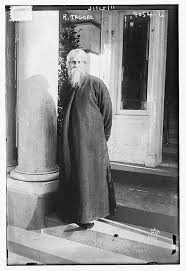
A Hymnto an Autumnal Goddess by Rabindranath Tagore, AmraBeddhechhi Kaasher Guchho ( We have Tied Bunches of Kaash), has been translated by Mitali Chakravarty. Click hereto read.
Dr. KPP Nambiar takes us through his journey of making a Japanese-Malyalam dictionary, which started nearly fifty years ago, while linking ties between the cultures dating back to the sixteenth century. Click hereto read.
We have Tied Bunches of Kaash

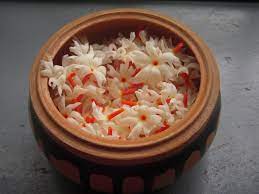
We have tied bunches of kaash* and strung garlands of shefali.
We have decorated the wicker tray with new-sprung paddy.
Welcome autumnal goddess on your chariot of white clouds!
Ride on angelic azure paths,
Travel through clean bright glittering forested mountains.
Come wearing a crown of white lotus, sparkling with dewdrops.
On the banks of Ganges, in a solitary bower
Carpeted with the flowers of fallen malati,
Swans flap their wings as your entourage.
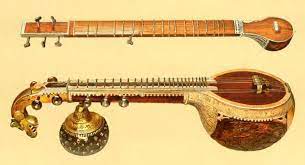
When you pluck the strings of your golden bina*,
Soft sweet notes,
Usher laughter amidst transient tears.
Like the magical parasmani* emanating light,
Stroke the flames of compassion in our hearts—
Brighten our thoughts and replace darkness with light.

*kaash: Wild grass flowers
*Bina: Musical instrument
*Parasmani: A magical touchstone
A Bengali rendition of the song performed by a contemporary artiste, Rezwana Choudhury BannyaShefali flowersMalati blooms(Rangoon creeper)Courtesy: Creative Commons
In 1913, Tagore received a Nobel Prize for his own translation, Gitanjali: Song Offerings, published in England. Only 69 of the original 157 of the Bengali Gitanjali made it into the English translation.
An essay, ‘Publication of Tagore’s song offerings, the Gitanjali : A Study’ by Partha Pratim Ray, a librarian in Vishwa Bharati, contends: “Rabindranath Tagore himself took the task of the translation of Gitanjali (Song Offerings) when he sailed for England on 27 May 1912. There he handed over the poems to William Rothenstein whom he met earlier in Calcutta in the year 1911. Moved by the poems, Rothenstein in turn gave the poems to W.B. Yeats to read. The literary and artistic circle of Yeats decided to publish the poems after Yeats made a selection of them and wished to write an introduction to it. That is how Gitanjali was first published by India Society of London on November 1912.”
The article further elucidates: “The next edition of Gitanjali was published in the next year (March 1913) by Macmillan and Company, London. The number of poems in Bengali and English Gitanjali are not the same. In Bengali there were 157 poems, but in English it was 103. The poems were first published in different Kavyagrantha. At the end of the Indian edition of India Society or Macmillan there was a statement: ‘These translations are of poems contained in three books- Naivedya, Kheya and Gitanjali…’”
Yeats wrote the introduction for Song Offerings. He wrote, “these prose translations from Rabindranath Tagore have stirred my blood as nothing has for years” and “Mr. Tagore, like the Indian civilization itself, has been content to discover the soul and surrender himself to its spontaneity.”
Gitanjali, 1910 editionGitanjali: Song Offerings by Tagore in English with a forward by W.B. Yeats
This poem has been translated by Mitali Chakravarty with editorial input from Sohana Manzoor on behalf of Borderless Journal
.
PLEASE NOTE: ARTICLES CAN ONLY BE REPRODUCED IN OTHER SITES WITH DUE ACKNOWLEDGEMENT TO BORDERLESS JOURNAL
Going up from East River to all heated up 46 Street,
Crossing quite a few avenues one after another,
Just where 5th Avenue comes into view jarringly,
One comes across America’s biggest bookstore, Barnes and Nobles,
Poised at this point of the city like an ancient philosopher.
And when I say “biggest”, I mean one store of a really big bookshop chain.
There may perhaps be a bigger shop than this one somewhere else,
Or perhaps there may be none comparable in size!

On weekdays I stand there for some time around ten
Perhaps because of its proximity to Diamond District,
The morning sunlight here—an amalgam of diamond and gold—
Streams onto the 5th Avenue pavement.

Perhaps to pick them up,
Causal and loosely clad, white-skinned women flood the street.
Usually, I buy a glass of smoothie from the Mohican youth
Making energy drinks on his machine,
Savouring afterwards a glass of the diamond-gold drink.

I can take many roads to come to F train station,
But I always use this particular crossing point.
On evenings, while returning from the UN building,
Unthinkingly, I enter Barnes and Noble’s cavernous stomach
Two concrete monsters cover the orange-coloured cloud.
What can a man possibly need in a bookshop?
It is quite one thing if it is a bar or a meat shop!
Of course, Americans crowd vegan shops nowadays,
Who knows if one day vegans will alter the American language?

From some aisle of the shop, on any given day, I’ll pick up any one.
The other day it was that old man from the Vermont Hills, Frost.
As soon as I picked him up, he wanted to make me wise in my ways.
“Try and fathom out the music of verse—that is it essence!”
What rubbish! The guy is still stuck in the 1960s!
The world of poetry has marched forward a lot,
And has been crossing all sorts of holes and pits nowadays,
And prose’s highs and lows.
The old man is such an ignoramus!

Holding a milk-honey concoction on her lap sat the Punjabi girl, Rupi Kaur.
Seeing me, she sprang into my lap.
India seemed to tremble as fingers touched soft dark skin.
Though someone who was still in her teens only yesterday,
She couldn’t resist dishing out advice. She said:
“Forge a knife on your own dear poet; hold the weapon in your hand,
The time has come to slice things with one stroke after another!”

The day I banged against Rae Armantrout, was the day I learnt about her verse,
About how in their silences became representative of language movement poetry.

I saw many others in their welcoming aisle as well!

I saw Ezra Pound trying to suppress a smile when I entered,
For sure I did not dare go near him out of fear
But let me whisper this into your ears:
I sure did mangle his poetry in trying to translate it!

I saw Amiri Baraka’s unruly beard fly in the air conditioner’s wind.
Nude Ginsberg was walking up the stairs leading to the second floor,
Shouting as he did so, “They don’t understand people’s sufferings
So obsessed are they with “development”!
John Ashberry was looking at the Hudson with one eye,
His tears stonily registering some hidden pain there
The other eye was all ablaze
All of a sudden, like a scene in some animation film,
The man’s eye’s fire made Manhattan burn.

I fled the fire that was burning so
Thinking as I did then—
How could Barnes and Nobles accommodate such hostile pronouncements,
                                                                                              such wrath!

				Holliswood, New York
				24 June, 2022
Quazi Johirul Islam has been writing for over 3 decades. He has published more than 90 books, 39 of them are collections of poetry. His travelogues are very popular. He has been with United Nations, has traveled all over the world, worked in conflict zones, his bag is full of colourful experiences. In 2023, Quazi was awarded Peace Run Torch Bearer Award by Sri Chinmoy Centre, New York. He has also received many awards and honours in Bangladesh, India and abroad.
Poem by Quazi Johirul Islam, translated from Bengali by Professor Fakrul Alam
Quazi Johirul Islam
As a boy I heard the same story from my father again and again:
My grandfather hadn’t left behind for his son any kind of plot
Where seeds could be planted that would yield a garden full of yummy stories.
In the same vein, a hunger for stories engrossed me in my childhood and teens.

I know that all ye still to be born children
Will cry glumly like I once had, hungry for stories.
That is why I’d braved cresting, roaring waves,
Cooked soups of stories on immigrant cookers on wintry nights;
Diving to the bottom of the sea, I’d seen how marine species
Dance to the rhythm of hidden waves,
And write on whale bodies of the sea!
From empty spaces, I captured wild African stories of desert bisons;
Standing in the chilling North Pole blizzards,
I was able to divine stories of stormy nights;
From Gibraltar, I fetched the bright light of new stories
Which I then strewed on Casablanca’s ancient eyes!

Out of my sweat and blood, I create endless stories for coming generations
For I know that even though all other causes of hunger may die,
What will only survive in the dark is the hunger for more and more stories.

From wintry prairies to grey Savannahs,
And in all pathways of the world,
I’ve been sowing seeds of new stories every day.
Climbing down from the lap of juicy fruit-filled gardens,
Seated on the soft mat that is earth,
They keep developing the craving for new stories endlessly.
Endlessly, the hunger for untold stories
Vibrate all sleepy pathways of the world!
Quazi Johirul Islam has been writing for over 3 decades. He has published more than 90 books, 39 of them are collections of poetry. His travelogues are very popular. He has been with United Nations, has traveled all over the world, worked in conflict zones, his bag is full of colourful experiences. In 2023, Quazi was awarded Peace Run Torch Bearer Award by Sri Chinmoy Centre, New York. He has also received many awards and honors in Bangladesh, India and abroad.
HOMA-BIRD

Once I fall, how much must I drop down before I can rise up again?

As this thought crosses my mind, I am reminded of the Homa-bird found high in the sky. It even lays its eggs there. The eggs then fall down. But because the bird lives so high in the sky its eggs take ages to fall. Its chicks hatch even as the eggs descend. And then it’s time for the chicks to fall. As they begin to fall the chicks sprout eyes and feathers and wings. And one day they discover that they are falling down and down. It is then that they begin to fly to their mothers high up in the sky. They fly so high now that they emerge as specks scattered all along the spread-out body of the sky

We are of the breed of these birds. We procreate, raise children; we drop down and rise up again!

[Homapakhi; Translated by Fakrul Alam]

GONE WHO KNOWS WHERE

An unending queue of children flowed forward
Going who knows where?

With great difficulty, I spotted my own child there.
But when I tried kissing him
I ended up kissing someone else’s child!

And then I lost him— lost him forever!
Dazed, distressed— I seem doomed to a lifetime of waiting.

[Aggato Uddesh; Translated by Fakrul Alam]


REJECTION

Abruptly today a baby is expelled from its mother’s breasts.
Though it keeps gravitating towards her— hopefully—
It continues to be rejected. Startled, it still keeps trying....

How can the innocent baby make sense of such evictions?
It can comprehend nothing— neither the implications
Nor the reasons behind its mother’s bizarre actions.
All it can do is wonder— is mother playing with it?
Or is she just being cruel, suddenly unmotherly,
Distracted by the sudden heat wave of the season?

The baby broods, all alone, helpless. And then once again
It turns towards its mother, only for another round of rejection...

Now inconsolable, it breaks out into tears, feeling hurt
And rejected, sobbing endlessly till sleep silences it...

Only its craving for love keeps striking one’s ears
Its magnitude scattering here, there, everywhere!

[Protyakhyan; Translated by Fakrul Alam]
Masud Khan (b. 1959) is a Bengali poet and writer. He has, authored nine volumes of poetry and three volumes of prose and fiction. His poems and fictions (in translation) have appeared in journals including Asiatic, Contemporary Literary Horizon, Six Seasons Review, Kaurab, 3c World Fiction, Ragazine.cc, Nebo: A literary Journal, Last Bench, Urhalpul, Tower Journal, Muse Poetry, Word Machine, and anthologies including Language for a New Century: Contemporary Poetry from the Middle East, Asia, and Beyond (W.W. Norton & Co., NY/London); Contemporary Literary Horizon Anthology,Bucharest; Intercontinental Anthology of Poetry on Universal Peace (Global Fraternity of Poets); and Padma Meghna Jamuna: Modern Poetry from Bangladesh(Foundation of SAARC Writers and Literature, New Delhi). Two volumes of his poems have been published as translations, Poems of Masud Khan(English), Antivirus Publications, UK, and Carnival Time and Other Poems (English and Spanish), Bibliotheca Universalis, Romania. Born and brought up in Bangladesh, Masud Khan lives in Canada and teaches at a college in Toronto.
It’s carnival time today.
Serfs and plebeians pour into streets.
Behold the giggling, decked up undertaker’s wife,
That man over there, completely soused, is her spouse!
He holds his pay tight in his fists and grins grotesquely,
See the sweeper there, lips reddened by betel leaf!

There he is— the constable— sporting a shiny wristband.
And look at that rotund young eunuch—
All merry, like dusky Abyssinians or Afghan revellers in the rain.

Today it’s time to collect wages and bonuses and forget files.
Today superiors have trade place with subordinates

And mandarins have transformed themselves into mere clerks.

The roly-poly slave and Kishorimohon Das
Sleep fitfully next to each other near the town reservoir,
Stirred again and again by the mayor’s snores,

The hapless water bearer gets completely wet.
The woman over there is a streetwalker,
Visiting town for the first time with her snotty-nosed brother.
That man there trades in lead, and there is the perfume seller,
He is the accountant, and he, the treasurer,
And next to him on this day of intermittent rain
Is the petty thief’s no-good brother.
And there— leaning, bent by the weight of his imagination,
As if in a trance, is the poet, the king of poets!

This day all have spilled out into the streets and stroll there
Endlessly — intransitive
Wrapped in newly spun silk.
Masud Khan (b. 1959) is a Bengali poet and writer. He has, authored nine volumes of poetry and three volumes of prose and fiction. His poems and fictions (in translation) have appeared in journals including Asiatic, Contemporary Literary Horizon, Six Seasons Review, Kaurab, 3c World Fiction, Ragazine.cc, Nebo: A literary Journal, Last Bench, Urhalpul, Tower Journal, Muse Poetry, Word Machine, and anthologies including Language for a New Century: Contemporary Poetry from the Middle East, Asia, and Beyond (W.W. Norton & Co., NY/London); Contemporary Literary Horizon Anthology,Bucharest; Intercontinental Anthology of Poetry on Universal Peace (Global Fraternity of Poets); and Padma Meghna Jamuna: Modern Poetry from Bangladesh(Foundation of SAARC Writers and Literature, New Delhi). Two volumes of his poems have been published as translations, Poems of Masud Khan(English), Antivirus Publications, UK, and Carnival Time and Other Poems (English and Spanish), Bibliotheca Universalis, Romania. Born and brought up in Bangladesh, Masud Khan lives in Canada and teaches at a college in Toronto.
ProfessorFakrul Alam brings to us a discussion on and translations of Tagore songs on the season that follows the scorching heat of summer months
Art by Sohana Manzoor
A rough count of the songs collected in Gitabitan in the section titled “Prakriti” or “Nature” reveals that Rabindranath Tagore composed about sixteen songs of summer, more than 100 monsoonal ones, 33 songs of Sharat or early autumn, five of Hemonto or late autumn, and a dozen or so songs of winter. In addition, he has left us around 93 songs of spring. For many decades, I kept wondering how Rabindranath managed to end up with such a lopsided list as far as his songs of the six Bengali seasons are concerned. After all, late autumn and winter are enjoyable seasons when Bengal is blissfully heat-free and the weather quite mild and bearable; why, then, did he show such fondness for the wet monsoonal months and the rapidly warming and (at its end quite unbearably hot) springtime? But I am puzzled no longer by his preference for our Borsha, for it now seems clear to me that he had good reasons to prefer the monsoonal months over all else. In recent decades, now that I fancy I have something of what Wordsworth calls the “philosophic mind” (and in this age of global warming as well!), I can appreciate fully why the monsoonal months stimulated Rabindranath so continuously into songs.
Think of the summer months. From mid-April till the second week of June, the weather torments us all over Bangladesh with stifling heat and unbearable humidity. Who in these weeks of scorching sun, steadily frying dampness and seemingly immobile and incredibly muggy air does not yearned for an ever-increasing cloud cover leading to sudden bursts of showers and rainy conditions? Isn’t the monsoon a huge relief after the summer months, despite the flaming krishnachuras [flame of the forest] and the seemingly endless stream of summer fruits that arrive in our market then? Don’t we all look forward to the pitter patter of raindrops, even if accompanied by thunder and lightning, when hot and dry ourselves? And isn’t the fresh green look of nature after a burst of rain so very soothing?
As in his devotional and love poems, Rabindranath captures feelingly in his monsoonal song-lyrics a variety of moods. One such mood is the longing for relief from an oppressive presence. Registering the cruel heat and humidity of our late spring and summer, his songs often exult in the respite that the monsoons afford us. Hear him thus dramatise the excitement all life forms feel just before, during and after the coming of the monsoons, in the opening two stanzas of the song-lyric ‘Oi Ashe Oi Oti Bhairob Horoshe’[i] [The Clouds Arrive Amidst Joy]
There, there they come — monsoonal clouds—
Exhilarating, awesome, moisture-laden,
Fragrant, earth-soaked, dense, rejuvenated
Dark-hued, somber, glorious— ready to burst!

Their deep rumblings quiver dark-blue forests
Tense peacocks out on strolls cry out,
The whole world is thrilled, overwhelmed.
Intense, amazing—monsoon is on its way!
Indeed, song after song of Gitabitan record Rabindranath’s fascinated melodic outburst after a dramatic monsoonal outburst. Here is another example, ‘Prochondo Gorjone Ashile Eki Durdeen’, [Amidst Thunder comes a Dreaded Day].
Such a dreadful day, so full of rolling, thundering sounds
Disquieting cloud buildups, ominous endless outbursts!
Such a thick cloud cover; serpentine lightning, scarring night
Making the sky stream tears despite its totally blinded eyes!
But abandon all your fears; stir O scared and slothful ones.
Cheerfully, build up within yourself ample strength
To behold with resolute and wide open eyes His serene presence
Behold Him seating superbly on his throne –defying death, fearless!
Completely committed to the notion of a Supreme Being in his works, Rabindranath conveys his wonder at the monsoonal drama of clouds, thunder, and lightning and rain in many a song, inspired by scenes that he sees in the last analysis as embodying the power and inspirational presence of the deity.
A sizeable number of Rabindranath’s song-lyrics are in this religious vein, but not all. In other monsoonal song-lyrics Rabindranath presents to us not only the awe-inspiring/ sacramental signs of the deity embodied in such seasonal storms, but also the frightening and intimidating aspects of our rainy season. He is well aware of the deep unease the monsoonal storm’s power and intemperate outbursts can cause, and the way it can scare all things in nature and make them aquiver. The foreboding created by the approach of an overwhelming and apocalyptic force is thus apparent in the concluding lines of the song ‘Hridaye Mondrilo Domoru Guru Guru’ (A Drum Rumbles in the Heart):
The night is full of thunder and lightning;
The clouds are intense, startling.
Jasmine creepers tremble and rustle in melancholy notes
Woodlands fill with insects chirping in alarm!
In fact, Rabindranath is acutely aware of how the monsoon can disrupt lives, particularly those of people out in the open or men and women who have to travel in inclement weather despite the thunder, lightning, rain and flash floods that the monsoons invariably bring. His concern for such vulnerable people and concern at such intemperate weather comes out clearly in Jhoro Jhoro Boreshe Baridhara [The Rain Streams Incessantly]:
Rain streams down incessantly
Alas wayfarer; alas disabled, homeless ones!
The wind moans on and on.
Who is it calling out to in this immense, deserted, dismal landscape?
The night is pitch dark,
Jamuna restless; its waves agitated, endless; its shores have disappeared!
Dense dark rain clouds hover in the horizon, rumbling continuously.
Lightning darts restlessly, dazzlingly—no moon or stars in sight!
On the other hand, the monsoons are also seasonal visitations for Rabindranath that induce in him desire for romance or romantic cravings that need to be fulfilled. Note how intensely the yearning of a lover anxious to impart his feelings to his beloved in a rain-stirred mood is articulated in Emono Dine Tara Bola Jai [On Such a Day, They Say]:
On such a day she could be told
On such a dense, dark, wet day!
On such a day to her I could my mind unfold,
On such a cloudy, thunderous, showery day
		On just such a sunless, dense, dismal day!

I’d tell her what no one else would know
	Silence would us probably surround,
We’d face each other, each sobered by a deep wound.
	Incessant rain would from the sky flow;
	Surely, no one then would be around.

	Societal and family life would feel unreal
	The hullabaloo of life too would feel surreal
What would only matter are eyes feeding on each other
	And two hearts savouring one another;
	All else would merge with darkness.
If in a corner of the house on such a rainy day,
	I had then a thing or two to tell her
Why would anyone have anything to say?

	The wind blows with great force today;
	Lightning keeps flashing away
What I’ve been storing in my mind till this day
	Is something that I’d like to tell her today—
	On just such a dense, dark, wet day!
Not a few of the song lyrics collected in the ‘Borsha’ [Monsoon] part of Gitabitan depict such brooding and passionate thoughts and the intense yearning for the beloved brought on by the turbulence of the monsoonal breeze. Here is another such song, Mor Bhabonere Ki Haowa [What wind is it lilting my thoughts so amazingly]:
What wind is it lilting my thoughts so amazingly?
Its caress swings, swings my mind unaccountably.
In my heart’s horizon moist dense new clouds swarm,
			Stirring a shower of emotions.
I don’t see her—don’t see her at all
Only occasionally in my mind I recall
Almost indiscernible footsteps sounding
And ankle bells tinkling, oh so tunefully!

A secret dreamscape spreads
Across the wet wind-swept sky—
A new and ethereal azure shawl!
Shadowy unfurled tresses fly,
Filling me with such intense disquiet
On this far-off ketoki-perfumed wet night.
All in all, Rabindranath’s inspired lyrical responses to the monsoons remind one that he is in some ways a poet following in the footsteps of William Wordsworth. One remembers, in this context, the English romantic poet’s lines in Book I of The Prelude where he conveys his ardent and positive response to the coming of the English spring after the English winter’s life-shrinking barrenness. Wordsworth sees the English spring ushering in a “correspondent breeze” that gives rise to poetry. To make the point somewhat differently, just as the spring breeze is Wordsworth’s metaphor for the muse, Rabindranath finds in the monsoons endless inspiration for composing song-lyrics and poetry. Here is a translation of one of his most popular ones Mono Mor Meghero Shongi [ My Friend, the Cloud]:
My mind is the clouds’ companion,
Soaring to the limits of the horizon
And crossing wide open spaces to sravan’s music
Of rain falling pitter patter, pitter patter!
	My mind soars on crane-like wings
	To startling, streaking, lightning flashes,
	And rumbling, terrifying,
	Tumultuous, deafening sounds
	Responding to apocalyptic summons!
The wind blows from some eastern sea
Surging, rippling waves crest endlessly
	My mind is fascinated by their frantic motion
	By palm-fringed, dark-tamal tree forests
	And to branches fluttering frenziedly!
Space will not permit any more long extracts, but on the subject of inspiration I can’t resist including the concluding stanza of the much loved song lyric, ‘Hriday Amar Nachere’ (My Heart Dances):
Like a peacock dancing, my heart dances this day.
Showers stream down on newly sprouted branches,
Cricket songs stir forests,
The rampaging river roars over banks and floods villages,
Like a peacock dancing, my heart dances this day!
No wonder then this monsoon-stirred poet has articulated for all Bengalis so melodically the many-sides and wonders of the season as no other writer has; no other writer from our part of the world has been so mesmerised by our rainy season and so stirred into unforgettable songs and poems by it!
[i] All translations from the Bengali song-lyrics are that of Professor Fakrul Alam.
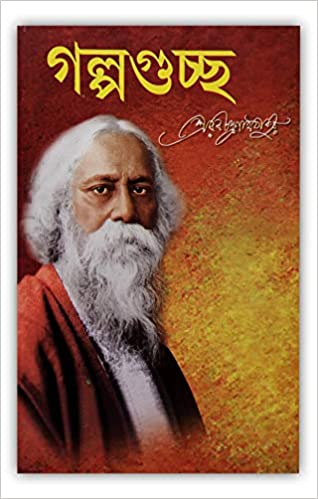
Written in 1916 by Rabindranath Tagore, ‘Aparichita’ is a short story featured in his ‘Golpo Guchho’ (A Collection of Stories). It has been translated from Bengali by Aruna Chakravartias The Stranger.
Goplo Guchho, a collection of 95 short stories was originally published in five parts by Indian Publishing House from 1908-1909
The Stranger
I am twenty-seven years old today. My life has been unremarkable, so far, both in terms of length and quality. Yet it is not without value. It can be compared to that of a flower on whose breast a honeybee had nestled once, leaving behind a faint glimmer that germinated and swelled into a tiny ball of fruit.
Something similar happened to me. The encounter was brief; almost ephemeral. In chronicling the events I shall be brief too. But make no mistake. Though short, my story should not be passed over unread. Those who take the trouble to go through it will find meaning in it.
I am well educated. I have passed all my college examinations with ease. I am good looking too. When I was a child my school masters would mock my pretty face. Simul phul they would call me. Makal phal. Simul is a flower and makal, a fruit. Both have gorgeous exteriors but are of no use to anyone. The first is totally lacking in fragrance and the second in flavour. I would shrink with shame and resent the unfairness of these remarks. But as I grew older, I told myself that if another birth was granted to me, I would like it to be a replica of this one. My face should be as handsome and those of my schoolmasters as twisted with derision as when I was a lad.
My father had been poor once. In later life he made a lot of money. However, his profession as a lawyer demanded so much time and effort that he never got a chance to enjoy any of it. He must have heaved a sigh of relief when he died. For the first time he had been granted a rest.
My upbringing was left to my mother. Having come from a poor family she never lost sight of the fact that she was a wealthy woman. Nor did she allow me to do so. As an infant I remember being carried long after I had learned to walk. As a result, I never really grew up. I still look amazingly young for my age. I could easily pass for the elephant headed god’s younger brother nestling in his mother Annapurna’s lap.
After my father’s death, my maternal uncle took charge of our affairs and became my guardian. Mama[1] was only six years older than me. But, like the parched sands of a subterranean river, he steadily sucked away everything we had… assets, liabilities, hopes, cares, dreams and aspirations. The draining had been so thorough that we were unable to access anything on our own. We had to dig into him for every drop. In consequence, I lived a life totally shorn of responsibility.
Fathers of marriageable daughters could not but consider me a good catch. I had no bad habits. I’d never even touched tobacco. I was simple and good tempered. That’s because being simple and good tempered made life easy for me. I obeyed my mother because I lacked the guts to disobey her. I was prepared to allow this quality full play in future. Girls permitted to choose their own husbands would do well to keep this in mind, when making their choice.
As soon as the time was ripe, marriage proposals from the best families started to pour in. But my uncle, who was the Chief Agent of the Dispenser of my Destiny, had very definite ideas of what constituted a good match. The girl had to come from an impoverished family for only then would she keep her head bowed and be humble and obedient. On the other hand, what was the value of a daughter-in-law who didn’t bring a substantial dowry? My uncle’s requirements were simple. The father had to be poor yet ready to give him all the money he wanted. He must be the kind of man Mama could milk with ease yet wasn’t obliged to treat with respect. One who wouldn’t complain if he was offered tobacco in the coconut shell hookah meant for subordinates instead of the lordly silver albola he smoked himself.
My friend, Harish, works in Kanpur. On one of his visits to Kolkata, he said to me, “O hey! Speaking of brides, I know an excellent girl.”
I was in a state of limbo at the time. I had passed my M.A. some months earlier. Now there was nothing for me to do. I didn’t have to study or look for a job. Nor was I required to poke my nose into any of my financial affairs. No work, no worries, no opinions were expected of me. A desert of indolence and inactivity stretched before my eyes. I was consumed with thirst for something; someone… I had no idea who or what I was searching for.
In this frame of mind Harish’s words struck a chord in me. My mind and body trembled with an unknown emotion — the way newly budding leaves on the boughs of a bakul[2] tree shiver and quiver with the first warm winds of spring, throwing dancing patterns of light and shadow on the ground. Harish had a romantic side to him, and he spoke with tenderness and passion. He described the girl in words that fell like a sweet shower on my shrivelled soul. I looked at him with star struck eyes, “Why don’t you speak to Mama, Harish?” I begged.
Harish was ready to oblige. He was a great entertainer, and everyone enjoyed his company including my uncle who, once they sat down to a chat, was loath to let him go. Mama, of course was more interested in the girl’s father than in her. From Harish’s description he came to know that, though wealthy once, the gentleman was now in straitened circumstances. However, there were still some good scrapings left in the pot of gold bequeathed to his family, years ago, by the goddess Lakshmi. Unable to keep up the lofty standards set by his forefathers, he had decided to leave his ancestral village and settle in a small town in the west where no one knew him and he could live a simple life, without worrying about lost prestige. He had just this one daughter, no one else, so he wouldn’t hesitate to pour the contents of the pot into the hands of one who ensured her happiness. What could be better? My uncle was thoroughly convinced that this was the man he was looking for.
So far so good. But there was one worrying factor. The girl was fifteen. Why had she been kept unwed for so long? Was there some flaw in the family? “Arre na na[3]” — Harish hastened to explain. The father was very picky. He hadn’t found anyone he considered worthy of her, so far. He didn’t mind waiting till the right boy came along. But the girl’s age did. Refusing to stop at her father’s command it had marched on at its accustomed pace. Harish’s ability to charm his listeners and lull their fears, worked. Mama was persuaded to look into the proposal.
Mama considered any place outside Kolkata to be as alien and exotic as the islands of the Andaman. The furthest he had travelled in his life was to Konnagar. If he had been Manu[4], he would have forbidden the crossing of Howrah Bridge, in his Samhita[5], for who knew what dangerous territory lay beyond it? There was no question of his leaving Kolkata, so my cousin Binu was sent to Kanpur to conduct the negotiations and, if all went well, seal the new relationship by a ritualistic blessing of the bride. Mama had full faith in Binu da[6]’s good sense, good taste and sagacity. I would have liked to go with him and see the girl but couldn’t summon up the courage to ask for permission. I didn’t even dare ask to be shown a photograph.
Binu da returned satisfied. “She’ll do…,” he muttered, “pure gold.”
He tended to speak in monosyllables and was extremely reticent in his praise. Where another would have exclaimed “Wonderful!” or “Excellent!” he mumbled, “Not bad”. His “She’ll do” was ample affirmation. It was clear to all of us that Fate had smiled on me. Prajapati, the God of marriage, had given the nod.
As was to be expected, Mama decided that the wedding would be held in Kolkata. The resultant effect was the bride’s father was forced to make all the arrangements in a city of which he knew nothing. Shombhunath Babu was a handsome man of about forty. There were traces of silver in his whiskers though not in his hair which was black and plentiful. He had the kind of good looks that compels attention even in a crowd. The immense trust that he reposed in Harish was evident from the fact that he agreed to the marriage without seeing me. He set eyes on the one who was to be his son-in-law only three days before the ceremony.
I fervently hoped that he liked what he saw. It was difficult to tell. He spoke little in a very soft voice and listened quietly when Mama’s tongue wagged vigorously with exaggerated accounts of our wealth and status and our reputation as one of the first families of Kolkata. I squirmed with embarrassment under that gentle, probing gaze. But Mama’s enthusiasm would not be dampened. He went on and on. He probably assumed, from Shombhunath Babu’s subdued voice and manner, that the man was spineless and easily intimidated. The thought must have filled him with glee for, in fathers of brides, this quality was deemed a virtue. He remained seated when his guest rose to take his leave. He didn’t think it necessary to escort him to his carriage.
The cash component of the dowry had been agreed upon already. Mama, who prided himself on his extraordinary skill in negotiation; his well-honed ability to extract the best deal for himself in any given situation, now turned his attention on the quality and quantity of jewels that would adorn the bride’s person. Polite but pointed questions elicited the response he desired. Enough would be given to satisfy the most determined of blood suckers. I had no idea of what was going on between the two guardians. To tell the truth I wasn’t interested. Financial affairs were not my business. Besides I was confident that, in any battle of wits, Mama would emerge the winner. It mattered little that we didn’t need the money or that Shombhunath Babu was being squeezed dry. I was proud of Mama as were we all.
The turmeric ceremony was conducted with a lot of fanfare. So many trays of gifts were sent to the bride’s house with so many maids and servants carrying them, that doling out the necessary tips must have been a financial drain on her father. Exchanging gleeful remarks about the poor man’s distress and helplessness, Ma and Mama had a good laugh.
The wedding day arrived. The bridegroom’s procession was led by a mighty concert of drums, trumpets, flutes and fiddles. This set up such a pandemonium of discordant sounds that the noise could be compared to a stampede into Saraswati’s lotus garden, by a herd of mad elephants, violent enough to force the goddess of music to flee to safer havens. Covered with brocade and precious gems, I looked exactly like a jeweller’s shop in the middle of an auction. I had to prove to the bride’s father, had I not, the worth of the son-in-law he had had the good fortune to acquire? It was a battle of prestige and I rushed headlong to win it.
Mama was not impressed by the wedding venue. The assembly hall, to which the bridegroom’s party was ushered, was small and the seating somewhat constricted for the number of guests we had brought. The arrangements were on an ordinary scale, hardly befitting our family’s wealth and position. He was also a bit miffed by Shombhunath Babu’s behaviour. He found it strange. Rather cold and distant. If it weren’t for another man’s servile bowing and scraping, oily smiles and folding of hands, Mama might have felt incensed enough to walk out of the house with the bridegroom in tow. This was a lawyer friend of the bride’s father—a hulk of a man with a huge bald head and a very dark complexion. That he was in charge of the logistics was obvious from the greasy sheet he had wrapped around his middle and the cracked voice that was clearly the result of having shouted orders all day. The good thing was that, unlike the bride’s father, he was aware of the niceties of social behavior and what was owing to the groom’s party. He smiled and swayed his heavy head at everybody and addressed strings of flattering words to each, from the cymbal player in the band to the most distinguished of the wedding guests.
Shortly after our arrival Mama took our host aside and whispered something in his ear. The two walked out of the room. I don’t know what transpired between them but, within a few minutes, Shombhunath Babu returned. “Babaji!” he said, “Your presence is needed. Please come with me.”
The problem was a simple one. Some persons, not all, are ruled by a single compulsion. Mama was one of them. He had a goal before his eyes of which he was determined never to lose sight. This goal, he would never forgive himself if he failed to reach it even in the tiniest degree, was that he would never allow anyone to get the better of him. He had a horror of being cheated. The bride’s father had promised a good amount of jewellery. But could he be trusted to keep his word? The man seemed somewhat tight-fisted judging from the tips and return gifts the servants, carrying the turmeric, had brought back with them. Who knew if the bridal ornaments were of the weight and purity of gold promised? The sensible thing to do was to have their worth assessed before the rituals commenced. To wait till after the ceremony would be an exercise in futility. Thus, with due caution and good sense, he had included our family goldsmith in the wedding party.
My future father-in-law led me to a small room. It was empty, except for Mama who was seated on a chowki[7], and the goldsmith who sat on the floor with his scales, weights and touchstones spread out before him.
“Your uncle wishes to have the girl’s jewels tested before the ceremony,” Shombhunath babu looked at me with a strange expression in his eyes. “What do you say?”
I hung my head in silence.
“Why should he say anything?” Mama answered for me. “It’s what I want that counts.”
“Is that so? Do you endorse your uncle’s statement?” The gentle, thoughtful gaze unnerved me. Not knowing how to respond I tilted my head expressing assent. Financial affairs were handled by guardians. What right did I have to interfere?
“Very well.” Shombhunath Babu murmured. “The trouble is…it will take some time to remove the jewels. The bridal toilette is complete, and my daughter is wearing them already. Had I known….no matter… please stay here till I return.”
“Why?” Mama cried out surprised. “Why should he stay here? Go back to the hall, Anupam, and join the others.”
“No.” Shombhunath Babu’s voice was soft but firm. “He will stay here.”
He left the room and returned after half-an-hour with a bundle wrapped in a gamchha[8]. Spreading out its contents on the chowki, he invited the goldsmith to begin his examination. The goldsmith’s practiced eye told him the worth of what he saw in an instant. “There’s no need to examine anything,” he said, “The gold is hundred percent pure. Not a trace of alloy. Look.” Picking up a bangle he pressed it gently. A tiny dent appeared. “These are obviously from a bye gone era. Nothing like this is fashioned anymore. The girl’s grandmother’s perhaps?” He threw a questioning glance at our host.
The moment he heard this Mama whipped a notebook out of his pocket and started listing the ornaments one by one. He had to make sure that everything he had been shown would find its way into the family vault. A pleased smile appeared on his face. They were far more in number and of greater weight than he had expected.
Now, Shombhunath Babu picked up a pair of earrings from the pile. “Kindly examine these and let me know their value,” he said. The goldsmith turned them over in his hands. “Bought from an English shop,” he curled his lips disdainfully, “They have hardly any gold to speak of.” Shombhunath Babu took them from him and handed them to Mama. “Keep these with you,” he said. Mama’s face flushed a deep red with embarrassment. They were the earrings he had sent with Binu da for the bridal blessing.
“Go Anupam.” He tried to recover his composure. “Go sit with the others in the assembly—”
“No. No.” Shombhunath Babu interrupted smoothly. “There’s no need to go to the assembly hall just now. Dinner, for the bridegroom’s party, has been served and your guests have proceeded to the dining area. Let me take you there.”
“What!” Mama exclaimed, “Eat now? Before the ceremony begins…?”
“The auspicious hour is far off. Why wait till then? Please come with me.” There was something in his voice, a strength that came from a long habit of command, that compelled obedience. Mama rose meekly and followed him out of the room.
The meal, though not ostentatious, was well-cooked, neatly served and plentiful in quantity. The guests ate to satiety and were well content. Shombhunath Babu invited me to join them, but Mama was aghast at the suggestion. “What nonsense!” he cried forcefully, “How can the bridegroom sit down to a meal before the rites have begun?”
Shombhunath Babu ignored the outburst. “What do you say?” His eyes looked into mine thoughtfully. As though he expected a reaction. Any reaction. But I remained silent. What could I say? How could I go against the express wishes of my uncle and guardian?
“Very well then.” Shombhunath Babu turned his attention back to my uncle. “You have taken a lot of pains and come a long way,” he said pleasantly. “My hospitality, I’m afraid, has not met the standards your illustrious family is used to. I’m a poor man. Please forgive me. I do not wish to trouble you any further.”
“It’s alright. It’s alright.” Mama waved his hands in the lordly manner he used to reassure his inferiors and demonstrate his generosity. “Let the ceremony begin. I’m ready…”
“It will take a few moments for your carriages to arrive. Kindly wait till then.”
“What!” Mama’s eyes nearly popped out of his head. “Is this a joke?”
“You are the one who has turned a serious affair into a joke.” Shombhunath babu answered calmly. “How could you even think that I would steal my own daughter’s jewels? What sort of people are you? I am sorry but I cannot give my daughter in marriage to a family like yours.” He looked straight into Mama’s eyes ignoring me completely. He didn’t glance at me even once or try to gauge my reaction. He seemed to have made up his mind that I was nothing.
What happened after that? As was to be expected the groom’s party shouted and cursed, broke the furniture, smashed the chandeliers and having completed the carnage to their satisfaction made their way home. The band that had pronounced its entry into the wedding venue with such a cacophony of sounds now slinked along the streets in funereal silence. The lamps had burned out and the only light that guided the mournful procession came from the stars.
The rest of the family was wild with fury. Had anyone even dreamed, let alone seen or heard, anything like this? Such arrogance in a bride’s father! What did the man think of himself? “Let’s see how he secures another match for his precious daughter,” the women cried out to one another, “The world doesn’t run according to his whims and fancies. Wait and watch. He’ll be taught the lesson of his life.”
Which was all very well. But what was the point of cursing a man with the eternal spinsterhood of his daughter if he was prepared to keep her unwed all her life?
In the whole of Bengal, I was the only bridegroom with the distinction of being turned away from the wedding venue. I, who was so eligible! Such an excellent catch! And to think that the stigma stamped on my brow had followed such a jingoistic display of wealth and status from our side! Everyone was laughing at us. Mama’s breast burned with rage and humiliation. The thought that stung him most cruelly was that the wily father of the bride had outwitted him. How cleverly he had managed to feed him and his party, keeping them in his debt forever, before sending them packing! The insult was not to be borne. “I’ll sue the scoundrel for defamation and breach of promise,” Mama shouted as he stomped about the house. “I’ll make sure he spends the rest of his days turning the grinding stone in jail.”
At this point some of his well-wishers stepped in. If he tried anything of the sort, they warned, he would lose the few shreds of dignity he had left. The farce would be complete.
Needless to say, I was fuming too. “If only some disaster were to strike the man,” I thought over and over again,” he would regret his folly and come rushing to my feet begging for forgiveness…” I wished fervently for something terrible to happen. I lined up all kinds of possibilities tugging at my whiskers in nervous anticipation.
Yet, running parallel to this dark stream of hate and malice, was another. Irradiated with light. My thoughts had been submerged in its waters all these months and would not be dismissed. No matter how hard I tried, I couldn’t pluck out the image of the unseen maiden which had taken root in my heart. Her face had possessed me entirely and continued to do so. I saw a brow adorned with sandal paste. Cheeks flushed a deep rose in shy expectancy. A form draped in red silk, glittering with jewels. In the fantasy world I inhabited she was a golden creeper, ready and waiting to shower her wealth of spring blossoms at my feet. One moment, another step, and I could have claimed her. But the moment had stretched to eternity. A mighty wall had appeared between us, and I had lost sight of her…
Ever since Binu da’s return from Kanpur I had made it a point to visit him, every evening, and pester him with questions. Being extremely economical in language and expression he had said little. Owing to that very fact, perhaps, the few words he uttered sent sparks flying into my soul and set it aflame. I was overwhelmed with a sense of the girl’s beauty. It was not of this world. It was ethereal.
I had waited patiently for the moment when the imagined would transform to reality. When I would see, with the eyes of the flesh, what I had only dreamed about. But alas! Fate had beguiled me with false hopes then dashed them to the ground. A thick veil of mist had risen between us. She had disappeared beyond it, and I was left on the other side, lurking like a ghost.
The girl had been shown my photograph… so I’ve heard from Harish. I’m sure she approved of what she saw. Why wouldn’t she? My heart told me that she has kept it hidden in a secret drawer. And on lonely afternoons, secure in her room with doors and windows locked against prying eyes, she would take it out and look longingly at it. I saw her bending forward to examine it more closely, her beautiful hair falling on both sides of her face in long shining strands. And the moment she heard footsteps, she would hide it quickly in the scented folds of her sari.
The days passed, one by one. No one mentioned marriage. Mama was still nursing his grievance and Ma thought it preferable to wait till people have forgotten my humiliation.
Harish told me that good matches were found for the Kanpur girl, but she had taken a vow to remain unwed. The news filled me with elation. My inner eyes could see her… pale and worn with longing for me. She ate little and that, too, when she was forced. Dusk[9] would set in but she would forget to braid her hair. Her father looks at her and wondered. “What has happened to my girl? Why is she so changed?” Sometimes, he would walk into her room and find her sitting by the window, her eyes streaming with tears.
“What is the matter Ma?” he would ask tenderly. “Tell me the truth. Is something troubling you?”
“Why, no Baba.” She wiped her eyes quickly and rose to her feet. “Nothing is wrong.”
The father’s heart would sadden. She was his only child. His pride and joy. How could he bear to see her thus? How could he stand by and watch a delicate bud, just about to open its petals, wilt and wither in the hot dry winds of a rainless summer? He decided to swallow his pride. He would rush to our door and beg pardon with abject humility…
After that…what?
The stream of hate that lay coiled within me unwound and stretched to its full length. “Tell the girl’s father to make fresharrangements,” it wouldhiss like a poisonous snake. “Let lights blaze and guests arrive from far and near. Then, just when the ritualsare about to commence, gather the bridegroom’s party together and walk out of the wedding venue with a smile.”
But the other stream, pure as a lover’s tears, appeared before me in the form of a milk white swan. “Set me free,” it pleads. “As Iflew to Damayanti’s[10] garden, aeons ago, so let me wing my way to the beloved one and whisper the joyful tidings in her ears.”
The dark night ended, new rain fell, the drooping flower raised its face. The wall crumbled and made way for me. Only me. The others were left behind. And then…?
My story ended here.
But no. It wasn’t the end. I’ll come to the point at which it was left hanging and conclude my narrative.
I was accompanying my mother on a pilgrimage to some holy cities of the north. I had been entrusted with the task since Mama, as I’ve said before, was so averse to travelling that he hesitated to even cross the Howrah Bridge. Tossed this way and that by the swaying of the train, I slept fitfully, dreams dancing in shards in and out of my head. Suddenly, it came to a halt, and I awoke. My eyes beheld an expanse of light and shadow the like of which I had never seen before. I was still in the throes of my dream, I think, because everything looked remote; unreal. I felt I was in another world. Only the few lamps burning on the station platform seemed vaguely familiar.
I turned to Ma who lay sleeping on her berth, the green curtain shielding her eyes from the light. Boxes and bundles, dislodged from their places by the movement of the coach, lay scattered. I hadn’t come out of my dream fully, perhaps, because even this common place scene appeared surreal in my eyes. The scattered objects, the dim green light…I felt I was floating in a space between existence and non-existence.
Suddenly the silence of the night was broken. “Come,” someone cried out, “Come quickly. There’s space here.” My heart leaped upon hearing the Bengali language spoken in a feminine voice. Was what I had just heard a string of words?Or was it a song? I wondered at myself. Did I react the way I did because the voice belonged to a member of the opposite sex? No, I’m quite sure that wasn’t the reason. Perhaps I had been yearning to hear my mother tongue through all these months of staying away from my roots. Have I heard anything like this before? I asked myself, feeling awed and humbled. Opening the window, I looked out. There was no one there. The guard waved his lantern and the train started to move.
All my life I have found myself being moved by a beautiful voice. Beauty of face and form has its own attraction but the human voice, I’ve always felt, expresses that which lies deep within the soul. Though I could see nothing with the outer eye a form started taking shape within me. Like a star-studded sky which wraps one in its folds but does not brush the skin, it slid deep into my soul making music as it went. You who are so perfect; so complete! I called out to that divine melody. You bloom like a flower on the bruised heart of a capricious age and let its winds pass over you. Yet not a petal is blown away. Not a speckappears on your pristine purity.
The train picked up momentum. The rattle was as metallic as before, falling like strokes on an iron drum. But, strange to say, it made music in my ears. There’s space here… I heard with every beat… there’s space here. But was there a space? In this self-absorbed world did anyone concede space to another? Did anyone know the truth about another? Yet, this not knowing, I was convinced, was a web of mist; an illusion. Once torn apart all would stand revealed. Recognition would be complete.
“ I know you,” my heart murmured to the one who was once a stranger, “I’ve known you from the beginning of time. You called out to me, ‘Come quickly,’ you said. I’ve come to you. I haven’t wasted a moment.”
I couldn’t sleep the whole night. At every station I opened the window and looked out, fearing that the unseen one would depart unseen…
We got down, the next morning, at a junction station where we had to change trains. Since I had reserved seats in a first-class compartment, I was not worried about being caught in a crowd. But the sight that met my eyes filled me with dismay. The platform was choc a bloc with sahebs and their orderlies. Some army general, out on a pleasure trip with his cronies, was waiting for the train which arrived, a few minutes later, crammed with passengers. I realised that travelling first class was out of the question and felt a stab of anxiety. Where, on this crowded train, would I find place? I ran up and down the platform peering into every window when a girl, standing at the door of a second- class compartment, called out to my mother. “Why don’t you come to our coach? There’s space here.”
I looked up startled. The same voice. The same words. There were only a few moments left for the train to leave. I helped my mother up then, climbing in, I called out to the coolies to stow the luggage. Just then the train started moving. Overcome with panic I stood helplessly, not knowing what to do. Who was worse equipped than me to deal with a situation like this? But the girl, with extraordinary dexterity, snatched the boxes and beddings from the hands of the running men and flung them on the floor. In the commotion of the moment, an expensive camera of mine was left behind. I made no effort to retrieve it.
What happened next? A perfect bliss pervaded my being of a kind impossible to put in words. How shall I even begin to describe it? Stringing a bunch of words together seems meaningless. They would express nothing.
The music I had only heard so far had assumed a shape and appeared before our eyes. I glanced at Ma. She was staring at the girl with such rapt attention that not an eyelash flickered.
She was about sixteen or seventeen. But the shy diffidence of approaching womanhood, so common in girls of her age, sat lightly on her. Her gaze was clear and unflinching, her gestures free, and there was a purity in her face and form the like of which I had never seen before. Not a trace of timidity or unease marred the natural grace of her movements.
What I felt at the time went beyond what I saw. To tell the truth, I can’t even recall the colour of the sari she wore. All I remember is that she was dressed very simply and that I was filled with a sense that externals held no meaning for her. She rose, slender and upright as a tuberose stalk, above the plant that had given her birth. Above the earth in which it was embedded. Her fragrance was hers alone and came from within.
I sat in one corner, my eyes glued to the pages of a book. But my ears were keenly attuned to the excited voices of the little girls who were travelling with her. I marvelled at the way she became one with them. Though considerably older she was totally at ease, and they laughed and joked merrily together. The little ones had an illustrated storybook out of which they were pestering her to read a story. I gathered, from their chatter, that they had heard it several times yet wanted to hear it again. I understood why. It wasn’t the story. It was her voice they wanted to hear; the golden voice that reinvented as it went along and made everything sound new. That, springing from the heart like a fountain, filled their ears with music. I found myself responding in much the same way. Her presence made my sun shine brighter. My sky was more intimate in its embrace. My heart was washed by the pristine waters that emanated from the one who was still a stranger…
At the next station she beckoned to a vendor and bought an enormous cone of spiced gram which the whole party proceeded to eat with gusto. My nature was so hedged in by restrictions that, though tempted, I couldn’t bring myself to ask for some. “Stupid me!” I thought, “this was my chance of speaking with her. Of letting her know I wanted something from her…”
The moment passed.
From the expression on Ma’s face, I realised that she was puzzled. She couldn’t decide what to make of our travelling companion. The way she was wolfing down large handfuls of the crunchy mixture, that too in the presence of a male, was surely reprehensible in a girl of her age! Yet, and this too I saw in Ma’s eyes, one couldn’t really think of her as shameless and greedy. There was an innocence about her, a lack of self-consciousness that proclaimed the fact that, though adult in years she was a child at heart. Perhaps she didn’t have a mother and hadn’t been taught the niceties of feminine deportment. Ma is not a garrulous woman. She cannot converse easily with strangers. I could see that she wanted to find out more about the girl, but her natural reticence stood in the way.
The train stopped at a large station and a group of sahebs, clearly belonging to the general’s entourage, came in. Striding purposefully up and down the compartment they scanned the seats with eagle eyes. There wasn’t an inch of extra space and they left.
A few minutes later a railway employee, a native, entered with two name cards which he proceeded to hang on the seats we were occupying. “These are reserved seats,” he told me, “You’ll have to move to another compartment.” Ma’s face turned pale and even I felt a pang of apprehension. But before I could say or do anything someone spoke in Hindi. “No,” the familiar voice was cool and confident, “We won’t give up our seats.”
“You’ll have to,” the man answered roughly, “There’s no other way.”
The girl left the train and returned with the station master, an Englishman who was clearly embarrassed by what he was being forced to do. “I’m sorry,” he looked at me with a rueful smile, “But these seats are—”
I rose to my feet and started walking towards the exit calling “Coolie! Coolie!” as I went. Suddenly I had to stop in my tracks. The girl was standing before me. “No,” she said firmly, “You’re not going anywhere. Please return to your seat.” Turning to the station master she said in flawless English, “That’s a lie. These seats are not reserved.” Plucking the name cards off the seats she flung them out of the window.
The man who had been allotted the seats was standing at the door instructing his orderly to stow his luggage. He stared in shock at the cards flying out of the window and, unable to meet the fire raining eyes, turned away. Plucking at the station master’s sleeve he whispered something in his ear. I have no idea of what transpired between them. All I know was that the departure was delayed for a while and a new coach fitted to the train.
Kanpur station arrived. Our travelling companions rose and started gathering their belongings. My mother, who had sat in silence all this while, could hold herself in no longer. “What is your name Ma?” she asked.
“My name is Kalyani.”
Ma and I threw startled glances at one another.
“Your father?” Ma’s voice was a whisper.
“He’s a doctor. His name is Shombhunath Sen.”
CONCLUSION
Setting my mother’s wishes firmly aside, disobeying Mama’s express command, I went to Kanpur. I met Kalyani and her father and apologised on my own and my family’s behalf with folded hands. The latter’s heart seemed to melted but the former remained firm in her resolve. She would not marry.
“Why not?” I asked.
“I follow my mother’s command.”
But she didn’t have a mother. I was wild with desperation. Was there another maternal uncle, then, lurking somewhere? Was history repeating itself?
It didn’t take me long to arrive at the truth. Her mother was Bharat Mata. After the fiasco of the wedding, she had taken a vow to dedicate herself to her country. And how better to do that than spend her life educating girls of the land?
But I did not give up hope. A stream of music, the like of which I’d never heard before, had crept into my ears from out of the dark and seeped into my soul. That exquisite melody played in my heart, all day long, like the strains of a flute from another world. It became the lodestar of my being; the refrain of my life-song.
I was twenty- three then… I’m twenty- seven now. I have shed my uncle. He is no longer part of my life. And my mother, perhaps because I’m her only son, has preferred to remain with me.
If you are under the impression that I nurture hopes of marriage–you are wrong. All I live for is hearing that voice speak the same words There is space. Of course, there is space. There has to be. If there wasn’t, where would I find the ground to stand on?
Years have gone by. I’ve stayed on here. I see her from time to time. I hear her voice. She entrusts me with small tasks, and I carry them out. This is the space I’ve needed and dreamed about. “O stranger!” my heart calls out to her, “you will forever remain a stranger for there is no end to knowing you. Yet I’m grateful. My destiny has been kind to me. It has granted me the space I’ve yearned for all my life.”
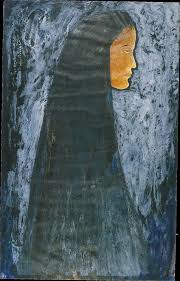
Painting by Tagore Tagore (1861-1941) Courtesy: Creative Commons
[8] Traditional thin, coarse cotton fabric often used in lieu of a towel
[9] Traditionally, women were supposed to tie their hair especially in the evening.
[10] Nala Damayanti, a story from Mahabharata, where the couple were parted before they were reunited.
Aruna Chakravartihas been the principal of a prestigious women’s college of Delhi University for ten years. She is also a well-known academic, creative writer and translator with fourteen published books on record. Her novels Jorasanko, Daughters of Jorasanko, The Inheritors, Suralakshmi Villa have sold widely and received rave reviews. The Mendicant Prince and her short story collection, Through a Looking Glass, are her most recent books. She has also received awards such as the Vaitalik Award, Sahitya Akademi Award and Sarat Puraskar for her translations.
.
PLEASE NOTE: ARTICLES CAN ONLY BE REPRODUCED IN OTHER SITES WITH DUE ACKNOWLEDGEMENT TO BORDERLESS JOURNAL
Ratnottama Sengupta shows the impact of Gandhi and his call for non-violence on her father, Nabendu Ghosh as she continues to emote over his message of Ahimsa and call for peace amidst rioting
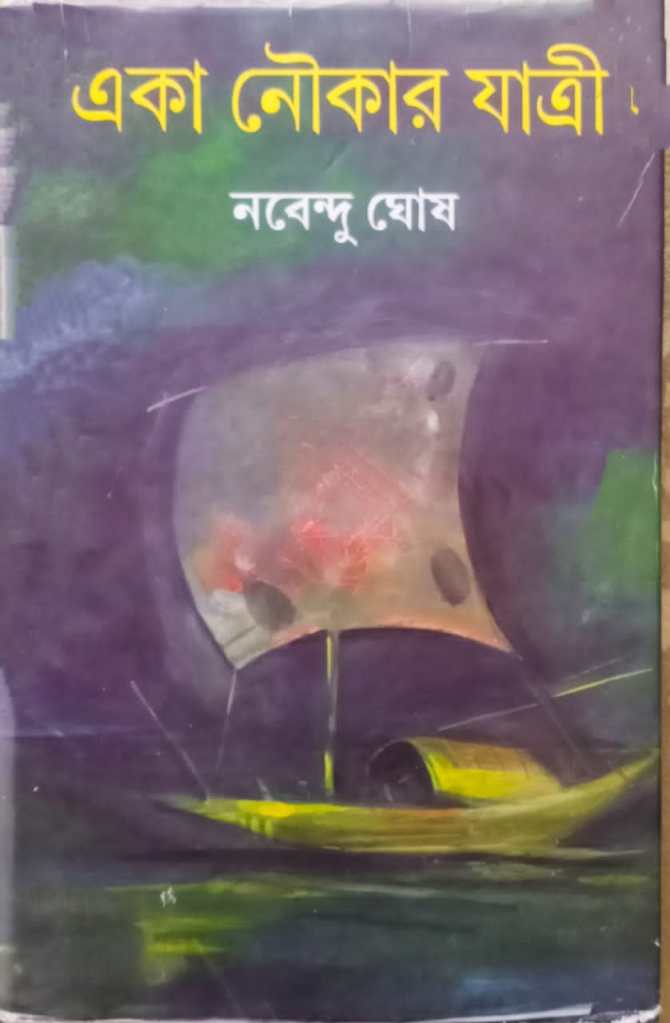
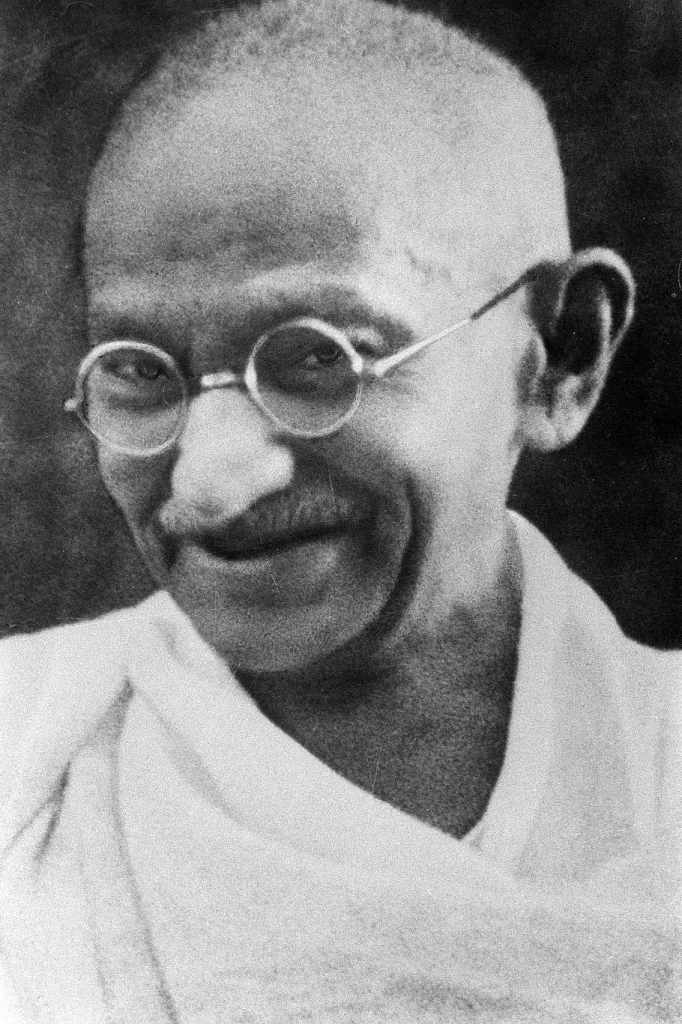
Eka Naukar Jatri (Journey of a Lonesome Boat)Gandhi. Courtesy: CReative Commons
The ferocity and senselessness of riots — Nabendu Ghosh had personal experience of both. In his autobiography, Eka Naukar Jatri (Dey’s Publication, 2008, Journey of a Lonesome Boat), he writes at length about grappling with the riots that had rocked Calcutta, Bengal — nay, the entire Subcontinent on 16th August 1946.
The Direct Action Day call was given out by Mohammad Ali Jinnah to press the demand for a separate Muslim State, Pakistan. The epicentre was Calcutta, a flourishing centre of business and education, that had Suhrawardy of Muslim League as its chief minister. On that black Friday, they unleashed unprecedented bloodletting along communal lines. At least 4000 deaths were reported on the very first day of the ‘Great Calcutta Killing’ that continued for more than four days. Many women were raped, many were kidnapped, many killed and hung naked in public areas… Dismemberment, forced conversion, bustees set on fire… Violence spread to Khulna in East Bengal, and Bihar. Within a year the hatred ignited on religious grounds culminated in the Partition of India.
The savagery of the mindless bloodbath had left such a deep dent on the yet-to-be-thirty writer, that he wrote a number of stories and novels on the theme: Phears Lane, Dweep, Trankarta, Ulukhar, ‘Chaaka’(Full Circle), and ‘Gandhiji’.
Gandhiji builds majorly on the author’s own memories of a darshan[1]of Mohandas Karamchand Gandhi while he was passing through Patna, sometime in early 1931. This is how he records his ‘encounter’ with the Saint of Sabarmati who worked magic on the masses with the mantra of Ahimsa, non-violence.
“By 1930 all of India and its British rulers too were uttering one name with awe: Gandhi. One evening it came to my ears that the Mahatma would reach Patna at 7 am the next morning, spend the day in the city and leave by the Punjab Mail at night.
“I did not sleep well that night. I was up at the crack of dawn and left home at 5 am on the pretext of getting a book from a friend. But I could not get anywhere near the Patna railway station, which was teeming with people who had arrived before sunrise. It was no different along the path he would be driven down. I hung around at one end of the platform, eyes glued to the exit gate.
“Policemen on horseback trotted past me. A police van was parked close by. Those patrolling the platform carried bayonets and batons. Because of my green years and my small built, I was allowed to inch ahead. From time to time the sky was rent with the cry of ‘Mahatma Gandhi ki jai! Long live the Mahatma!’
“All of a sudden, perhaps to steel myself, I started to whisper: ‘Vande Mataram! I salute you, my Motherland!’ As if on a cue, the man next to me cried out aloud: ‘Vande Mataram!’ The crowd roared in an echo: ‘Vande Mataram! Vande Mataram!!’
“Suddenly a train rolled in with a long whistle. And people all around me broke into the cries of ‘Mahatma Gandhi ki jai!’ ‘Bharat Mata ki jai!’ ‘Vande Mataram!’ I found myself matching their voice…
“Soon people started saying, ‘There he goes…’ Some cars came forward with Gandhi-topi clad volunteers. And then, there was the face so familiar from the newspapers, peering out of a hood-open Ford. Mahatma Gandhi, clad in a knee-length khadi dhoti, a chadar draped over his bare torso, a volunteer on either side, was greeting everyone with folded hands. What an inspiring image!
“I also broke into the cry of ‘Mahatma Gandhi ki jai!’‘ The crowd had started running behind the moving car. I joined them, without a pause in the slogan. A few paces later, I bumped into someone and fell down by the wayside. As an elderly gentleman lifted me up and soothingly dusted me off. I felt a resolve surface in my thoughts: ‘Freedom must be won!'”
*
Nabendu Ghosh may or may not have had another prototype for the protagonist Ratan in Gandhiji. But it is said there actually lived close to College Street — where Nabendu lived at the time — a person named Gopal Mukherjee who owned a meat shop. He was a devotee of Subhash Chandra Bose and a critique of Gandhi. Reportedly this ‘paatha‘ — butcher — was funded by some Marwari businessmen and he led his team to retaliate from the fourth day of riots. After Independence, when he was urged to surrender his guns, knives and sword to Gandhiji, he apparently refused, saying, “I would willingly lay down my arms for Netaji, but not for Gandhiji. Why didn’t he stop the killings in Noakhali?”
The author may have woven in some traits of Gopal Paatha but, like a mirror image that is identical yet opposite, his protagonist Ratan is transformed by the iconic personality so that he surrenders his weapons — expressed symbol of violence — at the feet of the Mahatma.
*
As I watched Kamal Hasan’s Hey! Ram (2000), I was reminded of this story, ‘Gandhiji’ that was published in the collection Raater Gaadi (The Night Train) in 1964. Perhaps unknowingly the character played in the film by Om Puri reflects the protagonist Ratan.
In Hey! Ram, A rioteer who has snuffed out scores of lives walks up to the fasting Gandhi in Beliaghata, throws a roti towards him and says, “I have bloodied my hands with many lives but I will not have your death on my conscience.” He resonates Ratan, the butcher who finds his biggest high in draining out human blood but once he rests his eyes on the frail sage, something happens deep inside him. He who wondered why his taking a life should matter to ‘Gendo’, stakes his own life to protect a Muslim.
*
Nabendu Ghosh experienced the magic of the Mahatma at age fourteen, long years before he became my father.
I felt the magic of the man whom Rabindranath Tagore gave the name of Mahatma when I was well into my forties, and was doing a Fellowship in Oxford, on a Charles Wallace award, on John Ruskin and his Influence on Gandhi and Tagore.
Then, almost 20 years later, we were at the critical juncture in time when we were completing 70 years of Gandhi’s passing and approaching his Sesquicentennial Birth Anniversary. That is when I started wondering: “What does Mohandas Karamchand mean to those acquiring voting rights in India now? Is he only the face on every Indian currency note? Is he only ‘M G Road’ — the high street of every city in India? Is he a boring memory who forces every one of his countrymen to shun drinking on his birthday?”
Or, is there any valid reason to recall what he said — in Natal and Transvaal and Pietermaritzburg; in Kolkata and Noakhali, Chowri Chowra and Dandi, Bombay and Delhi? Is there anything in his actions that can change the lives of not only Indians but everywhere in the world where people are tired of terror strikes and gunshots and discrimination in the name of caste or creed or colour?
For, influence he certainly did, the lives of so many personalities… Not for nothing was Mohandas of Porbandar to become Gandhiji, Mahatma, Bapu, Father of the Nation.
Ratnottama Sengupta, formerly Arts Editor of The Times of India, teaches mass communication and film appreciation, curates film festivals and art exhibitions, and translates and write books. She has been a member of CBFC, served on the National Film Awards jury and has herself won a National Award.
.
PLEASE NOTE: ARTICLES CAN ONLY BE REPRODUCED IN OTHER SITES WITH DUE ACKNOWLEDGEMENT TO BORDERLESS JOURNAL
Magic(Leela)
Like when a piece of iron falls in love with a piece of wood
Causing the iron to float on water,
Or like when the magic of love casts a spell
Making stone float on liquid,
For ages, in nation after nation,
People contrive to float stones,
For diverse reasons and occasions,
Letting love and desire take diverse forms
In manifold texts and discourses...
A Fragrant Tale(Sugandho-kahini)
The world is full of misleading, minus signs and foul smells
At times, the world feels as heavy and unbearable
As the weight of a son’s dead body on his dad’s shoulder,
Or as stressful as playing the role of a dead soldier,
Or as formidable as a physically challenged person’s ascent up a mountain
Or as painful as caring for a precocious, traumatised child...
Nevertheless, occasionally such stress-laden memories will blur,
And suddenly, wafting on the wind’s sudden mood swing,
A fragrant moment comes one’s way!
Love(Prem)
‘After all words die away, the heart starts speaking.’
When all heartbeats and hullabaloo die down,
Little by little the heart starts fluttering in a distinct metronome
When all words ends, silence begins to reign.
Where mathematics ends, music begins.
Gradually the Role of the Third Actor Becomes Clear(Kromosho Spasto Hoye Othe Triteeyo Praneer Bhumika)
Like in magic, in a seemingly miraculous move,
Two strangers will come together
While a third will have to disappear
To remain awol forever— in reality!
Masud Khan (b. 1959) is a Bengali poet and writer. He has, authored nine volumes of poetry and three volumes of prose and fiction. His poems and fictions (in translation) have appeared in journals including Asiatic, Contemporary Literary Horizon, Six Seasons Review, Kaurab, 3c World Fiction, Ragazine.cc, Nebo: A literary Journal, Last Bench, Urhalpul, Tower Journal, Muse Poetry, Word Machine, and anthologies including Language for a New Century: Contemporary Poetry from the Middle East, Asia, and Beyond (W.W. Norton & Co., NY/London); Contemporary Literary Horizon Anthology,Bucharest; Intercontinental Anthology of Poetry on Universal Peace (Global Fraternity of Poets); and Padma Meghna Jamuna: Modern Poetry from Bangladesh(Foundation of SAARC Writers and Literature, New Delhi). Two volumes of his poems have been published as translations, Poems of Masud Khan(English), Antivirus Publications, UK, and Carnival Time and Other Poems (English and Spanish), Bibliotheca Universalis, Romania. Born and brought up in Bangladesh, Masud Khan lives in Canada and teaches at a college in Toronto.







 Borderless