Categories
Poetry

Poems by Vern Fein

Vern Fein

BOSOM BUDDY

My seven-year-old grandson
is his own best friend.
Has many school buddies
but plays for hours
with his creative self—
art work, Star Wars structures,
films movies on his IPad,
imitates Michael Jackson dances—
never afraid to be alone.

In my childhood, I rode imaginary horses.
Smoky, my invisible steed,
wherever he would gallop.
Then, my green and white Schwinn—
named Los Cappacaros from a Western
about some cool bandits—
took me into my teens.

Imagination
as a childhood playmate,
such a fine gift.


CONVALESCENCE

My dog leaps into
a mellowing life.
Her leg buckles to surgery.
Too young to put down,
she breaks my heart,
a helpless creature,
beautiful big black
eyes, a forlorn quiz.

In my old age, I come alive
to pet and whisper
into her perked ears
why she now lives in a cage
unable to chase
her squirrel foes,
attack the garbage truck
at the back fence,
protect me from the neighbour dog.

In her convalescence
that will never make sense to her
she fills my limited lifetime
as if it will go on forever.

PINOCCHIO

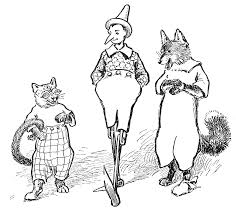
Pinocchio’s nose began to grow.
The cat and the fox whiskered him over.
“What’cha got boy?”
He doesn’t know his nose has grown.
He thinks they want the pennies in his pocket,
the hat Gepetto made him.
Fox says: “What a great nose. How’d you do that?”
He touches his nose and scares his hand.
“I don’t know,” he stammers.
Cat says: “Tell the truth!”

From Public Domain

Vern Fein has published over 300 poems and short prose pieces in over 100 different sites. His second poetry boo, Reflection on Dots, was released late last year. 

.

PLEASE NOTE: ARTICLES CAN ONLY BE REPRODUCED IN OTHER SITES WITH DUE ACKNOWLEDGEMENT TO BORDERLESS JOURNAL

Click here to access the Borderless anthology, Monalisa No Longer Smiles

Click here to access Monalisa No Longer Smiles on Kindle Amazon International
Categories
Editorial

“We are the World”

In 1985, famous artistes, many of whom are no longer with us, collaborated on the song, We are the World, to raise funds to feed children during the Ethiopian famine (1983-85). The song was performed together by Michael Jackson, Willie Nelson, Bob Dylan, Ray Charles, Diana Ross, Stevie Wonder, Smokey Robinson, Paul Simon, Tina Turner, Dionne Warwick, Lionel Richie, Billy Joel and Bruce Springsteen.  The producer, Julia Nottingham, said: “It’s a celebration of the power of creativity and the power of collective humanity.” The famine was attributed to ‘war and drought’.

Over the last few years, we have multiple wars creating hunger and drought caused by disruptions. Yet, the world watches and the atrocities continue to hurt common people, the majority who just want to live and let live, accept and act believing in the stories created by centuries of civilisation. As Yuval Noah Harari points out in a book written long before the current maladies set in, Homo Deus (2015), “…the stories are just tools. They should not become our goals or our yardsticks. When we forget that they are mere fiction, we lose touch with reality. Then we begin entire wars ‘to make a lot of money for the corporation’ or ‘to protect the national interest’. Corporations, money and nations exist only in our imagination. We invented them to serve us; why do we find ourselves sacrificing our lives in their service?”

What Harari says had been said almost ninety years ago by a voice from another region, by a man who suffered but wrote beautiful poetry, Jibanananda Das… and here are his verses —

“The stories stored in my soul will eventually fade. New ones—
New festivals—will replace the old — in life’s honey-tinged slight.”

Jibananda Das, from ‘Ghumiye Poribe Aami’ (I’ll fall asleep), 1934, translated from Bengali by Professor Fakrul Alam

We carry the poem in this issue translated by Professor Fakrul Alam, lines that makes one dream of a better future. These ideas resonate in modern Balochi poet Ali Jan Dad’s ‘Roll Up Not the Mat’ brought to us in English by Fazal Baloch. Korean poet Ihlwha Choi’s translation takes us to longing filled with nostalgic hope while Tagore’s ‘Probhat’ (Dawn) gives a glimpse of a younger multi-faceted visionary dwell on the wonders of a perfect morning imbibing a sense of harmony with nature.

“I feel blessed for this sky, so luminous. 
I feel blessed to be in love with the world.”

--‘Probhat’ (Dawn) by Tagore, 1897, translated from Bengali by Mitali Chakravarty

Starting a new year on notes of hope, of finding new dreams seems to be a way forward for humanity does need to evolve out of self-imposed boundaries and darknesses and move towards a new future with narratives and stories that should outlive the present, outlive the devastating impact of climate change and wars by swapping our old narratives for ones that will help us harmonise with the wonders we see around us… wonders created by non-human hands or nature.

We start this year with questions raised on the current world by many of our contributors. Professor Alam in his essay makes us wonder about the present as he cogitates during his morning walks. Niaz Zaman writes to us about a change maker who questioned and altered her part of the world almost a century ago, Begum Roquiah. Can we still make such changes in mindsets as did Roquiah? And yet again, Ratnottama Sengupta pays homage to a great artiste, filmmaker Shyam Benegal, who left us in December 2024 just after he touched 90. Other non-fictions include musings by Nusrat Jan Esa on human nature contextualising it with Milton’s Paradise Lost (1667); Farouk Gulsara’s account of a fire in Sri Lanka where he was visiting and Suzanne Kamata’s column from Japan on the latest Japanese Literary Festival in the Fukushimaya prefecture, the place where there was a nuclear blast in 2011. What is amazing is the way they have restored the prefecture in such a short time. Their capacity to bounce back is exemplary! Devraj Singh Kalsi shares a tongue-in-cheek musing about the compatibility of banks and writers.

Rhys Hughes’ poem based on the photograph of a sign is tongue-in- cheek too. But this time we also have an unusual exploration of horror with wry humour in his column. Michael Burch shares a lovely poem about a hill that was planted by his grandfather and is now claimed as state property… Afsar Mohammad explores hunger in his fasting poems and Aman Alam gives heart rending verses on joblessness. Poems by Kirpal Singh contextualise Shakespearian lore to modern suffering. We have more poems by Kiriti Sengupta, Michelle Hillman, Jenny Middleton, G Javaid Rasool, Stephen Druce, John Grey, George Freek and many others — all exploring multiple facets of life. We also have a conversation with Kiriti Sengupta on how he turned to poetry from dentistry!

Exploring more of life around us are stories by Sohana Manzoor set in an expat gathering; by Priyatham Swamy about a migrant woman from Nepal and by Naramsetti Umamaheswararao set against rural Andhra Pradesh. While Ahmad Rayees gives a poignant, touching story set in a Kashmiri orphanage, Paul Mirabile reflects on the resilience of a child in a distant Greek island. Mirabile’s stories are often a throwback to earlier times.

In this issue, our book excerpts explore a writer of yore too, one that lived almost a hundred years ago, S. Eardley-Wilmot (1852-1929), a conservationist and one who captures the majesty of nature, the awe and the wonder like Tagore or Jibanananda with his book, The Life of an Elephant. The other book takes us to contemporary Urdu writers but in Kolkata —Contemporary Urdu Stories from Kolkata, translated by Shams Afif Siddiqi and edited by Shams Afif Siddiqi and Fuzail Asar Siddiqi. A set of translated stories of the well-known Bengali writer, Bibhutibhushan Bandopadhyay by Hiranmoy Lahiri, brought out in a book called Kaleidoscope of Life: Select Short Stories has been reviewed by Somdatta Mandal. Malashri Lal has discussed Basudhara Roy’s A Blur of a Woman. Roy herself has explored Afsar Mohammad’s Fasting Hymns. Bhaskar Parichha has taken us to Sri Lanka with a discussion on a book on Sri Lanka, Return to Sri Lanka: Travels in a Paradoxical Island by an academic located in Singapore, Razeen Sally.

Bringing together varied voices from across the world and ages, one notices recurring themes raising concerns for human welfare and for the need to conserve our planet. To gain agency, it is necessary to have many voices rise in a paean to humanity and the natural world as they have in this start of the year issue.  

I would like to thank all those who made this issue possible, our team and the contributors. Thank you all from the bottom of my heart. I cannot stop feeling grateful to Sohana Manzoor for her fabulous artwork too, art that blends in hope into the pages of Borderless Journal. As all our content has not been mentioned here, I invite you to pause by our content’s page to explore more of our exciting fare. Huge thanks to all readers for you make our journey worthwhile.

I would hope we can look forward to this year as being one that will have changes for the better for all humanity and the Earth… so that we still have our home a hundred years from now, even if it looks different.

Wish you a year filled with new dreams.

Mitali Chakravarty

borderlessjournal.com

Click here to access the content’s page for the January 2025 issue

.

READ THE LATEST UPDATES ON THE FIRST BORDERLESS ANTHOLOGY, MONALISA NO LONGER SMILES, BY CLICKING ON THIS LINK.

Categories
Slices from Life

    When the Cobra came Home

By Antara Mukherjee

A strange thing happened.

A cobra came to our house in Burdwan two days ago. It stayed for few minutes in the washroom downstairs and then vanished in the dark. The caretakers were terribly frightened. They wanted to kill it by any means. When I got the call, I told them to wait for some time without even trying to do anything. Somehow, I knew it would go away on its own. And it did.

My mind raced back to the years when I was in school. One evening, to our horror, a cobra was discovered in my brother’s bedroom on the second floor. We shouted our heart out while my mother kept staring at it in silence with folded hands. After few seconds, it magically vanished. She looked at the calendar, hanging from the wall, and in a calm tone, declared that it wasn’t an ordinary cobra but Goddess Manasa, the Goddess of snakes, who came to ask for her annual worship; she further told us that whenever this would happen in future no one should try to do any harm to the snake but prepare to offer favourites to the Goddess.

Strangely, snakes kept visiting our house, infrequently though, before Manasa puja[1] and my mother wasted no time in preparing for her annual offerings. She, however, never cooked the day before, as was the usual practice related to the annual worship known as Aarandhan or No-Cooking Day. It is a ritual where Bengali households refrained from cooking on the day of worship and ate whatever had been cooked the day before, after offering the same to the Goddess. Neither the typical menu associated with Aarandhan— for instance, five types of vegetable fritters, vegetable mishmash, mixed vegetables, varied fish preparations and sweet dishes — nor the practice of eating previously cooked meal was a part of my mother’s annual worship of the Goddess. Her way of honouring the Goddess was a matter of pleasing her with a personal touch, something that was beyond the shackles of set rituals. As I grew up and got entangled in all sorts of activities, I hardly cared to ask her about such serpentine visitations. I don’t recall any such occurrences in the last seven-eight years until day before yesterday.

My mother was deeply religious and immensely superstitious. She had her own worldview about things, especially anything related to Goddess Kali — Goddess Manasa, being an incarnation, was quite honoured by her, though Manasa was not the coveted Goddess to be worshipped. In our locality, Viswakarma[2] puja, which falls on the last day of the Bengali month Bhadra, that is mid-September, is observed with huge pomp and glitter as we live in the same locality where the main power supply plant of Burdwan is located. On the same day of Viswakarma puja, Manasa puja is also observed. Close to the boundary of our house, every year a huge pandal is constructed by the working-class people and a sort of community meal is served. My mother never went to the power supply plant to offer puja, but to the pandal for Manasa. She strongly believed that it is her devotion that kept the snakes/evil away from her three children. When we would become unmindful of the power of Goddess, she told us, Manasa would send her agent to remind us!

As I have hardly believed in my mother’s self-constructed logic, I never subscribed to her practices. But, this time, with the cobra coming home, I felt I was being instructed to offer something to Manasa. I couldn’t believe myself doing this, but I called up the caretakers and coordinated so that Manasa got her favourites from us.

“Rinku, please buy some fruits, milk and a packet of sweets and offer it to Goddess Manasa tomorrow. Make sure that you remember doing this.”  I gave clear instructions to our homehelp.

In my mind, I prepared myself to visit the Goddess the next day, to see how she was doing!

Before the car took a turn towards Power House Para, my locality, Kumar Sanu[3]‘s powerful nasal tone that dominated my adolescence, reached my ears:

“Tu meri zindegi hai/Tu meri har khushi hai/Tu hi pyaar tuhi chahat /Tu hi aashiqui hai…(You are my life/You are my joy/You are my desire/You are my love) [4]

This song from the movie, Aashiqui[5], welled up fragments of my past. There used to be a time when I waited for ‘Pujor gaan‘ or  Bengali songs released during the puja. Almost all the notable singers of the time came up with new albums, yet Kumar Sanu was the unrivalled King. I passed my teens and jumped into adulthood with his superhit song – ‘Priyotoma mone rekho (‘Keep me in your heart, sweetheart’).’ That afternoon, after more than two decades, I heard him singing, again – ‘Koto je sagar nadi periye elam ami /Koto poth holam je paar/Tomar moton eto oporup shundor/ Dekhini to kauke je aar...(‘I crossed the seas/I walked through ways/ The beauty that you are/ I haven’t met’).’ Almost hypnotised, I got down from the car and walked straight to the direction of the pandal. I needed no Pied Piper from Hamlin; we, Bengalis have our own, the nasal Sanu. The closer I got, the louder he sang. Soon, familiar faces surfaced —

“Good to see you.” Lahiri Aunty shouted from her balcony.

“Same here.” I shouted back

The Lahiris and the Mukherjees are literally ‘samne wali khidki’[6], existing on the opposite lane, of Power House Para[7]. While my mother and Aunty went on talking for hours from their respective balconies, the doctor husbands silently attended to their respective patients in their respective chambers downstairs — a practice that went on for almost forty years.

The weather-beaten balconies have witnessed to the transformations in both the families. Lahiri Aunty was still standing on hers, while ours was empty. Instantly, I found myself standing there at the wee hours of a certain nineties morning, when Kumar Sanu was ruling the music industry and Uncle, the field of Dermatology, watching my father rushing to the Lahiris. Within few moments, our red telephone rang. I came inside and my mother told me to follow her immediately to the Lahiris. Inside their first-floor bedroom, for the second time in my life, I saw a dead body. Uncle’s eyes were closed. Aunty sat motionless. My mother went the window and sat beside her dear friend. I had nothing to do. I kept staring at various showpieces collected by them from all over the world. When my grandfather died couple of years earlier than Uncle, I had my cousin, Tiya, to play with me. We had our freedom then; the elders were busy. It was fun. Death had no power to scratch me, even though I saw a dead body for the very first time.

At the Lahiris that morning, not a sound could be heard. A house where harmonium, tabla and sitar existed in harmony, was unusually quiet. After Uncle, however, Aunty continued to sing but Kumar Sanu never ever dared to peep into her bedroom. She had the classics of Bengali music for her company. In contrast, I welcomed everyone in my life. From Kishore Kumar to Rafi, from Kumar Sanu to Udit Narayan, from Baba Saigal to Apache Indian etc[8], I brought all the cassettes that were available in the market. I was largely spoiled by my elder brother. Madonna, Michael Jackson, Backstreet Boys, Spice Girls, Harry Belafonte, Elton John, Phil Collins etc[9] were supplied by him and by some of my school friends. It was my elder brother who inculcated in me a deep love for what he called the four pillars of Hindi music: Kishore Kumar-Asha Bhonsle -R.D. Burman-Gulzar. I was in class eight when I heard ‘Sei rate rat chilo purnima/Mon chilo falguni hawate[10] (‘It was a full moon night/ my mind wandered in the spring air’)’. I replayed it ten times in our old, black tape-recorder. A hot and humid afternoon seemed so breezy then. And when dusk came, I became a moon-gazer. I have never stopped looking at the gorgeous lady ever since.

Since Viswakarma, Manasa and Kali pujas were observed in our locality with much gusto, I got the chance to listen to and update myself with the recent puja releases. At the same time, I also became aware of the oldies. A locality mostly consisting of doctors, engineers and professors, the choice of songs played was up to a certain standard. It was only when I went to one of the most notorious of colleges in town that I became acquainted with the masala numbers and I loved them! With time, the second generation took hold of the pujas and likewise the choice of songs to be played underwent a rapid change. Soft, romantic numbers as well as Jhankar beats were preferred. It was a time when Kumar Sanu gave voice to all the Khans — Shah Rukh, Salman, Amir [11]— and to seniors like Jackie, Anil and Sanjay[12]. Amongst Bengali Puja songs, Kumar Sanu somehow managed to coexist with the neo-liberal paracetamols of the nineties – Suman, Anjan and Nachiketa[13]. When ‘Bhoomi’, a Bengali band, swayed us with their hit songs, all sweethearts or ‘priyotomas’ were earnestly desired through Sanu’s nasal voice. The loudspeakers constantly amplified Sanu’s songs — be it the contemporary Bengali numbers or Bollywood hits. He was, as if, the unavoidable menu in our daily music-buffet.

My mother was cool about the change in the songs being played in our para-pandals but her friend, Lahiri Aunty, probably, was not. Bathed in the classics of Nirmala Mishra, Kanika Bandyopadhyay, Satinath Mukhopadhyay et al, she shut all her doors and windows when the speakers howled – ‘Ke bole Thakuma tomar / boyesh periye geche aashi! (It is unbelievable that Grandma/ you have crossed eighty)’– another Sanu blockbuster! She kept herself confined within the four walls and rarely came out in the balcony. Ma was always downstairs, on the streets, without caring which song was being played. Her attention was fixed at the puja, be it Kali or Manasa.

I don’t remember Lahiri Aunty joining her during Manasa Puja. But she enthusiastically participated during Kali Puja’s final ritualistic bidding adieu to the goddess, boron, and then,  in sindoor khela[14], a community practice where married women smear each other’s cheeks with vermilion powder. Aunty was the first to do boron and then to start the typical sindoor khela. Unmarried girls like us were not spared either. I disliked the rubbing of vermilion in my cheeks but who had the courage to say ‘no’ to her? After Uncle passed away, she stopped coming for boron and my mother, in solidarity, refrained herself from participating in the play. But nothing, absolutely nothing, could deter her from the elaborate preparation for the puja.

“So, puja means you would get a chance to harm your body by eating those items which you are not supposed to eat, right?” I often rebuked my mother.

“You are mistaken. I don’t eat anything. I offer everything to the Lord.” She was always ready with her defence.

I strongly believe that it was her blind devotion and irrationalities that drove her astray. I could no longer tolerate any ritual after her cremation. However, within one-and-half-year of her passing away, strangely enough, that same me, was standing in front of a Snake Goddess and repeating what her mother used to do.

*

“Here, take some prasad[15],” Nitai, the little boy of yesteryear, now a responsible local boy, in-charge of the Durga puja, offered a plate full of fruits and sweets. I don’t know for how long I was standing at the steps to the mandir[16]. His husky voice jolted me out of my inertia.

“How are you doing?” I asked him.

“Oh, I am very busy. Where were you yesterday?” He questioned

“I have just come.”

“I hope you’ll be with us during Durga puja?”

With no one waiting for me at home, why should I come to Burdwan during that time? I asked myself. Why should I pray to the Goddess whose annual visit, three years back, robbed me of my greatest treasure? My wounds were still fresh.

 He probably read my silence.

“Don’t worry at all. Uncle and Aunty have left the world but we are there for you. It’s where you were born. It’s your locality. Your roots are here. You must come.”

The para or locality where I grew up has changed a lot. My life, too, underwent massive transformations. Nobody awaits my arrival here anymore. Yet some things remain. Most importantly, my past remains, my root remains, my delightful memories remain. And in them, my parents still breathe. Why should I stop myself from generating further memories? Why won’t I live for my happiness too?

 I smiled and assured him that I will be back. He was still holding the plate of Prasad.

“I have given up sweets. I am taking a piece of cucumber, okay?”

“This is the blessing from Goddess. Nothing will happen if you take some,” he insisted.

Greedily, I picked up a batasha, a flat, coarse whitish sweet, and started to munch on. Ah! that heavenly feeling! When did I last eat a full batasha? I could not remember. We now have fancy sweets as prasad. The indigenous sweets like batasha, nokuldana — tiny, roundish sugary substance —  are fast vanishing from the platter of Bengali prasad.

During our childhood, nokuldanas and batashas had been middle-class Bengalees’ coveted folk-sweets. Roshogollas, pantuas or even malpuas, traditional Bengali sweets, were prepared by my mother on special days. But we always had jars of nokuldanas and batashas readily available at home. For an unannounced guest, a domestic help, a hungry beggar, the next-door child and, most importantly, for me, always looking out for something to munch on, batashas were generously distributed. However, she disliked my habit of stealing them from her Gods! Normally, after daily puja, I, reflexively, snatched batashas from her offerings and, in no time, crunched them inside my mouth. She cursed me for being so impatient. In those days, contrary to the softness of Bengali sweets, the crispy sound and feel of both nakuldana and batasha gave me an unparalleled satisfaction of winning over an invisible opponent.

After the ritualistic offerings, when my mother went inside her room to change (normally, she wore a special white and red saree for Puja purposes), I practically, ‘stole’ all the nokuldanas and batashas from the small silvery plates of her Gods and Goddesses. They were readily available candy to me. After her evening worship or during Satyanarayan puja, I watched with rapt attention the making of shinni– a semi liquid mixture of flour, banana, batasha, sweets, milk and dry fruits, treated as a special offering to the Gods. Particularly, I watched her hands, mercilessly squeezing the bananas, breaking the batashas and mixing milk and curd until it formed a smooth, soft semi-solid paste. We were at loggerheads, for her unmindful crushing of the batashas irked me to the core. It was, as if, she was bent on breaking the backbone of my childhood fantasies. I enjoyed the masculinity of the batashas amongst her otherwise feminine palate of prasad. I still avoid crushing batashas. I feel terrible to see them silently  disintegrate.

My precious memories of this rustic sweet were challenged by the Bengal politician, Anubrata’s gur-batasha politics; like a palimpsest, the visuals of my mother’s white cream-like smooth right hand, adorned with gold rings, a red and golden bangles, submerged in a copper tumbler full of flour, milk, fruits and batasha, surfaced in my mind. Ironically enough, the last desert which she ate before she passed away was shinni and, in all probability, it caused infection in her blood. An insulin-dependent, dialysis patient, after all, was not supposed to take such concentrated sweet items. But it was impossible to rationalise her. In Nitai’s plate of prasad, I saw her hand and felt the touch on my palm, as if asking me to take another sweet from it. But I controlled myself. I am not going to spoil my body after having witnessed the gradual disintegration of my mother’s body due to uncontrolled diabetes.

“Goodbye. We shall meet soon.” I waved at Nitai and left the pandal.

As I came home, instructions followed: “Rinku, please spread carbolic acid properly. We cannot take any risk with snakes.”

“Don’t worry. Snakes won’t come now. It came to ask for Puja. Your mother used to worship Manasa. Now that she is not there, you’ll have to carry forward the tradition.”

Rinku spoke like a philosopher. I was surprised to find her so relaxed! Just two days back she almost fainted when the Cobra had come.

I looked at my mother, hanging from the wall, and smiled.

“So you will make me do such things even in your invisible mode!” I communicated to her in silence.

Just then, it started to rain. I saw her smiling back at me.

Like the images of my mother’s jars of mixed pickle, her stories are stored in the depth of my unconscious mind. Whenever I need to energise myself, I take a scoop out and revitalise myself, the physical destruction of her body notwithstanding.

.

[1] Praying, normally in a community festival in this case

[2] The architect to the Hindu pantheon of Gods.

[3] Kedarnath Bhattacharya, popularly known as Kumar Sanu, a playback singer in India

[4] Hindi Bollywood song

[5]  Bollywood film translates to ‘Romance’ from Hindi  

[6] A reference to a popular Bollywood song – translates to ‘the window in front’

[7] Locality

[8] Indian popular singers

[9] Western pop singers

[10] A song by Kishore Kumar

[11] Bollywood actors

[12] Bollywood actors

[13] Bengali pop singers

[14] Sindoor is the vermilion powder worn by married women in the partings of their hair and Khela means play in Bengali. Women play with sindoor to bid the Goddess farewell.

[15] Offering of food for Gods

[16] Temple

Antara Mukherjee is the editor of three books and a Member of Review Boards of International Journals. She is a part of West Bengal Educational Service, Govt of West Bengal. She is presently teaching at the Dept. of English, Durgapur Govt College.

.

PLEASE NOTE: ARTICLES CAN ONLY BE REPRODUCED IN OTHER SITES WITH DUE ACKNOWLEDGEMENT TO BORDERLESS JOURNAL. 

Click here to access the Borderless anthology, Monalisa No Longer Smiles

Click here to access Monalisa No Longer Smiles on Kindle Amazon International
Categories
Essay

The Day Michael Jackson Died

A tribute  by Julian Matthews

The day Michael Jackson died on June 25, 2009, I received a SMS from my eldest brother. He rarely messaged me, but since I was the only journalist in the family, I was the go-to person when any major news broke. “Is it true?” he asked.

I was away in Gua Musang, Kelantan, attending a funeral of a relative on my wife’s maternal side.

We had ferried my aging in-laws there from Ipoh. We checked in at a tiny hotel that didn’t have a lift and had to walk up three flights of stairs. My 90-year-old father-in-law was a little hard of hearing and had poor eyesight. So, when we placed him in a room several doors away from us, I showed him where ours was — he could knock if he needed anything.

The hotel didn’t have internet access, and I was unable to confirm the news with my brother.

My wife and I chatted about “MJ”, how we went to his concert in Singapore in 1993 and how we were blown away by his singing, dancing and the special effects at that memorable show.

Michael had taken ill after the first show, and we were informed of a postponement on the second show only after we had all gathered inside the Kallang Stadium. We chose to stay, extended our leave and burnt our return train tickets. We definitely were not going to miss this once-in-a-lifetime event. Expectations were raised by the delay but Michael did not disappoint.

I refer to Michael in the first person because I grew up watching him, as part of the brotherly quintet, The Jackson 5. Their afros rocked and they were a lot hipper and cooler group than the strait-laced, clean-cut Osmonds.

The Jackson 5 appeared on popular musical shows of the time: The Andy Williams Show, The Flip Wilson show, The Sonny and Cher Comedy Hour, and eventually had their own self-titled variety show. Even on the black and white screen TV, you could tell their outfits were colourful and funky with floral motif tops and wide bell-bottom pants.

Michael, as the lead singer with his fancy footwork, always took centre stage, never missing a beat in coordinated choreography with his brothers or sliding smoothly out to do his solo turns.

His stage presence was magnetic; he was the consummate performer, an entertainer extraordinaire, the star of every show. As kids, we often tried to mimic his trademark move — multiple 360° spins — and flopped miserably in front of the TV in fits of laughter.

Fast forward to my mid-20s, I remember after late-night partying, I often crashed at a buddy’s house in Bangsar. He would always blast Michael’s solo album Off The Wall on his stereo system with its meter-high speakers and we would lie in bed, happy and high, mouthing the lyrics to Don’t Stop ‘Til You Get Enough, Rock With You, Workin’ Day and Night,  and end with the lovelorn pathos of She’s Out of My Life, until we drifted off to sleep.

Then came the follow-up album, Thriller and we were sucked in by the mesmerising MTV music videos from the album — Beat It, Billie Jean and Thriller, the last with its iconic zombie-dance and Vincent Price’s ghoulish monologue and trailing creepy laugh.

In 1983, at Motown’s 25th anniversary concert, Michael unveiled the moonwalk, a gliding stride so smooth that it almost seemed he was floating backwards on stage. It was epic and became his new signature move, just when breakdancing was taking the world by storm.

Each subsequent album — Bad, Dangerous and HIStory — added to Michael’s popularity and allure, whether the songs leaned towards harder, edgier rock numbers, Bad, Dirty Diana, Smooth Criminal; or message-laden anthems in Black or White, Heal the World, Earth Song; or softer tunes reflecting his vulnerability in Liberian Girl, You Are Not Alone and the confessional Man In The Mirror. Only Michael could pull them all off.

Michael had transitioned from the precocious child star to adult superstar. And we were fans for life.

But by the mid-90s, along with fame came infamy.

Michael was nicknamed Wacko Jacko, the subject of tabloid fodder with some bizarre stories about his exotic pets, his penchant to sleep in a hyperbaric oxygen chamber (note: later denied), his multiple plastic surgeries, his failed and supposedly “sexless” marriage to Elvis’ daughter (note: Lisa Marie Presley was quoted as saying the couple’s sex life was “very hot”), his extravagant shopping sprees and endless scrutiny on his changing skin tone (note: he had vitiligo).

Michael was quoted as aspiring to be Peter Pan, the boy who never grows old. He even named his palatial home Neverland, built his own private amusement park and movie theatre there and lived with a chimpanzee named Bubbles and llamas named Louie and Lola.

Along with the rumours, came more credible pieces on an abusive father, being robbed of his childhood, and a desperate need to connect with children by inviting them over to Neverland for park rides, to play arcade games, watch movies over popcorn, or just climb trees. And, unfortunately, for sleepovers.

In October, 1996, Michael was scheduled to have his first-ever concert in Malaysia. My wife and I were expecting our first child and we were deep in the throes of preparing, with gynae visits, birthing classes and acquiring baby things — the crib, baby bottles, diapers, baby car seat.

By then, we were over our concert-going, partying phase and were looking forward — albeit with nervous, fevered anticipation — to welcome our new-born.

The news headlines suggested Michael was also expecting his first child with an Australian nurse and the gossip mill was churning out exposés on the surrogacy.

A previous accusation on child molestation had also re-surfaced.

The week that Michael was in Kuala Lumpur, we heard of a few sightings of him about town. We were rushing to a family gathering one day and stopped by at Toys ‘R’ Us to get a last-minute gift. Something was obviously amiss at the mall when we reached there. There were children dressed in costumes aligning the escalators and as soon as we entered the store, we heard screaming outside. Suddenly, a group of men in suits, surrounding a slender shadow, entered the shop and the staff pulled the shutters down. We were trapped inside, along with 20 or so other shoppers.

It was Michael Jackson and his entourage. We were distracted, but only momentarily, as we knew we were late for our event and eager to just shop and leave.

Then Michael appeared in the very aisle we were browsing in. No bodyguards, no minders, just him alone. He was in understated black and had dark glasses and a black mask on.

He pointed at my wife’s pronounced bump, gesturing in a semi-circle and mumbled. I remember acknowledging she was pregnant and introducing us. I proffered a hand and he shook it gently but firmly with a pale, un-gloved one. His dusky, bright eyes peered over his glasses and it appeared he wanted to lower the mask and say something.

It was a surreal moment.

Perhaps, he was trying to convey our commonality, the three of us as expectant parents – a language we could share, just a normal chat with normal humans on upcoming baby matters. But somehow, he sensed we were not up to that conversation. How could we be? Something had changed. Here before us was not the superstar we knew but just another man in disguise, who maybe, just maybe, had a predilection for young boys.

We just wanted to get our gift and go. He moved on — and so had we.

*

The years rolled by and after awhile, I tired of repeating the story of the encounter and seldom spoke of it.

Back at the wake in Gua Musang in 2009, a light, dreary rain came down and we huddled under the makeshift tent which stretched across the narrow road in the village. Amid the chanting, tiny bells rang with regularity, and the air was infused with the smell of joss-sticks and burning charcoal from a nearby kitchen. It was a Taoist ceremony, the family was of Hakka descent and all the close family members in the funeral procession wore white.

My father-in-law was seated in his usual long-sleeved light blue shirt, pressed brown pants, shiny black shoes and although it was already night, still had his dark glasses on. He had undergone eye-surgery again recently to rescue his vision after an earlier operation was botched. The dark glasses were for protection from the glare of the lights. This small-framed, Ceylonese man stood out in a sea of white.

As relative after relative came by to convey condolences to the family, there were whispers, a murmuring in Hakka among the older aunties and uncles, then raised voices recognising his presence.

Back in the day, my father-in-law, as a young medical officer, was a hospital assistant based at the General Hospital in Kota Baru in Kelantan. He must have treated many of those present at the funeral. They came up to him, acknowledged him, shook his hand and bowed low, almost in reverence. There was no language barrier in their paying homage to a 90-year-old man, who they obviously respected. With his dark glasses, under the glow of lights, he was a star in his own right.

Sometime in the middle of the night, after we returned to the hotel to sleep, I was awakened by someone knocking in the distance. I knew it wasn’t our door. The knocking grew louder and more persistent. I tried to get back to sleep, then realized, it might be my father-in-law!

I bounced out of bed, opened the door and sure enough, it was him.

He was knocking furiously on some stranger’s door, two rooms down the hotel corridor.

“Papa! Papa! Here!”

I alerted the wife and we sorted him out, got him a glass of water, and returned him to his room.

The next morning, on the return journey, the radio stations were playing many of Michael Jackson’s hits: Ben, Bad, Billie Jean, Beat It, Black or White, Man in the Mirror.

The one that finally got to me, though, ferrying my in-laws home, was Gone Too Soon:

Like a comet, blazing ‘cross the evening sky…Gone too soon.”

We grew up with Michael. We watched him evolve from the lovable child prodigy fronting his brothers on our black and white TVs, twirling and spinning for us, to churning hit after hit as a solo artist. He was a brilliant, talented musician who gave us his all in exhilarating music videos and energetic performances in live concerts, as he ascended into superstar status.

For Michael, at age 50, the boy who never wanted to grow old, death came a-knocking too early. And indeed, like a comet, blazing across the evening sky, he was gone too soon.

.

Julian Matthews is a former journalist and trainer currently expressing himself in poetry, short fiction and essays. He is based in Malaysia

.

PLEASE NOTE: ARTICLES CAN ONLY BE REPRODUCED IN OTHER SITES WITH DUE ACKNOWLEDGEMENT TO BORDERLESS JOURNAL