Categories
Review

Is it a Story, a Novel, or a Memoir?

Book Review by Somdatta Mandal

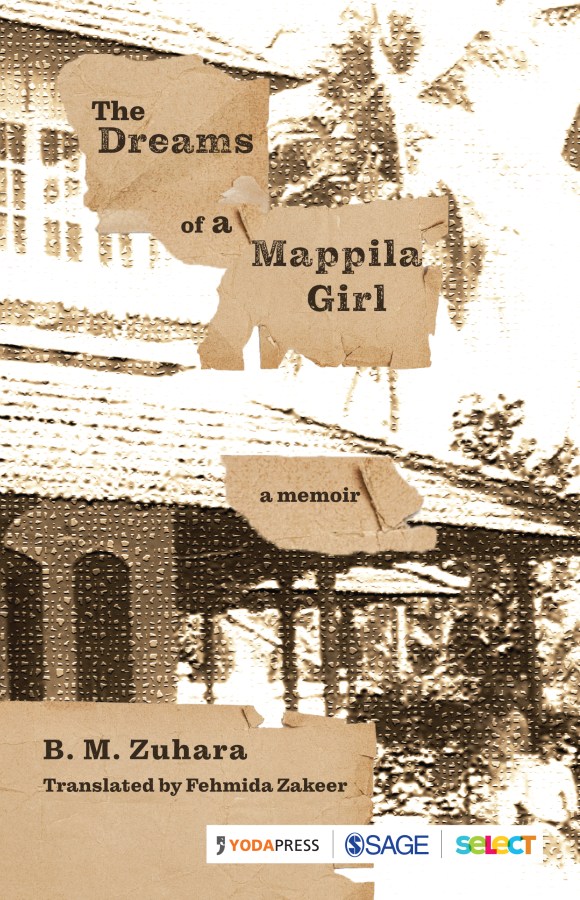
Title: The Dreams of a Mappilla Girl: A Memoir

Author: B.M. Zuhara

Translator: Fehmida Zakeer

Publisher: Yoda Press & Sage

 The terms ‘autobiography’ and ‘memoir’ are sometimes used interchangeably but the former is more fact-based and tends to be historical, whereas a ‘memoir,’ derived from the Latin word ‘memorandum’, is chiefly a personal, minute recollection of events, not necessarily intending to cover a person’s entire life, but often written from an epiphanic perspective, a significant event, or a particular aspect of the memoirist’s life. Thus, memoirs are essentially subjective and can never claim to be bio-bibliographical narrations. B.M. Zuhara, the writer and columnist from Kerala and a Sahitya Akademi awardee who writes in Malayalam, had penned The Dreams of a Mappila Girl: A Memoir (2015), which was recently translated by Fehmida Zakeer to English. It traces the childhood years of the writer, growing up in the village of Tikkodi in rural Kerala as a young Mappila girl from the Muslim community in post-Independence India.

For Zuhara, the things she remembers from her childhood act as vignettes which we readers string together to form a wholesome picture of the feudal system and social issues that were significant in her mind as she was growing up in the Malabar Muslim community in the 1950s. The tenth and youngest child of her parents living in a huge ancestral house called Kizhekke Maliakkal, Soora’s narrative gives us details of the things she remembered about the place till the point where at the age of thirteen she moves with her family to live in a rented house at Kohzikode to be admitted in a high school and begin a new chapter in her life. But even after she gets admitted into a prestigious school at Kozhikode, uncertainty looms large over Soora’s life as her mother stays adamant about not allowing her daughter to wear a skirt as a uniform as mandated by the school. In the ‘Preface’, Zuhara mentions that her childhood ancestral home does not exist anymore, but its memory is so strong that it appears as a character in many of her writings.

From the very beginning of the memoir, we form a clear picture in our minds about the location of the house, its detailed set-up filled with characters of the extended family including servants and cooks who lent a helping hand to run it smoothly. Like many other narratives, food plays a significant role in developing the ambience of Soora’s household. We get details of the elaborate tea ritual every evening, the eating of pathiris soaked in coconut milk, the aroma of fried plantains and coconut residue that filled the air, the details of the betel leaf chewed by her mother and grandmother with their decorative boxes and copper spittoons, the attempts to hatch chickens from eggs that were undertaken in the storeroom, the rearing of hens and ducks and goats by her brothers, the midday meals offered in their village school which their mother did not allow them to partake considering that it was solely meant for underprivileged children, and so on fill up a considerable portion of the narrative. Apart from visiting the village fair, Zuhara recounts the social mores of the society she lived in and offers glimpses into the secluded lives of Muslim girls and women who, despite obstacles, made the best of their circumstances and contributed positively to their communities.

One significant point about the memoir is the presence of Soora’s mother throughout the narrative and the strong influence that she had over her. While growing up, Soora often accused her of not looking after her well because she was an unwanted child. A religious woman who prayed five times a day, she not only tried to apply the teachings of the Quran to her life, but also shared her newly acquired knowledge with the people around her. Any deviation from the traditional lifestyle was, according to her, punishable as an offence by Allah. A pampered cry baby who would often burst into tears for the slightest reason, Soora from the very beginning was a sensitive child, who was often admonished for her interest in playing with boys and learn Kalari Payattu like her brothers, play with them in the rice fields, stand on the bridge and listen to the songs sung by the farmhands as they worked. She was also scolded for eavesdropping into conversations made by adults and like all traditional Muslim women, her mother wanted to get her married at a very young age. The real and perceived slights that Soora was subjected to, were primarily targeted at her physical appearance, specifically her dark complexion and her tendency to cling to her mother. But paradoxically for a seemingly timid child, Soora’s propensity to constantly question what is established as normative behaviour for a girl earns her the nickname of ‘Tarkakozhi’ – one who argues. What these contradictory impulses perhaps reveal was a girl who was overwhelmed by the big and small battles she must constantly fight, a life burdened by gendered expectations, yet a girl whose deepest desire was to be like Unniarcha, a mythological woman celebrated for her fearlessness whose ballads Soora grew up listening to.

But soon Soora realised that some of her dreams would never materialise because of her gender. Certain details, such as that of Soora’s grandmother passing away at the age of thirty when Soora’s mother was fifteen; or that two of Soora’s sisters were married even before she was born, reveal the dark reality of women’s lives in those times. In the ‘Preface’ Zuhara categorically states:

“I grew up at a time when Muslim girls did not have the freedom to dream. When I started writing, I had to face a lot of criticism and threats, and I found many limitations imposed on me. Until then, only men had recorded the inner lives of Muslim women. Even though I could not comfort my sisters physically, I have tried through my writings to give them a voice by speaking about their dreams, chronicling the obstacles and difficulties faced by them, and providing a perspective from the point of view of women. In the process, I have tried to define a space for myself in the literary landscape.”

In her ‘Preface’, the author also wonders if her work is a “story, or a novel, or a memoir.” Her words became the wings upon which forgotten, and deeply bruised memories travelled out into the world. She recreated the stories of her dear and near ones around whom she had spent her childhood. She coloured her childhood experiences with her imagination and penned them all down. Even though all the names are of actual people, if she is asked if the stories are real or imagined, she can only say that they are both. So, she leaves it to her readers who have encouraged and supported her writing journey to decide.

Here one needs to add a few words about the translation. The translator Fehmida Zakeer also hails from Kerala and being a Muslim herself, her effort to make this book read as smoothly as the original Malayalam text is laudable. There is no italicisation of non-English words throughout the text and the list of kinship terms at the beginning, along with the elaborate glossary at the end, makes the book as reader friendly as possible while trying to retain the flavour of the original. The only occasional problem this reviewer faced while reading the text was that too many authentic words and salutary terms for relationships of even a single individual often turned confusing for a lay reader like her who had to pause and recollect who the actual person referred to was. For the protagonist, mention of Sora, Soora, Sooramol, and Zuhura is understandable, but addressing members of the extended family and others residing in the neigbhourhood in different salutations sometimes becomes difficult for people not acquainted with the South Indian Malayali culture. However, despite such a minor lapse, the book is engrossing and offers a wonderful slice of life of the rural and semi-urban Muslim community in Kerala, of its customs and lifestyle which otherwise would remain unknown to us in a muti-cultural and multilingual country like India.

.

Click here to read an excerpt from The Dreams of Mappila Girl: A Memoir

.

Somdatta Mandal, critic, translator, and reviewer, is a former Professor of English at Visva-Bharati, Santiniketan.

.

PLEASE NOTE: ARTICLES CAN ONLY BE REPRODUCED IN OTHER SITES WITH DUE ACKNOWLEDGEMENT TO BORDERLESS JOURNAL

Categories
Interview Review

The Fearful Trill of Freedom & Equality

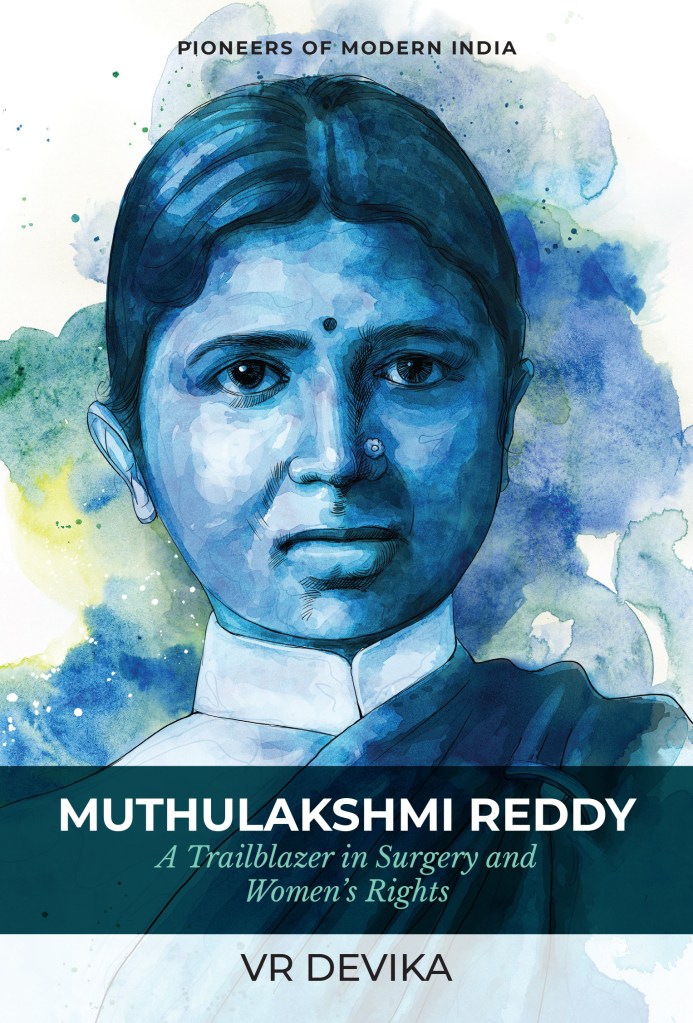
A conversation with VR Devika, author of Muthulakshmi Reddy: A Trailblazer in Surgery and Women’s Rights, Niyogi Books.

“Education, Freedom and Responsibility bring out the best from the individual and race. This will apply to all men and women irrespective of caste, creed or colour.”

—Dr Muthulakshmi Reddy, Muthulakshmi Reddy: A Trailblazer in Surgery and Women’s Rights

 Muthulakshmi Reddy: A Trailblazer in Surgery and Women’s Rights by VR Devika is a biography of a woman who shouted out to demand reforms among devdasis ( women who had been ‘married’ to lifelong service of a deity or a temple) and prostitutes in the nineteenth-twentieth century. The biographer, V R Devika, is a storyteller, educationist and Gandhi scholar.

Muthulakshmi Reddy (1886-1968) was born to a devdasi mother and transcended the system that had deteriorated from when a devadasi was considered ‘auspicious’ as she would never be widowed or married, and she could maintain her status quo, the book informs, adding a historic perspective to this ‘norm’. By Reddy’s times, these women had been reduced to become mistresses to rich men. In ancient times, before malpractices set in, a princess is said to have opted to become a devdasi. The decline started in the sixteenth century when devdasis were transferred from temple to temple.

The narrative is simple and straightforward but what stands out is the value of the content, the strength of the woman who could speak up boldly and demand reforms — even have some of them instituted. She spoke out for reforms with searing words. The author quotes from many of her speeches.

“Muthulakshmi used strong language to explain her position on the Devadasi question. ‘Of all the laws, rules and regulations which down the centuries have helped to place women in a position of inferiority, none has been so very powerful in creating in the minds of men and people a sentiment of scorn and contempt for women as the degrading idea of the double standard of morals.’

“She thundered, ‘From this double standard that has sprung that worst attack on women’s dignity, that safety valve theory that a certain number of women should exist, should sacrifice their self-respect, their honour, their comforts, their health and happiness to satisfy the lust of the other sex. At the present day, the continuance of such a doctrine and of the laws which are founded on it, is a shameful anachronism unworthy of our civilisation. Both in the past and in the present, women have disproved their inferiority, and how then can we at the present day tolerate or connive at a system which transforms a woman of whichever caste or class she may be, into a mere chattel, a piece of tainted merchandise? The inequity of the system is too deep for me to give expression, and further under that inhuman and unjust system the innocent children of a certain caste or community are trained to become proficient in all the arts of solicitation that they become captives to vice.’”

That men and women perpetrate social norms to justify the existence of the so-called ‘world’s oldest profession’ is well brought out in the book. That women forced into the sex trade are not doing this out of choice is conveyed with conviction. Names of Reddy’s associates include Sarojini Naidu (1879-1949) and the well-known singer whose mother was a devdasi too, MS Subbulakshmi (1930-1997).

Reddy was one of the first female medical graduates[1] in India, the first woman[2] to enter an Indian Legislature and the first woman in the world to preside over a Legislative Assembly. A recipient of the Padmabhushan and more accolades, she, as a doctor founded the Addyar Cancer Institute in 1952 after her sister was caught with cancer, and, as a humanitarian, started the Avvai Home in 1931 for those rescued from brothels and streets. Her spirit is well captured by the author when she writes:

“In 1942, during the World War II, soldiers of the British Royal Airforce camping in tents on the banks of Adyar river had made some derogatory remarks about the girls and harassed them. Muthulakshmi stood vigil all night with a stick in her hand and dared any soldier to come near the Home. She even went up the ranks to the commander’s house near Fort St. George to complain to him about the conduct of the soldiers and curb their behaviour.”

VR Devika has extensively shown that Reddy was a force to be reckoned with but she has not given way completely to adulation. She has objectively shown how Reddy over ruled her son’s choices for the well-being of her own institutions. It brought to mind Gandhi’s attitude towards his own family. An established cultural activist, VR Devika has been associated with the inception of Chennai’s Dakshinachitra Heritage Museum and Tamil Nadu INTACH[3], has been visiting the Avvai Home and in this exclusive she tells us the story of how the book came about and why she visited this home and its impact on her.

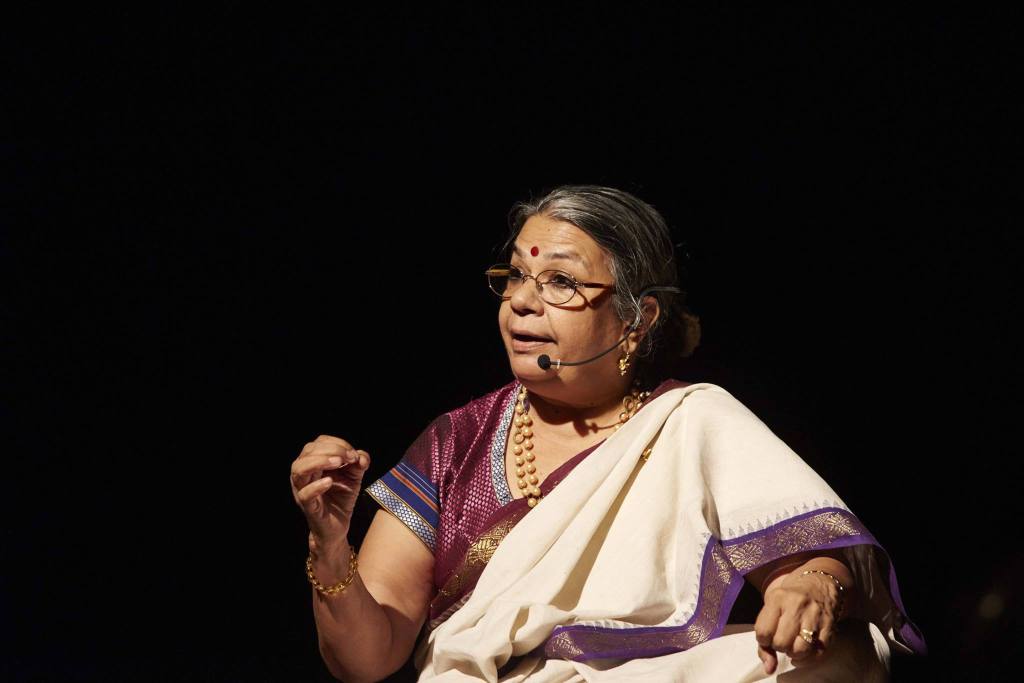
VR Devika. Photo provided by Niyogi Books

Tell us why you felt that Muthulakshmi Reddy’s story needed to be told. What was the readership you had in mind when you wrote the biography?

The dance scholarship [donors] consisting of mainly outsiders who had a hypothesis, got a good grant, employed interpreters and cherry picked to denigrate her in a fashion that took dance academic world by storm after the 1980s. I had also bought into them when I began to learn Bharathanatyam. But when I joined INTACH Tamilnadu and Madras Craft Foundation in 1985 after having been a schoolteacher since 1974, I began a project of English language as a skilling programme and theatre as empowerment for Avvai Home. That is when I began to get the other side of the story that was really fascinating. I kept thinking I must reach this story out. Dr.V.Shanta, chairman of Cancer institute, said I must write her [Muthulakshmi Reddy’s] biography and I decided to work on it after she passed away. I had young people who were studying English but had no access to English other than their textbooks as the target audience but I am a story teller and I just began to tell the story in simple way as I always do.

You tell us in the authorial note that you went on ‘work’ to the Avvai home. Tell us about the home. Why were you there?

Geetha Dharmarajan and I lived near Avvai Home. I had no idea about the history of the home etc. But I knew very poor girls studied there. Geetha had spoken to them and I went along but Geetha relocated to New Delhi and started Katha[4] and I stayed on helping Avvai Home in many different ways. I have written a full story of Avvai Home in the book. It was volunteer work. Rajalakshmi of Avvai Home requested me to help them on a production on Dr.Muthulakshmi Reddy. I interviewed Sarojini Varadappan, Dr.Shanta, and several others to write the script for the production. I am now on their school advisory committee.

For me, the most interesting aspect was how Muthulakshmi Reddy made the transition from being born a devadasi to empowering herself enough to outlaw the custom. Did her parents ever marry?

No there was no way they could marry as a girl born in the system was barred from ritualistic marriage according to Hindu custom. She was his companion.

Your narrative is direct and eulogistic of great names and associations of/ developed by Muthulakshmi Reddy and the lady herself. The personal is largely left out, except to emphasise her achievements. Why?

I cannot [describe that] as I never met her. I had to sketch a portrait from her writings, her achievements and her son’s writing.

Would you regard the devdasi system as a social ill that has been erased or is it an ongoing battle?

There is no social evil that has been erased completely. Nostalgists for devdasi system denigrate her [Reddy]. But there is the social evil of discrimination against Dalits still, but should Ambedkar be blamed for giving a legal handle for those who wanted to come out and achieve something of their own despite the caste hierarchy? Those who benefited from the abolition of dedication are in thousands while those who bemoan the loss of culture in the way they want it are in hundreds.

The devdasi system is a generic system in a number of states in India. Did Reddy’s reforms benefit all the states? Was the Avvai Home open to all devdasis or only from her state?

Avvai Home never claimed to be only for devdasis but for girls who needed protection and access to education. No reform benefits everyone. Her law was for the Madras Presidency of the time which consisted of parts of Andhra, Orissa and Karnataka too as part of it.

Muthulakshmi Reddy started a number of things, including the second oldest cancer hospital in India. But all these were reactions borne of personal experiences. Do you think if she had been born into a regular family, and her sister would not have had cancer, would she have striven for these institutions too?

I can’t answer a hypothetical question. How do we know what she would have done?

What was the driving force behind the reforms instituted by Muthulakshmi Reddy?

Her own indomitable will and the stubborn streak that sought to get it done and get others who would help her come in whole heartedly.

Would you justify the “emotional blackmail” on her son to fulfil her own dream by giving up his own? Do you think that it is right of a parent to impose their will in this way?

I am not justifying it. It happened that way. Just telling the story. She did not force her elder son who went into Electrical Engineering. Her second son never resented the “emotional blackmail” He went along whole heartedly.

What for you was the most endearing quality of Dr Reddy?

I have many who worked with her telling me she was very kind, but she was also a tyrant and would not bend. Her own indomitable will and the stubborn streak that sought to get it done and get others who would help her come in whole heartedly. She was a mother (Amma) was the unanimous opinion.

Thank you for giving us your time.


[1] Anandi Gopal Joshi(1865-1867) and Kadambini Bose Ganguly (1861 –1923) graduated and practiced as doctors in other parts of India.

[2]  Muthulakshmi Reddy joined the Madras Legislative assembly in 1930.

[3] Indian National Trust for Art and Cultural Heritage 

[4] Katha is a non-profit and non-governmental organisation that has established itself in the field of community development, child welfare, education and literature.

(This review and interview is by Mitali Chakravarty.)

.

PLEASE NOTE: ARTICLES CAN ONLY BE REPRODUCED IN OTHER SITES WITH DUE ACKNOWLEDGEMENT TO BORDERLESS JOURNAL

Categories
Interview Review

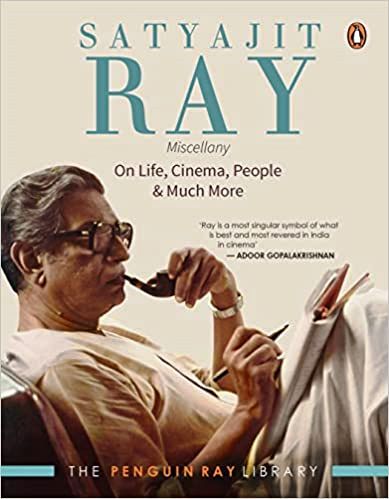
Satyajit Ray – Was he really ‘The Man Who Knew Too Much’?

In conversation with Barun Chanda, an actor who started his career as the protagonist of a Satyajit Ray film and now is a bi-lingual writer of fiction and more recently, a non-fiction published by Om Books International, Satyajit Ray: The Man Who Knew Too Much

“[O]ne would like to remember Ray as one of the last truly great renaissance men of Bengal, moulded much in the tradition of Tagore, in the sense that his genius manifested itself in manifold directions: film-making, photography, writing, composing poetry, limericks, music, designing, drawing, developing new typefaces, you name it.

“For a long time, he was also our most distinguished cultural ambassador to the world.”

This perhaps is the one of the most apt descriptions of a man whose films were legendary in our lifetime and a part of the concluding chapter in The Man Who Knew Too Much by Barun Chanda. The book is an exhaustive account of Ray and his major films, how he made the films, what were the influences he had, how he directed the films and how versatile he was. Chanda is clearly impacted by this giant of Bengal renaissance, which started with Raja Ram Mohan Roy in the eighteenth century and encompassed Tagore.

The book is as much a memoir by Chanda about Satyajit Ray as it is a narrative about his films. Structured unusually, this non-fiction has an introduction sandwiched between two sections, the first being Chanda’s own interaction with Ray as a hero of his award-winning film, Seemabadha[1](1971), and the making of the movie; the second being the narrative that covers the titular content (borrowed from Alfred Hitchcock’s famous 1956 thriller), The Man Who Knew Too Much, about the genius of Ray as a filmmaker. Chanda shows us how Ray was truly unique and very gifted. He would remember all the dialogues and be intent on being involved with every part of film making, from costumes to camera, lighting and makeup — which is probably why his films had a unique touch so much so that he has to date been the only Indian filmmaker to win an honorary Oscar which Hollywood actress Audrey Hepburn, collected for him as he lay sick in bed (1992) breathing his last, saying: “Dear Satyajit Ray, I am proud and privileged to have been allowed to represent our industry in paying tribute to you as an artist and as a man. For everything you represent I send you my gratitude and love.”

And this note has been quoted by Chanda to bring out the uniqueness of a man who counted luminaries like Arthur C Clarke, Jean Renoir, de Sica, Kurusawa, Cartier-Bresson among his friends. He has unveiled the unique persona further. “As Ray was wont to say, everything that he had done earlier in his career, helped prepare him to be a complete filmmaker. His sense of framing stemmed from his knowledge of still photography. His deep love of Western and Indian classical music helped shape him as a music director. His sense of art direction came from his earlier stint at D.J. Keymer. His power of illustration helped him design the sets of Hirak Rajar Deshe[2]and Shatranj ke Khilari[3], both marvellous instances of art direction. And a combination of these two factors facilitated his making of some of the most original and impressive cinema posters ever.”

Chanda goes on to describe the full genius of Ray’s film making which even stretched to scripts, songs — both the lyrics and music often, and of course his ability to visualise the whole movie beforehand. Ray is quoted as having said: “I have the whole thing in my head at all times. The whole sweep of the film.”

Interspersed with anecdotes about the films, the text highlights the eternal relevance of some of the dialogues and lyrics that Ray wrote himself. For example, listening carefully to the lyrics of ‘Ore Baba Dekho Cheye[4]’ (Goopy Gyne Bagha Byne, 1969), one could see it as a comment from a current pacifist in today’s war-torn world. This book actually seems like an eye opener not only to understand Ray’s films, but also to find out what the world needs from the media, an important comment in times of false news and sensationalism.

However, the book is not all adulation. It is also a critique of the persona of a visionary who could risk all for realising his vision. Chanda tells us how to attain perfection, Ray could risk necks: “There was an element in Ray bordering on ruthlessness. To get a certain effect on the screen he wasn’t averse to taking risks, at times to dangerous levels.”

New perspectives are brought in from unpublished interviews: “In an unpublished Bengali interview of Ray which is in the possession of Abhijit Dasgupta, one-time chief of Doordarshan, Kolkata, when asked about his film Sadgati[5], the maestro is quoted to have said: ‘One needed to make a film on this story immediately. As a Marxist, Mrinal Sen would have probably made it differently, more angry … Had this film been angrier I’m not sure it would have served the purpose any better. I don’t think display of anger alone can lead to much of an achievement. To my mind a truly politically angry film hasn’t been made so far. Until now what has been done is to shoot at safe targets. It hasn’t made any difference to establishments in any way. If one were to achieve this kind of a thing, I would sooner be a political worker than a filmmaker.’”

While looking at the maestro through an objective lens, Chanda finds it hard not to express his affection for the giant who impacted not just him but a whole generation of movie goers, film personnel and the world. His last sentence says it all:

“As far as I’m concerned, he [Ray] is always present. Not past. Not even past perfect.”

Chanda, a man who started his life working in the same advertising agency as Ray and dreaming of being an actor, with four books and multiple films under his belt, himself mesmerised audiences as a protagonist in Ray’s award-winning film and then suddenly withdrew from the industry for two decades. Why would he do that? Let us find out more about him and Ray in this interview.

Barun Chanda

First of all, let me tell you I am very honoured to be interviewing a Ray hero from a film I have watched multiple times. So, tell me, why did you act only in one Ray film, have a hiatus of twenty years and then go back to acting with Hirer Angti [6]  in 1992, the year Ray died. Did it have anything to do with Satyajit Ray’s presence or influence?

No. I’ll tell you what – after Seemabadha, I got a cluster of film offers, nine-ten offers and I did not accept anyone of them because they did not seem to be significant enough. I wasn’t interested in making money out of films or becoming a film star. I was interested in acting in good films. If they came my way, I would do. If they didn’t come my way, I wouldn’t. I would go back to my profession which is advertising. I was very happy there.

So, these offers that came didn’t quite satisfy me. And Manikda[7] did not call me back again for whatever reasons. The other significant filmmakers like Tapan Sinha, Mrinal Sen and Ritwick Ghatak – they did not call me. I suppose I was branded as a capitalist actor. Or Imperialistic actor! I suppose it became ingrained in their mind I was an executive and nothing else. They felt they could not bend me into the roles in their film. A pity!

Is this your first non- fiction? What led you to think of writing a book on Satyajit Ray?

Yes, it is my first non-fiction. I had harboured this thought for a long-long time but there is a natural reluctance about writing anything. I am, by and large, a lazy person and there were a whole lot of things that were pretty personal, and I thought, you know, let it be stored in my mind. Maybe, I could narrate to my close friends’ circle certain stories and certain things that happened between me and him. But not for everyone. Even in this book, I have not mentioned a whole lot of things that are too personal, which he confided to me in good understanding that I will not tell another. I won’t speak about it.

Then the centenary year came, and many asked me why I did not write my out my memories. Shantanu Ray Chaudhuri was one of them. He said the time is right and you have such wonderful anecdotes and experience, put it down for posterity. When I did the first part, I realised it could not just be my experiences but also something larger – in the sense what kind of a man was he in real life.

I was also dissatisfied with the books I have been reading about Ray and his works — starting with Marie Seton[8], who was supposed to be a gospel on Ray. I found it was a narration of his films in chronological order and what she thought of them. It was film-based assessment, not of the man himself or his qualities separated from the films. So, I decided to explore his persona. This book is quite different from any written on him. I have sections on music, editing with a whole lot of films but not in a chronological order. That is passé. The second part started with what has not been done. As I progressed, newer sections dawned on me – a whole lot of sections I have not used. I wanted a chapter on “The Rise and Fall of the Ray Empire” – but then thought I’d rather not finally. It would have been terrific, but I did not, perhaps want to spoil the public feeling about Ray. I did not want to criticise. I did do a chapter though — “Director or dictator”.

Absolutely. Your book is dispassionate but has no scandals or any unfair criticism. In fact, it seems to be based on not just your memories but also many interviews and lot of research. Can you tell us what went into the making of this book in this context? What kind of research and who all did you interview? How much time went into the making of the book?

I used Ray’s experiences with actors who are no longer alive – like Chabbi Biswas or Tulsi Chakraborty. I have used Aloknanda Roy who happened to work with Chabbi Babu in Kanchenjunga[9]. I used the living actors. I did not interview Soumitra Chatterjee – I know his feelings on Ray. So, I did not interview him separately. But there is a lot in the book about how Soumitra da perceived Ray or his equation with Ray.

The book worked well for me – I would have gone to a madhouse but for this book. You have to believe me. For it helped my sanity, writing this book during the Covid period[10]. The eighteen months—closer to two years. I could really concentrate on something as I am an outgoing person – not that I am a club person – but I would like to meet my friends, lead an active life. Suddenly, I felt imprisoned – it was like house imprisonment. So, I turned my attention to writing this book and whatever I could get out of YouTube, whole lot of other’s books, Ray’s interviews. One gentleman, Abhijit Dasgupta, who was the head of Kolkata Doordarshan, had conducted an interview. He gave me part of it which I found very intimate. You could do a book on Ray and Mrinal Sen dispassionately –Mrinal’s films would be of historical importance but not of relevance otherwise whereas Manikda’s films can be watched again and again because it touches your heart.

That is so true. Your book is structurally unusual with an introduction in the middle of two parts. Why did you follow such an unconventional format? Do you feel it helped your presentation in any way?

Yes. Because I was writing a different book. No one has written a biography in two parts. In a way it is not a biography, but it is trying to understand and appreciate Ray as a filmmaker. That’s what the book is.

I was in an advantageous position to write on Ray. Actually, Dhritiman Chatterjee could have done the same. I admire Dhriti for his thinking, but I guess there is an innate laziness. He did interview Manikda but I do not know where the tapes are.

I felt the way I did it was the right way. The book came naturally to me. For somethings, I went out of my way — like the titling.

To this date, no Indian director has made a film where the title is relevant to the film. The film follows from the title. The thought is not there. But it is there in the West. That is why you have people like Saul Bass. Ray wanted to do things himself – that might have been why he did the titling too. He would draw and present to the art director who would work further on it. I should have had a whole lot of drawings in this book, but it was not readily available.

I continue to feel I could embellish certain chapters, especially on music. Debojyoti Mishra, a film music director, has written a book in Bengali which actually traces from where Ray has borrowed what piece of Western Classical music. It is not unlike Tagore – there are analogies in the use of music between the two.

Ray spent a few years in Santiniketan when he was young, I think around 1940. Was he impacted by Tagore? Can you tell us about it? Did he meet Tagore or have any conversation with him as it was a year before Rabindranath passed on?

He did not actively seek out Rabi Thakur. He was a very shy person. There is no mention anywhere in his writings about seeking out Tagore, knowing very well Tagore held his father and grandfather in great esteem. His mom knew Tagore well. But he never sought him out. It is rather difficult to understand why he did not utilise the time speaking with Tagore. Maybe, Tagore was inaccessible. I could have asked him, but I never did. I do not know why I never asked.

Why would you borrow from Alfred Hitchcock to name probably one of the last of the Bengal renaissance men? Can you please elaborate?

I thought that the title was absolutely apt. As a director he knew more than any director did. It described him to perfection. He would draw, give music and work with his basic idea with the rest of the team.

What would you say is Ray’s most major contribution to the world?

The brilliance of Ray’s portrayal of the village was outstanding. You watch the film and think you cannot improve on it. And Ray knew it and has said it.

Does Ray continue to impact current trends in cinema?

Ray was a classicist. The film making style has moved away from that. He would not move the camera unless it became imperative to his film. But now, cameras are handheld, and they have fast shooting. Film making has transformed with the emergence of the web series. Shooting has become so much easier and quick, though they work very hard. There is something more raw about web series. The feature film is more stately, more crafted. Films have enough time. You cannot get a good film if the actors are not brilliant. You cannot shoot a good film in ten or twelve days as they do for web series. That is not physically possible. In the West, they take eighty to ninety days to shoot a film.

Ray wrote many novels on Feluda and Professor Sonkhu. Yet made few films on them. He made films of others’ books rather than his own. Can you tell us why?

Maybe, the writing part started late in his life. It was propelled by his need to feed Sandesh[11] and he had to supply stories to Desh[12] — one per year, for the puja [13]special. His writing came as an offshoot – it was an accident. But the preparation was there – if you read his scripts or lyrics, they are fantastic. The scripts he wrote were brilliant. There is much to admire and respect about him. He was a writer too.

You are known to be a writer too. Are your books impacted by your association with Ray?

What I learnt from him was how to write dialogues. The publisher of my Bengali books, Tridib Chatterjee, said he found my dialogues “smart”. Ray’s writing was very tight. I tighten my descriptions. I do not expect the readers to read a book like Tom Jones[14].

Can you tell us about your other books? Coke (2011) interestingly, is available in both Bengali and English. So, which came first — the Bengali book or the English? Are they both your handiwork? Tell us a bit about your novels?

I wrote it in Bengali first and then wrote it in English later. Actually, it was not a direct translation. I write in both the languages. Another one which is in English is Murder in the Monastery. The second edition is being brought out by Rupa, should be available on Amazon soon hopefully. Post-Covid, people have gone into hibernation. So, many have complained they cannot get it.

I have two books in English, Coke and Murder in the Monastery. The others are in Bengali.

Which genre is preferable to you — murder, mystery thrillers or non-fiction like this one?

I get my high writing fiction, especially crime.

Are you giving us any new books in the near future?

Yes, a collection of short stories in Bengali, probably after the pujas. I have created a character called Avinash Roy. He is learned and intelligent but not overtly brilliant like Sherlock Holmes. My favourite character [fictional] among detectives is that of Inspector Morse – I have seen the TV series but not read the books. He was very human. Absolutely brilliant. But coming back to my current book, it is also facing delays, but I am hoping it will be out this October.

Thank you for giving us your time and answering our questions


[1] Translates to ‘bound by limits’

[2] 1980 film by Ray, translates from Bengali as ‘In Hirak Raja’s Kingdom’

[3]1977 film by Ray, translates from Hindi as ‘The Chess Players’

[4] Translates from Bengali to ‘Oh dear look around’

[5] 1981 television film by Ray, translates from Hindi as ‘Deliverance’

[6] A film by Rituporno Ghosh, translates as ‘Diamond Ring’

[7] Satyajit Ray – he was often referred to as such by his friends

[8] Marie Seton: Portrait of a Director: Satyajit Ray, 2003

[9] Ray film released in 1962

[10] Lockdown due to the Pandemic

[11] A magazine started by Ray’s grandfather, Upendrakishore Ray in 1913

[12] A Bengali magazine that was started in 1933

[13] Durga Puja, the main festival of Bengalis, where the Goddess is said to return to her parent’s home for five days

[14] The History of Tom Jones, a Foundling (1749) by Henry Fielding

.

(This review and telephonic interview has been conducted by Mitali Chakravarty.)

.

.

PLEASE NOTE: ARTICLES CAN ONLY BE REPRODUCED IN OTHER SITES WITH DUE ACKNOWLEDGEMENT TO BORDERLESS JOURNAL
Categories
Review

Netaji: A Legend Revealed by the Family

Bhaskar Parichha reviews a non-fiction written on Netaji by his family.

Title: Netaji Subhas Chandra Bose’s Life, Struggle and Politics 

Author: Krishna Bose

Editor and Translator:  Sumantra Bose

Publisher: Picador India

Books on Netaji Subhas Bose are plentiful and readers are unvaryingly fascinated by every book that hits the bookshelves. The enigma and the ecstasy of Netaji’s short yet eventful life continue to enthrall people worldwide even after decades since his death in a plane crash.

This new book Netaji Subhas Chandra Bose’s Life, Struggle and Politics by the late Krishna Bose is a refreshingly new account of the great leader’s life. Three aspects of his life stand out prominently in the book: Subhas Chandra Bose’s political motivations, personal relationships, and the daring military campaigns he undertook to secure India’s independence. 

Krishna Bose (1930-2020) was a Member of Parliament thrice. A professor of English Literature, Krishna (nee Chaudhuri) married Dr. Sisir Kumar Bose — son of Netaji’s elder brother Sarat Chandra Bose. Sisir was Netaji’s chief aide in his daring escape from India in 1941 and drove the escape car from the family’s mansion on Kolkata’s Elgin Road. After Netaji’s death, Krishna helped Sisir build the Netaji Research Bureau at Netaji Bhawan. She served as NRB chairperson after Sisir’s death. 

The book offers a rare in-depth account of the Netaji’s meaningful life by one of Bose’s close family members. That makes the book authentic and stimulating. Originally written in Bengali, the writings reveal the “human being alongside the revolutionary and freedom fighter”. It traverses Bose’s life from childhood to his death in August 1945. With important chapters about his youth, political career, and the power equation with Mahatma Gandhi and Jawaharlal Nehru, the book subtly brings out different shades of Netaji’s personality.

Drawing on Netaji Research Bureau’s archives and decades of fieldwork and interviews, this book offers an unmatched portrait of Subhas Chandra Bose – the man, his politics, and his epic struggle for India’s freedom. Krishna Bose’s writings were compiled, edited, and translated from Bengali by her son Sumantra Bose.

Krishna Bose traveled the world and extensively to the subcontinent in order to find out more about Netaji’s life.  She strung together her findings, giving new insights into Subhas Chandra Bose’s political motivations, his personal relationships, his epic journeys, and the daring military campaigns he undertook to secure India’s independence. Written over six decades the book vividly reveals Netaji as a human being alongside his radical views.

The book has a detailed account of the women who influenced Netaji (his mother, adoptive mother, wife, and close friends as well as the soldiers of the all-women Rani of Jhansi regiment that was trained in Singapore), an eyewitness account of Netaji’s epic struggle in Europe and Asia, his secret submarine journey and escape from his Calcutta home and the Andamans where Netaji raised the national tricolour.

Divided into seven chapters (‘The Women who Influenced Netaji’; ‘Netaji’s relationships with Indian and World Leaders’; ‘Azad Hind Fauj’: ‘Netaji’s Epic Struggle in Europe and Asia’, ‘Netaji’s Soldiers: Remembering the Brave’; ‘The Liberated Lands’: ‘Visiting Manipur and the Andamans’; ‘Netaji and Women’: ‘In War and Friendship and Requiem’), the book is a truthful chronicle of Netaji.

The book contends: “[W]e visit the Manipur battlefields where the Indian National Army waged its valiant war, the Andamans where Netaji raised the national tricolor; Singapore, where the INA took shape; Vienna and Prague, his favorite European cities; and Taipei, where his life was tragically cut short. We meet Netaji’s key political contemporaries – from Nehru and Gandhi to Tojo and Hitler. And we learn in gripping detail about the Azad Hind Fauj’s spirit of unity and the bravery in the war of its men – as well as the women who fought as the Rani of Jhansi Regiment.”

In fact, Krishna Bose closely knew many personalities who feature in this book – Basanti Debi, Subhas’s adopted mother; Emilie Schenkl, his spouse; Lakshmi Sahgal, Abid Hasan, and many other leading soldiers of the Azad Hind movement – who all shared vital memories that helped complete Netaji’s life story.

Rabindranath Tagore and Subhas Chandra Bose are the two most iconic figures late modern Bengal has produced. The nature of their relationship is, however, not very well known. We are told: “Tagore and Bose first met at sea, in July 1921. Subhas, aged twenty-four was returning by ship from England to India after resigning from the Indian Civil Service to join the national struggle for freedom taking shape under Mahatma Gandhi’s leadership. Tagore, aged sixty, happened to be a co-passenger on the ship. In his book, The Indian Struggle, 1920-1934, published in London in January 1935, Netaji recalled that journey and wrote that he and Tagore had extensive discussions during the voyage.”

Aiming to bring an end to the controversies and conspiracy theories surrounding the freedom fighter, the over 300-page book gives a detailed and evidence-based account of his death in one of its chapters. Notwithstanding the mystery surrounding his demise, Netaji is widely believed to have died in a plane crash in Taiwan.

Featuring 95 images and letters from family albums and Netaji Research Bureau archives, this compilation by Krishna Bose on Netaji and his struggle for India’s freedom will enlighten readers, and especially the younger generation, about Subhas Chandra Bose’s ideals and his vision about the development of a free India.

.

Bhaskar Parichha is a journalist and author of UnbiasedNo Strings Attached: Writings on Odisha and Biju Patnaik – A Political Biography. He lives in Bhubaneswar and writes bilingually. Besides writing for newspapers, he also reviews books on various media platforms.

.

PLEASE NOTE: ARTICLES CAN ONLY BE REPRODUCED IN OTHER SITES WITH DUE ACKNOWLEDGEMENT TO BORDERLESS JOURNAL

Categories
Review

A Train to Kolkata and Other Stories

Book Review by Hema Ravi

Title: A Train to Kolkata and Other Stories

Author: Mrutyunjay Sarangi

Dr. Mrutyunjay Sarangi, a former judge and recipient of the Fakir Mohan Senapati Award for Short Stories from the Utkal Sahitya Samaj in 2018, edits the Literary Vibes, an online literary journal hosted by him. A bilingual writer with number of Odiya stories under his belt, A Train to Kolkata And Other Stories is his second book of short stories. In his ‘Preface’, Dr Sarangi tells us from where the stories are drawn:[T]hanks to my professional assignments, I have come in close contact with people from varied walks and experienced the joys, the wonders of life through a fulfilling journey. Some of these experiences have spilled into the characters and situations I have created in my stories.”

The fifteen stories that make this collection have the right mix of humour, suspense, love, sarcasm, imagery, vocabulary and more. A blurb by a pre-launch reviewer has very justifiably contended that the stories are “measured, controlled, balanced, jolly or courageous, sad or tear-jerking, from the start his stories hide a surprising climax”.

The climax in ‘Nepali Baba’ is both dramatic and unbelievable.  The author’s thought resonates with a rational mind: “Somehow, I am always uncomfortable with the idea of Babas.  I neither believe nor disbelieve them.”  ‘A Small Lie’ is the poignant tale of two passionate hearts, whose world is smashed to smithereens in the baatyaa[1].  It goes on to narrate the struggles of the female protagonist who lives with the memory of the “night of intense passion and immense tragedy”. Stormy nights evoke pictures of menacing, disruptive clouds, dark lanes bring along ghastly images of skimpily clad women, men chewing paan, smoking and indulging in garrulous conversations.  In ‘The Dark Lane’, the author has deftly portrayed varied images: “long tunnel of horror, infested with anti-social elements, school dropouts and vagabonds”.  The reader heaves a sigh of relief “when at the end of lane, there was light, the crowded street welcomed them likes its long-lost friends” — a nail-biting finish to the narrative!

‘Ananyaa’ is the story of a shy girl from a middle-class family who gets trapped into marriage with a tall, handsome man who proves to be immoral, and unscrupulous, all because she did not have the courage to reveal her special love, fearing the family members would misunderstand her as a “girl of loose morals”.  How many hapless Ananyaas still live in such prisons, I wonder.  Each little act of kindness goes a long way, at times, and comes full circle is the quintessential truth which the reader gathers in ‘A Touch of Love’. At times, truth can be stranger than fiction.

‘Subashini Didi’ is definite to leave the emotional reader teary-eyed.  The vicissitude of human behaviour is revealed when certain unseen truths or “analysis of fatal errors”occur. “I am sure one day you will realise what it is and see your subject in a new light,”the author proffers a cryptic message to people who are judgmental and prejudiced without investigating what the eye sees and what the ear hears!  The story of ‘Khusi’, an abandoned baby reunited with her biological mother after several incidents, is like one out of Bollywood.  Often romantic comedies are fun filled, they do not illustrate “real life”.  Some films, however, can resonate and inspire, and I believe this story was born after watching one such portrayal.

The title story ‘A Train to Kolkata’ — a tale that many of us can relate to, has a melancholic start. The somber mood and “heavy heart”of the protagonist Anjali is pitted against the “damp weather”. Dr. Sarangi has dextrously depicted human behaviour, familial love, bonding between an invalid husband and devoted wife; more importantly, has described how a callous and insensitive friend can be a pesky intruder, inflict deep wounds and shatter another’s peace.  The story ends with lines that are both awe-inspiring and hard- hitting: “She looked up at heaven, at the infinitely merciful Supreme Power who was beyond all joys and all sorrows…”

The central theme running through the assortment of stories is ‘love’ in its varied hues. After all, love is a way of life, and the most important facet of human life – its mention brings along a feeling of warmth and security; yes, it also brings a lot of pain.  While discussing the relationship dynamics, psychologist Frank Conner talks about the “essence of why we seek love in all relationships”.  Using Sternberg’s Triangular Theory of Love, Conner reveals the “elements of this triangle are passion, intimacy, and commitment”. Interestingly, Dr. Sarangi has touched upon these facets in his stories.  His protagonists are strong individuals with a never say die attitude; this includes the fragile Sushant in ‘The Procession’, who walks back with renewed vigour to his “home in a solemn procession, awaiting a starry night looming over the horizon.”

In the ‘Looney of the Town’,the author narrates the conversation between two generations with great élan and sharp twinge – the pre-Boomers, with the earlier twentieth century freedom fighters and the Generation Z, who have little knowledge about the patriots of the freedom struggle, their contributions and sacrifices. “Things had changed rapidly in free India, as if freedom was a license to perpetrate all kinds of irregularities. Promotions, transfers in jobs were bought by paying bribes red tape killed initiative for academic excellence and students were more interested in passing exams than acquiring knowledge…” Any reader can surmise that only one who has experienced these can vehemently come up with such potent expressions. 

Setting aside his scholarly prowess, Dr. Sarangi has penned his stories in a language that is lucid and flowing. The choice of words, the vivid descriptions, and the realistic portrayals are sure to rouse creative minds. The stories in this collection will attract a multitude of readers as the protagonists and allied characters bear semblance to people whom one may have come across somewhere, at some point of time in their lives.


[1] Gale or storm in Somali

Hema Ravi is a part-time IELTS and Communicative English Trainer, writer by passion. independent researcher, and resource person for language development courses.  She is a recognised poet, author, reviewer, editor (Efflorescence), secretary and event organiser of CPC (Chennai Poets’ Circle)  and CAB (Connecting Across Borders)

.

PLEASE NOTE: ARTICLES CAN ONLY BE REPRODUCED IN OTHER SITES WITH DUE ACKNOWLEDGEMENT TO BORDERLESS JOURNAL

Categories
Review

Books in Rebellion?

Book Review by Rakhi Dalal

Title: Comfy Rascals

Author: Rhys Hughes

Publishers: Raphus Press, Gibbon Moon Books

“The moon was a tomato in the sky, then it was an orange, then a grapefruit, then a metaphor, then it was exactly like a simile, then like some other comparison, then finally it was itself, the moon. The comfy rascals reclined on loungers on the beach and watched it change and pretended it was a weak sun they had tricked out of sunbeams…..”

Thus begins the title story of the collection, which with its brilliant wordplay, focuses on the imagination of things, on moon and Baudelaire, thus first transferring awareness to the realm of uncanny and then almost quietly turning it back to the real world. It is peculiar and subtle, the way it happens. A tale of palpable human helplessness in a cold and dark world as the comfy rascals first laugh and “then shiver at night in their own last desperate resort, an abandoned seaside town”.

Comfy Rascals is Rhys Hughes’ recent collection of experimental short fiction where the stories constantly shift/ permeate to the realm of fantasy from real world and vice-versa, blurring the binary categories of human/nonhuman and natural/material world. Hughes was born in Wales. His first book, Worming the Harpy, was published in 1995. Since that time he has published fifty other books, more than nine hundred short stories, and innumerable articles. He graduated as an engineer but now works as a tutor of mathematics.

Hughes, who sees himself as a comedic writer, uses fantasy and humour to explore unusual concepts which compel readers to re-visualise the accepted ideas of reality, challenging their understanding of the certainties this world offers and the possibilities it may, when seen in a manner unaccustomed to the mind. While some of the stories may unsettle –

“I have destroyed the world, but what of that? Light a candle in my memory and that will be more than enough.” (‘A Deep Breath’)

Some bring a vivid element of the fantastic, like —

It is so cold that the candle flame just froze solid and I was able to snap it off and put it in my pocket for later. When it thaws out I will use it as a hand warmer and then put it back on the wick. In fact it is so cold that the flames of the fire have frozen solid and can be snapped off and used to cut butter, if cutting butter is something you need to do.” (‘How Cold is It?’)

And some others just amuse by virtue of their humour/satire:

“One Socrates in the market square is not a heap of philosophers. What happens if we add another Socrates? Still, this is not a heap. It is two philosophers, that is all. Add another Socrates and keep adding them.” (‘Sorites Speculation’)

Hughes works with human anatomy, sometimes in tandem with non-human forms, and challenges the anthropocentric worldview where everything human has more value over others. The elements of grotesque that he thus makes use of, subvert the notions of ‘real world’ and ‘materiality’ while being playful. He also makes use of spaces inhabited by humans, like homes to question the extent of boundaries we willing create.

One important space that is difficult to overlook in this collection is author’s use of the concept of libraries (Four stories in all), especially in the wake of a tyrannical rule. He employs it to drive home the point that tyrannies succeed when people become subservient to the rule. We witness books being burned but not always.  

“Tyrants burn books, but sometimes the books fight back and vanquish the inferno.” (‘The Library’)

Science fiction and mythology are brought into play by Hughes. His stories swerve socio-political understanding and narratives to the realms of the uncanny, the grotesque and the fantastic while displaying a vibrant play on words, thereby alluring with unconventional reads and hence, unimagined revelations.

In the author’s own words –

“Many rascals are too tense to be comfortable. Real life rascals have much to worry about. But rascals in fiction can afford to relax a little in the waves of prose that surround them, gently swirling on the wit and wisdom, bobbing on the contrivance, floating on the syntax. It is nice to be a comfy rascal.”

Rakhi Dalal is an educator by profession. When not working, she can usually be found reading books or writing about reading them. She writes at https://rakhidalal.blogspot.com/ .

.

PLEASE NOTE: ARTICLES CAN ONLY BE REPRODUCED IN OTHER SITES WITH DUE ACKNOWLEDGEMENT TO BORDERLESS JOURNAL. 

Categories
Review

Orienting : An Indian in Japan

Book Review by Aditi Yadav

Title: Orienting : An Indian in Japan

Author: Pallavi Aiyar

Publisher: Harper Collins

The mention of “Japan” evokes dreamy Instagrammable scenery of Sakura with Fuji-san, serene shrines, grand castles, modern skyscrapers, cute dolls, geishas, bullet trains, cool robots, so on and so forth — a long list of all things ‘kirei[1] and ‘kawaii[2]’. Of late, the world has been swept by the tsunami of Japanese life philosophies of Ikigai, Wabi-sabi, Kintsugi, and Zen. To an outsider, the perception of Japan is mostly curated through social media stories, anime, J-pop and J-drama. However, the first-hand experience as a tourist or resident will have a spectrum of shades to offer.

Orienting : An Indian in Japan by Pallavi Aiyar vibrantly captures this spectrum. Aiyar is an award-winning foreign correspondent and author of several books including travel memoirs on China and Indonesia. In “Orienting”, she shares her insights on Japanese society, history and customs against the background of her globe-trotting experiences and Indian heritage. The book originally published in English in 2021 has recently been translated into Japanese, a rare feat for an Indian author.

Historically speaking, the “Oriental” depiction of the East has been a West orchestrated exercise.  As a result, the world vision and perception of countries like Japan have been dominantly seen through the lens of Western authors, historians and travelers. Aiyar’s book is a fresh breeze in travel literature — a global Asian writing about another Asian country– especially given the shared culture of Buddhist heritage.  From the get-go, the title stands out for its intelligent word play.

The author has a difficult time orienting herself. A country that’s world famous for its punctuality, hits her as “anachronistic” when she discovers how cumbersome it is to buy a mobile connection, open a bank account or use a taxi app. In neighboring China even beggars are open to e-payments while Japan still struggles with credit card usage in stores and restaurants. Yet, to the average Japanese, “Chinese were lacking in good manners”. The book is delightfully sprinkled with cross-cultural comparisons, insights and of course haikus.

It is common to spot young kids traveling on their own to school on buses and subways, as Japanese society watches out for them with solidarity, ensuring their safety. Talking of awe-inspiring features of Japan, the list is long one– literally convenient kobinis, super-smooth public infrastructure, clean public toilets, vending machines, and most strikingly, the land of ‘what is lost-is-always found’. Aiyar narrates how she and her family members lost their iPhones, wallets, laptops, umbrellas, jackets, tiffin boxes and hats during their four-year long stay in Japan. And, every single item was retrieved undamaged. Yet, despite all the community spirit, safety and solidarity, Japan is home to almost one million hikokimoris, people who have withdrawn from society and avoid social interaction. Patriarchy, high rates of suicide, overtime at workplace and death by overwork (karoshi) are hard facts of life in Japan that take some sheen off its ‘first world-ness’. Just like any other place on earth, the bright and dark sides exist together with multiple shades of gray.

The apparently ‘homogeneous’ society has shied away from discussing issues like ‘racism’ or ‘discrimination’. While historically, indigenous race of Ainus, Korean descendant Zainichies and socio-economically backward Burakumin were dealt second grade treatment, in these globalised times, unlike many rich countries, Japan had resisted multiculturism.  The ‘gaijin’ syndrome (prejudice against foreigners) conspicuously stands out given that Japanese invented a whole new script ‘katakana’ to address anything ‘non-Japanese’. The kikokushijo, the children who return to school in Japan after being partly educated abroad, face bullying and harassment for their foreign association. The half- Japanese peculiarly termed as ‘hafus’, are also subjected to prejudices of various kinds.  However, a mild streak of silver lining is evident in cases of Priyanka Yoshikawa – half-Indian, half-Japanese winner of Miss Japan title in 2016 and Yogendra Puranik, an Indian who won the elections for City Councilor (Edogawa ward) in 2019. Such cases, though few and far between, are indicative of some changes in the Japanese air of insularity.  Comparing discrimination in Japan to its Indian counterpart, Aiyar observes that it almost felt churlish to point it out at all. “Indians were the perpetrators of the ugliest kinds racial and religious discrimination”. While Japan’s racism was “more respectable, less violent. It simmered rather than boiled over, and got mixed in with a general shyness and culture of suppression”.

On gastronomic spectrum, India and Japan are almost diagonally opposite. It is relatable how as an Indian, Japanese food strikes the author as “too cold and polite with too many bonito flakes” — too spiceless and raw for Indian tastes.  On a trip to Tottori, she discovers how some restaurants even discourage Indian groups because they carry their own pickles and sauces, a habit which offends most Japanese. The land of mouth-watering sushi, sashimi and mochi quite amusingly is also fond of fugu, the puffer fish, which is 1200 times more poisonous than cyanide! Curry is by far the most loved Indian food. But its Japanised version would hit Indian taste buds differently. The author details how Rash Behari Bose, the Indian nationalist settled in Japan and introduced authentic Indian curry in Nakamuraya café in Tokyo.

Historically, Japan and India share the common thread of Buddhism. The oldest documented Indian resident in Japan was Bodhisen, a monk from Madurai, who held a very exalted status as a Buddhist scholar in his days. He arrived in Osaka in AD 736, and moved to Nara. He taught Sanskrit and helped establish the Kegon school of Buddhism. Japanese Buddhist pantheon even absorbed several Hindu gods in its fold. Aiyar gives an interesting account of the shared culture of yore and also “not always salubrious” relationship during the colonial era. The latter period saw Indian luminaries like Subhash Chandra Bose, Vivekananda, P.C Mozzomdar and Rabindranath Tagore visit Japan, which deepened the connections between the two countries. But when it comes to doing business together, the practical jugaad-proud Indians and perfectionist shokunin-spirit driven Japanese find it difficult to cope up with this dichotomy. The book analyses it all with facts and engaging experiences.  Anyone who has ever been to Japan will find the book extremely relatable and sincere.

Aiyar writes with enthusiasm of a traveler who has pitched her tent in foreign land to capture the richness of landscape in daily travels, with a keen eye, humour and honest penmanship.  The read is indeed a rewarding journey towards “Orienting”!


[1] Clean, beautiful

[2] Cute

Aditi Yadav is a public servant from India. As and when time permits, she dabbles in translation works.   She is an alumnus of Yokohama National University, Japan and  a  devout Japanophile.

.

PLEASE NOTE: ARTICLES CAN ONLY BE REPRODUCED IN OTHER SITES WITH DUE ACKNOWLEDGEMENT TO BORDERLESS JOURNAL
Categories
Review

Requiem in Raga Janki

A book that highlights the independence and achievements of a lone woman in the Raj era where majority bowed to patriarchal norms even in the West, revisited by Rakhi Dalal

Title: Requiem in Raga Janki

Author: Neelum Saran Gour

Publisher: Viking

Janki Bai Illahabadi (1880-1936) was one of the first recorded artists of India, an artist whose records can still be found and whose voice can still be heard. She was a courtesan, an Indian classical singer with an extensive training in the field by great maestro Ustad Hassu Khan. Born to Shivbalak and Manki, a family of sweets sellers in Benaras, tragedy befell her family when her father left the house in search of his mistress. Her mother was then betrayed and duped by one of her friends and sold to a kotha[1] in Allahabad. It was then that Janki was introduced to those dingy alleys of Allahabad where she could have easily faded into oblivion amidst the sea of unfortunate women like her. But that wasn’t meant to happen. For her mother recognised her talent and arranged for her to be mentored by the great master. The rigorous training bore fruit when she was invited to sing in a royal court. So enchanted was the Maharaja that she was lavished with riches along with a high praise. She then rose to become one of the greatest singers of the time and performed alongside legends like Gauhar Jaan (1873-1930).

One of the famous anecdotes about her life is that she had received fifty-six (chhappan) knife wounds while very young but had miraculously survived them. She then came to be known as Chhappan Chhuri Wali[2]and slowly, over time, it acquired the meaning we are now acquainted with. Today in Hindi, the phrase is used to refer to a haughty woman.

Requiem in Raga Janki is a heavily fictionalised biography of the singer written by Neelum Saran Gour who works as a Professor of English Literature at the University of Allahabad. She has authored six novels, four short story collections, two works of non-fiction, and has translated one of her novels from English to Hindi. Requiem In Raga Janki had won The Hindu Prize for Fiction in the year the book was published, 2018.

In her attempt to tell the story of the once famous songstress, the author succeeds in making Janki Bai come out of dark alleys of obscurity and claim her long lost place of recognition. Gour not only explores her journey to becoming a famous courtesan but also, through her vivid imagination, she tries to explore Janki as a woman fraught with anxieties about love, religion, relationships and fame. Gour undertakes to give her a voice since voices like hers have easily been forgotten and have not been accorded due reverence in the popular culture.  To forget these voices is akin to forgetting a past which is as much a part of our history as it is of our musical heritage. Gour’s work thus deserves more recognition.

To begin with, author’s depth of research — on Janki, on the time she lived in, the customs and social mores, on the history of classical singers and on the knowledge of ragas, is apparent in her writing. Add to it her flawless writing, attention to detail, an evident grip on the vernacular, lucid and almost poetic prose and what we have is a book that is unputdownable from beginning to end. 

In the very well-crafted narrative, we not only become privy to the real incidents in Janki’s life, her journey to fame but also to the fact that she was a gifted poetess as well. At author’s deft hand, Janki’s conversations with famous poet, Akbar Illahbadi (1846-1921), with whom she shared a good rapport in her lifetime, glitter with beautiful couplets. Though Janki’s couplets are mainly taken from her work Diwan-e-Janki, the couplets that had been attributed to poet Akbar are composed by Gour herself, whose eloquent rendition leaves the reader enraptured.

This book is a beautiful tale of the life a singer who carved her own destiny and lived life on her own terms, in times when women were generally subjugated and confined to roles given by society.


[1] Brothel

[2] Survivor of 56 stabs by knife

.

Rakhi Dalal is an educator by profession. When not working, she can usually be found reading books or writing about reading them. She writes at https://rakhidalal.blogspot.com/ .

.

PLEASE NOTE: ARTICLES CAN ONLY BE REPRODUCED IN OTHER SITES WITH DUE ACKNOWLEDGEMENT TO BORDERLESS JOURNAL. 

Categories
Review

The Story of Arunachal Pradesh

Book Review by Gracy Samjetsabam

Title: Escaping the Land

Author: Mamang Dai

Publisher: Speaking Tiger

Escaping the Land (2021) by Mamang Dai is a gripping saga of turbulent times in Arunachal Pradesh from the North East Frontier Agency (NEFA) days to the present times. Padmashri and Sahitya Akademi Awardee, Mamang Dai, is an anglophone poet and novelist from Arunachal Pradesh.

In Escaping the Land, Mamang Dai weaves the history, myth and politics of Arunachal Pradesh across time. Maying, the narrator returns to her homeland from Delhi to do a project on the land of her birth and its people. Dai uses Maying to recount the story, blending fiction and history from when the state was governed as the NEFA[1] to becoming the twenty-fourth state of India as Arunachal Pradesh in 1987.

Maying meets Lutor, the ageing veteran politician and the son of a shaman, who is loved by the people and has had a long and successful career in politics since the formation of the state, to share “the story of a long ago when everything had been different and full of possibilities”. As she runs through the flow of time from the past to the present, Maying ruminates over Lutor’s idea of the “original obsession” that all of us are born with and the power of “dreams” and “instinct”. As the story begins, Maying picks up an old journal marked NEFA notebook and shuffles through the old piece of memorabilia to reflect, “The lives of people in every village and district had changed since the time this piece of fern had been so carefully pressed in between the thin pages of the book”.     

Dai divides the book into five sections. The story opens with the view of a traditional house that stands on a hill with thick bamboo thickets and mountainous region. The author talks of the essence of dates and calendars in the lives of the people of a close-knit community in a remote part of the state, where tradition and family mattered. Time is an overarching theme in the novel. “Time had a method”, where everything happened in stages and history was written as it came. Dai’s novel recounts changes in time and history in the place and culture of the people of the state with emphasis on Pasighat, which was also her hometown.

Dai’s story interestingly accommodates an avalanche of landmark incidents in the history of the north-eastern state of India including battles against oppression starting from 1911,  the Achingmori incident (1953), the India-China War (1962), the liberation of Bangladesh (1971) and its impact on the state, the passing of the infamous Bill for Control of Organised Crime Act (APOCO), and also, on migration and infiltration of outsiders. References to attending boarding school in Shillong, going to Delhi for higher education, or taking long hours of ferrying across the tumultuous tributaries of the Brahmaputra river that flow in the region for a sarkari[2] job, Dai reflects through the fiction the sea of change experienced in the lives of men and women in terms of education and perceptions of security in moving in or out of their homes.    

Experiences of the horrors and violence in the face of insurgency, militancy and atrocities in the times of war that the people faced are vividly incorporated in some sections of the story. In times of uncertainty in the story, dreams and reality collide in a delirious mix of magic and mystery. Dai fuses myth as a consolation to the harsh realities of history. A mystic rain man heralds that change and loss of solitude cannot be halted. Though it is often reiterated that “We are safe in the hills” speedy changes in time made Lutor and his close friends rethink the credibility of this remark. Dai explodes beautiful metaphors that are specific to the culture, cross-cultural references to the exchange of people and culture from outside India, other parts of India and of the neighbouring states of Assam, Nagaland, and Manipur.   

In the shifting times, money and greed have engulfed traits of love and loyalty for one’s land and people. Time moved to stages of no return from how it was in the mythical time of the ancient civilization of the Kojum-Koja [3]of the land, to when politics seemed to overtake every move in the place. The story highlights the sentiments of the people in the midst of  the politics of inclusion and exclusion in the periphery.

As candidate for the office of Chief Minister, Lutor promises of development, “caught between a feeling of great humiliation and a pitying love for his homeland” but lost to his corrupt and crooked political rival Tanik, who had more money and men.  Varied interesting characters add flavour to the story. With the non-retreating timber trade, where greedy traders, politicians, local middlemen and forest mafia no longer care to uproot the whole of the virgin forest in the state, the ecology at stake is echoed in the corruption portrayed in the story. Lutor in a dire strait between the memory of a lost time acknowledges that times have changed but continued to believe and live in anticipation of a pan-Arunachal unity and hopeful idea of home.

Dai through Lutor’s nostalgia for a peaceful land and longing for a homeland devoid of greed and corruption, implicates that love can heal and restore the state to a humane land as it had been in the past. Time brought changes and the world infringed by investing more money into the state. While business boomed, Lutor, as the title suggest, looked outward to escape from the land not as one defeated but with a hope to explore newer possibilities so that he could return with a better tomorrow. 

In the engrossing historical novel, Escaping the land (2021), Dai works on a huge canvas to lyrically voice a tale of time, geography and changes that leads to a cohesion with the larger world.


[1] The North-East Frontier Agency (NEFA), originally known as the North-East Frontier Tracts (NEFT), was one of the political divisions during the Raj

[2] government

[3]  Kojum-Koja was supposed to be an ancient civilisation that established villages, part of the ancient tribal lore.

.

Gracy Samjetsabam teaches English Literature and Communication Skills at Manipal Institute of Technology, MAHE, Manipal. She is also a freelance writer and copy editor. Her interest is in Indian English Writings, Comparative Literature, Gender Studies, Culture Studies, and World Literature. 

.

PLEASE NOTE: ARTICLES CAN ONLY BE REPRODUCED IN OTHER SITES WITH DUE ACKNOWLEDGEMENT TO BORDERLESS JOURNAL

Categories
Review

Building a Free India

Book Review by Bhaskar Parichha

Title: Building A Free India

Author: Rakesh Batabyal

Publisher: Speaking Tiger Books

“Under this Flag there is no prince and there is no peasant, there is no rich and there is no poor… Whether we be Hindus or Muslims, Christians, Jains, Sikhs or Zoroastrians and others, our Mother India has one undivided heart and one indivisible spirit.” — Sarojini Naidu, poet and political activist, on the resolution on the national flag in the Constituent Assembly, 22 July 1947

The immutability of prodigious speeches and their magnifying impact on people can’t be underestimated. The prize of a great speech comes from pure wisdom that originates from indulgence. These words from Naidu’s speech can work as magic anytime one reads them.

Building A Free India – Defining Speeches of Our Independence Movement that Shaped the Nation by Rakesh Batabyal is just the book you needed to read as India celebrates her 75th year of its independence. It is a thought-provoking assemblage of solicitous speeches delivered by some of the most prominent Indian personalities.

Many of these men and women have made invaluable contributions to India’s coming together as a nation of people and are the pride and honour of the sub-continent. These are people who impacted the lives around them. Their words were the gems that had the power to evoke courage and emotion in countless people and inspire them to make history.

Rakesh Batabyal teaches history, theory, and philosophy of media at the Centre for Media Studies, Jawaharlal Nehru University. His The Penguin Book of Modern Indian Speeches is widely accepted as an important work in the genre. He is working on a book on the history of nationalism in India.

Says the blurb: “The new public sphere that emerged in nineteenth- and early-twentieth-century India was a space that enabled magnificent public oratory, particularly that which mounted a challenge to colonial rule. From social and political platforms like the Indian National Congress, in the courts of law, or inside legislative bodies, leaders of the freedom struggle gave eloquent and clear-eyed articulations of not only the social, economic, and political problems that faced India and their possible solutions but also the kind of sovereign nation we must collectively aspire to be. India’s democratic ethos was a product of these foundational ideas of the freedom movement.”

Building a Free India brings together these landmark speeches delivered over roughly a century by the leading lights of the national movement—from Dadabhai Naoroji, Surendranath Banerjee, Bhikaiji Cama, Lajpat Rai, and Tilak, to Gandhi, Nehru, Ambedkar, Bose, Sarojini Naidu, and Maulana Azad—as well as a range of lesser-known but equally remarkable figures.

Writes Batabyal in the book: “As the movement progressed—from the economic critique of colonial rule by the early nationalists to the unequivocal demand for Purna Swaraj[1] and the immense moral authority of the Mahatma Gandhi-led resistance—the notion of an equal society that ensured dignity to all—irrespective of caste, class, gender or religion—came to occupy a central place in it. By the time the Constituent Assembly met in December 1946, not just civil rights, but the particular rights of women, of minorities, of the Depressed Classes, and the Adivasis were being articulated and demanded, not as favours but as a matter of course.” As the editor of this volume writes in his brilliant introduction, the effect of the speeches delivered by the leaders of our national movement was to focus “political action towards scripting an ennobling nationalism that would give us a just and equal society”.

A couple of speeches in the book are captivating. This one by India’s philosopher-President Dr Sarvepalli Radhakrishnan on India’s history and legends reads: “Our pledge tells us that this ancient land shall attain her rightful and honored place. We take pride in the antiquity of this land for it is a land which has seen nearly four or five millenniums of history. It has passed through many vicissitudes and at the moment it stands, still responding to the thrill of the same great ideal. Civilization is a thing of the spirit; it is not something external, solid, and mechanical. It is the dream in the people’s hearts. It is the inward aspiration of the people’s souls. It is the imaginative interpretation of human life and the perception of the mystery of human existence. That is what civilization actually stands for.

‘We should bear in mind these great ideals which have been transmitted to us across the ages. In this great time of our history, we should bear ourselves humbly before God, brace ourselves for this supreme task that is confronting us and conduct ourselves in a manner that is worthy of the ageless spirit of India. If we do so, I have no doubt that; the future of this land will be as great as its once glorious past.’

Painstakingly divided into six chapters, each section in the 300-plus page veers around freedom and that itself makes the collection unique. What’s more Batabyal provides a context to every single discourse.

On his way to Noakhali and in the face of the large-scale massacre, to the question ‘Will Partition Change Us Forever?’ Mahatma Gandhi replied: “I have seen more of history than anyone of you, and I tell you that I have known Hindu boys who called Muslims ‘uncle’. Hindus and Muslims used to participate in each other’s festivals and other auspicious occasions. You want to force me to leave this place but you should know that I have never submitted to force. It is contrary to my nature. You can obstruct my work, even kill me. I won’t invoke the help of the police. You can prevent me from leaving this house, but what is the use of your dubbing me an enemy of the Hindus? I will not accept the label. To make me quit, you have to convince me that I have made a mistake in coming here.”

This and many such defining speeches make the collection truly exceptional. The book  is not only a priceless history of India’s  freedom movement but also of the ideas of universal equality, dignity, and justice that are—and must always remain—at the root of any democracy. The assortment of some sixty communicative moments of oratory would provide the reader with a fresh perspective and evoke feelings of patriotism, motivation, and infinite stimulus.


[1] Full self-rule

.

Bhaskar Parichha is a journalist and author of UnbiasedNo Strings Attached: Writings on Odisha and Biju Patnaik – A Political Biography. He lives in Bhubaneswar and writes bilingually. Besides writing for newspapers, he also reviews books on various media platforms.

.

PLEASE NOTE: ARTICLES CAN ONLY BE REPRODUCED IN OTHER SITES WITH DUE ACKNOWLEDGEMENT TO BORDERLESS JOURNAL