Categories
Review

The Birth Lottery and Other Surprises

Book Review by Somdatta Mandal

Title: The Birth Lottery and Other Surprises

Author: Shehan Karunatilaka

Publisher: Hatchette India

When Hatchette India sent the reviewer’s copy of Sri Lankan author Shehan Karunatilaka’s collection of short stories, The Birth Lottery and Other Surprises, it had two eulogies on the cover, namely “From the Commonwealth Book Prize Winner” and “Booker-Shortlisted author,” assuming both would add to the USP[1] of the volume. Karunatilaka’s debut novel Chinaman: The Legend of Pradeep Mathew had received a lot of critical acclaim when it was first published in 2010 and received the Commonwealth Prize. In the meantime, on 17 October 2022, the author did manage to win this year’s Booker Prize for his third novel, The Seven Moons of Maali Almeida, set against the backdrop of the civil war in Sri Lanka. This award definitely garners more attention to read this new book of short stories. According to the publishers, The Birth Lottery and Other Surprises offers a pointed conversation “about religious fanaticism, social prejudices, and the devolving state of democratic order in the Indian subcontinent”. Replete with unexpected twists, it is a “vivid and engaging commentary on privilege, class, and societal ills” and offers a collection of fantastic short stories that serves up fantasies for both doomsday and everyday, marking the return of one of South Asia’s most compelling storytellers.

As a writer with an English literature background and having studied in Sri Lanka and Australia and lived and worked in London, Amsterdam, and Singapore, Karunatilaka’s style of writing is unique. He has not only written about the Tamil-Sinhala conflict plaguing the island nation both from an insider and an outsider’s point of view but has, at the same time, experimented with the postmodern literary form where many entries resemble the magic realistic mode of narration. Ranging from short entries of half a page to stories covering several pages, it seems that the author has put together all his assorted unpublished writing within the two covers of this volume. In an interesting entry at the beginning titled ‘How to Read This Collection’ the author with all his blessings to the readers prescribes seven different categories in which to read his work and clearly tells us not to read them in sequence – “I don’t with other people’s work. Why should anyone with mine?” He then tells us, “If you like stories with twists, try …. If you prefer tales where things happen, go for …. If you enjoy fiction, where nothing happens, start with …. If you’re okay with tales that force the author’s worldview down your throat, read …. If you prefer stories that hope there’s a God, try …. For ones that allow you to accept godlessness, read ….and if you like stories that everyone hates, start with ….”

With such a prescription, it becomes clear that the author himself is at a loss to classify the multifarious nature of the thirty stories of differing length under specific categories.  There is the story of unpleasant truths that await a Sri Lankan president in the back of a London cab. In ‘Small Miracles’, an advertising agency must come to terms with a blown-up collection of pictures of the employees’ penises. ‘If you’re Sad and You Know It’ talks about suicidal tendencies in poetry form. A man presumed missing, quietly journals by the sea – “while he sat alone, free of noise, on an island not far from here, writing his story in a yellowing journal…Staring at sunsets through large binoculars, surrounded by books and fruit and no one.”

Written in an interesting format in the nature of mobile text messages, ‘Easy Tiger’ has a husband and wife cheating each other while attending a movie show on Sylvester Stallone with someone else. With the background firing in the movie, the man pretends he is in the war front where the shooting has started and his phone would die soon; he knows adultery is a crime but doesn’t want a divorce, but his story of being in the warfront in the east is busted by his wife who came to watch the same movie with her paramour and a special camera and films her husband with another woman and asks, “Who’s the hag next to you?” Looks like everyone texts at the movies these days.” In ‘The Colonials’, an Englishman, a Dutchman and a Portuguese walk into a Ceylon bar and profess their grand narcotic designs and counter proposals–“Let us plant our poppies while we can.”

Karunalilaka experiments with the narrative mode once again in the title story ‘The Birth Lottery’ where he tries to depict the historical past and present condition of Sri Lanka through the point of view of forty-two different men and animals each written in the first person. For example, in entry number 27, we read:

“It is the first alliance between the Tamils, Cholas, Moors, Malays and Sinhalese, and I, the Great Arasaratnam, am charged with leading it. With an army of four thousand, we rout the Portuguese and hold the Sithawaka kingdom for three hundred moons. Then they return with bigger cannons, eviscerate us all, and erase our names from history.”

Entry number 29 states:

“I am the justice who signs as a witness the agreement between Wimaladharmasuriya and Joris Van Spillbergen. The one that hands the coast to the Dutch and the kingdom to Ceylon. A treaty that both parties break. I never marry, never amass wealth, never create. Never do anything aside from putting my name on a document that will outlast anything you have ever touched.”

The plight of indentured labourers becomes clear once again in entry number 32:

“I am brought to the hill country as a slave and made to pluck the sweet leaf. I am imprisoned with coolies from South India, even though my family has lived here for centuries. I bear children for five different masters, and each are taken from me. I take my life before my ovaries dry up. I am not unhappy to go.”

Wry humour is also revealed in entry number 37:

“I am an elephant in the Kandyan kingdom, and every few months, to celebrate being conquered by foreign invaders, they parade me in chains and walk me miles carrying burning objects that scald. I don’t mind, because I get to go home to Ravani, who lives with me all my life and bears me many calves.”

It is not possible to point out further details of other stories within the short span of this review. But one needs to mention two excellent long entries, ‘Time Machine. I have Built A (Part One)’ and ‘Time Machine. I Have Built A (Part Deux)’. In the first part the author speaks about stealing the time machine though he was not the one who built it. That credit belongs to Professor Cyril Ponnambalam, Dr Kumar Thiruchelvam and Chancellor Sivaram Duraiappah. Though some would say not. …All three resigned from their posts in 2004 to return to Sri Lanka, though not with their families. Two were executed by the Tiger leadership a week before the end of the war, five years later. One was reported missing in action.

“They weren’t the only scientists, engineers, financiers and logisticians from the diaspora to return to Sri Lanka following the 2002 ceasefire. Many came on humanitarian missions or for peace conferences, most to assist with reconstructing the north and the east, fractured from decades of war and about to be pounded by a tsunami. A majority were recruited by the LTTE, some by force, some by extortion, some by the memory of wrongs.”

The author’s political allegiances become clear in several places in the narrative. He says he “pondered whether this government would want to share examples of Tamil brilliance, when they were trying to convince the world of the enemy’s savagery.” Again, in another place he writes, “The Sinhala bullies had over the decades chased some of the brightest Tamil minds from the island and Prabhakaran had electoral rolls in 75 countries and conscripts to track down long names ending in consonants.”

Karunatilaka  ends the story by saying that he does not have any clue how time or history moves. If he assassinates a Milosevic, a Pinochet or a Cheney, how sure would he be that another butcher would not rise in their stead? Maybe certain destinies are made to play out as written and it is not their place to meddle. So he concludes, “Maybe the only thing I can affect and take responsibility for is my own could-have-been-better life.”

Karunatilaka begins the second part of the story with a more personal and direct statement:

“The history of Sri Lanka since 1945 is a catalogue of me missing out on sex. In 1958, when SWRD was sprouting the vitriol that would divide a nation, I was going to Aunty Sumana’s piano class. She used to put her hand on my shoulder as I played Chopin…. When the 1962 military coup was taken down with whimper and without bang, I was also whimpering and not getting banged in my first year of cadetting…. When the 1971 insurrection happened, I had a girlfriend in Polonnaruwa who only let me touch them under the umbrella. When the island changed from Ceylon to Sri Lanka in ’72, I fell into a whorehouse in Nikaweratiya along with nine other cadets and even though I ended up with the prettiest I was unable to spark the flame. By the time the ’83 riots came along, I was married with three, transformed into my wife’s peon and unable to raise a flag nor fire a gun.”

In an interview Karunatilaka had admitted that he took almost two decades to finish the entries in this book. The oldest story was written during the millennium bug and the newest during a global pandemic. These were stories that he wrote while procrastinating on things he never finished, or to win prizes that he never entered, or to try out ideas that wouldn’t leave him alone. All in all, Karunatilaka’s love and concern for his homeland comes out in different ways through these multifarious vignettes and he can certainly be labelled as a current spokesperson of this small, beleaguered nation of Sri Lanka, a strong and concerned South Asian voice indeed. Reading the book is surely recommended.

[1] Unique Selling Proposition

Somdatta Mandal, critic, reviewer, and translator, is a former Professor of English at Visva-Bharati, Santiniketan, India.

.

PLEASE NOTE: ARTICLES CAN ONLY BE REPRODUCED IN OTHER SITES WITH DUE ACKNOWLEDGEMENT TO BORDERLESS JOURNAL.
Categories
Review

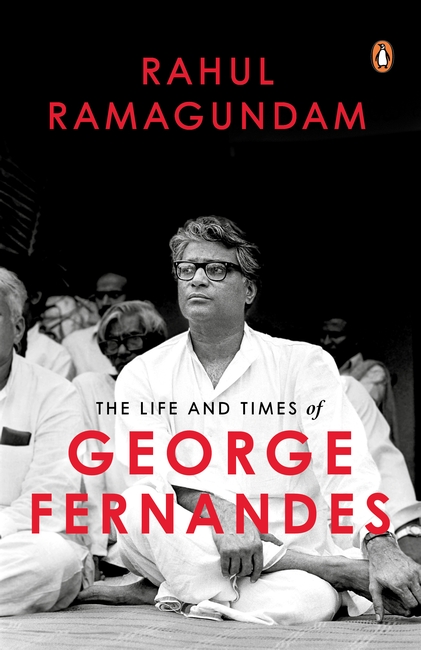
The Life and Times of George Fernandes

Book review by Bhaskar Parichha

Title: The Life and Times of George Fernandes

Author: Rahul Ramagundam

Publisher: Penguin /Allen Lane

“Always for the people and never with the establishment”- that sums up the persona of George Fernandes. One of India’s firebrand leaders, Fernandes (1930-2019) lived his life fully and with resolve. He was a multifaceted personality: a trade union leader, a socialist, and a powerful orator. No other politician in India had risen to such heights of popularity as Fernandes was. A down–to–earth politician, he has left behind him an unparalleled legacy.

The Life and Times of George Fernandes by Rahul Ramagundam is one of its kind biographies – well-researched, colossal, and one which tells the story of a leader in minute detail. It is hard to find a biographer so immersed in the subject that it becomes a monumental work.

Reads the blurb: “George Fernandes is popularly known for leading the All India Railwaymen’s Federation (AIRF) in 1974 and calling upon its approximately 1.7 million employees to strike, which brought India to a halt for twenty days. Often described as a rebel, he pursued every cause he took up with passionate devotion, heedless of the many ups and downs in his life. From the early years of fighting for the rights of the dock and municipal workers of Bombay through the Emergency, which he resisted by going underground, to his last private decade as a bed-ridden Alzheimer’s patient, his fights were always persistent and single-handed. It chronicles the story of George, who rose from the streets of Bombay to stride the corridors of power.”  

If Fernandes was known for trade union militancy, politically he was dauntless. A rebel political leader, he was an anti-capitalist dreamer. George could call Bombay to shut down and rose from its streets to become India’s Defense Minister.

In this amazing biography, Ramagundam records George’s political evolution and traces the course of the Socialist Party in India — from its inception in the 1930s to its dissolution into the Janata Party in the late nineteen-seventies. In the process, the book explores the trajectory of India’s Opposition parties that worked to dislodge the long-ruling Congress Party from its preeminent position in the thick of the emergency. 

Ramagundam received his doctoral degree in modern Indian History at Jawaharlal Nehru University. He was associated with a grassroots movement in the united Madhya Pradesh for many years. Presently, he teaches at a Delhi-based university and also is the author of Gandhi’s Khadi and Socially Excluded.

In the prologue, Ramagundam writes: “The book tells the story of India s tortuous post-Independence building and the role of George Fernandes in it. In some ways, the book presents a contemporary history of India through the lens of George’s life and his political work. The story has George’s political emergence at its center but does not emanate merely from his perspective.” 

Explaining the basic objective of the book, the author says, “This is not a narrative of events – however defining they might have been. A biography is a chronicle of an evolutionary process and not a conglomeration of self-standing events in the subject’s life. Events shall feature here, as they are bound to be in a book dealing with a political personality. But more than the events, the book is a delineation of processes that define Indian politics. It delves deep into the evolution of India where George lived and worked tor. He also attempts to enter the political mind and probe the political choices George made.” If the book tries to present an insider’s account it also strives to construct those processes with documentary evidence and oral testimonies.

Divided into a dozen chapters with acronyms, a chronology of events, dramatis personae, and a guide to sources, there is nothing that the author has not covered about George’s action-packed life.

From his Christian beginning to the revolutionary road, George’s Bombay days, the sobriquet that George earned — More Dangerous than the Communists– the most hunted man, George’s underground days, how he was chained and confined, the gritty years — the book has all that Fernandes was made of. But it is in the last chapter (‘They Hate My Guts’) that Ramagundam exposes the double-speak of leaders who were close to Fernandes. 

Says the book: “The pedigreed hated him. The plebeians felt jealous at his powerful expression of their predicament with a perspective they lacked. Left with Bihar alone, the English-speaking socialist imports (J.B Kripalani, Asoka Mehta, Madhu Limaye, and George) won there because of their national and wider outlook to the disadvantage of the homegrown socialists. Sooner or later, to survive in Bihar politics, when caste-parochialism was raising its monstrous head all over, it was inevitable that George would have to depend on the accruing local elements and accord them primacy.”

This particular incident was one of the saddest ones in George’s life and was played out in full glare then. Ramagundam recollects the episode in the book: “In the 2004 general elections, Nitish Kumar made his return to Muzaffarpur, where he won, but in 2009, when he again desired to stand for election from the same constituency, his party headed now by Sharad Yadav, a front of Nitish Kumar, denied him a nomination. As a consequence, a fumbling George, Alzheimer’s disease already having taken some visible grip over him, was made to fight the election as an independent and he lost his deposit, denying him a graceful exit. The unsavoriness of George contesting the election against his party was opposed by his family members, who blamed Jaya Jaitly for it. Michael Fernandes wrote to Jaya about it and asked her not to make a mockery of him. And, after the election, in which he not just lost his deposit but showed up as decrepit his inability to campaign exposed to the world, Leila Fernandes put out a public statement expressing her displeasure at the goings-on in his life and politics.”

Concludes Ramagundam: “George Fernandes lived a life driven by a commitment that was experientially born, he had ideologies to believe in, and for most of his life these ideologies seemed to be personified in his endeavors and struggles, but beyond that, he lived a life of experiences, up close and personal, that is left for future generations to sort out and sift through, and learn from.” 

Comprehensive, evocative, and unputdownable, this definitive biography of George Fernandes is a tour de force. It is not only the biography of George Fernandes but also an account of the times gone by in contemporary India.

.

Bhaskar Parichha is a journalist and author of UnbiasedNo Strings Attached: Writings on Odisha and Biju Patnaik – A Political Biography. He lives in Bhubaneswar and writes bilingually. Besides writing for newspapers, he also reviews books on various media platforms.

.

PLEASE NOTE: ARTICLES CAN ONLY BE REPRODUCED IN OTHER SITES WITH DUE ACKNOWLEDGEMENT TO BORDERLESS JOURNAL

Categories
Review

Reconstructing a Broken World with Sufism

Book Review by Basudhara Roy

Title: Evening with a Sufi: Selected Poems

Poet: Afsar Mohammad

Translator: Afsar Mohammad and Shamala Gallagher

Publisher: Red River

I’m sorry, my Lord. 

My poem is not your slave,
it’s a sickle with its head to the sky. 

My poem is not a damsel timid in your moonlight,
it’s a tiger prowling in a shadowed forest. 

My poem won’t be your grand constitution, 
devoted to your happiness 
at all costs.

-	‘Outcast’s Grief’ from Evening with a Sufi

Not all poetry can be read with the same eye or ear. Certain poems demand to be seen and heard on their own terms, offering to the reader their own canons of understanding and appreciation in imaging an idea that, through them, has just been born into thought. Afsar Mohammad’s Evening with a Sufi sets out to be one such thought-provoking book of poems.

A slim collection of twenty-six verses selected and translated from Afsar Mohammad’s extensive oeuvre in Telugu by Shamala Gallagher and the poet himself, these are existential political poems that are as theoretically perspicacious as they are urgent and astounding in their overwhelming sincerity. Like Eliot’s The Waste Land, Afsar Mohammad’s Evening with a Sufi aesthetically documents a difficult world, especially one criss-crossed with systemic hegemony, and bereft of equality. An engagement with these poems is a direct invitation to the reader to embark on an epistemological tour into a sharp symbolic landscape that encapsulates visceral records of social meaning.

The title, to begin with, itself upholds a strong symbolism. Its ‘evening’ bespeaks the twilight of civilisation, the personal-social moment of the unleashing of despair, and a decadent global landscape thriving on inequity and deprivation. And yet, evening, in these poems, is also the transitional period of awareness, self-reflection, evaluation, and the collective envisioning of an egalitarian dawn. These poems, therefore, become investigations and articulations of both fatigue and rest, of falling apart and re-gathering, and of old failures and new beginnings, leading us to look at the idea of the Sufi or Sufism anew.

“For me, Sufism is nothing but a tool of resistance,” avers the poet, indicating how Sufism, as a philosophy, offers a vigorous counternarrative to transnational policies and practices of discrimination, marginalisation, disempowerment and exclusion. “In my village Sufism, I see how people of diverse colours and castes share food, rituals and stories. As a village person, it’s not a far-fetched utopia for me — but an everyday reality. My writings are nothing but reminders of that shared realm of life.”

In Afsar’s poems, Sufism becomes a political as well as existential search for a vision of oneness. This vision is, at the same time, philosophical and social, local and global, integrating and intimidating in the way that most revolutions are – “The drop that can swallow a desert” (‘Another Word’) or “Where walls are knocked down,/ we won’t need the splendour of curtains” (‘The Spectator is Dead’) or “I always speak the language of war.” (‘A Green Bird and the Nest of Light’)

Identity surfaces as a significant theme in this book. Most of the twenty-six poems in Evening with a Sufi embark on a complex exploration of identity on geographical, cultural, social, historical or linguistic terrains. However, the book’s conceptualisation of identity is far from monolithic. Germane to the vision of these poems is the essentially dialogic space of identity and its characterization as an ever-contingent work-in-progress.

Mark the first poem in the collection, for instance. Titled ‘Name Calling’, an ambiguous phrase that poignantly addresses the phenomenon of naming as an act of use and abuse, the poem captures the essential seamlessness of names and identities. The protagonist of the piece is a boyhood contemporary called Usman who is visibly an ‘other’ to the speaker of the poem, the difference between them marked out distinctly in class terms and perhaps also (less evidently) in terms of physical ability – “You scared all the children/ away from the river./ A body like a wound/ peeks from your torn shirt.” It is, however, to this social pariah – “the one street dog doggedly haunted by a ball” that the speaker feels affiliated in his later life:

Now I don’t see much difference between you and me. 
We are the same.[…]
Usman, times never change 
only the roles change.

Muslim, Telugu and Third-world migrant, the poet reads the theory and experience of otherness on a number of sociological axes and through a variety of cultural lenses. In ‘The Accented Word’, he uses the idea of accent to explore the complex genealogies of language on the intersections of purism and cultural hegemony, contemplating variously, through the three sections of the poem, on linguistic integrity, capitalist subordination, and postcolonial erasure:

Words 
are stillborn babies. 

Their blood has gone bad with white poison, 
their words have gone bad from the accent. 

I’ve been poured, shared, and bathed in white poison 
since I was little 
and now I want to speak out for myself. 

But my voice is in chains 
and my language is poisoned, 

and the language of my time is poisoned. 

We live on the brackish water of life.

While Shakespeare’s Caliban in The Tempest felt that the colonizer’s language profited him by teaching him “how to curse”, Afsar’s poems approach language with utmost caution, forever mindful of the possibility of trampling and obscuring buried histories of domination and betrayal. Many of the poems, here, are metapoetic in their thrust, assiduously exploring the value of meaningful postcolonial poetic creation from the inescapable inequities and ideological loopholes of language: “a market piles up words sounding like poetry” (‘The Accented Word’) or “How long this slavery to white poems?” (‘Outcast’s Grief’) or again as in “Poetry: / just one dried leaf.” (‘Walking’)

In ‘A Piece of Bread, a Country, and a Shehnai’, bread, music, war and pain – all come together to avow our subcontinent’s shared heritage of poverty and cultural intimacy brutally shredded by politico-religious separation. In ‘No Birthplace’, the speaker of the poem is as much the Indian subcontinent as its hapless postcolonial citizen faced with the inability to reconcile its historical legacy of cultural plurality with the blind spots in its mythological and ideological machinery:

Come, divide me by myself, I say. 
Not by forty-seven. 

My laughs, screams, harangues, deaths, and rapes — 
They’re all yours too! 

It is interesting to note how Afsar’s poems consistently invigorate and socially translate the idea of spirituality through sinewy sociological imagery with the result that spirituality is transformed from a closeted and socially-indifferent personal practice to a welfare-oriented everyday social ritual. In ‘Iftar Siren’, the idea of fasting as self-purification is ironically brought to bear on the understanding of the hunger-stricken socially dispossessed as perpetually cleansed while the overfed victimisers walk about unconcerned:

What a great life. 
In the holy month, 

do you see how you are all becoming pure? 
I’ve been like this for years 

burning in the divine fire. 
Unable to turn into ashes. 

I’m a fire-pit you try 
and try to stamp out. 

Yes, the fire-pit 
is tired too.

The haunting and incendiary metaphor of hunger as fire and the stomach/body as the fire-pit, tired of being stamped out or dispossessed, makes these poems powerful bandages for social injustices as well as flaming flags of protest. In ‘Qibla’, the posture of prayer, again, pivots on the stomach – “a belly turned deep/ into itself/ in which I obscure my body,/ feet, hands and everything/ for a long time” – suggesting the omnipotence of hunger as surpassing all acts of asocial faith. The poem concludes with considerable uncertainty of the efficacy of prayer and with an ideological pun on “arms” (arm/armament) as a means of erasing human hatred.

The stupendous yet composed energy of the book needs no forestatement. Every single word here is deftly chosen, well-placed, and tersely poised to make emotional leaps on command. The images are taut, the sentiments thoroughly grilled in the fire of creative originality, and everywhere, there is a sense of potential unruliness held firmly in check by a balanced and farsighted imagination.

In considering these poems, one must not forget, also, their complex linguistic history. Though translated from the original Telugu, the Telugu language itself includes, for the poet, “the entangled history of Urdu, Hindi and English — the languages that indeed shaped my emotional realm.” Arriving into English via such multi-layered linguistic travails and travels, these exceptionally well-translated poems infuse postcolonial English with a visceral depth, a spiritual profundity and a razor-sharp urgency that would be difficult to come by in the original English.

Accompanied by a very relevant author interview and insightful essays by the translator and  valuable first readers of this collection, Evening with a Sufi arrives, in its essential philosophy and call for humanitarian action, with a new theory and praxis for the world, determined to reconstruct rather than redeem it.

Basudhara Roy teaches English at Karim City College affiliated to Kolhan University, Chaibasa. Drawn to gender and ecological studies, her four published books include a monograph and three poetry collections. Her recent works are available at Outlook India, The Dhaka Tribune, EPW, Madras Courier and Live Wire among others.

.

Click here to read the book excerpt from Evening With a Sufi

PLEASE NOTE: ARTICLES CAN ONLY BE REPRODUCED IN OTHER SITES WITH DUE ACKNOWLEDGEMENT TO BORDERLESS JOURNAL

Categories
Interview Review

Born Free to Follow your Heart

Anthony Sattin, an award winning journalist and travel writer in conversation about Nomads: The Wanderers Who Shaped our World, his recent book published by Hachette, India.

A breath-taking narrative that travels with the freedom of nomads, drawing from folklore, history and modern movements to give voice to an idea that might help move towards a more progressive and hopeful future — Anthony Sattin has achieved all this in a single book called Nomads: The Wanderers Who Shaped our World, a non-fiction that touches the heart with the concept of unifying humanity beyond the borders of ‘isms’ drawn over time. It explores the history of people who often have not been chronicled in conventional texts.

We are living in times where floods, forest fires, wars and divides are ravaging humanity as it wakes up from the coils of a pandemic that had almost stilled all normal interactions and economic activities for more than two years. The unrests and the changes attributed to “climate change” call for “continued solidarity” and a united front from all humanity as indicated by UN Secretary-General Antonio Gueterres and global guru Harari. In times such as these, an attempt to revive the concept of asabiyya, or bonds based on felt interests, is laudable and a necessity for the world to move forward. And that is exactly what Sattin has done in his recent book.

He has travelled with nomads; folklores, starting with Cain and Abel, Gilgamesh and Enkidu; history, Gobelki Tepe or Potbelly Hill, the place where he locates what might have been Eden, Achaemenid kings, Persian nomads, Mongols, Mughals to global nomads — spanning 12, 000 years of history.

In his book, Sattin tells us: “We are living at a time when the world — our world — shaped by the age of Reason and Enlightenment, powered by industrial and technological revolutions is faltering.  Social contracts are fraying and communications are breaking down. The raw materials and natural resources are becoming scarce, and the consequence of our actions … are written large across landscapes, the climate, the fabric of our lives…Change is needed.”

Sattin “traces the shifting relationships between people who move and those who were settled” to find the concept of asabiyya or the sense of bonding popularised by an Arab philosopher called Ibn Khaldun (1332-1406). Perhaps, this is an ideal that could benefit humankind if we were all to see ourselves as one tribe. He has mentioned modern attempts at asabiyya, like the call given by ‘Black Lives Matter’, to contextualise the concept for us and to show how a movement born from within the hearts of people could touch and change attitudes.

The book is divided into three parts after an initial introduction from Mount Zagros, where Sattin was rescued from a bout of sunstroke by nomads: the first part is called ‘The Balancing Act’, where he explores ancient folklore and history, Huns, Hyksos, Scythians, Xiongnu and more: the second part is called ‘The Imperial Act’, from  ‘The rise of the Arabs to the Fall of Mongols’ where kingdoms and world history is brought into play and the importance of asabiyya is introduced with historic instances and the last part is called ‘The Act of Recovery’, where changes towards redefining the world in terms of ideals aligned with asabiyya are explored.

The scope of the non-fiction is clarified at the start of the book from Mount Zagros. He starts the first section interestingly in a locale, termed by him as “Paradise” in 10,000 BC with a global population of ‘Perhaps 5 million’, of which he lists the nomad population as ‘Most of the number’. As he unfolds the history of mankind, from the past we find echoes of what could be called mobile or nomadic bonds that embrace to expand and heal civilisations. Sattin has been exploring such bonds for the last forty years.

Described as “a cross between Indiana Jones and a John Buchan hero” and “one of the key influences on travel writing today”, Sattin started his interactions with bedouins at age nineteen and found them nurturing. He elucidates: “After I left school, I went travelling in the Middle East. In the Sinai Peninsula, at that time, there were no hotels or other facilities outside of Sharm el Sheikh. So, I and the friend I was travelling with relied on the Bedouins for many things — they brought us fish and other food, they told us stories about the magical places in the desert mountains and although we had been told that they would rob us, they looked after us.”

Anthony Sattin. Photo Courtesy. John Murray/Hachette India. 

Sattin has several non-fictions under his belt and is an award-winning journalist, who writes in a number of well-known journals, like the Sunday Times, the Conde Nast Traveller and the Financial Times. An editorial advisor to the Geographical magazine, he is also a fellow of the Royal Geographical Society and a founder-member of Travel Intelligence and ASTENE (the Association for the Study of Travel in Egypt and the Near East). He was the director of the Principal Film Company, has written, advised and presented on television and radio productions, including the BBC.

In this exclusive conversation, Sattin discusses Nomads, and tells us how the book came to be.

What made you think of writing a book on nomads, who — you have stated in your book — now constitute only 40 million in a world of 7.8 billion humans?

Every book has its moment, and this is the right time for Nomads. It came out of a lifelong interest in people who live on the move and on the problems of settled society, especially with cities – some of the first thoughts in Nomads occurred decades back when I read Lewis Mumford’s The City in History[1]. But I also have many ideas for books in my head at any one time and they don’t all get written! And some of them sit around for ages and then it seems to me to be the right moment to write. The way our world has changed in the past decade helped shape my sense that this is the moment to write about open borders and freedom of movement. I also wanted to write something that would stretch me more than anything else I had written. Twelve thousand years of history seemed like a big enough challenge…

How long did it take you to research and write the book? What kind of research did you do?

I began shaping the idea nine years ago, after I finished my previous book, Young Lawrence[2], about how the second son of an anonymous, middle class Oxford family became Lawrence of Arabia. The proposal took more than a year to get right – as my editor at WW Norton in New York pointed out, a subject this big can be about everything and nothing. Then there were years of research, particularly in the Bodleian Library at Oxford and the London Library, which is a wonderful place, the largest private library in the world and which serves as my home from home. I had many conversations over the years with scholars, people in publishing, fellow writers, travellers and nomads. And then there was the travelling with nomads, the writing and rewriting.

You travelled and lived among nomads for some time? How many years? Were your travels affected by the pandemic? If so, how did you bypass that?

I have been meeting nomads for more than forty years, particularly in North Africa and the Middle East, where I have travelled extensively. When I was 19, I was looked after by Bedouin in the Sinai Desert. In 2010, I was back there on a camel trek with a guide who impressed me because he knew every mountain, every watering place and every cave, including one which he pointed out as the place where he was born.

In Mali, I spent time with Touareg nomads, who came together each year at a place in the desert beyond Timbuktu – these tribes used to be at war with central government (and are again), but a treaty had been brokered and one of the terms was that tribal and government leaders would meet once a year to sort out grievances. They also played music, danced, raced camels… How could one not be swept away?

Specifically for Nomads, I went to Iran to spend some time with the Bakhtiari, a large nomad tribe who I had chosen in part because they claim lineage that goes back millennia, because they had played a part in the making of modern Iran but also because in the 1920s, a movie[3] was made of their annual migration into the Zagros Mountains, amazingly by the director and producer[4] whose next movie was the original King Kong! The Bakhtiari taught me much about the challenges facing nomads today.

Can you tell us of a few interesting experiences while moving with nomads which are not part of the book?

When I first went into the Zagros Mountains to meet the Bakhtiari, I was taken by a guide (being British, I had to have a guide for my entire stay in Iran) and he could not understand why I would waste my money and my time going into the mountains. He was from the city and exhibited age-old prejudices against people who lived on the move, whom he called ‘primitives”. But I am not a nomad and although I don’t find them primitive, I do find some aspects of their lives very challenging: years ago, on a camel trek in the Thar Desert, I caught what I now assume was sunstroke and thought I was going to pass out. My guide – there were just the two of us travelling – got me out of the desert. At the first village we reached, he had someone bring a bed out of a house and placed in the shade of a tree. I lay down and remember no more until about four hours later when I woke to find myself surrounded by the whole village. They had been angry with the guide for bringing me to them – think of all the trouble they would face if I died! When I woke, in the middle of this scene, the whole crowd burst into cheers like a scene out of a Bollywood movie.

You have spoken of ‘asabiyya’ taught by Ibn Khaldun. Can you explain the concept briefly and tell us if this can be of relevance in the current global situation?

Asabiyya is a sense of group feeling, something that binds people together. Ibn Khaldun thought it had shaped the world and found that it was most powerful among nomads and people who lived in the desert, in part because they must rely absolutely on each other. When this group feeling is channelled by a leader – the Prophet Muhammed, for instance – it can lead the group towards extraordinary achievements, as when the first Arabs overcame the might of the better-trained and armed Byzantine and Persian armies. It might all sound like something from long ago but I think there is a sense, in our own time, of someone like Greta Thurnberg having channelled that same feeling to force our leaders to pay attention to the climate emergency.

At a point you tell us that “…cities posed existentialist risks, and their temptations could overwhelm the asabiyya and nomads would lose their identity.” Why was maintaining their identity for the nomads so essential? Do you think this is something that needs revival in the present?

The existential risks I mention are the ones that rob nomads of their asabiyya and therefore of their power. Ibn Khaldun had seen this first hand: in North Africa, several small reformist movements had come out of the harsh desert or mountains to the south and overwhelmed the courts and kingdoms along the north coast. But each of those movements had fallen apart within a few generations as the pure people of the desert found themselves corrupted by living in cities. As for identity, it is important for all of us to know who we are and where we have come from — that was one reason to write the book, because very little is taught about nomads in western schools.

Your book touches upon number of issues — including faith. Given the fact that the great Khan had a Nestorian church, a mosque and a Buddhist temple in his capital city despite following the Shamanistic faith, would you say that an openness or tolerance in beliefs and faiths led to a more strongly tethered kingdom, as they did not really seem to have concepts of permanent national boundaries then? Is this not a dichotomy that you create a strongly tethered kingdom and yet are open to move on, leaving the old capital behind? And is it not wasteful?

I think there are two things going on here. On the one hand, a belief in freedom of conscience, the right to follow any or no religion. This was certainly something the great Mongol khans believed in. They were mostly animists, believing in the Sky Father and reliant on signs and omens, but they were not adverse to being prayed for and blessed by an imam or priest. Even the Ottomans, who came out of a nomadic tradition and were clearly Muslims, thought it important to allow freedom of conscience in their empire. What mattered was not who you prayed to, but whether you were prepared to acknowledge the sovereignty of the khan or the sultan. Some of the most successful periods in human history have flourished because of this idea.

A strongly tethered kingdom is another issue. For nomads, cities and capitals were not as important as lands, particularly hunting and grazing lands. The Mongol khans, like ancient Persian emperors and many other nomad leaders, recognised the need for a pivotal meeting place, a capital, but they were mostly more interested in spending time elsewhere and on the move. A leader such as Attila, the Hun ruler, had no interest in the cities he conquered.

You mention British author, Bruce Chatwin(1940-1989), as having said “we are born to move, that we must move or die.” Can you explain what that would mean? In the current context, people talk of roots and homeland. If they keep moving what happens to their firm conviction in homeland?

It depends what sort of ‘moving’ we are talking about. On a mundane and personal level, research now tells us that we are less likely to get ill and more likely to live longer if we walk 10,000 steps a day. On a national and global scale, we need interaction, we need to live lighter, we need to be nimble on our feet and in our thoughts.  

You have divided the world into two groups — nomads and settlers — and said we need a bit of both. Can you tell us how and why?

Humans began to settle and cultivate some 12,000 years ago and since then, like Cain and Abel, humans have broadly been divided into those who stay in one place, usually either cultivating the land or living in towns/cities, and those who live on the move. For most of history they have lived in a state of mutual dependence and often even in harmony. A world without nomads, with everyone fixed in one place – which seems to be where we are heading – is a smaller, less rich, less fertile world.

In a post-pandemic world, would the nomadic lifestyle you have written of be feasible, especially with all the governmental issues creeping in? 

The word nomad comes from a very old Indo-European word meaning pasture or a fixed area, which suggest the right to graze. But if you take a broad view of what it means to be a nomad in the 21st century, you might also include digital nomads and others who move to work or just because that is how they want to or have to live. That might not have been possible during the pandemic, when we were all locked down, but the number of people on the move now in many parts of the world is right back up and that can only be a good thing – we need to mix and meet, to exchange experiences and opinions.

If we opt for a mobile lifestyle, would we need to redefine borders as of old? Would that take us back to a pre-nationalistic era? Do you think we should be redefining our mindsets and our isms? Do you suggest we all go back to an intermittent nomadic lifestyle?

We should always be questioning mindsets and isms! Happily, we are living through a golden age of revisionist history shaped by a number of forces, decolonialism, Black Lives Matter and #MeToo among them. We also live in an age of misinformation on a massive scale. Nomads has come out of a need I had to shine some light on a way of life that is either entirely missing, or misrepresented in our histories.

Are you planning to write more on this issue or move on to something else? Would you share with us your next project?

There is much more to be written about this issue, but after spending most of the past eight years working on Nomads, it is time for me to look elsewhere. I hope I have stimulated a debate about nomads that will encourage others to look further. Meanwhile my thoughts are turning to Egypt — and to Italy, from where I am writing today.

Thanks for giving us your time during your travels.


[1] First published in 1961

[2] First published in 2014

[3] Grass (1925)

[4] Merian C. Cooper (1893-1973)

(This review and online interview is by Mitali Chakravarty)

.

PLEASE NOTE: ARTICLES CAN ONLY BE REPRODUCED IN OTHER SITES WITH DUE ACKNOWLEDGEMENT TO BORDERLESS JOURNAL

Categories
Review

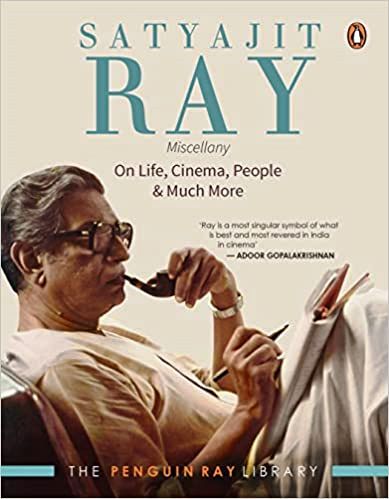
Satyajit Ray Miscellany

Book review by Bhaskar Parichha

Title: Satyajit Ray Miscellany: On Life, Cinema, People & Much More

Author: Satyajit Ray

Publisher: Penguin Randomhouse

There could be any number of books on Satyajit Ray. Even after thirty years after his death, he continues to be written about. The present book Satyajit Ray Miscellany: On Life, Cinema, People & Much More, as the title suggests, is everything that the veteran filmmaker India had put in black and white.

As part of the Penguin Ray Library, the book has more than seventy rarest essays on filmmaking, screenplay writing, autobiographical pieces, and rare photographs and manuscripts.

“Ray is a singular symbol of what is best and most revered in Indian cinema” as the film director and scriptwriter, Adoor Gopalakrishnan, has put it and the actor, Ben Kingsley, complimented him: “Satyajit Ray, I salute you. The greatest of our poets of the cinema.”

One of the doyens of world cinema, Ray gave a “unique aesthetic expression to Indian cinema, music, art, and literature. His writings, especially, autobiographical works, thoughts on filmmaking, screenplay writing, and eminent personalities from art, literature, and music, among others, are considered treasure troves, which largely remained unseen and therefore less known till date.” Ray was a writer of repute – his short stories, novellas, poems, and articles, written in Bengali and translated into English, have been immensely popular. Author of the famous Feluda stories, Ray’s Bengali books have long been bestsellers. 

Ray was awarded the Oscar for Lifetime Achievement by the Academy of Motion Picture Arts and Sciences in 1992 – the year he was also awarded India’s highest civilian honour the Bharat Ratna, and also when he breathed his last.  

Writes Sandip Ray in the ‘Foreword’ to the book: “Since his schooldays, my father was a cinema addict in the true sense of the term – lapping up Hollywood movies of Billy Wilder, William Wyler, Frank Capra, and others as well as the timeless comedies of Chaplin and Keaton. The hobby gradually turned into a serious interest. The formation of the Calcutta Film Society in 1947 with a few like-minded friends opened to him the diverse range of European cinema, and in a sense, acting as a catalyst to his writings on cinema. In his first two articles, he heavily criticized the make-believe stereotypes of erstwhile Bengali cinema and called for soul-searching among the filmmakers. The result as he himself remarked later amusingly – ‘Nothing of that sort happened. The piece was simply shrugged off by the people of the trade as yet another piece of tomfoolery by some arrogant upstart who saw only foreign films and knew nothing of local needs and local conditions.’”

The book has been enchantingly divided into: ‘Satyajit Ray – A Self-Portrait’, ‘A Director’s Perspective’, ‘Personal Notes’, ‘Reminiscences’, ‘Festival greetings LP Sleeve Notes’, and ‘Miscellaneous Writings’. There is also a chapter on the ‘Preservation of Satyajit Ray Archives’. Together, these writings bring to the fore fascinating anecdotes of Ray’s eventful life.    

About the art of Rabindranath Tagore, Ray wrote: “Tagore took to painting at a later stage in his life. Some manuscripts dating back to his youth show doodles in the margin which suggest a natural flair for drawing. After that, there is nothing to show that he had any interest in visual expression until, when he was well over sixty; fantastic forms began to appear in his manuscripts. Where one would normally cross out a word or a sentence, Rabindranath turned them into grotesque creatures. These emendations were stung together until the whole page took on the appearance of a tapestry of words and images. In time, paintings and calligraphic drawings began to appear as independent efforts, unrelated to manuscripts. Blue-black ink gave way to transparent colors, and the subjects became more and more varied. The output clearly suggests that Rabindranath was absorbed in his new pursuit and enjoying the experience. The lack of formal training was compensated by an instinctive feel for rhythm, texture, and spacing. There was also the calligraphic virtuosity when he used the pen. (His unique and beautiful Bengali handwriting– which came to be known as the “Rabindrik” script has been widely imitated.) But the brush, too, was frequently used. Some of the efforts were purely abstract while others dealt with subjects which covered a wide field.’

Ray considered scriptwriting to be an integral part of direction. Initially, he refused to make a film in any language other than Bengali. In his two non-Bengali feature films, he wrote the script in English; translators adapted it into Hindustani under Ray’s supervision. Such was the purist in Ray!

In the section ‘The Outlook for Bengali Films’ Ray was fairly real-world: “It is generally conceded that the film industry in Bengali is facing a big crisis. Some have gone so far as to predict a total annihilation of the Bengali film as such, and the sprouting up in its place of a product not dissimilar to the well-known type created by Bombay. This may be the height of pessimism, but there is no denying some alarming symptoms. Firstly, the area of exploitation of the Bengali film has been considerably reduced by the Partition; secondly, for reasons we shall presently examine, the exhibitors in Bengal have grown increasingly distrustful of the home product preferring the unpretentious, brassy, and frankly escapist products of Bombay and more recently, Madras.”

Nemai Ghosh was Satyajit Ray’s only cinematographer who did almost all his films. Ray wrote: “We founded the Calcutta Film Society in 1947 with the help of a few friends and associates. Nemai Ghosh was one of them. Like me, he was also enamoured by the cinema; so we got along very well. I was a mere cineaste then but he was already a practitioner as a cameraman. However, he harboured the desire to direct films himself at the back of his mind. The chance came his way during the late forties when he made Chhinnamul (The Uprooted, 1952) on the theme of Partition. It was the first instance of realism in Bengali cinema. But thereafter he was compelled to head for Madras for want of work in Calcutta and had to spend the rest of his life there. Being a leftist to the core, he did a lot for the cinema workers in Madras. We exchanged correspondence only occasionally. But whenever we met, the old warmth of friendship was revived. Today I am feeling his absence intensely and I am sure the cine workers of Madras are also feeling likewise.”

Satyajit Ray Miscellany, the second book in the Penguin Ray Library series, brings to light some of the rarest essays and illustrations by Ray that opens a window to the myriad thought-process of this creative genius. With more than seventy gripping write-ups and rare photographs and manuscripts, this 275-page book is undoubtedly a collector’s item. 

.

Bhaskar Parichha is a journalist and author of UnbiasedNo Strings Attached: Writings on Odisha and Biju Patnaik – A Political Biography. He lives in Bhubaneswar and writes bilingually. Besides writing for newspapers, he also reviews books on various media platforms.

.

PLEASE NOTE: ARTICLES CAN ONLY BE REPRODUCED IN OTHER SITES WITH DUE ACKNOWLEDGEMENT TO BORDERLESS JOURNAL

Categories
Review

Of Ghosts and Tantriks

Book review by Basudhara Roy

Title: Taranath Tantrik and Other Tales from the Supernatural

Author: Bibhutibhushan

Translator: Devalina Mookerjee

Publisher: Speaking Tiger Books

The book decides to arrive on a crisp Friday morning, its sunshine so keen and abundant that any thoughts of the supernatural can only be merrily chuckled over. The cover, however, is strangely disconcerting. It takes me time to mark that the brilliant art on it actually depicts skulls. Not ordinary enough to be dismissed as mere biological specimens, the skulls seem to represent, in their complexity, vibrancy and the silhouette of birds that haunt them on every side, a text that is both hauntingly familiar and eerily not so. Bibhutibhushon’s short stories exploring the supernatural and tantra, a practice associated with dark forces and the Goddess Kali, translated by Devalina Mookerjee from Bengali — could not, perhaps, have been showcased better.

Bibhutibhushan (1894-1950) was an eminent Bengali writer whose best known works are his novels, Pather Panchali (Song of the Road) and Aparajito – both immortalised into films by Satyajit Ray,  Chander Pahar (Moon Mountain) Aranyak (Of the Forest). Some of these books can be found in translation.To one even remotely acquainted with Bibhutibhushan’s oeuvre, his stories offer a definite assurance of being in good company. In reading , Taranath Tantrik and Other Tales from the Supernatural, however, what the reader might fail to bargain for is the almost complete obliteration of the physical world by the world of the book, and by the time the journey through the nine translated stories therein has been made, one is no longer sure where one world ends and the other begins.

It takes time to step out of the frame and to express admiration for the conduit that has led to this extraordinary experience in fiction – the translator. To transcend spatiality and temporality and conjure these tales again for an entirely different readership in an entirely different language is likely to have been a project fraught with its own pointed challenges. Mookerjee, however, seems to have successfully met them all, so much so that in the context of the English language, these spooky, unsettling tales offer not the slightest semblance of foreignness, even when they deal thematically with something as acutely local and specialised as tantra. The language is sparklingly contemporary and in its inflections, energy and dreaminess to allow these nine narratives to carve their own particular niches. The pace of the collection stays heady throughout and the atmosphere is completely overpowering.

Of special significance is Mookerjee’s nuanced and insightful twenty-seven paged ‘Introduction’ to the collection that calls upon the reader to visualise concrete connections between social justice and the genre of the supernatural. Mookerjee writes: “Seen against the background of what people are capable of doing to each other, stories of ghost may be seen as corrective mechanisms in the scales of justice. A person who has been wronged returns to tell their story, perhaps to wreak havoc on their tormentors. A disbeliever sits in a séance for which the medium is clearly not prepared, and chaos ensues. We have a word for this already. We call it karma.”

The ‘Introduction’ serves, also, as a brave attempt to place Bibhutibhushan’s writing in current socio-cultural perspective, and to bridge the disparate worlds of rural Bengal that birthed these stories and that of the contemporary English reader of these tales who could belong to almost any geographical space on the global map.

The first two stories of the collection are centred around the protagonist after who the book has been named, a dabbler in the dark arts, Taranath Tantrik. The remaining seven stories are each unique in their own ways as they chart their individual journeys into the terrain of the invisible and the occult with remarkable skill and clarity. “Human beings have historically shown very little need of support from the otherworld to behave in perfectly horrible ways with other people. This is the point at which the darkness of the uncanny and the darkness of people converge,” avers Mookerjee, pointing out how the surreal is often only another dimension of the real revealed in a disjointed spatial-temporality.

Not all of the nine stories strike with equal power. If ‘The Ghosts of Spices’ appears quite facile and juvenile in its description of a march-past of spice sacks on the deserted nocturnal streets, ‘A Small Statue’ appears rather simplistically cinematic in its  dream presentation of the tableau of the monk, Dipankar’s life. In the most evocative stories of the collection like ‘Maya’, ‘The House of His Foremothers’, ‘Arrack’ and ‘The Curse’, however, the quiet, intricate weaving of setting, psychology and idea dazzles in its brilliance, leaving behind a sense of both fracture and healing.

Bibhutibhushan’s poignancy is at its unsurpassable best in his delineation of place and in his exploration of links between physical place and human placed-ness. His most unforgettable stories are those in which people and places interact with each other organically and without inhibitions, creating a documented identity of both being-in-place and place-in-being. In ‘Maya’ for instance, the house acquires an identity of its own as its past inhabitants gently draw its present dweller/s into the folds of its mystery and inexplicable self-sufficiency. In ‘The House of His Foremothers’ similarly, the ghost-girl Lokkhi mourns for the bereft house more than her lost family and consistently haunts its silences in the hope of resurrection for the house which, unlike her, still lives across the family’s generational lifetimes.

To allow one’s imagination to be overpowered by these stories is to experience a strange welding of the probable and the improbable into the arc of the possible — to be awakened to a new dimension of being in which while vision remains at par, the other senses experience a heightened participation with what is positively undefinable but utterly undeniable.

Taranath Tantrik and Other Tales from the Supernatural, by thus placing the reality in the larger context of a world that still evades the cartography of reason, becomes a portal to a widened, heightened and more enlightened worldview. It helps remind of the intersections between our own human finitude and the infinite world with its geo-historical consciousness incapable of forgetting and thoroughly unable to forgive.

.

Basudhara Roy teaches English at Karim City College affiliated to Kolhan University, Chaibasa. Drawn to gender and ecological studies, her four published books include a monograph and three poetry collections. Her recent works are available at Outlook India, The Dhaka Tribune, EPW, Madras Courier and Live Wire among others.

.

Click here to read the book excerpt from Taranath Tantrik

PLEASE NOTE: ARTICLES CAN ONLY BE REPRODUCED IN OTHER SITES WITH DUE ACKNOWLEDGEMENT TO BORDERLESS JOURNAL

Categories
Review

Is it a Story, a Novel, or a Memoir?

Book Review by Somdatta Mandal

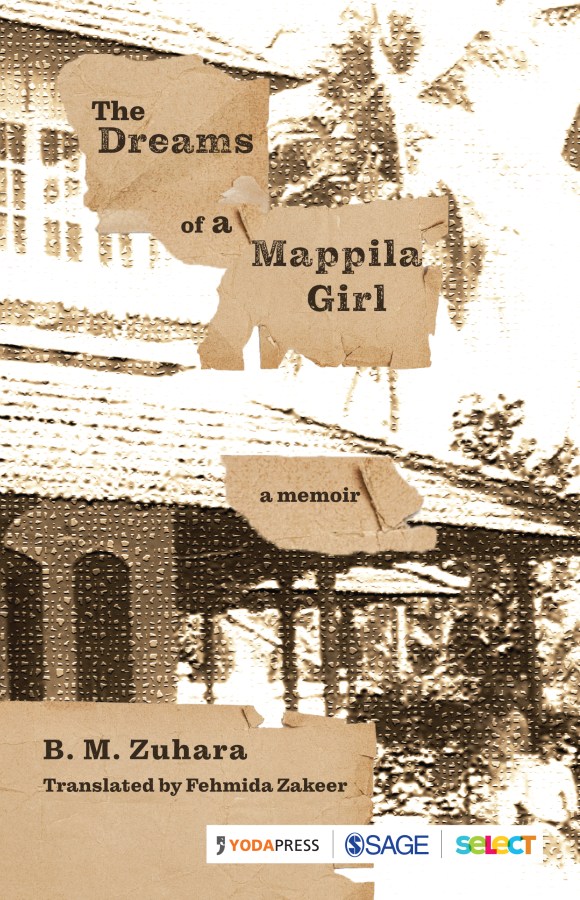
Title: The Dreams of a Mappilla Girl: A Memoir

Author: B.M. Zuhara

Translator: Fehmida Zakeer

Publisher: Yoda Press & Sage

 The terms ‘autobiography’ and ‘memoir’ are sometimes used interchangeably but the former is more fact-based and tends to be historical, whereas a ‘memoir,’ derived from the Latin word ‘memorandum’, is chiefly a personal, minute recollection of events, not necessarily intending to cover a person’s entire life, but often written from an epiphanic perspective, a significant event, or a particular aspect of the memoirist’s life. Thus, memoirs are essentially subjective and can never claim to be bio-bibliographical narrations. B.M. Zuhara, the writer and columnist from Kerala and a Sahitya Akademi awardee who writes in Malayalam, had penned The Dreams of a Mappila Girl: A Memoir (2015), which was recently translated by Fehmida Zakeer to English. It traces the childhood years of the writer, growing up in the village of Tikkodi in rural Kerala as a young Mappila girl from the Muslim community in post-Independence India.

For Zuhara, the things she remembers from her childhood act as vignettes which we readers string together to form a wholesome picture of the feudal system and social issues that were significant in her mind as she was growing up in the Malabar Muslim community in the 1950s. The tenth and youngest child of her parents living in a huge ancestral house called Kizhekke Maliakkal, Soora’s narrative gives us details of the things she remembered about the place till the point where at the age of thirteen she moves with her family to live in a rented house at Kohzikode to be admitted in a high school and begin a new chapter in her life. But even after she gets admitted into a prestigious school at Kozhikode, uncertainty looms large over Soora’s life as her mother stays adamant about not allowing her daughter to wear a skirt as a uniform as mandated by the school. In the ‘Preface’, Zuhara mentions that her childhood ancestral home does not exist anymore, but its memory is so strong that it appears as a character in many of her writings.

From the very beginning of the memoir, we form a clear picture in our minds about the location of the house, its detailed set-up filled with characters of the extended family including servants and cooks who lent a helping hand to run it smoothly. Like many other narratives, food plays a significant role in developing the ambience of Soora’s household. We get details of the elaborate tea ritual every evening, the eating of pathiris soaked in coconut milk, the aroma of fried plantains and coconut residue that filled the air, the details of the betel leaf chewed by her mother and grandmother with their decorative boxes and copper spittoons, the attempts to hatch chickens from eggs that were undertaken in the storeroom, the rearing of hens and ducks and goats by her brothers, the midday meals offered in their village school which their mother did not allow them to partake considering that it was solely meant for underprivileged children, and so on fill up a considerable portion of the narrative. Apart from visiting the village fair, Zuhara recounts the social mores of the society she lived in and offers glimpses into the secluded lives of Muslim girls and women who, despite obstacles, made the best of their circumstances and contributed positively to their communities.

One significant point about the memoir is the presence of Soora’s mother throughout the narrative and the strong influence that she had over her. While growing up, Soora often accused her of not looking after her well because she was an unwanted child. A religious woman who prayed five times a day, she not only tried to apply the teachings of the Quran to her life, but also shared her newly acquired knowledge with the people around her. Any deviation from the traditional lifestyle was, according to her, punishable as an offence by Allah. A pampered cry baby who would often burst into tears for the slightest reason, Soora from the very beginning was a sensitive child, who was often admonished for her interest in playing with boys and learn Kalari Payattu like her brothers, play with them in the rice fields, stand on the bridge and listen to the songs sung by the farmhands as they worked. She was also scolded for eavesdropping into conversations made by adults and like all traditional Muslim women, her mother wanted to get her married at a very young age. The real and perceived slights that Soora was subjected to, were primarily targeted at her physical appearance, specifically her dark complexion and her tendency to cling to her mother. But paradoxically for a seemingly timid child, Soora’s propensity to constantly question what is established as normative behaviour for a girl earns her the nickname of ‘Tarkakozhi’ – one who argues. What these contradictory impulses perhaps reveal was a girl who was overwhelmed by the big and small battles she must constantly fight, a life burdened by gendered expectations, yet a girl whose deepest desire was to be like Unniarcha, a mythological woman celebrated for her fearlessness whose ballads Soora grew up listening to.

But soon Soora realised that some of her dreams would never materialise because of her gender. Certain details, such as that of Soora’s grandmother passing away at the age of thirty when Soora’s mother was fifteen; or that two of Soora’s sisters were married even before she was born, reveal the dark reality of women’s lives in those times. In the ‘Preface’ Zuhara categorically states:

“I grew up at a time when Muslim girls did not have the freedom to dream. When I started writing, I had to face a lot of criticism and threats, and I found many limitations imposed on me. Until then, only men had recorded the inner lives of Muslim women. Even though I could not comfort my sisters physically, I have tried through my writings to give them a voice by speaking about their dreams, chronicling the obstacles and difficulties faced by them, and providing a perspective from the point of view of women. In the process, I have tried to define a space for myself in the literary landscape.”

In her ‘Preface’, the author also wonders if her work is a “story, or a novel, or a memoir.” Her words became the wings upon which forgotten, and deeply bruised memories travelled out into the world. She recreated the stories of her dear and near ones around whom she had spent her childhood. She coloured her childhood experiences with her imagination and penned them all down. Even though all the names are of actual people, if she is asked if the stories are real or imagined, she can only say that they are both. So, she leaves it to her readers who have encouraged and supported her writing journey to decide.

Here one needs to add a few words about the translation. The translator Fehmida Zakeer also hails from Kerala and being a Muslim herself, her effort to make this book read as smoothly as the original Malayalam text is laudable. There is no italicisation of non-English words throughout the text and the list of kinship terms at the beginning, along with the elaborate glossary at the end, makes the book as reader friendly as possible while trying to retain the flavour of the original. The only occasional problem this reviewer faced while reading the text was that too many authentic words and salutary terms for relationships of even a single individual often turned confusing for a lay reader like her who had to pause and recollect who the actual person referred to was. For the protagonist, mention of Sora, Soora, Sooramol, and Zuhura is understandable, but addressing members of the extended family and others residing in the neigbhourhood in different salutations sometimes becomes difficult for people not acquainted with the South Indian Malayali culture. However, despite such a minor lapse, the book is engrossing and offers a wonderful slice of life of the rural and semi-urban Muslim community in Kerala, of its customs and lifestyle which otherwise would remain unknown to us in a muti-cultural and multilingual country like India.

.

Click here to read an excerpt from The Dreams of Mappila Girl: A Memoir

.

Somdatta Mandal, critic, translator, and reviewer, is a former Professor of English at Visva-Bharati, Santiniketan.

.

PLEASE NOTE: ARTICLES CAN ONLY BE REPRODUCED IN OTHER SITES WITH DUE ACKNOWLEDGEMENT TO BORDERLESS JOURNAL

Categories
Interview Review

The Fearful Trill of Freedom & Equality

A conversation with VR Devika, author of Muthulakshmi Reddy: A Trailblazer in Surgery and Women’s Rights, Niyogi Books.

“Education, Freedom and Responsibility bring out the best from the individual and race. This will apply to all men and women irrespective of caste, creed or colour.”

—Dr Muthulakshmi Reddy, Muthulakshmi Reddy: A Trailblazer in Surgery and Women’s Rights

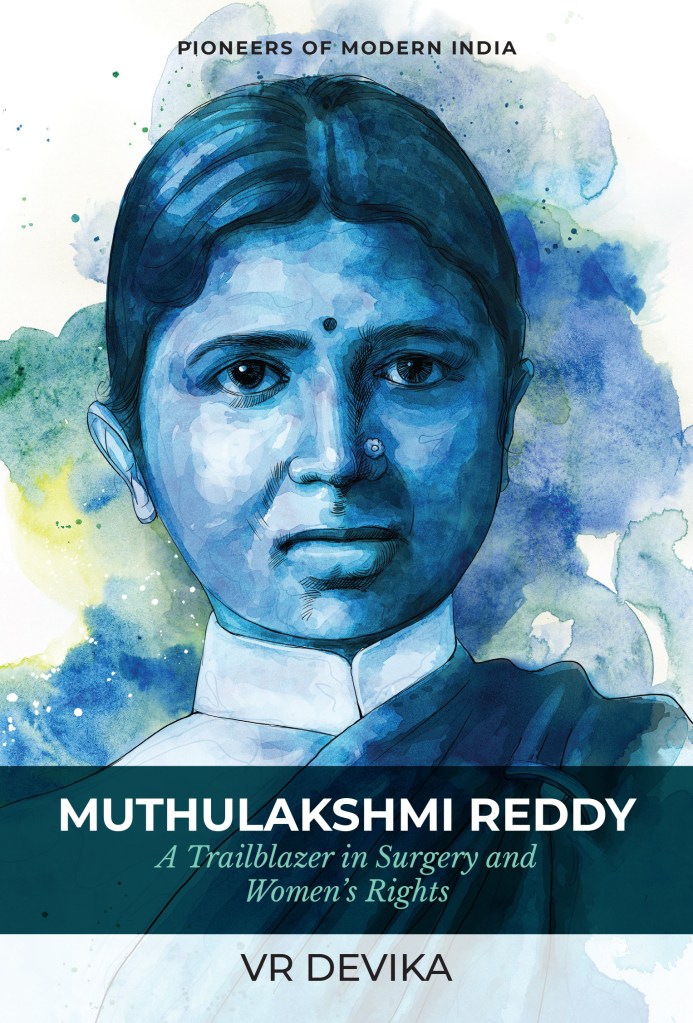
 Muthulakshmi Reddy: A Trailblazer in Surgery and Women’s Rights by VR Devika is a biography of a woman who shouted out to demand reforms among devdasis ( women who had been ‘married’ to lifelong service of a deity or a temple) and prostitutes in the nineteenth-twentieth century. The biographer, V R Devika, is a storyteller, educationist and Gandhi scholar.

Muthulakshmi Reddy (1886-1968) was born to a devdasi mother and transcended the system that had deteriorated from when a devadasi was considered ‘auspicious’ as she would never be widowed or married, and she could maintain her status quo, the book informs, adding a historic perspective to this ‘norm’. By Reddy’s times, these women had been reduced to become mistresses to rich men. In ancient times, before malpractices set in, a princess is said to have opted to become a devdasi. The decline started in the sixteenth century when devdasis were transferred from temple to temple.

The narrative is simple and straightforward but what stands out is the value of the content, the strength of the woman who could speak up boldly and demand reforms — even have some of them instituted. She spoke out for reforms with searing words. The author quotes from many of her speeches.

“Muthulakshmi used strong language to explain her position on the Devadasi question. ‘Of all the laws, rules and regulations which down the centuries have helped to place women in a position of inferiority, none has been so very powerful in creating in the minds of men and people a sentiment of scorn and contempt for women as the degrading idea of the double standard of morals.’

“She thundered, ‘From this double standard that has sprung that worst attack on women’s dignity, that safety valve theory that a certain number of women should exist, should sacrifice their self-respect, their honour, their comforts, their health and happiness to satisfy the lust of the other sex. At the present day, the continuance of such a doctrine and of the laws which are founded on it, is a shameful anachronism unworthy of our civilisation. Both in the past and in the present, women have disproved their inferiority, and how then can we at the present day tolerate or connive at a system which transforms a woman of whichever caste or class she may be, into a mere chattel, a piece of tainted merchandise? The inequity of the system is too deep for me to give expression, and further under that inhuman and unjust system the innocent children of a certain caste or community are trained to become proficient in all the arts of solicitation that they become captives to vice.’”

That men and women perpetrate social norms to justify the existence of the so-called ‘world’s oldest profession’ is well brought out in the book. That women forced into the sex trade are not doing this out of choice is conveyed with conviction. Names of Reddy’s associates include Sarojini Naidu (1879-1949) and the well-known singer whose mother was a devdasi too, MS Subbulakshmi (1930-1997).

Reddy was one of the first female medical graduates[1] in India, the first woman[2] to enter an Indian Legislature and the first woman in the world to preside over a Legislative Assembly. A recipient of the Padmabhushan and more accolades, she, as a doctor founded the Addyar Cancer Institute in 1952 after her sister was caught with cancer, and, as a humanitarian, started the Avvai Home in 1931 for those rescued from brothels and streets. Her spirit is well captured by the author when she writes:

“In 1942, during the World War II, soldiers of the British Royal Airforce camping in tents on the banks of Adyar river had made some derogatory remarks about the girls and harassed them. Muthulakshmi stood vigil all night with a stick in her hand and dared any soldier to come near the Home. She even went up the ranks to the commander’s house near Fort St. George to complain to him about the conduct of the soldiers and curb their behaviour.”

VR Devika has extensively shown that Reddy was a force to be reckoned with but she has not given way completely to adulation. She has objectively shown how Reddy over ruled her son’s choices for the well-being of her own institutions. It brought to mind Gandhi’s attitude towards his own family. An established cultural activist, VR Devika has been associated with the inception of Chennai’s Dakshinachitra Heritage Museum and Tamil Nadu INTACH[3], has been visiting the Avvai Home and in this exclusive she tells us the story of how the book came about and why she visited this home and its impact on her.

VR Devika. Photo provided by Niyogi Books

Tell us why you felt that Muthulakshmi Reddy’s story needed to be told. What was the readership you had in mind when you wrote the biography?

The dance scholarship [donors] consisting of mainly outsiders who had a hypothesis, got a good grant, employed interpreters and cherry picked to denigrate her in a fashion that took dance academic world by storm after the 1980s. I had also bought into them when I began to learn Bharathanatyam. But when I joined INTACH Tamilnadu and Madras Craft Foundation in 1985 after having been a schoolteacher since 1974, I began a project of English language as a skilling programme and theatre as empowerment for Avvai Home. That is when I began to get the other side of the story that was really fascinating. I kept thinking I must reach this story out. Dr.V.Shanta, chairman of Cancer institute, said I must write her [Muthulakshmi Reddy’s] biography and I decided to work on it after she passed away. I had young people who were studying English but had no access to English other than their textbooks as the target audience but I am a story teller and I just began to tell the story in simple way as I always do.

You tell us in the authorial note that you went on ‘work’ to the Avvai home. Tell us about the home. Why were you there?

Geetha Dharmarajan and I lived near Avvai Home. I had no idea about the history of the home etc. But I knew very poor girls studied there. Geetha had spoken to them and I went along but Geetha relocated to New Delhi and started Katha[4] and I stayed on helping Avvai Home in many different ways. I have written a full story of Avvai Home in the book. It was volunteer work. Rajalakshmi of Avvai Home requested me to help them on a production on Dr.Muthulakshmi Reddy. I interviewed Sarojini Varadappan, Dr.Shanta, and several others to write the script for the production. I am now on their school advisory committee.

For me, the most interesting aspect was how Muthulakshmi Reddy made the transition from being born a devadasi to empowering herself enough to outlaw the custom. Did her parents ever marry?

No there was no way they could marry as a girl born in the system was barred from ritualistic marriage according to Hindu custom. She was his companion.

Your narrative is direct and eulogistic of great names and associations of/ developed by Muthulakshmi Reddy and the lady herself. The personal is largely left out, except to emphasise her achievements. Why?

I cannot [describe that] as I never met her. I had to sketch a portrait from her writings, her achievements and her son’s writing.

Would you regard the devdasi system as a social ill that has been erased or is it an ongoing battle?

There is no social evil that has been erased completely. Nostalgists for devdasi system denigrate her [Reddy]. But there is the social evil of discrimination against Dalits still, but should Ambedkar be blamed for giving a legal handle for those who wanted to come out and achieve something of their own despite the caste hierarchy? Those who benefited from the abolition of dedication are in thousands while those who bemoan the loss of culture in the way they want it are in hundreds.

The devdasi system is a generic system in a number of states in India. Did Reddy’s reforms benefit all the states? Was the Avvai Home open to all devdasis or only from her state?

Avvai Home never claimed to be only for devdasis but for girls who needed protection and access to education. No reform benefits everyone. Her law was for the Madras Presidency of the time which consisted of parts of Andhra, Orissa and Karnataka too as part of it.

Muthulakshmi Reddy started a number of things, including the second oldest cancer hospital in India. But all these were reactions borne of personal experiences. Do you think if she had been born into a regular family, and her sister would not have had cancer, would she have striven for these institutions too?

I can’t answer a hypothetical question. How do we know what she would have done?

What was the driving force behind the reforms instituted by Muthulakshmi Reddy?

Her own indomitable will and the stubborn streak that sought to get it done and get others who would help her come in whole heartedly.

Would you justify the “emotional blackmail” on her son to fulfil her own dream by giving up his own? Do you think that it is right of a parent to impose their will in this way?

I am not justifying it. It happened that way. Just telling the story. She did not force her elder son who went into Electrical Engineering. Her second son never resented the “emotional blackmail” He went along whole heartedly.

What for you was the most endearing quality of Dr Reddy?

I have many who worked with her telling me she was very kind, but she was also a tyrant and would not bend. Her own indomitable will and the stubborn streak that sought to get it done and get others who would help her come in whole heartedly. She was a mother (Amma) was the unanimous opinion.

Thank you for giving us your time.


[1] Anandi Gopal Joshi(1865-1867) and Kadambini Bose Ganguly (1861 –1923) graduated and practiced as doctors in other parts of India.

[2]  Muthulakshmi Reddy joined the Madras Legislative assembly in 1930.

[3] Indian National Trust for Art and Cultural Heritage 

[4] Katha is a non-profit and non-governmental organisation that has established itself in the field of community development, child welfare, education and literature.

(This review and interview is by Mitali Chakravarty.)

.

PLEASE NOTE: ARTICLES CAN ONLY BE REPRODUCED IN OTHER SITES WITH DUE ACKNOWLEDGEMENT TO BORDERLESS JOURNAL

Categories
Interview Review

Satyajit Ray – Was he really ‘The Man Who Knew Too Much’?

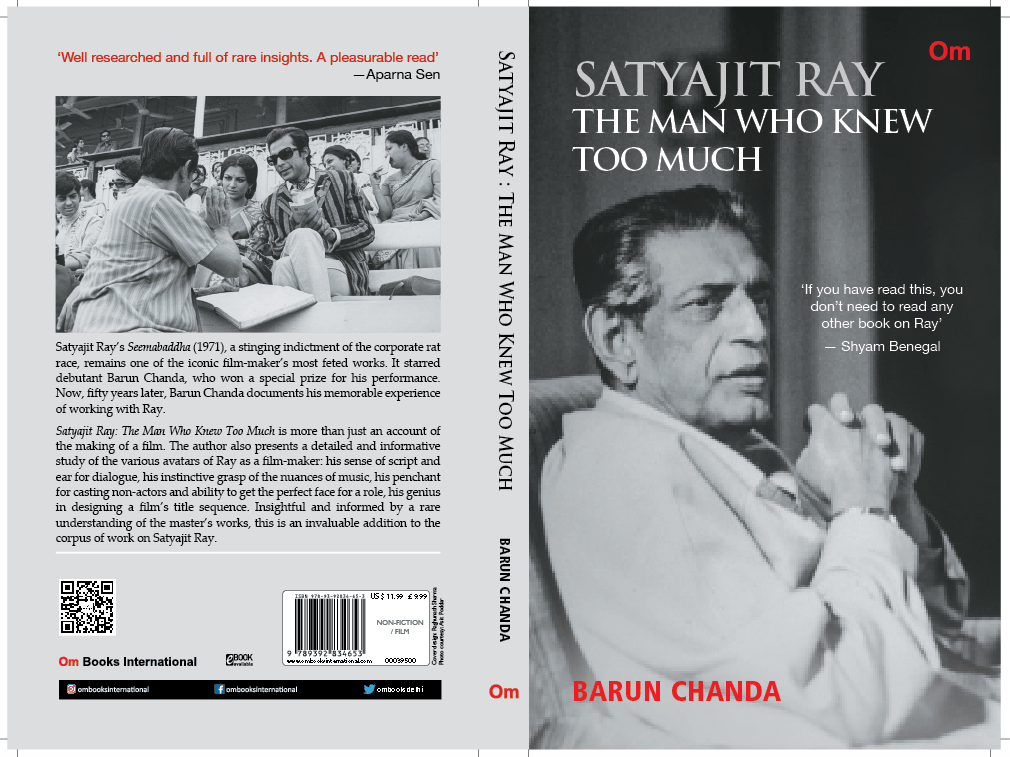
In conversation with Barun Chanda, an actor who started his career as the protagonist of a Satyajit Ray film and now is a bi-lingual writer of fiction and more recently, a non-fiction published by Om Books International, Satyajit Ray: The Man Who Knew Too Much

“[O]ne would like to remember Ray as one of the last truly great renaissance men of Bengal, moulded much in the tradition of Tagore, in the sense that his genius manifested itself in manifold directions: film-making, photography, writing, composing poetry, limericks, music, designing, drawing, developing new typefaces, you name it.

“For a long time, he was also our most distinguished cultural ambassador to the world.”

This perhaps is the one of the most apt descriptions of a man whose films were legendary in our lifetime and a part of the concluding chapter in The Man Who Knew Too Much by Barun Chanda. The book is an exhaustive account of Ray and his major films, how he made the films, what were the influences he had, how he directed the films and how versatile he was. Chanda is clearly impacted by this giant of Bengal renaissance, which started with Raja Ram Mohan Roy in the eighteenth century and encompassed Tagore.

The book is as much a memoir by Chanda about Satyajit Ray as it is a narrative about his films. Structured unusually, this non-fiction has an introduction sandwiched between two sections, the first being Chanda’s own interaction with Ray as a hero of his award-winning film, Seemabadha[1](1971), and the making of the movie; the second being the narrative that covers the titular content (borrowed from Alfred Hitchcock’s famous 1956 thriller), The Man Who Knew Too Much, about the genius of Ray as a filmmaker. Chanda shows us how Ray was truly unique and very gifted. He would remember all the dialogues and be intent on being involved with every part of film making, from costumes to camera, lighting and makeup — which is probably why his films had a unique touch so much so that he has to date been the only Indian filmmaker to win an honorary Oscar which Hollywood actress Audrey Hepburn, collected for him as he lay sick in bed (1992) breathing his last, saying: “Dear Satyajit Ray, I am proud and privileged to have been allowed to represent our industry in paying tribute to you as an artist and as a man. For everything you represent I send you my gratitude and love.”

And this note has been quoted by Chanda to bring out the uniqueness of a man who counted luminaries like Arthur C Clarke, Jean Renoir, de Sica, Kurusawa, Cartier-Bresson among his friends. He has unveiled the unique persona further. “As Ray was wont to say, everything that he had done earlier in his career, helped prepare him to be a complete filmmaker. His sense of framing stemmed from his knowledge of still photography. His deep love of Western and Indian classical music helped shape him as a music director. His sense of art direction came from his earlier stint at D.J. Keymer. His power of illustration helped him design the sets of Hirak Rajar Deshe[2]and Shatranj ke Khilari[3], both marvellous instances of art direction. And a combination of these two factors facilitated his making of some of the most original and impressive cinema posters ever.”

Chanda goes on to describe the full genius of Ray’s film making which even stretched to scripts, songs — both the lyrics and music often, and of course his ability to visualise the whole movie beforehand. Ray is quoted as having said: “I have the whole thing in my head at all times. The whole sweep of the film.”

Interspersed with anecdotes about the films, the text highlights the eternal relevance of some of the dialogues and lyrics that Ray wrote himself. For example, listening carefully to the lyrics of ‘Ore Baba Dekho Cheye[4]’ (Goopy Gyne Bagha Byne, 1969), one could see it as a comment from a current pacifist in today’s war-torn world. This book actually seems like an eye opener not only to understand Ray’s films, but also to find out what the world needs from the media, an important comment in times of false news and sensationalism.

However, the book is not all adulation. It is also a critique of the persona of a visionary who could risk all for realising his vision. Chanda tells us how to attain perfection, Ray could risk necks: “There was an element in Ray bordering on ruthlessness. To get a certain effect on the screen he wasn’t averse to taking risks, at times to dangerous levels.”

New perspectives are brought in from unpublished interviews: “In an unpublished Bengali interview of Ray which is in the possession of Abhijit Dasgupta, one-time chief of Doordarshan, Kolkata, when asked about his film Sadgati[5], the maestro is quoted to have said: ‘One needed to make a film on this story immediately. As a Marxist, Mrinal Sen would have probably made it differently, more angry … Had this film been angrier I’m not sure it would have served the purpose any better. I don’t think display of anger alone can lead to much of an achievement. To my mind a truly politically angry film hasn’t been made so far. Until now what has been done is to shoot at safe targets. It hasn’t made any difference to establishments in any way. If one were to achieve this kind of a thing, I would sooner be a political worker than a filmmaker.’”

While looking at the maestro through an objective lens, Chanda finds it hard not to express his affection for the giant who impacted not just him but a whole generation of movie goers, film personnel and the world. His last sentence says it all:

“As far as I’m concerned, he [Ray] is always present. Not past. Not even past perfect.”

Chanda, a man who started his life working in the same advertising agency as Ray and dreaming of being an actor, with four books and multiple films under his belt, himself mesmerised audiences as a protagonist in Ray’s award-winning film and then suddenly withdrew from the industry for two decades. Why would he do that? Let us find out more about him and Ray in this interview.

Barun Chanda

First of all, let me tell you I am very honoured to be interviewing a Ray hero from a film I have watched multiple times. So, tell me, why did you act only in one Ray film, have a hiatus of twenty years and then go back to acting with Hirer Angti [6]  in 1992, the year Ray died. Did it have anything to do with Satyajit Ray’s presence or influence?

No. I’ll tell you what – after Seemabadha, I got a cluster of film offers, nine-ten offers and I did not accept anyone of them because they did not seem to be significant enough. I wasn’t interested in making money out of films or becoming a film star. I was interested in acting in good films. If they came my way, I would do. If they didn’t come my way, I wouldn’t. I would go back to my profession which is advertising. I was very happy there.

So, these offers that came didn’t quite satisfy me. And Manikda[7] did not call me back again for whatever reasons. The other significant filmmakers like Tapan Sinha, Mrinal Sen and Ritwick Ghatak – they did not call me. I suppose I was branded as a capitalist actor. Or Imperialistic actor! I suppose it became ingrained in their mind I was an executive and nothing else. They felt they could not bend me into the roles in their film. A pity!

Is this your first non- fiction? What led you to think of writing a book on Satyajit Ray?

Yes, it is my first non-fiction. I had harboured this thought for a long-long time but there is a natural reluctance about writing anything. I am, by and large, a lazy person and there were a whole lot of things that were pretty personal, and I thought, you know, let it be stored in my mind. Maybe, I could narrate to my close friends’ circle certain stories and certain things that happened between me and him. But not for everyone. Even in this book, I have not mentioned a whole lot of things that are too personal, which he confided to me in good understanding that I will not tell another. I won’t speak about it.

Then the centenary year came, and many asked me why I did not write my out my memories. Shantanu Ray Chaudhuri was one of them. He said the time is right and you have such wonderful anecdotes and experience, put it down for posterity. When I did the first part, I realised it could not just be my experiences but also something larger – in the sense what kind of a man was he in real life.

I was also dissatisfied with the books I have been reading about Ray and his works — starting with Marie Seton[8], who was supposed to be a gospel on Ray. I found it was a narration of his films in chronological order and what she thought of them. It was film-based assessment, not of the man himself or his qualities separated from the films. So, I decided to explore his persona. This book is quite different from any written on him. I have sections on music, editing with a whole lot of films but not in a chronological order. That is passé. The second part started with what has not been done. As I progressed, newer sections dawned on me – a whole lot of sections I have not used. I wanted a chapter on “The Rise and Fall of the Ray Empire” – but then thought I’d rather not finally. It would have been terrific, but I did not, perhaps want to spoil the public feeling about Ray. I did not want to criticise. I did do a chapter though — “Director or dictator”.

Absolutely. Your book is dispassionate but has no scandals or any unfair criticism. In fact, it seems to be based on not just your memories but also many interviews and lot of research. Can you tell us what went into the making of this book in this context? What kind of research and who all did you interview? How much time went into the making of the book?

I used Ray’s experiences with actors who are no longer alive – like Chabbi Biswas or Tulsi Chakraborty. I have used Aloknanda Roy who happened to work with Chabbi Babu in Kanchenjunga[9]. I used the living actors. I did not interview Soumitra Chatterjee – I know his feelings on Ray. So, I did not interview him separately. But there is a lot in the book about how Soumitra da perceived Ray or his equation with Ray.

The book worked well for me – I would have gone to a madhouse but for this book. You have to believe me. For it helped my sanity, writing this book during the Covid period[10]. The eighteen months—closer to two years. I could really concentrate on something as I am an outgoing person – not that I am a club person – but I would like to meet my friends, lead an active life. Suddenly, I felt imprisoned – it was like house imprisonment. So, I turned my attention to writing this book and whatever I could get out of YouTube, whole lot of other’s books, Ray’s interviews. One gentleman, Abhijit Dasgupta, who was the head of Kolkata Doordarshan, had conducted an interview. He gave me part of it which I found very intimate. You could do a book on Ray and Mrinal Sen dispassionately –Mrinal’s films would be of historical importance but not of relevance otherwise whereas Manikda’s films can be watched again and again because it touches your heart.

That is so true. Your book is structurally unusual with an introduction in the middle of two parts. Why did you follow such an unconventional format? Do you feel it helped your presentation in any way?

Yes. Because I was writing a different book. No one has written a biography in two parts. In a way it is not a biography, but it is trying to understand and appreciate Ray as a filmmaker. That’s what the book is.

I was in an advantageous position to write on Ray. Actually, Dhritiman Chatterjee could have done the same. I admire Dhriti for his thinking, but I guess there is an innate laziness. He did interview Manikda but I do not know where the tapes are.

I felt the way I did it was the right way. The book came naturally to me. For somethings, I went out of my way — like the titling.

To this date, no Indian director has made a film where the title is relevant to the film. The film follows from the title. The thought is not there. But it is there in the West. That is why you have people like Saul Bass. Ray wanted to do things himself – that might have been why he did the titling too. He would draw and present to the art director who would work further on it. I should have had a whole lot of drawings in this book, but it was not readily available.

I continue to feel I could embellish certain chapters, especially on music. Debojyoti Mishra, a film music director, has written a book in Bengali which actually traces from where Ray has borrowed what piece of Western Classical music. It is not unlike Tagore – there are analogies in the use of music between the two.

Ray spent a few years in Santiniketan when he was young, I think around 1940. Was he impacted by Tagore? Can you tell us about it? Did he meet Tagore or have any conversation with him as it was a year before Rabindranath passed on?

He did not actively seek out Rabi Thakur. He was a very shy person. There is no mention anywhere in his writings about seeking out Tagore, knowing very well Tagore held his father and grandfather in great esteem. His mom knew Tagore well. But he never sought him out. It is rather difficult to understand why he did not utilise the time speaking with Tagore. Maybe, Tagore was inaccessible. I could have asked him, but I never did. I do not know why I never asked.

Why would you borrow from Alfred Hitchcock to name probably one of the last of the Bengal renaissance men? Can you please elaborate?

I thought that the title was absolutely apt. As a director he knew more than any director did. It described him to perfection. He would draw, give music and work with his basic idea with the rest of the team.

What would you say is Ray’s most major contribution to the world?

The brilliance of Ray’s portrayal of the village was outstanding. You watch the film and think you cannot improve on it. And Ray knew it and has said it.

Does Ray continue to impact current trends in cinema?

Ray was a classicist. The film making style has moved away from that. He would not move the camera unless it became imperative to his film. But now, cameras are handheld, and they have fast shooting. Film making has transformed with the emergence of the web series. Shooting has become so much easier and quick, though they work very hard. There is something more raw about web series. The feature film is more stately, more crafted. Films have enough time. You cannot get a good film if the actors are not brilliant. You cannot shoot a good film in ten or twelve days as they do for web series. That is not physically possible. In the West, they take eighty to ninety days to shoot a film.

Ray wrote many novels on Feluda and Professor Sonkhu. Yet made few films on them. He made films of others’ books rather than his own. Can you tell us why?

Maybe, the writing part started late in his life. It was propelled by his need to feed Sandesh[11] and he had to supply stories to Desh[12] — one per year, for the puja [13]special. His writing came as an offshoot – it was an accident. But the preparation was there – if you read his scripts or lyrics, they are fantastic. The scripts he wrote were brilliant. There is much to admire and respect about him. He was a writer too.

You are known to be a writer too. Are your books impacted by your association with Ray?

What I learnt from him was how to write dialogues. The publisher of my Bengali books, Tridib Chatterjee, said he found my dialogues “smart”. Ray’s writing was very tight. I tighten my descriptions. I do not expect the readers to read a book like Tom Jones[14].

Can you tell us about your other books? Coke (2011) interestingly, is available in both Bengali and English. So, which came first — the Bengali book or the English? Are they both your handiwork? Tell us a bit about your novels?

I wrote it in Bengali first and then wrote it in English later. Actually, it was not a direct translation. I write in both the languages. Another one which is in English is Murder in the Monastery. The second edition is being brought out by Rupa, should be available on Amazon soon hopefully. Post-Covid, people have gone into hibernation. So, many have complained they cannot get it.

I have two books in English, Coke and Murder in the Monastery. The others are in Bengali.

Which genre is preferable to you — murder, mystery thrillers or non-fiction like this one?

I get my high writing fiction, especially crime.

Are you giving us any new books in the near future?

Yes, a collection of short stories in Bengali, probably after the pujas. I have created a character called Avinash Roy. He is learned and intelligent but not overtly brilliant like Sherlock Holmes. My favourite character [fictional] among detectives is that of Inspector Morse – I have seen the TV series but not read the books. He was very human. Absolutely brilliant. But coming back to my current book, it is also facing delays, but I am hoping it will be out this October.

Thank you for giving us your time and answering our questions


[1] Translates to ‘bound by limits’

[2] 1980 film by Ray, translates from Bengali as ‘In Hirak Raja’s Kingdom’

[3]1977 film by Ray, translates from Hindi as ‘The Chess Players’

[4] Translates from Bengali to ‘Oh dear look around’

[5] 1981 television film by Ray, translates from Hindi as ‘Deliverance’

[6] A film by Rituporno Ghosh, translates as ‘Diamond Ring’

[7] Satyajit Ray – he was often referred to as such by his friends

[8] Marie Seton: Portrait of a Director: Satyajit Ray, 2003

[9] Ray film released in 1962

[10] Lockdown due to the Pandemic

[11] A magazine started by Ray’s grandfather, Upendrakishore Ray in 1913

[12] A Bengali magazine that was started in 1933

[13] Durga Puja, the main festival of Bengalis, where the Goddess is said to return to her parent’s home for five days

[14] The History of Tom Jones, a Foundling (1749) by Henry Fielding

.

(This review and telephonic interview has been conducted by Mitali Chakravarty.)

.

.

PLEASE NOTE: ARTICLES CAN ONLY BE REPRODUCED IN OTHER SITES WITH DUE ACKNOWLEDGEMENT TO BORDERLESS JOURNAL

Categories
Review

Netaji: A Legend Revealed by the Family

Bhaskar Parichha reviews a non-fiction written on Netaji by his family.

Title: Netaji Subhas Chandra Bose’s Life, Struggle and Politics 

Author: Krishna Bose

Editor and Translator:  Sumantra Bose

Publisher: Picador India

Books on Netaji Subhas Bose are plentiful and readers are unvaryingly fascinated by every book that hits the bookshelves. The enigma and the ecstasy of Netaji’s short yet eventful life continue to enthrall people worldwide even after decades since his death in a plane crash.

This new book Netaji Subhas Chandra Bose’s Life, Struggle and Politics by the late Krishna Bose is a refreshingly new account of the great leader’s life. Three aspects of his life stand out prominently in the book: Subhas Chandra Bose’s political motivations, personal relationships, and the daring military campaigns he undertook to secure India’s independence. 

Krishna Bose (1930-2020) was a Member of Parliament thrice. A professor of English Literature, Krishna (nee Chaudhuri) married Dr. Sisir Kumar Bose — son of Netaji’s elder brother Sarat Chandra Bose. Sisir was Netaji’s chief aide in his daring escape from India in 1941 and drove the escape car from the family’s mansion on Kolkata’s Elgin Road. After Netaji’s death, Krishna helped Sisir build the Netaji Research Bureau at Netaji Bhawan. She served as NRB chairperson after Sisir’s death. 

The book offers a rare in-depth account of the Netaji’s meaningful life by one of Bose’s close family members. That makes the book authentic and stimulating. Originally written in Bengali, the writings reveal the “human being alongside the revolutionary and freedom fighter”. It traverses Bose’s life from childhood to his death in August 1945. With important chapters about his youth, political career, and the power equation with Mahatma Gandhi and Jawaharlal Nehru, the book subtly brings out different shades of Netaji’s personality.

Drawing on Netaji Research Bureau’s archives and decades of fieldwork and interviews, this book offers an unmatched portrait of Subhas Chandra Bose – the man, his politics, and his epic struggle for India’s freedom. Krishna Bose’s writings were compiled, edited, and translated from Bengali by her son Sumantra Bose.

Krishna Bose traveled the world and extensively to the subcontinent in order to find out more about Netaji’s life.  She strung together her findings, giving new insights into Subhas Chandra Bose’s political motivations, his personal relationships, his epic journeys, and the daring military campaigns he undertook to secure India’s independence. Written over six decades the book vividly reveals Netaji as a human being alongside his radical views.

The book has a detailed account of the women who influenced Netaji (his mother, adoptive mother, wife, and close friends as well as the soldiers of the all-women Rani of Jhansi regiment that was trained in Singapore), an eyewitness account of Netaji’s epic struggle in Europe and Asia, his secret submarine journey and escape from his Calcutta home and the Andamans where Netaji raised the national tricolour.

Divided into seven chapters (‘The Women who Influenced Netaji’; ‘Netaji’s relationships with Indian and World Leaders’; ‘Azad Hind Fauj’: ‘Netaji’s Epic Struggle in Europe and Asia’, ‘Netaji’s Soldiers: Remembering the Brave’; ‘The Liberated Lands’: ‘Visiting Manipur and the Andamans’; ‘Netaji and Women’: ‘In War and Friendship and Requiem’), the book is a truthful chronicle of Netaji.

The book contends: “[W]e visit the Manipur battlefields where the Indian National Army waged its valiant war, the Andamans where Netaji raised the national tricolor; Singapore, where the INA took shape; Vienna and Prague, his favorite European cities; and Taipei, where his life was tragically cut short. We meet Netaji’s key political contemporaries – from Nehru and Gandhi to Tojo and Hitler. And we learn in gripping detail about the Azad Hind Fauj’s spirit of unity and the bravery in the war of its men – as well as the women who fought as the Rani of Jhansi Regiment.”

In fact, Krishna Bose closely knew many personalities who feature in this book – Basanti Debi, Subhas’s adopted mother; Emilie Schenkl, his spouse; Lakshmi Sahgal, Abid Hasan, and many other leading soldiers of the Azad Hind movement – who all shared vital memories that helped complete Netaji’s life story.

Rabindranath Tagore and Subhas Chandra Bose are the two most iconic figures late modern Bengal has produced. The nature of their relationship is, however, not very well known. We are told: “Tagore and Bose first met at sea, in July 1921. Subhas, aged twenty-four was returning by ship from England to India after resigning from the Indian Civil Service to join the national struggle for freedom taking shape under Mahatma Gandhi’s leadership. Tagore, aged sixty, happened to be a co-passenger on the ship. In his book, The Indian Struggle, 1920-1934, published in London in January 1935, Netaji recalled that journey and wrote that he and Tagore had extensive discussions during the voyage.”

Aiming to bring an end to the controversies and conspiracy theories surrounding the freedom fighter, the over 300-page book gives a detailed and evidence-based account of his death in one of its chapters. Notwithstanding the mystery surrounding his demise, Netaji is widely believed to have died in a plane crash in Taiwan.

Featuring 95 images and letters from family albums and Netaji Research Bureau archives, this compilation by Krishna Bose on Netaji and his struggle for India’s freedom will enlighten readers, and especially the younger generation, about Subhas Chandra Bose’s ideals and his vision about the development of a free India.

.

Bhaskar Parichha is a journalist and author of UnbiasedNo Strings Attached: Writings on Odisha and Biju Patnaik – A Political Biography. He lives in Bhubaneswar and writes bilingually. Besides writing for newspapers, he also reviews books on various media platforms.

.

PLEASE NOTE: ARTICLES CAN ONLY BE REPRODUCED IN OTHER SITES WITH DUE ACKNOWLEDGEMENT TO BORDERLESS JOURNAL