Categories
Poets, Poetry & Rhys Hughes

What I Thought I Knew About India When I was Young

Courtesy: Creative Commons

I had a jigsaw of a map of India but it wasn’t a proper map. It had the names of cities on it but it was covered in pictures too, scenes of ‘typical everyday life’ for people who lived in various parts of the country. This jigsaw introduced me to India. I saw lots of elephants and tigers and women picking tea and men drinking the tea and coconut trees and mountains and a few deserts. The trees, elephants, tigers, women and mountains were all the same size. Sri Lanka was included in the map and because it is a much smaller landmass it only had room to show one elephant and one woman picking tea.

This jigsaw was one of several jigsaws that I had in the same series. They were all the same size too, so that I came away with the mistaken impression that India, Australia, New Zealand, Japan and South America were all as large as each other. I have checked just now and I see that these jigsaws were made by Waddingtons and called ‘jig-maps’ and now I also learn that the Indian one didn’t contain Sri Lanka after all. The fallibility of memory! Looking at it for the first time in almost fifty years I discover that Bangalore is represented by a man playing a flute to two cobras in a basket while a wise mongoose looks on. Was Bangalore ever really like that? Was it like that when the jigsaw was made? Clearly a lot has changed in half a century.

The jigsaw was only the starting point of my intellectual discovery of the Indian subcontinent. Films augmented my growing awareness. Films showed me that the meaning of India could be found in elephants, tigers and women picking tea, not to mention men drinking tea, coconut trees, mountains, deserts. The place seemed marvellous. I decided to go there one day. But when? The thing to do was to consult a proper atlas, not a jigsaw, in fact a battered old atlas bound in ripped green cloth that dated from the 1920s and was probably a book once owned by my great-grandfather.

India seemed far away, yes, but not as far as Australia, and because I had cousins in Australia who had come to visit (bringing me a boomerang as a gift), I knew the voyage was feasible. First, I would reach France, that was the first step, and I felt confident I could walk to France. There was the inconvenience of a stretch of open sea between Britain and France, but I believed I could construct a raft from driftwood and sail across without too much trouble. Once I arrived in France the remainder of the journey would look after itself. I equipped myself for the walk. I took a penknife and a flask of orange squash, and I set off. There was woodland near the house where I grew up and I walked for ten minutes or so before meeting a boy I knew who was unsuccessfully trying to climb a tree. He came down with a crash, asked me for a drink and I obliged. Half the squash went down his gullet and I knew I could never hope to reach France on a half empty canteen. I returned home.

But I never abandoned the quest to reach India, I merely postponed it. The country had snakes in baskets! How could I resist that? Where I came from, the only stuff you found in wicker baskets was laundry. Boring in comparison! The snakes in India were musical and loved flute melodies. That also was amazing. It occurred to me that snakes were flute-like themselves and perhaps had even evolved from flutes (or vice versa) which explained the association. What if the strong resemblance led to a flautist accidentally trying to play a snake instead of a flute? The question alarmed me for days.

Maybe the music produced as a result would be the best ever heard by any human ear? Or perhaps it would be the worst! Yet another thing to find out for myself when I got to India. In the meantime, to continue my research, I spent a lot of time with a toy called a ‘View-Master Stereoscope’ that showed images on slides in 3-D. It was a plastic box with two lenses and a lever that rotated a disc on which the images were fixed.

One of the discs in my possession was an arrangement of “spectacular views” from around the globe. It included Banff in Canada, the Golden Horn in Turkey (those are the only other two I remember) and yes, a frontal view of the Taj Mahal. I studied the Taj Mahal carefully. It was vast and white. What clues could I glean from it? I wasn’t sure. Someone told me it was constructed by elephants. I accepted this but wondered what use elephants had for such a grand monument. It wasn’t edible. It wasn’t a bun.

On a school trip I was taken on a bus to Bristol Zoo, which seemed to lie at an extraordinary distance from the small town where I lived. We were shown an elephant and informed by a teacher that it was an Indian elephant, because it had small ears. Those ears looked vast to me and from that moment I had no choice but to regard the teacher as incompetent, a fool who didn’t know the difference between big and small. The incompetence of adults was something I learned the hard way, like most children. For instance, another teacher told us that crude oil was ‘liquid gold’ but I knew he was wrong. Oil was black and gold was golden, they couldn’t be the same. He had neglected to explain it was a metaphor. That might have helped his credibility.

My grandmother knew a little about India because one of her uncles was a sailor and had been there. He came back full of stories about it. People in India were able to levitate cross-legged, he had told her, after studying a thing called yoga. But yoga was dangerous. Some men had tied themselves in knots doing it and couldn’t be untied. They had spent the rest of their lives as a knot. Only the lightest men could levitate as far as the ceiling. Occasionally one of them would go up the chimney and drift away on the breeze. He had sometimes been far out at sea and watched them drifting over his ship. He had waved to them but if they broke their concentration they would come back down and make a splash, so his cheerful greetings were ignored. No offence taken, he said, he understood their predicament. Well, that was India for you.

In Calcutta he had seen a magician with a rope who had thrown it up high in the air and it had become rigid. Then he climbed it and vanished at the top. It was an impressive trick but he couldn’t see the point of it. He preferred the men who slept on nails instead of mattresses. Had he actually seen any of these chaps himself? No, not exactly. Nails grew on trees in that country and during his stay there had been a drought and a bad harvest and there weren’t enough nails to spare and those magic men had to sleep on porcupines instead. It was better than nothing, he supposed. My grandmother passed these tales onto me, uncritically and with evident approval. She always regretted not being born a man and going to sea herself. She wanted to be a pirate.

My grandmother’s uncle knew all about curries but I didn’t and I waited a long time before I tasted my first. It blew off the roof of my mouth, but looking back, I imagine, it was a very mild curry. Like most British men I soon acquired a taste for spices and eventually I became what is known in common parlance as a ‘chilli head’, going so far as to munch on the spiciest raw chillies available and insisting through a forced grin that they were “nothing special”, but that was later. My first curry was an eye opener. On second thoughts, it was more of an eye shutter, as I squeezed back the tears into my ducts. Yet this experience is a necessary rite of passage for all British males. It is the ‘test of fire’ and no less important than ‘the test of liquid’ (one’s first beer in a pub) and the ‘test of hair’ (the first shaving of the chin). These are the three essential tests, although there might be some others of lesser importance.

It must also be admitted, and I don’t say this cheerfully, that Kipling had a deep influence too on what I thought I knew about ‘India’. He is a problematic author now, one who made too many assumptions about how acceptable it was to work within the rigid structures of an imperialist system and only petitioning for greater humanity within that system. We can look back now and chide him for not opposing the system itself, but as a young British boy, I had no thoughts about systems of any kind. I was unhistorical despite my interest in history. The past was a place of knights bashing each other with maces, the distant past was a place where cavemen bashed each other with clubs. The present could never be history because it wasn’t the past, a simple equation in my head, and when Kipling wrote of his contemporary India, I received his impressions in my own time. Therefore, his India became mine too. ‘Gunga Din’ was exactly the sort of chap one might meet in the streets today. It never occurred to me that Kipling was a relic, an antique, for the reason that his books stood on my bookshelves now, and thus had contemporary relevance.

My sister’s best friend at school was an Indian girl, Joya Ghosh by name, but because we lived in a small town in Wales, I don’t think it registered in my mind that her parents had come from elsewhere. I didn’t think about the matter very much, if at all. She was merely a person with a deep laugh, much deeper than the laugh any child ought to have, thinking back on it now. It rumbled. It was the sort of laugh I later came to associate with hearty men with big beards, Captain Haddock or Taras Bulba types. She didn’t have a big beard or even a small one, at least I don’t recall seeing one.

She once courageously interceded in order to stop a pillow fight between myself and my sister. Her diplomacy in maintaining her neutrality as she did so impressed me considerably. But I never asked her anything about India. Maybe she wouldn’t have known much, but that is beside the point. I never even made the attempt. Nor do I remember meeting her parents or siblings, though I surely must have. She was here and India was elsewhere, so no connection could be logically made. The Jungle Book cartoon film filled in all the gaps anyway. I learned that in India wolves held conferences, that monkeys had kings, and that vultures were willing to join forces with humans to frustrate the machinations of tigers. This seemed perfectly reasonable.

When I was 14 years old, a brief article on Buddhism in an encyclopaedia captured my imagination. I wanted to know more about this philosophy. Where should I turn in order to find out more? There were no books on the subject in my local library, which was the only source of reading material in the town, and no adults I asked knew anything about it. The Buddha had found enlightenment under a tree in India. Would I have to travel to India to find enlightenment about his enlightenment? That seemed probable. My grandmother’s uncle hadn’t said anything to her about it, strangely enough, so I had to extrapolate from that one encyclopaedia article. It mentioned reincarnation and I liked this idea. To get an opportunity to be every other animal under the sun! To understand that already I had been many of those animals. Sublime!

The deeper aspects of the philosophy were passed over in that article. But my mind was made up, I would henceforth be a vegetarian, and I have been one ever since. There was familial opposition to my decision, of course. If I was no longer going to eat meat, what would I eat? British food back then was famous for being terrible (some would say it still is) and there was no tradition of tasty vegetarian meals. A vegetarian meal was simply an ordinary meal but without a lump of meat included, in other words a plate of boiled potatoes, boiled carrots, boiled cabbage, sprinkled with salt and pepper. This was years before the Curry Revolution that shook our island nation to the core, threw out our complacency and shattered our culinary blandness.

I now decided that I was a Buddhist and would go to live in a monastery in the mountains when I was older. Unlike my first attempt at walking to India, my second attempt would see me equipped with more than just a penknife and flask of orange squash. I would go equipped with inner tranquillity. That was the idea anyway. If I met with an accident during the journey, savaged by wild beasts or attacked by bandits on mountain slopes, it wouldn’t matter too much because I would be reborn as some other animal, maybe a squirrel or goose, and have an interesting life in a new form. I might even be reborn as an animal with enough strength to turn the tables on my attackers. A rhinoceros or hippopotamus. That would be fun and I regretted that I wouldn’t be there to see what happened, even though in another sense I was there…

But I kept putting off the day of my departure. There were too many other things to do first, such as pass my school exams and save enough pocket money to buy a new bicycle. Also, I didn’t want to shave my head. Time and tide wait for no man, or so they say, and weeks turned into months, months into years, and then I lost interest in walking seven thousand kilometres overland because I had started to go on hiking trips with friends and was learning what distance really meant to legs and feet. My first proper manly hike was 28 Km through forested hills and my feet were blistered on the soles so badly that for the next three days I walked on tiptoes like a conspirator but while making noises that no conspirator would make, “Ouch!” and “Yow!”

I grew up even more than I already had, went to university, graduated and travelled. I had friends who went to India and came back and they told me tales of their adventures. These adventures were suspiciously devoid of canyon rope bridges and cobras swaying to flute music, and equally suspiciously full of ghee-laden sweets and cheap beer. I eventually made it to India, but I went first to Sri Lanka, for reasons too complicated to outline in an article of such a short length. Yes, there were ghee-laden sweets and cheap beer shortly after I landed in Bangalore, but I think that was just coincidence. As for canyon rope bridges I still haven’t encountered any, but I did see an incredibly rickety broken bridge when I went to Coorg, absolutely the sort of thing one finds in old adventure novels or in the films adapted from them.

And now I sit under a magnificent banyan tree and consider how all my current knowledge about India deviates from what I thought I knew about the country in my distant youth. I think I have only really learned one thing, which is that India is simply too large to comprehend. There is too much of it, and it is full of people doing things, and those things are baffling even when explained because the explanations, no matter how lucid they are, are also baffling. This is a complicated way of saying I haven’t found any snakes in my bed yet, no bears in my bathroom, and I still haven’t been eaten by a tiger and reincarnated as a mongoose. But anything at all can happen.

Rhys Hughes has lived in many countries. He graduated as an engineer but currently works as a tutor of mathematics. Since his first book was published in 1995 he has had fifty other books published and his work has been translated into ten languages.

.

PLEASE NOTE: ARTICLES CAN ONLY BE REPRODUCED IN OTHER SITES WITH DUE ACKNOWLEDGEMENT TO BORDERLESS JOURNAL

Click here to access the Borderless anthology, Monalisa No Longer Smiles

Click here to access Monalisa No Longer Smiles on Kindle Amazon International
Categories
Poetry

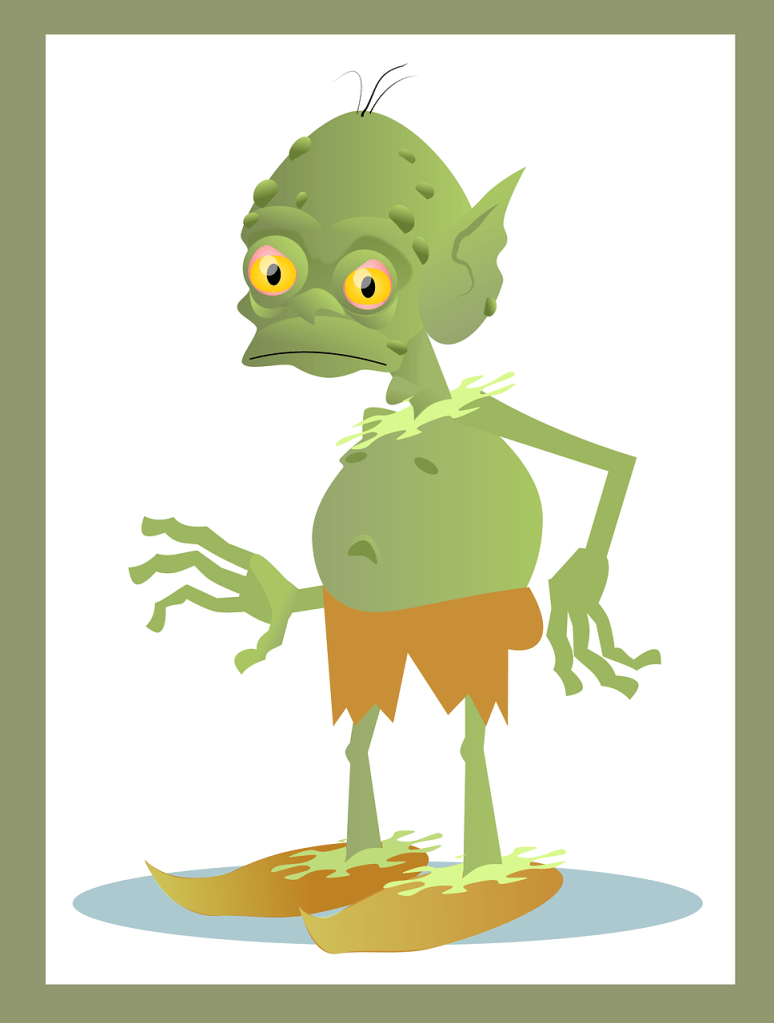
Eighteen Goblins

By Rhys Hughes

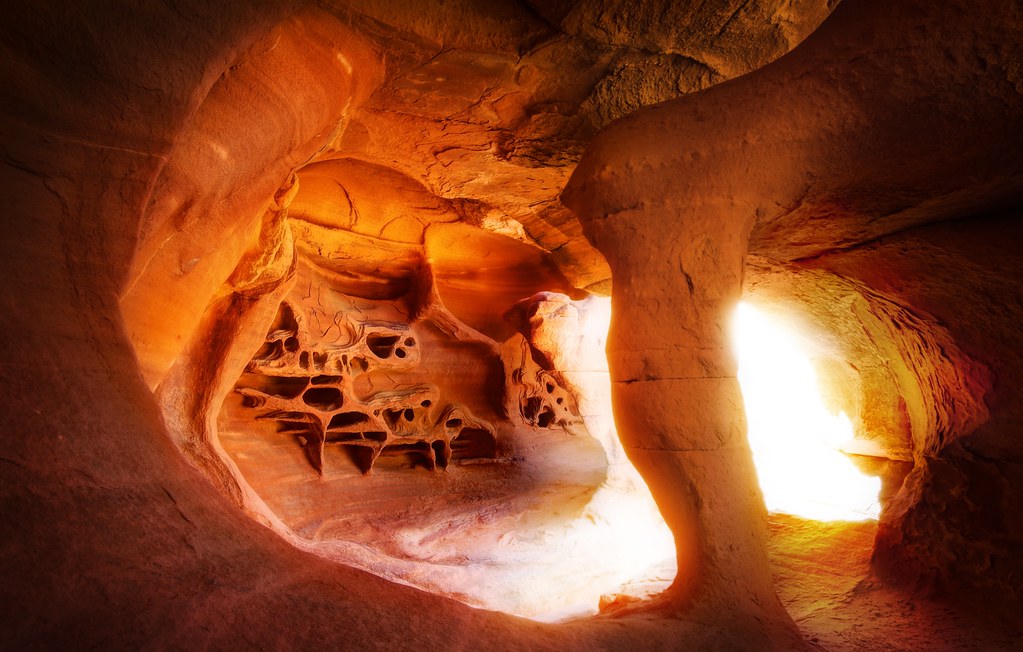
Courtesy: Creative Commons
There are eighteen goblins
     who live in a cave.

Harry is surely the bravest one;
he’s best at climbing stalactites
while wearing ladies’ tights
and sadly often stalagmites too
dressed in a badly-pressed vest.

Grabba is a mischief maker;
some say he’s quite a pest,
for he enjoys juggling worms,
toads and the pets of guests
until they feel distressed.

Humpty is the biggest goblin;
he’s twenty-two inches high,
just look at his gargantuan fists!
Standing on his taller friends
he can almost touch the sky,
which, of course, of rock consists.

Gfyxxlgr the Unpronounceable
has only one regret; nobody has
ever addressed him by his name,
at least not yet, because it’s not
reducible or even undisputable
and it sounds more like a threat.

Bunny isn’t a goblin authentic;
most of his decisions are unwise,
he is a green-suited interloper,
a gnome no-hoper in disguise.

Mandy is a goblin queen’s niece;
a brilliant impersonator of geese
after drinking too much brandy,
and swans too, sometimes ducks,
but only when she trusts her luck.

Baglo-Snag is a clever inventor;
his duty as a part-time mentor
to apathetic apprentice goblins
who say, “Whatever” to every
question asked about magnetic
portentous progressive dreams,
not to mention, “So what?” to
his cleanly kinetic machines, is
never challenged by dissenters.

Snapdoodle is a poet and chews
old shadows as he seeks a muse
and sucks the dripping cavern
slime as he designs new rhymes.

Freddie wants to live on his own;
but the cave system is his only home
and he’s too timid to seek elsewhere
a dwelling space, because his face
has been located below a bald dome
ever since the day he lost all his hair.

Gillian Oblivion won’t kick up a fuss;
she’s the only goblin with a surname.
One half fairy, three parts amphibian,
she loves to flitter from pool to pool,
wings as shiny and black as obsidian,
skin more slimy than any green ghoul.

Gruntybones flatly refuses to discuss
why he is flatter than a pancake by far;
his brothers are so much fatter, we find,
than the planet Mars not seen from afar
but magnified by a powerful telescope.
One only hopes he’ll change his mind.

Kravdraa seems like a normal goblin;
but the candle flame sets him sobbing
and his frame is racked with trembles,
for although his body is goblin-shaped,
his shadow’s mark on cave walls draped
an aardvark acutely resembles.

Cuthbert feels like the odd goblin out;
for he always prefers fresh air to stale
and when sparkling water is offered
in a glass, he never declines the drink
with a disgusted face while insisting,
“Stagnant in a decanter for me!” like
his goblinesque friends and enemies.

Ratso is keen on exploring the narrow tunnels
that undulate through the mysterious ground;
not once in a tight space has he become stuck
because his body is far too flexible and soft
for accidents of that sort to be his tough luck.

Tourmaline is a very musical goblin;
he loudly strums the lute late at night
and plays the drums with his knees
while bashing a gong with his head
and then he sleeps through the day.
Sometime soon, instead of waking
with a brand new tune in his mind,
I think he’ll find he’ll wake up dead.

Do you know the goblin named Karl?
He paints animals on the stone walls
and some are short but more are tall
and some are wide but more are thin;
yet he takes great pride in all equally.
Except for a cat that looks like a bee.

Kushy is a pushy goblin, apparently;
if he ever unlocks doors with a key
he never pulls them open but only
ever pushes, his expression so brave,
and groans when he snaps the hinges.
Luckily there are no doors in the cave.

Prude is a pure mathematician
and also the king of the tribe.
He has taught arithmetic to all
so that they have no need to hide
from quantities and sums; there’s
only one who fails to understand.

Abacuso is the one who can’t count;
his face and neck are bottle-green.
Only eighteen goblins are allowed
in the cave but he is goblin nineteen.
Courtesy: Creative Commons

Rhys Hughes has lived in many countries. He graduated as an engineer but currently works as a tutor of mathematics. Since his first book was published in 1995 he has had fifty other books published and his work has been translated into ten languages.

.

PLEASE NOTE: ARTICLES CAN ONLY BE REPRODUCED IN OTHER SITES WITH DUE ACKNOWLEDGEMENT TO BORDERLESS JOURNAL

.

Click here to access the Borderless anthology, Monalisa No Longer Smiles

Click here to access Monalisa No Longer Smiles on Kindle Amazon International
Categories
Slices from Life

Kissed on Kangaroo Island

Narrative and photographs by Meredith Stephens

We are regular visitors to Kangaroo Island, a nature-lovers’ delight that lies 14 kilometres off the South Australian coast. Much of our time there is spent trying to atone for the environmental damage caused by our European forebears. Swathes of the vegetation have been cleared due to almost two centuries of European farming. Thousands of sheep have grazed on this cleared land for much of that time, and European crops have replaced much of the original flora. The crops have been fertilized for years, and now that we allow the land to remain fallow, noxious weeds take over, fueled by the remnant fertilizer in the soil. Our mission is revegetation, trying to reverse some of the damage from farming.

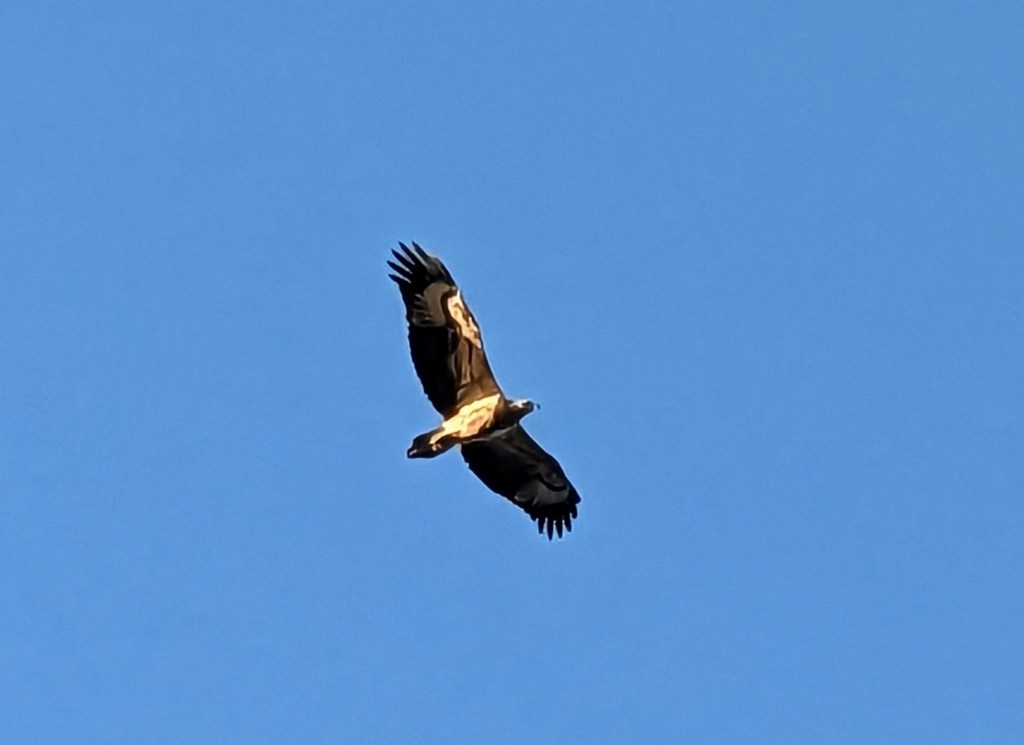
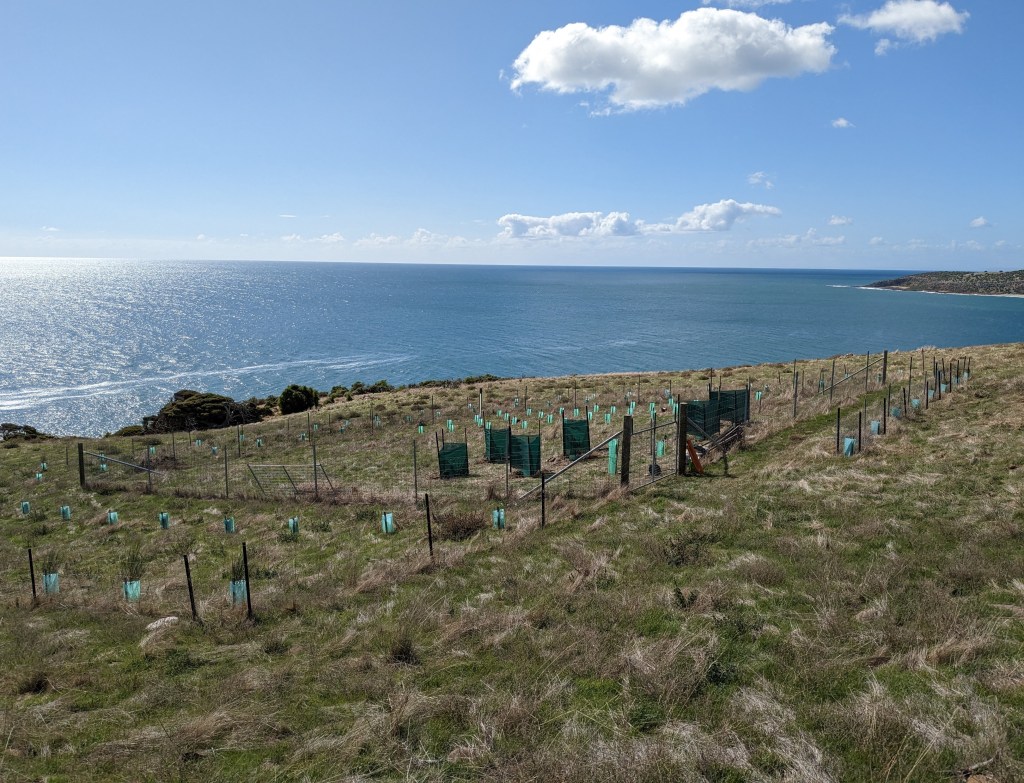
On our most recent visit, one of my jobs was to uproot the weeds. The task was impossible given that they sprawled across the land as far as the horizon, so we focused on a small fenced-off area. We dared not poison the weeds because they could be consumed by endangered bird species, such as the white-bellied sea eagles that nest nearby. For the same reason we never use rodent poison, but instead trap mice in buckets of water.

White-bellied sea eagle soaring above us

I donned my gardening gloves and grabbed the weeds by their roots, pitted my body weight against the plants, and uprooted them and before discarding them onto the weed pile.

Meanwhile my partner Alex was busying himself planting yet more trees. He was somewhat disgruntled because his boat was being repaired in Yaringa, near Melbourne, after being dismasted in Bass Strait. He gazed longingly out to sea, but seemed to regain a sense of contentment when he was planting trees. For him, planting trees was not a chore, but rather a consuming passion. He made deep holes in the rocky ground with his fencing crowbar, delicately coaxed the seedlings out of their containers, pushed the roots into the hole, pressed the soil back around the seedling, and made a berm around each plant to trap water. Then he drove stakes into the ground around each plant, and encircled them with either a corflute tree guard, or a wire cage, or both. These measures were necessary to protect them from marauding possums and kangaroos, which would otherwise devour the plants overnight.

The fenced-off orchard where we weeded, flanked by Investigator Strait.

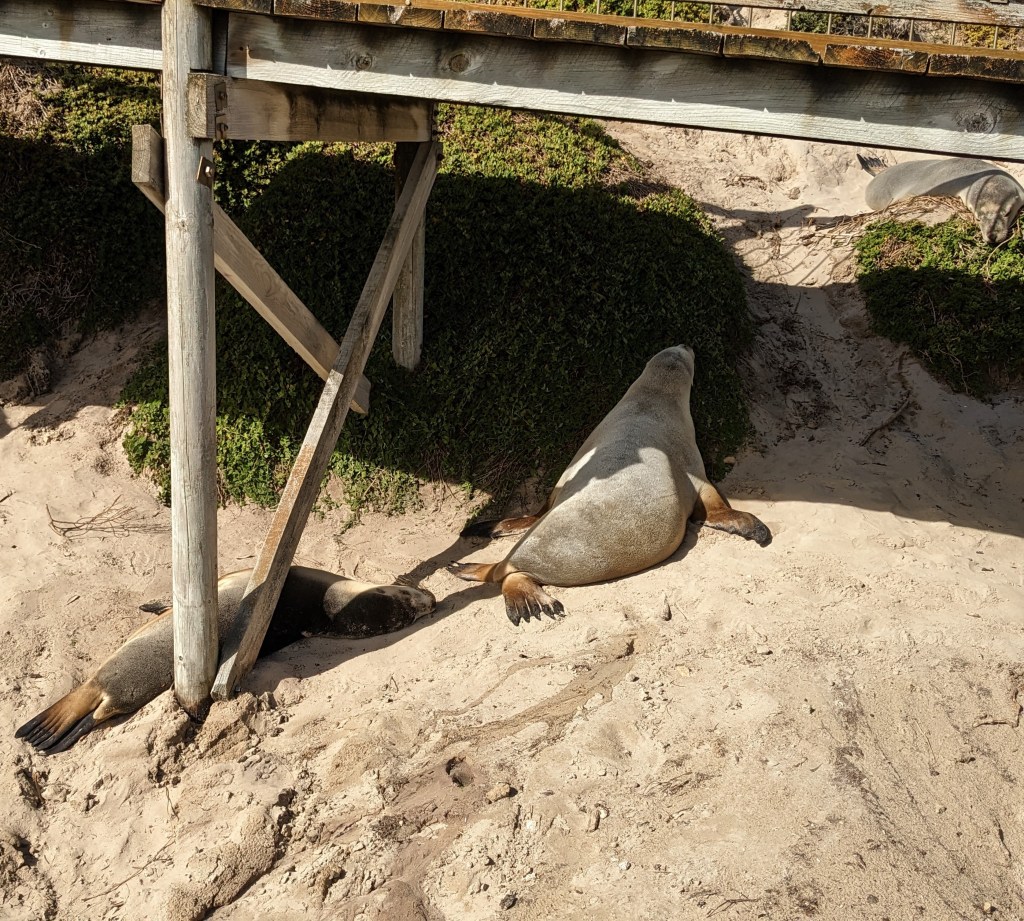
There is only so much revegetation you can do without hankering for some relief. Alex was content to plant trees from dawn to dusk but I pressed him to take me on a day excursion. Besides, coming to Kangaroo Island was not just about our earnest efforts at revegetation; it was also meant to be a romantic getaway. Our first outing was to Seal Bay, where the attraction was not in fact seals but rather Australian sea lions. We drove there, now an official tourist destination, and entered through the park office. We walked along the boardwalk with the other tourists, many being international visitors, and gazed down at the sea lions enjoying lying in the sand in the sunshine.

Sea lions under the boardwalk at Seal Bay, Kangaroo Island

Back at the revegetation site, we resumed our routine of weed-whacking and planting for the next few days, by which time we felt we deserved another outing. This time we chose to visit American River (named after visiting American sealers in 1803) known for its picturesque harbour and fresh seafood. But for me, American River was less about the view and the seafood than spotting sea lions. I had spied one on a previous visit and was hoping to see some again. I walked onto the boat ramp near the shed where the reconstruction of the Independence schooner was taking place. (The Independence was the first ship constructed in South Australia, in 1803, commissioned by a visiting American shipmaster and sealer, Isaac Pendleton.) I walked past the door to the boat shed, because as much as I would like to claim interest in the history of local shipbuilding, my real interest was in finding a sea lion.

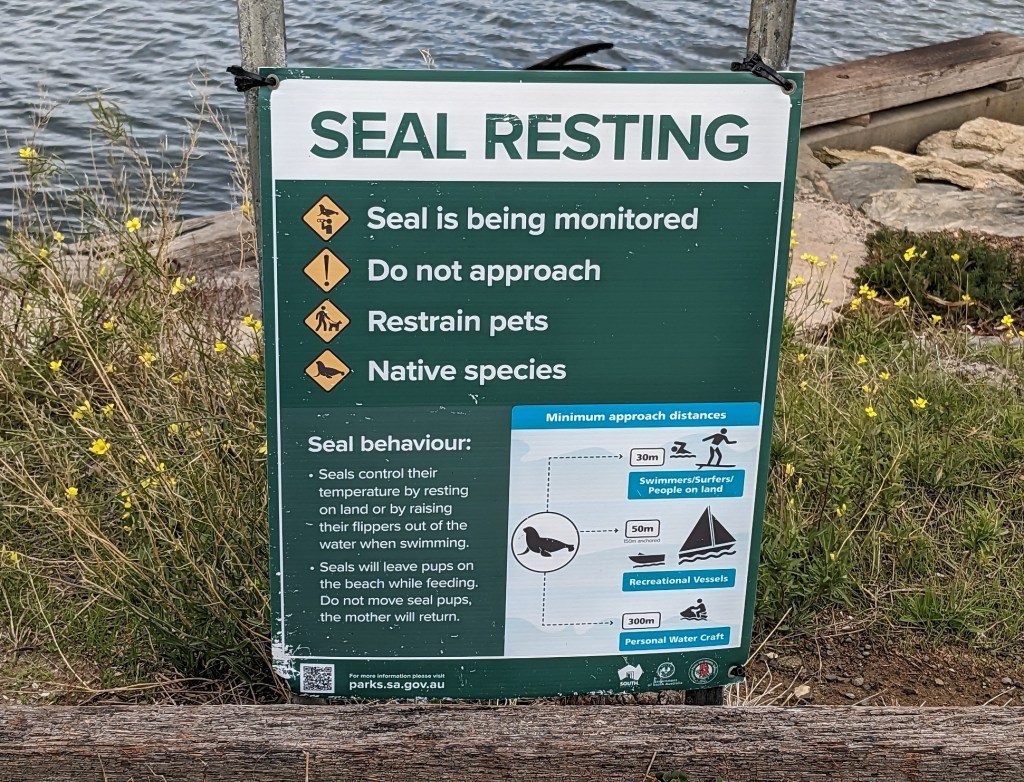
I was not disappointed. Behind a ‘Resting Seal’ sign explaining that you were required to keep a thirty metre distance from the sea lion, we found what we were looking for.

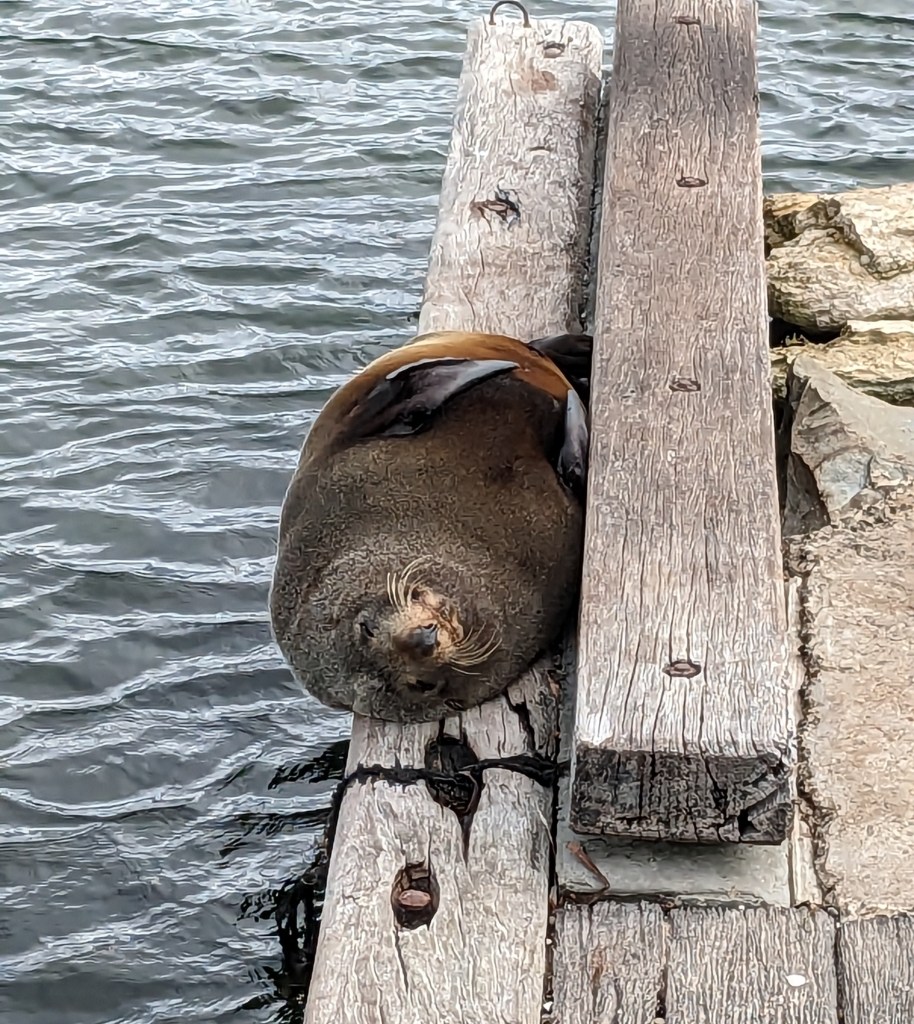
Sea lion in American River, Kangaroo Island

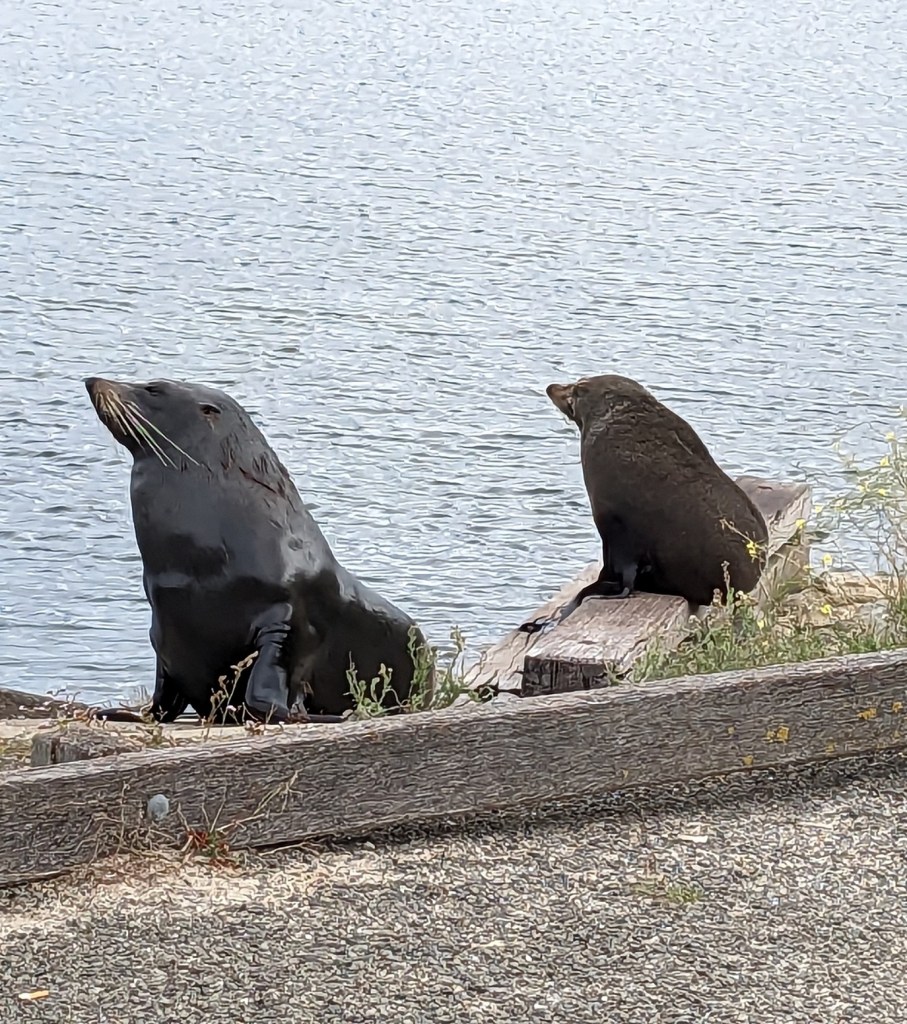
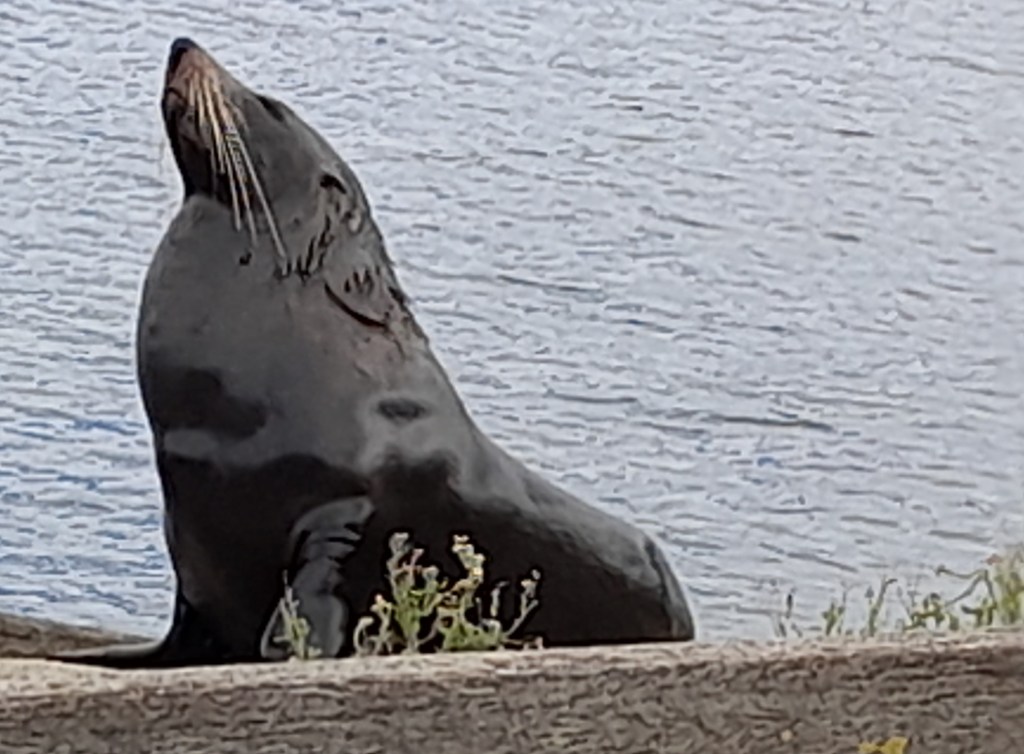
I glanced into the lagoon, and spied the sea lion’s mate, proudly flipping his body around in the water, before he scrambled onto the shore to demonstrate his supremacy in this territory.

An American tourist next to us asked Alex, “How far is thirty meters?”

He replied, “About one hundred feet, which is twice the distance we are now!”

We all walked backwards trying to preserve the thirty-metre distance between the sea lion and ourselves.

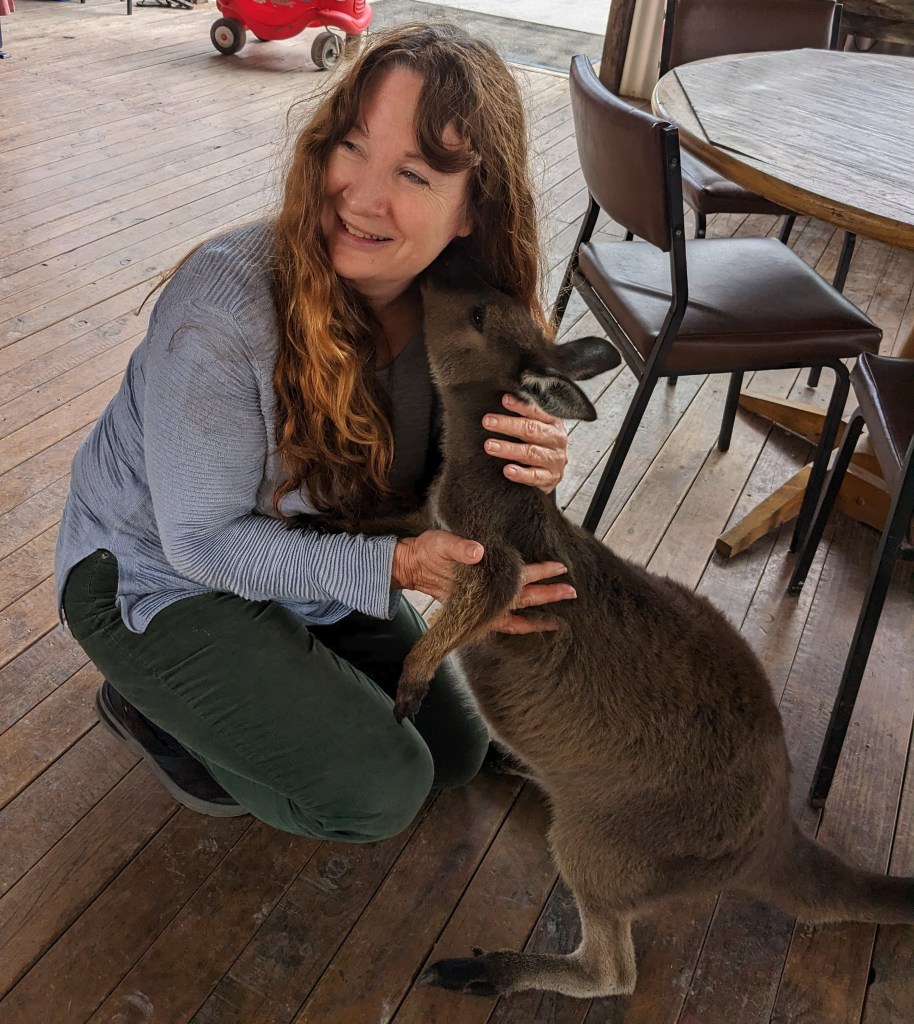
It was mid-afternoon and there were still hours of daylight left, so we decided to visit the nearby eucalyptus distillery. Before entering the building our attention was arrested by young kangaroos, known as joeys, hopping freely around the outside of the building. We entered the premises and purchased some eucalyptus products, and as we left, approached one of the joeys.

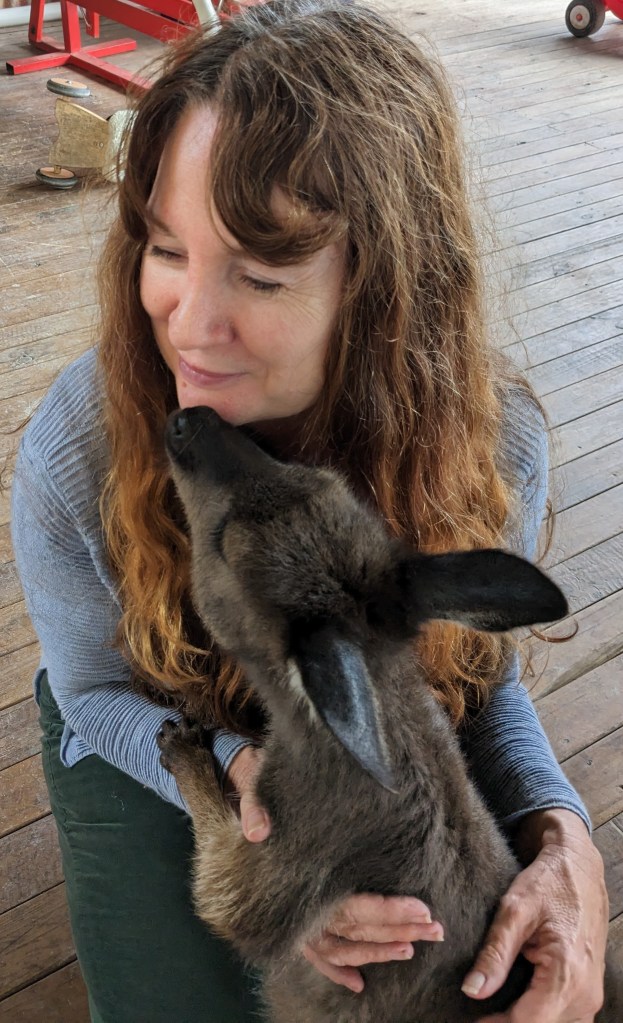
Kangaroo Island, like many parts of Australia, has dead wallabies and kangaroos alongside its roads, victims of road-kill. Because kangaroos are marsupials, some of their young may be found alive inside their pouch, even after the mother has been killed. Those finding the road-kill may drag it safely away from the road, after ensuring that no approaching cars are in sight, and then remove the joey from its mother’s pouch. The joeys we came across had been rescued in this way, and hand reared. Unlike most kangaroos, they had no fear of humans. I knelt to pat one of the joeys, and then he gently raised his pointy face to my ear and whispered in it. Then he raised his lips to mine and brushed them against me.

“Don’t let him!” urged Alex. “You’ll get germs from a wild animal.”

I let the joey tickle my lips for a few more seconds, before heeding his urgings. I had been kissed by a kangaroo!

Meredith Stephens is an applied linguist from South Australia. Her work has appeared in Transnational Literature, The Muse, The Font – A Literary Journal for Language Teachers, The Journal of Literature in Language Teaching, The Writers’ and Readers’ Magazine, Reading in a Foreign Language, and in chapters in anthologies published by Demeter Press, Canada.

PLEASE NOTE: ARTICLES CAN ONLY BE REPRODUCED IN OTHER SITES WITH DUE ACKNOWLEDGEMENT TO BORDERLESS JOURNAL

Click here to access the Borderless anthology, Monalisa No Longer Smiles

Click here to access Monalisa No Longer Smiles on Kindle Amazon International
Categories
Poetry

Dreams of Disenchantment

Poetry by Michael Burch

OF CIVILISATION AND DISENCHANTMENT 

Suddenly uncomfortable
to stay at my grandfather’s house—
actually his third new wife’s,
in her daughter’s bedroom
—one interminable summer 
with nothing to do,
all the meals served cold,
even beans and peas—

Lacking the words to describe
ah!, those pearl-lustrous estuaries—
strange omens, incoherent nights.

Seeing the flares of the river barges
illuminating Memphis,
city of bluffs and dying splendours.

Drifting toward Alexandria,
Pharaos, Rhakotis, Djoser’s fertile delta,
lands at the beginning of a new time and “civilization.”

Leaving behind sixty miles of unbroken cemetery,
Alexander’s corpse floating seaward,
bobbing, milk white, in a jar of honey.
 
Memphis shall be waste and desolate,
without an inhabitant.
Or so the people dreamed, in chains.

(Published by The Centrifugal Eye and The Centrifugal Eye Fifth Anniversary Anthology)


JUST DESSERTS

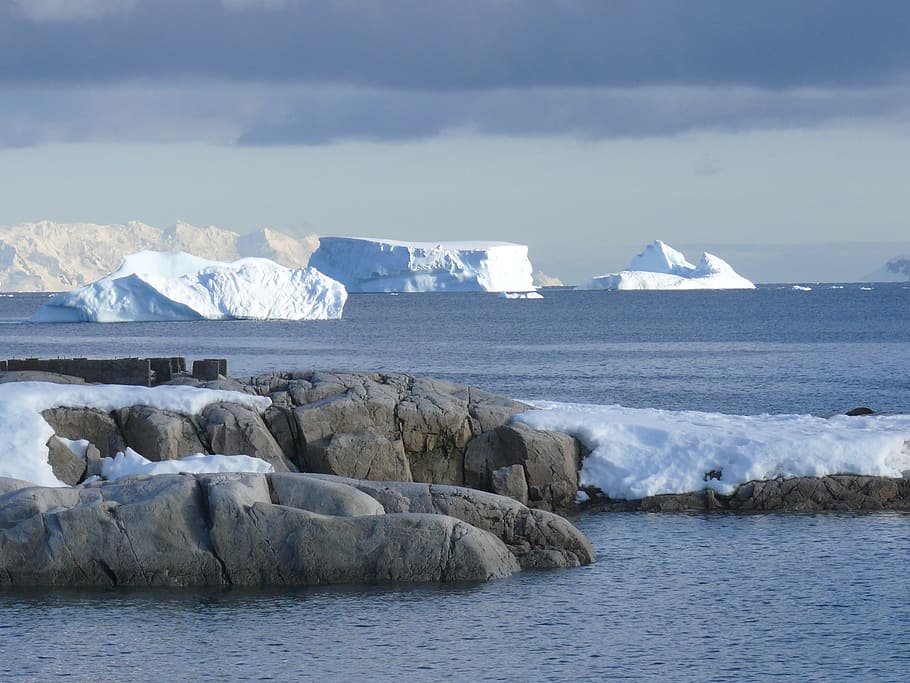
“The West Antarctic ice sheet
might not need a huge nudge
to budge.”

And if it does budge,
denialist fudge
may force us to trudge
neck-deep in the sludge!

(The first stanza is a quote by paleo-climatologist Jeremy Shakun in the Science magazine.)
Antarctica. Courtesy: Creative Commons

Michael R. Burch’s poems have been published by hundreds of literary journals, taught in high schools and colleges, translated into fourteen languages, incorporated into three plays and two operas, and set to music by seventeen composers.

PLEASE NOTE: ARTICLES CAN ONLY BE REPRODUCED IN OTHER SITES WITH DUE ACKNOWLEDGEMENT TO BORDERLESS JOURNAL

Click here to access the Borderless anthology, Monalisa No Longer Smiles

Click here to access Monalisa No Longer Smiles on Kindle Amazon International
Categories
Review

A Journey, a Memoir and an Inspiration

Book Review by Bhaskar Parichha

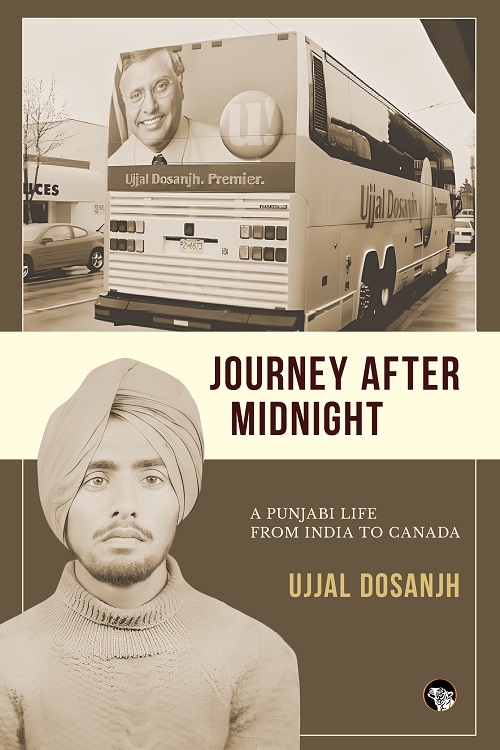
Title: Journey After Midnight – A Punjabi Life: From India to Canada

Author: Ujjal Dosanjh

Publisher: Speaking Tiger Books

The Punjabi Diaspora is a global phenomenon that has grown in size and complexity in recent years. It is estimated that there are around 20 million Punjabis living outside the Punjab region in India and Pakistan. This is stretching across multiple continents and countries. Punjabis have migrated to different parts of the world since the British Raj. However, this diaspora has become more visible in recent decades due to technology and global connectivity.

Highly diverse and dynamic, with different groups of Punjabis living in different places around the world. In North America, Punjabis are concentrated in the United States and Canada. In Europe they are mainly settled in the United Kingdom, Germany, Italy, and France. In the Middle East, they are found in the United Arab Emirates, Qatar, Kuwait, and Saudi Arabia. In South East Asia, they are mainly settled in Malaysia, Singapore, and Indonesia.

Punjabis have had a significant impact on the culture and economy of the countries where they have settled. Their positive contributions were felt in multiple industries, from agriculture to tech. They have been key to spurring economic growth in the areas where they have settled. They have also had a major influence on the culture and cuisine of these countries, with Punjabi food being a popular choice in many areas.

Journey After Midnight – A Punjabi Life : From India to Canada by Ujjal Dosanjh speaks about the Punjabi diaspora in all its splendor.  Dosanjh was born in the Jalandhar district of Punjab in 1946. He emigrated to the UK in 1964 and from there to Canada in 1968. He was Premier of British Columbia from 2000 to 2001 and a Liberal Party of Canada Member of Parliament from 2004 to 2011, including a period as Minister of Health and Minister Responsible for Multiculturalism, Human Rights and Immigration. In 2003 he was awarded the Pravasi Bharatiya Samman, the highest honour conferred by the Government of India on overseas Indians.

The blurb contends: “Journey After Midnight is the compelling story of a life of rich and varied experience and rare conviction. With fascinating insight, Ujjal Dosanjh writes about life in rural Punjab in the 1950s and early ’60s; the Indian immigrant experience—from the late 19th century to the present day—in the UK and Canada; post-Independence politics in Punjab and the Punjabi diaspora— including the period of Sikh militancy—and the inner workings of the democratic process in Canada, one of the world’s more egalitarian nations.”

Dosanj states candidly: “Today’s world has few leaders brimming with great ideas. The paucity of great leaders afflicts India as well. There are no inspiring giants on the national stage tall enough to lead India out of the ethical and moral quagmire. Asked whether he was working to create a new India along with seeking its independence from Britain, Mahatma Gandhi had declared that he was trying to create a new Indian–an honest, fair and just Indian for a proud, progressive, prosperous and caring India. Since the Mahatma’s time the moral and ethical values of India have decayed. In Indian politics, civil service and public life, there is little evidence of the ideals he lived and died for.”

He continues: “A substantial portion of the Indian economy is underground; all due to the sadly enduring disease of corruption. The albatross of financial, ethical and moral corruption is strangulating and shortchanging the country. Those who say economic progress will by itself free India from corruption are just as wrong as those who in the 1950s maintained that education by itself would reduce corruption. It obviously hasn’t, and India finds itself counted among the most corrupt countries on earth. Corruption shatters human dreams and stunts ingenuity. It constrains personal and political liberties. It severely limits opportunities. The main hindrance in the path of social, political, economic and cultural progress is the disconnect between knowing what is right and doing the right thing; most know what is the right and the ethical thing to do, but they continue to do the wrong and the unethical thing; hence the ubiquitous corruption.

Calling upon the Indians for a moral revolution Dosanj writes: “The sculpting of Gandhi’s Indians, and the building of the India of the dreams of its founding fathers and mothers, requires a moral and ethical revolution-a revolution of values that are of Indians, by Indians and for Indians. No matter how bleak the political and ethical scene today, I’m certain there are great minds fearless, humane and brave among the billion plus residents of India. We may not see
them, but they exist. We may not know them, but they are among us. They must heed India’s call. They must come forward and lead. India’s destiny demands it.”

In the ‘Afterword’ he laments about the state of affairs of Punjab in recent times: “Punjab is staring at the prospect of turmoil, radicalization and violent fundamentalism, and yet many in the government and otherwise seem obsessed with presenting and treating the likes of the late singer Moosewala as modern Punjab’s heroes. That the young singer’s life was cut short by gangsters’ guns was horrible and must be condemned. Beyond that the AAP and others must be careful not to glorify violence. Unfortunately, almost the whole of Punjab seems taken with Moosewala; the young man was a talented singer but much of his poetry and music was about guns and aggressive machismo. Is that what Punjab needs and must idolize?”

Dosanjh writes candidly about his dual identity as a first-generation immigrant. And he describes how he has felt compelled to campaign against the discriminatory policies of his adopted country. He opposes regressive and extremist tendencies within the Punjabi community. His outspoken views against the Khalistan movement in the 1980s led to death threats and vicious physical assaults, and he narrowly escaped the bombing of Air India Flight 182 in 1985. Yet he has remained steadfast in his defence of democracy, human rights and effective governance in the two countries he calls home—Canada and India.  

The writing style is fluid and languid. This is not a book that can be judged on the basis of its literary merit. It isn’t just a simple memoir, but rather a record of a turbulent period in India’s history. It is a book that represents a lifetime journey, crossing oceans and cultures. As a memoir, Ujjal Dosanjh’s book is at once personal and political, but most importantly, it is inspiring.

.

Bhaskar Parichha is a journalist and author of UnbiasedNo Strings Attached: Writings on Odisha and Biju Patnaik – A Political Biography. He lives in Bhubaneswar and writes bilingually. Besides writing for newspapers, he also reviews books on various media platforms.

.

PLEASE NOTE: ARTICLES CAN ONLY BE REPRODUCED IN OTHER SITES WITH DUE ACKNOWLEDGEMENT TO BORDERLESS JOURNAL

Click here to access the Borderless anthology, Monalisa No Longer Smiles

Click here to access Monalisa No Longer Smiles on Kindle Amazon International
Categories
Poetry

Desolation: A Poem by Munir Momin

Translated from Balochi by Fazal Baloch

Courtesy: Creative Commons
Why didn’t you bring along the fire, 
embers of pain or snow clouds?
Perched on the green meadow,
I wonder if it’s a bird or its silhouette,
looking all alone at the city 
of its solitude 
like a handful of breeze 
someone held frozen in his hand.
If you move a few steps westward,
you’ll see life is a flock of birds
in a playful flight above
the surface of water.

Today, the eventide yielded 
my exhausted soul as
an empty vessel of melodies
and a wound inflicted by stillness
wrapped in a melancholy haze.
Today there lingers nothing
between the heaven and earth, 
neither a gaze, nor a scene, 
nor even I --
no call, no gimmick
to thrive in solitude.

Ages after
the wind seemed to have come to life again,
so did the statue of solitude.
It raised its eyes 
and saw the wind carry an epistle as
the cloud melted in its crystalline eyes.

O, pigeon!
If a tyrant monarch
forces upon me 
his quietude, pain and solitude
I, in that very moment will
join the ranks of a fierce legion
and mark for myself a grave
in the battlefield.

Munir Momin is a contemporary Balochi poet widely cherished for his sublime art of poetry. Meticulously crafted images, linguistic finesse and profound aesthetic sense have earned him a distinguished place in Balochi literature. His poetry speaks through images, more than words. Momin’s poetry flows far beyond the reach of any ideology or socio-political movement. Nevertheless, he is not ignorant of the stark realities of life. The immenseness of his imagination and his mastery over the language rescues his poetry from becoming the part of any mundane narrative. So far Munir has published seven collections of his poetry and an anthology of short stories. His poetry has been translated into Urdu, English and Persian.  He also edits a literary journal called Gidár.

Fazal Baloch is a Balochi writer and translator. He has translated many Balochi poems and short stories into English. His translations have been featured in Pakistani Literature published by Pakistan Academy of Letters and in the form of books and anthologies.

.

PLEASE NOTE: ARTICLES CAN ONLY BE REPRODUCED IN OTHER SITES WITH DUE ACKNOWLEDGEMENT TO BORDERLESS JOURNAL

Click here to access the Borderless anthology, Monalisa No Longer Smiles

Click here to access Monalisa No Longer Smiles on Kindle Amazon International
Categories
Stories

The Whirlpool

By Abdullah Rayhan

The bird just died in his hand, a brown bird with a yellow beak. It didn’t bleed, but its senses were silent beneath the greenish-dark eyelids. The tiny heart within its chest didn’t beat anymore. “What have I done!” thought Manik.

He put the slingshot back into his torn pocket and tenderly held the dead shalik[1] in his sunburnt arms. Something inside his chest thumped heavily as if a mad giant was scampering within him. A gloomy whirlpool of clouded sorrow confused Manik. Where did his happiness go?

Two months ago, when his elder brother Ratan crafted this slingshot for him, Manik started to dream of hunting a bird with it. As Ratan cut the stick and attached the elastic to the leather pad, Manik crafted a colourful tapestry in his mind. Thousands of times, he imagined the bright, flamboyant vision of shooting birds with pebbles and capturing them once they had fallen to the ground. His mind would light up at the thought of it all.

But after the slingshot was built, and Manik threw his first shot with it, he realized it wouldn’t be as easy as he assumed. He nagged his brother to teach him how to shoot perfectly, but Ratan got irritated.

“Isn’t it enough that I made this slingshot for you? Don’t disturb me, or I will break it apart”. Ratan had yelled.

However, this didn’t deter Manik. He went on exploring his village, looking for a vulnerable bird. He would have a handful of tiny pebbles in the pocket of his dirty khakis. Their weight would weigh down his pants a little, and he would pull it up repeatedly.

In his own mind, Manik was a hunter. His one and only goal was to hunt down a bird. The moment the bird tumbled, Manik would cage it in his fists and put it inside the small mosquito net he used to sleep in when he was an infant. Everything was arranged. He even had his mother mend the hole in the net. Now there wouldn’t be any way for the bird to escape!

But where was the bird? That’s what Manik tried to hunt all day long.

He would wake up before the first ray of the sun blanketed their village because that’s when birds were abundant. Though his mother would scold him, he didn’t care much.

His hunt would begin near the bank of the canal. On either side of the stream, there were numerous nests of shalik, doves, and sparrows. Manik could never pinpoint the location of the nests, but he was aware of where the birds lived.

Right beside the canal, he would walk on the dewy grass and collect tiny stones for the day. While collecting the pebbles, he would sling some if he saw any bird, and obviously, he missed every time. His stone collection continued until the sun rose higher in the horizon. Then he would run around the village. Occasionally to spot a prey, he would tiptoe quietly and cautiously.

He would see hundreds of birds sitting here and there. But Maniks’ amateur hands would miss them by a yard, and the bird would fly away at the sound of the slingshot. After a week or two of this routine, almost all the birds were familiar with the little hunter who had a bad target and pulled up his pants every now and then. Thus, Manik had a hard time finding any prey.

He would sit silently in the bushes for hours and hours, waiting for at least a sparrow to show up. But nothing did. Every bird was aware of Manik now. The barber told Manik that his attempts had scared off all the feathered friends.

Just like every year, on the carpet of shadows beside the bamboo forest, the barber was shaving Maniks’ hair for the summer.

The barber said mockingly, “How is the hunting going?” while running the blade on his half shaven head.

Manik sat on a high stool with his feet dangling in the air, “There aren’t any bird around. I wonder why!” A tone of disappointment vibrated in his words.

“Well, probably they are scared because they all know your intention.” The barber said, not stopping the razor.

“So, what should I do?” Manik asked with genuine concern.

“You can try looking for birds in my village.”

“Will you take me?” Manik said, excitedly turning his face toward the barber who was still shaving the back part. This sudden jerk sliced a thin, long cut on Manik’s bald head. Blood began to slowly stream out of the fresh wound.

Ehhe[2]! I asked you to sit still. Look what happened.” The barber washed Manik’s head and finished the rest of the job irritated. He was annoyed by the sudden movement.

But, even with a cut on his head, Manik was delighted by the thought of exploring a new territory. The next day he followed the barber. It was noon when Manik reached the new village.

The new village was just like his native one. The same trees, same odour of bamboo, wet mud, and the stench of cow dung were an imitation of his home. There were a lot of birds here too. The whisper of their fluttering wings expanded a new sky of hope in Manik. “I will catch one for sure,” he thought as he started on his hunting mission.

After missing a few, Manik found a shalik sitting on a bamboo fence. Manik was stealthy this time. He slowly approached a hedge near his target. From behind the bush, Manik stared at the bird for a while, memorising its position. Then he slowly grabbed his slingshot, drew out a good, round stone from his pocket, and set it on the leather pad properly. Holding the handle with a steady grip, he pulled the elastic with all his might to the back of his ear. The target was fixed on the bird.

Swoosh…

A tiny stone ran into a tiny bird. The prey fell on the ground and twitched its thin yellow feet for a few seconds. And then, the Shalik was still.

Maniks’ heart immediately filled up with victorious ecstasy. He couldn’t believe he had finally hit a bird. Holding on to the slingshot, he ran to his prize and picked it up.

But the smile faded away from his face in an instant. He realised that the bird had died. The profound innocence that slept inside him suddenly woke and stared at the dead life with melancholic eyes.

The brown Shalik lay like cold silence in his clutch. Its feathers dampened as Maniks’ tears fell on them. Though weeping like a beaten child, Manik didn’t know why he was crying. Something heavy was crumbling inside of him. His heart thumped loudly under his dust-covered chest.

Other birds gathered around and watched a small bald boy, wearing loose pants and torn shirt, digging a small hole in the ground with his bare hand. The sadness in his eyes echoed the vibration of his cracked heart. A small stream of thick, transparent mucus drooled down his nose, and he kept sucking it back as he patted the ground. When the hole was deep enough, the boy gently laid the Shalik to rest and then spread the loose soil all over the dead bird. A hefty cloud continued to blur his sight while a heart-wrenching torment swarmed inside him. He felt he was crumbling.

.

[1] Common mynah

[2] An exclamation of regret

Abdullah Rayhan is an English literature student who loves to read novels and write stories about simple and insignificant aspects of life.

.

PLEASE NOTE: ARTICLES CAN ONLY BE REPRODUCED IN OTHER SITES WITH DUE ACKNOWLEDGEMENT TO BORDERLESS JOURNAL

Click here to access the Borderless anthology, Monalisa No Longer Smiles

Click here to access Monalisa No Longer Smiles on Kindle Amazon International
Categories
Poetry

Standing in a Vineyard, Souring All the Grapes

By Ryan Quinn Flanagan

Courtesy: Creative Commons
They could not stop arguing.
Lobbing the most vile of accusations at one another.

At this wine tasting in Southern Ontario.
In spite of the wonderful weather.

The host trying to ignore them as he poured.

These two vipers having escaped the pit.
Now standing in a vineyard, souring all the grapes.

So that you would taste it in the bottle
when it came time to pick the harvest.

That petty jealousy that kept them at each other’s throats.
Surrounded by all those grapes 
that could not escape that overwhelming anger.

Their rancid lives infusing everything,
you could feel it! 

A sudden heavy cloudiness of sky.
No one driving and everyone sauced.

Ryan Quinn Flanagan is a Canadian-born author residing in Elliot Lake, Ontario, Canada with his wife and many bears that rifle through his garbage.  His work can be found both in print and online in such places as: Evergreen Review, The New York Quarterly, Borderless Journal, GloMag, Red Fez, and Lothlorien Poetry Journal

.

PLEASE NOTE: ARTICLES CAN ONLY BE REPRODUCED IN OTHER SITES WITH DUE ACKNOWLEDGEMENT TO BORDERLESS JOURNAL. 

Click here to access the Borderless anthology, Monalisa No Longer Smiles

Click here to access Monalisa No Longer Smiles on Kindle Amazon International
Categories
Poetry

Loneliness

Written by and translated from Korean by Ihlwha Choi

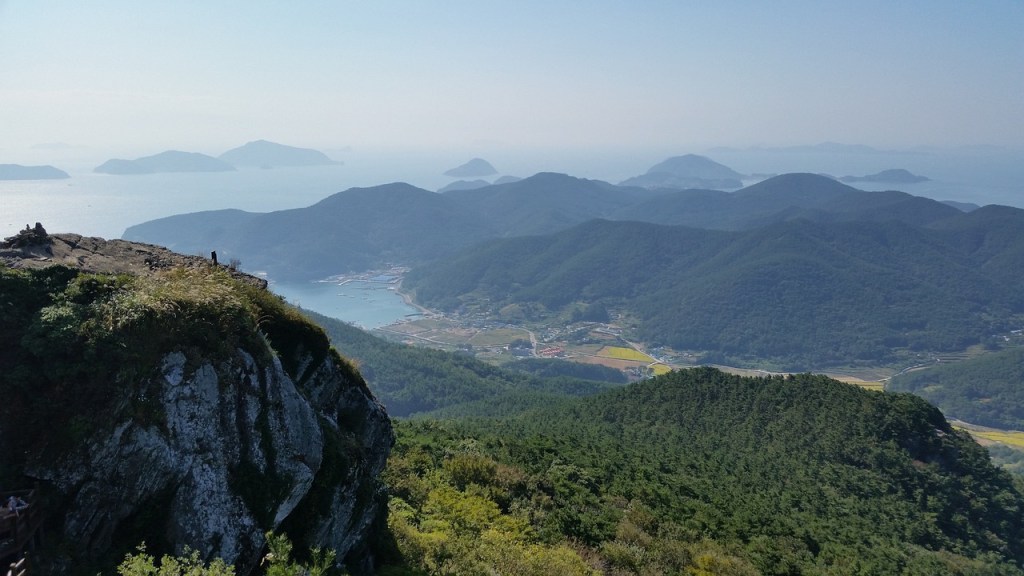
Korean landscape. Courtesy: Creative Commons
LONELINESS

Like a breeze, I tread softly.
Sitting in the spring sun, gazing at the green mountain valley,
Life is truly a lonely thing.
Even with yesterday's memories and tomorrow's hopes,
Even with friends coming and going, amidst the daily bustles,
Living is truly a lonely thing.

All day today, I've been thinking of you.
Is my life lonely because I miss you?
Is this spring day lonely because you're there?
Like a breeze, I walk aimlessly.
Sitting in the grassy field, gazing at the lake's waves,
Even this blossoming season is lonely like this.

Ihlwha Choi is a South Korean poet. He has published multiple poetry collections, such as Until the Time When Our Love will Flourish, The Color of Time, His Song and The Last Rehearsal.

.

PLEASE NOTE: ARTICLES CAN ONLY BE REPRODUCED IN OTHER SITES WITH DUE ACKNOWLEDGEMENT TO BORDERLESS JOURNAL. 

Click here to access the Borderless anthology, Monalisa No Longer Smiles

Click here to access Monalisa No Longer Smiles on Kindle Amazon International
Categories
Stories

Look but with Love

By Sreelekha Chatterjee

The laptop glows, as Ruby gazes at the email sent by an author. Her bespectacled, middle-aged eyes are like two ignited blocks of coal, burning with irritation from the constant stare at the computer and the revelation that the message has brought.

Dear Editor Ruby,
         Please reinsert the word “effigy” in the following sentence as the author himself wasn’t burnt down. Probably the word had been inadvertently missed out at the time of typesetting.

Typeset sentence: “Mr White was burnt down by a group of agitators who thought that his book dealt with controversial topics.”

Original sentence: “Mr White’s effigy was burnt down by a group of agitators who thought that his book dealt with controversial topics.”

Comparing the original manuscript with that of the copyedited version, Ruby calls Victor to her desk.

 “Tell me the meaning of the word ‘effigy’?” She asks with an air of seriousness about her, adjusting her glasses which have almost reached the tip of her nose.

The frivolous young lad, in his early twenties, keeps quiet, toys with his mobile, while his eyes waver around the books, clutter of files, papers on her table. He notices the page tugged onto the clipboard in front of her table where he reads the well-known lines once again: “When I take a long time to finish, I’m slow, but when my boss takes a long time, he is thorough.”

Victor usually takes a long time to edit the manuscripts and the end result is mostly devastating, though he always makes a point to look everything up in the dictionary as well as do an online search on the internet. What he is unable to understand is that despite all his efforts, things don’t turn up the way they should have been and lead to fresh miseries. He stares at the clipboard and thinks of inserting another line there which he mumbles under his breath with a supercilious smile:“When you take a long time to discuss about something, then you are wasting your time, but when your boss takes a long time to discusses it, then it’s a serious matter that needs attention.”

He keeps his head obstinately lowered, determined that he will not look up.

Ruby squirms in her chair, observing his quivering lips. Is he muttering abuses? Or, calling her a devil (as they do behind her back)?

“Look at me, look into my eyes. Last time you’d queried an author about ellipsis points at several quoted instances in his article and asked him what he intended by that. Don’t you know what they are meant for?”

Victor winces as his face twists, struggling hard to appear unmoved. Impatiently, he wriggles his right toe on the floor as if he’ll create holes in it or trample her down.

“A copyeditor needs to be hawk-eyed. Use your damn eyes. The editing eyes reach the desired perfection based on their use and cultivation. Last time you misspelt the word ‘snacks’ in the sentence and it read: ‘Tea, coffee, and sacks served here.’ And you didn’t correct the word ‘molest’ to ‘mullet’—‘His eyes sparkled like the shiny skin of the molest.’ The words ‘soul’ and ‘peace’ were replaced by some ridiculous words in the sentence: ‘May his sole rest in piece. Can you bake a cake with flowers as was mentioned in the sentence—‘The main ingredient of the cake was flower.’”

In response to Ruby’s usual mocking harangue, he recalls a famous quote on shame and vulnerability:“Grace means that all of your mistakes now serve a purpose instead of serving shame.”

His sun sign is Cancer and he believes in the prophecies made by a Panditji every morning on a popular TV channel. Though he didn’t quite understand what Panditji’s astrological predictions for the day indicated when he watched the show early in the morning, but now it feels somewhat relevant in the present context:“Remember, the things that are occurring today are not happening ‘to’ you. You need to have a greater perspective in mind to understand that the so-called challenges you are facing at the moment aren’t what they appear to be. Turn your experience into wisdom and you’ll find the way ahead.” 

That morning when he was stuck at the traffic signal, he recalled having seen a truck on which it was written “Sunil Treaders”. People often say that they write wrong spellings to attract attention, then why is it that editors are blamed for all the spelling errors that the authors make.

“When an editor makes a mistake, he is an idiot, but when an author makes a mistake, he is only human.” He utters in a low voice so that it doesn’t reach Ruby.

“Why don’t you look at me?” she yells.

Victor still keeps his eyes lowered or rather fixed on to the ground. Are those eyes loaded with tears?  

Suddenly, he recalls that Panditji had mentioned something important and he totally forgot about it. He mumbles what Panditji repeated again and again today morning, “All Cancerians should be cautious about their position today. They should be standing on the left side of all their senior officials to avoid any sort of conflict.” But he is standing in front of his boss. How will he change his position now? That’s why things are not going in his favour. Absentmindedly, he moves towards the nearby wall.

Immediately, Ruby says testily, “Where are you going? Come closer.” After a brief pause, she resumes watching him through the edge of her eyes, “Look into my eyes. It’s where the truth lies.”

In an instant he is strangely reminded of the phrase that he has mostly seen painted on the rear side of trucks, lorries:“Dekho magar pyaar se.” (“Look but with love.”)

At last he raises his head, his cheeks flushed red, sweaty, tense-limbed, and says, wide-eyed, showing his tobacco-stained blackish teeth, “I’ve never looked into the eyes of my wife, how can I look into yours?”

Sreelekha Chatterjee lives in New Delhi, India. Her short stories have been published in various national, international magazines, journals, and have been included in numerous print and online anthologies.

PLEASE NOTE: ARTICLES CAN ONLY BE REPRODUCED IN OTHER SITES WITH DUE ACKNOWLEDGEMENT TO BORDERLESS JOURNAL

Click here to access the Borderless anthology, Monalisa No Longer Smiles

Click here to access Monalisa No Longer Smiles on Kindle Amazon International