Categories
Slices from Life

A Towering Inferno, A Girl-next-door & the Big City

Ratnottama Sengupta time travels fifty years back as famed actress Jaya Bachchan recounts her first day on the sets of Satyajit Ray’s Mahanagar
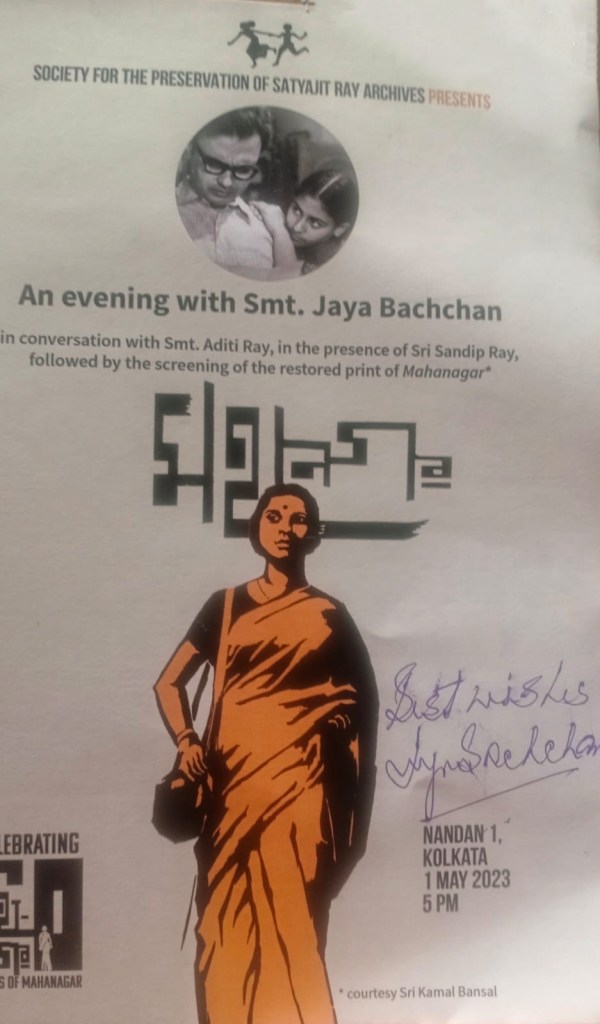
In this event, Jaya Bachchan recounts her days while acting in Satyajit Ray’s award-winning film Mahanagar or The Big City. Photo provided by Ratnottama Sengupta

When Shanti Di, my eldest aunt’s eldest daughter, had got married in 1964, she was already working. So she did not have to face the resistance Arati, the pivotal character of Mahanagar had to face from her in-laws and son. But prejudices and cryptic comments she did face — from her male colleagues. “Women in workplace? They only deprive deserving men of a livelihood,” they would say. “Because, men have to run entire households on their earnings while women work only for the ‘sauce’ — jewellery and saris!”
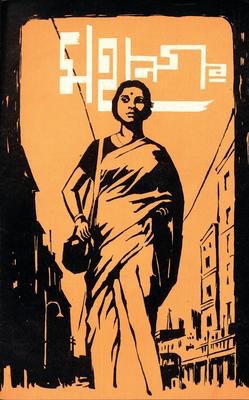
Mahanagar poster designed by Satyajit Ray. Photo provided by Ratnottama Sengupta

I remembered this at the screening of a restored print of Mahanagar (The Big City, 1963) at Nandan, the West Bengal Film Centre, to mark the 102nd birth anniversary of Satyajit Ray. Based on Narendra Mitra[1]‘s novel, Abataranika (Staircase), the film followed the trials and triumph of Arati, a housewife who steps out of the narrow domestic walls when she finds her husband Subrato bending under the weight of fending for a superannuated father, an aged mother, a school going sister, and their little boy along with themselves. 

But once she starts working, she enjoys her new role of conversing with and convincing women with deep pockets to buy her products — and soon her confidence in her work grows along with her empathy with other women who are yet to be empowered like her sister-in-law, Bani, her mother-in-law, Sarojini, her Anglo Indian colleague, Edith Simmons…  When her husband loses his job, Arati firmly negotiates a raise. And when Edith is fired for absence due to ill health she takes up cudgel for the ‘insult’. 

The remarkable sensitivity and the eye for details with which Satyajit Ray etched the ordinary lives of a middle class family earned him the Golden Bear at the Berlin Film Festival 1964. The director’s son, Sandip Ray, remembers attending the ceremony with his parents. “Why were you not there?”  a voice from the audience asked Jaya Bachchan, who was in conversation with the maestro’s son, now a renowned director in his own right. “Why would they invite me, who was just a ‘cameo artiste’ as someone mentioned this evening?”
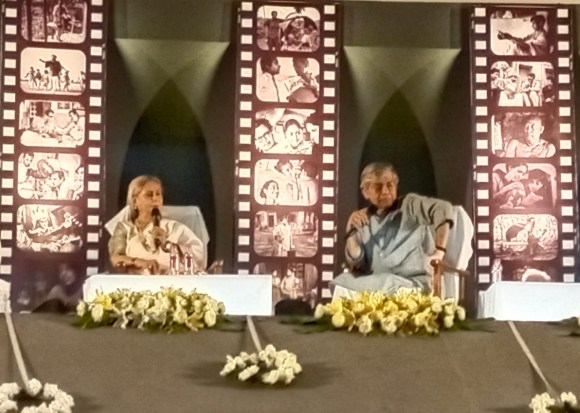
Jaya Bachchan and Sandipt Ray conversing at the event on May 1, 2023.

Jaya Di[2] — as I am privileged to address her, much like Sandip ‘Babu’ Ray — was much more than a cameo artiste in Mahanagar. Her ‘Bani’ was a flesh and blood character as she brought to life a marriageable sister who, in my childhood and not just in Bengal, was a part and parcel of any Indian household. Bubbly, sincere, attached to her Boudi as much as to her little nephew whom she mothers when the housewife is earning the family its bread, she is pampered by her brother even as she is being trained by her mother to pick up the haata-khunti…spatula-spoon…in the kitchen!

“I distinctly remember the first day of shooting in Indrapuri Studios. It marked my debut in films. Madhabi Di and Anil Kaku were in that shot which is reproduced whenever something is written about Mahanagar. I am at the study table, trying to write something. Those days I used to wear specs when I was reading.  Manik[3] Kaku must have made a mental note of that, he said, ‘Don’t take off your specs, keep them on for the shot.’ I didn’t have any dialogue for the scene. So, although I had not even been on stage before this, I didn’t feel that I was acting. The camera in front of me with Subrata Mitra behind it was not daunting. I was comfortable, just my usual self…”

Little did Jaya Bhaduri know, then, that this ‘girl-next-door’ identity would become her calling card in the years to come, storming even the glamorous boulevards of tinsel town Bollywood.

*

How did Jaya reach the sets of Mahanagar? She didn’t: Ray had sent for the girl in her teens. In all probability, she was recommended by Robi Ghosh and Sharmila Tagore. “They were shooting for Tapan Sinha’s Nirjan Saikatey (1963) when I had gone to Puri with my father, Tarun Bhaduri,” Jaya Di recounts. “We met them and on their return to Kolkata both Robi Kaku[4] and Rinku[5] Di told Manik Kaku that ‘the girl for that role (of sister) has been found at last!'” 

The first time she met Ray he did not ask her anything special. Nor did he ask her to do anything particular on the set. Young Jaya was told to read her lessons aloud, which she did, just as any school going child in Bengal did half a century ago. “I remember that Baba told Jaya Di to continue reading after the camera had moved on because he wanted an audio track of her reading in the background,” Sandip recalled in the course of the conversation. “She continued to read, but suddenly there was a sound of coughing. What happened?? In reply to everyone’s anxious query she coolly replied, ‘Why? Can’t a fly wing its way into my mouth while I’m reading?'”

Jaya Di herself has no recollection of this prank, but she vividly remembers that she would pester people on the set, incessantly asking questions. She especially questioned Subrato Mitra for taking time to light up! “It was as if we were out on a picnic,” she smiles. “The entire unit indulged me like a little girl. I was very comfortable because I had no burden to carry. In the presence of major actors I was required to do very little!”  

*

Jaya Bhaduri was not given any express direction — neither about how to speak her lines nor about action or emotion. She had full freedom to interpret the scene and react to the other characters. “Manik Kaku used to call all the artistes and read out all the dialogues to us. His intonation would give us an idea of what he wanted from us. We interpreted the scene according to our capacity and gave our best shot. He went about canning it, he never had any problem with my delivery.” 

But lessons in acting she did learn on the sets of Mahanagar — by observing how the director groomed the lead actress. “I have seen Manik Kaku directing Madhabi Di to grow into the role of Arati. He literally groomed her in acting. ‘Look this way, through the corner of your eyes. Turn your head like this. Say it like this. Wear the sari in this manner…’ The fact is that Satyajit Ray had a strong visual sense. He envisaged how the character would look and behave at the outset, how she would change, how she would resolve her dilemmas.” 

In other words, his actors were not puppets: he allowed the spontaneity of some, like Jaya; he moulded the emotive action of some, like Madhabi Mukherjee who would soon storm the silver screen as Charulata (1964).

*

Mahanagar was a very modern film, and not just at the time it was made,” Jaya Bachchan observes. Her critique of Ray’s first urban development film gains greater weight from the fact that, in the intervening years, she has ‘grown up’.  From a school girl to a trained actor. From the heartthrob of every Indian family in 1970s to the heartthrob of her ‘Lambuji[6]‘ — Amitabh Bachchan — whose charisma straddles two centuries, three generations, five continents. From a reclusive personal life to a vibrant political presence in the upper house of India’s Parliament. 
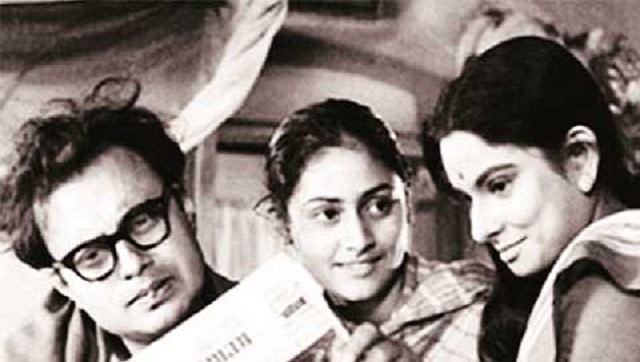
Young Jaya Bhaduri (now Jaya Bachchan) in between lead actress Madhabi Mukherjee and Anil Chatterjee. Photo provided by Ratnottama Sengupta

So let me elaborate on her observation, taking off from a scene between her and Subroto, her elder brother in Mahanagar, enacted by Anil Chatterjee.

Subrato has come home from work and his sister asks him for his pen as hers has run out of ink. He enquires when her exams are to commence, then he comments, “What use is this reading and writing? Sei toh henshel thelte hobey, you’ll end up dealing with only pots and pans!” 

Sekhaay toh,” Bani is quick to revert. “They teach us that too – it’s Domestic Science.”

That statement portrayed Ray’s attitude towards housewife. It was and still is a commentary on the identity — role — of a contemporary wife. It is in fact every woman’s attitude in contemporary India, 

Jaya Di has observed: “Today every woman also has to and does work. Not only for economic reasons but for identity, purpose in life. Those who have had higher education, certainly do. Those who have not studied much, who help with housework also have such dignity. I see their confidence in the way they carry themselves. They know their mind and they don’t hesitate to say up front what work they will do and what they won’t; how much time they will apportion to a household and when they will leave. And like urban working women, they too save a little from their earnings, use some of it and keep some for emergencies.”

*

Ray’s masterstroke is seen in the way he sketched the nuances of the bank clerk husband, complete with his angst and jealousy. He is proud of his wife’s charming appearance, he is confident she can steer herself through the career of a salesgirl, he is happy when the second income flows in. Yet — and especially when he loses his job — he suffers from insecurity, jealousy, suspicion. To the extent that the man who wrote her application letters, goads her to write a resignation letter. He is redeemed by the stand he takes at the very end when she gives up her much-needed job to protest a wrong against a colleague.  

Critics have found Ray to be more kind to the protagonist than Narendra Nath Mitra,  the Bengali author who also penned Ras[7] (made into the Hindi film Saudagar (Trader, 1973) which again builds upon how economic realities can make or mar a marriage. About a decade later Jaya Bachchan co-starred with husband Amitabh Bachchan in Abhimaan[8] (1973). In it Hrishikesh Mukherjee takes to an extreme the consequences of a husband’s ego trip when his wife fares better than him, professionally and financially.

*

Earlier Hrishikesh Mukherjee had, in Guddi (1971), given the young sister of Mahanagar a full canvas to come into her own as an actor. The same bubbly girl matures into a woman who can differentiate between love and infatuation. “After Mahanagar I was very selective. I chose to work only with directors who had a ‘Bengali’ sensibility,” Jaya Di says without a hint of hesitation. 

And the rapport she struck with Ray? It lasted a lifetime. When she joined the Film and Television Institute of India (FTII) she asked her Manik Kaku for a letter of commendation to go with her biodata. He wrote back saying that she doesn’t need an institute but join it, “it is the place for you”. 

She went thinking she would not last beyond a few months but with batchmates like Anil Dhawan, her co-star in Piya Ka Ghar (1972), and Danny Denzongpa, she stayed the full course. “And when Manik Kaku came with the print of Goopy Gyne Bagha Byne (1969), I felt so proud! I went to the airport to pick him up!”

That bonding would show every time they were in each other’s vicinity, Sandip Ray reiterates. “Once we were in Bombay and Baba stepped out of the Taj Mahal Hotel to leaf through books in the stall just outside. Suddenly a shrill voice screamed, ‘Manik Kakuuu!’ Jaya Di was passing by in her car and had spotted him!” “And I hugged him!” Jaya Di adds, “I took liberties others would hesitate to.” 

So why was she was not seen in his films again? “There were talks of casting me in Pratidwandi (1970) opposite Dhritiman Chatterjee,” Jaya recalls, “but I was in FTII then. Later I accosted him for not giving me a thought (for the role) – ‘You could have at least called me!’ His reply? ‘It was not necessary.’ That’s all!

“As if to add insult to injury, Manik Kaku got Amitji to do the voice over for Shatranj Ke Khilari (The Chess Players, 1977)  but a role for me? No! I was so angry I went and met him in Rajkamal Studio. His reply? ‘ Ha ha ha…’ Not a word more.”
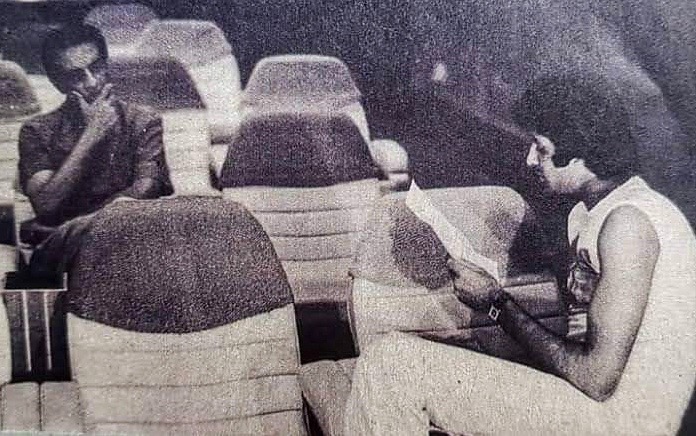
Amitabh Bachchan doing the voice over for Satyajit Ray in Shatranj Ke Khilari. Picture from Bachchan’s FB, provided by Ratnottama Sengupta.

That did not stop Jaya Bachchan from going to Bishop Lefroy Road every time she happened to be in Kolkata. She had, after all, seen the films the ‘Towering Inferno’ made even before Mahanagar. “Every time I watched a film by Ray I felt this is his best. Until the next one came along…” So, when Charulata came, Mahanagar paled. But wait, to this day Debi (The Goddess, 1960) continues to haunt Jaya Bachchan.

And to think that, when Ray had sent for her, the young girl growing up in Bhopal was beset with doubt and hesitation. “I was studying in a convent school, and I feared that the nuns would disapprove of my acting in a film. But my father said, ‘It’s the opportunity of a lifetime — don’t let go of it.'”

Cut to the convent when she went back after Mahanagar. The same austere nuns came and said, ” ‘You have acted in a Satyajit Ray film?! You are so lucky!!’ That is when I first realised, even before he was crowned in Berlin, what a major director my Manik Kaku was!”
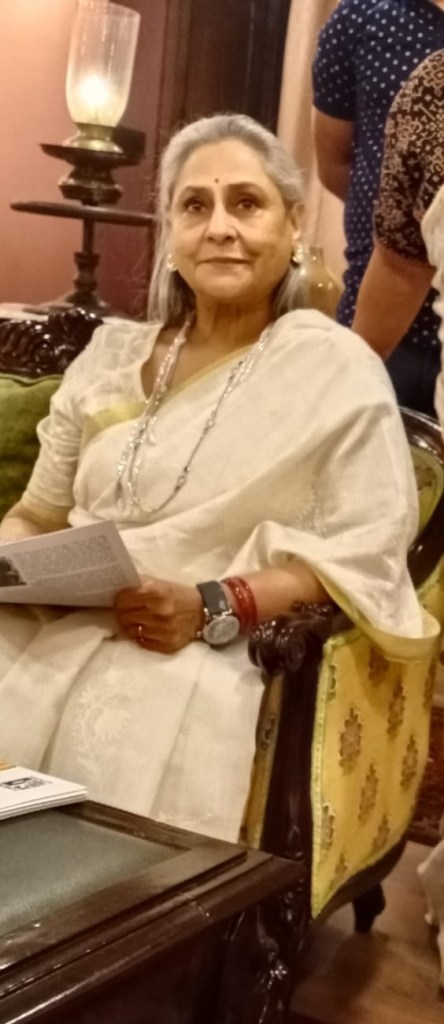
Jaya Bachchan on 1/5/2023. Photo provided by Ratnottama Sengupta

[1] Bengali writer (1916-1975)

[2] An honorific for elder sister

[3] Satyajit Ray was Manik to his friends.

[4] Uncle, father’s younger brother

[5] Sharmila Tagore

[6] Tall man

[7] Juice

[8] Pride

.

Ratnottama Sengupta, formerly Arts Editor of The Times of India, teaches mass communication and film appreciation, curates film festivals and art exhibitions, and translates and write books. She has been a member of CBFC, served on the National Film Awards jury and has herself won a National Award. 

.

PLEASE NOTE: ARTICLES CAN ONLY BE REPRODUCED IN OTHER SITES WITH DUE ACKNOWLEDGEMENT TO BORDERLESS JOURNAL

Click here to access the Borderless anthology, Monalisa No Longer Smiles

Click here to access Monalisa No Longer Smiles on Kindle Amazon International
Categories
Poetry

I Drank with the Moon

By Urmi Chakravorty

I watched the pregnant moon melt – a pearly blob
in the pulp of my onyx sleeplessness.
As I tossed and turned on the bed,
She played peek-a-boo through the lush filigree
of the wishing tree outside my window,
mocking my naivete, scorning at the maelstrom
ripping through my jilted heart.

I invited her to a late-night cognac.
She accepted, scattering her uppity sparkle 
on the blistered walls and cracked floors
of my restless atelier -- with eavesdropping walls
and kitschy souvenirs, carrying the dust of sterile memories.

We clinked the crystals and raised a toast,
I, to my wasted sepia breath and moribund yen,
She, to her borrowed sheen and waning arc.
The clouds waved and the stars smiled but half. 
We laid out our picnic basket on the leaden sky --
One, with the whiff of stale desire, and a taste of dementia,
A one-pot meal of life’s battle scars
Slow cooked on the embers of pain, love and loss.

Then the tired moon yawned and tucked herself to sleep
As I slid under the duvet of half-crocheted, gossamer dreams,
High on life…drunk on hope…a dandelion 
amidst the rubble of my being.

Urmi Chakravorty is an educator whose articles, stories and poems have found space in The Hindu, The Times of India, multiple social and literary platforms and anthologies.

.

PLEASE NOTE: ARTICLES CAN ONLY BE REPRODUCED IN OTHER SITES WITH DUE ACKNOWLEDGEMENT TO BORDERLESS JOURNAL

Click here to access the Borderless anthology, Monalisa No Longer Smiles

Click here to access Monalisa No Longer Smiles on Kindle Amazon International
Categories
Stories

The Mysterious Murder of Adamov Plut

By Paul Mirabile


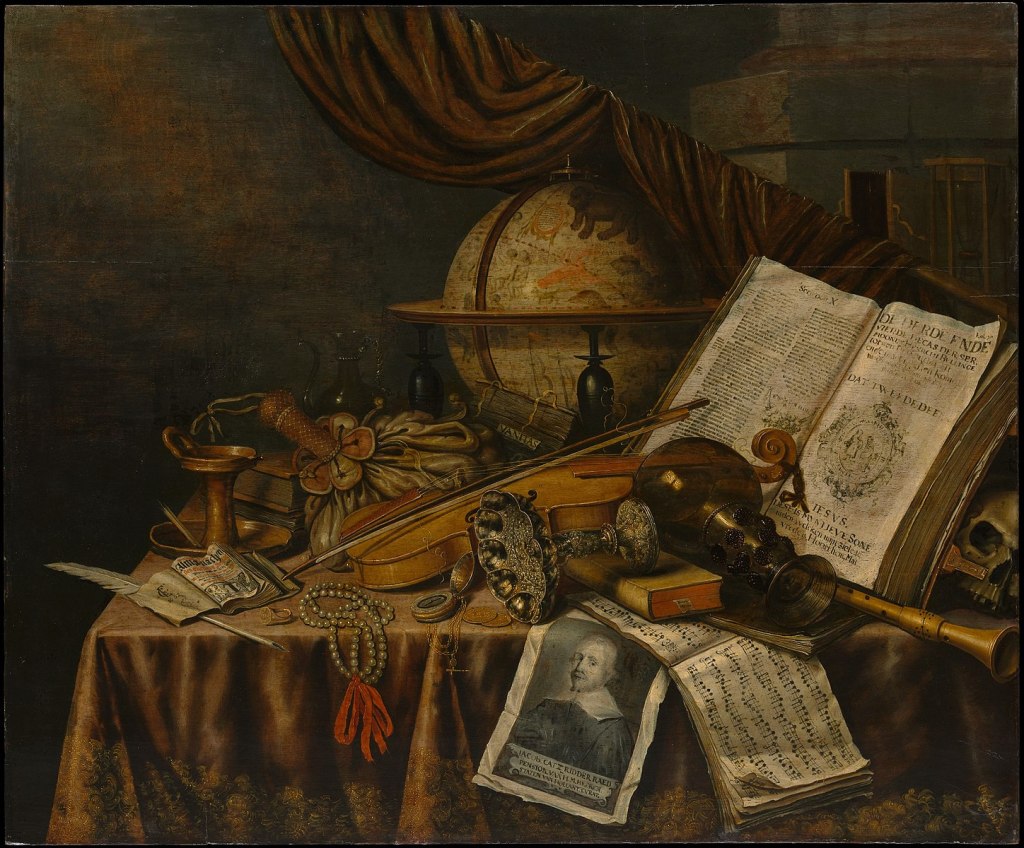
Vanitas Still Life, painting by Evert Collier(1640 –1708). Courtesy: Creative Commons

Back home in Madrid, having abandoned Adamov Plut to his posthumous fate, I was a bit surprised that neither the New York Times nor the Washington Post reported anything about the murder, not even a paragraph, or as the French so imagitively put it, an entre-filet ! I soon realised, due to this journalistic silence, that the time had come for me to give a full account of my relation to Mr Plut ; that the time had come for me to expose, publicly, by way of this revelation, his ‘mysterious murder’.

My information is of the surest sources for the simple reason that it was I who had Mr Plut murdered ! Yes, I ! And for reasons that shall be shortly disclosed. A mysterious man he might have been; however, his methods of acquiring priceless books and other inestimable valuables can hardly be called mysterious: Mr Plut was a vulgar thief, a scoundrel, an ingenious trickster whose singular flair caused much grief to many individuals, enraged those whose trust had been flouted.

It was in Istanbul, where I was invited to sojourn with an Armenian merchant, that I witnessed Mr Plut’s dupery. And if my naive friend fell for his crooked smile, I certainly didn’t swallow his high tale of returning to pay him for the two illuminated manuscripts my friend had graciously offered the blighter on condition that he be held accountable for them. His thick, coarse lips translated a smile that held contempt and disdain towards those who trusted him. So infuriated and insulted did I feel on behalf of my friend that that I reacted on a lightning urge and decided to follow him. I said nothing of this to my disbelieving companion, but left immediately in pursuit of my game — and game it was — for I, to tell the truth, had nothing more substantial to do at the moment and felt disposed for a good hunt.

I said that Mr Plut was a genius. Yes, in his own way. However, genius has its limitations. His arrogance and haughtiness knew no bounds, although he knew that his foul doings had attracted the attention of police and Interpol. Some may surmise that a certain paranoia drove him to invent individuals tracking him down like a wild boar or moose. No, no one was tracking him down except me, and that as subtlety as possible. In Uzbekistan, I actually chatted with him over a cup of coffee on two occasions disguised as a professor of Slavic philology, dressed in a quilted chapan robe and silk embroidered tubeteyka cap. There we sat in Samarkand, sipping our thick beverages in the vaulted bazaar at one of the storied cafés that dot the town. He was all smiles, obsequious and gold-toothed. I had the impression that I was dealing with a child or a mentally-dwarfed man whose sense of reality lacked all discernment or sagacity. I concluded that he had come into quite a bit of money, and never having had to work for a livelihood, traipsed about the world at his leisure, buying or stealing books, cheating people out of their invaluable collections. So self-indulgent and confident was he that he never saw through my masquerade as we conversed in broken Russian.

It was at that café where I learned about his fabulous treasure, as he called his book hoard. Only an idiot would have divulged this information to a perfect stranger, but as I said, Mr Plut’s contemptible demeanour caused him to fall into the most infantile traps. Traps that I began laying out for him, and that would lead to his downfall. For I had begun to design my own plan to relieve the rogue of his fabulous possessions, all the more so since he also let slip that his parents had passed away, and he had inherited the house. How I would make his treasure mine and ‘disinherit’ the  owner  still remained vague in my mind.

We departed as ‘friends’, as two strangers seeking an answer to the mystery of their existence. Or so I made him believe. Mr Plut appeared to me a dying species, a worldly aesthete, in spite of his extreme vulgarity and ponderous gait, whose debonair demeanour masked a loathing for his victims, a bent for the lowest duplicity, a gratification in spinning the most treacherous stratagems in order to allay his desire to prevail.

Mr Plut slipped out of Uzbekistan without my knowing it. He probably used his Russian passport, one of the four of five in his possession. I felt a twinge of misgiving. Had the fat fellow got on to me? After many enquiries, I finally discovered that he had crossed into China at the Xinjiang border, and was hastening towards the Yunnan. Why ? I hadn’t the faintest idea …

His brief sojourn in the town of Lijiang enabled me to catch up with him. My Chinese was fluent enough not only to query his whereabouts in that lovely town, but more important still, to learn of his new ‘purchases’, once I had questioned the director of the Dongba Museum of Culture. Mr Plut had planned to gone there to acquire several Naxi pictographic sacred books, which he did from a rather corrupt priest with whom he had been corresponding for some time, using a special code so as not to be unmasked by the Chinese authorities of the Centre. The director only learned of this a week after the unlawful negotiations had occurred, and three or four very valuable Dongba liturgical books had been stolen. It goes without saying that the rapacious priest was severely punished.

I immediately left Lijiang much to my displeasure for it was indeed a quiet, pleasant place, and set out in hot pursuit of the marauder. I followed his all too familiar scent through Nepal into North-western India to the Zanskar region where he put up for a while at the Phuktal Gompa[1], a strange spot to make a halt. But a perfect hideout to gain time in order for planning his next move, whilst at the same time inveigling in the most repulsive manner his generous hosts.

The monastery is nestled in the most remotest of valleys, ensconced within a cliff of tuft of fairy chimneys, crags and honey-combed spires which bulge black and red against the background of sandy, dazzling ash and cinerous tones of hemp. I had trekked there from Lamayuru in twenty days, and as I was to learn, Mr Plut had arrived there three days ahead of me, but by way of Padum. To gain the main entrance of the gompa, the pilgrim had to climb a steep path, keeping his or her right shoulder to the seventeen chortens[2] that mark the steep climb towards the vaulted entrance. I had shaved my head, grown a long beard and donned a woollen chuba tightened around my waist with a long colourful sash. It kept me warm, for in spite of it being Summer, the nights were very cold, and my cell had only a small wood-burning stove to keep me warm.

I spent three weeks at the monastery, sleeping on a ratten matting, eating skieu, tsampa and chappatti, drinking steaming salt-buttered tea off a chopsey — a low, small table — reading or gazing out of the little window that offered me a full view of the dusty, treeless courtyard below, where monks would mutter their mantras, and beyond into soundless nights whose stars were generally veiled.

Without Mr Plut’s slightest suspicions, I assisted at all the ceremonies, mornings and evenings, even vigils, while in the afternoon, I would venture out into the monastic complex, twisting and turning in the warren of lanes, under the low archways and high ladders, at times pursuing my promenades upon the rather precipitous mountain paths. As to Mr Plut, he hardly left his cell, and when we did cross paths, he most probably took me for a Buddhist pilgrim. Once or twice I sat near him in the prayer hall in the meditation grotto, but he never attempted to communicate with me, albeit he did not seem very deep in prayer or contemplation. He was probably scheming his next miserable move. His face had become terribly pale and flabby. His darting, black eyes seemed to have sunk deeper into their sockets. Unable to sit cross-legged on the low benches at the back of the prayer hall, he sat ‘western style’, staring off into the clusters of chanting monks, tilting his huge, bobbing head every so often to the banging drums, blowing ox-horns and tinkling triangles. Observing him from afar, I sought to sound his soul, to wring out his innermost thoughts, to extract from his evident lassitude and apathy his flight from both his victims and himself. But Mr Plut was a sphinx. Would he rise out of his own ashes when his hour came ?

I left the good monks three days after his departure, a hasty one indeed. And they were furious! The scoundrel had stolen several pustuks[3] and thangkas, and failed to pay for the prayer masks that he ‘purchased’. They implored me to find the culprit, inform the police and recover their stolen property. It was perhaps the beseeching words of the infuriated monks, after having received such incomparable hospitality from them, that my plans to have the thief killed began to germinate ! The theft was not only gratuitous, it exposed the very ugliness of the man’s heart, blackened by greed, cynicism and remorselessness. It would only be a matter of time before he tasted a soupçon of his own medicine.

Meanwhile the cat would play with the mouse, a rather fat mouse at that ! I boarded the cargo ship that took the fugitive from Karachi to Oakland via Japan. On the long, monotonous voyage across the Pacific, my ominous shadow crossed his at the most unsuspecting moments. Attired as a Pashtun merchant, bearded, long-haired and turbaned, Mr Plut sensed an onerous presence whenever he laboriously carried his huge body across the decks. How many times had my eyes penetrated his anguish, his torment, his pangs, not of compunction, but of incomprehension. He scented a sleepless menace pressing him. Fear inflamed his dark, beady, mirthless eyes like the burning incision of the trenchant knife.

Oakland … Sacramento … Reno … Tombstone … Boulder … Santa Fe … Saint Louis … Chicago … New Orleans … Birmingham … Miami … Atlanta and finally New York. Yes, New York, where the curtains would finally fall on this tragic fat figure. Where upon the stage of 8 million walk-ons, and against the backdrop of the grottiest of hotels, the last act of Mr Plut’s abominable performance would be played out.

His infatuation with Louis Wolfson amused me, as well as his grandiose project to write twelve stories in twelve different languages signed by twelve different authors. I found all this quite pompous and pathetic. A real exercise in self-indulgence to say the least. All this information I culled when I ‘accidentally’ met him in the ill-lit corridor of that hotel on Water street in downtown Manhattan. In New York, I played the role of a French researcher in mediaeval literature, a field that he completely ignored, in spite of possessing several manuscripts of Anglo-Norman stamp, apparently purchased (so he said ?) from a London book-seller. I pretended to be interested, taking the opportunity to study him closely. Besides, he was such an inveterate liar how could one believe anything he said ? He lied to curry favour and win confidence, only to swindle and steal from the naive and simple-hearted. Better to observe his eyes, his gestures, his bouncing from one tongue to another. These were all genuine signs of his distorted psychological make-up. To play my part well, I sported an immaculate white suit, orange tie, a pair of silver-rimmed glasses and spanking new alligator shoes. I had shaved my beard and moustache and had my hair cut very short, leaving a few gossamer wisps which touched the tips of my ears and fell bouncily on my forehead.

Every day I followed his Humpty Dumpty gait as he waddled to and from the public library, in and out of Central Park. And it was there, in Central Park, that I noted two blond-haired rough fellows slouching on a bench, eating the remains of fried chips or chicken sandwiches, cursing and making gross signs at the passers-by, drinking beer and spitting. They were seated at the same bench daily — the bench that Mr Plut walked by every day. They seemed to know him because they would hoot at him, call him names and ask for money. Fatso passed by without even a glance at them.

One Saturday, I decided to approach the two ruffians. They sized me up with obvious contempt, and made it perfectly clear that I was intruding on their ‘territory’. I sat down none the less, and exposed my scheme to be rid of Mr Plut once and for all, explaining how the culprit had cheated and robbed so many people. The two burly blokes, former marines in the Green Beret (or so they vaunted!) listened attentively as I unfolded my plan: Three thousand dollars for each if they would simply walk up to his room in the early morning hours, the night porter always being asleep, knock at his door and kill him, however, without any blood shed or theft of his belongings. It must be a murder without reason, without any sign of bestial violence. One of them suggested strangulation. Yes, excellent idea. It would thus be a ‘clean’ murder.

And so it was, very professional at that I must say. They were paid off, as agreed. And I left New York two days later, as planned, a very satisfied man indeed …

This all happened five years ago. Now … well, here is where my account ends and my confession begins. For you see, Mr Plut was never really murdered ! Those two ‘ruffians’ were in fact F.B.I. agents who had been trailing me since disembarking in California. To tell the truth, Interpol and local police had been following me since the Istanbul affair. How and why they began doing so I cannot say. During my trial neither the judge nor the prosecuting attorney afforded any information as how the F.B.I. learnt of my scheme, nor why they had decided, at one point in time, to cooperate with Plut. What was I convicted of ? What was my indictment ? As to my appointed lawyer, a young short-sighted clerk more than a seasoned lawyer, who could be easily cajoled by the ‘evidence’ against me, pliantly manipulated by the prosecutor, after he had taken the floor and had made an absolute fool of himself. He let out a sigh of relief when the judge pronounced a sentence of fifteen years instead of twenty-five! The wigged judge, a grotesque figure studded with huge warts, yawned throughout my lawyer’s deplorable speech for the defense, as well as during my feeble plea. There was no jury either to lament or to applaud his verdict. It was a trial held at ‘huis clos’[4], military style. I buried my face in my hands. As expected, my lawyer made no effort to appeal.

Had Plut sensed my innermost aversion towards him ? Or seen through my many disguises ? He was a clever man, and probably had hired detectives to learn why I was following him. The hotel room murder was staged. Plut lay recumbent on the floor, waiting for me to steal his papers so that I would be indicted for premeditated murder (although there was no murder!), of paying off hoodlums to commit this murder (although they were F.B.I. agents!) and the theft, which indeed it was (but fifteen years for that?) of his household papers, keys, and other official documents concerning his inheritance … and that vile short story of his.

So here I sit in my rancid smelling cell in Madrid, having been arrested at the aeroport on my arrival some five years ago, writing out this confession. I do not to repent mind you, I have no intention of atoning for my doings, nor avowing my sins. These words wrenched from my pen seek to vent the animosity and hatred I harbour towards that fat impostor who had the cheek to write me a letter from the Seychelles revealing how he had got on to me since Uzbekistan, and how our little cat and mouse game had amused him greatly : “You thought me a fool, deary, but I saw through your pusillanimous scheme in Samarkand ; that was some outfit, but you forgot the galoshes ! Not to mention your pilgrim weeds at Phuktal which truly charmed me, and your blazing orange tie in New York. Come, come, what French professor would ever sport an orange tie with a badly tailored, cheap white suit ?” The vicious irony underlining these sentences, along with a soupçon of cynicism caused me to gag. The blighter added in a post-script that he had sold all his books for a fabulous sum of money, and had retired from the world’s wearisome fair. In the envelope I found a photo of him sipping coconut juice, lying on the golden sands of a crescent-shaped beach under groves of swaying palm trees and an indigo blue sky. I laughed bitterly, and yet, in spite of my nettled nerves, pinned up the blasted photo in my lonely cell, a sort of souvenir of our enshrouded relationship …

One day at the prison library, browsing idly through a dull, detective story, I thought of Plut’s or Hilarius Eremita’s story The Enchanted Garden, which I had taken and read to amuse myself on the aeroplane to Buenos Aires. Had anyone ever published such ridiculous trash? To my horror, the answer came three days later whilst I rummaged through a new batch of literary magazines, some of which contained short stories in English, French and German. And there it was — The Enchanted Garden, by Hilarius Eremita, Plut’s pen name. I couldn’t believe my eyes — someone had published that rubbish ! Plut indeed had the last laugh, adding insult to injury, salt to my festering wounds.

I savagely tore out the pages of his story from the magazine, went to the toilet, ripped them into tiny pieces and flushed the filth down the bowl. So much for hiss ‘first of the twelve’ ! I shan’t be punished for it, no inmate in this prison reads any language besides Spanish, and that with a dictionary … I’m sure it was Plut who sent me that magazine to drive the knife deeper into my wounded pride. The miserable rat !

So here I sit at my iron table, staring at Plut’s photo as he sips his coconut drink under the blue skies and swaying palm trees whilst I sip my wretched thin noodle soup with strips of hard, nervy beef under a cracked, peeling, dirty grey prison ceiling …

.

[1]          Monastery in Tibet

[2]          The Tibetan word for stûpa, a Buddist shrine which initially housed the relics of the Buddha.

[3]          Books used for Buddhist ceremonies written in Tibetan.

[4]          Behind closed door without any public participation or observers. It is a French legal term.

Paul Mirabile is a retired professor of philology now living in France. He has published mostly academic works centred on philology, history, pedagogy and religion. He has also published stories of his travels throughout Asia, where he spent thirty years.

.

PLEASE NOTE: ARTICLES CAN ONLY BE REPRODUCED IN OTHER SITES WITH DUE ACKNOWLEDGEMENT TO BORDERLESS JOURNAL

Click here to access the Borderless anthology, Monalisa No Longer Smiles

Click here to access Monalisa No Longer Smiles on Kindle Amazon International

Categories
Poetry

Carnival Time

Poetry by Masud Khan, translated from the Bengali poem, ‘Aj Ullash Diba’ by Fakrul Alam

Courtesy: Creative Commons
It’s carnival time today.
Serfs and plebeians pour into streets.
Behold the giggling, decked up undertaker’s wife, 
That man over there, completely soused, is her spouse! 
He holds his pay tight in his fists and grins grotesquely, 
See the sweeper there, lips reddened by betel leaf!

There he is— the constable— sporting a shiny wristband. 
And look at that rotund young eunuch—
All merry, like dusky Abyssinians or Afghan revellers in the rain. 

Today it’s time to collect wages and bonuses and forget files. 
Today superiors have trade place with subordinates

And mandarins have transformed themselves into mere clerks.

The roly-poly slave and Kishorimohon Das
Sleep fitfully next to each other near the town reservoir, 
Stirred again and again by the mayor’s snores,

The hapless water bearer gets completely wet. 
The woman over there is a streetwalker,
Visiting town for the first time with her snotty-nosed brother. 
That man there trades in lead, and there is the perfume seller, 
He is the accountant, and he, the treasurer,
And next to him on this day of intermittent rain 
Is the petty thief’s no-good brother.
And there— leaning, bent by the weight of his imagination, 
As if in a trance, is the poet, the king of poets!

This day all have spilled out into the streets and stroll there 
Endlessly — intransitive
Wrapped in newly spun silk.


Masud Khan (b. 1959) is a Bengali poet and writer. He has, authored nine volumes of poetry and three volumes of prose and fiction. His poems and fictions (in translation) have appeared in journals including Asiatic, Contemporary Literary Horizon, Six Seasons Review, Kaurab, 3c World Fiction, Ragazine.cc, Nebo: A literary Journal, Last Bench, Urhalpul, Tower Journal, Muse Poetry, Word Machine, and anthologies including Language for a New Century: Contemporary Poetry from the Middle East, Asia, and Beyond (W.W. Norton & Co., NY/London); Contemporary Literary Horizon Anthology,Bucharest; Intercontinental Anthology of Poetry on Universal Peace (Global Fraternity of Poets); and Padma Meghna Jamuna: Modern Poetry from Bangladesh(Foundation of SAARC Writers and Literature, New Delhi). Two volumes of his poems have been published as translations, Poems of Masud Khan(English), Antivirus Publications, UK, and Carnival Time and Other Poems (English and Spanish), Bibliotheca Universalis, Romania.  Born and brought up in Bangladesh, Masud Khan lives in Canada and teaches at a college in Toronto.

Fakrul Alam is an academic, translator and writer from Bangladesh. He has translated works of Jibonananda Das and Rabindranath Tagore into English and is the recipient of Bangla Academy Literary Award (2012) for translation and SAARC Literary Award (2012).

PLEASE NOTE: ARTICLES CAN ONLY BE REPRODUCED IN OTHER SITES WITH DUE ACKNOWLEDGEMENT TO BORDERLESS JOURNAL

Click here to access the Borderless anthology, Monalisa No Longer Smiles

Click here to access Monalisa No Longer Smiles on Kindle Amazon International

Categories
Review

The River Within

Book Review by Lakshmi Kannan

Title: letters in lower case

Author: Jaydeep Sarangi 

 Jaydeep Srangi is an academic who writes beautiful poetry. letters in lower case is his tenth collection of poems. The poem that bears the title in the first section, blithely mentions the names of super figures such as Tagore, Tutankhamun, Ashoka and others in lower case, like it is an act of defiance, with the last three lines taking on a tongue-in-cheek tone to explain:

my letter to my boy hood idol is undelivered                                                                                                                                                        navigating an outswinger, the peon is on leave.                                                                                                                                                 all letters are in lower case. (Letters in Lower Case) 

He dedicates this book to his father-in law:

I know not how to pray --                                                                                                                               the hot tears I possess                                                                                                                        with that I will worship your cold feet. (Dear Departed)

The poems are classified broadly under three sections – ‘Laws of the Land’, ‘Gesture of Surrender’ and ‘The Window you Hold’. Poetry is often born between the said and the unsaid. Sarangi’s best poems leave some things half-said to reverberate in the mind of the reader. Sarangi returns to the lower case in another poem in the last section, only this time it is not just letters but life itself that is in lower case.

I take off the shirt that i liked so much,                                                                                                                  names written in only lower case                                                                                                                     here i shall rest in peace. (Life in Lower Case) 

The ‘I’ takes its place in a diminutive ‘i’.

Sarangi’s poetry has a distinct sense of geography.  Jhargram in West Bengal where the poet spent his boyhood days, together with the river Dulung, become powerful motifs. They are magnified manifold times to haunt, to evoke associations and emotions that one cannot always explain. Sarangi writes:

Stand near me, speak to me.                                                                                                                              Time arrives at my lips. 

He goes on to evokes a series of vivid images before he concludes:                 

With body carrying memories, dysfunctional habits,                                                                                  I wait for your green touch sometime, somewhere. (When You Visit Jhargram) 

In a number of poems, Sarangi has internalised the river so deeply that it seems to flow in his bloodstream.

Dulung in summer.                                                                                                                                        Where farmers can cross                                                                                                                         Cows can walk down.                                                                                                                                                          Each leaf is green. 
In love, I ask you to become a river.                                                                                        …
Dulung is sleepless tonight.                                                                                                                        It can’t wait to see                                                                                                                                 How dreams meet in a river. (Gifts of the Night)

Dulung calls you at this hour,                                                                                                                        trees are deep with the night,                                                                                                       mysteries of the world are back                                                                                                                         with bats calling a bad weather. (Dulung Moment) 
 
where do we all go? my mate, you know me --                                                                                                           for years, since my family nestled on your bank                                                                                          you have watched me with care and concern.                                                                                                        you always instructed me what to do and how to do. 

dear river, pure silver of the earth                                                                                                                     true mineral in humans, by blood and voice                                                                                                                     lead me to your honest home, always faithful,                                                                                       but never take away the window you hold. (My Growing up as a River) 

Like rivers, the rain holds a special fascination for poets, music composers, singers, dancers, and all artists. Interestingly, it means different things to different people. Sarangi’s poem “Rain Means” needs to be read whole to absorb the impact of the line ‘Rain brings me back to you’ that begins each stanza. So does the beautifully written poem ‘Rains in my Garden of Dreams’ and ‘Raining Always’. Life, memory, new experiences are all inextricably woven into the poem ‘Where the Rain is Born’. However, my favourite is ‘Waiting for Summer Rains in Kolkata’ with its laconic, understated humour, held on a tight leash. There is supplication, anticipation, yet an awareness of the wayward, capricious nature of rain. It is structured in a superbly ironical mode.

If she decides to come,                                                                                                                                               she may not.  
If the forecast is, she will come,                                                                                                            she will not come. 
Taking her on our side,                                                                                                                                               we keep white flowers on doorways

The third section of the collection is refreshing in its mix of poems about some of the most precious things in our lives, such as friendship. A poet’s best tribute to a friend is to pen a poem that could be remembered. It was a joy to read Sarangi’s ‘Makers’ to his ‘Friend Forever’, reminiscent of feelings evoked while reading Alfred Tennyson’s ‘In Memoriam’.

 With friends, Sarangi returns to rain again: ‘my old friends are fresh raindrops’ he declares. Other poems evoke memories so vivid and alive that Sarangi could have opened a box of perfectly preserved treasures. ‘In Folders’, he gives a feel of nostalgia with Jamdani muslin saris or his grandmother’s ‘delightful Bengali silks’. It is in the interstices between paradoxes and enigmatic ironies that Sarangi’s poems speak much the way life does – in fragments, snatches, lucid glimpses and haunting fade outs. 

Keep me in the waiting                                                                                                                       Once you attend to my call                                                                                                         My lines will lose charm. (Gifts of the Night) 

Lakshmi Kannan, also known by her Tamil pen-name ‘Kaaveri’, is a bilingual writer. Her twenty-five books include poems, novels, short stories and translations. For details regarding the fellowships and residencies she received, please visit her website http://www.lakshmikannan.in

PLEASE NOTE: ARTICLES CAN ONLY BE REPRODUCED IN OTHER SITES WITH DUE ACKNOWLEDGEMENT TO BORDERLESS JOURNAL

Click here to access the Borderless anthology, Monalisa No Longer Smiles

Click here to access Monalisa No Longer Smiles on Kindle Amazon International
Categories
Poetry

Poems on Hope & Grief

By Sreekanth Kopuri

HOPE

We die 
like great trees 
but the roots of
memories hold 
deep into the earth
that waits for the 
fresh monsoons 
of our dreams 
to sprout some 
hopes around.

GRIEF

a tear runs down 
the earth’s eye

a sandpiper tethers along 
these sandy dunes of 
a prolonged absence

here a half sunk boat
dilapidated by broken dreams
stinks of dead fish  
		
birds winter again
and the silence of desire
worms the blood
before the soul’s last flight
to the bleeding Sun

A DESTINATION

Those bruises -- time’s ashes 
beneath these aging feet 
will bring home a love 
beyond all our meanings;
but not yet, since the 
ash flakes of these dreams
still blur the way. 

Sreekanth Kopuri is an Indian poet, Current poetry editor for The AutoEthnographer Journal Florida, Alumni Writer in Residence, and a Professor of English from Machilipatnam, India. 

PLEASE NOTE: ARTICLES CAN ONLY BE REPRODUCED IN OTHER SITES WITH DUE ACKNOWLEDGEMENT TO BORDERLESS JOURNAL

Click here to access the Borderless anthology, Monalisa No Longer Smiles

Click here to access Monalisa No Longer Smiles on Kindle Amazon International
Categories
Essay

A Night Hike in Nepal

By Ravi Shankar

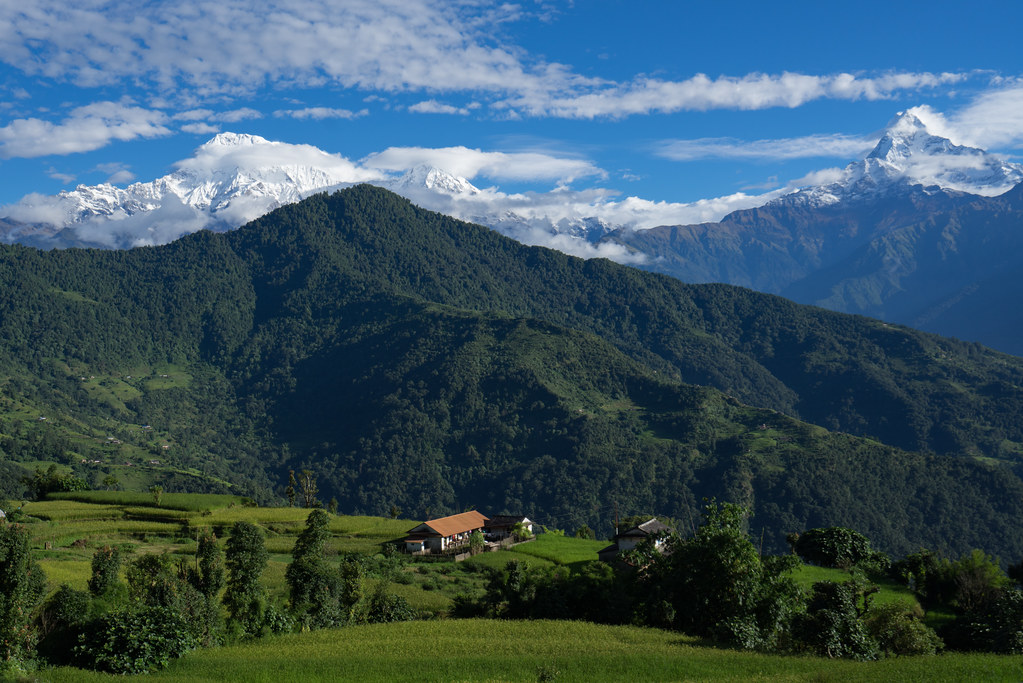
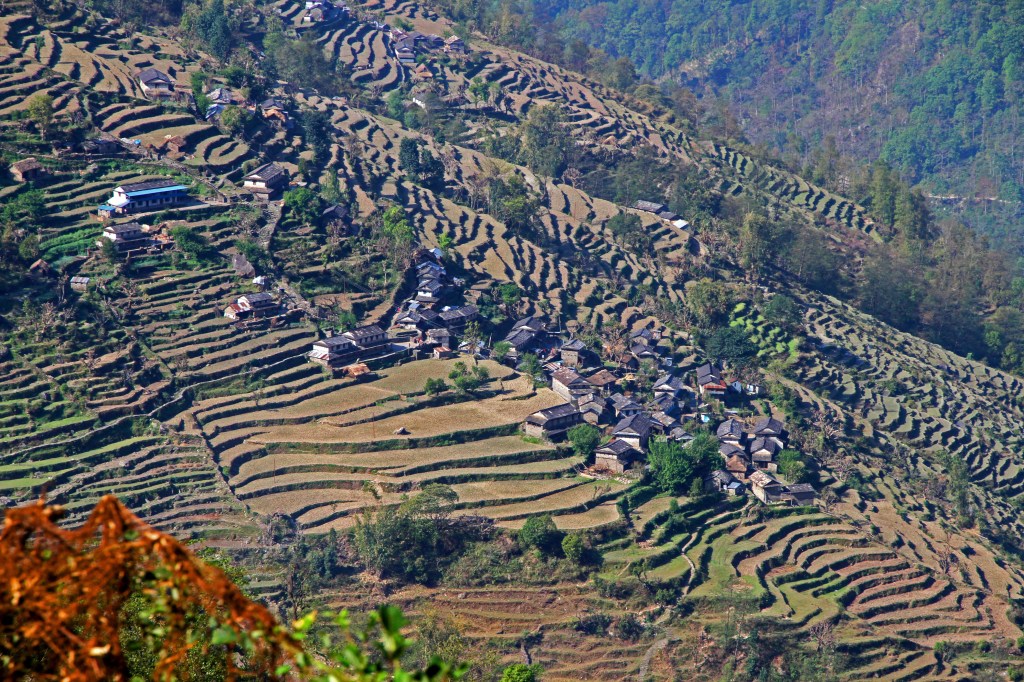
Dhampus, Nepal. Courtesy: Creative Commons

Seared into my mind’s eye, is an image that crops up every time I think of Dhampus, a hilly village situated at a height of between 1600m to 1900m in Nepal. I recall a rainy day with clouds blanketing the surrounding hills and a young chap strumming a guitar and singing a Nepalese folk song in a restaurant.

Dhampus is drenched in rain during the monsoon but most of the water flows down quickly and there is water scarcity during the summer. The views of the Annapurnas and Machapuchhare to the north are spectacular. The Australian Base Camp is nearby and is a popular trek with foreigners. The base camp used to be a herding place for cows, goats and buffaloes and was called thulo kharka (big pasture). The mountain view and the peace and quiet attracted Austrians who used to camp here for a few days during the 1980s. The locals found the word Austrian hard to pronounce and the camp was termed the ‘Australian’ camp.

The village is mainly inhabited by Gurungs who are one of the many hill tribes who form the famous Gorkha soldiers. The village sprawls over ridges and the houses are spread apart. There are stone paved streets in the center of the village with houses on both sides. The village is one of the entry points to the Annapurna Conservation Area Project (ACAP) and in early 2000 had five or six lodges.

Carrying a change of clothes in our day bags, two packets of Wai-wai (a Nepalese noodle brand), a bottle of water and two packets of biscuits, we were at last in the village of Dhampus near Pokhara, Nepal with a group of medical students and their two community medicine preceptors. We visited the subhealth post in the village and the students obtained first-hand insights into the working of the Nepalese primary healthcare system. We were now waiting for lunch to be prepared at one of the many restaurants in the village.

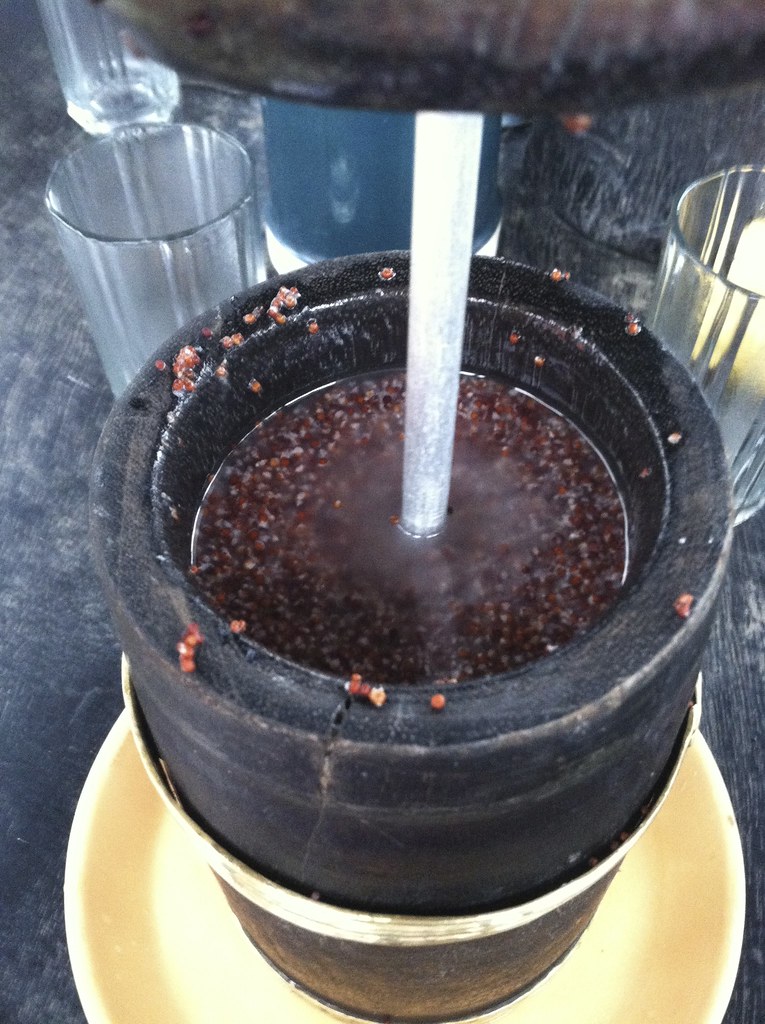
Thongba. Courtesy: Creative Commons

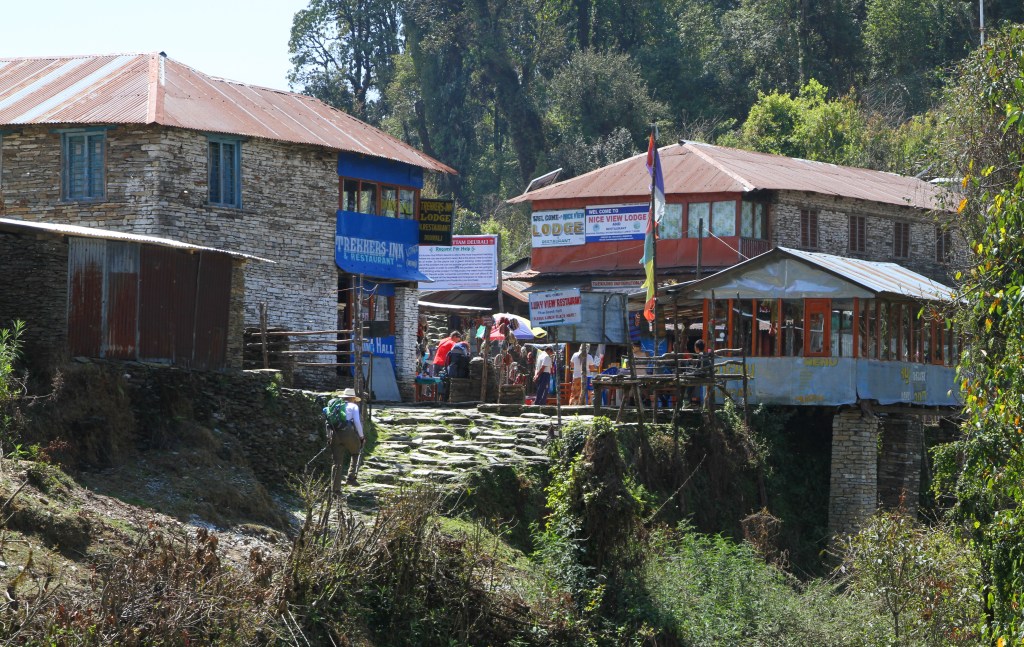
The climb to the village of Dhampus starts right from Phedi (the base of the hill in Nepali) on the Baglung highway. The climb was initially very steep and on stone staircases. The terrain was rocky but gradually became more fertile. Bamboo groves were in evidence with scattered houses and a few rhododendron trees (Lali guraans in Nepali). There were shops selling cold drinks and snacks along the trail. The main lodges and the houses are situated at the top of the ridge. An attraction for many is Thongba. This is a drink made from fermented millet. The grains are served in a container. You add hot water, wait for a few minutes, and then slurp it through a straw.

We soon reached the settlement of Pothana. The settlement consists of a few lodges run by people of Tibetan descent. Many Tibetans migrated to Nepal as refugees in the 1950s and 60s and settled around Pokhara. There is a large Tibetan refugee camp on the Baglung highway.

While we were waiting for Nepalese chiya (tea) after our lunch, it started raining.  The students were scurrying down the hillside to get to the waiting college buses at Phedi. You can climb down in about forty-five minutes to an hour but this is hard on the knees. However, some of us were determined to continue our overnight hike. The rain was testing our resolve. Eventually, we set off along the ridge. The hills were shrouded in mist. A few water buffaloes were climbing the ridges and probably getting back to the shelter of their homes. The buffalo is an adaptable animal. The ones raised in the plains of India cannot climb hills, but the Nepalese ones do so with ease. 

We were drenched and cold. We decided to have cups of Nepalese tea and warm up. The tea in Nepalese trekking lodges is often served in steel mugs. They may use milk powder or milk from the local buffaloes if available. The milk is usually burnt slightly giving a distinct taste that may not be to everyone’s liking. The rain stopped and we decided to continue.

We soon regretted our decision. The rains started again with renewed vigour. The light was also beginning to fade. It was thundering around us, and we lost our way. On top of that, we were assaulted by bloodsucking leeches. I had encountered these creatures earlier at the Eravikulam national park in Kerala. But that is another story.

We were now getting scared. The trail was not evident. We eventually met a farmer and asked him the way to the village of Landruk. At that time our knowledge of Nepali was rudimentary, and we communicated through actions. He volunteered to show us the trail in return for a small fee.   

We continued along the main trail to the village of Landruk but darkness was falling fast. The trail was uphill, muddy, and slippery, and the leeches gave us little respite. Eventually, we saw the light of a lodge on top of a hill. We reached the settlement of Deurali at 2300 m. Deurali means a pass in Nepali. This small settlement had no electricity. We were sweaty, dirty, and wet. The leech-bites were oozing blood. The next hour was spent carefully examining our legs and removing the leeches by applying salt to the wounds. Luckily Nepalese leeches are smaller than the ones in India and the wounds do not bleed so long.

We dined on rice, lentil curry, green vegetables and dried meat and settled in for the night. The darkness was absolute once the lamps were extinguished. I had never previously experienced this level of darkness. The rain continued to drum through the night. The dawn was cloudy, and we could see hills in every direction. The Himals to the north were blanketed in clouds. The lodge had some sel roti (a Nepalese specialty resembling a doughnut) prepared the previous day and we had these for breakfast along with an omelette and chiya (Nepalese tea).

Landruk. Courtesy: Creative Commons

I later did the trek to Landruk and beyond in better weather. Someone once said that weather can make or break a trek. I wholeheartedly agree. The views of the Annapurnas from the trail are spectacular. The forests are green and dense, and the trail is mostly broad and easy to walk on. Landruk has several excellent lodges to spend the night. You can continue down and cross the Modi Khola and then join and climb the main trail to the village of Ghandruk. I have spent a few New Year’s Eve in the lodges of Dhampus. The village is a day hike from Pokhara and the mountain views on a clear day are spectacular. A night hike like the first one I had with leeches and rain is, of course, different in many ways from a day one.

Longer hikes of between a week to two weeks are an enjoyable activity and provide you with a different perspective on life. As roads penetrate ever deeper into the hills, hike trails have become shorter. Today mobile connections are available nearly everywhere. During the early 2000s however, going on a long hike meant being out of contact with the outside world. You stayed in basic lodges and ate simple food. You carried what you required in your rucksack and obtain other necessities at lodges. You realise how much extra baggage all of us carry during our lives. A hike is a step back to a simpler gentler time. I have met several people doing hikes after completing their military service, finishing university, after a breakup, or while contemplating what to do next. You climb stone staircases, cross suspension bridges, crawl through landslides and make way for mule trains. The lack of vehicles makes for a quieter world. As the chaotic voices of the outer world begin to fade, you become more attuned to your inner voices and begin to listen to your soul!

Dr. P Ravi Shankar is a faculty member at the IMU Centre for Education (ICE), International Medical University, Kuala Lumpur, Malaysia. He enjoys traveling and is a creative writer and photographer.

.

PLEASE NOTE: ARTICLES CAN ONLY BE REPRODUCED IN OTHER SITES WITH DUE ACKNOWLEDGEMENT TO BORDERLESS JOURNAL

Click here to access the Borderless anthology, Monalisa No Longer Smiles

Click here to access Monalisa No Longer Smiles on Kindle Amazon International
Categories
Poetry

Poetry by Wilda Morris

Wilda Morris
A BLOB OF GOO? 
    
. . . instead of being like an empty room
 (a really big room) space is more like 
a huge blob of thick goo.     
 ~ Jorge Cham & Daniel Whiteson

When I was just a child I knew
the universe was awfully full
of emptiness and nothing more
surrounding us—that was the lore
taught in those times, the teacher’s store—
but now they say that’s bull.

Astronomers have changed the facts.
It’s hard for me to understand
how space can be a blob of goo
when astronauts tell us they flew
up to the moon itself, and new
research says space expands.

It’s not like taffy, that I know.
Not sticky gunk or sludge or slime.
It’s not like goop. It doesn’t jell. 
Invisible. It doesn’t smell.
So what it is, I just can’t tell.
I hope I’ll learn sometime.	

What Einstein said was surely true—
he said that space can stretch and bend.
Space goo is something like the air
in which we walk without a care
and hardly notice anywhere—
without it life would end.

Wilda Morris’s third full-length book of poetry, At Goat Island and Other Poems is scheduled for publication by Kelsay Books this spring. She lives in Bolingbrook, Illinois, USA.

PLEASE NOTE: ARTICLES CAN ONLY BE REPRODUCED IN OTHER SITES WITH DUE ACKNOWLEDGEMENT TO BORDERLESS JOURNAL

Click here to access the Borderless anthology, Monalisa No Longer Smiles

Click here to access Monalisa No Longer Smiles on Kindle Amazon International
Categories
Poetry

The New Understanding

By Peter Cashorali

The change whose start no one observed
Continues. Just above the roofs
What was sky becomes dark water.
Trees convert to flame and throw
Their orange light up at the waves.
Now the earth rolls out from under
And takes its new place overhead,
Soaked black with authority
That will not entertain appeals. 
Everything depends on it.
Come, it’s time to hold our hands
Out to how it’s going to be
And accept with gratitude
The beggar’s share that’s spared for us.

Peter Cashorali is a psychotherapist, previously working in community mental health and HIV/AIDS, now in private practice in Portland and Los Angeles. He is the author of two books, Gay Fairy Tales (HarperSanFranciso 1995) and Gay Folk and Fairy Tales (Faber and Faber, 1997). He has lived through addiction, multiple bereavements and the transitions from youth to midlife and midlife to old age and believes you can too.

PLEASE NOTE: ARTICLES CAN ONLY BE REPRODUCED IN OTHER SITES WITH DUE ACKNOWLEDGEMENT TO BORDERLESS JOURNAL

Click here to access the Borderless anthology, Monalisa No Longer Smiles

Click here to access Monalisa No Longer Smiles on Kindle Amazon International
Categories
Stories

   The Kabbadi Player by Nadir Ali

Translated from Punjabi by Amna Ali

Painting by Amna Ali

Since I struggled with poor health most of my life, I imagined those who enjoyed good health must be happier too. As the saying goes, “Be fit and healthy and the world is yours!” The strong ones can till and plow the land, but that doesn’t win them the world, as far as I can tell. When I was younger, I naively believed that only the athletes at our college were truly vibrant and alive. The entire college and district worshiped Ahsanullah. Kabbadi[1] was a popular sport back then, and Ahsanullah a peacock strutting in the kabbadi arena. He would tag the opponent and remain standing. “Dare to tackle me big guy!” he seemed to say, before slipping away. Clapping his hands, he would be off and running and onlookers would marvel – “There he goes!”

We witnessed a new race of men when the team from Jullundhar’s Khalsa College arrived. The players — tall, big and heavy– were built like wrestlers. Unlike us, they didn’t tackle opponents with moves like the scissor or the squeeze or run with lightning speed. They would simply grab a man by the arm and immobilise him with sheer force. When they were the ones caught, a few vigorous shoves were enough to help them escape. But they failed against Ahsanullah. They couldn’t even touch him. He slapped the opponent, grabbed him in a tight embrace as if a vine had wrapped itself around the Sardar. Then he spun him to make him lose his balance. A carefully applied tug followed, enough to send him crashing to the ground. The Sardars realised that Ahsanullah’s slight frame was misleading. He was strong as iron. In the end, his opponents always lay defeated at his feet. Thanks to Ahsan and Shareefa, Zamindara College came first in all of Punjab. Khalsa College Jullundhar came in second. But gone are the days of college and kabbadi. Zamindara College was never the same and hockey and kabbadi met their demise. What a strange race everyone joined once the sports grounds disappeared.

I remained friends with all the kabbadi players. Shareefa became the head of a police-station and even played for the police. Ahsanullah would be invited to the village or the college for informal matches. Once he got married, worries seemed to swallow him up. Glasses appeared on his studious face. Kabbadi proved useless for all the players, except Shareefa who put it to good use, tackling and hustling even at his prison job. Thana, Bala, Qooma, Abdullah Raja, all my companions, simply disappeared from my life. The game of life is all about money and power. Some of them were even so-called leaders, honoured with titles like Chaudhry of the village, but being a Chaudhry is meaningless without also being a crook. Despite my ill health, I managed some thuggishness now and then. But those farmers didn’t manage too well. Some thirty years passed.

I left my job and moved to the US, but college days remained etched in my memory. Gujrat had turned into a graveyard where my youth lay buried. Lahore swallowed up everyone. And from Lahore I made my way to the US. The United States – a place filled with endless worry and anxiety, in which everyone seemed to be in a rush to get somewhere. The bright lights and women added some colour, but there was no time to look up.

One day, in the midst of all this, a man caught my eye. A partner in misery, he was staring at the ground. He was wearing glasses and sat slightly hunched, but I recognised that jawline of chiseled iron and the long nose sticking out. “Ahsan Sahab!” I called out. He looked up but his face showed no emotion. “I am Nadir Ali, from Dharekan!” I said.

“What fix have you gotten yourself into?” he asked. No greeting, no salam. What sort of a question was this? He shook my hand without enthusiasm and patted my back. “Managed to find any work?” he asked. I had addressed him as Sahab out of respect for my kabbadi hero. But this man was bent on remaining distant.

“Yes, I did, by the grace of Allah,” I replied mechanically.

“The grace of God does not make it to distant places like New York. It has yet to reach me,” he went on.

“What’s the matter Ahsan Sahab? Is everything alright? Are you well?” I asked.

“The night refuses to end!” he said. “Earlier, I worked a night shift. Now I work at a store at the bottom of a skyscraper. By the time sunlight makes it to the ground, it is evening.” His eyes, full of sadness, seemed to be longing for the sun just then.

“We are in a foreign land, Ahsan Sahab!” I said, acting all mature suddenly.

“Well, it is not like Pakistan is our father’s estate either!” he replied. He got off at the 34th Street station in midtown. I was free and decided to accompany him. He was carrying some stuff for the store, and I gave him a hand. It was not a long walk.

We both stood outside the store. The owner hadn’t yet arrived. Ahsan took out a hash-filled cigarette and lit it. “You didn’t smoke back then!” I commented, trying to put him at ease.

“It’s not like I play kabbadi anymore!” he said and smiled sweetly at last. He didn’t seem to be doing too well. He didn’t ask about Gujrat, and I didn’t bring it up. “I get off at six in the evening. Stop by if you are free,” he said, extending some warmth for the first time.

I returned at a little before six that evening and noticed that he smiled again. It was faint, yet for me that smile was worth a million. “Like the road to my village, like the path that leads me home”– words from one of my poems came to mind. He took me to a bar. “Two whiskeys!” he called out and presented cash at the bar as was New York’s custom. He sat silent. He had always been on the quiet side. But we were both comfortable in our silence.

A few drinks later, I noticed a slight sparkle in his eyes that hadn’t been there before. I felt intoxicated. “Brother, I should stop now,” I said, “I have exceeded my quota.” Once we were outside, I blurted out, “Ahsan Sahab, I write poetry.” What a thing to say! I noticed the moon was visible in the sky. “I have never been able to see the moon in New York before! How did it manage to survive the rough and tumble and make it up there tonight? Good lord, the memories!”

Ahsan Sahab benevolently prodded me — “What are you remembering?”

 “You are the moon, Ahsan Sahab! Somehow, God made you appear tonight.”

“But this is the waning moon, Chaudhry!” he replied, sighing deeply.

Two weeks later, he was dead. Someone at the mosque mentioned that they were raising funds to return the dead body to Pakistan. Words tumbled out of my mouth as I helped lift the coffin for the journey. “He was worth his weight in gold!”

.

[1] Traditional contact sport of Punjab. Players “raid” the opponent’s territory and tag or touch opponents and then attempt to make it back. The defending team tries to stop the player from returning.

.

This story is a translation of Nadir Ali’s short story, first published in a collection titled Kahani Paraga , published by Suchet Kitab Ghar in 2004 in Lahore.

Nadir Ali (1936-2020) was a Punjabi poet and short story writer. In 2006, he was awarded the Waris Shah Award for his collection Kahani Praga. Coming late to writing, particularly fiction, Nadir Ali is credited with spearheading a unique style, blurring the boundaries between significant and petty, artistic and ordinary, primarily due to his preference for and command over the chaste central dialect understood by the majority of Punjabi speakers. He is also noted for writing and speaking about his experiences as an army officer posted in East Pakistan at the height of the 1971 war.

Amna Ali is Nadir Ali’s daughter.  She translated a selection of Nadir Ali’s short stories into English in collaboration with Moazzam Sheikh. The translations were published by Weavers Press in USA in a book titled Hero and Other Stories in 2022. She is a librarian and lives in San Francisco with her husband and two sons.

PLEASE NOTE: ARTICLES CAN ONLY BE REPRODUCED IN OTHER SITES WITH DUE ACKNOWLEDGEMENT TO BORDERLESS JOURNAL

Click here to access the Borderless anthology, Monalisa No Longer Smiles

Click here to access Monalisa No Longer Smiles on Kindle Amazon International