Right Strings

Life, at all stages, even in a difficult hour,
Is never without dreams, joy and beauty.
If you have a heart to wonder,
Eyes to see and mind to think positively.
Flowers wither and seasons fly,
But passion for life never dies.
There is eternal spring in the human heart
And bliss even in small things
If you strike the right chord,
And play the right strings.
Ashok Suri is a retiree and is settled with his family in Mumbai. He tries to convey in simple words what he wants to say.
.
PLEASE NOTE: ARTICLES CAN ONLY BE REPRODUCED IN OTHER SITES WITH DUE ACKNOWLEDGEMENT TO BORDERLESS JOURNAL
A schoolmate was fond of creating a big impression of being an avid reader. He knew there were benefits of reading that were largely unknown to genuine book lovers. He fell in love with the idea of reading as he wanted someone to fall in love with him because of this good habit he cultivated. On the way to school, whether inside the bus or train, he always sat with a storybook, trying to cast a furtive glance and observe the bevy of girls noticing him engaged in this pedantic pursuit. He had faith that some girls would become curious and smitten very soon.
With the fond hope of a conversation with them someday, he kept doing the same thing. The book covers kept changing. As he became desperate, he picked up a romantic novel to send the signal. When he did not have a storybook, he fished out a textbook. The compulsion to have some reading material in front of his eyes helped raise a façade of erudition. He wanted to be seen as a reader whenever girls were pottering around.
The impact of reading was severe for him. He was classified and identified as a bookworm. The bespectacled first-rank holder in our class never read so much. Much to his disappointment, girls did not take an interest in him or his reading. It was scary for the fun-loving types. The guys who boarded a moving train at the last minute or disembarked from a speeding bus were heroes to them.
Driven by fatigue for the first time, he was ready to flirt with other options. When he realised books were futile in winning fans or praise, he switched his strategy to something that involved more daring. He went and stood near the entrance door. Ignoring the warning sign ‘DO NOT LEAN OUT’ crafted capitals and in red, he put almost half of his body out of the train compartment, suspending his weight with the support of the hand railing above his head, hoping to be noticed by girls for his bravado.
Before he could realise what had happened, he was hit on the head and rushed to the nearest hospital at the next station halt. He underwent multiple stitches and survived a life-threatening experience. When he regained consciousness, no girls were waiting with bouquets and get-well-soon notes outside his cabin. He found just a few of us with fruit baskets. Such a misadventure, though unintended, did not elicit any wave of sympathy, but he ended up being famous as a silly boy who could not keep himself safe.
Some girls enquired how he was after he rejoined, but it was a formal query devoid of affection. The one he had a soft corner for did not seek any update. The poor fellow failed miserably in reading as well as heroism. Now he was always made to sit inside the coach, never allowed to stand near the door. Some of us cracked jokes, but he often lost his temper after this brain injury. We read it as a change of personality traits. He sat with a bandaged head for some days expecting sensitive queries, but he had stopped being an object of curiosity or pity for the entire class.
Inside the school, during the recess hour, he stopped playing indoor games like chess. He changed his strategy by approaching a lady teacher with suggestions for his reading list during lunch break. He went to the library and got some uncommon books issued, expecting that lady teachers would gauge him better, unlike the carefree girls. Inside the classroom, he raised irrelevant questions and drifted our attention to storybooks, making other students grumble as the lessons were incomplete.
When the copies arrived checked, he performed below average. Soon, the new English teacher understood his ulterior motive. He used difficult words to flaunt his vocabulary and to impress the woman English teacher. Most of us did not know the meaning of the words he used. He derived wicked pleasure as we were shown as ignoramous despite scoring better in English. He loved the idea that he was advanced in reading. He firmly believed someone would appreciate him better and attune themselves to his wavelength. Turning bespectacled before eighteen was a plus point for him as he thought readers looked like that. But the truth was that some vitamin deficiency had led to his poor eyesight.
Most of us saw him spending time in the library scanning books. He would ask us the names of the author on his list. He recalled many names and titles unheard of as his memory appeared sharpened after the head injury. Since we failed to answer, he was pleased to find us ignorant. He mentioned some names to enlighten us. Most of us thought he would become a writer one day since he was discussing what we never bothered to know in such depth. Perhaps the system of education was not doing justice to him.
When we reached high school, a creative writing contest was organised in which the toppers took part. He was asked why he had stayed out of it. He was quiet for a while and then replied the teachers who were judging had not written anything in life, so he would not insult himself by writing for them and submitting to them for assessment. We did not know whether it was his arrogance, or his statement had an iota of truth attached to it.
Years later, it was shocking for him to know I was dabbling in writing. He was still trapped in the world of books, as it appeared from the pictures he sent me of the sprawling library at his residence, and his various poses with books. I asked him what he was doing when Google did not list his name in the top five pages. He said he was doing a regular job for a living that gave him ample time and freedom to read and write. He also said he was the president of the local literary club for youth and a part-time social worker. Although he was eager to know what I wrote, he did not ask me anything as he feared being asked what he wrote all these years, I guess. I told him what I read, and he said he had finished reading those authors a long time ago – pretty advanced, as usual.
He mentioned without radiance that he wrote love poems in his mother tongue using a pen name. It must be for the girl he liked – who qualified as a doctor. Maybe, he still went around her old house on his bicycle to feel her presence though she had moved overseas to another country long ago. His unreciprocated love had many shades, and he kept it alive through poetry.
He forwarded me pictures of reading in the garden, terrace, recliner, et al. In this age of emojis, if you are seen reading, you get hundreds of likes. But in those days, you did not get a single like. These likes – for the book or his reading nook – would have made him confident then. The well-crafted image of being a pretentious reader he remains stuck with – despite no rewards. Possibly, these likes warm the cockles of his sad heart.
I realised I owed him a few likes and pressed the love icon for some of his social media posts as an act of repentance. Being a friend, he deserved likes from me. He messaged me saying one like during those school days would have worked. Even though I praised him today, he understood I was faking like many others. True, I was always a miser when it came to showering praise.
Devraj Singh Kalsiworks as a senior copywriter in Kolkata. His short stories and essays have been published in Deccan Herald, Tehelka, Kitaab, Earthen Lamp Journal, Assam Tribune, and The Statesman. Pal Motors is his first novel.
PLEASE NOTE: ARTICLES CAN ONLY BE REPRODUCED IN OTHER SITES WITH DUE ACKNOWLEDGEMENT TO BORDERLESS JOURNAL
Their eyes locked in a momentary glance,
The first time they met was by mere chance.
But neither could forget the other's face.
’Twas as if their souls had exchanged places.

She grew restless and dissatisfied,
For nothing in the world could provide
The same joy that his presence brought.
She yearned to know who he was, her thoughts distraught.

"Who is he? Where has he gone?
Appearing briefly, then withdrawn,
Am I dreaming, or is this real?
My heart aches, weakened by what I feel."

He, too, was plagued by thoughts of her,
His discipline and propriety a mere blur,
As he longed for another fleeting sight,
Of the girl on the balcony, his heart's delight.

Their hearts beating in harmony,
Drawn together by a mysterious symphony,
They could not help but yearn for more,
A thousand more times, they wished to explore.


(Inspired by RK Narayan’s Ramayana, the scene where Sita and Rama see each other for the first time)
Shahriyer HossainShetu is a student of English and Humanities who indulges in writing prose fiction and poetry during his free time. His philosophy is to live life to the fullest.
PLEASE NOTE: ARTICLES CAN ONLY BE REPRODUCED IN OTHER SITES WITH DUE ACKNOWLEDGEMENT TO BORDERLESS JOURNAL
Rabindranath Tagore spells different things to different people: National Anthems; the Nobel, Rabindra Sangeet, a veiled woman, Sriniketan or Santiniketan. A cineaste might think of Charulata or Kabuliwala, Chokher Bali (Best Friend) or Kadambari. But the subject ‘Tagore and Cinema’ would mean talking of Tagore’s exposure to cinema, his interest in the medium, the fate of his involvement with celluloid, the films based on stories penned by him, their interpretation in a world that is so far removed from his, in historical, economical, and cultural terms… In other words, it would mean talking of what about Tagore endures — and why it reaches out to the wide world of humanity.
To me, it is Tagore’s awesome, inspiring humanism that offers us immense scope to transcreate, reinterpret, relocate the socially relevant developments and rooted characters again and again onscreen. Like Shakespeare, his works are universal in terms of age, geophysical location, terrain of the mind and tugs of emotions…
Rabindranath was almost seventy when he exhibited his paintings that were so radically different from the style associated with the Tagore family artists, Abanindranath, Gaganendranath, Sunayani Devi, or Nandalal Bose. For, if the Bengal School looked East and sought inspiration in delicate miniatures, Chinese watercolours or the sparseness of Japanese zen, Tagore absorbed the boldness of German expressionism and created a unique style. It’s impossible for someone so open to avant garde trends to take no interest in cinema, the 20th century art form that was silently taking its juvenile steps in India when Tagore won the Nobel.
When he visited Russia, he watched Battleship Potemkin, the classic ‘handbook for editors’ (to quote Phalke winner Hrishikesh Mukherjee) that influenced a long line of filmmakers in India too. By 1931, the year when Alam Ara (Hindi) and Jamai Shasti’(Bengali) turned ‘movie’ into ‘talkie’, Tagore was in the last decade of his life. So, when he directed Natir Puja (The Dancing Girl’s Worship) at New Theatres, he was substantially assisted by Premankur Atorthi, who was the first to direct a film based on a Tagore composition. This was the only time when the Renaissance personality directly interacted with the celluloid medium. His nephew Dinendra wrote the screenplay, albeit under Tagore’s guidance, and students of Santiniketan acted in it. More importantly, Tagore himself essayed an important role in the dance-drama which was shot with a static camera over four days. However, the result was more a staged play than cinema. A greater tragedy is that the reels perished within 10 years, when a fire ravished the New Theatres Studio in 1941.
Atarthi’s own direction of Chirakumar Sabha (1932) set off a tradition that received a robust boost, first in the 100th year of the poet’s birth, and again in 2011, when he turned 150 and further. If literary treasures like Gora (1938) and Chokher Bali (1938) were adapted onscreen by Naresh Mitra and Satu Sen, they were remade and reinterpreted by Rituparno Ghosh who veered towards Tagore rather than Saratchandra, the more popular litterateur of Bengal who was a staple of Tollygunge for years. In fact all major names of Tollygunge, from Nitin Bose, Agradoot, Tapan Sinha, to Purnendu Pattrea, Partha Pratim Chowdhury and Rituparno Ghosh have announced their coming of age in cinema with a film based on a Tagore composition.
It is interesting to note that when Tagore visited Russia in September of 1930 members of the Cinema Board who had a conversation with him regarding his “new film stories” were deeply impressed by the short versions of the stories (as narrated) by the Poet, and they met him at his hotel to discuss in detail the possibilities of filming them. Tagore himself had enough interest in cinema to visit the Amalgamated Cinema Union, where he was received by its president M Rutin and was shown Eisentein’s Battleship Potemkin and portions of Old and New, we learn from his Letters from Russia.
Although evoking the Bengal of his time in divergent hues, Tagore’s stories continue to inspire man to go beyond divisions of nation, religion, caste or gender, perhaps because they explore how society shapes our love and relationships. This essay dwells on films that highlight the pervading themes of feminism, humanism and universalism in Tagore’s literary works.
Not Slave, Nor Goddess
The champion of women tells us to enunciate aami nari, I am a woman … with pride, because a woman is not a slave nor needs to be the other extreme, a goddess. That it is right for a woman, whether young, maiden, or widowed, to be a person of flesh and blood. That Tagore empathised so deeply with his women characters that today’s social historians are talking of an androgynous strain in the humanist.
* When Satyajit Ray filmed Ghare Bairey (The Home and the World), we got a glimpse of the regressive practices that ailed even the wealthy and educated households. However the most symbolic scene was the one where Bimala is inspired by Nikhilesh to step out of the inner quarters of the zamindar’s household. Even Sandip, the false god, hails it as a ‘social revolution’. Tagore the author goes on to criticise the pseudo rebel but at no point does he criticise Bimala — not even when her sister-in-law cautions Nikhilesh about the freedom his wife is abusing. We find a repeat of this theme in Char Adhyay (Four Chapters) – but we’ll come to that later.
* Chokher Bali, first filmed in 1938, turned the spotlight on the deprivations young widows were subjected to even after the reformist crusades of Raja Ram Mohan Roy and Ishwar Chandra Vidyasagar. Very sympathetically, and most aesthetically, it held a brief for their sensuality — even sexual needs, especially when Rituparno Ghosh filmed it in 2003. But even here, before Mahendra’s mother dies, she urges that in her memory he should host a feast for widows — “people feed Brahmins, beggars, even animals, but never for the unfortunate widows,” he underscores.
* Nitin Bose’s bilingual Noukadubi was probably the first to take Tagore to Hindi cine-goers. Incidentally Rituparno and Subhash Ghai’s Noukadubi were also bilingual. In 1944, Milan afforded Dilip Kumar opportunity to mature as an actor, for here Ramesh upholds the flag of humanism. After being boat wrecked he comes home with Kamala, the ‘bride’ he has not deigned to look at, and realises that she is in fact someone else’s wife. The gentleman in him decides to take her to a convent and give her not just protection (from a par purush, stranger) but also proper education — even at the cost of his own spotless reputation and his chances of finding happiness with his beloved, Hem Nalini.
* In Charulata (1964), although Satyajit Ray continues to unfold her story from Amal’s point of view, his sympathy without reservation lies with the lonely wife. For half a century and more viewers have no doubt that Charu was an alter ego for Tagore’s Natun Bouthan – his sister-in-law Kadambari Devi, who took her own life. This story has inspired Bandana Mukherjee’s Srimati Hey and Suman Ghosh’s Kadambari (2015). Ray underscores this aspiration aspect in the film when Charu writes, gleaning from her experiences, and her writings are published in a magazine. This was unthinkable in the 19th century — and only a deeply humane soul could understand that a woman too needed to express her intellectual and creative self. (This aspect is completely missing in Charulata of 2011, directed by Agnideb Chatterjee, although it unfolds from the woman’s perspective and unabashedly speaks of her physical intimacy with Amal.)
* For Tagore, perhaps the stifling of this intellectual self was as great a tragedy as the ‘burying’ of her potentials within the walls of domesticity. In the poem ‘Sadharan Meye’ (Ordinary Girl), he urges his contemporary Sarat Babu to write a novel where the protagonist — a scorned woman — goes on to study, travel abroad, re-valued by several admirers, including the man who ditched her for being an ‘ordinary’ woman. The core thought of this poem had inspired a script by Nabendu Ghosh, an altered (and unacknowledged) version of which was made by Hrishikesh Mukherjee as ‘Pyar Ka Sapna’ (Dream of Love, 1969). In recent times the theme has been most successfully revisited in Vikas Bahl’s Queen (2014).
* In Megh O Roudro (Clouds and Sunshine), Rabindranath’s short story creates a protagonist whose struggle to affirm her dignity in the British ruled 19th century prompts her to read and write under the tutorship of a stubborn law student who is jailed for constantly challenging the discriminatory ways of the imperialists. By the time he is released, she is a prosperous widow who courteously acknowledges his role in her achieving self-confidence. In 1969, Arundhuti Debi, herself raised in Tagore’s ethos at Santiniketan, chose this for her second outing after Chhuti (Holiday) and her lyrical treatment brought her recognition as a director of substance.
* But what happens when a woman cannot fulfill her destiny, as in Streer Patra (A wife’s Letter, 1972)? How did Rabi Babu want his Mejo Bou — haus frau — to behave when the acutely male dominated household turns a blind eye to the injustice of marrying off the hapless orphan Bindu to a lunatic? Not drown her woes in the vast ocean at Puri but to slough off, in a moment of illumination, the shell of ‘Mejo Bou’ and become Mrinal, a woman with .her own soul and individual identity Why must she end her life like his Natun Bouthan — “Meera Bai didn’t,” he points out. And to us, even by today’s standards, it is the ultimate expression of feminism.
* Perhaps because of the class she belonged to, and with the support of a rebellious brother, Mrinal could do what Chandara couldn’t in Shasti (Punishment, 1970). Tagore knew that neither his ‘Notun Bouthan’ nor his own wife Mrinalini got the opportunities enjoyed by his ICS brother’s wife. Far from it: Chandara’s husband Chhidam places the burden of his Boudi’s death at the hands of his elder brother on his wife. In the prevailing patriarchal society it wasn’t unthinkable: a wife was expendable because you could get another, but not a brother. But the unlettered Chandara has her own estimation of the sanctity that is the conjugal bond. When her husband comes to meet the wife condemned to hang, she denies him the right of visitation by disdainfully uttering a single word: “Maran!” How should we read it today? Go, drop dead or go hang yourself!
* Jogajog (Connection) was written in 1929 in a society where there were caste/ class distinctions even amongst zamindars. Tagore had first-hand experience of this within his family. His crude protagonist is a johnny-come-lately who seeks revenge by marrying the educated and cultured Kumudini. He cannot stand any expression of respect for her brother and feels belittled at the slightest hint of will in his wife. Matters go so far that in the 2015 film, director Sekhar Das can effortlessly trace moments of marital rape in their conjugal discord.
* Chitrangada had poised the question: where lies a woman’s true beauty – in her outward appearance or her inner worth? Should the princess, raised to be as good as a prince, deny her essential self to please a man? Or is she wrong to sacrifice her being for one she loves? In 2008, Rituparno Ghosh gave a whole new androgynous reading of the dance drama, with Madan/ Cupid becoming a psychoanalyst.
Child — The Father and Mother of Man
Robi, who immortalised his childhood in Chhelebela (Boyhood), could never forget the restrictions imposed by adults and the suffocating effect it had on an imaginative soul. Therefore in Ichhapuran (Wish Fulfillment,1970), directed by Mrinal Sen for the Children’s Film Society of India, he effected a role reversal whereby their bodies get swapped. The naughty child Sushil becomes the father and the senior who covets the youthfulness becomes the free spirited son.
The comical confusion this ensues in the village leads both to realise the importance of their individual positions in life. They get back to their original self with the profound lesson for humanity – that each one of us has a place in the world no one else can ever fulfill.
* Of course the best known child in Rabindra Rachanabali (Creations of Tagore) is Amal. Essentially Dakghar (Post Office) was a testimonial against the crushing of childhood Tagore suffered. In the recent past actors Chaiti Ghoshal and Kaushik Sen have proved the enduring appeal of Dakghar — she in the form of a recorded audio play (CD); he on stage. Chaiti Ghoshal interprets the protagonist she had played with Shambhu and Tripti Mitra not as a Rabindrik character but as any child today, familiar with cricket and computer. Manipur’s Kanhailal has used elements of dance and drama to reinforce this message of freedom beyond frontiers. And, following the 2007 police firing in Nandigram (that killed 14 persons who were opposing state officials on land acquisition drive), Kaushik Sen had interpreted Amal’s desire to send a letter as a message to every household to raise awareness.
Sen’s Dakghar, then, was not about death but about liberation from life in bondage. “Perhaps that’s why, a day before Paris was stormed during WWII, Radio France had broadcast Andre Gide’s French translation of the play,” Kaushik had said while staging the play. “Around the same time, in a Polish ghetto, Janus Kocak had enacted the play with Jewish kids who were gassed to death soon after.” After such multi-layered readings of the text, Dakghar as filmed by Anmol Vellani in 1961 remains a simplistic viewing — perhaps because it was made for the Children’s Film Society.
* In The Postmaster the child – an illiterate village girl in this instance – metaphorically becomes a mother and a priya , or beloved, of the pedantic city boy who is stirred by beauty of the moon but can’t wait to go back. When he falls critically ill she dutifully serves him and cares for him like a wife. When he is set to depart by simply tipping her with silver coins, the child with a maturity beyond her years refuses to say goodbye. Rejection doesn’t need words: she can negate his very existence by her silence.
* Samapti (Finale) the concluding story of Teen Kanya (1965) remade by Sudhendu Roy as Upahaar ( The Gift, 1975), builds on the flowering of a woman in an unconventional girl child. Mrinmoyee is certainly not a Lakkhi Meye…a good girl , she’s a scandal in rural Bengal of 100 years ago. She escapes her wedding night by climbing down a tree, she spends the night on her favourite swing on the riverbank, she snatches marbles from her friend, a boy… When they try to tame her by locking her up in a room she throws things at Amulya. But when he returns to Calcutta and she’s sent back to her mother’s, she realises grown up love for the man she’s married to, and sneaks into his room by climbing the same tree!
* Buddhadev Dasgupta had woven Shey from Tagore’s late novel written for his granddaughter, and then scripted a feature based on 13 poems by the bard. When we read a poem, certain images arise before our mind’s eye. The director interprets Tagorean poetry through such images and experiences. “It is about how a poet responds to another poet,” he explains.
Of Zamindars and Servants
Robi, the ‘good for nothing’ youngest son of Debendranath, had to prove himself in his father’s eyes by successfully performing the job he was entrusted with – that of collecting taxes, ‘khajna’, from the ‘prajas’, subjects, no matter how impoverished they were. We all know that in doing the job he came across a vast cross section of people of the land whom he would not otherwise get to know so intimately. And while he could not be lenient as his father’s representative, he created caring characters like the zamindar in Atithi ( The Guest) who brings home a vagabond, gives him education, and even prepares to give his daughter in marriage to the free spirited boy whose restless soul drives him away…
* But having seen the reality of the lives of the subjects Rabindranath also created uncaring zamindars like the one in ‘Dui Bigha Jami’ (Two Bighas of Land) that had inspired the Bimal Roy classic Do Bigha Zamin (1953), set in a post-independence India that was rapidly industrialising. Debaki Bose attempted a more literal visualisation as part of Arghya, his Centenary Tribute to Tagore, along with his poem ‘Puratan Bhritya’, (Old Retainer).
* Robi, the motherless child who was raised in a large household in the rigid care of servants, said ‘Thank You’ to them through characters like Kesto, the old family retainer who refuses to leave even when he’s dubbed a thief or driven away. Instead, he saves his master from small pox at the cost of his own life. Tagore, in fact, goes a step further in his short story, ‘Khokababur Pratyabartan’. The trusted servant even raises his son to eventually give him up as the master’s child lost to a landslide in the river! Oppression of Religion
Pujarini (Worshipper) was immortalised by Manjushri Chaki Sircar’s dance. Although set in the revivalist times of Ajatshatru who was set upon putting the clock back and wipe out the Buddhist tenor of his father Bimbisara, we can easily identify with Rabindranath’s condemnation of any excess – violence in particular – in the name of Religion. Visarjan (Immersion) too raises consciousness against violence in any form, against even animals, in the name of religion.
* Nor can we overlook instances where he raises his angst ridden voice against the inhuman treatment of humans on grounds of caste or creed. In Chandalika, the untouchable gets a new mantra to live by when the Buddhist monk Ananda says “Jei manab aami sei manab tumi kanya (You, lady, and I are part of the same humanity).” The act becomes a beacon for Sujata, the eponymous protagonist of Bimal Roy’s film, who is on the verge of ending her life (following casteist discrimination).
* Tagore’s poem called ‘Debatar Grash’ (God’s Greed), lashes out against the cruelty people can unleash through the heart rending plight of the mother whose child is snatched from her and thrown into the raging waters to appease the villagers superstitious belief in god’s wrath. Shubha O Debatar Grash (Shubha and God’s Greed, 1964) remains a signature film of Partha Pratim Chowdhury.
* Tagore questioned the very concept of belonging to ideological boxes. His time-transcending novel, Chaturanga (Four Quartet), points out that human experiments (like, say, Communism) have failed because they put ideology in watertight boxes that do not have any room for flexibility. This inspired Suman Mukhopadhyay to film it in 2008. Tagore, who himself created walls and broke them, questions this through Jyathamoshai, his uncle, and Sachish, who invite Muslim singers and feed them at shraddha or funeral as much as through Damini, whom Sachish wants to domesticate much against her wish. She even questions her husband’s authority to will her away along with his property, to his religious guru. Tagore uses the graphic imagery of a hawk and a mongoose that Damini has as her pet (it is well known that these animals cannot be domesticated).
Nationalism to Internationalism
‘Where the world has not been fragmented by narrow domestic walls, and the clear stream of reason has not lost its way into the dreary desert sand of dead habits: into that heaven of freedom’ Tagore, forever and always, wanted his compatriots to awake. That is why Nikhilesh, in Ghare Bairey, does not condone violence even in the name of nationalism. That is why he decries Sandip, who uses the passion of young freedom fighters and the wealth of the poor to fill his coffers.
Beware the false god: Tagore repeats the criticism in Char Adhyay. In 2012 Bappaditya Bandopadhyay revisits the novel filmed by Kumar Shahani in 1997, the golden jubilee of Independence. But Ela’s Char Adhyay review it for its politics, its backdrop of ultras and violence, for the debate that acquired a new validity in the world after 9/11. Tagore was much in favour of non-violence, so much so that he criticised the nationalist movement too when it turned violent. How much of a visionary he was to ask a full century ago: “What will be the state of the nation that is based on violence?”
Young filmmakers are amazed by Tagore’s vivid criticism of the deterioration of party structures although he himself never belonged to any party. Sarat Chandra’s Pather Dabi (Demands of the Path), written about eight years before Char Adhyay, had taken a populist stand while Tagore didn’t hesitate to say through the protagonist Atin, ‘I am not a patriot in the sense you use the term.”
* That Rabindranath was against any form of regimentation is well established. His play, Tasher Desh or the land of cards, perhaps, written to criticise the submission of the conscience in Hitler’s Germany, remains the ultimate critique of regimentation. Directed by Q in 2012, the text layers his criticism of contemporary society by “trippy” visuals. By Q’s own submission, it is a “quirky” retelling of the Tagorean allegory.
* Gora (directed by Naresh Mitra in 1938) goes further: He bows to his adopted mother, hails her as his Motherland and says, every child is equal for a mother, she does not differentiate on any ground. Tagore here gives us a blueprint for an ideal Republic where a hundred flowers can fill the air with a hundred different colours.
* Perhaps the ultimate example of Tagore’s humanism is Kabuliwala, directed in Bengali by Tapan Sinha in 1958 and in Hindi by Hemen Gupta in 1961. An Afghan selling his wares in a Calcutta 150 years ago and striking a friendship with a child who reminds him of his own daughter back home, is a story that will strike a chord in anybody, anywhere in the world, at any given point in time — even in a world swamped with internet, chat rooms, mobile phones and multimedia messaging.
All of this reiterates the ‘forever-ness’ of Tagore. It also redefines the need to interpret his farsightedness, his comprehensiveness, his universality for our own times, in our own terms. Tagore himself had observed in a letter: “Cinema will never be slave to literature – literature will be the lodestar for cinema.” So we may conclude that since Tagore was primarily delving into human emotions, into the psyche of men and women placed in demanding situations that forced them to measure up to social, political, cultural or gender-based challenges, films based on his stories not only continue to be made but find an ever-growing audience in the globalised world.
(Courtesy: Tagore and Russia: International Seminar of ICCR 2011 held in Moscow. Har Anand publications, 2016. Edited by Reba Som and Sergei Serebriany)
.
Ratnottama Sengupta, formerly Arts Editor of The Times of India, teaches mass communication and film appreciation, curates film festivals and art exhibitions, and translates and write books. She has been a member of CBFC, served on the National Film Awards jury and has herself won a National Award.
.
PLEASE NOTE: ARTICLES CAN ONLY BE REPRODUCED IN OTHER SITES WITH DUE ACKNOWLEDGEMENT TO BORDERLESS JOURNAL
And then came Winter
dressed in a loose white cloak,
melancholic, like a forlorn lover
sweeping across the pale grass,
dull December, cheese-like snow
with hardened memories of hanging roots
buried in the womb in grandiose silence
under its noiseless weight.
Snowfall dangled pearls
on my eyelashes.


And then came youthful Spring --
like a danseuse mesmerising the valleys and hills to smile,
filling the woods and plains with colour and harmony,
songs of joy, birds and flowers,
awakening the buried strawberry memories
underneath the cobalt sky
with life and cheer.
K.V. Raghupathi is a former academic, poet, short story writer, novelist, critic, and book reviewer. Widely published and anthologised, he has thirteen collections of poetry, two short story collections, and two novels. Currently he lives in Tirupati, devoting full time for writing, and he can be reached at drkvraghupathi9@gmail.com
PLEASE NOTE: ARTICLES CAN ONLY BE REPRODUCED IN OTHER SITES WITH DUE ACKNOWLEDGEMENT TO BORDERLESS JOURNAL
In her heyday, my mother was a full-time homemaker, and an excellent cook and baker. She managed to have lunch and dinner on the table at the exact time every day, and there was always a homemade dessert. She followed recipes closely, something that I also have a tendency to do, which irritates my freewheeling husband. Mom had a box crammed with recipes handwritten on three by five cards, and a shelf of cookbooks, many of which were community compilations filled with recipes by the members of various churches she and my grandmother had attended. Occasionally, she made alterations which became notations in the margins: “Only half a teaspoon of sugar.” “Omit garlic.”
Several years ago, my mother, now in her eighties, lost her ability to follow a recipe. Although she can handle making a sandwich or opening and heating a can of mixed vegetables, she no longer makes meals. That task has fallen mainly to my father, but on my annual trips home from Japan, where I now live, I try to help out. On my most recent visit, I made a meat loaf using the recipe that my mother used exclusively, which calls for evaporated milk, chopped onions and peppers; Japanese-style curry and rice; and macaroni and cheese. I asked my dad what else he might have a craving for. He said “chop suey.”
When I was a kid in 1970s Michigan, chop suey was one of my favorite dishes, but I hadn’t had it in ages. Last I recall, Mom had made it when my Japanese husband had accompanied me on a visit. Her version called for chunks of pork, bean sprouts, and celery with some kind of sauce. This mixture was layered over rice and topped with crunchy chow mein noodles. I knew that it wasn’t authentic Asian cuisine, that it was more of an interpretation for Americans. But the dish still conjures memories of my childhood, those days of riding bikes and climbing trees until dusk, of no homework, and ‘Gilligan’s Island’ and ‘I Dream of Jeannie’ on our black and white TV.
“Okay,” I told my dad. “I’ll make it.” I turned to my mother and asked her where the recipe was. Although she can’t cook, she remembers in exactly which cookbook certain recipes are located. But this time she said, “There’s no recipe. It’s in my head.” But she couldn’t tell me how to make it.
I turned to the internet and learned that chop suey had been all the rage in the 1950s, and that every American housewife had had her own way of making it. Some used chicken, some added snow peas and baby corn, but I remember my mother’s as being totally brown. She had never added anything green or any other color. The sauces were slightly different, too, calling for oyster sauce in one case, soy with dark molasses in another.
I went back to my mother’s cookbooks to see what I could find. Finally, I came across a recipe in a community cookbook produced by a Methodist women’s group at the church we had attended in Grand Haven, Michigan, when I was a child, before we moved to South Carolina. It was annotated in blue ink: “See p. 78 Good Housekeeping Cookbook.” I couldn’t find the volume in question.
“Maybe you don’t have it any more,” I told my dad.
He shook his head. “It’s there somewhere. She never threw anything away.”
I looked again. Nothing. Even so, the recipe I’d found seemed pretty close to what I recalled. I made a shopping list and headed to Walmart.
The grocery section at the local Walmart had a modern selection of Indian curries and Japanese Pocky sticks and Thai noodles, but I couldn’t find canned bean sprouts or those crunchy chow mein noodles. Was it due to a supply chain issue? Or maybe no one produced those ingredients anymore. Maybe, along with chipped beef on toast, chop suey was a relic of the past. Disheartened, I scoured the rows of raw vegetables; still, no luck.
As a last resort, I made a stop at Food Lion, which also had an international foods isle, heavy on the Mexican. Lo and behold, they stocked a few cans of bean sprouts and a bag or two of those crunchy La Choy noodles from my past!
Back home, after sleuthing around the shelf a bit more, I came across a thick old cookbook which had lost its cover. It turned out to be the Good Housekeeping Cookbook. Some of the pages had fallen out, and been tucked back in. I immediately turned to page 78 and found a recipe for “California Chop Suey” with further annotations.
My South Carolina version was a combination of the one found in the Methodist church community cookbook and the Good Housekeeping version. I had substituted fresh chopped celery and onions, and a can each of mushrooms, beans sprouts and water chestnuts, for the “canned oriental vegetables.”
Due to a variety of dietary restrictions, real or imagined, my mother declined to partake. She did peer into the pot and declare my concoction watery, but I didn’t want to add more cornstarch. I hefted the pot onto the table, along with the rice I’d cooked, and a bag of those crispy chow mein noodles. My dad had made salads.
We heaped our plates with rice, then ladled chop suey on top. Lastly, we sprinkled some of those chow mein noodles over the mounds.
Dad dug in with a spoon. “Mmmm! Good!”
I thought it had turned out pretty well, too. Maybe that chop suey wasn’t authentically Chinese, or any other Asian country’s dish, but it hinted at a flavour that resonated more deeply. My tongue recognised that chop suey as the taste of Mom.
Suzanne Kamatawas born and raised in Grand Haven, Michigan. She now lives in Japan with her husband and two children. Her short stories, essays, articles and book reviews have appeared in over 100 publications. Her work has been nominated for the Pushcart Prize five times, and received a Special Mention in 2006. She is also a two-time winner of the All Nippon Airways/Wingspan Fiction Contest, winner of the Paris Book Festival, and winner of a SCBWI Magazine Merit Award.
PLEASE NOTE: ARTICLES CAN ONLY BE REPRODUCED IN OTHER SITES WITH DUE ACKNOWLEDGEMENT TO BORDERLESS JOURNAL
JIVA AND ISVARA

From his perch on the branch of a tree,                                                                                                            Jiva dug into the luscious fig,                                                                                                     his beak buried deep into the fruit.
Isvara, from another branch of the same tree,                                                                                             looked at Jiva and felt the juice                                                                                                         slide into his own throat, like nectar.
Jiva ate the fig bit-by-delicious-bit                                                                                                    then rubbed his fruit-smeared beak                                                                                                                on the rough trunk of the tree.
Isvara, his beak clean                                                                                                              felt completely satiated                                                                                                                      by the fruit he never ate.

*Mundaka Upanishad: 3.1. 1-2.                                                                                                           Both the birds are bound to each other in deep friendship. The first bird, Jiva, represents an individual self or soul. It lives in the human body and is covered in desires. The second bird, Isvara, is the Paramatman, an aspect of God who also lives in the heart of every living being, and is beyond sensual desire.

BEING BILINGUAL

The binaries                                                                                                                                 can complement each other,                                                                                                           or nearly split you apart.
It all depends on the wise counsel.
Just join the dots,                                                                                                                                         said a glib voice in English.                                                                                                             You’ll see a pattern, emerging.
Oh no, countered the voice in Tamil                                                                                                                 go around the dots                                                                                                                                                 you’ll see a lovely pulli kolam* arise from it.

*pulli kolam: In Tamil, ‘pulli’ is a dot and ‘kolam’ is a rangoli. In the traditional, elaborate rangolis that are special to Tamil Nadu, patterns are worked around multiple dots sinuously.
Dr. Lakshmi Kannan is a poet, novelist, short story writer and critic. She has published twenty-seven books to date. She was a Resident Writer for the International Writing Program, Iowa, USA; Charles Wallace Writer with the University of Kent at Canterbury, UK; delegate to the Feminist Book Fairs at Montreal and Amsterdam; Fellow, Indian Institute of Advanced Study, Shimla. In her Tamil pen name “Kaaveri”, she has published a novel and collections of short stories. She taught English on the faculty of colleges, and in IIT – Delhi before she joined a multinational as a Senior Writer & Language Coordinator.For deta ils, please visit www.lakshmikannan.in
.
PLEASE NOTE: ARTICLES CAN ONLY BE REPRODUCED IN OTHER SITES WITH DUE ACKNOWLEDGEMENT TO BORDERLESS JOURNAL
April 13, 1948. It was on this day that the first Prime Minister of India Pandit Jawaharlal Nehru laid the Odisha capital city’s foundation stone. Since then, Bhubaneswar has remained a celebrated model of modern architecture and city planning with its prehistoric past as a temple city. Along with Jamshedpur and Chandigarh, Bhubaneswar is one of modern India’s first planned cities.
While laying the foundation-stone, Nehru observed: ‘Bhubaneswar would not be a city of high-rise buildings for officers and rich men without relation to the common masses. It would be consistent with the idea of reducing differences between the rich and the poor. The New Capital would embody the beautiful art of Odisha, and it would be a place for beauty…so that life might become an adjunct to beauty.’
Bhubaneswar is a temple town with a series of ancient sandstone temples varying in size from the towering eleventh century Lingaraja Temple. It was a city of temples. Once upon a time, there were more than 7,000 temples in and around Bhubaneswar. Today, there are only a few.
EXQUISITE ARCHITECTURE
From a religious standpoint, the Lingaraj temple is the most popular. Other temples include the 7th century Vaital temple, the impressive 10th century Mukteshwar temple, and the 11th century Raja Rani temple with its fine carvings. There are many other temples of exquisite architecture.
Several Grade-I temples of national importance have been protected by the Archaeological Survey of India (ASI) in Old Bhubaneswar, such as Ananta Basudeva, Mukteswara, Persurameswara, and Rajarani Temples, which are just a few examples. Bhubaneswar’s modern capital is shaped by Old Bhubaneswar’s ancient temples.
The state capital city planning began near the old temple town. The Master Plan for the upcoming city of Bhubaneswar was prepared by Dr Otto H Koenigsberger on the concept of neighbourhood unit planning. The original plan envisaged horizontal development rather than vertical growth for a population of 40,000 with administration as the primary function. Koenigsberger designed a linear pattern for the city, with administrative units on the main artery, and neighborhood units attached to them. Neighborhood units offer residents the most sophisticated amenities in a city. They were placed at short distances to give people easy access to schools, hospitals and other facilities.
CENTRAL VISTA
Six units were developed. Unit-V served as the site for the administrative complex, while other units were planned according to neighborhoods. As part of the town center, there was a market building, a weekly market, a day-to-day market, and a bus station. There was a central vista with views of the Raj Bhawan. There was also a commercial zone along Janpath and Bapuji Nagar up to the railway station. Koenigsberger’s planning zone provided characteristic weather control and a salubrious climate throughout the year. This area — the heart of the city — maintains the lushest green cover in the city with open space and a well-organized transportation system.
A neighborhood unit required that each child live within a quarter of a mile or a third of a mile of their school. Housewives were required to live within a half mile of the civic center to shop there and have access to medical facilities within the town. Distances between a person’s home and place of employment could conveniently be covered by a bicycle or a cycle rickshaw. Koenigsberger suggested 7 different types of roads for 7 different groups of users and 7 different functions. Those are footpaths, parkways, cycle paths, minor housing streets, major housing streets, main roads and main arteries.
Bhubaneswar was planned to be the state capital, but it is primarily a city for government officials. Residential quarters were designed to meet the needs of officials from various income groups. Planning was made to meet the ideal urban family’s requirements. This was done by providing them with single-storey independent houses with a front yard and kitchen and garden space in the back yard. Government bungalows have extensive open spaces around them and abundant space between one house and another. Those with high incomes occupy bungalows near the main employment complex.
Low income housing consists of mostly one and two bedrooms comprised of more than one unit broken into rows. Early in the planning process, residential quarters in different neighborhoods were mostly standardized. Small scale industries and manufacturing activities were added after 1980. Much of the original plan has changed in twenty years.
HERITAGE ZONE
Bhubaneswar has been declared a special heritage zone as Ekamra Kshetra, which consists of several significant structures. Various socio-cultural and religious heritages of Odisha are represented in the monuments, which represent different periods in Odisha’s history. In recent years, several of these significant elements have steadily lost their significance due to modern construction activities.
An integrated regional development plan has been prepared to meet the growing demand for services in the region. This plan has been declared as the Comprehensive Development Plan (CDP) of the Bhubaneswar Development Plan Area (BDPA). The BDPA comprises Bhubaneswar Municipal Corporation, Khurda Municipality, Jatani Municipality and adjoining 122 Mouzas. The Long Term Perspective Plan for Bhubaneswar-Cuttack Urban Complex (BCUC) provides a vision for the development of the whole region by 2030. Bhubaneswar-Cuttack Urban Complex being the hub of commercial, political, administrative and socio-cultural activities in Odisha, it has rich potential for development.
A lot of resentment was felt — and it still exists — when Bhubaneswar replaced Cuttack as the capital on 19 August 1949, two years after India gained independence from Britain. In recent times, Bhubaneswar and Cuttack have been called the ‘twin cities of Odisha’ – one with a modern look and another with a millennium-old history. Bhubaneswar and Cuttack have become closer since the Netaji Subhash Chandra Bose Bridge, also known as the Trisulia Bridge, opened on 19 July 2017.
BIG FIVE
There are a few Tier-2 cities in the country that host the top five IT companies in the country. Bhubaneswar is one of them. These companies include Infosys, Wipro, Tata Consultancy Services, Tech Mahindra, and Mindtree. It is considered one of the three most attractive places in the world to do business, according to the World Bank. Bhubaneswar has been selected as one of the first twenty cities in India to be developed as a smart city. This is part of his flagship ‘Smart Cities Mission’ which seeks to develop 100 smart cities in India.
Bhubaneswar was added to the World Heritage List (WHL) as part of the application process. The WHL requires that the site be of outstanding value, as well as having at least one of the ten selection criteria met. This is required for inclusion on this list. Bhubaneswar meets four of them. Over 100 cities have been designated World Heritage Sites by UNESCO.
Nations that nominate heritage sites and cities to UNESCO, and submit data, maps, and photographs, are given heritage status by the organization. World Heritage Status is the highest honor and most prestigious title given to heritage monuments, sites, and cities in recognition of their universal value.
Bhubaneswar, one of the two Indian capitals planned after independence, alongside Chandigarh, is today one of the most prominent cities in Odisha. It has a culture as vibrant as the city itself. With a population of one and a half million, Bhubaneswar has become known as one of the most happening cities in Eastern India. India’s evolving urban landscape places the city among its upcoming metropolises.
This book contains twenty-seven essays written by learned scholars on different aspects of Bhubaneswar. From temples to town planning, from becoming India’s sports capital to urban living, from culture to literature, and from business to education, the book says it all. It represents everything that has happened since the foundation stone was laid. It is a throwback to what we have witnessed.
It is hoped that by the time Bhubaneswar celebrates its centennial twenty-five years from now, the city’s signature identity and impeccable heritage will have been preserved and passed on to future generations in a more intact form.
Bhaskar Parichha
About the Book:
The capital of Odisha and a city that is still in the process of being shaped, Bhubaneswar is many things to many people. The Temple City, as it was once called, was home to thousands of temples at one time.
The foundation stone of ‘modern’ Bhubaneswar was laid in 1948 by Pandit Jawaharlal Nehru. It became the administrative capital of Odisha in the learly 1950s. Bhubaneswar was declared a ‘smart city’ under the urban initiative by the government of India in 2014.
Bhubaneswar, one of the two capitals planned after independence, is today a vibrant city in Odisha with an equally vibrant culture. With a population of one and a half million, Bhubaneswar has become known as one of the most happening cities in Eastern India. India’s evolving urban landscape places the city among its upcoming metropolises.
The book has 25 essays on different aspects of Bhubaneswar written by scholars of standing. From temples to town planning, from becoming India’s sports capital to urban living, from culture to literature, and from business to education, the book says it all. It is a compilation of all that has happened over the past 75 years.
A ‘portrait’ of the city is presented in the book.
About the Editors
Bhaskar Parichha (1957) is a senior journalist and author of five books Unbiased: Writings on India, No Strings Attached: Writings on Odisha, Madhubabau – The Global Indian, and BijuPatnaik – A Biography. He has edited an anthology of essays entitled Naveen @25 -Perspectives. He is a bilingual writer and lives in Bhubaneswar.
Charudutta Panigrahi (1968) is a social advocate and practicing intellectual. He has set upthink tanks in India and abroad. A TED Speaker and an author, he is a polymath whose work takes him everywhere. This is from the last mile in indigenous communities to the high table of global policy making. He lives between Gurgaon, Bhubaneswar, and Panjim with his family. His recent release, The Scent of Odisha, has been received well by readers all over and is acclaimed as an exceptional Odisha chronicle of current times. He is engaged in climate change work and has set up a global platform called Climatists in Berlin.
PLEASE NOTE: ARTICLES CAN ONLY BE REPRODUCED IN OTHER SITES WITH DUE ACKNOWLEDGEMENT TO BORDERLESS JOURNAL
PRISON LIBRARY

A few books are stacked on a rolling cart;
small wheels turn and faintly squeak.
The trustee is young, tattooed and bald.
Time passes without passing—every sky
is a grey square between towers, a stretch
of stucco wall.
Words matter here. Books are passed
from hand to nervous hand. Reading is risky;
ideas in cold print are messages
from the underground, secret code
for the resistance movement in blue shirts
with white numbers.
Escape is compressed into a story
about escape, a man who almost drowned
but washed ashore naked,
free from the wreck of the ship,
a sole survivor. Books are the most dangerous
explosive, more deadly than Semtex
packed inside a pipe bomb hurled
into a line of policemen with body armour,
high-tech shields.
No man refuses to read unless he is willing
to die on the inside, die slowly
behind iron bars.


DEATH OF A GARDEN DISTRICT MANSION

All afternoon it burned on live tv.
The city watched one of the oldest mansions
turn from a benign tyrant to charred timber,
listened to the crack of ancient beams.
And though there were three murders, five carjackings
and a double shotgun in the Lower 9th burned
with a homeless man inside, no one cared.

Sacred as Mardi Gras, plastic beads and coconuts thrown,
this house belonged to everyone.  While the trucks
 pumped water, orders were shouted in vain,
 the rich watched in horror, the poor happy
 to see the barn collapse.  A woman whose
 grandmother was a maid there, her mother too—
 thought of their days spent wiping down sideboards,

washing crystals one by one in a bucket
of water and solvent, hanging them on the chandelier.
until the light shone through and cast its magic
on the teakwood floor.  What about the ghosts?
someone asked, and there was nervous laughter.
All old houses had ghosts, hid murders,
incest, even duels in the back yard—shotguns

at twenty paces.  But no ghosts appeared—
no cries were heard of pain or release.
By dusk the flames were down, and two candlesticks,
a single portrait had been saved from the fire:
an octoroon mistress with curled hair,
hands folded on her green crinoline lap,
stared at invisible chains.
William Miller’s eighth collection of poetry, Lee Circle, was published by Shanti Arts Press in 2019. His poems have appeared in many journals, including, The Penn Review, The Southern Review, Shenandoah, Prairie Schooner and West Branch. He lives and writes in the French Quarter of New Orleans.
.
PLEASE NOTE: ARTICLES CAN ONLY BE REPRODUCED IN OTHER SITES WITH DUE ACKNOWLEDGEMENT TO BORDERLESS JOURNAL
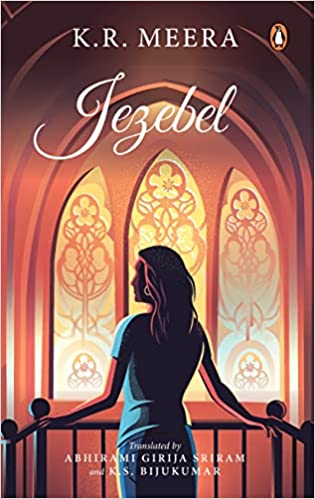
Author: K.R. Meera, translated from Malayalam by Abhirami Girija Sriram and K. S. Bijukumar)
Publisher: PenguinRandom House India
In a multicultural and multilingual country like India, it is very difficult to ascertain the progress of literary creativity in all the regions because of language barriers. Translation is one of the means through which this deficiency can be met. Recently even big publishing houses are paying a lot of attention to translate texts from different bhasha[1] literatures into English so that they can cater to a pan-Indian readership. K.R. Meera’s original Malayalam novel Jezebel is one such recent addition. It has the eponymous protagonist Jezebel, a young doctor in Kerala, struggling against the cruel realities of a patriarchal world –realities that not even her education, resolve or professional brilliance can shield her from. Trapped in an abusive and claustrophobic marriage that had been arranged by one of her relatives for some ulterior motive, the novel begins with a powerful metaphor of suffering and endurance:
“As she stood in the family court, pelted with the blame of having paid a contract killer to murder her husband, Jezebel had this revelation: To endure extreme torture, imagine yourself as Christ on the cross.”
In this novel, which takes the form of a courtroom drama to show us the rich inner worlds of its characters, we see Jezebel reflect on her life and its pivotal points as she takes the stand. Through her memories, we see her grow from a reticent, serious young woman to a rebel who refuses to bend to the conventions of society. In the Old Testament of the Bible, Jezebel was a prophet and she was the only one to challenge prophet Elijah. She was at the same time a strong woman and an accursed one. Like the Biblical story of Queen Jezebel, who was much maligned as a scheming harlot and infamously thrown to her death from her palace window, Jezebel is a novel that asks if independent women can ever live lives that are free of judgement. The marriage between Jezebel and Ahab was an agreement between two communities that worshipped two different gods. Poor King Ahab was a good king who ruled for twenty-two years. His only mistake was to marry the Sidonian princess Jezebel. And that too to improve relations between the two kingdoms and to trade with them. When they got married, Queen Jezebel brought her gods along with her to Samaria. In our protagonist’s case, her already contentious divorce proceedings go suddenly awry, and her unhappy marriage holds complex secrets. Throughout the novel, K.R. Meera’s powerful prose makes resonant allusions to the Bible in different ways that elucidate the correlations between legend and the protagonist’s life while also exploring how sexuality and gender roles are manipulated by the dictates of society.
In the novel we are shown how Jezebel’s arranged marriage with Doctor Jerome George Marakkaran ended in disaster from day one, and in the two and a half years they lived together as husband and wife, their marriage was never consummated. Her father-in-law, George Jerome Marakkaran is a brute straight from TV serials, and starts cursing Jezebel right from the first day believing in his god-ordained mission to punish her in any form whatsoever. The court hearings frame the narrative, with the (very filmy) lawyer’s dramatic queries triggering flashbacks, each a tale of tremendous misery, shocking injustice or unbearable trauma – a veritable catalogue of the woes of a half of the world even in this day and age. The mother-in-law, Lilly George Marakkaran, however, is kind-hearted even if meek, and she too secretly supports her daughter-in-law to break the shackles of patriarchy and go out into the world – something she was unable to do. This inability leads to her suicide in the end. Jezebel’s parents, too, are characters who refuse to come out of clichés. The result is a series of unfortunate events, and they all end up in a family court for divorce. In order to narrate the plight of her protagonist from the very beginning, Meera creates the canvas with plenty of characters, who like Chaucer’s ‘God’s plenty’ fill the pages of the novel from the beginning to the end. Most of these characters are stereotypes and yet they manage to make the story convincing, though melodramatic at times. Jezebel has a difficult childhood growing up with her mother Ammachi who explains every move in Biblical terms and who argues that “a good woman will not ever speak a word” against her husband, however worthless he is; her maternal grandmother Valiyammachi is the one who understands her and asks her to discontinue her marriage immediately and live life on her own terms. Throughout the novel she offers her shoulders for Jezebel to weep upon.
In between, a lot of melodrama is thrown in. The novel itself confesses the soap opera part:
“John’s wedding was a frugal affair. George Jerome Marakkaran stood ramrod stiff, hands clasped behind his back, chin tilted up at a hundred-and-twenty degrees. In his sandalwood-coloured silk jibba and gold-bordered mundu, he looked every bit the father in television serials.”
The rigid patriarch that he is, George Jerome Marakkaran is no exception; almost all characters and situations befit TV serials. There are no surprises, no nuances, no gray between black and white. To give an entire cross-section of society, we have sympathetic characters like Father Ilanjikkal from the nearby church, Jezebel’s uncle Abraham Chammanatt, who was a party to the injustice inflicted upon her and to whom she begs, “Please give me back my life. That’s all. My happiness …my ability to laugh.” We also have sexually abused children, references to other broken marriages, gay relationships, the story of Advait, who had undergone a sex-change surgery to become a man, and who tells Jezebel, “To prove that a man is a man and a woman is a woman, you need a certificate.” On another occasion explains it thus:
“‘Society is a great playwright, Jezebel. Our job is to act out our cliched roles again and again in the ancient play that it has scripted. Every role has its prescribed dress code, make-up, hairstyle, and dialogue. Our job is to play those roles, no matter how ill-fitting the costume, without changing the course of the script. If I decide to change my costume midway through the play, then what will happen to the play? What will the audience, eager to hear a story that they like, do?’ he sighed.”
Amidst the struggle of Jezebel to come to terms with society, Meera also mentions the flitting relationships that Jezebel undergoes with different men and all of which fizzle out due to different reasons. When her lawyer informs her that the verdict for her divorce suit would come out soon, this is how Jezebel reacts:
“Verdict? What verdict? Verdict against whom? In an instant, Jezebel was flung from heaven to the netherworld. She despaired about the she-who-was, and the she-who-had-been. She felt emboldened thinking about the she-who-would-be, though. Just then, she saw four creatures in the centre of and around the throne under the sea. They had many eyes in the front and the back. The first creature looked like Ranjith, the second had Jerome’s face, the third resembled Nandagopan, the fourth had Kabir’s looks. The four creatures had six wings each, many eyes all around and within. They proclaimed day and night. In their midst, she saw a lamb that looked like it had been slain.”
Each ordeal leads the reader to the next in a highly skilfully woven narrative that becomes unputdownable after the opening. That, arguably, is what Meera is aiming for, getting every reader to care for the fate of the characters no matter how stereotypical they might be. Indeed, their being stereotypes helps in making the story universal, whereas nuances and specifics might have made it different. While Meera’s story-telling abilities are way above average, the simplistic treatment of many subplots may mar the reading experience for a few readers. Paradoxically, that is what at the same time may compel the kind of readers who don’t bother about ‘feminism’ and ‘patriarchy’ to keep reading this novel till the end, and even think through it.
Jezebel reflects on her life and its pivotal points as she takes the stand. Through her memories, we see her grow from a reticent, serious young woman to a rebel who refuses to bend to the conventions of society. Jezebel is a novel that asks if independent women can ever live lives that are free of judgement. K.R. Meera’s prose, in this elegant translation from the Malayalam by Abhirami Girija Sriram and K.S. Bijukumar, makes resonant allusions to the Bible in powerful ways that elucidate the correlations between legend and the protagonist’s life while also exploring how sexuality and gender roles are manipulated by the dictates of society.
The beginning of the novel is set seven years after that day the Marakkaran family arrives at Jerusalem, Jezebel’s home, to “appraise” her. A broken Jezebel is facing a barrage of questions from Jerome’s lawyer in a family court which is hearing her divorce petition. She feels like Jesus Christ on the cross, enduring extreme torture. There is yet another round of accusations, all built around an alleged attempt to murder her husband. A courtroom saga begins as Jezebel looks back and remembers scenes from her marriage that brought her exciting life and career to a screeching halt.
Jezebel’s is not the only story of suffering in the novel. There is Sneha, a schoolgirl traumatised by the sexual abuse at the hands of her math teacher, and Angel, a four-year-old girl, who survived a mass suicide by her family because of debts, only to be sexually assaulted by her sixty-year-old neighbour. Jezebel is also a story of the will to survive physical and mental wounds and standing up to force the change of a medieval mindset. Anitha, one of the novel’s characters, picks up the brushes to become an artist after both her husband and lover abandon her. And Jezebel stands tall above everybody else while she fights a system rigged in favour of men. The novel is a serious attempt to end the silent suffering of gender injustices in homes and outside, especially when women find themselves always constrained by the limits that patriarchy imposed upon them. Indeed, the work is a testament to the fact that even in this modern age, in India at least, patriarchal social norms wield an inordinate power over women and restrict their ability to exercise their agency and achieve self-determination.
Reading through the 390 pages of a novel is not an easy task but the way K.R. Meera manages to retain the reader’s interest is praiseworthy. Despite having so many stereotypical characters strewn throughout the narrative, Meera’s manner of storytelling is unique and like a detective novel one often goes on guessing what happened next.
The book drags a little towards the end and would have read much better if some sort of precision was adopted in the narrative technique. To remain politically correct and elaborate on the reasons and ramifications of the story line sometimes, such details may have been unnecessary.
In the author’s acknowledgements section Meera states that she shadowed Dr. Dhanya Lakshmi in her professional life and for verifying the medical facts and interpretations in the novel. In some places these details seem superfluous and could have been avoided. The author also thanks the advocates who accompanied her to Kottayam’s family courts and observed the court proceedings. The way the interjections of the lawyer and the judge are narrated in the novel sometimes seems rather contrived as the author seems to rely on sensationalism as found in films. The translators use informal expressions in Malayalam for the retention of the local idiom and unlike several other translated texts where the reader is often confused because different relationships are addressed in the local lingo, in this novel it does not seem so. Finally, the way issues of ‘feminism’ and ‘patriarchy’ – the two main thrust areas of the novel – that plague contemporary society in Kerala even today, are wonderfully resolved by the author must be mentioned. K.R. Meera tried to break free from Malayalam literary traditions. Jezebel’s reluctance to take a stand for herself in the novel and the consequent adversities in her life tell a tale of epistemic marginalization. According to the author, “I have seen bold, patient women take their time to stand up for themselves. What we often forget is that to sprout wings, one must go through the stages of being a cocoon and a pupa.” The last sentence of the novel therefore speaks of the resilience of Jezebel when she turned her face up to the sun. The old Jezebel was no more. The new Jezebel is one who received the revelation — “And so, the woman adorned with the sun will weep and wail no more.” The novel is recommended to all readers who will find interest in reading about contemporary Christian society in Kerala and realise that societies in other parts of India are also not free from accepting a powerful educated woman who wants to live her life without paying heed to the shackles imposed at every step through patriarchal domination.





 Borderless