SHADOWLANDS
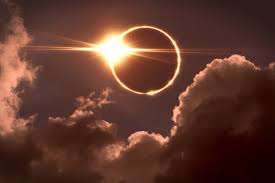
(Inspired by the global solar eclipse on April 8th, 2024)

Tomorrow
the shadowlands
will
have their edict
up
in the sky
with
the whole world's prior knowledge.

The Sun
and The Moon --
those two fastidious
and ever at loggerheads
to mark their showy turns --
will indulge
in their sibling rivalry
of ages.

It will be a sight.

The earth will be omnipresent,
pooling resources
for this compromise
between two
arch-rivals,
pulling
in a tie
as the final verdict.

It will all be over
before we know it.

EXPEDITION

There is a halt in
the expedition.

From not so far
away,
a decaying skeleton
shrieks,
its bones
gradually
ground to a paste.

Sordidly,
the remnants
of privation
now feebly
agitate
for all of us.

A blood-soaked spray
emerges
from a songwriter's
torso.

The day has commenced.
Rain clouds
cry
tears of blood
today.
Prithvijeet Sinha, is a resident of the cultural epicenter of Lucknow. He has published poetry, musings on the city, cinema in anthologies and journals of national and international repertoire as well as a blog. His life-force resides in writing, in the art of self-expression.
.
PLEASE NOTE: ARTICLES CAN ONLY BE REPRODUCED IN OTHER SITES WITH DUE ACKNOWLEDGEMENT TO BORDERLESS JOURNAL
It’s been ten months since I quit my last job and have been attempting to gain employment. However, this isn’t my first rodeo. It has been my privilege to go on similar attempting-to-seek-what-I-really-want-to-do sabbaticals twice before in the last decade. And each time the gradual-at-first-and-then-suddenly-debilitating desperation of needing to earn something to pay bills, cuts short the quests to seek happiness and fulfilment in work.
Whether it is fulfilled or not, whether it is life-changing or not, every quest for applying for a job comes with an unavoidable and annoying task that wears you down so much that all you are left with are bouts of self-doubt and PCLSD (post-cover letter stress disorder).
Before I go any further, I just want to say that it is not my intention to seem naive or ignorant about the hiring process, I understand and appreciate all the work that goes into it and how difficult it can be for recruiters and hiring teams. And, of course, it’s understood that some aspects of a job application are unavoidable and inevitable. But just like we all sometimes lament about other inevitable things like growing old, this is just some good old-fashioned cribbing about cover letters and CVs and such.
So, here are some of my thoughts, that I hope will resonate with others like me out there, about the mentally harrowing thing called ‘job applications’.
CV on File
“Hi, Thank you for applying to the XYZ opening at ABC. We’re grateful to have received many highly competitive applications for this role. After careful consideration, the team has decided not to advance with your candidacy at this time. Of course, we’ll keep your information on file and will reach out if there’s a new role that fits your experience.”
At this point I feel like at least 50% of the world’s data servers are filled only with people’s CVs/resumes/portfolios, given the amount of information all these employers claim to “keep on file”. However, I don’t know of one instance where anyone ever received an email in their inbox saying, “Hi, we had on your resume on file with us for 33 months, and of course you know we remembered the exact skills and experiences you had and so we immediately knew we must access the file and reach out to you with this amazing, fulfilling exact job profile you’ve been looking for. Would that be something of interest to you? If yes, then we need you to join latest by tomorrow. Do let us know. Kind regards, an unicorn of an HR/hiring team.”
If there Is A Hell, I would recommend adding writing Cover Letters as a Form Of Torture
Having to write about how you will be a good fit even as you are 99% sure that you are “not a good fit/not what we are looking for”, can really mess with your head as time passes and rejections pile up.
We all understand the hiring processes and the need for things like cover letters as a means to weed out the non-ideal candidates. But at the same time, it is also a nearly impossible task to constantly present yourself as an ideal, desirable candidate when all your mind tells you is that “you are not good enough … is this even worth it … why am I doing this”. After a few months in this loop, the idea of writing a cover letter, in order to apply for something, becomes so daunting that all you want to do is to curl up and cry. As unnecessarily dramatic it may sound, how am I supposed to write a cover letter that will make me stand out when I can’t even stand to look at myself and the failure I have seemingly become?
Constant rejections cannot possibly result in more earnest and more confident cover letters, period. And it is okay to acknowledge and accept that and stop berating ourselves at least for a day (before some expenditure sends you spiralling once again).
What those rejection emails actually feel like after the 3rd month of continuous rejections
“Hi worthless applicant, thank you for your interest in applying for this role we are going to hire for internally actually. We don’t really care about any highly competitive applications for this role. After three weeks of zero consideration, the automated email reply has decided not to advance with your candidacy at this time.
“While we are not able to give anymore ducks (*1 premium suggestion, see more in grammarly) about it at this point, we discourage you to keep an eye out for any new open roles and just forget about it. And, of course, we’ll keep your information on file and never reach out even if there’s a new role that exactly fits your experience and skills.
“We appreciate the mental breakdown you underwent to consider working with us, and wish you the best of luck as you continue your futile search.”
Don’t forget to give yourself some of those kind regards
It can be very daunting when you are stuck in a rut where you feel like nothing is going to change and you are doomed to keep struggling to even make it past the first round of the job application process. Some days will be worse than others, and you will feel no matter what you do you have no agency over your own career path and choices.
While struggling to navigate through such demoralising thoughts, it is important to keep trying to find moments where you micro-reward yourself with some hope, self-belief, and rationale. For example, even something as stupid as reasoning with your own mind about how it can’t just be you and there are many other reasons (global economic crisis, high unemployment rates, employers’ feudal mindsets, you don’t come from generational wealth, etc.) for your continued struggle to find a fulfilling job. But even a lost battle against your mind makes a little difference because you are at least contending with certain unideal realities.
On a slightly-not-as-worse day, you can use some of that as a catalyst to try and see what else you can do to make a better case for yourself (be it learning a new skill, doing an online course, reading/watching something that is inspiring, or attempting to write a piece like this and instantly regretting submitting it) for your next application. And most importantly, and for as long as possible, don’t lose hope and stay resolute towards your goals and what you want to do, because the only thing worse than rejection is regret… Actually having Rs 832.70 in your bank account in possibly worse.
Okay I must stop now because it has been two days since I last wrote a cover letter and applied for a job, and my PCLSD is kicking in.
Uday Deshwal suffers from an ‘always wanted to be a writer but was diagnosed with impostor syndrome’.
.
PLEASE NOTE: ARTICLES CAN ONLY BE REPRODUCED IN OTHER SITES WITH DUE ACKNOWLEDGEMENT TO BORDERLESS JOURNAL
When the sun goes down And the light goes out, I can walk the lonely streets Thinking about ways To deal with pressure, Waiting for the dawn to crack. I can shout. But, instead, I write. I paint. I sing. I dance. And I write. Again. I pour my heart out When I write. My body screams words And my pen screeches. I let it go, Let it flow. Some things hurt only when You hold onto them. Death is peaceful. It is the effort to prevent it That hurts, isn't it? Sometimes, There's so much to say. But my mouth? It chooses to remain shut. No why, how or what. The pen and the paper empower me. They are my safe haven Amidst the battle within, Companions through Thick and thin. They are the retreat for my inner recluse. Nowhere can I find more peace. Nowhere.
Anushka Chaudhary is an undergrad student in University of Delhi. She is also an ardent reader, who enjoys romance and crime thrillers at her leisure. She likes to travel.
PLEASE NOTE: ARTICLES CAN ONLY BE REPRODUCED IN OTHER SITES WITH DUE ACKNOWLEDGEMENT TO BORDERLESS JOURNAL
The cars line the street like curbed turtles spuddling with inertia, sketchy bellhop flies working the door in teams.
And the don has left the family. Breaking your heart was easy, hardly a crime of note.
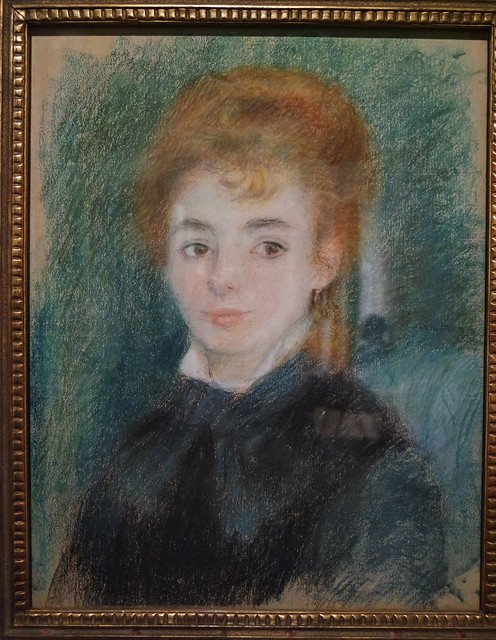
Watching those lost auburn curls drop down past your shoulders with a theatre curtain fini.
To an angel’s dancing calm we go, to places unseen, early glories: silt songs of the whaling deep.
Ryan Quinn Flanagan is a Canadian-born author residing in Elliot Lake, Ontario, Canada with his wife and many bears that rifle through his garbage. His work can be found both in print and online in such places as: Evergreen Review, The New York Quarterly, Borderless Journal, GloMag, Red Fez, and Lothlorien Poetry Journal.
.
PLEASE NOTE: ARTICLES CAN ONLY BE REPRODUCED IN OTHER SITES WITH DUE ACKNOWLEDGEMENT TO BORDERLESS JOURNAL
I had gone on a five-week walking tour of western Ireland when a very perplexing and unsettling event took place. I am not one to believe in the supernatural or in anything more ‘alien’ than, let us say, a snowstorm in May. Nevertheless, what I experienced at Hog’s Head[1] in 1973 shattered all those former positivistic convictions …
My Irish jaunts led me through the Ghaeltacht areas of western Ireland where the majority of the Irish population speak Gaelic. Armed with my trusty walking stick, I tramped over sheep-and horse-dotted meadows, espying every now and then a fleeing fox; trekked near the massive cliffs that plunged into the Atlantic, alive to the thunderous roar of the puffing holes[2]. I pointed my stick at the numerous sea-caves — home to the black-headed gull and the common tern, and above these arched bulky flying buttresses with brilliant sheen.
One particular morning while lodging at a farm near Hog’s Head, I set out very early on the famed loop road all around which spread a series of blanket bogs[3]. The excellent hostess of the farm, a spirited gaunt-faced middle-aged widow with a florid complexion, advised me to stay on the road, the bogs reputed to be dangerous, especially when the fog lay low and thick upon them. As the sun rose, and the fog with it, I pressed forward breathing the clean air of Ghaeltacht Ireland, lands so enchanting both to the eye and the ear. At times my ears caught the echoes of ancient harps, strumming bardic ranns[4] of dead warriors and poets. My Irish was getting better thanks to the communicative people and my constant reading of Irish poetry and children’s stories written in simplified Irish. So delighted was I that particular morning that I broke into an impromptu tune!
I reached a sharp bend in the road which led me around to the other side of a long, grassy hillock. There, at the foot of the hillock, through the recalcitrant wisps of mist, my eyes fell upon the ruins of a homestead. The stone walls remained more or less intact, but its roof had caved in. What astonished me most were the layers of lime that covered the ruins, mantled them like a blanket of soft snow. The lime aroused my curiosity more than the remoteness of the ruins themselves, so far from hamlet or village. I thought of inspecting them but the advisory from the hostess of the house caused me to baulk … I carried on round the bend reaching the farm towards late afternoon.
That night after supper, the hostess, my co-lodger– a young, taciturn man from Devonshire — and I sat comfortably near the sizzling, glowing fire of the hearth in the sitting-room. Aligned like a row of sentinels on guard duty stood a dozen alcohol bottles on the chimney-piece, in between which were snugged two framed photographs of her late husband, a good-looking man with steel-blue eyes. For five evenings now it had been our wont to take our after-supper brandy near the welcoming hearth, listening to the crackling of the logs, inhaling the perfumed scent of resin mixed with the hostess’s excellent brandy.
No longer able to contain my curiosity, I asked the good woman about those ruins and the layers of lime. She turned her eyes from the fire and gave a piercing glance in my direction! I involuntarily fell back into my armchair. She placed her glass on the three-legged table adjacent to her armchair stared at me.
“Did you go into them, lad?” she asked sternly.
“No … no … the bogs.” I stammered.
“Don’t you be going into them,” she followed up, lowering he voice. “Don’t you ever be going into them.” She pulled up her wicket chair closer to us, eyes aflame, face wan.
“Why not?” enquired the other lodger. The young man appeared a bit put out by the change of atmosphere from the usual casual and flippant ambiance. She answered him in a sort of fey chant: “Ruined stone walls, roofless. Former homestead of the famine-stricken. Mournful black tombs never to be laid low.” An eerie silence followed. She took a quick glance out the big bay window as if expecting someone … or something! The logs crackled. The fire glowed. I felt the hour was ripe for story-telling. Had she captured my thoughts? A broad smile spread across her taunt face, one that invited listeners to ready themselves as the curtain slowly rises on a stage already set.
“So I see that both of you would like to know why …”
“Yes. Why?” the other lodger sputtered, taking up his brandy glass.
“Yes, why. Why the lime? Why do those ruins need to be left intact?” I added.
The setting had now been perfectly set; I imagined a reincarnated Mary Wollstonecraft Shelley[5] about to embark on a most disquieting tale. And so she did …
“I need not comment on the terrible Potato Famine that swept over Ireland in the 18th century[6], which caused a million deaths mostly because Irish farmers were forced to produce wheat and corn for export instead of potatoes to feed their families.” The hostess of the house looked sharply at the young man. He, slowly sank into his seat.
The Potato Blight (1847), painting by Daniel Macdonald (1821-1853)
“Do you lads know that one acre of potatoes can feed a family of four for a year?” We shook our ignorant heads. “Anyway, during that famine the Brits ladled out free soup only to those of us who agreed to Anglicise their Irish family names. No change, no soup! Many who refused, emigrated. The others died of starvation. Well, the parents of that poor family refused to Anglicise their names or emigrate. A family of six, three boys and one girl, all under ten years’ old, managed to scrape up some potatoes, but soon were eating the peels of them before they gave up their souls. First their dog, then the children, finally the parents (Here she made the sign of the cross). No one dared offer them food lest the Brits punish them either by a whipping or stopping their soup rations.
“My great grandfather wasn’t afraid of the Brits. One day he went by to help the family with his horse-drawn cart full of flour, corn and some vegetables. He thought to feed them, then ride them from their out-of-the-way homestead over to his farm near Waterville. He found the whole family lying on the only bed of the house, on their backs, the whole lot of them holding each other’s hands, eyes bulging out of their sockets staring into the void of death. Then it happened …”
“Happened?” I spurted out in spite of myself, taking a gulp of brandy.
“IT happened,” she repeated frigidly. “First he heard the horrible yowling of their dog, yet couldn’t really see the animal. The poor beast yowled and whined so much that he covered his ears. Then before his eyes they all rose from their death bed, all of them I say. They rose and floated up, and down on to the bare floor with outstretched hands and open, toothless mouths. They shuffled towards him, all of them huddled together, whining and crying, their cries rising above those of the dog’s! My great grandpa screamed and ran to the bedroom door, then ran for his life across the bogs to the cart. He jumped up to the seat, took up the reins but when he looked back at the homestead there was no one … No one!”
“No one?” squeaked the young man who had been swallowing liberal amounts of the hostess’s brandy.
“No one. It was their ghosts that rose up before my great grandpa’s eyes…what we call in western Ireland appearances or the unquiet dead. You know, they dwell in the invisible world and will emerge at the presence of the living. The living must never disturb the sorrowful slumber of the unquiet dead. They gave up their ghost, their spirit, and if the intruder to their slumber looks upon them, it is their mortal coil that we see (and again the hostess made the sign of the cross), although they be only spirits or ghosts of themselves. That’s why we say they are no longer ‘living’, but do retain ‘life’ in them.”
“Life?” I echoed.
“Yes, life. Because those poor souls have to be saved and not lose themselves in the throes of limbo or Hell … “ And her eyes were ablaze like the blazing flames of the hearth. She went on in fiery tones: “They have been freed from the misery of the living; and because their souls have so suffered we spread lime over their famine-stricken corpses and doomed home so that nothing would trouble their soundless sleep. Nothing! So that no one dares trespass on their earthly hardship and misfortune. Their home has been preserved like a memorial for everyone to see and feel the tragedy of that period. So I’m telling you lads, let them rest wherever they be. You can see it from the roadside but don’t you be going in there.” She paused, lowering her head. “My poor great grandfather; I’m sure those hapless souls were pleading for salvation or heavenly mercy from the only person who dared venture into their damned dwelling.”
By that time I was sitting on the edge of my chair. I managed to state emphatically: “But ghosts don’t exist.”
Her eyes grew fiery: “No ghosts, my lad ? No ghosts you say ? Let me warn you never to set a foot in those ruins; that homestead has been doomed. Don’t go in I say. The shock may turn your wavy blond hair grey in an instant.” She made the sign of the cross, threw a cursory glance out of the bay window then stared at me as if lost in thought. “You know lads I’ve seen them meself.”
Her story was growing thicker like the dense flames rising in the hearth …We sat still in anticipation.
“Yes, meself. I was too stupid or curious after listening to all the tales told about that wretched family. Told again and again by my family and neighbours …”
The young man asked abruptly: “You haven’t told us their name.”
Why he wished to know the name of that family was beyond me. The woman sighed, clearly annoyed at this interruption, and answered with overt irritation: “The Donnellans if that is so important to you, lad. A good Irish name if there ever was one.”
“And what is your good name?” I ventured with a faint smile, attempting to quell the compressed atmosphere of the sitting-room.
“O’Casey, if that makes you happy to know,” she responded, now quite ruffled by our ‘irrelevant’ questions. “Now lads, may I proceed or is there something else that you both would like to know ?” There was not.
“Good! Now, I must have been about twelve or thirteen at the time when one day I gathered courage enough to enter the house of the dead. The smell of lime almost put me off, but I wanted to see for meself ! And see I did: There they lay on the death bed, covered in a smooth blanket of lime, holding hands. I imagine that the lime conserved their bodies. As I stared down at them, little by little my head throbbed and my ears went mute. Everything became so estranged in the world that surrounded me, so blurry, as if I were caught up in a morning mist. Then as God be my witness, voices rose from the death-bed like soft flakes of falling snow. Then they slowly rose from the bed and floated upwards, then downwards to the broken limed boards of the room, slipping out of their bleached mortal coils. The soft voices and the shrivelled bodies all drifted in the air huddled up to one another, drifting closer to me, those skeleton-like hands outstretched, tiny, toothless mouths wide open, chests sunken. Closer and closer they approached in mid-air. I cried out backing away to the doorless bedroom then ran out across the bogs to the road crying sidhes[7], banshees[8]until I got home, my clothes covered with mud. When my father found out about my whereabouts he gave me a proper whipping.”
The hostess collected her thoughts. “Don’t do anything foolish. Stay away from the dead. The dead are the dead, the living, the living.” She stood up and bid us a good night.
Was she being ironic? A good night after that tale? I glanced at my fellow lodger. His face was as white as a ghost’s, if I may say so. We both sat in silence, listening to the crackling of the fire slowly dying into soft glowing embers.
As I trudged up the creaking wooden steps to my room, I will say that her story really spooked me. My pragmatic education had taken quite a few blows, knocked off its pedestal of pedantry. Needless to say my sleep was hounded by queer, saturnine scenes difficult to decipher much less interpret.
It goes without saying that the next morning I felt as if I were in some sort of trance. Ambiguous thoughts wrestled within my confused mind. Our hostess had left for the day to Waterville, and the other lodger had not as yet been down for breakfast.
I remember that it was a rather chilly morning. The fog undulated in rhythmic wavelets over the bogs. I bent my direction towards the homestead walking briskly. As the mist gradually lifted, the ruins rose to my left. The mist, for some odd reason, lay stationary upon the forsaken stones like a shroud upon its corpse. Suddenly I heard the barking and whining of a dog whose echoes filled the misty bogs with rueful omens. I had never heard them on my previous promenades along the loop road. I stole a glance behind me: no one …
Whatever impelled me to cross those bogs to the ruins God only knows! But there I found myself at the threshold of the baneful interdiction. I stepped in, tip-toed towards the bedroom, the thick lime sticking to my walking boots. I tried to chip it off with my stick. Shards of roof tiles and chimney bricks lay scattered under a layer of foul-smelling lime. At that instant the wailings of the dog grew closer. They almost brought tears to my eyes. I felt a sudden helplessness due to this odious intrusion into their mirthless home.
My ears began to drum, pulsating and pulsating an uneven tempo, benumbing my senses, deadening my limbs. A terrible fatigue overwhelmed me. The whining and barking of the dog somewhere out over the bogs aroused such a sadness in me, an uncontrollable desire to cry. The poor beast whimpered and wailed like a baby. I eventually reached the master bedroom: there they lay, the six of them, hands locked together. Sound asleep ? No, their eyes stared up into the now descending mist; eyes without pupils, only the rims of the orbits, blackened by starvation. And as the mist descended soundlessly like falling snow upon the prostrate corpses, the little girl turned her head towards me, lethargically, mechanically like a toy doll, an arched smile spread across her bleached face, widening her bloodless lips. Patches of caked lime clung limply to her tattered clothes as she rose out of the bed like a feather, stood up and began to limp towards me, her tiny, dirty hands outstretched, her eyes … no … no eyes, only empty sockets peered steadily at me, approaching … approaching. I couldn’t move. I screamed but heard nothing. Screaming … screaming my voice summoned no echo, no one flew to my aid. She approached, that horrible smile now an ugly sneer deforming a fleshless face.
How I reached the bogs and over them I’ve never been able to recall. I saw myself running and running, my screams now pounding the misty morning. I splashed through the bogs like a maniac, wallowing in the low, dirty waters, my clothes and long, blond hair mud-splattered. My only salvation was the loop road, which I finally gained, panting like a tracked animal. I remember hearing the voice of the young man calling out to me, his long, lanky figure looming out of the mist like a phantom’s! He caught me in his arms as I screamed a terrible scream. He struggled to get me to my feet and whisked me away as best he could. I looked behind. There was no one.
And still, as the courageous fellow dragged me over the salutary road, I carried on screaming much to his dismay. He tried to calm me down as I tried to explain … No explanation was needed: He understood, frowned, and soon had me hustled off to the farm. It was only late in the evening that I began to regain my senses thanks to the steadfast care of my fellow lodger who plied me successively with tea, brandy and spurts of lively conversation whilst I lay prostrate on my bed.
Luckily the hostess had not as yet returned; she surely would have sensed something amiss and if she did find out about my misadventure would have certainly broken out into a storm of abuse. Contrary to what I expected, however, I slept like a top, waking quite fresh at six in the morning, although I had sensed someone slipping into my room twice or trice that night, most probably my fellow lodger checking on me.
The next morning at breakfast, I said nothing. Our hostess was much too busy to ply me with questions of my whereabouts yesterday, and the Englishman, sipping his tea gloomily, uttered not a word. He departed an hour after breakfast, peering at me from under a pair of reproachful brows which, I suppose, meant to upbraid me for my irresponsible actions in the realms of the supernatural. Before closing the door, though, he gave me a conspiratorial wink and an uneasy smile. I myself took leave of the good woman and her wonderful hospitality en route for Sligo, thanking her warmly for such insights into Irish lore. She looked at me funnily and wished me all the best of Irish luck.
Sauntering towards Waterville, my stick beating out a well-paced rhythm, I suddenly stopped dead in my tracks realising that I never found out the names of my fellow lodger or the hostess. Ah well, no one would hold it against me. Off I went on my wary way in the opposite direction of the accursed homestead not quite avid as last week for any new ‘adventure’ …
Here I now write, back in my cozy house-boat in Amsterdam, somewhat recoverred from that shocking encounter. Although my hair has not turned grey and the ghostly vision of that little girl from the homestead still haunts my sleep every now and then, a gruesome vision that I find impossible to come to grips with. Was it real or a figment of my imagination ? Dangling, wispy threads of the Irish hostess’s eerie yarn ? I’ll probably never seize the reality of that horrible moment
One day as I strolled along the canals on my way to the Stedelijk Museum and the Rembrandt House Museum, my usual haunts, and recently, havens to calm my overtaxed nerves, a book caught my interest in the window of the Scheltema book shop: Visions and Beliefs[9] in the West of Ireland by Lady Gregory[10]. I bought the 1970 Coole edition. Since that purchase, I have read five to ten pages every night, rereading them until the effects of those gleaned encounters with the supernatural banalise mine! A curious woman this Lady Gregory — she learnt Irish and orally collected the stories of banshees, sidhes and ghosts from the inhabitants of the Gaeltacht regions before writing them down and publishing them. She might be acclaimed the Jacob Grimm[11] of Ireland ! So inspiring are her accounts that I am also reading her Poets and Dreams and A Book of Saints andWonders[12].
This being said, in spite of the many months that have passed since my encounter with the unquiet dead, and my readings of Lady Gregory, the image of that little girl has for ever left its indelible imprint on my mind and heart. Mind you, it no longer terrifies me, but I remain wary, none the less.
.
[1] A hamlet located in Kerry County of western Ireland.
[2] Large circular holes located above sea-caves out of which water ‘puffs up’ when the ocean waters rush into the caves.
[3] Wild areas that cover the lowlands of western Ireland made up of decomposed plants.
[4] A stanza of Celtic poetry. It is of Irish origin.
[5] Mary Wollstonecraft (1797-1851) author of the Frankenstein story told before the hearth to her husband, Percy Byshe Shelley and to Lord Byron one stormy night.
[10] Lady Gregory (1852-1932). A remarkable woman who was one of the foremost literary founders of the Irish Republic by her stage works and translations.
[11] Jacob Grimm (1785-1863) A German philologist who collected folk tales from German peasants orally, then had them published, retaining their orthographic and dialectal traits.
Paul Mirabile is a retired professor of philology now living in France. He has published mostly academic works centred on philology, history, pedagogy and religion. He has also published stories of his travels throughout Asia, where he spent thirty years.
.
PLEASE NOTE: ARTICLES CAN ONLY BE REPRODUCED IN OTHER SITES WITH DUE ACKNOWLEDGEMENT TO BORDERLESS JOURNAL
                   A POEM
     Like a mat, we laid out the night,
 And birds adorned the jungle around their feet,
     Heart —- an ocean, and within the ocean,
   Each tide wore shackles around their feet.


A POEM

Everyday,
Time slips through my hands,
Like millet grains.
Would that you were a bird,
You'd be my guest!

A SCENE

Crystalline shards
Of shattered smiles,
Once they pierce the eyes,
The world, like a teardrop,
Seeks an escape
Towards the lap.


A POEM

Just an evening,
From the seasons of your eyes,
Let my heart
Soar for a moment,
With the birds of silence.


STARS
If one night,
Suddenly,
Stars scatter across my eyes,
I’ll cast my eyes at your lap,
And spread the sky,
Upon the earth.


WAITING

With the same pace and rhythm,
They sail ahead --
Yet the moon reaches the shore,
Long before the boats.

MELODIES AT DAWN

“Is there someone, each night who comes,
Sprinkling on the city's somnolent birds,
The colourful melodies of her words?”

“What secrets do I hold? What sights I’ve seen?
In the ambiance, a beauty sifted through,
Casting a strange, enchanting sheen,
Painting hues on voices, wings and silence.”


WORLD

In a bottle,
Carved from your beauty
I’ve preserved for me
A lush green moment of spring --
A nest,
In the nest,
A sweet birdsong.
A window,
Every morning it opens
To a melodious overture of sea-waves
And a cold, bright moment of solitude --
Like a tear drop,
The size of a tiny pearl,
Sustaining you, me and my God.
Munir Momin is a contemporary Balochi poet widely cherished for his sublime art of poetry. Meticulously crafted images, linguistic finesse and profound aesthetic sense have earned him a distinguished place in Balochi literature. His poetry speaks through images, more than words. Momin’s poetry flows far beyond the reach of any ideology or socio-political movement. Nevertheless, he is not ignorant of the stark realities of life. The immenseness of his imagination and his mastery over the language rescues his poetry from becoming the part of any mundane narrative. So far Munir has published seven collections of his poetry and an anthology of short stories. His poetry has been translated into Urdu, English and Persian. He also edits a literary journal called Gidár.
Fazal Baloch is a Balochi writer and translator. He has translated many Balochi poems and short stories into English. His translations have been featured in Pakistani Literature published by Pakistan Academy of Letters and in the form of books and anthologies.
.
PLEASE NOTE: ARTICLES CAN ONLY BE REPRODUCED IN OTHER SITES WITH DUE ACKNOWLEDGEMENT TO BORDERLESS JOURNAL
The Jnanpith and Sahitya Akademi Award winning Konkani novelist Domodar Mauzo’s Jeev Divum Kai Chya Marum is translated into English as Boy, Unloved by the acclaimed writer, Jerry Pinto. The translation succeeds in offering an immersive experience to the reader, especially of the life, sights and cuisine redolent of a Goan village in the backdrop. Although a reader, in the absence of knowledge of Konkani and hence the original work, may not be able to gather the nuances often difficult to translate.
This novel is a bildungsroman which follows the life of its protagonist, Vipin Parob, born into a loveless marriage in a serene village in Goa. It navigates his lonely formative years and explores his friendships in teenage years. While the exploration of his growing up years as a kid wrenches the heart of a reader, those of his later pre-adult years leaves one with an unsettling feeling. And that makes a reader wonder at what went amiss…
At the outset, the harrowing circumstances within the family of five-year-old Vipin are revealed. His house, with its closed windows and doors, restricts his body and mind. He becomes lonesome, finds solace in books and has difficulty making friends at school. In an environment which stifles him both physically and emotionally, he adheres to reclusiveness to cope with his ruthless father and careless mother. An unloved child of a bitter and broken wedlock, Vipin’s plight, as stunningly portrayed by the author, wrings the reader’s core. Mauzo’s incisive insight into the complexities around childhood trauma emerges in his portrayal of Vipin’s manners. His submissiveness in front of his parents, because of the treatment meted out to him perhaps, indicates how distress during childhood years may affect a person’s sense of self-worth. In fact, when his brilliance in academics makes his father’s relation with him transactional, where he is favoured because his father believes he can become a doctor, Vipin lets go off his own desire to study the subject he likes.
During his time in junior college, Vipin comes across people he befriends. Martin Sir, his English teacher from school, is the first person who understands and mentors him. Subsequently, although reluctantly at first, he manages to forge meaningful connections with Chitra and Fatima from his college. Krishna (initially a house help), and Amanda (the nurse caring for his mother later) also become people he can relate to. However, a narrative inconsistency appears in the depiction of the dynamics among teenagers, Vipin, Chitra and Fatima who despite becoming very close to each other, grapple with unnecessary confusions. Where Vipin’s character appears reliable, the characters of both Chitra and Fatima come off as unreliable. Perhaps because they are not fully explored and much appears unsaid in terms of their backgrounds and their mannerisms.
Regardless of the lack of love and care in his familial relationships, when it falls upon Vipin to take care of his ailing parents during their respective illnesses, he does it with a sense of responsibility and concern, if not love. It is something that also comes forth in his relationships with others, whether it is helping Krishna to study further, helping him financially or protecting Amanda from his cousin.
Mauzo, very strikingly captures the quagmire which makes a vulnerable, unloved child grow up to become a young adult who fiercely feels protective towards people close to him. However, Vipin’s journey of exploration of his self and subsequently of his aim in life, wrestle with disparities thrown at him by circumstances. The loneliness of his heart swells to consume the ties he forged in hope of love, leaving an emptiness he finds difficult to conquer. For the invested reader, it renders a disconcerting mark.
Rakhi Dalal is an educator by profession. When not working, she can usually be found reading books or writing about reading them. She writes at https://rakhidalal.blogspot.com/ .
.
PLEASE NOTE: ARTICLES CAN ONLY BE REPRODUCED IN OTHER SITES WITH DUE ACKNOWLEDGEMENT TO BORDERLESS JOURNAL
Ratcheting of seizure-moves
Across the doomy dancefloor

Blips and beats burning in our starry dynamos
laced through our spun-glass flow

The universal retina gored, flash-frozen whores descending the staircase of timespace
In a race to join the bottom feeders

We are fissures of men, vending bad medicine
The gaps in our gene-spliced minds morphing together in synesthetic waves

Grouped together in caves
we scrawl our appalling mysteries on the wall

Staking the mythic beast
with arrows of microplastic disease

Plato came a-calling
and called our ways appalling,
a pall on the earth that gave us birth

A shock to the systems of a downed saucer
we rock on our haunches
reaping the raw
holiday of decay

Driving our play beyond the body map
deep time elapses as a stellar footprint
carving snowed in angels
on the tombs of the atomic race
Alex S. Johnson is an anthologist, editor, journalist, teacher, author and publisher (Darkest Wine Media). His books include The Junk Merchants: A Literary Tribute to William S. Burroughs and We Are Gregor: A Disability Rights Anthology (forthcoming from Nocturnicorn Books).
PLEASE NOTE: ARTICLES CAN ONLY BE REPRODUCED IN OTHER SITES WITH DUE ACKNOWLEDGEMENT TO BORDERLESS JOURNAL
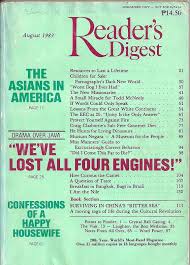
The last two years have been especially sad ones for printed books and magazines. Toward the end of 2023, the iconic magazine, National Geographic stopped selling its print issues. And in April 2024, Reader’s Digest stopped publishing. Many other print magazines have also downed their shutters though the online version continues.
I grew up with the Reader’s Digest. My father subscribed to the magazine and each month a copy wrapped in a brown envelope arrived at our door. The envelope partially covered the magazine inside, and you could see the top and bottom of the magazine. The size was small, and this made for easy handling. Reader’s Digest was a magazine you could read comfortably in bed. During the festival of Diwali, there was a special wrapping for the magazine. We had several magazines in our house when I was growing up. My mother used to read many magazines in Malayalam (our mother tongue).
Reader’s Digest provided shortened versions of stories and articles that had been published elsewhere. Their skill was in condensing the material while still retaining the interest. There was a rich collection of reading material. There were also advertisements for other books published by Reader’s Digest. Unfortunately, these were beyond our family budget. I wanted to purchase these when I grew up and became financially stronger. My neighbour who was a scientist had some of these books that I occasionally borrowed.
Another favourite of mine was the National Geographic. My father was a faculty member at a banker’s training college in Mumbai and their library subscribed to National Geographic. He often brought the magazine home. I was mesmerised by the articles and the photos in the magazine. The artistic quality of the photos was superb. The magazine had only three or four articles in an issue but addressed these at great depth. I travelled to faraway places, to the bottom of the ocean, to within the human body and to outer space with the magazine. Later, National Geographic started a television channel, and I would watch the documentaries in the nineties.
We also subscribed to the Illustrated Weekly of India. This was in a large format and again had very good photographs. I still remember the column by the journalist Khushwant Singh titled ‘With malice towards one and all’. I was also a fan of the comics section of the magazine. I had a huge collection of comics and my father purchased both Amar Chitra Katha and Indrajal Comics. Amar Chitra Katha introduced me to the rich history of India. Indrajal comics had superheroes like Phantom, Mandrake, and Flash Gordon. I used to eagerly await new issues. Most of my comics were lost when we shifted houses.
When the news magazine, India today, made an appearance, we subscribed to it and to Outlook and The week (Indian news magazines). During my school days in May, I used to eagerly await the new textbooks and notebooks for the next class following the results. I used to go with my mother to purchase these from a stationery store near the railway station. The smell of the new paper and the fresh ink was mesmerising. I loved to read some of the easier chapters in these books. Covering the notebooks with brown paper was another major activity. Our school year started with the rains in June.
My good friend, Sanjay Mhatre had a good library and loved to collect books. I loved to borrow from his vast collection. His collection on physics and cosmology were extensive. In those days, the erstwhile Soviet Union used to have cheap books of high quality for Indian readers. I remember the publishers Mir and Progress and I had several of their collections on science. The Soviet publishers used to hold exhibitions in our college. For twenty or thirty rupees, you could purchase high quality hard bound books. My introduction to quantum mechanics and to chemistry was through one such book.
At Thrissur in Kerala most of our medical textbooks were western and predominantly from the United Kingdom. There used to be an English Language Book Society (ELBS) that published cheaper versions of textbooks for developing countries. With our limited resources purchasing textbooks was a challenge. The two major textbooks published from the United States were those of Anatomy and Pathology. Those days we did not have online textbooks and online sources and were limited to the printed word.
I used to write for our medical college magazine and eagerly waited for the annual issue to be published. During my residency days at PGI, Chandigarh I was the literary secretary and was very involved in bringing out the annual magazine, The Resident. We also introduced a newsletter, ARDent Voice, with ARD standing for the Association of Resident Doctors.
At Pokhara, Nepal the college library had a good collection of general books and novels in addition to medical books. I used to read a lot of novels and the author, Frederick Forsyth was one of my favourites. His meticulous research blurred the lines between fact and fiction. Sidney Sheldon was another bestselling author. Novels enabled me to travel vicariously to different places and through varied situations.
Today reading has become less common among the younger generation. Reading strengthens creativity and the imagination as you must imagine in your mind’s eye the situation the author is creating. Is it not magical that the author can communicate with you, the reader through squiggles on a page across the boundaries of space and time?
I started writing during my MBBS days. I still remember the versification competition I took part in and won the first prize. I used to participate in different literary events at my college. In Nepal, I combined my triple loves of writing, photography and hiking with articles for the newly started newspaper, The Himalayan Times. I met my writing guru, Don through the magazine, ECS Nepal. Don was the editor of the magazine and a powerful writer with a deep knowledge of Nepal. I learned a lot from his comments and suggestions and the workshops he conducted. I also used to write a medical column for ECS Nepal. ECS Nepal was a beautifully produced magazine with great photographs. Unfortunately, it stopped publishing around the beginning of the pandemic.
Other travel and lifestyle magazines were also published from Nepal but could not sustain themselves. In the Caribbean Island of Aruba, I used to write off and on for a daily newspaper published in English. Again, the newspaper ceased publishing. During the last two decades several print magazines have ceased to exist. I feel it is a great loss.
I do not read much on paper these days. Most of my reading is done online on computers, laptops and tablets. I also have a Kindle reader. Kindle screen mimics the appearance of paper closely, but it is not the same as reading a printed page. You can no longer feel the smoothness of glazed paper, the smell of fresh ink and the vivid colours of photographs. With the closure of the print version of Reader’s Digest, an era in print publishing has ended. The demise was sadly expected. Without printed books, our (my) world may never be the same again!
.
Dr. P Ravi Shankar is a faculty member at the IMU Centre for Education (ICE), International Medical University, Kuala Lumpur, Malaysia. He enjoys traveling and is a creative writer and photographer.
.
PLEASE NOTE: ARTICLES CAN ONLY BE REPRODUCED IN OTHER SITES WITH DUE ACKNOWLEDGEMENT TO BORDERLESS JOURNAL
Your love is like the surface of still water
Untouched, a mirror reflecting
The brightest of stars, those of
Your eyes that gaze in silent curiosity
As ripples ride along your body,
And as rosy droplets penetrate
Your surface — stillness, explodes
Supernovas, incontestable
There is no more silence but cacophony
As droplets continue to slam unto you
Until your love becomes fistfuls
Of shattered memory dust and
Your peace becomes
An eternal disturbance
Ivan Ling is an Editor at Sunway University Press and has published several poems, book reviews, and, recently, a journal article under Creative Flight.
.
PLEASE NOTE: ARTICLES CAN ONLY BE REPRODUCED IN OTHER SITES WITH DUE ACKNOWLEDGEMENT TO BORDERLESS JOURNAL.








 Borderless