Categories
Poetry

The Lonely Path

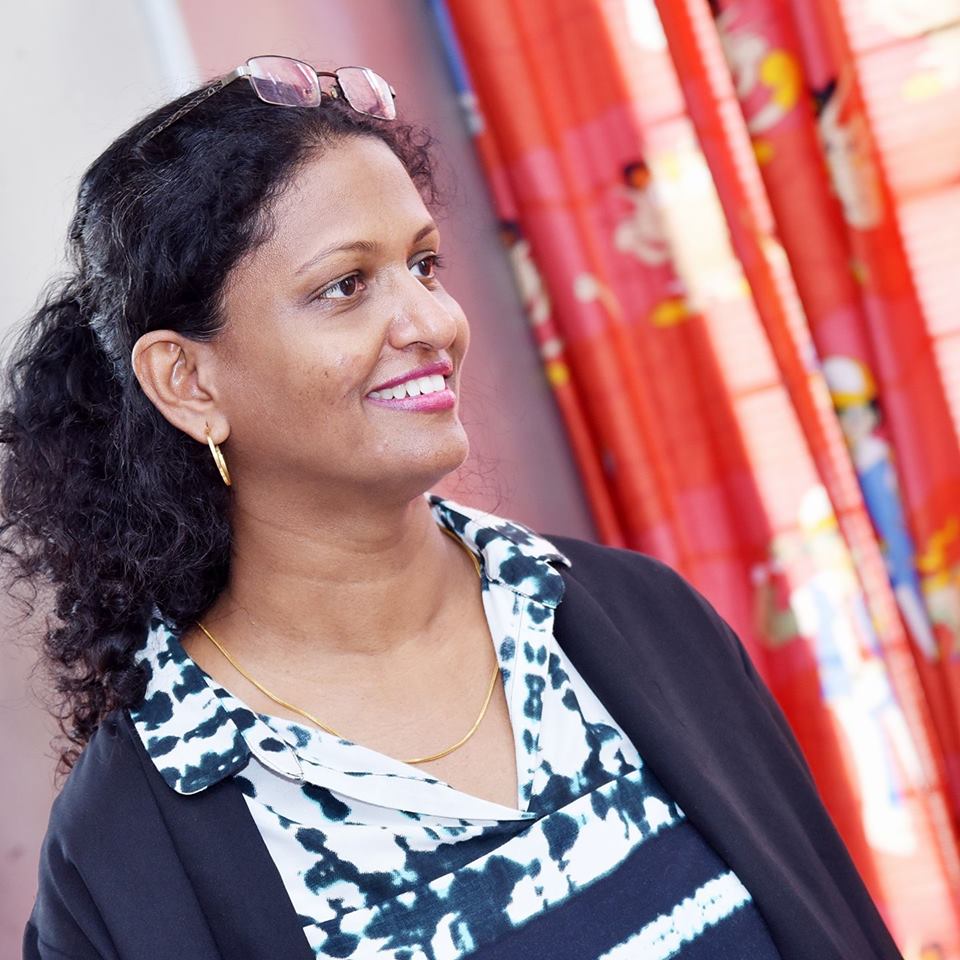
By Rachel Jayan

I see a little girl amongst the millions
With dreams in her eyes and wild curls in her hair,
Her unbreakable spirit to survive and her passion for life.
She moves forward in life playing by the rules one day at a time, 
until she asks herself, 'Why am I here in this rat race?'
 
Some say to bring new life.
Some say to live for others.
Some say to be creative and to appreciate creation. 
Some say to love. 
Some say by God's will.
Some say for money and to build empires. 
Some say just to live, and
Some say, just about make it each day.
 
She bravely treads each path to see
Where would she find peace?
What could be her final destination?
 
She chooses each path
And looks for footprints to follow 
Till she finds a lonely untrod road.
She makes that one her own.
 
She finds she has no need to 'fit in' anymore. 
 
She fought her fears and won her wars. 
She lived for others and found true love.
At last, she found her way, her peace.
She had finally found her heart, her God!

Rachel Jayan has been a passionate educator for 24 years and is currently the Primary Years Coordinator at Indus International School, Bangalore. This is her maiden attempt at writing.

.

PLEASE NOTE: ARTICLES CAN ONLY BE REPRODUCED IN OTHER SITES WITH DUE ACKNOWLEDGEMENT TO BORDERLESS JOURNAL

Categories
Stories

The Protest Outside

By Steve Ogah

Here I am with my head swathed. The last time the doctor came to my room, I told him my demons hadn’t deserted me. I am losing confidence in this community health facility which is named after the military dictator. Do people ever get healed here?  It has been a week since I arrived here. Things are just the same. I am beginning to have a fight in my head with the doctor and the nurse.

“I need to see the doctor,” I find myself screaming at nurse Nkoyo when she comes to check my bandages. Though she is innocent of the pain I feel, I still find myself barking and shrieking as though a dog gone mad.

She smiles her signature smile, the kind of smile all trained nurses are supposed to wear at all times. “Kune, the doctor is rather busy at this time of day.” She says to me.

Disappointed, I sit up against the pillow which I prop against the wall behind my head. I move my forefinger in the air as though a radio’s frequency tuning needle. Then I say to her: “I don’t think you heard me.”

She is about to say she is not hard of hearing when I scream again, this time invoking God angrily. I hear my voice run through the quietness of the hallway, throwing up a storm in the ears of others in the building. I imagine all who heard my voice are startled. Some walk to the window and look out hoping to find a demented man in crutches and bandages standing in the centre of the courtyard. Some hope to find a mad man hopping down the corridor. Those sleeping pop open their eyes; shake their heads in regret that a man just lost his sanity today.

“Okay, take it easy,” the frightened nurse says to me as she gently places the tray of medications on the side stool of my bedside.

“No. It’s not okay until the doctor gets here!” I slam the side of the bed. She is careful not to spill the tablets and water as her eyes look up to meet mine. I stare, not willing to drop my eyes, wishing for her to see the anger and urgency of a sick man in an equally sick country. Of course, she sees the colour in my eyes. It is the pigment of pain and frustration. It is the colour of a man wishing for revenge. She sees that I am more than willing to conjure a world of torment for everyone around me. She sees I can only do that if I leave my bed in good health. Perhaps, she is willing to help me get off this damned bed. There is overwhelming pity in her eyes for me. They get teary all at once. She is about to mumble some words of sympathy when I ask: “What would the problem be?”

“I will get the doctor.” She walks away. The soles of her white tennis shoes begin to echo in my head as though they were stilettos. I feel I am going to scream at her: Take those cursed shoes off your feet. But I can’t say that because I find myself feasting on her all the way down, wishing I would leap from the bed and tell her this is a hospital ward and not a clubhouse. She is gone now, and the door slams shut. All is quiet again. I begin to wait for the doctor to come see me and use his magic to drive away my pain and frustration.

I close my eyes shut and try to sleep. I do not sleep for long. I hear footfalls and voices in the narrow corridor. The doctor is checking his white coat to see if he carries a pen with him. But he finds a surgical knife and his stethoscope instead. He tells the nurse at his back to hurry up. She bears a tray, and in it, is a cocktail of huge tablets, a glass of coloured water and a scary syringe. He is sure he can take care of me without much drama. He has put countless troublesome patients to sleep before.  But he still has the plan of calling in extra hands if I act like the craziest of the crazy. He could be violent with me if the situation demands it.

I imagine him at my side. He tries to appear like most doctors are — calm. Then he sees that his cultured ways are at variance with my primitive actions. I try to resist his caring touch. So, he lets the stethoscope slide down his neck. It hits the floor. It vibrates in my head a million times. The doctor hits me with his forearm. I collapse back to the bed. He lets out a jet of air, having overpowered me.

“Here,” The nurse says to him, as she passes the syringe to him. I am motionless as the tip of the instrument pierces my arm and the fluid in it travels through my veins and decides to stop in my brain. Nurse Nkoyo flinches as the tip of the needle is withdrawn from my body. But the doctor betrays no emotions. Mean doctor?

These images were in my head when Doctor Kpo walked in. He had a gift with people, and I had seen him offer sick people hope before giving them medical treatment. He would pray with them too. But it was that hope that the country needed. It was also in need of cure, and I imagined Kpo as the man for my country. He was the one to examine the heads of members of the supreme military council to tell them that only sick heads would lock up sane people who were merely asking for their rights and the freedom to associate among themselves. I also needed him to tell them that it was wrong of them to have armed men beat up people on the streets for simply nudging them in the arm unknowingly. He needed to tell them that the sight of soldiers smoking at street corners with AK-47 rifles was enough terror for the average Nigerian. Soldiers needed to be told that it was criminal enough to make people forget when they want to remember. They needed to know that military brutality was a crime, especially when committed against defenseless and unarmed people.

The doctor was unusually calm for my liking. His sky-white coat was in good shape. It was well-pressed with few creases and that made me think that perhaps, he hadn’t taken a seat since he wore it. He clutched a clipboard close to his chest as though it were a baby in need of comfort. And his stethoscope was slung down his neck. He walked like an angel who had come to transport me on wings to the judgment throne, without giving me the chance to receive the sacrament of penance, and without the chance to hug dearest ones for the last time. He looked like an angel who had come to transport me to mama. Mama, I believed, was glued at Jesus’ feet in heaven, free from the pain my country had caused her. I have never imagined mama in any place other than heaven. Mamas don’t go to hell or anywhere hurting. They are so kind and tender they deserve to dine with angels and saints and God. If God needed wives, he would have chosen all mamas. They never do wrong.

She had been a petty trader who sold tomatoes and pepper at the market in town which was named after the wife of the military ruler. Just like any other day in her quiet and lonely life, she had gone to display her articles of trade at her roadside table. She was trying to convince a young boy to add few coins to what he was offering her. She said that was the little profit she stood to make. Out of the blue, commotion rose all around her. She thought it was the usual anti-coup protest that had been taking place since the dictator sent the democratic president to exile.

“Hey. Run. Fast!” Many people had been screaming as she later narrated to me. But she wasn’t Usain Bolt. She had willed strength from her inner self but had found no youthful reserves. She was still at her stool when soldiers with blistering eyes, bearing horsewhips descended on her. They whipped with a searing horsewhip and kicked her while she called out for help that wasn’t going to come. The soldiers didn’t relent in their torture exercise. She believed some demons of sorts had possessed them. And the soldiers were so many that she thought a war had been declared on old fat petty traders who sat on low stools.

The soldiers had come from two angles, jumping down from ugly army trucks imported from some totalitarian countries. They were excited. They didn’t just beat hapless civilians and had them lie down on broken road; the heartless men were happy to destroy people’s wares with their jackboots. Mama had told me this on her hospital bed.

She had thought that by screaming and holding her head in her palms, she would find mercy with the invaders. But with each shout that she had made, she had gotten a heavier kick and harsher whip to her body. Soon, she found herself rolling in the mud and invoking God’s name to plead her case. That didn’t help. They brutalized her until the welts on her skin began to course with blood. Her screams were now dying. Slow. Slower. She rolled slowly and lay on her stomach, her face buried in the mud, her backside open to several jackboots and whips of a demented gang of military misfits. They only stopped beating her when she lay motionless on the ground. The pandemonium at the market was soon over, then the military men left, blissful that they had not been challenged. What was Mama’s crime? She had not been able to afford the high cost of stalls in the main market complex, which was already sold out, in any case. And that the curfew was due in thirty minutes, and no one had been expected to be on the streets.

In the weeks that followed, Mama never made it to the market area again. She was badly wounded. She could not understand why her country had done her so much harm. She found succor from the delegation of market women who visited her at the hospital telling her not to worry that all would be well. But Mama never got well. She was admitted to a local hospital. She had complained of pains in her stomach. I went to see her daily. I went one day and met an unusual calm at Hope medical center. I didn’t suspect anything out of the ordinary. I walked to Mama’s room only to find out that the door was locked. I went to the doctor’s office and there I was told the tragic news.

She had died. Now, I didn’t understand what death meant because I had never for one moment believed my mama would die. I thought death was a disease far from our home.  I didn’t want to take the news like one takes a loving present home from teachers at school. I told the bearer of the news that he was a terrible comic act and should never consider a career in comedy if he was trying to make me laugh. But he insisted that he was serious about the tragedy that had befallen my family.

Truth.  She had closed her eyes while a prayer froze on her full lips. She was Catholic and she had been praying the prayer for Nigeria in distress before she passed on. It was a prayer she knew by heart as she had attended masses without fail. Her death wish was that I prayed the prayer daily, but I had failed her religiously. I was still trying to shake off the memory of Mama from my mind when the doctor touched me; his usual smile was not on his round face. I wanted to ask what the issue was, but he spoke first. Doctors deliver tragedy best.

“It has been a bad day,” he said as he motioned me to lay flat. He placed his stethoscope on my chest and listened with that trained ear of his. He placed his left palm on my forehead and wanted to know if I still felt the migraines.

“Just yesterday,” I answered.

He reached for his clipboard and took down some notes. He was taciturn with the nurse who stood by. The Dr Kpo I had known would have asked about my night, would have poked fun out of the stories in the news of the television authority, and would have spoken about things in other wards. So, I had to ask him the question he had frozen a while ago.

“Doctor, I shouldn’t really be asking this. But is everything okay at home and at work?”

He looked at me and smiled. Or rather enacted what looked like a smile. He failed at hiding an emotion which wasn’t joy. He shook his head as if to shake the weight of my question away. He blinked rapidly and wrote hurriedly in his file. I wasn’t going to force him to words if he wasn’t going to speak willingly. I lay down for him to carry out his medical ritual on me. But he didn’t.  He stopped writing instead. He hugged his clipboard with sadness.

“My country is wicked,” he cast his eyes in sad colours. He went to the window and parted the curtains into two halves, each stuffing into the iron burglary. He stepped aside. The sharp rays of the rising sun bathed me in full. They were people on the streets marching and singing that they had lost the fear of death. They had just carried away a dead man from the health centre. 

“What happened again?” I sat up against the wall.

“The unspeakable happens in this country every day.” He was still speaking to himself. Rather, he was speaking to the sad, angry, and frustrated people outside the window, the trees down below, I thought. “We are told the police is our friend, yet they extort and clamp us into jails at will. We are told the army is to protect against external aggressors, but the army boys think civilians are enemies.”

I questioned him with urgency poking out in my voice. I had expected him to turn and address me. But he chose to glue his vision to the window. There was pandemonium outside, angry voices tearing through into the room.

“They snatched Amina away last night.” He spoke at last.

“And who is she? Who took her away?”

“My wife,” he said, and I imagined his eyes had grown distant as he searched for her in the cramped houses, broken roads, and dusty sky up ahead in his view. I imagined his eyes were teary too and he didn’t wish me to see the infant side of him.

“She had been returning from the market when soldiers and armed men in a patrol van screeched to a stop beside her and asked her to get into their van.  The doors of the van were plastered with the words ‘Operation Sweep’. She had resisted casually by walking ahead. Then she heard rifles snapping with fury behind her.”

“So sorry to hear about this. What time of the day did this happen?”

“Just before sunset.”

He explained that they seized her plastic bag, which was filled with beans and plantain, meant for dinner. They spilled the contents on the road. And what was her offence? They claimed they had sighted her at a corner talking to a man in whispers. They had lost trail of the man. They feared he was an activist, and his wife was one too. He said his wife denied the claim. The patrol van swept up people at random at street corners, blinding them with sharp torch rays at first. They would simply be told that they were ‘security threats’.

Doctor Kpo walked away from the window and announced to me that I would be discharged in a day or two. He said my injuries were not so severe anymore and the migraines would go away soonest.  He said I had been fortunate not to crack my skull when the soldiers raided the soccer viewing center I had been, searching for activists.

“Steer clear of crowded areas,” he admonished me. “They don’t want to see so many young boys gathered in one place, even if you guys claim it’s the English soccer season on satellite television.”

I nodded. The doctor left my room. “What’s going to happen to Amina?” I asked as he got to the door.

“She will be fine. She will be out. She will not be in detention for long.”

“How? When?”

“The director of the health centre has already petitioned the military administrator.” He shut the door. A vanishing act followed. Then he returned to the room without knocking. “Don’t join the protests outside. The Special Anti-Robbery Squad of the police just tortured a young man to death. I hear there will be end SARS protests in the days to come.” Another vanishing act was accomplished.

I closed my eyes, wondering why men with guns wanted to rule over us, bothered about what I would do to stop soldiers from flogging civilians at will, wondering if the confrontations in my head wouldn’t return. Then I saw myself joining the groups on the streets, confronting the army. The possibilities that I saw in my mind hit my eyelids, then they opened.  I screamed for the nurse. I would discharge myself from the facility.

.

Steve Ogah is Voicesnet (USA) Poet of the month (Feb.2002) and fellow of the British Council/Lancaster University Crossing Borders online writing program. He is the author of Barack Obama’s Logic.

.

PLEASE NOTE: ARTICLES CAN ONLY BE REPRODUCED IN OTHER SITES WITH DUE ACKNOWLEDGEMENT TO BORDERLESS JOURNAL.
Categories
Review

Sylvia: A Genre-Bending Book

Book Review by Rakhi Dalal

Title: Sylvia: Distant Avuncular Ends

Author: Maithreyi Karnoor

Publisher: Tranquebar, 2021

Maithreyi Karnoor’s Sylvia is a genre-bending book which appreciates the immensity of life while treading insouciantly.

Maithreyi Karnoor has won the Kuvempu Bhasha Bharti Prize for translation from Kannada to English. She was shortlisted for the Lucien Stryk Asian Translation Prize, and twice for the Montreal International Poetry Prize. Her essays, poetry, translations and reviews have been published in most mainstream and literary journals in India. She is currently putting together her poetry collection Skinny Dipping in Tiger Country, and collaborating with Rhys Hughes on Rainbow Territory. Sylvia is her debut novel. 

We live life linearly. Growing, ageing and experiencing, we pass through events which stop us by to assert the primacy of time. Still, too often, we tend to dwell much upon the emotions we happen to go through – focusing hugely on our own desires and despairs. So much so that we lose sight of the only event which is bound to be certain – death. We overlook the fact that our lives, though lived in a linear manner, are also tangentially connected to lives of others, to all those people we come across. And taken together, the web that it creates, affirms our nothingness in the immensity of this design. Wouldn’t it be then wise to live the life in the constant knowledge of it. And not to take our own emotions too seriously, to make the journey bit easier for us.

Maithreyi Karnoor’s experimental novel appears to be an exploration of this idea. She gives us a character, Sylvia, and then proceeds to create a tapestry of life which includes warps of lives of the people she either meets or stumbles by, where her own life runs as an underlying nap, at times palpable while at others, invisible.

The novel is divided into two parts. Part I tells us the story of Bhaubaab, Sylvia’s uncle whom she happens to meet accidently, and of Lakshmi, Bhaubaab’s neighbour in a sleepy Goan village. Part II consists of nine distinct stories, telling the tales of its characters who may or may not be acquainted with Sylvia. At times, one wonders whether it is the same Sylvia in each story but the author doesn’t make it apparent. She weaves these stories with a confident hand, like a weaver who knows the design instinctively and doesn’t have to necessarily abide by the set patterns of construct.

Spanning sixty pages, Bhaubaab is also the longest story in the book. Cajetan Pereira or Bhaubaab returns and settles down in a village in native Goa from Africa where his forefathers had migrated. Karnoor’s research into the practices of living in both the places comes through her deft narrative. She touches upon the notions of familial conflict, ambitiousness of impressionable youngsters, smugness of educated elite and homosexuality as she intertwines the three characters of Bhaubaab, Lakshmi and Sylvia in the first part.

In Bhagirati, Karnoor probes mental illness of a character who dies by suicide. In Venison, she looks at the superstitious beliefs of people of a village where a young couple, Shaila and Sujeeth, make a home far away from conventional city life. In Blue Barrel, Karnoor tells us the story of Reshma, from an underprivileged background, who has to steal water even to bathe. Eighteen Spoons, presents a snippet of Sylvia’s life as a well-established writer through the lens of another character with whom she exchanges messages. The title draws its name from a poem included in the narrative which exemplifies Karnoor’s craft as a poet.        

The story A Cat named Insomnia seems to render a closure to the stories of characters from previous stories in the sense that it suggests an ending whereas the other stories give the impression of seeping into each other. We meet Bhaubaab from Part I again in The Afterlife of Trees and RIP but not Lakshmi. The last story, RIP of Part II, also appears to suggest a closure as we witness Sylvia getting ready to go back to her home after what looks like some years of travelling.  

All rest and peace is for the living

Know peace while you can

What if what lies beyond is more of the same thing

Get some sleep tonight

Appearing at the beginning of last story, these lines are a remarkable expression of the underlying idea of the genre-bending book – that of appreciating life for its vastness, of accepting, to borrow from the author, that love, loss, success, disappointments, shouldn’t be taken as seriously as we do. That if all these are taken in our stride perhaps they would hurt less. That we must know peace and cling to it. The pen which so assertively forges to interpret and portray this imperative view towards life is a pen worth watching for.

.

Rakhi Dalal is an educator by profession. When not working, she can usually be found reading books or writing about reading them. She writes at https://rakhidalal.blogspot.com/ .

.

PLEASE NOTE: ARTICLES CAN ONLY BE REPRODUCED IN OTHER SITES WITH DUE ACKNOWLEDGEMENT TO BORDERLESS JOURNAL. 

Categories
Story Poem

Hawkbill Knife

By Jared Carter

Hawkbill Knife

We had driven all morning on the back roads,
my father and I, into those dense green hills,
all that way just to fix a leak on the roof 
of the old lodge hall – the patched-up building
where the artist kept a studio during the war,
where his widow still came to stay each summer
till Labour Day, sleeping on a cot in the back room,
heating cans of soup on a single hotplate,
selling a pastel now and then to a passerby.

It would be my grandmother's annual visit
to see her only sister-in-law, the two of them
entirely unalike – one from a small town,
the other from the city – but cordial, since
both had known the same man, both lived with him
for a few years, one early in life, one late.
She would be with us in the cab of the pickup,
dozing in the heat, leaning forward, catching
herself, peering out at the unfamiliar hills.

The old building – two stories, square-fronted,
white clapboard with an elaborate cornice –
faced east across a broad lawn always dusky
in the shade of great towering, arching elms.
Along the stones of the foundation, on steps
leading to the front door, in that rare cool
of high summer, a brindled tomcat belonging
to one of the neighbours would be stretched out, 
too drowsy to slink away when we pulled up.

A cast-iron pump stood anchored in a square
of limestone in the yard. We leaned to wash
our hands and faces, then took the tin cup
and drank. Aunt Carolyn would be talking
to Effie, then to my father, telling him
about the leak, how the man tending the yard
was not to be trusted. I worked the handle
and watched water cascading over the stone,
glistening and disappearing in the grass.

The two of them set out tea in a room filled
with unframed paintings and relics of Paris.
My father brought the bucket of pitch; I lugged
the roll of tarpaper. Upstairs, we followed
the hall to the roof ladder. I went first,
feeling ahead in the gloom, the thick heat,
reaching to push against the rough boards
until the hatch gave way. Fresh air swirled
all around me as I struggled into the light.

We were there, in the stillness, high above
everything else in town, looking out and down
through a pale scrim of leaves – at the roof
of the Baptist Church, the library on the corner,
the barbershop in the red-brick building,
the cars parked along the courthouse square.
I gazed out at the hills surrounding the town
while my father took a jackknife and probed
to find the roof's bad places. He scraped
at beads of tar, and whistled at the damage.

He sat back on his heels. Then he called to me,
fished around for a dollar bill, and explained
he wanted me to go to the hardware store
on the main street, and tell the old man there
I needed to buy “a hawkbill knife.” Years later
I would learn it was simply a roofer's knife
with a short curved blade, but then I had only
the strange name he had given me, and the dollar
clutched in my hand as I climbed down the ladder.

Since then, too, I have seen that kind of knife
sharpened and resharpened again and again
by roofers, by those who work high in the air
with hot pitch, with the steamy black smell
of tar rising all around them, the ropes caked
and stiff, everything sticky to the touch –
I have seen such knives filed to the nub,
handles wound with tape, hawkbills worn flat,
seen them thrown away, useless, in the street.

And could I have looked out far enough over
those quiet houses, beyond those green hills,
I might have seen how everything in that town
would be worn away too, would pour glistening
over the smooth ledge of time – the elm trees
burnished by the wind, the huge dim interior
of that building, the two old ladies talking,
the cat on the doorstep – all that would dwindle
and fade, as though falling down a deep chasm.

Part of me did know: had glimpsed, in drawings
thumbtacked to the walls of the meeting room
on the second floor, scenes of a vanished world.
Lacking the money for canvas, for oil paints,
how many times had he gone out to sketch
young girls at their sewing machines, old men
trundling carts, sidewalks crowded with menders,
fixers, buyers hurrying along and yet caught,
saved for an instant, by his smooth-flowing hand?

What held them up could yet hold me. August,
nineteen forty-eight: I was nine years old.
My father had given me a dollar to spend
and waited for me to return. I came out 
onto the walk, under the canopy of trees,
sunlight dappling the grass, cicadas pulsing
all around me.  At the pump I filled the cup
to overflowing, drank its coldness, then walked
on toward the square, to buy a hawkbill knife.

(First published in Sandscript)

Jared Carter’s most recent collection, The Land Itself, is from Monongahela Books in West Virginia. His Darkened Rooms of Summer: New and Selected Poems, with an introduction by Ted Kooser, was published by the University of Nebraska Press in 2014. A recipient of several literary awards and fellowships, Carter is from the state of Indiana in the U.S.

.

PLEASE NOTE: ARTICLES CAN ONLY BE REPRODUCED IN OTHER SITES WITH DUE ACKNOWLEDGEMENT TO BORDERLESS JOURNAL

Categories
National Day Special

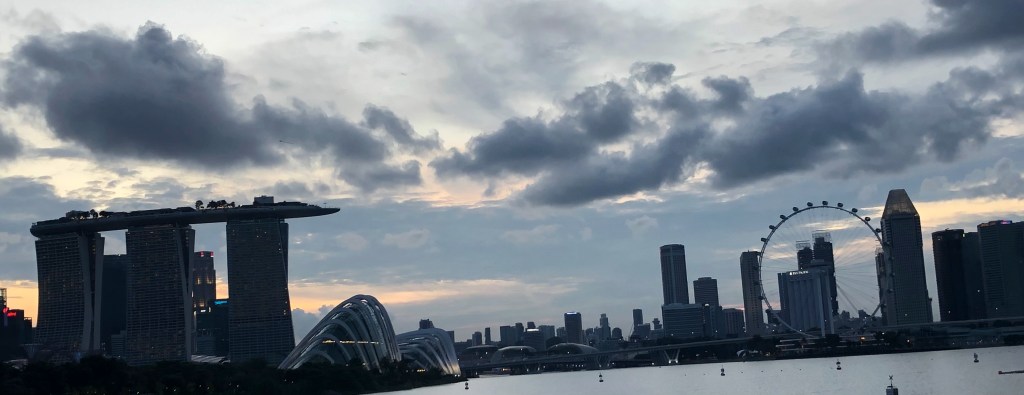
Vive La Singapore

Singapore is a tiny country connected to the bigger land mass of Malaysia with two causeways. It started out as a small island inhabited by pirates and legends. Sir Stamford Raffles (1781-1826), a British East Indian administrator, thought it strategic and relocated some of the trade routes through the island. Migrants from many countries merged here — some looked for a better life and some served as coolies and prisoners of the colonials. When Malaya threw off the colonial yoke in 1963, Singapore continued part of the country till it gained sovereignty in 1965.

Lee Kuan Yew, the first Prime Minister envisioned a multicultural society where people of different cultures lived as one people. He said in one of his moving speeches in 1965: ” We will prosper, and a multi-racial society will take roots here. And it will do so because when you don’t allow people to play communalism, or racial bigotry, or religious bigotry, you breed an atmosphere of tolerance.”

Fifty-six years later, Prime Minister Brigadier Lee in his National Day speech clearly took the bull by the horns and said, while social media highlights the negative altercations of race and religion, it fails to highlight the positive ones. “Many more happy interactions happen every day but these seldom go viral.” He added these were values that needed to be reinforced with every passing generation. Read to find out what some Singapore residents feel about the outcome of Lee Kuan Yew’s vision, not just of race and religion but of living in a city state which hopes to continue as ” one united people“.

Poetry

Poetry of Kirpal Singh 

Fifty-six years down the line, eminent academic and litterateur, Dr Kirpal Singh, comments on the dream of the first Prime Minister of Singapore. Click here to read.

Unaccompanied Baggage 

Marc Nair, a multifaceted artiste who moves from photography to writing to music with equal elan, reflects on life in Singapore. Click here to savour his work.

Prose

Interview

Dr Kirpal Singh talks of his life and times through colonial rule, as part of independent Malaya, and the current Singapore. Click here to read.

Flash Fiction: Horizon

Tan Kaiyi, a young vibrant writer, evokes the spirit of the Singapore National Day amidst the darkness spread by a deadly virulence. Click here to read.

Singapore’s Secret Recipe

A recent immigrant, Aysha Baqir takes us through the flavours of life here on the tiny island during the lockdown. Click here to read.

The island state continues a home for many immigrants — some came early and some late. As a first generation immigrant, to me the little red dot is Asia’s gateway to the rest of the world. I enjoy its sand and seas very much. We conclude our ensemble with a little poem to the green islet that nestles between the Indian Ocean and South China Sea rippling with notes of harmony…

Anointing with Love 
By Mitali Chakravarty

Listen to the swish of the waves.
Feel the breeze whisper caresses. 
See the mangroves stretch 

their roots above the ground, 
in a siesta during lazy sunrises 
and sunsets. Murmurs from the 

ocean come wafting as 
coconut fronds sing in the
fringes where the sand 

welcomes the surf. It is a 
party at the beach with
differences woven to 

harmonise into a melody 
sung in tune. A crescendo
that anoints with love. 


First published in Daily Star, Bangladesh
Categories
Interview National Day Special

In Conversation with Kirpal Singh

Dr Kirpal Singh
we are known globally
as a nation of multi-cultures
but we are united as one people.

not an easy goal to realise
knowing how differences divide
and make unity problematic.

-- Reaching Out... Kirpal Singh, 2021

Kirpal Singh is a poet and a literary critic from Singapore. An internationally recognised scholar whose core research areas include post-colonial literature, Singapore and Southeast Asian, literature and technology, and creativity thinking,  Singh has won research awards and grants from local and foreign universities. He was one of the founding members of the Centre for Research in New Literatures, Flinders University, Australia in 1977; the first Asian director for the Commonwealth Writers’ Prize in 1993 and 1994, and chairman of the Singapore Writers’ Festival in the 1990s. In 2004, he became the first Asian and non-American to be made a director on the American Creativity Association’s board. He retired dean of Singapore Management University.

Singh was born as a part of Malaya in 1949 to a father of Sikh descent and a Jewish-Scottish mother. He lived through three regimes in this part of the world: colonial, Malayan and Singaporean. His poetry is perhaps what best tells us about his faith in the little island state that came to its own in 1965. In this interview, he shares his life story with us, the last being a huge donation of books that he is making to the National Library of Singapore – a donation of 3,000 books collected over decades.

You are an academic, critic and writer who stretches out across SE Asia. When did your ancestors move to Singapore from India and why?

My paternal grandparents moved to Singapore from Punjab in 1901. They came to the then Federation of Malaya in search of a better life.

You have never lived in India but shuttled between Singapore and Malaysia. Probably at that time it was all part of Malaya. Can you recall Singapore/Malaya during your childhood?

Yes, though born in Singapore in March 1949, I was taken back to be with my dadiji (paternal grandma) in Malaya when I was two months old.  However, I was brought back to Singapore when I was seven to begin school. My grandparents thought Singapore was a better place to receive an English education.

Your mother was Scottish and father, an Indian. What languages did you grow up speaking? What language is most comfortable for you to write in? 

I grew up speaking bits of Punjabi, Malay and, of course, English. In my teenage years I also picked up some Chinese dialects. Though I did study Mandarin in school, I am not too good at it. I can only speak a smattering of it. I am most comfortable writing in English.

You have seen Singapore move from infancy to its current state. Can you tell us what this journey has been like?

It has been an astonishing journey. When I was young-preschool age — Singapore was a British colony. In 1963, Singapore joined Malaya to become part of a new entity then known as Malaysia. However due to basic differences, Singapore pulled out of Malaysia and became an independent, sovereign nation in August 1965.

You are an academic who retired dean of Singapore’s major management institute. And yet, you write poetry. Can you tell us a bit about your journey?

At the then newly established Singapore Management University which I was invited to join as Founding Faculty in 1999, I was told to introduce Creative Thinking as a new mandatory module for all undergraduates. I helmed this exciting and new programme for ten years. SMU was the first University in the world to make Creative Thinking a compulsory course for all undergraduates. Sadly in 2010 this was made optional.

You have a huge collection of books —25,000. How long has it taken you to collect these books?

It has taken me more than 50 years.

Tell us a bit about your book collection. What are your favourite books?

My collection is eclectic. Most of my books, however, belong to the humanities, and within this, most belong to the literary genre. I loved reading from a very young age (being alone at home, reading brought me solace and also knowledge). Among my favourite books, the tragedies of Shakespeare and Sophocles feature prominently. Some 20th century books (those of D H Lawrence and Aldous Huxley in particular), I value tremendously. I should also add that I have been very blessed to have met many of the more well-known/established writers of the 20th century and blessed to have been given signed copies by these wonderful authors: among them Doris Lessing, William Golding, Brian Aldiss, and numerous others.

Did your reading impact your writing?

Quite naturally, yes. I think it’s hard not to be affected by what one reads when it comes to one’s own writing. Even with writers who consciously try to ensure that no clear influences obtain, critics have frequently found far too many disguised references not to infer which authors influenced those writers.

Recently, you made an announcement that you will donate 3,000 books to promote love of reading in Singapore. Do you think donating these books will be enough to make book lovers of non-readers?

I doubt if the mere act of donating will create readers. However, I feel that having a few thousand additional books in a library will, hopefully, draw at least the attention of a few readers and maybe among these will be new readers.

Most people read bestsellers.  What do you think will attract more to appreciate literature like EM Foster, DH Lawrence, and Coleridge?

Yes, in the age of commercialisation, classic writers may not obtain immediate readership– hence schools and colleges/universities play a vital (and necessary) role to ensure that our graduates are educated– at least minimally– in the works of writers who helped change and shape new sensibilities.

Thank you for your time. 

Click here to access poetry by Kirpal Singh

.

PLEASE NOTE: ARTICLES CAN ONLY BE REPRODUCED IN OTHER SITES WITH DUE ACKNOWLEDGEMENT TO BORDERLESS JOURNAL

Categories
National Day Special Poetry

Poetry of Kirpal Singh

My Beloved Singapore

who would have thought
in 50 years you'd grow
from a village/town
to a city/metropolis?

and yet if I had been
attentive, the seeds were sown
and the fruits were expected.

little in my nation
grows spontaneously
there's careful planning,
planting of opportunities
obtaining rewards
for jobs well done.

so now, celebrating
our National Day
comes naturally-
and we rejoice knowing
many become one.
 
Reaching Out...

we are known globally
as a nation of multi-cultures
but we are united as one people.

not an easy goal to realise
knowing how differences divide
and make unity problematic.

despite the given difficulties
we have come through-
showing there is hope
when the desired ends
are commonly shared-
and understood.

Kirpal Singh is a poet and a literary critic from Singapore. An internationally recognised scholar,  Singh has won research awards and grants from local and foreign universities. He was one of the founding members of the Centre for Research in New Literatures, Flinders University, Australia in 1977; the first Asian director for the Commonwealth Writers’ Prize in 1993 and 1994, and chairman of the Singapore Writers’ Festival in the 1990s. He retired the Director of the Wee Kim Wee Centre.

.

PLEASE NOTE: ARTICLES CAN ONLY BE REPRODUCED IN OTHER SITES WITH DUE ACKNOWLEDGEMENT TO BORDERLESS JOURNAL

Categories
A Special Tribute

Peace in the footsteps of Hiroshima & Nagasaki

The mother of a soldier once told me she did not agree that winning a war was a solution to peaceful living. She said, “If our army kill the enemy, some other mothers lose their sons; some other wives are widowed; some other children lose their fathers…”

Her summation of the war seems like an accurate description of the current day scenario. While politically the bombs that killed 140,000 in Hiroshima and 74000 in Nagasaki on 6th and 9th August respectively(1945), destroyed two cities, ended the Second World War (1939-1945) which claimed a total of 70-85 million lives over six years and led to the celebration of VE Day (Victory Europe Day), can we afford such horrors of violence and annihilation again? This is a question that remains in the grey zone as nuclear non-proliferation looks like agreeing to peace because the terror of war frightens. Will we ever have a world where peace is loved for the sake of what it brings and not for the fear of annihilation?

Writers in this special commemorate the horrors of the atom bomb and write their plea for peace. While American-Japanese writer, Suzanne Kamata, and Manjul Miteri of Nepal explore victimhood, Michael Burch talks of the Enola Gay, the legendary bomber that dropped “Little Boy” and annihilated a whole city. He reflects on the testing that continued on Bikini Island and further to ‘maintain peace’. We also have the words of Kathleen Burkinshaw who continues impacted by this terror — though it was her mother who was the hibakusha or survivor of the bomb blast. We round up this section with Candice Louisa Daquin’s reflections on peace and the reality as it is.

Poetry

Commemorating Hiroshima: Poetry by Suzanne Kamata that brings to life August 6th and the impact of the bombing on the victims and the devastation around them. Click here to read.

Oh Orimen! A poem in Nepalese about a victim of the blast written by a sculptor, Manjul Miteri, who while working on the largest Asian statue of the Buddha in Japan visited the museum dedicated to the impact of the blast. The poem has been translated to English by Hem Bishwakarma. Click here to read.

Mushroom Clouds: Poetry by Michael Burch that reflects on Enola Gay and the Bikini atoll. Click here to read

Prose

Surviving Hiroshima

Kathleen Burkinshaw is the daughter of a woman who survived the Hiroshima blast. Burkinshaw suffers neural damage herself from the impact of the bomb that her parent faced. She has written a book called The Last Cherry Blossom recounting her mother’s first hand experiences. Her novel has been taken up by the United Nations as a part of its peacekeeping effort. She has been actively participating in efforts to ban nuclear weapons, including presenting with Nobel Laureates. Click here to read the interview.

Peace: Is it even Possible?

In the post second world war scenario, Candice Lousia Daquin explores war and peace through history. Is peace possible? Click here to read.

Categories
Review Tribute

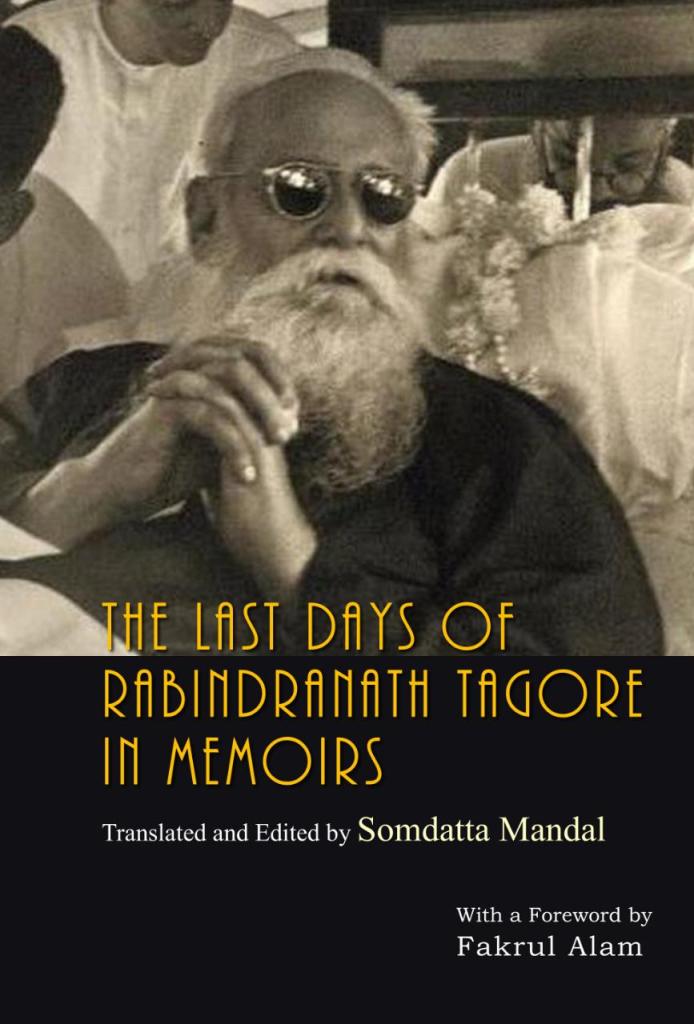
Under the Shadow of Death: Memoirs of Tagore’s Last Days

To Commemorate Tagore’s 80th Death anniversary, we present a review of Somdatta Mandal’s translation of memoirs around Tagore’s last days with a forward by Professor Fakrul Alam

Book Review by Meenakshi Malhotra

Title: The Last Days of Rabindranath Tagore in Memoirs

Translator/ Editor: Somdatta Mandal

Publisher: Birutjatio Sahitya Sammiloni, 2021

The Last Days of Rabindranath Tagore in Memoirs, selected, edited, translated, and put together from the original Bangla by Somdatta Mandal, hovers along a fine line between biography, autobiography and perhaps a bit of hagiography around the account of a life lived in the shadow of imminent death. Mandal draws on all these genres to create a rich chiaroscuro of effects, with a chorus of the memoirs of a few caregivers, mostly women, who were in close proximity to Tagore and served and took care of him in the last year of his life.

Criss-crossing between bouts of illness and creativity, the caregivers also doubled as scribes and notetakers, transcribing the precious words of the great poet. Together, they create an incredibly rich web of narratives, which have been very ably selected and translated by Professor Somdatta Mandal. The memoirs also convey a sense and flavour of the place, whether it is Santiniketan, Jorasanko, Kalimpong or Mongpu — the various places and haunts of Rabindranath in the twilight of his life. The interesting thing is that many of these ancillary memoirs were written by young people who later became famous as writers and artists, their talents often nurtured, encouraged and incubated by the greatly revered poet himself.

The titles of their respective memoirs attest to their unique writerly talents: ‘Nirbaan’ by Pratima Devi, representing a release and freedom from a painful state. Rani Chanda, the second section talks about the ‘alapchari’(Musical) Rabindranath and Gurudev, highlighting his sensitivity to and concern for others.  Mongpu-te Rabindranath and Swarger Kachakachi (Rabindranath at Mongpu and Close to Heaven) by Maitreyi Devi are deeply evocative pieces. Nirmalkumari’s “22nd Shravan” is perhaps given the most space by the editor/translator and shows his anxieties about the fate of the university built by him, a unique educational experiment very dear to his heart. Living in the shadow of the great man, it is as if each memoir and person measures up their life which gains in meaning and significance, as a result of the unique legacy bequeathed to them, with love and affection, by the poet.    

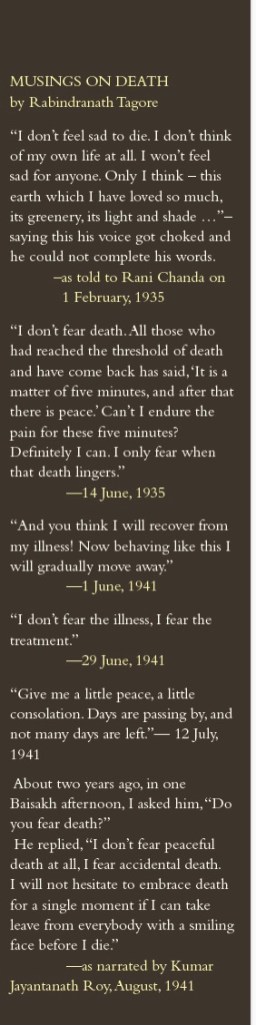
In reflecting and refracting, through the prism of their care and service, the closing year of Rabindranath’s life, the memoirs lay bare several facts. The bard was often a difficult patient, experiencing several crests and troughs as far as his moods — creative and otherwise — were concerned. Too intelligent and perceptive to avoid facts, he could see his imminent death, but did not want his caregivers to be morose and mournful. On them, fell the job of entertaining him, creating laughter and fun, in which he would participate when his health permitted him. He was less scared of death, he said, than of surgery advocated by his very eminent doctors like Dr Bidhan Chandra Roy (later he Chief Minister of West Bengal from 1948-1962) and Dr Nilratan Sarkar.

That this book is a labour of love is evident from Professor Mandal’s careful selection and editing, as well as her meticulous and competent translation. She has presented the momentous and moving final months of Rabindranath Tagore’s eventful life up to the day of his death which witnessed an outpouring of grief from many quarters. It is the final months of his life which is transcribed and inscribed by his memorialists, among whom are Pratima Devi, his daughter-in-law and son Rathindranath’s wife; Rani Chanda, his secretary Anil Chanda’s wife and a writer herself; Maitreyi Devi, the well-known writer and a protégé and favourite of Tagore’s; Nirmalkumari Mahalanabis, whose exchanges with the kobi-guru (great poet) have been detailed in Kobi and Rani (translated by Professor Mandal in 2020) and Amita Thakur, his granddaughter.

The first selection Pratima Devi’s ‘Nirbaan’ (1942) demonstrates his faith in and affection for his conscientious daughter-in-law, who, along with Rani Chanda and others, become an embodiment of care and nurture. He is aware of being a difficult patient and this awareness, which shines through in many of his comments and pet peeves, not only redeems him, but makes him more human. Musing “fondly on the poet’s twilight moments” while punning on the Robi (Bangla for sun) in the poet’s name, Maitreyi Devi, a Sahitya Akademi award-winning novelist writes: “The almost setting sun…was no less pleasant than the glory and radiance of the afternoon sun” and even within the sickroom, the poet continued “playing” his tunes, along with the march of time.

In his sensitive and nuanced foreword, Professor Fakrul Alam points out the memorialists’ refusal to minimize or sentimentalize Gurudev’s illness. In fact, Rani (Nirmalakumari Mahalanobis) expresses her impatience and criticism of the happenings and the people around the poet in the last stages. Amita Thakur, Rabindranath’s granddaughter was a notable exponent of his songs in her time, and he would depend on her to note down the songs as they came to him. Her work is chosen, says Alam, “as a coda for her assemblage of extracts from the memoirs of the five devoted caregivers who were women who had served him selflessly for sustained periods.”

The literary and archival value of such a work is undeniable and its benefits for exploring literary culture is immense. Between its glimpses of a towering giant in the world of letters with a truly international perspective to its comments about Tagore’s closeness to women and his seeking women as caregivers, the collection is also a testament to Tagore’s faith in the selfless capacity of women.

The book and Rabindranath’s close relationship with his many caregivers and later, memoirists, sometimes created a family dynamic of some tension between his natal family and adopted one. At one point, Maitreyi Devi (called “Mongpobi” or “Mitra” by the poet) talks of the negative comments made about her by Indira Debi (Bibi), one of Tagore’s favourite nieces, daughter of Satyendranath Tagore and Jnadanandini Debi. Later however, Maitreyi Devi also mentions the kindness shown to her by Indira Debi when they are together in Santiniketan.

Like in Kobi and Rani, the memoirs of Rani Mahalanobis (called Prathama or first to differentiate her from Rani Chanda who was referred to as Dwitiya or second) show the many facets of the great man himself — his many moods from his mellow moods even when he was in extreme pain to his irascible mood to his playful and humorous moments. It is to the credit of the editor/translator that she has organised and arranged the material very skillfully to bring out his mercurial nature, his flashes of temper and his expectation that his caregivers would wear their responsibilities lightly.

Overtly committed to personal memory, life narratives and biographies occasionally come  close to hagiography. They also lay bare a  performativity inscribed in the very form, implicit in the relationship between the great man/ luminary and those who are satellites in his orbit. The many layers of feeling get reflected in a plurality of forms that are both sedimented and fluid in structure — comprising letters, diaries, poems, fragments. These innovative narrative structures are evolved to convey through an overlapping of various genres: non-fiction, poetry, memoir, autobiography, letters, etc. Extending well beyond any coherent theoretical coordinates to streamline its disparate forms, life narratives are as much constructed by an individual artist — subject as they are the product of her/his intersecting textures of historical, social, political, economic, and cultural contexts.

The socio-cultural context  is specifically that of the progressive environment of Santiniketan and Vishwa Bharati. We see how the ambience of cultural efflorescence and Brahmo liberal ideas helped shape these young women. Perhaps, because of the reformist cast of Brahmo womanhood or the holistic educational schemes fostered by Tagore, in his caregivers, we see the emergence of relatively independent or mobile women, cast in agentic roles of decision making. We see an extraordinary sense of  a tightly-knit community of caregivers whether in Pratima Devi and Maitreyi Devi during the harrowing journey back from Kalimpong to Calcutta when Tagore’s illness worsens, the encounters of Maitreyi Devi with British doctors in Kalimpong or the journey undertaken by Maitreyi from Mongpu along with her young daughter immediately after a landslide, when her husband, Manmohan Sen, undertakes  to get the landslide cleared.

With a vibrant assembly of many pictures and voices, the story emerges from a collage. Piecemeal in bits and pieces, like the oranges sent to Rabindranath by Maitreyi Devi from Mongpu. Each experience, like the fruit, is savoured slowly and with relish. The remaining fruit, both actually and figuratively/symbolically, is given to the students.

A life, even one as extraordinary as Rabindranath Tagore’s, unfolds in time, simultaneously, it also participates in eternity. Thus, even as his nearness and the promise of proximate greatness draws his mentees into his magical orbit, we see him worrying about his imminent death and the fate of Santiniketan. We have to also see the life of the women, details of which get inscribed in their memoirs. The demands placed upon them are often relegated to the margins as they form part of the enchanted circle around the ailing poet, who at times seems to assert his claim on their time, albeit often  in jest, sometimes in a semi-serious way, competing for their attention with their other affections and preoccupations. Their lives, they realise, are given significance and irradiated by his presence, endowed with value through the care they could extend to the great soul.  

Ultimately the collection testifies to the power of great literature and poetry. As the poet himself says:

“Of course, literature is based upon lies — from beginning to end. Whatever I have said, whatever I am saying, how much of that is true? I have done a lot of farming for 80 years. I cannot vouch that all the grains will be stored in the barn. Some will be eaten by rats, but even then, something would be left behind. I cannot say that with certainty, eras change, times change and along with that everything also changes. But I can say with certainty that my songs will last the longest. Especially Bengalis will have no other way except to sing my songs in grief, sorrow, joy and happiness. They will have to go on singing them for ages.”

Kumar Sri Jayantanath is aptly quoted in Appendix B of the memoirs: “There is nothing new to say about Rabindranath because whatever we had to say has already been said by him.” Therefore, we pay a tribute to the poet in the poet’s own words:

You had brought along with you

 Deathless soul

In your death you have

Donated that

You have donated that

In your death.”

.

  Dr Meenakshi Malhotra is Associate Professor of English Literature at Hansraj College, University of Delhi, and has been involved in teaching and curriculum development in several universities. She has edited two books on Women and Lifewriting, Representing the Self and Claiming the I, in addition  to numerous published articles on gender, literature and feminist theory.       

.

PLEASE NOTE: ARTICLES CAN ONLY BE REPRODUCED IN OTHER SITES WITH DUE ACKNOWLEDGEMENT TO BORDERLESS JOURNAL

Categories
Index

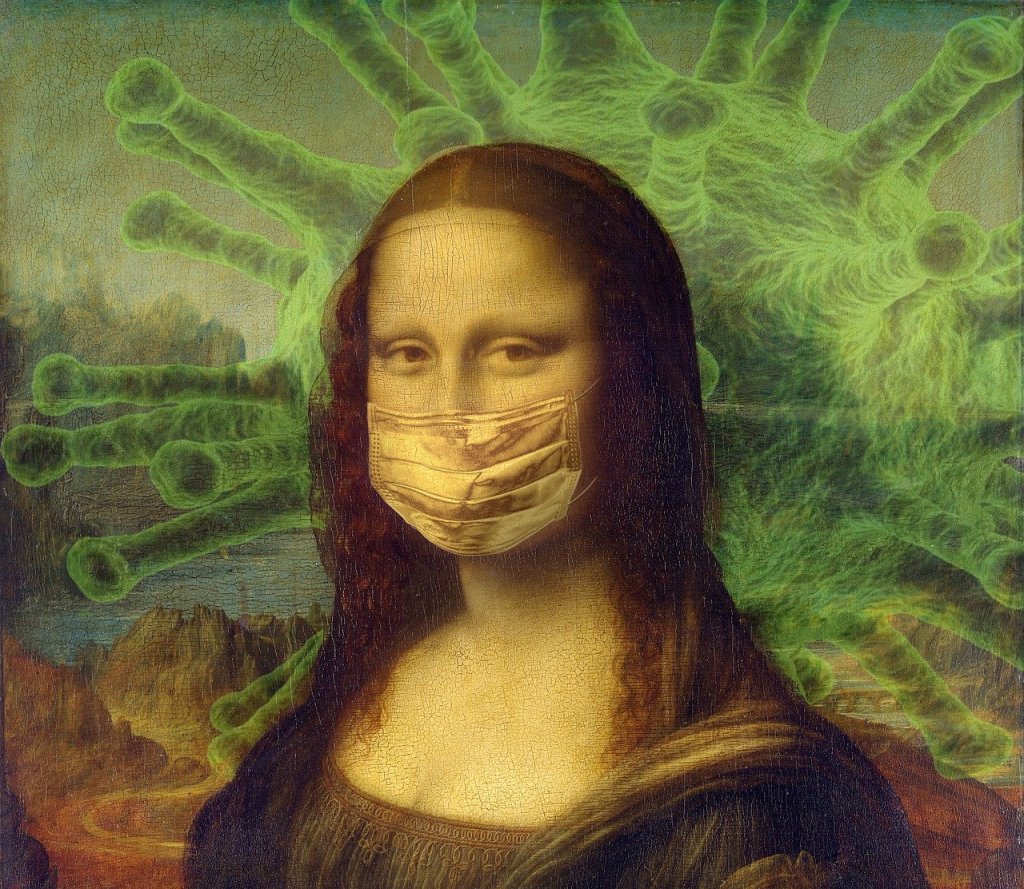
Pandemic Pandemonium

As we glide in and out of different phases of the pandemic, recalling when it started to make news takes one to a different world, a world where human interactions, travel, life — all of it seemed more predictable. I remember, I heard of it while in Yogyakarta in December 2019. At that time, we just knew of some new outbreak that had taken toll of a few human lives.

In three months, it became larger and larger and lockdowns became a reality. At some point, the outbreak was named a pandemic. Now, it seems to loom over us like a Sisyphean burden which rolls back to a fresh threat from a new variant just as we start to feel we have finally overcome the virus and made it to the peak, where we can resume our old ways. Is this a hint that we need to redefine our lives and change the tenor of our existence?

With eternal optimism for a weapon, mankind has overcome more deadly situations, when there were neither labs nor technologies to overcome diseases. Writers on our pages have reacted to the multiple outbreaks in varied ways. Here we present a selection of poems, stories and non-fiction from Mid-2021 that feature the onset of the new waves of the virus, which eventually will hopefully evolve to become an endemic. What is heartening to see is some writing has started to move towards a direction to define new ways to overcome the fear and darkness that seem to have been generated by the inability to bounce back to our ‘normal’ ways of living within a given timeframe. Perhaps, one should tend to agree with Keith Lyons, when he says in his essay: “I’ve learned to better cope with the challenges of life. As Jedi Master Yoda once said: ‘Named must be your fear before banish it you can’.”

Poetry

One Last Time by Heena Chauhan. Click here to read.

A Lament, A Prayer by Bibek Adhikari. Click here to read.

O Mother, O Father! by Ruchi Acharya. Click here to read.

Hope in Pandemic by Geetha Ravichandran. Click here to read.

Non-Fiction

Here, There, Nowhere, Everywhere

‘Did life change or did I change’ ponders New Zealander Keith Lyons. Click here to read.

Corona & the Police

Subhankar Dutta reflects on the role the police has taken in a pandemic torn world. Click here to read.

Fiction

If at all

Shobha Nandavar, a physician in Bangalore, depicts the trauma of Covid 19 in India with compassion. Click here to read.

The Arangetram or The Debut

Sheefa V. Mathews weaves lockdown and parenting into a story of a debuting dancer. Click here to read.