Categories
Stories

After the Gherkin

Deborah Blenkhorn

A Mrs Tadpole Mystery by Deborah Blenkhorn

Parry Lines was an ordinary fellow, so much so that even his friends couldn’t be bothered to find out his actual name and were content to call him “Parallel,” his nickname since childhood.  Regular, indeed nondescript features were surmounted by his trademark bald pate; the most you could say was that occasionally he wore a bright plaid shirt in neon pastels to liven things up a bit.

Ten weeks A.G. (After Gherkin)

Yet his death (by gherkin) caused a butterfly effect that changed the world.  Until the incident with the gherkin, the most notable thing that had ever happened to Parry was when his surprisingly dashing teenaged son had consumed an entire teacup full of gravy during Thanksgiving dinner.  Honoured guests had watched in horror as Parry Jr. (PJ for short), notable for his twinkling hazel eyes and flowing chestnut hair, gulped down the rich, brown fluid–though they should have expected something of the kind when he poured the gravy from the pitcher on the table into the China cup ready at his place setting for after-dinner tea.

Present at that event, and at the gherkin incident as well, was Mrs. Honoria Tadpole, English professor and amateur sleuth.  Her demure, conservative appearance (she always wore a smart, tailored suit–or at least the best the local thrift shop could provide–and had her silver-blonde hair cut in a perky, short bob) and her self-effacing manner and diminutive (if plump) stature belied the sharpest mind north of California. It would fall to her to unravel the complicated mystery that the local paper dubbed “Gherkingate.” 

Interviewed by the features’ editor, as the criminal trial of the alleged murderer dragged on, Mrs. Tadpole was asked the inevitable question of how it had all started. The interview took place in Mrs. Tadpole’s well-appointed parlour, a room replete with Victorian bric-a-brac.  With characteristic hospitality, she poured out a strong brew of  BC Bold to accompany the delicate sandwiches (ham, egg, and cucumber) and homemade oatmeal cookies that were her signature “high tea,” known to local islanders as a four o’clock tradition at the old manse where Mrs. Tadpole rented a small suite.

“Now, Mrs. Catchpole, I understand you were part of the original party that travelled to Moany Bay,” the interviewer began.

“Tadpole,” Mrs. Tadpole corrected.  A veteran instructor of nineteen- and twenty-year-olds, she was used to misspellings and mispronunciations. Marpole, Rumpole, Toadpole: she had heard and seen it all, and could make the necessary correction without even flinching anymore.  She cast her mind back almost three months to a mid-summer weekend off British Columbia’s Sunshine Coast.

She began with an allusion to classic culture: “Just sit right back and you’ll hear a tale, a tale of a fateful trip…”

Sadly, the features’ editor of the Island Gleaner failed to catch the reference to Gilligans Island, one of the best sit-coms of the 1960s.  Mrs. Tadpole had been a toddler when the series was first aired, but its popularity throughout her childhood made it a touchstone for, really, almost everything in life, according to her observations.  She knew that some people accorded such a status to the iconic, original Star Trek, but what did Captain Kirk have that “the Skipper” did not?  Not much, thought Mrs. Tadpole.

The premise of Gilligan’s Island was classic: a small number of people, randomly-assorted, stranded on an island together with no real prospect of deliverance.  After all, wasn’t that just the paradigm of human existence?  You didn’t need to be an English proffessor (though Mrs. Tadpole was one, of course) to figure that out. 

That fateful weekend, when the seeds of the gherkin incident was sown, had been rife with undertones of Gilligan’s Isle.

Breathing deeply of the fresh Pacific breeze, the passengers sat out on the deck of the vessel as it hugged the rugged BC coastline. The rushing water behind the Skirmish flumed out into a fan of spray, while the murky depths offshore spat out seals and sealions–even the occasional humpback whale–with random irregularity.  Black bears hid among the rocks and evergreens in the uninhabited areas; cabins dotted the beaches in the populated areas of cottage country.  On the way up the coast, the party of friends and family had composed their own version of the theme song, with each member of the group assigned to a role from the original cast.  Mrs. Tadpole was the Professor, of course.  Never mind that the community college where Mrs. Tadpole worked had opted not to accord academic titles to their teachers, or that the original Professor in the TV series was a man.  (As Mrs. Tadpole had been known to say to her first-year college students, we live in a post-gender, post-glass-ceiling world. And if we don’t, we should).

Aboard the Bayliner, Skirmish, Parry Lines was the Skipper, and his hapless, gravy-drinking son was typecast as the irrepressible Gilligan, full of mischief and ridiculous ideas. Mrs. Tadpole could only hope that her adorable niece, Mary Anne (same name as her Gilligan’s Island counterpart!), was immune to his sauce-swilling charms.

The Millionaire role was assumed by the reclusive entrepreneur Deadhead, Mickey Garcia (if that were in fact his real name), accompanied by his charming wife, Penelope, a voluptuous brunette. Together they had built an empire founded on tribute bands and biopics.  The rumour mill had it that there was trouble in paradise, but no one outside his immediate family had seen Mickey for years, so it was difficult to substantiate the gossip.

The cast was fleshed out (so to speak) with a bona fide movie star, the internet sensation who began as one of the central figures in a YouTube series called Project Man Child (“For the price of a cup of coffee… you can buy this underemployed househusband a cup of coffee!”) and had gone on to a viral barrage of TikToks under the sobriquet of “The Naked Gardener”.  Mrs. Tadpole was relieved (as no doubt were the others) to note that all the passengers aboard the Skirmish, including this one, appeared to be fully clothed. 

At least, all whom she could see wore conventional travelling attire:  Mr Garcia, recovering from surgery and groggy with heavy opiates, was shrouded in a blanket and wearing dark glasses. He slumped a little to the side, and his heavy breathing attested to a well-earned reputation for napping as a pretense in order to ignore his surroundings.

As Mrs Tadpole later told the Gleaner interviewer, the real concern of the trip quickly emerged: not the rapprochement of Mary Anne and Parallel Jr., but the burgeoning, even violent antagonism between Parry Sr. and Penelope Garcia, whom the latter insisted on calling “Cherry” with a suggestive leer while her husband languished in his bunk.  “Is he grateful? Or just dead?” quipped Lines. One night, Penelope went so far as to brandish a knife in Lines’ general direction and had to be restrained by Mrs Tadpole and Mary Anne in tandem.

Although Madame Garcia was the only one to meet his taunts with open animosity, no one was spared the self-proclaimed wit of Parallel Lines.

He had the nerve to call Mrs Tadpole’s beloved niece, whose sunny disposition was outshone only by the sweet, fair face that perched above her perfect figure, “Mistress Mary, Quite Contrary” –nothing could have been further from the truth!  Of course, Mary Anne merely smiled and shrugged it off, as if no insult could penetrate her cheerful exterior … but others were less armour-clad.

The bully referred mercilessly to the Naked Gardener as “Jamie Oliver, the Naked Chef” (whom he slightly resembled) a slur that obviously got under the man’s skin (“I couldn’t boil an egg to save my life!” he protested angrily.  “That’s not my brand at all! He’d better watch his back…”).

Even Mrs. Tadpole (surprisingly resilient after having been bullied through her shy youth as resembling a chubby little toad) came in for her share of abuse, rechristened as “Mrs Toad” after making her one of specialties, toad-in-the-hole, for her shipmates. (Once she discovered that the galley of the Bayliner was stocked with a potato ricer and La Ratte potatoes, there was no holding her back.  A ring of caramelized onions surrounded each serving dish, with two nut-brown sausage-ends sticking out of the centre, for all the world like a couple of froggy eyes.) “No one calls me Toad,” she intoned ominously.

Cruelly and unaccountably, Parallel Lines saved his worst tirade for his own son.  Recalling that terrible moment of youthful folly, that mind-gripping shame that only time could heal, the father saluted the son like a champion hog-caller summoning his prize sow. “Sooooo-Eeeeee! Want some gravy with that?” Alternatively, he would break into song to the tune of ‘Hey, Jude’:

"Au jus,
Just make it fat,
Take some gravy
And make it wetter..."

It was pitiful to see the boy’s response, especially in front of Mary Anne. His pale face was suffused with a ruddy glow beneath his chestnut fringe, and hot, angry tears rose in his sensitive, hazel eyes.

“I’ll kill him,” PJ muttered under his breath.

And now the tranquil Mary Anne, who couldn’t have cared less about any vitriol directed her way, was at last roused to fury in defense of her maligned and helpless friend.  “I’ll do it for you!” she offered.  “By G—!”

Two Hours B.G. (Before Gherkin)

Suffice it to say, no one was all that distressed when Parallel Lines failed to return to the Skirmish after an afternoon in the seaside village of Egmont (pronounced with an “egg” and not an “edge”).

Penelope had steered Mickey off in a collapsable wheelchair they had stowed on the boat; “the millionaire and his wife” were off for lunch al fresco, heading for a picnic table in an accessible, though private, spot.  Roast beef sandwiches and condiments, along with champagne and a couple of plastic flutes, had been assembled into a decorative yet sturdy straw basket which the amazon-like Penelope slung easily over one arm as she manouevred the wheelchair down the forest path.

The movie star had gone in search of Egmont’s famous cream cheese cinnamon buns, hoping to be recognised at the Forest Cafe by someone who would do a double take and exclaim, “Hey!  Wait!  Aren’t you that man child?”

Mrs Tadpole and her niece decided to go for a refreshing swim in the brisk waters of the bay, washing off the grime of shipboard life before stopping at the Village Green Room for a bowl of veggie curry soup and some fresh, hot rolls.

As for PJ, he declared himself too upset to leave the Skirmish, and was hoping to curl up with a graphic novel, a diet soda, and a bag of Doritos, to forget all his cares for a few hours while the rest of the party looked around Egmont Village.

But where was Parallel? It was time to cast off. If they didn’t leave soon, they wouldn’t make it to the Coastal Lodge before dark.  And–not to mention–P. Lines was the skipper!

“I’m perfectly capable of getting us there,” insisted PJ, fortified by his power nap.  “I’ll bet you anything, dad’s holed up at the Drifter Pub, and he’ll crash at the hotel there. I’m sure he’s as tired of us as we are of him.  Let’s just go.  We’ll all have cooled off by tomorrow morning, and I’ll swing back and get him then, bring him up to the Lodge for the rest of the weekend.”

The plan sounded good, and all agreed to it willingly.  Off they set for the rustic cabin someone had dubbed the Coastal Lodge in hopes (quite justified, as it turned out) of charging a tidy sum in AirBnB rates.  Never mind that it featured a remote outhouse and a camp kitchen; the setting was beyond beautiful, and the (now) congenial group looked forward to beach and forest walks, blazing bonfires, and midnight swims.  Mrs Tadpole insisted on taking charge of the outdoor kitchen: she had brought the ingredients for her famous moussaka and looked forward to the challenge of cooking it in a casserole dish on the barbecue.  PJ and Maryanne diced feta, tomatoes, onions and cucumbers for a Greek salad, while the movie star tried in vain to get a cell signal and the millionaires played cribbage by the big bay window in the cabin. 

Parallel Lines could cool his heels at the Drifter until morning, thought PJ and crew.

G.T. (Gherkin Time)

“So,” said Mrs. Tadpole to her interviewer, “Can you guess who did it?”

“Uh,” said the Features editor.  “Nope.”

“I’ll give you a hint: don’t ask who was the perpetrator. Ask who was the victim!”

“Well, that would be Mr. Lines, would it not?”

“Would it?  What if the wheelchair-bound invalid, Mr. Garcia, was really Parallel Lines in disguise?”

“But–”

“He was wrapped in a blanket, wearing dark glasses and a mask, slumped in his chair.  And there was a switcheroo.”

“A what?”

“A switch.  In the forest.”

“Well, I’ll be jiggered. Why haven’t you said anything?”

“Blackmail.”

“You’re blackmailing the unlikely lovers? Parry Lines and Madame G?”

“No, they’ve been blackmailing me.  But it’s time to come out. My trans-formation is at hand!”

“Mrs Tadpole!  What a story for the Gleaner–and for the world!  May I be the first to congratulate you?”

“You may.”        


Deborah Blenkhorn is a poet, essayist, and storyteller living in Canada’s Pacific Northwest.  Her work fuses memoir and imagination, and has been featured in over 40 literary magazines and anthologies in Canada, the United States, Britain, the Netherlands, Germany, Australia, Brazil, India, and Indonesia.

PLEASE NOTE: ARTICLES CAN ONLY BE REPRODUCED IN OTHER SITES WITH DUE ACKNOWLEDGEMENT TO BORDERLESS JOURNAL

Click here to access the Borderless anthology, Monalisa No Longer Smiles

Click here to access Monalisa No Longer Smiles on Amazon International

Categories
Poetry

The Tyne is Still

Poetry by Stuart McFarlane

River Tyne at Newcastle. From Public Domain
                       I                         

The Tyne is still, the water's calm,
a restful, reassuring balm.
In Newcastle our train has stopped.
From here it seems the perfect spot.
Where the iconic bridges span,
where, once, a different river ran;
well, different water, anyway,
flowing on into yesterday.
An errant cloud floats in the sky,
as if it's only passing by.
Nimble fingers unpick its seams;
on water sunlight softly gleams.
Transporting good to buy and sell;
the stories this river could tell!
Riverside harbours, wharfs and docks,
today replaced by concrete blocks.
Where there was muck once there was brass;
now buildings of shimmering glass,
high-tech hubs, computer centres;
the past flees; the future enters.
Newcastle, grimy, built on coal;
Have you now sold your northern soul?
Those hardy people of the past?
How long will their memory last?

II

Will the march of modernism harm
that fabled humour, Geordie charm?
Will your essential being change,
or will it just remain the same?
We're too busy with our smartphones
to dwell on our ancestors' bones.
To get on YouTube; that's our goal;
we are not used to heaving coal.
Those people, they belong to then;
yet the people now come from them.
Through generations runs a thread;
They are by shared history wed.
Yet, perhaps, they who once were here,
who, too, enjoyed a pint of beer,
are still with us; at least in thought,
their lives unfinished; dreams still sought.
Will our hopes, too, be unfulfilled,
our vision struck, our voices stilled?
We share with them. husband and wife,
the fickle randomness of life.
Now the train jolts into motion
and dispels my idle notions.
One final glance, one final time.
The Tyne is still; and still the Tyne.

Stuart McFarlane is now semi-retired. He taught English for many years to asylum seekers in London. He has had poems published in a few online journals.                                                                                                                    

.

PLEASE NOTE: ARTICLES CAN ONLY BE REPRODUCED IN OTHER SITES WITH DUE ACKNOWLEDGEMENT TO BORDERLESS JOURNAL

Click here to access the Borderless anthology, Monalisa No Longer Smiles

Click here to access Monalisa No Longer Smiles on Kindle Amazon International

Categories
Musings

Elusive XLs

By Shobha Sriram

Yet another sop story on slimming woes from a fat woman, you might think. But, no, this is about an erstwhile slim woman trying to stay slim.

At the turn of the century, I had just discovered the art of slimming. But my smiles in front of the mirror turned to frowns at the dinner table. While following a strict diet: breakfast of two slices of plain bread, lunch of vegetable salad, and dinner of two chapathis[1], I used to motivate myself with images of me going as slim as those skinny girls, who we’d all admire for their hourglass figures. Finally, after loads of exercising, yoga, and dieting, I slimmed down to a figure my friends called “Chic”. In those six months, I also learned the art of dressing well—an exclusive knowledge only the affluent had back then.

As time went on, I went to work, married, switched jobs, made money, lost money, gained fame, and graced anonymity. I had found dealing with people — be they friends or relatives — unpredictably tough. Sandwiched between my parents and in-laws, my emotion too had its highs and lows. Moments of clarity could follow chunks of confusion. But, through all those tranquil and torrid times, my determination to follow my dietary routine and exercises never wavered. I was unbelievably steadfast in balancing feasts with fasts and idleness with mobility. I bought a lot of expensive dresses, well-cut and flowing, and prided myself in them. I stayed slim.

Pandemic happened. Recipes crowded the YouTube listings. Women doled out never-before-heard dishes. Kids, when not running around bringing the roof down, went about relishing and demanding varieties of snacks. Everyone I knew burst out of their blouses. Amidst all the pandemonium, I was overly cautious about—you guessed it—eating. For my part, I also doled out varieties of dishes, but not for me. My family savoured every last bit. To maintain my routine, I went for long walks in nearby parks to offset all the sitting that work brought along with it. While my friends graduated to buying XL-size dresses, I stayed slim. Although I looked wistfully at the expensive dresses I had bought earlier, I saved them for wearing to work after the lockdowns.

Alas, little did I know that that ‘wearing’ was never to come. Imagine my shock when I could not bring the kameez[2]down my neck! I felt like somebody had slapped the insides of my head. My vanity went for a toss. How could I not know I was putting on weight? Wait, was it some health issue? Checkups followed. No problems there. Then, what was wrong? Had I become complacent? By now, I knew all the tricks to staying slim, and they had never let me down. What happened? Was I overconfident?

Last year, a mischievous aunt’s comment on my getting fat made matters worse. Up until then, she had never acknowledged my slim figure—not that I had expected her to, relatives being what they are. But she was quick to point out that I had grown fat and hoped there was no underlying disease. The overfamiliarity on her part, especially when she had never bothered to interact with me, filled me with disgust. But the damage was done. My expensive dresses went to charity. I started buying XLs. XXLs were in the offing too. My blouse size matched my husband’s shirt. I began exercising with greater vigour. Every morning, panting and puffing, I would jog, do floor exercises, and yoga.

One beautiful morning, I was exercising with full energy, pushing in my tummy hard, and I sighed with defeat at my fat waist and protruding tummy. When I sat down with a huff, my husband said, “Why are you torturing yourself? Don’t exercise to lose weight. Just do it to stay fit.”

A great relief engulfed me.

He said, “Do you know you look really beautiful now? Your face has broadened. That makes you look pretty. The dark circles under your eyes are vanishing so fast.”

I realised then and there: Be fat but keep fit.

From Public Domian

[1] Flatbread

[2] Indian shirt

Shobha Sriram is a writer from Chennai and a former fellow at Amherst College, US. Her writing has appeared in print and online magazines and journals, including The Wire, The New Indian Express, Muse India, Funny Pearls UK, and others.

.

PLEASE NOTE: ARTICLES CAN ONLY BE REPRODUCED IN OTHER SITES WITH DUE ACKNOWLEDGEMENT TO BORDERLESS JOURNAL

Click here to access the Borderless anthology, Monalisa No Longer Smiles

Click here to access Monalisa No Longer Smiles on Kindle Amazon International

Categories
Slices from Life

Hooked for Life and Beyond…

By Ravi Shankar

I was hooked! It was my first exposure to a computer though I had read about these in the newspapers and seen them on television. I think it was a Spectrum personal computer popular in the 1980s. My friend, Sanjay and I did a few simple tasks and played a few games on the computer. The games of the 80’s were slow and clunky by today’s standards. In those days however they were interesting and enticing. BASIC was the most popular computer language then. We also had COBOL and a few others. My good friend, Sanjay Mhatre was a bibliophile and a free thinker, and I often used to visit his place and borrow from his vast book collection. However, even in the 1980s there was uneasiness and opposition to computers and the fear that it would replace people and lead to mass unemployment was often mentioned.

The rise of information technology (IT) and the important role to be played by Indian companies was still in the future. I expect artificial intelligence (AI) will also open new jobs in the future. At my medical college in Thrissur, Kerala, India computers were still rare. Communist Kerala had a love-hate relationship with computers and technology. Maharashtra (a western Indian state) was an early adopter of computers, and my tenth- and twelfth-mark sheets were computerised while my MBBS ones were handwritten. During my postgraduation at Chandigarh, computers gained prominence in our conversations. Our head of the department was gracious enough to offer the services of his secretary for typing our research manuscripts when she was free. The only other option was to pay for the service from outside providers. In those days WordStar and WordPerfect dominated word processing. 

Creating slides for presentations was a challenge. LCD projectors were not available, and we had to create physical slides with cardboard mounting. The slides were created on early versions of PowerPoint and photographed using a camera to create the physical ones. My co-guide, Dr Anil Grover (then a cardiologist) at Postgraduate Institute (PGI), Chandigarh mentioned how computers will become increasingly common and encouraged me to learn the Microsoft package of Word, PowerPoint, and Excel. PGI also started offering email facility on a limited basis. You had to write down the details of your email and take it to the IT section who will send your message. We had modems then, which took a while to connect and made a series of sounds with flashing lights while connecting to the internet.

In Pokhara, Nepal at the beginning of the twenty-first century, internet was still a luxury. Manipal College of Medical Sciences used to charge 10 Nepalese rupees to send a message. Faculty could type their message in Outlook and twice a day, the IT person would send and receive messages. In those days, a floppy disk was the most common external storage device, and I soon had a large and colourful collection of floppies. Floppies were not always reliable and sometimes the data on them could not be read. CD-ROMs were another storage device, but CD writers never became commonplace. At Mahendra Pul in the heart of Pokhara, a new cybercafé came up in the early 2000s offering internet browsing at 150 Nepalese rupees per hour. Compared to what we were previously paying, this was a steal!

The college also had an LCD projector though it was not commonly used by faculty members for teaching-learning. This was a large and clunky device. Earlier versions often had compatibility issues. You create your slides and hope for the best. These may or may not open on the laptop and may or may not be projected. One had to have a backup of the lecture on overhead projector (OHP) transparencies, just in case. We did not yet have easy access to computers or laptops. This came only later when the United States Pharmacopeia (USP) set up a drug information and pharmacovigilance centre at the teaching hospital. We got two excellent Dell computers, and the hospital provided us with internet.

The early computers were slow with a big, bulky, and heavy cathode ray screen. They had a blinking cursor and words appeared slowly after typing. The Hollywood movie, You’ve Got Mail (1998), follows the romance between Meg Ryan and Tom Hanks developed through email. The movie is a good introduction to the early days of the internet.  

We had purchased a home desktop computer in 2001 or 2002. This purchase was a financial disaster. The computer required frequent repairs and drained our finances. Google launched its beta version of email, Gmail in 2004, and I was one of the early adapters. I became a fan of Gmail right from the start. It offered significant advantages over the then dominant Hotmail, Yahoo mail and Rediff mail. The storage was larger and there was no need to delete your old emails. Kist Medical College in Lalitpur, Nepal had purchased Dell desktop computers, and these were among the best ones I had used. Fast and responsive with good memory and speed. These had LCD monitors and looked sleek and modern.  

Computer technology has made significant advances. I read that if cars had made similar advances to computers we could drive to the moon and back on a litre of gasoline. Chips started getting smaller and more powerful and are today fought over by the global technology superpowers. A variety of online applications started making their appearance with the spread of the internet. Some of these eventually became the internet giants of today. In India, internet became widely available, and the costs dropped significantly. Mobile technology also made dramatic advances. In India most people access the internet and carry out online tasks using their mobile phones. For around 12000 Indian rupees today you can get a decent mid-range phone. Today mobiles in the palm of your hands have greater processing power than the giants of the 1950s and 1960s. I remember reading a comic strip where a visitor from the future time travels to the present. He laughs on seeing the supercomputer, the most powerful one on earth. When asked why he shows a small ball and introduces it as a computer from his time with much greater processing power than the humungous supercomputer.

One of the major advances has been cloud computing and cloud services. We have Chromebooks that work on web-based applications and needs the internet to do things. Both Google and Microsoft offer a range of services including storage, meetings, messaging, and applications for text, presentations, and calculations. AI is now an integral part of applications. PowerPoint offers the designer option for slides and creates stunning backgrounds. I recently attended a workshop on Copilot, the AI support software from Microsoft that is fully integrated into all their applications. I like the transcribing option for interviews and focus groups offered by Teams and later by Zoom and this makes my life as a researcher easier.

Star Trek, Futuristic computing

When I was growing up, I had no clue about what would soon become commonplace. The world wide web, the ability to browse libraries and art collections, video conferencing, online work processes, applying for government and other services online, online fund transfer and remittance are now at our fingertips. The COVID pandemic shifted a lot of learning and even assessment online. Presently we mainly interact with computers using a keyboard. I am a fan of the sci-fi series, Star Trek, where people interact with computers mainly using their voice. Voice commands are already available and  steadily improving.

I was slow getting into social media. Their judicious use is to be recommended. Facebook keeps me updated on what my friends, acquaintances and former students are doing. LinkedIn is the professional face I present to the world, Twitter (now X) is a concise way to stay connected and YouTube is a major source of entertainment. Computers have changed our life for ever. At a basic level these are based on the flow of electrons through circuits and on the pioneering work in atomic physics done at the start of the twentieth century.

The last three decades have seen developments and changes at unimaginable speed. Who knows what the next three will bring? Will progress continue at an ever-accelerating pace or will we eventually hit a roadblock? We may have to wait for Father Time to provide the answers!

Dr. P Ravi Shankar is a faculty member at the IMU Centre for Education (ICE), International Medical University, Kuala Lumpur, Malaysia. He enjoys traveling and is a creative writer and photographer.

.

PLEASE NOTE: ARTICLES CAN ONLY BE REPRODUCED IN OTHER SITES WITH DUE ACKNOWLEDGEMENT TO BORDERLESS JOURNAL

Click here to access the Borderless anthology, Monalisa No Longer Smiles

Click here to access Monalisa No Longer Smiles on Kindle Amazon International

Categories
Slices from Life

No Film? No Problem

By Ravi Shankar

The studio room was ill ventilated. The bright lights were making things hotter! We were at a photo studio in Bhandup, Mumbai, trying to take a family photograph. The photographer was trying his best to arrange us in a pleasing and photogenic composition. The process was however, taking longer than expected and my youngest brother was getting scared. He was beginning to cry and soon was bawling his head off. My mother has a knack of soothing and calming crying children, but this time even her efforts were not successful.

I was reminiscing on this episode recently and was thinking on how easy it has now become to capture photographs and video. For a long time, you had to use film to capture photographs. Photography was an expensive proposition then. Initially, you only had black and white films. Later colour films became widely available. The cost of films, of processing and printing photographs all added up.

Films were also only invented in only 1889, but they were highly flammable. ‘Safety films’ were introduces only in the last century in 1908. Before 1889, photographers had to lug around heavy glass photographic plates. The process of capturing images on film also took a long time. When taking portraits people had to stay still for minutes at a time. The older generation of cameras were bulky and heavy and difficult to carry around. Photography was a significant advance in human history. Before 1802, we had to depend on painters and portraitures to depict everyday scenes and special occasions.

The Eastman Kodak company invented flexible film to capture photographs and for several decades the company was a world leader in photography. Unfortunately, they were not able to fully adapt to the change to a digital format and after filing for bankruptcy the company is now back with commercial printing, film stills and movie production. The Japanese were the world leaders in cameras for several decades. Yashica, Minolta, Nikon, Canon, Pentax, Olympus are legendary names. For a long time during my student days and early medical career photography was an expensive hobby to indulge in. My first purchase was an Olympus. A small and compact camera that captured great images. The camera came with a remote and a timer. Olympus made great cameras and usually the lens was integrated into the body and could not be removed and changed.

My good friend, Sanjay Mhatre in Mumbai, is an architect with wide-ranging interests. He was the one who informed me about large format cameras and the Hasselblad series. Large format is especially important in architecture. Another major German brand was Leica. These were very expensive. Dr Unnikrishnan PS was my batch mate and hostel mate during the MBBS course. He had a keen interest in painting and has now switched to photography. Recently he has opened a museum dedicated to photography, Photomuse (https://photomuse.in/) in Thrissur district in Kerala. This is India’s first museum dedicated to photography.

My first single lens reflex (SLR) camera was a Pentax. I had purchased this from New Road in Kathmandu in 2000. A SLR is a camera that has a mirror in front of the film and when the shutter is clicked the mirror moves up and the film is exposed. The mirror otherwise helps photographers see what they are about to click through the view finder. The view finder was very important as you did not have screens that showed you what you were about to click. These came much later. With the advent of screens showing the scene in front of you, view finders began becoming less common.  

Himalayas — shot using the Pentax, Photo courtesy: Ravi Shankar

Kathmandu is a very photogenic city with ancient monuments and temples, and I tested out my new buy under a variety of conditions. I had to wait to get the film developed before I could see how my photos turned out. One had to be creative and resourceful as immediate feedback was lacking. I also invested in a polarizing filter, and this was very useful in highlighting the contrast between the snow-clad mountains and the deep blue sky.   

The camera was heavy and weighed around 1.2 kg but came with its own bag making it easier to carry. The camera accompanied me on most of my treks in Nepal. I was able to capture great images of the spectacular country. While hiking the hills, you had to stop, take the camera out of the bag, focus it, adjust the polarizer, compose the scene, and then click. Someone said that photography provided the sahibs with an excuse to rest and catch their breath during steep hikes. Karna Shakya is a famous Nepalese traveller and photographer who later he founded the Kathmandu Guest House in Thamel, Kathmandu. He has written about photography during his treks (in his books and articles) and the difficulty he faced while looking for colour films and developing the same in the 1970s in Kathmandu.

The cameras on mobile phones started becoming better from 2010 onwards. I had a Samsung mobile phone with me in Aruba that took good pictures. Aruba is a picturesque place with nice beaches and turquoise blue waters.

Aruba Coastline — shot using a Samsung Mobile. Photo courtesy: Ravi Shankar

I eventually graduated to an Oppo smart phone with a better camera. This smart phone accompanied me on my travels in Peru. In late 2019, Realme introduced a new smart phone with a 64 Megapixel sensor.  

Cusco Peru – Shot using an Oppo. Photo courtesy: Ravi Shankar

Mobile phone manufacturers are constantly upgrading their cameras. The mobile camera war is hotting up. The image sensors started getting larger and cheaper. Samsung and Sony started investing in sensor research and development. Some mobile manufacturers collaborated with camera makers like Hasselblad and Leica to bring these cameras to mobiles. Around late 2023, I was looking to upgrade my smart phone and wanted a more powerful camera. There was a wide choice available. 200 MP sensors were available on some phones while others had 120 and 100 MP cameras. I did some research and found that most phones only shoot images of around 32 MP at the maximum. Usual photos are taken at a much lower resolution.

I eventually purchased an Honor phone with a 100 MP camera. I have used this widely during my travels and gives excellent results especially in good lighting conditions. Mobile phones are lighter and less obtrusive compared to a SLR. Most SLRs have also now shifted to digital sensors rather than film. With a mobile phone it may be easier to capture people in their natural situations. The trend today is to have one device that can do it all. Play videos, check emails, make online bookings, call, chat, capture images and video.

Capturing video has also become easier and many phones have image stabilisation and allow you to shoot in HD and 4K formats. There are a variety of software that integrate images from different sources and can edit and polish a video. Taking a photograph is no longer regarded as something special. Taking a video and posting it on social media is also very common. Many people earn their livelihoods through creating and posting videos on platforms like YouTube and TikTok. We have come a long way from dressing up in our best formals and going to a studio to get our photographs taken to capturing images, selfies and videos using our mobile phones. Only a very brave person can predict what the next hundred years will bring!

Dr. P Ravi Shankar is a faculty member at the IMU Centre for Education (ICE), International Medical University, Kuala Lumpur, Malaysia. He enjoys traveling and is a creative writer and photographer.

.

PLEASE NOTE: ARTICLES CAN ONLY BE REPRODUCED IN OTHER SITES WITH DUE ACKNOWLEDGEMENT TO BORDERLESS JOURNAL

Click here to access the Borderless anthology, Monalisa No Longer Smiles

Click here to access Monalisa No Longer Smiles on Kindle Amazon International

Categories
Essay

Cinema, Cinema, Cinema!

By Gayatri Devi

Is it appropriate to speak of transnational glee as a legitimate audience response to a film? If so, that might be a fitting label for the global spectator reaction to the blockbuster Indian film, Jailer, released worldwide on August 10, 2023.  The film whose OTT rights were purchased by Amazon Prime is streaming online while simultaneously playing to packed theatres in India, Sri Lanka, Malaysia, China, the Middle East, Australia, Canada, the US, the UK, France, and other countries. In its first month of theatrical release, Jailer brought in an impressive 300 crores in India alone with over 600 crores and counting (just shy of 22 million US dollars) as its worldwide earnings. Many Indian blockbuster films have had a worldwide high-performance index recently with the likes of Ponniyin Selvan, Pathaan, Bahubali etc. thriving on an exoticised glamour of an India of kings and queens and palaces and freedom fighters and medieval breakdance routines, a sort of mystified enchanting India of the travel brochure version for viewers both inside and outside India. Even a mediocre film like RRR had a localised transnational success in the United States during the academy award season as well.

Unlike these historical and revisionist costume dramas, Jailer is a full-on pop culture phenomenon, a movie of the moment, a tale of its time; it is as au courant as cellphones and police corruption. It is full of attitude, and packed chockful of allusions and homages to both Indian and western movies in what is essentially a fun romp. Shot mostly in sumptuous wide shots and rhythmic cuts, it establishes an onscreen India, dry and dusty, with industrial warehouses running forgery, guns and knives, roadside ice cream vendors, fly-by beheadings, and struggling gardens along with elementary school YouTube influencers.  Its real distinction is that people all over the world get it. But it is as Indian, specifically, it is as Tamil as a Tamil can be, and it puts a smile on the face of anyone anywhere who watches it. The international blockbuster with no pretensions to anything other than cinematic entertainment is back, thanks to Jailer and its vibrant young director Nelson Dilipkumar.

Jailer tells the story of two men, a hero and a villain, a retired police officer Tiger Muthuvel Pandian, the eponymous jailer, and a criminal mastermind Varman who runs an art forgery ring. They make counterfeit Indian statuary and sells them in the international market. Their encounter becomes complicated when the jailor’s son, a corrupt police officer, starts working for the villain, the male melodrama of father-son conflict being a favorite trope in Tamil cinema from older films like Thangappathakkam (The Golden Badge, 1974) that starred an earlier era’s superstar Shivaji Ganesan. Jailer belongs to the same pedigree of male melodramatic films. The hero is played by the Tamil superstar Rajnikanth and the villain, the psychopathic leader of the forgers by Vinayakan from the nearby Malayalam film industry in Kerala.

Both Rajnikanth and Vinayakan belong to the highly successful world of mainstream, commercial Indian cinema with strong populist reception while also maintaining a certain level of middle-class entertainment sophistication. When compared to Rajnikanth, Vinayakan is relatively a newcomer, but one who has very quickly claimed his own space in Mollywood, Kerala’s film industry that produces Malayalam language-based films.

Vinayakan’s breakout performance as an underworld operative, an executioner and strongman, a complex character who is right, wrong and everything in between in Kammatti Padam[1] (2016) earned him a Kerala State Film Award for Best Actor.  Jailer sees him as a criminal psychopath with unpredictable ticks like instructing his lackeys to dance for him, drowning his enemies in big vats of sulphuric acid, delivering his Tamil-Malayalam pidgin with menacing comic timing etc.  The overall excesses of his character have the potential to turn him into a stereotypical villain, especially since the sulphuric acid dunking trope has a colourful cinematic legacy in Indian popular culture. (The “sulphuric acid joke” is an instantly recognisable film joke in Indian pop culture attributed to the persona of an outlandish villain played by the erstwhile Bollywood star Ajit who is credited with asking his henchman Raabert (Hindi pronunciation of Robert) the following purely apocryphal lines: “Raabert, is haraami ko liquid oxygen mein dal do; liquid ise jeene nahin dega, oxygen ise marna nahin dega”  (Robert, drown him in Liquid Oxygen; the Liquid won’t let him live, and the Oxygen won’t let him die!”). Jailer abounds in many such recognisable “quotation marks” throughout the film, including an ear-slicing scene, an evident homage to Quentin Tarantino’s Reservoir Dogs(1992), and “Stuck in the Middle with You”. These artfully placed allusions create an enjoyable self-reflexive layer in the film where Jailer talks to film materials that have provided evident inspiration. The self-conscious scripting and direction, and the sheer enjoyment and abandonment with which Vinayakan embraces the deranged psyche of Varman makes him a bonafide villain and not a caricature.

Rajnikanth who plays the title role of the jailer is the 72-year-old veteran superstar of Tamil cinema known to his massive adoring fan base as thalaivar (“Leader/Chief” in Tamil). Rajanikanth started his film career with the 1975 romantic drama Apoorva Ragangal (Rare Melodies), a far cry from the action crime thriller genre which would soon become synonymous with his name in the industry. With his trademark moustache, lopsided pursed lips, thick mop of straight black hair swiped across the forehead, lean frame, and long lanky legs, Rajnikanth from the 80s onwards played the righteous underdog on both sides of the law who took on the snobbish elite as well as the violent underworld players and won. He played orphans, rickshaw drivers, underworld consigliere, police officer, milkman, engineer, writer, grandfather, father, son, brother, husband, lover – he played the full spectrum of masculine roles in mainstream Indian cinema.

There is an underacknowledged colour line in Indian films where the relatively whiter-complexioned actors and actresses are considered stardom material. Rajnikanth with his dark-complexion and Midas touch at the box office demolished this industry practice and became the mirror for the ordinary darker Dravidian face on the Indian silver screen.  Jailer sees him aged but fuller and lighter than his earlier years, though what has not changed are his instantly recognisable dance moves; underworld or the penthouse, underdog or the aggressor, Rajnikanth’s dance moves set the tone in his films. The standing jogs, the high kicks, the hip shake, the robotic arm movements and hand props like dark glasses and hand towels showed a new definition of “cool” to his fans.  His tentative dance performance in Jailer is reminiscent of another accomplished dancer who exhibits a pretend stage fright; John Travolta in Pulp Fiction dancing with Uma Thurman to Chuck Berry’s “You Never Can Tell.”

Other significant performances include Vasanth Ravi as the jailor’s corrupt and clueless son, Ramya Krishnan as the jailer’s visibly irritated wife, along with hilarious cameos by Malayalam superstar, Mohanlal, Bollywood star, Jackie Shroff, and Kannada star, Shiva Rajkumar — all of them act as outlaws who help the jailer in his fight against Varman. An equally hilarious subplot involves a love triangle between the dancing beauty Kamna, her lecherous costar “Blast” Mohan, and her lover, the timid film director.

The film clocks an impressive two hours and fifty minutes on the strength of these men and their vivacious performances, smart, sharp, and funny dialogue, over-the-top violence, and a sizzling cameo dance sequence, popularly known in Indian film lingo as an “item number” by the alluring Bollywood actress Tamannah. The single “Kaavaala[2] composed by the music director, Anirudh, is a proper earworm turned worldwide viral hit with the young and the old alike shaking their hips to its mood altering percussive rhythm, the latest being a Japanese version of the song. Perhaps as a testament to the song’s instant infectious popularity, the original dance features dancers of multiple ethnicities, a global potpourri as it were, with a set reminiscent of the production design of Raiders of the Lost Ark[3] (1981) as well as a flute intro that calls out to Andean musicians. If any song can bring the world together, “Kaavaala” can.

Indeed, the multiple references to Quentin Tarantino, Reservoir Dogs and Pulp Fiction are unavoidable while watching Jailer. As with Tarantino, director Nelson (as he is popularly known) too operates inside a similar vision of cinematic storytelling.

The proper subject of Jailer is cinema, cinemas of India, cinemas of the world. Tamil melodramas of the 1970s, the middle class Tamil comedies of the eighties and the nineties, Bollywood action flicks, Hollywood adventure films, the black  crime comedies of Quentin Tarantino, the epic blood splatter of Robert Rodriguez, the bumbling and menacing sociopathic capers of Guy Ritchie films  – Jailer tips its hat to all of these crime-as-entertainment influences through its multilayered dense scripting, the large cast of characters, and the no holds barred display of gory violence. It is a refreshingly confident film without any false notes though some of the repeated explosion scenes could be tightened.

Jailer tells an old story familiar to the Tamil audience, a story as old as Shivaji Ganesan in Thangappathakkam(1974)—the upright police officer father and the fallen corrupt son. The film chugs through its dense thicket of plot and counterplot towards an inevitable moral resolution to this impasse. This is where the power of the star system in Indian cinema, a status equal to that of gods, plays its trump card. With Rajnikanth playing the jailer father there can be only one moral resolution, son, or no son. It is a formula that never fails, and speaks of a justice perhaps unique to cinema.

.

[1]  Kammatti Paadam — is the name of a slum in Kochi, Kerala. It is a place name. Kammatti is a proper noun without any traceable etymology.  Paadam means “field” in Malayalam. “The Slum Fields” of “The Slum” could be an appropriate translation.

[2] Kaavaalaya — A Telugu phrase, “I Want You, Man”

[3] Set in 1936

.

Gayatri Devi is a teacher, translator and writer living and working in Savannah, Georgia.

.

PLEASE NOTE: ARTICLES CAN ONLY BE REPRODUCED IN OTHER SITES WITH DUE ACKNOWLEDGEMENT TO BORDERLESS JOURNAL

Click here to access the Borderless anthology, Monalisa No Longer Smiles

Click here to access Monalisa No Longer Smiles on Kindle Amazon International

Categories
Slices from Life

Kardang Monastery: A Traveller’s High in Lahaul

Narrative and photographs by Sayani De

I sipped on my cup of piping hot, sugary tea at Kardang monastery, twelve thousand feet above sea level. The chomo who prepared it chatted away the details of the snow festival that happened a few months ago. The edges of her maroon robes fluttered in the wind. ‘Chomo’ — I learned a new word that day – in Tibetan, it means a female Buddhist monk.

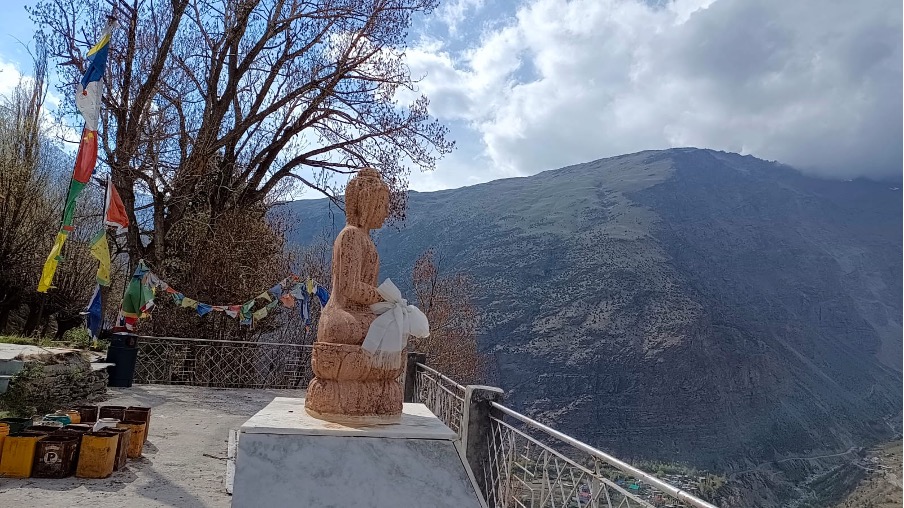
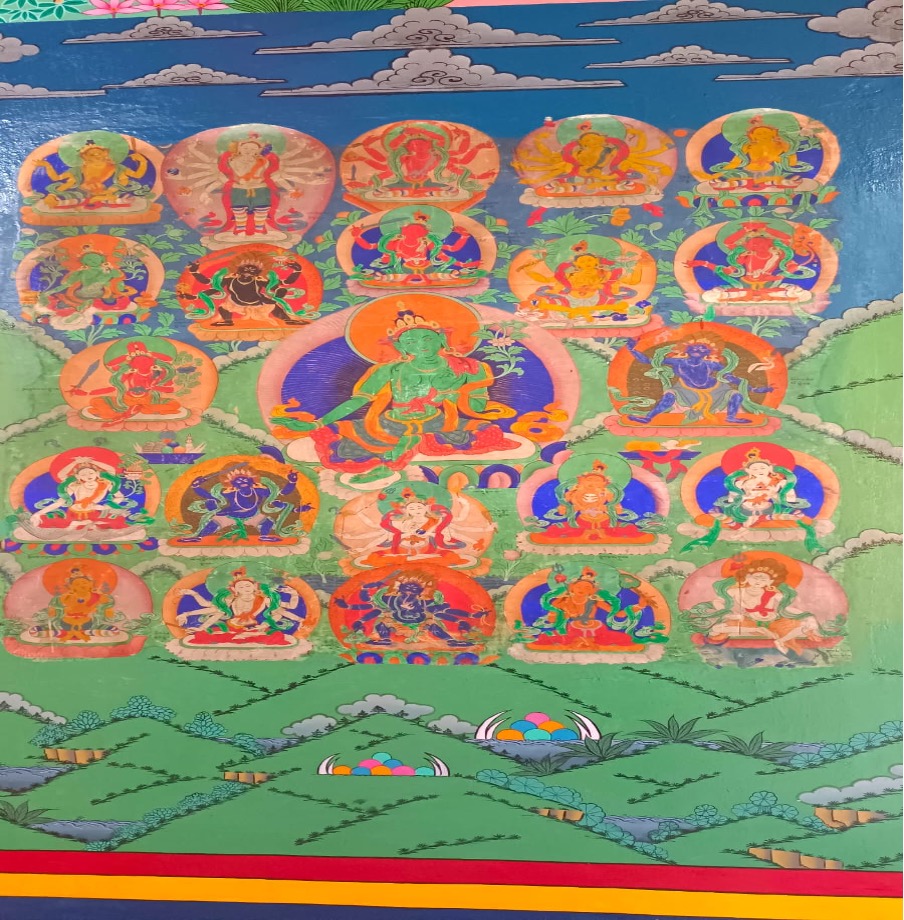
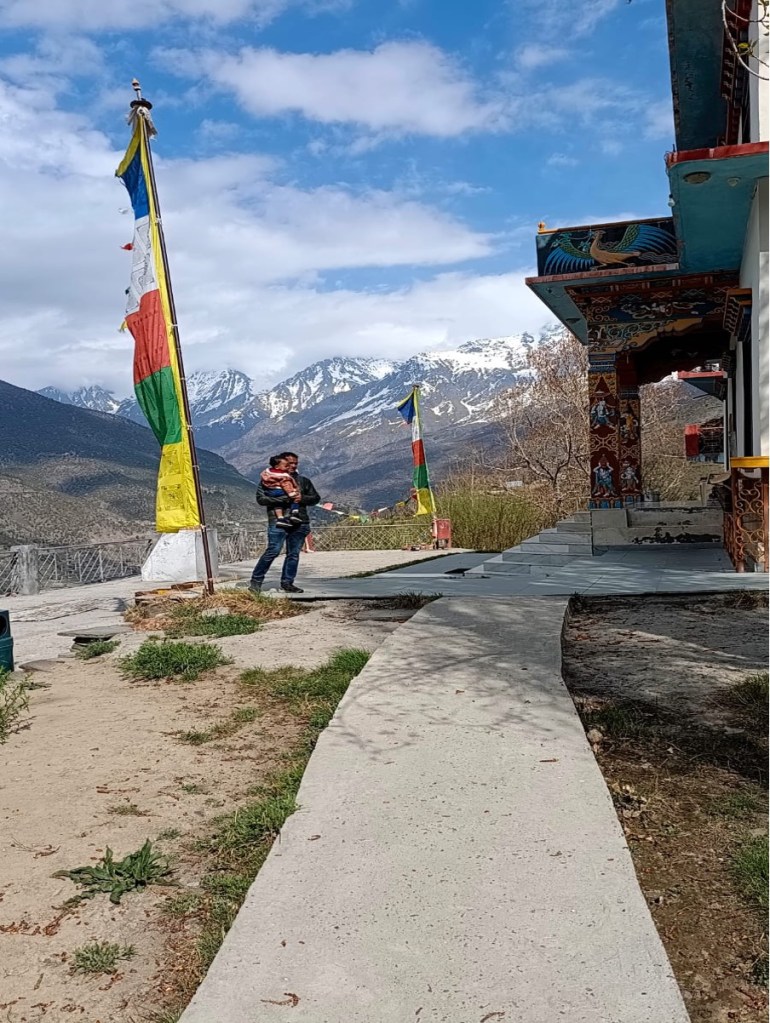
The monastery is an important one of Drukpa lineage[1] built in the twelfth century. The beautiful white facade with gold details gleamed in the sunlight. Intricate thangka paintings adorned the walls and ceiling of the monastery. It was perched on the barren mountain of Lahaul with multi-coloured Buddhist flags swaying in the wind. An imposing statue of Lord Buddha sat in the courtyard, looking over the whole valley. There was still some snow on the mountain tops, spring had just set in.

The chanting of the lamas filled the air. It was part of the evening ritual. Gentle drum beats punctuated the chanting. I felt fortunate to be in such a tranquil space. It was a happy concoction of the high altitude, the rhythmic rituals, and the lack of human habitation around the monastery that left me in a self-contained peace bubble.

A thangka painting

“How did you know about this place? Not a lot of tourists come here,” the chomo asked me with a twinkle in her eyes. My mind browsed through the incidents that led me here. 

It all started two years ago. My penchant for zoning out to Tibetan chanting mantras on YouTube, and love for off-beat places in the Himalayas led me to some serious research. Lahaul district in Himachal seemed to fit the bill perfectly to get a taste of both. It was easily approachable from Manali, where my family could stay with all creature comforts. Our travel group included our one-year-old son and elderly parents.

The beautiful monasteries in dramatic mountainous settings were as much a reason to visit Lahaul as the adventure to travel to such harsh terrains. We based ourselves in Manali and acclimatised ourselves for a few days before climbing to twelve thousand feet. We hired a local car and driver to visit the Lahaul district. When we told our local driver that we wanted to go to the Kardang monastery, he looked at us blankly. It dawned upon me that it was even more remote than I had realised. 

We started from Manali towards the Atal tunnel, a nine-kilometre-long highway underpass in the Pir Panjal range of Himalayas, on the Manali- Leh highway that connects two districts of Himachal. The Atal tunnel was opened in October 2020 after several years of work and today connects the remote Lahaul district with the rest of Himachal. 

We left the verdant coniferous forests and mountains with gushing streams on one side of the tunnel and gaped at the dry snowy mountains with freshly sowed fields at the base of the mountains of Lahaul on the other side. It was a dry desert with farming done in little patches at the base of the mountains. The difference was stark.

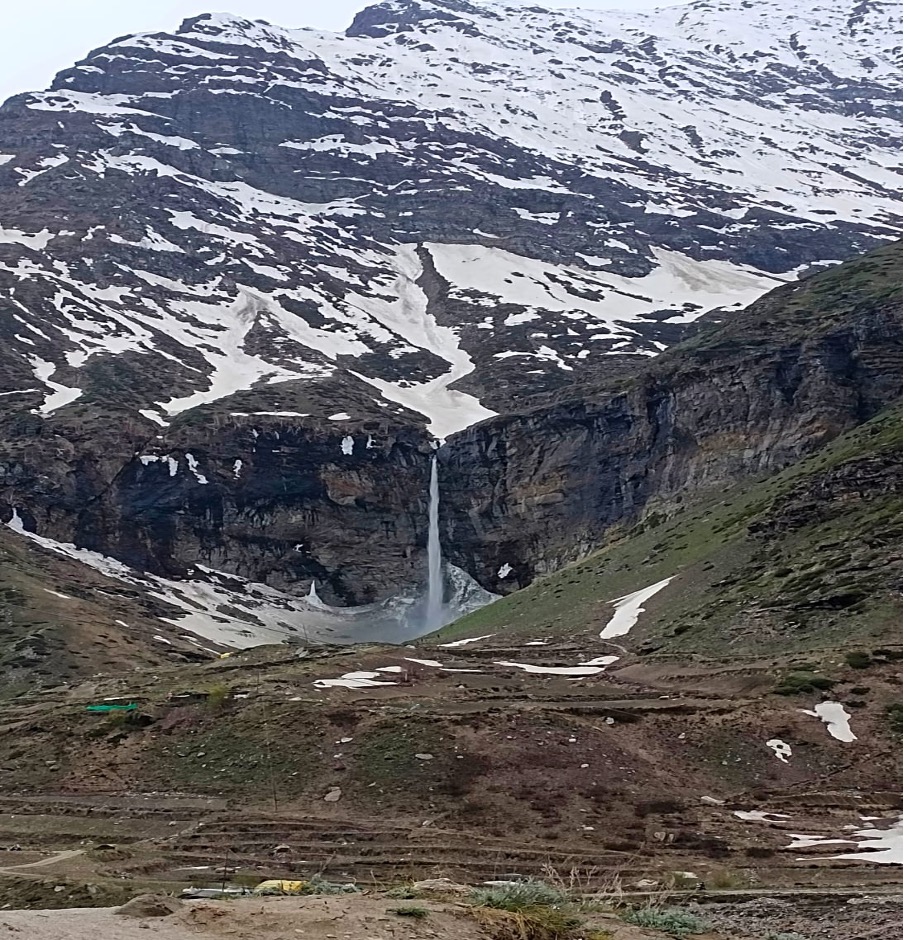
We stopped at the helipad by the Sissu waterfall in Lahaul district, to recharge ourselves with tea and steaming momos. I saw my father-in-law skip around like a little boy, his jaws dropping every time he looked at the waterfall coming straight out of the glacier that cradled it. It was his first time being in such a terrain. All of us, including my one-year-old son, seemed to be breathing fine and enjoying ourselves, in spite of the sudden gain of altitude to eleven thousand feet. I sighed in relief; no acute mountain sickness (AMS) for us.

We set out to the monastery following google maps and stopped for lunch on the way. After some conversation, the restaurant folks told us that we were going in the wrong direction. Apparently, google maps didn’t work very well in this region beyond the well-travelled tourist circuit. They told us how to reach and from the sound of it would involve off-roading. After losing our way twice, we finally discovered a bumpy path that led to the monastery. We found out later that the best option was to take the mud road on the right after the lone petrol pump in Sissu.

The bumpy mud road that we took instead was devoid of human habitation or road signs till the Kardang village. On each serpentine turn, I could see my travel companions digging their fingers deep into the seat in anxiety. On some stretches, there were walls of ice on the mountain side and the car had to cross the several streams that these walls caused. Later, we all laughed about how each of us was praying for dear life during that treacherous journey.

After a good thirty-minute climb we finally reached the Kardang village and the metalled road was in sight. The Kardang village had a few homestay signposts but none were open in spring. Soon we crossed the signs of the pilgrimage trek of Mt. Drilbu Ri and we were at the gate of the monastery. The short walk to the monastery was nice but we did it slowly as the lack of oxygen was palpable. Kardang monastery is nestled in the ridge below the fifteen thousand feet Rangcha peak. Kardang is the starting point for the Buddhist pilgrimage of Mt. Drilbu Ri. 

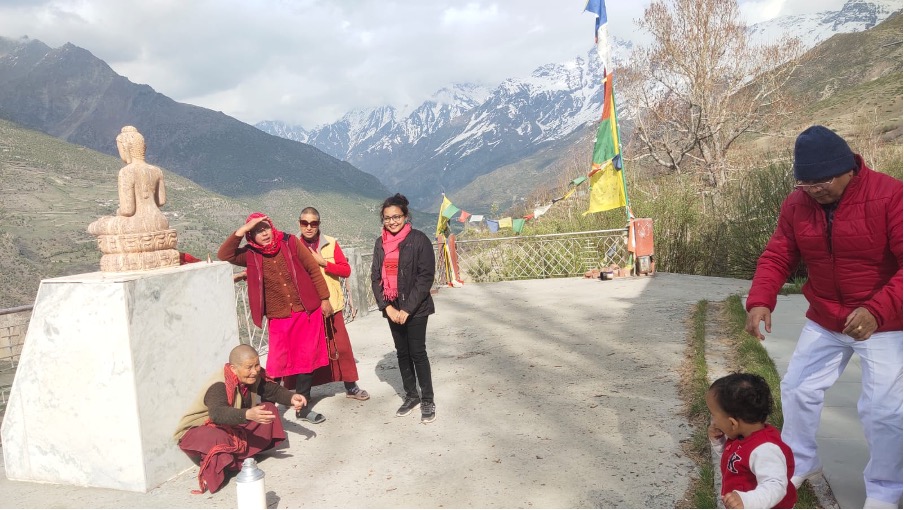
Upon reaching, we found the door of the monastery closed. Soon we were greeted with the Tibetan greeting ‘Juley Juley’ by a smiling monk who opened the door for us. His name was Sonam Dawa. He was happy to show us around and answer our questions about the prolific thangka paintings on the walls and ceiling of the monastery, on Buddha’s life, dakinis [woman spiritualists], and other important figures of Tibetan Buddhism. Tibetan Buddhism with its characteristic animism and symbolism of Bon culture is a hallmark of this Lahauli monastery. A few lamas and chomos joined us and offered us tea. We were touched by their warmth. They played with my son, told us a lot about the snow festival that happens every February and asked us to come back during the celebration.

To this day I am not sure if it was the high altitude, the aromatic incense, or the space itself that made it feel so special. I remembered the chant on Youtube that started this journey for me and am glad I followed that instinct.

.

[1] The Drupka lineage of Tibetan Buddhism dates back to the twelfth century.

.

Sayani De is a bibliophile, compulsive traveller and sustainability enthusiast.  Her work has been featured on Women’s Web and  been selected for publication at Muse India for its May-June issue. 

.

PLEASE NOTE: ARTICLES CAN ONLY BE REPRODUCED IN OTHER SITES WITH DUE ACKNOWLEDGEMENT TO BORDERLESS JOURNAL

Click here to access the Borderless anthology, Monalisa No Longer Smiles

Click here to access Monalisa No Longer Smiles on Kindle Amazon International

Categories
Stories

A Letter Adrift in the Breeze

Haneef Sharif

By Haneef Sharif, translated from Balochi by Mashreen Hameed

From the world,

coldness,

autumn,

silence… intense silence.

My lord!

Fair wishes…

I am somewhere between the better and the best in this world. Safe and sound. Breathing. Every morning, I had walked to my job and the evening breeze had wafted me back home. Drifting like this, many times I pondered over penning down a letter to you but was held back…. lack of address ….my own fears…. dread of time…. Therefore, I never quite made up my mind to complete the task.

My Lord! Today I am feeling very dispirited. I have been expelled by the head of the post office from my job. He said, I happen to deliver the letters, orders, registry and parcels on wrong addresses. The recipients receive the wrong mail. He states, for three months I kept reiterating these mistakes.

I had never envisioned this situation.

Giving it some thought, I concluded that this is all because I did not write a letter to you. Thus, today, I am writing to you.

I apologise in advance for any errors in my penning.

The crucial thing is — My Lord! Tonight, is curtained by stillness, the fire is inhaling its final breath. After the fire dies, I remain with taciturnity alone at home. Whosoever obtains more power than others, will press them down, and you know well who is more powerful than me and who….

God Almighty! To say worthily, I love you a lot and very much —

like toys kept on carts,

like whirlwinds on mosques,

like ash that clings tired on jammed wheels,

like wandering cows on streets,

like the daughters of neighbours…

Almighty God! I love you limitlessly. I don’t know how to convince your ears about my profound affections. I love everything about you, I stoop to your every word, and your every creation is beyond examples, wordless and irreplaceable.

But my Lord! This is also true that you left nothing but confusion in this world, everywhere inconclusiveness, lack of fulfilment, no ins and outs but all the edges of incompletion.

My Lord, who are you? What are you?

The pouring light of lamp igniting before the home of Khuda Baksh[1], I wonder are you

the tyre-prints of police cars,

the pay-day for teachers,

the rock on the pavement of road,

or the first daily paper each morning?

Who are you? Where are you? In the skies…

No, I cannot admit this, how come my friend, my companion is so far? My Lord is not cruel. He is alone, childfree, poor, miserable like me… stricken by hunger, and knows that the most powerful thing in the world is hunger… hunger… ufff…. I cannot explain. But My Lord, what do you think, is the most powerful among your creations —

drug filled cigarettes,

leftovers of bread,

a cold, collapsed lonely road,

sunsets in summers,

or relics of autumn leaves?

As per my heart, these all are powerful, frightening, but tempting.

What do you say my lord?

What is your point of view?

Do you know one more thing Almighty God, you made abundant useless things in your world; they are meaningless, unimportant, but absurdly you are accountable for creating them.

Lord Almighty! Don’t you realise some surplus things remain unnoticed when you look at the world, like —

school going children in the morning,

busloads of travelers to cities,

 ‘wedlocks’ in marriages,

ventilators of bathrooms,

 and traffic police on roads.

My lord!! These all are complaints, all protests. These are our grievances echoing before you.

We are wretched, distressed, dead hearted. Other people are engulfing us. We are being thrown out of the world. Lord, my heart has become the residence of hatred, enmity and envy; I feel jealous of everyone. I suffer in anguish. I am changing into a devil, converting to wickedness. In spite of all these, I am amazed to discover that, My Lord, I love you a lot, in fact, very, very much –

like a healthy fish,

like the last drop of wine,

like a full plate of curry,

like a room filled with water,

like… like…

God Almighty! There is nothing more vital to pen down except, the fire is dead now. My stomach is screaming, hunger creeps, cold extends, surfeits, magnifies and I am…

My best regards to all.

Your son,

And… actually…. I am handing over this letter to the breeze; I hope you will receive it.

Everything is pretty well.

.

(This story was first published in Balochi in Teeran Dask, a collection of stories by Haneef Sharif and is being published in translation with permission from the author and the Balochistan Academy of Literature and Research, Turbat.)

Haneef Sharif, born on December 25, 1976, is a well-recognised author, filmmaker, YouTuber, photographer and  script writer. He completed his basic education in Turbat, Balochistan, and received his MBBS degree from Bolan Medical College, Quetta, in 2003. He currently lives in Germany. He has published a novel, Chegerd Poll enth ( The Chegerd Tree is blossoming), and a number of short stories in Balochi. Some of his short stories have been published in 3 collections: Shapa ke Hour Gwareth ( The Night When It Rains), Teeran Dask ( Teeran Dask) and Haneefnaam ( Hey you Haneef). He has also directed four films in Balochi. He also runs a YouTube channel Radio Balochistan where he publishes videos, short stories, interviews and lectures on miscellaneous subjects. 

Mashreen Hameed is a fresh graduate of University of Turbat with a Masters’ degree in English literature. She is a writes fiction, poetry and translates from Balochi and English.

.

PLEASE NOTE: ARTICLES CAN ONLY BE REPRODUCED IN OTHER SITES WITH DUE ACKNOWLEDGEMENT TO BORDERLESS JOURNAL

Categories
pandies' corner

Children of Nithari: A Will To Be Human

Based on a real life story by Sachin Sharma, translated from Hindustani by Diksha Lamba

Sachin Sharma joined the pandies’ workshops when they started there in 2006 and has been among the most consistent ‘performers’ there. He calls himself a dreamer who harboured a secret desire to be an actor as a child. He found an English word to describe his shyness when he joined the school run by the NGO, Saksham, in 2003 — “introvert”. The support of the two organisations helped him survive the difficult times following the Nithari pogrom. He resolved to not give up on his passion for the arts while doing what was necessary, financially, to aid his family. His family also encouraged and supported his interest in acting and singing. The onset of the pandemic left him unemployed as the company he worked for shut down under economic losses brought on by the lockdowns. He used that time to finish a Masters’ degree in English Literature. He sings Haryanavi songs along with his elder brother and works for a multi-national company at present. He is also pursuing a course in Event Management as that area would combine his passion for acting and entertainment with the capability to earn for the family. 

A Will To Be Human

In this world brimming with desires, humans have high expectations from life. Some look up to others, some to God and some look within to find the human strength and courage to achieve those. All of us do know that in this world full of hopes and desires no one has it all. 

This is a story of the human will to resolve to find happiness and purpose in life despite many hardships. Here we have a boy who was dealt a bad fate, you could say, because of a disease but it was made worse by a human error, yet he refused to accept defeat.

Ankit was born in a small village called Nithari in Uttar Pradesh to a middle class family. In this village, which sat uncomfortably as a necessary evil in the heart of Noida City, children are born with desires higher than the skyscrapers and malls towering on top of their village and desires deeper than the overflowing drains and sewage pipes under their feet. 

The fragrance of freshly made sweets greeted the guests who had visited the family to welcome Ankit into this hardened world. Ankit’s family could not stop smiling and distributed gifts and clothes to near and dear ones. These smiles would be wiped off their faces soon. Small villages like Nithari are treated as necessary evil by the encircling city.  The children born here have as precarious an existence as the village itself. They may or may not find the right kind of medical care at the right time. 

At the height of festivities and celebrations, Ankit’s body started to burn with high fever. He was immediately rushed to Mandiki hospital where the doctor, unfortunately or just out of sheer habit, was not on duty. A compounder (close to quacks with no medical education) gave Ankit the wrong injection in doctor’s absence. Polio preyed upon Ankit’s small body and he lost the use of both his legs. This resulted in a lifelong dependency on crutches. 

The family felt crushed with helplessness. The government’s polio awareness campaign had not yet crossed the residential complex across the street to this village yet. The cramped lanes and the aroma of overflowing drains make it harder for public awareness campaigns to reach such small places. This smallness was not to define who Ankit would become as he grew up. Such is the strength and power of the human desire to live and to live with dignity. 

When Ankit started school, he made many friends. They were supportive and sympathetic about his situation. The thought that he could not jump around and play like other kids in school kept nagging Ankit. He gradually resigned to what fate had in store for him. Something else – that was more powerful – also grew out of his handicap. He started focusing on the talents he did have. His heart and mind took up the challenges life had strewn in his path. 

Even when he was just a child, Ankit had a sharp mind and a keen interest in sports and education. Unable to play with friends, he spent most of his time studying. He earned a postgraduate degree and simultaneously started to work harder on his interest in music.

He made it a point to spare enough time from his hectic coursework to practice music at home with his younger siblings. With a desire to establish himself an artist, he picked up musical instruments like dholak (drums) and harmonium, and started singing. 

He managed to take long strides ahead with his brothers by his side. He made considerable progress day by day and released his first Haryanavi song on YouTube along with his younger brother in 2018. The song received much love and appreciation online. Ankit has never looked back since that day. He carries on singing. Many of his songs are played during wedding festivities and are famous on YouTube.

Ankit’s will power had the courage to change his weakness into his strength. This story is about all those people who find their inner strength when life gets tough. People who accept defeat should take inspiration from Ankit’s story. If you are willing to work hard, it is possible to make a mark in this world. 

This is my elder brother’s story. You can find this name, Titu Sharma Nithariya, on any social media platform today. The boy fought against hopelessness and followed his passion against many odds to start his own company, TSN Records. I write in the hope that, like me, you will find inspiration to dream big even in moments of crisis. My brother has been my inspiration and both of us have decided to contribute to the world of singing. We hope to inspire others through our art.

Diksha Lamba is among the senior members of pandies’, having over 15 years of experience of performing (acting and workshopping) for the group. Coming from a background of studying and teaching English Literature, Diksha is now pursuing Law and teaching a course module of Theatre and Law at NLSIU, Bangalore.  She has been associated with Saksham, Nithari from the time that pandies’ started working there and has a 15 year association with the place and with Sachin.

.

PLEASE NOTE: ARTICLES CAN ONLY BE REPRODUCED IN OTHER SITES WITH DUE ACKNOWLEDGEMENT TO BORDERLESS JOURNAL