Pondicherry must have been a dream. To co-exist in the halls of history where the French had left their mark was well within one’s capacity, but to thrive in a society where sandwiches were the norm and butter paneer the exception verged on the extraordinary. Every day in Pondicherry merited a visit to Baker Street, whose otherworldly triad of sandwich, croissant and quiche deserved an equally competent pat on the back; to not grow fat, content and happy in this town would have been doing it an injustice.
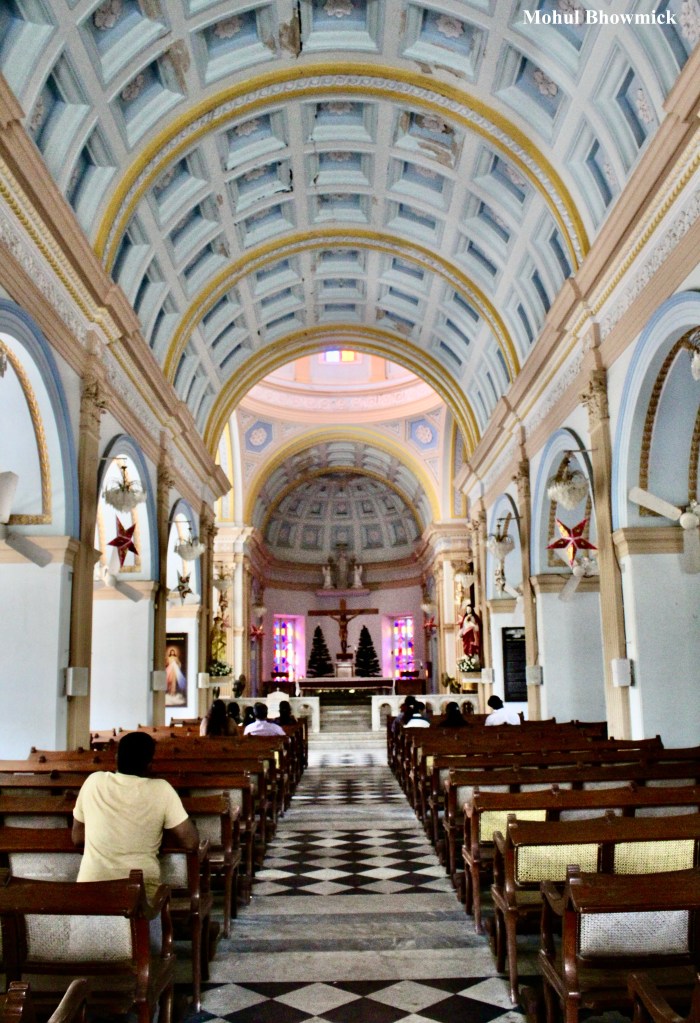
The Basilica of the Sacred Heart of Jesus, towering above the modest remains of Mahatma Gandhi Road, buffered the excesses that Our Lady of Angels (or Notre Dame des Anges – you tended to pick up lingua colonia in Pondicherry) gracefully bypassed. The ashram of the terrorist-turned-mystic Aurobindo Ghosh sat quietly on Rue Marine. To capture the whiff of spirituality by contact two lanes away on Rue de Dupleix was not to ask for much.
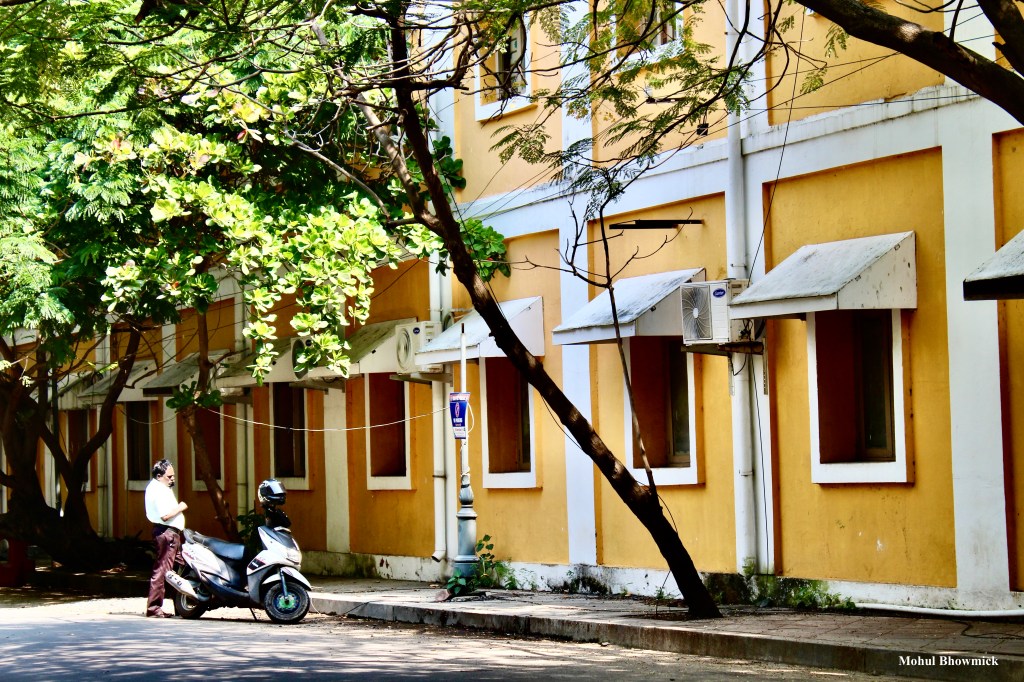
Yellow buildings in French Pondicherry Church of Notre Dame des Anges
The breath of fresh air that Ananda Adyar Bhavan up the same road promised but did not deliver remained just as it was when I had last come here three monsoons ago; in a stubborn reluctance to offer it anything but importune wisdom, I remembered being carried away by Alexander Dumas’ The Count of Monte Cristo (1846).Yet, it befitted the traveller to note that Rue Dumas honoured the colonialist Pierre Benoît Dumas[1], and not the man considerably greater than him. Of course, the French celebrated Dupleix[2] far more, as evidenced by a huge monument dedicated to him at the end of Goubert Avenue. To them, he was the greatest hero in a world where Napoleon was yet to be born, and where the English did not have Cromwell and the Americans had not seen Washington.
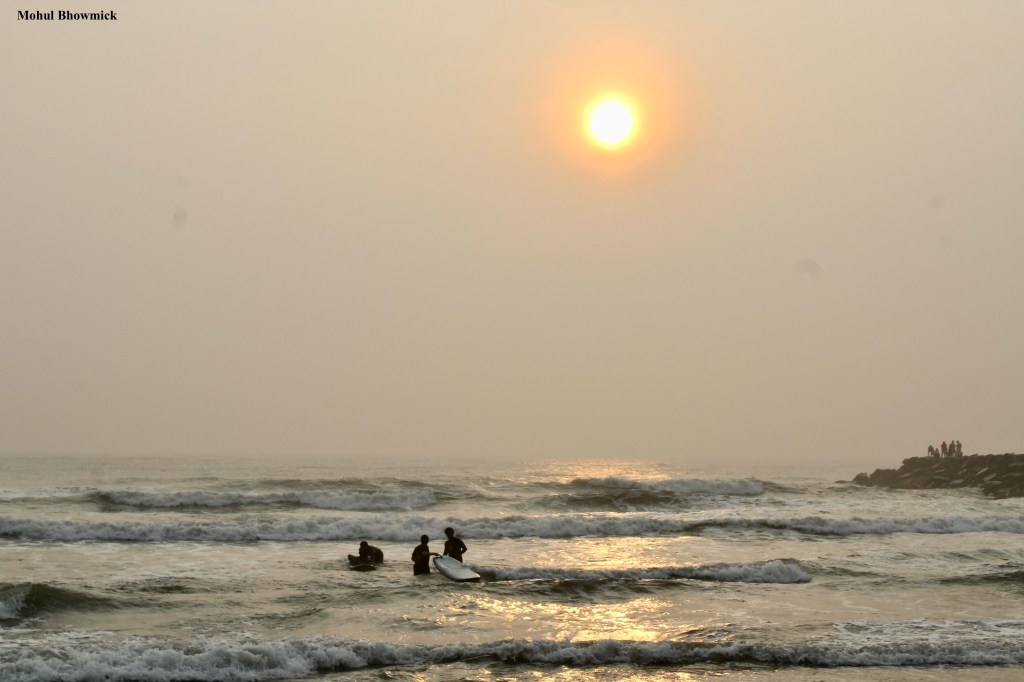
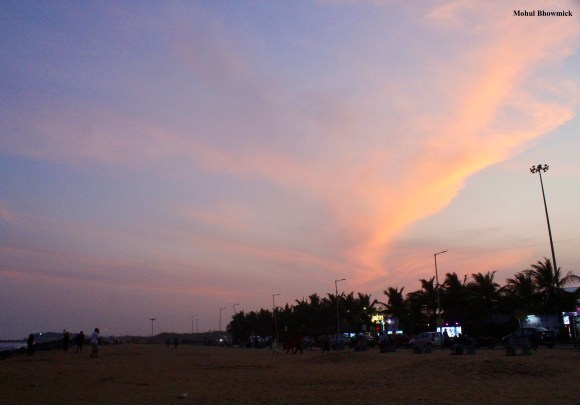
The sun bypassed the graceless winds that set up shop on the Promenade every evening; frequented far more by tourists than locals, it risked losing its sheen as something more than a weekend destination. But the coffee — of course, the coffee — whose aroma one could smell five streets away, was only a tad more appealing than the Pain au chocolat in all the bakeries of Pondicherry, upon whom entire paeans could be written.
To be carried away by such history was a must in Pondicherry; to stay sane, all one had to do was avoid mixing one’s emotions up in the Black Town, and be carried away by scarcity, poverty and destitution while crossing the canal between Netaji Salai and HM Kassim Salai. When I asked a fumbling Frenchman as to why the most significant roads of Pondicherry were named after men who vociferously advocated for self-rule, he told me that he did not know much about de Gaulle, and that his companion, a mild-complexioned young woman to whom being a liberal meant the same as being a libertine, had not read Voltaire.
“In the heart of every Frenchman, there is wine,” I said, quoting Ramanujan, who had been to Strasbourg and Marseille by road, but this only elicited the tiniest of smiles from a pockmarked student from Nantes who had read Hugo, and to whom the world was only just showing its vraies couleurs. It was all she could do not to stand in attention and belt out La Marseillaise under the mid-afternoon sun on Rue de Bussy.
[1] Pierre Benoît Dumas (1668–1745) was the French Governor General for Pondicherry
[2] Joseph Marquis Dupleix (1697-1763), Governor general of French India
Mohul Bhowmick is a national-level cricketer, sports journalist, poet, essayist and travel writer from Hyderabad, India. He has published five collections of poems and one travelogue so far. His latest book, The Past Is Another Country, came out in 2025. More of his work can be discovered on his website: www.mohulbhowmick.com.
.
PLEASE NOTE: ARTICLES CAN ONLY BE REPRODUCED IN OTHER SITES WITH DUE ACKNOWLEDGEMENT TO BORDERLESS JOURNAL
Sitting up, unconjured by thoughtless easel,
a turpentine painter runs through all the permutations
of light and license – the early sunrise crawling his curtains
with sleepless termites; this is how the unrendered morning
will appear to proxied bothered mind, precursor to eager
foot traffic by hours.

It is said to be quite unhealthy to stew in the quicksand
of one's own thoughts, to wander as doddering widower
might, muttering gibberish before a return to prolonged silence:
Washington Square had its own hanging tree,
an old execution ground long before it became the Village.

And one may feel ghosts upon shivered nape, but never see them.
Never know them like the neighbourhood bodega*, that smell
of simple courage.  The binding of someone not named Isaac.


*Small neighbourhood shop
Ryan Quinn Flanagan is a Canadian-born author residing in Elliot Lake, Ontario, Canada with his wife and many bears that rifle through his garbage. His work can be found both in print and online in such places as: Evergreen Review, The New York Quarterly, Borderless Journal, GloMag, Red Fez, and Lothlorien Poetry Journal.
.
PLEASE NOTE: ARTICLES CAN ONLY BE REPRODUCED IN OTHER SITES WITH DUE ACKNOWLEDGEMENT TO BORDERLESS JOURNAL
Imagine a land of milk and honey, a destination, where manna rains down to nourish us all.
In that space, greed and hunger have no room. Trust reigns. Even fear disappears.
We no longer startle at loud sounds or imagine shotguns mowing down innocent bystanders.
There’s no standing army. Penguins walk freely in the Falklands, where once men were afraid to tread because of land mines.
We lock eyes, find glimmers of smiles, trust our leaders. We break bread with strangers because there aren’t any.
Miriam Bassuk is inspired by her daily walks — the teeming life of eagles, herons, and the occasional sighting of Orcas that thrive in the Puget Sound. She has been published in The Journal of Sacred Feminine Wisdom, Raven Chronicles, PoetsWest Literary Journal, and 3 Elements Review. She was one of the featured poets in the digital portion of the WA 129 project sponsored by the Washington State poet laureate.
.
PLEASE NOTE: ARTICLES CAN ONLY BE REPRODUCED IN OTHER SITES WITH DUE ACKNOWLEDGEMENT TO BORDERLESS JOURNAL
“If Washington goes to Dhaka, there’s a chance that Paris might make it to Stockholm. And of course Moscow would be moved to Geneva!?”
Sounds like gibberish? But this is a piece of the speculative conversation on transfers and postings that is regular in the drawing rooms of embassies and consulates, Dr Reba Som found out on her very first posting after her marriage with Himachal Som.
Both were Presidency graduates pursuing higher careers — he in Foreign Service, she on the threshold of a doctorate. But life as the wife of an ambassador wasn’t only about glamour postings, fancy holidays and brush with celebrities. It was a mixed bag of blessings, as the woman who had grown up in Kolkata with a grounding in Tagore’s music would soon conclude. For, there were the dark clouds of life away from ageing parents and school going children; from the comfort of familiar food and mastered language; from developing your potential and crafting your own identity in the world out there.
In recent years we have read accounts of retired ambassadors and career diplomats’ experiences in diplomatic life. In her memoirs, Hop, Skip and Jump; Peregrinations of a Diplomat’s Wife, Dr Som’s is a woman’s voice, abounding in stories and observations about how the spouses keep a brave front in alien surroundings to hold up the best image of her country. In this conversation, she voices outmore about her encounters with racism, with political emergencies and exigencies. In short, about her lessons in a borderless world of multicoloured humanity.
You went to Brazil (1972), then to Denmark (1974), then Delhi (1976), Pakistan (1978), New York (1981), Dhaka (1984), then Ottawa (1991), Laos (1994), Italy (2002). Please share your gleanings from these lands.
The roller coaster ride was a saga of discovery. Travelling across expanses of the planet earth that we had seen only on the pages of geography books and atlases was a great learning experience. I gained an understanding of diverse cultures, imbibed social customs, became proficient in languages, and was exposed to exotic cuisines. At the same time I faced homesickness. Each posting entailed the challenge of uprooting oneself, finding schools for children, and reinventing oneself every time.
A large part of this life was in the years that had no mobile phones, no video calls, no social media, no internet communication. What did you thrive on?
Continents and hemispheres away from home, the only link with family and friends then was the diplomatic bag. The weekly mail service ferried across oceans by the ministry in Delhi contained letters and parcels from home. We were asked to judiciously use the weight allowed to bring spices, tea, condiments, clothing and other necessities. It became a ritual to write long letters and send them weekly by the diplomatic bag to Delhi from where they would be posted to respective destinations throughout India.
Along with letters would come bundles of magazines and newspapers. These brought us news of home from which we were truly cut off. With no television or internet or phone calls, we were in the dark about all news, be it political, social or entertainment. Every week on the bag day we waited anxiously to receive the newspapers – and the letters, which had instructions, news, recipes, advice, gossip. All of these were crucial for nurturing our souls.
One telegram from my father in 1973 carried the cryptic message: ‘Reba, solitary First class.’ These were the MA results of Calcutta University which were out after a delay of two years.
I was most taken up by the understated humour of some of your encounters in your memoir. Please recount some of them.
On our very first posting, to Brazil, not only our unaccompanied baggage but also our accompanied baggage did not arrive. Eventually when the lost luggage showed up, Himachal’s ceremonial bandhgala[1]was steeped brown — in the colour of the gur[2] my mother had lovingly packed in!
In Brazil, we found the people to be fun loving but too flamboyant. They made tall claims that their institutions were the biggest in the world. But reality often proved the claims to be hollow. Such was the Presidential bid to make the tallest flag pole in the world in Brazil’s new capital, Brasilia. A very tall flag mast was indeed built but the huge flag atop it was torn to shreds since the engineers had not factored in the wind speed at that height. Brazilians mirthfully called it the President’s erection!
And at Denmark. we were surprised by a sudden news of our posting to Mozambique. We had long realised that we were mere players on the chessboard of postings – we could be shunted off across continents at the whims of the powers that be. By the same token, a couple of phone calls by the newly arrived ambassador undid the mischief. We were happy to unpack and settle down again. The only guilt I felt was when I met the owner of Anthony Berg chocolates: I had in no time demolished the entire carton of chocolates he had sent as farewell gift!
You are among the few I know who have mothered in different continents. So how different is it to become a mother away from India?
I always felt that the best way to get to know certain nuances of a country’s cultural tradition was to have babies in them. My elder son, Vishnu was born in Copenhagen and Abhishek, the younger one, in New York — and my experiences each time couldn’t be more different.
In Copenhagen, a social democrat country, hospital visits for full term pregnant women were fixed on a certain day of the week. On the preceding day they had to collect their urine in a jerry can and present it for lab examination. I was confounded and not a little embarrassed to meet other mothers-to-be, swinging their jerry cans like designer bags without fail on the appointed day. I learnt only later that, from the urine examination doctors would note the condition of the placenta and not unnecessarily rush patients into childbirth with caesarean and surgical intervention!
In NY, on the day of my discharge, the hospital staff were highly excited because Elizabeth Taylor had come in for one of her facelifts. I could not forgive them their magnificent obsession when, along with a goodbye hamper, they wheeled in a bassinet with a different baby. On my protestation the nurse rudely shouted, “Can’t you read… the tag says Som Junior?” Shocked by the implication I said, I could not only read but also see! And it was not my child. While everyone was looking on in disbelief another nurse wheeled in my little one. The babies had their diapers changed and were put back in the wrong bassinet.
Years later, we discovered in an informal meeting with an American ambassador that Abhishek was indeed an American citizen. Because, at the time of the child’s birth Himachal was posted not to the embassy in Washington but to the consulate in New York. Only consulate children were given the privilege. This discovery, rechecked by State Department Records, gave our son the US passport. It was a windfall as Abhishek went on to graduate summa cum laude from a prestigious management school in the US and enter Wall Street as an investment banker.
I must also share another truth about birthing away from India. Before Vishnu’s birth, my parents had come to Copenhagen. When I was discharged from the hospital I received their care and being fed Ma’s cuisine was the best gift I could have. So, when phone calls came from hospital, followed by visits enquiring about my state of depression, I was totally confused. I realised how many mothers suffered from postpartum depression in a society bereft of nurturing family care.
How could you master languages as removed as Portuguese from Lao and Italian from Urdu? Is a flair for languages the key to this proficiency or the training imparted before each posting?
I enjoy learning languages. My stint at learning French at Ramakrishna Mission Golpark stood me in good stead in grasping Portuguese in Brazil, French in Ottawa and Italian in Rome — all Latin languages. But there was also the hazard of mixing up some phrases and words, so similar yet so different! Like Bon Appetit in French and Bueno Appetito in Italian. Or Amor in Portuguese; amore in Italian and amour in French.
Sometimes though, I accidentally learnt how language travels. My mother had packed in many petticoats to match with my saris but without their cord. We went to a store that promised to hold all we need but all my sign language did not bring what I needed. “Phita is obviously not available here,” I told Himachal, preparing to leave. Suddenly the storekeeper perked up. ‘Fita, si senhora!” he said and produced bundles of cord.
In due time I found out that janala, kedara and chabi – Bengali for window, chair and keys – had travelled from India to become janela, cadeira and chavi.
What did Dhaka mean to one raised in West Bengal – per se the Ghoti-Bangal[3]divide, your roots or the cultural side with Firoza Begum and Nazrul Geeti?
Dhaka was a great posting in so many ways. It was a hop, skip and jump away from my home town Kolkata, with the same language and culture and yet was a foreign posting with foreign allowances!
As you know, there’s a subtle cultural difference in East and West Bengal. Both speak Bengali but in East Bengal, it’s a colloquial rustic dialect while West Bengal speaks its refined cultural form. This formed the infamous ‘Ghoti-Bangal’ divide: Urban Calcuttans looked askance at their country cousins from the East.
The difference extended to the palate. East Bengalis flavoured their dishes with more chillies and West Bengalis, with a pinch of sugar. For the fish loving people, the two iconic symbols are Hilsa and Prawns, for East and West. Emotions soared high in Kolkata when the supporters of the football teams, East Bengal and Mohun Bagan, clashed, after intensely fought matches that spurred deadly arguments and bets.
Given this background, Himachal created a minor storm by announcing to his parents from Chinsurah, Hooghly in West Bengal that he would marry a girl whose parents were from Dhaka and Faridpur in East Bengal. Ghoti-Bangal feud remained the subject of much friendly banter between Himachal and me until we were posted in Dhaka. There, in a diplomatic turnaround, Himachal played down his Ghoti background to announce that his mother’s family was from Chittagong and he was born in the principal’s bungalow in Daulatpur, Khulna, where his grandfather was posted.
To give a bit of Himachal’s family background: Dr Pramod Kumar Biswas, the first Indian doctorate in Agricultural Sciences from Hokkaido University in Japan, had settled in Dhaka as principal of the Agricultural College. His charming daughter Kana won the heart of Dr Rabindranath Som, a veterinarian who weathered the predictable Ghoti Bangal storm to win her hand in marriage.
When my parents Jyotsnamay and Manashi Ray visited us, we couldn’t visit Patishwar in Rajshahi district, where my maternal grandfather Atul Sen had worked with Rabindranath Tagore before he was arrested for revolutionary activities with Anushilan Samiti, and exiled to Kutubdia, an isolated island in the Bay of Bengal. As a headmaster, he had given shelter to Jatirindranath Mukherji, popularly known as Bagha Jatin[4].
It was a breezy day when my octogenarian father revisited Faridpur Zilla School. The colonial bungalow had acquired a fresh coat of terracotta paint. Finding his way to the headmaster’s room, he announced with a lump in his throat that history had been rewritten, boundaries redefined and new national identities forged since 1923, the year he had matriculated.
The headmaster, delving through yellowing files, fished out the matriculation results for that year. My father’s face was that of an excited school boy impatient to show off his prowess: “Look at my maths marks! Oh yes, my English scores were a trifle lower than expected because I had a touch of fever, but look at Jasimuddin’s marks in English! Thank God, he passed it.” We looked around in hushed surprise. This isn’t The Jasimuddin, the beloved poet of Bangladesh? “But of course,” my father responded. “Jasim’s weakness in English was my strength!”
Dhaka was also personally fulfilling as my doctoral studies, which I had carried across three continents, found fruition at last! On another front, I met with success in gaining the confidence and blessings of Firoza Begum, the legendary exponent of Nazrul Geeti.
The songs of Kazi Nazrul Islam were a great favourite of my father. He often hummed those made famous by Firoza Begum. Since I had trained in Tagore songs from age five, I never aspired to master the distinctly different style of rendition. A chance encounter with the golden voice revived this desire. Firoza Begum bluntly refused. When I persisted, she wanted to hear me sing a few Tagore songs.
One morning I mounted three flights of steps, harmonium on my driver’s shoulder, to enter her flat with apprehension. At her bidding, I sang four songs of Tagore. She heard me without any comment, then she asked why I hadn’t been singing for Bangladesh television. My relief was palpable! I had passed her test.
Over the next two years, my weekly classes with her extended well beyond the music lessons to serious discussions on life itself and the meaning of religion. What began as a guru-shishya[5]relationship, transcended to deep friendship. She declined any remuneration and dearly wished that I should cut a disc. This wish of hers came true only when Debojyoti Mishra heard me and decided to record my Nazrul-songs for Times Music in 2016.
Food is perhaps the first face of culture. So please share with us some of your culinary adventures. Or should I say ‘fishy’ stories?
Adventures? I could talk about the chapli kebabs in Pakistan, or about putting samosas in Bake Sales. I could tell you about making rasgullas from powder milk. I could even tell you about our gardener in Laos who merrily collected every scorpion and caterpillar that came his way, “for snacks,” he told me. But let me focus on fish.
The very first party I hosted at home in Brazil led me to seek substitutes for Indian ingredients. Fish of course had to be on the menu, mustard fish at that. I had already learnt from the Brazilian ambassador in Delhi that surubim, being boneless, was the most suited for curries. So surubim it was for months until the day I had to go to the fishmongers – and found it was a monster of a whale!
In Pakistan, traversing the arid countryside of Sind, the train would stop at stations where fillets of pala were being shallow fried on large skillets. Savouring its delicate flavour we went into a discussion on the merits of pala versus hilsa. Both have a shiny silver body with thin bones, both swim upstream against current. The taste of hilsa steam-cooked in mustard sauce is a super delight in both Dhaka and Kolkata. There of course the discussions are on the merits of the hilsa from Padma and Ganga respectively.
In Laos I once called the plumber to ease the draining of the bathtub since the pipe had got clogged. He arrived with a live fish in a plastic bag and promptly emptied it into the pipe. It would eat through the slush as it travelled through the pipe, he assured me!
Post retirement, Himachal settled to honing his culinary skills. Cooking, which he had started in Ottawa, became his lasting hobby. He would shop for fish in C R Park or INA Market[6]. He would pore over cookbooks and plot innovative recipes. “Cooking,” he was quoted in Outlook magazine, “is art thought out with palate.” And his piece de resistance was the salmon baked whole.
Which was your most cherished, or striking, brush with celebrities in world history?
At one of the finest dinners in Copenhagen I found myself seated next to a countess. She invited me to visit her since she lived in the neighbourhood. The next day a liveried man arrived to escort us to an imposing manor house. We were welcomed with sherry and we had to select a card from a silver salver with the name of our partner for the dinner. I was escorted by a handsome young man who floored me when we exchanged names. He was the descendent of Count Leo Tolstoy!
Another memorable encounter was with a person straight out of the history books. I was strolling in a forested park outside Copenhagen. I noticed with a shock that I was looking into a glass topped coffin. The aristocratic face inside had an aquiline nose and a goatee that lent a refinement to the visage that still sported a faint smile. The starched lace collar was held in place by a jewelled button that showed impeccable taste. But the elegant hands tapered off to skeletal fingers, and the feet too had become skeletal.
The plaque at the bottom of the coffin informed us that this was James Hepburn, the Earl of Bothwell, with whom Mary, Queen of Scots had fallen in love. It was a fatal attraction since both were married. But soon her husband, Lord Darnley, the father of her son James, the future king of Scotland and England, was mysteriously burnt down in a manor, and Bothwell was granted a divorce. However, their marriage incensed Catholic Europe, so Mary gave herself up to buy the release of Bothwell, who fled to Denmark.
‘Whoever marries your mother is your father’: this dictum defines the acceptance of whatever political dispensation you are forced to live with, at home or abroad.So how did you cope with a turmoil like Emergency or antagonism in Islamabad?
We had returned to Delhi in the midst of Emergency. We felt some relief to see trains running on time and punctuality being maintained in government offices. Corrupt officers were being hauled up and over-population being addressed. But the atmosphere was sombre and conversations hushed. The deep scar left by the Emergency saw Indira Gandhi being swept out of power the following year.
In Islamabad tension had mounted when I arrived over the imminent execution of Zulfiqar Ali Bhutto[7]. Our residence had become the favourite watering hole for Indian and international journalists who knew Himachal from his Delhi days. Animated discussions over drinks were followed by quick despatches typed out on my rickety typewriter. Unending speculations on the unfolding drama had kept us on tenterhooks. Then one morning in April 1979, the phone rang to say, “It’s done.” [8]
How did Italy change your life?
Italy was easily the best posting of my life in embassies, not only because of its rich history. There I found Italian artists painting inspired by Tagore’s lyrics, and singers like Francesca Cassio singing Alain Danielou’s translations. What made them take it on? The question led me to rediscover Tagore.
My singing of Rabindra Sangeet also found recognition in Rome. My first CD album was released there. I was in many concerts. It was so fulfilling when my translation of Tagore’s lyrics into English found appreciation. Tagore himself believed that his songs were ‘real songs’ with emotions that speak to all people. I began translation in earnest. And that led me to write Rabindranath Tagore: The Singer and his Song (Penguin 2009). The book, with my translation of 50 Tagore songs, was considered very useful to many performing artistes who could understand and represent Tagore better in their art forms.
Please tell us about growing up with Tagore.
Like many girls in Kolkata I began learning Rabindra Sangeet from the age of five. Over the years the songs grew on me. The unique lyrics conveying a gamut of emotions spoke to me when I was far away on postings abroad. I continued my practice of the music through the years and felt vindicated when I got the opportunity to perform to appreciative audiences abroad and back in India.
Why did you work on his songs rather than his poems or stories?
There’s something compelling about Tagore songs. Remember that Gitanjali, which won him the Nobel, was a collection of ‘Song Offerings.’ Songs had given Tagore the strength to ride over the tragedies that had beset his life. They not only helped him express his grief over the deaths and suicides in his family, they were also his mode of expressing his frustration over the political situation that obtained then. And he felt his songs would help others too. “You can forget me but not my songs,” he had written.
Did you ever feel the need to jazz up the songs for Western audiences?
Tagore’s songs are like the Ardhanariswar[9] – the lyrics and the music are inseparable. The copyright restrictions that prevailed after this death did not allow translations. And that was a handicap since his music cannot be appreciated without comprehending his lyrics which are an expression of his creative thoughts.
I would say his songs have near-perfect balance between evocative lyrics, matching melody and rhythmic structure. And the incredible variety of his musical oeuvre touches every emotion felt by any human soul, without jazzing up.
Tagore’s songs are the national anthem of India and Bangladesh, and have also inspired that of Sri Lanka. But will his internationalism hold up with the change of order indicated by the recent developments on the subcontinent?
Tagore was known to be anti-nationalistic. He believed no man-made divisions can keep people segregated. He did not agree with the Western concept of ‘nation,’ he was an internationalist who accepted the ideals of democracy – ‘aamra sabai raja’[10], of gender equality – ‘aami naari, aami mohiyoshi’[11]; indeed, in equality of humans. What he wrote in lucid Bengali suited every mood. Georges Clemenceau, who was the Prime Minister of France for a second time from 1917 to 1920, had turned to Gitanjali when he heard that World War I had broken out. Even today people can relate to what he wrote.
How did all the hop skip and jump shape the feminist within Reba Som?
The wives of Foreign Service officers are often seen as decorative extensions of their spouses. People only saw the glamour we enjoyed on postings abroad, not the heartbreaks and disappointments we battled. Despite their qualifications the wives were not allowed to work abroad. Instead they had to be perfect hostesses: clad in colourful Kanjeevarams they had to prepare mounds of samosas and gulab jamuns.
But there was little recognition, appreciation or compensation by the Ministry of External Affairs of all the hard work and struggle they put in. To settle down in different postings in rapid succession. To host representational parties where they had to conjure Indian delicacies with improvised ingredients. To raise disgruntled children on paltry allowances.
Once, as the Editor of our in-house magazine, I had floated a questionnaire to all the missions abroad asking about the changing perceptions of the Foreign Service wives. That had opened a Pandora’s Box. Eventually in response to our requests the Ministry relaxed service conditions and allowed the wives to work abroad if they had the professional qualifications and received the host country’s permission. This was a veritable coup!
My own act of rebellion was accepting the Directorship of the Tagore Centre ICCR Kolkata (2008-13) after we returned to Delhi on Himachal’s retirement. It became a challenge for me to try and get the Tagore Centre on the cultural map of Kolkata, proving to myself and my disbelieving family in Delhi that it was possible!
Ratnottama Sengupta, formerly Arts Editor of The Times of India, teaches mass communication and film appreciation, curates film festivals and art exhibitions, and translates and write books. She has been a member of CBFC, served on the National Film Awards jury and has herself won a National Award.
.
PLEASE NOTE: ARTICLES CAN ONLY BE REPRODUCED IN OTHER SITES WITH DUE ACKNOWLEDGEMENT TO BORDERLESS JOURNAL
A writer, a painter, an actor too? Which of these have I known in my friend, Bulbul Sharma? Ratnottama Sengupta ponders as she reverses the gear in the time machine
Bulbul Sharma
I have never formally ‘interviewed’ Bulbul Sharma. That’s because I was editing her writings even before I met her, became friends with her, with her brother Dr Ashok Mukherjee, her sister-in-law, Mandira, whose brother-in-law, Amulya Ganguli, was a much-respected political commentator including with The Statesman and The Times of India which I joined after I shifted to Delhi.
There were many journalists in her family. Bulbul herself was a columnist with The Telegraph when I joined the ‘handsome’ newspaper. Her columns on ‘Indian Birds’ would always come with her own illustrations. These later combined to become The Book of Indian Birds for Children – and now she’s penning stories for neo-literates. So I have never been able to separate the two souls of Bulbul – a writer whose books have been translated into French, German, Italian, Finnish, and an artist in the collection of National Gallery of Modern Art, Lalit Kala Akademi, UNICEF, Chandigarh Museum, Nehru Centre, London, National Institute of Health, Washington.
Bulbul, born in Delhi and raised in Bhilai, studied Russian and literature at Jawaharlal Nehru University before going to Moscow for further studies, in 1972. When she returned a year later, she decided to pursue her other love and made a career in art. So, in mid 1980s, once I shifted to Delhi, I got to know the artist Bulbul at close quarters. By then she was an active graphic artist who worked in the Garhi Artists’ Studio.
She would do papier mache items – sculptures, or of day-to-day usage. Then, she was teaching art to children of construction site workers left in the care of the Mobile Creche. Soon she was handholding me in creating monoprints in printmaking workshops, while my son started taking serious interest in art even as he keenly participated in her storytelling sessions.
Paper mache sculpture: BowlAubergines & Onions: Etching from Ratnottama Sengupta’s collectionArtwork by Bulbul Sharma: Photos provided by Ratnottama Sengupta
And then one day Bulbul invited me to join her and Dolly Narang of The Village Gallery in Hauz Khas, to do a workshop with the inmates of Tihar Central Jail, one of the toughest in Asia, which had started off on its reformation trail under the no-nonsense IPS officer, Kiran Bedi, who dreamt of giving convicts “the hope for a better future once they stepped out as free people.”
The other avtar of Bulbul is the one you are most likely to encounter online. A gifted narrator who depicts people and places she has known and seen in person, styled with little complication, to bring out the beauty in everyday life. Her first collection of short stories, My Sainted Aunts (1992) had bewitched me as much as my son, then in his pre-teen years. For, it etched with endearing affection the reality in a Bengali household that abounded — especially in my childhood — with pishimas[1]and mashimas[2] who were eccentric yet lovable. These aunts are easily identifiable and not easily forgettable though few aunts today are widows in white, eating out of stoneware, shunning onions, or an ‘outsider’: caste, creed, chicken and dog — all were barred.
A few years down, Bulbul, a naturalist who grows herbs in her orchard in the folds of Himalaya and often etches carrots and onions, came out with The Anger of Aubergines (1997) which had cuisine and recipes layering the text. It is a collection of stories about women for whom food is passion, or obsession. “For some it is a gift, for some a means of revenge, and for some it is a source of power,” as Bulbul herself might summarise. Once again, my gourmet family loved it.
Food is the most elementary aspect of human society and culture. And Bulbul has repeatedly capitalized on this multi-contextual significance of food. Not surprising, when I was editing an Encyclopedia of Culture, for the publishing house Ratna Sagar, I directly went to Bulbul for the chapter on ‘Cuisine’. In quite the same way, when a literature festival in Amritsar’s Majha House got Bulbul and me together on a panel, it was to talk about food as an expression of culture. “Learn everything you can, anytime you can, from anyone you can. There will always come a time when you will be grateful you did…” Bulbul once told a classful of students what she herself has practiced through life.
But with all this, I had virtually forgotten that Bulbul had acted in a film by Mrinal Sen[3]. Bulbul herself reminded me of this after reading my interview with Suhasini Mulay[4] occasioned by the ongoing birth centenary of the director of watersheds in Indian cinema like Bhuvan Shome[5]. I promptly wrote to her asking her to remember the salient ‘truths’ she had learnt by acting in the first of Sen’s Calcutta Trilogy[6].
Interview (1971) was a slim tale – a uni-linear storyline that unfolds on screen as a non-linear narrative. Stylistically it was the opposite of Calcutta 71 (1972), the second of Sen’s Calcutta trilogy, which built on stories by eminent authors like Manik Bandopadhyay, Prabodh Sanyal, and Samaresh Bose. Interview was about Ranjit, whose love interest Bulbul, was enacted by Bulbul Sharma.
The story went thus: A personable, smart but unemployed Ranjit is assured, in Calcutta of the post-Naxal years, of a lucrative job in a foreign firm by a family friend – if he shows up in a suit. It can’t be such a big ‘IF’, right? Wrong. He can’t get his suit back from the laundry because of a strike by the labour union. His father’s hand-me-down doesn’t fit him. He borrows from a friend but, on his way home, a fracas ensues in the bus and the net result is Ranjit is without a suit to appear in for the critical Interview. Will he, must he, go dressed in the hardcore Bengali attire of dhuti-panjabi?
Just the year before, Pratidwandi (1970) had been released, and it too had an interview at the core of the script. The first of Satyajit Ray’sCalcutta trilogy[7], it had cast newcomer Dhritiman Chatterjee, who would play the pivotal role in Padatik (1973), the clinching film in Sen’s trilogy. But Interview had cast another newcomer who was crowned the Best Actor at Karlovy Vary for playing Ranjit. In subsequent years, he became a megastar of the Bengali screen whom Ray too cast in his penultimate film, Shakha Prosakha (1990). And even as he was scoring a century in films, Ranjit Mallick’s daughter, Koel, was scaling heights as a lead actress.
Bulbul Sharma and Ranjit Mallick in Interview: Photo provided by Ratnottama Sengupta
Contrast this with Bulbul: She did not pursue a career in acting. So how had she come to play the Bulbul of Interview? Let’s hear the story in her own voice.
Bulbul Sharma: I was visiting my cousin sister Sunanda Devi — Banerjee who was a very renowned Bengali actress in the 1950s. She had featured in New Theatre’s Drishtidan[8] (1948), directed by Nitin Bose; Anjangarh[9](1948), directed by Bimal Roy; opposite Uttam Kumar in Ajay Kar’s Shuno Baranari[10](1960) and Chitta Basu’s Maya Mriga[11](1960).
Sunanda Didi and her husband[12], who was a film distributor, had produced Mrinal Sen’s first film, Raat Bhore[13](1957). Mrinalda had come to her house to discuss something with her husband and he saw me. He asked my cousin if I would like to act in a Bengali film. I was 18 years old and a student at JNU then. I was thrilled but my parents were not keen at all. However, though reluctantly, they agreed since it was Mrinal Sen. By this time he had won national and international awards with Bhuvan Shome.
Me:How did you prepare for the character? Did Mrinalda brief you? I don’t think he had a script in hand…
Bulbul: I did not do anything to prepare. My name in Interview is ‘Bulbul’, and Ranjit Mallick is ‘Ranjit’. Mrinalda said, “Be your natural self. Don’t try to act.” In fact I am an art student in the film. The only problem was that since I had lived all my life in Delhi, my Bengali accent was not very good. He often teased me about it. “Keep that smile for my camera,” he would say to me.
Me:Tell me about your co-actors Bulbul. Do you recall any incident that stays on in memory?
Bulbul: I remember my co-actor, Ranjit Mallick, was a serious, very quiet person. I think he got fed up of my constant chatter. He asked me once if everyone in Delhi talked so much. I was not surprised that he became one of the biggest stars in Bengali cinema but we did not keep in touch, alas.
Me:Why did you not think of pursuing acting as a career?
Bulbul: Acting was not something I had ever thought of doing. This film just happened by chance. Painting and creative writing was my passion and still is. But don’t lose hope! Recently I was offered a role of a grandmother. I might just do it!
Me:How did you respond to Interview when it released more than 50 years ago? And how do you respond to it now?
Bulbul: When I saw the film almost fifty years ago I don’t think I really understood what a brilliant film it was. I was 18 and just happy to see myself on the big screen.
Now when I saw Interview again, I really admired the way the everyday situations in a middle class Bengali home are played out. The scene when Ranjit’s mother, the great actress Karuna Banerjee – who had played Apu’s mother in Pather Panchali – searches for the dry cleaner’s receipt is just heart breaking.
The interview scene itself is so sensitively done. You want Ranjit to get the job but you know it will not happen. There is such understated humour, anger and sadness in that scene. I wish I could tell Mrinalda all that today!
Me:Interview, the first of Mrinalda’s Calcutta Trilogy, is considered a milestone in his oeuvre because of its socio-political content as well as its naturalistic form. How does it compare with the other two films of the Trilogy – Calcutta 71 and Padatik?
Bulbul: Unfortunately I have not seen these two films.
Me:Would you compare it with Ray’s Pratidwandi which also centred on a job interview?
Bulbul: Yes, Ray’s Pratidwandi also deals with the theme of unemployment during that turbulent period – 1969 to 1971 – in Kolkata. Yet they are not at all similar.
I think Mrinalda’s slightly impish, dark humour is lacking in the other film. Both are amazing films by our most brilliant directors. Films you very rarely get to see now.
Silk Painting with Kantha stitch by Bulbul Sharma Photos provided by Ratnottama Sengupta
Okay Bulbul, now my son and I will both wait to meet your onscreen Grandma avtar!
[6] Three films by Mrinal Sen: Interview (1971), Calcutta 71 (1972), Padatik (The Guerilla Fighter, 1973)
[7] Known collectively as the Calcutta trilogy, The Adversary (1970), Company Limited (1971) and The Middleman (1975) documented the radical changes Calcutta.
Ratnottama Sengupta, formerly Arts Editor of The Times of India, teaches mass communication and film appreciation, curates film festivals and art exhibitions, and translates and write books. She has been a member of CBFC, served on the National Film Awards jury and has herself won a National Award.
.
PLEASE NOTE: ARTICLES CAN ONLY BE REPRODUCED IN OTHER SITES WITH DUE ACKNOWLEDGEMENT TO BORDERLESS JOURNAL
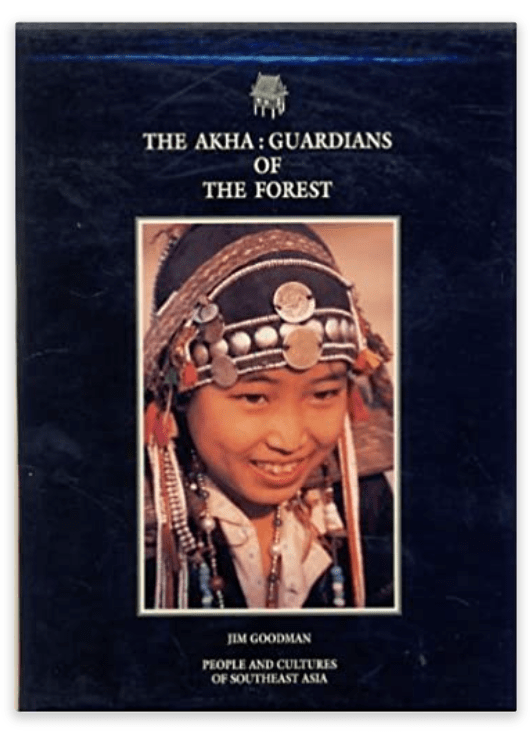
Jim Goodman, an American traveler, author, ethnologist and photographer who has spent the last half-century in Asia, converses with Keith Lyons.
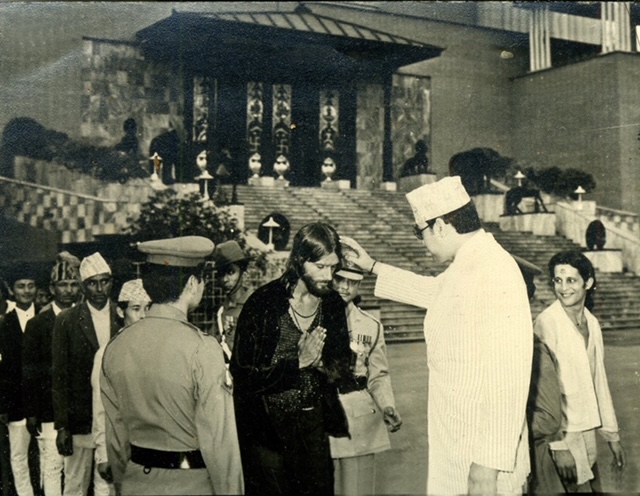
Jim Goodman in Nepal at Dasain being blessed by King Birendra, October 1978.
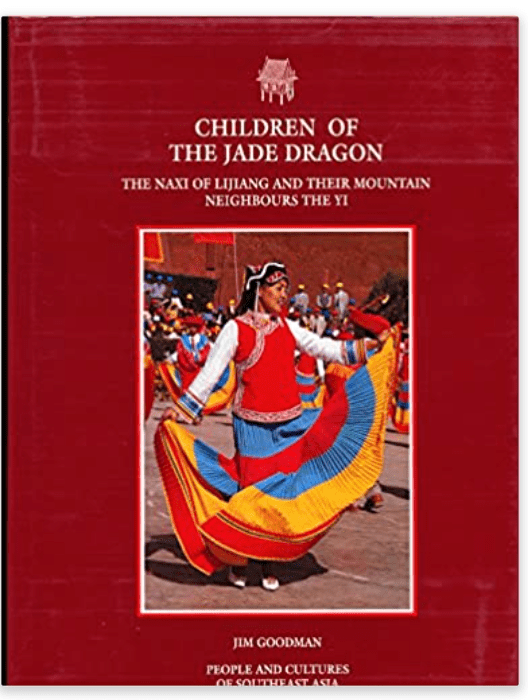
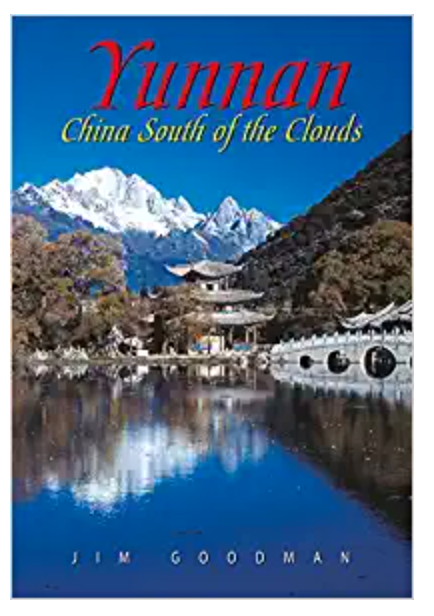
Jim Goodman is something of a legend in Southeast Asia and Eastern South Asia. His definitive guide to southwest China’s Yunnan province was the most sought-after travel book for any intrepid backpacker wanting to get off-the-beaten-track in the ethnically-diverse province bordering Vietnam, Laos, Myanmar and Tibet. That’s how I first came across Jim, through the well-thumbed pages of his The Exploration of Yunnan. Back then, I marvelled at his ability to venture into areas that were only just opening up to foreign travellers, and the breadth and depth of his knowledge of different ethnic minorities. It was almost 20 years later that I finally met Jim in person in a cafe inside the old city gates of northern Thailand’s Chiang Mai, where he has been based since 1988. Later, on a media trip to the Golden Triangle’s eastern Shan state hill-tribe villages, I saw how Jim’s interactions, appearance (and conversation in ethnic language) endeared him to local minorities.
He has published books in Nepal, Singapore, Thailand, China and Vietnam, and also worked with ethnic minorities, including on textiles with Newars in Nepal and northern east Indian Mizos, and on traditional handicrafts with Akha in northern Thailand. “Besides acquiring new labour skills—I was the dyer and designer—the work gave me valuable insights into the different cultural norms and ways of thinking of traditional societies in this region,” he once wrote. “My writing, research and photography reflect my fascination with history, traditional cultures and ethnic minorities, not just in the ethnologies, cultural studies and histories I’ve published, but in my fiction and poetry as well.”
You were born in the US capital Washington D.C. and raised in the Midwest in Cincinnati, Ohio. Growing up in the US, what do you think contributed to your interest in different countries and cultures?
As a kid I was fascinated by American Indians, especially those from the western plains and the southeast. My father taught Latin American history at Xavier University in Cincinnati. He and my mother were members, later chairmen, of the Foreign Students Welcoming Committee. Every American holiday — 4th of July, Thanksgiving, Christmas, etc — we had foreign guests. They were from India, Nepal, Tunisia, Thailand, Colombia and Nigeria. They aroused my natural curiosity.
How were your first experiences of ‘foreignness’ in the US and then overseas?
I stopped believing in my parents’ Catholicism by the time I was in high school and for the next few years felt like a foreigner in my own family and neighbourhood. In later years, when I was living in Europe or Asia I was always conscious of being foreign, especially in things like double pricing, but I integrated socially enough not to let it bother me. Occasionally, that worked in my favour. In Korea in the 70s, males were forbidden by law to grow their hair over their ears or past the collar. Every four or five months the police carried out widely publicised roundups. But foreigners were exempt.
What was it like growing up in the 1960’s in the US?
It was very exciting. Thanks to the civil rights and anti-war movements it was easy to challenge the system intellectually and practically. The drugs and music, a very new kind of music, also contributed to this sense of the times are changing everywhere and lots of options were possible. It was an amazingly optimistic decade.
How did you come to be in the army, and what was your experience as a soldier in Germany and later South Korea?
I got my draft notice in the summer of 1967, at the peak of the Vietnam War, when 80% of those drafted were sent off to Vietnam after training. So I took the enlistment option, signing up for an extra two years, with one year at the language school studying Arabic. War might be over by the time I finish the course, I thought, and anyway they wouldn’t need an Arabic translator in Vietnam. But the Army inserted a little clause in every contract, “subject to needs of the Army,” that let them do what they liked. When I arrived at the language school, after basic training I was told my orders had been changed. I had to go back and wait for new ones. Eventually they put me in a tank training unit, but by the luck of the draw I was in the company sent after training to Germany, while the other three were dispatched to Vietnam.
In Germany, I served in an armoured unit which was very often in the field. However, this was 1968 and I managed to get a pass to go to Paris in early June and marched down the avenues with the students and workers singing L’internationale over and over. I still know the first stanza, in French. I also met Arab officers from Jordan and Libya and took a month’s leave in the autumn to have my 21st birthday in Beirut. On my first night in Beirut, a South Yemeni staying in the same hotel told me there were three good reasons to travel. The first was to meet the different kinds of people living in this world. Second, was to try the various local foods and drinks. And third, was to appreciate the scenery and historical monuments. I never forgot the order in which he listed those attractions: people first. Throughout my trip, I wore a button on my shirt that said Restore Palestine to the Arab People, which guaranteed a good reception everywhere in Lebanon and Jordan. I was very active politically by then and the following spring published the first anti-war newspaper by a soldier in Europe. That later got me transferred to Korea, the only place there was no organised anti-war soldier activity. In Korea, I was in charge of the Photo Lab, where I learned the basic principles of photography. Also joined rock bands as a singer, so I wasn’t very political in Korea, except for some of the song lyrics.
After your time in the army, how did you get back to Asia?
I was discharged in Seattle in January 1972, went to San Francisco to live and later got a clerk-typist job with General Services Administration. Then my boss recommended me for a low-ranking administrative position. I would have been in charge of the installation of furniture in the California offices of the state’s two senators. Not exactly exciting work, but anyway I had to get a security clearance, starting with answering a questionnaire with things like ‘are you now or have you ever been a member of the Communist Party’ and ‘do you advocate the overthrow of the US government by force or violence’.
I answered no to everything, but within 24 hours the office got back a disapproval of my application “for security reasons”. After that news got out, everybody in the building thought I was a terrorist, and that was before terrorist was a household word. It was doubtless my activity as an anti-war soldier but it meant I would really have no future in my country. I went to Korea that autumn on a one-way ticket without enough money for a round-trip. (I don’t think that’s even possible anymore.) I met other ex-GI’s in Seoul who gave private English lessons, so I did, too. In the second year, I got hired by Language Teaching Research Center, which didn’t use textbooks and so I made up my own lessons. I spent free time among soldiers on the army base and in off-base bars and would listen carefully to their conversations. Whatever they said that I thought my students wouldn’t understand, I wrote down and worked it into my lessons. It was a wonderfully creative job and made me especially conscious of my own language.
What happened for you to leave Korea and ending up almost dying and in jail in Nepal?
My last summer (1976) in Korea, I met travellers who had been to India, Nepal and Southeast Asia. Later that year I got busted for a small amount of grass and, near the end of the year, was expelled from Korea. India and Nepal seemed a natural place to go next. It wasn’t easy in the beginning and once in Calcutta, I got robbed of everything and went over three weeks without eating. I was kind of resigned to dying by starvation but a Muslim street merchant recognised the situation, paid my bills and lent me enough money to get back to Kathmandu. Everything seemed fine but when I finally ate a meal I vomited it all a few minutes later. Body won’t take food, eh? Guess I’m going to die after all. He said don’t worry, wait a little and try again. He had witnessed the same thing with starving Bengali refugees during the break-up of Pakistan. He was right. The next meal was fine and ever since then, I’ve not worried about, for one reason or another, missing a meal or two. I missed meals three and a half weeks and got by.
And you spent some time in jail, not just in Kathmandu but in Korea?
I was three weeks in Korean solitary confinement until my girlfriend bailed me out. Longer, about four months, in the holding centre in Kathmandu, where those arrested awaited trial. I was busted for a lot of hash but charged with both possession, 10,000 rupees fine, and exporting, 100,000 rupees fine (about 70 to a dollar then). I pleaded guilty to possession only. The judge dismissed the exporting charge because the hash was found in my home, not at any border. However, to save face, the prosecutor appealed the acquittal for exporting. The appeal had to go to the special court, which only met once a week, so cases piled up. In Nepal, you don’t bribe the judge. You bribe the clerk to put your case before a sympathetic judge. I wasn’t going to hurry up the case because then I would have to leave the country afterwards. The prosecutor wasn’t going to speed up the proceedings because he still would have no evidence and would lose again. Meanwhile, I was free to continue my Nepal life. For over a year the government’s attitude to me was like a joke. They thought I had figured out how to beat the system. The following year, I became an embarrassment and the year after that, with a new government, it became an issue and I finally got a new passport and left Nepal for a month’s holiday in Thailand.
What took you to Assam, and what made you later leave?
It was one of the few places in India I hadn’t visited yet. It had an interesting separate history from the rest of the country and was surrounded by many fascinating ethnic minorities. My first trip was in the autumn of 1979, when I was paid to take an American woman and her daughter, whose tutor I was, to Darjeeling, Sikkim and Kaziranga, the rhinoceros park in Assam. The Assamese anti-immigrant demonstrations had already begun, so I kept up on news then and afterwards. In 1980, I made two trips to cover the movement for newspaper articles. I only got to visit hill people (Khasi) in Meghalaya, as the other states, and parts of Assam were closed to foreigners. I bought a lot of books about them, anticipating freer travel sometime soon. Instead, I got blamed on my third trip in May by the Delhi government for organising the Assam movement (as if they couldn’t organise themselves) and banned from re-entry.
After moving to Chiang Mai Thailand, what did you concentrate on?
Jim Goodman with a Akha girl in Thailand, 1988
The skills I learned in Nepal were those involving weaving and dyeing. I used natural dyes and designed the patterns for the looms. I had worked with both Mizos from Northeast India, who used a back-strap loom, and Newars, who used a stand-up frame loom, like that of the Thai. I began working with the Karen, who used back-strap looms. But after meeting the Akha, I conceived the idea of making Akha jackets, which were cut like Western jackets, using my colours from natural dyes and bigger to fit Western bodies. I soon dropped the work with the Karen and found enough customers for Akha jackets and shoulder bags to cover the expenses of a modest lifestyle and my research on them.
What made you decide to go to Yunnan and southwest China? When did you go, and what was the experience as the region just opened up to travel by foreigners?
One of the sub-groups I worked with in Thailand, the Pamee Akha, came directly down from Yunnan. I met a relative on one of my trips who was in Pamee to make money picking lychees for a season. He invited me to his village in Xishuangbanna, if I could ever come to China. Not long afterwards a flight opened from Chiang Mai to Kunming. I booked one for July 1992. After a few days around Kunming and Lunan County, I flew to Xishuangbanna and found out from Akha in Jinghong how to find my friend I met in Pamee. After some time there, I returned to Kunming and embarked for the northwest for a quick look that did include the Torch Festival in Ninglang. I couldn’t speak much Chinese then, but in Xishuangbanna, the Akha enjoyed the fact that the first foreigner they ever met could speak their language. People were friendly everywhere and once I started repeating visits for research, I got introduced to English-speaking locals who could assist me.
When you first went to southwest China, did you feel you might be documenting some people whose culture would be wiped out by modernisation, and if so, has this happened?
From the very beginning I felt ethnic cultures were having a true revival but wondered how long that could last, not because of politics, as in the past, but because of the greater exposure to outside modern influences, including mass tourism. Certainly, that has happened, but not to the same extent everywhere. And mass tourism has been more disruptive. Lijiang and Lugu Lake are two obvious examples. I was lucky to have chosen those places to fully research before they completely transformed into tourist traps. In other places, like Ailaoshan, parts of Lincang and Pu’er prefectures and even much of Xishuangbanna, modernisation has been less noticeable and the traditional culture and lifestyles still strong.
What have been some of your most memorable experiences in Yunnan?
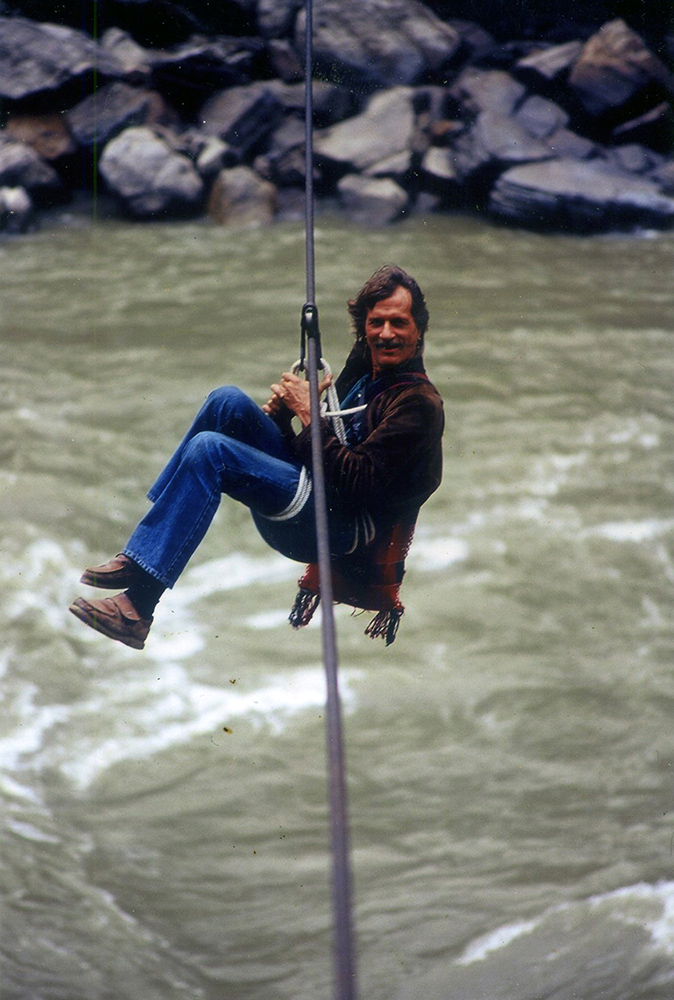
After watching two little Lisu girls at Lishadi cross the Nu River on the rope-bridge several times, for their own amusement, without adult supervision, I concluded:
1. It can’t be dangerous.
2. It must be fun.
Next trip to Nujiang I had a Lisu friend in Fugong get me the harness and cable hook. Made my first crossing, just for the fun of it, at Damedi south of Fugong and over the next few years carried my cable hook and rope harness to Nujiang for more rides at more locations.
Jim Goodman making the crossingJim Goodman with a crossbow
The other unique, to me anyway, research experience was my repeated visits to Lige village, Lugu Lake. Mosuo culture is matrilineal, the children belong to the mother, but also Tibetan Buddhist and each family has a resident monk. Women were definitely in charge of domestic affairs. At Lugu Lake, my friends, the folks I hung out with, got high and drunk with and had the most experiences with, were mainly women. Many of them introduced themselves to me. I only knew a few men. With every other minority, I only met women because they were my friend’s wives, daughters or sisters, whom he introduced to me. The Mosuo were really special.
From your experiences across Southeast Asia and eastern Southern Asia, what are some of the most interesting things you’ve learnt about hill tribes, their customs, societies, and beliefs?
They are very attuned to nature, with a cultural sense of ecological balance. Most of their festivals are concerned with important junctures in the agricultural work cycle. Their societies are very collective-oriented. Everyone has relationships with everyone else. No one ever has to feel alone.
How has learning languages and assisting local craftspeople enabled you to get inside like an anthropologist?
Learning an ethnic minority language is a clear indication of special interest in them. And they respond very favourably to that. Involving them in handicrafts production shows appreciation of their traditional arts and crafts, like a form of flattery. It also means getting to know them more personally and becoming an accepted part of their existence, making research easy.
What’s your personal approach to meeting new people, and why do you think it works?
As that pertains to my research work I always made clear to the people what my interest in them was and that I was going to write about them. Always had a positive response and when I indulged in their hospitality I followed four rules I set for myself: eat whatever they give me, drink whatever they give me, smoke whatever they give me, and sleep wherever they put me. As a result, I’ve had some really spicy food, very powerful liquor, pretty raunchy cigarettes and even opium and some pretty uncomfortable sleeping conditions. But I figured nothing can hurt me much for a day or so and the effect on them was that they thought I was a great guest. Everything they did for me seemed to work. They didn’t have to make any adjustments.
What’s it like to be the first outsider or ‘white person’ that some groups have seen?
That happened mostly in Yunnan and was never a negative experience. I remember once about to enter a Yunnan village that was definitely off the beaten track and when children spotted me they ran back to the village shouting, “Weiguo pengyou lai!” (“Foreign friend comes.”) And then the adults came out to welcome me. I never found any animosity or impolite, intrusive curiosity anywhere I went. The local attitude seemed to be ‘here’s a chance to make a foreign friend’. Minorities were as curious about me as I was about them. And being American in China or Vietnam, in their context I was a fellow minority person.
For many of the groups you’ve studied and spent time with, they are spread across countries and borders. Are there differences on different sides of the borders, or does close contact mean the groups retain their traditions?
I made my first trip to Vietnam precisely to answer that question. I was researching the terrace builders in Honghe between the Red River and the Vietnam border. Many ethnic groups lived on both sides, so I travelled through the border areas in Vietnam to meet sub-groups I knew in Yunnan. Lifestyles and cultural traits were very similar. The minorities in Vietnam seemed more conservative, more resistant to modern influence, while the same minorities on the Yunnan side seemed better off economically.
Your other interest is Vietnam. What fascinates you about Vietnam?
I was already familiar with Chinese culture when I first visited Vietnam, as well as Southeast Asian culture. It didn’t seem like such a strange place and I was able to discover what was unique about Vietnam, its separate cultural characteristics. The people were uniformly friendly, even though I came from a country that bombed the hell out of it. Yet the Vietnamese I met regarded all that as the past and now it’s different so no time for resentment. I made close friendships there easily (eventually married one) and found new topics to write books about—what was unique about Vietnamese culture, the special history of Hanoi, and how the country became one entity.
Why do you have a fascination and affinity with ethnic minorities, particularly hill tribes?
Hard to really say, but I suppose it was because I like their very different kind of living environment, the way they look and the way they act. Always felt comfortable with them.
How do you feel about the changes that have happened to minorities, such as becoming tourist attractions, or having to move to towns for economic opportunities?
It was probably inevitable. Traditional agriculture, the shifting cultivation type, was no longer sustainable due to population density growth. Roads are better and more numerous, too, so those who do move to cities can still maintain links with their villages. Becoming tourist attractions can be more of a lifestyle change. Everything cultural seems to become a commodity, something to be paid to do. In some places, the culture on display is not even their own. For example, in Sapa Vietnam, many Hmong girls dress up in fancy clothing of the Flowery Hmong because their own Black Hmong outfits are not as colourful or photogenic for tourists, who pay them to take photographs.
When did you know that you wanted to be a writer?
When I first started reading world literature as an early teenager and started fantasizing about one day becoming one of the literary giants.
How do you go about your writing process?
I begin by thinking about it for many sessions, then, when it’s a book or a lengthy article, make an outline and start adding details before I actually write anything. When I do get going I often inspire myself by fantasising what a positive review might say, then add or revise something to justify the imaginary praise.
How has photography integrated with your writing?
Most of what I write requires illustration and some of it was because I had a set of photographs that sort of made a story. When doing cultural research, I photographed anything I thought might be relevant, whether it was photogenic or not, because then I would have a reference. I wouldn’t have to write down or have to remember what I saw. The photo was the record.
Yes. It was set up by a young friend many years ago. I don’t make any money from it. It would have been nice to have sold all the site’s articles, but I continue it because it represents my self-image of contributing to the sum of human knowledge concerning the topics I write about. Regarding books, I have had publishers in several cities: Kathmandu, Bangkok, Singapore, Kunming, Hong Kong and Hanoi.
What projects do you have on the go currently?
This year’s project was Peoples of the Mekong River Basin: The Ethnic Minorities. It covers 23 ethnic minorities and over 100 photos, 90% mine. The publisher is World Scientific Press, Singapore and it should come out in or maybe before October. I would like to do one more book, on Lamphun and its first ruler Queen Chamadevi, the most interesting and accomplished woman in all of Thai history. But I have to find a publisher interested before I start work on it.
*Photographs provided by Jim Goodman
Keith Lyons (keithlyons.net) is an award-winning writer, author and creative writing mentor, who gave up learning to play bagpipes in a Scottish pipe band to focus on after-dark tabs of dark chocolate, early morning slow-lane swimming, and the perfect cup of masala chai tea. Find him@KeithLyonsNZor blogging at Wandering in the World (http://wanderingintheworld.com).
PLEASE NOTE: ARTICLES CAN ONLY BE REPRODUCED IN OTHER SITES WITH DUE ACKNOWLEDGEMENT TO BORDERLESS JOURNAL








 Borderless