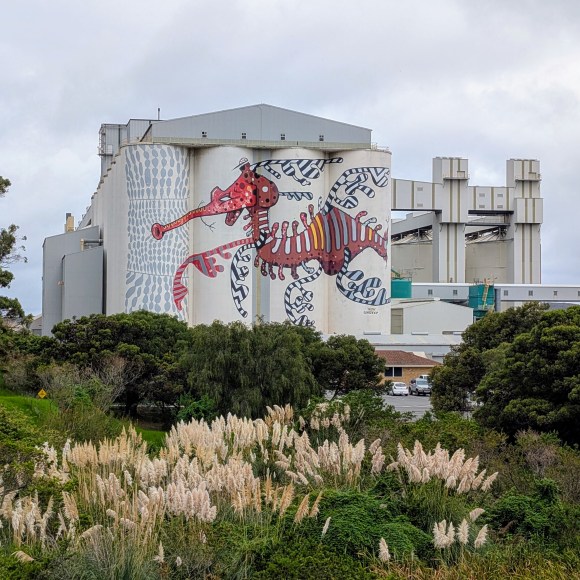
Ruby Seadragon, Albany Silo Art by Yok & Sheryo. Photo Courtesy: Alan Noble
“Will the passenger who borrowed my mobile phone please return it?” came the announcement in an American accent from the bus driver. I had never heard a bus driver with an American accent before, which was all the more surprising on a bus in regional Western Australia. The woman next to me rose from her seat and walked up the aisle to the driver to return his phone.
I was catching the bus from Albany to Perth at the conclusion of my Indian Ocean sailing adventure with Alex. I had enjoyed sailing in the Indian Ocean despite the sensation of being inside a washing machine on the odd occasion. However, I couldn’t face a succession of nights at sea on the next leg in the lonely and capricious Southern Ocean. Nor did I have the confidence to perform adequately as crew if I had to rescue a man overboard. Instead, Alex enlisted a qualified sailor to join him for the eastward crossing of the Great Australian Bight, and I decided to return to South Australia by bus and plane.
The woman passenger turned to me.
“I had to leave my twelve-year-old son alone at the bus stop,” she explained. “His father had not yet arrived to pick him up and I had to catch this bus. It only runs once a day so I couldn’t wait. I tried to call my son to see if his Dad had arrived, but his battery had run out. I couldn’t call his father either because he has blocked me. That’s why I borrowed the phone from the driver. When I reached my ex on the bus driver’s phone, he reassured me that he had picked up our son.”
I could sense she felt embarrassed at being called up to return the phone to the bus driver. I also sensed that she needed to share her anguish with someone, and that person happened to be me because I was sitting next to her.
“I understand the feeling of feeling worried about your children,” I confided in her. “My children have grown up now, but I still worry about them every day.”
It was true. Sailing for months along the coast of Western Australia, exploring uninhabited islands, and heading ashore on the paddleboard to visit coastal towns had been an unparalleled adventure, but this didn’t stop me from worrying about my daughters back in Adelaide. I would ring them daily from the boat. If they were busy, I would tell them that I just needed to hear their voice and then I would let them go. I could understand this mother’s anguish at having left her young son at the bus stop not knowing when his father would arrive to pick him up.
“Worrying about your children is lifelong,” I continued. “But if we don’t worry about them no-one else will as much as we do. There’s a reason for it.”
She murmured agreement.
I stared ahead of me rather than returning to my book, not knowing whether she wanted to continue with the conversation. It felt rude to turn away from her in her distress, nor did I want to distract her with details of my own life story. I glanced outside and the sun pierced into my eyes. After a period of companionable silence, I returned to my book.
Several hours later we arrived at the town of Popanyinning. She rose from her seat and turned to fix her eyes on me.
“Have a wonderful Easter! All the best to you!”
I had forgotten Easter was coming up but knew that her farewell had nothing to do with Easter. It was an appreciation for our conversation in her moments of distress.
“Take care. I hope it all works out,” was all I could manage in the short time we had as she moved up the aisle of the bus. Our paths will never cross again, but her story lingers in my mind.
Meredith Stephens is an applied linguist from South Australia. Her recent work has appeared in Syncopation Literary Journal, Continue the Voice, Micking Owl Roost blog, The Font – A Literary Journal for Language Teachers, and Mind, Brain & Education Think Tank. In 2024, her story Safari was chosen as the Editor’s Choice for the June edition of All Your Stories.
PLEASE NOTE: ARTICLES CAN ONLY BE REPRODUCED IN OTHER SITES WITH DUE ACKNOWLEDGEMENT TO BORDERLESS JOURNAL
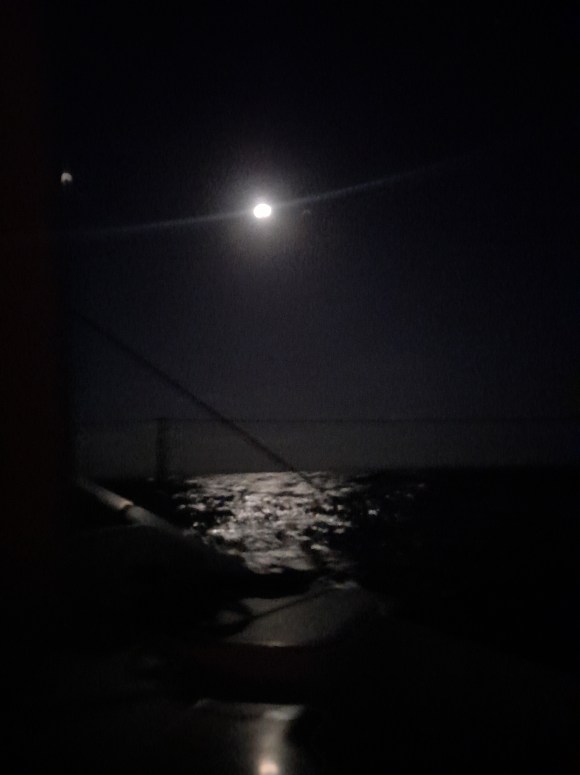
I looked out at the waters beyond the stern. The black waves danced in the moonlight. The swell pushed the boat in all directions, slapping against the water. I was unable to move around the boat without planning every movement. Thankfully, all the edges were rounded so even if I bumped into something I would not get hurt. I had remained in my pyjamas all day because I was unable to stay still enough to open drawers, retrieve clothing, and get dressed. I was unable to comb my hair because walking to the cupboard and retrieving my comb was too hard given all the bumps. Our bags had all fallen to the floor.
“I’m not scared,” replied Alex.
He looked at me straight in the eye. Suddenly I knew that it was not dangerous. If not dangerous, it was uncomfortable, but as far as Alex was concerned, we were not in danger.
We had left False Entrance off the mid-west coast of Western Australia at 4 am. There was an easterly wind predicted at this time. At 3 am, the anchor alarm had sounded. Alex rose and confirmed that this was because of the wind change. He spent thirty minutes trying to raise the anchor because the windless was malfunctioning. I could hear the anchor chain churning above the cabin where I was lying. Alex had to raise it by hand.
“At least I’ve done my morning workout!” he quipped.
Then I heard the motor turn on, and before long we left the safety of False Entrance for the swell of the Indian Ocean. The easterly blew for several hours pushing us south but then changed direction. This required us to head away from shore towards the Abrolhos Islands. Once the wind shifted Alex had to turn the motor on, and we thumped across the swell. Because of the high cliffs lining the mainland coast there would be no bay to shelter in for twenty-four hours. This wild stretch of coastline had claimed dozens of ships since Dutch vessels first arrived in the 1600s.
“What’s our latest estimated time of arrival?” I asked.
“The forecast was off, so we won’t be at Port Gregory until 3 am.”
We continued riding across the slapping swell. All I could complain about was the discomfort. I knew from Alex’s tone that we were not in danger, and we need not worry. He remained at the helm until we were safely at Port Gregory, while I rested in the cabin and braced myself for every slap against a wave. I put two pillows under my head to cushion myself.
I heard the familiar dropping of the anchor and realised we must be in Port Gregory. Alex spent the next ten minutes making everything ship-shape before going to bed. I looked at my phone. It was 2.57 am. Our voyage had taken almost 23 hours.
“It was tedious,” was his only complaint the next morning. Not scary, uncomfortable, or exhausting. Just tedious, in his typical understated way.
We gratefully slept until the sun forced its way through the cabin hatches at 8 am, and then, we roused ourselves for a comfortable breakfast at anchor. The skies were blue, and the waters calm.
“The wind is in the right direction. We’ll get to Geraldon in five or six hours. We should be able to sail the whole way, without motoring.”
How could the wind change so suddenly? How was it possible to have capricious winds one day and friendly ones the next? Alex raised the sails, and for the next six hours the wind ushered us on our way. Instead of erratic slapping, the keels produced a regular whooshing sound. The bucking bronco[1] had turned into a docile, ageing Clydesdale[2]. The first sign of the approaching Port of Geraldton was bulk carriers anchored out at sea, waiting their turn to load grains for export. As we entered the bay we had to make our way through the massive channel markers and dodge the lobster pot buoys. Once in the bay, we were greeted by live music from the amphitheatre on the shorefront lawns. We heard the sound of children playing in the water, on the beach, and on the playgrounds.
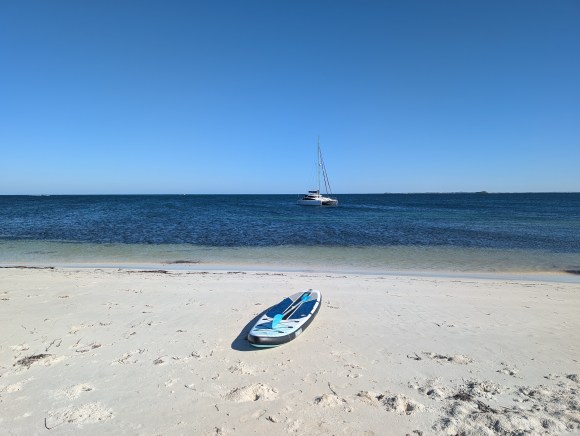
Alex anchored and by this time the windless had stopped malfunctioning. We then lowered the paddleboard. Alex knelt at the rear and I at the front, relieved to dismount our steed of the seas. I held myself steady as he paddled firmly behind me to the shore. We alighted at the sand, pulled the paddleboard to a safe height, and washed the sand off our flip-flops under a tap. A wall of hot air from the land accosted us, and the ground continued to gently canter beneath us as our bodies recalibrated to being on terra firma. Our discreet entry on the paddleboard had attracted no attention. We walked past children playing in the foreshore fountain, found a place to sit on the lawn alongside other family groups, and tuned in to savour the comforting 1970s pop music being performed by the live band.
Meredith Stephens is an applied linguist from South Australia. Her recent work has appeared in Syncopation Literary Journal, Continue the Voice, Micking Owl Roost blog, The Font – A Literary Journal for Language Teachers, and Mind, Brain & Education Think Tank. In 2024, her story Safari was chosen as the Editor’s Choice for the June edition of All Your Stories.
PLEASE NOTE: ARTICLES CAN ONLY BE REPRODUCED IN OTHER SITES WITH DUE ACKNOWLEDGEMENT TO BORDERLESS JOURNAL
We sail into Turtle Bay on East Wallabi Island. I make my way barefoot to the bow. Then I hold the boat hook and crouch at the edge, extending it towards the buoy. I loop the hook under the thick slimy rope covered in algae and yank it upwards.
“It’s too heavy!” I yell, my voice disappearing into the wind.
Alex must have heard because he abandons the helm and races to the bow. He grabs the boat hook from my hands and pulls up the rope, securing the buoy to the cleat.
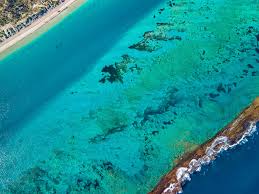
Turtle Bay is a wide horseshoe. The waters are glistening turquoise and are surrounded by white sands. It’s uninhabited but small planes of tourists regularly fly in and out to walk and dive. Night is descending and it’s too late to disembark, so we look longingly at the shore and wait for the morning.
Once day breaks, we head ashore on the stand-up paddleboard. Alex places his phone in a waterproof bag. He alights from the stern and kneels on the back of the paddleboard. I kneel at the stern and carefully slide over to kneel at the front of the paddleboard. Alex paddles to shore behind me and I try to remain as still as I can, unresponsive to the moving water beneath me, retrieving the muscle memory of riding wayward horses in my youth. Once we arrive, we alight as quickly as we can and drag the paddleboard away from the water’s edge.
A shaft of light catches my eye, and I reach down to pick up the object. It’s a small purple shell lined with brown flecks. As the sun is blinding, I am forced to continue casting my eyes downward. Never have I seen such an array of shells on a beach. Alex, on the other hand, finds his attention caught by even brighter hues than the shells. A blue plastic wrapping. A broken glass bottle. An aluminium-insert from boxed water. He retrieves these items unflinchingly. We continue to walk around this uninhabited island and find yet more rubbish washed up ashore. Most of it is plastic bottles and brightly coloured bottle tops. Then we spot a large blue plastic tub. Alex picks it up and places the rubble within. I respond with strong disgust, so am ashamed to say that I do not help him. Alex does not chide me for this, and I am grateful that he withholds judgement. I continue to admire the multi-coloured shells washed up by the tide.
We beat our way back through the fierce heat to the section of beach where the paddleboard is waiting. Alex affixes the bucket of rubbish to the stretchy cords at the front of the paddleboard. Spray surges as each wave hits the shore. He waits for a lull between the swell. After several more waves hit the shore there is a momentary calm, and he pushes the board forward. I climb on and crouch behind the rubbish. Alex mounts the board behind me and paddles towards the boat. I’m no longer a retiree, but a teenager at the beach with her boyfriend. I close my eyes and now I am keeping balance on my lively horse. Suddenly, when we have nearly reached the boat, I sense Alex is worried. The tide is pushing us away from the boat and he paddles harder. Will the wind push us into the vast empty seas out of the range of mobile devices? Just as we reach the stern Alex thrusts his paddle into the water to do a U-turn. I find myself parallel with the boat, grab the steel handle, and slide onto the boat without tipping Alex and the rubbish into the depths.
All is secure, and now it’s time to sail back to the mainland. We head north-east to the tiny township of Port Gregory, with its population of eighty, renowned for a submarine shelling in 1943, and a vast pink salt lake. After anchoring in the bay, we again secure the rubbish to the front of the paddleboard and kneel behind it. Once on the shore, we are reassured by the sight of multiple rubbish bins. Port Gregory is too remote for recycle bins, so we reluctantly place the island rubbish into one of the general bins, and trudge through the heat to explore the town.
Port Gregory. From Public Domain
Meredith Stephens is an applied linguist from South Australia. Her recent work has appeared in Syncopation Literary Journal, Continue the Voice, MickingOwl Roost blog, The Font – A Literary Journal for Language Teachers, and Mind, Brain & Education Think Tank. In 2024, her story Safari was chosen as the Editor’s Choice for the June edition of All Your Stories.
PLEASE NOTE: ARTICLES CAN ONLY BE REPRODUCED IN OTHER SITES WITH DUE ACKNOWLEDGEMENT TO BORDERLESS JOURNAL
Jibananada Das’sAndhar Dekhecche, Tobu Ache (I have seen the dark and yet there is another) has been translated from Bengali by Professor Fakrul Alam. Click here to read.
Manish Ghatak’sAagun taader Praan (Fire is their Life) has been translated from Bengali by Indrayudh Sinha. Click hereto read.
Manzur Bismil’s poem,Stories, has been translated from Balochi by Fazal Baloch. Click here to read.
Homecoming, a poem by Ihlwha Choi on his return from Santiniketan, has been translated from Korean by the poet himself. Click here to read.
Tagore’sShotabdir Surjo Aji( The Century’s Sun today) has been translated from Bengali by Mitali Chakravarty. Clickhereto read.
Paul Mirabile wraps his telling like a psychological thriller. Clickhere to read.
Conversations
Ratnottama Sengupta converses with Divya Dutta, an award-winning actress, who has authored two books recently, Stars in my SkyandMe and Ma. Clickhere to read.
“So relieved that we will make good time today,” I declare. “I’ve had enough of arriving in the dark.”
“We have to stop to get diesel on the way but that won’t make too much of a difference,” Alex reminds me.
We head south of Adelaide to the most fertile part of the state. The coast is lined with stately Norfolk pines, and further south there are rolling green hills lined with heritage gums. There are more cattle than you could count, mobs of kangaroos, and horses wearing coats to protect them from the winter chills. We arrive in Yankalilla, the last town before our departure point, and fill the jerry cans with diesel. There is no fuel at Wirrina Cove, as the marina went out of business a few years ago, so we have to haul diesel to the boat.
We leave Yankalilla and head past yet more horses. After the turn-off for Wirrina I catch a glimpse of my favourites, two Clydesdales, one of whom has a forelock that reaches down past his nostrils. At the marina, we park in front of a tree to protect the car from the harsh marine environment. It’s mid-morning so there should be plenty of time to arrive in Kangaroo Island before darkness. My border collie, Haru, springs from the car, and happily trots down the finger wharf behind me as I carry my luggage to the boat. It’s hard for me to make the leap onto the boat from the finger wharf but Haru skips in while I am still worrying about how not to fall in the water.
“There is less wind than forecast. We’ll have to motor-sail,” bemoans Alex.
I move to the trampoline at the bow to savour the view of boats in their berths opening out in front of me as we exit. Haru sits next to me and whinges every time I stop patting her. Once we are in open water the boat starts rocking, and I walk back along the side of the boat, all the while gripping the side with my right hand, until I am safely inside. Haru trots lightly alongside me.
The waves become increasingly bouncy and Haru frowns. She eyes her crate which is sitting just inside the doorway. I open the flap, and she heads in and curls herself on the old silk cushions and Alex’s old woollen jumper lining the bottom of the crate. She prefers the safety of the crate to sitting outside with the possibility of being splashed.
I abdicate the task of sailing to Alex and watch him at the helm, while I settle myself on the couch, placing cushions behind my head and covering myself with a blanket. I can’t confidently move around on the boat when it is rocking this much, so I stretch my headphones over my head and listen to music, while watching Alex raise the sails and maneuver the boat towards Kangaroo Island. I feel a twinge of guilt at lying down in warm comfort while Alex busies himself with sailing, but he doesn’t seem to mind, so I close my eyes and revel in the music.
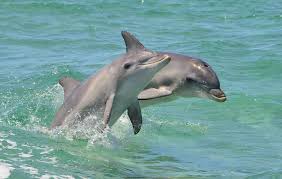
After several hours, we reach the middle of Investigator Strait. I glance outside and can see dorsal fins rising from the waters. As much as I like lying down with a blanket and listening to music, I cannot ignore pods of dolphins. I rise and brace myself for the cold and wind outside the boat. I head towards the bow, but the rocking motion and the cold winds defeat me. From the stern I can see dolphins swimming alongside the boat, and as I gaze into the distance yet more dolphins are breaching as they head towards us. Of our many crossings of Investigator Strait there has never been a time when I have not witnessed pods of dolphins, but the sense of wonder never diminishes.
Despite my determination not to arrive in darkness, by late afternoon the sun begins to slip into the horizon and Point Marsden is still well in the distance. The sky erupts in bright orange, and I hope the light will hold out till we reach our mooring. Heading for Point Marsden is like trying to reach the summit of a mountain. Finally, we pass the point and head into the bay, but darkness has already fallen. Alex locates the mooring buoy in the distance. I grab the boat hook and head to the bow. I crouch on the trampoline and stretch the hook out in front of me over the dark water. Haru crouches at my side and brushes herself against me, willing me to hook the buoy on the first attempt. I stretch forward, hook the buoy, and drag it up to the bow. I call Alex, and he leaves the helm to secure it.
Alex lowers the dinghy, and we prepare to alight. We lift our bags in, and I carefully place one leg into the centre and ease myself in. Meanwhile, Haru has delicately skipped into the dinghy behind me. Finally, Alex enters, unties the ropes, turns the outboard motor on and takes us to the shore. We shine the torch in front of the boat and locate the cove. It’s high tide. Alex hops out into chest-high cold dark waters. He pulls the dinghy towards the rocks and secures it. I clamber out and perch myself on a rock. Alex hands me the bags. I place them on a higher rock just behind me. Then he hands me his backpack containing our laptops. I hold on to them tightly, afraid to place them on the rock in case water rushes over them. Alex picks up Haru and holds her above the water, before placing her on the shore. Then he takes the backpack from me, picks up the bags, and returns to the shore. I pick my way in the dark over slippery rocks, not moving one leg until the other has been firmly anchored. We reach the sand and walk up the switchbacks. Haru delights in running along the switchbacks after having been confined to the boat.
I tread carefully in the dark up the hill, Haru brushing her side against my calf. The holiday house is in sight, and just as I am about to reach the road leading to the house I fall over a boulder and gasp. How did I manage to navigate the submerged rocks in darkness and yet stumble on land?
‘“Oh sorry!” exclaims Alex. “That’s because I wasn’t holding your hand.”
He grabs my hand, and we walk up the last part of the track to the house. We enter and I make a doggie dinner for Haru. Then I collapse on the sofa and Alex makes a fire. After the adventure of arriving by boat and walking up the steep hill in the dark, the pleasure of lounging on a sofa and warming to a fire is multiplied. I am looking forward to spending the next day curling up on the sofa, reading a book in the sunshine, and taking Haru for walks.
A few minutes later the phone rings.
“Auntie May is not doing well. You have to come home as soon as you can!” urges my sister Jemima.
Great Auntie May, aged 103, is my oldest living relative. She was in the nursing home for two decades, even outliving her sons, before moving to the palliative care ward of the hospital. I remember the card from the Queen which she posted on her dressing table three years earlier. She once said that she had lived too long, because her sons and friends had passed. Because her grandchildren are interstate, it is up to her grand-nieces and grand-nephews to visit her.
“OK. We’ll be there as soon as we can!” I reassure Jemima.
“Alex, Auntie May is doing poorly. We have to get back to the mainland as soon as we can.”
“I’ll just check the weather,” he replies. “The wind is in the wrong direction. It’s a north-northeasterly. It may be too rough.”
His brow furrows as he scrutinizes the forecast.
“Can we fly home instead of sailing?” I ask.
“The weather will be getting worse over the week, so it won’t even be safe to let the boat stay on its mooring. Perhaps we can sail to the marina in Penneshaw and leave the boat there. Then we can catch the bus home from there.”
We decide to leave the next morning, but it is noon by the time we lock the front door. I dress Haru in her lifejacket, and don mine as well. We head back down the hill, and down the switchbacks to the shore. Alex picks up Haru and places her in the dinghy. She stands tall, ears pricked, the wispy hairs on her forelegs blowing in the wind, trusting that we will join her.
Alex places the bags in the dinghy. It’s too far away for me to board. If I walk to the dinghy in freezing water, I won’t be able to hop in from water at chest height. Alex pushes the dinghy to the rock I am standing on, and I leap in. He switches on the outboard motor, and we bump over the waves to the boat. Haru is at the front, and she winces as sprays splash onto her face. I pull her back against me to protect her from the sea-sprays. The boat is bobbing in the water. Alex grabs the rope to secure us. I stretch my left leg onto the boat, but the dinghy moves away, and my legs are thrown apart. I don’t want to fall victim to the cold water below. I move my left leg back into the dinghy. The waves are thrusting the dinghy towards the stern.
“Move back. It’s safer to alight from further back,” advises Alex.
Meanwhile Haru jumps effortlessly onto the boat, undeterred by the rough conditions.
“Now!” urges Alex, during a lull in the waves.
This time I extend my left leg onto the boat and somehow the rest of my body follows. Haru is standing expectantly at the bow wondering what all the fuss has been about. Alex raises the dinghy, then the sails, and we head towards Investigator Strait. Once we are in the boat the sea conditions are not as difficult as we had anticipated.
“I think we can sail across to the mainland in these conditions. We don’t need to leave the boat at Penneshaw after all,” Alex informs me.
The sea is bumpy but not enough to make me seasick. I bring Haru inside, and swaddle myself in blankets and locate my headphones, leaving Alex to manage the sailing. Six hours later we arrive at Wirrina Cove and drive back towards Adelaide in darkness.
“Let’s head straight to the hospital!” I urge Alex. “We can’t afford to waste any time.”
Alex floors the accelerator on the freeway, weaving past slow coaches who are blocking our way. Haru curls herself up on the back seat, oblivious to the drama around her.
We arrive at the palliative care ward and enter through the back door where visitors are allowed to enter with their dogs. Will Auntie May have waited for us? We make a beeline for her room. Auntie May is propped up on pillows and beams when she sees us. Haru jumps onto her bed and lies down facing her waiting for a pat.
“I had a bad turn, but I am feeling better today. Did you sail all the way back from Kangaroo Island to see me?”
“Yes, we did.”
“I’m sorry to have put you out. I’m feeling much better now.”
Alex and I glance at each other, and I catch the relief in his eyes. Even though she is 103, we aren’t ready to say goodbye. We hope she will make at least 110.
A few days later the phone rings. It’s the nurse from the palliative care ward.
“Would you come and pick up your Great Aunt May please? She is doing much better than expected and we need to move her out of the palliative care ward. The social worker has found a room with an ocean view for her in the Star of the Sea Nursing Home.”
Later we celebrate Auntie May’s 104th birthday at the nursing home, and next year we look forward to celebrating her 105th birthday. We continue to sail back and forth to Kangaroo Island, choosing our weather to only sail in favourable seas, never hurrying back. Haru continues to sail with us and enjoys visiting Auntie May just as much as we do.
.
Meredith Stephens is an applied linguist from South Australia. Her recent work has appeared in Syncopation Literary Journal, Continue the Voice, MickingOwl Roost blog, The Font – A Literary Journal for Language Teachers, and Mind, Brain & Education Think Tank. In 2024 her story Safari was chosen as the Editor’s Choice for the June edition of All Your Stories.
PLEASE NOTE: ARTICLES CAN ONLY BE REPRODUCED IN OTHER SITES WITH DUE ACKNOWLEDGEMENT TO BORDERLESS JOURNAL
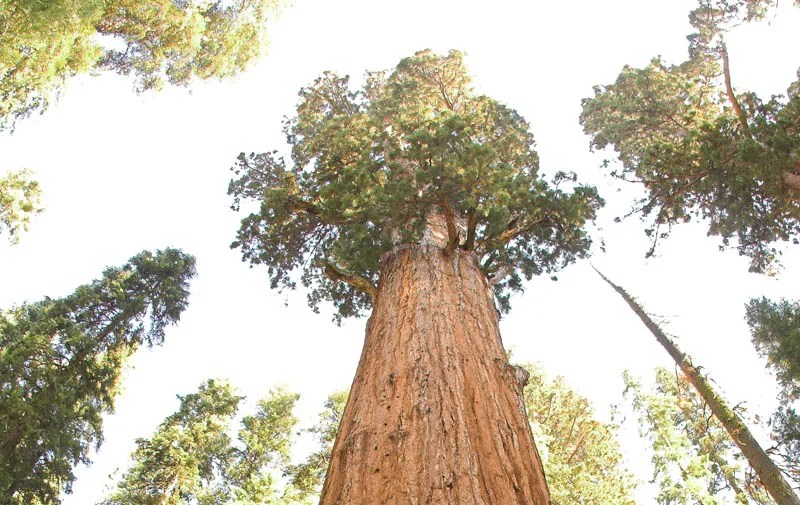
General Sherman: The largest tree in the world. Courtesy: Creative Commons
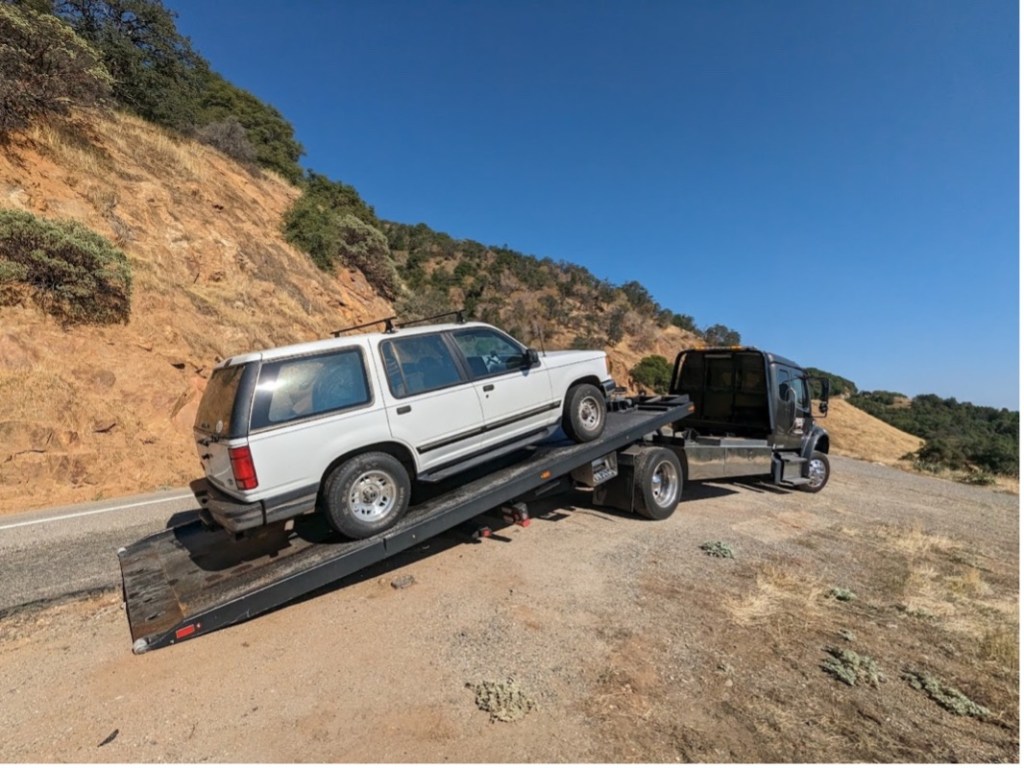
On our final day in California, we were looking forward to making the journey to Kings Canyon to see the largest tree in the world, a giant sequoia 87 metres tall. We packed the car with eight pieces of luggage destined for Australia, into Alex’s 1993 Ford Explorer. It had served us faithfully for several hundred miles of touring in California for the previous weeks. We headed up the winding mountains to Kings Canyon, dotted with live oaks and cattle in the foothills. We were heading up a particularly steep section of the road when the engine faltered. Alex urgently pressed his foot on the accelerator but the car refused to budge.
“I’ll try and push it,” I offered.
I positioned myself to one side of the rear of the car. If the brakes failed, I did not want the car rolling back and flattening me. The car did not respond to my urgings so I gave up. I noticed cars ascending the mountains at speed, and the blind corner ahead. I decided to walk uphill so that I could signal the cars coming up the hill to warn them of oncoming traffic around the corner. When there was a car descending the hill on the other side, I put up my hand to warn them to stop until it was safe. About twenty cars passed us this way, until one driver noticed our plight and decided to help us. He stopped at the turn-out, and two elderly couples alighted from the car.
“Hasn’t anyone stopped to help you?” the driver asked.
“You’re the first,” I replied.
The two men walked towards the car to help push it twenty metres to the turn-out.
“John!” called out his wife, trying to stop him. It obviously wasn’t safe for a man in his seventies to push a heavily laden car up a mountain ahead of oncoming traffic.
Meanwhile, a man in his thirties had joined the party. Another car stopped on the other side of the road. Two burly men with tattoos crossed the road to help push the car to safety. Alex, the elderly men, the younger man, and the burly men, joined forces to push the car to the turn-out. The car slowly responded and was eventually positioned off the road. The burly men crossed the road to return to their car, and the elderly men returned to theirs. The younger man remained with us.
Alex tried to call the automobile service but his phone had no reception.
“Can I borrow your phone?” he asked the younger man.
“Sure. By the way, it might be quicker to call a tow truck. I suggest getting a tow-truck from Reedley, because you will be able to rent a car there.”
We called the tow truck company in Reedley and they agreed to come in two hours. The young man, who turned out to be an off-duty ranger, took his leave. We grabbed our picnic items from the car, and headed downhill to the shade of a large live-oak, while we waited for the tow truck. Lying on the grass under the cool shade of the live-oak, enjoying our picnic items, I could almost forget that we were in a crisis. After an hour or two we thought we needed to be visible from the road for the tow-truck, so we returned to the punishing heat road-side, and soon the tow truck appeared. The driver expertly loaded the car onto the truck, and invited us to join him in the front.
“Careful. It’s very high up,” he warned.
Photograph by Meredith Stephens
I stretched my legs to reach each step to get into the front of the truck, and sat in the back seat, while Alex sat next to the driver.
Sitting in air-conditioned comfort high up with a view down the mountain was such a contrast to sitting in the old car, straining up the mountain. We reached the plains and passed through the hamlet of Squaw Valley before reaching Reedley. With only minutes to spare, we picked up a rental car, removed a few items from the Explorer, and drove back up the mountain. We wound our way past where the car had broken down, into the National Park, through dense forest and charred remains of forest fire several years ago. We followed the signs to our lodge, but our break-down had cost us several hours, and we did not have time for sights that evening.
That evening, Alex checked the passports to confirm they were at hand for our departure to Australia the following evening. They were not in their usual place. We searched our other bags. Then we retrieved bags from the car and searched them too, to no avail.
“We’ll have to call the consulate and get temporary passports,” I suggested.
“First, we will have to retrace our steps. Maybe they fell out when the car broke down. Maybe they are still in the Explorer,” suggested Alex.
That night Alex could not sleep, worrying about the passports. What if we could not return to Australia the next evening and had to buy new tickets? The next morning he was still worried.
“We’ll have to look for the passports, retracing our steps from yesterday. We have no time to see the tallest tree in the world.”
“Do we have time to see the third to tallest tree in the world?”
“Yes. That’s only a fifteen minute detour.”
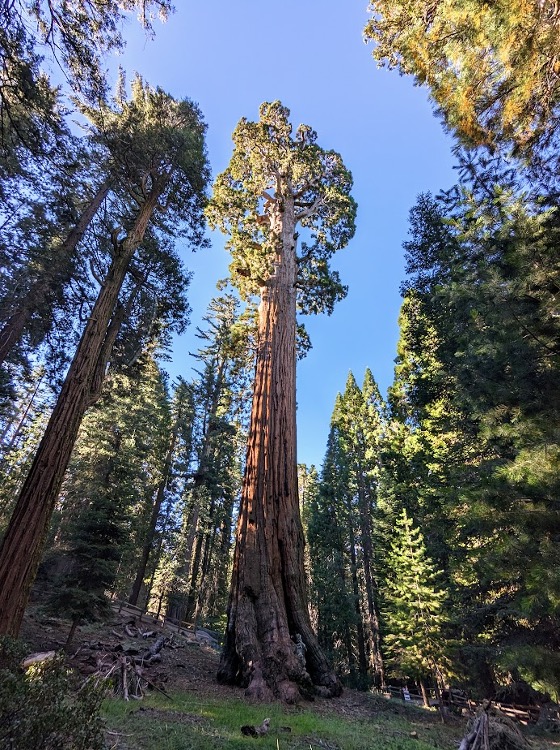
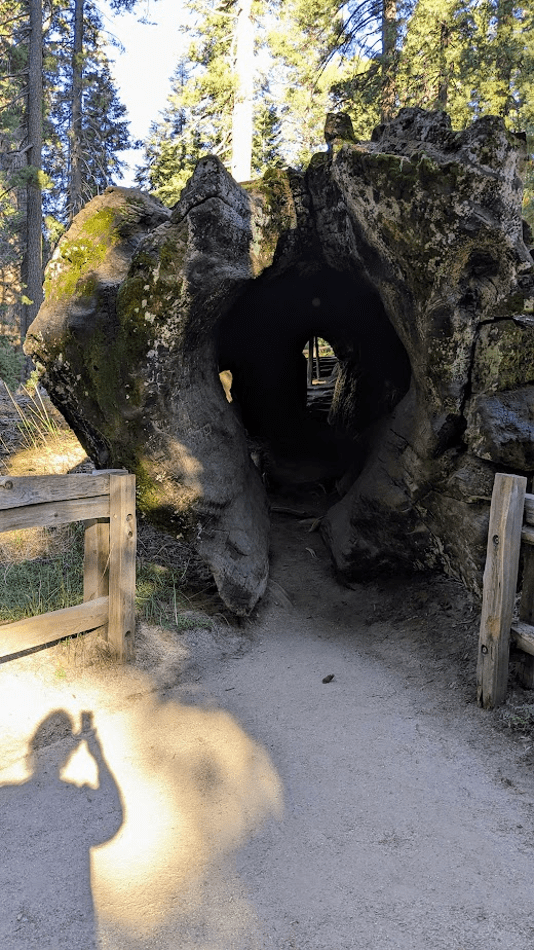
We drove to see the third to tallest tree in the world. As I started walking in the forest I immediately felt both exhilarated and relaxed. These giant trees provided a protective canopy and their scent sent a rush of well-being through my body. I was satisfied. Did I really need to see the largest tree in the world? Yes, but that would have to wait!
Photographs by Meredith Stephens
We hurried back down the mountain to search for the passports. We could not risk the possibility of not finding them just because of sightseeing. We reached the area of our break-down, and combed the grassy hill carefully in search of the passports, to no avail. Then we wound our way back down the mountain to the tow truck business. I received the keys from the office, opened the car door, and there were the passports on full display.
“Shall we go back to Kings Canyon to see the largest tree in the world?” I asked Alex.
“It will be ninety minutes to get back to the National Park, and then a five hour drive to the airport in LA.”
“I really want to see the tree, but I can’t face over six hours in the car. I guess we should head for the airport.”
“If we had known that the passports were here, we could have gone and seen the tree while we were still in the park,” lamented Alex.
With passports in hand, we did not need to visit the consulate to be issued temporary ones. We could catch the plane as planned. We were not able to see the tallest tree in the world, even though we had driven up the mountain twice. There was some consolation in the fact that the tree would be waiting for us, in years to come, when we had the opportunity to return to our beloved California.
Photographs by Meredith Stephens
Meredith Stephens is an applied linguist from South Australia. Her work has appeared in Transnational Literature, The Muse, The Font – A Literary Journal for Language Teachers, The Journal of Literature in Language Teaching, The Writers’ and Readers’ Magazine, Reading in a Foreign Language, and in chapters in anthologies published by Demeter Press, Canada.
PLEASE NOTE: ARTICLES CAN ONLY BE REPRODUCED IN OTHER SITES WITH DUE ACKNOWLEDGEMENT TO BORDERLESS JOURNAL
A narrative set against the 2020 impact of Californian forest fires, a community bent on healing the Earth and a travelogue with photographs by Meredith Stephens
The drive up the mountains to the town of Shaver Lake, California, continues to shock me, even though it has been three years since the 2020 fires. Where there formerly stood proud ponderosa pines extending into the sky, there are now barren mountains exposing charred tree trunks and the view beyond of granite boulders previously hidden. The bottom half of the mountain is scarred on both sides of the road, but the upper half is charred and desolate on one side and partially untouched on the other. As you ascend the mountain you notice gates announcing the entrance to where ranches once stood. Some have positioned a caravan or two on the site where their house was. Once you have passed through the town, at an elevation of almost six thousand feet, you notice a line of ponderosa pines adjoining a barren landscape indicating the point where fire-fighters saved the community.
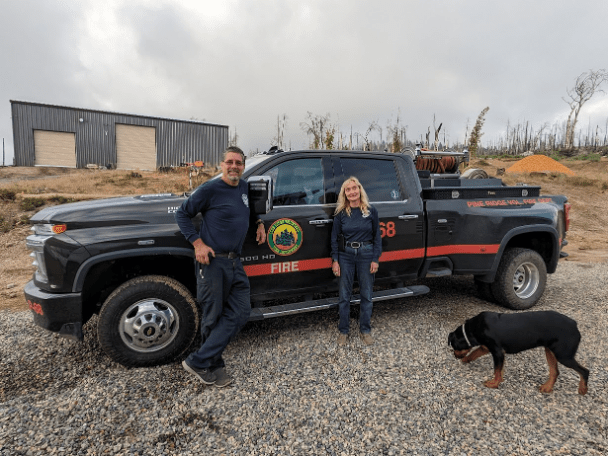
As the Assistant Chief of the Shaver Lake Volunteer Fire Department, James and his team were saving Shaver Lake, while his own property further down the mountain was under threat. His wife Janet, also a fire-fighter, received a mandate to evacuate. Janet was reluctant to leave her home, but obeyed the order, and left with her two dogs. This was just as well, because their house and property were ravaged by the wildfire and she and her dogs would not have survived had they remained at home.
My partner, Alex, had been put into contact with James and Janet when the fires had begun ravaging the mountain in 2020. A mutual acquaintance sent an email to Alex at his home in Adelaide, Australia, asking whether he could offer his holiday house in Shaver Lake to James and Janet. Alex had been focussed on watching the nightly news of the fires back in Adelaide, and scrutinised the maps of the fires every evening to see whether they would engulf his holiday house. It was spared, so he was able to offer it to James and Janet. Alex was unable to visit California himself because of international travel restrictions during the pandemic.
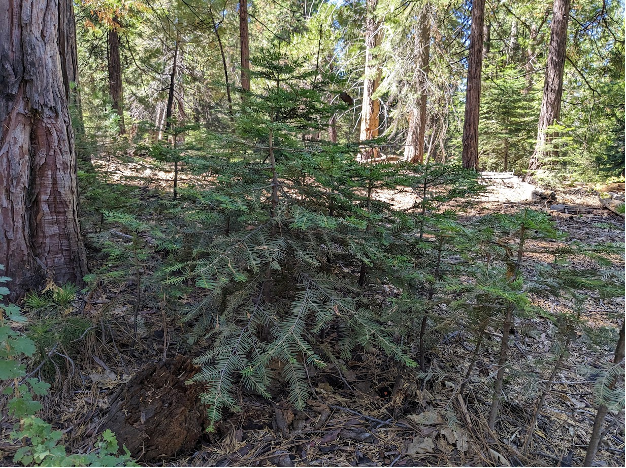
Cluster of Baby Ponderosas
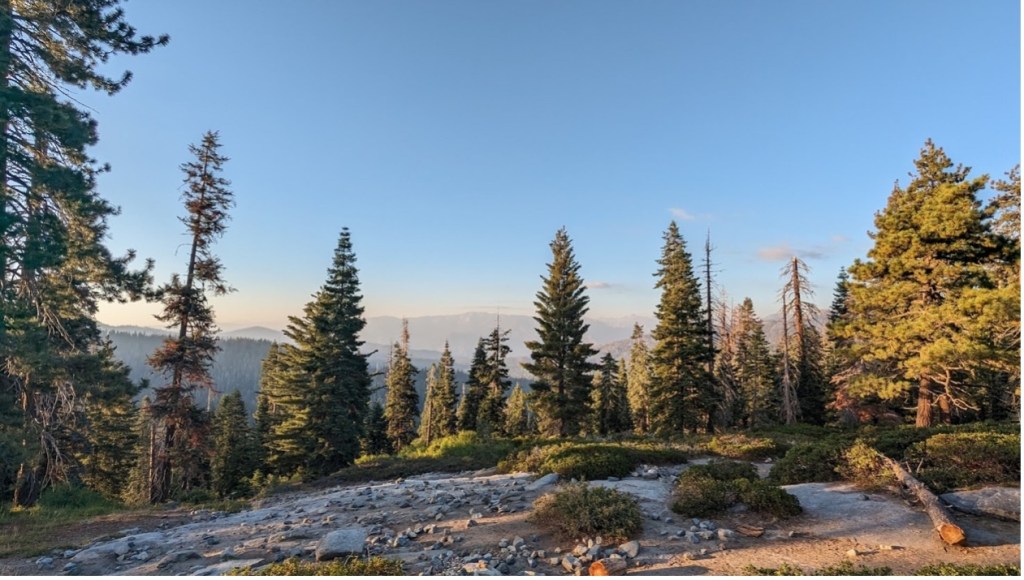
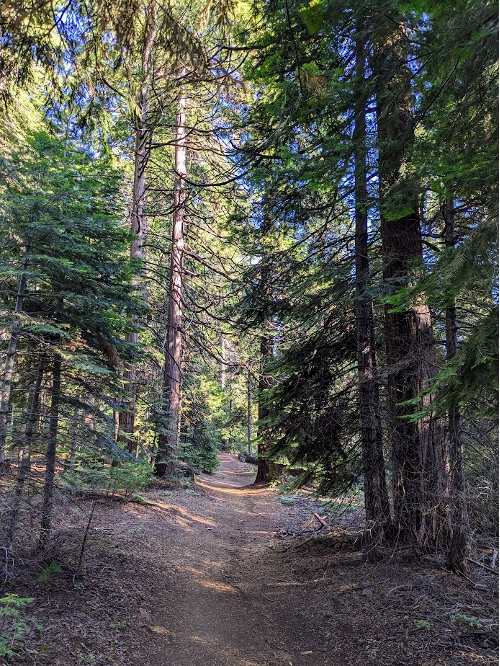
In 2023, Alex and I made the eight-thousand-mile trip from Adelaide to Shaver Lake. Once we arrived, we indulged in morning and evening walks on an undulating path through the ponderosa pines, Douglas firs, and cedars. The path was soft beneath our feet in the aftermath of rain the day before. There was a scent of pine which was immediately calming. In places it is fashionable to pursue ‘forest-bathing’, but here you can simply walk out of your back door and experience biophilia without having to consciously seek it out.
Lupins alongside the Forest Path
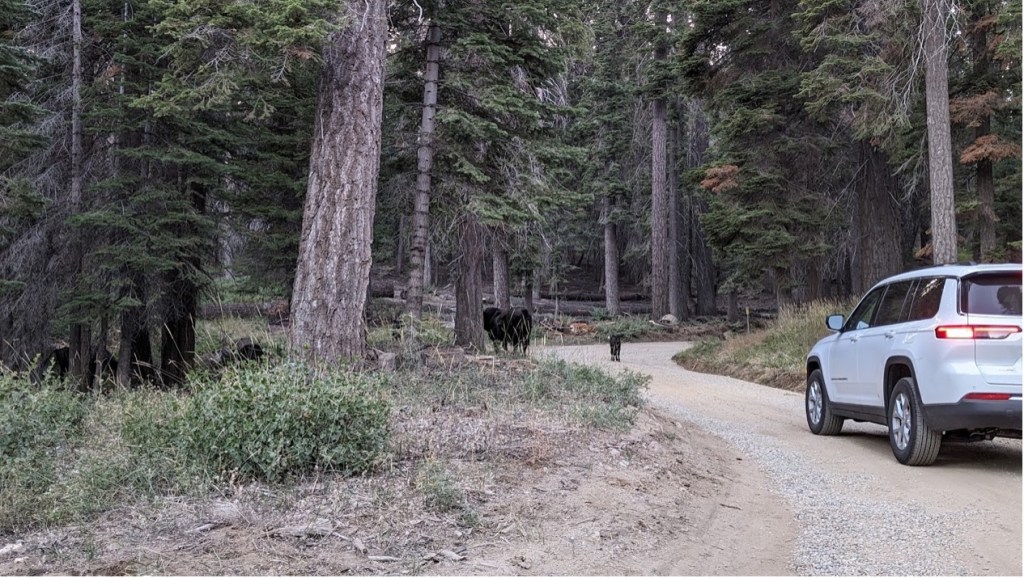
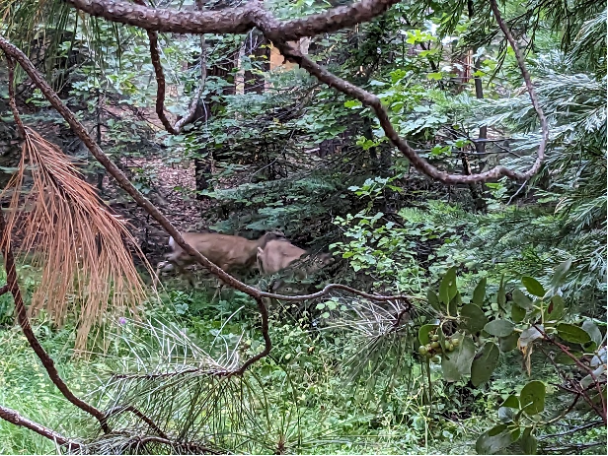
Whenever I heard a rustle I half-expected to see a kangaroo, as I would have in Australia, but instead spotted squirrels hiding behind tree trunks, or a pair of deer cantering away from us as they heard our voices. The path was adjacent to a national park where hunters could hunt deer with a permit in the hunting season.
“When is the deer hunting season?” I asked Alex.
“Not until autumn.”
Phew! It was still late summer, so I needn’t have worried.
“Best wear a fluorescent top in the hunting season,” he advised.
Can you spot the deer?
When I chatted to residents further down the mountain, some said that they could not bear to rebuild their lives on their beloved mountain, such was the shock and devastation of their loss. They had left the site of their former home and relocated to the city of Fresno at the base of the mountain. Others, like James and Janet, have bravely rebuilt their house and are busily engaged in revegetation.
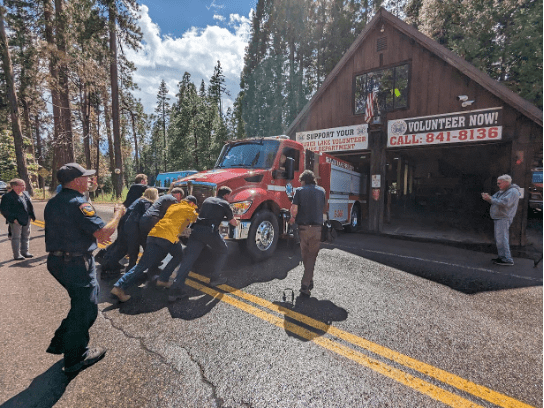
In August, 2023, James and Janet invited us to a fire-truck “push-in ceremony” at Shaver Lake, to celebrate the arrival of a new firetruck. We drove to the township the next day at three pm. The road was blocked by the flashing lights of the sheriff’s patrol cars. We turned back and parked the car, and then entered the township on foot. A crowd of well-wishers was cheering the volunteer fire-fighters, who were pushing the shiny new firetruck into its new home. They strained as they pushed it into the narrow confines where it will be housed. Once it was pushed in, the crowd cheered, and everyone was offered a free ice-cream.
James, Janet, and Cyclone.
I hope the firetruck remains shiny and new, and never has to confront smoke and flames, so that the people of Shaver Lake, the deer, the squirrels, and the ponderosa pines, can live in peace.
.
Meredith Stephens is an applied linguist from South Australia. Her work has appeared in Transnational Literature, The Muse, The Font – A Literary Journal for Language Teachers, The Journal of Literature in Language Teaching, The Writers’ and Readers’ Magazine, Reading in a Foreign Language, and in chapters in anthologies published by Demeter Press, Canada.
PLEASE NOTE: ARTICLES CAN ONLY BE REPRODUCED IN OTHER SITES WITH DUE ACKNOWLEDGEMENT TO BORDERLESS JOURNAL
Alex and I had completed our road trip from California to Colorado and now it was time to make the two-day drive back along the interminable desert roads.
Every time we stopped, I would try to get into the driver’s side of the vehicle, thinking it was the passenger side. My brain would not adapt to a car with the steering wheel on the left. Once back in the passenger seat, the sun blazed on my temple, so I manoeuvred my visor to cover the right window to block it from penetrating my eyes. It was hard sitting still, so I stretched my legs before me, then slid them beneath me to elevate my height.
“As soon as we hit the Nevada border you will see a casino town,” Alex informed me.
Sure enough, we crossed the border into Nevada from Utah and a town immediately arose from the desert. Alex made a detour into the town to get some fuel.
“Can we drive down the strip?” I asked.
“Sure,” he replied. “Are you hoping to find a hotel here?”
Yes, I thought, but kept my silence. I was too proud to confess that I wanted to stay anywhere near a casino, but I would have welcomed clean sheets and hot water.
I took hold of Alex’s phone and searched for campsites en route, but they all involved deviations that would rob us of precious time.
“We can always stop at a rest area,” suggested Alex.
He searched his phone and found a rest area nestled into a hill, with outdoor tables surrounded by trees. We arrived at sunset and parked the car at the far end, away from other vehicles. We gratefully hopped out, picked up the ice box, and headed for the picnic tables, which we had to ourselves. No sooner had we started anticipating our picnic than we heard the murmur of a refrigerated truck.
“He probably has to keep his engine on to keep the food cool,” observed Alex.
The din was inescapable, so we decided to park back near the entrance to the rest area. I noticed a car parked with sheets draping the windows. Clearly, we were not the only ones seeking sleep in the rest area. Alex parked the car at an angle contrary to the parking lines so that nobody would be tempted to park right next to us. We hauled the icebox to a nearby picnic table to consume our leftovers. Alex proceeded to pour us a glass of wine, and we snacked on sourdough, cheese, avocado, deli meats, and corn chips.
I ate a little too quickly because it was getting late, and I was hungry. It was high desert, so the air was cool, even though it was mid-June. We packed up our picnic and headed for the car, where Alex moved all of our goods to the front seat and made up our bed in the back.
It was nearly 9 pm and we went to bed in the twilight. I revelled in the sensation of the thick flannelette cotton sheets, but I could not slip into a deep sleep. The overhead lights snuck through cracks in the fabric I had put up to cover the window, and the traffic rumbled on the adjoining freeway. Then, a few hours into the night, I heard a clanging outside the car. I peered myopically outside.
“That’s just a dumpster diver,” explained Alex, who turned back to sleep, obviously not too alarmed.
I had never heard that expression before, but I realised that some poor soul was working their way through the bins in the rest area in the wee hours when nobody could see them. I reflected on what I had thrown out after dinner, which had included a nectarine seed, and hoped their fingers did not come into contact with its slime. Then I started worrying whether the dumpster diver would come after us in the night. The next morning Alex explained to me that they were probably collecting cans to sell to a recycling centre. That, at least, was preferable to scrounging around in the bins for food.
We left early the next morning because Alex wanted to show me Lake Tahoe en route to California.
“That reminds me of Lac Leman in Switzerland,” I told him.
“Yes, there’s California on one side, and Nevada on the other. They share the lake.”
We stopped for photos, then resumed our way, winding through snowy mountains, and passing cattle, horses and foals down below. It was a huge relief after the deserts of Utah and Nevada. Then we wound our way through a canyon, following a rushing river, passing through picturesque towns adjoining Yosemite National Park.
“I need a coffee,” lamented Alex, typing ‘coffee shop’ into Google Maps. We entered the town of Columbia, heeding Google’s directions. We were directed down a narrow road through wooded hills. We passed a large car park the size of an oval, much too large for this rolling wooded area. Then Google Maps told us we had arrived. We parked under some shady trees to arrive at a tea shop from another place and time.
We wandered inside. They had a wide range of teas but no coffee, so we took our leave. The voice on Google Maps kept insisting we take a detour, so we followed her urgings past what seemed to be a historical town.
We turned the corner to find the coffee shop Google Maps had been directing us to. We entered and ordered Americano coffee, which despite the 19th-century decor was served in 21st-century paper cups.
We then realised in our quest to find a roadside coffee shop we had stumbled on Columbia Historic Park. The buildings which had been used in the town in the gold rush had been restored and made available to tourists. I wanted to linger in this authentic setting. Unlike a theme park, this was not a re-creation. Alex was worried that we still had several hours driving to go, so we had to resume our journey.
We wound back home through gentle valleys, passing cattle and horses. The sun in my eyes gave me an aura; a circle of lights started appearing in my vision. After 25 hours of driving, we arrived at our cabin at Shaver Lake. I crashed on the sofa, while Alex made a fire. He made up a bed in cotton flannelette sheets in front of the fire, and I rolled onto it from the sofa. What a relief it was to sleep in comfort, in contrast to the person in the rest area scrounging for cans in the wee hours. For us, sleeping in a rest area was a novelty, but for others, it was a way of life.
Meredith Stephens is an applied linguist from South Australia. Her work has appeared in Transnational Literature, The Muse, The Font – A Literary Journal for Language Teachers, The Journal of Literature in Language Teaching, The Writers’ and Readers’ Magazine, Reading in a Foreign Language, and in chapters in anthologies published by Demeter Press, Canada.
PLEASE NOTE: ARTICLES CAN ONLY BE REPRODUCED IN OTHER SITES WITH DUE ACKNOWLEDGEMENT TO BORDERLESS JOURNAL
My partner, Alex, has always been enthralled with the natural beauty of the west of the United States, having spent sixteen years studying and working there in his youth. He wanted to share his love of this part of the world with me, so took me on a seven-day road trip from his base in the Sierra Nevada Mountains to Fort Collins in Colorado and back.
“You must see Arches National Park in Utah!” urged Alex’ long-time friend Ryan. “Bryce National Park is worth visiting too.”
Two days later we arrived at Bryce National Park. At first, the scenery was pleasant but unremarkable. I wondered why there were so many tourists and so many cars in the carpark. We donned our raincoats and walked towards the trail to follow the other tourists. It started hailing and I pulled my hood around my face. Thunder and lightning resounded. A tall thin park ranger approached us from the other direction and looked directly at me.
“We advise you to turn around immediately and seek shelter. We have lost ten people in twenty-five years in these weather conditions.”
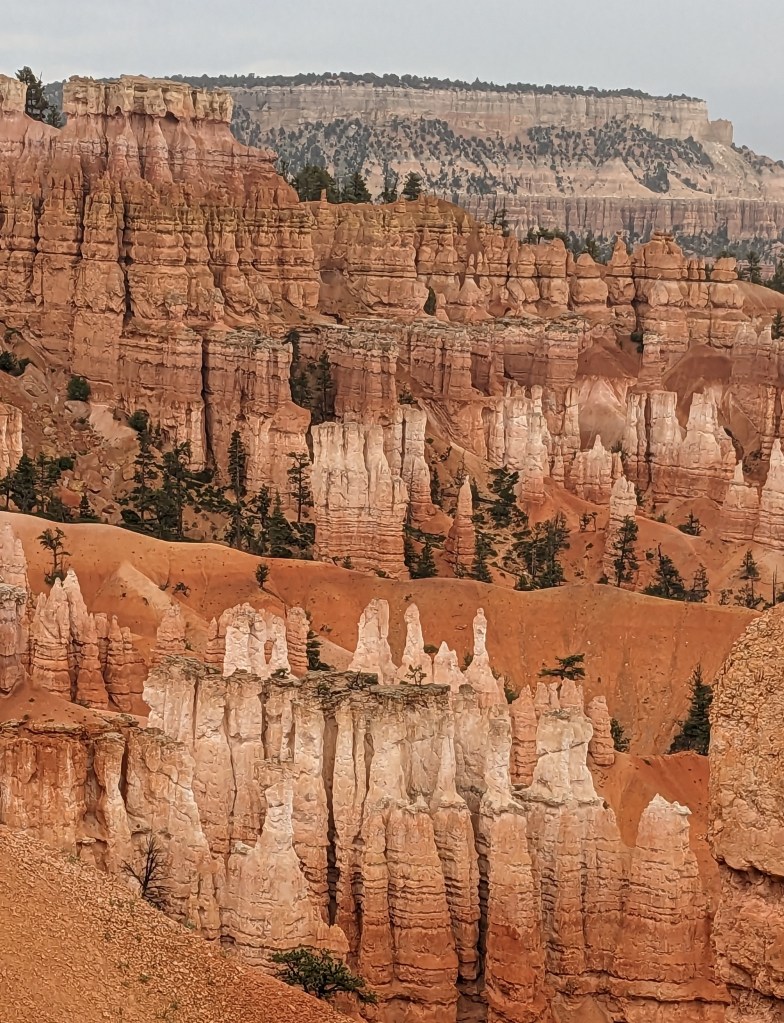
We looked at the brochure to confirm this and read that there had been four fatalities and six injuries. I would have been happy to follow the park ranger’s advice, but we had driven for eleven hours to get there and were too curious to turn back. We started walking towards the Navajo Loop trailhead at Sunset Point. Tourists were posing for photographs at the rim. I wondered what the attraction was and peered over the rim myself. Suddenly, I understood why the site was so crowded.
Navajo Loop
I gingerly placed one foot after another to carefully descend the steep muddy trail. Each time I planted my foot down I held it steadily to ensure I would not slide. A couple approached us from the opposite direction as they ascended the trail.
“We strongly recommend you turn around immediately!” they warned. “It’s treacherous in these muddy conditions.”
Muddy trail
We thanked them, but I continued to gingerly traipse through the mud along the downward trail for a few metres.
“You go ahead,” I urged Alex. “I can’t go any further.”
It continued to hail, and we could hear thunder. I turned around and slowly plodded back up the muddy trail back to the edge of the rim, closely followed by Alex. We contented ourselves with the less slippery 2 km walk along the rim to Sunrise Point and back. Back at the car, we scraped the mud off our shoes, fairly unsuccessfully, and continued our drive to Arches National Park.
The Arches National Park is so popular that visitors have to book through a timed entry system. At 6 pm, when the booking system opened, Alex opened the booking site and secured one of the few remaining availabilities for a 7am entry the next day. He hoped we could also enter just before sunset that day, after 6pm when entry was not timed.
Four-and-a half-hours later we arrived at Arches National Park. The drive had been uneventful along straight desert roads and it had been difficult to force myself to stay awake, as I sat in the passenger seat.
“If we are too tired, we can go straight to our accommodation,” suggested Alex.
I hoped we would do so. I needed to escape from the enclosed space of the passenger seat. Suddenly huge rock formations loomed just beyond the park gates, and we decided to enter. I was lulled from my stupor into a sense of shock from the grandeur of the giant ochre rocks emerging from the plains. I could sense the onset of palpitations.
“I think I’m going to faint, Alex,” I warned him.
“I think you’re experiencing ‘geophilia’,” he responded.
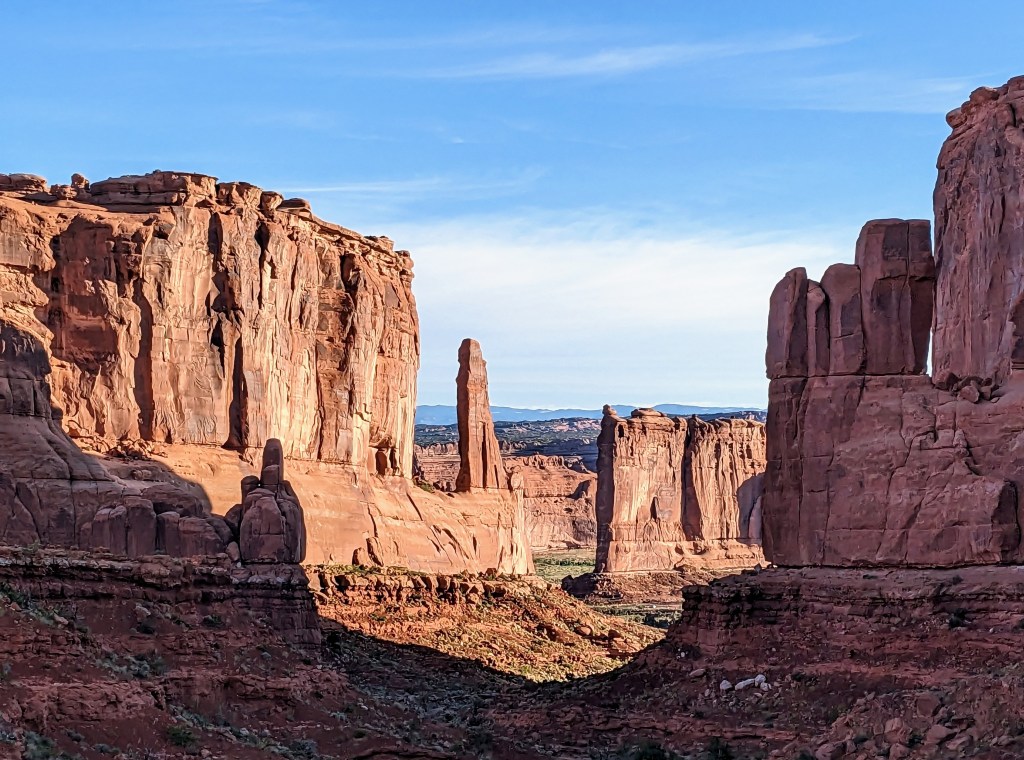
Suddenly, I realised why people found the study of geology so fascinating. Strata upon strata of ochre rocks rose before us. Their layers indicated the movement of the earth’s surface over eons of time,
Entrance to the Arches
The sunset light flattered the rock formations. Cars lined the road heading to the distant formation of Delicate Arch thirteen miles into the park, and tourists parked their vehicles at the many carparks along the wayside to walk amongst the various giant rock formations.
The next morning, we rose to meet our 7am booking to enter the park. The light portrayed the rock formations in a slightly different way from the light of the evening before. We headed to the trail leading to the Delicate Arch. Even at that early hour, the carpark was almost full, and we secured a space before following the throng of tourists walking the trail heading to the arch. We scrambled across rocks and boulders in the piercing sunshine. I glanced at the climbers ahead of me and thought it would be impossible to reach where they were climbing, but with Alex’s encouragement found myself joining them. After a series of false summits, we found ourselves within sight of the arch. I looked at the abyss below and suddenly decided I would content myself with watching others pose for photographs in the arch rather than entering myself. A photographer was set facing a couple posing in the arches perilously close to the drop-off. Couples and children walked across the rocks in front of me towards the arches.
“I feel sick, Alex! I can’t go any further.”
I wondered why the others were walking so freely along the rocks in front of me, in full view of the yawning abyss.
“I promise I’ll hold your hand.”
“I don’t want to drag you down!”
“You won’t!”
I continued to worry I would drag Alex down with me in the abyss, but as usual, succumbed to his confidence. I gripped his hand and refused to gaze below me, carefully placing one foot in front of the other. Fellow tourists were taking turns to pose under the arch. A couple noticed us heading towards the arches.
“Shall we take your photo for you?” they offered.
Alex accepted and handed them his phone.
We continued to inch towards the arch. Finally we reached it and posed beneath it. I tried to assume a confident stance that I did not feel, all the while steeling myself away from glancing down at the abyss. I was naturally inclined to hold myself steady in a tense position, but instead decided to stretch my free arm outwards and pretend to exert confidence.
Arches
After standing there for long enough for the couple to take turns photographing us, we returned to the smooth large boulders ready for our trail down the mountain. As we walked down, I started reflecting on the contrast between how brave others seemed to feel as they freely walked over the boulders facing the abyss, and how timid I had felt.
“I think I have a fear of heights!” I announced to Alex. “I don’t know how I made it to retirement age without noticing this.”
There was one more trail we wanted to pursue, namely, the Devil’s Garden. As before, there were few empty places in the carpark. We finally edged into a free space, and then headed to the trail on our way to the Landscape Arch. This time I decided to read the information posted on the sign at the entrance. It read “Drop-offs on both sides challenge those with fear of heights”. I realised that there must be at least some people who shared my fear.
Arches National Park remains the most impressive national park I have ever visited. The force of nature had never felt so overwhelming. I felt small in this vast ancient landscape but privileged to be able to witness it.
Meredith Stephens is an applied linguist from South Australia. Her work has appeared in Transnational Literature, The Muse, The Font – A Literary Journal for Language Teachers, The Journal of Literature in Language Teaching, The Writers’ and Readers’ Magazine, Reading in a Foreign Language, and in chapters in anthologies published by Demeter Press, Canada.
PLEASE NOTE: ARTICLES CAN ONLY BE REPRODUCED IN OTHER SITES WITH DUE ACKNOWLEDGEMENT TO BORDERLESS JOURNAL
When I recently flew from Australia into Gatwick Airport, London, I was struck by the ease of passing through customs and immigration. Once I exited the plane, I was ushered to an empty lane and directed to a machine to present my passport. As I had nothing to declare I walked through the green lane. A group of four customs officers were engaged in conversation and did not notice me. I had entered the UK seamlessly in about five minutes without making eye contact with a single person.
Not so when travelling within my home state of South Australia. Alex, Verity and I were on our way from Adelaide to Kangaroo Island, situated across Investigator Strait off the southern coast of South Australia. We would have preferred to sail there, but Alex’s boat was high and dry, awaiting repairs to the mast and windows in Yaringa, eight hundred kilometres away in the state of Victoria. We had made a booking for the three o’clock ferry from Cape Jervis to Penneshaw, on Kangaroo Island. We left Adelaide at 1 pm, allowing ninety minutes for the drive and thirty minutes to board, as we always do.
Half an hour into our trip, we were stuck in a traffic jam along the arterial roadway heading south. We had never been trapped in a traffic jam in this direction before, because it was leading away from Adelaide towards sparsely populated farmland.
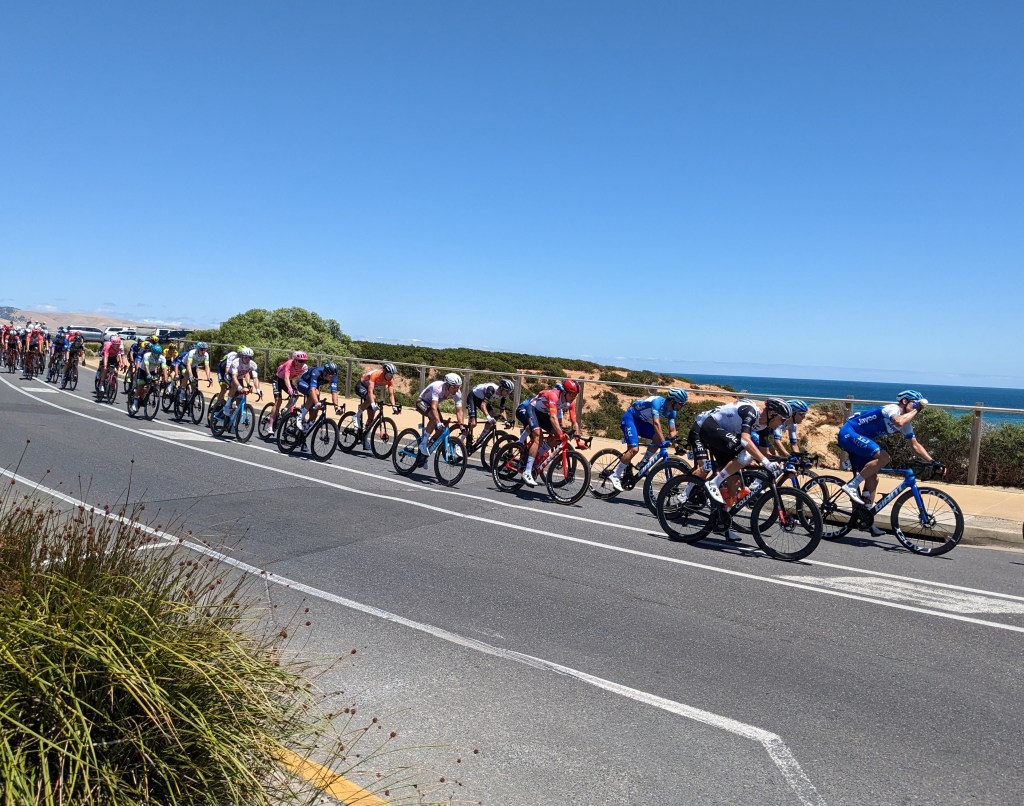
“Oh no! It’s the Tour Down Under! The road is closed for the cycling race,” lamented Alex.
He did a U-turn and headed west to the side streets in the hope of finding an alternative route along the Esplanade. After winding through the coastal suburbs, we arrived at a T junction facing the Esplanade, and were greeted by a woman in a bright orange vest holding a prominent sign saying ‘Stop!’
Onlookers lined the streets holding their cameras ready to snap the cyclists. We waited, all the while nervously checking the time on our phones, wondering whether we would miss our ferry. A few minutes later we heard an excited murmur run through the crowd, and sure enough, a group of cyclists whizzed past.
We glanced at the woman in the orange vest, hoping she would let us pass. She was on her walkie talkie and shook her head at us. Soon another group of cyclists raced past. Then the woman let us on to the Esplanade and we headed south. Soon after we were stopped by a police officer on a bicycle, who directed us away from the Esplanade. We turned east to weave our way back to our original route.
“We won’t make it to the ferry on time!” complained Alex, pressing heavily on the accelerator.
We arrived back on the highway that we had originally departed from and tried to turn right so that we could head south to Cape Jervis. A line of cars from the north were trying to turn right into our street.
“We’ll be here for hours. Best turn left and then do a U-turn,” announced Alex.
Alex turned left, accelerated, and braked when he found a gap in the oncoming traffic. He quickly did a U-turn and then headed south, passing the line of cars waiting to turn right onto the road where we had been waiting.
Would all of this be in vain? Would we get to Cape Jervis just after 3 pm to watch the ferry departing, on its way to Penneshaw? I held my phone to check the distance to Cape Jervis and noted that the estimated time of arrival was 2.54 pm. Alex tried to make up time by driving to the speed limit. A truck was labouring up the hill in front of us. Alex waited until we reached a passing lane, and then floored the accelerator. The estimated time of arrival was now 2.52 pm. Sitting next to Alex as he sped along the highway was more exciting than rides on a fairground had been when I was a child. I trusted his judgment and felt safe all the while enjoying the exhilarating speed. Next, there was a red car dawdling in front of us. Again, Alex waited until we reached a passing lane, and overtook them. The estimated time of arrival was still 2.52 pm. At least we had not been losing time as we were delayed by the slow coaches ahead of us. We entered the township of Cape Jervis, rounded the hill, and then descended to the ferry port, arriving as predicted at 2.52 pm. We expected boarding to be well underway. Instead, four lanes of cars were waiting in the line-up to board the empty ferry, which was running late. We slid into the shortest lane and turned off the engine. A biosecurity officer approached Alex’ window, his curly auburn ponytail blowing in the wind. Alex wound down the car window.
“Do you live on Kangaroo Island or are you just visiting?” he asked.
“We’re just visiting.”
“Oh, lovely! Do you have any honey?”
“No honey.”
“Do you have any bee-keeping equipment?”
“No, definitely not.”
“How about fruit?”
“We have some apples.”
“Are they from the supermarket?”
“Yes.”
“Where did you buy them?”
“In Adelaide.”
“How about potatoes?”
“No.”
“Do you have any plants?”
“We have some caper plants in the back.”
He looked at the back of our vehicle in acknowledgement.
“Oh capers! They look nice. Where did you get them?”
“From a business in Port Adelaide.”
The biosecurity officer seemed satisfied and waved us on.
“Have a lovely trip!”
Shortly after we boarded the 45-minute ferry for Penneshaw. We had been asked more biosecurity questions than at any other place on our travels, and we hadn’t even left our home state. I yearned for the ease of passing through immigration at Gatwick Airport. I had felt perversely miffed at Gatwick for having been ignored by immigration and customs officials.
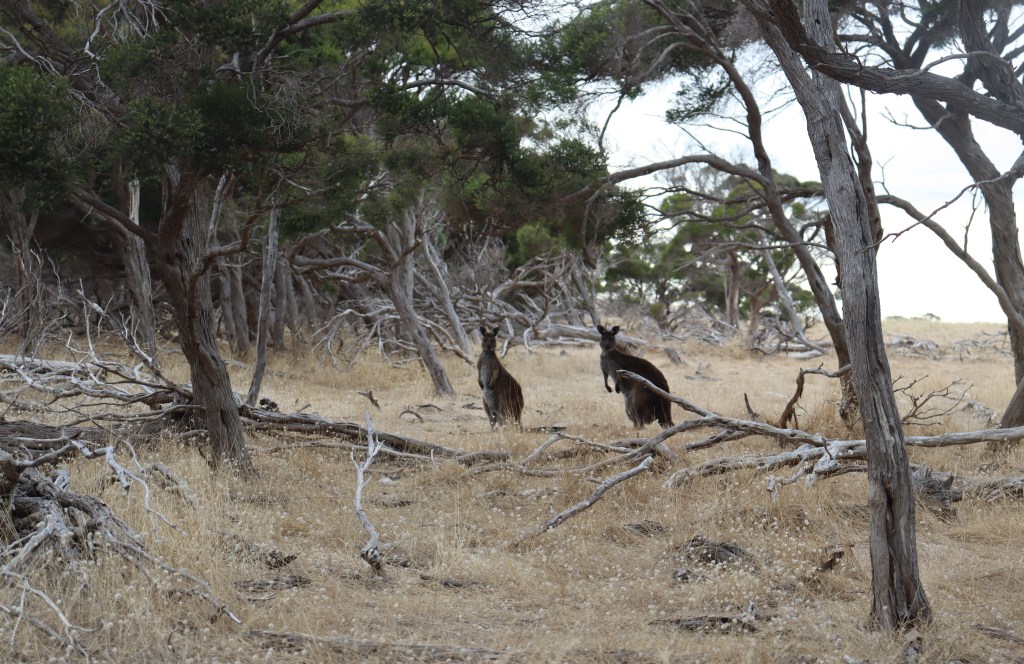
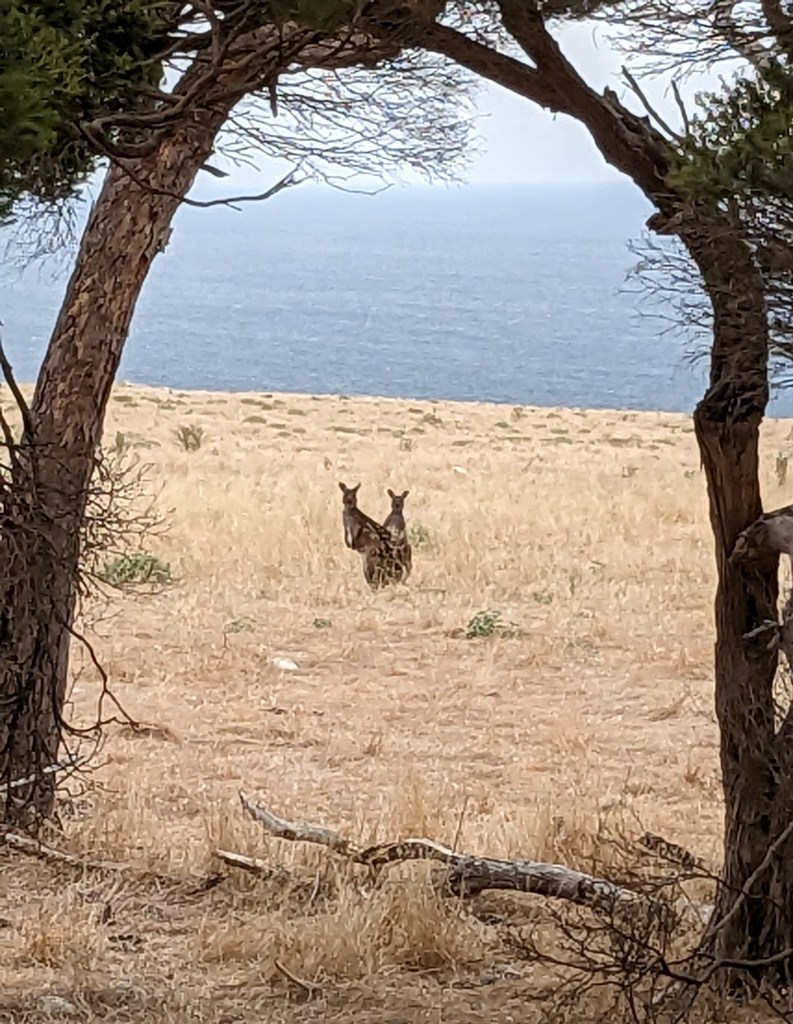
No sooner had we arrived at our destination though, did we spot a marvellous mob of kangaroos bounding across the property.
Then the following day we had a charming encounter with a Rosenberg’s Monitor looking for a drink of water – a species that is endangered on the mainland.
Rosenberg’s monitor lizard
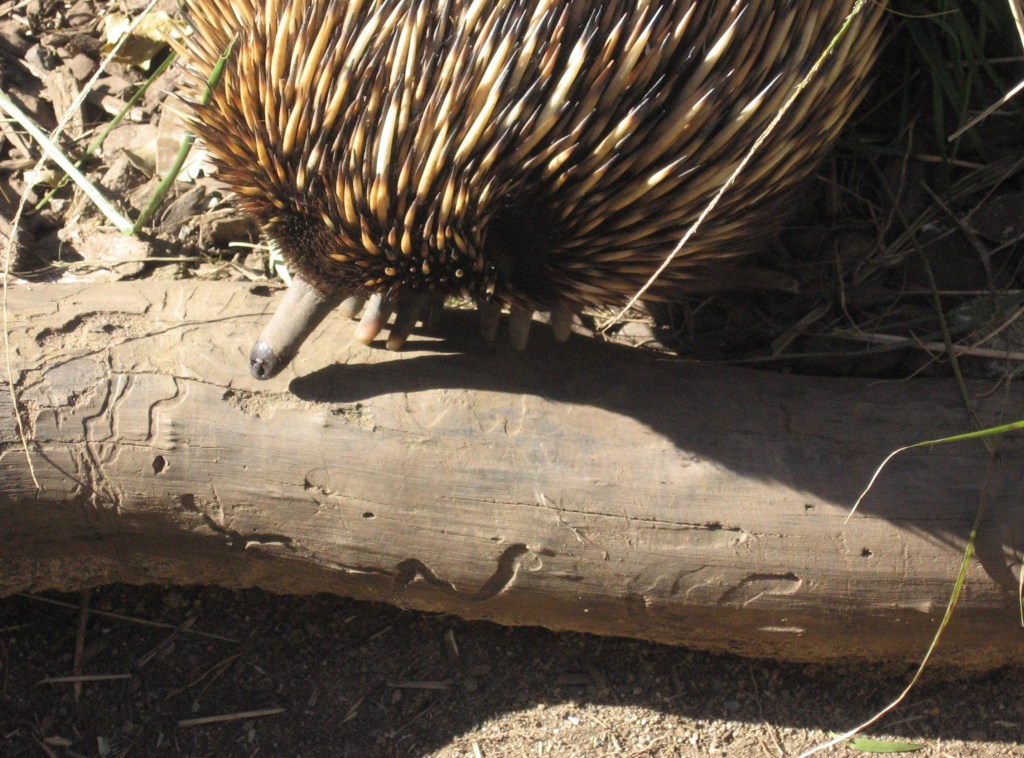
Verity later came across an elusive short-beaked echidna.
Short-beaked echidna
At last I could appreciate that protecting the fauna and flora of Kangaroo Island was important and necessary, and well worth the interrogations of a biosecurity officer.
Meredith Stephens is an applied linguist from South Australia. Her work has appeared in Transnational Literature, The Muse, The Font – A Literary Journal for Language Teachers, The Journal of Literature in Language Teaching, The Writers’ and Readers’ Magazine, Reading in a Foreign Language, and in chapters in anthologies published by Demeter Press, Canada.
PLEASE NOTE: ARTICLES CAN ONLY BE REPRODUCED IN OTHER SITES WITH DUE ACKNOWLEDGEMENT TO BORDERLESS JOURNAL







 Borderless