Book Review by Somdatta Mandal
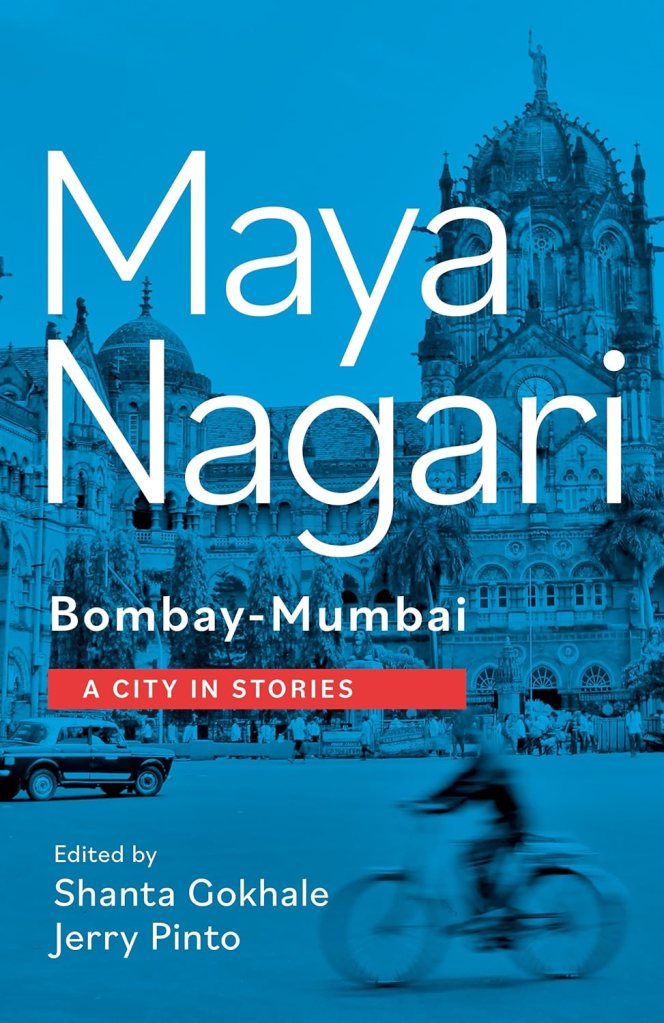
Title: Maya Nagari: Bombay-Mumbai A City in Stories
Editors: Shanta Gokhale, Jerry Pinto
Publisher: Speaking Tiger Books
The very mention of the name Mumbai (or Bombay) brings to our minds a great city in India where the thriving metropolis grows at a rapid speed because people not only flock here from different parts of the country to make quick bucks and survive against all odds, but also because the film industry of Bollywood has also established it as a city of dreams, one that never sleeps and instead creates a mirage-of-sorts — an illusion, rightly labelled by the editors of this anthology as ‘Maya Nagari’. Edited by Shanta Gokhale and Jerry Pinto, this book, comprising twenty-one short stories about Mumbai takes the road less taken to create a non-uniform image of the metropolis. In tune with its multicultural and multilingual nature, we have stories about the city that is a sea of people and speaks at least a dozen languages. There are stories translated from Marathi, Urdu, Gujarati, Tamil, Hindi, Kannada, Malayalam, and stories written originally in English. Among the writers are legends and new voices—Baburao Bagul, Ismat Chughtai, Pu La Deshpande, Ambai,Urmila Pawar, Mohan Rakesh, Saadat Hasan Manto, Ambai, Jayant Kaikini, Bhupen Khakhar, Shripad Narayan Pendse, Manasi, Krishan Chander, Udayan Thakker, Cyrus Mistry, Vilas Sarang, Jayant Pawar, Tejaswini Apte-Rahm and Anuradha Kumar.
As Jerry Pinto clearly states in the introduction, the stories can be read as we like, we can begin with the first story or the last, or any story in between. The observant reader might notice that he and the other editor Shanta Gokhale have deliberately chosen not to organise the material according to chronology, or geography. This is partly because they believe that the city lives in several time zones and spaces at once, as does India, but also because there is something essentially chaotic about its nature. So, he says, “the stories echo and bounce off each other, they do not collide, but there is a Brownian motion to these patterns” and he hopes to let the readers find it. Here, Mumbai is stripped of its twinkle; it is deglamourised to reveal how it’s the quotidian that lends the city its character—warmth and hostility alike and as inhabitants of the city the editors call ‘home,’ they hope a narrative will emerge.
In the twenty-one stories of this collection, there is the city that labours in the mills and streets, and the city that sips and nibbles in five-star lounges, the city of Ganapati, Haji Malang and the Virgin Mary. What binds the stories together is ‘human muscle’ – the desperate attempts of men and women of all classes and castes to survive in this heartless city amid all odds.
The stories are of different lengths and written in different narrative styles. Of the five or six stories translated by Shanta Gokhale herself from Marathi, one is struck by the excessive length of the so called ‘short’ stories. The very first one “Oh! The Joy of Devotion” by Jayant Pawar, forty-five pages in length, narrates in detail about the Ganapati festival and how it is related to the fate of the local people. Pu La Deshpande’s story “A Cultural Moment is Born”, set in the 1940s, tells stories of people living in chawls [slums] and how they spend their cultural days. Another very long story translated by Gokhale called “The Ramsharan Story” tells us about the rise and fall of a bus conductor by the name of Ramsharan who turns out to become a union leader. Baburao Bagul’s “Woman of the Street”, written originally in Marathi and translated by Gokhale again, tells the story of Girija, a sex-worker trying to collect money to cure her son in the village. The story ends on a disturbing note, as it reaffirms the relativity of success.
Once again, Krishan Chander’s story “The Children of Dadar Bridge” translated from Hindustani by Jerry Pinto is so long that it qualifies to be called a sort of novella. In this powerful story God comes to earth to a chawl and offers food to the first-person narrator. Then, impersonating as a small and innocent child, and along with the child narrator, he moves around different places in the city to witness its activities firsthand — we get to know about behind the scene affairs that take place in the film studios, about satta[1] dens, about bribery, local dons who arm-twist every new hawker to carry on their business after receiving their weekly cut money and more. In “Civic Duty and Physics Practicals”, Malayalam writer Manasi reveals the different experiences one comes across living in a society defined by power equations. Issues of hooliganism, superstition, illegal colonies, corruption, intimidation and violence are explored in a single story where the narrator is struggling, for days, with blaring speakers at a wedding nearby, even as her son tries hard to prepare for his upcoming exams. The story soon takes a dark turn where power trumps over consideration for fellow human beings.
A very powerful story written by Ambai in Tamil called “Kala Ghora Chowk” deals with issues of Marxist ideology, trade unions and the fate of a raped woman called Rosa. Anuradha Kumar’s “Neera Joshi’s Unfinished Book” tells us the life story of one woman who “made the city” and the perennial problems of displaced mill workers when the closed mills give way to high-rise buildings. Some of the stories are of course written in a lighter vein, though they also depict different problems related to city life. As the title of Vilas Sarang’s story “An Afternoon Among the Rocks” suggests, it narrates the plight of a couple trying to make love in the deserted seashore and how they get hijacked by a smuggler! In “The Flat on the Fifth Floor”, Mohan Rakesh writes about two sisters who meet the narrator after one failed love affair. A moving picture of the closing down of cinema halls in Mumbai comes out very beautifully in the Kannada story “Opera House” by Jayant Kaikini, especially narrating the plight of one of the sweepers working there when the declaration of permanent closure is pasted everywhere. Tejaswini Apte-Rahm’s “Mili” tells the story of a man who meets his ex-girlfriend after five years.
Though it is not possible to give the details of each and every story included in this anthology in this review, one must mention some of the stories that were originally written in English. Cyrus Mistry’s “Percy” about a young and lonely Parsi boy is so compelling that it was even made into a Gujarati motion-picture. “House Cleaning” by Jerry Pinto tells the story of a woman cleaner and his son, who talks about the reality of street dwellers. Eunice de Souza’s “Rina of Queen’s Diamonds” is not a straightforward narration at all but offers a collage of different vignettes of life in Bombay.
Though most of the stories portray the seamier side of life and in some ways de-glamourise Mumbai, at the same time they also portray how human resilience can combat all sorts of odds, and the city can be revealed only through shared experiences. Thus, each of the twenty-one stories in this collection tells a different tale of Mumbai, Bombay, Momoi, Bambai, Manbai and many others. As the editors have rightly pointed out at the beginning of their introduction, “You cannot catch a city in words. You cannot catch a city at all.” They felt that “it is not meant to be caught…this city resists even more because it was not designed at all; it just happened and it keeps on happening.” Thus, the four-hundred plus pages of this anthology Maya-Nagari remains a book to be treasured and read now at leisure and also at any time in the future.
.
[1] Betting or gambling dens
Somdatta Mandal, critic and translator, is a former Professor of English at Visva-Bharati, Santiniketan, India.
.
PLEASE NOTE: ARTICLES CAN ONLY BE REPRODUCED IN OTHER SITES WITH DUE ACKNOWLEDGEMENT TO BORDERLESS JOURNAL
Click here to access the Borderless anthology, Monalisa No Longer Smiles
Click here to access Monalisa No Longer Smiles on Kindle Amazon International
 Borderless