Categories
Essay

Reminiscences from a Gallery: The Other Ray

Dolly Narang muses on Satyajit Ray’s world beyond films and shares a note by the maestro and an essay on his art by the eminent artist, Paritosh Sen
My trunk call from Delhi to Calcutta booked one day before finally materialised.  This was way back in 1990 when trunk calls were the fastest mode of communication. In a coarse voice, the operator demanded a response from the deep, modulated voice on the other end. ‘Satyajit Ray hai[1]?’ she asked, her tone sharp with impatience.

I could hear the legendary filmmaker’s composed response to the operator’s gruff, abrupt tone.  I winced at her brusqueness feeling helpless to intervene and apologise.

When she connected me, I introduced myself to Satyajit Ray and ventured to share my idea of an  exhibition that would showcase a lesser-known yet equally fascinating facet of his oeuvre—his drawings, film sketches, graphic design and more. A visual archive that, though rarely seen by the public, was as significant as his cinematic legacy. He was initially apprehensive—modest about this body of work and uncertain about how it would be received

This initial conversation was followed by a series of follow-up exchanges over trunk calls,  over several months. Each call felt like a step closer to realising the exhibition. I would book trunk calls in the urgent category request for PP (person to person) as they took less time to materialise.  PP calls were specifically for the person whose name was specified.  Still, patience was essential.

Ray, to my surprise and admiration, always answered the phone himself. No secretary, no assistant screening the calls. The simplicity and humility was endearing.

I had first shared the idea of the exhibition with Paritosh Sen one of India’s master painters and a friend of Ray’s of an exhibition of a lesser known yet fascinating facet of Ray’s genius: children illustrations, detailed film sketches, designs for book and magazine covers, typeface designs, his diverse portfolio of graphic work.   Paritoshda, as I affectionately called him who mentored and guided  me as I began my journey into the art world, not only approved of the idea but took it upon himself to speak to Ray, whom he knew personally.  Following the introduction through Paritoshda, I pursued  the idea with the legend.

During the first phone call, I briefly spoke about my concept— an exhibition that would focus  on his rarely seen visual art. His immediate response was  hesitant and guarded, “These are very small works on paper just a few inches in length and width.” he said. “They would be of no interest.”  I ventured  that this was a unique and a first time view into his visual legacy and the size would not take away from the impact.  He further expressed his doubt  about his graphic work having any resonance beyond Bengal, in North India. I   further submitted that his artistic genius and versatility has an appeal beyond Bengal. This exhibition would give a rare insight into the work and thought process of not only the deeply respected and admired film maker that we all know but also of Satyajit Ray the illustrator, the graphic designer, along with revealing the meticulous and detailed planning into his films.

I hoped to bring this body of work — into public view for the first time. The idea was to get  people to see another Ray — not the filmmaker behind the camera, but the artist behind the pen and brush.

I remember Ray had explained that he had a  busy schedule and preoccupied with the editing of Ghare Baire. After several months  of trunk calls and waiting, I booked another urgent, person to person call. Finally the breakthrough I was waiting for, “ Come next week,” he said. His doubts of an exhibition having been cleared through the intervention of Paritoshda and somewhat through my persuasion.   

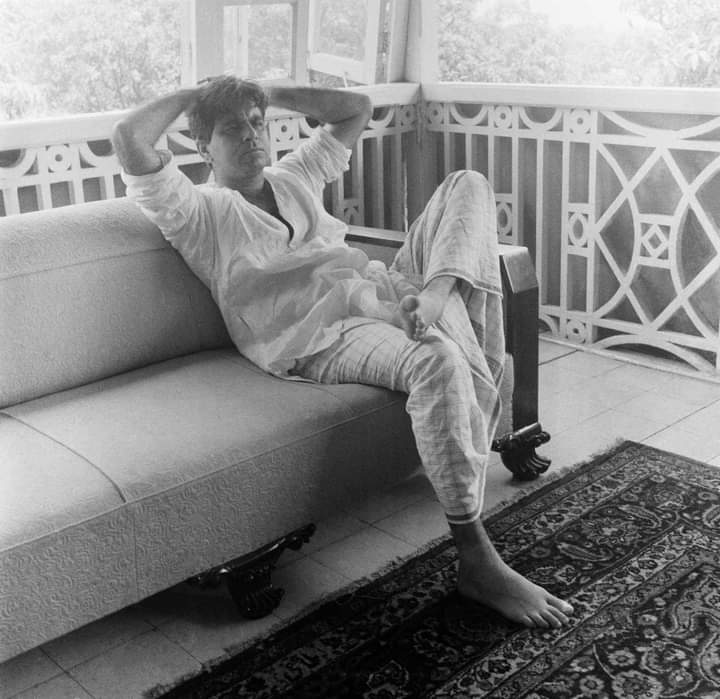
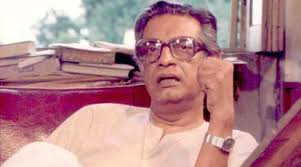
 As I boarded the Indian Airlines flight to Calcutta the following week, a surge of excitement gripped me. I was given a morning time to meet him at his residence: 1/1  Bishop Lefroy Road. I arrived with some trepidation. Standing outside this tall imposing door, I rang the bell. Soon, I found myself face to face with the master who opened the door himself—his tall, commanding presence matched only by his deep, well-modulated baritone voice greeting me warmly. He led me into his much photographed studio/workplace. He was looking comfortable and relaxed in a white kurta pajama. In contrast to his majestic yet simple presence,  I was nervous and hoping it was well masked.

Thereafter, began a series of visits to his flat. Each time the door was opened by the master himself. And I would be led into his study teeming with books lining the teak wood book shelves.   

He would sit  in a comfortable looking swivel chair with a brown rexine cover, the corners of which were slightly frayed.   Opposite him and within a comfortable arms reach was a small work table with jars tightly packed with paint brushes, pen, pencils.   Here is where he did his drawings to create his vast and varied visual legacy of set design, costume design, make up instructions, graphic design, children’s illustrations for the monthly children’s magazine, Sandesh, started by his grandfather,  He also designed the covers for Sandesh, more books and magazine covers.  

Making of the exhibition

 Working alongside him to sort through his drawings was an enriching and memorable experience—one that offered rare insight into his creative mind. Each meeting felt like a step closer to the exhibition becoming a reality.  I noticed  his interest was slowly growing and he was participating in the selection with increasing enthusiasm and a discerning eye.   He approved some while some he felt need not be exhibited. Our meetings would stretch till lunch time until he was gently summoned by his wife, Bijoyadi, to take his lunchbreak.  He would extend the search and wrapped up a little beyond lunch time. I too was cautious not to overstep limits.

As he began to look in his study, he unearthed these miniature treasures on paper tucked between  books or between their pages, resting on tall teakwood bookshelves. Some were found under sofa cushions. He remembered that many were with his cousin Lila Majumdar[2] and that he would have to ask her. As he delved deeper into his collection he remarked, “I had forgotten I have done all this work.”

During  few initial meetings, I would address him as Mr. Ray, which was beginning to feel formal and somewhat awkward. So I asked if there was another way I could address him.

“Manik,” he asserted. “Everyone calls me Manik.”

From that moment on, I called him Manikda. These recollections return to me vividly as I write this piece.

We turned our attention to his iconic crimson books, neatly stacked in his study. These well-known volumes are a treasure of Ray’s meticulous preparatory work—filled with detailed sketches for his films, costume and set designs, makeup instructions for his makeup artist, architectural notes, and an astonishing range that gave glimpses into his thought and work process.
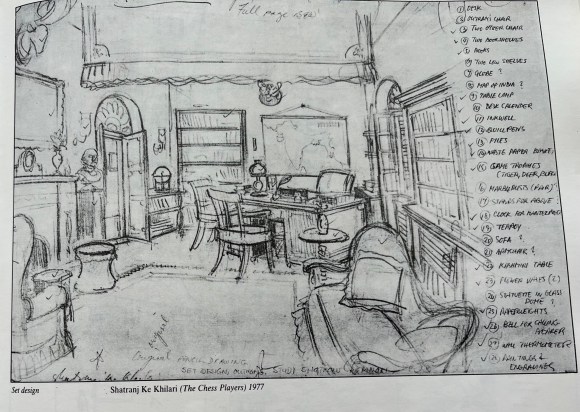
Sourced from the brochure provided by Dolly Narang

We did not want to remove any drawings from these precious notebooks. He selected the drawings that he liked and decided he would ask Nemai Ghosh (1934-2020), his close associate and long-time photographer, to photograph them for the exhibition.

Several drawings, having come loose from the notebooks, were used in their original. We did not want to remove any drawings which were firmly in  place in these volumes. Ray  identified  the drawings that appealed to him and Ghosh photographed them.

Part two of the exhibition was titled “Drawings and Sketches For Films’ and it comprised of both originals and the photographs by Nemai Ghosh  of the drawings chosen by Ray.

I nudged him further and asked if there was anything else he might suggest from his visual repertoire. 

He thought of his film posters. The ones readily available in his flat were  posters of Nayak and Ghare Baire, which were loaned for the exhibition. He was particularly eager to include the poster of Devi, but after searching, he discovered he only had one copy and was reluctant to part with it.
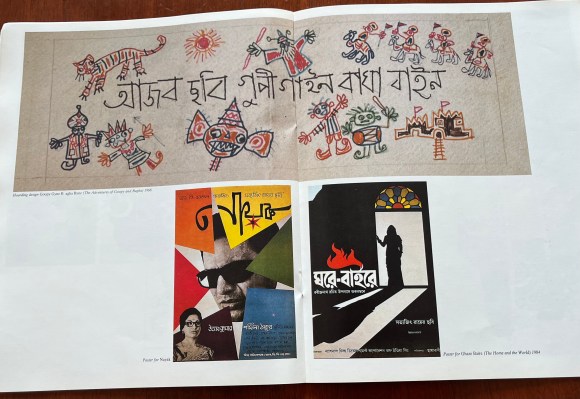
Top: Hoarding of Ray’s film Goopy Gyne Bagha Byne (1969). Below:: Film posters of Nayak(Actor, 1966) and Ghore Baire (Home and the World, 1984). Sourced from the brochure provided by Dolly Narang

 We tried to include artworks which would represent the different aspects of his visual repertoire.  It seemed there was no end — typefaces he had designed, advertising campaign when he worked for D.J.Keymer.   While searching he realised he did not have the originals of the typefaces he had designed but fortunately they had been preserved in the photographs taken  by Nemai Ghosh.  Later Paritoshda told me that he was given an award for  the typeface by an American foundry and named it after him, Ray Roman.  
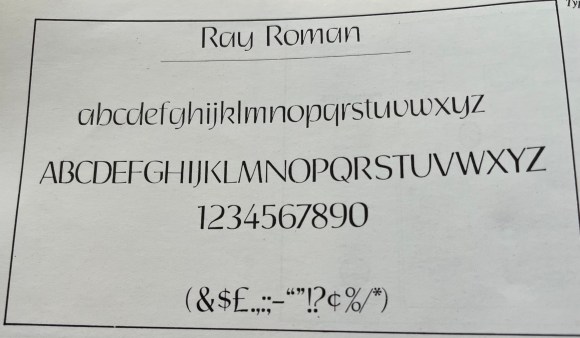
Provided by Dolly Narang

An album was discovered containing a silent film he had conceptualised on paper but never brought to life—a silent film on Ravi Shankar with his music in the background.  The album, composed of monochromatic black watercolours, was photographed by Nemaida. It drew great interest, offering a first-ever glimpse into a project that was never realised.

Paritoshda advised  that Ray had composed music for many of his films.  A tape with his compositions was playing continuously and softly in the background at the exhibition.

The exhibition was presented in two parts each had a duration of three weeks.  Part one was devoted to his Graphic design, drawing and part two was about his preparatory sketches for films.

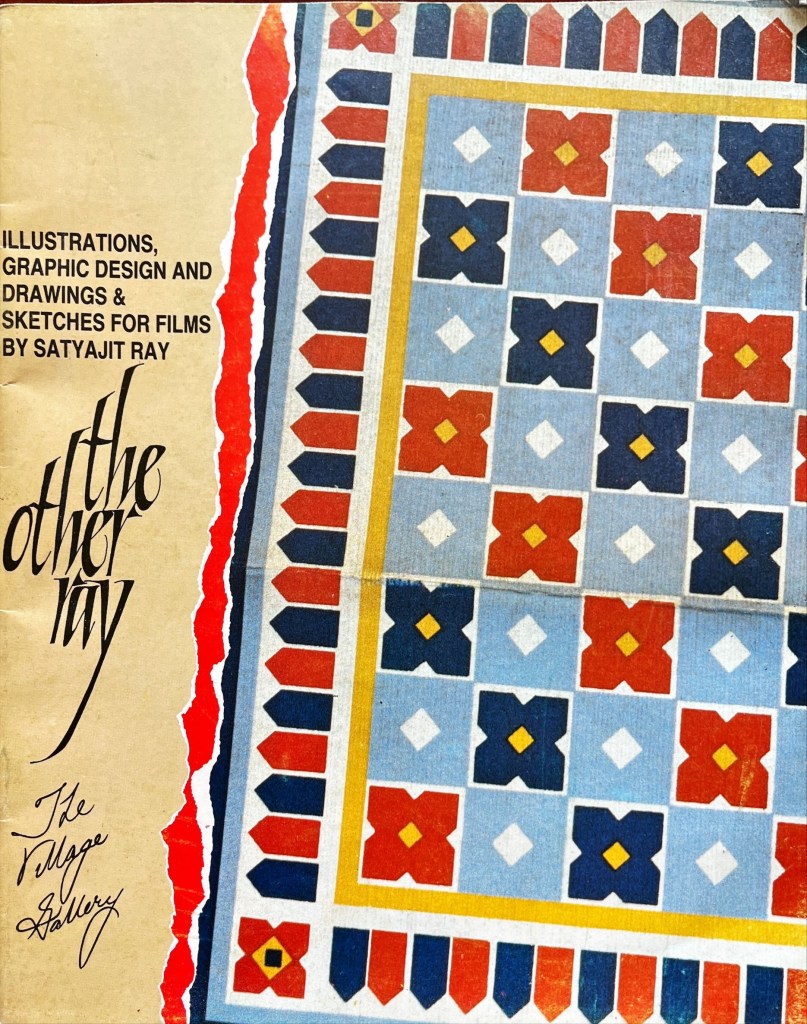
I requested Paritoshda to write an article for the exhibition catalogue, to which he graciously agreed. He penned an insightful essay which was appreciated by Ray himself as well as by fellow artists, critics, and visitors who found his insights both illuminating and deeply  engaging.  When I asked him for his suggestion for a  title for the exhibition, he thoughtfully suggested  — “The Other Ray” — a title both fitting and meaningful.

With the socio-political upheavals around us in Delhi, it wasn’t easy—cataloguing, printing invitation cards, framing, arranging transport to distribute the invitations.  Invitation cards from our mailing list of  over one  thousand had to be hand delivered.

I asked Manikda for names of his friends and associates who he would like invitations to be sent to.  His list included names both in  India and abroad.

About a week before the event, I visited AIFACS[3] to put up a poster for the exhibition. To my surprise and delight, sitting in one of the exhibition halls was none other than M.F.Husain himself. It felt like a godsend—an unexpected opportunity to personally invite him.

He was visibly excited upon hearing about the exhibition and expressed  interest in seeing the artworks immediately wherever they were.   I explained that the pieces were still at home and would be better appreciated once they were displayed on the gallery walls.  But he was insistent—he wanted to see them right away.   We got into my car and drove to my house. Husain viewed the works in thoughtful silence moving from work to work, looking at each with great interest. After perusing them keenly he settled  at the dining  table and began reminiscing about his association with Ray – a moment as historic as it was moving, etched forever in my memory. 

I was not prepared with either a tape recorder or a camera to record this memorable encounter. Fortunately, The Illustrated Weekly, under editor Pritish Nandy, later published his reflections in an article spread over two pages with several illustrations of his graphic work.

Opening to the Public

When the exhibition finally opened at The Village Gallery in New Delhi’s quaint Hauz Khas Village it was received with great enthusiasm and acclaimed  by both critics and the public

 Visitors from all walks of life came to see the “ The Other Ray”.  For many, it was a revelation. The same legendary filmmaker who had given the world The Apu Trilogy had also crafted whimsical illustrations for children, designed  book jackets,  created typefaces. It was exciting for them to get a peek into his creative process as a filmmaker through his detailed film sketches.   

 I made another trunk call to inform him that the article in the brochure by Paritosh Sen had been chosen for The India Magazine’s cover story.   The next day, when I spoke to him again and offered to send him a copy of the magazine, he responded with excitement. He said he couldn’t wait and had already gone to the market to buy a copy for himself.

Once the exhibition—having stirred great excitement in the art world—came to an end, it was finally time to take it down. The last few days were deeply moving. Visitors lingered, often spending long hours in the gallery, reluctant to leave, as if trying to hold on to the experience a little longer. The space was filled with quiet reflection and enriched by heartfelt exchanges.

Looking back, organising this exhibition remains one of the most fulfilling experiences of my life. What I cherish is the memory of the many hours spent in his study carefully selecting the works for the exhibition.  It was a collaborative process, he was open to my suggestions yet he became more and more involved as he delved deeper into his graphic work.

An idea, carefully nurtured, took shape as an exhibition. What was especially fulfilling about the exhibition was how it brought to light a lesser-known facet of Ray’s creative genius—his remarkable visual imagination, his penchant for details, his industriousness. Until this exhibition, only a few of his sketches had appeared in articles and books, leaving much of this work largely unseen. The display offered audiences a rare and intimate glimpse into his visual world as well as his work and thought process, making it especially significant.

The final step was to return the works. I personally placed each delicate sheet into thin plastic sleeves, compiled them into a portfolio, and flew to Calcutta to return them to the master. True to his dignified demeanour, he received the compilation with quiet pleasure. He expressed both satisfaction and a hint of surprise at the enthusiastic response the exhibition had received. I took the liberty of asking him if I could keep as a memento two works from each part of the exhibition. He readily agreed and asked me to choose. I selected one black white illustration for Sandesh and credit title from his film Sonar Kella (The Golden Fort, 1974) .  One more request —  Could he sign these please? To which he graciously agreed.

As I took my leave, I shared a  thought—could we perhaps work on a sequel to The Other Ray? He received the idea warmly, but unfortunately, it never came to fruition. He soon became immersed in Agantuk (The Stranger, 1991), and not long after, his health began to decline.

As I write this, memories come rushing back, and I find myself tempted to echo Manikda’s words of my experience  that  “I had forgotten I had done all this work.”
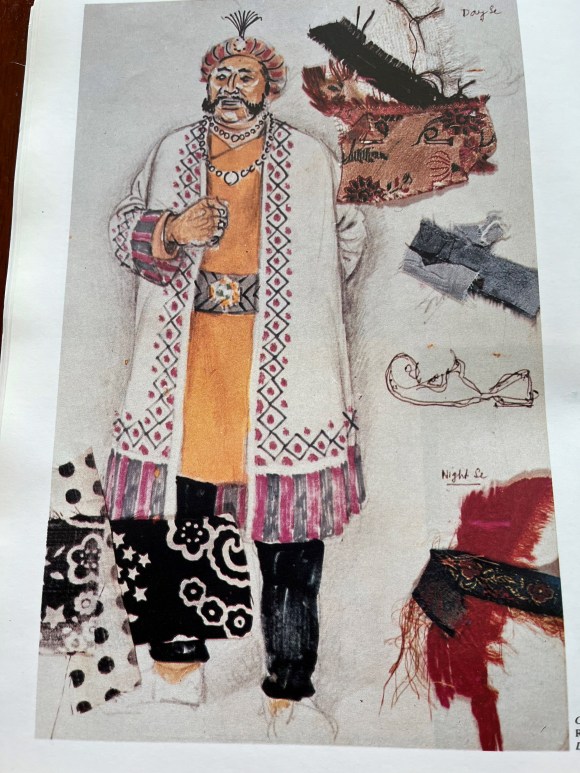
Costume designed and sketched by Ray for Hirak Rajar Deshe (In the Country of the Diamond King, 1980) Sourced from the brochure provided by Dolly Narang
Ray’s Note in the Brochure:

My grandfather was, among other things, a self-taught painter and illustrator of considerable skill and repute, and my father — also never trained as an artist — illustrated his inimitable nonsense rhymes in a way which can only be called inspired. It is, therefore, not surprising that I acquired the knack to draw at an early age.

Although I trained for three years as a student of Kalabhavan in Santiniketan under Nandalal Bose, I never became a painter. Instead, I decided to become a commercial artist and joined an advertising agency in 1943, the year of the great Bengal famine. Not content with only one pursuit, I also became involved in book designing and typography for an enterprising new publishing house.

In time I realised that since an advertising agency was subservient to the demands of its clients, an advertising artist seldom enjoyed complete freedom.

This led me to the profession of filmmaking where, in the 35 years that I’ve been practising it, I have given expression to my ideas in a completely untrammelled fashion.

As is my habit, along with filmmaking, I have indulged in other pursuits which afford me the freedom I hold so dear. Thus, I have been editing a children’s magazine for thirty years, writing stories for it and illustrating them, as well as illustrating stories by other writers.

While preparing a film, I’ve given vent to my graphic propensities by doing sketches for my shooting scripts, designing sets and costumes, and even designing posters for my own films.

Since I consider myself primarily to be a filmmaker and, secondarily, to be a writer of stories for young people, ·I have never taken my graphic work seriously, and I certainly never considered it worthy of being exposed to the public. It is entirely due to the tenacity and persuasiveness of Mrs. Narang that some samples of my graphic work are now being displayed. Needless to say, I’m thankful to Mrs. Narang; but, at the same time, I must insist that I do not make any large claims for them.

Ray’s signature: Sourced from the brochure provided by Dolly Narang

 SATYAJIT RAY

The Consummate Artist by Paritosh Sen (1918-2008)

(Republished from the brochure of “The Other Ray” exhibition)

It was the summer of 1945. I was holding my third one-man show and my first in Calcutta. On the third day of the exhibition, Prithwish Neogy (a brilliant scholar, now heading the Department of Asiatic Art at the Honolulu University) entered the exhibition hall accompanied by an extraordinarily tall and swarthy young man. I had known Prithwish earlier. The latter was introduced to me as Satyajit Ray. I was vaguely aware of him as the only son of the late Sukumar Ray, the creator of a unique body of nonsense rhymes and humorous prose remarkable for their originality of vision and an extremely sharp intellect and imaginative power. Satyajit was also known as the grandson of Upendra Kishore Ray, one of the inventors of half-tone block making, a pioneering creator of a sizeable body of children’s literature and the founder of the well-known children’s magazine, Sandesh, and a painter of no mean talent either.

Satyajit was then doing a course in painting in Santiniketan under the very able guidance of Benode Behari Mukherjee, a great artist and an equally great teacher. Besides, Ray had also the unique opportunity of coming in close contact with Nandalal Bose, the guru of both Benode Behari and Ram Kinkar, undoubtedly the foremost sculptor of contemporary India.

Earlier he had also received the blessings and affection of Rabindranath Tagore. Although he did not complete the art course in Santiniketan, the experience of being surrounded by these great artists and the unique rural setting of the Santhal Parganas, as portrayed by these artists and the poet, enabled Ray to appreciate nature in all its diverse and glorious manifestations and opened his eyes to the mysteries of creation. This single unprecedented and cherished experience helped him to formulate his ideas about the visual world and to unlock doors of visual perceptions. Added to this was his study and understanding of the classical and folk art, dance and music of our country. The magnificent collection of books in the Santiniketan library of world art and literature also helped him to widen his horizon. It was here that he read whatever books were available on the art of cinema. The seeds of a future design artist and a filmmaker were simultaneously sown here.

Having lost his father early in life, the need for earning a livelihood assumed enough importance to make him leave Santiniketan prematurely and look for a job in the field of advertising art or, as it is better known in modern parlance, graphic design. A latent talent is bound to make its presence felt sooner or later, whatever be the chosen field. As Tagore said in one of his early verses, “Flowers in bloom may remain hidden by leaves but can they hide their fragrance?” Satyajit Ray was appointed by the then D.J. Keymer (now known, as Clarion Advertising Services Ltd.) as a visualiser-cum-designer, often executing the finished design or an entire campaign himself.

Together with two of his contemporaries, O.C. Ganguli and Annada Munshi, Ray was trying to evolve certain concepts not only in illustrations but also in typography which would give their design an overall Indian look. One recalls those highly distinctive newspaper and magazine ads, the magnificent calendars, posters, cinema slides and what not of the late ’40s and ’50s not without a certain nostalgia. If my memory does not fail, I think some of the works of these three artists were even published in Penrose Annual and elsewhere. Here it may be worthwhile to bear in mind that the style evolved by these three artists made a welcome departure from the dull academicism and the stereotypes being practised by most of the advertising agencies of those times. The freshness and vigour displayed in their approach was readily appreciated both by their employers and their clients. Ray was particularly strong in the difficult area of figure drawing, an area in which many graphic designers were found singularly wanting.

Although he was soon to move away from commercial art to embrace his new-found love of filmmaking, he would continue to remain an illustrator of the first order as would be evident from his emergence as a story-teller in the two popular genres of detective and science fiction. (Not many outside Bengal know that Ray’s literary output is in no way less than that of his cinema and that most of his books have already run into thirty to thirty-five editions). He has not only been illustrating his own stories, but over the years he has been designing the covers of his grandfather’s once defunct children’s magazine Sandesh, revived by him nearly two decades ago, which also carried many illustrations by him. But in my opinion his most cherished field is calligraphy, whether that be of the pen or brush variety.
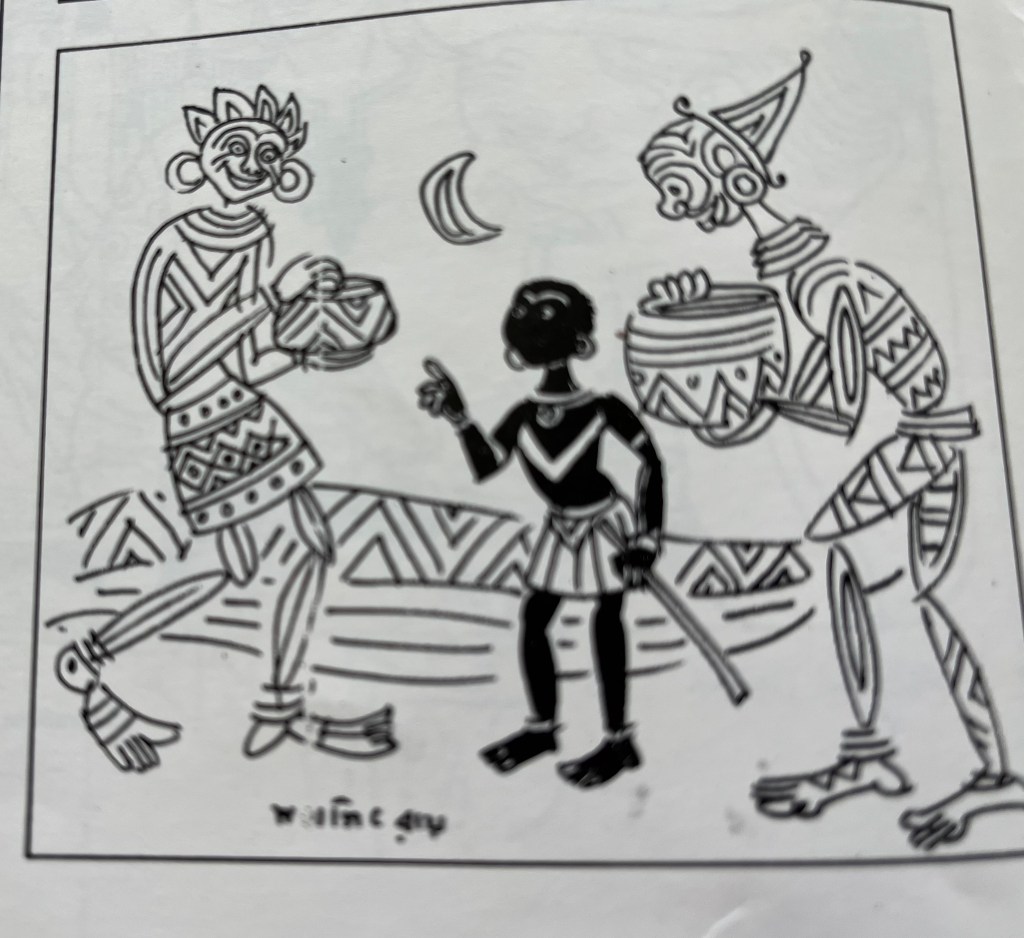
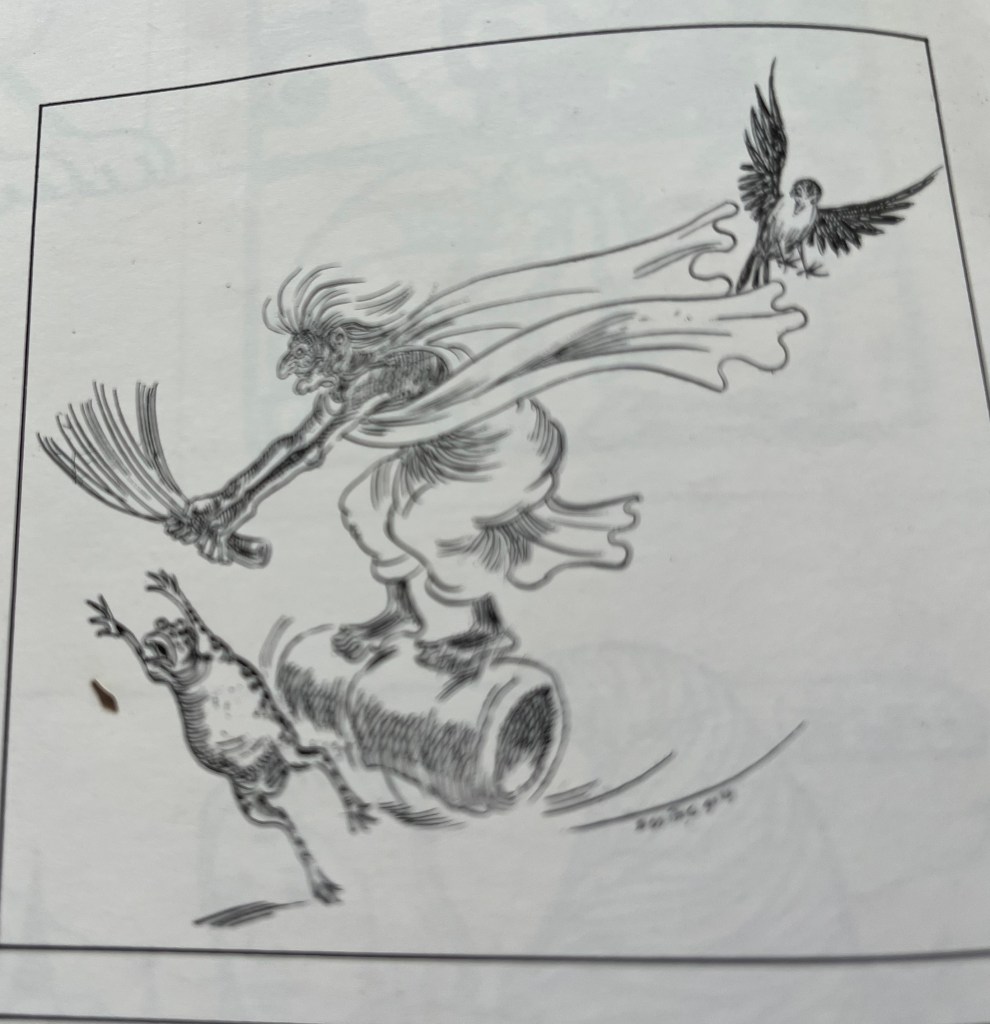
This art he imbibed from his guru Benode Behari Mukherjee. Over the years he had also been studying the art of typography with the scrutinising eye of a highly creative calligrapher. The result has been a series of innovations in both Bengali and English lettering evolved for posters, banners and book covers. These very original works gave a tremendous fillip to graphic design in general and book, magazine and record covers in particular, especially in Bengal. The books Ray designed for the now defunct Signet Press of Calcutta way back in the early ’50s set new trends and were considered as models for book production both in terms of page layout, typography and jacket design, the last being his chosen field where, as I said earlier, his innovations have known no bounds. The covers of the well-known literary magazine Ekshan, which he has been designing for many years, to give only one instance, bear ample testimony to his apparently playful but significant experiments with the forms of three Bengali letters which constitute the name of the magazine. The wide variety of his inventiveness is one of his great achievements in the field of cover design.
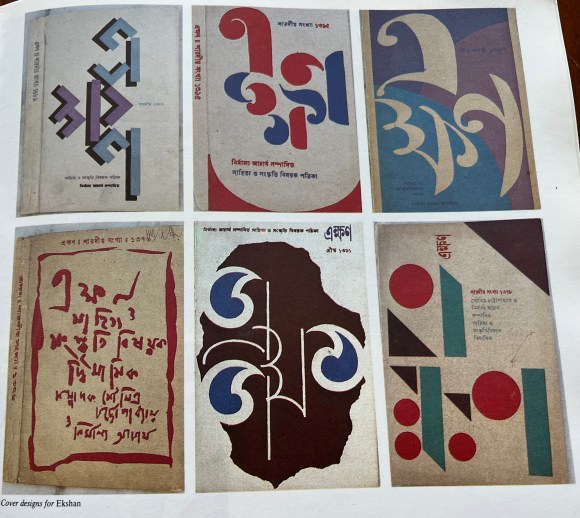
Cover designs for Ekshan. Sourced from the brochure provided by Dolly Narang

Then there are the posters, banners and slides he designed for his own films. These too were eye openers and instant trend setters. Who can ever forget the huge banners and billboards of the Apu trilogy put up at important street junctions of Calcutta! Their freshness of ideas, design concepts and calligraphy were not to be missed even by men and women in the street. Simultaneously with his creative outburst in the art of cinema, his creativity in graphic design reached new heights. What was remarkable was the fact that Ray imminently succeeded in investing all these works with a highly distinctive Indian flavour derived from his awareness of our folk traditions (especially 19th century Bengali book illustrations and woodcut prints of decorative lettering) both in their linear vigour and simplicity as well as in ornamentation.

One of the most outstanding examples of this approach was the publicity material he designed for Devi. The underlying theme of the title expresses itself forcefully both in the highly imaginative design of the lettering and the image. Their fusion is perfect. Not many graphic designers have been as type conscious as Ray. He personifies the printing designer’s gospel “type can talk”. That a letter or a printing type is not only a sign but an image by itself, and if appropriately employed can have immense communicative power and is capable of expressing a whole range of human emotions was known to Ray from the very beginning of his career.

In the enormous range of Roman printing types there are many in the humanist tradition in their simple aesthetic charm, warmth of feeling as well as in their highly elegant but delicate anatomical details. There are also those which are severe, powerful and cold but nonetheless are highly attractive in their own ways.

It is often overlooked by most readers that a letter’s structure and anatomy can be reminiscent of things in the visible world, both natural and man-made. Some can have the gentle rhythm of the rise and fall of a female form, others may have the majestic look of a well-designed edifice-just to give only two similes. Ray not only bore all these considerations in mind but used his calligraphic knowledge, skill and innovative power to their full advantage when he designed the three printing types called Ray Roman, Daphnis and Bizarre for an American type foundry nearly two decades ago.
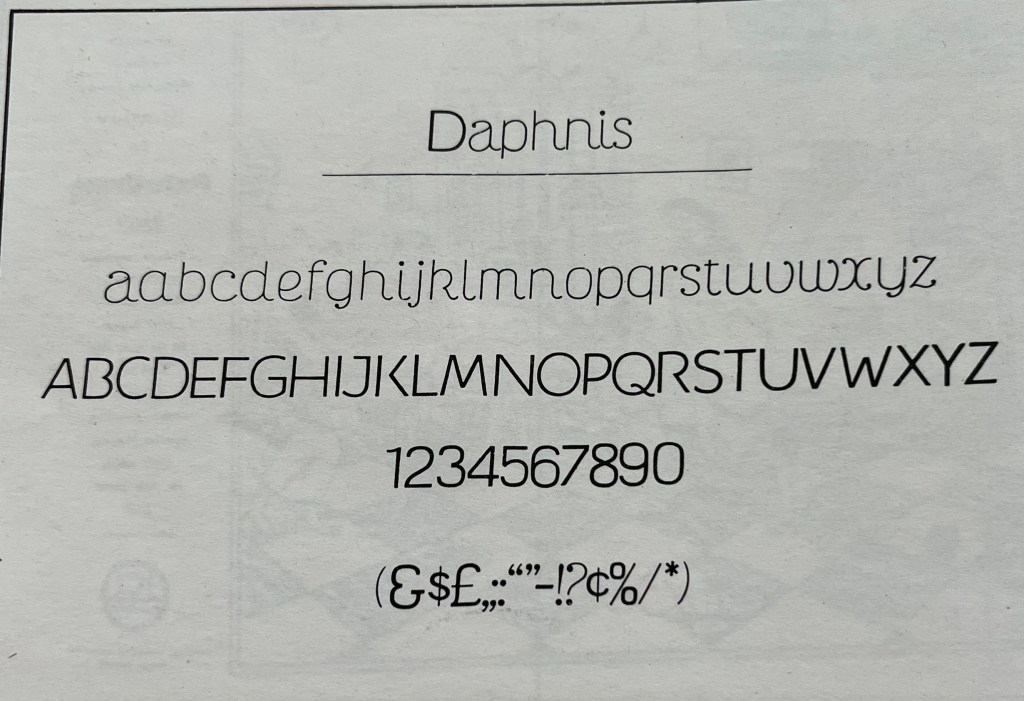
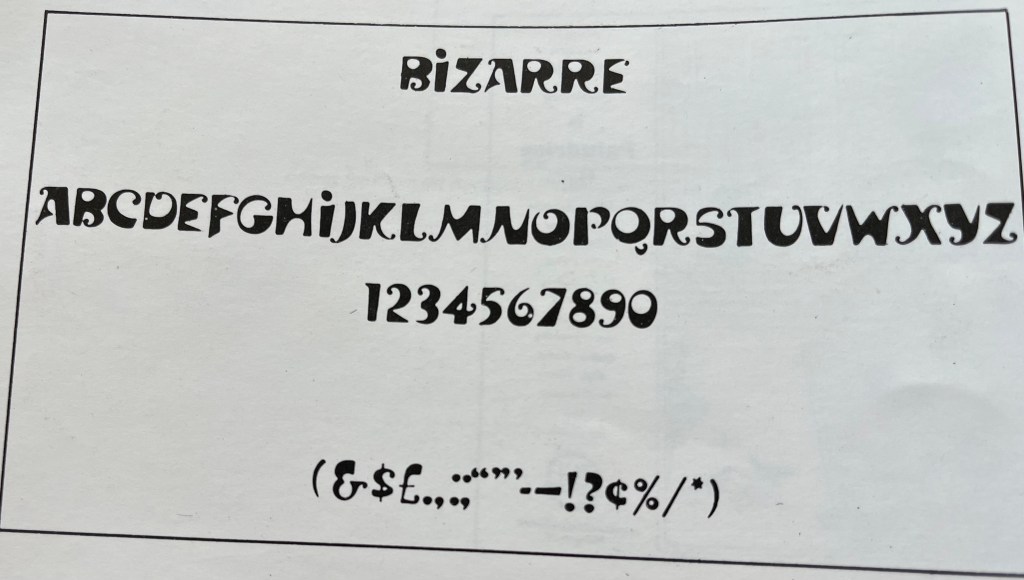
Not many of us know the infinite patience, rigours, discipline and the endless process of trial and error involved in designing a whole series of a printing type. That, in spite of his other demanding preoccupations, he found enough time to design three complete sets of types bears ample proof of his diligence and perseverance and his passionate love for the world of types. Those of us who have known him over the past decades are profoundly admiring of the fact that he is a workaholic in the best sense of the term. His diverse creative output is staggering and would put many a man half his age to shame.

In the ’40s, I met Satyajit periodically as I worked as an art master in Indore. One of the high points of my visits to Calcutta during the long summer or the short winter holidays was to frequent his ground-floor apartment in South Calcutta. It was at his place I first listened to TS Eliot’s recital in the poet’s own voice of The Waste Land which was just brought out by HMV (now known as EMI). It was on such visits I would also have an opportunity to listen to his latest collection of records of European classical music. And it was also on one of such occasions I first heard him toying with the idea of making a film based on Rabindranath Tagore’s novel, Home and the World, a project which was abandoned soon after and was finally realised nearly four decades later.

It was not before1 returned home in 1954 after a five years’ stint in Paris that I came to know of his intense involvement with the making of Pather Panchali[4]. I vividly remember to this day the excitement with which he described it to me and invited me to a screening of the rushes. He brought out all the sketches and doodles he made along with side notes in Bengali not only of the dress, props and characters in the script but also very quick but masterly sketches of frames of each of the sequences, camera movements, etc. I remember asking him why he thought it necessary to make such careful preparations before shooting. To which his quick but significant reply, “One of the foremost but very difficult things in filmmaking is to determine the placement of the camera.” He was equally quick to point out that this is only the first part of shooting a movie and not stills.

Those of us who watched him in action know only too well that although there is always a professional cameraman present in his unit, in reality he becomes the cameraman himself. The visual richness of a film is as important to him as a story well told — the one being inseparable from the other. This is the most distinctive feature of his artistic achievements in all his films.

Ray is a lyricist of the highest order. From his first film Pather Panchali to his latest Shakha Prashakha[5], this lyrical bend binds all his films together in the form of an oeuvre and finds full fruition in his most recent work.

Some of the imperceptibly slow camera movements in this film are sheer poetry. Although not yet released, I had the opportunity of seeing it twice, and apart from anything else, I as a painter was bowled over by its visual richness and its consummate technical finesse. I have reasons to say this. Whenever I see a movie, I try to see it through the lens of the camera and having witnessed many film shootings of some of Ray’s films, it has become a habit with me to follow the movements with great fascination. Thus, it helps me greatly to enjoy watching a film from the aesthetic and technical viewpoint.

I am sure that in order to achieve maximum artistic quality Ray finds the preliminary exercises made primarily in pen and ink very useful. These small and simple sketches, evidently done in quick succession, have all the spontaneity and vigour of something impeccably visualised and bear the unmistakable stamp of a born lyricist. Their linear treatment, unorthodox positioning on paper and an apparent insouciance, at any rate, in my eyes, are the products of a highly creative mind and are designed to meet the needs of a fastidious aesthete.

Among the sketches, one comes across portraits of many of the characters in his films in various moods and postures. These could easily be rated as some of his best works in this group. Only someone with consummate skill can bring out the full characterisation in a postage-stamp format with utmost economy and clarity. The lines which define the contours and other details of the figures are free flowing, sure and firm, the result of years of practice both with the pen and the brush.

One of the most interesting exhibits in the present collection is the album containing one of his earliest essays in visualisation of a film project — the documentary he once wanted to make on Ravi Shankar playing the sitar and on the tabla accompaniment. Ray showed it to me as early as 1954. It is possible that the inspiration came from his viewing Uday Shankar’s ballet film, Kalpana (Imagination) ­-– a film which he studied frame by frame by taking scores of stills in the dark theatre where the film was released. He showed me the entire series one by one and pointed out among other things the unusual camera angles, the dramatic lighting, the magic of black and white, especially in the close-ups of both the dancers and the tabla playing. Although the Ravi Shankar film was never released, I think Ray thoroughly enjoyed the exercise and learnt a lot from it.
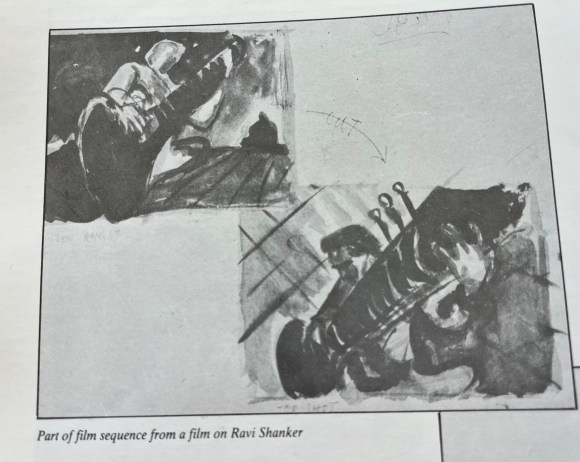
Sourced from the brochure provided by Dolly Narang

This, along with numerous sketches and doodles related to his films, will ever be regarded as something unique in the history of filmmaking in our country.’ Only a few’ and they can be counted on one’s fingers, in world cinema have been such gifted artists too like Eisenstein, Kurosawa, Fellini and a few others. The Village Gallery should be congratulated for presenting to us “The Other Ray – the Consummate Artist.”

[1] Is Satayjit Ray there?

[2] Lila Mazumdar ( 1908-2007, a well-known Bengali writer of children’s stories) 

[3] The All India Fine Arts and Crafts Society

[4] Song of the Road,1955

[5] Branches of a Tree, 1990

Dolly Narang, a gallerist, has conceptualised  innovative  pathbreaking exhibitions. A recent student of sculpture, she has the satisfaction of experiencing both personal and spiritual evolution as a Pranic healer and as a grandmother. 

.

PLEASE NOTE: ARTICLES CAN ONLY BE REPRODUCED IN OTHER SITES WITH DUE ACKNOWLEDGEMENT TO BORDERLESS JOURNAL

Click here to access the Borderless anthology, Monalisa No Longer Smiles

Click here to access Monalisa No Longer Smiles on Kindle Amazon International

Categories
Essay

Take One by Ratnottama Sengupta

A stock taking of women in Bengali cinema – as protagonists, actors and directors – by Ratnottama Sengupta

“Mother, allow me to go and get a slave for you,” this conventional line may have been uttered by the husband essayed by Anil Chatterjee in Mahanagar (The Big City, 1963), as he set out to marry Aarati alias Madhabi Mukherjee. Women of those years had no problem accepting such husbands as their Lord and Master. But the lead actress of Ray’s film evinced determination of a different order. That’s why even today, 52 years after its release, Mahanagar remains so contemporary.

Time was when women in Indian — rather than just Bengali — films were typecast as mother, sister or beloved of a male character. The mother would sacrifice her creature comforts, her career, her every happiness for her son — but if she cared for her brother, she would be rebuked (Mejdidi, Second Sister, 1950; 2003). If she offered shelter to her orphaned sister, she would have to ‘repay’ her in-laws for the favour by making her work overtime (Streer Patra, The Wife’s Letter, 1972). It was ‘her’ responsibility to stay ‘pure’. If she were ‘tainted’, she had no option but to embrace death. The long-suffering Indian woman has left way behind her ‘helpless’ (abala) definition: No Nirbhaya needs to die of shame if she’s the victim of rape. The silver screen is reflecting this transformation. She’s no goddess (devi) nor a slave (dasi) — she’s proud to be what she is: a woman (nari).

But a woman is always more vulnerable, more fragile compared to a man. Reason? Could be biological, economic, social structure, or her lack of confidence born of mental malnutrition. Perhaps that is why women have provided material for intense human drama. At times she is Lady Macbeth or Lady Chatterley, at other times she is Mrinal (of Streer Patra), or Ashapurna Devi’s Subarnalata (1981). Besides, Bengal worships Goddess Durga — in this state, women are simultaneously Saraswati, the goddess of learning; Lakshmi, the deity of prosperity; and Kali, the icon of destruction. That may be why, from the beginning of Bengali cinema, lead personalities have enjoyed multidimensional projection. Sometimes a mere ‘actress’ becomes a mouthpiece for a socially sensitive and relevant issue, sometimes she is the face of psychological conflict, sometimes she is a philosopher, preacher.

Un-Covered 

There are many different ways to approach the projection of women in Bengali films. Literature has always been the first to convey their self-sufficiency — be it on this soil or elsewhere. Gems mined from Bengali literature provided the raw material for pioneers like Naresh Mitra (1888-1968), Pramathesh Barua (1903-1951), Debaki Kumar Bose (1898-1971), Nitin Bose (1897-1986), Bimal Roy (1909-1966) — giving us landmarks such as Jogajog (Connections, 1943; 2015), Durgesh Nandini (Queen of the Fortress, 1956), Bishabriksha (The Poison Tree, 1922; 1983), Debi Chaudhurani (1974; upcoming 2025), Biraj Bou (Biraj, the Wife, 1972), Pather Dabi (The Right of Way, 1977), Udayer Pathey (Towards the Dawn, 1943). However, the minute we utter the two words — ‘women’ and ‘literature’ — in one breath, we think Pratham Pratishruti (The Early Promise, 1971) and Subarnalata (1981). Together  they are a flawless portrayal of social transformation and women’s emancipation.

Dinen Gupta had filmed Pratham Pratishruti even before Ashapurna Devi had won the Jnanpith Award. Its protagonist Satyawati kept at it but did not succeed in altering the social dynamics of Women’s Education. Her daughter Subarnalata is married off in her childhood, into an urban family with rustic mindset. Alone, unsupported she fights the male chauvinists (and this includes the women too!) who were unfamiliar with the word ‘self-identity’; whose only understanding of women’s honour, sanman, comprised of ghomta-sindoor, the veil and the vermilion. Despite her efforts, how often do we hear of a Bakul (Subarnalata’s daughter) who rides a bike to drop off her elder brother to his college?

Streer Patra devolves around ‘Mejo Bou’ Mrinal (Madhabi Mukherjee). She has the freedom to offer shelter to her sister-in-law’s sibling but not to love, educate, and honour her. When the sister, pushed into marriage with a mentally deranged person, commits suicide, Mrinal leaves home in protest. But her protest is not a sentimental reaction, so she does not end her life in the ocean. Nor does she sign off her letter as ‘Mejo Bou’ — the Second Bride of the joint family – which was till then her only identity. She is now ‘Charantalashray Chinna Mrinal’, one who has lost the protection of her husband’s feet.

*

Long before Purnendu Pattrea, Bimal Roy had set an example in ‘deconstructing’ the well-entrenched structure of male domination even in wealthy families. When it came in 1943, Udayer Pathey had broken several norms: Jyotirmoy Roy was an unknown writer, Binata Roy was not a conventional beauty. As the daughter of an industrialist — read, a 20th century princess — she takes up the fight for labourer’s rights and leaves the shelter of her father and brother to make a home with a ‘hired’ writer. She was emboldened by her predecessors like Kanan Devi who became a star in Mukti (Liberation,1937).

Rebellion need not necessarily be a battle — won or lost — as Sujata (1974) showed. Litterateur Subodh Ghosh, who created the character, imagined her as a sweet, caring persona, who is alert to every little need of her foster family. But, despite all her care and love, she doesn’t become ‘a daughter’ to the parents she dotes on. Her fault? She is born of ‘untouchable’ genes. An even bigger fault? She is loved by the man whom the foster parents want to see as the husband of their biological daughter. Film director and writer, Pinaki Mukherjee, fired away with this double-barrel gun although he knew it was impossible to overshadow Nutan’s performance in Bimal Roy’s Sujata (1959).

Director is Special            

Follow the director and you land at the door of Satyajit Ray. If his filmography opens with Pather Panchali (Song of the Road, 1955), his depiction of the mother, Sarbajaya, opens the pantheon to women who are found in any middle-class home. Women who are not dressed like the shiny stars of saas-bahu shows but cringe nevertheless when it comes to feeding their aged mother-in-law. Women who have no big dreams for their children but to protect them from any hint of slander by the neighbours.

Half a century later Mahanagar remains a head-turner. Its protagonist Aarati is a working woman whose pay-cheque keeps the kitchen fire going. But this does not place a halo around her head. Instead, society crinkles its brow at her. Still, she does not shy from protesting a wrong done to her colleague. Still, she does not think twice before turning in her resignation. She is not scared of the dark days ahead — because she has light within. She has confidence in her own entity. 

Prior to that Ray had etched with care the homemaker Charulata (1964). She too is a housewife but from another world, in terms of both time and social status. The educated wife of a wealthy intellectual — an editor who has no time to chat with his wife or hear her out — she sews, she writes, she is published in journals…  If the devotion of such a woman finds an anchor in her brother-in-law, what would the world say of the ‘homebreaker’? 

Charu’s husband Bhupati must shoulder the blame for wrecking the marriage, but Nikhilesh (Victor Banerjee) of Ghare Baire (The Home and the World, 1984)? The zamindar stood by his wife when Bimala (Swatilekha Sengupta) stepped out of the inner courtyard and wedded herself to the nationalist fervour of Sandip (Soumitra Chatterjee). Perhaps that is why, when she realises that Sandip loves himself far more than his motherland, the disillusioned wife returns to her original ‘guru’ — her husband. There is no shame nor despondency of defeat in this, for this is not regressive, it is merely a ‘course correction’.

*

Ritwik Ghatak, a contemporary of Ray, envisaged women as the Lakshmi-Saraswati-Kali of a partitioned Bengal. 

Nita (actress Supriya Devi) in Meghe Dhaaka Tara (The Cloud Capped Star, 1960) earns to feed her parents, marry off her sister, build her brother as a vocalist… But who cared for her love? Her dreams? Her sheer desire to live? At the other end of the spectrum is Sita (Madhabi Mukherjee in Subarnarekha, 1965). She had held her fatherly elder brother’s hand when the child had to seek refuge across the barbed wires. She sacrificed that secure shelter (of her brother) to her love. When that love proved ephemeral, she sought survival in the world’s oldest profession. When that profession placed her face to face with a fallen angel — her brother — she turned into Kali, the destroyer.

Mrinal Sen’s Baishe Shravan (The 22nd of Shravan, 1960) was an essay in marital discord in the disjointed times of war. But times change, and with that going out to work becomes routine for women in Bengal. No one looks askance — so long as she returns home by nightfall. For, that is one routine that hasn’t changed: even today, exceptions to it are meant only for men. Even today, if a Nirbhaya is gang-raped, many react by asking, “Why was she out so late?!” So, when the breadwinner daughter in Ekdin Pratidin (And Quiet Rolls the Dawn, 1979) does not return home, she is branded a siren even before she is given a hearing.

Tapan Sinha has repeatedly pointed to women’s vulnerability. His Nirjan Saikate (The Desolate Beach, 1963) depicts the barren lives of single women, be they widows or spinsters. Jatugriha (The Inflammable Home, 1964) paints the pangs of legal separation and divorce. Adalat O Ekti Meye (The Law and a Lady, 1981) highlights the legal ‘molestation’ of a rape victim. Aapanjon (Dear Ones, 1968) bestowed a new kind of dignity on the uncared for senior widows. Wheel Chair (1994) became the symbol of struggle when a chairbound woman fights the injustice of a rape that leaves her incapacitated for life. Antardhan (Missing,1992) opened our eyes to the base trade in human flesh. And the Daughters of This Century (Satabdir Kanya, 2001)? Better not talk of them, Sinha might say, for like Kadambini of Jibito O Mrito (Alive and Dead), they have to die in order to prove they were living!

Aparna Sen, as a popular actress, did characterise some women of substance. She charmed us in Ekhane Pinjar (Caged Here,1971)as she slaved to  provide her family a life of some worth. Much seen? Yes, it was a much seen reality in our midst. Shwet Patharer Thala (The Marble Plate, 1992), Prabhat Roy’s adaptation of Suchitra Bhattacharya, showed that despite the changed times, a widow’s is still a solitary struggle. A single shot in Paramitar Ekdin (House of Memories, 2000), under her own direction, makes her unforgettable. As the mother-in-law who loves fish, she’s chewing on a fishbone with deep satisfaction when she learns her husband is dead. “Over,” says the blank expression on her face, in her eyes, in her entire being, “no more fish.” That single look bespeaks sadness, disappointment, vacuum in the life of a Bengali widow. Why is it that a man does not stop having fish when his wife dies?

As a director Aparna uses the same fish, to establish a progressive mindset. When her daughter-in-law, Paromita (actress Rituparna), takes her to a restaurant and treats her to a fish fry, we viewers are delighted. She herself has suffered, so the daughter-in-law understands the mom-in-law’s suffering. Not for her the ‘revenge’ story of family dramas.

At the very outset Aparna Sen had given a fair indication of the road ahead. Elderly and lonely, Ms Stoneham in 36 Chowringhee Lane (1981) is poised against her ebullient, self-centred, even ruthless student Debasri Roy. The two worlds of seniors and youth clash again in Goynar Baksho.(The Aunt Who Wouldn’t Die, 2013). But this child widow, Pishima (the aunt), extracts every inch out of life. Even after death she demands her pound of flesh: she smokes, she bikes, she zealously guards her dowry, streedhan. She even encourages extramarital love! But, perhaps, Aparna Sen’s boldest statement is Paroma (The Ultimate Woman, 1985). Should a woman bury her sexuality simply because marriage has turned her into someone’s aunt or a sister-in-law? “No” —  comes the unflinching reply.

*

Women are deprived, exploited. They protest, they rebel. They stride ahead alone and draft a path for others to follow. Their confidence gets a boost, they enlighten hide-bound males, transform mindsets. This is how we see women in Rituparno Ghosh’s oeuvre. He drew our attention towards several issues, but the empathy in his tenor led us beyond the immediate pre-occupation and endowed his scripts with such universality that free-thinking men, too, had no issues with them.

In Unishe April (Nineteenth April, 1994), the national honour of a Padmashri for Sarojini angers her daughter. Because? She chose to be a danseuse rather than a homemaker, and sent her daughter to a hostel so that she could dance on. Dahan (Crossfire,1997)sees Ramita molested by strangers on the street, but the man in her bedroom? What about him? Surely you won’t construe a ‘husband’s conjugal right’ as ‘marital rape’?! On the other hand, Jhinuk has to pay a price as the witness. She is put in the dock by the law of the land, and dropped by her boyfriend. Banalata in the Bariwali (The Landlady, 2000) has aged but not married. Her dreams of a family are somewhat fulfilled when a film unit comes to shoot in her ancestral mansion. She drapes a red-bordered sari and dons sindoor in her hair too, for a single shot. But that’s mere acting! The director’s praise and love for her too was acting! Kiron Kher as Banalata realises this when she sits in the darkened theatre, and finds the scene has been clipped out of the film. How many times will you be shortchanged, lady, emotionally too?

In Antarmahal (The Inner Chamber, 2005), Zamindar Jackie Shroff authorises a sacrificial yagna to ensure the continuity of his line with the birth of a son. And what is that sacrifice? In the presence of his first wife (Rupa Ganguly), he will copulate with his child bride (Soha Ali Khan). Night after night. Isn’t this mental as well as physical torture? So what! Isn’t he a zamindar and the husband too!

Dosar (Companion, 2006) sees the husband (Prosenjit Chatterjee), a corporate bigwig, returning with his secretary from a weekend retreat in his love nest. A massive accident leaves the woman dead, the husband bedridden, and the wife in a fix. Should she leave the helpless man, or restore life in the faithless marriage?

Even when All his Characters are Fictitious (Sab Charitra Kalponik, 2009), Rituparno Ghosh speaks an Eternal (Abahoman, 2009) truth: Women’s efforts to create an identity for themselves have been wrecked by men. Women have had to confront layer after layer of inhibition, prejudice, agony. But it is much worse to be a woman trapped in a male body, Rituparno showed in his last film, Chitrangada (The Crowning Wish,2012).

*

Bengali cinema was meant to be thus: modern, lively, brilliant. Viewers have said this time and again. After the release of Anuranan (Resonance,2006) Antaheen (The Endless Wait, 2009), Aparajita Tumi (You Undefeated, 2012) this was said for Aniruddha Roy Chowdhury. He has continuously shown that women ‘culture, nurture, explore’ life. Viewers had applauded when Bappaditya Bandopadhyay (1970-2019) handed over the right to ‘give away the daughter’ in marriage to the mother in Sampradan (The Offering, 2000). The director of films like Kaal (An Era, 2005) on human trafficking and Kantataar (Barbed Wire, 2005) on illegal migration, Bappaditya was ecstatic that in the present century, women are being recognised as ‘Researcher in Child Development and Interpersonal Relationships’. Women are morally superior, declares Srijit Mukherjee in Autograph (2010), when the jean-clad Srinanda (Nandana Sen) leaves her live-in partner (Indraneil Sengupta), for encashing the accidentally recorded confession of the star Arun Chatterji (Prosenjit) in an inebriated moment of weakness. Somnath Gupta projects a mofussil girl in Aadu (2011) who does not hesitate to write to the President of America to find out the whereabouts of her immigrant husband who went missing in Iraq after the outbreak of Gulf War 1. With Shunyo E Buke (Empty Canvas 2005), Kaushik Ganguly raises a question that still seeks an answer: Is a big-hearted woman less attractive than a big-chested one?

We have watched films that break stereotypes in startling ways. The protagonist of Atanu Ghosh’s Rupkatha Noy (Not a Fairy Tale, 2013) is a bride who flees home; an IT professional who admits to taking a life, and a gritty though little educated delivery girl at a petrol pump. Judhajit Sircar’s Khasi Katha (Saga of a Goat, 2013), centres around Salma, the motherless daughter raised in a convention bound Muslim family who works in a leather factory to feed her unemployed father and brother but fights to become a professional boxer!

The Actor is the Star

Irony, thy name is cinema. For, here, the deception of ‘acting’ must turn imagination into ‘real’. The personas are imagined, but they are rooted in our soil. Naturally, some characterisations remain with us forever. Thus, some actresses become the voice of women’s fight for emancipation. Suchitra, Supriya, Madhabi, Arundhuti, Aparna, Rituparna, Paoli –any of these actors in the central role promises a powerful document in the fight for women’s rights.

* It started even before Suchitra Sen (1931-2014), when Kanan Devi (1916-1002), Bharati Devi (1922-2011), Chhaya Devi (1914-2001) and Sabitri Chatterjee (1937) were playing at New Theatres, Chhayabani, Radha Films. We will return to Kanan Devi but meanwhile, let’s revisit Suchitra Sen. A married woman, mother of one, Mrs Sen became — and still remains — an icon, not only in the two Bengals but pan India. No gossiping with unit members, the detailing of her character, its costume, its co-actors kept her busy as long as she was in the studio. Understandably, her fame ignited jealousy and she was tarnished as temperamental, aloof, selfish…

Yes, unwilling to compromise in matters pertaining to her role, Mrs Sen would not spare even haloed producers like R D Bansal or Haridas Bhattacharya. But her glamorous dignity ensured a so-far unknown respect for actresses in Bengali filmdom, especially when her name was printed above Uttam Kumar’s, in posters pasted all over the town. Nylon sari, sunshades, short hair, sleeveless blouse — every expression of ‘modernity’ became Mrs Sen. She came to personify the middle-class Bengali woman who — married or not — could be a professional: journalist, nurse, doctor, singer, lawyer… On the other hand, the single-minded determination that characterised courtesan Pannabai and her hostel-educated daughter Suparna (Uttar Falguni, In Her Autumn, 1963), Rina Brown (Saptapadi/ Seven Steps, 1961), Archana (Saat Paake Bandha, Knotted by the Vows, 1961), and Radha (Deep Jwele Jai, To Light a Lamp, 1959) only reflected Mrs Sen’s own firmness of intent. 

One Meghe Dhaka Tara alone was enough for Supriya Devi to shine through the annals of Bengali cinema. Add to that the appeal of Komal Gandhar (Soft Note on Sharp Scale, 1961). In many a film she is the beloved of matinee icon Uttam Kumar. What firmed her position was her boldness in accepting roles with negative shades. Be it Lal Pathar (The Red Stone,1964), Sanyasi Raja (The Monk Who Was a Monarch, 1975) or Mon Niye (All About Her Heart, 1969) — her presence gave a shine to both, the persona and the film. 

* Sharmila Tagore went away to Bombay and Bollywood gobbled her, but she remains evergreen as Aparna of Apur Sansar (The World of Apu, 1959), the newly wedded bride in Devi (Goddess, 1960), the journalist in Nayak (The Hero, 1966), the questioning eyes in Seemabaddha (Company Ltd, 1971) and the irrepressible, dark-complexioned tomboyish Ghetu of Chhaya Surja (Overshadowed, 1963). If Ray films cast her as the silent conscience speaking mainly through her eyes, Partha Pratim made her unforgettable in casting her in an opposite role.

* For a while, Tanuja ruled the Bengali heart from the theatre chain of Minar-Bijoli-Chhabighar. The frothy actress from Bombay became a hit with the superhit musical romance, Deya Neya (Give-n-Take, 1963). Uttam Kumar’s Antony Firingee (1967) immortalised her as Saudamini. And Nandini of Teen Bhubaner Pare (Beyond Three Worlds, 1969) broke new grounds in a society where it was customary for men to marry illiterate women, but unthinkable for an academic woman to marry an unlettered, alcoholic blue-collar worker. Husbands, after all, had to be superior, right? That’s why the highly educated princess of Ujjain during the Gupta period (3-4 CE) was ‘taught a lesson’ by being fooled into marriage with the worthless Kalidas, who eventually rose to be the peerless poet of Sanskrit classics like Abhijnana Shakuntalam and Meghdoot!

* In recent decades, Debasree Roy bagged the Golden Lotus through significant films like 36 Chowringhee Lane (1981), Unishe April (19the April, 1994),  Asukh (Ailing, 1999), Ek Je Achhe Kanya  (There’s This Girl, 2001), Dekha (Vision, 2001), and Nati Binodini (The Actress, 1994). Her contemporary, Rupa Ganguly scored nationally as Draupadi in the television serial Mahabharat (1988). The riveting beauty of the epic had ruled the five Pandava brothers who took on the male order of the Kauravas — the clan that de-robed her — even as their patriarchal head remained a silent spectator. Rupa endowed the persona with a rare dignity that came to the fore again in Antarmahal (The Inner Chamber, 2004) saving it from becoming voyeuristic. Instead, she evoked pathos and a certain sadness in us when her husband proceeded to copulate with a younger wife in front of her eyes. Again she won our applause and institutionalised laurels in Abosheshey, (Finally, 2011) as the mother whose separated son, raised in America, comes to know her heartbreaking love for her child after her death. And in Sekhar Das’s Nayanchampar Din Ratri (The Tale of Nayanchampa, 2019) she breathes life into the marginalised character who epitomises the multitudes that travel from the suburbs to serve as maids in urban homes. 

Rituparna Sengupta, the first of the divas from Bengal today, wears the mantle of Kanan Devi. Like the icon, she excelled in acting, bagged the Golden Lotus for her performances, and then started a production house, Bhavna Aaj O Kaal. This has enabled her to get a veteran like Tarun Majumdar to direct her in Aalo, (Light, 2003) and a young Ranjan Ghosh to explore her creativity in Aaha Re! (Wow! 2019).

Form and Content Too: Actor Turns Director

Roopey tomay bholabo naa – I will not entice you by looks alone, women directors have been saying for long. Thus, Manju Dey (1926-1989) not only starred in Jighansa (Blood Lust 1951), Neel Akasher Neechey (Under the Blue Sky, 1959), ’42 (19421951),her Abhishapta Chambal (The Blighted Ravine, 1967) based on Tarunkumar Bhaduri’s accounts. recounted the life of legendary dacoits of Chambal who paved the way for Phoolan Devi.

Arundhati Devi, (1924-1990) the unforgettable Bhagini Nivedita (1962) who lives on through Tapan Sinha’s Kshudhita Pashan (Hungry Stones,1960), Jatugriha (1964), Harmonium (1976), turned director with Megh O Roudra (Clouds and Sunshine, 1969) to highlight a young widow’s quest for education. Apart from making Chhuti (Vacation, 1967) and Padipishir Bormi Baksho (The Burmese Casket, 1972), she also composed music for Shiulibari (The House of Jasmines, 1962) and produced Bicharak (The Judge, 1959). In her personal life the independent minded actress-director had divorced writer-director Prabhat Mukherjee to marry Tapan Sinha — later highly decorated — in the-then convention-bound Tollygunge. Prior to her only Kanan Devi, the singing star of New Theatres classics who was celebrated across India, had taken upon herself the onus of producing films, by setting up Srimati Films.

Coming after them, Madhabi Mukherjee did not produce films. But the “beautiful, deep, wonderful … (lady who) surpasses all ordinary standards of judgment” justified the praises heaped on her Charulata by not merely acting in Baishey Shraban (22nd Srabon— July-August, 2011) Mahanagar, Subarnarekha, Kapurush (The Weakling, 1965), Dibaratrir Kabya (The Poetry of Everyday Lives, 1970), Streer Patra, Biraj Bou, Utsab (The Festival, 2000). She also took on the then chief minister Buddhadeb Bhattacharya in an election.

* Aparna Sen has been an inspiration to an entire generation of women directors. Satarupa Sanyal has garnered praise in the multiple roles of an actor, producer, director and editor. Her Anu (1998) exemplifies an idealist who is raped by the political opponents of her incarcerated fiancee. It is a crime they perpetrate, but a greater crime is perpetrated when her fiancée, Sugato, refuses to marry her because she has been raped!

* With financial help from NFDC, Urmi Chakravarty made Hemanter Pakhi (Autumn Bird, 2003). It offered another new experience. A housewife shoots into the limelight by authoring a book, but her middle-class husband and sons are not thrilled. They would rather she remained the demure housewife, cooking and caring only for them.

* Aditi Roy won Rupa Ganguly a Lotus through her Abosheshey.  Meanwhile Anumita Dasgupta won awards with Jumeli (2012) that tells the story of a tribal woman whose husband turns her pain of losing her child into a business commodity. How? The only balm for her pain lies in breastfeeding newborns. So? Get her pregnant, repeatedly, and get her to abort, again and again! The impact on her health? Her morale? Her childbearing ability? Who cares!

* Now we have Nandita Roy and Sudeshna Roy. Both are creating a buzz with their co-directors Shiboprasad Mukherjee and Abhijit Guha respectively. Nandita-Shiboprasad have come out with Icche (Desire, 2011), Muktodhara ( The River of Freedom, 2012), Accident (2012), Alik Sukh ( Unreal Happiness, 2013), Ramdhanu ( Rainbow, 2014) — all of which including their latest Amar Boss (My Boss, 2024) focus on various walks of our social life, be it education, accident, medical ethics, or jail reforms. 

* Sudeshna-Abhijit started with focusing on the sexually free relationship of gen-next, or the unrestricted use of abuses by urban youth, and graduated to Jodi Love Diley Na Prane (If There’s No Love, 2014), which shows that even undying love, once behind us, should be left behind. They used Chaplinesque spoof to tell the story of Hercules (2014), the power within us, which alone can give us the strength to fight bullies. Their latest Aapish (Office, 2024) recounts the plight of working women, whether they belong to the upper class or come from the suburbs.

Post Script

To conclude: Be it men or women, as director or actor, or even a writer like Suchitra Bhattacharya — they have all made it clear — that women in Bengali films are not mere sex objects. Yes, many films still use ‘item-numbers’ to titillate the male fantasy. But then, with Takhan Teish (When He Was 23, 2010), Atanu Ghosh records the attitudinal change in our men — through a woman protagonist who is a professional porn star. Rightly, then, we may say that Bengali films carry on the tradition of Kanan Bala who outclassed her humble origins to become the revered Kanan Devi.  

.

Ratnottama Sengupta, formerly Arts Editor of  The Times of India, teaches mass communication and film appreciation, curates film festivals and art exhibitions, and translates and writes books. She has been a member of CBFC, served on the National Film Awards jury and has herself won a National Award. 

.

PLEASE NOTE: ARTICLES CAN ONLY BE REPRODUCED IN OTHER SITES WITH DUE ACKNOWLEDGEMENT TO BORDERLESS JOURNAL

Click here to access the Borderless anthology, Monalisa No Longer Smiles

Click here to access Monalisa No Longer Smiles on Amazon International

Categories
Nostalgia

Of Birthdays and Bondings

Ratnottama Sengupta traces her bonding with Joy Bimal Roy that commenced with their birth and has wended through the warp and weft of life…

Ratnottama Sengupta and Joy Bimal Roy. Photo Courtesy: Debashish Sengupta

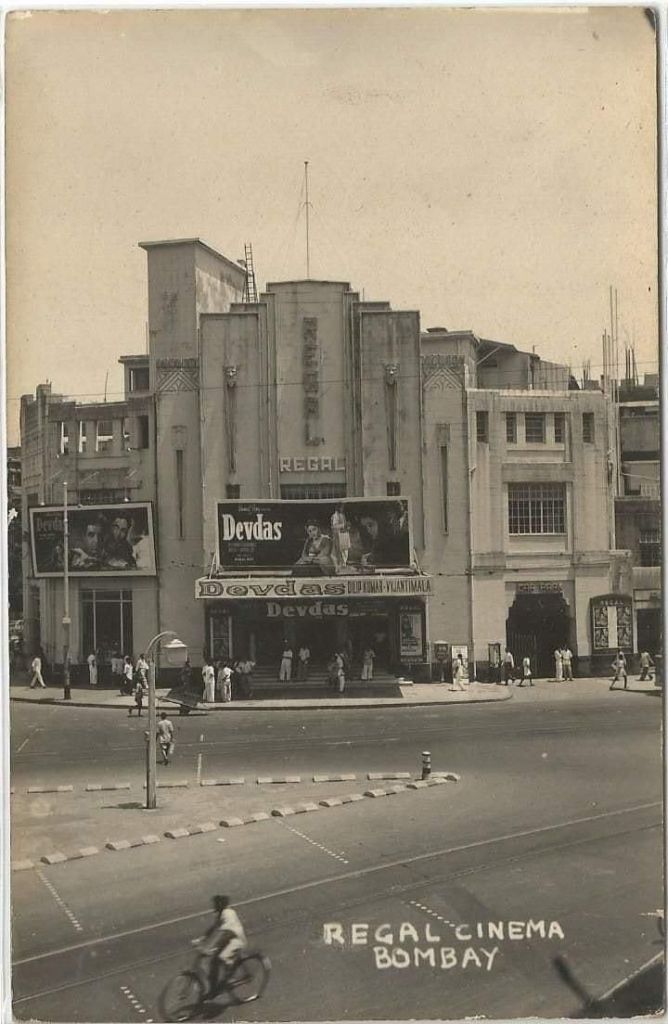
The year1955 is precious in the annals of Indian cinema. That year had seen the release of the Bengali classic, Pather Panchali in August and the Hindi evergreen, Devdas, in December. The opening month of that very year, a certain Mandakini Nursing Home in Bandra, the western suburb of Bombay had seen Manobina, wife of director Bimal Roy, give birth to a son, and Kanaklata, wife of writer Nabendu Ghosh, give birth to a daughter.

“Mita (Friend) Bina was expecting after three daughters and Kanak Boan (sister) was also in labour for the fourth time, after two sons (her first born had gone within months). And we were all praying that Mita should have a son, and Kanak should have a daughter – not the other way around!” This family lore comes from Mary Jethima, wife of music director Arun Mukherjee, first cousin of thespian Ashok Kumar.

So, every time the month of January came around, I would wonder, what if the Roys had a fourth daughter and the Ghosh family a third son? I have wondered but never needed an answer. Because? I have been ever grateful to the powers that be to have Joy as my virtual ‘twin’ born six days apart.

This bonding was forged years before our birth – when Nabendu Ghosh had watched Bimal Roy’s directorial debut, Udayer Pathey[1], in a theatre in Rajsahi, now in Bangladesh; and Bimal Roy had read Nabendu’s allegorical novel, Ajab Nagarer Kahini[2], wanting to film it before Pehla Aadmi [3]became a reality. “Never have I seen a film like this!” Nabendu had echoed what hundreds, thousands, were saying when Udayer Pathey released in 1944. And he had prayed, “If ever I get to work with this director, my dream will be fulfilled!”

Bimal Roy, on his part, had said to him, “Your writings have a graphic visual quality that is so important for cinema.” And when he took up Ashok Kumar’s offer to make Maa for Bombay Talkies, and moved to Bombay in 1951, he invited Nabendu to join him as his screen writer.

That momentous journey has moulded our lives.

*

My earliest memory of the Roys at Godiwala Bungalow on 5 Mount Mary Road is of a toy horse-drawn carriage that had come from some distant land, and a life-size doll – both properties of Joy. I would take turns to ‘drive’ the carriage through the giant hall. And the doll? It opened its eyes and shut them too and even said ‘Maw!’

Outside the bungalow was the garden, a beautiful landscape hemmed in by boulders that created nooks and corners where we children could play hide and seek. But wait, there was a swing and a seesaw too, and I had all the time in the world! There was a spoilsport well at the far end of the garden that I stayed as far away from as I could. “There are ghosts in the well!” – I remember Joy telling me in a hushed tone that was perhaps meant to fool me. But when Joy said something, could I ever doubt it?

The aforementioned giant hall indoors was dominated by an imposing photo of Jethu foregrounded by 11 identical statuettes. These dancing ladies, I later learned, were the coveted Filmfare awards he had won in his illustrious career studded with unforgettables like Do Bigha Zamin[4], Devdas, Madhumati, Sujata, Bandini. As long as he lived and for years after that, Bimal Roy was the sole ‘owner’ of that many ‘Black Ladies’. But, to a girl yet to grow up, more attractive were the Japanese beauties in colourful kimonos adorning another end of the hall. However, what struck even greater awe was a ‘mosaic’ image of Madonna that Joy had crafted while in school — at age 12? It still adorns a part of his world at 6 Mount Mary Road.

Joy had a natural gift for drawing cats: One large O, another horizontal O, a curve that was an inverted C, two bright eyes and perked up ears… How effortlessly he breathed life into the lines! Joy and Bubundi’s house is now overrun by cats but back then only two brown dogs ruled, Toto and Burikin.

*

Joy was the reason I trailed into a shooting floor for the first time in life. We were maybe seven when Benazir[5] was under production at the now-extinct Mohan Studios. As the producer, Bimal Roy need not have stood next to the camera when Meena Kumari, half lying on a mehfil-style chaise lounge, would sit up, sing a single line of a tarana, discant, and the director would say ‘Cut!’ Since the fans would all stop whirring as soon as a voice called ‘Action!’, every ‘Cut!’ was followed by the make-up person trotting up to the diva and retouching her beautiful face. How many ‘Cut!’ did we survive before Joy and I skittered off the floor? No idea. But to this day I remember the deep affection in the eyes of Jethu[6] who became an icon when Joy and I were yet to outgrow the tenth year of our lives.

We were not yet teenagers when Teesri Manzil [7] released in Bandra’s New Talkies which normally screened Hollywood films. Ma and I arrived when Joy, Bubundi and friends were heading for an evening show. I got included naturally. The super hit entertainer had smashing songs in a tautly constructed suspense tale – yet I was not floored. When I said this to Jethima[8], she said, “You are speaking like a critic Uttama!” Unknown to me, that comment had perhaps set me on the course of dissecting a film like an initiated viewer.

After our school finals, Joy took to studying Commerce at Sydenham College, while I marched on with the Arts. So, I joined the Elphinstone College where all the Roy sisters – Rinkidi, Tatudi and Bubundi – had studied English Literature. Bubundi – Aparajita is her bhalo[9] name — was in the final year of BA when I joined the institution. And after she graduated, I inherited all her books and notes. With her benign presence she has been the Didi I never had in the Ghosh house, I realised in the process of preparing the short Aparajita, for her 70th birthday.

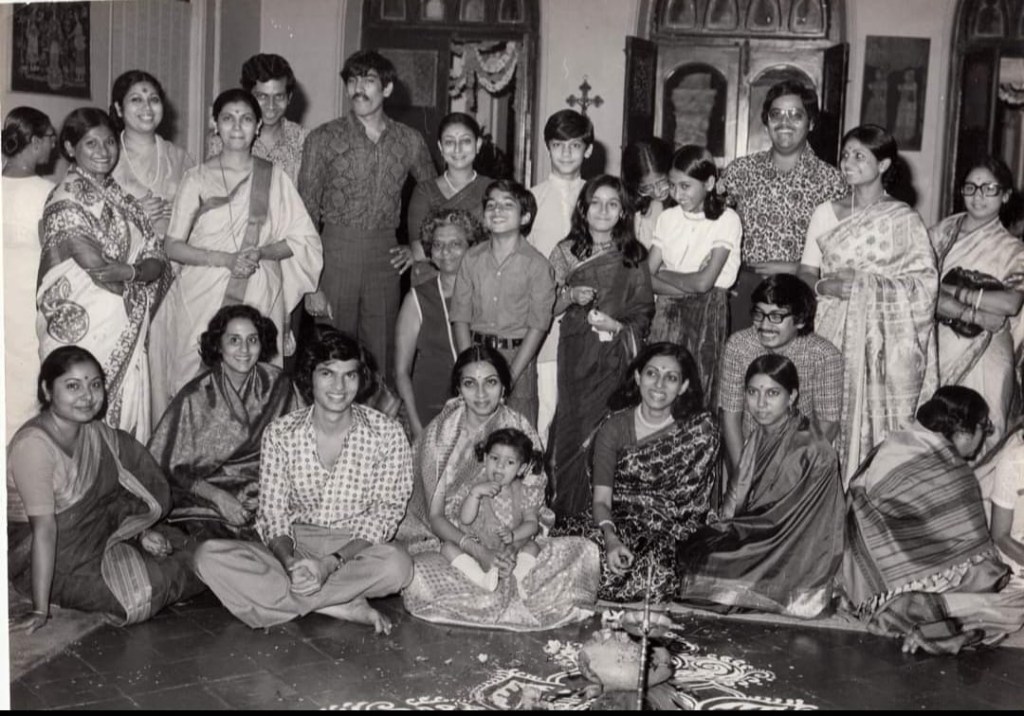
The Ghosh’s and the Roys at a family wedding. Photo provided by Ratnottama Sengupta

And when she got married, just like Joy I missed classes for days and weeks. More so because my elder brother, Dipankar, married Lesley Christine around the same time. Consequently, both Joy and I were least prepared for our MA exams. Together we shared our doubts with Mouni Baba, our spiritual guide who had come from Ujjain. “Do not entertain any doubt or fear,” Baba had drilled into us. “If you utter the word ‘No’ you say that to your inner self, and you will not succeed.” This priceless lesson has been my ‘Kindly Light’, leading me on at every turn of life.

*

* Jethima passed away when the 33rd International Film Festival of India was celebrating seven accounts of Devdas in Indian cinema, in 2002. In the chill of Delhi’s winter, Joy and I sat down in the Siri Fort lawns, clung to each other and howled away, oblivious of the curious stares darting in our direction.

* Joy was in Italy when Baba passed away in December 2007. The biggest bouquet at his funeral had come from Joy.

* Along with Aparajita and Yashodhara – that’s Tatudi’s formal name – Joy had completed Remembering Bimal Roy, a centenary tribute to their father. He had commenced its shooting with Nabendu Kaku, the most authentic and reliable resource person, having been with his father from Maa (1952), through Parineeta ( Wedded, 1953), Biraj Bahu (1954), Naukri (Job, 1953) and Yahudi ( The Jewess, 1957), till the very last Bandini (1964). There was another reason, as Joy himself wrote on Baba’s 90th birthday in March 2007. “He has expressed faith in my abilities even in my darkest moments of self-doubt and always encouraged me to come out of shell and move ahead in life.”

* Year 2008. Bimal Roy’s birth centenary was round the corner. Joy and I met my friend Neelam Kapur. As director, she lost no time in scheduling the tribute in the IFFI [10] at Goa. Serendipity! That very year, IFFI also paid a homage to Nabendu Ghosh who’d passed away the previous year.

The screenings, the press conferences, the purchases, the idling on the beach – more than all of these, I recall the time we spent on a boat that had ladies from Commonwealth of Independent States dancing away to glory. While most of the guests toasted with whiskey or wine, Joy and I sipped on our mineral water. Because? It happened to be a Sunday, the one day in a week we were enjoined by Mouni Baba to forego every food except one salt free vegetarian meal before sunset!

*After Remembering Bimal Roy had been feted internationally and enhanced Joy’s fan following at home, he said to me, “Here’s the entire conversation with Nabendu Kaku. I’ve used only a few minutes of it. I’ll be glad if you can use it.”

I can never thank him enough for this generosity. For, I culled 20 minutes out of the 2-hour conversation, added clippings, posters, stills, book covers, letters, reviews and critical comments to the hour-long documentary And They Made Classics… This centenary tribute traces the unique bonding Nabendu Ghosh shared with his Film Guru.

*

But let me circle back to the birth of a Bundle of Joy and the Best of Jewels in the Roy and Ghosh families respectively.

Days before 21 January 2015 Tatudi called me up. “Joy is turning 60, and how can the celebration be complete if you are not there?” Needless to add, I put on hold my preparation to retire from The Times of India just five days later, and boarded a flight bound for Mumbai. I alighted with just enough time to change into a joyous outfit, for I’ve always revered Tatudi’s good taste and Joy’s flair for dressing just right for any occasion. And was I glad I did so! For, when I reached the venue, I was speechless.


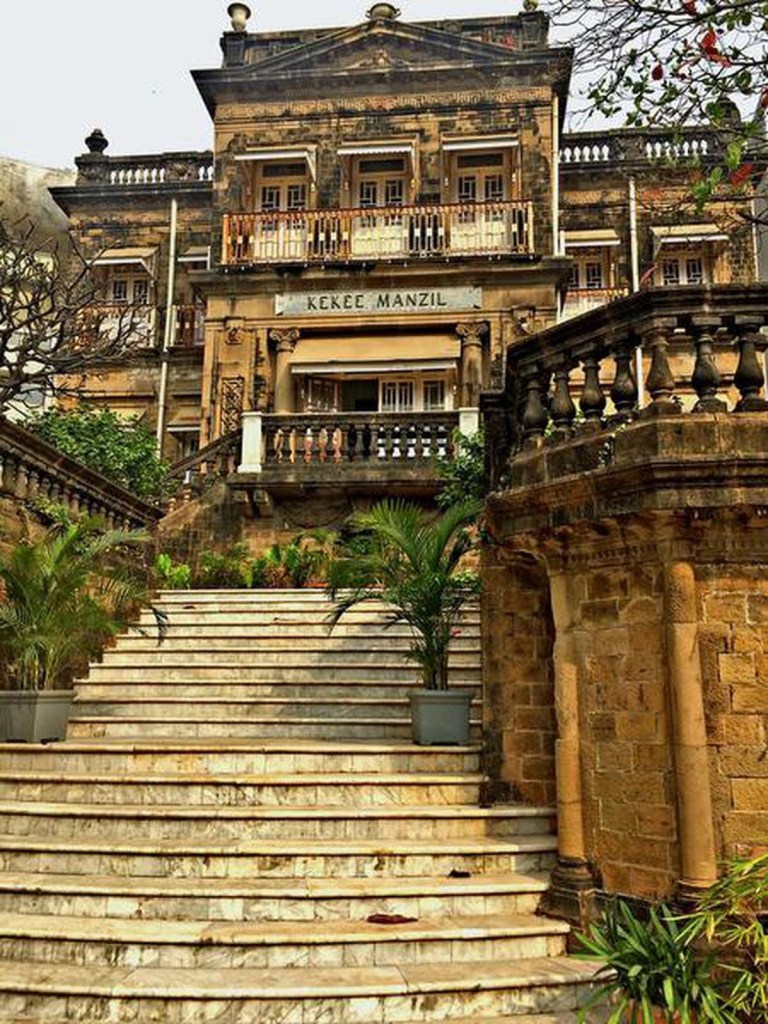
Filmmakers Behroze Gandhy and Dilesh Korya’s documentary,Kekee Manzil – The House of Art offers a glimpse into the interiors of a heritage home, shedding light on its iconic residents Kekoo and Khorshed Gandhy. Kekoo established the only picture-framing company in Asia in the 1940s and later opened the city’s first contemporary art gallery, Gallery Chemould, now known as Chemould Prescott Road, run by his daughter, Shireen Gandhy. The documentary captures how Kekoo and Khorshed displayed compassion during challenging times, stayed true to their secular ideals, and remained engaged civically, while building frameworks within which art could grow in post-colonial India.

What did I admire most? The heritage Kekee Manzil overlooking the Arabian Sea? The gathering of friends and family, including Gen-X of Bimal Roy’s team? The drinks, the amsatta paneer, the grand Birthday Cake? All of this, yes. But most of all, I will cherish for the rest of my life the taste of another cake that Tatudi and Bubundi and Joy had got. Inscribed on it were these words: “Happy Birthday Uttama!”

Some bondings start with our birth, but they live on beyond our life.

[1] On the Path of Light 

[2] Tales of a Curious Land

[3] The First Man(1950)

[4] Two Acres of Land

[5] Peerless, 1964 movie

[6] Uncle, father’s elder brother

[7] Third Floor, 1966

[8] Aunt, wife of Jethu

[9] Good, but when used with name, it conveys the formal name

[10] International Film Festival of India

.

Ratnottama Sengupta, formerly Arts Editor of  The Times of India, teaches mass communication and film appreciation, curates film festivals and art exhibitions, and translates and writes books. She has been a member of CBFC, served on the National Film Awards jury and has herself won a National Award. 

.

PLEASE NOTE: ARTICLES CAN ONLY BE REPRODUCED IN OTHER SITES WITH DUE ACKNOWLEDGEMENT TO BORDERLESS JOURNAL

Click here to access the Borderless anthology, Monalisa No Longer Smiles

Click here to access Monalisa No Longer Smiles on Amazon International

Categories
Review

A Kaleidoscope of Bibhutibhushan Bandopahyay’s Works

Book Review by Somdatta Mandal

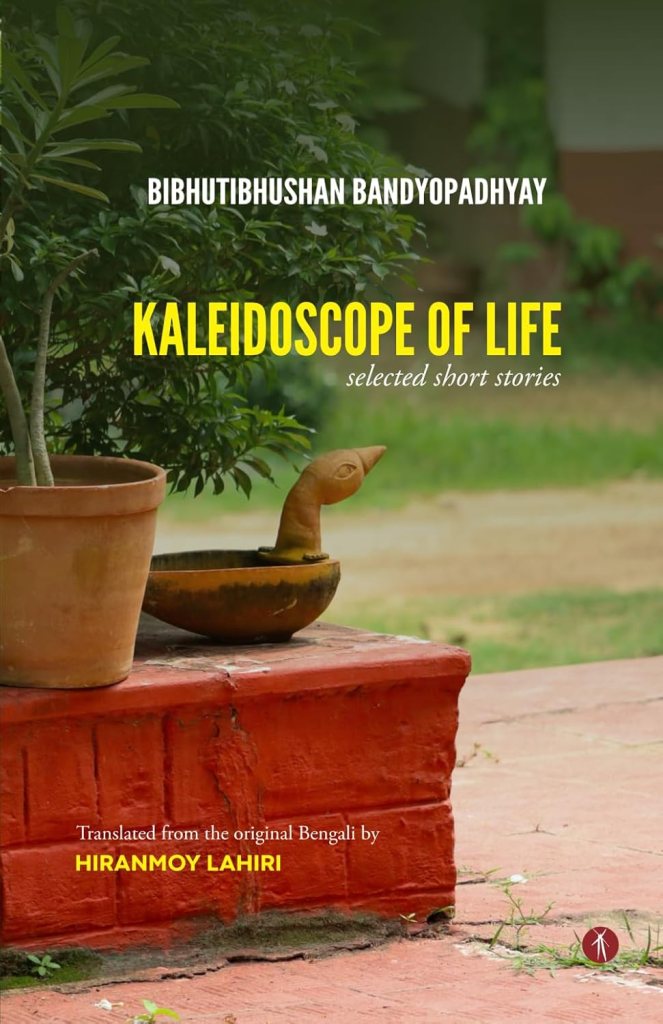
 Title: Kaleidoscope of Life: Select Short Stories

Author: Bibhutibhusan Bandyopadhyay

Translated from Original Bengali by Hiranmoy Lahiri

Publisher: Hawakal Publishers

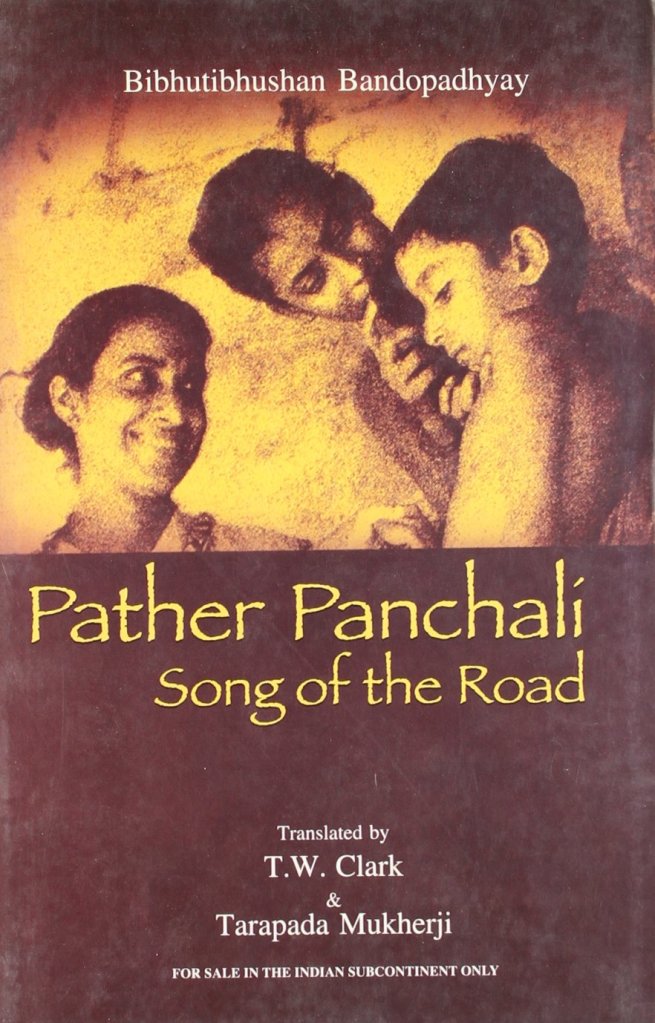
Bibhutibhusan Bandyopadhyay (1894 – 1950) is one of the best-known Bengali writers of the twentieth century and therefore needs no introduction.  Though most of his works are largely set in rural Bengal, he didn’t receive much critical attention until 1928. Author of famous novels like Pather Panchali (1929), Aparajito (both of which inspired the famous film director Satyajit Ray make  his films based on them), Chander Pahar and Aryanak, he is the also the author of several short story collections like Meghmallar (1931), Jonmo O Mrityu (1937), Kinnardal (1938), Talnabami (1944), Upolkhondo (1945), Kshanavangur (1945), and Asadharon (1946). The multifaceted nature of his short stories has invited translators to explore the different facets of this genre and till date, we find several new translated volumes of his short stories see the light of the day quite frequently.

An interesting feature of the short story is that down the centuries the genre’s changing variety made it difficult to be classified under any fixed notion. Whatever may be the subject matter, structure, or style, a short story tells a ‘story’; otherwise, readers would not read it. Whether events in their stages of development or sequential movements and logical relationships are enough for it to be considered a story have been debated so often that it is not necessary to repeat them here. We just need to remember that as far as the short story is concerned, readers have opted for it because of the beauty that lies within its compact structure, a beauty that thrills the reader when the story ends.

Now to come to this collection of Bibhutibhusan’s short stories selected and translated by Hironmoy Lahiri, a young translator and a freelance writer. Apart from the semi-autobiographical piece “How I began writing,” with which it begins, there are fifteen stories ranging from the sentimental, bizarre, thrilling, meditating, and occult where different other kinds of emotions are also expressed. Except for a couple of already translated pieces by other hands, most of the stories selected here by the debut translator have not been translated earlier and all of them are unique for their theme, style and narrative method. The stories have not been chosen on the criterion of chronology of their appearance in print or a particular theme which is usually resorted to by other translators; instead, the focus has been on the diverse nature of the author’s creative world. The volume thus includes ‘slices of life’ stories, unusual stories such as those of smugglers and dacoits, fictions of remote places and unusual personalities, and even supernatural narratives. They really provide a comprehensive view of Bibhutibhusan’s genius, and the phrase ‘kaleidoscope of life’ mentioned in the title definitely justifies this collection.

The very first story in this collection titled Upekshita, ‘The Disregarded’, is significant because it happens to be Bibhutibhusan’s first published story that appeared in the leading Bengali magazine Prabasi in 1921 and narrates the writer’s special relationship that he had developed with a village lady who took on the responsibility of taking care of his meals and looking after him. Drawn upon his personal experiences, especially during his stint as a teacher at a suburban school in Harinavi, when the myopic residents of the area misrepresented the author’s innocent nature of the relationship with the lady as a scandalous incident, it led to such misunderstanding that Bibhutibhusan eventually resigned from his school and moved to Calcutta.

 ‘Archaeology’ talks about a statue that mysteriously comes to life and establishes Bibhutibhusan’s interest in ghosts, the mystic and occult that is revealed in several other stories as well. Some of them are simplistic, like the story ‘Motion Picture’ that narrates the vision of seeing a lady djinn swinging outside an old house, or the sighting of the ghost of an opium seller in ‘Gangadhar’s Peril’. But there are also much more complicated ones like the very popular long story of ‘Taranath, the Tantrik’ where the protagonist is a mystic figure and practitioner of occult. With a growing fascination for tantra and tantric practices and philosophy in real life, it is said that the author had interactions with a commanding female ascetic who was a devoted follower of the Hindu goddess Kali, and she offered him words of wisdom about tantra and afterlife. The popularity of this fictional character created by Bibhutibhusan was later continued by his son Taradas Bandyopadhyay and even graphic stories continue to be created on him.

 Bibhutibhusan’s penchant for exotic locations in his fiction like Chander Pahar (The Mountain of the Moon, 1937) and Moroner Donka Baje (The Death Knell, 1921) comes out clearly in the story ‘Chyalaram’s Adventure’ where a driver is recruited to help the King and his family escape from Kabul by crossing inhospitable terrain and reach India. The narrative is packed with action and thrilling escapades and Bibhutibhusan portrays Chyalaram’s brave actions and unorthodox approach to life in a positive light. As in the novels mentioned above, it expresses the author’s impressive ability to vividly and accurately describe exotic places he had never visited but write about them imaginatively, totally resting upon ‘the wings of poesy.’

In several stories, we find a delicate twist at the end of the tale, be it ‘Grandpa’s Tale’ narrating how he was forced to marry a dacoit’s daughter with a subtle touch of humour seamlessly integrated into the narrative, or ‘Not a Story’ that focuses on the danger posed by dacoits in rural Bengal at that time, where a traveller narrates the tale about a person called Satish Bagdi; or the sweet romantic ending of ‘The Suitcase Wrap’ that was inspired by an actual event when the author’s  sister-in-law’s suitcase was accidentally switched on a train. This story captured the attention of readers and was eventually made into a very popular Bengali feature film called Baksho Bodol. ‘Jawharlal and God’ is a satirical tale born out of the author’s anguish and sorrow caused by the Partition of India and the tumultuous aftermath of World War II. The story was written to depict the loss of human values and how man had lost compassion and wonder for the natural world and distanced himself from God. Each of the remaining stories in this collection is unique and once again the translator needs to be congratulated for such an eclectic selection.

Providing a suitable glossary at the end, Hironmoy Lahiri has tried to stick to the original as far as possible, as well as to keep inconsistencies at bay. He has also taken particular care to maintain the essential Bengali linguistic and cultural nuances in the stories. The book will provide non-Bengali readers a good example of the quintessential Bibhutibhusan Bandyopadhyay, who is definitely a difficult writer to translate. The stories explore several universal themes that transcend cultural boundaries and will prove to be popular with readers from different cultural backgrounds.

.

Somdatta Mandal is a critic and translator and a Former Professor of English, Visva-Bharati, Santiniketan.

.

PLEASE NOTE: ARTICLES CAN ONLY BE REPRODUCED IN OTHER SITES WITH DUE ACKNOWLEDGEMENT TO BORDERLESS JOURNAL. 

Click here to access the Borderless anthology, Monalisa No Longer Smiles

Click here to access Monalisa No Longer Smiles on Kindle Amazon International
Categories
A Special Tribute

Abol Tabol: No Nonsense Verses of Sukumar Ray

Ratnottama Sengupta relives the fascination of Sukumar Ray’s legendary Abol Tabol, which has  just completed its centenary

Sukumar Ray, the creator of Abol Tabol[1], came into my life long before Upendra Kishore Roy Chowdhury, the author of Goopy Gyne Bagha Byne. Pather Panchali, the timeless novel, cast its spell when I outgrew the ghost stories penned by the father for kishore-kishoris, the young adults of Bengal. And Satyajit Ray, Sukumar’s son, became an icon only after I got my primary lessons in film viewing. 

But, to go back to the beginning: I was a pravasi toddler growing up in Bombay when I would lisp, Baburam Sapure, kotha jaas bapu re/ Where are you off to, snake-charmer Baburam! And I’d recite, Ramgarurer chhana, haanste taader maana[2]! No no no no, we shall not laugh, I’d say, trying to choke my own laughter at the thought of forbidding laughter. For, by now, I would also fondly spout, Maasi go maasi, pachhe haansi – Neem gaache tey hocche seem… Aunt dear Aunt, I’m rolling in laughter that broad beans are growing on the neem tree! The mushroom wants to be an umbrella for the elephant, and a crow’s hatching the egg of a stork! Yes, I would laugh too as I recited these lines. For I had learnt that contradictions are funny.

There were other poems that I learnt by rote without knowing they were limericks, not mere rhymes. Some, I later realised, told stories; some were satires aimed at Sukumar’s own Banga samaj – the Bengali society – and some were oblique critiques of the Imperialists then Lording over his land. Hunko mukho hyangla, bari taar Bangla, do you know his dour-faced compatriot? And have you encountered the three pigs maathay jaader neiko tupi? The three pigs wearing no hat! 

But most of all, his critique of his compatriots comes through in Sat Patra, A Suitable Boy. I won prizes for reciting it, long before I understood the critique of a Bengali father’s keenness to marry off his daughter to a ‘suitable boy’ – even if the proposed groom is dark or deaf, drunkard or devil…

It took years of growing up, in the literary family of Nabendu and Kanak Ghosh, to realise that some of the lines I heard every day were not abol tabol katha, mumbo jumbo words spewed out perfunctorily. So, my mother never took ‘No’ for an answer: “Utsahey ki na hoy, ki na hoy chestaay?” She’d quote Haaturey to say, “what can not be achieved by enthusiasm and effort?” And if I screamed to protest, she’d simply smile and ‘admire’ like the he-owl, “Khasa tor chechani, how sensationally you scream!”  While Baba, come winter, would keep repeating, “Kintu sabar chaitey bhalo, powruti aar jhola gur[3]!” Who would have thought of clubbing the daily bread of the rulers with the winter delicacy of the ruled rustics!

When I visited Kolkata, I often heard the phrases “Narad! Narad! (let the fight begin)”, “Gechho Dada (here now, off again now)”, and “Nyara beltala jaay ka baar (how often does a bald-pated man walk under the wood-apple tree).” And I wondered, did Sukumar Ray weave poems around the phrases, or did they become part of our colloquialism, thanks to Abol Tabol?

It was Baba who brought me alive to the literary merits of the verses sans sense. And even as I studied Edward Lear as a student of literature, I recognised that Sukumar Ray pulled off the harnessing of contradictions with as much ease as he surprised us with his endings. Ei dekho notebook, pencil e haatey,/ Ei dekho bhara sab Kil bil lekhatey[4]. Yes, Ray’s Kheror Khaata – handmade rough red cotton cloth wrapped scroll book — was overflowing with thoughts, words and illustrations. If he was talking of the lack of coherence in God’s own country, Shib thakurer aapan deshe, he was also making fun of Ekushey Aiin, The Law of 21, whereby Karur jodi gof gajaay, a man would have to pay a hefty tax for even the natural occurrence of whiskers! And Abaak Kando! How strange that he ate with his hand, se naaki roj haat diye bhaat maakhey!

Like Satyajit Ray’s reading of his granddad’s Goopy Gyne Bagha Byne, Larai Khyapa has nuggets hidden in the lines to protest the war mongering of nations. So, Saat German, Jagai eka, tabuo Jagai larey! And Paanch byata ke khatam karey Jagai Dada molo! Jagai, a homegrown brawny, alone takes on seven strapping Germans! And breathes his last only when the last of them is dead!

To conclude, I will quote Bujhiye Bola [5]and say, Ki bolchhili, esab sudhu abol  tabol bakuni? Bujhtey holey magaj laagey, bolechhilam takhuni![6]

Didn’t I tell you, you need to read and re-read Sukumar Ray, to understand the truth lining his nonsense poems?

*

“Sukumar Ray’s drawings are a unique part of our art tradition. And Swapan Maity has dared to give sculptural forms to those two-dimensional line drawings.” It is tough to put in words the significance of these miniatures in terracotta, of those humour-induced fun-filled drawings of the quirky protagonists of Abol Tabol, said Partha Pratim Deb. The former Dean, Faculty of Visual Art at Rabindra Bharati University, Kolkata was speaking at the inauguration of ‘Ajab Kumar’, a weeklong exhibition of reliefs and miniatures in terracotta along with portraits of Sukumar, his father Upendra Kishore, his son Satyajit Ray, and grandson Sandip  – each of them a legend in their own right. What made the portraits so special was that they were all done in a single stroke of one unbroken line.

Sukumar Ray – born October 30, 1887; died September 10, 1923 — is easily identified as a pioneer in Bengal’s literary art. His father was not only a writer, he played the violin, he painted, he dabbled in composing music, he was an amateur astronomer, and he was an entrepreneur in printing technology. Upendra Kishore Ray studied block-making, conducted experiments and set up a business in making blocks. His sister, Mrinalini, was married to Hemen Bose, elder brother of pioneer scientist Jagadish Bose, who was an entrepreneur of renown.

Sukumar too grew up to be an expert in Printing Technology. To master that, he travelled to London on a scholarship to train in Photography and Printing Technology at the School of Photo Engraving and Lithography. On his return, he worked to further the family firm, M/s U Ray and Sons, where he was involved with his brothers, Subinay and Subimal. And his sisters, Sukhalata Rao and Punyalata, too were involved in the magazine published by Upendra Kishore Ray,  Sandesh[7], which carved a distinct place in the realm of children’s literature in Bengali.

Sandesh covers. The Journal was started in 1913

Born at the peak of the renaissance in Bengal when literature to art, religion to fashion, were all experiencing a regeneration after coming in contact with European lifestyle and industrial revolution, Sukumar had among his friends the literary genius Rabindranath Tagore, the scientists Jagadish Chandra Bose and Prafulla Chandra Ray, composer Atul Prasad Sen. Multitalented like his father, Sukumar was adept at photography and had joined the Royal Photographic Society. And apart from limericks, he wrote the stories of Pagla Dashu[8], technical essays on the new methods he had developed in halftone block-making in journals like the Penrose Annual, plays like Abaak Jalpan (The Curious Thirst), a wealth of literature for young readers in Khai Khai[9]. And within days of his passing was published Abol Tabol – mumbo jumbo that etched his name in the mind and heart of every child born to the language spoken by Tagore and Bankim, Nazrul and Sarat Chandra.

*

The year was 1993. Swapan Maity, thirty years ago, was a student in the Visual Art Department of Rabindra Bharati University on the campus housed in the ancestral residence of the Tagores at Jorasanko. When his other batchmates spent time singing, playing, painting or simply leg pulling their friends, Maity would tirelessly bury himself in crafting figurines in clay. Some of these figures had naturally different tint – pink or red earth – determined by their source, Ganga in Kolkata or the clay of Rangamati near his hometown Midnapore.

Once satisfied with the finish, the learner would lay them out in the long corridors of the heritage architecture to let them dry in the sun. Even his friends who teased him over his ceaseless devotion to sculpture were left speechless when they recognised the life-like recreation in lifeless mud of the snake charmer, Baburam Sapure; of Uncle’s Contraption, Khuror Kal; of Kumro Potash, the Pumpkin Prince; of the Theft of the Whiskers in Gonf Churi.

The expressive miniatures have added volume to the body of illustrations imaged by the genius of Sukumar Ray. The miniatures, unique then, are still a marvel. Reviewed in the popular magazine Desh [10]of April 9, 1994, they were exhibited in the closing month of 2023 – at Kolkata’s celebrated Academy of Fine Arts – to mark the completion of a hundred years of their creation in a Bengal – nay, an India that was ruled by the imperialist government in the name of King George V of Britain.

Along with the miniatures Maity – whose statue of Don Bosco is a landmark of Kolkata’s busy Park Circus area – had added a few relief sculptures to encapsulate the entire range of the satire robed in rhymes that amazingly continue to be repeated decade after decade by generation after generation, and still are so pertinent.

[1] Literal translation from Bengali: Mumbo Jumbo. First published on 19th September 1923

[2] Literal translation from Bengali: Ramgarur’s children, they are not allowed to laugh

[3] Bengali literal translation: But the most supreme food is bread with liquid molasses…

[4] Bengali literal translation: See the notebook, pencil in hand,/ See it filled with all squiggly writing

[5] Bengali literal translation: Explaining clearly

[6] Bengali literal translation: Were you saying this is all nonsensical talk? You need brains to understand what I was saying…

[7] A traditional Bengali desert

[8] Mad Dashu

[9] Literal Bengali Translation: Eat, Eat.

[10] Literal Bengali Translation: Country

Ratnottama Sengupta, formerly Arts Editor of  The Times of India, teaches mass communication and film appreciation, curates film festivals and art exhibitions, and translates and write books. She has been a member of CBFC, served on the National Film Awards jury and has herself won a National Award. 

.

PLEASE NOTE: ARTICLES CAN ONLY BE REPRODUCED IN OTHER SITES WITH DUE ACKNOWLEDGEMENT TO BORDERLESS JOURNAL

Click here to access the Borderless anthology, Monalisa No Longer Smiles

Click here to access Monalisa No Longer Smiles on Amazon International

Categories
Feature

Interviewing Bulbul: Remembering Mrinal Sen…

A writer, a painter, an actor too? Which of these have I known in my friend, Bulbul Sharma? Ratnottama Sengupta ponders as she reverses the gear in the time machine

Bulbul Sharma

I have never formally ‘interviewed’ Bulbul Sharma. That’s because I was editing her writings even before I met her, became friends with her, with her brother Dr Ashok Mukherjee, her sister-in-law, Mandira, whose brother-in-law, Amulya Ganguli, was a much-respected political commentator including with The Statesman and The Times of India which I joined after I shifted to Delhi.

There were many journalists in her family. Bulbul herself was a columnist with The Telegraph when I joined the ‘handsome’ newspaper. Her columns on ‘Indian Birds’ would always come with her own illustrations. These later combined to become The Book of Indian Birds for Children – and now she’s penning stories for neo-literates. So I have never been able to separate the two souls of Bulbul – a writer whose books have been translated into French, German, Italian, Finnish, and an artist in the collection of National Gallery of Modern Art, Lalit Kala Akademi, UNICEF, Chandigarh Museum, Nehru Centre, London, National Institute of Health, Washington.

Bulbul, born in Delhi and raised in Bhilai, studied Russian and literature at Jawaharlal Nehru University before going to Moscow for further studies, in 1972. When she returned a year later, she decided to pursue her other love and made a career in art. So, in mid 1980s, once I shifted to Delhi, I got to know the artist Bulbul at close quarters. By then she was an active graphic artist who worked in the Garhi Artists’ Studio.

She would do papier mache items – sculptures, or of day-to-day usage. Then, she was teaching art to children of construction site workers left in the care of the Mobile Creche. Soon she was handholding me in creating monoprints in printmaking workshops, while my son started taking serious interest in art even as he keenly participated in her storytelling sessions.

And then one day Bulbul invited me to join her and Dolly Narang of The Village Gallery in Hauz Khas, to do a workshop with the inmates of Tihar Central Jail, one of the toughest in Asia, which had started off on its reformation trail under the no-nonsense IPS officer, Kiran Bedi, who dreamt of giving convicts “the hope for a better future once they stepped out as free people.”

The other avtar of Bulbul is the one you are most likely to encounter online. A gifted narrator who depicts people and places she has known and seen in person, styled with little complication, to bring out the beauty in everyday life. Her first collection of short stories, My Sainted Aunts (1992) had bewitched me as much as my son, then in his pre-teen years. For, it etched with endearing affection the reality in a Bengali household that abounded — especially in my childhood — with pishimas[1]and mashimas[2] who were eccentric yet lovable. These aunts are easily identifiable and not easily forgettable though few aunts today are widows in white, eating out of stoneware, shunning onions, or an ‘outsider’: caste, creed, chicken and dog — all were barred.

A few years down, Bulbul, a naturalist who grows herbs in her orchard in the folds of Himalaya and often etches carrots and onions, came out with The Anger of Aubergines (1997) which had cuisine and recipes layering the text. It is a collection of stories about women for whom food is passion, or obsession. “For some it is a gift, for some a means of revenge, and for some it is a source of power,” as Bulbul herself might summarise. Once again, my gourmet family loved it.

Food is the most elementary aspect of human society and culture. And Bulbul has repeatedly capitalized on this multi-contextual significance of food. Not surprising, when I was editing an Encyclopedia of Culture, for the publishing house Ratna Sagar, I directly went to Bulbul for the chapter on ‘Cuisine’. In quite the same way, when a literature festival in Amritsar’s Majha House got Bulbul and me together on a panel, it was to talk about food as an expression of culture.  “Learn everything you can, anytime you can, from anyone you can. There will always come a time when you will be grateful you did…” Bulbul once told a classful of students what she herself has practiced through life.

But with all this, I had virtually forgotten that Bulbul had acted in a film by Mrinal Sen[3]. Bulbul herself reminded me of this after reading my interview with Suhasini Mulay[4] occasioned by the ongoing birth centenary of the director of watersheds in Indian cinema like Bhuvan Shome[5]. I promptly wrote to her asking her to remember the salient ‘truths’ she had learnt by acting in the first of Sen’s Calcutta Trilogy[6].

Interview (1971) was a slim tale – a uni-linear storyline that unfolds on screen as a non-linear narrative. Stylistically it was the opposite of Calcutta 71 (1972), the second of Sen’s Calcutta trilogy, which built on stories by eminent authors like Manik Bandopadhyay, Prabodh Sanyal, and Samaresh Bose. Interview was about Ranjit, whose love interest Bulbul, was enacted by Bulbul Sharma.

The story went thus: A personable, smart but unemployed Ranjit is assured, in Calcutta of the post-Naxal years, of a lucrative job in a foreign firm by a family friend – if he shows up in a suit. It can’t be such a big ‘IF’, right? Wrong. He can’t get his suit back from the laundry because of a strike by the labour union. His father’s hand-me-down doesn’t fit him. He borrows from a friend but, on his way home, a fracas ensues in the bus and the net result is Ranjit is without a suit to appear in for the critical Interview. Will he, must he, go dressed in the hardcore Bengali attire of dhuti-panjabi?

Just the year before, Pratidwandi (1970) had been released, and it too had an interview at the core of the script. The first of Satyajit Ray’s Calcutta trilogy[7], it had cast newcomer Dhritiman Chatterjee, who would play the pivotal role in Padatik (1973), the clinching film in Sen’s trilogy. But Interview had cast another newcomer who was crowned the Best Actor at Karlovy Vary for playing Ranjit. In subsequent years, he became a megastar of the Bengali screen whom Ray too cast in his penultimate film, Shakha Prosakha (1990). And even as he was scoring a century in films, Ranjit Mallick’s daughter, Koel, was scaling heights as a lead actress.

Bulbul Sharma and Ranjit Mallick in Interview: Photo provided by Ratnottama Sengupta

Contrast this with Bulbul: She did not pursue a career in acting. So how had she come to play the Bulbul of Interview? Let’s hear the story in her own voice.

Bulbul Sharma: I was visiting my cousin sister Sunanda Devi — Banerjee who was a very renowned Bengali actress in the 1950s. She had featured in New Theatre’s Drishtidan[8] (1948), directed by Nitin Bose; Anjangarh[9] (1948), directed by Bimal Roy; opposite Uttam Kumar in Ajay Kar’s Shuno Baranari[10](1960) and Chitta Basu’s Maya Mriga [11](1960).

Sunanda Didi and her husband[12], who was a film distributor, had produced Mrinal Sen’s first film, Raat Bhore[13](1957). Mrinalda had come to her house to discuss something with her husband and he saw me. He asked my cousin if I would like to act in a Bengali film. I was 18 years old and a student at JNU then. I was thrilled but my parents were not keen at all. However, though reluctantly, they agreed since it was Mrinal Sen. By this time he had won national and international awards with Bhuvan Shome. 

Me: How did you prepare for the character? Did Mrinalda brief you? I don’t think he had a script in hand…

Bulbul: I did not do anything to prepare. My name in Interview is ‘Bulbul’, and Ranjit Mallick is ‘Ranjit’. Mrinalda said, “Be your natural self. Don’t try to act.” In fact I am an art student in the film. The only problem was that since I had lived all my life in Delhi, my Bengali accent was not very good. He often teased me about it. “Keep that smile for my camera,” he would say to me.

Me: Tell me about your co-actors Bulbul. Do you recall any incident that stays on in memory?

Bulbul: I remember my co-actor, Ranjit Mallick, was a serious, very quiet person. I think he got fed up of my constant chatter. He asked me once if everyone in Delhi talked so much. I was not surprised that he became one of the biggest stars in Bengali cinema but we did not keep in touch, alas.

Me: Why did you not think of pursuing acting as a career?

Bulbul: Acting was not something I had ever thought of doing. This film just happened by chance. Painting and creative writing was my passion and still is. But don’t lose hope! Recently I was offered a role of a grandmother. I might just do it!

Me: How did you respond to Interview when it released more than 50 years ago? And how do you respond to it now?

Bulbul: When I saw the film almost fifty years ago I don’t think I really understood what a brilliant film it was. I was 18 and just happy to see myself on the big screen.

Now when I saw Interview again, I really admired the way the everyday situations in a middle class Bengali home are played out. The scene when Ranjit’s mother, the great actress Karuna Banerjee – who had played Apu’s mother in Pather Panchali – searches for the dry cleaner’s receipt is just heart breaking.

The interview scene itself is so sensitively done. You want Ranjit to get the job but you know it will not happen. There is such understated humour, anger and sadness in that scene. I wish I could tell Mrinalda all that today!

Me: Interview, the first of Mrinalda’s Calcutta Trilogy, is considered a milestone in his oeuvre because of its socio-political content as well as its naturalistic form. How does it compare with the other two films of the Trilogy – Calcutta 71 and Padatik?

Bulbul: Unfortunately I have not seen these two films.

Me: Would you compare it with Ray’s Pratidwandi which also centred on a job interview?

Bulbul: Yes, Ray’s Pratidwandi also deals with the theme of unemployment during that turbulent period – 1969 to 1971 – in Kolkata. Yet they are not at all similar.

I think Mrinalda’s slightly impish, dark humour is lacking in the other film. Both are amazing films by our most brilliant directors. Films you very rarely get to see now.

Okay Bulbul, now my son and I will both wait to meet your onscreen Grandma avtar!

[1] Paternal aunts

[2] Maternal aunts

[3] Indian filmmaker,

[4] Actress, had her break in films when she was picked by Mrinal Sen for Bhuvan Shome

[5] 1969 film directed by Mrinal Sen (1923-2018)

[6] Three films by Mrinal Sen: Interview (1971), Calcutta 71 (1972), Padatik (The Guerilla Fighter, 1973)

[7] Known collectively as the Calcutta trilogy, The Adversary (1970), Company Limited (1971) and The Middleman (1975) documented the radical changes Calcutta.

[8]  Translates to ‘Donating eyes’

[9] Translates to ‘Unknown Fort’

[10] Translates to ‘Listen, Wealthy Woman’

[11] Translates to ‘Illusory Fort’

[12] S. B. Productions

[13] Translates to ‘Night and Dawn’

Ratnottama Sengupta, formerly Arts Editor of The Times of India, teaches mass communication and film appreciation, curates film festivals and art exhibitions, and translates and write books. She has been a member of CBFC, served on the National Film Awards jury and has herself won a National Award. 

.

PLEASE NOTE: ARTICLES CAN ONLY BE REPRODUCED IN OTHER SITES WITH DUE ACKNOWLEDGEMENT TO BORDERLESS JOURNAL

Click here to access the Borderless anthology, Monalisa No Longer Smiles

Click here to access Monalisa No Longer Smiles on Amazon International

Categories
Excerpt

Tarnath Tantrik by Bibhutibhushan

Title: Taranath Tantrik: And Other Tales from the Supernatural

Author: Bibhutibhushan

Translator: Devalina Mookerjee

Publisher: Speaking Tiger Books

Since I was deep in meditation, it took a few seconds for the smell of musk to register on my consciousness.

It was with a smile that my mind turned towards the smell. What a wonderful fragrance, I thought, nature is truly magnificent in her bounty! Immediately after this my senses sharpened because it felt as if someone was standing behind me, on the other side of the trunk of the tree. It is true that I could not see the person, but that made me no less sure of her presence. Sometimes instinct serves better than eyes. My entire being was suddenly, completely awake and alert. The air went still. Then, I felt as if my body was on fire, burning embers scorching my insides and exploding outward. The excruciating pain was growing. Was I about to faint again? Just at that moment, the pain disappeared, and there was a woman standing in front of me. I was absolutely certain that she had not been anywhere near that spot even a heartbeat ago. The suddenness echoed exactly that night when I occupied the tantrik’s seat. But this time I knew that she had come for me. This time, I would not slide into unconsciousness. I looked at her. She seemed to be frowning in disapproval—’

***

‘Are you sure you saw this woman yourself, with your own eyes?’ The question slipped out of my mouth before I could stop it. Taranath heard my disbelief, and his tone became agitated and defensive—‘Did I see her with my own eyes? Of course I saw her with my own eyes!

There she was, large as life, standing in front of me! Look, you can believe me or not, that’s up to you. But you can’t say that I’m lying to you, because I’m not.’

‘What did she look like?’ I asked, hoping to appease him somewhat.

‘If I said she was beautiful, that would be less than a proper description. She was exactly as the incantation to call her says, a loveliness beyond words, beyond compare, beyond this world. I realised that the incantations of power I had been pronouncing for months were not simply words made up to call this being, they were descriptions of her power and beauty.’

‘Did you talk to her?’ I was hanging on to his words.

‘Talk to her?’ he scoffed. ‘I was just barely hanging onto consciousness, and you want to know if I talked to her! This was not a normal woman, you understand?

Not from any point of view was she ordinary. Her power radiated from her like the sun. And those eyes!

The incantation to call her mentions her eyes, I had thought those were just words to propitiate the goddess and compel her to respond to the call. My god, you should have seen those eyes—worlds could be conquered and burn in the fiery steel of those exquisite eyes.’

I became impatient. ‘Never mind the long descriptions! What happened? What did you talk with her about?’

He became circumspect. ‘What we talked about is private, between her and me. Such things are not for others to know.’

***

‘What happened is that Madhusundari Devi started to visit me every night. In that desolate place by the river, I had called her as a lover. But you must have guessed that already. After all, who could possibly be dull enough to listen to overcautious warnings from an old tantrik?

It was a mild winter. The waters of the Barakar river were gentle, and low in the bed. The lilies in the shallow water near the banks had become dry and yellow, revealing rock-minerals in the sand that sparkled in the light of the moon. The forests on both sides of the river were shedding leaves into the breeze. The skies were clear and blue in the day, and the moon shone in a cloudless sky at night. From that time on, for three months, she visited me every night. I felt completely alive in those three months, never before, or since, have I felt like that. It’s painful to talk about feeling like that now.

You cannot imagine the pain of it, the grief of loss over a self capable of that kind of joy. I reached a pinnacle of happiness and stayed there for three whole months. She was a goddess indeed. No ordinary human woman would be able to grant such experiences of love, such deep, perfect friendship. Being with her was heavenly, not of this earth. I can’t explain it to you. What words would I use? And you would disbelieve me anyway. You’d call me a liar, or say I’m mad. Perhaps you’re thinking those things right now, as I gabble on.

It’s not just you, even my wife does not believe me. She says the tantrik had used his black magic skills to shut my brains down.

That kind of happiness is intoxicating, like being drunk on very strong wine. But being drunk on strong wine also creates an ennui of its own. I would be listless all day, nothing in this real world held my interest. The daylight hours would go in longing for the evening.

When would dusk darken to twilight under the trees, in the forest by the river? When would she appear, my beautiful actress, perfect heroine to my new-found role as hero? The nights would pass like a dream, time slipping through my fingers like dry sand, each night deeply intoxicated and glittering with joy. My consciousness would expand outwards, grow unfettered, till the sky, the planets, the gods and goddesses were all part of my being, each night, under the stars by the river.

Then, something happened.

A young woman who lived in the nearby village used to come to the river to get water. Since she came every day, I saw her quite regularly.

Excerpted from Taranath Tantrik: And Other Tales from the Supernatural by Bibhutibhushan, translated by Devalina Mookerjee. Published by Speaking Tiger Books, 2022.

ABOUT THE BOOK

Ghosts are everywhere. Most are ghosts of ideas, feelings, memories. These are our personal ghosts, and they follow us alone. But there are other ghosts, in which we share a common fear. Thickening shadows pooling at the corner of the room, unexplained breathing in the dark, the child who steps out of an old photo—the shiver of supernatural frisson, a thin crooked finger of ice tracing its way down your spine. This fear, and thrill, is rightfully the domain of the kind of ghost you will meet in this book.

In Taranath Tantrik, Devalina Mookerjee translates nine stories of the uncanny and occult by legendary Bengali storyteller, Bibhutibhushan. Seven are short stories of séance, curses, return for revenge, and the desire for things that have no place in human lives. Two are about tantra, of necromancy, spiritual power, goddesses, and ghosts.

The borders of reality are porous in this world.

ABOUT THE AUTHOR

Bibhutibhushan Bandyopadhyay (1894–1950) is regarded as one of the greatest Bengali writers. His best known works are the autobiographical novel, Pather Panchali (The Song of the Road), which was made into a film by Satyajit Ray, Chander Pahar, and Aranyak.

ABOUT THE TRANSLATOR

Devalina Mookerjee is a translator and publisher. She is also a researcher in health and education. Her interest in ghosts is based on two decades of social science research. She learned to play bass over the lockdown, mostly jazz, blues and folk, and finds that the sound of the bass goes beautifully with stories of ghosts. She lives in New Delhi with her partner and five dogs.

.

Click here to read the review of the book

PLEASE NOTE: ARTICLES CAN ONLY BE REPRODUCED IN OTHER SITES WITH DUE ACKNOWLEDGEMENT TO BORDERLESS JOURNAL

Categories
Essay

The Kaleidoscopic World of Satyajit Ray

By Anasuya Bhar

Satyajit Ray in New York. Courtesy: Creative Commons

The last year and a half has seen exhaustive commemoration of the works Satyajit Ray (1921 – 92) as it marked his birth centenary. To us in India and to the world in general, Satyajit is now revered as a filmmaker, primarily. He has become a myth and a legend in the art of filmmaking, so much so that Akira Kurosawa has pleaded that the ignorance of the former’s art is comparable to not having seen the sun or the moon. Nevertheless, it would be highly unjust to his artistic persona if we study him merely as a film maker. He was a polymath intellectual who was versatile in several arts, where literature, visual art and music were only among a few of his talents apart from cinema. Satyajit had re-invented himself severally, in various times of his life and career.

The Beginnings

Born to the illustrious and talented family of the Rays of Gorpar in north Kolkata, Satyajit was grandson to Upendrakishore Ray Chowdhury (1863 – 1915) and the only son of Sukumar Ray (1887 – 1923), whom unfortunately Satyajit lost, when he was merely two and a half years old. The vein of versatility ran high in the family. Upendrakishore distinguished himself as a pioneer in the art of photography and later also in printing technology. In fact, to him we owe the science of half-tone printing and photography. His research papers were published in the prestigious Penrose journals of England. Upendrakishore also distinguished himself as a writer of children’s literature and published not only in Bengali journals like Mukul, Sakha and Sathi (in the nineteenth century), but also founded his own magazine for children in 1913, by the name Sandesh – a name indicative, not only, for a Bengali sweet meat, but also for information and news. Sukumar Ray was primarily a student of science, with a double B.A in Chemistry and Physics honours from Presidency College Kolkata. He, however, went to England to study Printing Technology with the long term goal that he would assist his father in their own press, U. Ray and Sons. Sukumar too, got his research papers published in prestigious scientific journals. He was in England at a time when Rabindranath Tagore, too, had made his visit in 1912 and was a witness to some of the poet’s reading of his poems from Gitanjali (1912) in the company of many influential people in that country. Sukumar returned to Kolkata and was compelled to take up the editorship of Sandesh from 1915, after the death of his father. Sukumar had already started the ‘Nonsense Club’ and his hand written journal Share Batrish Bhaja (Thirty-two and a half Fried Savories) even before he went to England. The vein of the ‘nonsense’ tradition only perfected itself after his return; his own poetry and prose began to see the light of day from the time he began to edit Sandesh. However, and rather unfortunately, his life and career too, came to an abrupt end in 1923. It was only a few years after this that the magazine Sandesh closed down.

Satyajit Ray was largely brought up in his maternal uncle’s home in Ballygunge, from where he completed his schooling at Ballygunge Government School and attained his B.A in Economics (Honours) from Presidency College Kolkata. His mother Suprabha Devi, preferred that Satyajit follow up his education under the guidance of ‘gurudev’ Tagore and hence cajoled him to join Kala Bhavana in Santiniketan in the year 1940. The reluctant Satyajit actually wanted to study ‘commercial art’, but was denied that opportunity in Santiniketan. Nevertheless, he was struck with the brilliance of Nandalal Bose and Binodebehari Mukhopadhyay, whom he got as his mentors in Kala Bhavana. Satyajit was steeped in the nuances of western art, music, films and books; ever since his childhood he was an avid listener of western classical music and a keen viewer of foreign films as they appeared in erstwhile Calcutta.

Santiniketan, for the first time, afforded a glimpse of the beauty of rural Bengal, a gift that he would utilise later when he would make films. While here, Satyajit still felt restless and left after completing only over two years of the course. He returned to Kolkata and joined the advertising firm of D. J Keymar in 1942 as Junior Visualizer, where D.K. Gupta was then Assistant Manager. Among his colleagues were the talented artist Annada Munshi and the younger O.C. Ganguli and Makhan Dutta Gupta. It may be mentioned here that Satyajit, at that point, was rather keen on getting a job and procuring an independent residence for himself and his mother. The scourge of having to labour without a father was quite evident. In 1943, the Signet Press was founded by D. K. Gupta and Satyajit was assigned several books to design. Thus began a career in book designing, which marks an interesting chapter in his artistic career.

The Composite Artist

Satyajit Ray has designed as many as over 300 book covers. The repertoire of Ray book covers is extensive and varied; he continued to remain a composite and wholistic artist throughout the span of his career when he evolved as a writer, mainly for children, even while continuing to make films. He designed books for a host of writers beginning with Sukumar Ray to Bibhutibhusan Bandyopadhyay, to Premendra Mitra, Jibanananda Das, to Lila Majumdar, while he worked for Signet, and later even for other publishers. Each of these covers were aesthetic statements linking themselves to the themes and the content within. The frontispiece as well as the illustrations inside, ranged from the linocut / woodcut designs to fine lines and geometric solid shapes. Each one of these designs proved beyond doubt his versatility, talent and uniqueness of vision. Some of Ray’s book covers found pride of place in internationally reputed journals like the Graphis (in 1950).

Book cover by Satyajit Ray from personal collection

Ray’s artistry found new space in the covers of Ekshan, a Bengali bi-monthly periodical edited by Nirmalya Acharya and actor Soumitra Chattopadhyay between 1961 and 1995. The periodical died an untimely death after the demise of Nirmalya Acharya. Satyajit designed several of its covers and each one of them is a masterpiece of visual jugglery. There are three letters in the title and Ray seems to act as a visual conjuror of these three letters using various planes, letterings, geometry and even characteristics of various art forms.

Ekshan journal, Photograph from Frontline Ray Commemorative Issue, November 2021

The 1950s saw Ray totally emerged in films and his own maiden attempt at a directorial venture took shape in 1955, with Pather Panchali (Song of the Little Road) Ray also designed his film posters, title cards and even fliers, apart from writing the screenplay himself. Later, he also graduated to composing his own music and writing his own stories; seldom do we see such a versatile artist.

It may be pointed out here that while we keenly study the various facets of Satyajit Ray, he was not alone in diversifying the art of design and illustration in books. One may mention here the works of Purnendu Patri, Pranabesh Maity and several others whose works are significantly remarkable in the history of book making. As mentioned earlier, Satyajit has constantly re-invented and adapted himself to the changing face of time. This has allowed him to survive several cultural and historical changes.

The Writer

Satyajit began writing consistently from his fortieth year, somewhat out of necessity. Before that he wrote sporadically. That year, 1961, saw the revival of the children’s magazine Sandesh under the entrepreneurship of Ray and his poet-friend Subhas Mukhopadhyay. The magazine, inactive since the thirties, saw a new lease of life when Ray and Mukhopadhyay decided to revive it in 1961. They were also the editors of the new Sandesh. Ray designed most of its covers and like the various letterings of Ekshan, he juggled with the masthead of Sandesh as well.

The magazine continues to be among the leading children’s magazines till date and is currently being edited by Sandip Ray, Satyajit’s son. In the first issue of the new Sandesh, published in May 1961, Satyajit decided to translate some of Edward Lear’s The Jumblies into Bengali, simply as a gesture of participation. The second issue of the magazine carried his first short story in Bengali along with his own illustration. That marked the beginning of a series intriguing literature primarily published in the pages of Sandesh in a Bengali that is modern, contemporary, smart, and attractive to the young and inquiring minds of children. Some of his works were also published in Anandamela, another children’s magazine in Bengali and Target, a children’s magazine in English, which was quite popular in the 1980s. The latter mostly published Ray in English translation, mostly made by himself. Some of his English translations were anthologised in Stories, published by Secker and Warburg in 1987. There are many more translations of Satyajit now available in English; those of the adventures of Feluda and Professor Shonku, and Fotikchand and many others are also published by Penguin.    

Satyajit Ray’s books were a staple to the children of the eighties in the last century. Most of us then, welcomed our teenage with the scientific adventures of Professor Shonku and those of the private investigator Prodosh Mitter alias Feluda. These books were the repository of a variety of knowledge – one emerged cleverer and better enriched after regaling oneself with the exhilarating laboratory experiments of Shonku, while on the other hand, one cajoled one’s brains with the cerebral magic of Feluda. For children like us, Ray’s identity as a filmmaker came second to his writing, as we understood less of that art in that age. In fact, his stories were a rage among our contemporaries then, and we marvelled at his plots, along with his accurate illustrations and cover designs, all of which made him a supreme artist-figure in our childhood. There were also occasions when we connected his films on children with respect to his books. Hence, the adventure tales around the ‘golden castle’ (Sonar Kella, 1974) or those around in Benaras (Joy Baba Felunath, 1978), were only a derivative of what we perused in the books of the same names.

The Ray Generation

It would, perhaps, not be wrong to say that Ray’s writing created a brand in the genre of children’s literature. As contemporary and the immediate consumers of his books, some of us identify a part of our childhood with the Ray literature. He was a master in the handling of the bizarre and the fantastic, the investigative crime thrillers and also the evolution of the science fiction. Again, Ray may not be said to be a pioneer in any of these genres, but he made them highly palatable and attractive to the young minds. One would be guilty of falsification if one does not mention Sukumar Ray himself, or Hemendrakumar Ray and Premendra Mitra, who made, perhaps, the earliest forages into the art of the bizarre, the supernatural or the sci-fi in their own times and generations.

Satyajit Ray’s repertoire as a writer for children is extensive. He is credited to have composed thirty-eight adventures of Professor Trilokeshwar Shonku. In him, Ray creates a familiar Bengali with extraordinary scholarliness who was once a teacher in Scottish Church College Kolkata, but now resides in Giridi. Although his only companions are now his valet Prahlad and pet cat Newton, he has an elaborate family history which the author creates as a back drop for his readers. Professor Shonku’s various travel destinations offer extensive scope for young minds to travel within the safety of their homes. In creating the several marvels of science Satyajit must have surely drawn extensively from the works of Jules Verne, H.G. Wells as well as The Chariot of the Gods (1968) by Erich von Dӓniken – works with which he must have been familiar ever since his childhood. Scholars also propound similarities between Professor Challenger of Arthur Conan Doyle (The Lost World) and Professor Shonku. However, there is also reason to believe that Professor Shonku has a distant antecedent in the character of Professor Hushiyar (Heshoram Hushiyerer Diary) created by Sukumar Ray. With time, of course, Shonku evolves as a more serious and responsible, internationally acclaimed scientist. Ray had also wanted to make a film on aliens, with a sound background on science fiction, but this dream remained unexecuted. The first ever film on Professor Shonku was made by his son in 2019.

The Private Investigator Mr. Prodosh C Mitter first made his appearance in the arena of Bengali detective fiction in the year 1965. The Bengali readership was already accustomed to private detectives created by Niharranjan Ray (Kiriti Ray) and Sharadindu Bandyopadhyay (Byomkesh Bakshi) before Ray launched the career of Feluda, who emerged as a highly identifiable neighbourhood man with his nephew and assistant Topshe and their elderly writer-friend Jatayu. One may again mark the presence of other detectives in contemporary literature like Kakababu (Sunil Gangopadhyay), Gogol (Samaresh Basu) and the boy group of Pandava Goyenda (created by Sasthipada Chattopadhyay), which were also available to the young readers along with the adventures of Feluda. All of them were simultaneously popular among contemporary children, although Ray scored higher because of his razor sharp intelligence and complete artistic and aesthetic package that his books offered. Some, made into films, made him the most popular among children and adults alike. Apart from his series characters like Shonku or Feluda, Ray has created a host of other characters in numerous short stories and novellas, over a period of thirty years or more. There is, quite interestingly, very little adult fiction written by Satyajit, with the exceptions of Nayak (The Hero, 1966), Kanchenjunga (1962) and Pikoo’s Diary (1980), all of which have been made into films.

Ray as Translator and maker of Children’s Films

Ray distinguished himself as a translator as well. The first major translation done by Satyajit Ray was, perhaps, those of a selection of Sukumar Ray’s Aabol Taabol (‘Nonsense Verse’, 1923). About ten such poems were translated / trans-created in the pages of a radical weekly called Now, edited by Samar Sen during 1967-69. These poems were then noticed by P. Lal of Writers Workshop, a pioneering publishing enterprise which patronised (and still does), Indian writing in English, since 1958. They were brought forth as an independent collection by this house in much admiration for Satyajit’s skill in rhyme and meter, in 1970. The edition has remained a popular one and has recently suffered alterations in the fourth corrected and expanded edition in 2019. The text is also prescribed for study in a course on Popular Literature in the undergraduate syllabus of the University of Calcutta, since 2018.

Satyajit also translated some works of Upendrakishore along with other works of Sukumar into English in various times of his career. These are now available with the translations of his own works, in a compendious edition titled 3 Rays (Penguin Books, 2021) and edited by Sandip Ray.According to Sandip Ray, these were mostly done with a view to popularise the works outside Bengal and to a larger audience, mostly as recreational activities, which Satyajit undertook between the shooting of his films.

In 1969, Satyajit Ray directed Goopy Gyne Bagha Byne, a novella originally written by Upendrakishore Ray Chowdhury about two rustic simpletons Goopy and Bagha and their careers in music. The occasion was the birth centenary of Upendrakishore and was a result of requests from his teenaged son Sandip, to create something for children. The film was an improvement on the literary text, and continues to be a marvel in the study of the fantastic, given the limited means with which it was produced. Satyajit introduced in the film a dance – the sequence of the ghosts’ dancing – which remains a marvel of cinematography and an example of ingenuous thinking, intelligent editing and deft execution within a limited budget. As always, Satyajit creates a family pattern for Goopy and Bagha, too. They re-appear after a hiatus of ten years in Hirok Rajar Deshe (1980). By this time, the duo has earned fame as extraordinary performers, with magical powers to transfix their listeners and with uncanny powers to unravel the mysteries of state politics. On the domestic front, they are also married to princesses as well as proud fathers.  Hirok Rajar Deshe or ‘The Land of the Diamond King’ is a study on an ugly regime of totalitarianism, where almost all are being brainwashed to worship a power hungry king. The film may be identified as a political satire under the garb of entertainment for children, where good eventually overcomes evil. Satyajit makes extensive use of fantasy and magic as well as creates a world where science is being used to destroy the good sense of people. It is the musical duo of Goopy and Bagha who re-affirm good sense and sanity in an anarchic and dystopian state. The duo returns in Goopy Bagha Phire Elo (Return of Goopy Bagha, 1991) and the setting now is influenced more by a sense of science fiction and fantasy. The last film of the trilogy was directed by Sandip Ray, who re-affirms his presence in a cyclical and metaphorical ‘coming of age’ marking himself as a filmmaker.

The cover page of the Commemorative Calendar celebrating 50 years of Goopy Gyne Bagha Byne

The enormity of the Satyajit Ray papers, letters, manuscripts, posters, notebooks, sketches, as well as his film prints are now being collectively maintained and conserved by the Society for the Preservation of Satyajit Ray Archives. The Society also organises regular lectures and exhibitions and looks to the publication of books on the maestro. It is significant that Penguin India has decided to dedicate a whole collection of books on Ray as ‘The Penguin Ray Library’. One must not fail to acknowledge the scholarship and hard work of his son Sandip Ray and Satyajit-scholars like Debashis Mukhopadhyay and Pinaki De, who mesmerise with their encyclopaedic knowledge on the master. The past year and half have seen innumerable lectures and scholarly interactions on Ray where the two have shone independently. The present author stands in awe of their scholarship.

( Note: All the photographs used in this article are taken by the author, except the one licensed under creative commons.)

References

  1. Frontline – ‘The World of Ray: A Commemorative Issue’, November 5, 2021
  2. Ray, Sandip (ed.). 3 Rays: Stories from Satyajit Ray. New Delhi: The Penguin Ray Library, 2021.
  3. Ray, Sandip (ed.). Sandesh. Festival Numbers 2020 and 2021. Commemorative issues on Satyajit Ray entitled ‘Satyajit 100’. Kolkata.
  4. Ray, Satyajit (trans.). Nonsense Rhymes – Sukumar Ray. Kolkata: Writers Worshop, 2019.
  5. Ray, Satyajit. Shera Satyajit. Kolkata: Ananda Publisher’s Private Limited, 1991.
  6. Robinson, Andrew. Satyajit Ray: The Inner Eye – The Biography of a Master Film-Maker. London and New York: I. B. Tauris, 1989.

Dr. Anasuya Bhar teaches English at St. Paul’s Cathedral Mission College Kolkata.

.

PLEASE NOTE: ARTICLES CAN ONLY BE REPRODUCED IN OTHER SITES WITH DUE ACKNOWLEDGEMENT TO BORDERLESS JOURNAL

Categories
A Special Tribute

Dilip Kumar: Kohinoor-e-Hind

In a tribute to Bollywood legend Dileep Kumar or Yusuf Khan in real life, Ratnottama Sengupta, one of India’s most iconic arts journalist, time-travels to the days when the ‘Fankar-e-Azam’ – the great actor – sprinted about on the sets of Bombay’s studios …spiced up with fragments from the autobiography of Sengupta’s father, famed screenwriter and litterateur, Nabendu Ghosh

“Actually the quality of a performer is also measured by the contrast that he can handle. To do something different, to be humorous, and intimidating, and also to make them feel sorry for you… that is the way people like you.” – Dilip Kumar

On 7thJuly, 2021, I was at a loss — in trying to think of an epithet for the thespian who had just passed away.  So am I now, in deciding where I should start my recollections of the deathless legend. For, Dilip Kumar was already B-I-G when I started understanding the word ‘Cinema’.

I was born in 1955 — the year of Satyajit Ray’s Pather Panchali in Bengal, Bimal Roy’s Devdas in Hindi films, and also of Azad. Years would go before I learnt that Apu-Durga’s Song of the Road had placed India on the celluloid map of the world. Before I understood that my father, Nabendu Ghosh, had a hand in immortalizing Devdas by writing its screenplay – often dubbed ‘direction on paper.’ And before I observed this curious coincidence: Azad had released the same year as Devdas, the ode to undying, self-destructive love. Curious, because it brought the Monarch of Tragedy with Tragedienne, Meena Kumari, in order to create a comedy! A fun outing where a rich man, Azad, rescues Shobha from bandits; and when she decides to marry him, her family discovers Azad is the bandit.

1955 First release of Devdas . Photo provided by Ratnottama Sengupta

I became aware of this film only recently, while working on the song Apalam Chapalam – danced by Sayee and Subbulaxmi – for my underproduction documentary on Dance in Hindi Films. That number is a lesson for anyone studying dance. But aeon before I came to it, I would start dancing every time the Murphy radio in our Malad bungalow played Radha na boley na boley na boley re (Radha shan’t speak to Krishna).  I would pick up the hairband lying in front of our mirror, put it on and start swaying in a circular motion. I must have been about two-and-half. There was no television, no silver screen, no Meena Kumari in my life, only a radio. And it cast a spell with this song from Azad, one of the few comedies of Dilip Kumar, with Kohinoor and Ram Aur Shyam.

Years down the star actor had talked about distributors objecting to his playing a comic role. “’But people are used to seeing you in tragic roles… so you will die in the end, right?’ they would insist. ‘But I wanted to alter the image. I did not want to be stuck in one groove. There is a risk in breaking a familiar mould, but if people can anticipate you, that is the end of your mystery! So you must do something different each time, a departure from your familiar personality. You must work a little harder and change the chemistry of the personality’.” This could be the Bible for any actor if he plans to defy time.

Dilip Kumar captivated me with a dance which – like Meena Kumari’s in Azad – was no classical number, only robust, folksy Nain lar jai hey toh manwa ma kasak hoibey kari (When our eyes meet, I feel a pang in my heart). This was in Gunga Jumna (1960), produced by Dilip Kumar and directed by his mentor Nitin Bose. The star gustily dancing with a bunch of guys in dhoti – he was so spontaneous, so natural! This at a time when women danced but men dancing was seen as effeminate. Yes, the traditional dance gurus were male, but the movie idol had to be macho, so no dancing! Dance gurus were revered in life but on screen they were lampooned as in Padosan (The Next-door Neighbour, 1968). But he was so confident, suave you cannot but be infected by his joi de vivre.

The other thing about Gunga Jumna was its dialect.  The tongue he speaks — an admixture of Brajbhasha, Khaiboli, Awadhi, Bhojpuri — connects all our people in northern India. That may be why, when Amjad Khan was preparing to play Gabbar Singh, his lines garnished his dhobi’s (washerman’s) dialect with Gunga’s. Again, Lagaan (2001) returns to this tongue which Aamir Khan once more picks up as PK (2014), the alien who knows no earthly language of communication, from a street walker in a psychic manner, by simply holding her hand.

Dilip Kumar’s dialogue delivery was distinctly different from his other contemporaries, Raj Kapoor or Dev Anand. One had cultivated a generous dose of Charlie Chaplin in his mannerism; the other had to thank Gregory Peck for his angular tilt of head. Dilip Kumar’s controlled delivery, low and clear, probably stemmed from his admiration for Paul Muni. He whispered for the benefit of his lady love alone – how romantic! A person standing at an arm’s distance, and being addressed almost with reverence, at a time when so many of contemporaries had yet to cast off the theatrical manner of vociferous enunciation: this intensity charmed my mother’s generation of men and women and spilled over to actors of my preteen years – unabashedly they subscribed to the adage, ‘Imitation is the foremost form of adulation’.

When Joy, the worthy son of Bimal Roy, made his centenary tribute to his father, he had started by interviewing Nabendu Ghosh. In it, while talking about Devdas, the screenwriter says: “On the first day of shooting I saw Dilip Kumar loitering by himself, aloof, remote. So I asked him, ‘What’s the matter Yusuf Bhai? Every day you sit with us, talk to us, join us in our banter. Why are you so preoccupied today?’ He replied, ‘Woh teenon mere kandhe par baithey hain Nabendu Babu (those three are weighing me down like a burden on my shoulder).’ ‘Kaun teen (which three)?’ – I asked him. He replied, ‘Barua Saab, Saigal Saab, and Sarat Chandra.’” The first two legends had played Devdas (1935), Pramathesh Barua in Bengali and K L Saigal in Hindi, in New Theatre’s bilingual production, and Sarat Chandra Chatterjee (the author of Devdas) of course is the most translated author in India: Devdas alone has seen a dozen versions in as many languages if not more. Nabendu continued: “So I asked him, ‘What do you think of Sarat Chandra as a writer?’ And he replied, ‘He had divinity in his pen.’”

What a pithy appreciation of a literary master. Hardly surprising that Dilip Kumar was a major presence on the stage when the Sarat Centenary Celebrations were held in Bombay. Others present included Nitin Bose and Biraj Bahu Kamini Kaushal along with Sunil Gangopadhyay, then a young Turk who pooh-poohed the literary giant. Baba, having scripted Parineeta(1953), Devdas, Biraj Bahu(1954), Majhli Didi(Middle Sister, 1968) and Swami (later filmed by Basu Chatterjee), as much as due to his standing in Bengali literature, had chaired the unforgettable celebration.

 When Nabendu Ghosh was wondering about Yusuf Saab’s eloquent reticence, clearly the actor was in the process of pouring himself into the soul of the persona — or was he giving Devdas the stamp of Dilip Kumar? It was this total absorption that saw him transcend every known interpretation of the character and make his Devdas the abiding face of an indecisive, love-torn soul.  In an interview Dilip Kumar had said, “If I have to be convincing as a 30-year-old, I must familiarize myself with what he has gone through in the preceding 29 years.”

 However in another interview — this one, to renowned film critic, screenwriter and director, Khalid Mohamed — he had debunked method acting saying, “Yeh kis chidiya ka naam hai? What is this thing you call Method Acting?” Okay, so he did not learn – or unlearn – the acting technique of the Russian master Stanislavsky but he certainly believed in the ‘art of experiencing.’ He must have drawn on personal experiences or their memories to inform his characterization, the truth behind the persona who lived and loved in another space and time.  This I can say from my visit to the sets of Sungharsh (Clash,1968) directed by H S Rawail.            

 I can’t remember why I had gone there but I remember visiting with my father. The crew was busy preparing lights for the shot. This was the last film where Dilip Kumar was seen with Vyjayantimala: their first was Devdas, and included Gunga Jumna, Madhumati, Naya Daur, Paigham. I noticed him running round the sets, dressed in a dhoti with a gamchha tied round his waist. “Why is the hero working himself out of breath?” I’d wondered to myself.  I got the answer when they started the takes: the scene required him to run up, axe in hand, and breathlessly deliver a message.  The film based on Mahasweta Devi’s novel, Layli Aasmaner Aina (The Mirror of Layli Aasman), revolved around a courtesan and a thugee, and almost half a century later Baba wrote Sei Sab Kritantera (Those Gods of Death) which won him the Bankim Puraskar, about the cult of bandits. But circling back to Dilip Kumar, I find it astounding that a quarter century after his screen debut, the legend was preparing for the shot by physically running around!                 

No wonder he was so natural. Yet this perceptive actor did not skyrocket into fame with Jwar Bhata (Ebb and Flow, 1944), directed by Amiya Chakravarty, nor did Pratima, directed by Jairaj with music by Arun Mukherjee, do any good to his career. It was with Nitin Bose’s Milan (The Union), based on Tagore’s Naukadubi (The Wreck) and released on a Friday preceding 15tH August 1947, that his listless performance gained sparkle. Along with Jugnu (Fireflies), which was the highest grosser of the year, Milan laid the ground for the long innings of the resolved player. Small wonder, when he produced Gunga Jumna, he singled out his mentor to be the director.

All the three films, Jwar Bhata. Pratima and Milan were produced by Bombay Talkies, then being run by Devika Rani and Ashok Kumar. The popular pair of Achhut Kanya (The Untouchable Girl, 1936) was responsible for most decisions in the milestone production company that gave breaks to other majors of Indian cinema like Dev Anand, Gyan Mukherjee, B R Chopra, Sadat Hasan Manto. Ashok Kumar and Devika Rani had given Mohamed Yusuf Khan, the son of a Pathan dry fruits trader from Peshawar, his screen name. “Why did Yusuf Khan become Dilip Kumar?”  is a much asked question. To Khalid Mohamed the thespian had revealed, “The choice was between Jehangir and Dilip Kumar. The second seemed a better option because it sits easy on every tongue.” Many others have seen a different reason behind the change.

Ashok Kumar Ganguly was directed to lop off his family name at the instance of Franz Osten, the Bavarian director who partnered Himanshu Rai in the early years of Bombay Talkies, to make him more ‘Indian’ rather than a Bengali or a Brahmin. ‘Kumar’ – meaning, young prince – was, since then, included in their name by most actors — Uttam Kumar too. When Dilip Kumar debuted in mid-1940s, the national movement to free India from colonial harness was coming to a head — as was the crescendo for a separate political identity for the Muslim populace. In this scenario, many in the profession that depended on the support of maximum number of viewers, were opting for names that did not underscore their Islamic roots. Thus Mahjabeen Bano became Meena Kumari, Mumtaz Jehan Dehlavi became Madhubala, Nawab Bano was renamed Nimmi by Raj Kapoor, Nargis had started as Baby Rani, Hamid Ali Khan had assumed the name of Ajit. However, Dilip Kumar spawned many other clones. Thus, commenced the age of Pradeep Kumar, Rajendra Kumar, Manoj Kumar, Sanjeev Kumar, Akshay Kumar. And many tried to clone his histrionic abilities too!

*

The year 1947 proved a turning point in the life of Dilip Kumar in so many ways. Mehboob Khan’s Andaz (Gesture,1949), his Aan (Pride) and Nitin Bose’s Deedar (A Glance), both released in1951, Amiya Chakravarty’s Daag (The Stain,1952), Bimal Roy’s Devdas, Yahudi (Jew), Madhumati,  K.Asif’s Mughal-e-Azam (1960) — all the films thereafter proved super hits. They also carried a message for the masses, be it against alcoholism, or war; in favour of fidelity in marriage, or unadulterated friendship. They turned the brooding hero into a popular idol. At a time, the country was rapidly industrializing, Naya Daur (New Age) focused on the conflict between modernity and tradition through a race between a tonga and a bus. Yahudi, through the love between the Jewess and the Roman prince, sent out a message of communal bonding.

Dilip Kumar, it is evident, kept pace with the transformation coming in the nation’s life. His own performance, his selection of roles all reflected this. That could be why Gunga Jumna by the family production house of Citizen Films, became a precursor in so many ways. I have already spoken about its dialect. Projecting dacoits in the central roles was another. Later decades saw dacoits being replaced by smugglers as villain, drag racketeers as the evil guys, terrorists as the despicable ones.  But the dacoit theme kept recurring through Mujhe Jeene Do (Let Me Live, 1963), Mera Gaon Mera Desh (My Village My Land, 1971), Sholay (Flames, 1975), Pratiggya(The Oath, 1975(, Ganga Ki Saugandh ( Swear by the Ganga, 1978), Bandit Queen (1994), Pan Singh Tomar (2010). More so, the keynote of two brothers on either side of law was to see many reincarnations – most remarkably in Deewar (The Wall), which turned Amitabh Bachchan into the legend he is. Years later Dilip Kumar teamed with Amitabh Bachchan to play father and son aligned on opposing sides of law – again, with amazing success.

The legend teaming with a younger icon was not something new for Dilip Kumar, nor would it be the last. Keeping pace with his growing years he had shared screen space with Anil Kapoor in Mashal (The Torch, 1980s), and with Naseeruddin Shah in Karma. Prior to Deewar he had appeared in Paari (1970s), a Bengali film, where the then rising star Dharmendra played the lead. This film was remade as Anokha Milan with the same cast. Likewise, Tapan Sinha’s Sagina Mahato (Bengali) was remade as Sagina (Hindi) with his wife Saira Banu opposite him.  This remains one of Dilip Kumar’s most significant performances — perhaps also his most ‘political’ incarnation on screen. Here he is a factory worker who becomes the first to stand up to the tyranny of the British bosses in the tea gardens on the Himalayan reaches of North Bengal. Once more he surprised us, his younger viewers, to whom he was nothing but a man named Sagina Mahato whose naivety was being cleverly exploited. I had seen both the Bengali and Hindi versions but I have no answer as to why the remake did not work a magic nationally. Dilip Kumar was, after all, a master of delivery in Hindi and Urdu, although his English too was flawless.

Dilip Kumar seems to have had a special equation with Bengal, which could have grown out of the fact that so many directors from Bengal dominated the Indian screen through 1940s, 1950s, 1960s, 1970s… in other words, the screen idol’s active years. I was won over by the charisma of the star in Madhumati, incarnated from a story by Ritwik Ghatak. He had penned the first draft of the immortal classic that continues to mesmerise viewers to this day, then he was summoned back to Kolkata to direct two of his own films, Bari Theke Paaliye (The Runaway) and Ajantrik( 1957). The final script was prepared by Bimal Roy, as was his practice, in conference with his team. As a part of this Nabendu Ghosh had worked on detailing the reincarnation film as Dilip Kumar himself revealed in the interview to Khalid Mohamed. I was simply enchanted by the actor’s screen presence. Here I was, growing up in the age of Rajesh Khanna and Amitabh Bachchan, remember? Yet I was compelled to surrender to the charm of this actor! The only other ‘Kumar’ who superseded his charm for me was Uttam Kumar – and both had started their screen journeys in 1940s – long before I was born! Madhumati itself was ‘born again’ – most successfully as Farah Khan’s Om Shanti Om (2007) but the enduring charm of Dilip Kumar as an engineer arriving the upper reaches of Kumaon Hills and losing himself amidst tribals remains matchless.

Baba (Nabendu Ghosh) also scripted Yahudi where Bimal Roy directed Dilip Kumar and Meena Kumari as the Roman prince and the Jewess who fall in love – endangering lives. In the Nehruvian era, it resonated with the values of secularism that the super actor himself enshrined. In his personal life, this saw Dilip Kumar align with the Congress. He donned the hat of the Sherif of Bombay (1980) and raised funds for causes, including for the physically challenged, through exhibition cricket matches. His commitment to the country’s constitutional framework saw him campaign in support of V P Singh — and later Manmohan Singh — as Prime Minister. Nominated to Rajya Sabha — the Upper House of Parliament — from 2000 to 2006, he served in Standing Committees that brought in amendments to Indian Medical Council Act 2006. He used his MP funds to restore Bandra Fort and improve the Bandra Promenade. These kept earning him laurels in India and beyond. The Dadasaheb Phalke Award winner was decorated as Padma Bhushan in (1991), Padma Vibhushan by the present Modi government in 2015, and — befittingly — accorded state honour at his funeral.

My most significant interaction with Dilip Kumar happened four decades after Yahudi – in 1999. Atal Behari Vajpayee was then the Prime Minister, and the Pakistan government was to confer their highest civilian award – Nishan-e-Imtiaz on the actor. In the wake of the Kargill infiltration and the ensuing war this was red rag to the right wingers. Shiv Sena had laid siege outside the thespian’s Pali Hill mansion, objecting to his receiving the award of merit as a betrayal of his own country. At that point Dilip Kumar, who continues to have a massive following across the subcontinent and beyond, had come to meet the Prime Minister. And I, then the Arts Editor of The Times of India, was given a special audience – perhaps also because I was the daughter of ‘Nobendu Babu’.

I clearly recall his words: “I was born in Peshawar, which by a twist of events is now in another land. A boundary line has turned it into a foreign country but I continue to be a produce of that land. I cannot deny that nor do I wish to. And I am not breaking any law of this land by accepting this Order of Excellence. If my country benefits in any way by my refusing this award, then I am willing to do so. If instead it strengthens bonding with a (warring) nation, why should I decline it?”

This is what he said to the Prime Minister too, resulting in Vajpayee ji issuing a statement to the effect that Dilip Kumar does not need to prove his patriotism to anybody. He will do just as his heart dictates. Whether he should accept the Nishan or decline it will be decided by his inner self. No one needs to tell him that.

In later years I have thought to myself: Suchitra Sen, another abiding icon who was paired with Dilip Kumar in Devdas, has been honoured by the Bangladesh government because she was born in Pabna, and we felt happy. Soumitra Chatterjee has been honoured by the French Legion de Honor – as was his mentor Satyajit Ray before him – and we felt honoured. The Government of India conferred the Padma on Sir Richard Attenborough for his directorial essay on Gandhi (1983) and we rejoiced. If all of these gladdened our hearts, why should we take exception to Nishan-e-Imtiaz? Why must we carry scars of the past in our mind and heart? Would it not be better to apply balm on wounds and reinforce peace? 

Before I wrap up, I must time-travel back to 1991. That was the year the Film and Television Institute of India (FTII) conferred an Honoris Causa on Nabendu Ghosh whose 25 year association (1966-1991) had seen the emergence of such famous alumni as Kumar Shahani, Jaya Bachchan, Subhash Ghai, Girish Kasaravalli, Aruna Raje, Syed Mirza, Ketan Mehta, Kundan Shah. “By honouring his association with FTII we are also honouring the milestones the screen writer has gifted to the world of cinephile,” Dilip Kumar had said as the Guest of Honour handing over the honorary doctorate.  And in his address to the students, who had caused waves of unrest in FTII, he had said: “You have come here to learn the art of filmmaking. Instead, do you wish to teach your teachers? In our times we did not have any institute, we learnt from our directors. Bimal Roy himself was an institution. Nitin Bose, Bimal Roy, Mehboob Khan – they have moulded masters who come to teach you here. You stand to gain if you learn from them. Never forget to benefit from those who have learnt by experience…”

The words stay with me, as do the performances of the timeless actor who stopped short of scoring a century.

.

Ratnottama Sengupta, formerly Arts Editor of The Times of India, teaches mass communication and film appreciation, curates film festivals and art exhibitions, and translates and write books. She has been a member of CBFC, served on the National Film Awards jury and has herself won a National Award. 

.

PLEASE NOTE: ARTICLES CAN ONLY BE REPRODUCED IN OTHER SITES WITH DUE ACKNOWLEDGEMENT TO BORDERLESS JOURNAL

Categories
Excerpt

Satyajit Ray, Bibhuti Bhushan & Nabendu Ghosh and a Famous Triology

Pather Panchali (Song of the Road) by Bibhuti Bhushan Bandopadhyay was a classic immortalised further by Satyajit Ray’s films, also known know as the Apu Triology. Here is a translation from Nabendu Ghosh’s autobiography which introduces how the film came to be. This portion has been excerpted from Eka Naukar Jatri (Journey of a Lonesome Boat) and translated by Ratnottama Sengupta as a celebration of the Satyajit Ray Centenary.

Pather Panchali : Unprecedented

The year, in all probability, was 1938. (This was the year of the Prabasi Bengali Sahitya Sammelan in Guwahati. Nabendu met Bibhuti Bhushan later, probably in 1942 or 1943, when the Bengal Famine was on.) Nabendu Ghosh talks of his meeting with Bibhuti Bhushan, reading whose novel, he was transported to Nischindipur, where the narrative was set. When he met Bibhuti Bhushan, he felt he had met Apu. When he saw Song of the Road, he could only chant, ‘Apurbo!’

The Prabasi Banga Sahitya Sammelan ( Bengla festival of expatriate writers) was being held in Guwahati. Delegates from all over the country were to meet and discuss Bengali authors, novelists and poets, enjoy cultural evenings, and to tour the city in between the sessions. From Patna we – five of us – set out with printed copies of the annual number of our magazine, Prabhati. The chairman that year was Anurupa Devi (1882-1958), one of the most reputed women novelist in the British colonial era. This eminent writer was the younger sister of Surupa Devi who also wrote under the pseudonym of Indira Devi. Anurupa Devi’s Poshya Putra (Adopted Son), when staged as a play, had become a super hit. I had read two of her major novels, Mahanisha (1919) and Mantra Shakti (1915), which were made into films in 1954 with a star-studded cast. Finally I was face to face with the formidable personality. To me, to this day Anurupa Devi tops the list of women writers.

The other name that made a deep impression was Bibhuti Bhushan Bandopadhyay. Everyone was talking about his Pather Panchali – apparently it was “mesmerizing.” At the end of the session, as soon as I reached Patna, I visited the city’s biggest bookseller, Burman Company. The owner Bidyut Burman hailed from Madhya Pradesh but spoke flawless Bengali. The minute I mentioned Pather Panchali, he brought out two copies. I bought one for myself.

I finished reading it in three days. Every night I was supposed to switch off at 11 pm but, on the pretext of writing an important tutorial for my college, I stayed up all night to finish it. Three days later I shook my head and shouted at the top of my voice, “Apurbo!” (That is the name of the protagonist, and it means ‘unprecedented.’)

Maa heard me shout and came running, “What is the matter? Why did you scream?”

“For the heck of it, Maa,” I assured her, “in sheer delight.”

“Delighted? By what?” – Maa asked me.

“This book Maa,” I pointed to the copy of Pather Panchali.

“Put it on my table,” Maa said. “Let me read it.” 

Morning till evening Maa had so much work, it took her two weeks to read the book. When she finished reading she returned it to me with these words, “What a lovely reading re! Soaked in sadness, yet it enriches you from within. In fact, it loyally reflects reality – life is such! Reading this book purifies the soul.”

The way Maa put it, my admiration for the greatness of the work went up manifold. Truly, Pather Panchali is a vivid chronicle of the journey of life. Simple in its language, unadorned but poetic in its descriptions. I learnt to look at Nature anew. I got acquainted with many a tree that I had only heard about. I discovered many that I was not even aware of. The names of many creepers brought me the story of a world so far unseen. Now I was in communion with Benibabur bagan, the widespread garden that surrounded the rented house we lived in.

Bankim Chandra was my first guru in literature but honestly speaking, I could not identify with many of his characters. Sarat Chandra evoked a world much closer to the one we inhabit. I could understand the motivations of his characters who were of my age. But Pather Panchali revealed one hundred percent the inner world of my childhood. Particularly in my case. I was raised in the happy environs of our house and yet, even in my young life I had witnessed extreme unhappiness too. In every station of life innocent children with their sinless minds are drawn to happiness. The way they raid the natural world to seek out the bare minimum quota of joy from nature, what they dream of — all this is stuff this novel is made of. When I finished reading it, I felt I AM Apu — Apurbo Kishore, the protagonist of Pather Panchali: timid, faultless,  ever keen to drink of the honey of life – much like a butterfly. Apu who is not ‘smart’ or clever, Apu whose constant hunger is for flowers and fruits and dreams…

After reading Pather Panchali my attachment with Benibabur bagan grew manifold. I felt that it was the abode of Nischindipur (where the novel unfolds). In the hazy light of morning, in the stillness of sun scorched noon, in the lazy twilight of sundown and the stifled darkness when night has swallowed day, I would be transported to Nischindipur.

Many many days have passed since then. I was a youth who was knocking on the doors of manhood, thereon I have advanced towards super annuation — but that little boy Apu still resides within me. The Apu of Pather Panchali who grew up into the teenaged Aparajito, Unvanquished, and then the young man who marries and sets up Apur Sansar — Apu’s household — and travels into fatherhood, stands frozen in time there. But he sets out on a new journey into childhood through his son Kaajal. This child breathes life anew into Nischindipur.

To me, Nischindipur equates the land of No-Worry. I am reminded of W B Yates’s ‘The Lake Isle of Innisfree’ :

And I shall have some peace there, for

Peace comes dropping slow 

Dropping from the veils of the morning

To where the cricket sings…

***

Without prior notice I got an opportunity to go to Calcutta. The occasion was the wedding of my paternal aunt’s son Radha Gobinda Ghosh, who had just completed his Master in Arts studies with distinction and secured a government job.

Let me confess here that the wedding was but a pretext to go to Calcutta.  My real intention was to meet the author of Pather Panchali — Bibhuti Bhushan Bandopadhyay.

Mani Bhushan Da, the editor of our magazine, Prabhati, had provided me with his address on Mirzapur Street. He lived in Paradise Lodge, next door to the famous sweetmeat shop Putiram. It was a seven minute walk from Sagar Dutta Lane where my cousin Radha Gobinda Da lived.

The day after I reached Calcutta I told my aunt that I was going for a stroll up to College Square. “Don’t stray too far,” she cautioned me. “No, I won’t,” I assured her and set out.

I walked down Kalutola Street and across College Street, the hub of books and publishing industry in Bengal. There, on my right was Putiram, beckoning me with its array of sweets. I ignored them all and turned into the three-storeyed structure next door. The dominating signboard at the gate read ‘Paradise Lodge’.

I entered and asked for Bibhuti Bhushan Bandopadhyay. An elderly person directed me, “Climb non-stop upto the terrace and walk into the room there.”

It was like a chilekotha – a garret. It had the touch of middle class living all over it: a table with chair, a cot, the floor covered with a sheetalpati woven out of mat, an almirah full of books.

Clad in a cotton banyan a gentleman seated on the chair was reading a book. The minute I showed up at the door he looked up with a question in his eyes, “Yes?”

“I would like to meet Bibhuti Bhushan, Sir.”

“I am that very person. Where are you from?”

“Sir I am from Patna. I am carrying a letter from Manindra Chandra Samaddar of Prabhati Sangha.” I touched his feet before handing him the letter.

“May you prosper,” he blessed me with a raised palm. Then, before opening the letter he said, “Come, sit — you have come all the way from Patna!”

He smiled after reading the letter. “So you are in Mani’s team. Well well, I know Mani — a splendid person with matchless character and breathing idealism. I have gone through the last annual number of Prabhati. Very good effort. Mani mentions that you also write.”

He called out a name.

“Yes sir, here I c-o-m-e –” the name replied. He was one of the attendants at Paradise Lodge. “Get some sweets, and tea for my guest — he has come from Patna,” Bibhuti Bhushan looked at me. Then he started asking me for details about me and my writing. It was his way of getting acquainted with Nabendu.

When he paused, I ventured to speak, “I am charmed by your Pather Panchali.”

He smiled at me. “I am happy to hear that.”

Out of the blue I popped my query, “Tell me, are you Apu?”

He smiled as he nodded, ” Sure I am there in Apu. Actually every writer blends himself in with what he has seen and heard to create his characters. They see the people around them, their joys and sorrows, they laugh and cry with them, they get involved with the problems and crises in their lives and then they adapt them to their novels and stories. You are also penning stories — be a bit more aware, observe more carefully, objectively, and you will find that you are also doing the same.”

Until that moment I was not aware that such a process was at work behind what I wrote. After I heard Bibhuti Bhushan I realised the truth of his words.

The tea and sweets didn’t take too long to appear in the chilekotha room. I decided that they must be from Putiram.

As I made to take leave, he said, “Read a lot. Read the established writers. As you keep writing you will yourself realise where to start and where to stop, how much to tell and how much to leave out.”

When I left I was convinced that I was leaving Apu of Nischindipur. By this time he had become an elderly relative of mine — a well-wisher.

***

Years later. Could be 1952. 

Puffing on his Chesterfield in between the sips from his teacup, Bimalda said, “Now that Maa is complete, What next? We need new work. Bombay Talkies is in a precarious state now – in case Maa is not a hit, we will be like bad penny to them. So, before Maa is released in the theatres, we must get a new contract. And for that to happen we need a stock of stories. Hiten Chaudhuri is talking to two possible producers, two others have got in touch with me. But without a story none of these will work out.”

So we needed stories. But what kind of stories? The kind that wins over viewers when it is reflected on the silver screen in a darkened theatre. One that compels them to repeat, “And then? What now? What will happen?” But what will happen to whom? To the problems and crises in the lives of the characters. If the problems are pregnant with drama, that will blend with the skill of unfolding the narrative and keep pumping the adrenaline of the viewer and raise his blood pressure higher and higher and they will wonder, “And then? What now? What will happen?” In unison with the persona, seeking a resolution of their conflicts, they will wordlessly demand, “And then? What now? What will happen to them?” 

In our country most people gravitate to stories that revolve around the crisis called ‘love’, perhaps because desire to love is universal and to be loved is eternal. So love is a safe bet, especially in cinema. We have just completed Maa for Bombay Talkies, but that does not revolve around love between a man and a woman — it is structured around a mother’s love, for her husband and her sons. It is a family drama. We will know the power of this love only when the film releases.

So what kind of stories shall we narrate to the producers? Which stories will assure them that their investment will be secure and prompt them to say, “Yes sir! We will film this very story!” Because, no matter which story you decide on, to make it into a film means investing lakhs of lakhs — and every producer prays that he should recover his investment if not make a profit.

Over the next five-six days, we discussed and narrowed down the list to a few ideas. We listed some stories and novels from Bengali literature.  Bas – done — we were equipped for one more round of chess with success. 

The problem with cinema as a mode of livelihood lies in this: the success or failure of each film decides the film you will get to do or not do next. The director’s team is engaged to constantly come up with ideas, concepts, narration that will appeal, first, to a producer and then to a financier.

That is the first stage. And, in the final stage, the viewer will give his verdict, “Waah!” “Lovely!” Only then will the moneybags be willing to hear your next story. There is only one problem: What if the aesthetics of the moneybag is not evolved? Or, sometimes, for the sake of livelihood you bow to his ego and settle for a story idea he supplies, then all your effort might go waste like a falling kite. In short, the art form we have embraced as our mode of eking a living is a dicey form — we are constantly walking the razor’s edge.

***

Suddenly I remembered the novel that had mesmerized me. I went up to Bimalda and said, “I want to remind you of this classic novel which you must have read…”

“Which novel?” Bimalda was curious.

“It can translate into a spellbinding movie. I am talking about Bibhuti Bhushan’s Pather Panchali.”

For a few seconds Bimalda gazed fixedly at me. Then, slowly, pondering over every word he said, “Yes, it is an amazing novel. But in this Hindi film industry nobody will be able to appreciate its innate rasa. No Nabendu Babu, there will be no taker for it in this market.”

End of story. But I could not forget Pather Panchali. That very evening I met Phani Da (Majumdar) in his office and, in the course of our conversation, I mentioned it to him. I did not stop there: for almost an hour I narrated the highlights of the novel to him.

Phani Da also responded, “It will be extremely difficult to sell this in Bombay. But,” he went on, “there is no doubt that it has the possibility to become a movie of an entirely different flavour. Let’s do this: Let’s buy the rights to the story. You please write the letter.”

Write to whom? In 1950, at the age of 56, Bibhuti Bhushan had left for his heavenly abode. I did not know where his son lived. So, the next day I wrote to the publisher, the noted writer Gajendra Kumar Mitra. His company, Mitra & Ghosh had published Pather Panchali and I was lucky to claim his affection. So he would certainly guide me in the matter.

A week or so later I heard from Gajen Da. The movie rights of the novel have been purchased by the art director of the established advertising firm, D J Keemer, Mr Satyajit Ray. Initially the name was not significant to me but then, within brackets Gajen Da had written “He is the son of Sukumar Ray, the author of HaJaBaRaLa (Habber Jabber Lawand Pagla Dashu (Mad Dashu).” The name acquired a certain significance then. 

At the same time I felt a sense of loss. For three years after that the sense of loss would surface like a bubble, at unguarded moments.

One day all of a sudden I learnt that Pather Panchali will be screened for a private gathering. Along with Bimalda we made a beeline for the show. By then Bimalda had become an international celebrity thanks to Do Bigha Zamin (Two Acres of Land).

During the interval, lighting up his Chesterfield, Bimalda said, “You can do justice to a classic of Bengali literature only in Bengali. West Bengal government has sponsored the making of this film — that is a rare happening in the history of cinema worldwide. Director Satyajit Ray deserves congratulations.”

***

Indeed everything about Pather Panchali was unprecedented. The casting of characters, the creation of environment, the re-creation of Nischindipur where the actions unfold, the cinematography, and — finally — the background score: I repeat, every single aspect of the film was unprecedented. Apurbo!

Since that evening the sense of loss has never surfaced to torment me. After watching the film I was convinced that the Good Lord had created Bibhuti Bhushan Bandopadhyay to write Pather Panchali, and that very Lord had created Satyajit Ray to transcreate the novel on screen.

Nabendu Ghosh and his daughter, Ratnottama Sengupta

Nabendu Ghosh (1917-2007) was a dancer, novelist, short-story writer, film director, actor and screenwriter. His oeuvre of work includes thirty novels and fifteen collections of short stories. As part of a team of iconic film directors and actors, he was instrumental in shaping an entire age of Indian cinema. He was the recipient of numerous literary and film awards, including the Bankim Puraskar, the Bibhuti Bhushan Sahitya Arghya, the Filmfare Best Screenplay Award and the National Film Award for Best First Film of a Director.
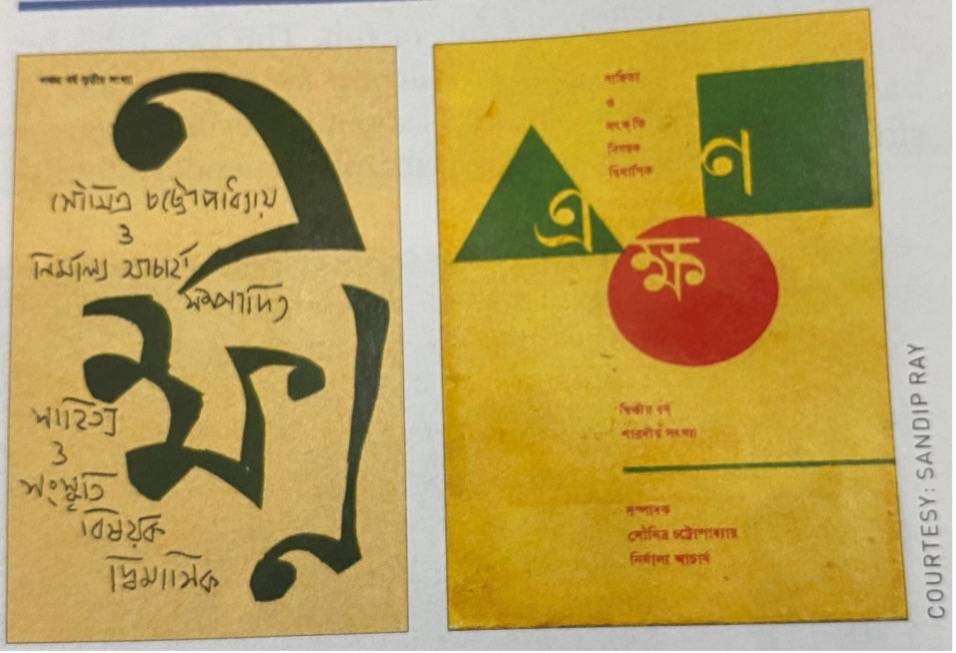
.

Ratnottama Sengupta, formerly Arts Editor of The Times of India, teaches mass communication and film appreciation, curates film festivals and art exhibitions, and translates and write books. She has been a member of CBFC, served on the National Film Awards jury and has herself won a National Award. 
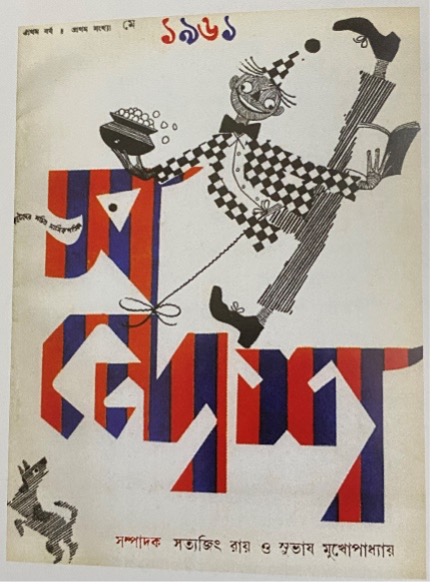
.

PLEASE NOTE: ARTICLES CAN ONLY BE REPRODUCED IN OTHER SITES WITH DUE ACKNOWLEDGEMENT TO BORDERLESS JOURNAL