Categories
Conversation

Rings on Her Fingers and Bells on Her Toes…

Ratnottama Sengupta in conversation with Sohini Roychowdhury, who uses dancing to build bridges across cultures

“Meet my daughter Sohini,” Uma Di was introducing the dancer who then lived in Madrid. And my first response was, “Why isn’t she in the movies?!”

Sohini Roy Chowdhury. Courtesy: Sohini Roy Chowdhury

Tall, fair, lissome, agile, Sohini Roychowdhury is the stuff beauty queens and show stoppers are made of. That wasn’t surprising: after all, Uma Roychowdhury herself is the picture of perfection in aesthetics.

It didn’t take me long to realise that, much like the well regarded sculptor’s bronzes, her daughter too was made of enduring stuff. One day she was teaching Bharatanatyam to French, Spanish, and Italian enthusiasts. The next day she was lecturing on mythology in New York. One day she was dancing to ‘Jai Ho![1]’ for the director of the Oscar winning Hollywood movie[2]. Another day she was delineating Durga in an Anthropology Museum…

None of these saw her run out of breath. Nor does she, ever, run out of time. When she’s not holding her fingers in a dance mudra, she is holding a metaphoric pen. This month she unveiled her second book, Dance of Goddess Kali. Yes, she has rings on her fingers and bells on her toes — and wherever she goes, there’s dance on the cards!

Here is what she had to say when I spoke to her:

The Dance of Kali follows Dancing with the Gods. How are the two books different?

Dancing With the Gods and The Dance of Kali are two distinct works, each focusing on different aspects of my artistic and spiritual journey. 

Dancing With the Gods is a pictorial, coffee-table book stemming from my journey as a classical Indian dancer with a multinational dance troupe. Its vivid visuals showcase my onstage performances and behind-the-scenes moments. These are highlights of my career as a dancer, both solo and with Sohinimoksha World Dance and Communications[3]

This visually captivating book focuses on imagery and aesthetics. It offers glimpses into my artistic expression through dance, celebrates my journey around the world, and highlights my life-mantra of connecting civilisations through my craft. This tracing of Sohinimoksha’s journey is for a broader audience: Indian dance enthusiasts, art lovers, and individuals interested in my achievements. The aim is to inspire through visually compelling storytelling.

In contrast, The Dance of Kali is a treatise on the ethos of Goddess Kali and Shaktism. It delves into the deeper spiritual and philosophical aspects associated with the goddess, exploring Kali’s symbolism, mythology, and significance within the context of Shaktism, a Hindu tradition of worshiping the divine feminine energy. The tone of this work is contemplative, as it delves into the profound symbolism and the spiritual aspects associated with the Goddess. It incorporates scholarly research, analysis, and interpretations from various perspectives. Hopefully it offers readers a deeper understanding of Kali’s significance in Hindu spirituality.

May I point out here that The Dance of Kali is not a religious book. It is for readers with a specific interest in Hindu mythology, spirituality, or the myths and legends around the resident Goddess of Kolkata. Those seeking a deeper understanding of Kali’s symbolism and philosophical underpinnings within the context of Shaktism, will find this book dispels disrespectful misrepresentations and unfounded Western misconceptions  surrounding the images of Kali as a demonic goddess. 

To sum up: both the books reflect different facets of my artistic and spiritual journey. However, they differ significantly in their subject matter, focus, tone, and intended audience. One celebrates my achievements as a dancer through captivating visuals. The other is an academic tome exploring the profound symbolism and spirituality associated with Goddess Kali.

What prompted you, an international dancer, to pick such a rooted in mythology subject?

I have always had a personal affinity with or inclination towards Goddess Kali. Many artistes draw inspiration from their own beliefs, experiences, and cultural backgrounds when choosing subjects for their work. I am no different. For me the depiction of the Goddess is an opportunity for artistic exploration. Kali, with her complex symbolism and multifaceted persona, offers rich material for creative interpretation through the arts, be it dance, literature or visual arts. 

This book also celebrates India’s rich mythological heritage and the way it connects to other ancient cultures, in Mesopotamia, Egypt, Spain and France. Kali, with her global soul sisters Ishtar or Sara La Kali, holds significant cultural and religious importance, not just in Hinduism, but other cultures as well, particularly within the contexts of worshipping Mother Goddesses. I delve into Kali’s mythology and symbolism to honour this aspect of Indian life, and its universal resonance. 

Yes, Goddess Kali is rooted in Indian mythology. But the themes she embodies — feminine power, transformation, and liberation —transcend cultural boundaries. I hope this book will serve to explore universal themes of empowerment and spirituality. It also aims to provide a deeper understanding of Hindu mythology, and the symbolism associated with the Dark Goddess. Effectively I seek to promote intercultural dialogue and foster greater appreciation for diverse religious traditions. Most significantly, I hope to dispel the uneducated interpretations of Kali as a horrific, savage, demonic goddess. How often she is typecast as a symbol of evil — in popular Western films, books and even as Halloween costumes for disrespectful celebrities like Heidi Klum

I have witnessed your performance as Durga in an anthropology museum in Madrid. I have noted your commitment to meaningful, even profound themes in your endeavours. What has been your grooming in dance?

I started dancing at a young age under  renowned Bharatanatyam Guru, Thankamany Kutty. Later I learnt from Kalamandalam Venkitt in Kolkata. I received rigorous training in Bharatanatyam, the dance  that originated in the temples of Tamil Nadu. My dedication to classical art led me to delve deep into its nuances. I mastered intricate footwork, expressions, and storytelling techniques. Over the years, I refined my technique and expression through consistent practice and performance and came to embody the essence of Bharatanatyam.

Your father was a renowned sitarist living in Germany. Your mother is a reputed sculptor of Kolkata. Why did you, an only child, not take to any of these streams of creative expression?

Indeed I was born into a family of accomplished artists. My father, Pandit Subroto Roychowdhury was a renowned sitarist, and my mother, Uma Roychowdhury, is a reputed sculptor. But I chose a different path for myself. 

As an only child, I was exposed to various forms of creative expression. But my passion for dance was ignited after watching a riveting performance by Yamini Krishnamurthy when I was about four years old. While I deeply respect my family’s artistic legacy, I followed my own calling and embarked on a journey to carve my niche in the world of dance.

What are the values you have imbibed from them individually?

My father’s sitar schools in Germany have produced hundreds of students — including distinguished sitar players. From him I imbibed a profound appreciation for music and rhythm. I learned discipline, dedication, and the importance of perseverance in mastering an art form. From my sculptor mother I inherited a keen love for aesthetics and eye for details. I learned the importance of expressing emotions and stories through visual and performing arts. 

Together these values have steered me towards excellence and innovation in my journey as a dancer and communicator.

Mixed genre performance by Sohini Roychowdhury. Courtesy: Sohini Roy Chowdhury

You have lived in Moscow and Madrid. You are guest professor in far-flung Universities, in America and Columbia. You have danced Bharatanatyam and you have danced to Jai ho! at the premiere of Slumdog Millionaire. What have you gained through your international exposure?

My international exposure has enriched me both personally and professionally. Living in cultural environments as diverse as Moscow and Madrid have broadened my perspectives and deepened my understanding of global arts and communication. 

More than 2000 students have ‘graduated’ through my two dance schools in Spain — Casa Asia and Sohinimoksha Artes de la India. In Moscow, more than 80 Russian students performed with me on stage at the Embassy of India and Nehru Centre at the end of their course. As a guest professor in universities across Europe, USA and Latin America, teaching dance, Natyashastra [theory of dance] and Indology, I have not only shared my expertise — I have learnt from students, artistes and scholars from different backgrounds. 

Through my performances of Bharatanatyam, and collaborations with international artists, have bridged cultural divides. My dancing to Jai Ho! at the European premiere of Slumdog Millionaire showcased the universal appeal of Indian dance and music. It  highlighted its ability to connect with people across borders. Today I can confidently claim to have promoted cross-cultural exchange globally.

Coming from an aristocratic, old Calcutta background, what merit do you see in Bollywood dancing?

Despite coming from an aristocratic background rooted in old Calcutta, I recognise the merit in Bollywood dancing which has become a global phenomenon. Not surprising. For, characterised by vibrant energy, expressive movements, and fusion of multiple dance styles — from Salsa to Tango, Twist to ChaChaCha – Bollywood dancing holds mass appeal. It serves as a platform for artists to showcase their talents to diverse audiences and has contributed to the popularization of Indian culture worldwide. It is rooted in traditional Indian dance forms, yet embraces modern influences. And it reflects the evolving tastes of contemporary audiences. 

Since the 1960s, Bollywood has drawn inspiration from various musical traditions across the world. This imparted its films a rich tapestry of global influences. This fusion of world music and dance enriched the aesthetic of Bollywood — and in turn contributed to its cultural significance and global appeal.

In the 1960s, Indian cinema underwent a transformation with the emergence of filmmakers like Guru Dutt and Raj Kapoor, who infused their films with elements of Western music and dance. The most iconic example of this is seen in the song Mera joota hai Japani [my shoes are Japanese] from Shree 420 (1955): here Raj Kapoor’s character sings about wearing Japanese shoes, English pantaloons, and Russian caps — all of which symbolised the growing influence of the West in post-colonial India. And yet, as the song stresses, at core these films are Hindustani — Indian.

Throughout the ’60s, ’70s and ’80s, the industry witnessed the rise of dance and music directors who played a pivotal role in incorporating world music and dance forms into Hindi cinema. Composers like OP Nayyar, Shankar Jaikishan, SD Burman, C Ramachandran, Kalyanji Anandji, RD Burman, Laxmikant-Pyarelal, and Bappi Lahiri experimented with disparate musical styles. These ranged from rock-n-roll, rumba, flamenco to disco, reggae and jazz. This infused their compositions with international flavours. 

Similarly, choreographers Sohanlal,  PL Raj, Herman Benjamin, Suresh Bhatt, Saroj Khan, Chinni and Rekha Prakash, Shiamak Davar, Farah Khan, Remo D’Souza, Terence Lewis, Vaibhavi Merchant, and Prabhu Deva have blended Indian classical dance with Western styles. This has created the unique dance style that is now identified as Bollywood dancing. It has homogenised movements from hip-hop to salsa and contemporary dance.

Soon stars like Shammi Kapoor, Helen, Asha Parekh, Hema Malini, Rishi Kapoor, Mithun Chakraborty, Jeetendra, Govinda, Hrithik Roshan, Madhuri Dixit, and Sridevi became synonymous with Bollywood’s larger-than-life dance numbers. For, it showcased their versatility and flair for different dance steps. Embracing the twist and turn era of the ’60s to the disco craze of ’70s and the hip-hop-inspired moves of the 2000s, Bollywood stars captivated audiences with their energy and charisma.

Along with Western influences, Bollywood also drew from traditional Indian dances. Its choreography incorporated elements of Bharatanatyam, Kathak, and Odissi. Dance sequences like Dola Re Dola from Devdas (2002) and Pinga from Bajirao Mastani (2015) exemplify the fusion of classical and contemporary dances, blending intricate footwork with dynamic movements and expressions.

In recent years, Bollywood has continued to evolve, reflecting the changing tastes and preferences of global audiences. Directors, like Sanjay Leela Bhansali and Farah Khan, have pushed the boundaries of traditional filmmaking, creating visually stunning spectacles that showcase the diversity of world music and dance. Stars like Priyanka Chopra, Deepika Padukone, and Ranveer Singh have embraced this eclectic mix of styles, bringing their own unique interpretations to the screen.

Spanish, Bulgarian and other European dancers from my own troupe, Sohinimoksha World Dance, have performed specially choreographed fusion dance items set to popular Bollywood tracks. Kristina Veselinova danced to Mere Dholna from Bhool Bhulaiya; Violeta Perez and Lola Martin to Senorita! from Zindagi Na Milegi Dobara and Maria Sanz on Padmavat’s Ghoomer on stages across India and the world. So I readily acknowledge the significance of Bollywood dance in preserving India’s cultural heritage while adapting to changing times.

Would you say our films are taking our dance traditions to votaries abroad? Just as Indian musicians of the 1960s had taken our ragas to the West?

In the 1960s, Ravi Shankar, Ali Akbar Khan and other maestros played a crucial role in initiating the West in the rich notes of Indian classical music — and that had enriched the global cultural landscape. My own father, Pandit Subroto Roychowdhury, spent more than 40 years in Germany and other European countries, spreading and popularising Indian classical music through concerts and classes. Today Indian films, particularly Bollywood, are carrying forward this legacy. They are showcasing the wealth that is Indian dance — often fused with world dance influences. Just as our musicians shared the wealth of ragas with the West, Bollywood films are spreading the infectious exuberance of Indian dance to enthusiasts around the globe. This is fostering cultural exchange on an international scale. Small wonder that Bollywood is now acknowledged as India’s most potent soft power. 

What, in your opinion, is needed to make GenNext learn from our past traditions?

If we want GenNext to learn from our past traditions, we must provide them with comprehensive exposure to our rich cultural heritage. For this, we must integrate our arts and cultural practices into educational curricula. We must foster appreciation through interactive experiences — workshops, performances, cultural events. Additionally we must leverage modern technologies and platforms to disseminate information. Let’s make traditional arts more accessible and engaging for the young. Let’s cultivate mentorship programs and intergenerational exchanges. For, we must bridge the gap between past traditions and contemporary lifestyles, to ensure their relevance and continuity for the generations to come.

Sohini I have seen you at close quarters, as a mother, wife, daughter, and daughter-in-law even as you criss-cross the world for your dance. How do you still find time to write, which is such a demanding, reflective expression?

I am fortunate to be able to balance my roles as a mother, wife, daughter, daughter-in-law, and a performing artiste. My experience as much as my dedication to my craft honed my time-management skills. Despite crisscrossing the world for performances, lecture tours, and other professional commitments, I carve out time to write, for I recognise its significance as a reflective form of expression. 

To effectively manage my time, I set priorities, create schedules, and maximize productivity during the available windows of time. I designate specific periods for writing, be it early mornings, late evenings, or during travel downtime. I try to integrate writing into my daily routine, seizing moments of inspiration and reflection to jot down ideas or draft passages.

My passion for writing is a driving force — it motivates me to make time for it amidst my busy schedule. Writing provides a creative outlet for introspection, and intellectual exploration. It complements my artistic endeavours and enriches my personal and professional growth.

I am grateful for the support I receive from the network of my family, friends, and collaborators. They play a crucial role in facilitating my writing pursuits. My latest book, The Dance of Kali, was co-written with my son Rishi Dasgupta, an Economics MSc from the University of St Andrews, UK. 

However, at the end of the day, that I find time to write amidst my multifaceted life, reflects my passion for engaging in reflective expression. Because? It contributes to my holistic development as an artist and an individual.

[1] A song from the 2008 Bollywood movie, Slumdog Millionaire

[2] Danny Boyle

[3] A dance troop started by Sohini Roychowdhury with presence in Madrid, Berlin and Kolkata

.

Ratnottama Sengupta, formerly Arts Editor of The Times of India, teaches mass communication and film appreciation, curates film festivals and art exhibitions, and translates and write books. She has been a member of CBFC, served on the National Film Awards jury and has herself won a National Award. 

.

PLEASE NOTE: ARTICLES CAN ONLY BE REPRODUCED IN OTHER SITES WITH DUE ACKNOWLEDGEMENT TO BORDERLESS JOURNAL

Click here to access the Borderless anthology, Monalisa No Longer Smiles

Click here to access Monalisa No Longer Smiles on Amazon International

Categories
Essay

A City for Kings

Narratives and photographs by P Ravi Shankar*1

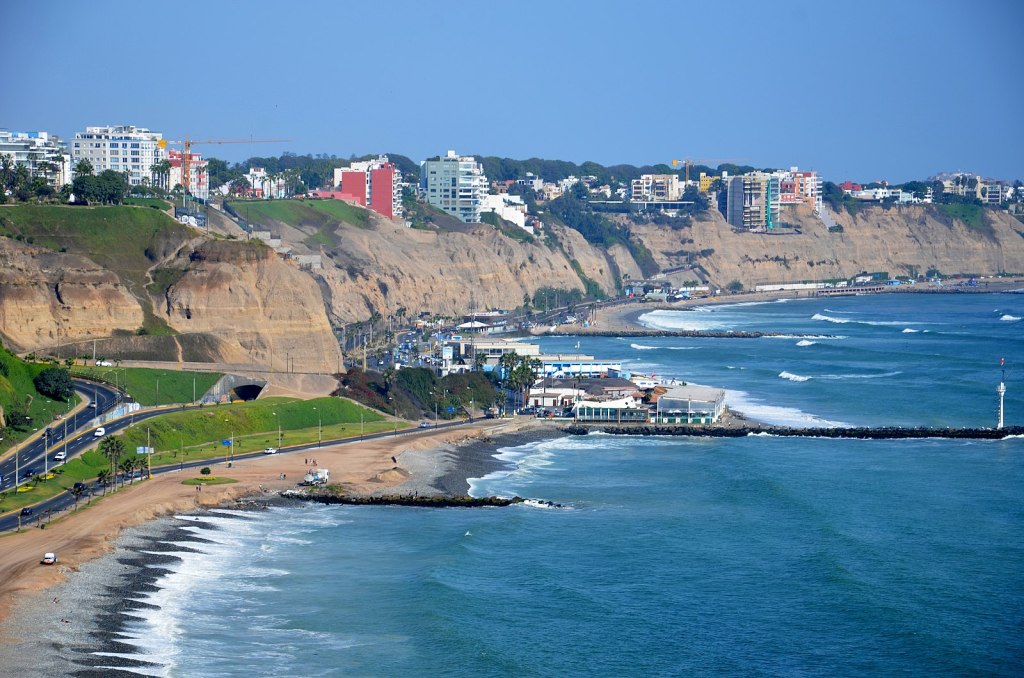
Lima. Courtesy: Creative Commons

The rich golden-brown skin peeled off easily to expose the pink flesh underneath. The ‘frita’ was a perfect symphony of flavours with every note being in the right place. I enjoyed the entire fish including the bones and the head. I was having a ‘trucha frita’ (fried trout) at a restaurant in Magdalena del Mar, Lima, Peru. The fish was large and had been fried without much oil. Peru is known for its food, and I enjoyed my lunch (almuerzo) throughout my visit. Lunch is the major Peruvian meal. There were special lunch menus and for around 8 nuevo soles (around 2 US dollars and fifty cents). I got an entrada (usually a soup or a salad) and a segundo (seconds with a big variety of dishes) with a drink and often a dessert.

I landed at Lima’s Jorge Chavez International Airport late at night late in September. The airport is not very large by international standards but functions quite well. Taxi fares from the airport are on the higher side. I had taxi-hailing apps on my phone, but they did not seem to work at the airport. Lima is a city of around 11 to 12 million people. About a third of Peru’s population lives in the capital. There has been a recent influx of Venezuelan refugees to the city. The city is crowded but most of it is well-planned with squares, roundabouts, parks, and sidewalks.

I liked Lima. For a large city, it is not very polluted though some areas are dusty. The city is usually covered by haze or fog till late in the morning. The weather is usually cloudy though it rarely rains. About 40% of Peru’s population lives in the arid coastal region (la Costa). You see a lot of cambios or shops where you can change money. You also see a lot of restaurants. Lima is the third largest city in Latin America and recently has gained a reputation for its food. Peru has a lot of Japanese and Chinese immigrants (most of whom arrived at the end of the nineteenth and beginning of the twentieth century) and may be the most ‘Asian’ country in Latin America. Many Chinese run Peruvian Chinese restaurants called ‘chifas’.

Lima gained in importance during the Spanish rule and was the capital of the viceroyalty of Peru which included parts of modern-day Ecuador, Colombia, Bolivia, Chile, and Argentina. The city became very wealthy. During my different visits, I stayed in three different parts of the city — Pueblo Libre (Free town), Magdalena del Mar, and Jesus Maria. Lima is divided into several municipalities.

In Pueblo Libre, I stayed near the Plaza de la Bandera (Plaza of the Flag), a huge roundabout. The archeological ruins of Mateo Salado were nearby. Peruvians take great pride in their rich heritage. Following the Spanish conquest, the pre-Hispanic religions and cultures were violently suppressed by the Spaniards. They do continue to influence modern Peru in several ways but there is a stark discontinuity.

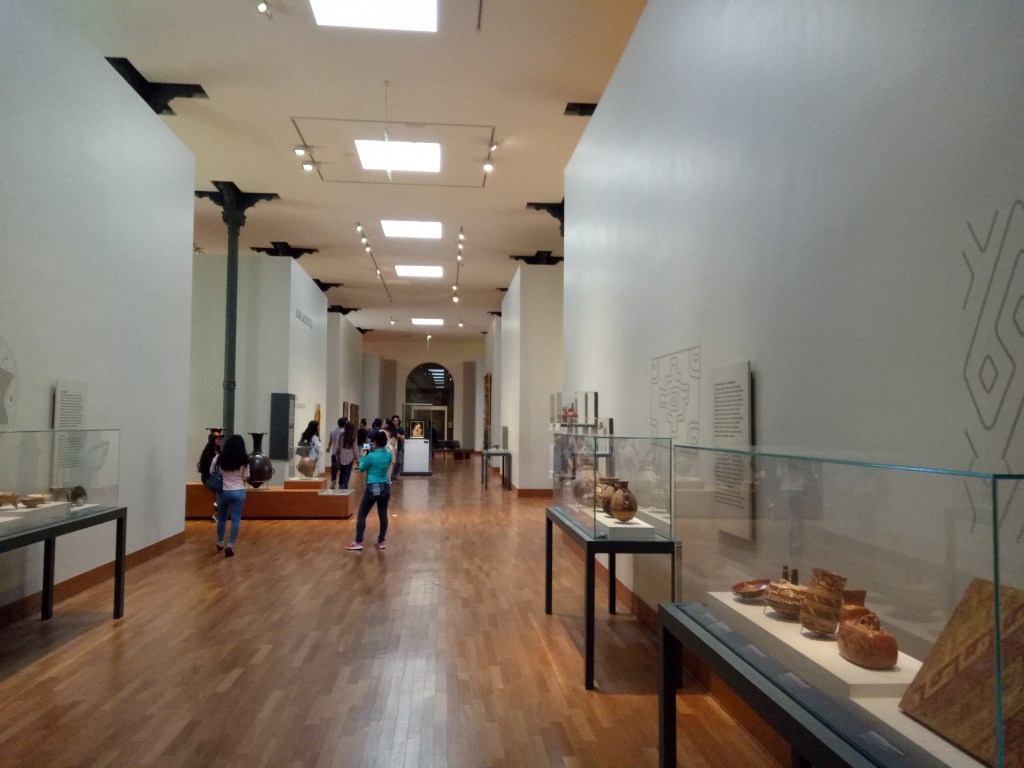
The Larco Museum is one of the many fine museums in the city. The museum has a rich collection of pre-Columbian art, is well-maintained, and is very appealing to the senses. Many civilisations took root on the arid coast. The Paracas and Nazca civilisations were prominent. The population had to learn to harness and use water from underground sources. The Anthropology Museum was under renovation, and I could only see the section commemorating the life of the liberator, Simon Bolivar. Bolivar is very popular in South America with several streets and buildings named after him. There is even a detergent named after him.

The Parque de la Leyendas (Park of Legends) is the zoo. The zoo is huge and is structured according to the three regions of Peru, the coast (costa), the mountains (sierra), and the jungle (selva). The Amazon rainforest constitutes the largest part of the country by land area. The largest city, Iquitos, can be reached only by boat or by air. The zoo also has a huge garden with plants from all over the world and a huge archeological site.

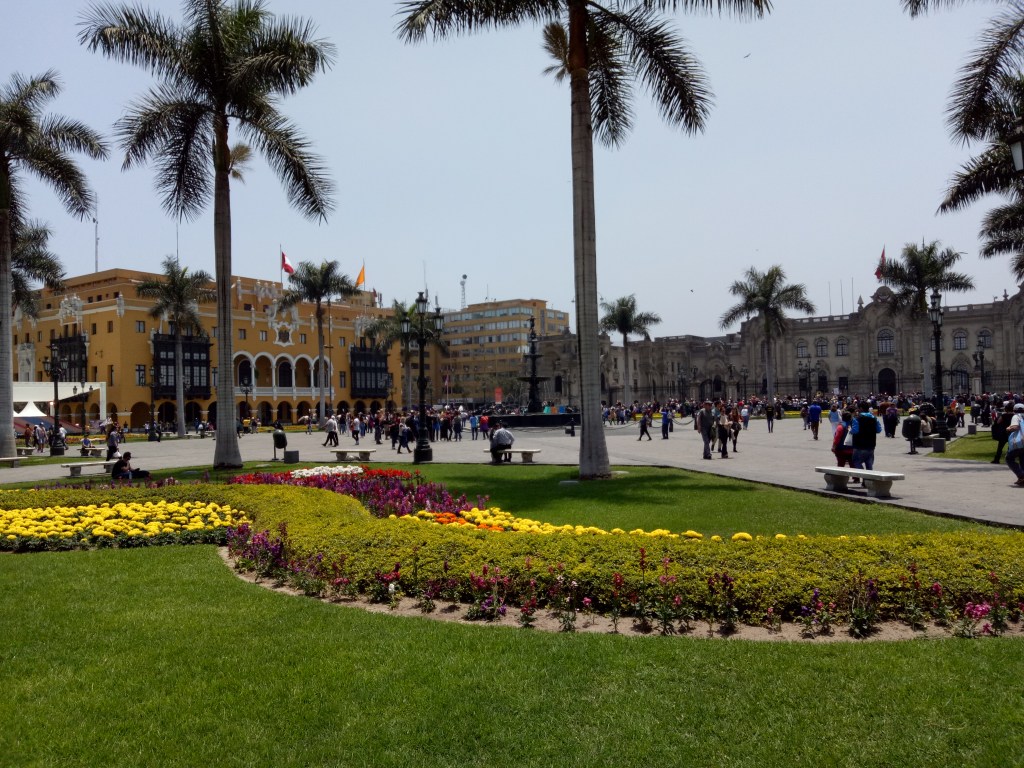
Plaza de Armas

Plaza de Armas de Lima (Plaza Mayor lof Lima) is the main square of the city surrounded by fine Spanish colonial buildings. Every town in Peru has a Plaza de Armas. Town planning is mostly good with numbered sectors and streets within the city. I was fortunate to see the changing of the guard at the Presidential palace which takes place around noon. What a show of pomp, colour, and pageantry on horseback! The synchronisation was perfect. The cathedral of Lima, the municipal palace, and the palace of the Union are major historical buildings.

Changing of Guards

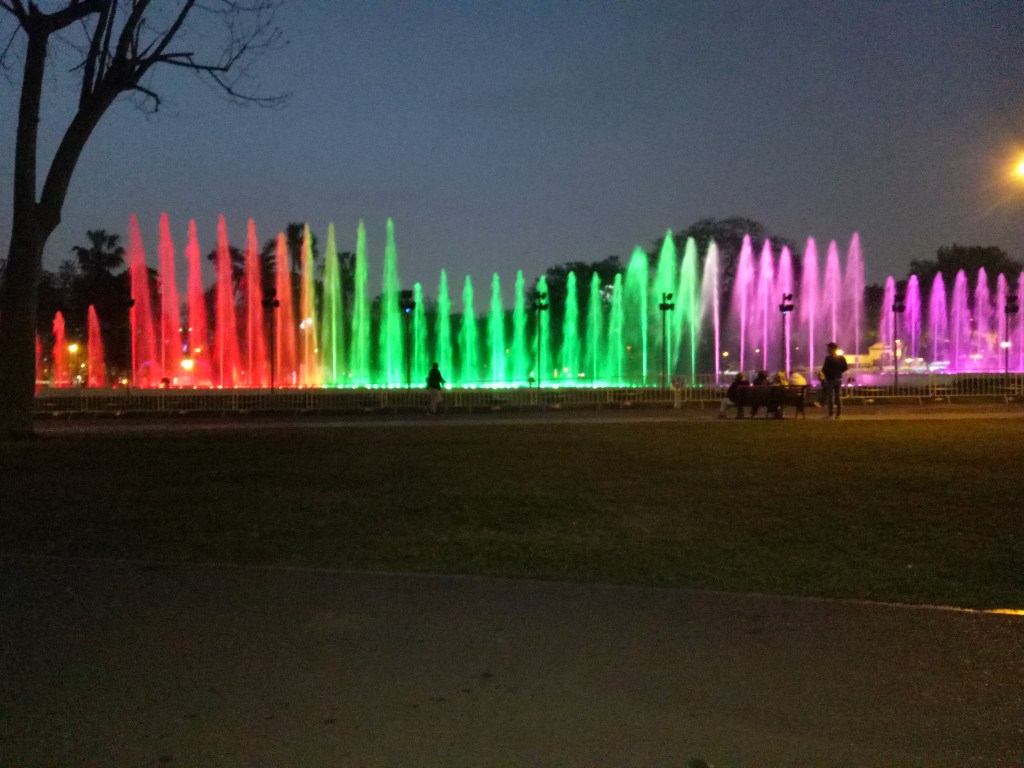
I had heard and read a lot about one of the more recent attractions of Lima – the magical water fountain. The Circuito Magico de Agua creates magic with water. I reached the place mainly known for the spectacular fountains around 5 p.m. You can walk underneath a tunnel of water. As the sun began to set the lights were turned on. The lights at the main fountain could reproduce an extravagant palette of colors and different scenes were created in tune with the music. There was a light show at 7.15 pm. Crowds began to gather around the main fountain. The light and sound show using lasers and lights was spectacular and provided a brief introduction to the rich tapestry of Peru.     

Magical Fountains

Chicha morada is a drink from the Andes region and is made from purple corn. Rich in antioxidants, the drink is refreshing and healthy. Chicha morada is smooth and beautifully complements various Peruvian dishes. The alcoholic variety plays an important role in different religious and other ceremonies from ancient times to the present day. There is a legend about the corn (mama jora, mother corn) plant from which these drinks are derived.

The legend about the chicha[1] is especially popular in Cuzco, the ancient capital of the Inca empire, and also in other cities in Peru. In ancient times the God Viracocha (the creator) saw people working hard. He wanted to help them, so he came down from Hanaq Pacha (the world above) to place in a single plant the powers he wanted to give humans.  He chose a weak plant that struggled to grow amidst spiny weeds. To give his power to this plant, Viracocha took from his bag a sliver of huaranguay wood, a puma hair, a condor feather, and the fox’s brain.  He put them together and placed them on the small plant.

The city that treats visitors like kings with its sumptuous meals and friendliness, creates mystery with magical legends, like the one about Viracocha. Perhaps, that is why a sense of lingering longing and gratitude fills my being as I think of the colourful capital of that distant country on the other side of the globe.

Acknowledgment: Senor Fernando needs to be thanked for his hospitality and help during my visit — Dr P Ravi Shankar

[1] The legend is mentioned in a blog article by WC Morveli titled ‘Drink chicha to become wiser than a fox’ (https://cuzcoeats.com/drink-chicha-wiser-fox/)

  1. Unless otherwise stated ↩︎

Dr. P Ravi Shankar is a faculty member at the IMU Centre for Education (ICE), International Medical University, Kuala Lumpur, Malaysia. He enjoys traveling and is a creative writer and photographer.

.

PLEASE NOTE: ARTICLES CAN ONLY BE REPRODUCED IN OTHER SITES WITH DUE ACKNOWLEDGEMENT TO BORDERLESS JOURNAL

Click here to access the Borderless anthology, Monalisa No Longer Smiles

Click here to access Monalisa No Longer Smiles on Kindle Amazon International

Categories
Stories

The Book Hunter

By Paul Mirabile

Courtesy: Creative Commons

Adamov led an introverted life. Perhaps because everyone, both friends and foes, thought he was ugly. In fact, he himself, when looking in the mirror that hung lopsided on his peeling wallpaper drew the same conclusion. An ugliness that drove him deeper into his own world, and which would lead him to become the foremost collector of books in the Kalmak region of the Caucasian mountains, and even beyond … This intense activity, which began at a very early age until his violent, and I may add, mysterious death in a dingy New York City hotel room, took him to the four corners of the earth, buying, bartering, stealing manuscripts, first published books, political pamphlets, rare essays. He even possessed, heaven knows how, an incunabulum[1]: a Lutheran Bible! Adamov also acquired, as a picturesque pastime, miniatures of Mughal, Kangra and Rajput stamps, Tibetan thankas, Buddhist prayer masks, mediaeval Chinese scroll paintings. It was said that he amassed more than 25,000 books at the humble two-storey lodging of his home village in the mountains of Daghestan ! But this, I will not confirm …

In short, books became his very existence, his raison d’être. His trusty companions and faithful, consoling friends in his many moments of maniac depression. His book-hunting transformed Amadov into a detective, snooping out the scent of an affair, flaring the odour of yellowing pages, crispy to the touch, invigorating to the smell, pleasing to the eye.

For Adamov, it was not just a question of tracking down a book like a hunter hunting his prey, but of locating the author’s place of residence, his or her favourite haunts. He would spend weeks, months in cities and towns, even after having procured his book, following the daily footfalls of those illustrious or obscure writers. If the writer happened to be alive, he would trail him or her from his or her home to a restaurant, a hotel, a library or book-shop, but never like a sleuth. If caught red-handed, this might have caused him some embarrassment. Adamov was afraid of direct confrontation, especially if it involved the law. To tell the truth, Adamov had no real intention of meeting an author, however famous. He reckoned that authors never measure up to their books, so why waste time actually meeting them? What would they talk about anyway: the birds and the bees? The weather?

It was during those moments of utter dolefulness on the road that Adamov recalled his childhood with a faint smile: He recollected rummaging through the dilapidated homes of his village in search of maps, pamphlets, books, picture cards or any scribblings that caught his eye, classing them in files either by theme or by date of their finding. For example, in 1960 he found 345 miscellaneous documents; in 1961, only 127. He had such a wonderful childhood, in spite of the periodic bombings from above, parental scoldings or beatings, visits from the neighbouring village militia that demanded money, food or young blood for the ’cause’ … A ’cause’ which he never adhered to, nor was ever recruited for, given his frail body and nervous disposition …

Finally he left his home village in search of bigger game, although he promised his parents that he would always keep in contact with them by his book trade; that is, every book purchased, after having read it, would be sent to their two-storey home … A home which became legally his after their deaths in the 1970s …

In 1974 we find our book-hunter in Amsterdam, lodged at the Van Acker Hotel, Jan Willem Brouuersstaat 14, just opposite the Concertgebouw, the famous concert hall, where he had been listening to Beethovan’s symphonies during that delightful month of May. It was in that hotel, in his room, that he arranged an appointment with a Dutch book dealer, a pasty-faced, unscrupulous dwarf, who negotiated hard for his wares. He clutched in his chubby, wrinkled arms an XVIIIth century first edition of Dom Bedos’ L’Art du Facteur d’Orgue[2], that Adamov had been tracking down for years. And finally, there it lay in the hands of that despicable dwarf who wanted more than 7,000 guilders for it! Adamov knew this was an illegal purchase, being classed as patrimonial property, probably having been stolen from the National Library by this slimy sod, but he had to possess it ! They haggled over the price for hours and hours well into the night. Following a rather violent squabble, the dwarf suddenly clutched at his chest, gurgled a few irrelevant syllables, and fell stone dead at Adamov’s shoeless feet. He wretched the priceless treasure from the still clutching arms of the dwarf, slipped on his shoes, checked the street from his window, then the corridor from the door, noiselessly. Adamov quickly packed his meagre belongings (he always travelled light), locked the door behind him and silently crept out into the soothing blackness of the street. In his flight, he threw the hotel door key in a rubbish bin, then made a bee-line for the bus station, where at six o’clock in the morning he was already headed for Berlin, and without wasting a moment, on a train for Istanbul where he was expected by an Armenian seller (or reseller ?) who possessed several Armenian illuminated manuscripts of mediaeval stamp, costly indeed, but since he paid nothing for Dom Bedos’ invaluable treasure, after an hour or two of desperate haggling, bought two manuscripts. The Armenian threw in two or three miniatures from Herat and Tabriz in the hope that his client would return for the other four illuminated manuscripts … Adamov never did: He was murdered sixteen years later …

Now the incident in Amsterdam caused our book-hunter much discomfiture; not any pangs of conscience mind you; Adamov felt no grief over the sudden death of that dwarf. He feared rather police enquiries about the death, and the overt fact that he fled from his hotel without assistance to him, and without paying the bill to boot! The police might accuse him of the dwarf’s death … As to the manuscript, that posed no particular problem since the dwarf had undoubtedly had it stolen or had stolen it himself. Wherever he went now, the hunter would have to look over his shoulder, staying at the grottiest hotels imaginable to avoid the police or their hired henchmen, travelling on night-buses or trains or on cargo ships when crossing oceans or seas.

The Amsterdam incident happened three years ago. Since, Adamov had eluded local police and Interpol not by any Arsène Lupin[3] tactics or strategies, but perhaps by some lucky star or a guardian angel, if the readers are inclined to believe in these wardens of the wanton. But still our book-hunter remained on the qui-vive[4]! Since that unfortunate (or fortunate?) incident, Adamov had been seen in Georgia, Armenia, Iran and Uzbekestan, where he spent over a year, illegally (his visa having expired after three months!), in Bukhara haggling over a XIVth century publication of Hoca Ahmet Yesevi’s Hikmets (Strophes of Wisdom)in the original Chagatai language, a language that he learned to read in three months.

How he slipped out of Uzbekistan is anyone’s guess. He probably bribed the custom officials. In any case, we find traces of him in the Yunnan, at Lijiang, southern China, bargaining hard for three colourful Naxi pictographic manuscripts from a Dongba priest, manuscripts which the Chinese government absolutely forbade to be taken out of the country, but whose exorbitant estimated price on the black market, a cheery sum of 25,000 yuan, persuaded the wily priests to take the risk. Besides, the priest could always imitate the three XVIth century manuscripts : it was all a question of time and patience … And he had both! Who would ever know? Adamov sensed the abysmal greed of his vender, and promised him 10,000 yuan more if he would relinquish two more of the forbidden scriptures, but payable in two days since he would have to wire back to Daghestan for the money. The plucky priest, all agog, smiling a wicked smile, handed the two booklets over to him without hesitation. Adamov never returned. He disappeared, travelling quickly through Nepal to the Himalayas via Sikkim, Ladakh and Zanskar, where, at last, at the Phuktal monastery he sojourned for five months, reading a first edition of James Hilton’s Lost Horizons whilst ploughing through the Hungarian philologist and Tibetologist, Alexander Csoma’s Tibetan-English Dictionary. Before he bid farewell to his kind and generous hosts, he had filched six illuminated prayer books in Tibetan, two festival masks and a thangka[5]. By the time the good monks noticed the theft, the incorrigible thief had trekked to Kaylong, bussed it to Manali, finally arriving in Karachi, where he boarded a cargo ship for Japan, then on to Oakland, California.

Aboard the cargo the thief had time to mediate upon his book-hunting existence. He admitted it wasn’t particularly glamorous — abandoned parents, a dead dwarf, stolen patrimonial property, false passports and bribery of officials. Nevertheless, these unsavoury moments of his hunting never dampened his enthusiasm. His lust for sweet-smelling tomes, his craving to possess, at any cost, more and more of them. To tell the truth, Adamov had become completely obsessed by his collection. Oddly enough, the more he accumulated the uglier he became ! In fact, he not only became uglier, he became fatter … Adamov had no qualms about this ponderous load; indeed, it enveloped him with a sort of pompous aura, whose fleshy freight he swaggered about the decks of the ship like some august, stately sultan. It added to the mystery of his past, present … and future. A future that had little cheer and much disquiet. He was running out of money, for he refused to sell what he bought. Even the many stolen books he dreaded to forswear. How many times had he asked himself why he hoarded such a vast treasure without really capitalising on his assets, without developing a trading-network throughout Asia, without, at least, rereading his precious volumes two or three times, sniffing their illuminated contents, inhaling the strange forms of their letters and signs, touching ever so lightly, again and again, the brittle paper of their pages or the calfskin vellum of their covers … To these questions he had no clear answer. He felt trapped in a conundrum, out of whose meshes Adamov, the hunter, gradually fancied himself the hunted!

But by who? The few passengers aboard hardly looked at him, much less spoke to him. He ate his meals with two or three burly fellows, perhaps Koreans, who beyond a good morning, afternoon or night, never pronounced a word to him, nor amongst themselves for that matter.

So he churned these thoughts over and over in his head as the days went by on the never-ending Pacific Ocean. What he needed was a project. Yes, a project that would offer him a meaning to his collecting … to his cherished collection. He resolved to go to New York City once disembarking at Oakland. Why New York City? Because Adamov had read about a Jewish New Yorker, named Louis Wolfson, who spoke many languages and wrote in French because he hated his mother speaking English to him. An odd chap indeed, but this is what he read. The idea fascinated him. The fact that Wolfson was still alive, in spite of the many sojourns in psychiatric wards and clinics. It was his book : Le Schizo et la Langue[6] that he would find and read. This posed no real problem, having been edited and re-edited since 1970. Yes, this book would put him on the trail of something enormous … Something worthwhile. Adamov looking out to sea gazed complacently into his future. A piercing crimson glow hollowed out a widening hole amidst the thick, grey clouds … He spun on his heels. The hunter sensed a pair of eyes bearing down on him. Yet, when he searched out the deck and the bridge high above him there was not a soul in sight. He sighed, padded his paunch, and casually shuffled off to his cabin as the swells lifted the ship high into the crests of the grey sky, only to drop with tremendous speed into the black, oceanic valleys below …

Six months later, Adamov had reached New York City on a greyhound bus from Atlanta, Georgia. He took up his lodgings at a sleezy hotel on the Lower East Side, Water Street, number 9. It wasn’t long before Adamov, weaving in and out of the 8 million New Yorkers day after day, night after night, had purchased a cheap 1970 edition of the aforesaid book by Louis Wolfson, with a preface by Gilles Deleuze, a French philosopher of some renown in Europe. He pored over this odd book as if he himself had written it. His fascination over such a contemporary edition unnerved him. This Wolfson grew on him like a drug-addiction — not for his writing, which indeed proved rather drab, but to the singularity of his method to achieve a written work through strenuous exercises of self-neglect and utter detachment from maternal infringement. The schizophrenic maniac had managed to create his own sphere of reality through the myriad experiences of listening to such diverse languages as Yiddish, French, Russian and German on his make-shift Walkman whilst strutting through the streets, sitting in parks, at the table when eating with his obnoxious mother, ensconced in the public library as he read or wrote in all the languages he knew … except English, that accursed language that his mother tortured him with like a sadist would when ripping out fingernails! That language which he hated as much as he hated his mother …

Adamov bought a Walkman and had recorded Persian, Arabic and Mongolian on it, which he listened to as he strolled about the same streets that Wolfson had strolled. Or, he sat in the same New York Public Library where Wolfson had sat for hours and hours until closing time. He couldn’t give a biscuit where Wolfson was now living, probably locked up in some clinic for the alienated in a straitjacket. He had nothing personal against English. However, these dippings into ‘alien tongues’ hour after hour, day after day, lifted him out of the ‘New World’ into one of his own making … his own created polyphonic world. His excitement grew as he shifted from Wolfson’s book to the many languages that he repeated over and over again …

It was more or less at this time that I penetrated Adamov’s world. I, too, had my grotty lodgings at the same hotel, a room right next to his. At night I heard his wild, inflamed exclamations about things I hardly deciphered. However, one day we met in the low-lit, begrimed corridor as he dawdled to his room. He had shaved his head and let grow a beard down to his chest. He wore a skullcap of pure white. Adamov’s black, beady eyed bore into mine with some suspicion at first, but my soft spoken, causal demeanour put him immediately at ease. I introduced myself, and he invited me into his room for an evening chat …

It was the first and last discussion I had with this odd fellow, and it lasted well into the night. The oddness lay not so much in the subjects that we touched upon, but the dream-like atmosphere that Adamov somehow created. There he sat enthroned behind his reading and writing table near the unclean window like Genghis Khan himself, stroking his beard, turning the pages of Wolfson’s book that lay before him, his pudgy fingers smearing coffee grinds on page 40, heavily marked with pencilled notes ! He would address me in English, then after several minutes switch to Spanish and Italian with the utmost ease, an ease that I echoed since I was well versed in those languages. My host appeared to be pleased by this hollow echo in the night. After a drink or two of some cheap red wine, Adamov would burst into a soliloquy in Turkish, afterwards slipping into Russian, German, Dutch and French, attempting to throw me off the chase, to deviate my beating. And in this, I must confess, he thoroughly succeeded. Oftentimes the sly polyglot began a sentence in Russian and finished it in Chinese or Tamil, a feature that linguists call ‘code-switching’. I was flabbergasted …

But what really stupefied me was this strange man’s ability to alter his speech patterns and accents. Now he would impersonate, linguistically, an American from the deep South, now one from New York City. Now a Frenchman from Paris, now from Marseilles! When he fell into speaking Spanish, he conversed ever so casually with a Mexican ‘gaucho’[7] accent, only to follow up with a ‘caballero’[8] one from Barcelona or Madrid … All these inflections and modulations left me swooning, to say the least. At length, at four in the morning, I rose and retired to my room, having learnt absolutely nothing of importance about this amazing creature. In short, I felt more ignorant of this man than before I ever laid eyes on him …

Everyday Adamov spent over ten hours at the public library. It was there that his great project suddenly took form, looming larger and larger in his excited mind. Why not write stories myself ? Why not write stories in many languages and not just read or listen to them ? Yes, different stories written in different languages, signed by invented names! Twelve stories – fiction, each bearing a style of its own, a flavour and texture of its own, yet signed by twelve different writers. Adamov grew more and more agitated, fidgeting in his chair much to the annoyance of two elderly readers opposite him, poring over a William F. Buckley essay and Eric Lux’s 1991 edition: Woody Allen: A Biography.

But what languages could he choose? French, Spanish, English, Turkish, Italian and German … Any. How about Russian and Chinese? That would make eight. “I can get on all right with Tamil and Persian … and Armenian?” Adamov paused, collecting his thoughts. What would be the twelfth language ? His own ? Never. It was his mother’s tongue, and besides who would ever read it? But was being read all that important, vital to his existence? No. This project was beyond a reading public … beyond mankind’s expectations of what writing and literature meant to him.

By this time, Adamov’s eyes seemed to pop out of their sockets. The two elderly readers rose from their chairs and left with many a smirk and sneer. What did he care? Still, he needed one last language: “I got it, I’ll invent a language from all the languages I know! That will be my twelfth story; a story to end all stories …”

He mapped out his plan of action mentally. Our future short-story writer shot out of his chair and made a bee-line for his hotel. He would put his plan into action that very night … He set to work at his reading and writing table, having decided to begin the Twelve with English, the language that Wolfson loathed! He cringed under that delicious stroke of inspiration. Let the bugger loathe all he might! Adamov could love his book, but he harboured no devotion towards its writer. Besides, he was residing in an English-speaking country and there he wanted to write in English. He would write French in France or Belgium, Spanish in Spain or in Latin America, Turkish in Turkey, and so on.

Hours went by as Adamov pressed on and on, burning oil of the midnight lamps, filling sheets of cheap notebook paper as quickly as his imagination spiralled out. Coffee after coffee kept pace with his hand, à la Balzac, amidst the screaming police sirens, the bickering of pimps and their whores below his window, rubbish bin cans crashing on pavements as stray cats or vagrants rummaged through their contents. Through the thin walls of his room he heard coughing, sneezing, cursing, snoring and sleep-talking.

As the sun broke through the thick, colourless skies of a New York City morning, Adamov, thoroughly exhausted, threw down his mighty writing tool. He had finished the first of the Twelve: The Garden of Enchantment, signed Hilarius Eremita …

Just at that triumphant moment a sudden hammering at his door rocked him out of his reverie. He rose sluggishly and shuffled to the unlocked door. As he grasped the knob the door burst open in one forceful thrust. Two hooded men seized Adamov by the throat, pinned him against the wall and strangled him with their bare hands. The ponderous writer slid limply to the floor, mouth ajar, eyes open in tragic astoundment. The hooded men fled, vanishing into thin air, as the expression goes …

Hearing hurried footsteps, I waited until they had died down, then tip-toed to his room. For some unknown reason his premeditated murder, for premeditated murder it undeniably was, did not surprise nor move me. I swiftly, however, rushed to the writing table : Nothing had been touched ! I gathered all his papers then returned briskly to my room …

And this was how I was able to salvage from the malevolent hands of Adamov, or Hilarius Eremita, the story called,  The Garden of Enchantment

When I think back on this whole affair there is no shadow of a doubt that the hunter had become the hunted for reasons that we shall never really know. In light of that, I departed from New York City the day after the murder on a flight to Buenos Aires, then on to Madrid …

.

[1]          A book printed on a Gutenburg Press before 1500.

[2]          The Art of an Organ Builder.

[3]          Famous French ‘gentleman’ robber who steals from the rich to give to the poor, and in doing so, always outsmarts the police, but without ever shedding any blood. Arsène’s adventures were written by Maurice Leblanc (1864-1941).

[4] On the alert (French)

[5] Tibetan painting

[6]          The Schizophrenic and Language.

[7]          A cowboy from the Mexican plains or pampas.

[8]          ‘Gentleman’.

Paul Mirabile is a retired professor of philology now living in France. He has published mostly academic works centred on philology, history, pedagogy and religion. He has also published stories of his travels throughout Asia, where he spent thirty years.

.

PLEASE NOTE: ARTICLES CAN ONLY BE REPRODUCED IN OTHER SITES WITH DUE ACKNOWLEDGEMENT TO BORDERLESS JOURNAL

Click here to access the Borderless anthology, Monalisa No Longer Smiles

Click here to access Monalisa No Longer Smiles on Kindle Amazon International

Categories
Poetry

In the Honduran Dusk

Traversing borders, Lorraine Caputo takes us on a visit to our brothers and sisters in a small Garífuna village on Honduras’ Caribbean coast. 

IN THE FALLING DUSK

I.
On a sand bar near the sea, seven 
young boys play pelota*.

With long sticks, they battle to hit 
the small yellow ball on the ground.
The sticks clack-clack-clack as the ball 
nears the opponent’s goal sticks.

And it finally goes past the goalie ….

The ball is tossed skyward
and their silhouette bodies
		jump
to hit it with clacking sticks.


II.
On a dirt street along the beachfront,
a young mother dances with her infant 
daughter cradled on one hip.

Their arms are around each other, are 
raised in the air. Music blasts from speakers
set in the street.

To the rhythm the pair flows ‘round
		and ‘round.
Small dust clouds rise and swirl
around mother’s feet.


*Pelota -- ball

Lorraine Caputo’s works appear in over 250 journals on six continents; and 18 collections of poetry. She travels through Latin America, listening to the voices of the pueblos and the Earth. 

.

PLEASE NOTE: ARTICLES CAN ONLY BE REPRODUCED IN OTHER SITES WITH DUE ACKNOWLEDGEMENT TO BORDERLESS JOURNAL