I sipped on my cup of piping hot, sugary tea at Kardang monastery, twelve thousand feet above sea level. The chomo who prepared it chatted away the details of the snow festival that happened a few months ago. The edges of her maroon robes fluttered in the wind. ‘Chomo’ — I learned a new word that day – in Tibetan, it means a female Buddhist monk.
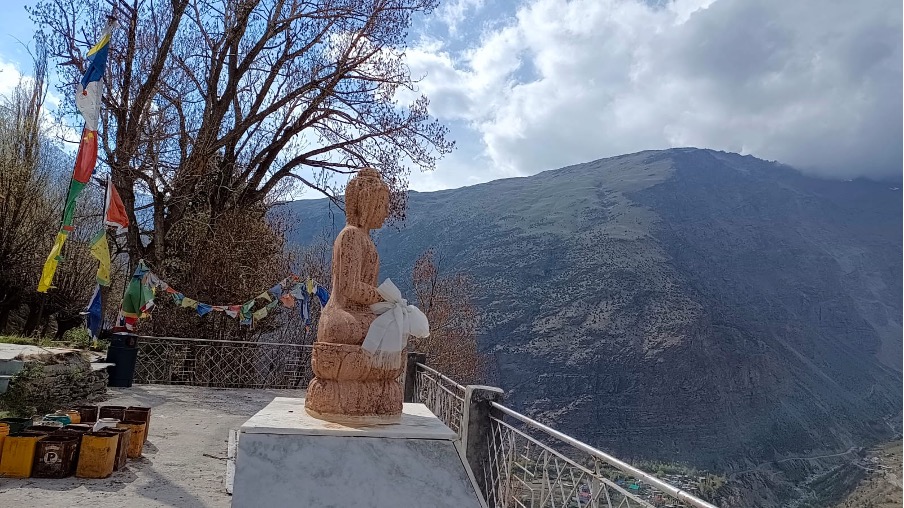
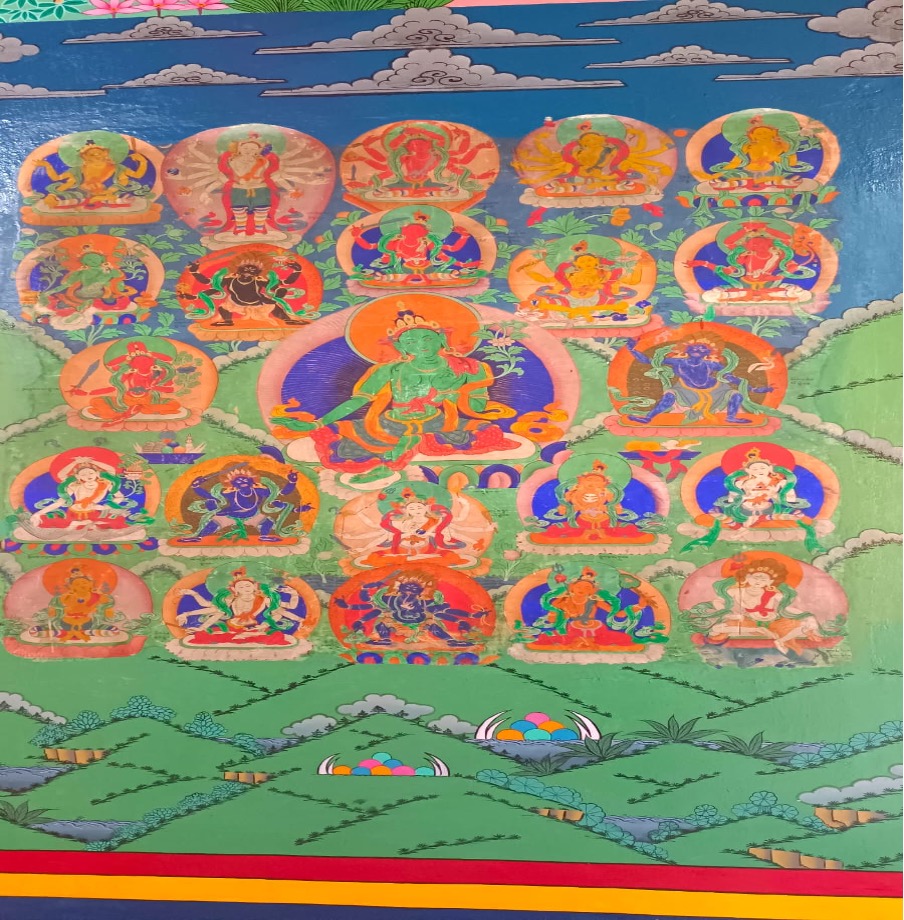
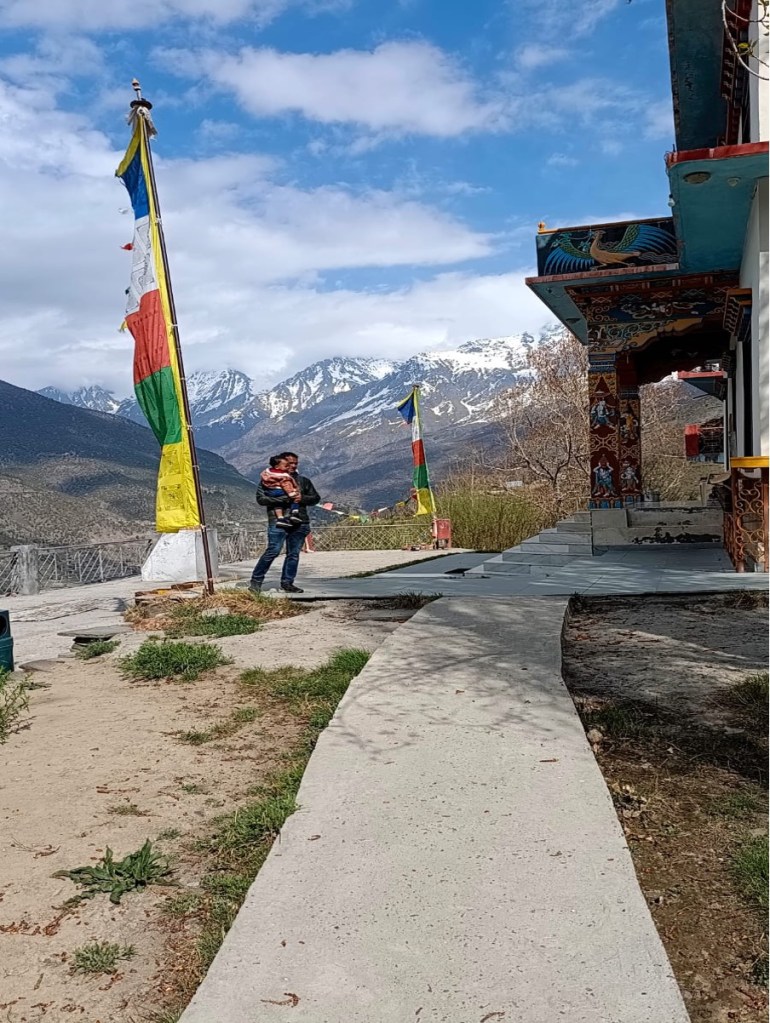
The monastery is an important one of Drukpa lineage[1] built in the twelfth century. The beautiful white facade with gold details gleamed in the sunlight. Intricate thangka paintings adorned the walls and ceiling of the monastery. It was perched on the barren mountain of Lahaul with multi-coloured Buddhist flags swaying in the wind. An imposing statue of Lord Buddha sat in the courtyard, looking over the whole valley. There was still some snow on the mountain tops, spring had just set in.
The chanting of the lamas filled the air. It was part of the evening ritual. Gentle drum beats punctuated the chanting. I felt fortunate to be in such a tranquil space. It was a happy concoction of the high altitude, the rhythmic rituals, and the lack of human habitation around the monastery that left me in a self-contained peace bubble.
A thangka painting
“How did you know about this place? Not a lot of tourists come here,” the chomo asked me with a twinkle in her eyes. My mind browsed through the incidents that led me here.
It all started two years ago. My penchant for zoning out to Tibetan chanting mantras on YouTube, and love for off-beat places in the Himalayas led me to some serious research. Lahaul district in Himachal seemed to fit the bill perfectly to get a taste of both. It was easily approachable from Manali, where my family could stay with all creature comforts. Our travel group included our one-year-old son and elderly parents.
The beautiful monasteries in dramatic mountainous settings were as much a reason to visit Lahaul as the adventure to travel to such harsh terrains. We based ourselves in Manali and acclimatised ourselves for a few days before climbing to twelve thousand feet. We hired a local car and driver to visit the Lahaul district. When we told our local driver that we wanted to go to the Kardang monastery, he looked at us blankly. It dawned upon me that it was even more remote than I had realised.
We started from Manali towards the Atal tunnel, a nine-kilometre-long highway underpass in the Pir Panjal range of Himalayas, on the Manali- Leh highway that connects two districts of Himachal. The Atal tunnel was opened in October 2020 after several years of work and today connects the remote Lahaul district with the rest of Himachal.
We left the verdant coniferous forests and mountains with gushing streams on one side of the tunnel and gaped at the dry snowy mountains with freshly sowed fields at the base of the mountains of Lahaul on the other side. It was a dry desert with farming done in little patches at the base of the mountains. The difference was stark.
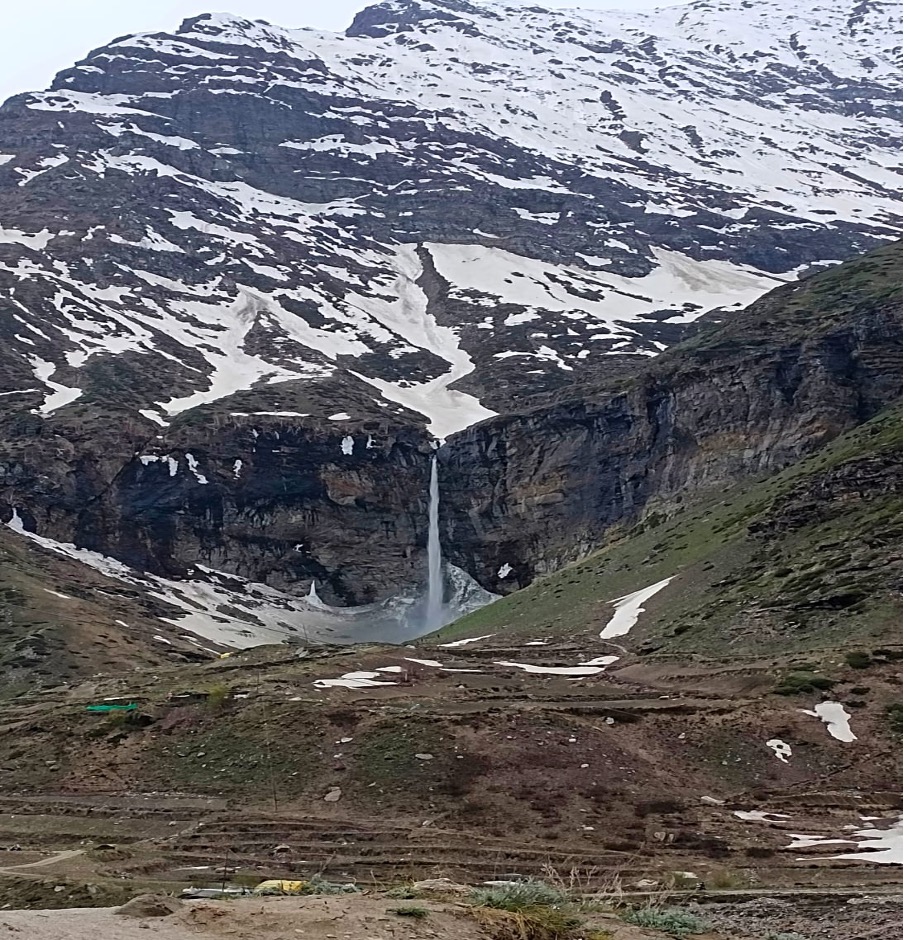
We stopped at the helipad by the Sissu waterfall in Lahaul district, to recharge ourselves with tea and steaming momos. I saw my father-in-law skip around like a little boy, his jaws dropping every time he looked at the waterfall coming straight out of the glacier that cradled it. It was his first time being in such a terrain. All of us, including my one-year-old son, seemed to be breathing fine and enjoying ourselves, in spite of the sudden gain of altitude to eleven thousand feet. I sighed in relief; no acute mountain sickness (AMS) for us.
We set out to the monastery following google maps and stopped for lunch on the way. After some conversation, the restaurant folks told us that we were going in the wrong direction. Apparently, google maps didn’t work very well in this region beyond the well-travelled tourist circuit. They told us how to reach and from the sound of it would involve off-roading. After losing our way twice, we finally discovered a bumpy path that led to the monastery. We found out later that the best option was to take the mud road on the right after the lone petrol pump in Sissu.
The bumpy mud road that we took instead was devoid of human habitation or road signs till the Kardang village. On each serpentine turn, I could see my travel companions digging their fingers deep into the seat in anxiety. On some stretches, there were walls of ice on the mountain side and the car had to cross the several streams that these walls caused. Later, we all laughed about how each of us was praying for dear life during that treacherous journey.
After a good thirty-minute climb we finally reached the Kardang village and the metalled road was in sight. The Kardang village had a few homestay signposts but none were open in spring. Soon we crossed the signs of the pilgrimage trek of Mt. Drilbu Ri and we were at the gate of the monastery. The short walk to the monastery was nice but we did it slowly as the lack of oxygen was palpable. Kardang monastery is nestled in the ridge below the fifteen thousand feet Rangcha peak. Kardang is the starting point for the Buddhist pilgrimage of Mt. Drilbu Ri.
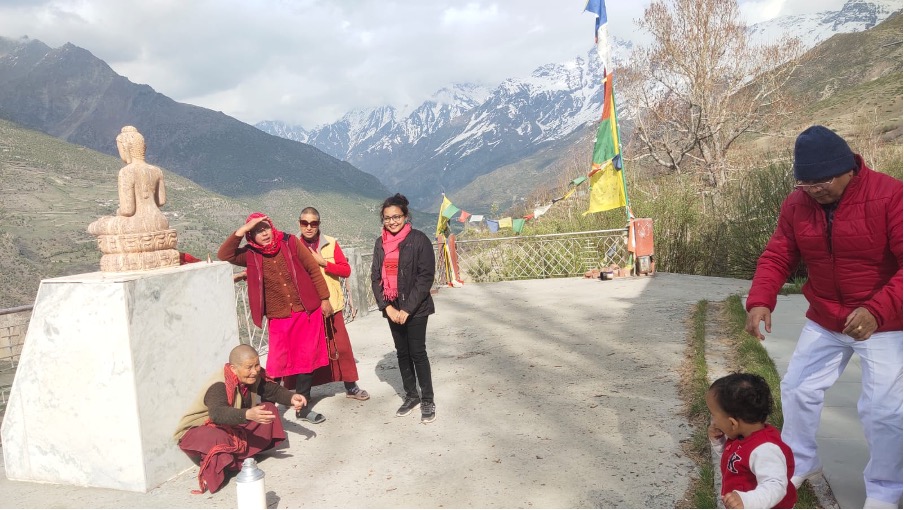
Upon reaching, we found the door of the monastery closed. Soon we were greeted with the Tibetan greeting ‘Juley Juley’ by a smiling monk who opened the door for us. His name was Sonam Dawa. He was happy to show us around and answer our questions about the prolific thangka paintings on the walls and ceiling of the monastery, on Buddha’s life, dakinis [woman spiritualists], and other important figures of Tibetan Buddhism. Tibetan Buddhism with its characteristic animism and symbolism of Bon culture is a hallmark of this Lahauli monastery. A few lamas and chomos joined us and offered us tea. We were touched by their warmth. They played with my son, told us a lot about the snow festival that happens every February and asked us to come back during the celebration.
To this day I am not sure if it was the high altitude, the aromatic incense, or the space itself that made it feel so special. I remembered the chant on Youtube that started this journey for me and am glad I followed that instinct.
.
[1] The Drupka lineage of Tibetan Buddhism dates back to the twelfth century.
.
Sayani De is a bibliophile, compulsive traveller and sustainability enthusiast. Her work has been featured on Women’s Web and been selected for publication at Muse India for its May-June issue.
.
PLEASE NOTE: ARTICLES CAN ONLY BE REPRODUCED IN OTHER SITES WITH DUE ACKNOWLEDGEMENT TO BORDERLESS JOURNAL
A narrative set against the 2020 impact of Californian forest fires, a community bent on healing the Earth and a travelogue with photographs by Meredith Stephens
The drive up the mountains to the town of Shaver Lake, California, continues to shock me, even though it has been three years since the 2020 fires. Where there formerly stood proud ponderosa pines extending into the sky, there are now barren mountains exposing charred tree trunks and the view beyond of granite boulders previously hidden. The bottom half of the mountain is scarred on both sides of the road, but the upper half is charred and desolate on one side and partially untouched on the other. As you ascend the mountain you notice gates announcing the entrance to where ranches once stood. Some have positioned a caravan or two on the site where their house was. Once you have passed through the town, at an elevation of almost six thousand feet, you notice a line of ponderosa pines adjoining a barren landscape indicating the point where fire-fighters saved the community.
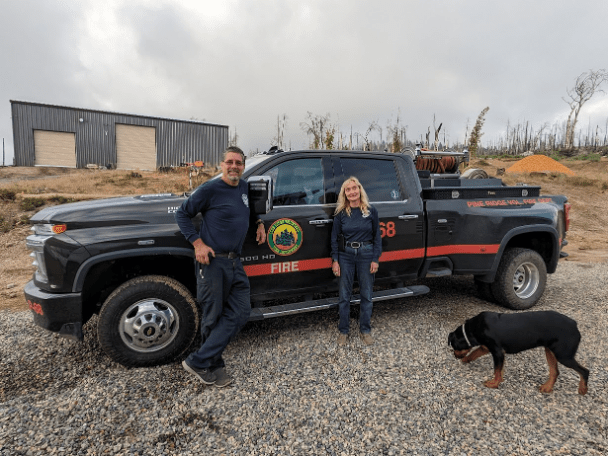
As the Assistant Chief of the Shaver Lake Volunteer Fire Department, James and his team were saving Shaver Lake, while his own property further down the mountain was under threat. His wife Janet, also a fire-fighter, received a mandate to evacuate. Janet was reluctant to leave her home, but obeyed the order, and left with her two dogs. This was just as well, because their house and property were ravaged by the wildfire and she and her dogs would not have survived had they remained at home.
My partner, Alex, had been put into contact with James and Janet when the fires had begun ravaging the mountain in 2020. A mutual acquaintance sent an email to Alex at his home in Adelaide, Australia, asking whether he could offer his holiday house in Shaver Lake to James and Janet. Alex had been focussed on watching the nightly news of the fires back in Adelaide, and scrutinised the maps of the fires every evening to see whether they would engulf his holiday house. It was spared, so he was able to offer it to James and Janet. Alex was unable to visit California himself because of international travel restrictions during the pandemic.
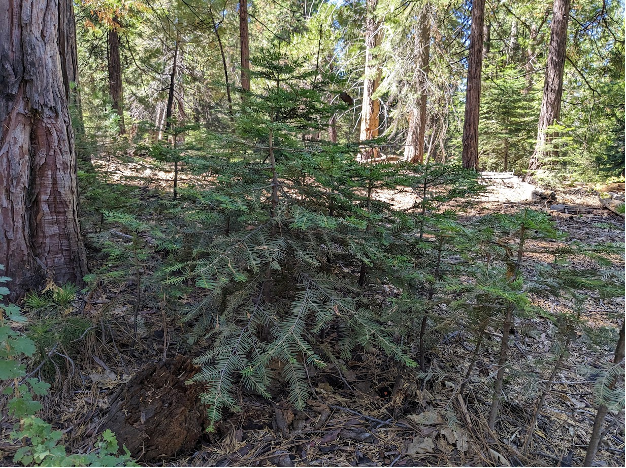
Cluster of Baby Ponderosas
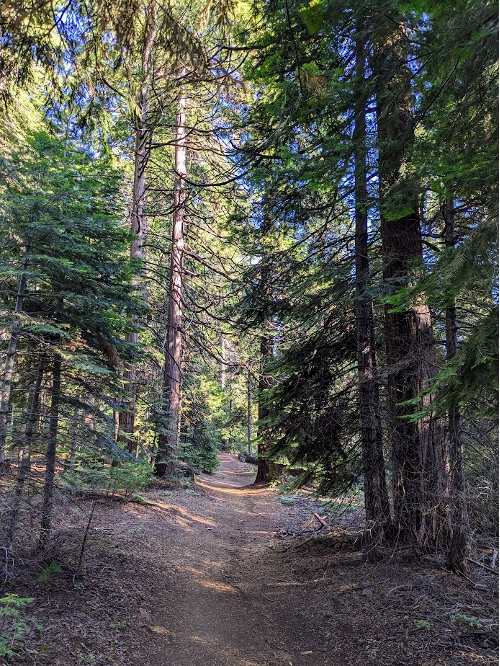
In 2023, Alex and I made the eight-thousand-mile trip from Adelaide to Shaver Lake. Once we arrived, we indulged in morning and evening walks on an undulating path through the ponderosa pines, Douglas firs, and cedars. The path was soft beneath our feet in the aftermath of rain the day before. There was a scent of pine which was immediately calming. In places it is fashionable to pursue ‘forest-bathing’, but here you can simply walk out of your back door and experience biophilia without having to consciously seek it out.
Lupins alongside the Forest Path
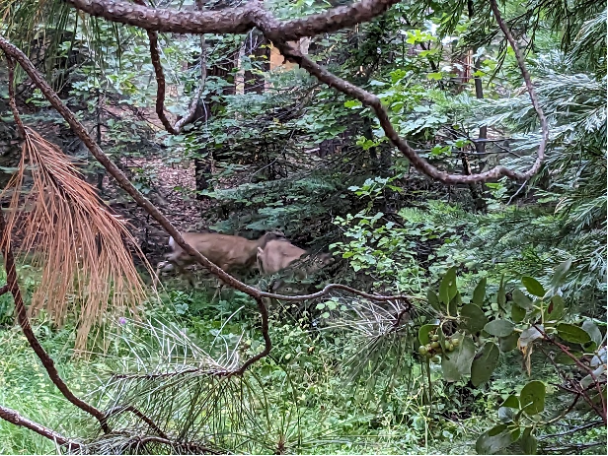
Whenever I heard a rustle I half-expected to see a kangaroo, as I would have in Australia, but instead spotted squirrels hiding behind tree trunks, or a pair of deer cantering away from us as they heard our voices. The path was adjacent to a national park where hunters could hunt deer with a permit in the hunting season.
“When is the deer hunting season?” I asked Alex.
“Not until autumn.”
Phew! It was still late summer, so I needn’t have worried.
“Best wear a fluorescent top in the hunting season,” he advised.
Can you spot the deer?
When I chatted to residents further down the mountain, some said that they could not bear to rebuild their lives on their beloved mountain, such was the shock and devastation of their loss. They had left the site of their former home and relocated to the city of Fresno at the base of the mountain. Others, like James and Janet, have bravely rebuilt their house and are busily engaged in revegetation.
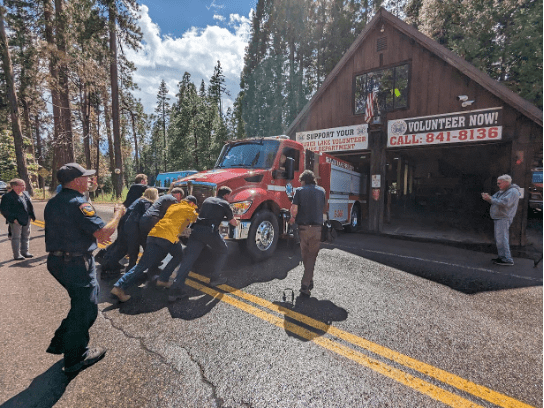
In August, 2023, James and Janet invited us to a fire-truck “push-in ceremony” at Shaver Lake, to celebrate the arrival of a new firetruck. We drove to the township the next day at three pm. The road was blocked by the flashing lights of the sheriff’s patrol cars. We turned back and parked the car, and then entered the township on foot. A crowd of well-wishers was cheering the volunteer fire-fighters, who were pushing the shiny new firetruck into its new home. They strained as they pushed it into the narrow confines where it will be housed. Once it was pushed in, the crowd cheered, and everyone was offered a free ice-cream.
James, Janet, and Cyclone.
I hope the firetruck remains shiny and new, and never has to confront smoke and flames, so that the people of Shaver Lake, the deer, the squirrels, and the ponderosa pines, can live in peace.
.
Meredith Stephens is an applied linguist from South Australia. Her work has appeared in Transnational Literature, The Muse, The Font – A Literary Journal for Language Teachers, The Journal of Literature in Language Teaching, The Writers’ and Readers’ Magazine, Reading in a Foreign Language, and in chapters in anthologies published by Demeter Press, Canada.
PLEASE NOTE: ARTICLES CAN ONLY BE REPRODUCED IN OTHER SITES WITH DUE ACKNOWLEDGEMENT TO BORDERLESS JOURNAL
The prawn curry was getting cold. “What’s taking you guys this long to finish a match point?” I demanded while dipping my index finger in the curry bowl and touching it to my tongue. “We never got to the end, Nina. Siddh fell on the grass and couldn’t get up after. He’s in immense pain. We’re going to have a long night,” Arko said.
The line clicked, but I stood there holding the telephone.
Little did we know then that Siddh would not be able to stand on his feet that evening and every evening until after two months.
Only last week, my favourite trio – brother Siddh, his wife, Saanvi, and their toddler, Uma, had arrived in India for a grand family reunion. This week the fun was planned at my home. After spending a day indoors, we slid into our sneakers for a walk in the park. The toddler at the swing, sisters-in-law chewing the fat, the boys at a badminton rally – the season of life we were all waiting for was finally here.
The twilight hours chimed in with the chirping of crickets. My niece asked me while rubbing her eyes, “What time do crickets go to bed?” “Not until morning. Crickets are night creatures,” I said. “Let’s sing a lullaby to crickets so they hit the bed on time,” Uma urged. Saanvi and I decided to walk back home, so the only person who went to bed on time was Uma.
The boys stayed on…
This park has an endearing presence in my life—an all-weather friend, where I end up on my good days and bad days. Just a stone’s throw away from where I live, the road to the house of this picturesque friend is never too long.
When I learned that Siddh had broken his leg in the lap of this green landscape…in the lap of my trusted friend, I felt thoroughly betrayed. No one had told me the road to the house of a friend could be bumpy too!
It took a village to lift my brother and settle him into a wheelchair. One emergency room, two hospitals, and three X-rays later, Siddh came home post-midnight…leaning on a walking frame, trembling in pain, falling apart.
The house went dead and silent, broken frequently by Siddh’s grunts and groans. Hiding behind the door tugging at a curtain, I anguished over what was tougher – to be afflicted by pain or watch someone you love suffer in pain.
The misery continued the following day – dialling up ambulances, moving between stretchers, painstakingly slow MRIs, mammoth injections, multiple doctor consultations, and whatnot. Reports said Siddh had suffered both a fracture and a ligament tear resulting in a full leg cast for six weeks!
The season of life we were all waiting for had gone awry. If there were a list of the ‘biggest holiday failures’, this would feature right at the top. Siddh seemed crestfallen – six weeks of staying in bed! Saanvi had a bewildered look on her face. Uma showed a big heart in saying she could wait until the next day for her Papa’s leg to get better so they could play chase. The dispirited Mom, Dad, and cousins drifted in different directions to make arrangements. Arko and I looked at each other and then looked around – we had gone from two to five to nine folks in a span of three days. Suddenly, my mind went elsewhere, “When was the last time we got together as one big family, with three generations living under one roof? When was the last time we sat face-to-face, speaking for hours, without a virtual screen orchestrating our conversations?”
I insisted that the trio stay with us during the recovery period. While no amount of caregiving could alleviate Siddh’s pain during the initial stage, nestling in a place of warmth and care helped him get through one day at a time. When he showed indomitable resilience in not just returning to working remotely only a few days after the accident but also stepping out on a whim while still using a walking aid, it only reaffirmed my belief that families do have the placebo effect.
Making lemonade out of lemons life had thrown at us, we often brought the house down with game nights, barbecue, drinks, karaoke, good music, and all that. On his birthday evening, when Siddh entered the living area, clacking his walker against the floor, shielding his discomfort with a grin, the message on the birthday cake sent him and everyone else into peals of laughter – Happiness is NOT playing badminton. The icing on the cake exhibited a passionate boy in the act of hitting a shuttle with a badminton racquet, wearing a replica of the red tee Siddh had worn on the evening he fell. Tongue-in-cheek, but everything is fair in love and life.
From sharing homes and hearts to strengthening family bonds, it only felt like this page in the book of our lives was written in stars.
Days and weeks rolled by. The long leg cast came off. The season of life began anew.
.
Siddh and Saanvi posted a handwritten note from London, “Years ago, anthropologist Margaret Mead was asked by a student what she considered to be the first sign of civilisation in a culture.
“Mead said that the first sign of civilisation in an ancient culture was a femur (thighbone) that had been broken and then healed. Mead explained that in the animal kingdom, if you break your leg, you die. You cannot run from danger, get to the river for a drink or hunt for food. You are meat for prowling beasts. No animal survives a broken leg long enough for the bone to heal.
“A broken femur that has healed is evidence that someone has taken time to stay with the one who fell, has bound up the wound, has carried the person to safety and has tended the person through recovery. Helping someone else through difficulty is where civilisation starts, Mead said.”
I cast my mind back to the evening we saw them off at the airport. A strange sense of accomplishment filled me – Siddh back on his feet, Saanvi’s beaming face, and Uma settled in my arms, making a toddler promise to visit Nina’s home in India ‘next week’.
Storing the sweet note of love in my memory box, I thought to myself, “There’s nothing more fulfilling than being there for your family in a difficult time. We are at our best when we lift each other up.”
Saumya Dwivedi often pens down anecdotes about her life. Her story ‘To the deep end’ has been published in a morning English daily. Passionate about skydiving, she keeps the spirit of flying alive in whatever she does.
PLEASE NOTE: ARTICLES CAN ONLY BE REPRODUCED IN OTHER SITES WITH DUE ACKNOWLEDGEMENT TO BORDERLESS JOURNAL
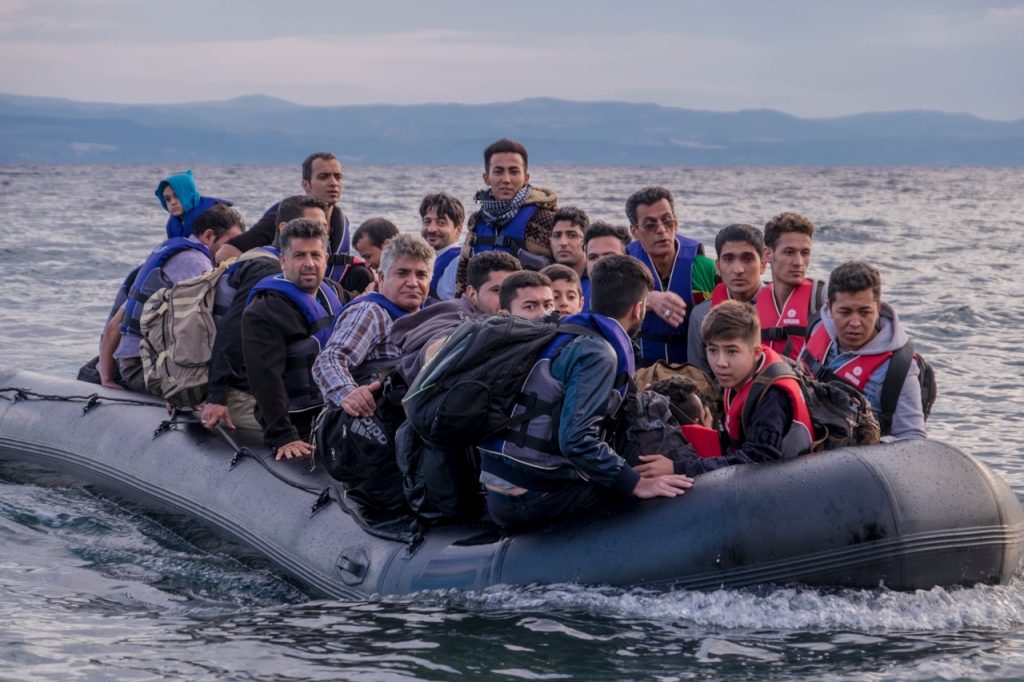
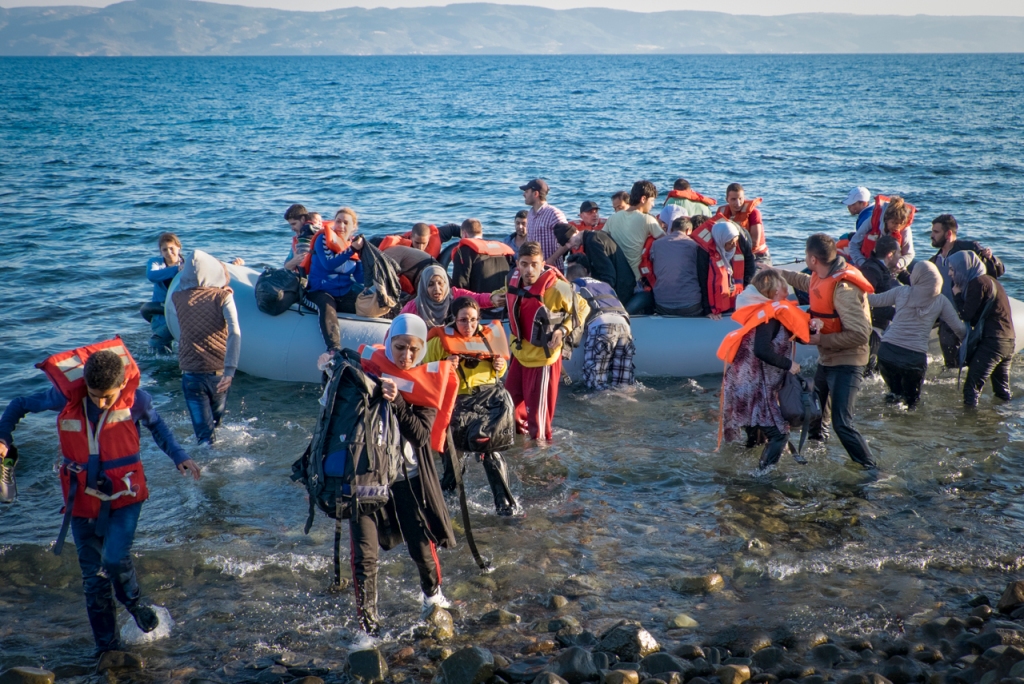
Refugees landing at Lesbos. Photographs by Michael Honegger
Memories of Lesbos, 2016.
Sunrise over the Mediterranean. The island’s hills brighten as the chug of boat engines can be heard over the lapping waves. These aren’t your typical Greek fishing boats returning from a night at sea, but a flotilla of black rafts, nine total carrying some 400 refugees to land on the north coast of Lesbos Island. Under five miles off the Turkish coast, Lesbos has become a beachhead for a flood of refugees that has come as unannounced as a tsunami, and for which local communities are even less prepared.
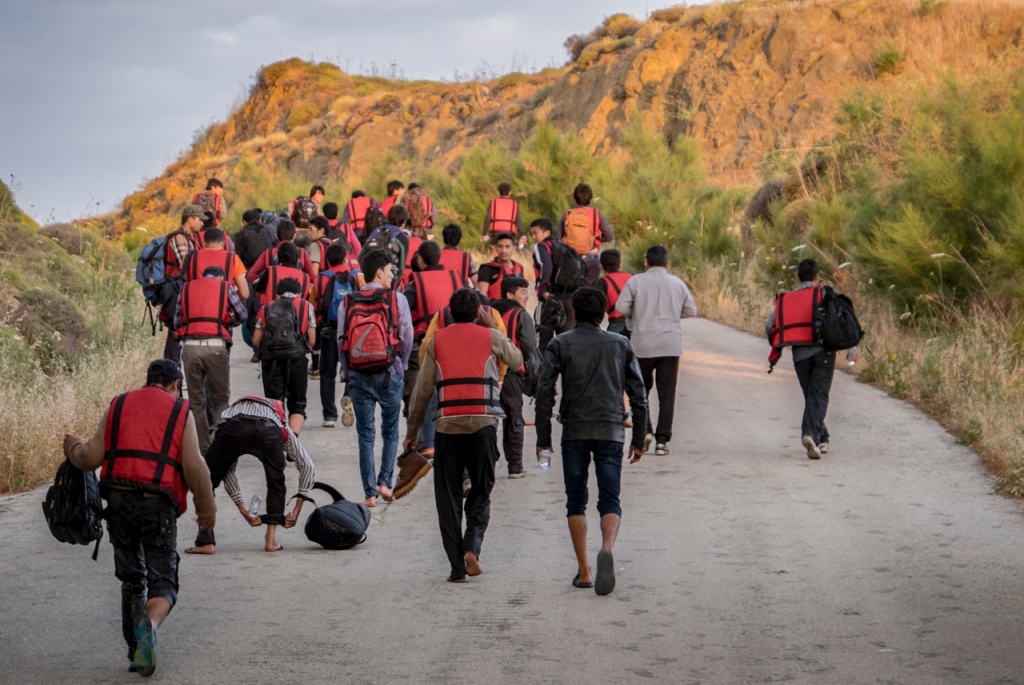
There has always been a trickle of refugees across the narrow channel. In the ten years that I have been coming here, every week I would find one or two rafts abandoned on the beach with ten or so life jackets or paddles. Until recently, most had been young men from Afghanistan and Iraq, escaping wars they didn’t want to fight, who would later be spotted on a road walking the forty miles or so to the island’s capital, Mytilini, to be processed and transferred to a camp in Athens. In the whole country, the number of such migrants has increased five-fold over the same period last year; but for the islands offshore Turkey, the numbers have risen far more dramatically. On Lesbos, the count has gone from a few dozen a month to over two thousand in one three-day period alone.
A surge in Taliban-led violence in Afghanistan, the rapid spread of the barbaric Islamic state in Iraq, and Syria’s devastating civil war have sent millions fleeing for their lives. Over half of the Syrian population has been displaced, and now accounts for half or more of the new arrivals. Often members of the middle class—teachers, IT specialists and engineers—more often Syrians come as families, forced to leave when their children’s school was bombed; or if from Aleppo, when their neighbourhood was razed. On the whole, Syrians have more money than others, but that doesn’t mean much when they have nothing else but the clothes they are wearing.
Refugees in Lesbos. Photographs by Michael Honegger
Some Afghani refugees have walked from as far as Kabul, taking weeks to hike over Iran’s mountains and cross the length of Turkey to its west coast. The odd Syrian has flown to Istanbul, and taken buses to where, even if he or she has money, still has to hide in forests, waiting for days until his turn for the ‘trafficker’ to bundle him aboard a rubber raft. With the craft’s captain (usually one of the refugees) given an hour of training, they are launched for Greece with nothing more precise nautically than a pointed finger.
It’s a harrowing journey for everyone, not the least because of the real risk of capsizing their overloaded rafts even in light seas—sometimes purposefully. The traffickers instruct them to slash their pontoons if the Greek Coast Guard approaches to keep from being turned back to Turkey, which inevitably tosses forty-some non-swimmers into the sea with a crew of only four frantically trying to save them. Ironically, the Coast Guard’s mission is not to turn them back, but to ensure their safe arrival.
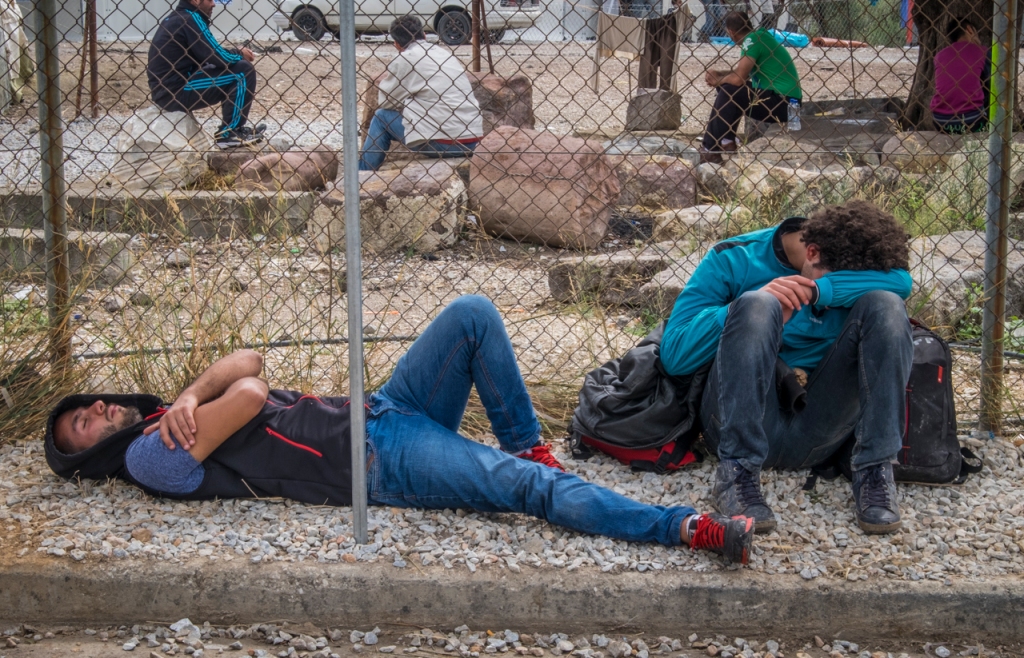
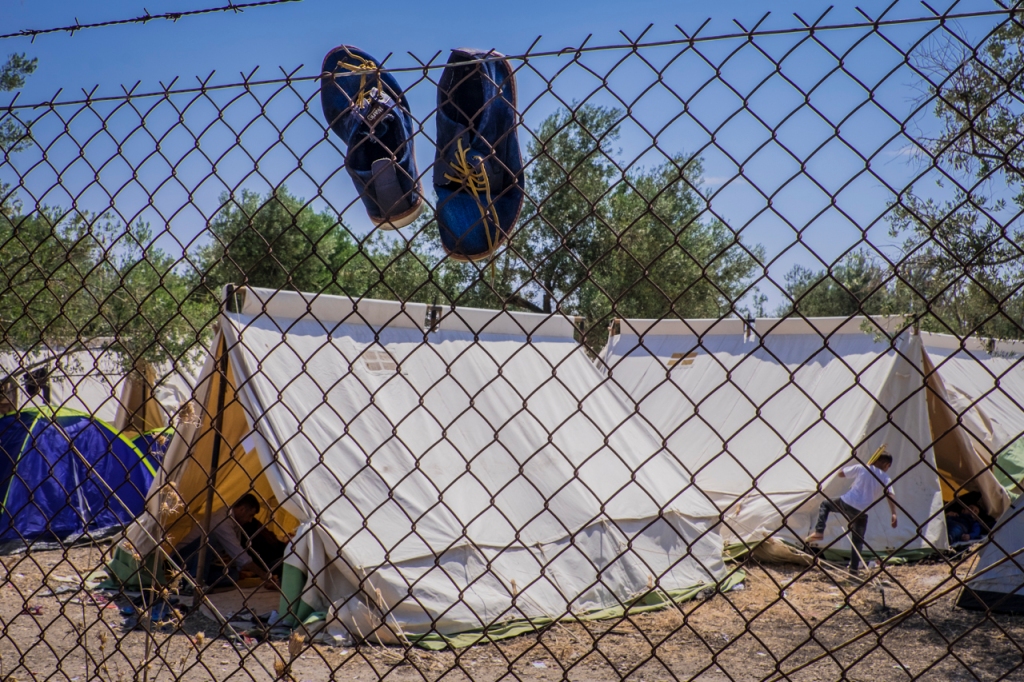
Ahead of them, the journey will still be hard. They don’t know it yet. Their dream—their safety—is their first footstep in Europe. It’s only one step in a perilous journey that will take them to processing centers, overcrowded camps, and force them into the hands of other traffickers, more malevolent than anyone else they have met on their way, who, for extortionist prices, promise to get them to Germany or Austria—the current popular destinations.
That emotional first step on European soil can’t be overestimated. As their rafts slide ashore, it’s a celebration. The journey has ended and they have arrived safely. Regardless of their wariness of what’s next, they scramble ashore, some feeling the need to run a short distance from the water; but others, overcome with their first sense of security in years, weep, embrace each other, believing—rightfully—that they have made it to a better place. Certainly a safer one.
It’s different, too, from what they imagined. There is little officialdom at this northern point of the island. No police to register them, no information other than the latest rumours that their rescuers—sometimes the Coast Guard, sometimes local volunteers—can pass on. Frequently they don’t know where they landed, only that they need to register with the police to get in the long line to be processed.
Where are the police?
Seventy kilometers away.
Will there be a bus?
Maybe.
Maybe?
Probably not. But maybe. It changes daily.
What do we do?
Walk.
Walk? My wife is pregnant. My boy is three years old.
I’m sorry. Walk.
The rules, and the probability of a bus, change daily. It’s not because of some great inefficiency by Lesbos’ government, though the elimination a few years ago of village mayors to create a central authority in Mytilini has complicated providing services as essential as portable johns at the bus park where people are often stranded for several days. Earlier this week, that meant thirty persons crowded into a bus shelter on a chilly and rainy night; among them, eight children and five women—two of them pregnant.
While it was foreseeable that the Syrians would mass in camps just over the border in Turkey, it was far less predictable that they would become such a massive wave of refugees headed for the West. If someone saw it coming, that message never got to frontline Lesbos. It might not have mattered if it did. The country is bankrupt. Local officials can hardly provide basic services, let alone cope with an explosion of refugees. International NGOs haven’t caught up with the crisis either.
Local volunteers are making extraordinary efforts to meet the rafts on arrival, and ensure that they have food, water, clothing, shoes, and even Pampers because there are so many infants. Of course, not everyone agrees on what assistance, if any, should be provided.
Most refugees don’t plan to stay in Greece. Some will, of course, but the locals, seeing first-hand the dimension of what is happening, are starting to ask the bigger picture questions: What does it mean for Europe? Who are these people, coming from war-torn countries, possibly armed because in war zones people have weapons? How many refugees can be absorbed before fundamentally changing the culture of Europe itself?
Closer to home, the concerns take on an economic aspect. What if tourists stop coming because they don’t want to be confronted with the plight of refugees, as some reports suggest has started to happen on other islands? No one denies they need water and food, but what beyond that might actually encourage the next groups to make Molyvos their destination? Tents? Toilets? The worry is that if the refugees, using their cell phones, report back to those following in their footsteps that they are being helped, even more people will come here.
The refugees expect to be met and confronted in some way. The lack of even one policeman in my village, or the absence of a bus to take them to Mytilini, puzzles them. A couple of days ago, a few staged a sit-in, blocking traffic on the road in the village, demanding to be arrested and taken to Mytilini. It lasted only as long as it took to convince them that there really was no one in authority who could arrest them.
One of the young men asked me why not a policeman? Why not a bus? I told him that Greece was a poor country, but he didn’t buy it. His was poorer.
I tried the argument: There are too many of you. The village can’t cope. You are sending messages back that here you get water, food, and until a few days ago, we had a small camp where you could sleep. Now too many people are coming.
He shook his head sadly at my obtuseness.
Mister, they’re coming anyway.
Photograph by Michael Honegger
Timothy Jay Smith, writer, wanderer and philanthropist, has traveled around the world many times collecting stories for his novels, screenplays and stage plays.
.
PLEASE NOTE: ARTICLES CAN ONLY BE REPRODUCED IN OTHER SITES WITH DUE ACKNOWLEDGEMENT TO BORDERLESS JOURNAL
Alex and I had completed our road trip from California to Colorado and now it was time to make the two-day drive back along the interminable desert roads.
Every time we stopped, I would try to get into the driver’s side of the vehicle, thinking it was the passenger side. My brain would not adapt to a car with the steering wheel on the left. Once back in the passenger seat, the sun blazed on my temple, so I manoeuvred my visor to cover the right window to block it from penetrating my eyes. It was hard sitting still, so I stretched my legs before me, then slid them beneath me to elevate my height.
“As soon as we hit the Nevada border you will see a casino town,” Alex informed me.
Sure enough, we crossed the border into Nevada from Utah and a town immediately arose from the desert. Alex made a detour into the town to get some fuel.
“Can we drive down the strip?” I asked.
“Sure,” he replied. “Are you hoping to find a hotel here?”
Yes, I thought, but kept my silence. I was too proud to confess that I wanted to stay anywhere near a casino, but I would have welcomed clean sheets and hot water.
I took hold of Alex’s phone and searched for campsites en route, but they all involved deviations that would rob us of precious time.
“We can always stop at a rest area,” suggested Alex.
He searched his phone and found a rest area nestled into a hill, with outdoor tables surrounded by trees. We arrived at sunset and parked the car at the far end, away from other vehicles. We gratefully hopped out, picked up the ice box, and headed for the picnic tables, which we had to ourselves. No sooner had we started anticipating our picnic than we heard the murmur of a refrigerated truck.
“He probably has to keep his engine on to keep the food cool,” observed Alex.
The din was inescapable, so we decided to park back near the entrance to the rest area. I noticed a car parked with sheets draping the windows. Clearly, we were not the only ones seeking sleep in the rest area. Alex parked the car at an angle contrary to the parking lines so that nobody would be tempted to park right next to us. We hauled the icebox to a nearby picnic table to consume our leftovers. Alex proceeded to pour us a glass of wine, and we snacked on sourdough, cheese, avocado, deli meats, and corn chips.
I ate a little too quickly because it was getting late, and I was hungry. It was high desert, so the air was cool, even though it was mid-June. We packed up our picnic and headed for the car, where Alex moved all of our goods to the front seat and made up our bed in the back.
It was nearly 9 pm and we went to bed in the twilight. I revelled in the sensation of the thick flannelette cotton sheets, but I could not slip into a deep sleep. The overhead lights snuck through cracks in the fabric I had put up to cover the window, and the traffic rumbled on the adjoining freeway. Then, a few hours into the night, I heard a clanging outside the car. I peered myopically outside.
“That’s just a dumpster diver,” explained Alex, who turned back to sleep, obviously not too alarmed.
I had never heard that expression before, but I realised that some poor soul was working their way through the bins in the rest area in the wee hours when nobody could see them. I reflected on what I had thrown out after dinner, which had included a nectarine seed, and hoped their fingers did not come into contact with its slime. Then I started worrying whether the dumpster diver would come after us in the night. The next morning Alex explained to me that they were probably collecting cans to sell to a recycling centre. That, at least, was preferable to scrounging around in the bins for food.
We left early the next morning because Alex wanted to show me Lake Tahoe en route to California.
“That reminds me of Lac Leman in Switzerland,” I told him.
“Yes, there’s California on one side, and Nevada on the other. They share the lake.”
We stopped for photos, then resumed our way, winding through snowy mountains, and passing cattle, horses and foals down below. It was a huge relief after the deserts of Utah and Nevada. Then we wound our way through a canyon, following a rushing river, passing through picturesque towns adjoining Yosemite National Park.
“I need a coffee,” lamented Alex, typing ‘coffee shop’ into Google Maps. We entered the town of Columbia, heeding Google’s directions. We were directed down a narrow road through wooded hills. We passed a large car park the size of an oval, much too large for this rolling wooded area. Then Google Maps told us we had arrived. We parked under some shady trees to arrive at a tea shop from another place and time.
We wandered inside. They had a wide range of teas but no coffee, so we took our leave. The voice on Google Maps kept insisting we take a detour, so we followed her urgings past what seemed to be a historical town.
We turned the corner to find the coffee shop Google Maps had been directing us to. We entered and ordered Americano coffee, which despite the 19th-century decor was served in 21st-century paper cups.
We then realised in our quest to find a roadside coffee shop we had stumbled on Columbia Historic Park. The buildings which had been used in the town in the gold rush had been restored and made available to tourists. I wanted to linger in this authentic setting. Unlike a theme park, this was not a re-creation. Alex was worried that we still had several hours driving to go, so we had to resume our journey.
We wound back home through gentle valleys, passing cattle and horses. The sun in my eyes gave me an aura; a circle of lights started appearing in my vision. After 25 hours of driving, we arrived at our cabin at Shaver Lake. I crashed on the sofa, while Alex made a fire. He made up a bed in cotton flannelette sheets in front of the fire, and I rolled onto it from the sofa. What a relief it was to sleep in comfort, in contrast to the person in the rest area scrounging for cans in the wee hours. For us, sleeping in a rest area was a novelty, but for others, it was a way of life.
Meredith Stephens is an applied linguist from South Australia. Her work has appeared in Transnational Literature, The Muse, The Font – A Literary Journal for Language Teachers, The Journal of Literature in Language Teaching, The Writers’ and Readers’ Magazine, Reading in a Foreign Language, and in chapters in anthologies published by Demeter Press, Canada.
PLEASE NOTE: ARTICLES CAN ONLY BE REPRODUCED IN OTHER SITES WITH DUE ACKNOWLEDGEMENT TO BORDERLESS JOURNAL
Will I see the Oppenheimer film? My answer – NO! I have no issues with the director, Christopher Nolan, as a person, nor toward the talented actors.
Do I hope people who haven’t considered nuclear weapons a current threat before, will now make nuclear disarmament part of their conversations (along with the demons plaguing a brilliant physicist during/after he developed the atomic bomb for our country’s war effort)? Yes!
That said, I don’t need to see Oppenheimer because I know how the story ends-even if they weren’t brave enough to show that in the movie itself.
I’ve needed some time to process my emotions after reading reviews, interviews, and social media posts. I discovered that Oppenheimer, even with 3 hours screen time, dismissed the rest of the story.
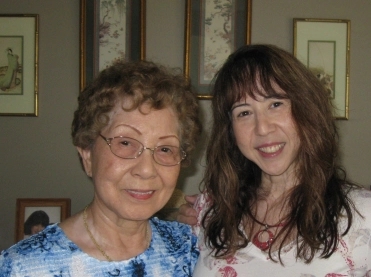
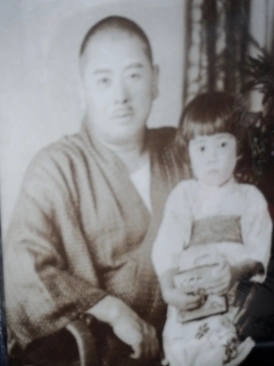
Spoiler alert — the bomb killed members of my family. My mother was 12 years old on August 6, 1945, in Hiroshima. She watched her beloved Papa die, lost her friends, and her home. 145,000 people died within the first 5 years of the bomb being dropped. And, not always mentioned — thousands survived only to carry the emotional/physical scars their entire life, unintentionally passing it on to their next generations-as my mother did to me.
The novel tells her mother’s saga as a survivor of the Hiroshima blastKathleen Burkinshaw and her mother(left)Photos provided by Kathleen Burkinshaw
So, I find it appalling that neither the death, injuries, nor damage from the Hiroshima and Nagasaki atomic bombs were depicted. Not to mention the omission of victims who suffered/continue to suffer from the Trinity test, despite filming the explosion for Oppenheimer in New Mexico!
Oppenheimer is not the first film about Hiroshima or Nagasaki atomic bombing that I’ve avoided. I can’t even listen to the specific chapters depicting the bombing in the audiobook for my own novel, The Last Cherry Blossom (TLCB) — it’s no fault to the lovely, talented narrator. But researching and writing those chapters devastated me. I’ve read a short section of the bombing to students for more than 11 years, and I cry every time. I still hear the agony in my mother’s voice, her sobs each time she shared the horror of that day. I can still hear her screams as she relived them in her nightmares — nightmares that lasted her entire life. Just as she couldn’t unsee it, I can’t unhear the pain in her voice.
Greg Mitchell’s headline for his Mother Jones article,‘Oppenheimer’ is a Good Film that Bolsters a Problematic Narrative, also touched on another issue for me. Mitchell described the lone narrative used in the movie about dropping the atomic bombs, “… an officer who insists the Japanese won’t surrender otherwise, … a host of American soldiers will then have to die storming the country’s beaches…reminded of how savagely the Japanese have fought to the last man in other circumstances.”
Why is this problematic? It’s false. There were many complicated reasons involved in the decision to use the atomic bomb. To me, the American/Allied soldiers who fought, gave their lives especially in the last two pivotal Pacific battles, won the war. The atomic bombs were just science experiments and a warning to other countries.
This issue has been argued by many scholars*. Yet rather than debating the ‘why’, what matters now, in 2023 is showing the Hell that the atomic bombs (along with the mining/testing of nuclear weapons) unleashed 78 years ago.
I realise that Oppenheimer depicts a “singular dramatic moment in history…” a phrase referenced to Nolan on motionpictures.org post.
Kathleen Burkinshaw’s Grandfather & Mother. Photos provided by Kathleen Burkinshaw
But what about that same singular dramatic moment in the lives of Hibakushas (atomic bomb victims)? Because of that moment, I witnessed the frightening effects of my mother’s PTSD throughout my childhood — such as her hours in a darkened room holding the few pictures she had left of her loved ones.
I live with it now having a chronic progressive nerve pain disease. My damaged immune system is attributed to my mother’s exposure to radiation from the atomic bombing.
Before my last thought, I must mention that I began my mission to educate students about the atomic bombing of Hiroshima (and why my mother finally let me tell her story to students) 14 years ago, because my daughter (then in 7th grade) was so upset when she heard students discuss that “cool” #mushroom cloud picture.
She asked me to speak with her class about the PEOPLE under that famous mushroom cloud, like her Grandma. My mom finally gave me permission to discuss it. She realized these students are future voters and should know why nuclear weapons should never be used again.
I wrote TLCB not just to honor my mom, my family, and all the atomic bomb victims. I also wrote it so that readers could connect with the people in Hiroshima during the last year of WWII – to show that the children in Japan loved their families, worried what would happen, cried over lost loved ones, and wished for peace-Allied children were feeling and wishing the very same things. We must connect with the humanity under the famous mushroom clouds, so not to repeat the same horrific mistake. Students in my daughter’s class weren’t being cruel, they needed a connection.
And I must say, I’ve had the privilege of making this connection with thousands of students around the world. It’s these future voters/leaders’ compassion and empathy that gives me hope that peace and nuclear disarmament could be achieved.
Photos provieded by Kathleen Burkinshaw
You might understand then, why I’m furious about the “Boppenheimer” /”Barbenheimer” memes. Believe me, the irony of two movies so polar opposites premiering the same day hadn’t escaped me.
However, I’ve seen pictures of Barbie and Ken dolls in the cute pink convertible with the mushroom cloud behind them, swimsuit Barbie with sunglasses standing in front of a PINK mushroom cloud, and the worst – the mushroom cloud wall art. Yes, it exists,and it is NOT “…beautiful within the chaos…”
Under that mushroom cloud are 80,000 people that died immediately or within hours that day-like my grandfather. Many people evaporated from the extreme heat of that blast-with only their shadows left to prove their existence. No family should ever have to experience that ever again.
One final thought, followed by a final question. The atomic bomb dropped on Hiroshima had the strength of 15,000 tons of TNT. Even so-called low yield nuclear weapons (which is an oxymoron) have a strength higher than that. So, the next time a nuke is used it could be 800,000 people dead in a large US city, in one day. Tell me, would you want someone selling mushroom cloud art after your family members are killed under that same cloud, now that you know the rest of the story?
Kathleen Burkinshaw, the daughter of a hibakusha, is the writer of The Last Cherry Blossom, a book that has been adopted by the UNODA as Education Resource for students and teachers to sensitise the world about the suffering involved in the atomic bomb blast. She first wrote and published this article in her own blog.
PLEASE NOTE: ARTICLES CAN ONLY BE REPRODUCED IN OTHER SITES WITH DUE ACKNOWLEDGEMENT TO BORDERLESS JOURNAL
My partner, Alex, has always been enthralled with the natural beauty of the west of the United States, having spent sixteen years studying and working there in his youth. He wanted to share his love of this part of the world with me, so took me on a seven-day road trip from his base in the Sierra Nevada Mountains to Fort Collins in Colorado and back.
“You must see Arches National Park in Utah!” urged Alex’ long-time friend Ryan. “Bryce National Park is worth visiting too.”
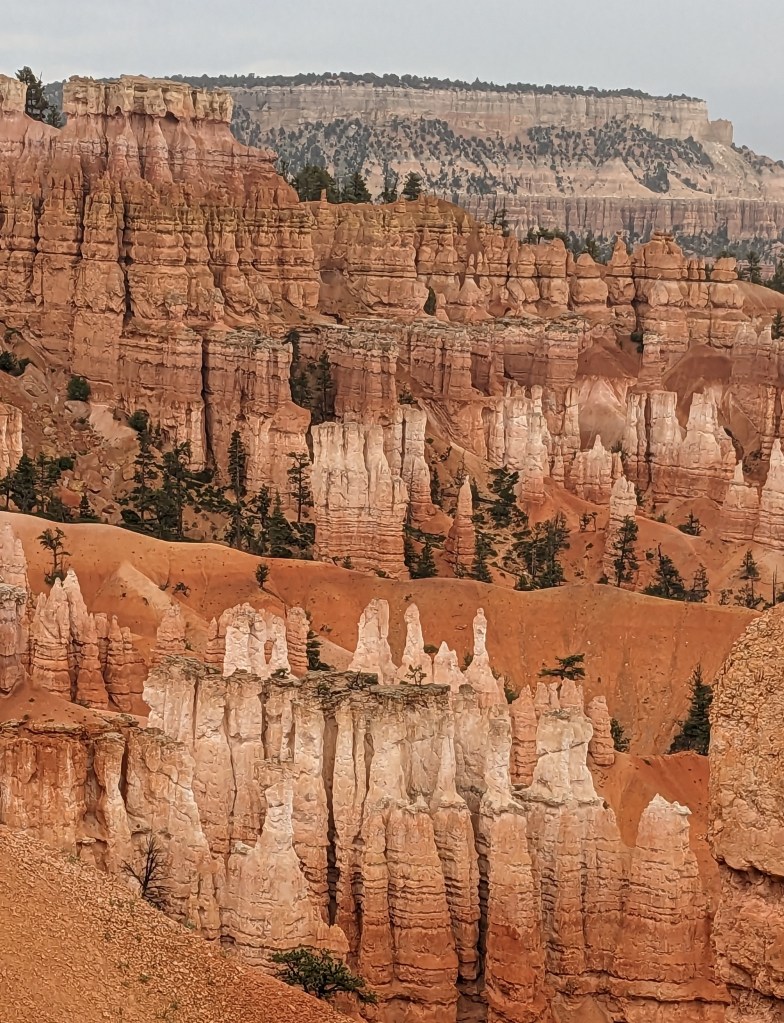
Two days later we arrived at Bryce National Park. At first, the scenery was pleasant but unremarkable. I wondered why there were so many tourists and so many cars in the carpark. We donned our raincoats and walked towards the trail to follow the other tourists. It started hailing and I pulled my hood around my face. Thunder and lightning resounded. A tall thin park ranger approached us from the other direction and looked directly at me.
“We advise you to turn around immediately and seek shelter. We have lost ten people in twenty-five years in these weather conditions.”
We looked at the brochure to confirm this and read that there had been four fatalities and six injuries. I would have been happy to follow the park ranger’s advice, but we had driven for eleven hours to get there and were too curious to turn back. We started walking towards the Navajo Loop trailhead at Sunset Point. Tourists were posing for photographs at the rim. I wondered what the attraction was and peered over the rim myself. Suddenly, I understood why the site was so crowded.
Navajo Loop
I gingerly placed one foot after another to carefully descend the steep muddy trail. Each time I planted my foot down I held it steadily to ensure I would not slide. A couple approached us from the opposite direction as they ascended the trail.
“We strongly recommend you turn around immediately!” they warned. “It’s treacherous in these muddy conditions.”
Muddy trail
We thanked them, but I continued to gingerly traipse through the mud along the downward trail for a few metres.
“You go ahead,” I urged Alex. “I can’t go any further.”
It continued to hail, and we could hear thunder. I turned around and slowly plodded back up the muddy trail back to the edge of the rim, closely followed by Alex. We contented ourselves with the less slippery 2 km walk along the rim to Sunrise Point and back. Back at the car, we scraped the mud off our shoes, fairly unsuccessfully, and continued our drive to Arches National Park.
The Arches National Park is so popular that visitors have to book through a timed entry system. At 6 pm, when the booking system opened, Alex opened the booking site and secured one of the few remaining availabilities for a 7am entry the next day. He hoped we could also enter just before sunset that day, after 6pm when entry was not timed.
Four-and-a half-hours later we arrived at Arches National Park. The drive had been uneventful along straight desert roads and it had been difficult to force myself to stay awake, as I sat in the passenger seat.
“If we are too tired, we can go straight to our accommodation,” suggested Alex.
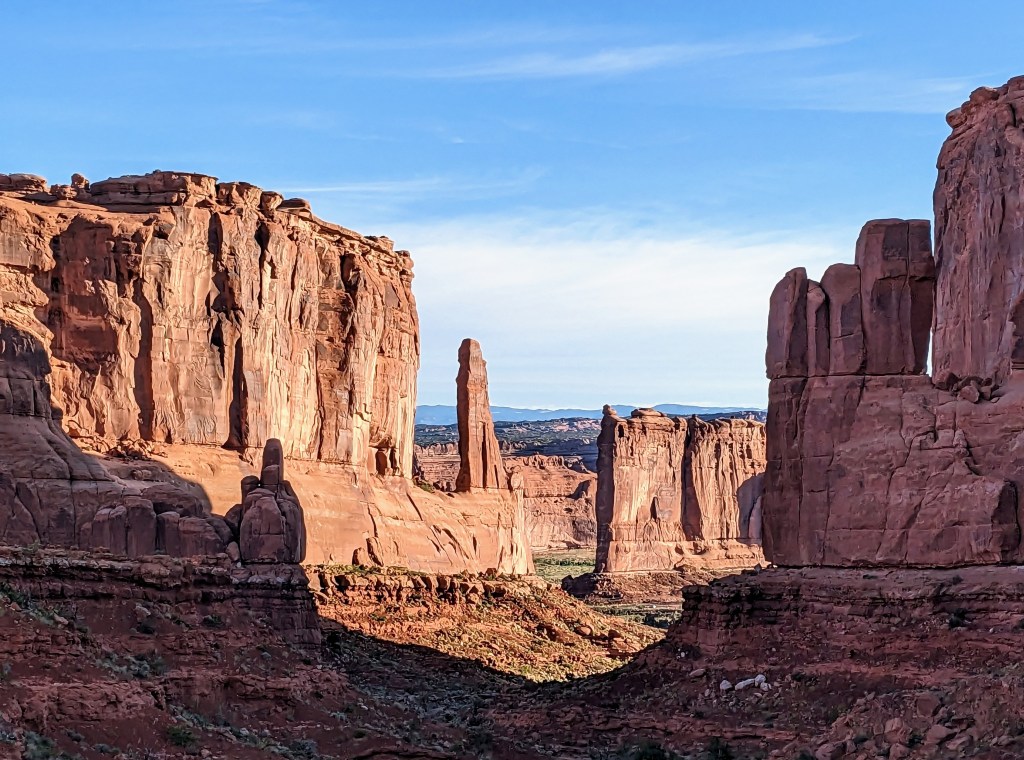
I hoped we would do so. I needed to escape from the enclosed space of the passenger seat. Suddenly huge rock formations loomed just beyond the park gates, and we decided to enter. I was lulled from my stupor into a sense of shock from the grandeur of the giant ochre rocks emerging from the plains. I could sense the onset of palpitations.
“I think I’m going to faint, Alex,” I warned him.
“I think you’re experiencing ‘geophilia’,” he responded.
Suddenly, I realised why people found the study of geology so fascinating. Strata upon strata of ochre rocks rose before us. Their layers indicated the movement of the earth’s surface over eons of time,
Entrance to the Arches
The sunset light flattered the rock formations. Cars lined the road heading to the distant formation of Delicate Arch thirteen miles into the park, and tourists parked their vehicles at the many carparks along the wayside to walk amongst the various giant rock formations.
The next morning, we rose to meet our 7am booking to enter the park. The light portrayed the rock formations in a slightly different way from the light of the evening before. We headed to the trail leading to the Delicate Arch. Even at that early hour, the carpark was almost full, and we secured a space before following the throng of tourists walking the trail heading to the arch. We scrambled across rocks and boulders in the piercing sunshine. I glanced at the climbers ahead of me and thought it would be impossible to reach where they were climbing, but with Alex’s encouragement found myself joining them. After a series of false summits, we found ourselves within sight of the arch. I looked at the abyss below and suddenly decided I would content myself with watching others pose for photographs in the arch rather than entering myself. A photographer was set facing a couple posing in the arches perilously close to the drop-off. Couples and children walked across the rocks in front of me towards the arches.
“I feel sick, Alex! I can’t go any further.”
I wondered why the others were walking so freely along the rocks in front of me, in full view of the yawning abyss.
“I promise I’ll hold your hand.”
“I don’t want to drag you down!”
“You won’t!”
I continued to worry I would drag Alex down with me in the abyss, but as usual, succumbed to his confidence. I gripped his hand and refused to gaze below me, carefully placing one foot in front of the other. Fellow tourists were taking turns to pose under the arch. A couple noticed us heading towards the arches.
“Shall we take your photo for you?” they offered.
Alex accepted and handed them his phone.
We continued to inch towards the arch. Finally we reached it and posed beneath it. I tried to assume a confident stance that I did not feel, all the while steeling myself away from glancing down at the abyss. I was naturally inclined to hold myself steady in a tense position, but instead decided to stretch my free arm outwards and pretend to exert confidence.
Arches
After standing there for long enough for the couple to take turns photographing us, we returned to the smooth large boulders ready for our trail down the mountain. As we walked down, I started reflecting on the contrast between how brave others seemed to feel as they freely walked over the boulders facing the abyss, and how timid I had felt.
“I think I have a fear of heights!” I announced to Alex. “I don’t know how I made it to retirement age without noticing this.”
There was one more trail we wanted to pursue, namely, the Devil’s Garden. As before, there were few empty places in the carpark. We finally edged into a free space, and then headed to the trail on our way to the Landscape Arch. This time I decided to read the information posted on the sign at the entrance. It read “Drop-offs on both sides challenge those with fear of heights”. I realised that there must be at least some people who shared my fear.
Arches National Park remains the most impressive national park I have ever visited. The force of nature had never felt so overwhelming. I felt small in this vast ancient landscape but privileged to be able to witness it.
Meredith Stephens is an applied linguist from South Australia. Her work has appeared in Transnational Literature, The Muse, The Font – A Literary Journal for Language Teachers, The Journal of Literature in Language Teaching, The Writers’ and Readers’ Magazine, Reading in a Foreign Language, and in chapters in anthologies published by Demeter Press, Canada.
PLEASE NOTE: ARTICLES CAN ONLY BE REPRODUCED IN OTHER SITES WITH DUE ACKNOWLEDGEMENT TO BORDERLESS JOURNAL
“It is 5.23 am,” I told myself as I glanced at my watch. “I guess I got up early. Anyway, SK should be here right about now, right on the dot at 5.30am, as he has always been. Today is not going to be any different.”
I plugged on my earphones to hear the continuation of a podcast that I had been listening to from the previous week. It was a day before the full moon, but the cloudy skies and the lack of streetlights made the road look pretty dark. I sat on the raised stone fence as the auto-gate slowly closed from the inside.
Far behind a parked car, I could see a moving shadow. It looked like the silhouette of two stocky legs pacing haphazardly as if they were swaying. At once, I thought that it must be my neighbour’s son struggling to get back to his home after a long Saturday night out with the guys.
“Wow!” I was thinking as I symbolically patted myself on the back for keeping up with the routine all these years despite raging inner demons and concerned naysayers who keep advising me to slow down on account of being a half-centurion! “Only madmen would be running on a Sunday morning when the sane recovers from a stuporous night out!” they say.
Just as I was drowning in the nectar of my self-praise, I realised that the shadow cast under the car was not that of a man. The contour of two legs soon became four, and a greyish, horrendously ugly-looking face with a tinge of what appeared like thick whiskers soon manifested. I was 10 feet away, locking eyes with Vishnu’s third avatar, the Varaha, a wild boar!
Here I was, I thought, in the comfort of city living, enjoying the fruit of my lifelong struggle to benefit from the support of privacy and security of the gated community, I felt I had had it all. Within the luxury of economic independence and intellectual reasoning, the brutal combat of our ancient ancestors and the street smartness of the lesser beings have taken a back seat. Even in my wildest dream, I never envisaged a moment when I would have to face a wild beast!
It was the stare between two worlds; one of the modern domesticated kind who had a fight-or-flight response limited to his autonomic nervous system versus one who had to fight to stay alive and keep his place in the hierarchy of the pecking order of the jungle.
The stare looked like it lasted for an eternity. The boar, of course, hungry and desperate for food, did not want a competitor. As if he knew that I was not interested in his food, thank you very much. Negotiation naturally was out of the question, and so were all civil niceties.
I turned around to ring the bell to my house as I did not have the gate key. The sudden movement must have startled the beast. It gave a low-pitched snorting grunt as if it was showing its displeasure. Interesting, it was my neighbourhood, and the visitor or rather an intruder was displeased! Well, that is the law of the jungle. Might is right, and there is no place for logic. This is the ‘id’ that Freud asks us to put under check by societal pressures. It could manifest in a mob situation when enforcement crumbles.
Just when I thought that nay was near, me being gored by a wild beast, a beacon of hope came in the form of a beam of light from an SUV. My ride arrived right on the dot, just in time to turn the table on the aggressor. Awed by the approach – perhaps it thought the vehicle was a giant animal with a louder roar — its ‘fight’ mode downgraded to ‘flight’ as it turned its back to return to its own home. It retreated.
As we drove along, we saw a humbled pig strutting with its tail between its legs heading towards the secondary jungle. Probably my friend must have been reminded of the carefree days of his childhood when sauteed and spiced wild boar meat with toddy was a delicacy among friends.
That is why we are repeatedly advised by wise men to get back to nature. Nature gives a purpose to our existence. Its massive structures, like the trees, the mountains and elements of nature, awe us to the ground. It impresses upon us our deficiencies and our feebleness. It drills unto us that we are nothing, just a passer-by who makes a cursory appearance, while Mother Nature and the Universe continue into eternity. We are not even a single fragment of a tiny dot in the Milky Way, and even lesser in the ever-expanding dimensions of the Universe.
.
.
Farouk Gulsara is a daytime healer and a writer by night. After developing his left side of his brain almost half his lifetime, this johnny-come-lately decided to stimulate the non-dominant part of his remaining half. An author of two non-fiction books, ‘Inside the twisted mind of Rifle Range Boy’ and ‘Real Lessons from Reel Life’, he writes regularly in his blog ‘Rifle Range Boy’.
.
PLEASE NOTE: ARTICLES CAN ONLY BE REPRODUCED IN OTHER SITES WITH DUE ACKNOWLEDGEMENT TO BORDERLESS JOURNAL
River Indus en route to Alchi, near Village Saspol.
I pulled my cap a little lower as I started for Alchi, after getting a full can of petrol from the Leh petrol pump. It was a very new thing for me — I marvelled at how a city could have just one petrol pump, and that too for miles around. Moreover, it served the neighbouring villages as well.
To reach Alchi, I had chosen the Delhi-Srinagar route. The distance would be approximately 66 kilometres from Leh, and would perhaps normally have taken two hours, but because of my propensity to stop and admire the rivers, trees and clouds, I knew it would be more than that.
The ageing two-wheeler I had rented was the last one available, but I was just grateful just to go, even though it was with prayers in my heart for a safe journey. The interesting part was, if I wanted to go straight, I had to aim the scooter a little to the right, which in itself was a scary thing, because if I lost myself in admiring the natural beauty too much, I could end up veering to one side, risking an unwanted encounter with the huge army trucks that passed through the remote roads from time to time.
As I started, I noticed the Himalayas in the distance, the white peaks were getting covered in the fresh falling snow, right before my eyes. It seemed propitious, and I started with a smile. Passing through the straight road, repeating the simple directions in my head — follow the road, reach the village Nimmoo, then just keep going on the same road — I felt at peace somehow. It was just me, the long, straight road, the puffy white clouds and the endlessly stretch of brown mountains. And of course, the blue sky that seemed to travel with me everywhere I went.
The journey to Nimmoo was smooth, with just the sound of the wind in my ears and no network on my cell phone. At Nimmoo, I stopped for a cup of tea and some biscuits. I saw the confluence of the Indus and Zanskar rivers on the way, near Nimmoo. I paused to take in the scene — the mixing of the greenish Indus and the bright teal-coloured Zanskar creating a mesmerising palette against the browns of the mountains. Some trees created a layer of green too – I think they are poplars and willows.
As I turned around to restart the drive, across the way, I saw a lady bent over by the side of the road. She was sweeping the road free of small stones that fell from the mountains onto the path. She stopped for a drink from a metal bottle from a backpack that she was carrying. I took the opportunity to talk to her about her motivation for this hard work. She said, “I am a government servant. It’s my job to clear the roads of small stones so that travelers can drive safely. For larger stones, I call other workers who work with shovels and machines.”
I asked, “No one is watching you here; why don’t you rest for a while?” She replied with an open smile, “But I know what I’m doing; I’m watching myself. I have already taken my lunch break. I will stop before it is dark and go back to my village.” Saying this, she pointed to a place not visible from where we stood. I’m reminded that I too, should reach Alchi before dark. Bidding her a respectful and heartfelt “Julley[1]”, I again started on my way.
I passed under mountains extending over the road. I was so hypnotised by the sights and the river and the song of the wind in my ears that I did not notice the huge army truck until it passed to my right. Another foot or so and I would have been history. A little shaken, I anchored myself more firmly to the task at hand and took the final left turn towards the village. I passed a beautiful small bridge made of metal, on both sides of which were poplars turning their leaves yellow and orange. A little further, I reached a huge prayer bell mounted by the side of a road, beyond which were mountains standing like sentinels, and yaks grazing the fields.
It was idyllic and pristine. After a quick drink of water and some photos, I was on to the last leg of the journey. Finally, just as evening was about to fall, I reached the village. Entering it, I could see hay bales, shingled houses and the boundaries of houses made of grey and brown stones stacked together, and rosy-cheeked children playing under trees. With a sigh of relief, I stopped my vehicle some distance from the monastery, taking it as close as I could get. The monastery was the main reason for my visit here. It was supposed to be one of the oldest in Ladakh; made around the year 1024 by hand. Somewhere in my mind, I was also worried about the fact that the seat of the vehicle would not lock, so I could not leave anything in it. By this time, I was famished that I decided to eat first and ask at the restaurant for a homestay nearby, trusting the goodness of the human heart and leaving some of my basic stuff inside the seat of the vehicle.
The restaurant was called ‘Alchi Kitchen’ and appeared to be the only one there. As I climbed the stairs with my backpack and my camera bag, I could see the mountains, the village stretched out below and the monastery. It was surprisingly comfortable, with low seating and gleaming brass and copper cookware in the open-plan kitchen inside. I ordered a plate of Manchurian and rice and watched them make it. The owner and her two young assistants were laughing and chatting as they cooked, their actions precise and practised.
Nearby was a group of youngsters, who appeared to be done with their meal. While waiting, I walked out to the balcony, in front of which was a mountain with the setting sun glinting off it, and prayer flags on its summit waving in the wind. After a few pictures, I just stood and gazed, absorbing the peace radiating from the mountains. Nature is always a balm for the soul. The mountain seemed like an old friend somehow, familiar, whom I was meeting after a long time.
Suddenly called back from my reverie by the owner’s call, I returned inside. The meal was simple but had layers of flavours. I devoured it feeling grateful towards the people who prepared it. Once I had eaten, refusing the offer of dessert, for I truly was stuffed, I thanked the owner and her friendly assistants and asked about a homestay. They guided me to a house just to the left of the monastery complex, saying that I should tell them that Padma had sent me.
I went to the house as directed. It was a beautiful old wooden three-storied house, with a big courtyard and trees all around. All the evidence of the busy and full household could be seen in the yard – a child’s bicycle, many pairs of shoes, sandals and rubber slippers, flowers planted in pots, random jars and even cut-off plastic bottles, clothes drying on a clothesline and some puppies and chickens playing in the lawn. Such a scene of blissful domesticity!
I asked the homeowner who was just coming out of the house if it was indeed Tsering Dolma’s house. He confirmed and asked if I needed a room. I affirmed that but added a request to see the room before I finally decided. He led me inside, up two flights of stairs, and showed me to a room which had windows from top to bottom, along two walls. These opened out into the backyard, that had a view of the monastery, the river Indus flowing behind it and the mountains beyond it.
I immediately said “Yes!” In all my 30 years of age, I had never once travelled or stayed alone anywhere, let alone at such a remote location, where even the mobile reception was sketchy! However, there was something about this place that seemed so comforting and welcoming, with a feeling of déjà vu.
Smiling, the friendly Tsering asked if I would like some butter tea. Although it was slightly late to be having tea, I could not resist his sweet smile and graceful manner and agreed. He asked his grandson to request his mother for two cups of tea for us. Having kept my stuff in the room, I washed my hands and face and came out. Tsering was sitting in the upstairs sitting room, which had beautiful low seating in front of hand-carved windows. The windows looked out over their lawn studded with apple and apricot trees.
Somehow, it was very easy to talk to Tsering, regardless of his age – he was a grandfather, and we were from such different backgrounds and our life experiences were diverse, yet there was a common thread of humanity and communion that linked us. I had found that people in Ladakh were open-hearted, warm and welcoming if we were friendly. I had never been very outgoing myself, but faced with such spontaneous acceptance, it was hard not to be receptive and equally responsive. Tsering told me about his family and his children’s studies, and we were discussing Ladakhi culture and life at Alchi when his daughter-in-law brought our tea. Smiling shyly, she placed the teacups on the hand-carved table. Tsering asked her to join us, but she said that since dinner was almost ready, she had better take care of that. She did stay, however, to tell me proudly about the children, aged five and two. The older boy I had already met; the younger — a daughter — was playing with her grandmother. After chatting with them both, I asked them if I it was safe to stroll outside for a while. He said that it was perfectly safe and that I could walk around, but to be sure to take a flashlight, or my mobile, as there were no streetlights there.
I took my phone and went outside. The street had small houses on both sides. In one, some women were lighting a clay lamp in a small alcove in front of their house, while chanting something which seems extremely melodious. The scene seemed out of this world, so removed from my usual life. I slipped into this new reality, which seemed far more real than from what I had left behind.
I looked around. The sky was full of stars. The chill breeze was interrupted with the scent of food being cooked in kitchens all around. I took a deep breath and rooted myself deeper into the present moment.
From somewhere came the smell of incense. I walked slowly through the short lane, looking up at the endless sky from time to time. After a slow walk around the monastery walls, I was back at the homestay. Skipping dinner in favour of a light soup served in their kitchen, I chatted a little with the family and then slept early, for I planned to catch the morning light for my photographs.
In the morning, I am woken up by birds outside my window. There were only three sounds I heard – the birdsong, the sound of chanting, and the sound of bells from the monastery. I got up and after freshening up, went out to find Tsering waiting outside in the hall. He said that breakfast could be ready soon and that if I went to the monastery early, I might catch the morning prayers there.
After a sumptuous breakfast of homemade khambir[2] and homemade apricot jam (made by Tsering’s family and even supplied to many shops and emporiums at Leh), along with piping hot butter tea, I went down to the lawn. I found Tsering’s grandchildren playing there with their friends. Enchanted by their animated play, I sat there for a while, clicking them after taking Tsering’s permission. Then I went to the monastery.
The street en route was being readied for the day’s market — people were setting up tables and taking out handmade wares — jewelry, masks, bronze statues, shells and more. As I entered the grounds of the monastery, a deep silence seemed to calm my being. Walking straight down to the main temple, I could feel the history of the place, soaked in the meditation and prayers of so many people.
I went inside, where there was a tall painting of the Buddha, decorated with gold leaves. I looked up at the wooden rafters. I thought how long ago, the common people would have crafted this by hand. I went around with my hand on the prayer wheels placed along one wall of one of the smaller buildings there.
Afterwards, as I stood there looking at a small boy praying with his mother, I tried to feel the stillness inside me. It was something new; a total contrast to the constant activity that was my norm. After sitting there to my heart’s content, I started to circumambulate. A local woman’s two-year-old was doing the same. The child was imitating her mother, who I noticed was not forcing the child to do anything. Little Amo, for that was her name, smiled at me shyly from behind her mother’s legs. I photographer too. When I said that I admired that she was not pushing her child to do anything, she replied that she was proud of her culture and religion and would just like to present them to her daughter and let her make her own choices. It was okay if she chose a different life, but at least she would do so knowing the alternative.
Amazed and humbled by the generosity of spirit of a young mother in such a remote place, I followed her as she finished her circumambulations. On my third round around one of the corners of the monastery complex, I felt this sudden urge to go down to the river Indus flowing behind the building. After I was done at the monastery, saying bye to Amo and her mother, I asked for directions and people guided me to a tiny lane going down the hill, behind some houses, right down to the riverbed.
I was thankful I was wearing my sports shoes and not the pair of sandals I had also brought. Walking down was a little harder than I had thought, and I was slightly out of breath by the time I reached the grey, stony bed of the mighty Indus. Taking off my shoes, I descended to the edge of the river. It turned out to be a wise choice, for the stones were a little slippery, being rounded and shaped over centuries by the river. I scooped up some handfuls of the river water and drank, excited about being in aa place I had only imagined in my wildest dreams. The water, as I brought up my hand to my mouth, sparkled, giving off rays of reflected light from the morning sun. It cooled my hand. I took a few pictures. Then keeping aside my camera, felt like sitting and meditating beside the slowly flowing river.
The flow rushed and slowed down in certain spots as the river wound around big grey rocks on its path. I sat to listen to the gentle gurgle and sounds of the ebbs and flow and lost track of time. After some time, I sensed another presence and opened my eyes. I saw a stranger a little distance away, setting up his tripod and making slow changes by trying to balance it on the rocks. He was wearing an orange sweater with a loose black jacket over it, jeans and a pair of those sandals that serious trekkers wear. He had extremely curly black hair and appeared to be lost in what he was doing. However, as if he sensed my gaze, he turned my way and smiled. As I rose, I could sense my heart decide that I would trust this person; I felt as if we had already met, or rather known each other for ages. Something in his eyes spoke to my soul in a way that was both soothing and familiar. I knew I could trust this person; he was no stranger — my soul recognised him.
He simply said, “Nice to meet you. I am Kabir.”
“I am Shivani. Same here.”
“Sorry to disturb your meditation.”
“No, you did not disturb me; I just felt your presence.” I responded.
He smiled and asked if I could help him position the tripod and focus his camera for a few pictures and videos. I agreed to help, and sitting as he directed, let him set the focusing timer on this camera, so he could take my place and shoot himself sitting in meditation along the riverbank.
He asked me to arrange some flat stones that are symbolic of a prayer to the elements. I was a little hesitant but when he said that the video would only show the stones and my hands, not my face, I relaxed and let him take his shots. After he finished, we sat there for a long while, sometimes speaking, most often just sharing the silence.
I did not want the meeting to end somehow. I sensed that he was feeling the same; he asked me where I was staying. I told him; he said that he had just put his stuff there too, that very morning, and came directly to the riverside. He must have arrived after I had already left for the monastery.
This meeting had a sense of déjà vu, a synchronicity to it. As we got up to go back to the homestay for lunch, our eyes met. For some seconds, the sound of the rushing river, the insistent wind and the distant bird calls all faded away and it seemed as if I was in a vacuum stretching across time, with just the two of us. I knew that this was a new beginning of an old connection. He felt something too, and we started walking in companionable silence, comforted by the shared upswing of so many emotions. The sense of having done this before created a bridge between our souls, across time and beyond. I felt I was finally home.
Shivani Shrivastav is a a UK CGI Chartered Secretary and a Governance Professional/CS. She loves meditation, photography, writing, French and creating.
PLEASE NOTE: ARTICLES CAN ONLY BE REPRODUCED IN OTHER SITES WITH DUE ACKNOWLEDGEMENT TO BORDERLESS JOURNAL
Grief was something I thought I could run away from. If I created as much physical distance as I could from my place of loss, surely I could find healing. I had just lost my beautiful sister Stephanie after more than five decades of sisterhood and hoped that I could find healing in travelling to distant climes. There couldn’t be anywhere more distant than the Sierra Nevada Mountains in California. The time zone is sixteen hours behind Adelaide, and the season is contrasting. Surely by distancing myself in time and space I could recover from my grief.
My partner Alex’s chief pleasures are planting trees, sailing, and hiking. In the Sierra Nevada, he could indulge his passion for hiking. We arrived in the Sierra in early June and stayed in a cedar house surrounded by ponderosa pines, Douglas firs and junipers, yawning into the sky. Every day we planned a hike along the numerous trails winding through the mountains. Even in June, it was pleasantly cool. Alex lit a fire in the fireplace every evening, and I donned a thick jumper. On our third day, our chosen hike followed a trail alongside the northern shoreline of Shaver Lake.
“If a bear approaches, the worst thing you can do is run away. Hold your ground and shout at them. Otherwise, they will think you are prey,” warned Alex.
Till then, I had been enjoying my stroll through the mountains at an elevation of almost 1800 metres, and it never occurred to me that we could cross paths with a bear. In Australia we often crossed paths with kangaroos, who would hold our gaze for a few seconds before gracefully hopping away. I had never considered that wild animals could be predators. Then, on second thoughts, I thought it would be nice to see a bear, and with Alex alongside me, felt less vulnerable.
“You have encountered wild bears before in California, haven’t you?” I quizzed Alex.
“Oh yes, several times,” he confirmed.
“Wasn’t there one time when you were alarmed?”
“Yes. That was when I was hiking alone in Montana. They couldn’t hear me. If a bear can hear you, they are more likely to stay out of your way. Some people use whistles.”
I started scanning the hillside for signs of large moving creatures, but instead my attention was drawn to the abundant wildflowers that I had never seen in Australia. I noticed bright red flowers protruding beneath the huge pine trees, known as Snow plants.
Snow plant (Sarcodes sanguinea)
I kept longing to spot a bear, but instead continued to notice wildflowers. The most common wildflowers were sensed by smell before I sighted them, small creamy flowers with a heady fragrance of rich honey. I wished I could photograph the smell.
Buck brush (Ceanothus cuneatus)
The nearby town of Shaver Lake had been saved by the firefighters in the 2020 wildfire known as the Creek Fire, the largest fire in California’s history. You could see the line where the fire had been stopped. On one side were scarred mountains which had lost their vegetation, and on the other remained majestic pine and fir trees.
Fire Devastation
On the side that had been spared, some pink flowers, known as mountain pride, asserted themselves through a crack in a boulder.
Mountain pride (Penstemon newberry)
I had been looking for bears, but instead found myself in the midst of a North American spring. Splashes of colour of ever more exotic wildflowers emerged along the roadsides and the trails.
Path through the forest
My hope to overcome grief through travel to a distant land had been in vain. Moving from a southern hemispheric autumn to a northern spring, and moving back sixteen hours in time to yesterday, was not enough to relieve me of my mourning. I missed phone calls and text messages from my sister Stephanie, and especially the opportunity to recount the tales of my travels when I returned home. Stephanie was my most avid listener, and never expressed any envy when I regaled my travel tales. Her concentration propelled me to provide ever more details of my travels. Now, I honour her memory by continuing to pursue the kinds of activities that she took delight in and writing the kinds of stories that she enjoyed.
In Loving Memory of Stephanie, Entrusted to God’s Care
Meredith Stephens is an applied linguist from South Australia. Her work has appeared in Transnational Literature, The Muse, The Font – A Literary Journal for Language Teachers, The Journal of Literature in Language Teaching, The Writers’ and Readers’ Magazine, Reading in a Foreign Language, and in chapters in anthologies published by Demeter Press, Canada.
PLEASE NOTE: ARTICLES CAN ONLY BE REPRODUCED IN OTHER SITES WITH DUE ACKNOWLEDGEMENT TO BORDERLESS JOURNAL








 Borderless