Categories
Slices from Life

Baudelaire and Paris

By Sunil Sharma

Gustave Caillebotte. Paris Street, Rainy Day, 1877. 

I

Modern Paris was discovered by Baudelaire in his avatar as the flaneur. And Walter Benjamin made this figure intellectually respectful as a field of study.

In a recent visit to Paris, I hovered between two allied states of being a flaneur and a gawking tourist. I had come as a sightseer from Mumbai, India, allured by the tales and well-crafted image of a mythic Paris, drinking in the street flavours on those May days, passively registering the wide monuments and boulevards and palaces and towers in one clean and clear sweep — almost like a wide-angle shot in a Stanley Kubrick film. Spring had set in and the Paris of May 2014 was full of eager tourists from nations as wide apart as China and the USA; Africa and Middle East and Latin America. A bouquet of the ethnicities strung together.

Then, I became a flaneur, making a neat switch, in a single instant.

I became Baudelaire.

Different terms can make you look differently at a similar set of things or a common setting.

Of course, I did not have the urge to write a new millennium version of The Flowers of Evil. At best, you can parody a sacred text but you cannot re-write it, howsoever Borges-like you might be.

I am neither of the two.

Like Mallarme and Verlaine, you can carry forward an idea by expanding it further but cannot imitate with complete fidelity to the original.

So, not in a mood for a cheap replication of a master praised by Proust so profusely, I took on the stance of a flaneur and became a connoisseur of the street-life.

Was it possible?

Assuming the role of a figure long dead or supposed to be dead? Replaced by a tourist? Solo or in a group?

Armed with a camera or a cell phone, in casuals, the modern tourist — guided by brochures and online information and a city map — looks at the urban skyline vicariously familiarized by prior research. Or, could it be at a professional polyglot guide spewing bits and pieces of history like a typical street performer or an amateur actor? A mass tourist consuming the city, architecture, culture, food, arts and clothes — public life — in a predictable way and sequence largely decided by the tourist industry. A few breaks are possible in that routine.

But to resurrect the role and agency of the classic flaneur, you have to take on a different position and way of seeing.

And what was that?

I could not become a dandy—detached, arrogant, inheritor of a small fortune, an idler walking a tortoise on a Paris street of the nineteenth century. Even if I had the means, I could get arrested for an act of animal cruelty!

Those were different times!

So what can be done?

The clues lie in The Flowers of Evil, perhaps.

Will this title be acceptable today? With changing definitions of evil? With life becoming more liberal and open?

Baudelaire was a dandy and a cultivated flaneur—the painter of modern life; a gentleman stroller of the city streets. Part of, yet apart from, the crowds.

But then, not every dandy is a flaneur and every flaneur, a dandy?

Again, dandy is a historical invention, a social-engineering, manufacturing of a social type for a particular age.

Perhaps, a metro-sexual male, now no longer fashionable.

Is he a voyeur?

Perhaps, we all are, given the nature of our society.

Or, a keen participant, an acute observer, a chronicler?

For me, the answer lies in the personality of Charles Baudelaire who in turn was influenced by Edgar Allan Poe. But that would be complicating things further.

Let us stick to our central figure Baudelaire. His genius lies in radicalizing the trope of the French flaneur. A theme that fascinated Walter Benjamin who, in the twentieth century, tried to essay the same role performed so well by Baudelaire in the industrialized Paris of the nineteenth century. The former could not capture the underlying passion of Baudelaire in this unfinished project.

In fact, by the late 1990s and start of the 21st century, author-flaneur proved an impossible figure.

Market forces, on global level, have incorporated author as a producer of kitsch or dystopia. Dissidents were slowly and subtly disenfranchised.

We are all sellers!

Baudelaire resisted this initial process in Paris. Beckett was next. Sartre and Camus too tried.

Then the flow stopped.

The Flowers of Evil mounts a challenge to the order and morality of the Second Republic.

The poems challenge the bourgeois morality and conception of order and beauty and aesthetics in a radical way. The book talks of evil and implies that the source of evil lies in its origins — capitalism.

In that simple gesture of observing, participating, recording of street life, Baudelaire liberates himself from his historical position and becomes a true artist. By talking of prostitutes and vampires, the poet shows the underbelly of capitalism. His creations provide the material basis for highlighting these themes and give credence to outcasts from the system that feed on the blood of the innocent and the gullible.

The Flowers of Evil is the greatest indictment of the French bourgeoisie by a person deeply embedded in it as a bourgeois but a radical one that unveils the brutal face of a system that once talked of revolutionary slogan of liberty, equality, fraternity!

An evil society can produce evil flowers!

Vampires are for real!

II

That Baudelaire had not died in 2014 was proven on a street near the Eiffel Tower on that memorable trip.

A Roma girl, bold and audacious, stole my son’s cell phone from his shirt pocket. She returned it after a cop intervened.

I could smell evil in the air. The disenfranchised and the ethnic Roma are still the threat — like the prostitute and the vampire, the perpetual outsiders.

The Paris of Baudelaire is not safe.

The shoot-out at the Charlie Hebdo proves that.

The vampires are out.

This time round, Baudelaire the flaneur has disappeared. There is no one to warn us of these sinister presences.

.

Sunil Sharma, an academic administrator and author-critic-poet–freelance journalist, is from suburban Mumbai, India. He has published 22 books so far, some solo and some joint, on prose, poetry and criticism. He edits the monthly, bilingual Setu: http://www.setumag.com/p/setu-home.html
For more details of publications, please visit the link below:
http://www.drsunilsharma.blogspot.in/
. This story was first published in Scarlet Leaf Review.

.

PLEASE NOTE: ARTICLES CAN ONLY BE REPRODUCED IN OTHER SITES WITH DUE ACKNOWLEDGEMENT TO BORDERLESS JOURNAL. 

.
Categories
Slices from Life

What waits for Rohingyas?

By Saifur Rahman Saif

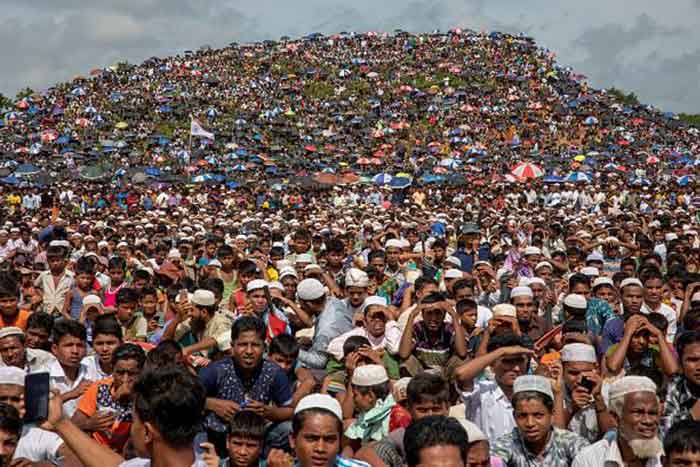
Rohingya people, who have no identity of their own, are now facing another danger. The pandemic of COVID-19 took away one of the Rohingyas, who found shelter at a camp at Cox’s Bazar in Bangladesh on the wake of genocide in their own land in Myanmar.

United News of Bangladesh reported that the man died from coronavirus infection while undergoing treatment at the isolation centre at Ukhiya camp in Cox’s Bazar on Monday night.

Referring to Abu Toha MRH Bhuiyan, who works as a health coordinator at the Refugee, Relief and Rehabilitation Commission, the news agency stated that the deceased could not be identified immediately but he was a 71-year-old man.

It was the first confirmed case of death of a Rohingya refugee in Bangladesh. Bangladesh is now home for over one million Rohingyas, who fled atrocities in Myanmar to Bangladesh.

In my earlier article in  Countercurrents, I tried to draw attention of the world community so that they would come forward to save Rohingyas from probable contamination of COVID -19. I don’t know whether anybody heard my appeal. In fact, the Rohingyas are no longer safe now from the devastation of COVID-19. We don’t know what is waiting for the densely populated Rohingyas. I also don’t know who will save Rohingyas from further deaths? Is it the Bangladesh government or the world community?

Super power USA is now facing manifold adversity- destructions of COVID-19, street demonstrations across the country and, so on. Many other powerful countriesare also in peril today. And Bangladesh, with 709 confirmed case of death from COVID-19 and 52,445 infected, is has failed to control the spread of the coronavirus.

The Gono Forum came up with the allegation on Tuesday as its president Kamal Hossain and general secretary Reza Kibria in a joint statement said that although World Health Organisation on March 11 declared COVID-19 a pandemic, the government announced general holidays in the last week of the month.

They also said that although Bangladesh had enough time to determine national strategy, the government failed to implement a fruitful strategy, New Age reported.

The Gono Forum leaders said that the rate of COVID-19 tests in the country was very low and people had no confidence on government’s information on COVID-19 infections and deaths.

They also said that the late announcement of public holiday amid relaxation put impacted people’s lives negatively as it failed to control the infections.

They said that only a small part of government aids reached to the poor and vulnerable due to corruption and inefficiency while lakhs of labourers and working class people faced unemployment.

The leaders said that withdrawal of public holidays ignoring recommendations of national technical advisory committee had created much anxiety among the people and the situation was worsening for the lack of adequate number of tests and mismanagement in the health sector.

In this situation, I cannot think of a future for the Rohingyas, at least not the kind I really wished for.

Saifur Rahman Saif is a Bangladeshi journalist. He works at New Age, a popular newspaper. He contributed a story in Freelance Success Stories published simultaneously from the USA and Canada. He can be reached at saifnewage@gmail.com

.

First Published in Countercurrents.org

.

PLEASE NOTE: ARTICLES CAN ONLY BE REPRODUCED IN OTHER SITES WITH DUE ACKNOWLEDGEMENT TO BORDERLESS JOURNAL. 

Categories
Slices from Life

Unbowed, She Stayed

By Bhaskar Parichha

Nobel Peace Prize Laureate Wangari Muta Maathai

Born in Nyeri, Kenya, in 1940, she died in Nairobi in 2011. Wangari Muta Maathai founded the Green Belt Movement, which has  — through networks of rural women — has planted over 30million trees.

Africa’s future has been the subject of fierce debate with the international media: full of warnings about environmental and economic collapse.

True, development workers continue to create hypothetical solutions to the problems they see, yet with little effect and much controversy. While these outsiders haggle over projections and prophecies, Africans had been working on a variety of small, grassroots projects, which they believe, might change the course of their future.

The Green Belt movement is one such project which has been creating and recreating history. It is so easy, in the modern world, to feel disconnected from the physical Earth!

Despite dire warnings and escalating concern over the state of our planet, many feel out of touch with the natural world. But, the Green Belt organization — which has planted millions of trees throughout East Africa in order to provide sources of fuel, food, and a way to stop soil erosion and environmental degradation — is one example of an indigenous movement working to influence Africa’s ecology.

When Maathai founded the Green Belt Movement in 1977, she began a poor people’s environmental movement, focused on the empowerment of women that soon spread across Africa.

She spent decades working with the Movement to help women in rural Kenya plant—and sustain—millions of trees. With their hands in the dirt, these women found themselves empowered and “at home” in a way they never did before.

Maathai wanted to impart that feeling to everyone and believed that the key lies in traditional spiritual values: love for the environment, self-betterment, gratitude and respect, and a commitment to service.

While educated in the Christian tradition, Maathai drew inspiration from many faiths, celebrating the Jewish mandate ‘tikkun olam‘ (repair the world) and renewing the Japanese ‘termmottainai‘ (don’t waste).

Through rededication to these values, she believed Kenyan women could finally bring about healing for themselves and the Earth. Unrelenting through run-ins with the Kenyan government and personal losses, and jailed and beaten on numerous occasions, Maathai continued to fight tirelessly to save Kenya’s forests and to restore democracy to her beloved country.

The Green Belt Movement became the inspiring story of people working at the grassroots level to improve their environment and their country. Their story offered ideas about a new and hopeful future for Africa and the rest of the world. Besides being a native writer, Wangari Maathai was also a parliamentarian.

In 2002, she was elected to Kenya’s Parliament in the first free elections in a generation. In2003, she was appointed Deputy Minister for the Environment and natural resources.

However, worldwide recognition came her way when she was awarded the Nobel Prize for Peace in 2004. In 2009; she was appointed a United Nations Messenger of Peace. This Nobel Peace Prize laureate recounts her extraordinary journey from her childhood in rural Kenya to the world stage in her autobiography Unbowed: A Memoir.

 Her trailblazing story illustrates how African women are striding out.

Infused with her unique luminosity of spirit, Wangari Maathai’s remarkable story of courage, faith, and the power of persistence is destined to inspire generations to come.

.

Bhaskar Parichha is a Bhubaneswar-based  journalist and author. He writes on a broad spectrum of  subjects , but more focused on art ,culture and biographies. His recent book ‘No Strings Attached’ has been published by Dhauli Books. 

.

PLEASE NOTE: ARTICLES CAN ONLY BE REPRODUCED IN OTHER SITES WITH DUE ACKNOWLEDGEMENT TO BORDERLESS JOURNAL. 

Categories
Slices from Life

Notes from Balochistan: Volunteers for humanity

By: Ali Jan Maqsood

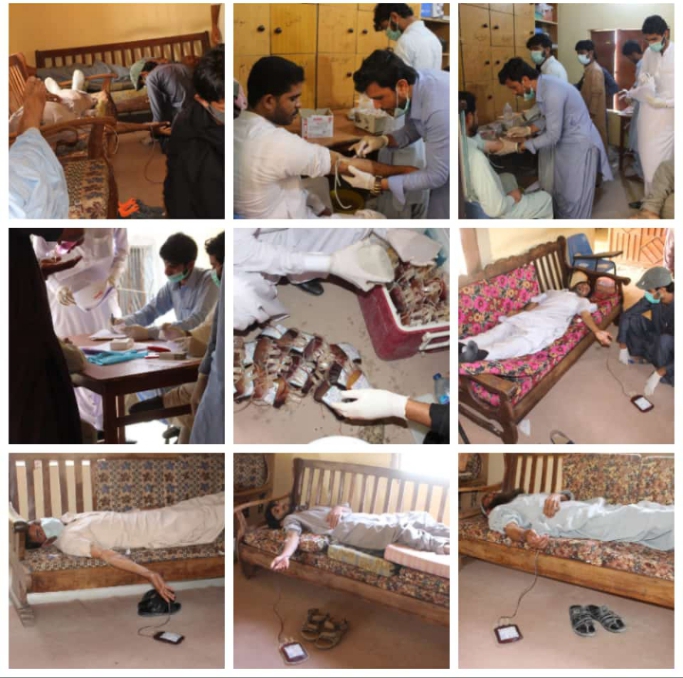
Blood Donation Camp set up by volunteers during COVID 19 restrictions

Pakistan, like many parts of the world, has announced a lockdown in most of the country. In some of the cities, however, there is a partial lockdown. The district Kech in Balochistan is partially locked down (from morning till five in the evenings with essential services still open like groceries, vegetables, banks, medical stores etc). However, all of the educational institutions will remain closed till May 31, with a warning that the date may be extended, depending on future developments.

Kech suffers from a great many medical services issues as the government gives very little attention to the affairs of the civil hospital. These have been further slowed down by the corona scare. On the other hand, Kech contains a number of — 286 — registered patients of thalassemia who need blood transfusion on a regular basis (some after every 15 to 20 days and the rest on monthly basis). The district does not own a single blood bank. Despite having three Members of Provincial Assembly (MPA) from the district with a Member of National Assembly (MNA), the need to build a blood bank in the district has not been addressed.

However, for the patients, a team of a social workers from Kech arranged a blood donation camp in the nearby tehsil of Buleda (about an hour and half of travel from Turbat) in order to collect blood for the needy thalassemia patients during the lockdown. Luckily, they got a good response from the locals of Buleda. The camp was set in Ruzhn School Mainaz Buleda under the support of Mr Zahoor Ahmed, the principal of Ruzhn school, and Mr Irshad Arif, a working faculty of Syed Hashmi High School Turbat and founder of Kech Blood Donors Team.

“A great many people supported us during the blood donation camp. I did not expect this kind of crowd since mostly people fear donating blood, but I am really amazed looking at such spirit from the people here, ” says Mr Arif in gratitude to the local people of Buleda. “I am wholeheartedly thankful to Mr Zahoor Ahmed for his kind help in our drive and all the people of Buleda for donating blood with high spirit.”

The principal of Ruzhn School Buleda was pleased looking at the youngsters doing their best to serve humanity. He said he was honoured to be part of the drive and had much hopes from the volunteers. “I was told they (Kech Blood Donors Team) were coming. I thought what would be more beautiful than to getting a chance to give your best to doing something for humanity in this very critical time,” Mr. Ahmed added

The blood camp got a huge number of donors. The team met their target only in four hours. However, many locals were rejected when they came forward to donate blood as they were considered unfit. They stood the whole time only in the hope they would be called back to give blood, added Murad Jan, a volunteer of the team.

The locals of Buleda have always helped when it came to do something for the people of the province. In such a critical time as the children affected by thalassamia are on the verge of death, they have showed their kindness by arranging the blood camps and supporting it to their best.

It is often said “Saving one human life is equal to saving the entire humanity.” The locals of Buleda proved it with their passion to help children fight death.

Despite the generosity of the residents, the government still needs to plan for a blood bank and a thalassemia centre in the district. Health is one of the basic needs that needs to be addressed. The people cast their precious votes and help politicians win elections, it is now their turn to pay back the community by providing basic facilities.

The writer is a student of Law at University Law College Quetta and a former teacher at DELTA in Turbat. He can be reached at alijanmaqsood17@gmail.com and tweets at @Alijanmaqsood12

Disclaimer: The opinions expressed are solely that of the author and not of Borderless Journal.

Categories
Essay Musings Slices from Life

Stray Musings – ‘Love at the time of corona’, as it were!

By Debraj Mookerjee

Those familiar with the cult author Ayn Rand (she of The Fountainhead fame) will possibly remember her somewhat sobering thoughts on love: “After a point, YOUR LOVE for a person becomes more important than the object of love” (Capitalisation mine). What is love, or the easier poser: What do we make of the idea of love? That love is a compelling emotion, which is perfectly democratic and non-discriminating in affecting the bright and the otherwise, the poor and the rich, the old and the young and so on is an incontrovertible fact. Its universality does, ipso facto, predicate on some common streak that runs through humanity. Is it the innate desire, an almost mammalian need, to copulate and propagate that stirs us into “loving” another, as a prelude as it were to pairing, and therefore mating and procreating and so on? Or is it some deep insecurity within, of a feeling of incompleteness till we have loved or are loved? Or is it just a reflection of the great human propensity to possess; more precisely to call things our own, to be comfortable only when what we desire, that is what we consider of worth, is ours for keeps, like the valuables we stash in our bank lockers?

To begin with, we ought to take a look at the popular rhetoric encountered in our representational sphere of reference to understand how love, though imagined as something special, is as much a commodity as anything else. Why do we say, for example, things like “he (or she) belongs to me”, “I wish to belong to her”, “I could not belong to anyone”, “I want her bad”, “Gosh, I can’t live if I can’t have her”, and so on and so forth? If love were so noble, or even selfless as it is often made out to be, why should it make us want to own the object of love unless it be to serve as a perpetual reminder of the great feeling of love that we have experienced for that object? It is as though our love would crumble to dust should the one we love not be ours forever. And we thought love was an abstract idea!

So let’s test the proposition with a hypothetical (though perfectly credible) situation. You say you love somebody. Now that somebody loves you well, after a manner, you know; loves you but is not in love with you, whatever. Here the balance is delicate. You can’t stop loving that person because you know her (or his) love could grow with time. Unless you keep professing your love, how can you fuel whatever spark she (or he) has for you, right?

Over a period in time, she may not progress beyond her incipient leanings. At some critical juncture, you have to take the decision on whether to let go of your love for her (or him) or push just that little bit more. What is this game, ask yourself? If this is love, fine, so it is, but let’s not pretend and suggest it is some elevated concept that can only be experienced at a heightened level of consciousness. The processes that it goes through is no different from the ones you adopt before deciding to buy a pair of pyjamas – is it good, is it worth the price, how much can I beat the price down to, and of course, how long will it last?

Love therefore, is not an abstract idea. QED. It is an idea though because we don’t know what it is. Probably it is nothing really, at least nothing tangible. But that does not make it abstract. The only way to know it is to register all the things we build around it and what we do with it. It is somewhat like the honour pupils earn in a boy’s school for pissing highest against a wall. The honour means little. It does not guarantee against urinary problems in later life, no does it confirm sexual prowess, but the effort to earn that honour is tangible.

To return to Ayn Rand, and the big question: Is most of what has to do with love merely a role? An assertion of what we can or must or should do to express our love. And what do you think would remain imprinted on the mind – our efforts or the object of love? Come on be honest; of course, we’d value our love more than the loved one.

But all these theories pertain to love that has to do with the desire to own. Love that does not demand, love that is not fixated on one person, love that is not possessive or centred on one’s singular desires comprise another kettle of fish. This is the sort of love that you can shower on so many people at the same time. Where you remain a free agent, and so does the person you love. And each of these loves can have sanctity. Because there is no sense of possession tied to such love it seldom unwinds, unlike the other type that tends to come apart when the tangible grounds for its existence seem to come unstuck.

The Czechoslovak writer Milan Kundera once spoke of two types of love – lyrical and epical – with reference to men. In the former, you see all women in one woman, and in the latter, you see one woman in all women. One liked the concept when one was young (that’s why the quote is remembered). Not anymore. Real love is ‘topical’ love, as it were, where you see all women (or men really) in every woman (or man). Anyway, the more you love, the more love there is that goes around. Philosophically, that sounds better than ‘winning’ somebody in love, as though the person were some prize catch!

And no, this piece has nothing to do with the virus. Of course, it’s possible that thoughts of mortality urge the mind to come clean on vexed conundrums, none more twisted than the subject of love. It circles the context of the writer’s consciousness because everybody is thinking corona, but it does not (in his opinion) contaminate his thoughts. Except to the extent that he could not help adding it to the title, unapologetically, and admittedly gratuitously!

Debraj Mookerjee has taught in Ramjas College at the University of Delhi for close to three decades, with specialised interests in Literary Theory, cultural studies, and popular fiction, especially SF. He is also a columnist, writing on culture politics and society, apart from food history. Mookerjee likes to travel and curate life and its myriad complexities. He is deeply interested in  exploring alternative pedagogies, because he feels higher education should unleash academic creativity and not constrain scholarship through enforced regimentation.