PIRATE BLACKTARN AND THE MERMAID


Pirate Blacktarn was sailing on a quest.
Each day he woke, feeling full of joy and zest.
“I’m going to find a mermaid, swimming in the sea
And then when I find one, I’ll ask her to marry me.”

The crew all sighed, “Blacktarn’s full of daft ideas,
We can see this adventure is going to end in tears.
Who’d marry Blacktarn when he doesn’t wash his hair?
And he’s got holes in his socks that let in all the air.
He’s lost his sword and the sheath is full of sweets
And he’s useless at cards ’cos he always cheats.”

“If he thinks a mermaid is going to marry him,
He’s soft in the head,” agreed Parrot Tim.
“Poor old Captain,” said Stowaway Fay,
“But we won’t find mermaids anyway.
They’re magic and mysterious and secret and strange
And they live in hidden places, far out of range.”

But then one evening, after a long day’s sail
They saw a mermaid on a rock, swishing her tail.
“A mermaid, a mermaid,” Blacktarn cried with delight.
“Come Crew, come and see this special sight.”

“Mermaid, mermaid, mermaid ahoy!
I’ve come to marry you,” cried Blacktarn with joy.
But the mermaid just laughed and jumped from the rocks.
“I can’t marry a man with big holes in his socks.”

Poor Pirate Blacktarn was dreadfully upset
But he found Bosun Mick, mending a fishing net.
And he asked if he’d help him mend his holy socks.
“You do it,” said Mick, “here’s the sewing box.”
So as the red sun set and the silver moon rose,
Poor Pirate Blacktarn sat darning his hose.

Then the very next day, all tidy and neat
He went to the mermaid, who sat looking sweet
And he showed her his socks and his very clean feet.
“Now you can marry me, oh mermaid my dear.”
“Oh no,” she said, “you’d better disappear.
You haven’t washed your hair for at least a year.
And your beard is tangled and matted and rough
I can’t marry you, you’re not smart enough.”

Poor Pirate Blacktarn shed a very sad tear
Then he whispered to Rakesh, hardly loud enough to hear
“Please will you lend me your comb and your shampoo.”
Rakesh was astonished but he didn’t dare to argue.
All night long, Blacktarn washed and brushed his hair
And curled and combed his beard with the utmost care.
And then in the morning, all shiny and tangle free,
He went to the mermaid and asked, “Will you marry me?”

But the cruel mermaid only shook her head
“No, for you haven’t got a sword,” she said.
“And even worse, you keep sweets in the sheath.”
And laughing she dived into the waves beneath.

Poor Pirate Blacktarn went grumpily away
“Looks like I’ll have to go searching today.”
“Will you help me find my sword?” he asked Big Bob the cook.
“No,” answered Bob, “you’ll have to look.”
All day and night, Blacktarn rummaged through his junk
And found his rusty sword, hidden by his bunk.
He cleaned and polished till it gleamed and flashed
Then put it in his sheath and to the mermaid dashed.
“Now you must marry me, please dearest mermaid.”

“Oh no Pirate Blacktarn, I can’t I’m afraid.”
“Oh dear,” groaned Blacktarn, “now what must I do?”
“Nothing, because I’m married to a merman, fine and true.”

“What!” Blacktarn jumped up and down with rage,
Then burst into tears and started to rampage.

“But never mind Pirate, I’ve bought you a gift
For I can see your spirits are in need of a lift.”
And she held out a shell, all curved and curly,
A beautiful thing, all whorled and pearly.
This magical shell you must put to your ear
And the music of Mer is the melody you’ll hear,
The sound of their singing will make you happy again
And you’ll forget all your anger and sadness and pain,
So all your hard work hasn’t been in vain.”
And down she dived into the green sea’s domain.

“Farewell Pirate”

Blacktarn held the shell and listened amazed,
For a wonderful music made him joyous and dazed.
“You know,” he said merrily to his startled crew
“I’m glad I didn’t marry, it really wouldn’t do.
That mermaid now, might have made a nice wife
But would she have suited our sea faring life?”

“Well come on crew, now we’re single and free
We must get sailing across the Lemon Sea.”
Note: The ‘Pirate Blacktarn’ poems were written in the early 1990s but were never submitted anywhere or shown to anyone. By lucky chance they were recently rescued from a floppy disc that had lain in the bottom of a box for almost thirty years. There are twelve poems in the series but no indication as to what order they were written in and the author no longer remembers. However, they seem to work well when read in any order. They all feature the same cast of characters, the eponymous pirate and his crew, including a stowaway and an intelligent parrot. The stories told by the poems are set on a fictional body of water named the Lemon Sea. (Dug up by Rhys Hughes from the bottom of an abandoned treasure chest).
Jay Nicholls was born in England and graduated with a degree in English Literature. She has worked in academia for many years in various student support roles, including counselling and careers. She has written poetry most of her life but has rarely submitted it for publication.
HUSKY DOG

I knew
a husky dog
      long ago.

     In the day
           he pulled
     sledges over snow.

                 But in the evenings
            he was a singer
                       in a jazz club.


WHAT WE CALL

I sometimes wonder
what we call a sea
in which a brave dog
swims desperately
through tempestuous
and perilous waves?

      Rough! Rough!


SHEEP MAY SAFELY GRAZE THEIR KNEES

Sheep may safely graze their knees
when skating in the dark.
Although the park is closed at night
and trees in the breeze are sepulchral
the half-pipe is still accessible
to those who have the keys
and this bold woolly flock do, it’s true.

The rams and lambs are showing off,
pulling wheelies and flipping spins,
while the ewes prefer to slalom
around tall bollards wet with dew.

But no matter what tricks they play
they are safe until the break of day,
for this is a town that loves their kind,
a place where animals can lark around
and sheep may safely graze their knees.
Rhys Hughes has lived in many countries. He graduated as an engineer but currently works as a tutor of mathematics. Since his first book was published in 1995 he has had fifty other books published and his work has been translated into ten languages.
.
PLEASE NOTE: ARTICLES CAN ONLY BE REPRODUCED IN OTHER SITES WITH DUE ACKNOWLEDGEMENT TO BORDERLESS JOURNAL
Pet owners consider themselves blessed and share enriching stories. It sounds like the credit goes to the pet for awakening the fine human that had been dormant, in hiding, till the advent of the creature. Those who live without a pet are not supposed to be caring. To be recognised as sensitive, they should be seen petting a dog or a cat, making a pout, or blowing kisses for a feline or a canine. Even if they are highly insensitive towards fellow human beings, the presence of a pet in life helps build the image of being gentle and compassionate. A boss returns home after sacking a dozen employees and cuddles his pet Labrador – to assure himself that he still retains the softer side.
Many pet owners feel offended if their pet is called a dog. They want pets to be accorded respect. It appears it has become a mission in life to ensure respect for pets. Most of the dogs have fancy foreign names difficult to pronounce. I have not managed to be as generous as the householder who yells at the domestic help, and his pet amplifies his scolding with a high-pitched bark.
Pet owners spend liberally on their upkeep. The pet is served branded food purchased from a supermarket for balanced nutrition. The allocated budget for the pet is much higher than the monthly spending on the domestic help who gets non-branded food to eat.
Frankly speaking, I have never been fond of pets. Preparing chicken or mutton is ruled out in my vegetarian household. It would be an additional responsibility to take the pet out for a fleshy treat during the weekends. And if the pet turned vegetarian because of lack of choice, it would grow weak and lose the aggressive approach while fobbing off salespersons, beggars, and monkeys.
A dog would never feel inclined to bark inside my house as it would be listening to meditative music all the time. Since I prefer spiritual shows on television, the dog would also develop spiritual leanings to prepare for a better next life. The lack of wholesome entertainment in the house would make the pet feel bored, forcing the poor fellow to hang around the entrance gate to seek friendship with stray dogs roaming on the street.
The pet would also be upset if I did not take it out for a leisurely stroll in the park, to ogle at beauties and seek their caresses with a cute wink. I cannot indulge in such flirtatious acts and get away with it without getting lynched in the era of instant justice. The freedom the pet enjoys with girls and women is what I envy the most. Holding a leash and keeping pace with the agile dog would be another cardio exercise for me. It would be plain silly to be its guardian and silently suffer while the pet relished the attention of lissome women around and left me with the job of collecting all those flying kisses on its behalf.
Pets are supposed to protect householders from burglars. When it comes to performing after dark, many pets fail to live up to the expectations. A neighbour’s burly dog fell asleep after consuming drugged cookies offered by burglars who decamped with cash and ornaments. Dozing off on a critical night when burglars break in and barking at the moon the whole night for almost the entire year is simply a case of dismal performance that calls for dismissal.
I have no idea how to keep dogs happy and satisfied. Cuddling them, pampering them, or chatting with them to vent frustration is not my cup of tea. I count myself as incompetent to understand the feelings of others. For such a person, understanding the psychology of dogs is tougher than clearing a competitive test. Any pet of any lineage would like to get rid of me within a few months of living together. It is downright selfish to torture the poor soul only to improve my sensitivity quotient.
I have never believed in competition, but the presence of a pet would make me reverse that. The dog trainer would like the pet to participate in various games and tournaments, to win medals and trophies, to outsmart the owner who managed to win nothing big in his career.
A pet in my bed is something I dread. I do not want that casual pawing, no scratches on the back to make the partner think there is another woman in my life. It depends on the temperament and mood of the pet, whether I am spared or mauled. Serious damage followed by an apology from the pet would be useless. Hence, all that is precious should be held away from the reach of the dog. If the pet suffers any accidental injury at home, animal welfare associations are likely to pounce on me. I need to safeguard my interest as the pet would play the victim card. The best way out is to keep it out of my life.
I am accused of showing my wicked side instead of the sensitive side to animals when I chase away stray dogs and cats instead of indulging them with leftovers. Once encouraged, they become regular visitors and it is transactional. I give something and they follow me in the hope of further benevolence. When I do not feed them anything, they are least bothered to visit me or find out how I am doing.
Nowadays, stray dogs bark at me in the lane before looking away morosely. Recently, a dog tried to grab my fleshy leg for a quick bite but I managed to escape unhurt. After this episode, they look miffed as I chase them away with a stick. They climb the boundary wall to protest and bark, drawing the attention of other human beings in the neighbourhood. But the stray brethren of the locality know I am a peace-loving person who loves to co-exist. They have every right to live and enjoy life just like me. I am in full support of saving them from high decibels and firecrackers. I want a dignified life for them with no ill-treatment at all. So they should appreciate my sentiments and reciprocate by staying out of my way instead of bumping into me. I have no intent to derive pleasure or happiness from any animal source whatsoever.
I am not comfortable with the idea of a dog sitting next to me or on my lap while I am eating food or reading. I do not want the pet to scratch my CD collection if lunch gets late or tear my manuscript pages for brunch. Many writers and poets get stirred when a cat or a dog sits in front of them on the window-sill, busy with a pack of biscuits or a bowl of milk. I am not one of those creative types and the emotional enrichment theory is not applicable in my case. I avoid trips to the doctor for myself and I am not keen to visit the vet with the pet for vaccination schedules from time to time.
I do not want to drive the car with a dog in the backseat. I do not want the people travelling in an e-rickshaw or public bus to feel inferior when the dog peeps out of the car window. The person feels this dog has a better fortune and prays for such a privileged life. I would save that space and drop some passengers to their destinations in the car.
There are deaths in the families all the time and grief management is a big issue. The death of a pet in the family adds to this burden as the pet owner has to cope with another tragedy. I wish to avoid such negative setbacks and block the avoidable sources of grief.
A friend once told me I would have been a better writer if I had been a pet lover. I agreed with that because most good writers are pet lovers. If this piece fails to grab your attention, consider it the outcome of not living with a pet.
.
Devraj Singh Kalsiworks as a senior copywriter in Kolkata. His short stories and essays have been published in Deccan Herald, Tehelka, Kitaab, Earthen Lamp Journal, Assam Tribune, and The Statesman. Pal Motors is his first novel.
PLEASE NOTE: ARTICLES CAN ONLY BE REPRODUCED IN OTHER SITES WITH DUE ACKNOWLEDGEMENT TO BORDERLESS JOURNAL.
Meredith Stephens introduces us to the varied fauna found in South Australiawith vivid photographs clicked by her
We seize every opportunity to travel around our home state of South Australia, searching for unexplored towns and dramatic seascapes. These do not disappoint, but the highlights of our trips tend to be unanticipated, such as the flora and fauna that surprise us with their fleeting appearances en route.
We did not necessarily have to leave the house to be surprised by native fauna. Rosellas descended into the garden and perch on the roof to show off their crimson heads, yellow bellies and the blue plumes on their tails. Their visit is especially treasured as it is rare.
Our canine companions’ presence is anything but fleeting. They listen carefully to our instructions, judging our intentions through the direction of our gaze, and the intonation of our voice. If we want them to accompany us in the car, we call them to the garage, open the car door, and urge them to jump in. If we want them to stay in the house when we leave, we tell them so, and they sit with their eyes fixed on us as we go through the door. This eagerness to please is what makes them such easygoing travelling companions.
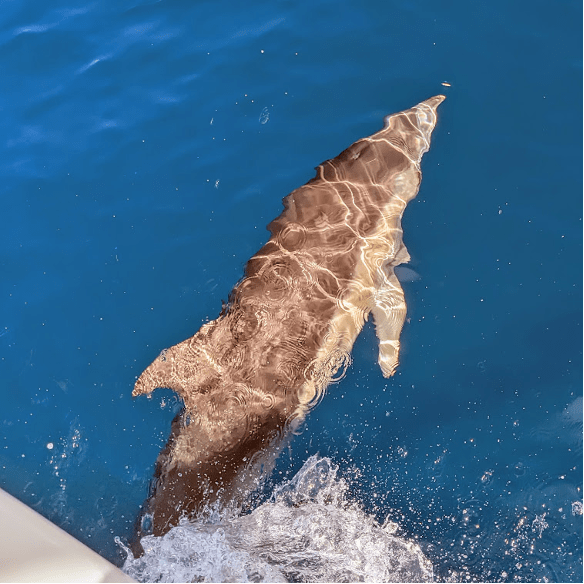
When we sail to Kangaroo Island, we are frequently accompanied by pods of dolphins. They are curious about the sound of the engine, and swim towards the bow. They swim back and forth in front of the boat, diving in and out of the water and keeping pace with the vessel in a performance for the sailors. They accompany us for about five minutes before disappearing. We hardly have time to feel bereft, because before long another pod approaches and provides the same performance.
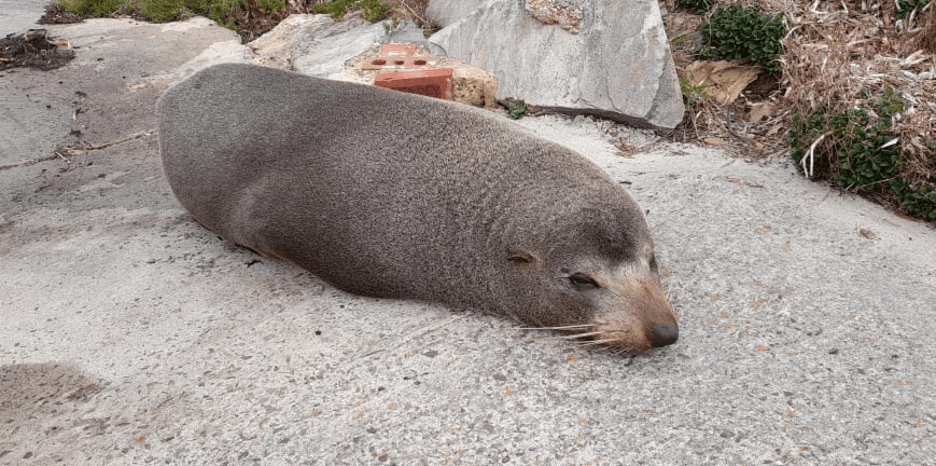
Once on Kangaroo Island, we drive to the township of American River, named after American sealers who visited in 1802. No sooner do we park at the wharf, than we spot seals on the rocks. We had thought that we would need to visit Seal Bay and pay an entrance fee to see seals, but here they are lazily resting in the bay in American River.
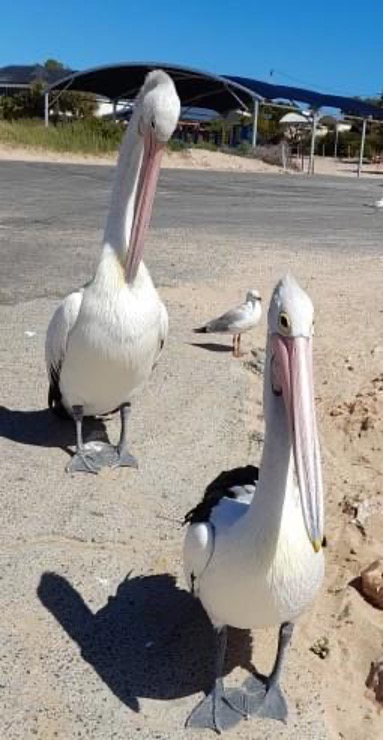
Once back on the mainland we decide to drive to the distant Eyre Peninsula in order to view the majestic seaside cliffs at Elliston. We enjoy strolling along the top of the cliffs and witness the ocean relentlessly pounding into the shoreline. We are just about satiated, but nevertheless decide to visit nearby Venus Bay. Here we are greeted by pelicans sunning themselves on the beach.
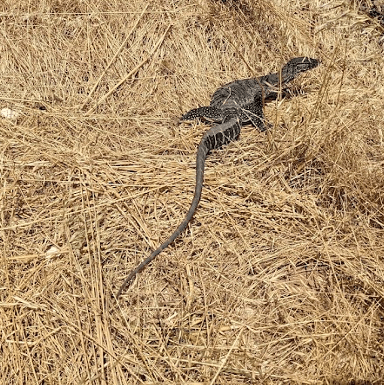
Driving back on the long dusty roads crisscrossing the peninsula we spot sleepy lizards slowly making their way across the roads. Every time we spot one we have to break and gently swerve to avoid them.
Then, as we approach the shore, a Rosenburg’s Monitor rustles in the grass. After detecting our presence, she makes a hasty retreat.
Finally, closer to home, in the undulating hills south of Adelaide, our attention is taken by a Clydesdale horse in a paddock. We stop the car so I can greet him. He walks towards me hoping to be rewarded by a carrot or an apple, but I am empty-handed. His forelock sweeps across one eye and is about the same length as my hair.
We have not had to visit a zoo or an aquarium. The tourist brochures have been helpful but none could have prepared us for the fleeting appearances of rosellas, dolphins, seals, pelicans, sleepy lizards, Rosenberg’s Monitors and a Clydesdale. As Alain de Botton reminds us in The Art of Travel. “Try, before taking off for distant hemispheres to notice what we have already seen.” Due to the pandemic, taking off for distant hemispheres is no longer straightforward. I am forced to pay attention to what I have already seen.
Meredith Stephens is an applied linguist in Japan. Her work has appeared in Transnational Literature, The Blue Nib, The Font – A Literary Journal for Language Teachers, The Journal of Literature in Language Teaching, The Writers’ and Readers’ Magazine, Reading in a Foreign Language, and in chapters in anthologies published by Demeter Press, Canada.
.
PLEASE NOTE: ARTICLES CAN ONLY BE REPRODUCED IN OTHER SITES WITH DUE ACKNOWLEDGEMENT TO BORDERLESS JOURNAL
Shadows pose behind and beyond; shapes and curtains flow.
Harmony of upside down and turn around in traces and hearts unfurl.
What self-conversation stumbles among the shapes that reveal a secret core?
To peer, without haste and permit the eyes and nose to investigate. The hands and body bend to each shrine of nature.
What musicality trails the leaves. A taste of tart and surprise entreats
. . . and yet?
Awake in the wild of impermanence, the temple draws an adventurer.
What do I know of secrets I don’t understand?
Like dew, a phantom or the flare of sunset gone. With hope revisited.
and yet . . . to awaken and arrive again at dawn.
.
.
Penny Wilkes, served as a science editor, travel and nature writer and columnist. An award-winning writer and poet, she has published a collection of short stories, Seven Smooth Stones. Her published poetry collections include: Whispers from the Land, In Spite of War, and Flying Lessons. Her Blog on The Write Life features life skills, creativity, and writing: http://penjaminswriteway.blogspot.com/ . Her photoblog is @: http://feathersandfigments.blogspot.com/
.
PLEASE NOTE: ARTICLES CAN ONLY BE REPRODUCED IN OTHER SITES WITH DUE ACKNOWLEDGEMENT TO BORDERLESS JOURNAL
WALKING GRETCHUMS

Ever seen a walking gretchum?
'The Scourge of a Good Night's Sleep' they are called.
Exactly when you are tired of the day's din and bustle,
Of trying to crawl up the ladders of your world,
And all you want to do is lie down and start the new day afresh,
Or when you are full and getting ready for your afternoon nap,
They will climb your bed and whisper into your ears,
All that which would have been better if you had not heard.

To semi-suicidal teens, they sing songs to overcome acrophobia.
To nine-to-five workers, they sing hymns of living the high life.
To the eligible jobless, they play the clarion call to defiantly create their own worlds.
To the old and wise, they sigh about counter culture blues,
Saying, there's still time to be obscene if you haven't tried that in your youth.

Whether they are good or bad is still up for debate though.
However, that is mostly because they sealed the mouths of opposers with craft glue.
Maybe that's why people call them crafty.

Finally, a word of advice for all those who sleep with their ears open,
If you see little horned creatures, with a little microphone and speaker in hand, trying to get inside your mosquito net, don't ignore them.
The worst thing you can do is to leave them
For they feed on human ignorance.
The best thing to do is to call someone else to stare,
Because the walking gretchums have one glaring weakness,
They set themselves on fire when more than one pair of eyes simultaneously look at them.
Saptarshi Bhattacharya is a student at St. Xavier’s College, Kolkata, India. He is an amateur writer and a die-hard Bob Dylan fan.
.
PLEASE NOTE: ARTICLES CAN ONLY BE REPRODUCED IN OTHER SITES WITH DUE ACKNOWLEDGEMENT TO BORDERLESS JOURNAL
The word echoed like shotgun fire through Trafalgar Square.
Pigeons scattered. Most quietened back to the ground, some flew to the domed roof of the National Gallery or away into the low and oystery clouds that folded in the morning sky.
The old man stood at the foot of the Gallery’s steps, a frayed square of cardboard and scratchy blanket at his feet a dog may have lain on before, though he stood alone and crooked, his lucid eyes betraying his wilted frame.
He clenched his fists by his side, closed his eyes and bellowed again.
GUILTY!
I was sat at the eastern fountain, soothed by the sound of sluicing water and the pulsing rumble of traffic from The Strand, but the word pealed through the square like a sudden toll of a faulty clock. I’m unsure how long I sat on the fountain wall watching him. He ignored me as if it was all part of street act, and perhaps I convinced myself it was to justify my voyeurism. We were invisible to each other and ourselves.
The square was quiet save litter pickers and the occasional businessperson crossing the square toward the office buildings, oblivious as the old man gradually lifted his arm in the air as if raising a starting pistol and roared the word once more.
GUILTY!
A smartly dressed woman walking alone toward Pall Mall vaulted like a frightened horse at the noise.
Guilty! He hissed behind her canter.
After she turned a corner, he stood to as upright a posture he could like an abandoned soldier, taking a moment to uncoil his wiry beard with his yellowed fingers, straighten his mariner cap and wipe his eyes.
Still, he didn’t look at me.
I began walking in the early mornings half a year ago. Four mornings after London came together to celebrate hosting the 2012 Olympics, three mornings after it was torn apart by bombs under and over ground. After days of self-confinement, my flat no longer felt like sanctuary. The view from my window of rows of shops and diners that often disappeared behind the type of bus that exploded in two filled me with dread. The bus would wait at the stop outside the drug store. And wait.
After a vivid dream of being chased by a bus and waking up at the pneumatic hiss of the first number 32 pulling in, I got out of bed, got dressed and left my flat to walk with no particular destination in mind. I walked all the way to Hackney Marshes and sat on the banks of the River Lea with a bottle of wine and a plastic cup. Usually, families would paddle in the water, but nobody swam that day.
The walks would last most of the day. I would circle Cricklewood to start, then walk through Maida Vale and Hyde or Regent’s Park and sometimes past the Thames toward Battersea. Every walk was navigated only by my awareness of London’s streets. I began stopping at pubs but felt too anxious to settle, even after drinking my fill.
A week later, my strolls brought me to Trafalgar Square. Small cuts of paper streamers floated on the paving and bobbed on the fountain’s water. The party was over before it began. The smoke and the ashes had dispersed, and the streets were cleansed of the mechanical — and other — remains, but something still hung in the air, like anger and fear had evaporated into an electrostatic force. It tasted blood-coppery and drifted consciously like lost ghosts.
The wound still gaped and would continue to as London silently endured.
Together, said the news, but London was shattered into grains that refused to rebind.
GUILTY!
But of what, precisely? Pride? Greed? Complacency? I took my battered tobacco tin from my pocket and picked out a pre-rolled cigarette. The bite of the first morning cigarette lingered and faded. I found myself drifting into the fountain’s chant and closed my eyes, my mind empty of all thought and memory. I remained in this mesmerised state until my cigarette burned down to my knuckle. When I reopened my eyes, the man had gone.
I checked my watch. Eight twenty-four. More people were passing through the square. Soon, groups would gather and loiter. I had no intention of being among them, so I rolled the remaining paper and tobacco between my fingers and scattered the dust on the ground, stepped off the fountain wall and headed east to the river.
Walking down Duncannon Street reminded me why I preferred the openness of the square. Cars passed closer, and the narrow pavement guided people to cross in tighter herds. While before I would walk with my head down, I now mark in every face I meet the city’s burdens. Though today, fewer people walked toward me. From the offices and the bistros, people exited and headed instead for the river until we were all like knots in the same rope being pulled toward the turbid waters.
Around Embankment Station, the line dispersed. People headed to the footbridge or the pier to get a closer look at the river. I headed to an elevated walkway that granted a view down the river all the way to the Vauxhall curve.
“There, I see it!” Cried out a man on the bridge, pointing down the river.
The morning sunlight burned on the water’s surface.
“Where”? asked a clipper, dashing on the sloping bank.
The gasps and cries could be heard over the traffic and the wind that groaned through the bridge girders.
I saw it. First a ripple on the surface and then the emergence, grey and colossal.
“There!”
“A whale! Look mum!” cried a child beside me, clutching his mother’s skirt. The mother held her hand to her mouth.
Throughout the morning and into the afternoon, crowds gathered on the banks and bridges to catch a glimpse of the whale that had come to visit. Though it had submerged soon after peering above the surface, we cooed over any disturbance in the water and cheered for the rescue service that zipped along the river on small engine boats toward any unconfirmed sighting.
I watched the river carefully. The water heaved with all the activity, exciting the crowds, who’s faces stole my attention. Many smiled and waved, as if welcoming family back from a long journey at sea. Many clapped and cheered. Some were holding back tears while others openly cried. Some prayed, in different styles and languages. It was a harmony of loving chaos. We were all, with our scars and religions, willing the whale to survive. We were thankful for its visit and the well wishes, but mentally guided it back to the vast ocean. We wouldn’t admit to ourselves that it was lost and afraid, that it had made some navigational error and swam into the shallow, fetid waters of our notorious tributary by mistake. A river once so polluted it was declared biologically dead. A river once a whaling port, where the stranded were hacked up for their oil and bone. A river that regularly surrenders corpses. We willed it back to safety with all our collective strength.
I stayed leaning on the walkway railings until the sun set and the winter chill had seeped through to my bones. I gazed on to the now calmer waters. Fewer rescue boats patrolled the river and most of the families had left. Workers crossed the footbridges with their heads down. I thought about the old man on the square. I still didn’t know what he was accusing us of, but really, I don’t think he did either. We all have our secrets, faults and regrets and we all have our rules and devotions. We have our histories that shape our futures, and for now the ever-occupied present. The old man stood there as a mirror to all that dared to look into it, and if they did, they would confront their guilt — just as we did when we stared into the soul of our river — and scream until all that is left is blind hope.
For the first time since the bombs, I wanted to go home.
.
Luke Draper is from Portsmouth, UK and lives in Japan. He studied Creative Writing at the University of Chichester. His literary influences include Leonard Cohen and Ryūnosuke Akutagawa.
.
.
PLEASE NOTE: ARTICLES CAN ONLY BE REPRODUCED IN OTHER SITES WITH DUE ACKNOWLEDGEMENT TO BORDERLESS JOURNAL.
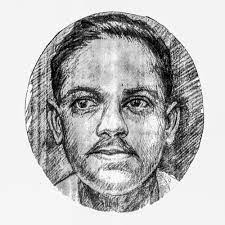
Jibananada Das (1899-1954) was a Bengali writer, who now is named as one of the greats. During his life he wrote beautiful poetry, novels, essays and more. He believed: “Poetry and life are two different outpouring of the same thing; life as we usually conceive it contains what we normally accept as reality, but the spectacle of this incoherent and disorderly life can satisfy neither the poet’s talent nor the reader’s imagination … poetry does not contain a complete reconstruction of what we call reality; we have entered a new world.”
ONE DAY IN THE FOG...(“Akdin Kuashai” from Ruposhi Bangla)
I well know a day will come when you won’t find me in this foggy field
Having ended its walks, the heart will move on to a silent, icy room then
Or perhaps it will be a while before it can be consoled. It may take time
For it to forget this earthly field. In astonishment, I’ll keep looking
At the shaliks of the field from my bed in darkness. Will golden eagles
Still unfurl their wings and waft their way to this fog-filled field from afar?
To this day they head for bare ashwath branches as evening turns golden.
While through the soft rice stalks field mice still keep looking at the stars
As evening descends. Do bees still not build hives in intense dense darkness?
Having their fill of honey, don’t they fly away in the foggy, evening wind?
So far they must fly to, alas…or perhaps hemmed by chalta leaves
Some get trapped under hives. The flies fly away…drop… die in the grass—.
Title: Jibanananda Das: Selected Poems with an Introduction, Chronology and Glossary
Translated by Fakrul Alam
Publisher: The University Press Limited, Dhaka.
BANALATA SEN

For a thousand years I have walked the ways of the world,
From Sinhala's Sea to Malaya's in night's darkness,
Far did I roam. In Vimbisar and Ashok's ash-grey world
Was I present; Farther off, in distance Vidarba city's darkness,
I, a tired soul, around me, life's turbulent, foaming ocean,
Finally found some bliss with Natore's Banalata Sen.
Her hair was full of the darkness of a distant Vidisha night,
Her face was filigreed with Sravasti's artwork. As in a far-off sea,
The ship-wrecked mariner, lonely, and no relief in sight,
Sees in a cinnamon isle signs of a lush grass-green valley,
Did I see her in darkness; said she, "Where had you been?"
Raising her eyes, so bird's nest-like, Natore's Banalata Sen.
At the end of the day, with the soft sound of dew,
Night falls; the kite wipes the sun's smells from its wings;
The world's colours fade; fireflies light up the world anew;
Time to wrap up work and get set for the telling of tales;
All birds home—rivers too—life's mart close again;
What remains is darkness and facing me—Banalata Sen!


LIFE'S MART HAS CLOSED AGAIN
(Shesh Holo Jeebaner Lenden)

Life’s mart has closed again
			Banalata Sen!
Where have you gone at this time of the day
The kingfisher hasn’t forgotten its noontime play
The shalik bird to its nest has found its way
Excited, the river is foaming again
	But you are nowhere, Banalata Sen.

Was there anyone like you anywhere?
Why is it that you are the first to disappear?
	Why do you have to be the first
	To go and make the world a desert
	(Why are you always the first?)
The magician’s mantras have lost their hold over men
	But you are far away Banalata Sen.

Evening will always come and spread across the sky
	Often I go to sleep where slums are close by
	Often winds startle and go on a high
In a station in hijal jam forests has stopped the night train
	Late night’s Banalata Sen!
(These translations are from Jibanananda Das: Selected Poems with an Introduction, Chronology and Glossary, translated by Fakrul Alam, published by The University Press Limited, Dhaka, 1999. Republished with permission from the original publisher.)
About the Book: Jibanananda Das (1899-1954) is one of the most important poets of Bengal. Nevertheless, he remains a poet little known outside West Bengal and Bangladesh. Perhaps due to the absence of competent translations into English and other languages, Das achievement as a poet remains unrepresented in world literature. This selection of poems is designed to emphasise how Das’s poems are great treasures of our literature through the medium of translation. Fakrul Alam’s uniquely competent English translations were done originally mark the birth centenary celebrations of Jibanananda Das this year (1999). In this second edition, he has translated a few more poems to show even more fully the range of Das’s verse. Lovers of poetry outside the Bengali-speaking world should get a sense of the richness of Das’s poetry, his growth as a poet, and the extraordinary range of his work through these translations.
Rakibul Hasan Khan explores death and darkness in Fakrul Alam’s translation of Jibanananda Das’s poetry
Jibanananda Das: Courtesy: Creative CommonsProfessor Fakrul Alam
I
Literary translation is a creative work, and the literariness of a translated work reflects the creativity of the translator. From a reader’s perspective who does not know the language of the “original”, the more the translated work reads “natural”, the better is the translation. But it is very intriguing from the viewpoint of someone who has access to both the original and the language of the translation. Reading the translation for such a reader is sometimes like reading the same poem in two languages at the same time, which is often a very enriching and exhilarating experience. But it is not always the case, for such readers may show a critical attitude to the translation for having a “bias” towards the original, especially if the latter is written in their first language. Then their reading turns out to be more an evaluation of the translation than enjoying the work in translation. It is a difficult task for such readers to overcome this predicament.
I also face this predicament while reading Fakrul Alam’s translations of Jibanananda Das’(1899-1954) poetry in Jibanananda Das: Selected Poems with an Introduction, Chronology, and Glossary (Dhaka: UPL, 2nd Ed, 2003). To keep aside my evaluative concerns, therefore, a middle course was necessary, while still comparing the translations with the originals. To this end, I read some of the most “popular” poems by Das in Alam’s translations with a particular focus on the latter’s recreation of the images of death, dread, and darkness.
There is a personal preference for my choosing of the dark images, for I always find Das’ grotesque or dreadful images as appealing as the beautiful ones, but more important reason for my choosing of the dreadful than the beautiful is to underscore the experience of a poet who lived under the dark shadow of colonial rule. Initially, I thought it would be very intriguing to read Das’ poetry postcolonially in Alam’s translations because of the latter’s reputation as an academic in the field of postcolonial studies. But while reading the translations, particularly the erudite introduction that he has included at the beginning of the volume to introduce the salient features of Das’ poetry as well as to offer a very insightful and resourceful discussion on others’ and his translations of the poet, I felt that Alam almost altogether suspended his postcolonial self and fully activated his own creativity to capture the sights and sounds of the works of a poet who is extraordinarily famous for the aesthetic and artistic qualities of his poetry. Alam seems to have embraced this challenge enthusiastically and has succeeded with flying colours, but his emphasis on the art may have cost him thematically on certain occasions, although it has not diminished the overall quality of the translations. His translations also continue to bear the mark of his academic background as a scholar in English studies.
In spite of discovering that Fakrul Alam does not highlight the postcolonial elements in Jibanananda Das’s poetry, I did not abandon my initial plan of reading his translations through postcolonial lenses. Therefore, I resort to Edward Said, whom Alam considers his “guru”, to adopt the former’s concept of “contrapuntal reading” and apply it on the latter’s translations.
Said theorised contrapuntal reading as a technique of reading the texts of English literature, particularly the novel, to unravel the unrecognised and unarticulated elements of colonisation which are ostensibly absent in those texts. I adopted this technique for reading Alam’s translations to examine the images of death, dread, and darkness in Das’ poetry as the expressions of the poet’s experience as a colonised person. To view translation as an act of interpreting a text, I invoked Frederic Jameson’s formulation that interpretations of literary texts could bring to surface the repressed political unconscious in the narrative. Although Jameson’s theory is essentially a Marxist reading strategy, for my postcolonial materialist reading of Fakrul Alam’s translations, a reworking was necessary. Alam’s translations brought to light the repressed political unconscious in Das’ poetry, giving clue to the poet’s rendition of the grotesques as a result of the material realities of his time under the British Empire.
II
The first poem of Jibanananda Das that I read in Fakrul Alam’s translations is “An Overwhelming Sensation” (“Bodh”) – a deeply engaging poem that highlights the extraordinary sensibilities of a poet that separate them from the multitude. There are two “dreadful” images in this poem, and the first one is as follows:
In my head!
Walking along beaches – crossing shores
I try to shake it off;
I want to grab it as I would a dead man’s skull
And dash it on the ground; yet, like a live man’s head,
It wheels all around my heart!
(26-31, p. 30)
The image of death and dread in the above quotation reminds me of Shakespeare’s the “grave diggers scene” in Hamlet as well as “Lady Macbeth’s persuasion scene” in Macbeth, although the original poem does not allude to Shakespeare so noticeably. Similarly, the second dreadful image of the poem resonates a Shakespearean diseased imagery in Alam’s translation:
Eyes whose nerves have dried up,
Ears which cannot hear,
And like that hump – a goitre erupting on flesh
Rotten cucumber – putrid pumpkin –
All that have grown rank in the heart –
All that.
(101-106, p. 32)
Is it a mere coincidence that Alam’s translations of the above images of death and dread remind me of Shakespeare? Do they have any connection with his academic background of English studies that must have included Shakespeare? It is also not a coincidence that Das himself was a student of English literature, who also pursued a teaching career in English. The colonial connection of English studies in the Indian subcontinent is a historical fact, which occasioned for the poet, the translator, and me to study the Bard, but more important is to note on how the presence of Shakespeare becomes more obvious in Alam’s translation than it is in the original. To me, the dreadful images recreated by Alam reflects the tormented mental state of the colonised poet. If we keep in mind that the original poem was written around the death throes of the colonial rule in India, we cannot overlook the link between these images and colonisation.
“Camping” (“Campe”) is another poem that contains some extremely poignant and dreadful images. In Fakrul Alam’s translation, this poem’s connection with colonisation becomes more recognisable than it is in the original. The poem describes a hunting night in a forest where the speaker of the poem is camping: “Somewhere deer are being hunted this day; / Hunters have moved into the heart of the forest today” (6-7, p. 32). The night for the speaker is both enchanting and mysterious – “a night full of wonders” (60, p. 34), but it turns into a horrible one due to the presence of the hunters. In Alam’s translation, the anxiety of the speaker reflects an acutely sensitive mind of a person who is restless by what is happening around him:
I can sleep no more;
Lying down
I hear gunshots;
And then more guns firing.
In the moonlight the doe in heat call again.
Lying down here all by myself
I feel a heaviness in my heart
Hearing gunshots
Hearing the doe calling.
(42-50, p. 33-34)
Alam’s use of the words, “gunshots” and “guns firing”, perfectly captures the dreadfulness of the night and clarifies the heaviness of the speaker’s heart. He makes the anxiety of the speaker palpable. As he informs the reader with a footnote at the beginning of the poem, Jibanananda Das wrote this poem as an expression of “the helplessness of life” (p. 32), the above lines represent that helplessness of the speaker.
Interestingly, this is a love poem – seemingly. The speaker compares himself with the fallen lovers of the doe who tempts the stags to come out of their hideouts by calling them passionately but deceivingly to be shot by hunters. According to the speaker, the doe has learnt this art of deception and cruelty from humans: “Lessons she has learnt from humans!” (51-54, p. 34). In Alam’s translation, the cruelty of hunting and the agony of the speaker become obvious:
I hear a double-barreled gun thunder,
The doe in heat keeps calling,
My heart can’t get to sleep
As I lie down all by myself;
(79-82, p. 35)
Here the doe is a symbol of deceptive love. The speaker himself is also a victim of such love. His heart bleeds at the sound of gunfire. The innocent death of the stags reminds him of his own wretched state, but he is aware that he needs to learn how to negotiate with this wretchedness: “Still I must learn to forget sound of guns going off” (83, p. 35). This realisation gives the speaker the composure to reflect on the identity of the hunters:
They who own the double-barreled guns that destroyed the stags this day,
They who brought the relish of deer flesh and bones to their dinner
Are like you –
Lying in camp beds they are drying up their souls
Reflecting on their feast – reminiscing – remembering.
(84-88, p. 35)
The hunters are those who “own the double-barreled guns”. Does it ring a bell? Although the first Mughal Emperor Babur introduced guns in India in the sixteenth century, it is the British who made use of guns the most in the Indian subcontinent. Thus, there is a strong association between the British colonisers and the hunters in this poem.
Alam’s translation brings to surface the repressed political unconscious of the poem. If the poem is an expression of “the helplessness of life”, he heightens that helplessness, demystifying some of the obscurities of the original poem in the process of translating it. He succeeds in recreating the atmosphere of horror that does not let the speaker sleep. The anxiety of the speaker over the helplessness of his fellow people and of the animal world as a whole make us think about the time and place of writing this poem.
The dreadful images of death and dread recreated by Alam using words and phrases like “gunshots”, “guns firing”, and “double-barreled gun thunder” present before us a troubled world where the serenity of the natural world is shattered by the sound of gunshots. Yet, the speaker realises that he needs to negotiate. The colonised also had to negotiate with the colonisers. Therefore, if we situate the poem against the backdrop of its writing during the colonial period from a colonised location, can we overlook its colonial connection? Does Das portray the tormented state of the colonised through this allegorical love poem? This allegory of the hunted existence of the colonised becomes more perceptible than the original through Alam’s interpretative translation – translating as interpreting. Alam’s translated version of the poem reveals the material realities of the poet’s time which are largely concealed by symbols and imageries in the original poem.
III
To write on the theme of darkness, the poem “Banalata Sen” first comes to my mind, for I consider it as one of the darkest poems by Das. The poem’s darkness is very subtly camouflaged by a tapestry of extraordinary images. Its astonishing popularity as a love poem also often hides the darkness. Alam’s translation largely unveils the camouflage, and brings to light the overwhelming darkness of the poem. In the Bangla version, Das deploys the word “darkness” by somewhat screening it with other associated images and allusions. Alam also does so without using any synonym for “darkness” in his English translation, understandably for not affecting the poetic quality of the poem. As a result, the word “darkness” appears as many as five times in his translation, which is the same number as in the original. Here, the recurrent word has been put on bold typeface.
From Sinhala’s Sea to Malaya’s in night’s darkness,
…
Was I present; Farther off, in distant Vidarba city’s darkness,
…
Her hair was full of the darkness of a distant Vidisha night,
…
Did I see her in darkness; said she, “Where had you been?”
…
What remains is darkness and facing me – Banalata Sen!
(2, 4, 7, 11, 18, p. 61)
Fakrul Alam does justice to the original while translating this “difficult” poem, and exposes the dominance of darkness in it. Probably any other translator would also keep the word “darkness” the same number of times, but Alam’s success lies in his maintaining a similar artistic sublimity that we find in the original poem. It is evident in his coining or use of the phrases like “the ways of the world”, “ash-grey world”, “foaming ocean”, “the soft sound of dew”, “fireflies light up the world anew”, and “life’s mart close again”. His successful recreation of the images of darkness opens up the opportunity to explore the political potentialities of the poem.
“Darkness” (“Andhakar”) is another poem of overwhelming darkness. Fakrul Alam’s translated version of this poem also testifies my claim of his interpretive translation. He also explains in the introduction of the volume the process of his using self-explanatory words for retaining Bengali names to honour Jibanananda Das’s preference for this: “[t]he sensible option, it appeared to me, was to use Bengali names when an exact English equivalent was not available, and then to use a Bengali word in such a way that the meaning could be conveyed where possible within the line” (p. 21). Alam’s explanatory use of two Hindu mythological rivers’ names in the following lines of “Darkness” may also clarify my point:
I looked up and saw the pale moon withdrawing half of its shadow from that river of death, Vaitarani,
As if gesturing towards the river of mutability, the Kirtanasha. (2-3, p. 72)
Alam supplements the meanings of the rivers by using the phrases “that river of death” and “the river of mutability” before Vaitarani and Kirtanasha respectively, while in the original poem, there is no such explanatory “notes” preceding the rivers’ names, assumingly because the Bengali readers of the poem are supposed to know the names of these mythological rivers, although I think many Bengali readers are also not fully informed of the significance of these rivers. Therefore, Alam’s innovative use of these rivers’ names becomes self-explanatory, without undermining the poetic quality of the lines. Similarly, the following line of the same poem is another example of his explanatory translation: “O Moon whose brightness has faded to a faint blue” (6, p. 72). In this line, the part following “O Moon” is clearly an attempt by the translator to explain the faded colour of the moon. However, Alam’s translation of this poem, like “Banalata Sen”, enhances the deep darkness manifested in the original.
If we go back to the time of publication of the volume Banalata Sen (1942) where the two poems “Banalata Sen” and “Darkness” were included, we can get an explanation to the poet’s obsession with darkness. It was indeed the darkest time for the people of the Indian subcontinent under British colonisers. The colonial rule affected the Bengal province (where Jibanananda Das is from) so severely that it resulted in the worst famine in the subcontinental history in 1943. The Bengal famine of 1943 has been called a “man-made holocaust” by Gideon Polya, for which the then Prime Minister of England Winston Churchill’s policy of hoarding food supplies for the British soldiers fighting in the Second World War by depriving the colonised. Apart from the effects of the famine and the World War, communal conflicts also ravaged the peacefulness and harmony of life in this region. The optimism of anti-colonial movement was soon to be marred by the proposal of partitioning India on the basis of “two-nation theory”. All these must have affected Das while writing “Banalata Sen” or “Darkness”, and Alam’s translations give us a clear view of the unfathomable darkness that engulfed the poet’s world.
IV
In this section, Fakrul Alam’s translations of the poems of Beautiful Bengal [Ruposhi Bangla], one of Jibanananda Das’ most loved poetry collections, will be discussed. The poems of this collection reflect the poet’s deep attachment with his land as well as his meditations on death and reincarnation through picturesque and sensuous portrayals of the flora and fauna and the landscapes of rural Bengal. The first poem of this volume that appears in Alam’s translations reveals the poet’s musings on death. The very title of the poem, “Knowing How These Fields Will Not Be Hushed That Day” (“Shei Din Ei Math”), alludes to the day after the poet’s death. In Alam’s translation, the poet’s sense of grief imagining the day when he will be no more becomes as poignant as it is in the original:
Because I will disappear one day
Won’t dewdrops ever cease to wet chalta flowers
In surges of soft scent?
(4-6, p. 43)
These lines demonstrate the poet’s wistful imaginings of the time after his own death, but at the final stanza of the poem, he perceives death from an objective viewpoint. Alam perfectly captures this transition from subjective to objective, and presents it as authentically as possible:
Quiet lights – moist smells – murmurings everywhere;
Ferryboats moor very close to sandbanks;
These tales of earth live on forever,
Though Assyria in dust – Babylon in ashes – lie.
(9-12, p. 43)
In Alam’s translation, the poet’s contemplation of the inevitability of death and the impermanence of everything, including great civilizations, appear in a perfect state of semblance and equipoise as in the original poem.
“Go Wherever You Want To” (“Tomra Jekhane Shadh”), one of the most famous poems of Beautiful Bengal, bears evidence of the poet’s deep desire to stay eternally in the lap of Bengal amidst its unique beauties, refusing the prospects of moving to elsewhere, especially to any foreign land. The poet asks those fascinated by the attractions of foreign lands to go wherever they want to, but he himself wants to remain in Bengal eternally, justifying his decision by describing its bewitching beauty. Fakrul Alam is at his best as a translator in recreating the sights and sounds of the poet’s beautiful Bengal, where the sestet of the sonnet implies the poet’s eternal connection with this land:
Ready to take her grey-coloured duck to some storyland –
As if the smell of Paran’s tale is sticking to her soft flesh,
As if she has risen from her underwater kalmi reed abode –
Silently leaving herself in water once – then disappearing
Into the fog far, far away – but I know I’ll never lose sight of her
Even in the press of the world – for she is in my Bengal evermore.
(9-14, p. 44)
Apparently, this poem is free from the heaviness of death imageries, but a close examination may bring to surface the poet’s embedded desires for death and rebirth. His yearning for remaining in Bengal eternally is only possible through his reincarnation in this land after his death.
The poem “I Have Seen Bengal’s Face” (“Banglar Mukh Ami Dekhiyachhi”), another sonnet of Beautiful Bengal, further justifies the poet’s decision to stay in Bengal for good and to go nowhere else. In his translation of the poem, Alam shows outstanding artistic skills to emulate the aesthetic and poetic beauty of the original. The octave quoted below may clarify my point:
I have seen Bengal’s face, and seek no more,
The world has not anything more beautiful to show me.
Waking up in darkness, gazing at the fig-tree, I behold
Dawn’s swallows roosting under huge umbrella-like leaves.
I look all around me and discover a leafy dome,
Jam kanthal bat hijol aswatha trees all in a hush,
Shadowing clumps of cactus and zeodary bushes.
When long, long ago, Chand came in his honeycombed boat
To a blue Hijal Bat Tamal shade near the Champa, he too sighted

Bengal’s incomparable beauty.
(1-9, p. 49)
Alam’s innovative use of native tress and legends appear as spontaneously and effectively as possible to make the piece apprehensible to non-native readers. The poem gestures to the poet’s desire to glorify his land and culture, and Alam’s translation further accomplishes that glorification.
The poet’s desire for rebirth in Bengal is emphatically expressed in the poem “Beautiful Bengal” (“Abar Ashibo Phire”). Since the poems of the Beautiful Bengal are untitled, the first line of each poem is mostly accepted as the titles of the poems in Bangla original. Fakrul Alam also mostly follows this tradition, but often makes use of his freedom as a translator to change the title. The title of this poem “Beautiful Bengal” in Alam’s translation is another example of his applying that freedom. Perhaps he translates the title so differently from the “original” title, which could be something like “I Will Come Again”, to emphasise the extraordinary popularity of the poem that could easily be rendered as the titular poem of the volume. While I agree with this position, I feel it is deviating from the sense of reincarnation that the “original” title evokes. However, Alam does not deviate from the idea of return used as a refrain in the whole poem, and maintains the same stature as a translator that I find him in most other poems. I quote first few lines of the poem to support my view:
I’ll come again to the banks of the Dhanshiri – to this land
Perhaps not as a human – maybe as a white-breasted
shankachil or a yellow-beaked shalik;
Or as a morning crow I’ll return to this late autumnal rice-harvest laden land,
Wafting on the fog’s bosom I’ll float one day into the jackfruit tree shade;
(1-4, p. 51)
This poem can be read as a companion piece to the two other poems I have discussed above: “Go Wherever You Want To”, and “I Have Seen Bengal’s Face”. The idea of reincarnation and the feeling of an inseparable connection with the homeland reverberate in these poems with exquisite descriptions of the beauty of Bengal.
The poems of Beautiful Bengal are perhaps most passionate “postcolonial poems” by Jibanananda Das, where he glorifies his native land and culture as an attempt to recuperate the damages done to those by colonials. Fakrul Alam’s translations bring to surface the repressed postcoloniality of these poems by making the poet’s postcolonial sensibility more prominent than they are in the originals. Das’s deep rootedness in his land and culture expressed in the poems of Beautiful Bengal exemplifies his unequivocal stand on the question of belonging. During a time when the colonial effects occasioned for many of his contemporaries to leave their homelands and embrace diaspora identities, Das’s unwavering utterance like “Go Wherever You Want To” reflects his resistance to colonization. It remains as a source of inspiration for many in the days to come, particularly at the wake globalization when the lure of a transnational identity complicates the questions of home and belonging.
V
In the final section of the essay one of Jibanananda Das’ most overtly time conscious poem entitled “1946-47” will be discussed. As the title suggests, this poem reflects Das’ deep observations on the contemporary sociopolitical issues of his time during and preceding the year of partition of India. Fakrul Alam adds a brief note to the poem to brief his readers the poem’s background. I find that note as a very helpful starting point for those who are not informed of the history of the Indian subcontinent. I quote it entirely to demonstrate how meticulous Alam is to make his translations comprehensive as well as comprehensible, particularly for non-native readers:
” “1946-47” is the longest poem by Jibanananda Das that I have translated and is one of his most impressive meditations on contemporary history. In it, he broods on the communal strife, chaos, and diasporas that accompanied the partition of India in general and Bengal in particular. Das himself had been uprooted by historical events, and had moved from the Muslim majority district of Barisal to Calcutta, where Hindus were in a majority. But Calcutta too was in tumult and riven by religious riots; the names and places mentioned in the poem represent Hindus and Muslims and localities associated with these communities.“(p. 115)
With this note, the translated version of the poem becomes self-explanatory and more transmissible than the original, but it may surprise one that neither Das nor Alam directly mention the culpability of the colonization for the tumultuous historical events that the poem foregrounds. Perhaps both of them skip this deliberately, for the role of the British colonisers is too obvious to mention.
The long history of colonial rule culminated in the partition of India, which was preceded and followed by communal riots and dispersion of people from their homelands, resulting in deaths, dreads, and destructions. Therefore, the poem is replete with images of dead, dread, and darkness that best describe the time it represents. In Alam’s translation, the horror of human atrocities becomes as poignant as in the original:
Somewhere someone’s house will be auctioned off now,
Possibly for a song!
And so you must cheat everyone else
And be the first to reach heaven!.
…
Thousands of Bengali villages, drowned in disillusionment and
benighted, have become silenced.
…
The children now are close to death, trampled
By ignorant exhausted rulers of an era of misgovernment;
Their ancestors had once laughed and loved and played,
And had gone to rest in dark after raising permanently
The swing landlords had them make from tall trees for charak festivals.
They were not that well off then; yet compared to present-day villagers,
Blinded and tattered by famines, riots, darkness and ignorance,
They lived in a distinct and clear world.

Is everything indistinct today? It is difficult to speak or think well now;
The rule is to keep everyone in the dark, full of half-truths;
The practice is to infer the other half of truth
All by yourself in the dark; all are suspicious of each other.
(3-6, 31, 49-60, p. 115-17)
The implications of the lines I have quoted above from Fakrul Alam’s translation of the poem “1946-47” are so obvious that they do not require further explanation. Das’ political consciousness is relatively more apparent here than his most other poems. In Alam’s translation, that political consciousness resonates very loudly. Like a typical postcolonial poet, Das highlights the miseries caused by colonial rule, comparing the present with a “better” past. While making this comparison, he refers to the exploitative system called “Permanent Settlement of Bengal” introduced by Earl Cornwallis on behalf of the East India Company in 1793 to settle a deal between the Company and the landlords, causing enormous oppression and deprivation for the peasants and those at the margins. Fakrul Alam aptly explains this reference with a footnote that “[t]here is an allusion here to the system introduced by Lord Cornwallis in colonial Bengal in 1793 which created a class of landlords and let to the impoverishments of peasants” (p. 116). Notes like this and the glossary he has added to the volume makes the poems very much accessible not only to the non-native readers but also the native readers of the translations.
In fine, I repeat that translating is a process of explaining a text, and often it is on the discretion of the translator how explanatory the translation would be. In the case of Fakrul Alam’s translations of Jibanananda Das’ poetry, sometimes his attempts to explain the texts are explicit. He even points out where the intertextuality of a particular poem is quite obvious by quoting some lines from the “original” poem that inspired Das to write that poem. In my discussion, I have so far deliberately avoided this point of intertextuality because I find those poems so authentic in expression that the “originals” seem to replicate those, but it is an important point that I cannot avoid altogether. The Western “influence” on Das’ poetry indicates the Western education and culture in which he was exposed to through colonization. As a poet, he and his contemporaries of Bangla poetry were “benefited” from that exposure, which makes it clear that to oppose European colonisation or Western imperialism does not necessarily mean to reject their artistic, cultural, literary, or scientific achievements. But it is also not to be forgotten that the artistic, cultural, or literary matters were often used by the colonizers to maintain their hegemonic dominance by relegating the same originating from the native societies to an inferior status. In Orientalism (1978), Edward Said categorically explains the basis of cultural supremacy of the European that prompted them to colonize. Therefore, a critical awareness is necessary to approach those even at this age of the so-called postcolonial period. In the case of Jibanananda Das, whereas he mostly succeeded in maintaining his originality while writing poetry being inspired by Western poets, many of his contemporaries merely imitated them as blind devotees, which makes him truly “a poet apart”. However, Fakrul Alam’s all-encompassing translations help his readers to access the poems with much ease than it is in the case of the originals, foregrounding the repressed political unconscious of the poems. And in spite of this “explanatory translating”, he succeeds exceedingly in maintaining the poetic qualities of his translations, and that makes the volume so special.



















 Borderless