Two days after learning her husband is sleeping with another woman, Elena crashes her son’s moped. Later, she will remark it was fortunate the only vehicle in the garage at the time was the moped, and not something that could’ve gone a great deal faster.
It’s a Tuesday. Afternoon. All the husbands are at their offices downtown, taking two-hour lunches with clients and customers; their wives hiding indoors from the heat, impatiently awaiting September, the start of school and the cooler temperatures that accompany autumn in the Midwest. When Elena frees the moped from its tarpaulin and stomps the kickstart, she isn’t sure whether it’s her or the bike that’s vibrating like a plane about to sprint down the runway. All she has to do is release it.
She leaves the helmet she insisted Nathan wear on the sawhorse. She squeezes the throttle down as far as it will go and the moped responds in earnest, shooting out from under her so fast, she almost falls off the back like a cowboy from his reluctant mount. Never mind that Nathan’s friends christened it “The Orange Blimp”, after Elena and her husband told him he couldn’t have a motorcycle, that they were a death wish. Within a block, she is traveling fast enough that the wind lifts her hair off her shoulders, her green house dress flapping against the rear spokes. The whrrrrrr of the bike—somewhere between the throaty growl of a motorcycle and high whine of a lawn mower—erases all thought. She ignores the stop sign and pushes the bike faster, giving it all the gas the little bike has.
The odometer wobbles around 40 m.p.h. on the little glass dial. It’s hard to tell because everything is bouncing and rattling like San Francisco during a quake. The thought occurs to her like lightning out of a clear blue sky: She doesn’t know where the brakes are. No one ever showed her and she didn’t think to ask. Panic races down her arms, into her fingertips. Her mind goes blank as a classroom with the lights off. She releases the throttle, but the bike seems to have a mind of its own. Thirty-eight…thirty-five… She isn’t losing speed nearly fast enough.
The cul-de-sac at the end of Pine Street rises to greet her. In a split second, she decides to bail rather than crash headlong into the Georgesons’ above-ground swimming pool. Her shoulder smacks the pavement first, and she rolls four or five times before coming to a stop. The Orange Blimp hits the curb like a missile, careening into the Georgesons’ metal trash cans with a terrific bang that shatters the afternoon, momentarily interrupting the pressure-cooker hiss of the cicadas.
It takes Elena a long, stunned moment to recover herself and appreciate that she is, more or less, all right—minus the continuous scrape down the left side of her body and the throbbing bruise where her stubborn heart continues to beat. At least she didn’t hit her head, thank God.
The Georgesons’ youngest boy gallops from the house, his freckled, nine-year-old face caught somewhere between terror and excitement. The bike’s rear wheel is still spinning.
“Mrs. Jaeger!” the boy shouts. “Gosh! Are you all right?” He is wearing a cowboy hat, the string cinched beneath his chin, a pair of twin holsters riding on his hips.
Perhaps, it is the result of the tremendous spill she has just suffered, or maybe the fact that her quiet, comfortable life has just been pulled from beneath her unsuspecting feet. Either way, the first thing she thinks to ask is:
“Did anyone else see?”
“No, I don’t think so. Just me. But that was cool!”
The Gottliebs’ blinds twitch, she’s sure of it, and she thinks she sees a shadow in the MacKenzies’ front room.
Christopher and James used to play with the MacKenzies’ oldest, she remembers. Baseball in the spring; football in August. Patrick was it? Or Paul? She hasn’t seen Loretta since the news. It hits her somewhere in the middle of her chest: She will have to sell the house, of course. She knows this, has known it all along, though she hasn’t admitted it to herself until now. Already Loretta and the others are treating her like a deceased relative, the cold corpse of their friendship whisked from its bed before dawn, delivered to the undertaker’s back door.
“Nobody else’s mom would have done that!” The Georgesons’ boy is still there, still watching her. Perhaps he’s worried about her. She would be.
The clamor of the cicadas has returned, the air vibrating with their insect whine.
“Yes, well,” she says, teetering to her feet, “none of the other moms’ husbands are leaving them.”
Elena corrals The Orange Blimp and, with a defiant jut of her chin, marches it past her neighbours’ darkened windows, back to her silent, waiting house.
,
Joseph Pfister’s fiction has appeared in Oyster River Pages, PANK, Juked, and X-R-A-Y, among others. He is a graduate of the MFA Writing program at Sarah Lawrence College and teaches fiction at Brooklyn Brainery.
.
PLEASE NOTE: ARTICLES CAN ONLY BE REPRODUCED IN OTHER SITES WITH DUE ACKNOWLEDGEMENT TO BORDERLESS JOURNAL
fiercely, you freed me, roughly parting the chained veil of my keeping.
you knew not to touch or look too deeply. you claimed me,
cutting the barbed cage with your smooth scythe.
aged eye gazing on freshly fallen flesh, you said,
cherish this gift. ask for none other.
Adeline Lyons is an emerging writer from New York. She studies at the University of Wisconsin-Madison. Her work can be found in The Hooghly Review and Spark to Flame Journal.
PLEASE NOTE: ARTICLES CAN ONLY BE REPRODUCED IN OTHER SITES WITH DUE ACKNOWLEDGEMENT TO BORDERLESS JOURNAL
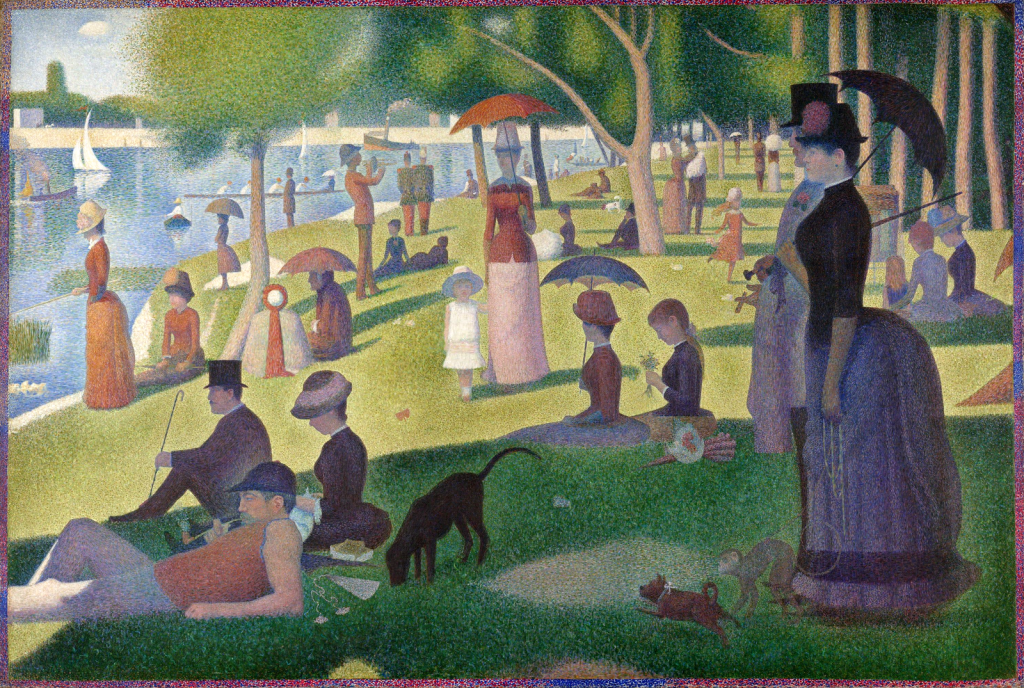
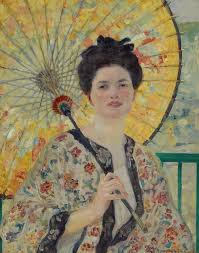
Painting by Georges Seurat(1859-1891). From the Public Domain.
Parasols? Seriously? Such were my thoughts when I first arrived in Japan one summer over twenty years ago. How quaint, I thought. How old fashioned! If a lady was worried about preserving her lily-white complexion, why not just slather on sunscreen and wear a hat?
In South Carolina, where I’d just come from, the only time I ever saw women wielding parasols was when I visited antebellum mansions. There, tour guides flounced around plantations in hoopskirts, twirling parasols as part of their period costumes. In real life, no one used them.
Back then, many of my friends spent hours laying out in the sun, in pursuit of the perfect tan. In the United States, people found my skin to be too pale, but in Japan women wore long white gloves and smeared their faces with whitening cream. And they carried parasols to ward off the sun.
Parasols have actually been in use in the Middle East and Asia for a very long time. They are depicted in ancient art in India, Egypt, Mesopotamia, and Greece, and are mentioned in a divination book from the Chinese Song Dynasty printed in 1270. Although alternative uses have been discovered for the parasol – for example, in 1902, ladies were advised by The Daily Mirror to use their parasols to fend off ruffians — the basic design is much the same as that of first century China.
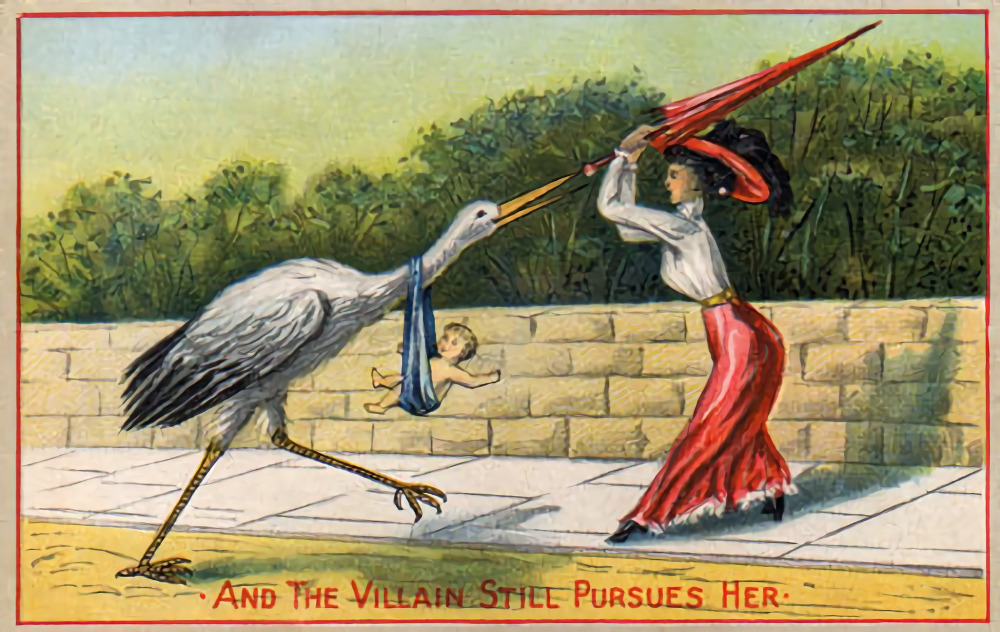
A postcard from the turn of the 20th century. From the Public Domain
The only parasol I’d ever owned was a bright red one made of paper, bought from a souvenir shop in Southeast Asia, which I displayed in a corner as an ethnic accent to my home décor. I never thought of using it outside.
Parasols were fussy and cumbersome, I thought. How could you do anything with your hands if you were holding one? They were a nuisance, and yet when I went to a baseball game with my mother-in-law in mid-summer, and the hot sun beat down upon us, I was grateful to share the shade of her black umbrella.
Ever conscious of my carbon footprint, I walk to the neighbourhood store with my eco-bags. One sweltering day last summer, I started to reach for my hat on my way out the door, but grabbed an umbrella instead. It really was cooler underneath! And carrying a parasol helps cut down on the new freckles. Today I browsed online for a new parasol. A number of new vendors have popped up in the West offering a variety of designs – Battenburg Lace for outdoor weddings, solid team colours for stadium sports, and more. Could it be that the parasol is about to come into fashion again in my native country? Here in Japan, it has never gone out of style.
From the Public Domain
Suzanne Kamatawas born and raised in Grand Haven, Michigan. She now lives in Japan with her husband and two children. Her short stories, essays, articles and book reviews have appeared in over 100 publications. Her work has been nominated for the Pushcart Prize five times, and received a Special Mention in 2006. She is also a two-time winner of the All Nippon Airways/Wingspan Fiction Contest, winner of the Paris Book Festival, and winner of a SCBWI Magazine Merit Award.
PLEASE NOTE: ARTICLES CAN ONLY BE REPRODUCED IN OTHER SITES WITH DUE ACKNOWLEDGEMENT TO BORDERLESS JOURNAL
Soundlessly they move at night beautiful and cold morning light reveals a lawn covered in snow a red headed woodpecker chips and drums steady oak trees that stand strong bare witnesses to it all
morning light reveals a lawn covered in snow blood spatters announce predators overhead and near a red headed woodpecker bangs steady blows hungry finches frantically feed watching the sky in fear
blood spatters announce predators overhead and near the news announces more dead due to Ice and climate hungry finches frantically feed watching the sky in fear we fight for climate change but tolerate ICE
the news announces the dead in Ice and snow the damaged fall like tree branches on the border we fight for climate change but tolerate ICE children in tents watch the snow and cry mother
the damaged fall like tree branches on the border both sides claim and deny any blame children in tents watch the snow and cry mother the red headed woodpecker watches with shame
Both sides claim and deny any blame the oak trees stand strong bear witness to it all children in tents watch the snow and cry mother soundlessly they cross at night resolute beautiful and cold
CORN BEANS SALT
Querida madre,
we crossed the border made it here tired but well we were caught by la migra there are many of us in a shelter which smells bad but they feed us and give us water the food is cold and bland I am grateful and do not complain but at night at bedtime the lights make it hard to sleep in the quiet you hear the little ones crying for their families or because they are afraid as for me …it is you I worry about I miss your face mama keep the dog near it can keep you safe it will bark and warn you of intruders try to keep your strength do not wander far from the house right now I see you clearly hair dark as frijoles negros held back in place with a thin ribbon you are smiling and shaking your head that here I am far away telling you what to do
I have faith that any day now I will make my case the judge will understand after he hears my plans and sees how strong I am despite all the weight I have lost I will tell them that I am already fifteen I will work hard so I can send for you they are lining us up for a shower it's been a long time God keep you safe I hope you have corn beans and salt enough to keep you going you are always in my heart
te quiero mama
tu hijo
SWEETWATER
Just the name made my mouth water With sugary southern syllables Sweetwater he carefully tracked the path of the Eclipse this was one of the cities (he smiled) spectacular prime viewing Although the shabby hotel The best in town did not meet my big city artificial aspirations fine-tuned over the years to four dollar hotel ratings But It was outside town had an expansive lawn and the right cost Arriving the night before the blessed event we drove into town Looking it over with small expectations The town center howled back with pacemaker shattering music A stuffed astronaut dressed in silver affixed to a post like a symbol of Christ Vendors and stray dogs filled the streets Around the plaza were small shops with enticing windows I could not resist I saw some old luggage I envisioned using as props the owner strode over as backup to the salesgirl We looked each other up and down New York she said Brooklyn I said Williamsburg we said Espanol we Espanglished Screaming and laughing like teenagers We hugged and traded ancestral names and towns trying to establish our connections We discovered we lived blocks from each other in Brooklyn We knew the same vibrant scary neighbourhoods We had Family names we shared I kept quiet about the stories of my father the case worker Visiting families to assess their needs long hours away from home with select Desperately beautiful women As she drew me close to answer her questions and we declared we were sisters She wanted me to meet her blind mother blind with the same rare disease My blind father had…. my heart went on pause…. breathe We traded phone numbers Made plans to visit each other Had a glass of wine A toast to life I paid for my discounted luggage
I imagined my future with a sister I never had let the past be past and welcome the new The next day we sat in wait With hundreds of others Waiting for the eclipse The crickets and frogs alerted us Special glasses in place We watched as the moon Passed between the sun and the earth Darkness came with a loud gasp
Packing the car the next day Sweating in the heat we left high with expectations But there were No Emails no calls Nothing but crickets from Sweetwater A chance meeting unexpected eclipse
Glossary:
La migra: Informal Mexican Spanish term for US Immigration
Querida madre: Dear mother
frijole negros: Latin American dish made with black beans
te quiero mama: I love you Mum. I have to go
tu hijo: your son
Nilsa Mariano is a graduate in comparative literature from Binghamton University New York. She has been published in Stone Canoe, Five Minute Magazine and MicroFiction Monday Magazine, Muleskinner Journal, Wildgreens Magazine and Chicken Soup for the Latino Soul.
.
PLEASE NOTE: ARTICLES CAN ONLY BE REPRODUCED IN OTHER SITES WITH DUE ACKNOWLEDGEMENT TO BORDERLESS JOURNAL
Malavika Rajkotia is a prominent divorce attorney based in Delhi. She has collaborated with numerous non-governmental organisations addressing civil liberties and human rights concerns. Additionally, she has a strong background in theatre, participating in approximately thirty productions in both Hindi and English. She has also served as the host of Shakti, the inaugural television talk show in India dedicated to women’s rights.
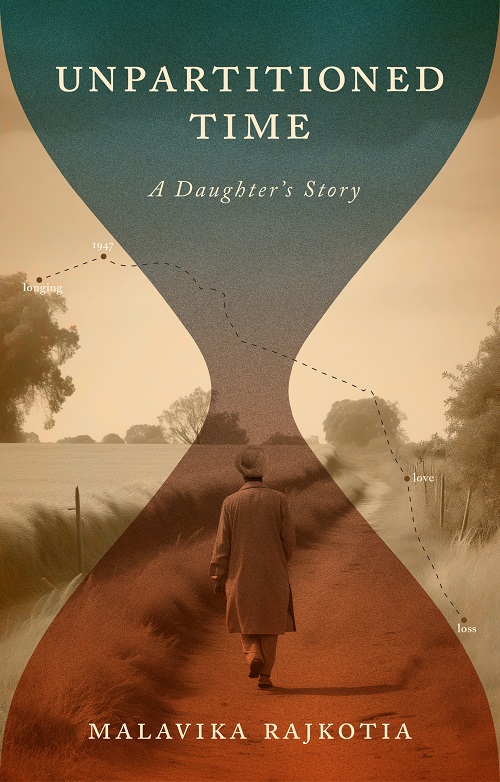
Her memoir, Unpartitioned Time: A Daughter’s Story, is a complex tale that intertwines the history and current experiences of a family following the Partition. Jindo, Malavika Rajkotia’s father, arrives in India amidst the chaos of the Partition riots. He is allocated a piece of desolate land in the small town of Karnal, where he must clear and cultivate the land to reclaim his role as landlord and patriarch. However, devoid of his past and confronted with an uncertain future in a place where the language is foreign to him, he undergoes a significant transformation. Rajkotia intricately weaves a narrative around this generous, humorous, loving, and increasingly despondent figure, delving into her family’s history and present.
The story explores themes of yearning and belonging, the nature of privilege and its loss, while reflecting on the resilience of a people stripped of their autonomy. Through her evocative and lyrical writing, she leads readers through the challenges faced by a large family—comprising uncles, aunts, siblings, cousins, and esteemed figures—who are all in pursuit of recognition, identity, and stability.
Rajkotia fearlessly confronts her milieu, whether navigating the radical Khalistan movement, the tensions between the Sikh faith and Hindu nationalism, or the pervasive cynicism of Indian politics. Her vivid, meditative, finely detailed portraits of a rich family life are filled with moments of tears, laughter, and music, and a diverse array of characters who are immensely relatable. Ultimately, this brave and moving book is about the enduring quest for meaning and fulfilment that transcends cultural boundaries.
Narrates Rajkotia: “The diffused light of dawn lit a dull, flat landscape cut by the highway, gleaming under randomly spaced streetlights. Until about thirty years ago, this single carriageway witnessed an almost daily carnage that left heavy and light motor vehicles, bicyclists, and bullock carts in confused mangles. Everyone had a personal story of loss on this road. Three of my family was killed in two separate accidents. A splintered windshield glass lodged in a young girl’s throat. An aunt and cousin died when their car rammed into a truck to avoid a cyclist.”
She has a detailed account of the road in Karnal town thus: “For over 2,500 years, this road has streamed with traders from Central Asia, scholars from China, adventurers from Europe, sadhus from the Himalayas, and armies coveting Hindustan. This portion of the road was the battlefield of the story of the eighteen-day Mahabharata war, marking the cusp of the end of the Dwapar Yuga and the rise of the Kali Yuga. Eighteen days of soldiers’ cries and trumpeting elephants and neighing horses, each ending with sunsets blackened by smoke from the funeral pyres hanging heavy until impelled by the sounds of wailing women.
“From myth, we come to somewhat recorded history in 300 BCE, when Chandragupta Maurya built this road to connect his fast-growing kingdom, spanning the north of the subcontinent from the source of the Ganga to its northwestern limits. The road was developed by Sher Shah Suri. My father remembered the time when it was called ‘Jarnailly Sadak’ under the British, and then GT Road, its official name, The Grand Trunk Road. The government of independent India called it Sher Shah Suri Marg, the Sanskrit ‘marg’ guillotining the English ‘road’ and the Urdu ‘sadak’.”
The memoir stands as a testament to the power of storytelling in bridging gaps between cultures and generations, ensuring that the voices of those who experienced Partition are heard and remembered. As part of the growing body of literature on this subject, it encourages further exploration and discussion, ultimately contributing to a more nuanced understanding of the complexities surrounding Partition and its enduring legacy.
.
Bhaskar Parichha is a journalist and author of Unbiased, No Strings Attached: Writings on Odisha and Biju Patnaik – A Political Biography. He lives in Bhubaneswar and writes bilingually. Besides writing for newspapers, he also reviews books on various media platforms.
.
PLEASE NOTE: ARTICLES CAN ONLY BE REPRODUCED IN OTHER SITES WITH DUE ACKNOWLEDGEMENT TO BORDERLESS JOURNAL
Poetry by Allah Bashk Buzdar: translated from Balochi by Fazal Baloch
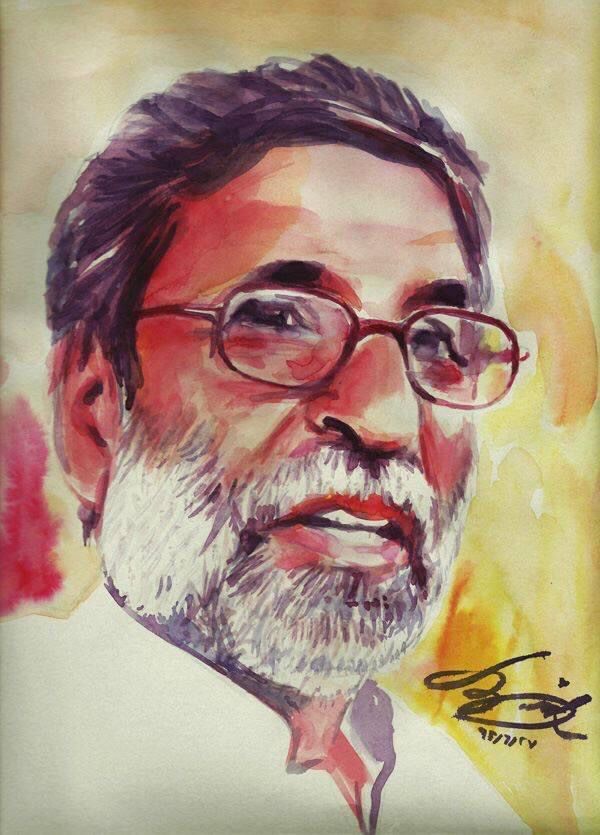
Allah Bashk Buzdar. Courtsey: Fazal Baloch
The world of my dreams longs for you,
My love, come and fill my thoughts with radiant hues and shades.
Let my eyes feast on your glowing face,
And grace my lips with the warmth of your breath.
Let my hands feel your soft caress,
And let the fragrance of blooming flowers
Permeate the air around me,
Filling my heart with boundless joy.
Let the breeze rising from your comely gait
Enchant my existence.

My destination lies far from here,
I’ve to journey beyond borders of tyranny and oppression.
Every stone and thorn along the way
I must gather,
The tangled strands of life
I must unravel.

A new harvest of love
I must sow.
Bid me farewell with
Blessings and infinite hope.
Hold me in your gaze
And beneath your sable tresses,
Lest the sapling and bloom of love
You planted should wither away.

I must leave for barren, distant lands,
I’m aware
The quest of life may lead me astray.
And who knows then,
On whose shoulders
Your tresses will fall in soft disarray?
Translator’s Note:Allah Bashk Buzdar is a remarkable modern Balochi poet known for his distinct diction, unique poetic language, and peculiar mode of expression. He writes in the Sulaimani dialect—one of the three major dialects of Balochi, predominantly spoken in the eastern regions of Balochistan and adjoining areas. Buzdar’s poetry reflects his unwavering love and commitment to humanity. Even when writing verses of love and romance, he connects them to the plight of people who live around him. He has published two anthologies of poetry so far. The translated poem is taken from his first anthology, Hoshken Rakk Saoz Bant (The Parched Lips Will Bloom Anew), published by the Balochi Academy Quetta in 2004.
Fazal Baloch is a Balochi writer and translator. He has translated many Balochi poems and short stories into English. His translations have been featured in Pakistani Literature published by Pakistan Academy of Letters and in the form of books and anthologies. Fazal Baloch has the translation rights to this poem.
PLEASE NOTE: ARTICLES CAN ONLY BE REPRODUCED IN OTHER SITES WITH DUE ACKNOWLEDGEMENT TO BORDERLESS JOURNAL
I hear the scents whisper. Familiar fragrances of clove and cinnamon, imbued with spicy notes of pepper and eucalyptus beckon and tease. Elusive murmurs of mysterious oils and herbs tinge the air as I walk along a narrow-paved lane in Old Dhaka, overshadowed by looming walls on either side. I ignore the press of prying eyes and inquisitive bodies that accompany my passage. The call of the scents is irresistible, and I feel strangely unafraid of what lies before the next turn in the path ahead. These were the scents of my childhood — of summer afternoons spent secretly exploring the forbidden depths of my grandmother’s closet, the kaancher almarih[1] where her medicines were stored in shiny glass bottles with peeling labels.
The narrow lane spills into a small courtyard hemmed by buildings on three sides. Everything is closed because it is Friday, the day of prayer in Bangladesh. Peering through grimy windows, I see gigantic iron cauldrons, cavernous kansa kadhais[2], their gold gleaming in glimpses amidst sooty splatters, huge ladles and enormous tongs. Some vessels perch on hand-crafted mud stoves, their sides smoothened and baked by fires. Wooden logs are stacked in the corner along with bulging sacks of coal. Nearby, some large pieces of cloth, perhaps used for straining, are hung out to dry. In the shadowy recesses, shelves stacked with glass bottles glisten with reflected light. It seems almost staged, like a theatrical representation of a medieval kitchen and yet the evidence of daily use is undeniable.
The fourth side of the courtyard has an open doorway. A sudden urge, an inexplicable pull, lures me towards it. I feel I know what lies beyond its brink. Yet how could that be? In this alien city, situated in a land scarred by a brutal Partition, from where does this knowing come? Concentrating on lifting the edge of my saree as I step across the threshold, it takes me a moment to lift my eyes to see what lies ahead. A painting of a pot-bellied man seated cross legged on an asana[3], a sacred thread adorning the vast expanse of his chest, looks solemnly back at me. Before me was the same face I’d seen on countless bottles in that medicine cupboard of my childhood — the same glossy hair, oiled and parted with precision, the same curled moustache, the same narrow bordered white dhoti[4].
The author with her great grandfather’s portrait in Dhaka. Photo Courtesy: Ranu Bhattacharyya
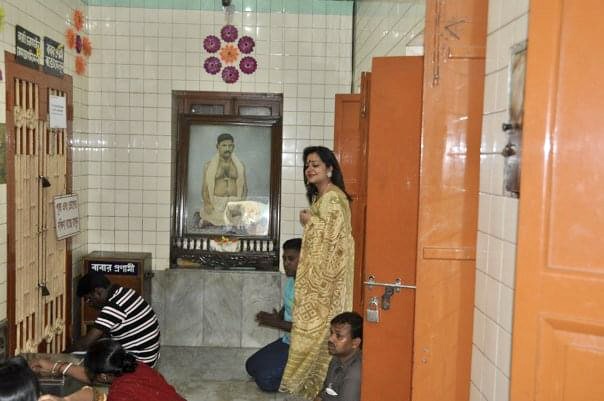
I find myself before a life-size portrait of my great grandfather, Mathura Mohan Chakraborty, founder of Shakti Aushadhalaya, the Ayurvedic pharmacy famed in the streets of Dhaka, Calcutta, Patna, Benaras and Rangoon at the turn of the 19th century. The kitchen behind me was the pharmacy’s karkhana[5] to prepare medicines of his formulations. His portrait hung before the inner sanctum of the temple he had dedicated to the revered Bengali saint, Lokenath Baba. Legend claimed that the mystic had whispered the recipe of the first medicinal formulation to his most faithful disciple — my great grandfather.
Ever since I arrived in Dhaka as an expat, I had been searching for the Shakti Aushadhalaya premises. Everyone knew of the company; yet nobody seemed to know where it was located. I was introduced everywhere as a young scion of the family. And though whispers followed me at gatherings and smiles broadened on hearing I was the great granddaughter of Mathurababu, my questions regarding the whereabouts of the company drew blank stares and confused responses. In horticulture, the word scion, refers to the detached living part of a plant that is cut to be grafted onto another plant. The sundering of this particular scion had been so complete, over so many generations, through such a series of violent events that it seemed my search for the original plant would remain elusive.
It was only through persistent enquiry that I found myself in Swamibagh Road in Old Dhaka where the manufacturing unit of Shakti Aushadhalaya was located. Mathurababu had founded the company in Patuatuli, Dhaka, in 1901. Family lore suggests Lokenath Baba inspired him to venture far from his origins as a schoolteacher in Bikrampur. The ascetic recognised his potential, unusual in those times, as a graduate versed in three languages — Bengali, Sanskrit and English. Starting from humble beginnings in the family kitchen, peddling hair oil and tooth powder in his neighbourhood, Mathurababu’s prescient business acumen saw his enterprise flourish. The company produced and supplied quality Ayurvedic medicines at low prices. Mathurababu also established an Ayurvedic institute, attached to his manufacturing unit to popularise Ayurvedic knowledge. The institute taught Ayurveda and philosophy in Sanskrit. Students were offered free tuition, boarding, and lodging.
Ayurveda, considered the oldest existing health science in the world, is believed to have originated in India 5000 years ago. The journey of Ayurveda from ancient times to its present incarnation is a fascinating story that follows several simultaneous trajectories, embracing geopolitics and history, trade and commerce, science and industry, technology and travel.
It is with a sense of wonder that I encounter my great grandfather’s name in journals and books that describe the history of Ayurveda in India. He was among the earliest entrepreneurs to transition towards production of Ayurvedic drugs for the market. Directly involved in all aspects of his company, Mathurbabu immersed himself in the study of Ayurveda and had an extensive library of rare treatises on ancient Indian medical traditions, including a prized copy of Susruta Sanhita[6].
He noticed that Western medicines advertised their products in newspapers and journals. Following this model, he embraced a similar practice for his own company. An advertisement published in Muhammadi in February 1940 included endorsements from freedom fighter Chittaranjan Das, Lord Lytton, the Viceroy of India, and Lord Ronaldshay, the Governor General of Bengal. In the vintage advertisement, Lord Lytton wrote: “I was very interested to see this remarkable factory which owes its success to the energy and enthusiasm of its proprietor Babu Mathura Mohan Chakravarty B.A. The preparation of indigenous drugs on so large a scale is a very great achievement. The factory appeared to me to be exceedingly well managed and well equipped &c. &c.” In the same advertisement, in Bengali, Chittaranjan Das endorsed that nothing could surpass the production processes for medicines at Shakti Aushadhalaya.
Since the mid-19th century, several eminent leaders of the Indian freedom struggle visited Mathurbabu’s factory in Dhaka. On June 6, 1939, in the company’s visitor’s book, Subhash Chandra Bose wrote, “I visited the Sakti Oushadhalaya[7], Dacca, today and was very kindly shown around the premises. Indigenous medicines are prepared here on a large scale and in accordance with Ayurvedic principles. The institution reflects great credit on Babu Mathura Mohan Chakravarty, whose enterprise has brought Ayurvedic medicines within the reach of the poor. I wish him all success to the institution which he has built up after so much enterprise and hard labour for a long period. The success of Sakti Oushadhalaya, Dacca, means the popularity of Ayurveda throughout the country and this in its turn means the relief of suffering humanity.”
When my parents visited us in Dhaka a year after our arrival, we went back to Swamibagh Road. Our visit included a trip to the shop where the medicines of Shakti Aushadhalaya were sold.
Despite being taken over by the Pakistan government in 1971 and subsequently acquired by a private entrepreneur, the company remains operational in Bangladesh to this day with 37 branches nationwide. Though Mathurababu’s portrait is no longer on the medicine bottles in the shop, the names of the formulations inscribed, are still recognised by my mother. As we browse through the offerings, a crowd begins to form around her, hailed and welcomed as Mathurababu’s direct descendant. Much to my mother’s delight, the crowd guided her to his house, a now derelict mansion hidden in the by-lanes of Old Dhaka.
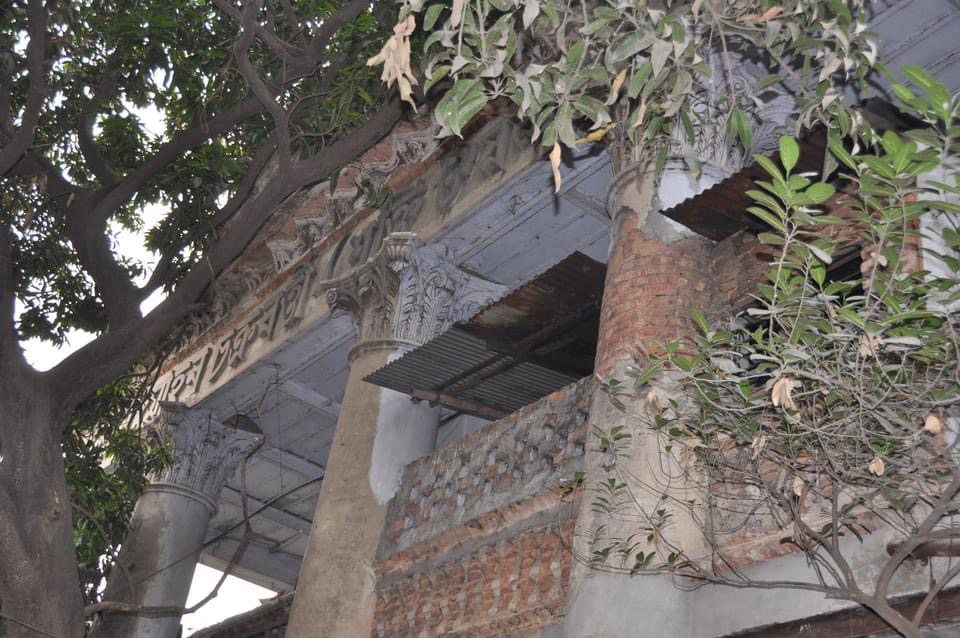
We entered the property through an ornamented gatehouse that opened to a large courtyard. On one side was the Baithakghar, the public receiving room with the Nat Mandir, the family temple in front of us. On the other side was the majestic mansion with tall columns, topped with ornate capitals. Next to the Nat Mandir was a small doorway that led to a shaded courtyard with a well, meant for the family’s private use. Beyond was yet another courtyard, enclosed with buildings on three sides.
Parts of the ancestral home. Photo Courtesy: Ranu Bhattacharyya
As I climbed the stairs leading to the second floor, I had a feeling of déjà vu. I felt I had been here before through my grandmother’s stories. Her small feet must have climbed these stairs. There was the arched windows she had said she gazed out of, and the vast veranda with colonnades, where she played with her eight siblings. Wandering through the rooms, I hear her voice narrating tales of her childhood — kite races on the terrace, indolent boat rides on the Padma, and the indulgence of choosing sarees from the weavers who came all the way from Benaras.
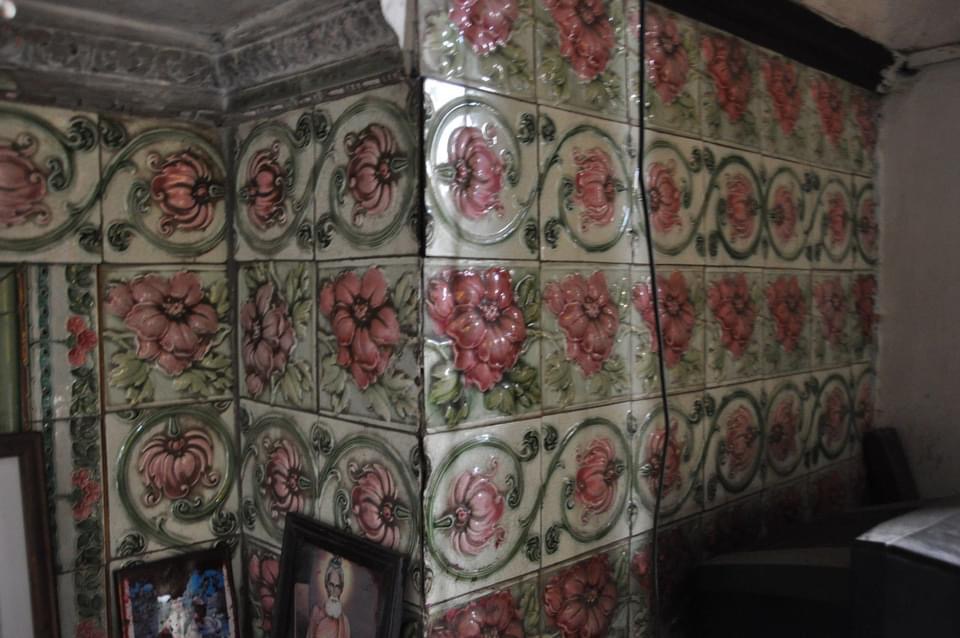
The house is now home to several families who regard our arrival with wary welcome. “Where are the Italian painted tiles?” I ask eagerly. The story of the tiles imported by her father from Italy were amongst the kaleidoscope of stories that my grandmother had shared with me. Whisperings and murmurings ensue amidst the crowd and then a hefty cupboard was pushed aside to reveal the tiles in all their faded glory.
Slowly it dawns upon me that the silent bottle in my grandmother’s cupboard had encoded stories that belied its seemingly mundane materiality. To uncover these lost stories, I embark on a renewed search for those old medicine bottles of my childhood. Their fragrance lingers at the edges of my memory, offering tantalising glimpses to fragments of knowledge. The sense of smell is our oldest sense. My memories of stories narrated by my grandmother were inextricably connected to the scents locked in that bottle. Would holding the bottle in my hand peel back the layers of my memory, answer some unanswered questions about my grandmother’s roots, help me map the route of our family’s journey? But alas! Those bottles are lost to time. My grandmother’s generation is gone and I search among Mathurababu’s scattered grandchildren and great grandchildren to no avail.
My grandmother left Dhaka in 1936, never to return. Mathurbabu’s house on Calcutta’s Central Street was completed that year, and it is there he moved with his wife and three youngest unwed daughters, including my grandmother. His older son remained in Dhaka to oversee the factory and drug production, while Mathurbabu focused on controlling the distribution from a central office in Calcutta. Till his death in 1942, despite his ailing health and flagging energy, he visited the company’s distribution centres spread across Calcutta everyday, accompanied by his faithful retainer Nathu. Probing for reasons for this abrupt migration, my uncle gave me a solitary clue. He recalled that my great grandfather had felt his family was unsafe in Dhaka. With this obscure clue in hand, I delved into history books for elaboration. I read about the rise of communal tensions in Bengal from the mid-1920’s. The Dhaka riots of 1930 targeted several well-established businessmen and involved loot and arson of their business and personal properties.
In 1947, there was yet another wave of migrations far more existential and grimmer. After the borders were drawn between the newly formed nations of India and Pakistan, the remaining family fled Dhaka overnight, leaving behind the factory, the mansion, in fact, all their material possessions in a land suddenly hostile to their continued habitation. Unable to exercise control over their properties in East Pakistan, there was an initial attempt by Mathurbabu’s heirs to establish a factory in Chandernagore. Without my great grandfather at the helm, this nascent enterprise floundered and ultimately sank. Cut from its moorings in Dhaka, Mathurbabu’s inheritors could not keep the business afloat in India. Slowly his legacy dissipated. The Shakti Aushadhalaya head office in Calcutta’s Beadon Street closed and the shops in Calcutta, Karachi, Kabul, and Colombo lowered their shutters.
Through generations of migration and resettlement, we are left with only scattered memories and fragmented stories. These intangible remains are my inheritance today. These intangibles are bound neither by form, nor by time. Instead, they offer limitless possibilities for exploration, crafting and archiving. Memory, nourished by the repeated telling of stories, provides continuity. These intangible wisps of legacy — a remembered glimpse of a peeling label, the stories heard from my grandmother, the whispered whiff of a familiar fragrance, open a door to the past and invite me to connect it to the present. “Listen to us,” the scents call. “Let us tell you our story.”
Ranu Bhattacharyya, author of The Castle in the Classroom: Story as a Springboard for Early Literacy, Stenhouse, 2010, is an educator and writer who has lived and worked across the world, exploring and archiving narratives that connect people and cultures.
.
PLEASE NOTE: ARTICLES CAN ONLY BE REPRODUCED IN OTHER SITES WITH DUE ACKNOWLEDGEMENT TO BORDERLESS JOURNAL
Kafka would've liked these corridors, these walls of painted advertisement, these coloured towns with attributions to deities at every tree's feet. The running nerve of this place, through the garble of a thousand dialects, sounds all kinds of chants, of faith, food, and architecture, of life weaving through its weighting waiting slums, through linoleum hardened heel-clad grounds.
Not a day goes by without auto horns, or political instability, or chai, sweet, sweet, God-sent chai, a thousand wicks in a thousand burning lamps, a million lit cigarettes in stalls, a million lit-up smiles in places you wouldn't expect to belong.
This home functions upon its dysfunctions, builds upon what breaks it, ever encompassing, entirely amassing, fields in farms, skills of talents, sacks of wheat, bundles of wires, collected coins, plastic bags like Russian dolls, ringing evening bells, a life so culturally fulfilled, lived in the grand denominations of Division of the masses and Parle G*.
* A popular brand of biscuits in India
Naisha Chawla is inspired by the works of Robert Frost, Oscar Wilde, W.H. Auden, Sylvia Plath, and Richard Siken amongst many others. She believes poetry to be a language of infinite letters, words and secret combinations to figuring out the better mysteries of life! Her debut book is called The Grants of Calliope.
PLEASE NOTE: ARTICLES CAN ONLY BE REPRODUCED IN OTHER SITES WITH DUE ACKNOWLEDGEMENT TO BORDERLESS JOURNAL
Both the doors were locked. We knew Ammi must have locked the main door on her way out, but the emergency door wasn’t opening either. Yusuf and I jumped into our flat through our exceptionally large windows. We were accustomed to swiveling our fingers until we reached the latch hidden on the inside of the window. We’d pivot the hook and squeeze our pinky fingers through the tiny hole between the plastic orifices in the windowpane. Ammi had gone over to Nani Jaan’s house, and we were not expected back for another few hours. Rashid, my brother’s friend was reprimanded by his mother and grounded in his house to study. There was a limit to how much time Yusuf and I could spend at Rashid’s house eating sev puris with his mother. We sighted an excuse to get away and return home. But as Abbu says, fate has its way of creeping into the unlikeliest of places, so it did. The sunset remained hidden behind the mass of clouds, just like the rest of the month of November, and brought with it its own woes. Yusuf and I had expected to be jumping into an empty house, but were taken aback to see our living room filled with a score of giant men dressed in white kurtas. Abbu sat at the centre looking disheveled in his unkempt hair and crumpled lungi. It was an oddly monstrous sight. We had never seen so many men gathering at home when it wasn’t an Eid celebration. We were also not accustomed to seeing men with beards as long as these men had.
Nani Jaan had a personal assessment about the length of men’s beards that we had internalized over the years. ‘When it is longer than your fist, you know the intention is intimidation,’ she’d say in a spinechillingly confident tone. ‘We don’t live amidst Jalaaluddin Rumis and Nostradamuses anymore. The only inspiration the men could possibly be hiding under their beards would be a horde of lice.’ Thus, I had developed a quaint habit of mentally calculating the length of the beards I saw as I walked. Within the split second when I glanced around our living-room, I knew all their beards were much longer than their fists. I wondered how Abbu fit in with this forest of mens’ hair, because Abbu always remained clean-shaven, save the Sunday stubble Ammi would pester him to get off. On that particular day too, Abbu’s facial skin remained exposed.
The visual was threatening far beyond the beards when we saw what the men were concealing below their cloth bags and our pillow covers —— big black and brown guns. On our news channels, such guns were called AK 47s —— Yusuf identified the type almost instantly. We looked at Abbu helplessly, rummaging up a response, a conjecture, a remark, hint, and something —— anything. My single most gigantic fear was that Abbu was in deep trouble. Yusuf looked at me from the corner of his eye, gesturing to me to be tight-lipped and non-reactive. Abbu stared at us pale-faced, without uttering a word. He introduced us in a point-blank manner as his children.
‘Here, Yusuf is the naughty one I’d told you about. And his elder sister, my first born, Aisha.’ Abbu pointed at me and his index finger poked me like the razor-sharp edge of the blade Ammi used to carefully slice the dead skin off her feet.
Both Yusuf and I hated being introduced to the strangers we clearly despised. We took a seat in the corner of the room as Abbu directed us to. The next few minutes were a blur as my mind wandered into nothingness, like the blurry images of a super eight camera unable to focus on any particular sight. It just moved from beard, to table, to Abbu, to slippers, to window, to teacup, and back again to the beard. The next few moments were nauseating, like the time I tried my first mushroom drug. It was in an open field, a few hours away from Mumbai, on top of a blue car bonnet. I felt my shivers as I cascaded back and forth, breaking the continuum of time and space. I was sick for the next few days, but all Abbu and Ammi ever knew was that I had terrible food poisoning. Whenever Yusuf uttered the word mushroom in front of our parents to provoke me, I simply smiled, knowing that Ammi had decided never to cook mushrooms at home ever again. Abbu had subjected me to a sly smile as if he were fully cognizant of what was happening to me. Like various other things in my family, this was another one we buried under our carpets so I could sleep peacefully.
The bearded men bid their salaams to Abbu, smiled at us coldly, and hid their guns inside their oversized black kurtas before they left our home.
I was sixteen, Yusuf was thirteen, and we had seen what most people never get to see in a lifetime. Abbu forbade us from asking questions, demanding answers, or telling anyone what we had seen, ever. When we asked Abbu if Ammi knew what he was up to, he asked us to abide by our oath of complete silence regarding what we had witnessed. As anxious, hormone-charged teenagers, we naturally argued our way through the conversation with Abbu. He sat on the edge of the sofa, staring at the floor like a victim with nothing to back up his conscience. When Yusuf saw a discreet tear trickle down Abbu’s cheek, we stormed out of the room with an uneasy feeling eating away our guts. We loved to drive our parents up the wall, so long as we knew it was our doing. But the moment we sensed the involvement of another hand, it made us lament uncontrollably. Abbu and Ammi’s story about their engagement period was folklore for us. In our heads, they weren’t three-dimensional beings like the rest of our family. I clearly recall the morning Abbu, Ammi, Yusuf and I tried making pancakes for the very first time after Abdul Chachu, Abbu’s cousin, had written to us saying it was their daily breakfast ever since they relocated to Detroit. Of course, Abbu had responded saying he didn’t fancy pancakes, but nudged Ammi to hunt for the recipe since he desperately wanted to taste what his cousin had substituted scrambled egg with. Pancakes, in Abbu’s mind, became the recipe to success; he envied how his cousin had started from scratch and managed to make a respectable living in a foreign land. That morning, when we ate pancakes for the very first time, we looked at each other, trying to gauge if the one seated opposite us really liked them. Ammi sat opposite me and I remember seeing her gulp hers down with long sips of sherbet. We all disliked them, but we never admitted this to each other. Probably the one who disliked them the least was Yusuf, but I could tell that he would never substitute our scrambled eggs for what seemed like a cross between South Indian dosa and Maharashtrian pooran poli with a whole lot of Nutella.
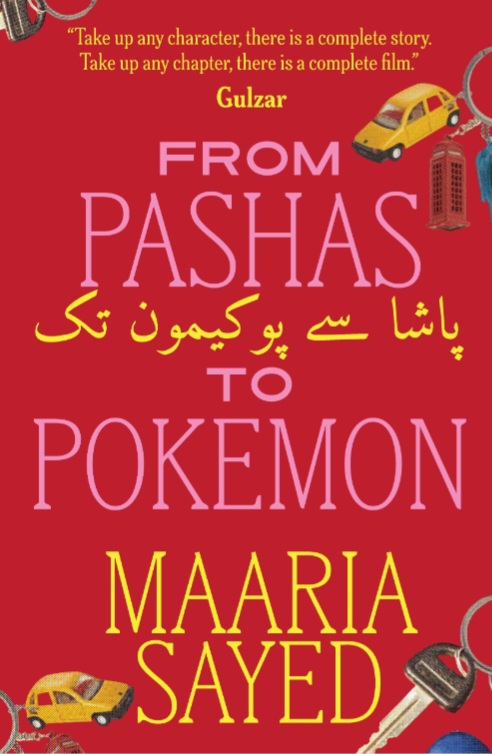
ABOUT THE BOOK
At 25, Aisha has seen more than many people do in a lifetime and has understood one thing: no matter who you are and where you are from, there are things that you can study and others that you can actually learn from and grow.
Lively tales from family history and everyday life in a Mahammad Ali Road colony in Mumbai form the background of Aisha’s internal journey. Childhood memories mingle with her experiences while studying in London, and are woven into a sharp commentary on the transformations in India over 20 years as she ponders her place in this ever-changing world. The novel narrates the story of many journeys. It is a journey of growing up: the journey from childhood to adolescence, youth to old age, from one culture to another, and a glimpse of past to present times.
ABOUTTHE AUTHOR
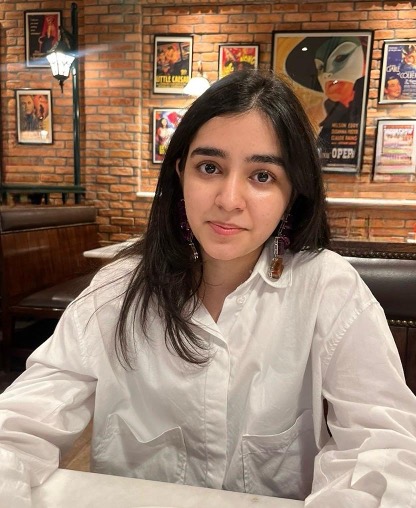
Maaria Sayed is an Indian filmmaker and writer whose work focuses on the sexual and spiritual liberation of women, evolving Muslim identities, and South Asian life. She has been supported by Cineteca di Bologna, Sharjah Art Foundation, and Busan Film Commission, among others, and was a delegate and jury for the UN-backed Asia Peace Film Festival in Pakistan. She regularly holds workshops on cinema for students and teaches intercultural communication to executives of multinational companies. She is a graduate of literature and cinema, and obtained her fellowship on Asian media production and collaboration in South Korea. She is passionate about Sufi poetry, folk music, Indian theatre and cats- big and small. This is her debut novel.
.
PLEASE NOTE: ARTICLES CAN ONLY BE REPRODUCED IN OTHER SITES WITH DUE ACKNOWLEDGEMENT TO BORDERLESS JOURNAL




 Borderless