‘Ghumiye Poribe Aami’ (I’ll fall asleep) from Jibananda Das’s poetry collection, Ruposhi Bangla (1934), has been translated from Bengali by Professor Fakrul Alam.
From Public Domain
I’ll fall asleep one day on one of your star-studded nights.
Perhaps youth will still stick to my soul —- perhaps
I’ll be in my prime then —- that will be so nice! But sleep
Overwhelms me now—Bengal’s grassy green bed lies beneath.
Eyelids shut. Tucked within mango tree leaves, Kach insects doze.
I too will doze off like them in this grassy land I love—- in silence!
The stories stored in my soul will eventually fade. New ones —-
New festivals -— will replace the old —- in life’s honey-tinged slight.

In your forever busy minds -— when finally, you, youthful ones,
Will be done tearing grassy stems and leaves -— when Manikmala
Will come here to pick up crimson-red bat and kamranga fruits
On some mellow autumnal morning -- when yellow shefali flowers
fall on this grass as shaliks and wagtails fly far, far away,
I’ll feel the sun -- the clouds —- lying down in death-like stupor!
Jibananada Das (1899-1954) was a Bengali writer, who now is named as one of the greats. In his lifetime, he wrote beautiful poetry, novels, essays and more. He believed: “Poetry and life are two different outpouring of the same thing; life as we usually conceive it contains what we normally accept as reality, but the spectacle of this incoherent and disorderly life can satisfy neither the poet’s talent nor the reader’s imagination … poetry does not contain a complete reconstruction of what we call reality; we have entered a new world.”
Morning walks, or rather ambles, tiptoeing towards the rest of the day. One’s day gathers pace seemingly hour by hour after one wakes up, like a typical Bhairavi[1] performance in Indian classical music, starting slow and accelerating in tempo till the end. The world seems so tranquil in the morning; the Dhaka air smells so relatively fresh (how fresh depends of course on where you are!) at that time. I think indolently most days now (even before the alarm rings!), why not walk at an easy pace and even lazily at first, at least for a while, before picking up speed afterward?
It was not always thus with me; time was when I used to greet the morning impetuously. Like Donne in ‘The Sun Rising’[2], albeit sans a lover next to me, I would, once upon a time, feel like chiding the sun— “busy old fool, why disturb my sleep so? Why not light up some other world and break someone’s sleep in continents far, far away?” My mother, stirred by the call to prayer she always heard in her conscience (for those were days without alarms), would try to wake us up. Or she would scold and cajole us till my siblings and I would eventually arise, rubbing our eyes and getting up from bed for another schoolwork-filled day in practiced disbelief and simulated foot-dragging.
Mother would tell us of fabled early risers. “Take Rabi Thakur[3],” she would say, “never missed a sunrise!” Or formulaically, “Morning shows the day!” My father would do his bit: “Early to bed,” he would recite ritually, “and early to rise/ would make a man healthy, wealthy and wise!” But the man who made me take up morning walks seriously and regularly was my physician. Gravely, he said, while writing blood pressure pills for me when I was well past 50, “You must walk regularly too—half an hour every morning at least!” Setting out for my “prescribed” morning walks initially, I would think, “How boring! How slowly does the body warm up this way!” For someone who had played contact sports requiring a lot of running around/movement (basketball, football, cricket and tennis) for decades, walking was decidedly dull when I began to do the needful in my 50s. One missed the excitement and emotions generated when like-minded boys of all ages competed with each other intensely in games. But like everything else in life pursued regularly, walking soon became a habit for me. In no time it became an activity I began to like and even looked forward to. After all, morning walks, I soon found out, have their unique attractions.
Fuller Road Morning Walks
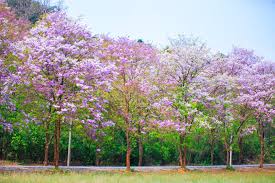
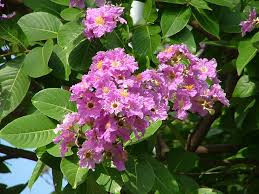
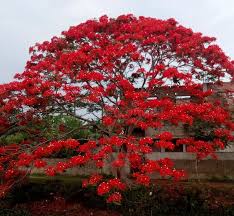
I was lucky that I first began to do my constitutionals on Fuller Road and the Mall part of the Dhaka University campus. The walks my doctor had prescribed soon began to feel pleasurable in the still lovely parts of the DU campus. How could I not like the early morning sights and sounds in that green and quiet world then? In spring and early summer flowering krishnachura, radhachura or jarul trees presented a visual feast even as mango blossoms and other flowers scented the air; the solitary cuckoo bird, at its most insistent in the early hours, too, was unforgettable. In the rainy season, everything looked lush green while the fragrance of kodom or kamini flowers suffused the air; in autumn, delicate sheuli blooms embellished mornings imperceptibly for us walkers.
Krishnachura treeRadhachura treeFrom Public Domain
February morning walks were made colourful by “early bird” couples all dressed up for the occasion of Bashanta Utshob[4] or Valentine’s Day dates. Ekushey February[5] and December 14[6]— Martyred Intellectuals Day—mornings, in contrast, were mournful occasions when walkers appeared touched by the solemnity of events they were heading towards. Eid days saw only scanty early morning traffic, but soon after seven in the morning, kurta-clad people could be seen rushing to the central mosque of the campus. But most days, Fuller Road mornings seemed to us walkers in sync with a relaxed, unhurried mode of existence.
Other scenes caught my attention during morning walks for often unusual reasons. The wild dogs of night would disappear in full light, but one would occasionally come across pack members intimidating one another or chasing solitary, skinny squirrels or stray cats who would fight back in their own fierce or wily ways. A not uncommon and sobering scene was that of a rickshawallah parked on the street, precariously perched on his seat, attempting to steal some sleep anyhow before heading for his next back-breaking assignment. Certain times of the year, the neighbourhood madman would attract one’s attention with his manic display. And not infrequently and sickeningly, one would encounter a bedraggled drug addict every now and then. Looking doped and possessed, his eyes turned away from prying gazes, he was inclined to slink away.
I, for my part, got addicted quickly to my early morning campus walks. There was the heady feeling of the fresh air charging up my veins; it was pleasurable too to walk with people with whom I could share the twists and turns of university politics and vent my indignation at the way campus politicking was vitiating the atmosphere day by day. And after 45 minutes of brisk walking and a quick shower, I had a healthy appetite and a mind relaxed for the day’s work.
Dhanmondi Morning Walks
In 2017, I moved to Dhanmondi to begin life in the city outside the DU campus after 20 or so years in it. One reason this seemed a fit place for retired life was the walkways edging the lakes, built thoughtfully for walkers, traversing Dhanmondi and winding their way through parks and open spaces. I felt in my mind in choosing a new flat, that this would be an ideal place for morning walks for people like me so dependent on constitutionals. I was not really disappointed by what I experienced in my Dhanmondi morning walks initially. We were surrounded by greenery. The water in most parts of the lake was reasonably clean and quite greenish blue; scattered bits of reflected sunlight here and there made the water even more attractive during the morning hours. If I was able to get up really early, I could watch the glowing sun ascend above Kalabagan from the road 32 bridge. One lucky day, I was even able to capture the crimson-daubed rising sun reflected in the placid lake water.
Unlike the Fuller Road-Mall areas of DU, the Dhanmondi lake walkways and the park areas fill up in no time at all with morning walkers. It was good to see people doing calisthenics in groups daily, or playing badminton (in winter and early spring). Occasionally, I came across a man or a woman on the mobile, rapt in intimate conversation, no doubt with a significant other with whom talking is essential even that early. All alone in my walks now, I, on the other hand, found early morning walks a good time to think about things or think through things—solitude is sometimes the best company! Ideas for papers I was writing or projects I hoped to undertake seemed to become clearer by the bend in my walks. And soon I discovered Dhaka FM radios that performed from 6 to 7 am with little or no commercial or smart-talking DJs intervening for long stretches and with music that synced with my Bhairavi mood.
But there are aspects of Dhanmondi life that make morning walks here much less relaxing than the Fuller Road ones—despite the lakeside ambiance and the abundance of greenery. The park becomes so crowded within half an hour or so of sunrise that a common experience is people jostle one another on the walkways after a while. The lake water is quite polluted in places; a common sight is the garbage littered in the lakeside or plastic bags floating on tucked away parts of the lake or even near bridges. Almost immediately after seven, never-ending honking and noxious fumes emitted by cars swarming to the main and neighbourhood roads to drop children to the innumerable schools of Dhanmondi can mar morning moods easily. Irritating, too, can be professional beggars placed strategically on walkways and on intersections. For instance, shortly after I start my walk every day from road 27, I encounter the conscience-clouding gaze of a beggar woman clad in a black burqa, peering at the passer-by purposefully, reminding one of the figures playing death in western medieval morality plays. And then there are the vendors lined up to sell food or this or that inside as well as outside the park. Truly, Dhanmondi is now an area where the line between the residential and commercial is close to disappearing. In many ways, Dhanmondi morning walks are nowhere near the ones I would set out for on almost always serene Fuller Road.
And yet I find much to like in my morning walks even now. Dhaka still appears a nice place to live at that time of the day. The morning breeze, if and when flowing, revives me. One morning recently, when I was walking by the lakeside where the palash flowers blazed against the greenery and the greenish blue lake water, I heard on my mobile FM radio lyrics of a song that said it all for me then: “Emon manob jibon ki hobe/Eto shundor prithibe te ki ar asha hobe?” (Will there be another life like this one/ Will I come back to another world as beautiful as this one?”)
[5] Mother tongue day. On 21/2/1952, the Bangladeshi movement started against the imposition of Urdu
[6] December 14 was observed as a Martyrs’ Day to commemorate the large number of Bangladeshi intellectuals killed during the Bangladesh Liberation War.
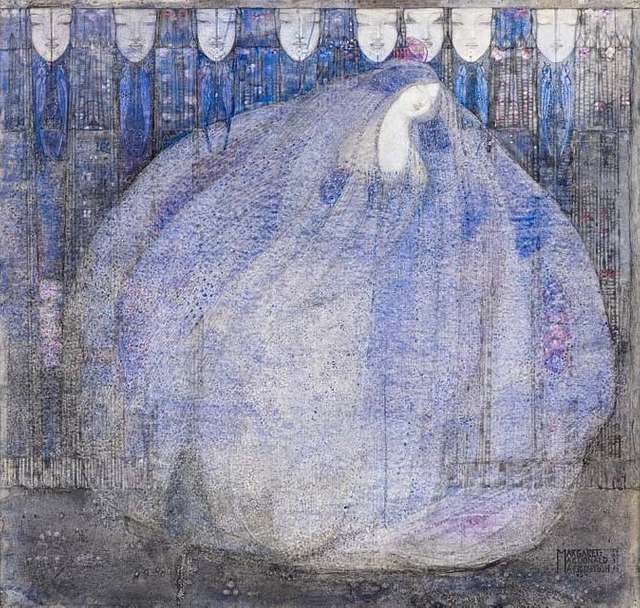
Painting by Margaret Macdonald Mackintosh (1864-1933)
Toma flopped onto the cushioned sofa in resignation and disgust. She cursed herself for being persuaded into believing that it would be a nice evening. She should have trusted her instincts. Now she regretted her decision to come to the party. Nothing to look forward to but the time when her uncle and aunt would decide to leave.
She sighed and took a sip of lemonade and noticed her uncle casting a worried glance at her. Feeling somewhat sorry for him, she smiled to assure him that nothing was amiss. It was not his fault, really. Her Latif Uncle and Rashida Aunty were doing their best to introduce Toma to the Bangladeshi community in Arlington. Back in Dhaka, Toma’s mother had lately been upset by her wayward daughter’s decision to stay on in the US to pursue a PhD after completing her Master’s. So, to appease her mother, she agreed to go to this party while visiting her maternal uncle and aunt in Virginia—a place to meet prospective bridegrooms and such. Toma herself had not been completely averse to the idea—she wouldn’t mind settling down eventually—but what she had seen so far was not very encouraging.
Early in the evening she had met Faiyaz, son of an eminent Bangladeshi doctor living in Fairfax, and himself a well-paid systems analyst with an MS from MIT. His mother had been crowing to the crowd about his recent raise. Toma could not help cringing. To her, such information was absolutely private, and she considered it as distasteful as a display of undergarments. Faiyaz, a stocky fellow of about 5 feet 4, smiled coyly at Toma, who was taller than him, poised, and very attractive. Throughout the evening, she had noticed quite a few men sizing her up and down. An elderly man even asked her if she had been in the Girl Scouts as she seemed to have an athletic body. Toma smiled politely and answered “no” before moving away feeling irritated and embarrassed.
Next came Tanvir and his parents. “Oh, how interesting! Both Toma and Tanvir begin with a T!” the father said with great mirth. Tanvir worked in a law firm in New York and was on the lookout for a prospective bride who would be smart and attractive, but not too career-oriented. He would be earning a lot, so he was more in need of a homemaker. The first question he asked Toma was what she planned to do after her master’s. When she replied that she was continuing into the PhD, he looked at her very seriously and said, “You are in physics, right?” Before Toma could reply he ploughed on. “You know, girls don’t have the right kind of aptitude for science. I don’t mean any offense. It’s just that research has shown that girls are better at languages while boys are better at mathematical and spatial cognition. In any case, with your degree and looks you can get a good job—why would you waste several years of your life on a PhD?”
Toma felt like scratching his eyes out. She took a moment before replying. “It has been my dream to become a physicist since I was in eighth grade,” she said. “Besides, I got accepted and funded at Purdue, so presumably, they didn’t find any problems with my mathematical and spatial skills.” Toma forced a smile before moving away.
After meeting Habib and his blabbering fool of a sister, Toma decided to take a break. After all, there was only so much one could take. She heaved a sigh and took another sip, no, a gulp at her drink. She could not understand why these people, who claimed to be so well-educated and cultured, acted the way they did. She looked across the room at the bevy of women in all their jewels and finery. To think that some day she might have to join their ranks made her feel nauseated. She saw a fat Mrs. Zoardar gesturing with her hands in such a way that everyone could see her emerald-studded bracelets. Another woman in a pale purple muslin saree was talking in a high-pitched voice, “Daud and I are planning to visit Europe next summer. I simply loove Paris—the Louvre is my soul. People here boast about cars and houses. You should all open your eyes and try to see the world. What is there in life, eh? Enjoy it!”
Toma grimaced and thought that the only person she could confide in about such nonsense was Mayeesha. Like Toma, Mayeesha too had been lately facing these situations. Actually, her case was worse since she lived in a city with a larger Bangladeshi community, whereas Toma had only come here to visit. Soon she would be back in the small university town in Indiana where the community would leave her largely at peace.
“Why so sad a face?” said a voice that sounded rather amused. Toma saw a woman occupying another sofa across from hers. She remembered seeing her before—a young woman who was accosted by a mother with two marriageable sons. She had deflected her by saying that she was already married and then had moved gracefully away from the vicinity. She was holding a glass in her hand, probably fruit punch, and Toma could not help noticing her fingers—the long, tapering fingers of an artist. She had an amused smile on her lips, but it was her eyes that made Toma take a second look at her. Her eyes were almost violet—a very unusual color for a Bangladeshi woman. Must be colored contacts, Toma thought. Still, there was understanding and compassion in her eyes. Unlike the other women in the room, she wore a simple vegetable-died, earth-toned cotton saree which made her all the more attractive.
“I am Urbee, I’m visiting too,” she said.
Toma smiled back. “I am Toma.”
“And you’re in the marriage mart?” said Urbee with her eyes dancing. It was more of a statement than a question.
Toma squirmed and then tried to change the topic. “I heard you say that you’re married. Is your husband around?”
“No,” replied Urbee solemnly. “I am actually separated from my husband. But I say I’m married to save myself from the old vultures. A woman here has no place unless she is under a man’s name.” She made a face and said, “Pathetic, isn’t it?”
Toma didn’t know what to say in response to this frank admission. “You’re not dressed like the other married women though,” she said.
“I’m still a student. So I can wear what I want. Besides, my husband is not here, right?” came the reply. “But there are also exceptions. See that lady over there? Urbee inclined her head and Toma followed her gaze to see a woman with a child seated on a sofa. She wore a crumpled silk shalwar-kameez, and seemed oblivious to the world. Her hair was casually tied at the back and she wore no make-up. As far as Toma could see, the only jewelry she had on was a pair of earrings, nothing gold or glittering. “Her husband is an economist, and she herself is a doctor. But she does not give a fig as to what people think of her,” murmured Urbee. “And now take a look at that decked-up camel.” Toma turned to see a tall, lanky woman in bright fuchsia pink lehenga passing by. She wore false eyelashes. The kohl eyeliner reminded Toma of Elizabeth Taylor in Cleopatra. She gave Toma and Urbee a fleeting glance as she walked by. Toma could almost see a camel in her awkward gait.
“She is a grad student at Virginia Tech—does she look like it? Her father pays for it, of course,” confided Urbee. “And there’s her sister who has come to visit from Texas.”
The sister looked normal, thought Toma. As if reading her thought Urbee said, “Wait till you see her with her son. They have a birthday bash for him once every month in anticipation of his first birthday this coming February. Oh, and they order several identical birthday cakes: one for the photos, one for the kids to smash, one for the kids to eat, one for the diabetic grandparents—you get the idea.”
Toma turned to look at her companion. “You’re kidding!” she spluttered. Urbee shook her head sadly. “No, I am not. Their father is a notorious government officer in Bangladesh. He is filthy rich. They have a ranch somewhere in Texas. The whole family spends time there every year. The decked-up camel is also in the marriage-mart, by the way.”
“She will fit in very well, I think,” answered a disgusted Toma.
Urbee smiled. Suddenly, a woman appeared from nowhere. “There you are. I’ve been looking all over for you.” Toma looked up to see a rather pretty but anxious-looking woman bending towards Urbee. “Don’t you think we should leave now?” she asked.
A flicker of annoyance crossed over Urbee’s face. But she replied in an even voice, “Come Rehnuma, I’ve just started enjoying myself. Don’t spoil it. Meet Toma. She is visiting too—like me. Toma, this is my cousin Rehnuma.”
Rehnuma glanced at Toma uncertainly and her lips stretched in a tight smile. Then she left abruptly but looked back at least twice. Toma felt somewhat uneasy. “Is there anything the matter? Your cousin does not like me, I think.”
Urbee laughed. “It’s not you. The problem is with me. I don’t fit in, you see. And she thinks I will get into trouble.”
“Do you get into trouble?” Toma was curious.
“Oh yes,” Urbee giggled. “If people bother me too much, that is. I told Mrs. Zoardar that she has a lot of similarity with the queen of pigs. And when Harun Ali’s brother came to look for a prospective bride, I told him nobody would be interested in a bald dwarf like him!”
Toma’s jaw dropped open. “What? No way! But why? Because they’re stupid?”
“Not just because they are stupid. Mrs. Zoardar has a daughter-in-law whom she treats very badly. And look at the woman—she thinks she looks like a queen. Yes, she is the Queen of Pigs.”
“And the other one?”
“That one is an absolute ass. He is a short, bald, hirsute fellow—not to mention almost middle-aged—yet he was looking for someone ‘beautiful and fair.’ Also, the bride would have to be less than twenty-five years of age. So I told him the truth. He has not found his bride yet, and that was three years back.”
A thought occurred to Toma. “You seem to know a lot of people around. How long have you been here?”
Urbee looked away. “I come here every December to visit my uncle. This is my fourth year in the US.”
“And Rehnuma is your cousin – I mean your uncle’s daughter?”
“Yes.” Urbee smiled. “She is rather cautious. Doesn’t like my ways.”
“Well,” laughed Toma. “I admire your courage. But I won’t be able to do what you do.”
“Oh, but you will,” replied Urbee with conviction, turning her shining eyes on Toma. “I, too, was polite and courteous once. But it seems a long time ago now. Sweet and enduring as my name. ‘Urbee’ means earth—did you know that?”
“I was thinking that yours is an unusual name. I have known a couple of Urmees, but no Urbee. But, seriously, you’re talking as if you’re my grandmother,” Toma laughed. “You cannot be more than three or four years older than I am.”
“I am thirty-seven, Toma. I may not look it but I am. When you reach my point in life, you too will think and feel differently.” She looked at Toma directly. “You too don’t fit in. You see things differently already.”
Toma shuffled uncomfortably. “A lot of girls feel like me. My best friend Mayeesha, for example.”
Urbee laughed. “I don’t know your friend. But you remind me of myself ten years back. I married because I thought I was in love.” She shrugged.
“I won’t get married until I find the right person,” Toma replied quietly.
Urbee peered into her face and laughed again. “And are you sure you’ll recognize the right person?” She shook her head. “You’re very romantic, just as I was,” she paused. “There’s no right person,” she shook her head. “There’s no man in this world to fit in the shoes….” Her voice trailed off. Then suddenly she got up and smiled brightly. “Best of luck in your groom hunting.”
Toma was suddenly angry. “I’m not looking for a husband,” she said firmly.
“Nooo?” Urbee looked at her wide-eyed. “What are you doing here then? Haven’t you been looking around and passing judgment too? ‘This one has a nosy mother, that one is too short, this one is too bossy’—isn’t that what you had been doing?”
Toma was too flustered to reply.
Her companion observed placidly, “We all do it, Toma. All the time. We are all in the same boat, only we think we are different.”
Toma found her tongue. “But you just said that I don’t fit in.”
“That too,” Urbee nodded. “You don’t fit into their world. You belong to another. That’s the problem. How will you survive in their world? Good luck.” Urbee walked away before Toma could stop her.
* * *
“Come dear, it’s time to leave,” Toma’s reverie was broken at the voice of her aunt. Rashida was smiling at her niece with genuine affection. Toma got up, relieved at the prospect of getting out of this place at last. Latif was already at the door, collecting their coats.
“I saw you talking to Tonima,” observed Latif when they were seated in the car. “What do you think of her?” he asked.
“Tonima?” Toma asked blankly. “Who is that?”
“The girl you were chatting with,” her aunt supplied.
“Oh! But her name is Urbee —was that her nickname, then?” Toma was a little perplexed.
Her uncle and aunt glanced at each other. “That was Tonima. What else did she say?” her aunt asked.
“I rather liked her,” Toma smiled. “She seems nice, though at the end I thought she was a bit strange. I would love to meet her again.”
“Did she say anything about herself?”
“She said she’s a grad student. But I don’t know what her discipline is, or where she studies. Why do you ask?” Then Toma added hastily, “She did mention that she is separated from her husband. . . you don’t disapprove, do you?”
Latif sighed. Toma went on, “She is a fine person, I think, even though different from most people.”
“She is not. . . er, normal,” her uncle blurted out, a little embarrassed.
“Not normal!” Toma echoed.
“She used to be a scientist, a molecular biologist doing cancer research, but then she went crazy,” Rashida said quietly. “She lost her only child in an accident. Never recovered from the blow fully. Her mother-in-law blamed her for being careless. It was not her fault though. She tried having another child but miscarried. Her in-laws interfered and poisoned her relationship with Biplob. A year later, they were divorced. Tonima and Biplob used to be a lovely couple, always the life of the party.” Rashida looked out at the lighted building they had come out from. “She was such a talented young woman—such a waste,” she sighed.
Toma fumbled for words, “But. . . uh. . . why was she . . . what was she doing in the party, then?”
“It’s her uncle’s house. She has a nurse, I think, who checks on her from time to time.”
Toma remembered Rehnuma and her anxious face. “Rehnuma,” she whispered.
“What?” Latif asked absent-mindedly. “She has this weird habit—takes on the persona of different people. And makes up strange tales.” He looked at Rashida. “Do you remember how she freaked out poor Ashraf by telling him that she is the re-incarnation of some Indian goddess?”
Rashida laughed. “Yes, Kali. I thought that was hilarious.” She looked at Toma explaining, “I don’t like Ashraf. He acts like Mr. Know-It-All. I thought Tonima gave him a good put-down.”
Toma was still struggling to grasp it all. “But she seemed quite normal to me. I mean—I mean the way she observes people.” Toma repeated some of the things she heard from her new friend. “And she has a very good sense of humour,” she added.
Latif sighed again and started the car. “That’s the problem. She seems normal—almost. But then, she has these hysterical fits when she remembers what she had and lost. Her uncle loves her very much and takes utmost care. Sometimes she is very charming, but. . .”
“And that Biplob!” Rashida grumbled. “He simply relocated. Married again—lives somewhere in California, I heard.” Then she added viciously, “The only good thing is that the new wife banished her mother-in-law from the house when she tried to meddle too much.”
Toma sat quietly, thinking of all she has heard. Urbee seemed so natural, intelligent, sane, and normal. Her observations on the people of the room were accurate and exactly as Toma thought. Suddenly, she jolted and felt a shiver run down her spine. Tonima—that name was so much like her own. And she used to be a scientist, just like she herself hoped to be. But what was she actually looking for in her prospective husband? Was she just a husband-hunter, as Tonima had said? Would she find the right person, or the right direction? Didn’t Tonima say that Toma will become like her?
As the car plunged into motion, Toma sat still and looked out into the darkness, trying to imagine what the future had in store for her.
.
Sohana Manzoor is a writer and academic from Bangladesh, with a PhD in English from Southern Illinois University Carbondale. Her works have appeared in Bellingham Review, Eclectica, Litro, Singapore Unbound, Borderless Journal, and elsewhere. She was the Literary Editor of The Daily Star from 2018- 22. Currently, she is pursuing an MFA in Creative Writing at UBC, Vancouver.
.
PLEASE NOTE: ARTICLES CAN ONLY BE REPRODUCED IN OTHER SITES WITH DUE ACKNOWLEDGEMENT TO BORDERLESS JOURNAL.
Midnight tonight won’t be just any night. Midnight tonight will be just right for frights.
The shrivelled mummy lumbers his doom from the room in his tomb to the outer gloom, unwraps himself like god’s gift to ghouls.
Vampires and werewolves and men who are half bulls wander the maze of mythical days like fools stuck in a funhouse.
As for Faust, he summons the Devil in order to revel with beautiful girls, tumbling curls and long legs included.
Denuded of armour, the hasty knight swipes at the hungry dragon who finds him tasty after a lick but later the bones will make him sick. Heartburn!
Every day I learn something new about the terrors of specific midnights. Behind the funeral parlour curtain there is a monster certain to pull your head off if you draw back those drapes.
A witch doctor has arrived in town, a wizard in a gown made from toad skins: he is thin and radiates weird despair from the stare of his sorcerous spiral eyes.
Who among us dares ignore the wise words of scholarly mythographers who caution us to avoid minotaurs and men with paws and claws instead of normal hands?
There are ghosts who love to spread themselves thick on the toast of our sixth sense: we shudder inexplicably when, wickedly, they tickle us spookily right from the inside.
Now I want to talk about the cobwebbed bottles of black wine in the cellar where ape skeletons wear dresses decayed into tentacular nets, fibrous, phantasmagorical.
But let me pause for a moment to re-read what is written in these lines…
I think the knight and dragon in this poem are out of place among the entities of gothic nightmare elsewhere found here. On the face of things they bring down the eerie quotient, ground the horrors in whimsy.
The face of things? A hideous visage indeed connected to a grotesque head. And now I just need to repeat the first stanza and we can all go to bed.
Midnight tonight won’t be just any night. Midnight tonight will be just right for frights.
From Public Domain
Rhys Hughes has lived in many countries. He graduated as an engineer but currently works as a tutor of mathematics. Since his first book was published in 1995 he has had fifty other books published and his work has been translated into ten languages.
.
PLEASE NOTE: ARTICLES CAN ONLY BE REPRODUCED IN OTHER SITES WITH DUE ACKNOWLEDGEMENT TO BORDERLESS JOURNAL
Based on Paul Gauguin’s life is a book by Somerset Maugham[1] called Moon and the Sixpence[2], a novel about a stockbroker who abandons his profession to become an artist. Gauguin[3] was a stockbroker turned artist, and Maugham was trained a physician but opted to write books and became a famed novelist. While earning a living as solely a writer has become increasingly difficult through the world unless you make it very big like JK Rowling[4], and therefore, most writers opt for being part time writers while holding full time jobs, we do have a few strange aberrations. One of them is Dr Kiriti Sengupta, who turned to publishing and poetry abandoning his profession — that of a dentist.
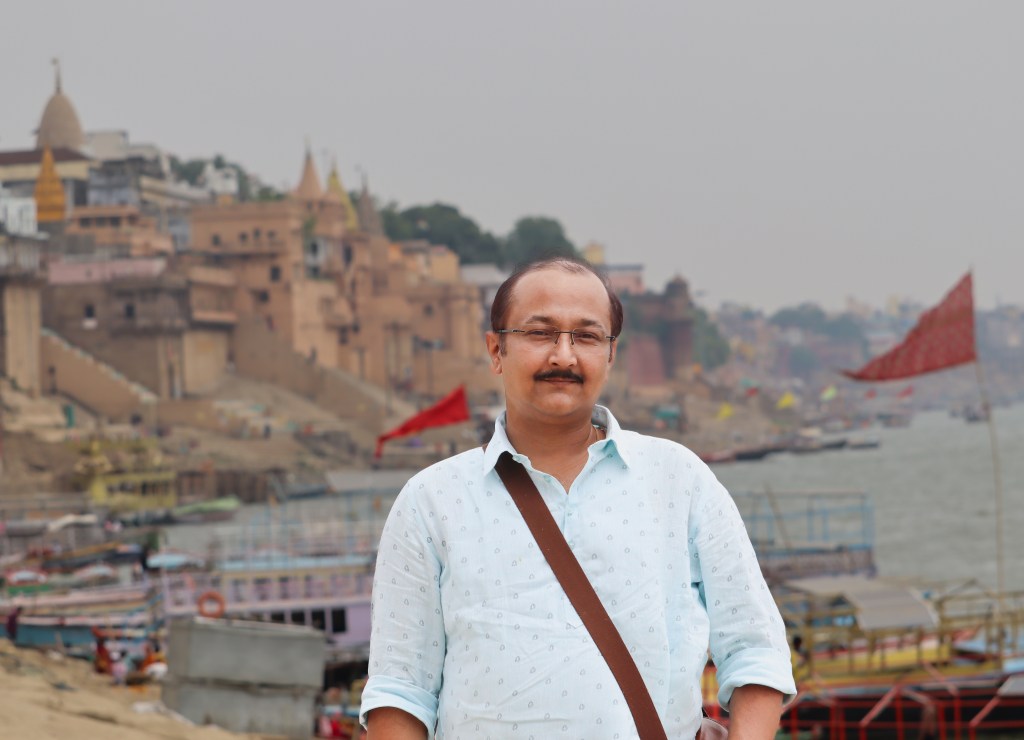
Kiriti Sengupta: Photo Courtesy: Bitan Chakraborty
He ran away from his home and started writing in a small, rented accommodation in 2011-2012. And now he writes, works as a director in one of India’s top upcoming publishing concerns, Hawakal, and rolls out poetry. Sengupta describes his former profession with, an underlined sense of irony, and perhaps with tongue-in-cheek humour:
I prefer patients who are edentulous. I dread
a tooth will wrangle my expertise, and I’ll fail
to make an impression.
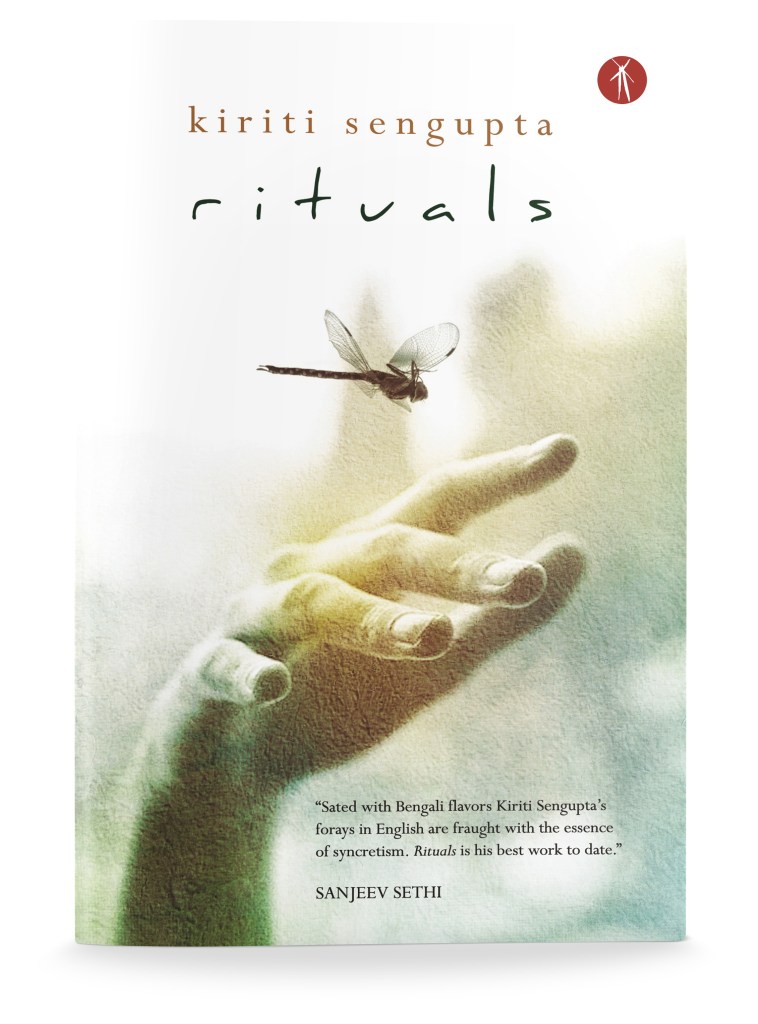
(Rituals, 2019)

Wisdom
the third molar adds
to the surgeon’s expertise
(Oneness, 2024)
He writes about water and the environment:
Water has many colors,
smudging pebbles
along its path

(‘Spectrum’, Water has Many Colours, 2022)


Feed the earth water
she flows in abundance.
Allow the planet to breathe:
the air is her consort.
(‘Hibiscus’, Water has Many Colours, 2022)
He writes for and about women:
How many mujras dwell in a kotha ?

How many neonates hew to a bordello?

Like her admirers
God is silent.
In her sinews
hides a hint of soil
from the yard of courtesans.

*Mujras are courtesan’s song and dance performances
*Kothas are brothels
(‘When God is a Woman’, Rituals, 2019)
And yet critiques stances with a twisted questions:
You define women as Durga
or Kali. Are you a believer? Are you
being kind? You could have convinced
them to fight the evil.
Instead, when you imply the goddess,
do you illustrate
sisterhood with many limbs? Would you
like men to act as Shiva—the destroyer?

(‘Primordial Learning’, Oneness, 2024)
Underlying all of Sengupta’s poetry, is a strong sense of irony which like a veil drapes words with double entendres. While the poems are layered, he dwells on human frailties too… like procrastination with a soupçon of sarcastic humour as in ‘From Being Late in Calcutta’ (Rituals):
As soon as you mark me
I’ll talk about events
that guide me to the records
you maintain.

I’d say crowded buses invite passengers
from unscheduled halts.
I’d emphasize the number of speed-breakers on road,
and their poor performance in preventing accidents.

I’d tell you trains run late.
Signals are laggy between stations.
I won’t forget to mention how
a sudden protest
makes the train stand still for hours.

I’d discuss about the day I reported late,
owing to instantaneous suspension
of underground train services
as a man killed himself on the railway lane.

I’d ask you to remember why I came late the other day.

If you can recall,
I had indigestion despite eating at home.
I blamed farmers for sprinkling pesticides on crops.
I pointed at my salary that failed to buy organic veggies.

And then,
I’d invariably argue about maintenance and population.

I’d appreciate China, one-child policy, and their claim on
how the government prevented four hundred million births.
And how India thrives on the revenues earned
from selling nicotine and condoms.

I’ll explore other issues
the next time I reach late.
He pours out lines on stars, film stars and politicians. Sengupta responds to life with poetry, often terse, brief… sometimes with a wry sense of humour. But in the brevity, lies a depth of mystery, which you can mull and cogitate over endlessly. A flickering of spiritual beliefs and a seriousness of intent despite the apparent lightness of words create a conversation within the poems. In this exclusive, an award-winning author of more than fourteen books, Kiriti Sengupta takes us on whirlwind tour of his life, his ideas and his work.
When and how did you start writing poetry? Why did you switch professions — from a dentist to a poet-publisher? What compulsion made you turn from a lucrative to an uncertain profession? Were you sure you’d succeed? Please share your story with us.
First of all, thank you for inviting me to Borderless for a heart-to-heart, Mitali. I greatly appreciate your dedication to literature, especially quality work. Coming to your first question (a bundle of questions, actually), I don’t remember when I first wrote a poem. Coming from a dentistry background, I never imagined that I would write poems. Until then, I was well acquainted with journalistic articles, critical responses, cultural essays, and, of course, scientific papers. Poetry was out of the question. I believe in karma. Maybe I was destined to write poetry. It wasn’t a deliberate choice. It wasn’t a spontaneous stance either.
I was passing through an obnoxious personal crisis that compelled me to reconsider my career in dentistry. I was comfortably placed in a government institution, enjoying a considerably thick monthly salary. In early 2012, I decided to leave my job and spend some time with myself. However, as you can understand, it was risky, as I was the only breadwinner in my family, which consisted of my wife and son. I had no career options to pursue.
I was new to social media back then. I had the opportunity to become involved with a virtual group, Indies In Action (IIA), run by Stephen L. Wilson. They were raising funds for the victims of the devastating earthquake in Oklahoma. I contributed a few poems to the literary anthology Twist of Fate(ToF), which Steve edited. It was hugely successful, and all proceeds went to the May Tornadoes Relief Fund, managed by United Way. For the promotion of the book, I interviewed a few eminent contributors, such as Bill Lantry, Terry Lucas, Colin Dardis, Marshall G Kent Sr., Allison Bruning, Maggie Rascal, Don Martin, Linda Bonney Olin, Maria Edwards (the then President of the American Authors’ Association), Ency Bearis, among others. Honestly, they all helped me become familiar with the world of poetry.
In 2013, my first book, The Unheard I, was published. It was released simultaneously in India by Dhansere Prakashan and in the United States by Inner Child Press Limited. It was non-fiction, although it contained two chapters dedicated to poetry. In his commentary, Stuart Aken remarked, “It is a scholarly [collection] that will appeal to those with an interest in poetry, particularly spiritual poetry expressed as literature, as well as [to] those who have a leaning toward or a significant interest in Indian myth and religion.”
Even then, I had no plans to pursue writing (or publishing, for that matter) as my career. Gradually, I evolved, and here I stand today. Do I call myself successful? I’m not sure whether I have turned into a consummate writer. Since I write poetry in a niche market worldwide, it is challenging to become a “successful” poet and earn enough royalties to sustain my family. As a publisher, oh yes, Hawakal has emerged as a leading traditional press that has published several writers and poets and enjoys its presence in New Delhi, Kolkata and Nokomis (Florida).
How long have you been in the literary framework? Was it a tough journey moving from dentistry to writing? How did your family respond?
My first essay was published in 1995 in the college magazine. I remember it was written for students suffering from anxiety and family expectations. While studying dentistry at North Bengal Dental College, I joined the All-India Freelance Journalists Association (AFJA, Chennai). My senior colleague, Dr. Falguni Maji and I were commissioned by Uttarbanga Sambad to write an article on the pottery art in Matigara (Siliguri). I was a regular contributor to “The Third Law” in The Telegraph (India). Later, I regularly wrote health-related articles for Ganashakti.
As I said before, I was initiated into poetry quite late. It was a challenging move as I had no formal training, but I was immensely blessed to have a few mentors who honed my skills and taught me the basics of writing poetry.
My family suffered badly from my career-shift. They had to compromise on their living standards. The initial years of becoming a full-time writer were dreadful, to say the least. From only one wholesome meal a day to just a pack of instant noodles for the day — I have personally experienced it all. I ensured that my family didn’t starve, nor did my son lose his schooling. However, their ceaseless support enabled me to survive as a writer and publisher.
How many books have you authored/translated and how many poetry collections, and within how many years? Do you see yourself more as a poet or as a publisher/editor?
I have written fourteen books of prose and poetry, and as a translator, I have two full-length collections of poems. I have also edited nine literary anthologies, including Shimmer Spring, an all-colour, hardback coffee-table book published during the pandemic, which addresses our perceptions of light.
Honestly, I see myself as a patron of Indian arts, literature and fine arts (painting, sculpture, etc.). I’m an admirer of Indian textiles, too! I love buying drapes, be it a saree, a shawl, or a dhoti, in rich fabrics. Bitan and I have plans to start a men’s brand of drapes. We are working on it.
You claim you are a slow writer, and you isolate yourself in a ‘studio’. Tell us about your poetic process. How do you write? What inspires you to write? Are you influenced by any writers/musicians, or artists?
You know, Mitali, we have two studios in India: one in Kolkata and the other in Delhi. These ateliers are essentially stations where we work on the submissions from authors — we read, select, edit, and design the books we publish. We invite authors and readers to have a one-on-one. Readers also drop by to buy a book or two they want. You see, these studios are not meant for our writing. I say “our” because Hawakal is the collective enterprise of Bitan Chakraborty (the founder director) and me. While Bitan oversees the Bengali department, I supervise the English-language division of Hawakal.
It’s difficult to describe how I write. Anything that stirs my imagination or fancy, whether a line from a song, an incident, or a tragedy, often inspires me to pen my thoughts. I am fond of ekphrastic poems and frequently visit art exhibitions to catch a thread or two. However, it takes days or weeks to write a poem, although most of my poems are short or very short. I believe in condensing my thoughts, which is a time-consuming affair.
Your first collection of poems, Healing Waters Floating Lamps (2015), was largely spiritual, while your latest, Oneness (2024), covers multiple aspects of life that may not be purely spiritual. Some of the poems in your later works are also ironic or verge on humour. A gap of nine years and multiple publications reside between the two books. Has there been a change or a progression in your poetry through your journey? Do you feel your poetry has changed?
Healing Waters marks my debut full-length collection of poems. Prior to this, I released 4 books, including My Glass of Wine (2013), which featured autobiographical poetry. My journey as a poet has led to a noticeable evolution. Scholars are more suited to examine these transformations. Some observe that my language and craft have become significantly more refined. They argue that my recent works display a level of sophistication. Conversely, others suggest that my earlier poems felt more spontaneous and grounded. Embracing evolution is crucial; without it, my growth as a writer would stagnate.
You translate from Bengali. Tell us who all you have translated. Have the translations impacted your own poetry. Do you feel translations should be literal or more focussed on capturing the essence of the language?
As I said before, I translated two volumes of Bengali poetry into English: Sumita Nandy’s Desirous Water and Bibhas Roy Chowdhury’s Poem Continuous—Reincarnated Expressions. I am delighted that these books have received rave reviews in India and overseas. Moreover, Hawakal recently released the 10th-anniversary edition of Poem Continuous, which has garnered critical appreciation.
Other than these books, I have translated a few contemporary Bengali poets as well: Ranadeb Dasgupta, Gourob Chakraborty, Rajeswari Sarangi, to name but a few. I can confidently tell you that translating Bengali poems has hardly influenced my work.
Whether translations of poems should be literal or more focussed on capturing the essence of the original is debatable. However, it is even more critical to ensure that the translated piece qualifies as poetry in the first place. If the piece does not read like a poem, regardless of the sincerity of the translator, the labour of translating the original work goes into vain. Every language comes with its own nuances. So, the translator should possess an excellent understanding of both the source and target languages.
Hawakal is regarded as one of the most important publishing houses for poetry in India. When and how did you join Hawakal as the director of the English section? How did you meet Bitan? Could you tell us about the journey?
Thank you for your kind comments on Hawakal, Mitali. Bitan Chakraborty established Hawakal in 2008 in Kolkata. He published numerous Bengali poets until I joined him in 2015. A common friend Kishore Ghosh introduced Bitan to me. Ghosh, a Bengali poet of some renown and a journalist, urged Bitan to publish a collection of literary criticism based on my work and that of Sharmila Ray. The book was titled Rhapsodies and Musings: poets in the mirrors of other eyes and authored by Ketaki Datta and Tania Chakravertty. So, we started our collaboration. Eventually, Bitan induced me to become one of the Directors of Hawakal.
Where do you see Hawakal travels as a publishing concern? What is the scenario like? Do you only bring out writers of Indian origin, or are you open to writers from other backgrounds? What does Hawakal look for in writers to publish with you?
For the past few years, Hawakal has been more focussed on fiction and non-fiction manuscripts. There is no dearth of poetry submissions, though. However, it’s challenging to find an authentic voice. We have published American poets like Dustin Pickering, t. kilgore splake, Marshall G. Kent Sr., Gary Manz, and others. Ethnicity isn’t a limiting factor for someone who wants to get published by Hawakal.
We really want to establish a steady foothold in the United States. Our tiny outlet in Nokomis is currently managed by Dr. Robertson James Short II. It has to grow big. Hawakal seeks original work, and we yearn for quality submissions.
Do you have any suggestions for young writers?
Aspiring writers or poets should read more and be well-versed with the works of contemporary authors. It is important to get published in journals, and accepting rejections from the editors is equally beneficial. Getting published should be a slow process. As the saying goes, there is no shortcut through the forest of life…
The daughter soaked joy for the past few days amidst her parents and children. When I woke up early, the trees, the leaves, and the grasses were damp. The rising sun parched them before late. I probed the air: Did the Mother weep as she left for Kailash?
The wife returned to her spouse.
Note: Hindu mythology holds that Goddess Durga brings her children when she visits her paternal home annually in autumn. After a designated period, she returns to her husband, Shiva, at Mount Kailash.
DURVA (for Durba Chatterjee | DOB: 25 September 2023 )
1 As I learn more about you, I'll pick up a batch or two wherever I reach.
2 The courtyard knew my boyhood days. You embraced my unshod limbs and healed my bruises as I slipped.
You made up the loving drape the earth donned for my convenience.
3 You taught us harmony. Resting in your mesh were the rice grains. Strengthened by prayers, you sat on my scalp for the nuptials. The bride held you in her hair.
4 You embody divine grace. You are more pristine than water that turns holy as it lets you sink.
5 You add to the sanctity of the soil. Blessed are the humans raising you in their yards.
Like Draupadi, the planet mourns when the veil is withdrawn.
Notes:
Durva or Durba is a common Bengali name for girls. It denotes Bermuda or Conch grass, known for its many therapeutic properties and frequent use in Hindu rituals. Numerous Puranic stories are linked to Durva grass.
In the Mahabharata, the Kauravas stripped Draupadi, subjecting her to great humiliation and distress.
Kiriti Sengupta has had his poetry featured in various publications, including The Common, The Florida Review Online, Headway Quarterly, The Lake, Amethyst Review, Dreich, Otoliths, Outlook, and Madras Courier. He has authored fourteen books of poetry and prose, published two translation volumes, and edited nine anthologies. Sengupta serves as the chief editor of Ethos Literary Journal and leads the English division at Hawakal Publishers Private Limited, one of the top independent presses established by Bitan Chakraborty. He resides in New Delhi. Further information available at http://www.kiritisengupta.com
PLEASE NOTE: ARTICLES CAN ONLY BE REPRODUCED IN OTHER SITES WITH DUE ACKNOWLEDGEMENT TO BORDERLESS JOURNAL
The Tyne is still, the water's calm, a restful, reassuring balm. In Newcastle our train has stopped. From here it seems the perfect spot. Where the iconic bridges span, where, once, a different river ran; well, different water, anyway, flowing on into yesterday. An errant cloud floats in the sky, as if it's only passing by. Nimble fingers unpick its seams; on water sunlight softly gleams. Transporting good to buy and sell; the stories this river could tell! Riverside harbours, wharfs and docks, today replaced by concrete blocks. Where there was muck once there was brass; now buildings of shimmering glass, high-tech hubs, computer centres; the past flees; the future enters. Newcastle, grimy, built on coal; Have you now sold your northern soul? Those hardy people of the past? How long will their memory last?
II
Will the march of modernism harm that fabled humour, Geordie charm? Will your essential being change, or will it just remain the same? We're too busy with our smartphones to dwell on our ancestors' bones. To get on YouTube; that's our goal; we are not used to heaving coal. Those people, they belong to then; yet the people now come from them. Through generations runs a thread; They are by shared history wed. Yet, perhaps, they who once were here, who, too, enjoyed a pint of beer, are still with us; at least in thought, their lives unfinished; dreams still sought. Will our hopes, too, be unfulfilled, our vision struck, our voices stilled? We share with them. husband and wife, the fickle randomness of life. Now the train jolts into motion and dispels my idle notions. One final glance, one final time. The Tyne is still; and still the Tyne.
Stuart McFarlane is now semi-retired. He taught English for many years to asylum seekers in London. He has had poems published in a few online journals.
.
PLEASE NOTE: ARTICLES CAN ONLY BE REPRODUCED IN OTHER SITES WITH DUE ACKNOWLEDGEMENT TO BORDERLESS JOURNAL
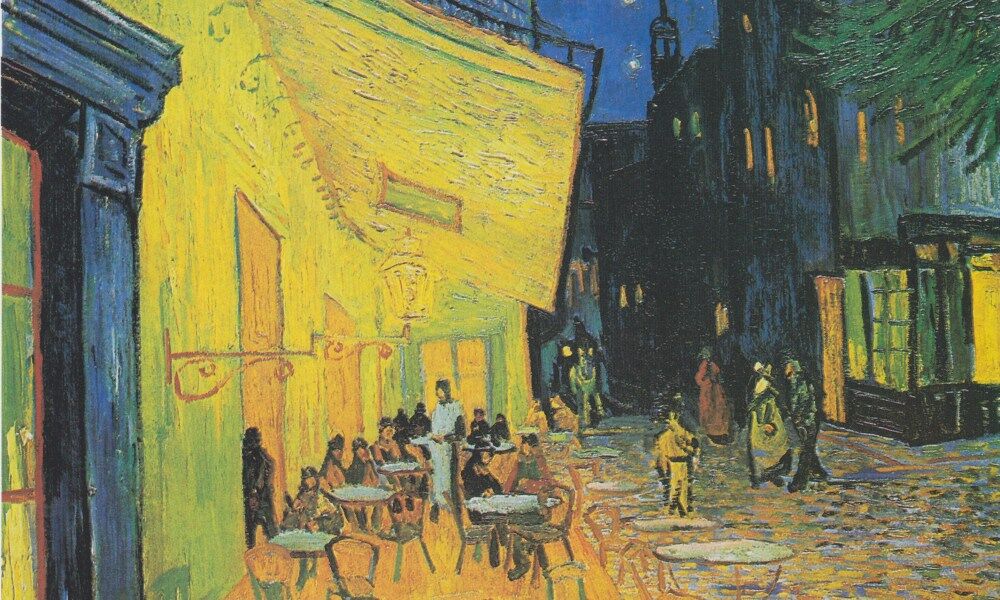
Painting by Vincent van Gogh (1853-1890). From Public Domain
NIGHT IN THE SUBURBS

As the night deepens,
the sky seems like a hole
that stars fall into.
Branches suddenly wave
like spastic arms,
as a wind from nowhere
sets them in motion,
and life quickly passes by,
leaving no time
to even wonder why.
The earth continues spinning,
like an alarm clock
with malfunctioning hands.
My wife is dead.
My friends are old.
Why did I live?
I have no idea.
I was never told.


EVENINGS AT SILVER MOON LAKE

The day stretches before me
like the water in the lake,
flat and dull.
I sit thoughtlessly,
as if riding the waves
like a somnolent gull.
A sudden breeze passes by,
like the rough touch
of an invisible hand,
but it’s quickly gone.
Like bygone days,
it didn’t last long.
As waves beat the shore
like the erratic notes
of a mad composer,
I’ve finally had enough,
and I close my door.
George Freek’s poetry has recently appeared in The Ottawa Arts Review, Acumen, The Lake, The Whimsical Poet, Triggerfish and Torrid Literature.
PLEASE NOTE: ARTICLES CAN ONLY BE REPRODUCED IN OTHER SITES WITH DUE ACKNOWLEDGEMENT TO BORDERLESS JOURNAL
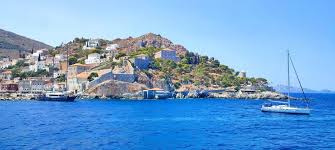
Winter, together with the northern gales, reached the shores of Hydra, an island belonging to the group of Saronic islands in the Aegean Sea. On the north-eastern side of Hydra, save a few monks in two monasteries, few human beings had built their homes. Hoary pines and cypresses intertwined with other plants, providing shelter and shade for the gangs of dangerous feral cats that roamed amongst enormous, solitary rocks and deep precipices hunting for food. Weird, colourful birds built their nests in the crevices of the towering cliffs whose plateaus were carpeted with red poppies and violet cyclamen. It was a desolate landscape unfavourable to human existence, although it was told that certain ‘wild’ islanders did dwell in the porous caves of the cliffs sculptured by the winds and rains overhanging the foamy waters far below …
It was in the south where the islanders enjoyed a relatively decent living, when of course the fish and tourists were plentiful. Now, however, the bathing areas lay silent and the villas, lifeless. Winter was the time for fishing. The sailing dinghies, catamarans and rowboats that had been hauled in for repairs were once again seen bobbing up and down upon the choppy waves. Seabass abound, as well as sea bream and sardines. Brightly painted sailing dinghies brought fish uninterruptedly to the market. But deep in this particular winter, the fishermens’ nets held little catch, and the islanders had to resort to eating vegetables that survived the cold from their gardens, the bread from their ovens, and now and then a partridge or a quail shot by those who owned rifles. Fish could be purchased from other fishermen in the neighbouring islands. But they sold their catch at a dear price.
Old Vasiliki was preparing his multi-pronged fishhooks. The nets that he had mended long ago had snapped and ripped again. Up till then, winter’s catch proved hopeless. He had scarcely earned fifty drachma. Vasiliki still had earnings from renting the second floor of his house to summer tourists, but those savings were slipping away on fishing material, goods from the shops or fish bought from the fishermen of the other islands, where apparently the catch was abundant. Nico, his grandson, had fallen ill that winter and medicine was dear. The poor boy had not been to school for over two weeks …
School and notebooks cost money, too. So be it. Tonight, Vasiliki would go out fishing, so he carried on straightening out his turkey-feathered multi-pronged fishing-hooks, mending the rotten fishing lines, changing the rusting hooks. If he could catch a lot of fish, he could buy a petrol lamp and more candles for the house, a pair of shoes and a woollen vest for Nico. He would buy Nico a book of sailors’ tales that his curious-minded grandson longed to read. He would also buy him a huge picture of a Spanish galleon that he could pin up on to the yellow painted wall of his tiny room.
Vasiliki went out fishing in the evenings. Nico never knew when his grandfather would return …
Every night the boy dreamed the same enigmatic dream in the absence of his grandfather. He stood at the helm of a beautiful boat whose name was written in bold black letters but which he could never read. Enormous waves continuously surged and battered the solid vessel. Then a sudden volley of rocks or missiles assailed him from all sides out of a rising mist, accompanied by a deafening din of hysterical screams and raucous shouts. From above, a huge white-crested wave was about to engulf him … Nico would be startled out of this recurrent dream, never understanding how he escaped the missiles, the monstrous wave and screams because at that very instant he was startled out of sleep by the flapping of the curtains against the paneless window and the slow, heavy footsteps of his grandfather returning from fishing. Vasiliki, smelling of the briny sea, stepped into Nico’s room.
The boy sat up in bed: “Did you catch any fish, grandpa?”
“No, the sea was empty of fish tonight.”
“Empty?”
“A sea monster has surfaced, Nico. It is eating all the fish in the sea.” Nico blinked his eyes in mistrustful wonder.
“Have you seen the sea monster, grandpa?” The exhausted Vasiliki offered no answer. He shuffled out of his grandson’s room and retired to his own.
Whether Vasiliki really saw a monster always remained a mystery to Nico. He had read about weird sea creatures with lamps on their heads in the inky darkness of the deep; read about shoals of huge fish that swallowed dinghies and rowboats whole. His father, Constantine, had been swallowed up along with his crew by those horrible creatures … so his grandfather narrated, sadly. His mother, Myrto, died a few months later of tuberculosis … or of a broken heart. Or both. They were in their early thirties …
Vasiliki and his wife, Nefeli, took their grandson in. They did their best to bring up the lonely, melancholic boy. Then Nefeli fell ill with fever and died soon after. Vasiliki buried his beloved wife at the neighbouring cemetery. All that the old man cherished now was Nico, his taciturn grandson.
Vasiliki owned a small, green, two-storey wooden house, a house that belonged to his father. Summer was not far off so he could again rent out the second floor to tourists and earn a few lepta or drachma.
In the small sitting-room where the flower-dotted wall-paper was peeling off the badly cut boards, he had nailed photos of his wife and daughter, now yellowing due to the humidity. Vasiliki’s home was hardly furnished, although he had made an effort to provide low sofas, wicker chairs and sturdy tables for his guests upstairs. He even built a shower for them, a luxury that he and Nico dispensed with. They washed either in the sea or directly from the wash-basins in the garden behind the house. But since no one occupied the two rooms upstairs, ever so often they would shower upstairs and from the windows look out at the sea. Presently, Vasiliki climbed the five steps to one of the rooms, parted the laced curtains of the recently washed window and looked out towards the sea, whilst he mended his net, sang songs, thought of Nico’s future. His warm eyes slipped from his mending to the brilliant blue waters of the Argolic Gulf. That boy was all he had. His treasure. When he thought of Nico he awoke from his day-dreaming and smiled. He had promised him long ago that they would build a small boat and send it navigating on the high seas, like a bottle thrown amid the waves, and whose destination would be known to no one, a horizonless destiny for that little boat.
Vasiliki sighed: “I have to keep an eye on Nico. Those nasty children from town always take the thump him at school. He’s not big enough to fight on his own.” Vasiliki took up a needle and began stitching Nico’s torn trousers. “I have to walk him home after school so he won’t go sleeping under the olive trees or on the beach where the schoolboys could knock him up.” Vasiliki wondered where his grandson had gone …
Nico stood under a plane tree in front of his grandfather’s house. He was busy making a boat. It wouldn’t be his first boat. But this one would be the boat of all boats ! A long-voyage boat, built for the broad, open seas … the remote and unchartered seas, a boat that would weather stormy waves, glide over placid rolls, sail alongside monstrous creatures of the deep, a boat without a flag, a nationless boat, yet unmanned by pirates or corsairs, a boat completely independent. Nico put his whole heart into this project, his whole imagination of what such a boat should be made of, and how it should be navigated.
“Nico?” cried down Vasiliki from the upstairs window.
“Yes, I’m here, grandpa.”
“What are you doing?”
“Making a new boat.”
“Another one?”
“The biggest and the best, grandpa. It’ll sail to the other side of the world … to China …”
“Tomorrow you must go to school, don’t forget. You can work on your boat after school.”
“Yes, grandpa. I’ll work hard in school.”
“By the way, what will you name your boat?” Nico thought for a moment. At first ‘Neptune’ came to mind, but he quickly changed it as his grandfather’s eyes swelled with pride and joy at his grandson’s aspirations and imagination.
“I’ll call her Nefeli, grandpa.”
Vasiliki gave Nico an odd look. He didn’t know whether to smile or cry. He murmured the name several times on his lips, slowly, intimately. The old man burst out laughing: “Nefeli! Nefeli!” he shouted. “Your grandmother would have been proud to know that her name will navigate the four oceans of the earth, my boy. Don’t forget to prepare your things for school tomorrow. We’ll be having sardines tonight that I bought from Dimitri. He sold more than a dozen at half price.” And Vasiliki returned to his mending and stitching since the yellowish light of late afternoon allowed his eyes to do so …
Nico went to school the following morning, shuffling along the dirt-packed road. What a burden to acquire knowledge that he would never use in ‘real life’. Neither Nico’s classmates nor his teachers held any interest for him. His two weeks’ absence afforded him time to dream … to concentrate on his boat-building. The boys who crossed paths with him on the way to school never wished him a good morning, nor did they enquire about his health. He was ostensibly shunned by all and sundry, even several of his teachers took a dislike to him.
Nico shrugged his shoulders, sitting in the back of the stuffy classroom, heated by a pot-bellied stove, gazing out over the bungalows to the wide sea. He envisioned the decks of galleons gleaming white from a good scrub, their sails bellowing in the refreshing breeze. Nico filled his lungs with the fresh, clean, ocean air. Yes, only the sea afforded the boy a pleasure in life, along with, of course, the voice and affectionate gestures of his grandpa. All other things to him seemed dull, lifeless … empty.
The children in his class thought only of the tediousness and boredom of their school work and the silly games they played with or against each other to compensate for that tediousness and boredom. None had any project to impassion their lives. None envisioned a future further than the next day at school or in the market. Few went swimming in the bay, where he swam too. They shrank away from his boyish laughter splashing about in the water, avoiding his company completely.
When Nico was not day-dreaming in school he was busy reading or making boats — all kinds of boats. Cutter in hand, he whittled small sailboats and rowboats … even catamarans! Everyday he whittled a raft as he contemplated the steamers’ coming and going in the glimmering Aegean. But his next boat would be huge. A huge boat with a bridge, lower and upper decks, a hold for cargo, masts, sails, portholes and a crow’s nest. This boat would be the largest, the loveliest … and the sturdiest of them all. A boat which had never been built before by a fourteen year old boy. And that day came. Nico, the fourteen year old boat-builder had completed his dream boat. For him this boat meant the world. He felt his heart swell with pride and satisfaction. Vasiliki inspected his grandson’s remarkable vessel. It was painted marine-blue. At the bow he had painted the head of Neptune. He had even cut a hole in the starboard for the anchor to be weighed or dropped using a big fish-hook tied to a long, thin rusty chain. The deck had been sand-papered to a dazzling gloss. He equipped her with a four-cornered small jibe[1], as white as the flesh of a sea bream. He had taken great pains to whiten that piece of cloth of a sail, rubbing and scrubbing away with aqua fortis. It took him days to attain that candid sheen …
All the rigging on the bridge was fixed solidly to the wide deck by thin copper wires rising high above all the rest, held securely with copper wires screwed into the thick wood of the deck and reinforced with English twine. Portholes had been carved out on both the portside and starboard for the cabins, for although Nico’s boat would be captainless — unless he himself exercised this task– his imaginary crew would be like the Lilliputians that he had read of in Gulliver’s Travels. How he had enjoyed reading those stories of sea and island adventures … Nico had even cut and inserted pieces of broken glass he found scattered about the streets to window the portholes, which he polished to a shiny, brassy gleam.
When all had been fitted out properly, he painted the endearing name Nefeli in bold, black letters on her portside. Vasiliki stood in quiet admiration of his grandson’s months of hard labour. It was indeed a work of art. He embraced him. His grandson may not be the best of pupils, but he worked wonders with his hands. Someday he would be a great boat-builder, and not just a poor fisherman like his father and grandfather …
The rising sun peeked over the watery orb of the sea. It was Saturday. That day Nico launched his boat into the placid waters of the Argolic Gulf. Vasiliki accompanied him on this long-awaited day, eager to witness her maiden voyage. The Nefeli once launched, slid with ease. At first, the boat floated unsteadily on her portside. But when the wind picked up, she rose to her full splendour and ploughed through the clammy waters with amazing ease, all sails aswell. Nico let the spool of English twine slide quicker and quicker from its spool. It unravelled rapidly, but the boy had full control of the situation. The spool held hundreds of metres of twine.
The Nefeli skimmed over the wavelets like a shark racing towards its prey. Vasiliki stretched out on the pebbly shore to mend a torn net, eyeing both the Nefeli and his mending in mute jubilation. He thought of his daughter and how proud she would have been to see her son manœuvre his own hand-made boat. His grandson, too, jubilated, running to and fro along the shore to manœuvre the cruising vessel as she swayed to the rhythm of the breeze. Suddenly an easterly gale drove her towards the shore. Nico slackened the twine. At the same time, though, he pulled her away from some dangerous rocks and uprooted pines. Any collision might have caused great damage to the Nefeli. After all, it was only a little boat and the sea a powerful force that no one should underestimate. Two hours or so later, Nico pulled her in, and he and his grandfather returned triumphantly homeward to eat.
News of Nico’s remarkable boat reached every ear on that small island. People from the big town would come to the shore to watch this young boy of fourteen manoeuvre his vessel. As promised, Nico launched his boat only after school as soon as he had finished his homework. For weeks now, the Nefeli had withstood the brunt of several white-crested waves and a slight collision against the rocky part of the shore. All in all, Nico’s boat proved robust and his manoeuvring worthy of any captain of the sea.
One fine, sunny Saturday Nico, as always, launched the Nefeli near a large grove of pine trees. A slight south-easterly wind was blowing. The twine unravelled rather quickly, the boat lying on her side, her stern twisting and turning in the foamy waters like a fish’s tail. He pulled at the twine and managed to steady her route. Nico sighed in relief … Suddenly he heard shouts, cries and screams from behind him. A gaggle of children were racing along the shore targeting his boat with huge stones, one of which, incredibly enough, after hitting its target, propelled her further away from the volley of projectiles. Two or three boys, whom he recognised from his class, had sling-shots and were letting fly stones with great rapidity but not necessarily with great accuracy. Nico ran faster, pulled at the twine, quickening the speed of his boat. But there were too many boys, many of them running faster than him. More and more stones were slung or thrown, luckily off their mark. Nico thought to haul the boat back to shore near the rocky cliffs in the hope that the scoundrels’ pockets would be emptied of stones by then.
The poor boy, however, stopped in his tracks. The Nefeli seemed to navigate on her own, wind filling her sails, skimming high and mighty over the angered waves in spite of the deluge of catapulted missiles. Then in one tremendous volley four or five of the bigger boys hurled dozens and dozens of stones at the speeding Nefeli, some of which broke through portside, others splintered the bridge and still others burst into the jibe and crow’s nest.
Nico’s wonderful workmanship managed to stay afloat for a half hour before sinking to the bottom of the sea. The last thing that Nico saw of his boat were the bold, black letters of his grandmother’s name: Nefeli.
The children vanished into the pine groves as quickly as they had appeared …
Nico turned his back to the dramatic sinking of his vessel. Opening the gate to his grandfather’s front garden, he strolled up to him.
Vasiliki, cleaning several fish and shrimp that he had caught the previous night smiled at the approach of his grandson: “So, how did she sail …?” He suddenly noticed that Nico hadn’t the boat in his arms. He frowned and lowered his eyes.
“She set sail for the other side of the world, grandpa. She’s in route to China. The English twine snapped and off she sped out of the gulf towards the open seas disappearing over the edge of the waters …”
“Well, like a bottle thrown into the sea, right? You never know where she’ll land. I just hope the sea monster won’t swallow her up like it does all the fish.”
“No, grandpa. Monsters don’t swallow boats only fish. Did you see the monster last night?”
Vasiliki shook his head. “Can’t say that I did.” He put down his knife and scratched his white beard: “I caught some prawns last night Nico, what the Spanish call gambas. We’ll have a marvellous meal just you and me tonight.”
“It’s always just you and me that eat, grandpa,” Nico reminded his grandfather.
Vasiliki pursed his lips: “How right you are, my boy.” The old man paused for an instant taking up his knife: “Will you build another boat?”
The boy kicked up the yellowing grass in the garden with his torn sandals. “Yes, grandpa, I’ll build another one.”
“Bigger than the one that just sailed to China?”
“Yes, much bigger.”
“What will you name her?”
Nico furrowed his brow. He looked sadly into his grandfather’s eyes: “I’ll name her Myrto.”
Vasiliki eyed his grandson affectionately. “I like that name Nico. It’s a beautiful name …”
“I like it too, grandpa.” And the boy shuffled off to his room …
Paul Mirabile is a retired professor of philology now living in France. He has published mostly academic works centred on philology, history, pedagogy and religion. He has also published stories of his travels throughout Asia, where he spent thirty years.
.
PLEASE NOTE: ARTICLES CAN ONLY BE REPRODUCED IN OTHER SITES WITH DUE ACKNOWLEDGEMENT TO BORDERLESS JOURNAL
Don't you strive for the fame or pursue its fortune -- play a roulette game like a business tycoon, climb a high status ladder? don't even start,
you've already made it, you've got a good heart,
don't boast your conquests - your qualifications, the talent contests -- the expectations, don't conquer the mountains or top the charts --
you've already made it, you've got a good heart,
don't be frightened to lose, or to take a rejection, wear an ego bruise for your imperfection, your legacy is sleeping - you've got a head start,
you've already made it, you've got a good heart,
don't stack on your power, don't you mass on appeal, build the tallest tower or sign a record deal, bin your trophies - certificates - rip them apart,
you've already made it, you've got a good heart.
StephenPhilip Druce is based in Shrewsbury UK. He is published in the USA, India, the UK and Canada. He’s written for theatre plays in London and BBC 4 Extra.
Contact: Instagram – @StephenPhilipDruce
.
PLEASE NOTE: ARTICLES CAN ONLY BE REPRODUCED IN OTHER SITES WITH DUE ACKNOWLEDGEMENT TO BORDERLESS JOURNAL









 Borderless