Categories
Poetry

Poetry by Nziku Ann

Nziku Ann
HOPE LINGERS 

I hear their stories—
and my heart drifts into their storms.
The air hums with sorrow,
an aura of misery
that speaks louder than words.

A tear escapes, unbidden.
How can life be so cruel?
So heavy with silence,
so unfair in its choosing?
Why must we surrender to such fate?

I see fragments of myself in them—
the same dreams,
the same quiet battles,
the same fire to rewrite the ending.

Then I hear them speak—
voices trembling yet strong,
breathing confidence,
power,
hope—
a convulsive awakening of the soul.

Another tear falls,
but this time it carries light.
Life may wound,
it may break,
but even in the wreckage—
hope lingers.

Nziku Ann is a literary enthusiast bases in Nairobi, Kenya. A beauty therapist by profession and an introvert who finds expression through poetry.

.

PLEASE NOTE: ARTICLES CAN ONLY BE REPRODUCED IN OTHER SITES WITH DUE ACKNOWLEDGEMENT TO BORDERLESS JOURNAL

Click here to access the Borderless anthology, Monalisa No Longer Smiles

Click here to access Monalisa No Longer Smiles on Kindle Amazon International

Categories
Notes from Japan

One Thousand Year Story in the Middle of Shikoku

Photographs and Narrative by Suzanne Kamata

I’d wanted to go on the Shikoku Mannaka Sennen Monogatari (One Thousand Year Story in the Middle of Shikoku) train trip ever since I saw it advertised on a poster in the window of Tokushima Station. When I investigated, however, I discovered one couldn’t begin the journey in Tokushima, where I live. Although it starts (or ends, depending on which way you’re coming from; it’s a one-way trip) deep in the mountains of Tokushima, I would have to change trains a few times before boarding the special sightseeing train. It would take hours to get there. A better way would be to board in Tadotsu, which is in the neighboring prefecture Kagawa. I could drive there in a little over an hour, take the fancy train to Oboke, and return by express train.

I decided to take a ride on the spur of the moment. The train was pretty much booked for the rest of the season, at least on the days when I didn’t have other plans, like my job. I did find one last seat on a train in mid-November. It might have been more fun to go with someone else, but I didn’t have time to coordinate with friends. I immediately booked the seat, reserving my lunch as well.

The morning of my train trip was chilly, but sunny. I donned a thin tunic and a long cardigan, wondering if it would be cold in the mountains. Maybe I should bring my down jacket? I rolled up a windbreaker and stuffed it into my backpack. I entered my destination – Tadotsu Station – into my phone’s navigation app, selected a podcast for the drive, and set off.

Tadotsu turned out to be a sleepy little town, which makes sense. These are the kinds of places that need something special to attract visitors and their money. If the whole purpose of these sightseeing trains is to rejuvenate dying towns, then Tadotsu seemed like a good choice. I could see that some construction was in progress, perhaps to accommodate the hordes of new visitors brought by the train. Porta potties temporarily served as bathrooms.

In front of the station, an intriguing sculpture attracted my attention. To me, it looked like a tall armless man wearing a hat, backed by a sickle. There was an emblem like a coat of arms where the neck of the man would be. At the base of the sculpture was a plaque with the words: “Thankful for my own life. Thankful for having you in it.”

Later, I discovered that it was meant to commemorate Doshin So, nee Michiomi Nakano, a former military intelligence agent who spent many years in China. After returning to Japan, he was stationed in Tadotsu, where he established a cram school to teach Buddhist philosophy and martial arts.

In 1947, he founded Shorinji Kenpo, a Japanese martial art with a holistic system. The training methods are divided into self-defense training, mental training, and health training. According to his philosophy, spirit and body are as one, and they must be trained together as such. His teachings emanated from this small town of about 20,000 people to the rest of the world. The emblem, as it turned out, was the symbol for Shorinji Kenpo.

I took a photo of the monument and proceeded to the train platform, where I was met with heavy equipment surrounded by a chain link fence. A sign apologised for this inconvenience, and explained that construction was underway to make the station barrier-free.

I was twenty minutes early, but my fellow passengers – Japanese, as far as I could tell – were already milling about, taking selfies and photos of each other in advance of their train trip. The group was mostly female, middle-aged, and older. Many people were wearing masks.

A cinematic melody heralded the approach of the train, accompanied by another rush for selfies and photos. The three cars, all different colors, were named after spring, summer, and fall. What happened to winter? A small doormat with the train’s motif, which resembled a stylized tree, was positioned on the platform at the entrance to the train. I boarded the green “spring” car, Haru Akari, and found my seat, a fuzzy green upholstered chair at a table against the wall, facing the window. The two seats next to me were unoccupied.

Most people wore casual clothes. I rarely saw folks from Tokushima get dressed up, unless it was for a wedding, say, or a graduation ceremony. One woman at the four-top on the other side of me was striking in a sumptuous Chinese-style jacket and gold barrettes. I wondered for a moment if she might be some kind of celebrity. I tried not to stare.

I examined the orange cloth placemat, again with the tree motif. Already my mouth was watering. Disposable chopsticks and a wet napkin were aligned at the bottom, while a spoon rested on a rectangle of granite. Paper napkins, toothpicks, and creamers were tucked into a small basket made of vines. Brochures detailing the train’s route, souvenirs for purchase, and additional menu items were laid out.

You could use your phone to scan a QR code and order keychains, sweet potato cakes, or a yusan-bako, a traditional lunch box which originated in Tokushima. This one was made of Japanese cypress adorned with Kagawa lacquerware. It had three drawers for various delicacies, which fit into a box with a handle, perfect for toting to a picnic in a meadow somewhere. You could also buy a CD with the train’s theme song.

I had already ordered my lunch, but I glanced at the menu anyway. Fish cutlets, another specialty of Tokushima were available, along with bamboo shoots, and ice cream made with sake lees. The sweet potato crumble, with a dollop of whipped cream, was also tempting, but I summoned my willpower.

One of the uniformed attendants pointed out the wooden box under my car for storing my backpack and purse. I got those items out of the way. She also handed me a coupon for soup and water to be redeemed at our first stop. And then finally, the train began to move. A whistle blew. Japan Railway employees and others lined up with flags and round paper fans and began waving at us. We all waved back.

After that enthusiastic send-off, the train began to trundle along the tracks, picking up speed as we zipped past backyards of houses, apartment buildings with laundry hanging on balconies, convenience stores, crows alighting on power lines, an empty playground. We passed rice paddies, some surrounding family gravestones; a construction site with bright blue, green, and yellow earth moving machines.

As we neared Kotohira Station, our first stop, a young woman chirped that Kotohira’s brass band had been declared second best in the country. She reminded us to redeem our coupons in the welcome center. After the train had stopped, I followed everyone into a small room adjacent to the station where we lined up at a counter. I handed over my little piece of paper and received a bottle of water and a small China cup of kabocha 1potage. I perched on the padded bench to drink it, while gazing around at the proud display of photos of the award-winning high school band. A white-gloved attendant came around with a tray to collect my empty cup, and I got back on the train.

A young Chinese family – a couple and their plump baby – were now occupying the seats beside me. The train moved on. The view outside my window was now more expansive – terraced fields, occasional houses with tiled roofs and walled gardens, tufts of pampas grass, a patch of pink and magenta cosmos.

The voice announced that we were nearing Sanuki Saida Station, which boasts a 700-year-old tabunoki tree, said to be a “power spot.” Apparently if you stand under the tree, you can absorb some of its spirit and energy. The tree has also been designated a Kagawa Prefectural Protected Tree. The train came to a stop again, but this time we didn’t get off. Instead, we all whipped out our smartphones to take photos of the person dressed in a polar bear costume shooting soap bubbles from a bubble gun. The baby was delighted.

Once we were again underway, the attendant distributed large square bento boxes with gold-rimmed lids. I opened mine to find an array of chilled meat dishes – the first course. I unsheathed my disposable chopsticks and broke them apart. “Itadakimasu!2

Out the window, farmland had given way to gnarly brush. `Although the foliage wasn’t quite at its peak, swatches of scarlet and gold popped against the greenery. I wondered about the wildlife in the mountains. I knew that there were monkeys, boars, and deer. The latter two appeared on menus deep in the interior of Shikoku. You could get a burger made with game meat, or “peony hot pot,” in which thin slices of pink boar meat curled up like flower petals after being cooked in miso broth.

Next to me, the young parents passed their good-natured baby back and forth. When I caught his eye, I smiled at him, and he showed his dimples, smiling back. I remembered how, when I had first come to Japan, whenever I had tried to engage with a stranger’s baby on the train, the baby’s face had crumpled up in terror. Apparently, big-nosed foreigners were scary even for infants. At least back then. It was nice to be able to engage with a small child without causing tears.

We made a brief stop at Tsubojiri Station, a small, unmanned station accessible only by switchback, surrounded by trees. “You can get off the train and smoke,” the voice announced. We all scampered off the train, but I didn’t see anyone light up a cigarette. Instead, passengers posed in front of the station’s sign and the weathered wooden building.

Back on the train, the next course was served – buttered rice and pork, arranged on a gold-rimmed China plate. The narration continued. “Please look to the right. You will be able to see Mount Hashikura. You can take a ropeway to Hashikura Temple, which was established by the famous Buddhist monk Kukai, also known as Kobo Daishi.”

Kobo Daishi is known as the father of Shikoku’s 88-Temple Pilgrimage. Hashikura Temple is not one of the 88, but is considered to be an associated temple. According to the Tourism Shikoku website, the name “Hashikuraji” contains the character for “hashi,” or chopsticks, “an everyday unifying ubiquitous tool of daily life for all Japanese. In 828 [CE], Konpira Daigongen revealed himself to the priest Kukai and promised to save all who use chopsticks, a pledge of salvation for all.”

According to an announcement, we would soon have a good view of the Yoshino River, the majestic “wild” river which runs west to east across Shikoku. Its rushing waters carved out the Oboke Gorge over millennia. This river flows 121 miles, past Tokushima City, and the house where I live, and into the Kii Channel. At one time, it flooded repeatedly. The “Tora-no-Mizu” (“Tiger’s Water”) flood of 1886 (Year of the Tiger), one of the worst floods in Japanese history, led to the deaths of an estimated 30,000 people. Now, however, strong levees keep the waters in check, though heavy rains can still shut down the roads nearest the river. These days, the Yoshino River is more known as a place where visitors can enjoy various forms of recreation including swimming, fishing, and white-water rafting.

As I gazed out at the glassy emerald waters, which reflected the rocky banks, the voice announced that we were approaching Awa-Ikeda. High school baseball, I thought. Sure enough, the voice told us that we would soon have a view of baseball players practicing at Ikeda High School’s diamond, and that they had once won the National High School Baseball Tournament at Koshien.

The train chugged on. We passed another station, Awa Kawaguchi, where another person in a polar bear suit filled the air with soap bubbles. A sign on the platform declared that this was a town where tanuki (an indigenous animal that is often called raccoon-dog, and is a notorious trickster in Japanese folklore) and people live together.

After traversing another tunnel, coffee was served with a petite madeleine. Outside the window, I could see the water rushing through the gorge, frothing over rocks. We were almost at the end of our thousand-year journey. It had lasted a little over two hours.

The train pulled into Oboke Station, in the town of Miyoshi, and we got off. We were greeted by a man wearing a woven peaked hat and happi coat, banging on a drum affixed with characters from the animated series Anpanman. Although my fellow travelers had been mostly Japanese, quite a few European and American tourists were milling around the station, perhaps waiting for transportation.

At the time I first visited, over thirty years ago, I recall no restaurants or hotels, but now there was a large roadside station with souvenir shops, food vendors, and a Yokai House. There was even yokai3-themed food. Some traditional houses have been refurbished as high-end inns.

I took a short walk around the area and then attempted to buy a return ticket on an express train. Although the station was now geared for tourists with English signage and souvenir shops, it was still old-fashioned in many ways. I realised it wasn’t equipped to deal with phone apps or credit cards. I hadn’t brought a lot of cash, but I had just enough to buy a ticket back to my starting point.

  1. A variety of winter squash ↩︎
  2. I humbly receive (feel grateful for the food) ↩︎
  3. A spirit having supernatural powers ↩︎

Suzanne Kamata was born and raised in Grand Haven, Michigan. She now lives in Japan with her husband and two children. Her short stories, essays, articles and book reviews have appeared in over 100 publications. Her work has been nominated for the Pushcart Prize five times, and received a Special Mention in 2006. She is also a two-time winner of the All Nippon Airways/Wingspan Fiction Contest, winner of the Paris Book Festival, and winner of a SCBWI Magazine Merit Award.

PLEASE NOTE: ARTICLES CAN ONLY BE REPRODUCED IN OTHER SITES WITH DUE ACKNOWLEDGEMENT TO BORDERLESS JOURNAL

Click here to access the Borderless anthology, Monalisa No Longer Smiles

Click here to access Monalisa No Longer Smiles on Amazon International

Categories
Nazrul Translations

With a Garland of Tunes and Lyrics…

Nazrul’s Shoore O Baneer Mala Diye (With a Garland of Tunes and Lyrics) has been translated from Bengali by Professor Fakrul Alam.

From Public Domain
With a garland of tunes and lyrics, you caressed me.
To my body and mind, you gave buds of affection.
Why, then, didn’t you instill love in my heart?
Having played the flute, where was it that you hid?
The flower that you had helped bloom is drying
And losing something dear. My soul cries out, alas!
If you wanted something so, why didn’t you take it?
Having hugged me tight, why did you leave me?
Tell me, what upset you? Why doesn’t joy stir me now?
Where is the sweetness and delight I once felt in my soul?
I must have misunderstood you completely
For surely you had come to make my love bloom.
Dearest, why didn’t you speak out at that time?
Why, why didn’t you hurt and correct me then?

You can listen to the Bengali rendition of this song by contemporary eminent singer, Ajoy Chakraborty, by clicking on this link.

Born in united Bengal, long before the Partition, Kazi Nazrul Islam (1899-1976) was known as the  Bidrohi Kobi, or “rebel poet”. Nazrul is now regarded as the national poet of Bangladesh though he continues a revered name in the Indian subcontinent. In addition to his prose and poetry, Nazrul wrote about 4000 songs

Fakrul Alam is an academic, translator and writer from Bangladesh. He has translated works of Jibonananda Das and Rabindranath Tagore into English and is the recipient of Bangla Academy Literary Award (2012) for translation and SAARC Literary Award (2012).

PLEASE NOTE: ARTICLES CAN ONLY BE REPRODUCED IN OTHER SITES WITH DUE ACKNOWLEDGEMENT TO BORDERLESS JOURNAL

Click here to access the Borderless anthology, Monalisa No Longer Smiles

Click here to access Monalisa No Longer Smiles on Amazon International

Categories
Review

A Mingling of History and Mystery

Book Review by Rakhi Dalal

Book Title: Love and Crime in the Time of Plague: A Bombay Mystery

Author: Anuradha Kumar

Publisher: Speaking Tiger Books

With Love and Crime in the Time of Plague, a sequel to her first Bombay mystery novel, The Kidnapping of Mark Twain, Anuradha Kumar brings historical fiction and moral inquiry into a gripping, imaginative dialogue. Placed in 1896 Bombay during the plague, the book begins with an image of visceral dread — a rabid rat biting a dock-worker — and from that moment on, the city is portrayed as a place where anxiety, illness and suspicion trickle into every crack of public and private life. The author, while successfully evoking an image of a city under siege, also makes a reader wonder whether epidemics, when they arrive, also expose deeper social and ethical contagions long embedded in a society.

The novel reconstructs the atmosphere of late nineteenth-century Bombay. The city, the colonial bungalows, the horses, the streets and the just added bicycles to the streets. Along with unnerving coexistence with science and superstition, it comes palpably alive in the pages. The plague is handled with restraint. Hospitals and the quarantine measures take the hue of resented interventions which provoke resistance from communities that view them as assaults on religious customs and social autonomy.

At the centre of the narrative is Maya Barton, a character whose quiet determination and curiosity anchors the novel. Alongside her is Henry Baker, an American trade official who figured in Kumar’s earlier novel, The Kidnapping of Mark Twain. The prequel had introduced both characters in a different historical and emotional register, foregrounding adventure, transnational intrigue, and the unsettling proximity between colonial India and the American literary celebrity. In Love and Crime in the Time of Plague, Maya and Henry reappear, seemingly shaped by prior experience. The relationship between the two books is subtle rather than overt. The second does not really depend upon the first for comprehension. Yet, the readers familiar with The Kidnapping of Mark Twain will sense a continuity of temperament, trust, and shared ethical curiosity between the protagonists.

This continuity is substantial indeed. Where the prequel revolved around kidnapping and spectacle, Love and Crime in the Time of Plague turns inward, replacing dramatic motion with moral gravity. Maya emerges as an introspective figure, troubled by unanswered questions about her lineage and identity. Her own search reflects the wider inquiry that shapes the book — what realities lie hidden beneath official narratives, and who bears the cost of their concealment? The discovery of some mysterious sketches further draws Maya into an investigation which links private memory with public disorder.

Kumar here renders institutions as sites of ethical strain. Offices, hospitals and private societies are shown not as abstract systems but as fragile human constructs, susceptible to fear, bias, and ambition. A secret organisation which opposes plague-control measures shows the darker side of communal solidarity, revealing how traditions can be mobilised to validate coercion and violence. Where colonial authority is shown without romanticisation, scientific rationality is depicted entangled with coercion and indifference.

Stylistically, the prose is austere and restrained. The unhurried pacing permits atmosphere and character to come together steadily. Although the narrative may appear deliberately slow, but this slowness mirrors the creeping, inescapable nature of the plague itself. The revealing of conspiracies does not erase loss, nor does the waning of the epidemic reinstate moral balance. Trauma lingers, relationships are changed, and the city remains marked by what it has borne. In this sense, the novel extends the thematic concerns of The Kidnapping of Mark Twain. It moves from the excitement of historical adventure to a more sobering contemplation on accountability, memory, and subsistence.

This book is historically immersive and yet quietly unsettling. Reflecting upon how societies perform under intense pressure, and how crime often emerges not from evil but from fear and silence. It stands as a richly imagined historical mystery can be read on its own. When read alongside its prequel, it divulges the steady evolution of a fictional world—and of characters—who keep searching for truth in times when certainty itself is under threat.

Click here to read an excerpt from the novel.

Rakhi Dalal is an educator by profession. When not working, she can usually be found reading books or writing about reading them. She writes at https://rakhidalal.blogspot.com/ .

.

PLEASE NOTE: ARTICLES CAN ONLY BE REPRODUCED IN OTHER SITES WITH DUE ACKNOWLEDGEMENT TO BORDERLESS JOURNAL

Click here to access the Borderless anthology, Monalisa No Longer Smiles

Click here to access Monalisa No Longer Smiles on Kindle Amazon International
Categories
Poetry

Traffic Jam by Rhys Hughes

TRAFFIC JAM

I was making toast
in the appropriate season
for a wholesome
host of reasons
in a trundling caravan
on its way
to Amsterdam.

Suddenly I encountered
to my distress
an obstacle hindering
further progress:
a rather tasteless traffic jam.

Undeterred I proceeded
to spread that jam
on my toast
until the coast was clear.
Hadn’t I been
warned about the dangers
of queued strangers
by my mother?

In my haste
I washed it down
with strong Dutch beer
and now I fear
I have acquired a taste
for vehicles
stuck behind each other.

That’s right.
Every night before bed
I eat traffic jam
instead of drinking cocoa.
From Public Domain

Rhys Hughes has lived in many countries. He graduated as an engineer but currently works as a tutor of mathematics. Since his first book was published in 1995 he has had fifty other books published and his work has been translated into ten languages.

.

PLEASE NOTE: ARTICLES CAN ONLY BE REPRODUCED IN OTHER SITES WITH DUE ACKNOWLEDGEMENT TO BORDERLESS JOURNAL

Click here to access the Borderless anthology, Monalisa No Longer Smiles

Click here to access Monalisa No Longer Smiles on Kindle Amazon International
Categories
Slices from Life

Honeymoon Homecoming

By Meredith Stephens

“Please show me your international driver’s licence.”

“Certainly!”

Alex produced the licence.

“This is out of date! I’m sorry but we can’t hand over the car.”

“No! It’s current! It’s valid for five years.”

We scrutinized the licence. The start date was prominently displayed, but not the expiration date. As we squinted to decipher the fine print on page three, we discovered that it had expired three years ago. Alex had thought it would be valid for five years, but it was only valid for one. We attributed it to his light-heartedly referred to “OCD Deficit Disorder”. And that is how a one-week road trip suddenly became a public transport and taxi trip.

This was my first visit back to Japan after having left at the beginning of the pandemic. Alex and I had been deliberating where to spend our honeymoon, and we agreed that the island of Shikoku in western Japan where I had spent over twenty years would be our first choice.

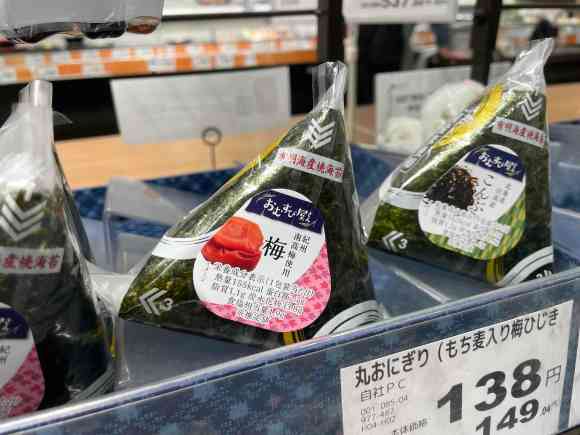
Onigiri. Photo courtesy:
Mariko Hisamatsu

There were so many things to look forward to. The first thing I did, before even leaving Kansai Airport, was rush into the convenience store and buy an onigiri flavoured with an umeboshi pickled plum. An onigiri is a triangle of rice, with a choice of flavours in the centre such as fish, seaweed, or the aforementioned umeboshi. It is wrapped in a crisp sheet of seaweed. Before eating it you gently pull away a thin layer of wrapping which protects the outer seaweed from absorbing the moisture of the rice. As you bite into it you can enjoy the three distinct textures and flavours – the piquant centre, the contrasting bland rice, and the crisp outer layer of seaweed. Next, I purchased a mugwort daifuku. This is a Japanese sweet, consisting of a layer of pounded mugwort-flavoured rice around a centre of sweet azuki bean paste. All of this was washed down with a bottle of green tea.

From the above account, it might sound like I was returning to Japan to indulge in simple culinary delights from a convenience store, and maybe this is a possibility I am unwilling to admit to myself. Of course, the main purpose was to reconnect with old friends, the second to reconnect with old pleasures, such as the aforementioned onigiri and daifuku, and the third, to stay in a traditional Japanese house.

After having been refused permission to drive our hire car, we headed back towards the terminal and searched for the railway station. We caught trains out to the UNESCO heritage listed site of Koyasan to enjoy the autumn leaves, and then seven trains and two buses later, to Wakayama station. Finally, we caught a taxi to our accommodation, which turned out to be a house that was over two hundred years ago, dating from the end of the Edo Period.

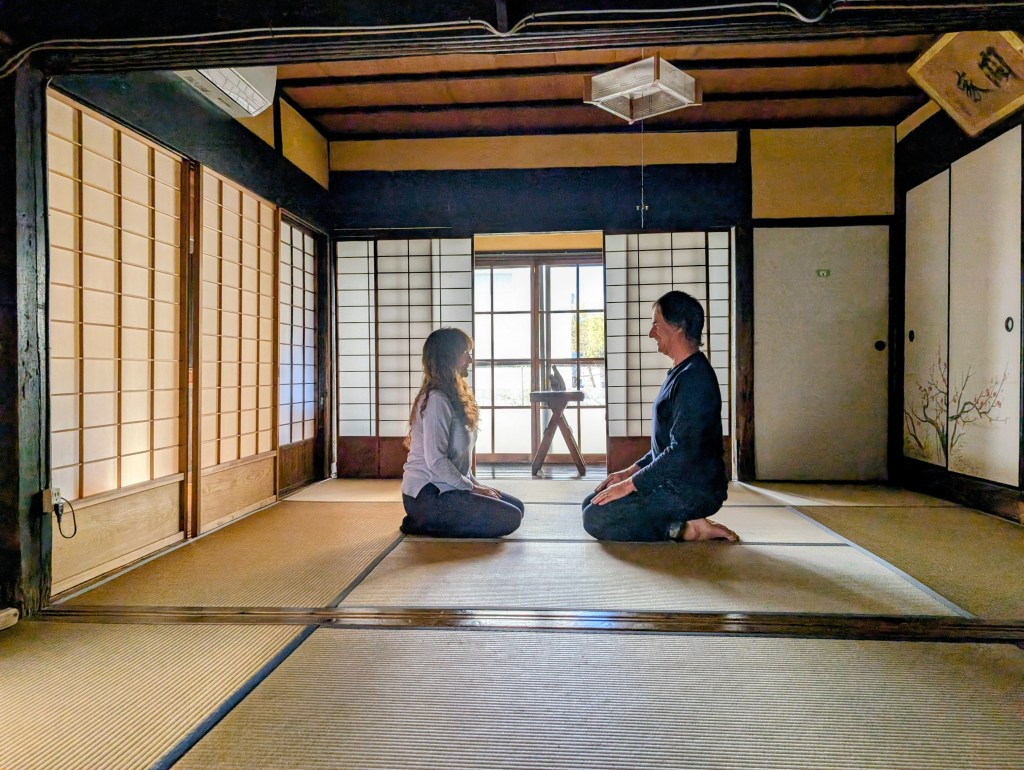
The door slid open to reveal an earthen floor. We walked down the hall to the kitchen, left our shoes in the sunken area, and donned the provided slippers. The kitchen opened onto two traditional tatami rooms, with fusuma sliding cupboards, and latticed paper shoji screens leading onto the garden. Beyond the shoji was a narrow hall known as an engawa, with a small wooden table and chair where you could enjoy sipping a drink while looking out over the garden. This was the kind of room I had been longing for during my five years away from Japan.

But we hadn’t had dinner yet and I was longing to ride to a local supermarket to purchase a ready meal.

‘“Do you have any bicycles?” I asked the host.

“Certainly. We have mountain bikes too!”

“You don’t want to go cycling in the dark?” queried Alex. “Not after a long-distance flight, seven trains, two buses, and a taxi ride? Surely not!”

I insisted, and Alex gave up persuading me otherwise. Rather than a mountain bike I chose the mamachari, a vintage bike replete with a shopping basket attached to the front handlebars.

We cycled to the supermarket, as I had done almost daily during my twenty years of living in Shikoku. There we bought sushi and sashimi ready meals, and cycled home, scanning to avoid roadside ditches with sheer drops and no guard rails. Once safely home, we indulged in the much longed for sushi and sashimi, enjoyed the traditional deep Japanese bath, spread out the futons on the tatami, and luxuriated in a deep sleep.

The next morning, we woke to a gentle light streaming through the latticed paper shoji screens. We cycled to Wakayama castle, Alex on the mountain bike and me on the mamachari. We strolled around the traditional garden before entering the castle and then completed it with a visit to the adjacent tearoom, where we enjoyed green tea and a sweet bean paste confectionery.

The following day, we bid farewell to our Edo Period home, and our kind host drove us to the ferry terminal. As soon as I saw the sign in Japanese for Tokushima, I could feel the colour rising to my cheeks. This had been my home in Japan for fifteen of my twenty years in Shikoku, until the day I departed for a routine visit to Australia, just before the international borders were closed due to COVID. Little did I know that the pandemic would prevent me from returning to Japan. I boarded the ferry as I had so many other times after returning from various work trips, but this time I was visiting on my honeymoon. The two-hour crossing readied me for the arrival in my old stomping ground and was heralded by the sentimental music played to signal a homecoming. Alex and I exited the ferry to be met by my old friend and writing mentor, Suzanne. Overcome with emotion, I covered my face with my hands to spare her the sight of my crumpled features and then gave her a hug. Then I went back to covering my swollen eyes and gave her another hug.

Platter of Sushi at Sally’s home. Photo courtesy: Alan Noble

Suzanne drove us to the home of the son of another old friend, Sally, who had kindly offered us a couple of nights’ accommodation. That evening a subset of old friends dropped in to see us and eat sushi. I braced myself for the entry of each friend into the house, trying to compose my features, after an unanticipated five-year interval. My eyes, however, betrayed me. I caught the expressions of those who returned by gaze, and they could sense my relief and excitement of meeting them again. Over five years people’s appearances were a little different. Those who had long hair now wore it shorter. Those with shorter hair had grown it. Those who were curvaceous were now svelte, and those who were svelte were now curvaceous. A child had now become a lanky teenager. I’m sure I must have looked different to them too. What had not changed was people’s smiles, conversation and sense of humour. People who I would normally see a few times over a month were now all present in the same room in the space of a few hours.

A few days later, we took the bus across Shikoku to Matsuyama, where another happy reunion took place of eight friends from six different countries. I was freshly aware of the joys of the expat life, where you can make friends from a greater range of countries, and a greater range of ages, than you would at home.

Ranma Carvings in a traditional room. Photo Courtesy: Alan Noble

I had been craving another stay in a traditional house, and we savoured a room with ranma carvings suspended from the ceiling, letting in light and air flow from the adjacent room. We sat at the kotatsu low heated table on the tatami, and slept on futon, in a room featuring shoji paper screens facing outside and fusuma cupboards where futons were stored. Features which had once seemed so ordinary were now infused with nostalgia.

Family obligations called us back to Australia after only one week of our Japanese honeymoon. A taxi was followed by a bus which took us on the long trek back across Shikoku, driving through impossibly long tunnels, crossing elegant bridges, with views of the sea and mountains. Once we crossed the final bridge onto the largest main island of Honshu, the landscape was transformed into high rise apartments, and dense traffic. We alighted from the bus at Kobe’s Sannomiya Station.

There we asked directions to the airport limousine bus and made a final purchase of onigiri. My favourite umeboshi pickled plum one was not on sale, so I had to make do with a tuna mayonnaise one and a pickled seaweed one. We ran to the bus stop, purchased tickets, and skipped into the bus holding our luggage. There was no time to store the luggage in the hold. Once the bus pulled into the traffic, we knew we could relax after our long and complicated journey. I gently pulled away the wrapping separating the layers of the tuna mayonnaise onigiri and savoured the contrasting flavours and textures. Our fleeting trip to Japan was punctuated by savouring onigiri on both arrival and departure. We bade farewell to this land of delectable tastes, exquisite arts, historic houses, hair-raising bicycle rides, and precious friends.

.

Meredith Stephens is an applied linguist from South Australia. Her recent work has appeared in Syncopation Literary Journal, Continue the Voice, Micking Owl Roost blog, The Font – A Literary Journal for Language Teachers, and Mind, Brain & Education Think Tank. In 2024, her story Safari was chosen as the Editor’s Choice for the June edition of All Your Stories.

PLEASE NOTE: ARTICLES CAN ONLY BE REPRODUCED IN OTHER SITES WITH DUE ACKNOWLEDGEMENT TO BORDERLESS JOURNAL

Click here to access the Borderless anthology, Monalisa No Longer Smiles

Click here to access Monalisa No Longer Smiles on Amazon International

Categories
Poetry

Poetry by Diane Webster

Diane Webster
SIDEWALK SHADOWS

Sunshine mottles
through leaves,
casting shadows
of silhouettes
on the pavement below.

Look down
on a constellation map
spreading out for pedestrians
who stroll along.

Daytime sparkles
stars laid out
to travel light years
from block to block,

wormholing through
galaxies of heat waves
between universes
of neighbourhood trees.


A PASSION IN DAYLIGHT

She greets the rising sun like her daughter
used to peek her head over the bed sheets
to squint her eyes in the daylight bursting
through her curtains.

But she has only herself to wake up now,
to sit in the sun with her sewing machine
like she used to do with her mamma cat
purring on her lap.

She stitches together patterns of cloth
that sprawl in Picasso cubism period.
Once sewn together the piece functions
under the interpretation in the eye
of the beholder.

Her daughter hated to wear handmade skirts
or perfect-seamed dresses.
One of a kind made no impression because
her daughter dreamed of conforming to her friends,
a blend of sameness unravelling at the hems.


BY DARKNESS

He cultivates his office like a burrow
with shades drawn, a 25-watt
light bulb illuminating his lair
so when he steps outside,
he squints with prairie dog eyes
standing upright to assess his dangers
before progressing outward
almost holding on to the door jamb
until his fingers brush nothing,
and he is released
to forage down the carpet hallway
until laughter whistles in his ears,
and he darts back
comforted by the darkness
of his office burrow.

KALEIDOSCOPIC PRIZE

This must be what it’s like
to walk inside a geode
when I step across
the cave’s threshold
and behold colours
sparkling in the interior.

An awe of wonder
in 360 degrees pushes
vertigo against my brain cells
attempting kaleidoscopic
reason between shape and colour,

Discovery of the prize inside
like in a box of Cracker Jacks...
the cave, the geode, the brain.


DRIFTWOOD WISH

Like dinosaur bones
scattered by scavengers,
driftwood tree trunks
lie on the sandy shore
awaiting discovery,

A crane-lifting ride
to the museum where
no seagulls sit and poop,
where no rain or wind
absconds with grains of self,
where a plexiglass sarcophagus
waits to house the carbon unit
behind fingerprints
and ooh/aah breath.

Diane Webster’s work has appeared in North Dakota Quarterly, New English Review, Studio One. She was a featured writer in Macrame Literary Journal and WestWard Quarterly. Her website is: www.dianewebster.com

.

PLEASE NOTE: ARTICLES CAN ONLY BE REPRODUCED IN OTHER SITES WITH DUE ACKNOWLEDGEMENT TO BORDERLESS JOURNAL. 

Click here to access the Borderless anthology, Monalisa No Longer Smiles

Click here to access Monalisa No Longer Smiles on Kindle Amazon International

Categories
Stories

Evergreen

By Sayan Sarkar

For 30 years, Mr. Roy had been a professor of mathematics at a university in Kolkata.

At 65, he had grown tired of the fast-paced and boisterous city life. He never married and had no close relatives in the city. Therefore, he never had any attachments to the city.

A few months before his retirement, he had heard of an old British-era bungalow in a village in the district of Bankura.

Mr. Roy visited the location and immediately fell in love with the place. The two-storeyed bungalow stood near the outskirts of the village, very close to the forest. The other houses in the village were a little further away, and it took around 10 minutes to reach the nearest house on foot. A peepul and a banyan tree flanked the back portion of the bungalow, behind which lay a large pond. The forest began from the other end of the pond. Numerous rows of teak, sal, mahua, and arjun trees stood almost shoulder to shoulder, creating a pleasant view for the human eye.

After inspecting the bungalow and speaking with the owner, Mr. Roy finalised the deal and completed the associated formalities promptly. He decided to employ the existing caretaker as his daily help. The caretaker lived just 15 minutes from the bungalow with his family.

Mr. Roy had already sent some of his belongings to the bungalow before his retirement, and on the 15th of April, he moved permanently to this place with the rest of his items. The date was significant – 15th April was the Bengali New Year, or Poila Baisakh. Mr. Roy had specifically chosen the beginning of the new year to start this new phase in his life.

Upon his arrival on the 15th, he found a small crowd in front of his bungalow. Many of the locals had come to welcome him to their village. He invited all of them into the bungalow and spent a considerable amount of time interacting with them. The crowd thinned around noon until only the caretaker was left. His name was Samir, a man in his mid-40s.

“Samir, please give me something to eat. I am famished,” Mr. Roy said, getting ready for his bath.

“Yes, Dada! I will prepare your lunch within half an hour,” Samir replied, heading towards the kitchen.

After a long and refreshing bath, Mr. Roy got dressed and approached his bedroom window to look outside. He found that the banyan and peepul trees were quite close to his window and obstructed most of the view. Some of the branches almost touched the window as if trying to claw their way into the house. He saw a lot of birds on the trees, chirping and hopping from branch to branch. As he looked down, he suddenly noticed a young boy of around 10. The little boy was sitting on a branch of the banyan tree and munching on an apple.

“Hey! What are you doing there? You’ll get hurt if you fall!” Mr. Roy shouted with a look of apprehension.

The boy looked up and saw Mr. Roy’s worried face. He smiled from ear to ear in response and jumped down from the branch like a trapeze artist.

“Don’t worry, Kaku[1]! I have a habit of climbing this tree,” he said with a mischievous smile and disappeared around the corner.

Hearing Mr. Roy’s shouts, Samir came up from the kitchen, just in time to see the little boy run away.

“That’s my son, Sukumar! He’s a very mischievous boy, Dada[2]! He runs around the village all day after returning from school. He climbs trees like a monkey. This spot is his favourite. He must climb the banyan tree at least once every day,” Samir confessed.

“I see,” replied Mr. Roy. “But don’t you think these trees are a little too close to the window? This is the only room in the house facing the forest, but I can’t see anything because of these two trees. And here I was thinking of sitting in front of this window and enjoying a view of the forest.”

“Yes, Dada! These trees are quite close to the house. You can even consider them to be a part of the house. It’s said that they are more than a hundred years old!” Samir informed Mr. Roy.

“Hmm. I see!” he remarked.

The next morning, Mr. Roy went out to explore the village after breakfast. He returned around noon, huffing and puffing in the summer heat. After his bath, he called Samir to his bedroom.

“Samir, there’s something I wanted to talk to you about,” he said, his eyes fixed on the trees outside.
“You see, I’d been thinking about those trees since yesterday. You must admit that the view of the forest beyond the pond is breathtaking. But those damned trees are in the way! I can’t see anything at all! So, I’ve decided to get rid of them.

“Usually, I’m against the felling of trees, but I must make an exception this time. I talked to a woodcutter in the village bazaar today. He agreed to do the job for me. However, he already had some assignments for the next three days, so he’ll be coming on Sunday.”

Samir stood aghast. He couldn’t believe his ears.

Dada…you wish to cut down the trees? But they’re a part of this house! They’ve been here long before I came to this house. You can simply cut some of the branches to give you a better view. You don’t need to cut down the entire trees!” he said, visibly emotional.

Mr. Roy stared at Samir for a few seconds before giving his reply.

“I’d thought about pruning the trees as well. But that wouldn’t solve the problem. The branches would grow back over time, and I’d have to continue pruning them every now and then. It’s better to just be done with them entirely. Besides, this village has an abundance of trees all around. It won’t cause anyone harm if I cut just two. No, no. I’ve made up my mind.”

“Okay, Dada… As you wish!” Samir turned away dejectedly.

“Samir,” Mr. Roy called him back, his tone much softer than before.

“I know you love the trees, and your son loves them too. I’ll build him a playground where he can enjoy himself.”

Samir nodded slowly and headed down towards the kitchen.

Mr. Roy felt a pang of guilt in his heart, but his desire to enjoy the view from his bedroom far outweighed his feeling of guilt. As he walked towards the window, he found Sukumar playing among the branches of the trees like the day before.

They’ll feel bad now. But time will heal everything eventually, he thought to himself.

*

Samir was a little late arriving the next day.

“What happened? Is everything all right?” enquired Mr. Roy, a little upset as well as worried.

“Sukumar is not well, Dada. He went swimming in the pond yesterday and caught a terrible cold. He’s had a fever since last night and couldn’t sleep a wink. I was finally able to put him to sleep in the morning. I’m sorry for being late,” Samir explained. His face looked worn out.

“Poor boy! If you need medicines, you can come to me, you know. I’ve been practicing homeopathy for quite some time,” Mr. Roy responded.

Samir nodded his head.

“You can go home early today after preparing dinner,” Mr. Roy added after a little pause. “Your son’s health comes first!”

“Thank you, Dada!” Samir said gratefully.

He took his leave around 5 PM, two hours before his usual time.

Mr. Roy read a book until nine o’clock, had his dinner, and then went to sleep.
He kept his bedroom window open for better air circulation. The weather outside was oppressively hot and humid. There was an unnatural stillness in the air, with no hint of a breeze whatsoever.

*

Mr. Roy was woken up by the chirping of the birds outside his window at the crack of dawn. As he gathered his senses and sat up in bed, he received quite a shock – the entire bedroom floor was strewn with dead leaves of peepul and banyan. They had reached as far as the door, which was quite some distance from the open window.

But how’s this possible? There wasn’t the slightest breeze last night! Even if there was a breeze late at night, how have the leaves fallen only on the floor and not on my bed? Mr. Roy thought to himself.

He couldn’t make head or tail of the situation.

The thing that worried him the most was the fact that all the leaves were withered and dead. Not a single fresh leaf was in sight! He collected the leaves and threw them out the window before Samir arrived, not wanting him to know about this incident.

When Samir came to work, he tried to act normally. He learnt that Sukumar was better, but still very weak. His mother was taking care of him that day.

The day passed quite uneventfully. Mr. Roy went out for a stroll through the village and returned before lunch. He took a nap in the afternoon and spent the evening reading. By the time Samir left at eight o’clock, he had finished his dinner and was sitting in front of his bedroom window smoking a cigar. As he gazed outside, the silhouette of the trees was the only thing visible to him.

The night was quite hot, and there was still no sign of a breeze. His mind wandered to the incident of the morning, and he tried in vain to find a logical explanation to satisfy himself. He decided to close the window that night to be on the safe side.

At 10 PM, Mr. Roy locked the window, double-checked it, and went to bed. As he dozed off, he silently hoped everything would be all right the next morning.

*

But alas! He woke up to a similar scene the next morning. Dead leaves were strewn across the floor. That day, he even found some leaves on his bed and his body. He jumped up to the window and found it locked—just as he’d left it the night before. His face turned pale, and he felt a chill run down his spine. As he opened the window, his eyes fell on the two trees staring back at him ominously.

Are the trees sending me a message and warning me against cutting them? But how’s that possible? Am I really supposed to believe that some tree spirits are trying to threaten me? That’s simply absurd!

Mr. Roy tried to strengthen his mind. It was Friday, and the woodcutter would be arriving on Sunday to do his job. He just had to endure two more nights. He decided that he would ask Samir to stay with him for the remaining two nights.

Happy with the resolution, he then proceeded to pick up the leaves and dump them out the window.

When Samir arrived, Mr. Roy learned that his son was much better. Relieved, he asked Samir to stay with him for the next two nights, citing that he wasn’t feeling well and might need assistance at night. Samir agreed and took his leave after lunch to inform his family of his overnight stay.

Mr. Roy took a little nap in the afternoon and read the paper till evening. There was a forecast of a thunderstorm at night—what the locals called Kalbaisakhi, or what is referred to as a Nor’wester.

Samir returned around 6 PM and prepared some tea for both of them. He sat on the floor of his master’s bedroom and sipped tea, chatting with him about various topics.

Mr. Roy felt his confidence returning in the presence of another human being.

After dinner, Samir made his bed on the floor and waited for his master to go to bed. Mr. Roy instructed him to close the window just in case it started raining after they fell asleep.
They conversed a little before eventually drifting off.

Mr. Roy’s sleep was disturbed by a series of shrill noises. As he woke up with a start, he found the room engulfed in pitch-black darkness. He heard the rain pattering against the closed window. A storm was brewing outside. The fan had stopped moving.

There was a power cut.

But all this was quite normal. The only abnormal thing in this atmosphere was the continuous chirping of birds outside his window! It felt as if dozens of birds were pressed against the window, chirping incessantly.

Mr. Roy had never had such an experience before. The avian cacophony created a haunting ambience.

“Samir! Samir! Wake up!” he shouted at the top of his voice.

Samir jolted up in his bed.

Dada? What’s wrong?” he asked, unable to grasp the situation.

“Birds! Why are so many birds chirping outside my window?” Mr. Roy panicked.

Samir rubbed his eyes in confusion. “Birds? Where? I can’t hear anything!” he said after processing everything around him.

“What do you mean you can’t hear anything? There are dozens of birds chirping outside! Have you gone deaf?!” Mr. Roy responded, his voice shaking with fear.

Dada, are you alright? I can’t hear any birds at all. The only things I hear are the sound of the rain and the whistling of the wind. Maybe you are mistaking the wind for birds,” Samir tried to explain, visibly confused at the delirium of his master.

“Impossible! That’s not the wind! That’s the sound of birds! I can’t stand it anymore!” Mr. Roy desperately put both hands against his ears.

“It’s those damned trees! They won’t leave me alone!” he shouted like a madman.

Dada! Calm down, I’m here with you. Nothing will happen.” Samir got up from his bed and approached his master.

But by this time, Mr. Roy had fallen silent. He had fainted.

*

When he finally opened his eyes, it was morning.

“Thank God you’re awake! How do you feel now?” enquired Samir with a worried expression.

“What happened? Did I pass out?” Mr. Roy blurted out, still quite confused.

“Yes, Dada! Last night, you were shouting about hearing birds. You passed out shortly after that episode. I was quite worried. I couldn’t go out to fetch anyone in the storm, so I waited till morning. Should I call a doctor?” Samir asked, still quite concerned.

“No, I’m fine. No need to call a doctor. I must’ve been dreaming. Why don’t you make some tea for both of us?” Mr. Roy replied slowly.

As Samir went to the kitchen, he sat up in his bed. Although he had told Samir that he might have been dreaming of the bird sounds, he knew that he had been wide awake. He had definitely heard the chirping of birds.

It must be the trees! What are they trying to tell me? That dozens of birds will be forced to abandon their nests if I cut them down? What should I do then?

He got out of bed and moved towards the window, deep in thought. As he looked outside, he found Sukumar playing near the peepul tree. How happy he looked!

A smile appeared across Mr. Roy’s face as he watched the child enjoying himself.

“Here’s your tea, Dada,” he heard Samir’s voice behind him.

“Samir, your son is here. He’s playing with the trees again,” Mr. Roy said, taking up his cup and sipping the hot tea.

“Yes, Dada. He missed his friends for the last few days. So, he came here early today to catch up.” Samir laughed.

Mr. Roy’s smile broadened.

“Samir, I’ve decided not to cut the trees,” he said after a moment’s silence. “As you said, they are a part of the house. Your son loves them too. Maybe I’ll get used to this view after all!”

Samir stared at his master, overwhelmed with joy.

“That’s great news, Dada! Sukumar will be very happy to hear that!” he said, wiping away a tear from his eye.

“Very well then, go home and get some rest. Come back in the afternoon. I have some reading to do.” Mr. Roy got up and shook Samir’s hand.

“Okay, Dada!” Samir replied, getting ready to go.

As he went out of the main gate, Sukumar ran to greet him.

“What did he say?” the 10-year-old boy asked anxiously.

“He has decided against cutting the trees,” assured Samir.

The boy’s face lit up. He started dancing around in joy.

Samir put his hand inside his pocket and took out an audio cassette player.

“Here, take it.” He handed it over to his son.

“I never thought your cassette recording of chirping birds from the zoo would be of any use. But it was of great service last night. You should’ve seen Mr. Roy’s face when the recording started playing outside the window. It looked like he’d seen a ghost. It was difficult for me to keep a straight face!” Samir broke off into laughter.

Sukumar quickly joined him.

“What about the dead leaves? You should give me some credit for that! That was my idea!” he declared, looking for his father’s approval.

“Of course! That was a fantastic idea,” Samir replied.

“That’s what sowed the seed of doubt in his mind. Little did he know that I’ve always had spare keys to the rooms in the house. With the keys, it was child’s play to get into his room and spread the leaves at night.”

“We sure fooled him, didn’t we, Dad?” Sukumar beamed.

“Yes, we did, son. Although it’s never good to fool another person, we did it for the greater good. Those trees are a part of the history of this village, and I will never let them be harmed!” Samir spoke, his voice quivering with emotion.

Sukumar squeezed his father’s hand tightly.

“I will protect the trees with you, Dad! I promise!” he replied with tears in his eyes.

.

[1] Uncle

[2] Elder brother – a polite form of address

Sayan Sarkar was born and raised in Kolkata. He is a passionate reader and lifelong learner who spends his leisure time immersed in books and new ideas.

.

PLEASE NOTE: ARTICLES CAN ONLY BE REPRODUCED IN OTHER SITES WITH DUE ACKNOWLEDGEMENT TO BORDERLESS JOURNAL

Click here to access the Borderless anthology, Monalisa No Longer Smiles

Click here to access Monalisa No Longer Smiles on Kindle Amazon International

Categories
Poetry

Winter Meanderings by John Grey

From Public Domain
FOOTPRINTS IN THE SNOW

The weather has landed
and moved on.
The house evokes candy
with its frosted roof,
creamy shingles,
and crystalline hangings.
The grass is heavy
with its burden of snow.
And the trees gleam like porcelain
in the tepid sun.

Bundled up outside,
we leave visible footprints
in the yard,
whereas, in previous seasons,
our presence lacked such evidence
and yet, intuitively,
we always know where we are,
what is ours, who we belong to.

The winter merely
reiterates the point I’m making.
It lacks our self-awareness.
So it sinks us deep instead.


ENVISION

Each evening, though
shaped by oncoming sleep,
my body informs me that
knowledge need no longer
conform to the physical.
So I gaze at black waters
of night, at sleep caves,
dream tunnels --
Senses float...sight on sound,
vision on taste.
Something awakens in me.
No, distractions ebb
so consciousness can flow.


NO POINT LOOKING UP

Jupiter…it’s all just hydrogen and helium.
A liquid body with a small solid core.
No one gets to love on a planet like that.
Or vote. Or watch sports. See movies.

The sky, for all its heavenly associations,
is sure no cosmic comfort.
The light is dead by the time it reaches me.
And the moon, near as it is, is just a rocky squib.

My escape cannot be collapsing nebulae.
Or atmospheres of methane and ammonia.
Or icy dots. Or superdense neutron stars.
And spare me your planet X.

There is no treasure up there.
No future. No work. No woman.
The good air sticks to what I know.
If I’m to breathe it, I can only be here.

.

John Grey is an Australian poet, US resident, recently published in ShiftRiver And South and Flights. His latest books BittersweetSubject Matters and Between Two Fires are available through Amazon. He has upcoming work in Rush, Spotlong Review and Trampoline.

PLEASE NOTE: ARTICLES CAN ONLY BE REPRODUCED IN OTHER SITES WITH DUE ACKNOWLEDGEMENT TO BORDERLESS JOURNAL

Click here to access the Borderless anthology, Monalisa No Longer Smiles

Click here to access Monalisa No Longer Smiles on Kindle Amazon International

Categories
Musings

Your call is important to us?

By Farouk Gulsara

From Public Domain

I cringe every time I hear this line, during those countless times during my calls, placed amidst the robotic, psychosis-inducing loop of hold music. Funny, this ‘muzak’[1] was meant to create calmness. 

“All our agents are extremely busy right now; you’ll be attended to shortly. Your call is important to us.” The robotic voice would go, trying to sound like how a hangman would place a hood over your head before pulling the lever. 

“You are the number 999,999,999th customer in line!”

This is nothing new. Even when an alien concept called customer service was introduced in the old days, people had to wait in line to have their issues resolved. At least, the saving grace at the end of this endless queue was a human voice, not a chatbot. Now, after a zillion years of human experience in crisis management, the problem of waiting persists, and we still have to wait in line, twiddling our fingers.

Now that all transactions and dealings are conducted electronically, I wonder why the queue on the telephone line is never-ending. Is there a rush for something that I am unaware of? Are the customers so unimportant or irritating that the company believes it does not need to invest in more agents to handle the increasing demand? Whether it is a Monday or any other day of the week, you can tune in and listen to an hour or so of so-called soothing music, or until your patience runs out. 

When you finally reach the end of the line and think it is all over, it is not. Here, you will be presented with a menu so extensive that you will be spoiled for choice. Press 1 for English, press 2 for …, press 1 for savings, press # to return to the main menu, yada yada. The fat lady never sings. 

Along the way, you will be forewarned, “anything you say can be used against you in the court of law!”, but not in the exact words. 

“Your call is important to us. It will be recorded and be used for training purposes!” Yeah, right. 

For all you know, nobody is there at the other end. The single casual employee employed to man the line may be on sick leave with a sore throat or something. The customer line is just to hold a caring image. If a problem cannot be resolved online, how can it be sorted over the phone? The clients have to present themselves in person at the office anyway. Just give the callers some chill music and let them be zombified by the hold music. At a time when AI (artificial intelligence) is taking over mundane tasks, it is not cost-effective to hire dedicated staff for them. This is what the big companies seemingly offering call-in customer service seem to think.

They may have made a devilish deal with the telco companies. We hold the line while the telcos go laughing all the way to the bank on our account. That is why there are frequent dropped calls. It is not due to poor cellular network coverage or a system glitch. It is intentional.

Not to forget the flurry of self-aggrandising advertisements that get inserted while clients wait in anticipation or are doing their down-to-earth activities like cutting vegetables or watering the garden with the phone on speaker mode, realising the futility and wasted effort of holding the phone to the ear. 

Customer service is a thing of the past. Now that there are so many online options to address the intended concerns, face-to-face interaction is quite dated. If the customer is too daft to use the services, they deserve to be taken for a ride. Increasingly, automation can handle most compelling transactional issues. If the customer’s problem is too big for the bots to handle, the customer still needs to go to the office.

The problem is that offices are virtual nowadays. Mailing addresses are in the cloud, and offices are shared by a zillion fly-by-night companies. There is a thin line between the modern way of doing business and being taken for a ride. Like the pleas of the stranded Nigerian princes and their stash of heirlooms, a legitimate transaction may turn out to be a scam, too.

From Public Domain

[1] Muzak- a brand of soft, instrumental, and smooth non-distracting music designed to create an atmosphere of calmness.

Farouk Gulsara is a daytime healer and a writer by night. After developing his left side of his brain almost half his lifetime, this johnny-come-lately decided to stimulate the non-dominant part of his remaining half. An author of two non-fiction books, Inside the twisted mind of Rifle Range Boy and Real Lessons from Reel Life, he writes regularly in his blog, Rifle Range Boy.

PLEASE NOTE: ARTICLES CAN ONLY BE REPRODUCED IN OTHER SITES WITH DUE ACKNOWLEDGEMENT TO BORDERLESS JOURNAL

Click here to access the Borderless anthology, Monalisa No Longer Smiles

Click here to access Monalisa No Longer Smiles on Kindle Amazon International