We took to not talking in the easy hours
of walking. Worry days, study days, days
like wasps that never pause, that made life sour
with fret and flit... out of those woods we came

to fallow fields loitered with restless rooks,
then through a brambled kissing gate and found
a bridge, and from the rushing river leapt
a trout with appetite, its nature bound

in blood to hide and seek. We wandered back
along a pockmarked lane, tufted with grass,
hedge-tight. An unmapped night, the sky crow-black,
no moon disclosed. Not talking, just walking.
Phil Wood was born in Wales. He studied English Literature at Aberystwyth University. He has worked in statistics, education, shipping, and a biscuit factory. He enjoys watercolour painting, bird watching, and chess. His writing can be found in various places, including recently : London Grip, Noon Journal of the Short Poem, Borderless and a featured collaboration with photographer John Winder at Abergavenny Small Press.
PLEASE NOTE: ARTICLES CAN ONLY BE REPRODUCED IN OTHER SITES WITH DUE ACKNOWLEDGEMENT TO BORDERLESS JOURNAL
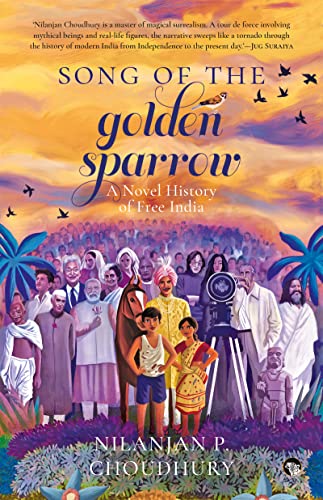
Title: Song of the Golden Sparrow – A Novel History of Free India
Author: Nilanjan P. Choudhary
Publisher: Speaking Tiger Books
Song of the Golden Sparrow by Nilanjan P.Choudhary is a defiant and gripping novel set in independent India, of its many successes and failures, and of its spirit – often battered by its own people. Choudhury is a new voice from the Northeast. His most recent book, Shillong Times, has been widely acclaimed. His debut novel, a mythological thriller entitled Bali and the Ocean of Milk, was a best-seller.
Placed within the period 1947 to 2022, the Song of the Golden Sparrow sets out to chronicle the history of India as witnessed by a sparrow named Prem Chandra Guha, who is actually a yaksha banished from the kingdom of Alaka by Lord Kubera and punished with the task of writing the history of India. The yaksha, a shape-shifter, finds it convenient to take the form a sparrow, a little bird for the task. Exactly when India enters its tryst with destiny, this sparrow reaches the small town of Netrahat near the forests of Chhota Nagpur and meets Manhoos and Mary. As the fates of Manhoos and Mary take them to various places across India, the sparrow follows too, covering in its wake the important events from their lives; events intertwined with the fate of independent India itself.
Manhoos is an illiterate and orphaned boy, working at a garage. Mary is a spirited tribal girl from a nearby Santhal village. Both are good friends and almost meet every day until they are separated by circumstances. Taken in by a Prince, Manhoos, later Manu, moves to the city of Calcutta from Netrahat, where he learns to read and write and takes on enterprises with the motive to earn money. Mary’s village, on the other hand, is destroyed by the government to make way for land mines. Time brings them together again and they make efforts to stay together. Their lives, however, knotted by various events taking place in the country, diverge to different paths.
The yakhsha or sparrow, who is their constant companion, observes the turns in their lives brought about and affected by larger events like industrialisation, liberation of Bangladesh, rise of Naxal movement[1], imposition of emergency, birth of Jana Sangh, chipko andolan[2], fall of a mosque, liberalisation of economy, IT boom, development of Silicon Valley of India, 2002 Gujrat, upheaval of 2014 and pandemic of 2020.
Choudhary employs the tools of magical realism to blend the historical facts with mythology and satire, creating a narrative that not only lets us imagine the lives of ordinary people, carving their own way after independence but also to visualise the many complexities and contradictions which were not only inherited but also turned inevitable as India marched on to the path of progress after attaining freedom from colonial rule.
Figuratively, Manu and Mary represent two distinct facets of independent India which has co-existed amid the incongruities brought about by the political and economic events and has largely shaped the realities of everyday life of common people. Whereas Manu symbolises the progressive, liberal and democratic spirit of the country which desires to advance, to progress and become wealthier by taking every opportunity that arises, Mary is the voice of oppressed people. Manu belongs to the India which made advancement through industrialisation, IT or real estate and cashed on the economic boom brought about by liberalisation of economy. Mary belongs to the India which keeps fighting the system that continues exploiting them whether by displacing them from their homes, their forests, their lands or by not giving them due share in the profits of development whose wheels are turned by them. Their final separation signifies the divide which overtime became even more difficult to address and heal.
The progressive Manu becomes disenchanted with wealth after his wife Sayoni is brutally killed during 2002 Gujrat riots. He returns to his roots and tries to make a meaningful life by devoting himself to the preservation of forests of his homeland. He adopts Ismail, an orphan like him, who is a brilliant young boy and has dreams of pursuing higher education. In 2016, Ismail is heckled to death on the suspicions of cow smuggling. This leaves Manu shattered. And he dies soon afterward.
Through the portrayal of disenchantment and despair of Manu, the author sketches the gloom which has shrouded the country in the last decade. Towards the end, the yaksha sparrow also experience anguish on having to observe and chronicle events which have bloodied the land and the spirit of the country over and over again. As a historian, despite all this, his task is far from over. For he has to keep recording all the incidents for the posterity. It is a tale that asks to be read.
[2] The Chipko andolan was a non-violent social and ecological movement by villagers, particularly women, in India in the 1970s, to protect trees and forests slated for government-backed logging.
.
Rakhi Dalal is an educator by profession. When not working, she can usually be found reading books or writing about reading them. She writes at https://rakhidalal.blogspot.com/ .
.
PLEASE NOTE: ARTICLES CAN ONLY BE REPRODUCED IN OTHER SITES WITH DUE ACKNOWLEDGEMENT TO BORDERLESS JOURNAL.
Magic(Leela)
Like when a piece of iron falls in love with a piece of wood
Causing the iron to float on water,
Or like when the magic of love casts a spell
Making stone float on liquid,
For ages, in nation after nation,
People contrive to float stones,
For diverse reasons and occasions,
Letting love and desire take diverse forms
In manifold texts and discourses...
A Fragrant Tale(Sugandho-kahini)
The world is full of misleading, minus signs and foul smells
At times, the world feels as heavy and unbearable
As the weight of a son’s dead body on his dad’s shoulder,
Or as stressful as playing the role of a dead soldier,
Or as formidable as a physically challenged person’s ascent up a mountain
Or as painful as caring for a precocious, traumatised child...
Nevertheless, occasionally such stress-laden memories will blur,
And suddenly, wafting on the wind’s sudden mood swing,
A fragrant moment comes one’s way!
Love(Prem)
‘After all words die away, the heart starts speaking.’
When all heartbeats and hullabaloo die down,
Little by little the heart starts fluttering in a distinct metronome
When all words ends, silence begins to reign.
Where mathematics ends, music begins.
Gradually the Role of the Third Actor Becomes Clear(Kromosho Spasto Hoye Othe Triteeyo Praneer Bhumika)
Like in magic, in a seemingly miraculous move,
Two strangers will come together
While a third will have to disappear
To remain awol forever— in reality!
Masud Khan (b. 1959) is a Bengali poet and writer. He has, authored nine volumes of poetry and three volumes of prose and fiction. His poems and fictions (in translation) have appeared in journals including Asiatic, Contemporary Literary Horizon, Six Seasons Review, Kaurab, 3c World Fiction, Ragazine.cc, Nebo: A literary Journal, Last Bench, Urhalpul, Tower Journal, Muse Poetry, Word Machine, and anthologies including Language for a New Century: Contemporary Poetry from the Middle East, Asia, and Beyond (W.W. Norton & Co., NY/London); Contemporary Literary Horizon Anthology,Bucharest; Intercontinental Anthology of Poetry on Universal Peace (Global Fraternity of Poets); and Padma Meghna Jamuna: Modern Poetry from Bangladesh(Foundation of SAARC Writers and Literature, New Delhi). Two volumes of his poems have been published as translations, Poems of Masud Khan(English), Antivirus Publications, UK, and Carnival Time and Other Poems (English and Spanish), Bibliotheca Universalis, Romania. Born and brought up in Bangladesh, Masud Khan lives in Canada and teaches at a college in Toronto.
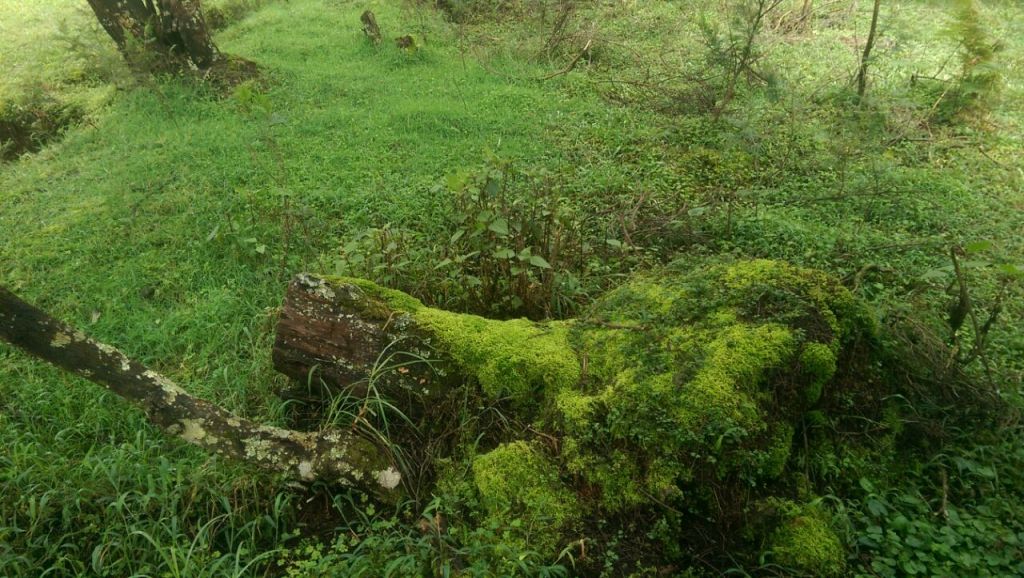
A moss-grown tree stump. Photo courtesy: PG Thomas
Ouseph’s gloom was accentuated by the rustling of dry leaves in the yard of his ancestral home. It was twilight and a movement near his feet made him glance down. He froze as he saw a little chameleon, climb up onto his designer shoe. It climbed up to his right toe, and tilting its head, looked at Ouseph with one bulging eye. Ouseph kicked wildly to dislodge the creature, and panting with fright, he found his gloom had been replaced by a series of shivers down his body.
“What am I doing here?” he wondered. He had last visited his ancestral house more than ten years ago, dragged there from Bombay by his father, who was keen on his child connecting with his roots. As a young boy, he had detested the countryside and his relatives; with their rustic stories and weird humour. Now a quirk of fate and the unexpected death of his bachelor uncle, had found the ancestral property bequeathed to him.
Ouseph lived ensconced in his techie world in Bangalore, where he spent his free time playing music and reading from his surprisingly large collection of books. His inheritance had come to him with the jarring notes of a thunderclap. But his now widowed mother had been firm, “Just go down, see the place and complete the legal formalities to make the property yours. Your father was attached to it and its worth quite a lot. Be practical and we can decide what to do with it later.”
He had travelled down from Bangalore to reach the remote countryside in Kerala at dusk. Pulling himself together from the reptilian shock, he knocked on the thick wooden weather beaten front door of his ancestral home. The door had creaked open into a dimly lit room, to reveal servants seemingly as old as the house itself. They had expected their new master to be young, but their incredulity at the sight of this gangly young man with tousled hair showed in their eyes. One obligingly took his suitcase from his hands but was surprised when he refused to part with his knapsack containing his laptop. He had been led to a musty smelling room, which did nothing to improve his mood.
The next morning, the sound of a broom swishing over the yard floor woke him up. Yawning and scratching his head, he stumbled into the smoky kitchen. A wood fire was burning, and Mariamma the elderly cook gave him a kind smile, and asked if he would like tea. With mug in hand, he stepped out of the house into the still misty morning. He wandered around the compound and looked anew at his inheritance. Noises unfamiliar to a city dweller assaulted his ears. The cow’s lowing seemed like a long drawn complaint, amidst which a rooster crowed, only for it to be picked up and repeated by another some distance away.
A sudden flurry of flapping wings drew his attention to the roof. He saw a startled covey of pigeons rise from the terracotta tiled roof. His eye then caught a single short piece of wire, suspended from a rafter under the eaves of the roof. He wondered if it was the remnant of an aerial wire from the bygone days of the wireless radio. He paused as he noticed a shabby looking ball attached to the end of the wire.
“It’s a sunbird’s nest,” whispered a voice from behind. He turned to see a sweeper women looking at him with laughing eyes.
“Oh!” was all Ouseph could muster. But as he gazed up again, he was rewarded by the sight of a little purple bird with a curved beak pop out of the opening in the nest. It sat there an instant; shimmering in the morning sunlight, and then with a whirr of its wings it flew away. “Oh!” said he again.
The sweeper smiled and said, “This pair has been nesting here for years, and has raised so many chicks in it.”
“Oh.”
He had wrangled leave from his software company on the condition of continuing to work online. But he now felt so befuddled with his bizarre inheritance in the countryside. He struggled to handle its finances and could not figure out how the place worked. “I might as well have landed on Mars,” he grumbled.
Rummaging through a list of relatives, Ouseph reached his cousin Anish, who readily offered to introduce him to his lawyer. The lawyer, a frail elderly man with an old world charm in his manners, took the proffered will and asked, “You’re Jacob’s son, aren’t you?”
“You knew my father?”
The lawyer’s eyes twinkled, and he said, “Your father and I were schoolmates here.”
This little exchange was inexplicably comforting to Ouseph. The lawyer asked for two days time to offer his legal opinion. Anish and Ouseph walked back along the narrow country road. Noting Ouseph’s anxiety, Anish said, “We’re glad you are here and the property has come to you.” They walked on under the canopy of trees over the road; Ouseph in his designer clothes and Anish in his home tailored short sleeved shirt and a cotton dhoti (a wrap-around lower garment).
They parted at the gate to Ouseph’s place. As Ouseph walked through the tree shrouded compound to the house, his phone rang. It was his mother from Bombay.
“Yes Amma, I met the lawyer. It looks like it will take a few days.”
A lunch of steaming rice, a coconut milk based chicken curry and a clutter of home grown vegetables done, Ouseph wandered out into the compound. He found a quiet place under the wood apple tree. The tall tree threw a filigreed crown of gnarled branches and tiny leaves against the blue sky. Ouseph sat down on a moss covered uprooted tree stump. The floor was thick with layers of shed leaves. Its soft cushiony feel reminded him of his boss’s carpeted office in Bangalore. But here the similarity ended. The cry of cicadas filled this place, and a crow pheasant’s ‘oopoopoop’ sounded through the thick greenery. He let the events of the past few days run through his mind.
The days following were consumed by visits to sleepy government offices. His cousin guided the process and taught Ouseph the art of greasing the wheels of the government machinery. But strangely, Ouseph found himself looking forward to returning to his ancestral house, and to his evening walks through the quiet of the verdant house compound. He did attend to his work online, but his metabolism seemed to have synchronised itself to the pulse of this ancient house.
For Mariamma the cook, with her plump face and grey streaked hair, her new geek master had roused all her latent mothering instincts. But she now observed him with concern. Ever pragmatic, she decided he needed tethering, and began by suggesting he visit his neighbours.
The first was the Ayurvedic apothecary and doctor. There was no response to Ouseph’s knock on the front door. But the noise of grinding and thumping drew him to the side of the house. He walked into a drying yard, where medicinal herbs of various colours and aromas were drying in the bright sunlight. He saw an old man on the side verandah, bent over a mortar and pestle. He worked at a steady pace and seemed totally absorbed in his work. Fairly certain that the old man was his neighbour Krishna Vaidyan (an Ayurvedic doctor), he volunteered a hello, and was waved to a seat on the verandah. The grinding and pounding continued for a few more minutes. The Vaidyan then stopped his work and looked up. A pair of keen eyes from between an aquiline nose and bushy white eyebrows scrutinised Ouseph, “Well?”
“Oh, I’m Ouseph, your new neighbour.”
An expression of confusion was soon replaced by a smile of comprehension and a friendly laugh, “Yes, yes, I heard you had come.” And after a pause he added, “This is your home, this is your land. I am happy you are back.”
.
The phone vibrated irritatingly, “Ouseph, this is your uncle Scaria. I’ll be there by eleven tomorrow. I am coming to help sell the property.” Scaria was his mother’s brother, for whom Ouseph had evinced a distaste when just an infant. He was the last person he had wanted to meet. Politeness prevented him raising any objections to his uncle’s visit.
The next day a car drew up, and his uncle Scaria stepped out in an orb of strong perfume. Furtive eyes from below a sweat speckled bald dome crawled over Ouseph, and then Scaria patted his shoulder patronisingly. Drawing himself up, Scaria looked around the compound, and nodded in approval at what he saw, “How many acres did you say this was?”
The two of them spent an hour walking around the compound. Ouseph was impressed by his uncle’s detailed scrutiny of the place. “You have quite a bit of valuable timber here,” and then he indicated he would like to see the house.
Over steamed tapioca, red fish curry and fierier chutney, Scaria delivered his seemingly implacable verdict, “You will not be able to manage this house and property. It will be a white elephant to you. Sell it at the best offer you get, and go back to your computer world, Ouseph.”
The last sentence was tinged with scorn, but Ouseph ignored it with, “The paper work is not yet complete.” He did not feel the need to elaborate. His uncle left him with a foul taste in his mouth, and Mariamma who overheard the conversation, looked anxiously at Ouseph’s face.
.
Ouseph began to get unsolicited enquiries for the property. He called his uncle and told him that he had not consented to sell the property. It had ended unpleasantly with implied threats and ingratiating offers from his uncle of a good price. Ouseph had complained to his mother, she merely replied, “You know your uncle. I can do nothing from Bombay. Think about It.”
His uncle’s perfidy had stunned him, and he began to feel bullied and pressured. He met and poured out the story to Anish and the lawyer. The lawyer couldn’t hide his amusement at the predicament of his innocent young client, “Your uncle is an artful crook. We will have to watch him.”
As they walked back, Anish, far more experienced in the ways of the world, threw his arm over the shoulders of his young despondent cousin, “Don’t worry, we are all here with you.”
Dusk was approaching as the two of them walked past the temple compound. There was an unusual buzz around the temple. Anish mentioned that a temple festival was on that night. Ouseph gazed at the temple with its age old banyan and peepul trees, now silhouetted against a red evening sky. The raucous cry of flocks of mynas roosting in the trees filled the air. Hundreds of lit oil lamps lined the walls and the walkway to the temple. It was all doubly lit up in the reflection of the temple pond.
“Looks like a big do Anish!”
“Yes and there will be night long performances too.”
That night, as the lights in his house were doused one after another, Ouseph lay back in his bed and listened to the night noises emanating from his compound. The drone of cicadas had become therapeutic to him now. There were screeches from the mango tree, as fruit bats squabbled over the ripe fruit, and a great Indian horned owl kept up its forlorn hooting above it all. And then, a ripple of drums carried over to him from the temple. “Must be the Kathakali dance ensemble warming up,” thought Ouseph.
And in a while, the distinctive percussion music of the Kathakali dance began to pulsate through the night. It was mesmerising. Ouseph knew only a little about this traditional dance of Kerala. But he knew that it portrayed archetypal characters and situations from Indian mythology and folk lore. The stories were told through the medium of dance and music. The archetypal characters portrayed were always dressed typically, to make identification easy for the audience. A green painted face signified divinity, shining makeup purity, and black demonic and so on.
Ouseph wondered at the enduring appeal of this art form among the local populace. He thought of his own problem with his uncle Scaria, and fantasised dressing him up as a Kathakali artiste, “Maybe I’ll give him the demon’s black face. Or maybe the red beard of a villain would be more suitable.” Ouseph in his fantasy finally picked the black bearded villain, for that signified a scheming villain.
He put his hands behind his head and listened to the distant drum beats. He fancied his uncle Scaria gyrating and dancing with theatrical gestures of a slimy schemer. Ouseph had to admit his phantasm danced well; and at this he began to giggle. Ouseph’s giggling increased and he thought he was becoming hysterical. His giggles became guffaws and he rolled over and buried his face in his pillow to smother them. His paroxysm abated and he drifted into a peaceful slumber. His pillow was wet with the tears of his laughter.
.
Ouseph leapt out of bed in the morning with the thought that Benji and Maya would be there that day. They arrived to voluble greetings and back thumping. In the lazy afternoon, the three of them sat on the tree stump under the shade of the wood apple tree. Ouseph took his friends through the details of his difficulties with his conniving uncle, and of how he struggled with his unexpected inheritance. He said his mother too, was not sure he could manage the property.
Benji said, “Ouseph, this place is most unusual. Think well before you do anything.”
Maya agreed too, “This place has great bones for a resort.”
Ouseph knew he too was falling under the spell of the place. But he needed to make a pragmatic decision. As they walked back to the house, he showed them the sunbird’s nest. He got them to be silent long enough to hear the cry of chicks from within the nest.
Ouseph had come prepared to handle the legal aspects of his unexpected inheritance. But as he stayed on, the house and its world, began to appeal subtly to his imagination and emotions in ways unexpected. The old house, with its moss grown tiled roof sat amidst the trees. The smell of some blossom or other invariably lingered in the air. The cry of birds and farm noises seeped through the rich vegetation. An irresistible, palpable primal energy seemed to flow from the compound. And all of this seemed to exist within an intense quietness; like the brooding silence of a sacred grove. And within this nestled the ancient house, an inseparable part of it all.
The place whispered to any that cared to listen. The house built in the distinctive wood architecture style of Kerala, nevertheless showed Chinese and Arabic influences too; influences that had permeated because of the ancient maritime spice routes. Inside, paintings and fading photos of ancestors stared from their frozen frames.
The compound also had traces of the more recent past. A curious seeker would find here, growing cheek by jowl with indigenous trees, breadfruit from the Pacific islands, nutmeg and mangosteen from Southeast Asia, clove trees from the Molaccas[1] and so on. It was a reminder of colonialism’s great botanical transplants of the past centuries. The heritage of his ancestral house was etched on it in myriad ways.
“Gosh!” exclaimed Maya, “it’s as if the house will always be here, and we are just passing through.”
It was then that Ouseph had this surrealistic feeling; the inkling that in the end, the decision would not be his. It seemed to have already been made in some strange way. This ancestral house seemed to be claiming him as one of its own, and every circumstance seemed to prod him to stake his claim and fight for things that he had earlier been indifferent to.
.
If some power grew this new symbiotic relationship between Ouseph and his heritage, then it seemed that events came cascading down to rivet it firmly together. It came on a morning as Ouseph was on the front verandah speaking with one of the servants. A white car drove up. The rapid opening of all its doors and the climbing out of several men set off alarm bells in Ouseph’s head. But he waited quietly for the people to approach him.
The leader smirked, “We have come to see a certain Ouseph.”
“I’m Ouseph; and what do you want?”
They climbed onto the verandah uninvited and sat down. “Scaria, your uncle sent us to look at the timber here. We understand it is for sale.”
Ouseph flushed and his voice rose, “Uncle Scaria has nothing to do with this property, and I have no timber to sell.”
The leader chuckled, rolled his eyes and tugging at the ends of his long mustache said, “We were warned that you would play games.”
“Games?”
Benji and Maya heard the altercation. Benji wondered if he should intervene, but Maya was out in a flash. She walked up to the chair besides Ouseph, sat down, crossed her legs and looked the apparent hoodlum in the face. Benji joined them too, and the sudden appearance of strangers, particularly of a determined young woman momentarily threw the visitors off balance. The leader began to say something, and then thought the better of it.
Ouseph saw one of his servants make a dash for the gate, but was too preoccupied to wonder why. He heard a shuffle behind him and turned to see the wide girth of Mariamma his cook behind him. She carried a wooden ladle in her hand.
“Who are you?” asked Ouseph.
“I am Chellapan.” The speaker then leaned back, as if awaiting a reaction. The name didn’t mean anything to Ouseph, but he heard Mariamma behind him draw in a sharp breath.
By ones and twos the servants and neighbours began to congregate. They stood quietly listening, but their faces glowered. Ouseph saw Krishna Vaidyan approach slowly. He was using a walking stick. Without a word, he climbed the steps to the verandah, and seated himself on Ouseph’s side. There was no mistaking his intention.
Chellapan made another attempt, “I know that you have made a commitment to Scaria, and I have paid him an advance for the timber here.”
Ouseph was surprised by the change in the tone of his own voice as he answered, “For the last time I tell you, Scaria has nothing to do with this property. If you have given him money, then take up the matter with him.” Then Ouseph heard himself distinctly say, “This property came to me through my ancestors, and I will not sell it during my lifetime. I will not violate it. I will pass it on as it is, to those that follow me.”
The visitors rose threateningly, but seemed unsure for the first time.
“And what is going on here?” It was a voice that was used to being obeyed. It was Lakshmiamma, the matriarch of the nearby Nair household. She was accompanied by two young men and she was sweating profusely from her barefooted walk to the house. All rose as she climbed the steps with difficulty. She lumbered across the verandah to the chair that Benji had vacated for her. She reached out and took hold of Ouseph’s wrist, and drawing him close to her asked the visitors, “Who are you?”
Mariamma sidled up to Lakshmiamma and whispered, “Its Chellapan.”
Lakshmiamma let out a short derisive laugh. Her snow white hair and the large vermillion dot on her forehead, set off her blazing mascara lined jet black eyes. She pointed at Chellapan and said, “I have heard of you. But before we drive you out, I want you to know something. We are here not just for our Ouseph. We are here because your conduct is a threat to us all. We will not permit such lawlessness in our area. So, when you go back to your rat hole, tell your bandicoot friends there, that we will break the legs of anyone attempting any such thing in future here… Now get out.”
Chellapan was quivering with rage and humiliation. But he looked around at the gathering of neighbours and servants. They reminded him of a wild elephant herd gathering around a vulnerable elephant calf. He was smart enough to know the game was up. Lakshmiamma had been explicit. But it was the unexpressed, simmering outrage of the gathering that really unnerved him. He turned his ire elsewhere and spat out, “We were set up by Scaria. Come on,” he roared, “Let’s go see Scaria.”
He strode out muttering obscenities under his breath. The crowd silently parted to let him and his lackeys through. And as Ouseph watched the retreat, somewhere in his own fevered imaginings; a Kathakali chant began. The accompanying drums and cymbals rose in throbbing waves to a crescendo. It was building up for the climax of Uncle Scaria’s final dance.
.
The storm broke at midnight with a crackle of thunder. It was followed by a wind that whistled through the many chinks in the old house and lashed at the trees in the compound; ruffling and driving their dry leaves in a stream. And then the rain came in as a steady downpour; and it lulled the household back to sleep.
Ouseph awoke to a pristine rain washed morning. He found his friends awaiting their morning cuppa in the dining room. Mariamma fondly served the kids, and just as Ouseph lifted his cup to his lips; Maya tremulously asked, “Would the sunbird’s nest have survived the storm?”
Leaving their tea steaming on the table, the trio scrambled out. They reached the nest and looked up anxiously. The nest, tucked under the eaves of the roof showed no damage. Amidst relieved laughter, Benji murmured, “Well, it seems that millions of years of evolution have taught the sunbird to build its nest in safe places.” Shining faces and gleaming eyes concurred.
Ouseph gave a little gasp and pointed up to a nearby windowsill. On it sat the brown and yellow mother sunbird, and next to her sat a chick. The chick was a male, and white downy feathers stuck out irregularly through his purple plumage. He was moulting. The mother bird signalled some anxiety at the chick’s first outing with little flutters of her wings. But the chick sat there calmly, as if he knew, that all he needed to do was to be true to that instinct within him; and then he would grow to be a perfect little purple sunbird.
They met in an alien city
After thirty years.
At first it seemed unreal --
She hardly had any expectations.
The other girl, now a woman,
Hardly emoted, but was civil,
Something that her corporate and rational
Mind taught her well
Over the years.
They were classmates, friends –
She thought she was more
And also wrote a few letters
Which went unanswered.
Life intervened –
Careers, marriages, children
After years of hearsay that are
Now so regular over social media,
The girl, now woman, called her up.
It was another girl, now her daughter
That needed help with literature.
Shakespeare and the rest,
Poems and the prose,
Who made sense of them all
Beyond the ken of rationality,
Or even of correct exactitude,
Who could ever fathom what
Magic words could do?
She was stunned –
But she was a teacher, and not less
A dealer of words, a reader
Of poetry, a lover of the arts –
It could only be an exercise of pleasure.
She did, the daughter succeeded.
The arrow had hit the target.
But this became a matter of course.
When the other day,
The day of colours,
They met, it was the same correctitude
From the other woman and the daughter,
Merely a recollection of other fellow mates
Never an introspective look or a glance.
She recollected, travelled back
To moments of past warmth
Expectations, and dried up memories.
Of course, there was no hint
Of all this in conversation.
Thirty more years may pass
In the neverland of meeting,
She hardly cared, anymore.
It was important, perhaps,
To say the proper goodbye,
Between wine and the splendour of
Five-star accommodation.
There were many Tinigaons within the city of this name. ‘Three Villages’ was the meaning in the local language. A small city in the folds of a valley in the middle of Assam. There was the Tinigaon that was still a small town, not in terms of size, but in the attitudes of the people. It was not just the middle-aged and older people who clung to tradition. Quite a few younger people did, too. And it was not always bad, this conservatism. Indeed, sometimes this unshakeable belief in the sanctity of the past was beautiful and illuminating. It was this conservatism that preserved the precious heritage of the past and kept it alive, preventing it from passing into oblivion.
But at other times, when conservatism became rigid, and sought to impose its beliefs on those who had a different mindset, dictating how they should behave, dress, what relationships they could or could not have, it could become a prison that prevented any kind of progress from taking place. As with much conservatism, the greatest restrictions were placed on women. There were strict codes of conduct for women and girls, codes that varied from age group to age group, but were authoritarian, nevertheless. Individual freedoms were always secondary to the ‘expected’ modes of conduct. ‘It’s always been like this,’ was a refrain often heard to justify the many rules which had lost all relevance in a swiftly changing world. If, indeed, they had ever been relevant at all.
The rules for girls and young women, though unyielding, at least took into account the rebelliousness of youth. ‘You are young, that’s why you think like this,’ was a sentence that was spoken grudgingly by parents or uncles and aunts, to people who were, in their eyes, guilty of ‘errant’ behaviour. But young people went outside the city, outside the state, to study, to work, and who knew what their lifestyles were there? Preferring to turn a blind eye to many rumoured ‘goings-on’ in the metro cities, goings-on in which their children were willing, even enthusiastic participants, they were for the most part relieved that at least when they came home, they behaved in ways ‘expected’ of them.
And so, even though they spoke viciously of that girl, WhatWasHerName, who was now living in with some boyfriend in Delhi, they preferred to keep silent about their own daughter who was doing the same. Grateful for small mercies, they pretended not to know anything when they visited her in the flat she rented in Gurgaon. They kept a deadpan face when they came across a shirt in size 42 hanging, forgotten in the cupboard in the second bedroom. They tried not to notice the other telltale signs that their daughter had been ‘cohabiting’ with a male, and refrained from asking where he had gone, now that they were here for three weeks. They did not ask about the long phone conversations that stretched to well past midnight and were only grateful that their daughter had been ‘considerate’ enough to spare them the trauma of meeting some unknown boy with whom she had been sleeping for the past so many months. They even pushed into a dark recess that worry of pregnancy, and the even greater worry of ‘WhatWillPeopleSay?’
Yes, in these changing times, people were learning, slowly, to ‘adjust’ to the fact that the younger people now were prone to living their lives in ways that were different from what was deemed to be ‘allowed’. But when it came to older people, things still remained as rigid as they had been for centuries. Especially for women. And especially, very especially, for widows.
True, Hindu widows were no longer expected to live a life that was, virtually, a death sentence. Younger widows, especially, ate non-vegetarian food, though their mothers, after the deaths of their husbands, still did not. They wore coloured clothes, though again, their mothers wore pale, traditional clothes, even though during the lifetimes of their husbands they had worn the most vibrant colours under the sun.
But there were, still, many restrictions on single women, widows, even divorcees or never-marrieds, in Tinigaon. They could go out in mixed groups, but never in a twosome with a man not closely related. They could not ‘date’ a man, and go out with him, even if it was as innocent as an outing to a theatre, or a music concert, or having a meal at a restaurant. There were always prying and peering eyes around who would ‘see’ what was happening, magnify it many times, load it with all kinds of intent, and then broadcast it with relish to salivating friends at the next kitty party that took place.
Mihika remembered the time a recently divorced forty-something mother of two had accepted a lift, two days running, from her superior, a married, fifty-plus man. Without a car at that time just after her divorce, she had been waiting on the pavement, in pouring rain, for a bus or auto or ricksha to take her home. As time passed and no vehicle stopped for her, she was growing increasingly desperate. The nanny who looked after the children would be leaving at six-thirty, and it was almost six already. She was greatly relieved, therefore, when her boss’s boss, whom she knew only slightly, stopped and asked her if he could drop her anywhere. It turned out her apartment was on the way to his house and she had gladly accepted the offer of the lift.
(Extracted from What Will People Say? A Novel by Mitra Phukan. Published by Speaking Tiger Books, 2023)
About the Book
When Mihika, 56 and a widow, gets drawn into a relationship with Zuhayr, a 60-year-old divorcee who was her late husband Aditya’s friend, it doesn’t seem to her like an event that should cause more than a raised eyebrow or two. Not in the twenty-first century, and not when their grown-up children are happy that their parents have found a second chance at happiness. But inTinigaon—a small town in Assam—it is just not done for a woman of Mihika’s age to have a romantic relationship—that, too, with a man from the Other Religion: a Muslim.Tinigaon’s Old Guard is scandalized as Mihika and Zuhayr are seen together in restaurants and cinema halls,‘flaunting’ their affair. And a nosy neighbour, Ranjana, keeps the moral brigade busy with juicy details of Zuhayr’s late-night comings and goings from Mihika’s house. Mihika decides to ignore the gossipmongering and slander and remain true to her relationship with Zuhayr, who has filled a void in her life after Aditya’s death five years ago.As long as her four closest friends,Tara,Triveni, Shagufta and Pallavi, stand by her, she doesn’t care if others turn away. But when the gossip turns into something more sinister that could threaten her daughterVeda’s happiness, Mihika is forced to take a call—should she give up the man she loves for her daughter’s sake, or is there an alternative that could give them both what they want? Writing with great sensitivity and gentle humour, Mitra Phukan proves once again that she is an extraordinary chronicler of the human heart. Rooted, like all her fiction, in the culture and sensibilities of Assam, What Will People Say? speaks to all of us, wherever we are, whoever we are.
About the Author
Mitra Phukan is an Assamese author, translator and columnist who writes in English. Her published works, fourteen so far, include children’s books, biographies, two novels, The Collector’s Wife and A Monsoon of Music, several volumes of translations from Assamese to English and a collection of her columns, Guwahati Gaze. Her most recent works are a volume of her own short stories, A Full Night’s Thievery, and a translation of a volume of short stories, by Sahitya Akademi Award-winning author, Harekrishna Deka, Guilt and Other Stories, both published by SpeakingTiger.
The wound of exile refuses to get healed.

The ghost of one’s nostalgic past;

the fairy of glorious future, designed

a division that refuses to get sealed.


I think of wanderers sometimes,

who went far and wide in search

of a mirage called “home” --

a piece of land that one calls one’s own.


Irony is that no true “home” exists

anywhere in the bounds of mind.

It is built, demolished and abandoned

to the storms of vagabond passion.


Isolation, inner or outer, will coexist,

No matter how far you go. She knows no border;

no human is foreign to her, the enchantress

of alienation will bewitch you,

haunt you and embrace your heart.


I think of those who wander in exile,

Perhaps they had to run for sanity,

Perhaps they had to choose between

death and life, and they chose life in exile.


Their owned world turned hostile,

That insane world didn’t spare their smiles;

didn’t house their self-esteem;

chased their aspirations and dreams.


Being exiled from a place was better

For them than exile in life.
Vipanjeet Kaur resides in India. Her poems have been published in Tangled Locks Journal, Hidden in Childhood anthology, White Enso, Cajun Mutt Press, Lothlorien Poetry Journal and Fevers of the Mind Poetry and Art Group.
.
PLEASE NOTE: ARTICLES CAN ONLY BE REPRODUCED IN OTHER SITES WITH DUE ACKNOWLEDGEMENT TO BORDERLESS JOURNAL
R.K. Narayan gives me a ‘warmer’ feeling than any other novelist. This doesn’t mean that his books make life seem easy. On the contrary, his work is absolutely committed to dealing with the travails of existence, but there is a deep humanity about his style that strongly appeals to my better nature, and I love immersing myself in his world. I feel that no more genuine and sincere guide can be found to our common reality than this author.
He was an author I was aware of for a long time before I actually read him. I planned to read his books one day, but most things that are postponed until that magical ‘one day’ seem never to happen. Finally, I dipped into a very small book of his short stories when I had a bout of flu. This was a sampler volume, pocket sized and easy to race through, but I paced myself at one story a day. They were a gift to an unwell man. I loved them. Nearly all of them had a twist at the end, but the twists didn’t feel at all contrived.
There was some other quality about them that intrigued me. They seemed to display not the slightest trace of self-consciousness. They reminded me of the authors I had most enjoyed when I first discovered the joys of literature, Robert Louis Stevenson, the early H.G. Wells, some Dickens. They allowed me to be a pure reader again, rather than an aspiring writer who was always on the lookout for ways to improve his own technique.
Hot lemon tea and short stories just like these are what a man needs when the flu takes hold of him. I finished the slim volume and recovered my health. I now knew that Narayan was an author who strongly appealed to me. Therefore, it was necessary to seek out his other books. I went to the local library, a library that happens to be one of the best I have ever visited, but all the Narayan books were already on loan. However, there was another author with an Indian name on the shelf very near where Narayan should be. I decided that he might act as a temporary substitute and I took out a volume at random. It turned out to be the very first book of V.S. Naipaul, certainly an Indian writer, but one who was also a writer from Trinidad, on the opposite side of the world to India. I read it, loved it, found it very different from Narayan.
Miguel Street is a brilliant collection of linked stories. These tales are set in one street in Port of Spain, the capital of Trinidad, and written in a deceptively simple style that Naipaul claims was inspired by the author of the old picaresque novel Lazarillo de Tormes, published in 1554 and probably written by Diego Hurtado de Mendoza, a book I read a few years ago with great enjoyment. But there is a rhythmic music to Miguel Street that clearly has little to do with that earlier work. It is a funny book, but behind the comedy is a certain measure of pain, and behind that pain is more comedy, and so on. The stories are therefore multi-layered, and this concealed complexity of form works as a very satisfying contrast to the singsong language of the telling. But these tales are hard. They aren’t as warmly embracing as Narayan’s.
I came to the conclusion, one I think I still hold, that Naipaul and Narayan are opposites, that they represent two poles on one spectrum of literature, that the first is hard and cynical, the other yielding and benevolent. Naipaul always seems to be a pessimist, and even in optimistic passages he is pessimistic about the worth of optimism. Narayan always seems to be an optimist, and even when things go wrong for his characters, he is optimistic about their pessimism. More to the point, their pessimism doesn’t endure, it dissipates rapidly. I admire both authors immensely, but I would much prefer to meet Narayan and drink coffee with him than meet Naipaul over any drink.
After I finished Miguel Street I returned it to the library, and now Narayan was back on the shelves, so I helped myself to The Bachelor of Arts, a novel that flows with incredible smoothness. It tells of Chandran, who graduates from college and falls in love with Malathi, a girl he sees on the river bank one fateful evening. His yearnings for her lead to the most dramatic adventure of his youth, as he impulsively but bravely decides to reject the world when he is unable to have her as his wife. But that is only one extended incident among many. The story is delightful, charming, innocent, but it also has elements of melancholy. It is humorous and yet serious. Reading it, I fully understood why Graham Greene said that Narayan was his favourite writer in the English language. Greene also claimed that Narayan had metaphorically offered him a second home in India, and that was exactly the way I felt too.
Then I learned that The Bachelor of Arts was one volume in a loose trilogy, and I obtained the other two books linked to it. Swami and Friends turned out to be almost as engrossing and fascinating, though a little simpler in structure. The English Teacher, on the other hand, was much more sombre in tone, with a plot concerning an English teacher who loses his new wife to typhoid. Narayan lost his own wife to the same disease. The sadness and poignancy of certain scenes in this novel are thus intense, yet the author never allows his narrator to become self-indulgent and the ending of this novel is beautiful. This is a trilogy that can be regarded as authentic, and what I mean by this is that there is no sense that the truth is being operated on by the tools of the writer’s trade for effect. Truth here is unadorned and more effective as a result. It takes gentle courage to write this way and succeed so admirably.
I do feel with Narayan that he is befriending the reader as well as relating a narrative. As I have already said, Narayan gives me a warm feeling that no other writers do to the same degree. His style is perfect for the needs of readers who wish to forget about the technical aspects of literature and feel exactly the same way they did when they were young and launching themselves into the mighty universe of literature for the first time.
Narayan is able to do two contradictory things simultaneously, namely (1) show that we are all the same throughout the world, and (2) show how cultures and people around the world differ from each other. And although other authors can pull off this trick, with Narayan it doesn’t feel like a trick at all but a natural expression of his being. It is true that I have enjoyed some of his books less than others, he is far from being the perfect writer. Talkative Man, for example is one of the weaker works, a short novel, more of a novella really, set in the fictional town of Malgudi as are most of his books, and it is charming and humorous and a little bit haphazard, a semi-picaresque in which the action always seems to be episodic and wide-ranging but in fact is firmly grounded in that one small town in a sleepy backwater of Southern India.
But it lacks bite, for although Narayan’s novelistic bite is gentle, unlike the bite of Naipaul, it is a bite all the same. The Painter of Signs bites, and although there are some slapdash passages in this novel (as there are in Talkative Man) they are easy to forgive, thanks to the compelling soft force of the poignant story about two individuals who despite being on different life-paths, meet and become deeply involved with each other.
Yet there is one Narayan book that is supreme above all his others, at least in my opinion, and it is a collection of stories I took with me when I travelled to East Africa and wanted a companion light enough to carry in my small rucksack and amusing enough to make each mosquito-filled night pass smoothly. The one quality possessed by Narayan that makes him such an agreeable companion on a long journey is that he never lectures or talks down to the reader but invites him to share his world, his vision. His fictional town of Malgudi feels absolutely real to me, so much so that it is my favourite invented location in all literature, and I always accept the invitation to stroll its dusty streets.
Malgudi Days is the title of this wondrous volume. I read it in Mombasa. It is a collection that displays enormous variety within the compass of its fictional setting, the remarkable town of Malgudi, only occasionally venturing outside it, into the countryside or the jungle where tigers and angry gods cause difficulties for the people who stray into their domain. Most of the time, the people settled in Malgudi, or just passing through it, devise deeply human strategies for coping with the difficulties thrown at them by circumstance and fate, often making their own difficulties through the accretion of actions over years. Despite the warmth of Narayan’s prose style, the gentle mood he evokes, the benign ambience of the setting, there is suffering and guilt here too.
Characters are not infrequently criminals who have fled the scene of their misdoings and have relocated to Malgudi in order to start afresh. Not always can they leave behind their pasts. And yet there are no simple morality lessons here, the resolutions are often chaotic, ambiguous, the stories of some lives are left hanging. Narayan is in control of his material but not of life and life bowls balls that his characters can’t always bat…
It is difficult for me to enthuse too precisely about this collection without ending up saying things I have no wish to say. The individual stories are superb, but the sum is greater than its parts. To choose individual tales to praise seems a mild insult to the integrity of the whole, though I am aware that it is perfectly acceptable to pick out particular pieces and talk about them. The collection was not designed as a whole anyway but amalgamated from two existing collections and updated with a handful of new stories.
I am merely delighted that I discovered R.K. Narayan and I fully intend to read everything he published. And there are districts of Bangalore and Mysore that evoke some aspects of Malgudi and are there to be explored without having any specific ‘sights’ to seek out. Ambience is everything. Friendship within that ambience is a blessing. Narayan is a friend on a shelf, a genuine friend, and the black ink of his words on the white pages of his books are like reversed stars on a night sky that is as radiant as daylight.
.
Rhys Hughes has lived in many countries. He graduated as an engineer but currently works as a tutor of mathematics. Since his first book was published in 1995 he has had fifty other books published and his work has been translated into ten languages.
.
PLEASE NOTE: ARTICLES CAN ONLY BE REPRODUCED IN OTHER SITES WITH DUE ACKNOWLEDGEMENT TO BORDERLESS JOURNAL
FUNERAL WISH

At my funeral
I want you to put on the
J Geils Band vinyl 33 RPM
“Blow Your Face Out”
and dance until you’re
sweated through
because when it
comes down to it
life ain’t nothin’
but a house party.
That’s my dying request.
And, if instead,
you play On Eagles Wings
I will rise from the casket
and smash that record
like the woman
in It’s a Wonderful Life
because I don’t want to
be raised up like a raptor
I want to cut a rug
until I hurt
Jim Landwehr has five books of poetry and four full-length memoirs. He is poet laureate emeritus for the Village of Wales, Wisconsin and lives in Waukesha, Wisconsin.
PLEASE NOTE: ARTICLES CAN ONLY BE REPRODUCED IN OTHER SITES WITH DUE ACKNOWLEDGEMENT TO BORDERLESS JOURNAL
Reading the nutrition chart on labels of packaged foods becomes the favourite pastime through your bifocals or progressive lens once you turn health-conscious after reaching a certain age. Those carefree days of feasting on anything in any quantity are gone. Anxiety shoots up after you gobble a gulab jamun. The glucometer starts ticking in your mind. You are smitten by guilt even if you are pre-diabetic. One gulab jamun pronounced the culprit for the imaginary spike in the sugar level.
It has become a successful business strategy to combine healthy with unhealthy these days. Restaurants and other eateries sell paneer roll but you know it is fried in oil. Since it has cottage cheese inside, you are told it is a good source of protein for your body to stay healthy. And you end up ordering a double paneer roll, ignoring the fact that oil is not good for the heart. Those big chunks of paneer allure you in the ads – and the visual treat tempts you for gastronomical excesses. Gradually, you convince yourself that cottage cheese is indeed good for the bones, and you need a good quantity of calcium from a vegetarian source to ensure they do not crack up under pressure from detractors. Expectedly, the frequency goes up as the paneer roll becomes your favourite ‘heaathy’ snack.
Having rummaged through articles on good sources of protein, you know the vegetarian diet has glaring deficiencies in this regard. Being a committed vegetarian, you do not try out animal sources. But the fear of protein deficiency haunts you, compelling you to dig up other vegetarian sources. If you need confidence to flex muscles in front of big bullies in your locality, you must have brawny biceps – not radish-shaped arms fit only to lift bathroom buckets. Protein shake becomes your predictable supplementary choice before you hit the gym floor.
Vegetarians often compromise when it comes to health though they hesitate to admit that. I have seen them almost puke at the sight of their vegetable chops being fried alongside fish cutlets in the same oil and pan. Such buddyhood is incompatible, intolerable and revolting for fanatics. But the same vegetarian folks pop cod liver oil capsules for stamina and justify it as a valid medical option to stay healthy. Likewise, animal fat is avoided but Omega-3 capsules are eagerly popped every day after lunch to keep mind and body in sound health.
Even though they know all about walnuts and their Omega content, they call it a hard nut to crack, preferring the cheaper alternative of medical supplements marked with a non-vegetarian symbol. Ask them why they are okay with that, and they are super quick to respond by saying their frail bodies need these. If the word goes around that non-vegetarian food is the ultimate secret behind longevity, will there be a sharp decline in the number of vegetarian folks?
Take the case of those who do not consume eggs, but they love pastries and cakes with eggs even though eggless variants have flooded the bakeries. As the form of egg has changed in the preparation process, they do not feel it is a cardinal sin to try out this option. While there are many who eat vegetarian stuff at home, they are very fond of non-vegetarian stuff outside. Striking the perfect balance between vegetarian and non-vegetarian food keeps them healthy though this truth is rarely spoken in this fashion.
The population of vegetarian people also includes those who have eaten non-vegetarian food before their retirement from carnivore fare. Some give up give up their favourite fish, egg, and meat for spiritual succor. While they need applause for showing the strength to resist, they think they have done the right thing as their organs cannot take in rich food after a certain age. To prevent digestive problems, it is better to have a vegetarian diet. Once again it boils down to convenience. The desire to stay healthy governs this decision – just as they chose to eat non-vegetarian food more for strength rather than taste.
There is perhaps another category of people who have switched from vegetarian fold to non-vegetarian diet in their old age. They say they have been quite cautious and avoided non-vegetarian food during their younger days but in old age they need solid strength that comes from animal sources alone. So, their decision to turn non-vegetarian after reaching sixty is right. Here, too, the desire to live healthy is the prime reason for the switch past their prime.
The other day I was reading the health benefits of chia seeds, flax seeds, watermelon seeds, and fox nuts along with their nutritional value. Items not tried before also become the focus as the age sets in to get familiar with the best sources of staying healthy in mind and body, along with keeping a glowing, radiant skin. The search for super foods continues and the health freak seeks the daily dose of multi-vitamins to remind himself that he will remain healthy because he consumes it regularly now. Even if one consumes the most powerful sources of health, one has one’s own health challenges setting in due to aging. The fascination with reversing age inflates the budget and leads to growing stress instead of delivering effective results despite consumption of healthy items on a regular basis.
Consuming fruits and vegetables is seen as a frail attempt to maintain health, but the tendency to strike out sweet fruits leads to explore other choices that are not well-balanced. A lifetime of rich diet based on vegetables and fruits should deliver the satisfaction of leading a healthy life but the presence of random fast food intake offsets the long-term benefits.
So, it is perhaps, best to keep oneself undefined as a vegetarian or non-vegetarian because the need to stay healthy always decides what you prefer and for how long. In a lifetime there are several stages and there are several stages of being a pure vegetarian, a pure non-vegetarian and a mix of both based on convenience.
Devraj Singh Kalsiworks as a senior copywriter in Kolkata. His short stories and essays have been published in Deccan Herald, Tehelka, Kitaab, Earthen Lamp Journal, Assam Tribune, and The Statesman. Pal Motors is his first novel.
PLEASE NOTE: ARTICLES CAN ONLY BE REPRODUCED IN OTHER SITES WITH DUE ACKNOWLEDGEMENT TO BORDERLESS JOURNAL







 Borderless