Categories
Poetry

Cast Away the Gun: Balochi Poetry by Mubarak Qazi

Translated by Fazal Baloch


Mubarak Qazi (24 December 1955 – 16 September 2023). Photo courtesy: Kamanchar Baloch
Fellow traveler! “Moons and seasons” have changed.
The eyes and the gaze are now trailed to elsewhere. 
You too forget the roar of muskets and bullets, 
Of our sorrow and happiness, the reasons have changed. 
Speak of the sun,
Of the moon.
Speak of light, 
Of life.
Cast away the gun! 
  
Fiddle pain, pluck soulful strings. 
Stop rhyming songs, extolling the curse of war. 
Don’t raise the fire of envy and hatred anymore. 
I long for love, its love I’m so desperate for. 
Speak of wine,
Of wineglass.
Speak of pain,
Of colors. 
Cast away the gun! 
  
Remind me of soft-treading maidens, 
And of sweet and dainty betel nuts.
Nobody’s pain is ever healed by fire and steel. 
Remind me of those fair and pretty damsels.
Speak of flowers,
Of lips. 
Speak of love, 
Of intimate moments. 
Cast away the gun! 

Mubarak Qazi (1955-2023), is one of the most prolific and popular of modern Balochi poets. He is credited with making poetry a vocation for the masses in a lucid vocabulary. In other words, Qazi is lile the conscience of the people — one who addresses them in a language they can easily comprehend and decipher. Instead of maintaining a subtle or vague approach, he conveyed his sentiments in simple and unembellished language. He has published ten anthologies of poetry. The translated poem is taken from the second edition of his first anthology published by Drad Publication Gwadar in 2007.

Fazal Baloch is a Balochi writer and translator. He has translated many Balochi poems and short stories into English. His translations have been featured in Pakistani Literature published by Pakistan Academy of Letters and in the form of books and anthologies.

.

PLEASE NOTE: ARTICLES CAN ONLY BE REPRODUCED IN OTHER SITES WITH DUE ACKNOWLEDGEMENT TO BORDERLESS JOURNAL

Click here to access the Borderless anthology, Monalisa No Longer Smiles

Click here to access Monalisa No Longer Smiles on Kindle Amazon International

Categories
Poetry

The Time for the Janitor to Pass By


Poetry and translation from Korean by Ihlwha Choi

THE TIME FOR THE JANITOR TO PASS BY 

Birds colliding with the glass window and falling,
The janitor sweeps them away with familiarity.
Birds that once lived in the square of the sky,
On Ukraine's transparent glass window,
On Myanmar's ruthless glass window, they plummet.

The time for the janitor to pass by again.

Flowers we see are like a fleeting paradise,
The way we viewed America once.
Glass windows erected over America, horrible barriers.
The time for the janitor to pass by again.
The mother bird becomes a glass wall of death,
Time and time again, a baby bird falls beneath the glass wall.
From the glass window of the sea,
To the soundproof walls of the land, colliding silver wings,
Many things plummet daily onto the blue star.

Ihlwha Choi is a South Korean poet. He has published multiple poetry collections, such as Until the Time When Our Love will Flourish, The Color of Time, His Song and The Last Rehearsal.

.

PLEASE NOTE: ARTICLES CAN ONLY BE REPRODUCED IN OTHER SITES WITH DUE ACKNOWLEDGEMENT TO BORDERLESS JOURNAL. 

Click here to access the Borderless anthology, Monalisa No Longer Smiles

Click here to access Monalisa No Longer Smiles on Kindle Amazon International

Categories
Stories

A Hand Mill

Ammina Srinivasaraju

A story by Ammina Srinivasaraju, translated from Telugu by Johny Takkedasila

Chandu is a smart child studying in the ninth standard at a Government High School in Charla village. He excels not only in his studies but also enjoys playing games. Everyone in the School knows him for his intelligence and hard work.

Every morning, Chandu wakes up early and completes his work. He even helps with household tasks before going to school on time. In class, he pays close attention to his teachers and diligently completes his homework.

Chandu has a habit of thinking deeply about everything and seeking guidance from his elders whenever he has doubts. Sometimes, he recalls the words of his Telugu teacher, Mr. Satyanarayana, who had said, “The one who asks questions is the true student.”

Chandu had come across an article in the newspaper. It mentioned that “Madhuravani” had been honoured as the principal of the school because Chandu’s class had scored good marks and achieved the highest pass percentage in the entire district. However, Chandu felt confused when he read this news.

Chandu had never seen Madhuravani teach a single day. She would come to school and comfortably sit in her room under the fan, signing papers brought by the attender. Sometimes, she would briefly visit the classes and give moral lessons to the students in the morning. This was her daily routine, as Chandu observed.

Chandu knew how hard the teachers worked every day to teach lessons in the classrooms. They put in a lot of effort to ensure the syllabus was completed, and the students could study well. The teachers’ hard work was the main reason for the students’ good results. But something seemed different about the recognition Madhuravani received.

Unable to contain his curiosity, Chandu gathered courage to approach the principal with folded hands and humbly ask her to clarify his confusion.

Madhuravani smiled at Chandu and told him to come back after the evening classes for a detailed explanation during the prayer session.

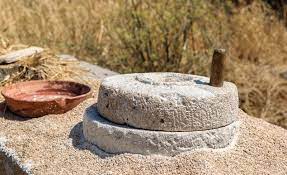
After the evening classes, all the children gathered for the prayer session under the supervision of the physical education teacher. Madhuravani began sharing a meaningful message with the students. She said, “Children, let me tell you a story. In the past, people used a handmill to grind flour. They would rub one stone against the other to make fine flour. It seemed the stone on the top bore the brunt of hard work, while the one underneath remained still and seemingly comfortable. But in reality, all the effort was actually to churn the contents in the stone that lay below.”

A hand mill made of stone.

All the children looked surprised and curious.

Madhuravani continued, “Just like the top stone, in our school, the teachers work hard every day and give lessons to you. Their work is visible and evident. On the other hand, I may not give lessons like the teachers, but my role is equally important. I take care of the administrative tasks and ensure everything runs smoothly behind the scenes.”

Chandu finally understood why the district collector had honoured Madhuravani, the principal, even though she didn’t teach. Her invisible efforts were essential for the school’s success, just like the bottom stone in the grinding process. From that day onward, Chandu developed a newfound appreciation for all the teachers and the principal, realising that everyone’s efforts, whether visible or invisible, contributed to the school’s achievements.

.

Dr. Ammina Srinivasa Raju is a writer and essayist with more than 300 articles and over 100 stories published in various journals. Since the academic year 2009-10, the Maharashtra Government Curriculum (Sarala Bharati) has included the children’s story ‘Adavilo Andala Poti‘ in Class 7. In addition to these achievements, Dr. Raju has delivered many speeches on the Akashavani. In 2005, he received the Pothukuchi Vamsa Award from Vishwasahiti Hyderabad.

Johny Takkedasila is a popular young poet, storyteller, novelist, critic, translator, and editor in Telugu. In 2023, he received the Kendra Sahitya Akademi Award for his criticism book, Vivechani.

.

PLEASE NOTE: ARTICLES CAN ONLY BE REPRODUCED IN OTHER SITES WITH DUE ACKNOWLEDGEMENT TO BORDERLESS JOURNAL

Click here to access the Borderless anthology, Monalisa No Longer Smiles

Click here to access Monalisa No Longer Smiles on Kindle Amazon International

Categories
Tagore Translations

Proshno or Questions by Rabindranath

Proshno or Question was written by Tagore somewhere between December 1931 and January 1932 and later published in 1932 in a collection called Parishesh[1]. The poem with its poignant overtones continues relevant to this date.

Art by Sohana Manzoor
Almighty, over eons, you sent emissaries
              To this ruthless world, 
They say: “Forgive everyone”, say, “Love only Love — 
               From deep within, toxicity purge.” 
In these cataclysmic times, I turn them away with a shamed bow
 For they now remain only as ideals to be revered, remembered.

I have seen the helpless persecuted by 
            Violence in the shadows of deceitful night. 
I have seen unprotesting truth victimised, 
             Justice weep secretly in plight.
I have seen passionate young men driven wild,
Beat their heads on rocks and tortured, die. 

Today, I am voiceless. My flute is stilled. 
            In the moonless night, who have filled 
 My universe with nightmares? 
            That is why cleanse with tears —
Those that poison the air, extinguish the light. O God, 
Have you forgiven them? Have you given them your love? 

One of the interesting things to note here is the reference to the flute player. Is he the same one who was evoked in his poem Ebar Phirao More (Take me back) written in 1894? That poem[2] starts with:

While the world moves busily
You play the flute, like a truant boy, 
Leaning under a shady tree in a field with 
The fragrance of the forest floating on 
A tired breeze. O, arise — there is a fire!

Is it the same flute player whose flute has been stilled?

.

[1] Translates to — At the End

[2] Our translation of Ebar Pherao More can be read by clicking here.

The poem has been translated by Mitali Chakravarty with editorial input by Sohana Manzoor on behalf of Borderless Journal

A video of Proshno recited by the poet in Bengali with subtitles by the you tuber, Swarup Dutta.

PLEASE NOTE: ARTICLES CAN ONLY BE REPRODUCED IN OTHER SITES WITH DUE ACKNOWLEDGEMENT TO BORDERLESS JOURNAL

Click here to access the Borderless anthology, Monalisa No Longer Smiles

Click here to access Monalisa No Longer Smiles on Kindle Amazon International

Categories
Poetry

Dangerous Coexistence

Poetry and translation from Korean by Ihlwha Choi

In an Indian Santiniketan guesthouse,
I swatted a buzzing mosquito with my palm,
But it seems I hit the mosquito's back instead.
Startled, it hurriedly flew away.

On a summer night in Seoul,
A single mosquito is scouting my room with its buzzing wings.
I struck it with the fan I had,
Like a roof being blown away by a tornado,
The mosquito spiralled and shot up towards the ceiling.

Even after the fan's breeze subsided for quite some time,
It still seems not quite in its senses,
Continuing to buzz around every nook and cranny of the ceiling.

This mosquito is engaged in a dangerous coexistence,
I wonder if it has stockpiled emergency rations other than humans!

Ihlwha Choi is a South Korean poet. He has published multiple poetry collections, such as Until the Time When Our Love will Flourish, The Color of Time, His Song and The Last Rehearsal.

.

PLEASE NOTE: ARTICLES CAN ONLY BE REPRODUCED IN OTHER SITES WITH DUE ACKNOWLEDGEMENT TO BORDERLESS JOURNAL. 

Click here to access the Borderless anthology, Monalisa No Longer Smiles

Click here to access Monalisa No Longer Smiles on Kindle Amazon International

Categories
Tagore Translations

A Muslim Woman by Rabindranath Tagore


Translated from Bengali by Aruna Chakravarti, who adds: ‘The story, Musulmani’r Galpa[1], was published posthumously in July 1995 in the journal Ritupatra. In all probability, it was dictated from the writer’s sick bed just before his death in 1941.’

Veiled Woman, Ink on paper, by Tagore, National Gallery of Modern Art, New Delhi. Courtesy: Creative Commons

This is a story of long ago. Of a period in our history when the seeds of evil governance had sprouted thorns all over the land. When fear and anxiety had trapped the soul of the common man in the skeins of such a stifling web that all other emotions had dwindled and died. When imagined assault from demonic forces gripped all minds. When the simple act of living turned into a nightmare and trust could be reposed in neither God nor Man. When the line between good and evil had blurred and tears were the only reality…

In an age such as this, the presence of a girl was deemed a curse in a middle-class family. More so if she was beautiful. Porarmukhi![2]May your fair face burn to ashes! Curses such as these, bitter and stinging, were heaped on the poor girl. “If we could only rid ourselves of this accursed creature,” the women of the family wailed, “we might sleep peacefully in our beds.”

Such a situation, exactly, had arisen in the household of Bangshibadan, the talukdar[3] of Teen Mahala. His niece Kamala was beautiful. Worse, she was an orphan. Had she died along with her parents the family could have breathed easy. But she had lived on as a burden in her uncle’s household and was made aware of it every passing minute. “Just look at my luck sister,” her aunt was often heard complaining to the neighbouring women, “The parents dumped this monumental responsibility on my shoulders and left for the other world. Evil glances are cast at her from all sides. Anything may happen at any time. I have young children of my own and can’t sleep from fear of what will become of them. I live in constant dread…”

Bangshibadan didn’t share his wife’s annoyance at Kamala’s presence in his house. He loved her dearly and had brought her up with great solicitude. He kept her hidden from prying eyes, personally supervising her welfare and taking care of her needs. Life went on somehow but when a marriage proposal came for her, she couldn’t be kept hidden anymore. “I will wed her only into a family which has the means to protect her,” Bangshibadan was in the habit of saying, and now it seemed as though he had found what he was looking for.

The boy was the second son of Paramananda Seth, the zamindar of Mochakhali. People feared Paramananda for his money power but even more for the posse of hefty Bhojpuri lathiyals[4] he kept to guard his house and possessions. “There isn’t one son of a gun in the whole district,” the prospective bridegroom boasted to Bangshibadan, “who’ll have the gall to lay a hand on her.” He was very proud of his father’s wealth and had devised many ways of spending it. Falcon flying, gambling, bird fights…he was a master of all these pursuits. He was, as well, extremely susceptible to feminine charm. Though he had a wife already he was looking for another, younger, one and when reports of Kamala’s beauty reached his ears, he decided that she was the bride for him.

Kamala was appalled when she heard what her uncle had in mind for her. “Where are you sending me Kakamoni?” She burst into tears, “You may as well set me adrift in the river.”

“If I had the power to, protect you,” Bangshibadan replied sadly, “I would have kept you clasped to my breast for all time to come. You know that Ma…”

The arrival of the wedding party at the bride’s house was accompanied by a lot of fanfare. The sound of drums and pipes rent the air. Bangshibadan was alarmed. “Babaji,” he folded his hands before the groom, “It would be better if the noise was toned down a bit. It is unwise to attract too much attention.” But the groom was unfazed. “Let’s see which son of a gun…” he repeated his old line, his chest puffed out with importance.

 “I am a poor man with little clout,” Bangshibadan sighed and said, “I can’t vouch for the safety of everyone under my roof for long. I take responsibility only until the completion of the rituals. After that I will leave it to you to conduct your bride safely to your father’s house.”

“No need to worry. No need to worry,” The bridegroom twirled his moustache arrogantly and, watching him, the lathiyals were emboldened to twirl theirs as well.

It was nearing midnight when the wedding party set off with the bride for Mochakhali. A couple of hours later, while crossing the dreaded tract of land called Taaltarhir Maath, they were waylaid by the notorious dacoit Madhu Mallar and his gang. Bearing down on them with flaring torches and weapons far deadlier than lathis, the dacoits soon made short shrift of the lathiyals. The wedding guests fled in all directions abandoning the palanquin in which Kamala sat trembling with fear. Then, just as she was about to step out and try to hide in the bushes, she heard a man’s voice booming out of the dark. “Halt! Go back from where you came my sons. I am Habir Khan.”

Madhu Mallar and his gang stepped back instantly. They had great reverence for Habir Khan. In their eyes he was no less than a paigambar …a messenger from God.

“We can’t disobey you Khan Saheb,” Madhu Mallar said glumly, “but you’ve certainly ruined my business for the night.”

Habir Khan did not oblige him with a reply. Helping Kamala out of the palanquin he told her, “You are in great danger, child. You must leave this place at once. Come with me. I will take you to my house. It is only a short distance from here.” Seeing her shrink at his suggestion, he added, “I understand your reluctance. You are a Hindu, a brahmin’s daughter. It is natural for you to hesitate before entering a Muslim household. But let me tell you something. A truly devout Muslim respects a truly devout Hindu and won’t dream of harming him in any way. Trust me my child. You and your religion will be totally safe in my house.”

Habir Khan and Kamala walked through the woods till they came to a huge mansion. Leading her into one of its eight wings, he said, “This will be your home from now on. You will live here exactly as you did in your uncle’s house.” Kamala looked around. There was a yard with a temple at one end and a tulsi manch[5]at the other. The place looked no different from an upper-class Hindu abode. Everything she would need for her day-to-day living could be found here.

An elderly Brahmin came forward to greet her. “Come Ma,” he said in a kind voice. “Have no fear. This place is sacred. Your religion will be fully protected.”

Kamala burst into tears. “Please inform my uncle about what has happened. Tell him to come and take me home.”

“You are making a mistake child,” Habir Khan’s voice came to her ears, “After tonight’s incident you won’t find acceptance in any Hindu household. You’ll be thrown out into the streets.” He saw the expression on Kamala’s face and sighed. “Very well. I will take you there and let you see for yourself.”

Habir Khan led her to the door of Bangshibadan’s house and bade her go in. “I’ll be waiting here in case you need me,” he said.

Kamala flung herself on her uncle’s chest and wound her arms around his neck. “I have come back to you Kakamoni. Don’t send me away,” she begged. Bangshibadan’s eyes filled with tears. But before he could utter a word his wife burst into the room. “Throw her out,” she shrieked, “Throw the blighted creature out at once. She’s lived in a Muslim’s house. She’ll pollute us all.” Then turning to the weeping, shivering girl, she cursed and upbraided her in shrill penetrating tones. “Accursed one! How dare you show your face here after what you’ve done? Don’t you have any shame?”

Bangshibadan disengaged Kamala’s arms gently from his neck. “Forgive me Ma,” he said sadly. “I cannot take you back. I’m a Hindu. I’ll lose caste if I accept you. I’ll be ostracised by everyone in the village.” Kamala stood for a while, head bowed, then slowly made her way out of the house to where Habir Khan was waiting. She went away with him. The door of her old world was now shut against her for all time to come.

Kamala settled down in the rooms allotted to her. “All this is yours,” Habir Khan said to her waving his hands across the yard. “Not a single member of my family will set foot in this wing. Feel free to live in it the way you wish.”

This part of the mansion had a history. It even had a name. It was called Rajputani’r Mahal[6]. Many years ago, a nawab of Bengal had brought a Rajputani princess and installed her here. He had kept her with great dignity and made sure that she had no difficulty in practicing her religion. She was a very devout woman and an ardent worshipper of Shiva, so a temple was built for her in her own premises. She loved going on pilgrimages and arrangements for them were made with meticulous care. Over the years she became a role model for other Hindu begums and many of them found sanctuary under her sheltering wings.

Habir Khan was the Rajputani’s son. Though he followed his father’s religion he worshipped his mother like a goddess. He sought her guidance in every matter and it was from her that he had learned to respect the opposite sex. She had been dead these many years, but Habir Khan never forgot the vow he had made to her. To provide shelter to widowed and abandoned Hindu women. Scorned, persecuted, hated and stigmatised for no fault of theirs, many were forced to sell their bodies for a roof above their heads and a handful of rice in their stomachs.

As the days passed a realisation started dawning on Kamala. The freedom and comfort she enjoyed in this Muslim household was of a quality she hadn’t even dreamed of while living with her uncle. He cared for her but was powerless to protect her from ceaseless taunts, curses and abuses. She had grown so used to them… she had begun to think of herself as a blighted creature, a disgrace on the family, fit only to be thrown out on the streets. Here, in her new home, she was showered with luxuries. Every need of hers was taken care of by Hindu serving women. She was overwhelmed with kindness and love.

A few years went by. Slowly a change came over her. The winds of youth started to blow and her mind and body quivered with an unknown emotion. She fell in love with one of Habir Khan’s sons.

One day she opened her heart to her protector. Habir Khan’s face paled at her confession, but she went on calmly, “My love is my religion Baap jaan[7]. I have no other. I have worshipped many gods and goddesses in the past. I have poured out my heart and soul to them in prayer. I have begged for deliverance. Yet not one deity deigned to cast a glance at me or even send a sign that my prayer had been heard. What hope is left to me from a religion that leaves a poor, trusting, suffering girl rotting in a pit of abuse and persecution? I have known what it is to live, truly live, only after I stepped across your threshold. From you I’ve learned that even the lowest of human beings deserve love and protection.” Tears rolled down her cheeks. She wiped them away and continued, “From all the hardships I faced in life I have learned one lesson. The Lover and Protector is the true deity. He is neither Hindu nor Muslim. Baap jaan, I have given my heart to your second son, Karim, and my worship is now tied with his. In embracing Islam, I need not give up the faith I was born to. I can follow both.”

The marriage took place. Kamala’s name was changed to Meherjaan and she became a valued and integral part of Habir Khan’s family.

Now the time came for Bangshibadan to wed his own daughter. And history repeated itself as it is wont to do. While crossing Taaltarhir Maath the groom’s party was waylaid by Madhu Mallar’s men. They had been thwarted once. They were out for revenge. But as soon as they launched their attack a voice came out of the dark. “Khabardar[8]! Step back at once.”

Ore baba re[9]!” the dacoits ran helter skelter, “It’s Habir Khan!” Abandoning the bride to her fate the wedding guests did the same. Suddenly, a figure appeared on the scene holding a banner aloft on a spear. It was Habir Khan’s banner with his emblem, a half- moon, painted on it. But the bearer was a woman. Approaching the palanquin, she helped the trembling girl out of it. “Don’t be afraid Sarala,” she said, “Your elder sister is here to save you. From today you’ll be under the protection of the One who loves and provides sanctuary to all human beings irrespective of caste, creed or religion.”

Turning to her uncle she said, “Pronam kaka[10]. Don’t be alarmed. I shall not pollute you by touching your feet. Take Sarala home. No one has dared to lay a finger on her. She’s as pure today as on the day she was born. And tell kaki [11]that I never thought I could pay back the debt I owe her. The debt of food and shelter so ungraciously doled out while I was her dependent. I am doing so now.” Putting a red silk sari and an asan[12] covered with rich brocade into her uncle’s hands, she added, “I brought these gifts for Sarala. Take them. And remember, if she’s ever in trouble her Muslim sister will be there for her. To give her all the care and protection she requires.”

[1] Literal translation: A Muslim Woman’s Story

[2] An abuse which literally means burnt face

[3] Minor official

[4] Men wielding sticks

[5] Tulsi is Basil, holy for Hindus and manch is dias.

[6] Rajput princess’s palace

[7] Father

[8] Beware

[9] An exclamation of fear — Oh my father!

[10] Salutations uncle

[11] Aunt

[12] A small carpet

Aruna Chakravarti has been the principal of a prestigious women’s college of Delhi University for ten years. She is also a well-known academic, creative writer and translator with fourteen published books on record. Her novels JorasankoDaughters of JorasankoThe InheritorsSuralakshmi Villa have sold widely and received rave reviews. The Mendicant Prince and her short story collection, Through a Looking Glass, are her most recent books. She has also received awards such as the Vaitalik Award, Sahitya Akademi Award and Sarat Puraskar for her translations.

.

PLEASE NOTE: ARTICLES CAN ONLY BE REPRODUCED IN OTHER SITES WITH DUE ACKNOWLEDGEMENT TO BORDERLESS JOURNAL

Click here to access the Borderless anthology, Monalisa No Longer Smiles

Click here to access Monalisa No Longer Smiles on Kindle Amazon International

Categories
Poetry

Poetry on Rain by Masud Khan

Translated from Bengali by Professor Fakrul Alam

Courtesy: Creative Commons
RAIN - 1 

It’s raining abroad now, in countries close by or far away. 
Occasionally a cold wind from some other land blows this way 
This summer evening brings with it sadness and beauty 
Blowing this way from some distant land!
 
A cold, cold wind keeps blowing
Slowly stirring desire, fomenting longing
For alien rituals on such an evening.
 
In the distance, in a riverbank ruled by beauty
In another land, wonderfully wet in the rain,
Lightning flashes time and again
Stirring desire for one’s lover steadily
Inevitably, on such an evening!
 
Towards my homeland
The cold wind keeps blowing
O my alien lover
Where could you be staying?

RAIN - 2
 
It’s raining
Over distant lands
Over Brahma’s world,
Over Rangpur and Bogra’s vast expanse
In alluvial plains,
The rain veils Burma’s evening fields
And keeps streaming down.
 
And below these lightning flashes,
At the rain-formed night’s third quarter
Radiant races
Spring up at home or abroad
Like hyperactive frogs leaping
Into the unknown.
 
Provoked by thunder and lightning’s violent outbursts, 
Allured by their promises,
In the thick veil 
And swirling stream,
In the darkness of the wet wind, 
In the eastern expanse, 
Underneath the sky
In vast and empty fields
Under the vast spread-out arum fields of the east, 
Incredibly, unformed new nations emerge --
Innumerable unsteady chaotic nations,
Restless, perturbed, incapable of standing up, 
Lending themselves to grotesque maps,
Forming unstable, quivering, permeable boundaries
Governed by ill-defined laws and dwarf impotent ombudsmen 
And armies marching past unimpressively,
They spring for no good reason
And seem destined to be doomed.
 
The night draws to a close. The rain too appears spent. 
When day’s first light breaks out,
Those nations that would thrive and grow
And glow with innumerable rituals and fast-spreading religions 
Feel their bodies disintegrating and disappearing
Under the vast spread-out arum fields of the east.
 
*Rangpur, Bogra— Two small cities in the northern part of Bangladesh

Masud Khan (b. 1959) is a Bengali poet and writer. He has, authored nine volumes of poetry and three volumes of prose and fiction. His poems and fictions (in translation) have appeared in journals including Asiatic, Contemporary Literary Horizon, Six Seasons Review, Kaurab, 3c World Fiction, Ragazine.cc, Nebo: A literary Journal, Last Bench, Urhalpul, Tower Journal, Muse Poetry, Word Machine, and anthologies including Language for a New Century: Contemporary Poetry from the Middle East, Asia, and Beyond (W.W. Norton & Co., NY/London); Contemporary Literary Horizon Anthology,Bucharest; Intercontinental Anthology of Poetry on Universal Peace (Global Fraternity of Poets); and Padma Meghna Jamuna: Modern Poetry from Bangladesh(Foundation of SAARC Writers and Literature, New Delhi). Two volumes of his poems have been published as translations, Poems of Masud Khan(English), Antivirus Publications, UK, and Carnival Time and Other Poems (English and Spanish), Bibliotheca Universalis, Romania.  Born and brought up in Bangladesh, Masud Khan lives in Canada and teaches at a college in Toronto.

Fakrul Alam is an academic, translator and writer from Bangladesh. He has translated works of Jibonananda Das and Rabindranath Tagore into English and is the recipient of Bangla Academy Literary Award (2012) for translation and SAARC Literary Award (2012).

PLEASE NOTE: ARTICLES CAN ONLY BE REPRODUCED IN OTHER SITES WITH DUE ACKNOWLEDGEMENT TO BORDERLESS JOURNAL

Click here to access the Borderless anthology, Monalisa No Longer Smiles

Click here to access Monalisa No Longer Smiles on Kindle Amazon International

Categories
Poetry

Motherhood: A Tiny Life inside Me

A poem by Sangita Swechcha, translated from Nepali by Hem Bishwakarma

Painting by Bernardus Johannes Blommers (1845-1914). Courtesy: Creative Commons


A purpose in my life,
A reason to survive,
A flower budding inside me
That impatiently cried,
Begging to understand the meaning of life.

The terrible struggle with life --
Hundreds of questions from
A one-day old
Deluged me, 
Exhausted and distressed.

Though life was not that easy--
The flower that desired to flower
Did not want to wither 
Without a struggle.

The amusement in my life,
Lost in strange thoughts 
With silent, helpless emotions,
Tensed, fell down and cried,
With an abrupt pain of separation.

A life as in a story
And a story of life
With hope dared to live.
She, her courage and I --

The entanglement of 
Struggle and pain,
Perhaps, was a trial of restraint. 
A tiny life to chuckle that learned
Living was a novel mesh of affection.

The life that sprouted inside me,
Has patience to contend her life.
There is a desire, and a trust 
For her whole life is a dream that has yet to unfold!


Dr.Sangita Swechcha
has been an ardent lover of literature from an early age. She has published a novel and co-authored a collection of short stories before the collection GulafsangakoPrem (The Rose: An Unusual Love Story) in Nepali. She has many short stories and poems published in various international journals and online portals. The Himalayan Sunrise: Exploring Nepal’s Literary Horizon and A Glimpse Into My Country are her recent publications, co-edited with Karen Van Drie and Andrée Roby respectively. Email: sangyshrestha@hotmail.com, Website: www.sangitaswechcha.com

Hem Bishwakarma is a translator and poet from Nepal. He is an ELT teacher and educator by profession.

Hem Bishwakarma is a translation enthusiast, he also writes poems and reviews.  Email: swarmadhurya@gmail.com

PLEASE NOTE: ARTICLES CAN ONLY BE REPRODUCED IN OTHER SITES WITH DUE ACKNOWLEDGEMENT TO BORDERLESS JOURNAL

Click here to access the Borderless anthology, Monalisa No Longer Smiles

Click here to access Monalisa No Longer Smiles on Kindle Amazon International

Categories
Poetry

Dancer: A Balochi poem by Bashir Baidar

Translated by Fazal Baloch

Courtesy: Creative Commons
O dancer!
Come and dance
with ecstasy and trance
to set my heart aflame.

This dark and ebony night
may never see dawn's light.
May the jingle of your anklets
never cease into silence,
even for a moment.

As long as lingers the hangover, 
Move forth, stretch out your hands
and see how the colourful cash floats.

Why think of honour and modesty?
You're helpless, so am I.
You're famished, so am I --
You, for a crumb of bread.
I, of an anguished heart.
Who is chaste? Who is wanton?
Who is innocent? Who a sinner?
I know each and everyone.
Sealed are my lips.

These perfidious Masters and Chiefs,
shameless Mullahs and Pirs,
blood sucking oppressors
Are Man's eternal enemies.

Keep shaking your body,
till it crumbles apart
and all your organs shatter
like crystal on the floor.

O dancer!
Come and dance
With ecstasy and trance
And set my heart aflame.

.

Bashir Baidar belongs to the generation of the Balochi poets that emerged on the horizons of Balochi literature in the 1960s. Drawing inspiration from Progressive Writers Movement, Baidar’s poetry is widely cherished for his political undertone. So far, he has published four anthologies of his poetry. This poem is taken from Gowarbam (second edition) published by Pak News Agency Turbat in 2021.

.

Fazal Baloch is a Balochi writer and translator. He has translated many Balochi poems and short stories into English. His translations have been featured in Pakistani Literature published by Pakistan Academy of Letters and in the form of books and anthologies.

PLEASE NOTE: ARTICLES CAN ONLY BE REPRODUCED IN OTHER SITES WITH DUE ACKNOWLEDGEMENT TO BORDERLESS JOURNAL

Click here to access the Borderless anthology, Monalisa No Longer Smiles

Click here to access Monalisa No Longer Smiles on Kindle Amazon International
Categories
Editorial

Where have All the People Gone?

Courtesy: Creative Commons

Can humankind ever stop warring and find peace?

Perhaps, most sceptics will say it is against human nature to stop fighting and fanning differences. The first recorded war was fought more than 13,000 years ago in what is now a desert but was green long ago. Nature changed its face. Continents altered over time. And now again, we are faced with strange shifts in climate that could redefine not just the dimensions of the surface area available to humankind but also our very physical existence. Can we absorb these changes as a species when we cannot change our nature to self-destruct for concepts that with a little redefining could move towards a world without wars leading to famines, starvation, destruction of beautiful edifices of nature and those built by humankind? That we could feed all of humans — a theory that won economist Abhijit Banerjee his Nobel Prize in 2019 so coveted by all humanity — almost seems to have taken a backseat. This confuses — as lemmings self-destruct…do humans too? I would have thought that all humanity would have moved towards resolving hunger and facing the climate crises post-2019 and post-pandemic, instead of killing each other for retaining constructs created by powerbrokers.

In the timeless lyrics of ‘Imagine’, John Lennon found peace by suggesting we do away with manmade constructs which breed war, anger and divisions and share the world as one. Wilfred Owen and many writers involved in the World Wars wrote to showcase the desolation and the heartfelt darkness that is brought on by such acts. Nazrul also created a story based on his experience in the First World War, ‘Hena’, translated for us by Sohana Manzoor. Showcasing the downside of another kind of conflict, a struggle to survive, is a story with a distinctive and yet light touch from S Ramakrishnan translated from Tamil by B Chandramouli. And yet in a conflict-ridden world, humans still yearn to survive, as is evident from Tagore’s poem Pran or ‘Life’. Reflecting it is the conditioning that we go through from our birth that makes us act as we do are translations by Professor Fakrul Alam of Masud Khan’s poetry and from Korean by Ihlwha Choi.

A figure who questioned his own conditioning and founded a new path towards survival; propounded living by need, and not greed; renounced violence and founded a creed that has survived more than 2500 years, is the man who rose to be the Buddha. Born as Prince Siddhartha, he redefined the norms with messages of love and peace. Reiterating the story of this legendary human is debutante author, Advait Kottary with his compelling Siddhartha: The Boy Who Became the Buddha, a book that has been featured in our excerpts too. In an interview, Kottary tells us more of what went into the making of the book which perhaps is the best survivor’s guide for humanity — not that we need to all become Buddhas but more that we need to relook at our own beliefs, choices and ways of life.

Another thinker-cum-film maker interviewed in this edition is Vinta Nanda for her film Shout, which highlights and seeks resolutions for another kind of crisis faced by one half of the world population today. She has been interviewed and her documentary reviewed by Shantanu Ray Chaudhuri. Chaudhuri has also given us an essay on a bookshop called Kunzum which continues to expand and go against the belief we have of shrinking hardcopy markets.

The bookshop has set out to redefine norms as have some of the books featured in our reviews this time, such as Rhys Hughes’ latest The Wistful Wanderings of Perceval Pitthelm. The reviewed by Rakhi Dalal contends that the subtitle is especially relevant as it explores what it says — “The Absurdity of Existence and The Futility of Human Desire” to arrive at what a person really needs. Prerna Gill’s Meanwhile reviewed by Basudhara Roy and poetry excerpted from Greening the Earth: A Global Anthology of Poetry, edited by K. Satchidanandan and Nishi Chawla, also make for relooking at the world through different lenses. Somdatta Mandal has written about Behind Latticed Marble: Inner Worlds of Women by Jyotirmoyee Devi Sen, translated by Apala G. Egan and Bhaskar Parichha has taken us on a gastronomic tour with Zac O’Yeah’s Digesting India: A Travel Writer’s Sub-Continental Adventures with the Tummy (A Memoir À La Carte).

Gastronomical adventures seem to be another concurrent theme in this edition. Rhys Hughes has written of the Indian sweets with gulab jamun as the ultimate life saver from Yetis while trekking in the Himalayas! A musing on lemon pickle by Raka Banerjee and Ravi Shankar’s quest for the ultimate dosa around the world — from India, to Malaysia, to Aruba, Nepal and more… tickle our palate and make us wonder at the role of food in our lives as does the story about biryani battles by Anagaha Narasimha.

Talk of war, perhaps, conjures up gastronomic dreams as often scarcity of food and resources, even potable water and electricity is a reality of war or conflict. Michael Burch brings to us poignant poetry about war as Ramesh Karthik Nayak has a poem on a weapon used in wars. Ryan Quinn Flanagan has brought another kind of ongoing conflict to our focus with his poetry centring on the National Day (May 5th) in Canada for Vigils for Missing and Murdered Indigenous Women by hanging red clothes from trees, an issue that perhaps has echoes of Vinta Nanda’s Shout and Suzanne Kamata’s poetry for her friend who went missing decades ago as opposed to Rachel Jayen’s defiant poetry where she asserts her womanhood. Ron Pickett, George Freek and Sayantan Sur have given us introspective perspectives in verse. We have more poetry asking for a relook at societal norms with tongue-in -cheek humour by Jason Ryberg and of course, Rhys Hughes with his heartfelt poem on raiders in deserts.

The piece that really brought a smile to the lips this time was Farouk Gulsara’s ‘Humbled by a Pig’, a humorous recount of man’s struggles with nature after he has disrupted it. Keith Lyons has taken a look at the concept of bucket lists, another strange construct, in a light vein. Devraj Singh Kalsi has given a poignant and empathetic piece about trees with a self-reflective and ironic twist. We have narratives from around the world with Suzanne Kamata taking us to Osaka Comic Convention, Meredith Stephens to Sierra Nevada and Shivani Shrivastav to Ladakh. Paul Mirabile has travelled to the subterranean world with his fiction, in the footsteps perhaps of Jules Verne but not quite.

We are grateful to all our wonderful contributors some of whom have not been mentioned here but their works were selected because they truly enriched our June edition. Do visit our contents page to meet and greet all our wonderful authors. I would like to thank the team at Borderless without whose efforts and encouragement our journal would not exist and Sohana Manzoor especially for her fantastic artwork as well. Thank you all.

Wish you another lovely month of interesting reads!

Mitali Chakravarty

borderlessjournal.com

.

READ THE LATEST UPDATES ON THE FIRST BORDERLESS ANTHOLOGY, MONALISA NO LONGER SMILES, BY CLICKING ON THIS LINK.