Poetry of Munir Momin, translated from Balochi by Fazal Baloch
Munir Momin is a contemporary Balochi poet widely cherished for his sublime art of poetry. Meticulously crafted images, linguistic finesse and profound aesthetic sense have earned him a distinguished place in Balochi literature. His poetry speaks through images, more than words. Momin’s poetry flows far beyond the reach of any ideology or socio-political movement. Nevertheless, he is not ignorant of the stark realities of life. The immenseness of his imagination and his mastery over the language rescues his poetry from becoming the part of any mundane narrative. So far Munir has published seven collections of his poetry and an anthology of short stories. His poetry has been translated into Urdu, English and Persian. He also edits a literary journal called Gidár.
The Beloved City

Bemoan not the silence.
You are still a new arrival here,
Your colour' still brighter than this city’s trees
No one will talk to you yet.
Once the city’s poison
Seeps into your veins and fades away,
A relationship will blossom
And then the city will converse with you.

Look at me,
I’ve travelled all my life
Still my questions remain thirsty for an answer
And dry are the eyes of these stagnant clouds.
If you seek life here,
Look for a few graves on the city’s outskirts
Which are not ruined yet.
On these graves,
Some flowers have blossomed
They often whisper to each other
And there are a couple of pigeons
Whose eyes well up at times, otherwise,

The inhabitants of this city are the kind of people
Who right at the time of their death
Drifted off to sleep.
When they woke up,
The battler was over
And the caravan’s dust had settled.
Fazal Baloch is a Balochi writer and translator. He has translated many Balochi poems and short stories into English. His translations have been featured in Pakistani Literature published by Pakistan Academy of Letters and in the form of books and anthologies.
.
PLEASE NOTE: ARTICLES CAN ONLY BE REPRODUCED IN OTHER SITES WITH DUE ACKNOWLEDGEMENT TO BORDERLESS JOURNAL
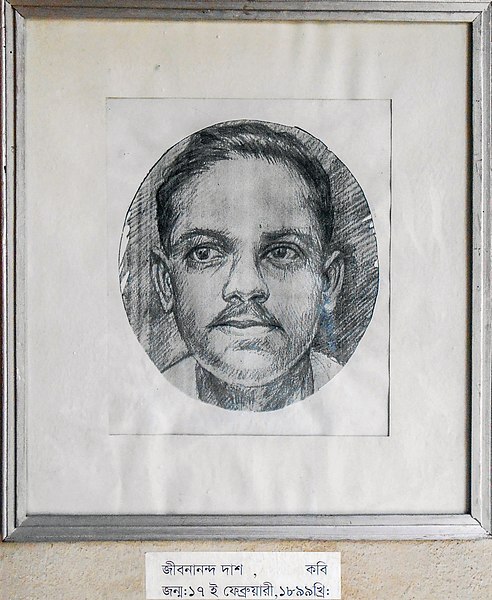
Jibonanada Das (1899-1954) was a writer from Bengal, who has now joined the pantheon as one of the greats. During his life he wrote beautiful poetry, novels, essays and more. He believed: “Poetry and life are two different outpouring of the same thing; life as we usually conceive it contains what we normally accept as reality, but the spectacle of this incoherent and disorderly life can satisfy neither the poet’s talent nor the reader’s imagination … poetry does not contain a complete reconstruction of what we call reality; we have entered a new world.”
Motorcar

A motorcar
Fills the mind with misgivings.
A motorcar is always a thing of darkness,
Though its name is the first
Among the children of light
In the bright streets of daylight
And glowing gas lamps at night.


It's a creature of the dark:
In clear dawn light
While walking past green corn fields
I look at a motorcar in amazement
And see a 1934 model --
Glimmering, causing a dust storm,
Rushing on a red brick-built road
Going underneath two hijal trees;
Streets, fields and dew disappear.
The morning light suddenly vanishes,
Like a shy bride
Faced with a contrary view,
The field and river, as if, lifeless,
Suddenly lose poise.
This motorcar is a trailblazer,
It's rushing in the direction
Where everyone is supposed to be going;
The course of a motorcar
Fills the mind with misgivings,
Just like darkness.
In the stands

Beside footpaths
On the East and West sides of the city's main field
Are motorcars;
Soundless.
Heads covered,
Seats decorated and cavernous
Steering wheels and headlights polished;
Why are they so still?
A tree of a Kolkata park is still as well
But for other reasons;
I too am still but for another reason;
The stillness of a motor is for some dark reason


It is a dark thing:
In night's darkness, thousands of cars
Dash past
Paris-New York-London-Berlin
Vienna-Kolkata
On this and that shore of the sea
Like myriads of wires,
Like meteors of night,
Like endless enigmas
And with the endless resolve of men and women
They also run
But where they head to I don't know.


The destination of a motorcar – a motorcar itself
Has always been a mystery to me,
It seems to move towards some darkness.


I don't want to go anywhere so fast;
I have the leisure to walk to wherever I want,
The leisure to wait and lounge for a long time after reaching my destination.
Let other people be excited
About all kinds of amazing feats – I don't feel the need for them!
I am a hopelessly outdated man
In this new century
Underneath the stars!
Rakibul Hasan Khan is an academic, poet, and translator. He is currently pursuing his PhD in English at the University of Otago, New Zealand.This translation was first published in Daily Star, Bangladesh.
.
PLEASE NOTE: ARTICLES CAN ONLY BE REPRODUCED IN OTHER SITES WITH DUE ACKNOWLEDGEMENT TO BORDERLESS JOURNAL
Author & Translator: T. Janakiraman, translated from Tamil by Lakshmi Kannan
Publisher: Orient Blackswan Private Ltd, 2021
T. Janakiraman (1921-82), affectionately known as Thi Jaa, is an iconic, widely read and revered Tamil writer and one of the most influential figures of the twentieth century. Belonging to the Manikkodi movement in Tamil literature, which brought in new ways of writing, with an emphasis on the art of fiction as practiced by the Modernist writers in England, he wrote in a deliberately pared-down style and explored psychological ramifications. It is no coincidence that the hundredth year of his birth is being celebrated in 2021 in a great way. As a tribute to him, Orient Blackswan has just published a second edition of his Tamil novel Marappasu (Wooden Cow) aptly translated by Lakshmi Kannan, the well-known contemporary bilingual writer and poet. A novel quite controversial when it was written, it is basically the portrayal of a strong woman who lives by her own convictions, rejects the institution of marriage, and who remains true to herself, despite social censure.
Narrated in the first person by the protagonist Ammani, it is through her consciousness that the events of the novel are reflected. Divided into two parts, the first section delineates Ammani’s growth from a precocious child to a luminous, spirited young woman. She leaves her natal home for higher education to live with her Periappa and Periamma, her uncle and aunt, and starts living a non-traditional life. The opening sentence of the novel, “Almost anything makes me laugh” vouches for her strange beliefs and behavior. Her headstrong nature coupled with her intolerance of injustice results in her being mired in controversy over and over again. She ‘hardened’ her mind as she “knew there is no meaning in marriage and all that sham in the name of respectability”. She doesn’t wish to steal but wishes to live on her own terms. She spouts communist philosophy and rails against the unjust treatment of the poor by the government. Though financially very poor, she goes and invites the famous singer and musician Gopali to perform at her cousin’s wedding celebrations. Soon Gopali’s charisma draws her into his ambit. He takes her to Madras and also arranges dance lessons for her and moves her into a house he buys for her. Ammani rejects marriage as a bourgeois concept but soon accepts her hedonistic new life and begins her unconventional and volatile relationship with Gopali.
In the second part of the novel, we see Ammani as a woman of the world, divested of all her connections with traditional Brahmin society. Wary of marriage, which she sees as a lifelong imprisonment, she travels around the world giving Bharatnatyam performances. Gradually her relationship with Gopali is strained when he realises that he is not her only male companion. Ammani’s many romantic entanglements provide her with a different view of the man-woman relationship. She gets into a relationship with a man called Pattabhi but laughs it off when he proposes marriage, thus wounding him deeply. Throughout the novel there are many more instances of her waywardness. She poses as a streetwalker in London and picks up a Vietnam war veteran called Bruce with whom she spends three weeks. Initially Bruce is convinced that he “got to know a rare human being”. He tells her, “You may have slept with three hundred people and kissed a few thousand. But you are a very pure woman”. But when he tries to be intimate with her, Ammani states: “I’m a public girl. At the same time, I’m also not public. I can be bought. But I’m also not for sale. It’s possible to stick to me, but it won’t last. Why are you looking at me as if I was an exhibit?”
She explains to him that she has no relations or friends. She drops each friend in their place and moves on. While on a train journey with Gopali, she makes a sardonic assertion that she is not Gopali’s wife and confuses the fellow English passengers travelling with them. Thus, far from adhering to the caste and class hierarchies and morality, the novelist portrays Ammani as a woman who lives by her own convictions and remains true to herself despite social censure. Towards the end of the story however she realises through the marital relationship between her servant Pachiappan and his wife Maragadham that a man and a woman can also be true soulmates, and this renews her faith in the institution of marriage.
The title is based on her perceptions when she sees a dead cow on the street one day. People were wary of the unpleasant task of having to dispose the carcass, even though the cow had provided milk and had borne calves when she was alive. Metaphorically speaking, she perceives herself to be similar to the cow that lacks functionality, and therefore wooden. By disclaiming the institution of marriage, she has been merely a shining curio that has not been of any real value to others.
Translation and its problems are nothing unique and hence critics have even labelled it by terms like ‘transliteration’ and ‘transcreation.’ In Mouse or Rat? Translation As Negotiation, Umberto Eco writes about a postlapsarian movement between different tongues, the perilous attempt to express concepts from one language into another. “Translation is always a shift, not between two languages but between two cultures. A translator must take into account rules that are not strictly linguistic but, broadly speaking, cultural.” By suggesting that translation is a ‘negotiation’ not just between words but between cultures, whether it be a loss or a gain on either side, Eco emphasizes that a translator’s job is to decide what elements are vital and which may be neglected. In another instance, the problems of translation are put forward by Jhumpa Lahiri in her latest novel Whereabouts (which she self-translated from Italian to English) attests to the fact: “Translation shows me how to work with new words, how to experiment with new styles and forms, how to take greater risks, how to structure and layer my sentences in different ways.”
That Lakshmi Kannan decided to re-translate the original Tamil text once again after a gap of nearly forty years vouches for the fact that a translation can never be declared as one and final. What she did in the first edition in 1979 left her dissatisfied and as she herself declared, trying to do a fresh translation of an older piece of work was like wrestling with “a new kind of beast that is hard to describe and difficult to handle”.
By paying more attention to enhance readability for a contemporary audience as well as to preserve the Tamil flavor of the original by retaining many original words in the text and providing a glossary at the end, this revised version has emerged rejuvenated as a new text.
As Anita Balakrishnan rightly points out in her foreword, the author wrote in the distinctive Tamil dialect of the Kaveri delta that created a characteristic style. This made the task of translating even more daunting, for the carrying across of the nuances of the Thanjavur Brahmin register is no mean task. Also, Jankiraman’s technique of interweaving the mellifluous strains of Carnatic music with his pathbreaking themes helped him to ensure his place in the great tradition of modern Tamil fiction. With a good command of both English and Tamil, Kannan’s translation ably captures the nuances of the original text, and she should be congratulated for bringing the works of T. Janakiraman to a pan-Indian as well as global readership. Her unique attempt to re-translate the novel once again by rectifying all the lapses in the earlier translation speaks of her sincerity, integrity and ultimately love for her mother tongue Tamil as well.
Somdatta Mandal is a critic and translator and a former Professor of English at Visva-Bharati, Santiniketan, India.
.
PLEASE NOTE: ARTICLES CAN ONLY BE REPRODUCED IN OTHER SITES WITH DUE ACKNOWLEDGEMENT TO BORDERLESS JOURNAL
Born in united Bengal, long before the Partition, Kazi Nazrul Islam(1899-1976) was known as the Bidrohi Kobi, or “rebel poet”. Nazrul is now regarded as the national poet of Bangladesh though he continues a revered name in the Indian subcontinent. In addition to his prose and poetry, Nazrul wrote about 4000 songs.
In Which Shore


In which shore has my boat moored today?
What golden village lies ahead?
Why does my boat, on a downstream-drift,
Yearn to move upstream again?

Making Sorrow my helmsman
I had set adrift my broken boat.
Who are you, nymph of my dreams,
Beckoning me on with your eyes?

Snuffing out my room’s lamp
You called me out that stormy night.
Who could you be, my tune’s companion,
Waiting at the gateway of my song?

Oh golden girl of a golden land
Will you be my boat’s pilot?
Row my broken boat onwards
To the Promised Land!

(This poem was first published in Daily Star)
Nazrul’s songs are sung by artistes of renown across the subcontinent. Here we celebrate his lyrics, with a rendition by a well-known Indian singer, Manabendra Mukhopadhyay (1929-1992).
A Poem for the Ol-Chiki

The Bengali script in Bengal
The Odia script in Odisha
I do not know the Bengali script
You do not know the Odia script
Let us agree to one script for Santhali
The Ol-Chiki is our script.
They write in the Roman somewhere
They write in the Devanagari at some places
I do not know the Roman script
You do not know the Devanagari script
One script will unite us all
The Ol-Chiki is our script.
Dear writer, for how long will you
Write your language using
Someone else’s script?
You are dividing our readers
You are making our publishers lose money
Let us all understand this
The Ol-Chiki is our script.
One language, one Script.
This is what will strengthen us Santhals
The talents of so many of us
Scattered for the want of one script
All of us Santhals, let us solve this script issue.

(First published in 100 Poems are Not Enough, Walking Book Fairs)
Sokhen Tudu is a Mayurbhanj, Odisha-based Santhali poet, haiku writer and Santhali script activist. He was involved in spreading the Santhali script, the Ol chiki, among Santhals in Bangladesh.
Hansda Sowvendra Shekhar writes in English and occasionally translates from Santhali and Hindi to English.
Adivasi Poetry


When the sorrow of all the directions
gathers as a whirlwind
rising high as a pillar
scattering
as it reaches the roof of the earth
making the heart shiver,
there emerges Adivasi poetry.

When there is anguish
in jungle, mountain, grasslands
in the bowels of the earth, in the waters of the rivers,
when people leave their mud huts —
like mice escaping a flooded nest —
carrying their handlachaatva*
in the crooks of their waists
in search of land
what rises with the tears in their eyes
is Adivasi poetry.

After a few drops of rain
trucks from the sugar factory
arrive and stare at the empty huts.
We toil, naked, on the earth for months
in the burning sun
without davaduri*.
Do we crush the sugarcane
or does the sugarcane crush us?

It lies like animals
at the edge of the river
on the outskirts of the village.
Just like a dog,
Adivasi poetry.

As the day dawns, standing in queues,
noses lowered, at the crossroads in cities
like cattle in cattle markets
to sell our labour.

All day and night, lying curled up
invisible, with the hungry ones,
Adivasi poetry.

Like the one who carries the weight of the house
rising with the first cock crowing
going to the jungle with axe on her shoulder
walking to the city through five villages
with the wood on her head,
pregnant, but carrying back
one kilo of flour
rice
oil worth Rs 2
salt
chilli powder.

Just like she cooks rotlo for two meals
a day, her blood turning to sweat
Adivasi poetry
is made.

*handlachaatva: Earthen cooking pot and wooden spoon
*davaduri: Medicine
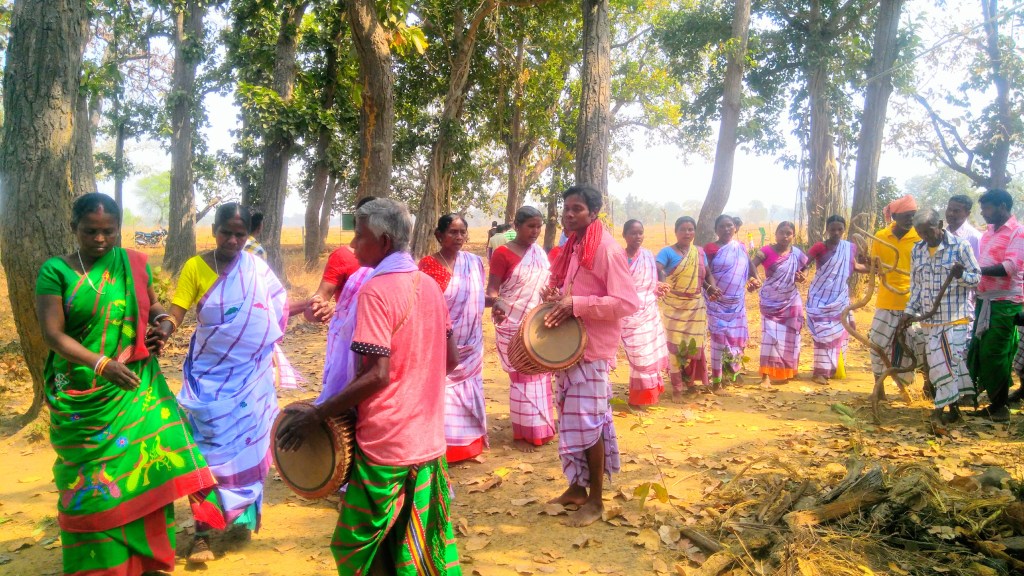
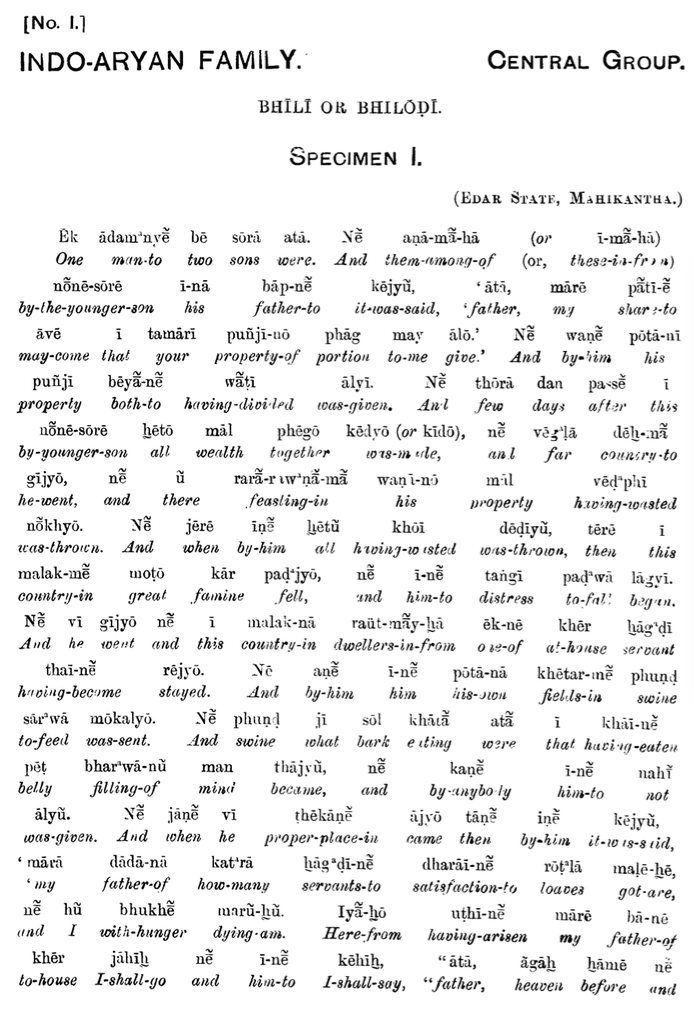
Jitendra Vasava was born in Mahupada on the banks of the river Tapi in the Narmada district of Gujarat. He writes in Dehwali Bhili, one of the few poets in Gujarat writing in a tribal language. Vasava established the Adivasi Sahitya Academy in 2014. As the president of the Academy, he has also edited Lakhara, a poetry magazine dedicated to tribal voices published by Bhasha, Vadodara. Vasava has been awarded a PhD for his research on the cultural and mythological aspects of oral folk tales of the Bhils from the Narmada district.
Gopika Jadeja is a bilingual poet and translator, writing in English and Gujarati. Gopika publishes and edits the print journal and a series of pamphlets for a performance-publishing project called Five Issues. Her work has been published in Asymptote, Modern Poetry in Translation, Wasafiri, The Four Quarters Magazine, The Wolf, Cordite Poetry Review, Cha: An Asian Literary Journal, Indian Literature, Vahi, Etad, etc. She is currently working on a project of English translations of poetry from Gujarat.
A parable by Louis Couperus (1863-1923), translated from Dutch by Chaitali Sengupta
Statue of Louis Couperus
Museum in The Hague
Portrait of Louis Couperus
Louis Couperus is one of the foremost figures in Dutch literature. Courtesy: Creative Commons
The forest was somber, and the air dark; it was a long night without the solace of the stars, it seemed to sink into infinity, sink deep into all that was mortal in this world. It was at a time like this when the young boy woke.
He was a boy of some years, and he did not remember anymore, whether he was lost or abandoned in that forest, because he had slept for such a stretching length of time. Shuddering, his eyes large and full of fear, he looked around himself. But the way forward was lost behind him.
“Where am I,” the little boy thought, in that soul-shattering darkness. “And who am I and where am I to go…”
A vague remembrance stole upon him, a memory of shimmering light and warmth. Like a weeping, wafting out of the warm sun palace. But more than the weeping, he remembered nothing much. Now, fully awake, he became aware of being alone, abandoned, lost in a forest of horror.
The very thought made the little boy cry out in childish despair. The fear of beasts and that of robbers assailed him. Then, he saw a silvery twilight moving across towards him, in silence. Was it the wild man, he wondered? In his deep consciousness, the thought rose death-like. His little heart throbbed wildly in his throat and his small eyes bulged out in terror.
Soon, he realized the beaming twilight, that glided on his way, was not the wild man; it was a white woman.
The little boy, in the twinkling of an eye, thought he recognized her: a woman, very white, the kind of white woman he liked. With mingled fear and expectation, the little boy ran up to her.
“White lady!” he begged, folding his hands in a gesture of prayer that perhaps he had been taught in the sun palace, many, many years ago.
Tall and slender, the white woman’s veils were the whitest white, flashing against the gloomy, dark depths of the forest. She bent over the child, and her gaze caught him through her veils; her white hands were briefly extended, as if she wanted to see better; better, with her deep dark eyes, as deep as the black, shadowy forest.
“White lady!”, the child pleaded again.
“Who are you, my child?” asked the white woman. Her voice sounded primeval, thick and dark. “And where have you come from and where are you going?”
The small boy began to cry again; the woman’s voice frightened him, and he did not know who he was, where he had come from, or even where he was going…
“Come with me then”, said the white woman gravely, and she stretched out her hand to him. The little boy held out his hand to her too, and went beside her, with weeping eyes.
“Don’t cry anymore,” said the white lady. “Hold my hand safely, let me lead you: do not be afraid. In this forest, there are no beasts or robbers.”
The child felt a gentle trust wash over him, especially now that the cold hands of the white lady were warmed by his own small, warm one, but he still stumbled very often, and his short legs grew tired soon.
“Then, let me carry you, my dear.” Saying so, she lifted the child to her breast and held him very lightly between her white veils: her footfalls were light, floating, like unheard-of steps. In her arms, the child fell asleep and dreamed of the sunshine and white women, and also of white children. She walked on.
When he awoke, the child smiled and peered into the dark depths of her eyes.
“You are a good white lady, aren’t you?” asked the child, as confidence sparkled in him. He wrapped his little arms around her neck.
“Yes,” said the white woman. “I am a good white lady, my child.”
“Are you not tired of carrying me, good white lady?”
“No, my child, I am not tired. I never rest, I always go.”
“Always?”
“Always.”
“Through the whole forest?”
“Through the whole forest. See, the morning breaks magnificently, through the branches, and the way ahead seems clearly visible.”
“Now I can walk again, white lady.”
The white lady put him down, carefully on his feet, and wrapped herself closer in her veils. The child walked on beside her, happy now that all the mystery of the night had been resolved in the smile of the morning.
“Oh!” cried the child; “See what a beautiful flower that is!”
“And there, what a beautiful butterfly!”
“Oh!” said the child joyfully. “I would like to have them, the butterfly and the flower.”
“I shall give you the butterfly and the flower,” said the white lady; “but then, you must also give me something in return.”
“And what can I give you, white lady?”
“In lieu of the butterfly and the flower, my child, you must give me this morning hour.”
“Oh, beautiful is the flower, and beautiful is the butterfly: oh, white lady, I gladly give you this morning hour, in return!”
The white lady smiled. With a mysterious, dark look she looked at the child.
Then she caught the butterfly in her veil and bent over the precipice to pluck the blue flower. She offered both to the child, who rejoiced with happiness.
“O white lady, O white lady,” the happy child spoke out in joy. “How happy I am with my flower and my butterfly!”
But in his joy, the boy squeezed the butterfly to death and the flower withered in his little hand. “Oh, but how soon, O white lady, is my flower wilted and my butterfly died!”
“But dear child, butterflies do not live long, especially not in the hands of children, and flowers wither even faster. But if you give me this new day of spring, I will bring up thousands of butterflies and thousands of flowers, by magic, all along your path today.”
“A thousand of butterflies and flowers! Oh, white lady, for so many flowers and butterflies, I will gladly give you my day in spring.”
Now the glowing sun had completely burst forth, and the forest no longer wore a black garment; it sparkled with golden-green spring. And along the shining road, the child walked in springtime, and picked the blooming flowers and caught the colorful butterflies, for they bloomed and fluttered all along the road.
But by evening, the flowers had wilted, and all the butterflies were dead.
“Still, it was a lovely spring day,” said the cheerful child, now with sleepy eyes. Exhausted, he wrapped his arms around the white lady and slept on her heart, between her ephemeral white veils.
Night fell, the white lady walked on, and in the depths of her shadowy eyes, a peal of wistful laughter broke quietly. “But that glorious spring day is now mine!” murmured she, in a nameless, deep, dark voice.
The white lady took the little boy to the city, among other people and children. The child grew up there. He became big and strong among those he assumed were his parents, his brothers, and sisters, relatives, and friends.
Many seasons later, the white lady appeared to him again. The white lady of his yesteryears, the one whom he had forgotten completely. Now, her deep dark eyes frightened him, even though he was now a young man of eighteen.
“My son,” the white lady called him. “I have not forgotten you.”
“I was ungrateful, white lady,” confessed the young man. “You saved me, a lost and forsaken child, from the gloomy forest of night And, you gave me butterflies and flowers.”
“Yes, thousands of butterflies… in exchange for one spring day!”
“Yes… thousands… for one day in spring. You brought me to the city, and I found my parents.”
“And they fed you and cared for you until you became a man, my son, a young man of eighteen. But don’t you remember, the promise? What returns would you give me now?”
“Oh, yes, white lady, I remember very well. A spring day in exchange for the butterflies and flowers. I also remember the eighteen spring seasons of my life, which you demanded to bring me into the city where I could be with my parents, and they would raise me with my brothers and sisters, and with my relatives and friends.”
“If you still remember that promise, my son, the white lady is now content… And she’s happy. In exchange of just eighteen, withering spring seasons, you have received youth and a youthful time of pure happiness.”
“But now, white lady, my happiness is over, and I am bitter with grief,” cried the young man. “For I love a girl as beautiful and as soulful as no other girl in the world, and I should like to call her my wife. But alas! She does not love me. I have but little possessions and one among them is my anguish, that I cry out on my violin.”
“My son, you know how much I love you. If you can give me, no more than twenty blooming summers of your life, I will gladly give you happiness, a consort, and money. Twenty blooming summers, in exchange for the bride, and the gold that will make you great among men. Do not lament in music anymore; music must fill the void and is more transient and rarer than what I’ve asked of you…. Your spring days and summer months…”
“But music has comforted me, white lady.”
“Yes, live happily then, my son,” said she. “Be happy with what I give you, with your bride and the money…”
“Oh, white lady, oh white lady, for so much I’d willingly give all my blooming summers to you!”
The white lady looked with deep dark eyes at the young man, and she did not come back in years.
The young man married the lady of his dreams, the one whom he desired much, and as the years slowly turned, he attained prestige, wealth and power, until the war erupted. Then, the country was in turmoil, and the smoke of crumbling, burning cities darkened the sky and the horizon.
The white woman appeared to her foster son for the third time. She looked terrible to him. Her face was lean and sunken, her arms bony and her outstretched hand, threatening.
“O white lady, O white lady,” exclaimed the man, full of passion. Worries had already wrinkled his face; pride was scorching his soul. “Years ago, you offered me happiness in exchange for twenty summers of my life. But I never found happiness… Like the flower and the butterfly, my love died and wilted, and my wealth never brought any joy. Now I only wish to be very powerful, for if I attain supremacy, that must surely bring happiness. I wish for a crown that would sit on my temple.”
“Foster son,” said the white lady, “my dear child, I never forgot you: if you will give me in exchange for the crown of this land, fifty purple autumn seasons of your life, I will cause a happy outcome in the war; it would make you the king of this land.”
The ambitious man hastily accepted the exchange, and a terrible battle raged for seven days. The battlefields were strewn with corpses: death seemed to reign supreme. The foster son of the white lady took a sword in his hand, fought fiercely in the front lines, and a mysterious power seemed to protect him and make him invincible in the heat of the war. He, at the head of the troops of the country, gained the victory, and they pressed the crown on his head.
He grew old under the weight of that crown, until war raged again, and rebellion broke out. Deserted by all his people, he fled the land half-naked, feeling miserable. He reached the same gloomy forest, collapsed there, where he had been once found as an abandoned boy by the white lady.
Old and dejected, he lay down in the twilight of the sinking evening, when she appeared before him, looking like a terror: gray hair fanned out around her face, which grinned like a skull; and now, she had hollow eyes.
“O white lady, O white lady,” cried the unhappy king. “You thought to gift happiness to me with this crown. You turned the war in my favor, in exchange for fifty purple autumn seasons of my life. But this crown has only brought me trouble, nothing else. I’ve never known happiness, except perhaps for that very first day of spring, when you conjured up butterflies and flowers for me! And yet I considered you to be my life! Why have you been so cruel? O white woman, O white lady! Now that I lie here, feeling miserable, abandoned, I beg of you. You who are so powerful, please bring a glimpse of happiness and life, to my poor suffering subjects, to my children… in whichever form it may be, flower, butterfly, bride, gold, or crown…”
“O my son, O my son!” raved the white lady. “You’ve always been ungrateful. You’ve cared neither for the flower, nor for the butterfly, nor bride or wealth, not even for the crown. But if you give me this last icy winter hour, well then, I’ll grant your children and your subjects life, and a glimpse of happiness.”
Helping him stand up, she led him on. Sobbing now, he entrusted his last winter hour to her. And she led him to a monument, whose bronze door she opened out for him.
“Get in there,” she said threateningly now. “So that I may receive everything: all the days of spring, summer and autumn, and also the last hour of winter: all that you have promised me, in exchange for my countless favors.”
The old king stumbled and staggered.
“But… but… this is a tomb!” he said, looking at the monument.
“This is a king’s tomb,” she corrected him. “Tomorrow your praise singers, O son, will engrave upon it, the words of glory, glorifying you for eternity. Get in there now, so that I may receive what you owe me.”
And she held open the bronze doors for him.
“Were you not my life then?” asked the King, on the threshold of the sepulcher. “Oh, tell me… Aren’t you, my life?
“No,” said the white lady gloomily. “I was never your life. I am not Life. I am Death.”
And she pointed him to go inside.
He obeyed; slowly, she turned the bronze door, which creaked in heavy hinges.
“And my life?” asked the old king in a begging voice, anxious, as he peered through the still open crack of the slowly closing tomb door.
The white lady said more softly, “You’ll get your life, but only when you have paid me your debt of the days and the seasons…
Then she closed the door, for thousands of years.
Louis Couperus (1863-1923) is one of the foremost figures in Dutch literature. His oeuvre contains a wide variety of genres, including lyrics, poetry, short stories, fairy tales and historical novels. Over Lichtende Drempels (About luminous thresholds) is a collection of four fairy tales and an accompanying story by Couperus. Published in November 1902 by LJ Peat, in Amsterdam, “Of Days and Seasons” (Van dagen en seizoenen) is a parable from this collection.
Chaitali Sengupta is a writer, translator, a language teacher, and a volunteer journalist from the Netherlands. Her first prose-poem collection Cross-stitched Words was published in February, 2021. Her published works also include two translations “Quiet whispers of our heart” and “A thousand words of heart”.
.
PLEASE NOTE: ARTICLES CAN ONLY BE REPRODUCED IN OTHER SITES WITH DUE ACKNOWLEDGEMENT TO BORDERLESS JOURNAL
Like every city or village, every road too has a character of its own. The road which has spread out its clumsy, uncouth body here, aiming to touch some distant point in the south of town, has no character to speak of. It is ugly and chaotic. It has let its coarse surface to be abused daily by scores of vehicles, bicycles, pedestrians, rallies, wedding processions, hearses and more. Humans and their automobiles mingle with stray cattle and dogs in a sad spectacle of urban confusion. Pedestrians have surrendered their right of walking to assorted vendors whose unauthorised shops have blocked the footpath. Anybody bold enough to walk on the remaining part of road is under constant threat of being hit by vehicles zooming past in both directions.
Our protagonist here is not the road but a person walking alone on the road. His name is Narottam Chowdhury. His destination and intent are both extremely unusual. Tragic and extreme too. He is on his way to commit suicide by jumping before a moving train. He is aware that the road on which he is walking doesn’t touch the train line, so he has planned to leave this road and enter into a narrow lane on the right side after about half a mile. The lane ends at a shrubbery which has the look and feel of a small jungle. He will find his way through the bushes to the open expanse where he will find two silvery lines of steel on which the trains pass. He has no idea where these two parallel train lines originate and where they end. Narottam will throw himself in front of a passing train today, which he has planned meticulously. This is going to be his last walk on this road. This same road may be used to bring his mangled, lifeless body from the railway track, possibly in an ambulance, after an hour or two.
He has been contemplating suicide for a long time. Once he had accidentally blurted it out before a few friends, but couldn’t come up to the stage of actual implementation. Although almost five long years had lapsed since that date, he was still hanging on to his meaningless life shamelessly. But he was determined to accomplish the task today. His life was becoming unbearable with every passing day. He was not so immature as to die just to honour his word. He had to die because he was unable to live the life available to him.
He gently touched his chest while walking, but not to check his heartbeat, which is steady. He wanted to ensure that his cell phone was intact in his chest pocket. He was not in favour of carrying this device up to the point of death, but realised afterwards that it was an essential accessory for anyone dying outside home or hospital. A phone in the pocket of a fresh corpse would quicken the intimations to his kin. The body would get identified fast. He had also placed a neatly folded note in his pocket which contains just the basic information about himself, including relevant phone numbers. It would come in handy for the finders of his body. He wasn’t too sure if either the cell phone or the paper can be salvaged from the mangled corpse, but it would always be better to carry both in order to improve chances. He also carried some money in his pocket. His spectacles were in place on his nose. His old wrist watch stayed at its rightful place, his left wrist. These were the only earthly possessions he was carrying with him, apart from the modest clothes he was wearing. The noisy erratic traffic on the road did not bother him. He did not mind being hit today by a passing vehicle on the road, although he will be terribly disappointed if the accident left him maimed but not dead. It would be very difficult to plan a decent suicide again if he wer maimed.
Did he hear something? Some vague distant voice seemed to reach him in spite of the din and bustle of the busy road. He would have dismissed it as a disturbance in his own mind, but it actually sounded like some announcement through a microphone. Had he been caught? His secret exposed? A public announcement asking people to capture Narottam before he did something foolish? He chuckled at his own silly thought.
How could anyone even guess what he was up to? He had been extremely careful; knowing well that even the slightest slip from his side could abort the mission. True, he had once blurted it out before four friends; but that was five years ago. He had let his intent slip in a moment of carelessness, purely by accident. He was neither hungry for sympathy nor did he want to deliver a shock. His announcement had not jolted anybody. Nor had anyone asked him to desist from such misadventure. They just asked him not to blabber like a mad man and veered away from the topic which, in their judgement, didn’t merit any further attention. Narottam wonders whether any of those friends still recalled his intent. Or perhaps, they were silently waiting to see whether Narottam really meant what he had said.
He was satisfied that during the half hour since he left home, not for a moment did he waver or vacillate in his resolve. Sometime back, he had stopped briefly at a stall selling hot snacks on the pavement. A sweaty man with a balding forehead was passing on hot samosas on round paper plates while collecting cash with remarkable speed and efficiency. Narottam stood and watched silently as balls of yellowish brown dough, with fillings of cooked potato, were moulded into tiny pyramids and dipped in a cauldron of boiling oil perched on a huge hissing stove. The samosas were allowed to sizzle and dance in oil a few minutes before a large slotted spoon would fish them out and heap in a basket, for onward transmission to the paper plates. The entire process, right from making of dough to eventual annihilation of the end products in hungry mouths, presided over by the balding man, was taking place in full public view. Narottam saw life pulsating at every segment of this activity, but scampered away from the spot, afraid that such open display of life might weaken his resolve to die. He wouldn’t allow some silly distraction to interfere with his tryst with death.
Narottam could vaguely hear the public announcement which had become a bit louder by then. Slightly louder but still indistinct. He strained his ears but could not make out what it was about. He would have been happy to hear every news, gossip, message circulating in his world during his lifetime, but what was the point now? Even if the government was announcing a ban on use of this road for walking towards train tracks, it wouldn’t affect him. He would have gone before the dictum was enforced.
An assessment of his age and health had convinced him that number of years he could reasonably expect to live was by no means small. He could not wait so long for a natural death with his unbearable life, with every passing day renewing a blow to his desire to live, which was already at its lowest point.
He had even weighed all alternate modes of suicide to choose the method most suitable to his condition and temperament, with zero risk of failure. Swallowing some strong insecticide, or any other dependable poison, in solid or liquid form, would have been easier but with uncertain results. He had heard of people surviving such attempts with severely damaged organs. Jumping from the terrace of a high-rise had never appealed to him, for fear of hitting some innocent person or dog or car on the ground. He preferred his corpse to be delivered undamaged at his home; but he had to abandon that preference when his secret attempt to hang himself failed by a wide margin of error. That was almost a year back. He had rolled his wife’s sari into a coil, secured one end around stem of a ceiling fan just above the blades; but the art of making a proper knot eluded him. The sari was retrieved with a thick film of dust collected from the ceiling fan. Cleaning it secretly, folding neatly and placing it back in his wife’s wardrobe was no mean job.
Slicing a wrist to allow his blood to drain out was an option, but his research showed that the success rate was only about forty percent. Even swallowing handfuls of powerful sedatives, with its fifty one percent success rate, didn’t meet the rigorous, zero-error standards he had set before himself. Finally he was left with only the train line, widely followed and highly popular among the suicide aspirants. Easy availability of open train tracks in his town came as an additional incentive.
Not far from the rail lines stood the small temple of Shiva on right side of the road. Narottam suddenly decided to have a last glimpse of the deity. It was not a part of his plan, but why not? Like all Hindu temples, this too expected devotees to remove their footwear outside. But Narottam didn’t go in. Gaining an unhindered view of the deity from the road itself, he folded his hands, closed his eyes and muttered a brief prayer: “I haven’t come to seek anything, Oh God. I am leaving. This is our last meeting! Goodbye.”
As he descended back to the road, he halted briefly, training his ears to listen to the announcement which was now audible clearly. A rickety van came slowly , with a large funnel shaped amplifier repeating one sentence ad nauseam : “Please be informed that electricity will be cut off tomorrow from seven o’ clock in the morning to five o’clock in the evening , on account of urgent maintenance work.”
How did that matter to a person who would not be around tomorrow?
But no, he made a quick reality check. What would happen if the news didn’t reach his home that day? The next morning there would be no water in the overhead tank, no electricity for any work whatsoever, not even for charging a mobile phone – and all this while a mutilated body would be awaiting cremation, not to speak of the fast arriving crowd of friends and relatives. This piece of news had reach his home immediately. His hand reached his pocket for the mobile phone, but he stopped again. Could he call at this point just to pass on this information? He would surely subject himself to the obvious question: why couldn’t he wait till he returned home. Could he say he had no plans to return home? He surmised that a public announcement as loud as this must have reached his home too. So his cell phone went back to the pocket.
In fact he didn’t have to feel guilty about leaving such a petty problem as a temporary power outage outside of his life span unresolved. He had listed and attended to every single issue that a man of the world is expected to. All financial and legal issues relating to his home, money, mortgage, insurance etc. were taken care of. Keys, IDs, passwords, codes, ATM pins were all kept neatly and could be easily located. He had also kept an index of all documents clearly mentioning where they could be found. Content with the knowledge that his absence would not cause any material problem to his family, Narottam continued his death walk.
His preparation had been thorough even about action points during his final moments. His mind and body both were well prepared, strong and unwavering. He had planned out where exactly he would stand before his final leap. He had to hide behind the thick foliage nearby waiting for a train to arrive. The wait would not be long because this line, extremely busy in the evenings, had a train passing almost every five minutes.
Last week, he had seen three trains passing in about twenty minutes, two carrying passengers and the third one some cargo in containers. The second train was passing slowly; so he could see a bunch of giggling kids waving their hands through the open window, hollering something he could not hear. He had wanted to ask them why they were so happy while in a moving train.
Today it would not matter what or who were in the train. He would jump not more than five seconds before the train reached the spot, not allowing enough time for the driver to apply brakes. In those few precious moments, his tormented soul would have been released to heaven. Or hell ; it did not really matter.
It was entirely up to him on which of the passing trains he would bestow the honour of crushing him. He might let the first train pass, perhaps the second one too; but not beyond the third, lest his resolve lose steam. His day without a tomorrow would be drawing to a close even as the townsfolks would be preparing for next day’s power outage. The announcement, still audible to him even from a distance, irritated him. He had two questions for the announcer in the van. Had it been announced distinctly near his home? Was the man sitting in the van using pre-recorded audio or parroting the sentence in real time?
Nearing his destination, he made a quick calculation in his mind and realised that in fifteen minutes he would be at point zero. Within an hour he would be dead and within the next one hour, his body would have been located, identified and taken to morgue.
He felt a vibration near his chest and stooped to locate its source. The cell phone. It released a gentle alert, shook a bit and fell silent. A message for sure. Should he read? Let the message also die unseen, unread. He hadn’t brought the offending device with him to receive messages today. He decided not to touch the mobile at all, but could not approve the propriety of dying before reading a message specifically meant for him. He would remain in dark about its content for ever, even though ‘for ever’ for him means just an hour. His curiosity overpowered him. He fished out the phone from his breast pocket and stared at the screen.
Gosh! This? Of all matters on heaven and earth?
It was a shame that such careless, offending words would claim his attention at a sensitive and delicate moment of his life. He would have thrown the cell phone and crushed it in sheer disgust, but he didn’t. It went back to his pocket. Cursing himself for having read the message, he decided to ignore the message and walk on towards his tryst.
But he could not. A sudden feeling of helplessness overpowered him. The moment he read the single sentence, he had understood that he had lost. He could not ignore it and proceed on his own. Not today.
He walked back and entered a market he had left behind. He took out his phone, read the message again and felt like kicking himself for his surrender. ‘Bring flour, sugar and some vegetables on your way back.’ Just ten words.
What does ‘on your way back’ mean? He had no plan to turn back today. Silly. Humiliating. But that was that. His zero-error plan, carefully chartered strategy lay assaulted and shattered by rude, untimely interruption of these shameless words.
While trudging homeward on the same road, clutching a bag of grocery, Narottam resolved to wait and plan for another day. The setback was temporary, not strong enough to break him.
A glance at his watch convinced him that nothing would be out of place. This was the normal time for his homeward trek every day. He would reach home at the usual time and nobody would be any wiser.
Satya Misra writes short stories in Odiya , a regional language of India. Some of his stories have been translated into other Indian languages. This was first published in Odiya magazine, Katha, and subsequently included in his collection, Miccha Raastara Sata.
.
PLEASE NOTE: ARTICLES CAN ONLY BE REPRODUCED IN OTHER SITES WITH DUE ACKNOWLEDGEMENT TO BORDERLESS JOURNAL
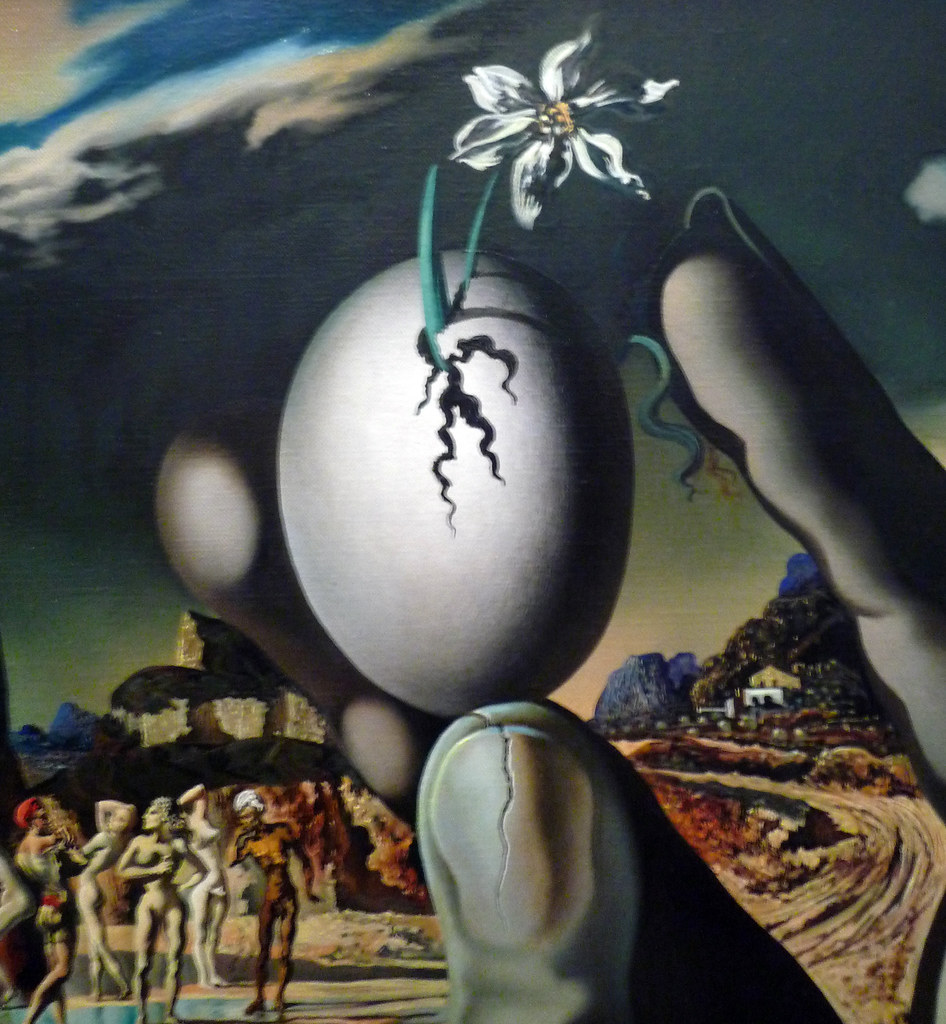
Salvador Dalí, Metamorphosis of Narcissus, 1937. Courtesy: Creative Commons
About Time

The flowers bloom and wither only to make people cry.
Tadpoles grow up to be frogs.
Just as robbers rob an old king's grave, a drunk catches frogs for a side dish.
Time does not take you like a river flowing with fallen petals,
but across the fixity of time,
seasons become spring, autumn and spring again.
The moving thing is not time but the sparrows,
the morning glories and the crescent moon.
Time does not bring you to the tomb step by step,
but it stays still without any facial expression,
while not only do the flowers bloom and the birds sing,
but also, you swim across the river of time towards a profound future.
You don't have to wait for the time when it takes you for a ride
but you must swim like a webfoot or with a fin
to build your own house on a housing lot of time like a silk carp, honeybee or kingfisher.
You must row on the milky way in the blue sky
with your own hands and feet like a pole,
your heart and brain like a mast.
Like a planet swimming in the universe,
you must fly across time like a kestrel.
The cornelian cherry and golden bells started to burst from yesterday.
Brilliant flowers bloom with their wings to build their own houses.
It is not that time brings you to the grand residence by taking you on the cloud train
but you are to walk struttingly through time to be a flower or a butterfly.
Ihlwha Choi is a South Korean poet. He has published multiple poetry collections, such as Until the Time, When Our Love will Flourish, The Color of Time, His Song and The Last Rehearsal.
.
PLEASE NOTE: ARTICLES CAN ONLY BE REPRODUCED IN OTHER SITES WITH DUE ACKNOWLEDGEMENT TO BORDERLESS JOURNAL
A story by Nadir Ali, translated from Punjabi by Amna Ali
Nadir Ali(1936-2020), recepient of the Waris Shah Award from Pakistan Academy of Letters in 2006.
A peculiar dream replayed itself in my mind recently. I am the kind of man who always thinks deeply about dreams. When I lost and then initiated the arduous task of recalling my memory, I went in search of all those times I could not account for by raking through my dreams. We rarely make sense of the surreal glue that holds dreams together, reconstructing them as if they are stories. Indeed, sometimes they chronicle our longings, other times they unfold our ardent desires reaching fulfilment, as in the union of a man and a woman! In essence, words lay the foundation, not only of the inner world, but also of our dreams. Words illuminate this journey we undertake in the pitch dark. They help us penetrate the maelstrom of existence!
This is how the dream began. I address a seated man, apparently a doctor, I recognize as Shahabuddin. He transmutes into a woman when I sit down across from him. She has the most beautiful eyes. Dark-complexioned, she appears to be Bengali. I find her very attractive. We take a stroll to the front of the Zamindara College in Gujrat. I point out Nawab Sahab’s grave to her. She moves closer to me as we approach the college hall. We continue onward to the back of the college. My heart turns tranquil as the dream fades.
I did not have to venture far to find the rungs that would help me comprehend my dream. Ah, I had recently read the translation of theMusaddas by Sir Shahabuddin. Since Shahabuddin had tanned skin, he visited my dream as a woman with dark complexion. Again, it was he who dissolved into Balo Jati in my dream because he belonged to the Jat caste. I rushed to Balo and narrated the night’s dream. “Lady, I have to remove curtain upon curtain to find you, even in my dreams!” She laughed and explained, “Such a distance lies between an old man and his youth!” I persisted with my interpretation of the dream. “I showed you Nawab Sahab’s grave to indicate that I am old and decrepit, yet I live on, like Nawab Sahab’s name lives on. We went to the back of the college to excavate my youthful days.”
“Lahore, Chaudhry Sahab, is overflowing with young lovers. My most prized beloved, though, remains this old man. He is a parent and lover rolled into one. People need conversations to share our joys and sorrows, no? Who would I converse with if I don’t see you Chaudhry Sahab?” Balo’s words lifted my spirits. My dream bestowed its blessings and then was forgotten. Two months passed.
Yesterday, as I sat reading the biography of Khwaja Muinuddin Chishti – the Consoler of the Poor*, Bundu dhobi* appeared in my thoughts out of the blue. Consider that one of Khwaja Sahab’s miracles or the secret of caring for the crushed! My mind was reminded of the two-month-old dream. I pictured the dark-skinned woman’s eyes. Ah, exactly like Bundu’s! So, the woman was in fact Bundu the washerman! Bundu is the only person I remember fondly from my two-year stint as a professor at Gujrat’s Zamindara College. He transformed me into a Sahab during those youthful days of surviving on the pittance I was paid as a novice professor. I wore the best starched and brightest white shalwar kameez in the entire college.
I also happened to be the college hostel warden. One day, Bundu appeared with a plea.
“Sahab, it is impossible to find accommodation in the homes seized after the exodus of the Hindus from the city. The Neighborhood of the Untouchables too is under the police’s control. They have escorted so many women there, turning it into their own personal cantonment. It is indeed not befitting for real men to spend nights at the police-station! Please if you get me a place at the hostel, I will manage.”
I arranged lodging for him at the hostel. Meanwhile, I found it hard to manage my expenses after sending two hundred and fifty rupees home each month. I had rashly jumped on the marriage bandwagon too. I ended up renting a house in Madina village situated on the outskirts of the town. Bundu would walk the two miles to my place. I had a bicycle at least.
Bundu never learnt to ride. “It has a mind of its own! What if the damn machine decides to carry me to Momdipur from Madina village?” Bundu would tease.
The marriage ceremony and monthly expenses drained us of all our money within a month of marital bliss. One day, my wife announced, “Someone named Bundu dhobi is asking for you.”
I stepped outside to meet him. “Sorry Bundu, I am penniless this month. I won’t be able to pay you,” I told him.
“Sahab, I am not here to receive my payment. I am here to pick up the dirty laundry. Moreover, I haven’t even congratulated you on your marriage. Your wife is one lucky woman. A good man usually finds a good match.” Little by little, Bundu developed the routine of picking up our laundry from my wife multiple times a week, instead of once a week. Thanks to the care he showered upon our clothes, my wife and I climbed up the social ladder. When the college let him go, he managed to rent a small place that used to belong to Hindus in Muhammadi village. We remained broke.
One day, my wife took out some old bills. “Bundu heard us fighting about the expenses. He left thirty rupees with me.” I expressed my anger. We didn’t have a penny. How were we going to repay him given how impossible it was to borrow from anyone in our village?
“He said we could repay him after one month. He placed the money in my hand,” My wife tried to allay my worries.
Bundu played an important role in my transfer to Lahore when our principal accepted a position at the university and took me along. “You are the best-dressed man in all of Gujrat!”, the principal had said. From Lahore, I went on to Dhaka University in 1965. My children and I took to Dhaka, but luck was not on our side. We were spared the perils of detention in 1971 as we had returned to West Pakistan for the summer holidays. But I remained affected by 1971. I became very ill. I lost my memory during my treatment. Once recovered, I made a trip to Gujrat after a gap of twenty-five years. Bundu had passed away by then.
Today, Khwaja Muinuddin, the Consoler of the Poor, reminded me of my Consoler of the Rich, a most loving and kind-hearted man. Perhaps even Khwaja Sahab had been softened by such love from people! After all, a poor person can also be a benefactor of the rich! Such are the links of love. The foundational bond, too. As in the love between a man and a woman! In my dream, he appeared as a beautiful, dark woman. He was a very handsome man. How can I ever forget his deeply telling eyes?
*Also known as Khwaja Ghareeb Nawaz (Consoler of the Poor), he was a sufi saint and founder of the Chistiya Sufi order in the early 13th century
*A dhobi is a washerman
Biographies:
Nadir Ali (1936-2020) was a Punjabi poet and short story writer. In 2006, he was awarded the Waris Shah award for his collection Kahani Praga. Coming late to writing, particularly fiction, Nadir Ali is credited with spearheading a unique style, blurring the boundaries between significant and petty, artistic and ordinary, primarily due to his preference for and command over the chaste central dialect understood by the majority of Punjabi speakers. He is also noted for writing and speaking about his experiences as an army officer posted in East Pakistan at the height of the 1971 war.
Amna Ali is Nadir Ali’s daughter. She is currently translating a selection of Nadir Ali’s short stories into English. She is a librarian and lives in San Francisco with her husband and two sons.
(Published with permission of the author’s family)
.
PLEASE NOTE: ARTICLES CAN ONLY BE REPRODUCED IN OTHER SITES WITH DUE ACKNOWLEDGEMENT TO BORDERLESS JOURNAL









 Borderless