Categories
The Lost Mantras

Four Poems by Isa Kamari

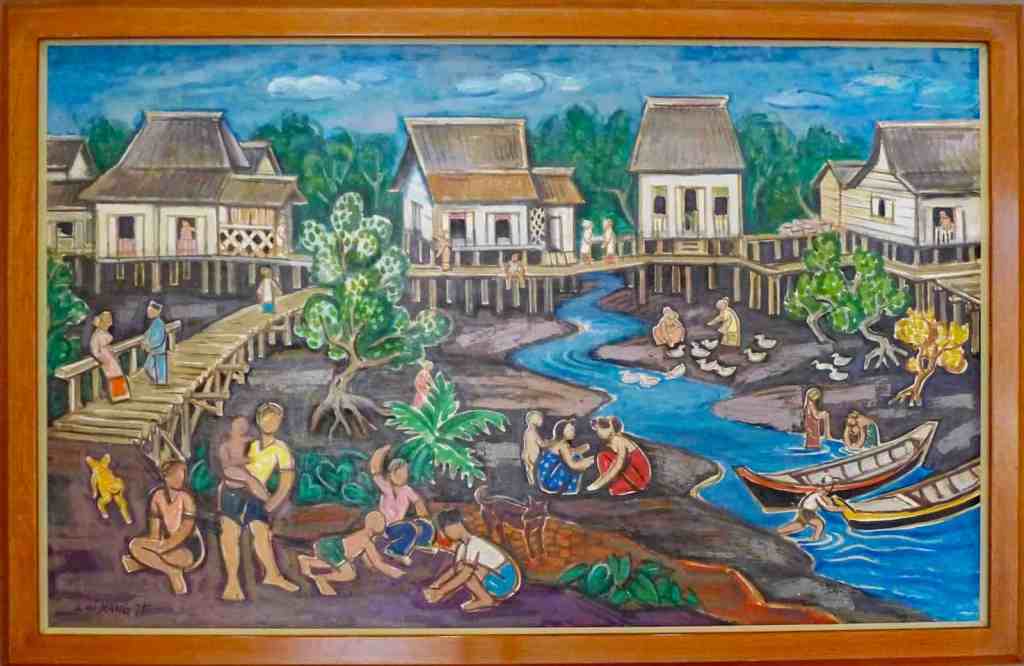
Women wearing baju kurongs and men wearing kain sampings. From Public Domain
OIL LAMPS

We did not taste chicken unless it was Hari Raya.
Mats laid on the corridor floor in front of ten doors—
the barrack houses at the end of Ramadan
decorated by oil lamps at each corner.
The gloomy village turned bright.
Each family brought out trays of varieties of dishes and cakes,
the feast welcoming Shawal.
The call of prayer from the radio,
followed by the hymns to glorify God.
Life in the village was indeed harmonious,
although sprinkled with misunderstandings,
slighted feelings throughout the year.
Exchanging delicious food,
extending congratulatory wishes,
laughter and tears flowed unimpeded.
The young proceeded to the field,
ignited the fuse of bamboo cannons
stuffed with carbide powder fodder.
The new moon was welcomed by blasts, claps, and cheers of happiness.
Flames of oil lamps swayed in the breeze,
resplendent till the morning,
before going to the mosque in groups,
wearing the baju kurung and kain samping.


THE BENCH

The melodious magpie on the bamboo twig,
the passing breeze welcomed the chirping.
Sitting on a dilapidated wooden bench,
the thick canopy of the mango tree,
village folks rested in the shade,
calming the tremors of troubled hearts.
The hardship evident in the sighs,
still hopeful of tomorrow’s dreams,
drying the sweat of weariness.
Honest earnings chased away worries.
A pinch on the thigh, a cry of pain,
laughter and jokes were shared merrily,
teasing the maiden sitting by the door,
smiling sheepishly, welcoming attention.
Recollecting a slice of an old tale,
fun and camaraderie were reminisced,
firm and amicable bonds were fostered.
It’s but a memory. It’s but a memory. It’s but a memory.
Now alone in a room,
gazing at the handphone screen,
chatting aimlessly in social media—
do we remember and long for the dilapidated bench,
crafting old tales, forging firm and amicable bonds?
Do we remember and pine
for the maiden sitting by the door?

CUSTOMS

Customs are not like banana fritters
coated with rice flour, dipped in hot oil,
served instantly, crispy and delicious, eaten warm,
accompanied by sips from a cup of black coffee.
Customs are like rain
that falls according to the weather.
It’s always there, although infrequent,
temperamental and purposeful,
sometimes an inconvenience— plans thwarted—
but always invigorating
and instils a sense of acceptance.
If received with gratitude,
directed with perseverance,
and tempered with wisdom,
life is beautiful with droplets of grace,
life is fertile with the pouring of bounties,
life is prosperous with love bestowed.
Customs make the earth supple.
Customs make the village noble.
Customs make a people well-mannered.
Once in a while,
relish a crispy banana fritter
and sip warm black coffee
while it rains cats and dogs.
Momentary disruption of plans,
the alleys and roads flooded—
a moment of reflection,
a moment of appreciation of the day,
inherent in droplets of grace,
inherent in the pouring of bounties,
inherent in love bestowed.
Shifting of time and signs
so the soil is tilled with purpose,
so the village gathers and collectively agrees,
the people ready to realise
aspirations of good character
and respected stature.

SIN

Sin is the earth,
Sin is the water,
Sin is the air,
Sin is the fire,
moved by a rebellious heart,
whispered by a vile intention.
Yes, Sin is the arrogance.
Yes, Sin is the pawn of power.
Yes, Sin is shamelessness.
Sin is a human,
who is given a will without limits,
without pity, who wants to be the reigning deity,
who wants to be the undeterred devil:
also, a human who chooses to want darkness,
wants to cheat, gorge, and be satiated:
the snake slithering in dark crevices,
the scorpion hiding in an undetected nest,
the leech waiting for prey in wetlands.
But Sin is the smelly compost that cultivates,
the cracked mirror that reflects form,
despondent valleys that look up to the summit,
tumultuous sea flowing from the openness of estuaries.
If the earth, water, air, and fire
are cleansed by seven skies, seven rivers, and seven blossoms,
moved by a modest heart,
whispered by a sincere intention,
Yes, the Sin will change to Repentance.
Yes, the Sin will change to Obedience.
The Sin will become Blissful and Fragrant.
Humanity.

Isa Kamari has written 12 novels, 3 collections of poetry, a collection of short stories, a book of essays on Singapore Malay poetry, a collection of theatre scripts and lyrics of 3 music albums, all in Malay. His novels have been translated into English, Turkish, Urdu, Arabic, Indonesian, Jawi, Russian, French, Spanish, Korean, Azerbaijan and Mandarin. Several of his essays and selected poems have been translated into English. Isa was conferred the S.E.A Write Award from Thailand (2006), the Singapore Cultural Medallion (2007), the Anugerah Tun Seri Lanang (2009) from the Singapore Malay Language Council, and the Mastera Literary Award (2018) from Brunei Darussalam.

He obtained a BArch (Hons) from the National University of Singapore in 1989, an MPhil (Malay Letters) from Universiti Kebangsaan Malaysia in 2008 and is currently pursuing a PhD programme at the Academy of Islamic Studies, Univeristi Malaya. His area of research is on the problem of alienation and the practice of firasat (spiritual intuition) in selected Singapore Malay novels.

The Lost Mantras is a collection that blends spirituality, Malay cultural heritage, and universal human experience. First published as part of Menyap Cinta (Love Greetings, 2022, Nuha Books KL), these poems are like a bridge between mysticism and everyday life, where traditional images (betel, jasmine, kris[1], oil lamps, setanjak[2]) are woven with Qur’anic echoes, prayers, and existential questioning. The collection carries a Sufi resonance—always circling back to longing, humility, surrender, and beauty as signs of God. The poems are not only lyrical but also function as cultural memory: they preserve Malay traditions, communal practices, and village life, while situating them in a cosmic framework of faith, sin, and redemption. The use of Malay customs, rituals, and objects is powerful: it asserts that spirituality is not abstract but embedded in heritage. This makes the collection uniquely Southeast Asian despite its universal in appeal.

[1]A dagger

[2] Malay headgear

PLEASE NOTE: ARTICLES CAN ONLY BE REPRODUCED IN OTHER SITES WITH DUE ACKNOWLEDGEMENT TO BORDERLESS JOURNAL

Click here to access the Borderless anthology, Monalisa No Longer Smiles

Click here to access Monalisa No Longer Smiles on Kindle Amazon International

Categories
Memoir

Recycling New Jersey  


By Karen Beatty       

When I was five years old, my father transported our impoverished family from the banks of the Licking River in Eastern Kentucky to Bound Brook, New Jersey, just off a tributary of the Raritan River. My mother had not wanted to leave her beloved Kentucky or depart from her numerous kin there, but she did want to stay married. And my father wanted to find work and get away from anything connected to hollows, moonshine, and that old-time religion. Mother also hoped that she, and especially her four children (with a fifth on the way), would be better off. As it turned out, we children mostly were, while she likely wasn’t.

My father chose Bound Brook, New Jersey, because he planned to work in the trucking business managed by his older brother. In Bound Brook, my father moved us into a place described as “Garden Apartments,” but there weren’t any gardens. It was post WWII housing, mainly for immigrants and working class people who could not afford to buy homes. Since I had been transported from a shack in Appalachia, the two-bedroom apartment in New Jersey, even for parents with five kids, seemed palatial: A bathtub and flush toilet!  Hardwood floors! A gas stove and oven! Sidewalks, and even a nearby building for doing laundry. Stupendous, indeed!

Bound Brook, New Jersey, was a town where most people worked in restaurants, retail, construction, trucking, and schools; plus, there were countless employees at a couple of highly polluting chemical plants located just above the west end of town. (Sometimes strange odors and actual particles released from American Cyanamid drifted into our schoolyards, homes and playing fields.)  I considered townspeople who were low-level bankers and teachers wealthy. Of course we all knew a few kids whose parents were doctors, high-level bankers, or businessmen. Those were the really rich people who did not live in project-style apartments or in low-income housing in the sections of town populated by immigrant Poles, Italians and Irish, with perhaps a random exotic Cuban or Indian family. It was rare to see a Black person or hear Spanish in Bound Brook in the 1950s.

In Kentucky, my mother was a vibrant woman who worked in the County Courthouse. Living in New Jersey, she devolved into a burdened housewife with no local kin and no capacity to access a new community or social life. When the sixth child was on the way, the apartment management informed my parents that they had to move out because they had too many kids. Our family was given two days to leave or pay an extra month’s rent, and regardless, we were being evicted. It happened that there was some new home construction on our west end, near a brook that occasionally overflowed its banks. I knew about the development because we local children frequented the site to steal plywood, tarpaper, and nails to construct lean-tos down the brook. We also nabbed construction cable, which the big kids affixed to tree limbs to make sturdy “Tarzan” swings for sailing from bank to bank across the brook. 

At age eleven, I surreptitiously joined a group tour of the model home in the completed new development, where the available space and the fancy furniture smote me. I raced back to our apartment to tell my mother about the model house, and she sent my father over to take a look. Fortuitously, he ran across a salesperson that informed him that as a veteran of WWII, he qualified for mortgage and down payment assistance. Child number six arrived shortly after we moved into one of the newly constructed homes in the development. Then, deep into the following year, my Mother delivered my youngest brother, child number seven. Our new house afforded a shared bedroom for me and my two younger sisters, and an elongated attic room for the four boys. 

Sadly, as the duration of her stay in New Jersey and the number of kids in our family increased, my Mother’s mental state diminished. She went from intimidation and apprehension about her life in Bound Brook to what could have been clinically diagnosed as agoraphobia and paranoia. In Kentucky she had been a proud and self-confident woman; in New Jersey she was increasingly unkempt, unhinged, and functionally disabled. I remember having to fake her signature on my report card and school permission slips because she was too distracted to sign or even look at paperwork; in fact, she opted out of most any activity not related to basic household management and cooking.

Without filtering her outbursts, my mother jabbered with religious fervor about her afflictions and her rage at our father who had brought her to New Jersey. She lamented that she would not live long enough to see us grow up. She sang sad and sometimes-scary gospel tunes like, “The Old Rugged Cross,” with lyrics about suffering and shame. She also warned us about rich “Republican snakes” that didn’t care about poor people, and dangerous immigrants with funny-sounding names who spoke strange languages (Polish, Italian). She denigrated both poor Black people and neighbouring Jewish people who didn’t love Jesus the way that she did. And she did love Jesus, and the church, even though she thought church people up North dressed too fancy, sang without spirit, and passed the collection plate with too many expectations. She loved us kids unconditionally, while often relying upon us for the basics of daily living. She was unhappy in her marriage and with living in New Jersey, but she was proud of her children, despite her disappointment when most of us went hippie and unchurched and, worse, two voted Republican. 

Sports events and churches consolidated the people in the town of Bound Brook. Officials and functionaries would save your soul if you let them, and, if you were male, tone your body. My brothers were better than good enough at sports, which won them friends, attracted mentors, and enabled them to acquire college scholarships.

I was an excellent gymnast, runner, fielder, and could handle baseballs, basketballs and footballs as well as many boys. And I could maneuver a cable swing and play ping-pong better than most boys. At an inter-school Sports Field Day, I won all six of the proffered blue ribbons. Nonetheless, I didn’t get scholarships, rewards, or accolades. Instead I was mocked as a tomboy for wearing sports attire, and teased as a “skinny-bones” because I didn’t eat or grow much. After leaving rural Kentucky where I was used to drinking raw milk, the New Jersey pasteurised milk did not taste right, and my mother was reduced to serving canned vegetables and mystery meat from a supermarket. I hated the ground meat, hot dogs, and strange overcooked vegetables she served up. So I mostly didn’t eat. At a time when women were expected to be voluptuous and alluring, I was lean and agile. I hated New Jersey.

In fact, I never embraced living in NJ the way I “owned” my early years in Eastern Kentucky and my adult years in New York City. My best friend Janice said whenever she told people she was born in New Jersey, they laughed. She even wrote a song about that. I wasn’t born in New Jersey, but had enough of it imposed upon me to understand the song. Although there were plenty of kids to play with and make “fun trouble” with in the apartments and in our new housing development, I was bullied by big (literally) girls in the neighbourhood, and spurned at school by stylish girls from the better-heeled households. To survive, I became fleet of foot and quick of tongue, able to either run away from dicey situations or talk my way out of them. I fully realised I had to get out of Bound Brook, New Jersey.

In the interest of fairness, I must report that in the late 1950’s and early 1960’s Bound Brook had excellent schools and recreation facilities. Unfortunately, I had not attended any school in Kentucky, so, upon entering elementary school for the first time, I was both shy and academically lost. I also suffered from undiagnosed dyslexia, so I didn’t learn to read until almost 6th grade and never learned to write script, to the chagrin of teachers charged with improving me. Self-conscious about my “hillbilly” accent, I also did not talk at school, a definite deterrent to making friends and getting teacher approval.

I finally caught up by playing and sparring with the kids on the west end, many of whom had worse family situations than me and had the kind of personal and academic issues that were not going to resolve with time. (Being a west end kid certainly informed me that the required “Dick and Jane” school readers did not represent most families.) By the end of fifth grade I could read slowly, print neatly, and participate orally in classes. Best of all, I learned about the local library where I took refuge and read about places and events beyond what I was exposed to at home or in school. I was determined to find a way out of New Jersey.

By high school I was considered one of the smart students who was also a discipline problem. I understood socio-economic differences and realised (without knowing the specified words) that I was from a home with domestic abuse and child neglect. We kids were essentially on our own because our mother had checked out mentally and our father was irritable, sullen and mostly absent. (His absence was a good thing, considering his PTSD rage disorder from WWII.) Never really fitting in either at school or in the neighborhood, I engaged in bravado and resentment to camouflage my fears and vulnerability.

While most of us west end kids were petty thieves and street combatants, my weapon of choice became wit. I assailed bad teachers with derision, mockery, and scorn, refusing to cave to silly authoritarian directives and relentlessly challenging their biased views or misinformation. In short, I was learning about and exposing racism (then called “prejudice”) and political manipulation (still called “patriotism”).

The good and honest teachers admired my audacity and laughed at my antics, but the bad teachers were threatened and became vindictive. I teamed up with Grace, a classmate from the neighbourhood. She came from a single parent household (rare for Bound Brook in the early 1960’s), and lived in one of those so-called garden apartments with her mother. Suffice it to say, Grace and I created a lot of “smart trouble” at school. Soon we were not allowed to be in the same classroom. Worse, despite my qualifying grades, I was barred from the National Honor Society and kicked out of senior English. I had to report to the guidance office where I befriended the guidance counselor, who arranged for me to graduate despite my not completing the English requirement. This all probably happened because English was my best subject, and I was beginning to nurture my lifetime commitment to human rights and civil rights. I held New Jersey in contempt.

I desperately wanted to get out of Bound Brook and away from my home life, but I had no information, experience, or resources to facilitate those yearnings. I had never even traveled to another town by bus or train.

Toward the end of my senior year, I got work at the local recreation center, where I met a woman who was attending Montclair State College. (At the time, Montclair was the best of the New Jersey State colleges.) My older brother was putting himself through Rutgers State University, where female applicants were relegated to their Douglas College campus, close enough to Bound Brook to have required me to live at home and commute. At the last minute, I mailed an application to Montclair State and got a late acceptance with a State Scholarship that covered the $150 annual tuition, without which I could not have attended. Best of all, I was required to find housing near the college, away from home.

I had managed to escape Bound Brook but not New Jersey. I only had enough savings to live off-campus and attend college for one year, so I was prepared to drop out when President Lyndon Johnson saved me by signing the Economic Opportunity Act. Based on family income, I was part of the first wave of acceptances. Yes, to socialism and good government! I was grateful and shocked to receive money for housing, books and general spending.

Moving onto the 7th floor of a new dormitory with a stunning view of the New York City skyline, I rejoiced. Furthermore, because of Montclair State’s proximity to New York City, I was able to partake of a broad liberal education in the arts and sciences. I could actually envision departing New Jersey, so I vowed never to use Bound Brook as my mailing address again. (As it turned out, my instincts were correct: the two of our seven siblings who remained in Bound Brook eventually voted unabashedly for Donald J. Trump.)

Still, my transition out of New Jersey was a long and winding road. I returned to the State (though not to live in Bound Brook) a couple of times for temporary work or educational opportunities, and I never abandoned my New Jersey family or friends. My escape route led me to explore living in Berkeley, California; Bangkok, Thailand; Hiroshima, Japan; Honolulu, Hawaii, and, finally, to settle permanently in Greenwich Village in New York City. My daughter was raised as a proudly triumphant New Yorker.

It was, therefore, not exactly serendipitous that in my early 70s I returned to the place of my former captivity: the state of New Jersey. My choosing a late-life summer residence in the Garden State just kind of happened. My sister and I had been looking in Cape Cod, Massachusetts for places to rent or buy near the ocean, bay or sound. At the time, I was living alone in New York City and Karla lived in Massachusetts. I wanted a get-away place; she was seeking a year-round home. After a couple of thwarted attempts and some financial reality testing, we conceded we could not afford Cape Cod.

Back in New York, we investigated numerous beach towns, with similar financial results. Then, in the New York Times, I read that Asbury Park, on the north coast of the New Jersey shore, was undergoing massively successful development. With more trepidation than excitement, Karla and I hopped on New Jersey Transit to check out the Asbury Park options. We were in the habit of referring to our old home State as “New F*cking Jersey” and reassured each other that “Down the Shore” is not the same thing as NFJ! 

From my youth and during the early days of my marriage, New Jersey towns along the ocean were not unfamiliar to me. In the 1980’s, my husband and I had joined resources with our New York City friends to rent summerhouses in towns close to the ocean. We were emulating our previous summer rentals in the Hamptons, except none of it was like the Hamptons or Amagansett. It was New Jersey.

The Garden State has the shore, not snooty beach towns. You go “down the shore,” not to the beach. The Jersey shore is much cheaper than the Hamptons, but also has far less cache. Thankfully, most of the Jersey Shore is also not like the TV series of that name, at least in the experience of my friends, who were college professors, psychotherapists, artists, or in media-related professions.

In the late 1980’s the shore rentals in New Jersey were affordable, the commute was a dream, and the ocean was fabulous, even if the food and entertainment were not top notch. Of course this was the early days of Bruce Springsteen, so we knew about the Stone Pony, but the town and boardwalk areas of Asbury Park were a wreck. We also knew that next to Asbury Park was an odd little town called Ocean Grove, which was developed and managed by the Methodist Church Camp Meeting Association. The church people did not allow driving on Sunday or the sale of liquor at any time. Entry to the beach was blocked until noon on Sunday mornings. (You were supposed to be in church at that time.) At best, we New Yorkers, many Jewish and all borderline atheists, thought this Ocean Grove place was endearingly bizarre.

We stuck to upscale towns like Spring Lake for our summer rentals. By 1992, when I was 47 years old, we ended our group rentals in New Jersey and eventually most of the friends and their marriages dissipated.

It was not until 2016, when I was 71-years-old, that my sister Karla and I sadly discovered, on a sweltering summer day, that the newly renovated Asbury Park was also not affordable. Dismayed, we crossed an inviting footbridge in Asbury that led to the Ocean Grove side of the Wesley Lake estuary. Meandering around the quiet, spiritually immersed town, we noted the striking contrast to bustling Asbury Park.

Needing a cool down, we spotted an air-conditioned realtor’s office and inquired, without enthusiasm, about properties near the ocean. The prices were considerably cheaper than Asbury and the town was charming, but could we contend with the controlling Methodists? (Certainly our Mother would have approved!) The realtor patiently showed us a couple of listings on the market, but none were very appealing.

As an afterthought, probably because she was kind, it was a slow day, and we were likeable, the agent mentioned that next door to her home was a large Victorian house that had been converted to condos a couple of decades ago. The gaudy blue structure was facing the ocean and included a small 2-bedroom apartment, which had been languishing vacant and unsold for about ten years. We asked to see it, and despite the heat, the realtor agreed to climb over thirty steps in the giant house to show us an unpolished, but fully furnished, top floor unit. A series of convoluted real estate and legal processes that dragged out for a year (plus simple naive luck) enabled us to purchase this condo in the turret (meaning attic) of a magnificent old house, with ocean views throughout. Yes, it was located in Ocean Grove, NEW JERSEY!

Nowadays, I very much enjoy spending my summers down the shore, gazing at the sea from our New Jersey condo and happily catching waves in the buoyant salty water. (Fortunately, my sister lives there year-round to help maintain it.) It is indeed ironic that lacking finances, but having good fortune, delivered me “down the shore” for the summers of my elderhood. Have I come to terms with NFJ?  Recently, I had lunch with a nephew visiting me in New York City. When he nonchalantly asked if I ever considered living year-round down the Jersey shore, I let out a resounding, “NOOO!” 

.

Karen Beatty’s work appears in over 30 publications, including Chicken Soup for the Soul, Books Ireland, Non Binary Review, and Mud Season Review. Her novel, Dodging Prayers and Bullets, was published in 2023.

.

PLEASE NOTE: ARTICLES CAN ONLY BE REPRODUCED IN OTHER SITES WITH DUE ACKNOWLEDGEMENT TO BORDERLESS JOURNAL

Click here to access the Borderless anthology, Monalisa No Longer Smiles

Click here to access Monalisa No Longer Smiles on Kindle Amazon International

Categories
The Lost Mantras

A Song of the Wind & Other Poems by Isa Kamari

A SONG OF THE WIND 

I surrender my body and soul
to smoke, steam, and mist,
which I gather with one last fibre of strength.
Listen to this lonesome song,
for the sun is envious of my existence.
This life yearns for separation;
frailty is only human.
Ballads after ballads you would know.
An honest young man is always chided for his age.
The unending love of parents
sometimes makes them act as dictators.
If you feel life as silkworms
dreaming of freedom,
just remember your wings have broken
the moment you willingly accept
the smoothness of silk.
If the clouds are too heavy
for the roof of your home,
call the wind, summon the earth.
Then you would taste the sweetness of charity.
But remember,
a barren land sometimes is best left barren,
for art also seeks justice.
Proclaim, but do not claim,
for your worth is still in a balance.
As life is a bountiful gift,
be discreet in giving alms,
but you must be brave to challenge,
although it means
you have to burn a piece of love letter.
For God is closer than your jugular vein.
I come to you from a dusty journey
where I gather smiles from smoke, steam, and mist.
Listen to this lonesome song for a while,
for I am envious of the ensuing dusk.

MOTHER

Oh, Allah,
I know of your Love
from the binjai which she craved for—
a slice from the only fruit plucked by a neighbour.
I know of your Mercy
from the warmth of the womb that protects a soul,
a frail presence in want of a mouthful of rice mixed
with soy sauce and fried fish,
under the thick foliage of the tree of Time,
offering shade to the unfolding age.
The moment she left to meet You,
the tree of Hope fell;
the kingdom of the Hereafter shook in my soul.
Parting will ultimately lead to meeting again.
Only to You I surrender,
begging for your love for Mother—
a straight path tracing her footsteps;
asking for your mercy for Mother—
which overrides your wrath over my life astray;
seeking your gentle affection,
as warm as Mother’s fingers.

TWEET

The chirping has escaped the cage.
The chirping is free; the trap is empty.
The chirping is returned and received.
The chirping is delirious on the rotten branch.
Your tail searches for the nest,
Your claws clench the twigs,
Your wings sift the wind,
Your beak catches the worm,
Your eyes survey the rainbow.
Hey you, the bird which has escaped!
Hey you, the bird which is free!
You bring along the cage in your flight.
The trap awaits your return.
If your tail is not guided by faith,
If your claws are not holding on to good deeds,
If your wings are not spreading grace,
If your beak is not chirping gratitude,
If your eyes are not seeking redemption—
Your song is a caged cry,
Your tweet is a prisoned anguish.
The resplendent feathers that you show off
are hiding a sadness as wide as the sky.

THE TRAIN

The door will close.
If religion is the track,
it does not determine
the path and destination for commuters.
They board and alight at different stations,
not the one, not the only one, not the same always.
Religion is like a map;
it does not make life boring,
does not block a journey,
shows the path anywhere you go,
not the one, not the only one, not the same always.
We are not carriages
that do not have choices.
Just make sure the meandering path is fun and secure,
the last stop safe and peaceful.
The door will close.
The One awaits there,
wherever it is.
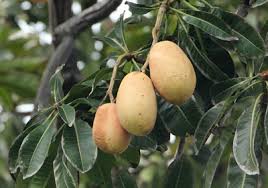
The inside of a binjai mango. From Public Domain

Isa Kamari has written 12 novels, 3 collections of poetry, a collection of short stories, a book of essays on Singapore Malay poetry, a collection of theatre scripts and lyrics of 3 music albums, all in Malay. His novels have been translated into English, Turkish, Urdu, Arabic, Indonesian, Jawi, Russian, French, Spanish, Korean, Azerbaijan and Mandarin. Several of his essays and selected poems have been translated into English. Isa was conferred the S.E.A Write Award from Thailand (2006), the Singapore Cultural Medallion (2007), the Anugerah Tun Seri Lanang (2009) from the Singapore Malay Language Council, and the Mastera Literary Award (2018) from Brunei Darussalam.

He obtained a BArch (Hons) from the National University of Singapore in 1989, an MPhil (Malay Letters) from Universiti Kebangsaan Malaysia in 2008 and is currently pursuing a PhD programme at the Academy of Islamic Studies, Univeristi Malaya. His area of research is on the problem of alienation and the practice of firasat (spiritual intuition) in selected Singapore Malay novels.

The Lost Mantras is a collection that blends spirituality, Malay cultural heritage, and universal human experience. First published as part of Menyap Cinta (Love Greetings, 2022, Nuha Books KL), these poems are like a bridge between mysticism and everyday life, where traditional images (betel, jasmine, kris[1], oil lamps, setanjak[2]) are woven with Qur’anic echoes, prayers, and existential questioning. The collection carries a Sufi resonance—always circling back to longing, humility, surrender, and beauty as signs of God. The poems are not only lyrical but also function as cultural memory: they preserve Malay traditions, communal practices, and village life, while situating them in a cosmic framework of faith, sin, and redemption. The use of Malay customs, rituals, and objects is powerful: it asserts that spirituality is not abstract but embedded in heritage. This makes the collection uniquely Southeast Asian despite its universal in appeal.

[1]A dagger

[2] Malay headgear

PLEASE NOTE: ARTICLES CAN ONLY BE REPRODUCED IN OTHER SITES WITH DUE ACKNOWLEDGEMENT TO BORDERLESS JOURNAL

Click here to access the Borderless anthology, Monalisa No Longer Smiles

Click here to access Monalisa No Longer Smiles on Kindle Amazon International

Categories
The Lost Mantras

More Poems by Isa Kamari

Poetry and translation from Malay by Isa Kamari

DAWN

Hey, the morning breaks!
Hey, the faithful sun!
Hey, the disappearing dew!
Hey, the layered air!
The breath desires,
the soul asks:
Who do you greet?
Have you pondered, sons of Adam?
Death awaits, life prolongs.
Have you realised, progenies of Eve?
The earth is impregnated and layered by purpose.
The one that you welcome is the morning,
The one that you coax is the sun,
The one that you touch gently is the dew,
The one that you breathe is the air.
The gift of death,
life fulfilled,
accompanies the inevitable:
morning, sun, dew, and air.
A breath dissipates, a soul obliterates.
Nothingness. Gone.
Hey!

THE FIELD

The green grass is a mother’s heart,
the velvet of love for her children.
Although stepped upon by mischief and transgression,
she distils dews of hope
that her children would grow with the sun.
The earth is the preparation of a father:
soil and compost for his children
where character would be rooted.
Barren or fertile,
he digs into his responsibility and self-worth,
as long as the rain nourishes his age.
Grass flowers are the children
who only know the joy of the wind
for as long as their dreams
have not landed on earth
and kissed the grass.

MOLTEN EARTH

This moment,
we’re walking in the rain,
accompanied by a bluish rainbow
and red birds with purple blood.
If they’re heading towards the dais,
we have yet to embrace the longing.
When the moon is in tears,
it’s just ill-suited for us to sail
on the orange henna sea.
In truth,
we verily love the eagle
that flies in the desolate morning.
If not for ravens like you,
our forest would be infested with rabbits.
Give us white wings;
we want to fly with blue birds
that return to reciprocate love.
We want to taste milk.
Is it for us only urine,
the manifestation of love by dogs?
Sound your prayer call in our shacks
so that our tears
are not just to bear
the pain and bitterness
of a plate of rice.
If your pensiveness is just to reminisce
the sufferings of night longing for day,
our tears have flowed
from the earth’s molten belly,
which are stepped upon
by saints like you and them
who have cast curses
upon us wretched souls.

POTPOURRI

The screw pine thrives on damp soil,
next to the swampy pond.
It spreads its green in the wild;
roots clench the earth we tread upon.
The jasmine grows on the lawn,
marks the boundaries of property.
Sturdy branches, leaves flourish;
petals open, greet the clouds.
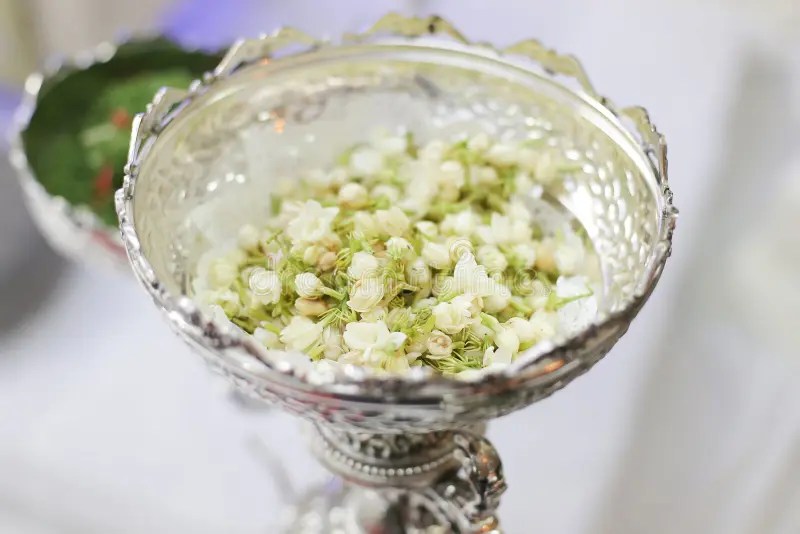
The sliced screw pine in a receptacle,
the jasmine blossoms spread on the tray,
perfume sprinkled to enhance the scent:
the potpourri of bunga rampai welcomes guests.
The ceremony officiated by the qadi,
the couple duly married,
customs and culture celebrated in fragrance,
religious laws honoured on the dais.
The shaving of the baby’s head,
first steps on the soil,
the coffin carried to the grave—
the potpourri of bunga rampai
adorns every domain,
binding firmly entire life’s moments.

Isa Kamari has written 12 novels, 3 collections of poetry, a collection of short stories, a book of essays on Singapore Malay poetry, a collection of theatre scripts and lyrics of 3 music albums, all in Malay. His novels have been translated into English, Turkish, Urdu, Arabic, Indonesian, Jawi, Russian, French, Spanish, Korean, Azerbaijan and Mandarin. Several of his essays and selected poems have been translated into English. Isa was conferred the S.E.A Write Award from Thailand (2006), the Singapore Cultural Medallion (2007), the Anugerah Tun Seri Lanang (2009) from the Singapore Malay Language Council, and the Mastera Literary Award (2018) from Brunei Darussalam.

He obtained a BArch (Hons) from the National University of Singapore in 1989, an MPhil (Malay Letters) from Universiti Kebangsaan Malaysia in 2008 and is currently pursuing a PhD programme at the Academy of Islamic Studies, Univeristi Malaya. His area of research is on the problem of alienation and the practice of firasat (spiritual intuition) in selected Singapore Malay novels.

The Lost Mantras is a collection that blends spirituality, Malay cultural heritage, and universal human experience. First published as part of Menyap Cinta (Love Greetings, 2022, Nuha Books KL), these poems are like a bridge between mysticism and everyday life, where traditional images (betel, jasmine, kris[1], oil lamps, setanjak[2]) are woven with Qur’anic echoes, prayers, and existential questioning. The collection carries a Sufi resonance—always circling back to longing, humility, surrender, and beauty as signs of God. The poems are not only lyrical but also function as cultural memory: they preserve Malay traditions, communal practices, and village life, while situating them in a cosmic framework of faith, sin, and redemption. The use of Malay customs, rituals, and objects is powerful: it asserts that spirituality is not abstract but embedded in heritage. This makes the collection uniquely Southeast Asian despite its universal in appeal.

[1]A dagger

[2] Malay headgear

PLEASE NOTE: ARTICLES CAN ONLY BE REPRODUCED IN OTHER SITES WITH DUE ACKNOWLEDGEMENT TO BORDERLESS JOURNAL

Click here to access the Borderless anthology, Monalisa No Longer Smiles

Click here to access Monalisa No Longer Smiles on Kindle Amazon International

Categories
The Lost Mantras

Poems by Isa Kamari

Poetry and translation from Malay by Isa Kamari

THE KING

I bow to you, King.
I bear the torment of your sadness
in the embrace of my sleep.
May it transform into glad tidings
for the days of your people.
This exploration is to find your throne,
which has disappeared from our hearts.
For my love to you, King.

JASMINES

Earth jasmines, sky jasmines,
a string of jasmines encircles the heart,
jasmines poured with water from the hills,
jasmines sprinkled by a pinch of compost.
Seven rivers, seven clouds—
rain pelts onto forlorn petals.
Beauty is in the form,
beauty to the eyes,
beauty is the hand that tends to the soil,
beauty is the fingers that caress the leaves,
beauty is the cut on the arms of the gardener.
The scorching sun,
the shade from the foliage,
bountiful is the soul of the tree that delivers,
witness to a life devoted to hard work,
with the laws of nature as the axis.
Strong roots clench the earth,
shoots look up high to the sky.
Stand firmly, the soul sings.
Blossoms waft fragrant dreams.
Earth jasmines, sky jasmines,
bloom in the early morning.
Say your prayers,
introduce yourself.

BETEL LEAVES

To be at the top
is to function at the bottom,
upholding responsibilities and trust,
strengthening shared roots.
The fragile branches are free to stretch,
the green leaves spread wide.
Wild betel, untouched betel,
covers the soil, climbs the trellis.
To be at the peak
in essence is to grow shoots,
carrying fertile hopes and dreams,
giving way and space to grow,
to climb each posting energetically,
to qualify for the position when seasons change.
Lofty betels, heavenly betels,
reach for the stars, greet the clouds.
To be in the ceremonial receptacle
in essence is to uphold tradition,
surrendering to the preservation of culture.
Typically chewed with lime, slicing problems,
mature-red in speech,
tracing the lives of roots and shoots.
Wild betel, untouched betel, lofty betel,
heavenly betel, courtship betel, customary betel,
weaving values and the essence of leadership
entrenched in tradition.

HOME

Free souls wouldn’t be easily bored
by mentoring and demands,
for it’s the stable self
that gives rise to liberation.
And that’s called freedom —
it isn't about release without aims,
just like city folks,
released from home or work,
wander aimlessly at shopping malls,
seek excitement from novelty and transience.
It isn't that Life doesn’t require variety,
or it isn't that the soul doesn’t long for fun.
It’s just that we who claim to be free
are easily entrapped in useless pettiness
that we spread in the city
without ever realising
that we haven’t returned to the doors of our hearts,
although we’ve stepped afoot
onto the compound of the house.

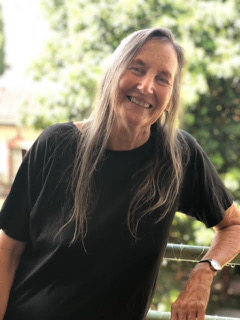
Isa Kamari : A foremost Malay writer from Singapore: Photo provided by the poet.

Isa Kamari has written 12 novels, 3 collections of poetry, a collection of short stories, a book of essays on Singapore Malay poetry, a collection of theatre scripts and lyrics of 3 music albums, all in Malay. His novels have been translated into English, Turkish, Urdu, Arabic, Indonesian, Jawi, Russian, French, Spanish, Korean, Azerbaijan and Mandarin. Several of his essays and selected poems have been translated into English. Isa was conferred the S.E.A Write Award from Thailand (2006), the Singapore Cultural Medallion (2007), the Anugerah Tun Seri Lanang (2009) from the Singapore Malay Language Council, and the Mastera Literary Award (2018) from Brunei Darussalam.

He obtained a BArch (Hons) from the National University of Singapore in 1989, an MPhil (Malay Letters) from Universiti Kebangsaan Malaysia in 2008 and is currently pursuing a PhD programme at the Academy of Islamic Studies, Univeristi Malaya. His area of research is on the problem of alienation and the practice of firasat (spiritual intuition) in selected Singapore Malay novels.

The Lost Mantras is a collection that blends spirituality, Malay cultural heritage, and universal human experience. First published as part of Menyap Cinta (Love Greetings, 2022, Nuha Books KL), these poems are like a bridge between mysticism and everyday life, where traditional images (betel, jasmine, kris[1], oil lamps, setanjak[2]) are woven with Qur’anic echoes, prayers, and existential questioning. The collection carries a Sufi resonance—always circling back to longing, humility, surrender, and beauty as signs of God. The poems are not only lyrical but also function as cultural memory: they preserve Malay traditions, communal practices, and village life, while situating them in a cosmic framework of faith, sin, and redemption. The use of Malay customs, rituals, and objects is powerful: it asserts that spirituality is not abstract but embedded in heritage. This makes the collection uniquely Southeast Asian while still universal in appeal

[1] A dagger

[2] Malay headgear

PLEASE NOTE: ARTICLES CAN ONLY BE REPRODUCED IN OTHER SITES WITH DUE ACKNOWLEDGEMENT TO BORDERLESS JOURNAL

Click here to access the Borderless anthology, Monalisa No Longer Smiles

Click here to access Monalisa No Longer Smiles on Kindle Amazon International

Categories
Musings

What’s in a Name?

By Jun A. Alindogan… also known as Manuel A, Alindogan

Lines from Romeo and Juliet by William Shakespeare(1564-1616) From Public Domain

When I was in kindergarten, the only name I knew was Jun. So when my teacher called me by my full name, I didn’t respond at all.

Obviously, I was named after my father and am the second child in a brood of four. Many acquaintances actually mistake my name for Emmanuel. I don’t know why my grandparents named my father Manuel, but it might be attributed to common influences in the community, not necessarily based on a desired dream or a definite meaning. My grandfather was from Fujian, China, as were many other Chinese migrants to the Philippines. It is presently common for Filipino Chinese to have Filipino surnames, which could be traced back to the Spanish regime in the Philippines when conversion to Catholicism entailed getting a godparent to sponsor one’s last name.

Although my surname has its Tagalog root, which means alluring or captivating, my facial features are predominantly Chinese despite being just a quarter Chinese. According to my mom, I got my habit of heavy toothbrushing from my father. My dentist told me that I inherited my yellowish and strong teeth from my dad. According to stories, my grandmother, Isadora, was from Tondo, Manila, who I presume, had some Chinese roots too as her maiden name was Gubangco.

While teaching at a special speech school in Manila, I met a student from Capiz province whom I got to know better through some conversations on a bus heading to a southern suburb. She asked me about my middle name, which is Arnaldo, and mentioned that my roots might have a tendril from her province. She also noted that in addition to Roxas City, there is an Arnaldo City in the province. Similarly, there is a highway named Arnaldo in General Trias, Cavite province. However, our Arnaldo clan is from Bulacan province, so I am not sure if we have relatives who migrated to Capiz or if it is the other way around.

It is interesting to note that my grandfather had only one sibling. They shared two last names, which were Arnaldo Cruz. These names were not to be mistaken for middle and last names, as is the legal order of our names. From some information I received from my cousins, I discovered that my grandfather decided to only have one last name, so he adopted Arnaldo, while his brother took on Cruz. In Spanish, arnaldo means powerful as an eagle.

Our Arnaldo clan is large, as my mother had twelve siblings, with one dying shortly after birth. All of my uncles’ first names ended with the letter O, while two of my aunts shared the same last letter, A, in their first names as my mom. I do not have information about my grandfather’s brother and whether he had a large family as well. However, I do know that my mom and her siblings were close to their first cousins, who mostly lived in a village in Tondo, Manila.

One of their cousins worked in theatre, sharing the last name Arnaldo, for many years until his passing. My second cousin, whose maiden name is also Arnaldo, is a seasoned actress for television and movies. Another nephew who shares the same last name, Arnaldo, owns a boutique in Makati and is a fashion designer. His father was a village captain (Barangay Chairman) in Tondo. I am a freelance writer with a creative non-fiction portfolio. I do not know if talent is innate, but I believe it is a gift that needs to be consistently nourished and shared. Each family has its own unique talent, origin, and destination.

A former movie actress, who used to be known by her maiden name Arnaldo, has now become a nun and has turned her back on films. However, we are not related. She was also an environmentalist. Perhaps we are all connected in some way, but as time and tradition fade away, we cannot definitively identify these physiological and social elements.

When I moved to a residence uphill a few decades ago, the municipal mayor’s last name was Cuerpo. Residents claimed he was originally from Nueva Ecija, the province next to Bulacan. Recently, I discovered that two last names were common during our grandparents’ time. I learned about this during annual visits to our family tomb in Obando, my hometown. My grandmother had a brother whom we fondly called Lolo (grandfather) and was a good painter. I remember a porch at their house with a concrete wall painted with fish, shells, and other marine life. His name was Eliseo, but we knew him by his nickname Sayong. On our family tomb, his death marker shows his full name as Eliseo Cuerpo Cruz Enriquez. Does this mean that we are remotely related to the previous town mayor of my current residence? Her daughter recently started a political career and won as the number one councilor in our just-concluded national and local government elections. It would be great to have a conversation with her about her family origins. Cuerpo means body in Spanish.

In my first teaching job at a high school in my province in the late 80s, I had the opportunity, along with my colleagues, to visit the ancestral house of the then-municipal mayor, former mayor Tito Enriquez of Bulakan, Bulacan, on his birthday. His house reminded me of the Alindogan ancestral house, also known as Bahay na Bato (stone house), where the ground floor was used for firewood storage, free-range chicken, and other household items. I suspect that we may be related, as my grandmother was also from Bulacan, but from a different municipality, Baliwag. I recall attending a large family reunion of the Arnaldo-Enriquez clan in the same town during my childhood, which rarely occurs now since all of my mom’s siblings have passed away. In my first year of teaching, I was too timid to inquire or discuss my ancestry with the mayor. “Enriquez” means “son of Enrique” in Spanish. According to history, the Enriquez family of Bulakan, Bulacan, were prominent heroes in the Battle of San Rafael[1].

Not everyone has the opportunity to observe, identify, and understand family connections from the past and present, but it is always a good idea to remember where we come from. This can perhaps help us navigate our present and future destinations more clearly.

[1] Fought between the Spanish and the Filipinos in 1896

.

Manuel A. Alindogan, Jr. or Jun A. Alindogan is the Academic Director of the Expanded Alternative Learning Program of Empowered East, a Rizal-province based NGO in the Philippines and is also the founder of Speechsmart Online that specializes in English test preparation courses. He is a freelance writer and a member of the Freelance Writers’ Guild of the Philippines (FWGP).

.

PLEASE NOTE: ARTICLES CAN ONLY BE REPRODUCED IN OTHER SITES WITH DUE ACKNOWLEDGEMENT TO BORDERLESS JOURNAL

Click here to access the Borderless anthology, Monalisa No Longer Smiles

Click here to access Monalisa No Longer Smiles on Kindle Amazon International

Categories
Poetry

Eco Poetry by Adriana Rocha

Adriana Rocha
LORD OF THE FOREST

Lord of the forest,
Home of birds,
Host of leaves,
Strong soldier,
Elder and wiser,
You have lived centuries.
And still noble,
Strong roots,
Gentle arms
That even naked,
In the coldest winters
Remain beautiful;
Air producer,
Silent life,
Please remain strong,
Because I want to use
My words
To celebrate you for
A thousand years more.

OCEAN

The blue of ocean
Comes in many tones,
The blue that is captured
By artists and painters
Is different from the blue
Where millions of creatures
Live. It is changing
And we are killing it,
But we can stop.
We can make it happen,
By reducing our trash
And use less devices,
Saving energy and plastic

Adriana Rocha was born in Bolivia. She is a psychologist who has been writing for five years and has been published in three languages: English, Spanish and Portuguese. She believes in the healing power of art, and she has found in it, both a way of expression and reflection.

.

PLEASE NOTE: ARTICLES CAN ONLY BE REPRODUCED IN OTHER SITES WITH DUE ACKNOWLEDGEMENT TO BORDERLESS JOURNAL

Click here to access the Borderless anthology, Monalisa No Longer Smiles

Click here to access Monalisa No Longer Smiles on Kindle Amazon International

Categories
Stories

Hotel du Commerce

By Paul Mirabile

Paris 1970s. From Public Domain

In 1974, the modest, starless Hotel du Commerce, at 14, Rue[1] Sainte Geneviève, in Paris became my home for over six months, and its owner, Madame Marie, my adopted mother.

A young, aspiring journalist, I was sent to Paris by the editor of a worthless monthly magazine in Palermo, Sicily, to write an article on the monuments of Paris. I took up my long residence at the Hotel du Commerce for two reasons: it was very cheap — that is, ten francs a day — and conveniently located in the centre of the city, only a ten minute walk to the Notre-Dame Cathedral. Madame Marie, ninety kilos of joy and laughter, rented me a room on the fifth floor (without a lift) with two other residents: Caban across from me and Paco at the end of the corridor. The rooms had neither attached toilets – there was one for each floor — nor showers (none). Like all residents and tourists, we washed from the washbasin in our rooms. My little window looked out on to the red-tiled rooftop of a Russian bookshop.

To tell the truth I never wrote that article on the monuments of Paris. What a boring subject! On the other hand, my stay at Madame Marie’s hotel afforded me enough material to write a book — a sketch of her and her residents, their trades, joys and sorrows … their  uncelebrated destinies. My editor would have probably sacked me for this ‘breach of contract’, but as luck would have it, his magazine went out of business before my return to Palermo.

I shall never know why Madame Marie took such a liking to me. Everyday, she would invite me for coffee and a chat. We would even watch television in the evenings in her sitting-room which separated the tiny kitchen from the reception. From there she kept an alert eye on the comings and goings of everyone. She was a jolly old woman, and this, despite the loss of her husband at an early age, and the terrible events that occurred in her hotel during the Algerian war in the fifties and sixties[2]. She was indeed fat, but quick-witted with plenty of pluck. She had rolls of flesh rumbling under her eye-catching flower-dotted red robe.

“You know, I was a young girl during the Second World War. I hid some French Resistance fighters in my parents’ house in the Alps. The Germans who hunted down the French fighters couldn’t scare me with their rifles and threats. I sent them packing whenever they pounded at our door!” she would repeat proudly when I was alone with her. When her husband died, she was left on her own to manage the hotel, and in the 50’s that was no asset. Deserters, police informers, merciless OAS members[3] and their equally ruthless adversaries, the FNL[4]  all came and went causing rows, arrests, even murders. The plucky Madame Marie handled it all with her sang-froid and flair for compromise.

“My sixth-sense got me through that lot,” she would laugh, her jowls shaking. By the 1970’s, however, things had calmed down in Paris. The lodgers were mostly Japanese and American tourists with a sprinkling of North Europeans. No more brawls, police raids or murders. Madame Marie spoke no foreign language but she understood everything that she needed to understand. She had hired an old woman to clean the rooms. The sprightly widow had learned how to say in English, after having knocked on the lodger’s door at eight in the morning: “You stay or you go?” It was enough to get her point across.

Madame Marie disliked the police. She flared at their scent even before they stepped through the front door in incognito on the trail of someone except on one occasion. I shall let her narrate that exceptional episode: “How that flic[5] fooled me I’ll never forget. Dressed like a hippy, long hair, a torn knapsack, he took a room in the courtyard. He spent two weeks here and never said a word. He got in no later than eight o’clock at night. I thought he played the guitar on the metro[6] for money. Then one day, dozens of police stormed through the front door into the courtyard. I was in the sitting-room and rushed out the back door of the kitchen to see what all the hullabaloo was about. The door of one of my clients was wide open, a young bloke who used to play the guitar on the metro; he had been handcuffed by the ‘hippy’ and was being walked out. I couldn’t believe it. It was like a film. When everything settled down, a police officer came over to me and politely explained that my lodger was a notorious drug-dealer and had been under surveillance for weeks by the ‘hippy’. He apologised for the inconvenience and paid the rent for both the dealer (who hadn’t paid me) and the hippy-policeman.” Madame Marie sighed. “He’s the only flic who ever fooled me.” And she laughed her usual jolly laugh.

She got up to make some more coffee for at that moment Caban and Bebert came in for a chat, both a bit tipsy from their usual drinking bouts before, during and after work. Then Bebette made her appearance, the prostitute to whom Madame Marie ‘lent’ one of the courtyard rooms every now and then to exercise her profession. Madame Marie had no moral qualms about such professions. Everyone had to earn a living … Close behind sailed in an elderly woman whose name I no longer recall. Madame Marie considered the woman to be her best friend. She would sit in front of the television and shout insults at the politicians whom she disliked, much to the displeasure of the others, especially Bebert, who would shower her with mocking abuse. When things got too rowdy Madame Marie would shout them all down or threaten to turn them out if they didn’t settle down.

Madame Marie was at times brusque but fair. She liked Caban, the former butcher and now factory worker hailing from southern France, shy and lonely, drunk by mid-morning. He had been living in Hotel du Commerce since the late sixties. She was fond too, of Bebert, the chimney-sweep, a small, taciturn, melancholic chap straight out of Dicken’s David Copperfield, drunk before ten in the morning. He constantly coughed. His clothes were impregnated with soot and cigarette smoke. Bebert hardly spoke at the table, smoking like a chimney, drinking his coffee whilst Caban smiled and winced at the others’ ridiculous jokes and jibes. Day after day and night after night that sitting-room typified for me – and for the others, I suppose — a sanctuary of friendship and convivial exchange. Oftentimes, I read myself into a page of Balzac’s novel Le Père Goriot [7].

The other two residents rarely joined at that cheery table. One of them, Bolot, stayed in a room in the courtyard. He was a former German soldier who joined the French Foreign Legion after his capture during World War II. The other was called Paco, a Republican Spaniard, who escaped Franco’s persecutions after the Spanish Civil War[8].

I got to know them all, save Bebert. We had no time to get really acquainted. “Poor Bebert,” Madame Marie would sigh. One evening as we sat watching a film Bebert knocked at her kitchen door, then staggered in towards us, blood streaming from his mouth, drenching his night-shirt. His face was ghost white. He kept murmuring, “Madame Marie … Madame Marie,” through clenched, blood-filled teeth. The chimney-sweep appeared lost in a daze. Madame Marie quickly took him by the shoulders, laid him on the sofa then trotted off to get the police. They arrived quickly (the station was two doors away). An ambulance shortly followed. Bebert was placed carefully on a stretcher and carried out.

We never saw Bebert again nor had any news of him. Madame Marie presumed that he had died of a haemorrhage from too much smoking, drinking and chimney soot. She had his room cleaned and fumigated. His belongings amounted to a pair of torn slippers, two shirts and trousers and two used razor blades. On the other hand, she gasped at the hundreds of empty packs of cigarettes. Bebert’s world had been compressed into a nebulous routine of cigarette and alcohol fumes and chimney soot. A bleak, Dickensian world to say the least.

Poor Bebert. He had been living at Hotel du Commerce for eleven years. A fellow without a family, friends … known to no one. He practiced a trade that was gradually dying out. No one ever asked for him at the reception — never a phone call. He was the unknown toiler whose burial stone carries no name because he had no money for a headstone. He was probably buried in the fosse commune[9].

Caban, whom I knew much better than Bebert, fared no better. His salary flowed away upon the torrent of fumes of cigarettes and drink, or as Madame Marie put it coarsely: “He pissed it all against a wall!” Too much gambling, too. So his wife left him, after that, his sixteen-year-old daughter. They were never to be heard from again. Caban was soft-spoken, very shy. Quite frankly, I never saw Caban sober, except at six in the morning before catching the bus to work at the wine-bottling factory. He had asked the foreman, Mister Tomas, to have me hired on for the summer since many of the workers had gone off on holiday. In the café whilst waiting for the morning bus, he began his inglorious day with coffee and a few shots of cognac. He continued his indulging all through the working day on the first floor of the factory where he drank the last dregs of wine from the bottles that were to be washed. By five o’clock he was completely sloshed! Mister Tomas kept him on out of pity. Besides, Caban was inoffensive. Madame Marie even told me he had saved a girl from drowning in the Seine River in Paris. But let Madame Marie tell this very true tale: “He was walking along the banks of the Seine after work when he heard the screams and splashings below him. Caban was a strong swimmer at that time, so he took off his shoes, dived in and grabbed the girl in the water. In a few minutes he had brought her back to the banks safe and sound where a crowd of people had gathered, applauding him. The young girl cried and cried but was unhurt. And you know, her father was the owner of the France-Soir daily newspaper. So, to thank Caban, he gave him a certain sum of money and offered him the France-Soir freeeveryday for the rest of his life. All he had to do was give his name at the news-stands.”

“Does Caban read the France-Soir? I never see him reading a newspaper,” I asked naively.

She laughed. “No, Caban never reads. He never had much instruction.”

I became quite friendly with Caban since we worked together at the factory, although he would constantly upbraid me for not joining him in his ritualised morning concoction. I insisted that I never drink. He would snicker and shrug his bony shoulders. “All men drink!” he slurred. That of course was a subject of conjecture which, and this goes without saying, I never pursued with him.

One day whilst I translated for Madame Marie at the reception, I mentioned that I hadn’t seen Caban for more than a week. Neither had she. Mister Tomas had telephoned, too. Caban never missed a day at work … never. She told me to go upstairs and knock at his door. Which I did for several minutes. Silence. When I returned without news of him she immediately dawdled out to the police station. She was back in no time with two policemen. I accompanied them upstairs. They pounded at the door then kicked it open. There knelt Caban over his bed, his face black as coal. The stench in his room made us gag. I hurried down to tell Madame Marie. And as we stood in the reception, the ambulance arrived and four men, escorted by the police, placed Caban’s frail, limp body into a plastic bag and dragged it down the steps, one by one : thump … thump … thump …  Madame Marie started to cry. I covered my ears …

Poor Caban had been dead for over a week, due no doubt to a blood clot of the brain. Madame Marie never forgot those thumps on the flight of stairs. Nothing was said of his death in the newspapers, even in the tabloids. Like Bebert, he succumbed to a companionless death, without flowers or prayers. Without sorrow or tears … He too was probably buried in a fosse commune. He had no bank account. The police found six Francs in his pocket … Six more than in Bebert’s …

Paco, the Spanish refugee, had been living in Hotel du Commerce for seven years. His lack of good French isolated him from the Paris scene, so he took refuge in the clusters of Hispanic scenes that peppered the Parisian streets, especially the taverns where flamenco music could be heard on Rue Moufftard, only a fifteen-minute walk from our hotel.

Since I speak Spanish quite well, I had on many occasions accompanied Paco to these musical haunts of his, where the paella was copious, the sangria flowed like water, the music, if not excellent, loud enough to forget one’s trials and tribulations of the day. Above all, it was cheap …

Paco drank heavily, rum and coke or sangria, but never behaved uncivilly. His deep, black eyes bore into mine whenever he spoke of his luckless past: “My older brother was killed in the war against Franco. I escaped via the Pyrenees leaving behind my parents. Since 1940, I’ve been living in France, working in factories or in the fields. And you know, I still don’t have my French papers. I have no identity! I can’t go back to Spain because of Franco[10], so I must stay here unloading lorries at the Halle Market or washing dishes in grotty gargotes [11].” Paco clapped to the sound of tapping feet and to the rhythmic chords of a furious guitar. “Every now and then I repair the toilets at the hotel which are constantly clogged up.” He snapped his fingers, ordered tapas[12], spoke to his friends in the language of his parents.

The fiery Spaniard would introduce me to his Spanish artist friends, all of them sullen, sad figures whose love of Spain had evaporated into hazy fumes of sangria, nostalgia, gaudy flamenco music, tasteless tapas and brief love affairs. As to Paco, he appeared to be a loner, an ill-starred chap lost in a huge city of lost souls, of crowds so busy that their business took no heed of such a shadowy figure, fugitive and fleeting, drifting from tapas to tapas, sangria to sangria.

Paco hated Paris, but it proved the only place for a stateless refugee to avoid police roundups. For Paco, Hotel du Commerce symbolised a haven for marginals, the homeless and stateless. “Madame Marie is my guardian angel,” he would croak. “My very fat guardian angel” as he clapped and stamped to the riotous music. “The police will never find me … never!” he boasted raising his glass to Madame Marie’s health.

He was wrong. One hot September week, Paco couldn’t be found in the hotel. Madame Marie suspected foul play. Two days later the police arrived, informing her that a certain Paco Fuentes had been apprehended without papers. He had been extradited to his country of origin. His belongings? He had none, like Bebert and Caban. The little he did possess were thrown into a bag and out into a rubbish bin. Poor Paco — would he ever find his parents?

On my many jaunts through Spain, after Franco’s death, I tried to locate Paco Fuentes, but it was like finding a needle in a haystack as the expression goes. Here, however, I must thank the excellent Spaniard, for it was he who introduced me to the world of flamenco.

Bolot kept very much to himself. Unlike the other residents he never drank nor smoked. You didn’t want to muck about with Bolot — a massive fellow, indeed. But then again who would muck about with a former French Foreign Legion soldier?

Yet, Bolot’s aloofness and reserved demeanour attracted many people to him. He had that sort of winning smile, and since he spoke very good French, albeit with a heavy German accent, he befriended those who came into contact with him. Moreover, he shared a passion for stamp-collecting. That was Bolot’s raison d’être[13]! His collection had become very well known to both specialists and amateurs. I would accompany him to the Flea Market on Sundays and there he would trade stamps with the best of stamp-collectors. Stamps from the Soviet Union, China, India, Cuba, several African states, Turkey and Libya. Bolot didn’t need the money, his pension as a soldier was comfortable enough. He simply enjoyed the thrills.

One day as we strolled back to the metro as he towered above me, Bolot acknowledged his good luck: “I volunteered for the army at seventeen, an enthusiastic patriot. Was captured by the French after two days of combat and given a choice: prison or the Foreign Legion. I chose the second, changed my nationality and name.”

“What was your German name?” He smiled but left the question unanswered.

“So I fought for the French. A traitor to my homeland. Call me what you like, I couldn’t sit out the war in a prison for years and years. You know, I never went back to Germany. When I quit the Legion I received my pension and came straight to Paris, the City of Lights.”

“To do what?”

“To sell stamps!” Bolot laughed. “No, I worked as a mechanic in factories until retiring.”

I got to know Bolot as well as Caban since all three of us worked at the same wine-bottling factory in the summer of 1974. He left earlier than me because of a fight between him and an obnoxious individual who abhorred Germans, even though Bolot had acquired French nationality long ago. Bolot refused to fight him, despite the other’s punches, which the former Legionnaire dodged or blocked with considerable ease. If Bolot had really fought, he would have killed him. Mister Tomas broke up the squabble, sacked the young rowdy on the spot and apologised to Bolot. Bolot exercised the noble art of self-restraint.

When I left for grape-picking at the end of September, then on to Italy and Sicily, it was Bolot who helped me repair the broken spokes of my bicycle. Outside Hotel du Commerce, Madame Marie and Bolot wished me the best of luck, inviting me back whenever it suited me. There would always be a spare room for me she insisted. I cycled out of Paris in the direction of Burgundy. I had spent six months at Hotel du Commerce

After a month of grape-picking I returned to Palermo only to discover that the magazine had failed due to lack of interest … and funds. Relieved, I went to Madrid to begin a career as a flamenco guitarist. Time passed quickly. Or as Madame Marie would philosophically say: “It’s not time that passes but us!”  Exhausted from so much playing in studios and taverns, I decided to take a break and travel to France and visit Hotel du Commerce.

It was under new ownership. The manager, an Italian, informed me that Madame Marie had died years ago from dementia after a spell in a nursing home. How everything had changed: the reception room had been refurbished and Madame Marie’s Balzacian sitting-room had become a dining-room for guests. The once starless hotel had become a three-star hotel.

I stayed two nights and paid sixty euros a night! In the seventies, I paid the equivalent of one and a half euros! True, all the rooms had been painted in bright, cheery colours, fitted out with toilets and showers. But sixty euros? Besides, I like a hotel that is lived in, not just slept in …

With the death of Madame Marie, a whole era had come to a close. Hotel du Commerce had decidedly conformed to the standards of kitsch. There were no more residents, only tourists. All the single rooms on the fifth floor had become large rooms suitable for modern travelling couples. Gone were the days and nights round Madame Marie’s convivial table, her coffees and conversation. Those colourful figures who had imprinted their existence there, whose joys and sorrows had been shared by Madame Marie and myself, no longer painted those refurbished walls simply because the epoch ignored the very existence of such figures.

Indeed, who during those two nights reminisced the glittering epoch of Madame Marie’s Hotel du Commerce? Who even imagined her singular story and those of her likeable, touching residents? No one. No one, perhaps, except me, who vouched to safeguard those memories. Memories of the anonymous whose faces will never be seen on photos, nor names ever printed in books.

[1]        ‘Street’.

[2]        1954-1962.

[3]        ‘Secret Army Organisation’ founded in 1954 that fought against those forces who wished to prevent the independance of Algeria.

[4]        ‘The National Liberation Front’, also founded in 1954 whose militants fought for the independance of Algeria.

[5]        Jargon in French for ‘policeman.

[6]        ‘Underground’ or ‘subway’.

[7]        ‘Father Goriot’ written in 1834. Translated into English by Ellen Marriage.

[8]        1936-1939.

[9]        ‘Communal grave’.

[10]      General Francesco Franco died in 1975, and with his death, King Juan Carlos proclamed Spain a democratic nation.

[11]      French jargon for ‘cheap, unsavoury restaurants’.

[12]      Spanish appetisers.

[13] French: Reason for being

.

Paul Mirabile is a retired professor of philology now living in France. He has published mostly academic works centred on philology, history, pedagogy and religion. He has also published stories of his travels throughout Asia, where he spent thirty years.

.

PLEASE NOTE: ARTICLES CAN ONLY BE REPRODUCED IN OTHER SITES WITH DUE ACKNOWLEDGEMENT TO BORDERLESS JOURNAL

Click here to access the Borderless anthology, Monalisa No Longer Smiles

Click here to access Monalisa No Longer Smiles on Kindle Amazon International

Categories
Conversation

Rings on Her Fingers and Bells on Her Toes…

Ratnottama Sengupta in conversation with Sohini Roychowdhury, who uses dancing to build bridges across cultures

“Meet my daughter Sohini,” Uma Di was introducing the dancer who then lived in Madrid. And my first response was, “Why isn’t she in the movies?!”

Sohini Roy Chowdhury. Courtesy: Sohini Roy Chowdhury

Tall, fair, lissome, agile, Sohini Roychowdhury is the stuff beauty queens and show stoppers are made of. That wasn’t surprising: after all, Uma Roychowdhury herself is the picture of perfection in aesthetics.

It didn’t take me long to realise that, much like the well regarded sculptor’s bronzes, her daughter too was made of enduring stuff. One day she was teaching Bharatanatyam to French, Spanish, and Italian enthusiasts. The next day she was lecturing on mythology in New York. One day she was dancing to ‘Jai Ho![1]’ for the director of the Oscar winning Hollywood movie[2]. Another day she was delineating Durga in an Anthropology Museum…

None of these saw her run out of breath. Nor does she, ever, run out of time. When she’s not holding her fingers in a dance mudra, she is holding a metaphoric pen. This month she unveiled her second book, Dance of Goddess Kali. Yes, she has rings on her fingers and bells on her toes — and wherever she goes, there’s dance on the cards!

Here is what she had to say when I spoke to her:

The Dance of Kali follows Dancing with the Gods. How are the two books different?

Dancing With the Gods and The Dance of Kali are two distinct works, each focusing on different aspects of my artistic and spiritual journey. 

Dancing With the Gods is a pictorial, coffee-table book stemming from my journey as a classical Indian dancer with a multinational dance troupe. Its vivid visuals showcase my onstage performances and behind-the-scenes moments. These are highlights of my career as a dancer, both solo and with Sohinimoksha World Dance and Communications[3]

This visually captivating book focuses on imagery and aesthetics. It offers glimpses into my artistic expression through dance, celebrates my journey around the world, and highlights my life-mantra of connecting civilisations through my craft. This tracing of Sohinimoksha’s journey is for a broader audience: Indian dance enthusiasts, art lovers, and individuals interested in my achievements. The aim is to inspire through visually compelling storytelling.

In contrast, The Dance of Kali is a treatise on the ethos of Goddess Kali and Shaktism. It delves into the deeper spiritual and philosophical aspects associated with the goddess, exploring Kali’s symbolism, mythology, and significance within the context of Shaktism, a Hindu tradition of worshiping the divine feminine energy. The tone of this work is contemplative, as it delves into the profound symbolism and the spiritual aspects associated with the Goddess. It incorporates scholarly research, analysis, and interpretations from various perspectives. Hopefully it offers readers a deeper understanding of Kali’s significance in Hindu spirituality.

May I point out here that The Dance of Kali is not a religious book. It is for readers with a specific interest in Hindu mythology, spirituality, or the myths and legends around the resident Goddess of Kolkata. Those seeking a deeper understanding of Kali’s symbolism and philosophical underpinnings within the context of Shaktism, will find this book dispels disrespectful misrepresentations and unfounded Western misconceptions  surrounding the images of Kali as a demonic goddess. 

To sum up: both the books reflect different facets of my artistic and spiritual journey. However, they differ significantly in their subject matter, focus, tone, and intended audience. One celebrates my achievements as a dancer through captivating visuals. The other is an academic tome exploring the profound symbolism and spirituality associated with Goddess Kali.

What prompted you, an international dancer, to pick such a rooted in mythology subject?

I have always had a personal affinity with or inclination towards Goddess Kali. Many artistes draw inspiration from their own beliefs, experiences, and cultural backgrounds when choosing subjects for their work. I am no different. For me the depiction of the Goddess is an opportunity for artistic exploration. Kali, with her complex symbolism and multifaceted persona, offers rich material for creative interpretation through the arts, be it dance, literature or visual arts. 

This book also celebrates India’s rich mythological heritage and the way it connects to other ancient cultures, in Mesopotamia, Egypt, Spain and France. Kali, with her global soul sisters Ishtar or Sara La Kali, holds significant cultural and religious importance, not just in Hinduism, but other cultures as well, particularly within the contexts of worshipping Mother Goddesses. I delve into Kali’s mythology and symbolism to honour this aspect of Indian life, and its universal resonance. 

Yes, Goddess Kali is rooted in Indian mythology. But the themes she embodies — feminine power, transformation, and liberation —transcend cultural boundaries. I hope this book will serve to explore universal themes of empowerment and spirituality. It also aims to provide a deeper understanding of Hindu mythology, and the symbolism associated with the Dark Goddess. Effectively I seek to promote intercultural dialogue and foster greater appreciation for diverse religious traditions. Most significantly, I hope to dispel the uneducated interpretations of Kali as a horrific, savage, demonic goddess. How often she is typecast as a symbol of evil — in popular Western films, books and even as Halloween costumes for disrespectful celebrities like Heidi Klum

I have witnessed your performance as Durga in an anthropology museum in Madrid. I have noted your commitment to meaningful, even profound themes in your endeavours. What has been your grooming in dance?

I started dancing at a young age under  renowned Bharatanatyam Guru, Thankamany Kutty. Later I learnt from Kalamandalam Venkitt in Kolkata. I received rigorous training in Bharatanatyam, the dance  that originated in the temples of Tamil Nadu. My dedication to classical art led me to delve deep into its nuances. I mastered intricate footwork, expressions, and storytelling techniques. Over the years, I refined my technique and expression through consistent practice and performance and came to embody the essence of Bharatanatyam.

Your father was a renowned sitarist living in Germany. Your mother is a reputed sculptor of Kolkata. Why did you, an only child, not take to any of these streams of creative expression?

Indeed I was born into a family of accomplished artists. My father, Pandit Subroto Roychowdhury was a renowned sitarist, and my mother, Uma Roychowdhury, is a reputed sculptor. But I chose a different path for myself. 

As an only child, I was exposed to various forms of creative expression. But my passion for dance was ignited after watching a riveting performance by Yamini Krishnamurthy when I was about four years old. While I deeply respect my family’s artistic legacy, I followed my own calling and embarked on a journey to carve my niche in the world of dance.

What are the values you have imbibed from them individually?

My father’s sitar schools in Germany have produced hundreds of students — including distinguished sitar players. From him I imbibed a profound appreciation for music and rhythm. I learned discipline, dedication, and the importance of perseverance in mastering an art form. From my sculptor mother I inherited a keen love for aesthetics and eye for details. I learned the importance of expressing emotions and stories through visual and performing arts. 

Together these values have steered me towards excellence and innovation in my journey as a dancer and communicator.

Mixed genre performance by Sohini Roychowdhury. Courtesy: Sohini Roy Chowdhury

You have lived in Moscow and Madrid. You are guest professor in far-flung Universities, in America and Columbia. You have danced Bharatanatyam and you have danced to Jai ho! at the premiere of Slumdog Millionaire. What have you gained through your international exposure?

My international exposure has enriched me both personally and professionally. Living in cultural environments as diverse as Moscow and Madrid have broadened my perspectives and deepened my understanding of global arts and communication. 

More than 2000 students have ‘graduated’ through my two dance schools in Spain — Casa Asia and Sohinimoksha Artes de la India. In Moscow, more than 80 Russian students performed with me on stage at the Embassy of India and Nehru Centre at the end of their course. As a guest professor in universities across Europe, USA and Latin America, teaching dance, Natyashastra [theory of dance] and Indology, I have not only shared my expertise — I have learnt from students, artistes and scholars from different backgrounds. 

Through my performances of Bharatanatyam, and collaborations with international artists, have bridged cultural divides. My dancing to Jai Ho! at the European premiere of Slumdog Millionaire showcased the universal appeal of Indian dance and music. It  highlighted its ability to connect with people across borders. Today I can confidently claim to have promoted cross-cultural exchange globally.

Coming from an aristocratic, old Calcutta background, what merit do you see in Bollywood dancing?

Despite coming from an aristocratic background rooted in old Calcutta, I recognise the merit in Bollywood dancing which has become a global phenomenon. Not surprising. For, characterised by vibrant energy, expressive movements, and fusion of multiple dance styles — from Salsa to Tango, Twist to ChaChaCha – Bollywood dancing holds mass appeal. It serves as a platform for artists to showcase their talents to diverse audiences and has contributed to the popularization of Indian culture worldwide. It is rooted in traditional Indian dance forms, yet embraces modern influences. And it reflects the evolving tastes of contemporary audiences. 

Since the 1960s, Bollywood has drawn inspiration from various musical traditions across the world. This imparted its films a rich tapestry of global influences. This fusion of world music and dance enriched the aesthetic of Bollywood — and in turn contributed to its cultural significance and global appeal.

In the 1960s, Indian cinema underwent a transformation with the emergence of filmmakers like Guru Dutt and Raj Kapoor, who infused their films with elements of Western music and dance. The most iconic example of this is seen in the song Mera joota hai Japani [my shoes are Japanese] from Shree 420 (1955): here Raj Kapoor’s character sings about wearing Japanese shoes, English pantaloons, and Russian caps — all of which symbolised the growing influence of the West in post-colonial India. And yet, as the song stresses, at core these films are Hindustani — Indian.

Throughout the ’60s, ’70s and ’80s, the industry witnessed the rise of dance and music directors who played a pivotal role in incorporating world music and dance forms into Hindi cinema. Composers like OP Nayyar, Shankar Jaikishan, SD Burman, C Ramachandran, Kalyanji Anandji, RD Burman, Laxmikant-Pyarelal, and Bappi Lahiri experimented with disparate musical styles. These ranged from rock-n-roll, rumba, flamenco to disco, reggae and jazz. This infused their compositions with international flavours. 

Similarly, choreographers Sohanlal,  PL Raj, Herman Benjamin, Suresh Bhatt, Saroj Khan, Chinni and Rekha Prakash, Shiamak Davar, Farah Khan, Remo D’Souza, Terence Lewis, Vaibhavi Merchant, and Prabhu Deva have blended Indian classical dance with Western styles. This has created the unique dance style that is now identified as Bollywood dancing. It has homogenised movements from hip-hop to salsa and contemporary dance.

Soon stars like Shammi Kapoor, Helen, Asha Parekh, Hema Malini, Rishi Kapoor, Mithun Chakraborty, Jeetendra, Govinda, Hrithik Roshan, Madhuri Dixit, and Sridevi became synonymous with Bollywood’s larger-than-life dance numbers. For, it showcased their versatility and flair for different dance steps. Embracing the twist and turn era of the ’60s to the disco craze of ’70s and the hip-hop-inspired moves of the 2000s, Bollywood stars captivated audiences with their energy and charisma.

Along with Western influences, Bollywood also drew from traditional Indian dances. Its choreography incorporated elements of Bharatanatyam, Kathak, and Odissi. Dance sequences like Dola Re Dola from Devdas (2002) and Pinga from Bajirao Mastani (2015) exemplify the fusion of classical and contemporary dances, blending intricate footwork with dynamic movements and expressions.

In recent years, Bollywood has continued to evolve, reflecting the changing tastes and preferences of global audiences. Directors, like Sanjay Leela Bhansali and Farah Khan, have pushed the boundaries of traditional filmmaking, creating visually stunning spectacles that showcase the diversity of world music and dance. Stars like Priyanka Chopra, Deepika Padukone, and Ranveer Singh have embraced this eclectic mix of styles, bringing their own unique interpretations to the screen.

Spanish, Bulgarian and other European dancers from my own troupe, Sohinimoksha World Dance, have performed specially choreographed fusion dance items set to popular Bollywood tracks. Kristina Veselinova danced to Mere Dholna from Bhool Bhulaiya; Violeta Perez and Lola Martin to Senorita! from Zindagi Na Milegi Dobara and Maria Sanz on Padmavat’s Ghoomer on stages across India and the world. So I readily acknowledge the significance of Bollywood dance in preserving India’s cultural heritage while adapting to changing times.

Would you say our films are taking our dance traditions to votaries abroad? Just as Indian musicians of the 1960s had taken our ragas to the West?

In the 1960s, Ravi Shankar, Ali Akbar Khan and other maestros played a crucial role in initiating the West in the rich notes of Indian classical music — and that had enriched the global cultural landscape. My own father, Pandit Subroto Roychowdhury, spent more than 40 years in Germany and other European countries, spreading and popularising Indian classical music through concerts and classes. Today Indian films, particularly Bollywood, are carrying forward this legacy. They are showcasing the wealth that is Indian dance — often fused with world dance influences. Just as our musicians shared the wealth of ragas with the West, Bollywood films are spreading the infectious exuberance of Indian dance to enthusiasts around the globe. This is fostering cultural exchange on an international scale. Small wonder that Bollywood is now acknowledged as India’s most potent soft power. 

What, in your opinion, is needed to make GenNext learn from our past traditions?

If we want GenNext to learn from our past traditions, we must provide them with comprehensive exposure to our rich cultural heritage. For this, we must integrate our arts and cultural practices into educational curricula. We must foster appreciation through interactive experiences — workshops, performances, cultural events. Additionally we must leverage modern technologies and platforms to disseminate information. Let’s make traditional arts more accessible and engaging for the young. Let’s cultivate mentorship programs and intergenerational exchanges. For, we must bridge the gap between past traditions and contemporary lifestyles, to ensure their relevance and continuity for the generations to come.

Sohini I have seen you at close quarters, as a mother, wife, daughter, and daughter-in-law even as you criss-cross the world for your dance. How do you still find time to write, which is such a demanding, reflective expression?

I am fortunate to be able to balance my roles as a mother, wife, daughter, daughter-in-law, and a performing artiste. My experience as much as my dedication to my craft honed my time-management skills. Despite crisscrossing the world for performances, lecture tours, and other professional commitments, I carve out time to write, for I recognise its significance as a reflective form of expression. 

To effectively manage my time, I set priorities, create schedules, and maximize productivity during the available windows of time. I designate specific periods for writing, be it early mornings, late evenings, or during travel downtime. I try to integrate writing into my daily routine, seizing moments of inspiration and reflection to jot down ideas or draft passages.

My passion for writing is a driving force — it motivates me to make time for it amidst my busy schedule. Writing provides a creative outlet for introspection, and intellectual exploration. It complements my artistic endeavours and enriches my personal and professional growth.

I am grateful for the support I receive from the network of my family, friends, and collaborators. They play a crucial role in facilitating my writing pursuits. My latest book, The Dance of Kali, was co-written with my son Rishi Dasgupta, an Economics MSc from the University of St Andrews, UK. 

However, at the end of the day, that I find time to write amidst my multifaceted life, reflects my passion for engaging in reflective expression. Because? It contributes to my holistic development as an artist and an individual.

[1] A song from the 2008 Bollywood movie, Slumdog Millionaire

[2] Danny Boyle

[3] A dance troop started by Sohini Roychowdhury with presence in Madrid, Berlin and Kolkata

.

Ratnottama Sengupta, formerly Arts Editor of The Times of India, teaches mass communication and film appreciation, curates film festivals and art exhibitions, and translates and write books. She has been a member of CBFC, served on the National Film Awards jury and has herself won a National Award. 

.

PLEASE NOTE: ARTICLES CAN ONLY BE REPRODUCED IN OTHER SITES WITH DUE ACKNOWLEDGEMENT TO BORDERLESS JOURNAL

Click here to access the Borderless anthology, Monalisa No Longer Smiles

Click here to access Monalisa No Longer Smiles on Amazon International

Categories
Poetry

Flowering in the Rain & More Poems

Poetry by Ahmad Al-Khatat

FLOWERING IN THE RAIN 

Are you going to bloom in the rain tonight?
I hear your footsteps in the darkness,
I smell your scent on the budding seeds,
and wonder whether you are among the stars.

This life can only be lived due to your existence.
I feel like I am losing myself more than usual.
After losing everything I cared about,
I considered migrating to a different country.

Regrets have shattered some of my aspirations,
and I miss giving my all to love someone like you.
Why does tonight’s rain sound so sad?
I've cried for ages, and you haven't flowered yet.

Thousands of breaths push me towards your sweet lips.
Allow our sorrows to touch the drenched grass in the park,
and follow the moonlight to
find me waiting with a rainbow umbrella…

TWO FINGERS CROSSED

I'm wondering if my depression stems
from my past or what I'll become in the future.
Is it because I speak your language with an accent?
I'm sorry, but my accent represents who I am.

I wish I could erase children's memories
of everyday genocide with a pencil and eraser.
My phone isn't charging. My cousin is wearing
my face mask. I lie dead in my blood-soaked bath.

Does the moonlight still brighten your melancholy heart?
What arouses your emotions?
Can you dream about kissing me the way you usually do?
Who wouldn't love a walk under the twinkling stars?

I miss the way you hold my frigid hands behind my back,
with at least two fingers crossed.
When I inhale your breath, I trust my senses completely.
Your amazing voice is the music that brings me joy.

PACK OF CIGARETTES AND LIQUOR

I'd swap my rusty flesh and chilly blood
for a pack of smokes and a drink.

I am willing to sacrifice my emotions and peace
for a pack of smokes and alcohol.

I'm willing to surrender my citizenship and foreign passport
for smokes and whisky.

I am willing to compromise my values and ethics
for a pack of smokes and alcohol.

I'd swap my wounded heart and warm hands
for a pack of smokes and a drink.

I'd swap my youthful smile and tears
for a pack of smokes and a drink.

I'm willing to exchange my healthy organs and memories
for smokes and whisky.

I'd exchange my imprecise accent and colourless fantasies
for a pack of smokes and a bottle of vodka.

I will never give up my past and hometown
for a coffin which I tried to steal before my sentence
by hanging with death.

Ahmad Al-Khatat was born in Baghdad, Iraq. His work has appeared in print and online journals globally. He has poems translated into several languages such as Farsi, Chinese, Spanish, Albanian, Romanian. He has published some poetry chapbooks, and a collection of short stories.

.

PLEASE NOTE: ARTICLES CAN ONLY BE REPRODUCED IN OTHER SITES WITH DUE ACKNOWLEDGEMENT TO BORDERLESS JOURNAL

Click here to access the Borderless anthology, Monalisa No Longer Smiles

Click here to access Monalisa No Longer Smiles on Amazon International